This is a repository copy of Motion fluency and object preference : Robust perceptual but fragile memory effects.
White Rose Research Online URL for this paper: http://eprints.whiterose.ac.uk/136874/
Version: Accepted Version
Article:
Flavell, Jonathan Charles, McKean, Bryony, Tipper, Steven Paul
orcid.org/0000-0002-7066-1117 et al. (3 more authors) (2019) Motion fluency and object preference : Robust perceptual but fragile memory effects. Journal of Experimental Psychology: Learning, Memory, and Cognition. pp. 1569-1582. ISSN 1939-1285 https://doi.org/10.1037/xlm0000667
[email protected] https://eprints.whiterose.ac.uk/
Reuse
Items deposited in White Rose Research Online are protected by copyright, with all rights reserved unless indicated otherwise. They may be downloaded and/or printed for private study, or other acts as permitted by national copyright laws. The publisher or other rights holders may allow further reproduction and re-use of the full text version. This is indicated by the licence information on the White Rose Research Online record for the item.
Takedown
If you consider content in White Rose Research Online to be in breach of UK law, please notify us by
1 TITLE
1
Motion fluency and object preference: Robust perceptual but fragile memory effects 2
3
RUNNING HEADER 4
Motion fluency and object preference 5
6
AUTHORS AND AFFLILIATIONS 7
Jonathan C. Flavell1, Bryony G. McKean1, Steven P. Tipper1, Alexander J. Kirkham1, Tim 8
Vestner1, Harriet Over1 9
1University of York, Department of Psychology 10
11
CORRESPONDING AUTHOR 12
Jonathan C. Flavell 13
[email protected], +44 (0) 1904323139 14
15
ACKNOWLEDGEMNETS 16
We would like to thank Delali A. Konu, Rebecca Lowndes, Francesca A. Patching, Emily A. 17
Pickett, Hannah E. Priday and Amy L. Robson for assistance with data collection. This 18
research was supported by a Leverhulme Trust grant (grant reference no. RPG-2016-19
2 21
KEY WORDS 22
Perceptual fluency; Affect; Preference; Learning; Memory 23
24
DATA AVAILABILITY 25
Data, assets, supplementary analysis and an additional experiment are available at 26
https://osf.io/pjwht. 27
3 ABSTRACT 29
In 8 experiments, we investigated motion fluency effects on object preference. In each 30
experiment, distinct objects were repeatedly seen moving either fluently (with a smooth 31
and predictable motion) or disfluently (with sudden and unpredictable direction 32
changes) in a task where participants were required to respond to occasional brief 33
changes in object appearance. Results show that 1) fluent objects are preferred over 34
disfluent objects when ratings follow a moving presentation, 2) there is some evidence 35
that object-motion associations can be learnt with repeated exposures, 3) sufficiently 36
potent motions can yield preference for fluent objects after a single viewing, and 4) learnt 37
associations do not transfer to situations where ratings follow a stationary presentation, 38
even after deep levels of encoding. Episodic accounts of memory retrieval predict that 39
emotional states experienced at encoding might be retrieved along with the stimulus 40
properties. Though object-motion associations were repeatedly paired, there was no 41
evidence for emotional reinstatement when objects were seen stationary. This indicates 42
that the retrieval process is a critical limiting factor when considering visuomotor fluency 43
effects on behaviour. Such findings have real-world consequences. For example, a 44
product advertised with high perceptual fluency might be preferred at the time, but this 45
preference might not transfer to seeing the object on a shelf. 46
4
INTRODUCTION 48
Perceptual processes extract information from the environment to facilitate action. Such 49
processes have evolved to be as efficient as possible, where within a short period of time 50
vision can identify targets and appropriate actions can begin to be evoked (e.g., Goodale 51
& Milner, 1992; Simon, 1969; Tipper, Paul, & Hayes, 2006; Tucker & Ellis, 1998). Such 52
highly efficient processes are necessary to enable organisms to survive in complex 53
environments. Not only has evolution selected the most efficient perception-action 54
systems, but fine tuning of the system continues through an organism s experiences. This 55
fine tuning, where the most efficient processes are selected, could be supported by 56
reinforcement, where positive affect is evoked when processing is more fluent (e.g., Reber 57
& Schwarz, 2006; Winkielman, Schwarz, Fazendeiro, & Reber, 2003; Yue, Vessel, & 58
Biederman, 2007). This is the principle behind the current work. 59
Evidence for the positive emotion associated with fluent perception and action has 60
been obtained in a number of studies. For example, Reber, Winkielman, and Schwarz, 61
(1998) showed that a number of perceptual properties that facilitated processing, such 62
as contrast, priming and time of presentation, were capable of changing how much an 63
individual liked an object. Similarly, symmetry has been shown to increases preference 64
by facilitating processing in a variety of studies (e.g., Flavell, Tipper, & Over, 2017; 65
Pecchinenda, Bertamini, Makin, & Ruta, 2014). In terms of action fluency, Cannon, Hayes, 66
and Tipper (2010) observed positive emotional embodied states during fluent action and 67
Hayes, Paul, Beuger, and Tipper (2008) demonstrated that merely observing another 68
person s fluent actions evoked increased liking of acted upon objects. Importantly, such 69
fluency effects can have real-world effects, as when more fluently named stocks increase 70
5
This current work extends previous studies of perception-action fluency and 72
engages with new issues. Previous work has shown that when assessing patterns of 73
movement, some forms of motion are preferred (e.g., Stevanov, Spehar, Ashida, & Kitaoka, 74
2012; Wright & Bertamini, 2015; Zeki & Stutters, 2012). However, to our knowledge 75
studies examining preference for objects identity (rather than objects motion) have only 76
examined properties of static object displays. Little published research has investigated 77
the effects of motion on object judgments in situations where the motion itself was 78
irrelevant and not declared to be judged (i.e. where participants were only instructed to 79
rate the object itself, rather than the motion property of the object). Motion, as a critical 80
property of the environment, could be manipulated as a technique for shifting preference. 81
Is it the case that the fluency and predictability of an objects motion influences an 82
observer s judgements of the object itself? 83
The second issue to be engaged is whether there is learning of the association 84
between an objects identity and its fluency of motion. In other words, does preference 85
for an object increase/decrease following repeated exposures to that object always 86
possessing fluent/disfluent motion? Such associative learning between an object and its 87
motion can be considered similar to evaluative conditioning (for a review see De Houwer, 88
Thomas, & Baeyens, 2001). That is, the neutral target property of identity can be 89
considered as a conditioned stimulus (CS) property, while the associated pattern of fluent 90
or disfluent movement can be considered as a positive or negative unconditioned 91
stimulus (±UC) property. 92
A further issue is whether any learning of the object-motion association 93
generalizes to other situations in which the object is not moving. That is, after repeated 94
6
associated objects when those objects are seen stationary with no cues to motion? 96
Whether or not perceptual fluency effects on preference are confined to objects with their 97
associated fluent/disfluent motion (as opposed to stationary objects) is an important 98
issue. For broader effects where manipulated preference for stimuli can have real-world 99
consequences, it will be necessary for fluency effects to be detected in different contexts. 100
For example, a particular consumer product might be preferred within an experiment 101
because it has greater movement fluency but can we demonstrate that this initial 102
preference transfers to situations where the product may be encountered without the 103
motion cue to fluency such as on a supermarket shelf? This generalization is clearly 104
important for preference effects to reach beyond the laboratory setting where they may 105
be initially demonstrated. 106
Therefore, in the presented experiments we aim to answer 3 questions. First, does 107
the motion fluency of an object influence liking of that object? Second, if fluency effects 108
exist, are object-motion associations learnt following repeated exposures or are they 109
immediately evident following a single presentation? Finally, if fluency effects exist, do 110
object-motion associations survive from moving to static presentations of object? 111
112
GENERAL METHODS 113
Elements common to each of our 8 experiments are described in General Methods. 114
Experiments 1 to 4 feature traversing objects and are described in Part I. Experiments 5 115
to 8 feature rotating objects and are described in Part II. Details of each experiment are 116
described in the relevant sections of each individual Method section. 117
7
Participants. All participants were recruited from the University of Yorks Department 119
of Psychology participant recruitment system. Participants received either course credit 120
(Department of Psychology students only) or financial compensation for participation. 121
No participant completed more than one experiment. Participation numbers are 122
provided in each experimental section. Exclusion criteria are described below in Data 123
Exclusion and Analysis Protocols were approved by the University of York s Psychology 124
Departmental Ethics Committee and were in accord with the tenets of the Declaration of 125
Helsinki. Participants gave written consent but were naïve to the purpose of the research 126
until participation was complete. 127
128
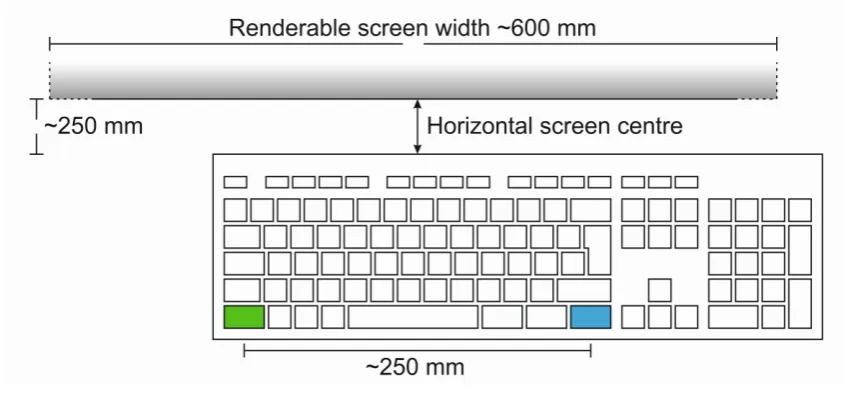
Apparatus & Stimuli. Participants sat at a table in a dimmed room facing a 27" touch 129
screen monitor (Iiyama (Tokyo, Japan) ProLite T2735MSC-B2, 1920×1080 pixels) at 130
approximately 60 cm distance. A keyboard was positioned on the table between the 131
participant and the screen. Participants and the keyboard response keys were position at 132
the screen s horizontal centre Figure 1). A PC (Dell (Round Rock, USA) XPS, Intel (R) Core 133
(TM) i5-4430, 3 GHz CPU, 12 GB RAM, 64 bit Windows 7) generated stimuli and recorded 134
responses. Stimuli were presented at 60 Hz in all experiments. Experimental stimuli are 135
described later in Parts I and Part II. Image assets for each experiment are available at 136
https://osf.io/pjwht. 137
8 139
Figure 1. Schematic representation of the keyboard and screen. In response to changes in 140
target appearance participants pressed the space bar (long lower key) in Experiments 1 141
to 7, or pressed left (green) and right (blue) response in Experiment 8. The control keys 142
were coloured similarly on the actual keyboard. 143
144
Procedure. Every experiment consisted of a practice block, a task block and at least one 145
rating block. Participants carried out a detection task in the practice and task blocks with 146
the former intended as rehearsal for the latter. The somewhat demanding detection task 147
was to ensure that participants continuously attended to the presented objects. It 148
required the participant to tap the space bar as soon as possible when they detected a 149
temporary change in an objects pattern. For all experiments, the response window was 150
the period when any portion of the changed object appearance was visible (~750 ms in 151
Part I and 500 ms in Part II). Trials on which the object changed are referred to as catch 152
trials and those in which it didn t change are standard trials . An object s changed pattern 153
is referred to as its catch pattern and its unchanged pattern is its standard pattern . 154
9
In the rating blocks, participants would rate each standard pattern object from the 156
exposure block for liking. These measures of object liking were used to assess fluency 157
effects. On a rating trial an object would be presented either as it would have appeared in 158
the task trials or stationary in the centre of the screen (detailed in each Experiment 159
section). The object would then disappear and there would be one second of blank screen 160
before a 50 cm long Likert scale was presented horizontally in the centre of the screen 161
for the participant to input their rating. The scale was a line with brackets at each end but 162
no other demarcations. Instructions to rate how much you liked the object were 163
presented on screen and verbally by the experimenter. Participants were told to tap the 164
scale towards the right if they liked the object, towards the left if they didn t, with how far 165
left or right they tapped indicating how much they did or didn t like the object. Details of 166
all rating instructions are available at https://osf.io/pjwht. 167
Presentation order was randomised in every block. Participants could take short 168
breaks before each block when the experimenter would provide instructions for the 169
upcoming block and subsequently answer any questions. Details of practice and exposure 170
blocks are provided in each experiment section presented later. 171
172
Data exclusion & analysis. Data were analysed using Matlab R2015a (The MathWorks 173
Inc., Natick, USA). Participants who made errors on 25% of standard or 25% of catch trials 174
in the task blocks were removed from the data set. An error on a standard trial is 175
responding (pressing the space bar) at any point. An error on a catch trial is responding 176
before or after the catch period, or failing to respond at all. Error rates are detailed in 177
10
Liking ratings made on the Likert scale were converted to values between -100 179
(most extreme possible response to the left i.e. minimum liking rating) and 100 (most 180
extreme possible response to the right i.e. maximum liking rating). Statistical tests were 181
assessed with of throughout. The analysed liking ratings for each experiment and a 182
brief discussion of data normality are available at https://osf.io/pjwht. 183
184
PART I: EXPERIMENTS 1 TO 4 185
Experiments 1 to 4 were executed using E-Prime 2.0 (Psychology Software Tools, Inc., 186
Pittsburgh, USA). In each trial of the detection task (see Procedure earlier) an object 187
moved across the screen either fluently or disfluently and passed behind black occluders 188
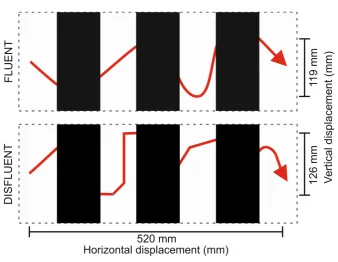
en route (see Figure 2). Objects were scaled to fit into 60 mm square boxes. 189
Fluent movements were smooth and predictable whereas disfluent movements 190
were less so in that they could make sudden direction changes whilst visible, and that it 191
was not possible for participants to predict an objects re-emergence position following 192
occlusion (further trajectory information and video examples of object movements are 193
available at https://osf.io/pjwht). Object movements could be leftwards (as shown in 194
Figure 2) or rightwards and inverted for either direction to give 4 fluent and 4 disfluent 195
trajectories. The total movement time was always 5000 ms made up of alternating 196
periods of visible motion (total 2500 ms) and occluded motion (total 2500 ms). 197
At the start of a trial, an object would appear and remain stationary for 500 ms 198
before moving for 5000 ms. The object would remain stationary for 500 ms at the end of 199
it s movement before disappearing. On a standard trial, the object would wear its 200
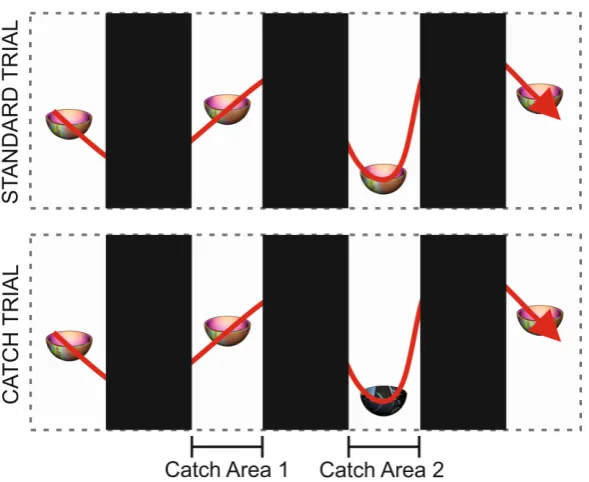
standard pattern for the whole movement whereas, on a catch trial, the object would 201
11
where it would wear its catch pattern (either between the first and second or between 203
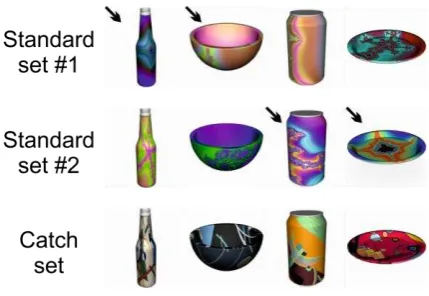
the second and third occluders; see Figure 3). The objects used are shown in Figure 4. 204
Response errors were indicated to the participant by a short tone issued by the PC at the 205
end of a trial. 206
207
[image:12.595.70.409.217.479.2]208
Figure 2. Schematic representations of object trajectories (red lines) in Experiments 1 to 209
4 in the fluent (top panel) and disfluent (bottom panel) conditions. Note that trajectory 210
paths were not visible during the experiment and are provided here for illustrative 211
purposes only. 212
12 214
Figure 3. Schematic representations of standard and catch trials in the fluent condition. 215
On a standard trial (top panel), the object would wear its standard pattern throughout 216
the trial. On a catch trial (bottom panel), the object would wear its standard pattern apart 217
from between one of two pairs of adjacent occluders (either Catch Area 1 or 2) where it 218
would wear its catch pattern. 219
13 221
Figure 4. Standard (top two rows) and catch (bottom row) patterns for each object type 222
in Experiments 1 to 4. Standard pattern set #1 and #2 featured in Experiments 1, 2 and 223
3. Only standard patterns marked with an arrow were used in Experiments 4. 224
Participants rated only the standard pattern objects. Image assets are available at 225
https://osf.io/pjwht 226
227
EXPERIMENT 1 228
The first experiment is a baseline study to verify that motion fluency does indeed 229
influence object preference ratings. 230
231
Method. The experiment consisted of a practice block, then a task block and finally a 232
rating block. Trials in the practice and task blocks were presented in a random order. 233
Objects in the practice block were a bottle, a bowl, a can and a plate, each with 234
unique standard and catch patterns. We designed the patterned objects used throughout 235
this article to be similar to artworks (interesting, distinctive and attractive) to ensure the 236
object liking task had ecological validity where everyday preference decisions are made 237
14
and one in a catch trial) and two disfluently (one in a standard trial and one in a catch 239
trial). Each object featured in a single trial. 240
The task block featured 8 objects of two standard patterns each for the bottle, 241
bowl, can and a plate (see Figure 4). One set of standard patterns would always move 242
fluently and the other disfluently. This was counterbalanced so that half of participants 243
experienced standard pattern set #1 as fluent and standard pattern set #2 as disfluent, 244
and the other half of participants experiencing the opposite pairing. Each object featured 245
in 8 standard trials and 2 catch trials. This created 80 task trials (8 objects × 10 trials). 246
The standard trials for a given object included two of every combination of 247
rightwards/leftwards direction and standard/inverted orientation. The trajectory for a 248
given objects catch trial was selected at random from the 8 possible combinations of 249
direction, orientation and catch area (e.g. a trajectory might be rightwards, inverted and 250
feature a catch pattern in catch area 2). Each catch trajectory was used only once for the 251
fluent objects and once for the disfluent objects. 252
In the rating block, at the end of the experiment, the final exposure to each object 253
was either fluent or disfluent as it would have been in the task block. Object assignment 254
to a trajectory was otherwise random with the constraints that for both the fluent and 255
disfluent sets: half of the objects moved rightwards and half leftwards, and half of each 256
direction were inverted. Trial order in the rating block alternated between fluent and 257
disfluent objects. 258
Further information on trajectory assignment in every block is available at 259
https://osf.io/pjwht. 260
15
Determining power. A power analysis was conducted in RStudio (RStudio Team, Boston, 262
MA) for a planned two-sided paired samples t-test with a target power of and Cohen s 263
d of 0.5. This yielded target samples of 34 but in an effort to maximise the robustness of 264
our investigation we increased our target sample size to 40. 265
266
Participants. Forty participants were tested (6 males, age mean ± SD = 19.00 ± 1.43). No 267
participant erred on more than 11 of 64 (mean ± SD = 1.8 ± 1.94) standard trials or on 268
more than 4 of 16 (mean ± SD = 1.5 ± 1.0) catch trials. 269
270
Results & Discussion. The liking ratings for fluent and disfluent objects are shown in 271
Figure 5. Note that due to technical error, two ratings were missing from different 272
participants, one was for a fluent object rating, the other for a disfluent object rating. Due 273
to balancing of fluent/disfluent ratings, we calculated each participants means as normal. 274
A two-tailed paired samples t-test indicated that liking of disfluent objects was 275
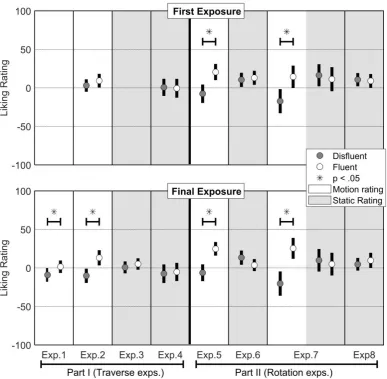
significantly less than liking of fluent objects (t(39) = 2.164, p = .037, d =.342 10.7). 276
These results confirm our predictions concerning motion fluency and object 277
preference extending previous research by demonstrating that an object s motion path
278
influences emotional responses which is reflected in the liking of that object. In 279
Experiment 2 we seek to replicate this novel finding and investigate whether learning 280
and memory processes mediate preference change. 281
16 283
Figure 5. Mean (±95 confidence interval) for disfluent (dark grey dots) and fluent (pale 284
grey dots) objects in each experiment. White panels indicate ratings made following 285
exposure to moving objects and grey panels indicate ratings made following exposure to 286
static objects. Ratings following the first exposure are shown in the top panel and ratings 287
following the final exposure are shown in the bottom panel. Significant differences (p < 288
.05) between fluency conditions are indicated with an asterix (*). 289
17
EXPERIMENT 2 291
Because motion fluency effects on object preference have not been reported previously, 292
it is important to replicate and extend our initial finding. Although Experiment 1 293
confirmed that motion fluency influences participants liking of objects, it did not indicate 294
whether liking for an object is simply evoked by the last seen motion or instead is 295
developed following repeated exposure to fluent/disfluent pairings of motion and object 296
identity. In other words, it does not tell us whether there was any learning of the 297
association of motion fluency with an object. 298
Therefore, Experiment 2 exactly replicates Experiment 1 except that a rating block 299
was run at the start as well as at the end of the experiment. This provides two advantages. 300
First, it will reveal whether a single exposure is sufficient to evoke preference for fluent 301
objects or whether repeated exposures are necessary. Second, the contrast between the 302
first exposure rating and the final exposure rating after 10 intervening presentations, 303
may provide a more accurate measure of if/how preference is changed via learning. That 304
is, whether fluent object motion increases preference, disfluent object motion reduces 305
preference, or both (see Manssuer, Pawling, Hayes, & Tipper, 2016; Manssuer, Roberts, & 306
Tipper, 2015; Strachan, Kirkham, Manssuer, Over, & Tipper, 2017 for similar 307
approaches). 308
309
Method. Experiment 2 is a replication of Experiment 1 but with the addition of a first 310
exposure rating block before the practice block. 311
18
Participants. Forty-one participants were tested. One participant failed to complete the 313
experiment and was removed from the data set. None of the remaining participants erred 314
on more than 5 of 64 (mean ± SD = 1.5 ± 1.4) standard trials or on more than 3 of 16 315
(mean ± SD = 1.3 ± 0.8) catch trials. The remaining sample consisted of 40 participants 316
(8 male, age mean ± SD = 19.52 ± 1.92). 317
318
Results & Discussion. The liking ratings for fluent and disfluent objects are shown in 319
Figure 5. A 2 factor (first/final exposure × fluency) repeated measures ANOVA indicated 320
effects of object fluency (F(1,39) = 8.307, p = .006, = .176) and the interaction of fluency 321
× first/final exposure (F(1,39) = 5.914, p = .020, = .132) but not the main effect of 322
first/final exposure (F(1,39) = 2.638, p = .112). To break down the interaction we 323
conducted two-tailed paired samples t-tests on first and final exposure ratings. 324
First exposure ratings of disfluent and fluent objects did not differ significantly 325
(t(39) = 1.368, p = .179) but final exposure ratings of disfluent objects were significantly 326
less than those of fluent objects (t(39) = 3.133, p = .003, d = .492 . This indicates 327
that the influence of motion fluency on object liking via learning of object-motion 328
association requires more than a single exposure to disfluent/fluent motion and that it is 329
evident following 12 exposures (2 rating exposures and 10 task exposures). 330
Further analysis compared liking ratings at the start of the experiment with those 331
at the end. Note, that unlike previous similar designs (Manssuer et al., 2016; Strachan et 332
al., 2017), we do not have a true baseline in the current study as the initial ratings 333
possessed object fluency properties. Nevertheless, two-tailed paired samples t-tests 334
revealed a decline in liking of disfluent objects (t(39) = 2.564, p = .014, d = .405 , 335
19
Finally, it should be noted that the final liking effects in Experiment 2 appear to be 337
somewhat larger than those observed in Experiment 1 (see also Figure 5). The sole 338
difference between these experiments is that of a first exposure rating in Experiment 2. 339
It is possible that this prior consideration of the affective properties of objects had primed 340
emotion/preference processes, producing more robust effects. To explore this, we 341
compared the difference between fluent and disfluent ratings in these experiments using 342
an independent samples t-test. There was no change in the difference between fluent and 343
disfluent ratings from Experiment 1 to Experiment 2 (t(78) = 1.410, p = .163). Hence we 344
cannot conclude that the effect was larger when an initial rating task was experienced by 345
participants. 346
Though we have demonstrated repeated exposures are required for the 347
association of an object identity with its motion fluency, we do not yet know whether the 348
association survives a change in the context in which the objects are viewed. This is 349
explored in Experiments 3 and 4. 350
351
EXPERIMENT 3 352
Experiment 2 provided evidence that there is learning of the association between an 353
objects identity and the fluency of its motion. That is, after 12 exposures to an object s 354
motion, liking of disfluently moving objects dropped significantly, resulting in a 355
significant preference for fluently moving objects. We have shown fluency effects 356
following repeated exposures, but it is unknown whether the association of prior motion 357
fluency with an object s identity is robust enough to survive a change of context i.e. if the 358
object is seen stationary rather than in motion. This critical issue of generalisation is little 359
20
Embodied accounts of emotional memory encoding propose that visuomotor 361
states are encoded during initial exposure to a stimulus (e.g., Niedenthal, 2007; Pawling, 362
Kirkham, Hayes, & Tipper, 2017). That is, during episodic memory retrieval, sensory and 363
motor neural processing states that were active at encoding are reactivated when the 364
stimulus is encountered at a later time (e.g., Barsalou, 1999; Glenberg, 1997). In our 365
previous experiments, the emotional reaction evoked by the fluent/disfluent motion was 366
associated with object identity. Hence during later encounters with an object this prior 367
embodied encoding of emotion was reactivated and influenced preference judgments. 368
Therefore, in the current and next experiment we explored whether prior motion 369
fluency can influence liking of an object even when that object no longer possesses a 370
motion property i.e. whether emotion associated with an object is activated when the 371
object is seen stationary rather than moving. 372
373
Method. Experiment 3 is a replication of Experiment 1, with the only change being that 374
the final exposure ratings are performed following exposure to a stationary image in the 375
centre of the screen (i.e. lacking any fluency properties) rather than following exposure 376
to a moving stimulus. 377
378
Participants. Forty-one participants were tested. One participant failed to complete the 379
experiment and was removed from the data set. None of the remaining participants erred 380
on more than 8 of 64 (mean±SD = 1.4 ± 1.6) standard trials or on more than 4 of 16 (mean 381
± SD = 1.4 ± 1.0) catch trials. The remaining sample consisted of 40 participants (5 male, 382
21 384
Results & Discussion. The liking ratings for fluent and disfluent objects are shown in 385
Figure 5. A two-tailed paired samples t-test indicated that post-exposure ratings of 386
disfluent and fluent objects did not differ significantly (t(39) = 1.355, p = .183). 387
Experiments 1 and 2 indicated that participants preferred fluently moving objects 388
to disfluently moving objects after 12 exposures when assessments were made after 389
seeing objects move. However, the current experiment demonstrates that this preference 390
does not generalize to situations in which the object is assessed while it is stationary. 391
Hence the association between object identity and its motion fluency may be weak 392
and/or not easily retrieved. The fragility of such a retrieval process has been observed in 393
other research where effects are not always observed. For example, Pawling et al. (2017) 394
found that retrieval of prior emotional states following context change was possible 395
whereas Kirkham, Hayes, Pawling, & Tipper, (2015) found that it was not. In Experiment 396
4, we continue to pursue the endurance of fluency effects following context change by 397
reducing the number of objects to lessen memory load. 398
399
EXPERIMENT 4 400
Learning and retrieval of object-motion relationships was demonstrated in Experiment 401
2. However, in Experiment 3 that retrieval process was found not to survive a change in 402
object viewing context. Persistence of fluency effects across contexts may be key to effect 403
choice behaviour change in the real-world, so in the current experiment we continued to 404
22
encoding of the object-motion relationship and thus allow easier retrieval when objects 406
are seen stationary. 407
First, Experiment 4 is modelled on that of Experiment 2 where ratings were made 408
at the start and end of the experiment. As we noted, although not statistically reliable, 409
there was a trend for final exposure effects to be larger in Experiment 2 than in 410
Experiment 1. Therefore, following the possibility that prior consideration of objects in 411
Experiment 2 might have subtly primed emotion/preference processes, we again opted 412
to use both a first exposure and a final exposure rating in the current experiment. 413
The second major change concerned the number of object-motion associations 414
(i.e. the number of unique standard objects in the experiment). Though incidental 415
associative learning has been demonstrated for 16 (e.g. Strachan et al., 2017) and even 416
40 face identities (e.g. Bayliss & Tipper, 2006), it is possible that the retrieval of prior 417
associative learning may be a limited capacity process for non-face stimuli, particularly 418
following a change in viewing context. Indeed the number of associations is often smaller 419
(e.g. Baeyens, Eelen, Crombez, & van den Bergh, 1992). The 8 object-motion associations 420
in the previous 3 experiments may have stretched that capacity so in the current 421
experiment we reduce the number of objects to 4. 422
The final change concerned the proportion of catch trials in the task block. Recall 423
that catch trials were to ensure that participants had to continuously attend to the 424
object s pattern (see Procedure earlier). In the previous 3 experiments, 20% of the task 425
block trials were such catch trials. In the current experiment we increase this to 50%, 426
with the aim of increasing attentional engagement with the objects and consequently 427
increasing affect encoding. 428
23
Method. Experiment 4 was a replication of Experiment 2 but with static objects in first 430
and final-exposure rating blocks, a reduction from 8 to 4 objects (2 fluent and 2 disfluent), 431
and an increase in the proportion catch trials to 50% for each object in the task block. 432
Standard and catch patterns are shown in Figure 4. 433
Objects in the practice block were a bottle and a bowl each with unique standard 434
and catch patterns. For even numbered participants the bottle was fluent and the bowl 435
disfluent (vice versa for odd numbered participants). One fluent and one disfluent object 436
featured in a catch trial with the other two featuring in standard trials (4 practice trials 437
in total). 438
In the task block, each of the 4 objects featured in 4 standard trials and 4 catch 439
trials to create a total of 32 experimental trials (4 objects × 8 trials). Half of participants 440
experienced the bottle and bowl as fluent and the can and plate as disfluent, and the other 441
half of participants experienced the opposite pairing. As in previous experiments, 442
trajectory assignment was counterbalanced for standard and catch trials. Further 443
information on trajectory assignment is available at https://osf.io/pjwht. 444
As in Experiment 3, objects were rated following a static presentation in the centre 445
of the screen. The experiment protocol was otherwise as described for Experiment 2. 446
447
Participants. Forty-two participants were tested. Two participants failed to complete 448
the experiment and were removed from the data set. None of the remaining participants 449
erred on more than 3 of 16 (mean ± SD = 0.9 ± 0.9) standard trials or on more than 2 of 450
16 (mean ± SD = 1.0 ± 0.8) catch trials. The remaining sample consisted of 40 participants 451
24 453
Results & Discussion. The liking ratings for fluent and disfluent objects are shown in 454
Figure 5. A 2 factor (first/final exposure × fluency) repeated measures ANOVA indicated 455
effects of first/final exposure (F(1,39) = 4.925, p = .032, = .112 mean ) where 456
final exposure ratings were lower than first exposure ratings. However, there was no 457
effect of object fluency (F(1,39) = 0.014, p = .906, < .001), or the interaction between 458
first/final exposure × fluency (F(1,39) = 0.589, p = .448, = .015). 459
Again we found no evidence of fluency effects in ratings of static objects following 460
repeated exposures to each object s motion This failure to detect an effect has now been 461
observed in 2 experiments, the latter of which employed a variety of manipulations aimed 462
at making the experiment more sensitive. Therefore, we are confident that the fluency 463
effects imparted by our current stimuli do not survive a change from moving to static 464
contexts. 465
However, although we demonstrate that objects that move fluently are preferred 466
over those that move disfluently in both Experiments 1 and 2, it is possible that our 467
motion fluency manipulation has a rather weak effect on emotional responses to a 468
moving object. Thus it may be the case that these weak effects cannot be retrieved when 469
transferred to static objects. Hence, in Part II we present a final set of experiments for 470
which we developed much more compelling motion fluency manipulations. We predict 471
that these new movements will produce stronger associations between an object s 472
identity and its repeated pattern of fluent/disfluent movement. Furthermore, to facilitate 473
such associative learning via a small number of associations, we again used only 4 objects. 474
In Part II, we first explore the effectiveness of these new motions before again attempting 475
25 477
PART II: EXPERIMENTS 5 TO 8 478
Experiments 5 to 8 were executed using custom scripts and Psychtoolbox 3.0.11 479
(Brainard, 1997; Kleiner, Brainard, & Pelli, 2007; Pelli, 1997) operating within Matlab 480
R2015a (The MathWorks Inc., Natick, USA). The block protocol for experiments in Part II 481
was the same as that for Experiment 4 in Part I: a first exposure rating block, a practice 482
block, a task block, and lastly a final exposure rating block. The principle difference 483
between Part I and Part II was the object movement. Rather than traversing across the 484
screen, objects remained in the centre of the screen and changed size while rotating. 485
On trials in which an object moved, it would appear in the centre of screen and 486
remain stationary for 500 ms before moving for 2500 ms. The object would remain 487
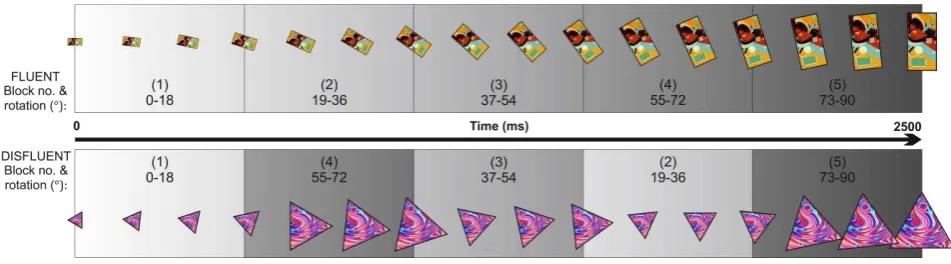
stationary for ms at the end of it s movement before disappearing Objects could 488
either expand or contract, and rotated either clockwise or anti-clockwise resulting in four 489
possible movements. Fluent movements were a constant rate of change of size and 490
rotation (see the top panel in Figure 6). Disfluent movements were generated by dividing 491
a fluent movement into 5 equal length sections and then reordering them from [1-2-3-4-492
5] to [1-4-3-2-5] (see bottom panel Figure 6). Further trajectory information and video 493
examples of object movements are available at https://osf.io/pjwht. 494
The objects used in the following experiments were a geometric shapes (see 495
Figure 7) to avoid implications of appropriate orientation and to more easily control 496
displayed object size. Just as in Part I, each object contained art patterns to provide 497
26
At the moment of appearance, an expanding objects area was mm2, and for a 499
contracting object it was 14400 mm2. The final area was always 5625 mm2. For example, 500
the length of one side of an expanding square would change from 30 mm to 75 mm, and 501
the length of one side of a contracting square would change from 120 mm to 75 mm. Just 502
as the final area of all objects was the same, the final orientation was too. All objects 503
rotated by 90° to the orientation shown in Figure 7 by the end of their movement. 504
The participants role in the detection task (practice and task blocks) was the same 505
as Part I press the space bar when the objects appearance changed. However, instead 506
of changing to a different pattern, objects would turn greyscale as shown in Figure 7. On 507
standard trials an object would wear its standard pattern throughout whereas on catch 508
trials the object would wear its standard pattern apart from in either block 2 or block 4 509
of the movement (see Figure 6) where it would wear its catch pattern. Participants were 510
not aware of catch trials until the object changed appearance. 511
Response errors (responding on standard trials, and failing to respond or 512
responding too early/late on catch trials) were indicated to the participant by a red 513
screen border from the moment of the error to 1500 ms after the object had disappeared. 514
Correct responses (pressing at the appropriate time on a catch trial or not pressing on a 515
standard trial) were indicated to the participant by a green screen border from the 516
moment of success to 1500 ms after the object had disappeared. 517
Just as in the Part I, during the object rating tasks, participants were asked to 518
assess how much they liked the object they saw. Object motion was never mentioned in 519
relation to rating. This meant that the focus of this task was on the object properties of 520
shape and pattern rather than with the object s motion, which was an irrelevant 521
27 523
[image:28.595.74.550.93.225.2]524
Figure 6. Schematic representations of object movements in experiments 5, 6 and 7 in the 525
fluent (top panel) and disfluent (bottom panel) conditions. Note that the background 526
colour in the experiments was a constant grey. In this figure the background varies to 527
highlight the reordered sections in the disfluent condition. 528
529
530
Figure 7. Standard (top row) and catch (bottom row) patterns for objects in experiments 531
5, 6 and 7. Participants rated only the standard patterns. Image assets are available at 532
https://osf.io/pjwht 533
534
EXPERIMENT 5 535
In Part I we demonstrated that the learnt association of an objects motion fluency affects 536
preference judgements only when the objects are seen moving. It is possible that 537
preference transference to a static context did not occur because the fluency effects were 538
not strong enough. As such, we developed a new and more compelling version of 539
28
following exposure to these new motions (current experiment) before testing whether 541
the fluency effects evoked by our new motions are sufficient to survive a change in 542
context (next experiment). 543
544
Method. Participants completed a first exposure rating block, practice block, task block 545
and a final exposure rating block as in Experiments 2 and 4. Four objects were used (see 546
Figure 7). Even numbered participants experienced the square and pentagon as fluent 547
and the triangle and rectangle as disfluent (vice versa for odd numbered participants). 548
This was true for the practice and exposure blocks. 549
In the practice block, one fluent object and one disfluent object featured in catch 550
trials with the other two in standard trials (4 practice trials in total). 551
In the task block, each object featured in 16 trials (total 64 trials). Of those, 8 were 552
standard trials and 8 were catch trials. Half of each trial type expanded (the others 553
contracted) and half of those rotated clockwise (the others rotated anti-clockwise). This 554
meant that each object and trial type appeared the same number of times in each 555
movement. 556
In each rating block, every object was rated after being seen to move in its assigned 557
way (either fluently or disfluently). Movements in this block were always clockwise and 558
expanding. 559
Trial presentation was randomised by participant for every block. Further 560
information on trial assignment is available at https://osf.io/pjwht. 561
29
Participants. Forty-one participants were tested. One participant exceeded the error 563
threshold for catch trials by failing to respond on 7 of 16 catch trials and was removed 564
from the data set. None of the remaining participants erred on more than 3 of 32 (mean 565
± SD = 0.2 ± 0.6) standard trials or on more than 7 of 32 (mean ± SD = 2.4 ± 2.0) catch 566
trials. The remaining sample consisted of 40 participants (3 male, age mean ± SD = 19.48 567
± 1.92). 568
569
Results & Discussion. The liking ratings for fluent and disfluent objects are shown in 570
Figure 5. A 2 factor (first/final exposure × fluency) repeated measures ANOVA indicated 571
effects of object fluency (F(1,39) = 16.94, p < .001, = .303) where fluent objects were 572
preferred over disfluent objects mean . There was no effect of first/final 573
exposure (F(1,39) =.913, p = .345, = .023) or of the interaction between fluency × 574
first/final exposure (F(1,39) = 0.297, p = .589, = .008). 575
This experiment has confirmed that our new fluent and disfluent motions produce 576
very robust effects on liking judgments of moving objects. This is revealed in two key 577
findings. First, the effect of fluency on liking ratings at the final exposure were larger in 578
this experiment (d = .691 derived from a two sample t-test]) than in Experiment 579
1 (d =.342 1) or Experiment 2 (d = .492, Second, and more strikingly, fluency 580
effects in the current experiment were observed after only a single exposure to motion 581
(at the start of the experiment) whereas in Experiment 2 the object-motion associations 582
had to be learnt for fluency effects to be revealed. 583
584
30
Having demonstrated clear fluency effects resulting from our new motions (rotation and 586
size change), in the current experiment we test whether such fluency associations are 587
preserved and retrieved following a change in context. That is, can fluency effects be 588
detected when assessing static objects? 589
590
Method. Experiment 6 is a replication of Experiment 5, with the only change being that 591
the objects are rated at the start and end of the experiment while they are static. The size 592
and orientation of this static image was the final size and orientation in each trial in the 593
task block. 594
595
Participants. Forty-one participants were tested. One participant exceeded the error 596
threshold for catch trials by failing to respond on 7 of 16 catch trials and was removed 597
from the data set. None of the remaining participants erred on more than 1 of 32 (mean 598
± SD = 0.2 ± 0.4) standard trials or on more than 6 of 32 (mean ± SD = 2.4 ± 1.9) catch 599
trials. The remaining sample consisted of 40 participants (2 male, age mean ± SD = 18.80 600
± 0.97). 601
602
Results & Discussion. The liking ratings for fluent and disfluent objects are shown in 603
Figure 5. A 2 factor (first/final exposure × fluency) repeated measures ANOVA indicated 604
that there were no effects of object fluency (F(1,39) = .356, p = .554, = .009), or first/final 605
exposure (F(1,39) = 3.085, p = .087, = .073). However there was an interaction between 606
31
interaction we conducted two-tailed paired samples t-tests on first and final exposure 608
ratings. 609
Ratings of disfluent and fluent objects did not differ significantly at the first (t(39) 610
= .429, p = .671) or final (t(39) = 1.515, p = .138) exposures. There was no change in the 611
liking ratings of disfluent objects (t(39) = 1.055, p = .298) but there was a significant 612
decrease in liking of fluent objects (t(39) = 3.055 p = .004, d = .483 9). 613
The interaction was thus driven by a decline between first and final liking ratings 614
for objects associated with fluent motion. This is an unexpected result that we have not 615
observed before and that is opposite to our apriori predictions. However, most 616
importantly for our hypothesis concerning learned associations between patterns of 617
motion and object liking, in ratings at the end of the experiment there was no difference 618
in preference for static objects that had previously been viewed moving fluently or 619
disfluently. 620
The current experiment was a stronger test of fluency effect survival following 621
context change than those in Part I due to the potency of the new object motions. 622
However, we have again failed to detect fluency effects while judging static objects for 623
preference. Nevertheless, we felt it worthwhile to further replicate and extend our 624
findings in a further experiment. 625
Thus far our contrasts between assessing moving versus static objects have been 626
between participants in separate experiments. It is possible that requiring people to 627
assess both moving and static objects for liking within the same experiment might 628
increase sensitivity to the latter (see Poulton (1982), for influential companion effects). 629
Indeed, we found a trend for larger fluency effects in Experiment 2 than in Experiment 1 630
32
increased participants sensitivity to object motion. Therefore, the following experiment 632
replicates Experiments 5 and 6, but combines assessment of moving and static objects 633
into a within-participants design. 634
635
EXPERIMENT 7 636
Experiment 7 combined Experiments 5 and 6: objects always moved in the task trials 637
but in rating trials they were either stationary or moved as normal. 638
639
Methods. All protocols were identical to those in Experiments 5 and 6 apart from the 640
assignment of objects to fluency and rating blocks. Again two objects were fluent and two 641
were disfluent but now one fluent object and one disfluent objects were always rated 642
following a moving presentation (as in Experiment 5) with the others rated following a 643
static presentation (as in Experiment 6). Four versions of the experiment were run to 644
counterbalance these conditions (further information at https://osf.io/pjwht). 645
646
Participants. Forty participants were tested (18 male, age mean ± SD = 20.65 ± 1.48). No 647
participant erred on more than 2 of 64 (mean±SD = 0.3±0.6) standard trials or on more 648
than 5 of 16 (mean±SD = 1.5±1.4) catch trials. 649
650
Results and Discussion. The liking ratings for fluent and disfluent objects are shown in 651
Figure 5. A 3 factor (first/final exposure × fluency × motion/static rating) repeated 652
measures ANOVA indicated main effects of fluency (F(1,39) = 9.143, p = .004, = .190) 653
33
(F(1,39) = 2.363, p = .132, = .057). There was a significant interaction between fluency 655
× motion/static rating (F(1,39) = 8.303, p = .006, = .176). There were no interactions 656
between first/final exposure × fluency (F(1,39) = 2.056, p = .160, = .050), first/final 657
exposure × motion/static rating (F(1,39) = 3.342, p = .075, = .079) or between first/final 658
exposure × fluency × motion/static rating (F(1,39) = 1.567, p = .218, = .039). To 659
breakdown the fluency × motion/static rating interaction we carried out separate 2 × 2 660
repeated measures ANOVAs on liking ratings made of moving objects and on liking 661
ratings made of static objects. 662
Replicating the results of Experiment 5, when objects were seen moving during 663
ratings, the ANOVA indicated a highly significant main effect of fluency (F(1,39) = 17.842, 664
p < .001, = .314), but no main effect of first/final exposure (F(1,39) = .720, p = .401, = 665
.018). Interestingly, the interaction between first/final exposure and object fluency 666
(F(1,39) = 4.505, p = .040, = .104), was significant, as observed in Experiment 2, 667
suggesting a role for learning in these object-motion association processes. However, 668
even though the fluency effect was smaller at the start of the experiment, nevertheless 669
the effect was significant at the first (t(39) = 3.473, p = .001, d = .549 32) and final 670
(t(39) = 4.426, p = .001, d = 0.670 46) exposures. Further analysis indicated no change 671
in ratings of disfluent objects (t(39) = .500, p = .620) but an increase in ratings of fluent 672
objects between the first and final exposure (t(39) = 2.068, p = .044, r = .330 11). 673
In contrast, and again replicating our prior results (Experiment 6) the analysis of 674
ratings of static objects detected no main effect of fluency (F(1,39) = .272, p = .605), no 675
main effect first/final exposure (F(1,39) = 2.452, p = .125) and no interaction between 676
34
Therefore, this final experiment again confirms our findings of clear effects of 678
visuomotor fluency on liking when assessing moving objects, but when the objects are 679
static no preference effects can be detected. 680
We have been surprised by the consistent failure to detect fluency effects when 681
assessing static objects. Associative learning/evaluative conditioning would have 682
predicted that such effects exist due to the CS of object identity being repeatedly 683
associated with the US± of motion fluency. Two reviewers suggested that the apparent 684
lack of association may be due to object identity being ignored. This could be because the 685
detection of, and response to, object appearance change is a somewhat low-level 686
transient signal that potentially results in a low-level of engagement, shallow encoding 687
and, consequently, weaker memories (e.g., the levels of processing theory of Craik & 688
Lockhart, 1972). Weak/absent associations between affect induced by motion and the 689
object identity may mean that participants are primarily influenced by the currently 690
observed motion (or lack of) when rating objects. 691
With this in mind, we designed a new experiment (Experiment 8) in which we 692
endeavoured to engage participants more directly with target appearance. Participants 693
were required to actively attend to and identify each object as this determines which key 694
press response would be appropriate if the target pattern changed to greyscale. 695
696
EXPERIMENT 8 697
In Experiments 5, 6 and 7 fluency effects were apparent when objects were rated 698
following a moving presentation but not when they were rated following a static 699
35
motion in a static rating condition by increasing participant engagement with target 701
shape/pattern. Experiment 8 is replication Experiment 6 but rather than tapping the 702
space bar when the object turned to greyscale, participants were required to tap either 703
the left control key for one fluent and one disfluent object, or the right control key for the 704
other fluent and disfluent objects. This would require explicit encoding of object-shape 705
and rapid detection of object-pattern change to produce the appropriate key-press 706
response. 707
708
Method. Experiment 8 is a replication of Experiment 6 (static object presentation for 709
ratings) with changes to the response key used in the task and practice blocks, the 710
composition of the practice block, and the object-condition assignments. 711
In all of our previous experiments, participants were required to press the space 712
bar when they detected a change in target appearance. However, in the current 713
experiment participants were instead required to press either the left or right control 714
keys depending on the presented object (see Figure 1). The left control key was covered 715
with a green sticker and the right with a blue sticker (referred to henceforth and in the 716
experiment as the green and blue keys). Four versions of the experiment were run to 717
counterbalance fluency and key assignment for each object (details at 718
https://osf.io/pjwht). 719
This new two-key task was much more demanding than the one-key task of 720
previous experiments so three practice blocks were run to slowly introduce object-key 721
assignments rather than the single block used in all previous experiments. The first 722
practice block included only the two objects assigned to the green key and the second 723
36
block included all four objects. Every object in each practice block featured in one 725
standard and one catch trial to yield 4 trials each in blocks 1 and 2, and 8 trials in block 3. 726
Each of these blocks began with instructions given verbally by the experimenter and 727
presented on the screen. The objects in the upcoming trials along with their assigned 728
colour key were also shown on the screen. Verbal and displayed reminders of key 729
assignments were also given before the task block. Reminders would also be displayed 730
after a trial if the participants made a response error on that trial. Examples of 731
instructions and reminders are available at https://osf.io/pjwht. 732
733
Participants. Forty-two participants were tested. Two participants exceeded the error 734
threshold for catch trials by failing to respond on 9 and 10 of 16 catch trials. They were 735
removed from the data set. None of the remaining participants erred on more than 1 of 736
32 (mean ± SD = 0.15 ± 0.36) standard trials or on more than 8 of 32 (mean ± SD = 2.75 ± 737
2.18) catch trials. The remaining sample consisted of 40 participants (13 male, age mean 738
± SD = 20. 26 ± 3.25, one participant did not disclose their age). 739
740
Results & Discussion. The liking ratings for fluent and disfluent objects are shown in 741
Figure 5. A 2 factor (first/final exposure × fluency) repeated measures ANOVA indicated 742
that there were no effects of object fluency (F(1,39) = .075, p = .785 002), or first/final 743
exposure (F(1,39) = .953, p = .335 24), or the interaction between fluency × 744
first/final exposure (F(1,39) = 1.696, p = .20 042). 745
This experiment has again failed to detect the fluency effects when rated objects 746
37
resulting from attention focused on both the object s shape identity and it s pattern 748
throughout the experiment would result in stronger memories for affect induced by 749
experience, which in turn would influence assessments of static objects (e.g., Craik & 750
Lockhart, 1972). 751
The results of all our previous experiments using static objects (Experiments 3, 4, 752
6, 7 and 8) challenge, to some extent, the idea that associative learning is an automatic 753
process that takes place in all situations. There certainly appear to be limits in the context 754
of perceptual fluency effects on liking. 755
756
FURTHER ANALYSIS 757
Cross-experiment analysis. We performed two additional analyses on the combined final 758
exposure ratings from the 4 experiments where moving objects were assessed (Experiments 1, 759
2, 5 & 7) and from the 5 experiments where static objects were assessed (Experiments 3, 4, 6, 760
7 & 8). These were 2-way repeated measures ANOVAs with a between-subjects factor of 761
experiment and provided high levels of power (160 participants for moving assessments and 762
200 participants for static assessments) to assess the fluency effects following presentation of 763
moving and static objects. 764
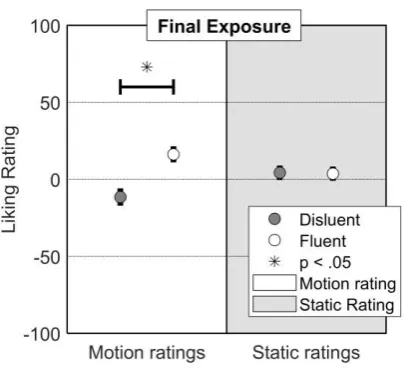
The analyses confirmed all of our previous findings on fluency effects. Objects that 765
moved fluently were preferred over disfluent objects when ratings followed a moving 766
presentation (F(1,156) = 51.631, p < .001, = .249) but not when they followed a static 767
presentation (F(1,195) = .038, p = .845). For the moving rating analysis, there was also an 768
interaction between fluency and experiment (F(3,156) = 3.614, p = .015, = .065) which 769
likely resulted from the greater efficacy of object motions in Part II of the study. There 770
38
= .926, p = .450). The mean liking ratings for fluent and disfluent objects from all 772
experiments are shown in Figure 8. 773
774
[image:39.595.74.277.174.358.2]775
Figure 8. Mean (±95 confidence interval) for final exposure disfluent (dark grey dots) and 776
fluent (pale grey dots) object ratings in all experiments. White panels indicate ratings 777
made following exposure to moving objects and grey panels indicate ratings made 778
following exposure to static objects. Significant differences (p < .05) between fluency 779
conditions are indicated with an asterix (*). 780
781
Bayesian analysis. Following discussions with reviewers we also ran Bayesian analyses 782
on the aggregate data described above using JASP v0.9.0.1 (JASP-Team, 2018). The 783
Bayesian 2-way repeated measure ANOVA (between-subjects factor of experiment) 784
strongly suggest that presentation of an object in motion influences rating (BF10 = 785
1.160e+10, p(H1|Data) > .999) and that presentation of a stationary object does not 786
39
samples t-tests (which also support our conclusions) are available at 788
https://osf.io/pjwht. 789
790
40
GENERAL DISCUSSION 792
In a series of 8 experiments we investigated three questions: (1) does motion fluency 793
influence object liking?; (2) are object-motion associations learnt following repeated 794
exposures?; and (3) do object-motion associations transfer from moving to static 795
presentations of objects? Before commenting on possible mechanisms and future 796
directions we first provide brief answers to these questions. 797
First, in Experiments 1, 2, 5 and 7 we demonstrated that liking of objects is 798
influenced by the motion patterns associated with them: when objects move disfluently 799
(unpredictable movement) they are liked less than objects that move more fluently 800
(predictable movements). 801
Second, the association between an objects identity and its pattern of motion 802
(fluent or disfluent) can, to some extent, be learned. In Experiment 2 liking ratings did 803
not differ between fluently and disfluently moving objects after one presentation but they 804
did following repeated presentations. And, in Experiment 7, the learned fluency effect 805
was larger after repeated exposures to the moving objects. Of course the interaction was 806
not observed in Experiment 5, so whilst associative learning of motion fluency can occur, 807
with sufficiently powerful stimulus motions it may not always be necessary since ceiling 808
effects can be reached immediately. 809
Finally, and most surprisingly, the association between an objects identity and the 810
affect evoked by its motion fluency did not transfer to situations where that object was 811
no longer moving. The lack of effect when rating static objects for liking was observed in 812
Experiments 3, 4, 6, 7 & 8 (n = 40 in each) and in the combined analysis (n = 200) on those 813
data. In our attempts to detect transfer from moving to static displays we have tested: 814
41
trials to encourage engagement with objects; using highly potent object motions that 816
were shown to yield fluency effects even following a single moving presentation; and 817
modifying the response task to encourage deeper levels of encoding. 818
Our initial prediction that learning of visuomotor properties would influence 819
object preference judgements, even when context changed, was motivated by embodied 820
or grounded accounts of cognition. In these, memory consists of visuomotor information 821
from different modalities in distributed systems and when encountering an object at a 822
later time, such visuomotor properties are retrieved (e.g., Barsalou, 2008; Glenberg, 823
1997). We expected such learning and retrieval to take place and that this would lead to 824
evocation/retrieval of motion evoked affect. However, this consistently appeared not to 825
be the case in our experiments. It is important to note that we are not questioning such 826
embodied/grounded accounts of cognition, and indeed we have previously provided 827
evidence for such learning and retrieval processes (e.g., Pawling et al., 2017; Rogers et al., 828
2014). Rather, our current results, and those of Canits et al. (2018) and Quak et al. (2014) 829
who also failed to show any effects of action fluency on later retrieval from memory, 830
provide important boundary conditions where visuomotor fluency when processing 831
objects may not always influence processing when later encountering an object in a 832
different context. 833
As noted previously, our task is a form of evaluative conditioning. In such tasks a 834
neutral conditioned stimulus (CS, e.g. an apple), when associated with a positive 835
unconditioned stimulus (US, e.g. a pleasant background), takes on positive properties and 836
is liked more subsequently. Such associations can develop following a small number of 837
pairings (e.g., 6) and may go unnoticed by participants (e.g. Walsh and Kiviniemi, 2014). 838