JOURNAL OF
RANGE MANAGEMENT
Publrshed brmonthly-January, March, May,July, September, November-by the Society for Range Management 2760 West Fifth Avenue Denver, Colorado 80204 Copyright 1979 by the Socrety for Range Management
Managing Editor LORENZ F. BREDEMEIER
2760 West Fifth Avenue Denver, Cola. 80204 Editor
REX 0. PIEPER
Dep. Animal and Range Scrence New Mextco State Univensty Las Cruces, N. Mex. 88003 Book Review Editor PAT 0. CURRIE
Science & Education Admin. Livestock and Range Research Station Route 1, Box 3
Miles City, Montana 59301 Copy Editor
PATRICIA G. SMITH 2760 West Fifth Avenue Denver, Cola. 80204 Editorial Board 1977-79
JAMES 0. KLEMMEDSON, Tucson, Anz. GEORGE W. SCOTTER, Edmonton, Alta. M. JOE TRLICA, Fort Collins, Colo. J. ROSS WIGHT, Logan, Utah
1978-80
DONALD A. KLEBENOW, Rena, Nev JAMES T. NICHOLS, North Platte, Neb. MICHAEL D. PITT, Vancouver, B.C. RONALD E. SOSEBEE, Lubbock, Tex.
INDIVIDUAL SUBSCRIPTION IS by membership In the Society for Range Management.
LIBRARY or other INSTITUTIONAL SUBSCRIPTIONS, on a calendar year basrs, are $22.00 postpaid to all countries. Payment from outside the United States should be remitted in US dollars by InternatIonal money order or draft on a New York bank
CHANGE OF ADDRESS notices should be sent to the Managing Editor, 2760 West Fifth Ave., Denver, CO 80204, no later than the first day of the month of issue. Copies lost due to a change of address cannot be replaced unless adequate notice is given. To assure uninterrupted service, provide your local postmaster with a Change of Address Order (POD Form 3575), rndrcating thereon to guarantee forwarding postage for second class mall. POSTOFFICE. Please return entire journal with address change. BUSINESS CORRESPONDENCE, concerning subscnp- trons, advertising, reprints, back issues, and related mat- ters, should be addressed to the Managing Editor, 2760 West Fifth Ave., Denver, CO 80204.
EDITORIAL CORRESPONDENCE, concerning manu- scripts or other editorial matters, should be addressed to the Edrtor, Dep. Animal and Range Sciences, New Mexico State Umv., Las Cruces 88003.
INSTRUCTIONS FOR AUTHORS appear each year In the March issue, copies of these Instructions are available from the editor.
SECOND CLASS POSTAGE pad at Denver, Colorado.
TABLE OF CONTENTS:
Vol. 32, No. 2, March 1979
84
President’s Address by Robert M. Williamson ARTICLES86
93
98
101
104
109
115
119
123
127
134
141
144
147
152
155
159
Grazing Management of Mediterranean Foothill Range in the Upper Jordan River Valley by Mario Gutman and No’am G. Seligman
Influence of Brush Control on White-tailed Deer Diets in North-Central Texas by Dee A. Quinton, Ronald G. Horejsi and Jerran T. Flinders
The Effects of Nitrogen Fertilization on Water Use by Crested Wheatgrass by R.J. Williams, K. Broersma and A.L. Van Ryswyk
Detecting Depth and Lateral Spread of Roots of Native Range Plants Using Radioactive Phosphorus by Pat 0. Currie and Frederick L. Hammer
Vegetation of the Willa Cather Memorial Prairie by Robert A. Nicholson and Michael G. Marcotte
The Effects of Grazing Intensity on Annual Vegetation by Michael D. Pitt and Harold F. Heady
Application of an Herbivore-Plant Model to Rest-Rotation Grazing Management on Shrub-Steppe Ranges by Thomas A. Hanley
Establishing Kleingrass and Bermudagrass Pastures using Glyphosate and Tebuthiuron by J.R. Baur
Economics of Using Cotton Gin Trash as a Supplemental Feed for Range Cattle by Kenneth B. Young and Mesbah U. Ahmed
Effects of Temperature and Moisture on Phenology and Productivity of Indian Ricegrass by L.C. Pearson
Impact of Various Range Improvement Practices on Watershed Protective Cover and Annual Production Within the Colorado River Basin by Iradj K. Hessary and Gerald F. Gifford
Stem Cutting Propagation of Big Sagebrush (Arfemisiu tridentuta Nutt.) by Eduardo Alvarez-Corder0 and C . M. McKell
Variability in Predicting Edible Browse from Crown Volume by F.C. Bryant and M.M. Kothmann
Sequential Development of Shoot System Components in Eastern Gamagrass by C.L. Dewald and V.H. Louthan
Cattle and Calf Losses to Predators-Feeder Cattle Enterprises in the United States by C. Kerry Gee
Control of Mixed Brush with Tebuthiuron by C.J. Scifres, J.L. Mutz, and W.T. Hamilton
Element Content of Crested Wheatgrass Grown on Reclaimed Coal Spoils and on Soils Nearby James A. Erdman and Richard J. Ebens
TECHNICAL NOTES
162 The Effect of Nitrogen, Phosphorus and Potassium Fertilization on Chemical Content of Sheep Diets by J.J. Doyle
BOOK REVIEWS
President’s Address
ROBERT M. WILLIAMSON
As I look back on the past year’s activities in the Society, I have mixed reactions. Much has been accomplished, but had all of our efforts been channeled in a forward motion to achieve the Society’s objectives, much more could have been achieved. However, 1 am firmly convinced that we can, as a Society, overcome the conflict we have dealt with. The challenge that faces all of us today is one of positiveness to keep moving our Society forward to achieve our goals and objectives. Let’s now look at some of our major accomplishments of the past year. It will be quite a challenge to convey all of our activities in this brief statement, but let’s give it a try. I hope I don’t miss too many.
l Predator Control. We supported the need for direct control of predators rather than an indirect approach to dealing with predators or the management of predators.
l The Range Improvement Act. Commented and supponed those portions of the Act that foster the improved management of laneelands.
. Wild Horses and Burros. We.continue to stress that the management of these users of rangelands be in harmony with the carrying capacity of the rangelands they occupy. We fully support any amendments to the Act that result in a more efficient and economical means of controlling wild horses and burros. Our financial status has improved even in the face of inflation. It is
our hope that the dues increase implemented in 1979 will help us hold our own in the face of inflation for a few years. Our new headquarters building is now paying its own way with a new S-year lease on half of the building. Membership participation in the contribution program is strong and growing. Through this program we are beginning to see the foundation of a sound financial structure built. I urge you all to take advantage of this program. As our financial flexibility grows, our ability to increase our program activities grows. Financial integrity is the key to our future--we cannot expand our program without a good financial base. To keep these in balance, programs and finances become our challenge.
The development of an annual plan of work has been a big factor in our ability to have program continuity. It has allowed for continuity in our programs and committee functions. Our big need to accomplish long-range planning will allow for even more program continuity. Hopefully, we can get some of this type planning finalized in the near future.
Perhaps, the most gratifying accomplishment has been to see our stature grow in the area of public affairs. We are being recognized and known by more and more individuals and groups that share common concerns and objectives. It has been extremely gratifying to receive requests for information and assistance from entities that we have developed strong rapport with. We are not always able to participate or take active roles as requested; however, in many cases we are able to palticipate with readily available material. By calling on members to represent us, we have been able to become involved in many issues throughout the world. As we become more widely recognized, we will become more involved. I am firmly convinced that OUT best role is to continue these efforts on a low profile, low intensity approach, taking advantaee of oooonunities. but being heard loud and clear when it is
l Desertification. The Society has adopted a tentative Benchmark Statement on Desertification. In addition, we are participating with the Department of Interior in the development of a domestic desertification policy for the administration.
l Rangeland Policies for the Future-A Symposium. 1 heard SRM mentioned more at this meeting than I have heard it mentioned at one of our Annual Meetings. An SRM statement of support and offer of help was entered in the Record. This statement was concurred in and suppotted by National Cattlemen’s Associa- tion, Wool Growers, Public Lands Commission, and National Association of Conservation Districts. SRM was involved in putting the Symposium together.
In addition, we have many members appointed to represent me Society on numerous on-going task forces and steering committees. We are becoming involved. I ask youallto bearwithus, aswhatwedo
in the arena of public affairs is to achieve the overall Society objectives.
Among the many new programs that we have undertaken is the Cenification for Range Consultants. This program is now developed and operational with the first certifications issued for 1979. Our Certification Panel has done an outstanding job of getting the program moving. I look forward to this program developing at a fast rate the next few years and becoming an integral part of the growing range consultant industry.
The Accreditation Program is currently being implemented on a trial approach. Our intent is to learn as we go into this program. However, we are receiving considerable interest from universities who offer
y .I
called for. We can be most effective yby just knowing when and where degrees in range management.
to be available and beine able to react when called won. Creating of Our efforts to have the Civil Service Commission review the range timely opportunities is-a key. This approach does not take the conservationist standards continue to be a disappointment. However, I resources that are required when we go at it in a direct approach trying feel we are making some progress. We are obtaining a unifom, to force the opportunities to become involved. Each of you must also commitment from agencies and some help from the Congress. It take a part as an individual in the public affairs arena. Some of the appears that we need time and patience on our side and we can maior issues and soecial concerns that we have oarticioated 1 . in are: accomplish this objective.
. Use of Herbicides in Agriculture. The Society for Range With the full implementation of the Certification for Range Consul- Management supported the continued production and currently tan&, College Accreditation, and update of the Civil Service Range registered use of 2,4,5-T and related products. Conservationist standards, we will have accomplished some major strides in the utwadinc of basic educational reauirements and estab- Thsr dkc\\ Sill premled 81 Ihe 3Z”d Annvat ivleemg 0, the soccety for Range lishment of “Professional” Range Management Standards. We must Mr’3~““‘“‘. held I” Caper. Wyoming, F&uriy I>- IS, ,979. continue to be alert to the eroding of these standards.
One of the newest standing committees of the Society is the Range- land Research Committee. This committee, immediately upon estab- lishment, undertook two very important and big projects. I am most pleased to report that tremendous headway has been made on both of these projects. They are:
l Rangeland Research Legislation. The Rangeland Research Act of 1978 was introduced by Congressman Poage into the last session of Congress. It has been introduced or will be into this session by Congressmen Foley and De La Garza. The Society Research Committee played a big role in the writing of this Bill. They are now getting organized to help push the Bill through Congress. We will have help in this endeavor for rangeland user groups.
l Range Inventory- A Common Approach. In this effort, it is our objective to serve as a catalyst in helping to establish more uniformity and standarization of methods and terminology pre- sently used in identification, classification, inventory, and assess- ment of rangelands. Much progress has been made by the committee on this effort.
Both of these projects surfaced as needs at the recent Rangelanc Symposium held in Tucson. The Research Committee stays active in promoting and encouraging the importance of strong programs to accomplish range research. To this end, we have a big challenge ahead of us. They will need all of us to help.
Our informal relations with the National Cattlemen’s Association and Wool Growers are continuing to reflect a good mutual relation- ship. We have been able to work in a complementary way to support each other’s objectives. One area where the NCA’s support is beginning to pay off is in the joint interest of achieving a review of the Range Conservationist Standards by the Civil Service Commission. We have also been involved in co-sponsoring many programs where the program subject matter has been of mutual interest. It is hoped that we can continue. The recent Rangeland Symposium, once again, brought to the surface many areas where we can and should share mutual interests.
The Producer Affairs Committee has been active in working with the National Cattlemen’s Association and Public Lands Committee. This effort is hoped to result in a strong bond between the two organizations.
The I&E Committee has been active through the year ( 1) providing Sections with five newsletters on current events and issues, and (2) assisting the Board with responses to requests for input from the Society. The I&E Student Talent Contest was initiated during the Annual Meeting at San Antonio. It was declared moderately success- ful. Hopefully, it will catch on and provide a means of developing working tools, displays, slide presentations, and brochures to help sell Society objectives to the public. The success of our I&E efforts is a very hard factor to measure and realize by any visible means.
The First International Rangeland Congress that was held in Denver, Colorado, in August was declared a big success. The regis- tration was over 700, of which 286 were representatives from 39 countries outside the United States. At the Denver IRC, an organi- zation was created to insure that a future IRC would be held. The second IRC is scheduled to be held in Venezuela in 4-6 years. The Society will participate in this effort as a supporting organization. The proceedings are just now off the press and will be mailed out in the near future.
Our membership at the end of 1978 was 5,882. This represents a steady growth rate over the past few years. Our need in membership recruitment is to interest those members that will be involved members, helping us to achieve our desired objectives. I don’t feel we need members for numbers sake, but we do need members who will assist us with the achievement of our objectives. We cannot and should not measure our achievement levels by number of members.
The Old West Regional Range Program, through the effective production and use of movies, press releases, symposia, field tours, short courses, youth camps, and other methods has broadened the
understanding of the general public as well as rangeland users and workers toward range management and range problems. The positive effects of the program have aided in legislative endeavors on a national as well as a state level, and have fostered a better public attitude about range management. The program has also greatly increased the aware- ness of public agencies about range problems and opportunities. Youth education efforts have planted seeds of interest in the minds of future range managers and users. Technical knowledge has been increased and communicated, and special interest groups have gathered together in one program concentrated toward better range management. The two films, “An American Heritage” and the “Silent Resource” have been viewed by 3% million people these last 7 years. This is just one measure of the success of OWRC.
The continuation and expansion of this program and especially the cooperative efforts of the many special interest groups working together will, in the long run, provide additional visibility for the Society for Range Management as well as the art and science itself. Perhaps, this will some day be noted as the most important impact of the Old West Regional Range Program. A hardy thanks go out to the Old West Staff of Bob Gartner, John Shrader, Dan Bose, J.C. Shaver, Tom Sparks, Rod Baumberger and their constant pusher, Dave Smith. The Old West crew are now looking toward new challenges in a different environment. We wish each of them the best of luck.
During the past 2 years, the Society has been a member of CAST (Council for Agricultural Science and Technology). Our experience in this endeavor to date has been far less than satisfactory. In fact, it has been very disappointing overall. During the next two days, the Board will be facing the decision to retain this membership or to withdraw.
Beginning with the February issue of Range-man’s Journal, there will be a new look. This new look includes the name change to
Rangefunds coupled with a photograph on the cover. It is the hope of the Board that these changes will further the popularization of the periodical. Our hard working editor, Danny Freeman, continues to accomplish his outstanding job as editor. It seems he and his Board come up with a new endeavor to improve quality with each issue. The new “In Brief” section in the October issue is a good example. We encourage students, ranchers, and all other members to contribute to this section. I look forward to articles of varying perspectives in Ru~rgelunds-let’s have them all. Let’s begin to present both sides of issues to our membership.
During the past few months, I have received numerous compliments on the quality of the Journal of Range Management. I agree with these comments; however, Rex Pieper and his Editorial Board are the ones to whom the compliments should be given. The minor changes that continue to improve this publication are the results of a special study and recommendations by the Publications Committee.
I am sure that both Rex Pieper and Danny Freeman join me in giving a big thanks to Dave, Pat Smith, and the rest of the Denver Office staff for their contributions to the high quality of these periodicals. As is often the case, the workers in the background make the success of any effort.
The Society is built on its individual members. It is not the Chapters, Sections, or the Denver Office that makes our Society what it is. Rather, through the work of individuals in a coordinated effort, we are able to accomplish the Society’s objectives. We grow when more members become involved in the “Doing” elements of the Society. Diversity oi membership is another one of our strengths.
The many facets of the Art and Science of Range Management provide the opportunity to retain our diversity. To retain and enhance the opportunities for a diverse membership, the Society will further its role as a leader in fostering the Art and Science of Range Management.
I am sure I have mtssed many minor points and some major ones in this State of the Union Address. However, I hope that I have hit the key and/or critical spots. I have had a wonderful crew to work with. They have all done everythmg I asked and then some. The Denver Office has especially been a big help.
Grazing Management of Mediterranean Foot=
hill Range in the Upper Jordan River Valley
MARIO GUTMAN AND NO’AM G. SELIGMAN
Abstract
A grazing trial with dry beef cows was conducted on an , herbaceous Mediterranean range for 10 consecutive years. It included comparisons of continuous heavy (1.2 head per ha); continuous moderate (0.7 head per ha); and rotational moderate (0.8 head per ha) grazing during the first 7 years and rotational heavy (1.3 head per ha) grazing during the last 3 years. Under continuous grazing the liveweight gain per head was higher at the moderate stocking rate, especially during the dry season. Even though the cattle received protein supplement, they began to lose weight towards the end of the summer when the pasture biomass dropped below 700-800 kg dry matter per ha. The liveweight gain per unit area was almost proportional to the grazing pressure and no diminution of the pasture production was recorded as a result of 10 consecutive years of heavy grazing. This result is attributed to the fact that less than 45% of the plant biomass was consumed during the growing season and that the amount of dead standing vegetation had little effect on the growth during the following season. The cattle in the rotationally grazed paddocks gained slightly less weight per head than those in the continuously grazed paddocks. However, on an area basis this difference was not significant. At the end of the grazing season there was more litter in the rotationally grazed paddocks than in the continuously grazed ones. Continuous and/or heavy grazing decreased the relative cover of the grasses. These were replaced by forbs (annual dicotyledons). Under equal grazing pressures the relative cover of grasses was higher in rotational than in continuous grazing. The grazing treatments had no influence on the occurrence of annual legumes, or on Psoruleu bituminosa (a common perennial legume) and Echinops viscosus (a widespread perennial thistle).
Now Abram was very rich in cattle . . .and Lot . . .also had flocks and herds and tents, so that the land could not support both of them dwelling together, and there was strife between the herdsmen of Abram’s cattle and the herdsmen of Lot’s cattle.- Genesis 13:2-7
The state of Israel is unique in that four major ecological regions are represented in a relatively small area (Zohary 1973). As a result, there is great botanical diversity in the rangeland, with many species that have become common pasture plants in other parts of the world. For the range specialist the country is also of interest because of the fact that three types of society use the rangelands with entirely different methods of management:
Authors are research scientist and director, Division of Range and Forage Agricultural Research Organization, Bet Dagan, Israel.
Crops,
This report is a contribution of the Agricultural Research Organization, Israel, 1977, writs no. 268-E.
Manuscript received January 26, 1978.
a modern agricultural society, with range allocated to individual herds; nomadic herding, which has not changed much since the days of Abram and Lot; and, in between these two, the traditional village society of the Fallahs where range is grazed as common land.
The range types include the open oak park forest (Naveh 1967, 1970); the shrubby maqui range of the Mediterranean zone; the Mediterranean steppes; the 150-300 mm belt which constitutes the border between the desert and the sown (Tadmor et al. 1974); and the shrubby desert range (Seligman et al.
1962). The Mediterranean steppes, which are the subject of this paper, are located in the north east of the country and extend across the Upper Jordan River Valley onto the Golan plateau. These are rocky ranges in which small patches of soil have been cultivated in the past, mostly for wheat and barely crops. Agriculture with modem machinery is not feasible, except after costly land reclamation. In the last few centuries the local population grazed the range intensively with camels, horses, donkeys, cattle, goats, and sheep. All this, together with tree cutting and selective gathering of plant species for food and fuel, strongly influenced the vegetation (Sonnen 1952). The area has been inhabited since the Bronze Age. To this day early dolmens, terraces, and ruins of ancient habitations testify to the ancient history of the area. The area was noted in the Bible for the good wheat produced there (Vilnay 1953). During the period of the Ottoman Empire, the region was inhabited by Bedouin,
who also extracted passage tolls from the people who travelled the main road from Galilee to Damascus.
At the end of the War of Independence in 1948, very few livestock remained, most having been removed to neighbouring countries. Slowly the range came into use again-first for sheep and cattle of dairy herds, and later mainly for beef cattle. New methods of range management were introduced, mainly with the help of the U.S. Operations Mission (USOM) to Israel, which was active from the early 1950’s. It soon became apparent that more information on the carrying capacity of the range and its response to grazing was urgently needed. In 1960, the Karei Deshe experimental range was established 10 km north of Lake Kinneret, close to the Jordan River. The first trials were planned with Mr. Larry Short of the USOM. The objective of these trials was to determine the response of animals and pasture vegetation to grazing pressure and to rotational grazing in the context of the rocky, herbaceous, foothill range, typical of large areas in Israel and other parts of the Mediterranean region.
The Experimental Site
Climate
Karei Deshe is in a winter rainfall area, with all precipitation falling between October and April and 50% in December-January. Rainfall and growing seasons are thus designated by two calendar years; e.g. 1966/67 refers to the year from October 1966 to September 1977. The extreme rainfall fluctuations during the trial years were 394 mm in
1972/73 and 9 11 mm in 1968/69. Rainfall distribution within a season greatly influences vegetation growth. Mean values are given in Table 1
Table 1. Mean monthly precipitation for Karei Deshe, 1960-1970.
Month
Precipitation (mm)
SD cv
(mm) (%)
October 16 18 114
November 17 16 90
December 134 91 68
January 171 77 45
February 96 66 69
March 81 47 58
April 21 15 71
May 5 6 120
The coldest month is January, with mean minimum and maximum temperatures 7” and 14”C, respectively; only very seldom does the absolute minimum descend below 0°C. The hottest month is August, with *mean minimum and maximum temperatures of 19” and 32”C, respectively.
Soils and topography
The soil is a basaltic protogrumosol (Dan and Raz 1970). Field capacity is about 33% (gravimetric) and wilting point is about 23%. Bulk density is 1.35. The outstanding features of the landscape are the hilly topography overlain with basaltic rocks which cover about 30% of the surface. Most of the area is inaccessible to vehicles. The slopes are gentle and the cattle can graze most of the range. There is very little erosion from the basaltic protogrumosol (Morin et al. 1976). Vegetation
The vegetation is classified as Mediterranean transitional batha (Zohary 1973), composed principally of hemicryptophytes (Psorulea
bituminosa, Echinops viscosus, Hordeum bulbosum). These species form 40-60% of the cover. The other botanical components include over 250 species, mostly therophytes, among which the following are prominent: Annual grasses: Avena sterilis, Hordeum ithaburensis, Bromus spp.; Perennial grasses (traces): Phalaris tuberosa, Dactylis glomerata; Legumes: Medicago polymorpha, Medicago rotata, Tri- folium subterraneum, Trifolium pilulare; Forbs: Scabiosa prolifera,
Scolymus maculatus, Carthamus glauca, Hirschfeldia incana, An- themis spp., Linum strictum.
Seasonal development of this vegetation depends almost wholly on the rains. Only Psoralea bituminosa and Echinops viscosus begin to grow in October, before the rainy season starts. After the onset of the first effective rains, usually between mid-October and late November, the annuals germinate and the perennials emerge. The growing period extends until the end of April (or, rarely, the beginning of May), when most of the herbaceus vegetation dries up. Psoralea bituminosa stays green till the end of May. During the summer the only green species are Cynodon dactylon and Prosopis farcata. The latter is a thorny dwarf shrub occasionally eaten by the cattle. Some of the similarities and differences between this type of vegetation and the grasslands of California have been discussed by Naveh (1967).
Experimental Animals and Herd Management The Cattle Herd
In each year, 150 to 200 head of cattle made up the experimental
nerd, which was composed of dry cows that were served during the green season (from December to May). The composition of the experimental herd followed the changes in breed composition of the beef cattle of Israel. At the beginning of the trial most of the cows were Baladi (local), Turkish, and Yugoslavian land races. The bulls were Brahman and Hereford initially, and later Simmental and Charolais.
All the off-spring of the Charolais breed were sent to the feed lots, because cows with Charolais blood perform poorly on the rough, rocky range. The average liveweight of the cows at the beginning of the grazing season (January) was 260-280 kg. In 1970 the trial was conducted with heifers that weighed about 200 kg at the beginning of the grazing season.
The Grazing Season
After the first heavy rains, the residual dry vegetation decomposes quickly. The newly germinated vegetation is generally insufficient to maintain the cattle until 40 to 60 days after emergence or regrowth of perennial species. This period (from November to January) is a difficult transitional season, when supplementary feeding is generally practiced. Grazing started with range readiness in the experimental paddocks when the herbaceous vegetation was about 10 cm tall, usually between January 15 and 25. The grazing season lasted approximately 200 days and ended when the cattle in the heavily grazed paddocks began to lose weight at two consecutive weighings. The protein content of the vegetation from June to December is low, less than 4%. Protein supplements are necessary and poultry litter has commonly been used for this purpose in recent years. From 1964 to 1969 the protein supplement was 0.8 kg oil cake (cotton seed or soya) mixed with 0.2 Kg salt per head per day. In 1970 no supplement was given and from 1971 to 1973 chicken litter was supplied ad lib. The cattle usually consumed from 1.8 to 3.3 kg per head per day.
Treatments and Experimental Layout
The trial was conducted during 14 consecutive years (1960-1973) and can be divided into phases with the following grazing treatments:
Establishment
and Grazing treatment period
Paddock
number
calibration phase Phase Phase II 1960-1963 1964-1970 1971-1973
(4 years) (7 years) (3 years)
l&4
3&6
Continuous Rotational
moderate grazing noderate
in all the paddocks
Continuous moderate
Continuous heavy
Rotational heavy
Continuous moderate
Continuous heavy
In the center of the farm, six experimental paddocks were fenced and divided into two blocks of three. The paddocks varied in size from 25.5 ha to 33.8 ha and were planned so as to have a similar mix of habitat types (Fig. 1). This was done to ensure the similarity of the carrying capacities of the range in the individual paddocks. During the calibration phase, which lasted 4 years, the grazing pressure was planned to be uniform in all six paddocks. This period was regarded as necessary to disclose differences in the productivity of the pasture between the paddocks, which could complicate the analysis of the results. This was one of the methodological conclusions that could be drawn from other, similar, trials (Wagnon et al. 1959).
During the first treatment phase (I 967- 1970) three grazing treat- ments were compared: rotational moderate, continuous moderate and continuous heavy. No range improvement methods were applied besides the management of the range inherent in the grazing treat- ments. The stocking density was 1.2 head-ha-’ for the heavy continu- ous and 0.8 head-ha-’ for the moderate treatments (continuous and
KEY:
0 5
PLOT NUMBERGENTLE SLOPES AND wlDE TERRACES-LESSTHAN 5%
UTILISATION REDUCTION.
NARROW STONY TERRACES AND GENTLE ROCKY SLOPES -2O’A uTlLlSATiON REDUCTION.
STEEP ROCKY SLOPES - 35% uTILISATION REDUCTION.
Fig. 1 l Habitat map of grazing trial paddocks, Kare LIeshe Experimental Range, Israel.
rotational). The paddocks allocated to the rotational treatment were divided into three fenced sub-units. Only one sub-unit was grazed at a time and each sub-unit was grazed at least once during the growing season, for a period of 15-50 days. All the sub-units were grazed (also one at a time) during the dry season. The order in which the sub-units were grazed was changed each year. Each treatment was replicated twice, once in each block.
During the second treatment phase (197 I- 1973), the grazing pres- sure in the rotational treatment was increased from moderate (0.8 head-ha- ‘) to heavy ( 1.3 head-ha-‘). The other treatments were continued without change.
Climate
Methods
Rainfall was measured daily with a standard rain gauge; temperature was recorded by a clockwork thermohygrograph; potential evapor- ation was measured with a Class A pan.
Vegetation
At the beginning of each grazing season, the vegetation cover and botanical composition of each paddock were recorded. The obser- vations were conducted along permanent transects, with a total length of 1,500 m in each plot. At 10-m intervals an iron quadrat, 0.25 x 0.25 m, was placed. The samples were taken only from herbaceous vegetation (annuals and Hordeum bulbosum). In the event of the quadrat falling on boulders or on concentrations of Psorolea bitumin- osu or Echiops viscosus, the quadrat was moved 1 m forward. For
each quadrat, the observations included vegetation cover in relation to bare soil, and relative cover of grasses, legumes, and forbs. The plant biomass of each quadrat was determined by a double sampling method. A visual estimate was calibrated by harvesting, drying, and weighing a subsample of IO-20% of the quadrats (Campbell and Arnold 1973; Pechanec and Pickford 1973; Tadmor et al. 1975). A survey of the amount and cover of litter left in each paddock was conducted at the end of the grazing season. This survey was also carried out along the permanent transects and based on double sampling. Detailed botanical composition was determined by the step-point method (Evans and Love 1957) in 1969 and 1974. Cattle
The dry-cows were taken from a commercial herd grazing the area adjacent to the trial paddocks. Each year about 120 head were divided into six herds between 16-24 each, depending on the treatment grazing pressure and size of paddock. The mean herd-weight and weight distribution were kept as uniform as possible. Number of animals in each paddock sometimes changed between grazing periods because of cattle jumping fences or removal due to illness or death.
All the animals were weighed at the beginning of i-th grazing periods , which were one-month during the green season, and 15-20 days long during the dry season. Before each weighing, the animals were held in the corrals overnight (12 to 16 hours), without food or water (Baker and Guilbert 1942). The number of days the herd spent in each paddock (di) was recorded for each grazing period.
Daily metabolisable energy requirements for each j-th cow (EDij) for each grazing period were calculated from A.R.C. tables based on body weight and on changes in the body weight during the grazing period (A. R. C. 1965; Levy and Holzer 197 1) . The total ME consumed per hectare (EH) in each paddock was calculated as follows:
P r n 7
where,
p =number of grazing periods per season 11 =number of cows in paddock
u =area of paddock in hectares
di=number of days in i-th grazing period.
EH is probably a low estimate of ME consumed as A.R.C. ED tables are based on hand-fed and not on grazing animals.
Calibration of Trial Paddocks
During 4 years, the treatment in all six paddocks was supposed to be continuous moderate grazing, but because of initial technical dif- ficulties, the grazing was truly continuous over the whole grazing season only during the latter 2 years. The total apparent productivity of the pasture was calculated as the sum of the cattle intake (calculated as above) and the ME value of the ungrazed biomass at the end of the grazing season. The relative pasture productivity of each paddock (RPP) was calculated as a percentage of productivity of the best paddock. The analysis of the calibration period data gave the follow- ing results (Seligman and Gutman 1977).
Block A Block B
RPP RPP
Paddock 1 = 100 Paddock 4 = 90 Paddock 2= 96 Paddock 5 = 90 Paddock 3= 94 Paddock 6 = 90
The results show that there was little measured difference in productivity between the paddocks within Block A, and none in Block B. The differences between the blocks appear to be due more to differences in the management of the individual trial paddocks rather than to differences in the inherent productivity of the blocks. This interaction between management and productivity makes it difficult to
Table 2. Animal performance and pature production during the two phases of the trial.
Year
Precip. mm
Liveweight gain Pasture product4 Residual litter
kg. head-’ kg.ha-’ [email protected]’ tonne.ha-’ (D.M.)
Phase 1’
1964 672
1965 786
1966 488
1967 684
1968 568
1969 911
1970 602
Average
Phase 1 673
Signif. (6)
Phase 2:s
1971 657
1972 450
1973 394
Average Phase2 Signif.”
500
(g)
(P) (8)
CH CM RM CH CM RM CH CM RM CH CM RM
81 81 76 73 45 50 3.75 2.32 2.45 0.65 0.96 1.60
77 93 91 72 52 59 3.14 2.31 2.33 0.70 1.00 1.24
83 88 82 80 61 55 3.51 1.89 2.41 0.78 1.24 1.32
70 85 76 85 62 54 2.68 (1.76) (1.59) 0.67 5 5
69 80 80 82 61 63 3.73 2.35 2.36 0.79 1.17 1.41
84 108 100 109 85 77 3.51 2.36 2.22 0.49 1.19 1.51
50 67 61 77 55 48 2.82 1.61 1.51 0.72 1.33 1.60
74 86 81 83 60 58
a a a a ab b
CH CM RH CH CM RH
84 79 80 107 59 96
80 87 73 102 68 101
60 79 61 72 65 78
75 82 71 94 64 92 3.19 2.02 3.14
ab a b a b a a b a
3.30 a
CH 3.26 3.48 2.82
2.09 2.12
b b
CM RH
1.87 2.95
2.17 3.53
2.00 2.94
0.69 b
CH 0.66 0.65 0.61
0.64
1.15 1.45
a a
CM RH
1.28 1.00
1.22 0.98
1.27 0.99
1.26 0.99
a b
I Phase I treatments: CH-continuous heavy; CM-continuous moderate; RM-rotational moderate. ’ Letters in brackets denote ramfall distribution; g-good; p-poor.
’ Phase Z treatments; as above except RH-rotational heavy. ’ Pasture productivity as utilized metabolizable energy.
’ Dry pasture burnt as a result of Syrian shelling in 1967 war. Pasture productivity of CM and RM up to June only.
” Significance p=O.O5 by the Duncan multiple range test; analysis as split plot with treatment as mainplots and years as subplots. Significance much improved with factorial analysis, treatment x years, which is only partially valid as herds were changed each year but paddocks were not.
determine an absolute value for potential productivity. The average and 1973 with 394 mm). In the heavy stocking treatment, the relative productivity of the two paddocks assigned to each treatment
(l-4, 2-5, and 3-6) was 95, 93 and 92, respectively. For practical liveweight gain per head was the same in both phases (Table 2). purposes it was decided to consider the pasture in all the treatments as On the other hand, in the moderate treatment the liveweight gain uniform on a total paddock basis. per head (which was higher than in the heavy stocking treat- ment) was lower in Phase II-apparently due to the shorter
Results green seasons in the drought years of Phase II. In the heavily
a PHASE 1 ( YEAR 1969)
Animal performance and pasture production during the trial LIVEWEIGHT GAIN / HEAD LIVEWEIGHT GAIN / HA
years are shown in Tables 2 and 3. k9
k9 --I>-
Cattle Responses to Stocking Density lOA_ - _&-_.N,
The influence of stocking density can be analysed by corn- 80.___ paring the continuous moderate and the continuous heavy 6o grazing treatments.
40
Liveweight Gain per Head. Phase I (1964-1970) 20
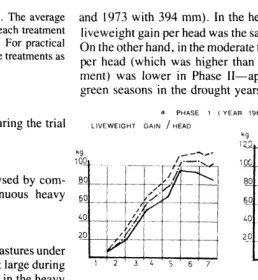
The liveweight gain per head was higher in the pastures under moderate stocking density. The difference was not large during
the green season (Table 3): 0.69 kg.head-*.day-* in the heavy MONTH
stocking treatment compared with 0.76 kg.head-‘.day-’ in the
moderate treatment. During the dry season the difference was b PHASE 2 ( YEAR 1972 ) greater, because the daily average increase per head in the
moderate stocking density was 0.04 kg, whereas in the heavy LIVEWEIGHT GAIN /HEAD LIVEWEIGHT GAIN /HA intensity treatment the animals lost weight, especially during
the last month of the grazing season. The cattle began to lose weight when the amount of pasture biomass dropped below 700 kg dry matter. ha-‘. In spite of these low pasture biomass values, the body condition of the cattle in the heavily grazed plots was satisfactory. There were no clear differences between treat- ments in the percentage of cows that came into calf.
Phuse II (1971-1973): MONTH
The same treatments were compared and the results were Fig. 2. Average liveweight gain ojdry beejcows in two seasons, representative similar to those of Phase I. Two of the three years in Phase II
were L 6&_ought7 7 years ( 1 972 with 45~ mm poorly distributed
JOURNAL OF RANGE MANAGEMENT32(2), March 1979
oj each phase of the experiment. Grazing treatments:
-- *~--*-- rotational moderate; --@--@--o rotationaf heavy;
--- continuous moderate; --- continuous heavy.
Table 3. Animal density and production parameters in the green and dry season.
Stocking
Grazing rate
treatment (head. ha-‘)
a. Treatment Phase 1 (1964- 1970)
Rotational 0.8
moderate
Grazing pressure (grazing days. ha-‘)
150
Daily liveweight Daily metabolizable
gain energy requirement
(kg head-‘) (Mcalshead-‘)
Green Dry Green Dry
season season season season
0.72 0.04 17.0 11.6
Continuous moderate
0.7 140 0.76 0.04 17.5 12.0
Continuous heavy
1.2 236 0.69 -0.03 16.7 11.3
b. Treatment Phase 2 (1971-1973)
Rotational 1.3
heavy
253 0.52 -0.05 13.7 10.8
Continuous moderate
0.8 153 0.56 0.17 14.2 11.4
Continuous heavy
1.3 245 0.59 -0.06 14.5 10.8
stocked paddocks, the smaller amount of pasture biomasss
which was available per head for grazing, rather than the length of the green season seemed to limit the total seasonal liveweight increase per head in both phases.
ments (Table 2). The results are similar to those obtained in grazing trials in the western U.S.A. (Heady 196 1; Murray and Klemmedson 1968).
Li\reweight Gain per Unit Area:
The liveweight gain per unit area was higher in the heavily stocked paddocks. The results of Phases I and IT are similar: 61 and 64 kgeha-’ in the moderate stocking densities and 83 and 94
kg-ha-* in the heavy stocking density. Within the range of stocking densities applied in this trial, the liveweight increase per unit area was in almost direct relationship to the grazing pressure.
Pasture productivity in terms of utilized metabolizable energy (ME) is calculated as total requirements of the cattle for maintenance and liveweight gain during the grazing season. The results (Table 2) showed that the pasture productivity was higher in the heavy stocking density. At the heavy stock density, the productivity of range relative to moderate stock density did not decline after 10 consecutive years (Table 2).
During the green season the cattle in the rotational grazing treatment gained slightly less per head than those in the continuous grazing treatment; the difference was not significant but fairly consistent (Table 3). It appears that toward the end of each grazing period, in each rotational sub-unit, the feed available during the green season was insufficient for the livestock to maintain their potential liveweight increase. During the same period, feed was abundant in the continuous treatment. As the animal density was the same in the two systems (rotational moderate compared with continuous moderate in Phase I, and rotational heavy compared with continuous heavy in Phase II) and the differences in liveweight increase per head were very small, there were no significant differences in the liveweight gain per unit area or in range production measured as metabolizable energy per unit area.
If one adds the 1 O-year mean ME value of the residual litter at at the end of the grazing season (assuming 1.5 Mcalekg-’ dry-matter, A.R.C. 1965) to the ME utilized, the difference between heavy and moderate grazing becomes very much reduced: 4300 Mcalaha-i in the heavy treatment and 3900 Mcal*ha-’ in the moderate. These results differ from those of many grazing trials conducted with similar vegetation in the western U.S.A. (Beetle et al. 1961; Klipple and Costello 1960; Launchbaugh 1957; Lewis et al 1956). The range productivity was relatively stable in spite of wide seasonal fluctuations in rainfall. The average ME utilised by the cattle during the grazing season in the heavy stocking density, was 3,350 Mcal-
*ha-’ (S.D. +340), with minimum and maximum values being 84.7% (1973) and 112% (1964) of the mean.
Vegetation Responses to Stocking Density
Cattle Responses to Rotational Grazing
The effect of grazing rotation on cattle and vegetation was studied under moderate and heavy stocking densities (Phase I and II, respectively). In both phases the liveweight increase per head was lower in the rotational than in the continuous treat-
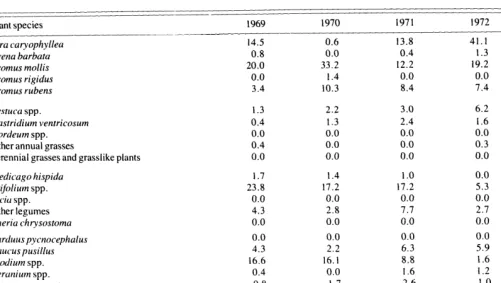
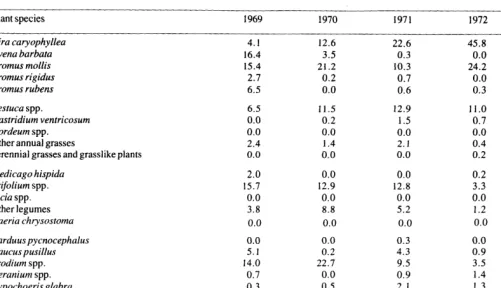
The botanical composition in all the paddocks at the be- ginning of the grazing treatment was similar (Fig. 3). During the first 2 years of the trial, no significant changes occurred, but after the third year the forbs began to increase in the continuous heavy treatment. As the relative cover of the forbs increased, the cover of the grasses decreased. After 5 years an equilibrium was reached and subsequently only small yearly fluctuations were observed. The relative cover of the legumes was not affected by the grazing treatments, but marked yearly variations occurred (Fig. 3), apparently due to the climatic conditions during seed set and germination (Quinlivan 1968). The amount of ungrazed vegetation at the end of the grazing season was greater in the moderate grazing treatment than in the heavy one (Table 2), but the amount of dead vegetation had no measurable influence on the growth in the subsequent season. Similar results were obtained by Weaver and Rowland (1952). At the beginning of the grazing season (January) the total cover of the herbaceous vegetation was similar in all the paddocks. No discernible influence of the grazing treatments was observed on the cover of
density in the rotational treatment was increased from moderate to heavy. After 3 years the relative cover of grasses was almost the same in the heavy rotational treatment (originally moderate rotational with high grass cover) as in the moderate continuous one. It appears that grasses persist better and even increase under rotational grazing compared with continuous grazing, but increasing stock density-even under rotational grazing- causes a reduction in the cover of grasses (Driscoll 1967; Rossiter 1952; Smith et al. 1967).
At the end of the grazing season there was consistently and significantly more litter in the rotationally grazed paddocks than in those grazed continuously. This appears to be due not only to more vegetative growth under the rotational treatment but also to the fact that the cattle apparently grazed less, as evidenced by the lower weight gains in these treatments.
Discussion and Conclusions
The heavy stocking density in this experiment was 1.2 dr-v cows .ha-’ or 1 .O cow-calf units .h-’ (Paulsen and Area 1962). Corrected for yearlong grazing, this is equivalent to about 0.7 cow-calf units a-‘, compared to 0.3-0.4 cow-calf units-ha-l
previously proposed for the region by the local extension service. Production under heavy grazing was maintained for 10 consecutive years. This result must be viewed in the light of the fact that the native vegetation has been grazed continuously since Biblical times (Seligman and Tadmor 1972). The species that have evolved and survived under these conditions can clearly withstand heavy grazing pressure. A very diverse flora-over 250 common species at Kare Deshe alone (Seli- gman and Gutman 1976)--must also contribute to the viability
0
C. FORBS and flexibility of the vegetation under grazing.-00 The stability of the pasture productivity from year to year was
due partly to deferring grazing for about 6 weeks after germin- ation and partly to the length of the grazing season, which extended almost to the end of the dry period, when the plants are dead or dormant. As a result, the consumption rate of pasture during the green season (about 11 kg .ha-*.day-‘) was much less than the growth rate throughout the period when it was grazed (20- 100 kg. ha-’ .day-I). The amount of dead vegeta- tion had no measurable influence on the new growth in the subsequent season, so that heavy utilisation of the dry standing biomass increased rather than reduced secondary production. It should, however, be pointed out that the basaltic protogrumo- sol, with additional protection from the rock cover, is very
IO resistant to erosion, and litter cover plays a small role in this
1964 1965 1966 1967 , 1968 1969 1970 197l 1972 '973 1974 regard.
YEAR The calves in the region are weaned during May-June. Most
Fig. 3. EfJect ojgrazing treatments on botanical composition of the herbaceous of the differences in live-weight increase per head between the
sward. (Key to grazing treatments as in Fig. 2). continuous heavy and continuous moderate treatments occurred
the hemicryptophytic dicotyledons-PPsoralea bituminosa and
during July and August. It is thus likely that production would have been higher with suckling cows, even after correction for
Echitlops viscosus. stocking density for the greater requirements of the cow-calf
Vegetation Responses to Rotational Grazing
At the moderate stocking density, the relative cover of grasses was higher in the rotationally grazed paddocks than in the continuously grazed ones. At the beginning of Phase II (197 1 ), the botanical composition in the paddocks with the heavy stocking treatments (rotational and continuous) was different, due to the different treatments in the preceding Phase I. Consequently, it is possible to compare the trend in botanical composition of the paddocks due to the change in treatments. The relative cover of the grasses dropped when the stocking
unit.
No important differences in cattle production per unit area between the rotational and continuous grazing systesm were observed. The principal possible advantage of the rotational grazing was the higher amount of ungrazed vegetation at the end of the grazing season that could have been utilised. At heavy stocking densities, it is thus possible to extend the dry grazing seasons in the rotationally grazed paddocks for a longer period than in the continuously grazed ones.
In some years the residual vegetation was grazed to obtain an estimate of its value. Daily intake of dry pasture was calculated
by dividing the reduction in the amount of litter during the residual grazing period, (i.e. the difference in the amount of litter on the ground at the beginning and end of the period) by the number of grazing days in the same period. It was found that the cattle intake during the dry season was approximately 4-5 kg dry matter per head per day, about half that consumed per day in the green season. The amount of grazable vegetation left in the rotational heavy treatment, over and above what was left in the continuous heavy treatment, was 350 kg-ha-’ (Table 2). Accordingly, with 1.2 head .ha-’ it was possible to graze another 5 days in the rotational treatment. Thus, when the animals are to be kept all the year long on the pasture, there is a possible advantage to rotational grazing that was not covered by this trial. However, for systems where seasonal use-especially green season use-is made of the pasture, there appears to be no obvious benefit from rotational grazing.
In the rotationally grazed paddocks, there wre more grasses and fewer forbs than in the continuously grazed paddocks. Nevertheless, the production in the continuously grazed pad- docks did not drop in spite of the high proportion of forbs. Thus, in the Mediterranean steppe range, botanical composition alone is a poor indicator of the productivity of a pasture.
An important advantage of rotational grazing is that where fire is a hazard-as in our region-those paddocks most exposed
can be grazed down early in the dry season. Thus, the choice of grazing system will depend on many factors: type of cattle, grazing season, fire hazard, herd management; etc.; but pro- duction from a given area seems to depend more on the animal density than on the grazing system.
Literature Cited
A.R.C. 1965. Nutrient requirements of farm livestock: Technical review no.
2, Ruminants. Agricultural Research Council, London, U.K.
Baker, G.A., and H.R. Guilbert. 1942. Non-random variations in daily weight of cattle. J. Anim. Sci. 4:293-299.
Beetle, A.A., W .M. Johnson, R.L. Lang, M. May, and D.R. Smith. 1961.
Effect of grazing intensity on cattle weights and vegetation of the Bighorn Ex-
perimental Pasture. Wyo. Agr. Exp. Sta. Bull. 373.
Campbell, N.A., and G.W. Arnold. 1973. The visual assessment of pasture yield. Aust. J. Exp. Agr. Anim. Husb. 13: 263-267.
Dan, I., and Z. Raz. 1970. The soil association map of Israel. Ministry of Agriculture, Israel, Tel Aviv. 147 p.
Driscoll, R.S. 1%7. Managing public rangelands: Effective livestock grazing practices and systems for national forest and national grasslands. U.S. Dep. Agr. AiB-315.
Evans, R.A., and R.M. Love. 1957. The step-point method of sampling-a
practical tool in range research. J. Range Manage. 10: 208-212.
Heady, H. 1961. Continuous vs. specialized grazing systems. A review and
application to the California Annual Type. J. Range Manage. 14: 182-193.
Klipple, G.E., and D.F. Costello. 1960. Vegetation and cattle responses to different intensities of grazing on short grass ranges on the Central Plains. U.S. Dep. Agr. Tech. Bull. 1216.
Launchbaugh, J.L. 1957. The effect of stocking rate on cattle gains and on
native shortgrass vegetation in West-Central Kansas. Kansas. Agr. Bull.
Exp. Sta. 394.
Levy, D., and Z. Holzer. 1971. The relative value of concentrates and
roughage for fattening cattle. Anim. Prod. 13: 569-579.
Lewis, F.K., G.M. Van Dyne, L.R. Albee, F. W. Whetzal. 1956. Intensity of
grazing. Its effect on livestock and forage production. S. Dak, State Coil.
Agr. Exp. Sta. Bull. 459.
Morin, J., M. Agasi, and L.A. Michaeli. 1976. Rainfall runoff and erosion relationships in the Lake Kinneret watershed. Internal report No. 41.
Soil Conserv. and Drainage Div., Res. Unit, Tel Aviv. (in Hebrew).
Murray, R.B., and J.O. Klemmedson, 1968. Cheatgrass range in southern
Idaho. Seasonal cattle gains and grazing capacities. J. Range Manage 21:
308-313.
Naveh, Z. 1967. Mediterranean ecosystems and vegetation types in California
and Israel. Ecology 48: 445-459.
Naveh, Z. 1970. Effect of integrated ecosystem management on productivity of a degraded Mediterranean hill pasture in Israel. Proc. 11 th Int. Grassland
Congr., Surfers Paradise, Australia 1970, p 59-63.
Paulsen, H.A., and F.N. Ares. 1962. Grazing values and management of black grama and toboso grasslands and associated shrub ranges of the South- west. U.S. Dep. Agr. Tech. Bull. 1270.
Pechanec, J.F., and G.D. Pickford. G.D. 1973. A weight-estimate method
for determination of range pasture production. J. Amer. Sot. Agron. 29:
894-904.
Quinlivan, B. J. 1968. Seed-coat impermeability in the common annual legume pasture species of Western Australia. Aust. J. Exp. Agr. Anim. Husb. 35: 695-701.
Rossiter, R.C. 1952. The effect of grazing on a perennial veltgrass-sub- terranean clover pasture. Aust. J. Agr. Res. 3: 7-15.
Seligman, N., and M. Gutman. 1976. Effect of grazing systems on the pro- ductivity of herbaceous range in the Mediterranean climatic zone of Israel. 1.
Experiments conducted at Kare Deshe, 1960-1970. Pamph. Agr. Res.
Organiz. Bet Dagan 15 1. (Hebrew, with English summary).
Seligman, N., and N.H. Tadmor, 1972. Natural pastures. Encyclopedia of
Agriculture, Tel Aviv, Vol. 2: 238-244 (Hebrew).
Seligman, N., N.H. Tadmor, Z. Raz. 1962. Range survey of the Central
Negeu Highlands. Nat. Univ. Inst. Agric. Bull. 67 (Hebrew and English
summary).
Smith, D.R., H.G. Fisser, N. Jefferries, and P.O. Stratton. 1967. Rotation
grazing in Wyoming’s Bighorn Mountains. Wyo. Agr. Exp. Sta. Res. J. 13:
26 v.
Sonnen, P.J. 1952. Die Beduinen am See Genesareth. Druck und Verlag.
J.P. Bachem, Kdln.
Tadmor, N.H., A. Brieghet, I. Noy Meir, R. W. Benjamin, and E. Eyal. 1975. An evaluation of the calibrated weight-estimate method for measuring
production in annual vegetation. J. Range Manage. 28: 65-69.
Tadmor, N.H., E. Eyal, and R.W. Benjamin. 1974. Plant and sheep
production on semi-arid annual grassland. J. Range Manage. 27: 427-433.
Vilnay, Z. 1953. Guide of Israel. Ed. Z. Vilnay, Jerusalem.
W agnon, K.A., H.R. Guilbert, and G.H. Hart. 1959. San Joaquin Experi- mental Range. Calif. Agr. Exp. Sta. Bull. 765.
Weaver, J.E., and N.W. Rowland. 1952. Effect of excessive natural mulch
on development, yield and structure of native grassland. Bot. Gaz. 114:
I-12.
Zohary, M. 1973. Geobotanical Foundations of the Middle East. Vols. 1 and 2.
Gustav Fischer Verlag, Stuttgart, and Swets and Zeitlinger, Amsterdam.