July/2000
The 13ö
EUROΕΥ ΡΩ
REPORT
EDITED BY THE INSTITUTE FOR PROSPECTIVE T E C H N O L O G I C A L STUDIES (IPTS)A N D ISSUED I N C O O P E R A T I O N W I T H E U R O P E A N S&T O B S E R V A T O R Y NE
a t ó á S ^ * ^
.¿iff .-*
tPxMbäA
q
ES.
wm*.
rsTo
ESTO: EST(
, J > ; E S T O ESTO ESTO .
¿JESTÖ ESTO ESTO EST
fc>jESTO ESTO ESTO E
Ό ESTO* ESTO ESTO EST
O ESTO ESTO ESTO ESTO E¡
ESTO ESTO ESTO ESTO EST«
„ T O ESTO ESTO ESTO ESTO E
STO ESTO ESTO ESTO ESTO EST
O ESTO ESTO ESTO ESTO ESTO E
-rifca£
O ESTO ESTO ESTO ESTO
m
Ό
ESTO ESTO ES'
ESTO ESTO E^
TO ESTO ESTO
.ESTO ESTO ES
TO ESTO ES
7' ESTO ESTO
1
ESTO
:STO ESTO
"STO ESTO E !
S T Í ^ E S T O
Έ 5 τ ι
o ESTO ESTO E
STO ESTO E S ~ '
E S T Q > £ S m
D ESTO EST
O EST(
EST
.*
'■^ψψ*
4 · yrr\
World Trade negotiations after
j j Seattle: The road from here
Dimitris Kyriakou and Giorgio Di Pietro
-J An Analytical Framework for
"
)
Assessing Sustainable Urban Mobility
Laura Lonza and Héctor Hernández
')
The .eu Domain: Issues for a
'J
Pan-European Registry Organization
Daniel J. Paré
21
Uncertainty and the Scientific
Basis for Decision-Making
Hansvolker Ziegler
f j λ
Science & Technology and Governance
_^j-_r of the Euro-Mediterranean Partnership
Giorgio Di Pietro, Khaled Elshuraydeh,
Sergio Gomez y Paloma and Mario Zapacosta
r\f\
Lifelong Learning: Beyond
/
-J
Education and Training
Odd Björn Ure and James P. Gavigan
EUROPEAN COMMISSION
Joint Research Centre
T h e I P T S R e p o r t
A B O U T T H E I P T S R E P O R T
r
he IPTS Report is produced on a monthly basis - ten issues a year to be precise, since there
are no issues in January and August - by the Institute for Prospective Technological Studies
(¡PTS) of the pint Research Centre QRC) of the European Commission. Tl)e ¡PTS formally
collaborates in the production of the IPTS Report with a group of prestigious European institutions,
forming with IPTS the European Science and Technology Observatoiy (ESTO), it also benefits from
contributions from other colleagues in theJRC.
The Report is produced simultaneously in four languages (English, French, German and
Spanish) by the IPTS. The fact that it is not only available in several languages, but also largely
prepared and produced on the Internet's World Wide Web, makes it quite an uncommon
undertaking.
'¡he Report publishes articles in numerous areas, maintaining a rough balance between them,
and exploiting interdisciplinarity asfar as possible. Articles are deemed prospectively relevant if
they attempt to explore issues not yet o?i the policymaker's agenda (but projected to be there sooner
or later), or underappreciated aspects of issues already on the policymaker's agenda. The
multi-stage drafting and redrafting process, based on a series of interactive consultations with outside
experts guarantees quality control.
The first, and possibly most significant indiaitor, of success is that the Report is being read. 'Tl)e
issue 00 (December 1995) had a print run of 2000 copies, in what seemed an optimistic
projection at the time. Since then, readership of the paper and electronic versions has far exceeded
the 10,000 mark. Feedback, requests for subscriptions, as well as contributions, have come from
policymaking (but also academic and private sector) circles not only from various parts of
Europe but also from the US, japan, Australia, Latin America, N. Africa, etc.
We shall continue to endeavour to find the best ivay offidfüling the expectations of our quite
diverse readership, avoiding oversimplification, as well as encyclopaedic reviews and lhe
inaccessibility of academic journals. The key is to remind ourselves, as well as the readers, thai
we cannot be all things to all people, that it is important to carve our niche and continue
optimally exploring and exploiting it, hoping to illuminate topics under a new, revealing light for
the benefit of the readers, in order to prepare them for managing the challenges ahead.
T h e I P T S R e p o r t
N
N
J U L Y 2 0 0 0
EDITED BY THE INSTITUTE FOR PROSPECTIVE TECHNOLOGICAL STUDIES <IPTSI And issued in Cooperation with the European S&T Observatory Network PUBLISHED BY THE EUROPEAN COMMISSION
Joint Research Centre ISSN: 1025-9584 Catalogue Number CK-AA-OO-006-EN-C
DEPOT LEGAL· SE-1957-95 DIRECTOR Jean-Marie Cadiou EXECUTIVE EDITOR
Dimitris Kyriakou EDITORIAL BOARD B. Clements. C. Fahrenkrog, J. Gavigan, M. Gonzalez. H. Hernández. D. Kyriakou. I. Maghiros
(Production Manager), P. Sørup, A. Soria. C. Tahir. PRODUCTION
CINDOC-CSIC/L&H Spain PRINT Graesal TRANSLATION CINDOC-CSIC/L&H Spain
COPYRIGHT
The views expressed in this publication do not necessarily reflect those of the European Commission
O ECSC-EEC-EAEC Brussels-Luxembourg, 1997 Reproduction is authorised, except for commercial
purposes, provided the source is acknowledged. The EC may not be held responsible for the use
made of the information. THE IPTS REPORT
is published in the first week of every month, except for the months of January and August, it is edited
in English and is currentiy available at a price of 50 EURO per year, in four languages: English,
French. German and Spanish. SUBSCRIPTIONS For a subscription to The IPTS Report, or to amend an existing subscription, please
write with full details to: The IPTS Report Secretariat
IPTS, JRC Sevilla World Trade Center
Isla de la Cartuja E-41092 Sevilla. Spain Tel: +54-95-448 82 97 Fax:+34-95-448 82 95 E-mail: ipt5_secrejrc.es
Web address: www.jrc.es/iptsreport/subsaibe.html
Editorial. World Trade negotiations after Seattle: The road from here
Transport
An Analytical Framework for Assessing Sustainable Urban Mobility
The urban mobility agenda needs to take social, economic and environmental aspects of mobility into account. Therefore, urban policy-makers need sound evaluation frameworks to help them balance potentially conflicting objectives.
i n f o r m a t i o n and Communication Technology
13 The .eu Domaln: Issues for a Pan-European Registry Organization
The European Commission's proposal to create a .eu top-level domain has sparked a controversy about whether this is the right way to tackle the naming problem, and if so how the .eu domain should be set up and managed.
Science and Governance
21 Uncertainty and the Scientific Basis for Decision-Making
The scientific establishment is having to adapt to a new situation in which it is increasingly called upon to deal with uncertainty. This has implications for the way science advice is delivered to policy-makers.
24 Science & Technology and Governance of the Euro-Mediterranean Partnership
In the context of the evolving free-trade area being created by the Euro-Mediterranean Partnership, science and technology (S&T) has the potential to play a key role in strengthening the region's social and economic integration.
Training and Skills
29 Lifelong Learning: Beyond Education and Training
Although the need to encourage lifelong learning is generally acknowledged, concrete action has often been disappointingly slow. Identifying bottlenecks and problems may help galvanize more effective action.
T h e I P T S R e p o r t
2
,
E D I T O R I A L
World Trade negotiations after Seattle:
The road from here
D i m i t r i s K y r i a k o u a n d G i o r g i o Di P i e t r o , IPTS
I
n the editorial of the April issue (43) of 'The IPTS Report' we argued that the abortive Seattle WTO meetings signalled a failure ofa kind unseen in previous trade negotiations.
In past rounds impasses reached usually involved
technical/legal issues, which specialists could
(and did) revisit, in order to sculpt a carefully
worded, consensus-seeking text. Such impasses
did not question the fundamental continuity of the
process. In Seattle however, there were deep
political divisions, with the less developed
countries (LDCs) appearing uncharacteristically
united. There was denunciation of the
procedures, and not just the texts. There was little
scientific and technical (S/T) preparation, both
overall as well as on specific issues, to help clarify
the terms of the debate, the stakes, the
repercussions of alternatives considered. Policy
choices did not ground their legitimacy in an
S/T-informed process, and failed to look more than
the result of power struggles, untamed by
cool-headed analysis.
Reduced legitimacy opened up the way to attacks on the organization itself, and even public
outcry on the streets by groups which descended on the city, stinging the WTO like a swarm of
bees. Even if their protests played a small role in
producing the debacle, they may well feel they have made their mark, won this battle and be
emboldened for similar undertakings in the future
against other international organizations which
should be prepared for such an eventuality (the
experience of the World Bank and IMF may be
informative here).
Moreover we suggested that it was easier when trade round targets were numerical and hardly
something against which to rally wide support. Reducing tariffs from 20 to 10% does not touch
on what a country stands for; labour standards,
food safety, environmental treatment come much closer to the hard core of sovereignty, the values
by which a society lives. Past rounds (especially the previous one) conveniently postponed thorny
issues for future rounds. As we reach the hard core
of resistance against making everything secondary to trade expansion, the cost of going that extra
liberalization mile rises very steeply.
Before we set our hopes too high on a serious relaunching effort before the US elections, we
should take a few considerations into account: First, sufficient time should be given to allow
experts to lay the groundwork to ensure success, to
avoid another, even more devastating, ministerial level failure. Second, one must realistically assess
the political incentives of US leaders in the next few months. Although in Davos US President
Clinton endorsed a renewed effort towards a new
T h e I P T S R e p o r t
trade round, his reassertion of the importance of environmental and labour issues recalls the
difficulties encountered in Seattle. Moreover, these issues appeared again in his last State-of-the-Union
address as US President, where he effectively
outlined what he may consider central elements of his legacy, and issues for his vice-president to
campaign on. Thinking towards November, the US Reform Party which did extremely well in 1992 on
a protectionist agenda will make Clinton/Core
unwilling to risk giving away an important part of their support base to a protectionist Reform party
candidate.
The wise approach then would be to move
very cautiously on issues where there is already apparent agreement: reviewing WTO procedures,
increasing transparency, providing technical
assistance to LDCs, instead of letting NGOs do it, enhancing confidence in the WTO, and
addressing pending/urgent issues (relaxing quotas, electronic commerce, etc.). Moreover, whenever
a new meeting does take place, the organizers
will likely exhibit less fanfare, and choose a site which is neither in the US nor the EU. The latter
attract both demonstrators and media; they also allow powerful headlines and dismay among the
population, in case of protests.
More generally, the WTO may be a victim of its own meteoric rise: the WTO may have become too
powerful too fast, threatening dearly-held paragons
of sovereignty. It has enforceability powers unprecedented for a non-military international
organization. It will either adapt by taking on more dimensions (such as environment, labour
standards, etc.) of issues into consideration,
effectively taking on more powers; or it will accept a gradual diminution of its power, allowing
countries exemptions from enforcing its rulings, until its decisions assume a moral value, rather than
a binding character. The third option that some
entertain will keep the WTO as is and create other
forums for environmental, labour, food safety, etc.
issues. However this would imply that such institutions should be able to enforce their rulings,
and when their rulings run contrary to those of the
WTO, because of their different emphases/ priorities, the result could well be paralysis.
In order to defend itself against attacks the WTO may try to co-opt NGOs (and recent
suggestions for bringing them from the streets to the boardroom point this way), just like the World
Bank did after it was attacked in 1994, involving
them in much of what it does. It will be however harder for the WTO; it does not have the
resources of the World Bank, and it will need to convince reluctant member states to increase its
budget. It will not be surprising nevertheless if the
WTO starts subcontracting studies to NGOs, jointly launching projects with them, and helping
them finance activities in the future.
Beyond the above implications, specific to the WTO and the trade round, there are two more
general ones. First, NGOs and anti-globalization
activists have emerged stronger. The NGOs can swarm targets, coordinate attacks, and galvanize
diffuse discontent in media-savvy ways. The talks may have provided inadvertently the catalyst for
authority-questioning coalitions, even across
national, linguistic, and other borders. They may even have enunciated an opposite pole to those
perceived to have overwhelmingly benefited from liberalization and rising capital mobility so far.
Maybe, after all, like most games, globalization is
a game at which two can play.
Second, the Seattle failure has been a sharp reminder of the importance of bringing sound
science closer to, and integrating it into, sound
governance, in a way that is accountable, transparent, thorough, impartial and credible, and
which will help focus the policy debate on the merits of proposed actions. Such integration will
3
T h e I P T S R e p o r t
4
provide reference quality information and analyses, presenting in a distilled, user-friendly fashion what
we know, what we do not know, and the extent of the uncertainties and risks involved in different
actions. The Seattle talks suggest a glaring example
of this need. Back in the early nineties the US Food & Drug Administration (FDA) gave its approval to
the marketing of genetically modified food in the US. There was little if any
collaboration-coordination with European-level counterparts.
Given recent suggestions that due to mounting pressure in the US the FDA may re-examine the
issue, one can wonder whether early contact between the FDA and a European level organization
might not have averted a quick approval by the
FDA, and ultimately the trade tensions regarding genetically modified food. Collaboration at an S/T
level might have ironed out differences, or at the very least, allowed better early warning and more
time to deal with trade issues.
Contact
Dimitris Kyriakou, IPTS
Tel.: +34 95 448 82 98, fax: +34 95 448 83 26, e-mail: [email protected]
T h e IPTS R e p o r t
An Analytical Framework for
Assessing Sustainable Urban Mobility
Laura Lonza and Hector Hernández, IPTS
Issue: The Urban Mobility Agenda has broadened its scope from just transport Issues to Its present holistic approach Including social, economic and environmental aspects of mobility. That is why urban mobility measures should be systematically and comprehensively assessed, with attention given to 'impacts' rather than 'outputs'.
Moreover, the evaluation process needs to be transparent.
Relevance: within the broad goal of sustainable development, urban policy-makers need sound evaluation frameworks to help them balance conflicting policy objectives such as fostering economic development and minimizing environmental stress. This need Is particularly felt when tackling urban mobility, where dynamic information patterns are
required to ensure monitoring of progress and to keep policy-makers constantly up-to-date.
introduction
ustainable Development has permeated
policy-making at all levels'. The application
of the sustainable development concept to urban areas is essential for a number of
reasons. In economic terms, these reasons include the fact that cities are the engines of growth and
centres of power. In environmental terms, urban
areas pose serious challenges and place increasingly heavy burdens on the global
environment (e.g. in terms of climate change), particularly in relation to the balanced use of
resources and disposal of pollutants. And in social
terms, urban areas shape lifestyles and are the prime reactors to change. Moreover, the phenomenon of
urbanization is a growing worldwide, making the issues it raises yet more pressing.
Mobility in urban areas is closely linked to the economic, environmental and social aspects of life
in cities and it is part of what enables them to be vital centres of activity. Moving towards sustainable
urban mobility means mitigating the negative
externalities of transport, such as air and noise pollution. It also calls for resource conservation,
reducing energy consumption, easing congestion and resolving equity concerns.
The first part of the article presents an analytical
framework to appraise sustainable mobility policy measures in urban areas. Existing research trends
and results point in the direction of cross-sector2 in-tegration as the solution to the sustainability riddle.
A set of criteria derived from the application of
the analytical framework is presented in the
5
X
Mobility in urban areas
is closely linked to the
economic, environmental
and social aspects of life
in cities and contributes
to their mie as vital
centres of activity
T h e IPTS R e p o r t
Effective handling of
cross-sector issues
requires an
impacts-driven appmach to
public policy, wliere
structures, systems and
processes are designed
around tlie policy
problem to be solved
rather than having the
problem defined in terms
of the existing system
The framework for
analysis proposed here
aims to identify and
characterize drawbacks
and success factors for
evaluation
Figure 1. Analytical Framework f or Urban Mobility
REGULATORY
SYSTEM
URBAN AREA
EU
National
Regional
Local
Transport &
Mobility
Urban
Dynamics
Environment
Air Quality Noise Levels
Social
Accessibility Equity Quality of Life
Economic
Accessibility City Viability
second part. Strengths and weaknesses of specific
measures for improved urban mobility are
identified. Good-practice examples are taken
from a range of urban mobility policy and
technical measures to illustrate the criteria
outlined.
A framework for analysis
An analytical framework is a useful way of
drawing attention to the public policy system as a
whole and to the need to see cross-sector issues as
being characteristic of the policy system. Better
handling of cross-sector issues is not just a matter
of better tools and techniques, although they have
their place, but of a fundamentally different
approach to government. It seems that effective
handling of cross-sector issues requires an
impacts-driven approach to public policy, where
structures, systems and processes are designed
around the policy problem to be solved rather
than having the problem defined in terms of the
existing system. Moreover, a framework for
analysis is useful in that it helps to identify limiting
factors and critical areas for intervention, define
priorities, and provide a balanced view of the
impacts of policy actions within a specific urban
context. A schematic representation of an
Analytical Framework for urban mobility is
presented in Figure 1, showing the main areas and
levels of competence concerned, together with
their interactions.
Because each urban area is different, there can
be no single quick-fix solution. The framework for
analysis proposed here aims to identify and
characterize drawbacks and success factors for
evaluation. An inductive approach has been
adopted, using indicators providing information
so as to take into account the unique characteristics of each urban area.
From the analytical framework to
indicators
The assessment of transport policies and their
impacts on sustainability implies the need to
represent complex phenomena. A set of indicators
based on quantifiable and available information
can provide concise information highlighting
T h e I P T S R e p o r t
what is happening in a large system, giving the
opportunity to compare across sites and a useful
and relatively quick way of displaying reality.
Indeed, provided a number of criteria are
respected, indicators can offer a reliable
representation of systems.
Indicators make it possible to present results to
nontechnical experts such as policymakers and
citizens in a 'catchy' way, as well as allowing com
parisons. Sound criteria must be considered when
selecting indicators: (1) close correlation to the
objectives set in order to achieve sustainable mobi
lity; (2) quantitative and monitored data; (3) available
—or easily obtainable— and reliable information; (4)
close correlation with policy agenda and
organizational schemes; (5) transparency, and
avoidance of biases in favour of specific interests.
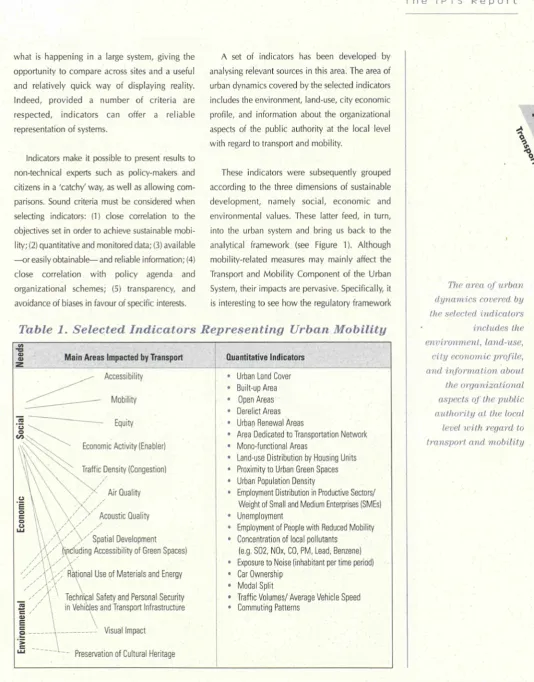
A set of indicators has been developed by
analysing relevant sources in this area. The area of
urban dynamics covered by the selected indicators
includes the environment, landuse, city economic
profile, and information about the organizational
aspects of the public authority at the local level
with regard to transport and mobility.
These indicators were subsequently grouped
according to the three dimensions of sustainable
development, namely social, economic and
environmental values. These latter feed, in turn,
into the urban system and bring us back to the
analytical framework (see Figure 1). Although
mobilityrelated measures may mainly affect the
Transport and Mobility Component of the Urban
System, their impacts are pervasive. Specifically, it
is interesting to see how the regulatory framework
Table 1. Selected Indicators Representing
Urban Mobility
(A
-a
to Main Areas Impacted by Transport
^ ^ Accessibility
__— Mobility
•2 Equity
Economic Activity (Enabler)
\ \ \ \ \ Χ . Traffic Density (Congestion)
\ \ \
\
Ì * Air Quality
■
8 W W
/
e 1 \ \ / y Acoustic Quality
8 \\ \ / V x
LU \\ γ /\ y
\ \ / y y Spatial Development
\v'' (including Accessibility of Green Spaces)
/ΆΥΛ
'/ A y , Rational Use of Materials and Energy
/
/ \ \ \
_ / y \ Technical Safety and Personal Security 3 / ι in Vehicles and Transport Infrastructure
i
\ \
o 1 Visual Impact
I - \
* " - Preservation of Cultural Heritage
Quantitative Indicators
• Urban Land Cover • Built-up Area • Open Areas • Derelict Areas • Urban Renewal Areas
• Area Dedicated to Transportation Network • Mono-functional Areas
• Land-use Distribution by Housing Units • Proximity to Urban Green Spaces • Urban Population Density
• Employment Distribution in Productive Sectors/ Weight of Small and Medium Enterprises (SMEs) • Unemployment
• Employment of People with Reduced Mobility • Concentration of local pollutants
(e.g. S02, NOx, CO, PM, Lead, Benzene) • Exposure to Noise (inhabitant per time period) • CarOwnership
• Modal Split
• Traffic Volumes/ Average Vehicle Speed • Commuting Patterns
X
The area of urban
dynamics covered by
the selected indicators
includes the
environment, land-use,
city economic profile,
and information about
the organizational
aspects of the public
autliomly at the local
level with regard to
transport and mobility
[image:9.558.12.547.26.708.2]T h e IPTS R e p o r t
8
/
A number of factors
have been identified as
being important for
success when analysing
urban mobility
measures ivith the
pmposed framework,
such as long-term
evaluation,
coordination of
transport and spatial
development, and
competence levels
maintaining a specific focus on mobility is not
contradictory. Additionally, the diversity of urban
realities makes it highly desirable —although
extremely difficult— to transfer experiences.
To achieve sustainable mobility in urban areas,
many trade-offs must be faced. It is up to local
decision-makers to recognize shortcomings and
engineer them out of the urban mobility system.
Therefore success depends on an integrated
approach to closely related policy areas. is implicated in the process at the local level but
also at the regional, national and EU level.
Using the analytical framework:
relevant criteria
Despite the need to substitute functional
separations with a holistic approach in urban policies, in-depth analysis is still crucial in order
to establish the links between sectors of intervention and areas of impact. Therefore,
Box 1: The Strasbourg Experience
The Urban Community of Strasbourg adopted in 1989 a far-reaching policy to modify transport patterns and urban space usage. Referring to the analytical framework, intervention on the Transport & Mobility component took place affecting Urban Dynamics. The overall goal was split into three objectives: reducing private car traffic (accounting for 72.5% of urban transport in 1989); increasing public transport use (11% of urban transport in 1989); and, if possible, increasing the use of bicycles (approximately 12% in 1989). Acceptability was checked via a household survey in 1989.
In 1995, public transport services (trams and buses) were meeting the identified targets of a 30% increase compared to 1992 with a 32% increase in passengers, around 50% of them using park-and-ride facilities, which proves the popularity of the mix of measures. In 1995, traffic entering the wider city centre had decreased by 17% compared to 1992. Since 1997, a study has been under way involving the regional and national levels to see how public transport could be made more attractive in urban and suburban areas via improved co-ordination of rail and tram services.
The objectives were achieved via a mix of measures, ensuring a balanced impact on the three dimensions of sustainability. Accessibility and equity grew thanks to increased transport alternatives. The city gained in terms of the attractiveness and economic viability of its centrally located
businesses through improved accessibility and its image of a forward-looking, dynamic urban area. Environmental quality improved thanks to the reduction in through-traffic.
Strategic objectives were clearly identified and shared by stakeholders, targets were defined and monitored, and care was taken to achieve a balanced impact on the various aspects of urban life. The analytical framework allows identification of the strengths of the policy adopted (on-going political commitment of the local administration), its weaknesses (limited involvement of the private sector), and therefore allows the site-specific and transferable aspects of the Strasbourg experience to be distinguished.
What is equally interesting is that the local administration functions as the innovation agent exporting its mobility policy to the surrounding regions and fostering the adoption of innovative mobility patterns. That is, original objectives are being adapted to new spatial and time horizons, (see: http://www.www.transports-strasbourg.org )
T h e IPTS R e p o r t
This is not an easy or straightforward task.
Evaluating whether needs are being taken into account in a balanced way has to reflect a
number of criteria going beyond the sectoral approach adopted so far. The process of moving
from the vision of an integrated approach to its
actual achievement is as yet far from being achieved. A number of factors have been
identified as being important for success when analysing urban mobility measures with the
proposed framework, such as long-term
evaluation, coordination of transport and spatial development, and competence levels. These are
discussed below.
Long-term evaluation using indicators
To evaluate the implementation of any given set of mobility measures correctly, it is crucial to
define objectives, targets and indicators clearly.
Nonetheless, dynamism must be given an appropriate place. No policies are carved in
stone. The purpose of defining objectives, targets and indicators is to help monitor changes and,
where changes are not achieved, to revise those
elements which have not worked as initially foreseen.
Coordination of transport and spatial
development policies
Interconnecting transport infrastructures with
spatial planning is fundamental to try and steer urban mobility towards more sustainable patterns.
This relationship determines the type and level of traffic. It also determines the activity of all other
modes (pedestrian, public transport, etc.) and what
happens to the connections between modes. Changing the balance between mobility needs and
spatial planning changes the environmental impacts of transport and the social texture of urban areas. It
is crucial to understand how this happens, and this
involves understanding the relationships involved.
Competence levels, intervention areas
and the spatial scope of urban mobility
problems
Despite the different degrees of competence
over urban policy matters, the problems, their causes, their evolution and, most importantly, their
interrelationships with dimensions outside the
transport sector need to be known in detail. If strategic long-term objectives and targets to
measure their progressive achievement - or, conversely, their need to be adjusted - are to be
decided upon in an efficient way, then the
framework within which the dynamics of the system operate needs to be clearly outlined. Moreover, it
also needs to be comprehensible to non-experts.
Fostering partnerships to reduce
conflicts in urban mobility
Policy actions involving a large number of actors benefit greatly from partnerships with other
organizations. That is why mobility managers have to consider working together with other
depart-ments, other local authorities and tightening links
with the community and local transport operators. Improved cooperation patterns within the public
sector are only a part of the process and partnerships with major employers and transport operators in and
around the urban area are also highly important.
Conclusions: Using the analytical
framework to monitor progress
Urban mobility actions belong to the urban
dynamic and should be followed over time. That is why the impacts of any new measures and
policies need to be checked systematically via a clearly defined monitoring programme.
Monitoring is a pre-requisite for optimizing system performance, i.e. to see how things have
changed and whether targets are being met before taking corrective action. The aim of
9
Policy actions involving
a large number of actors
benefit greatly from
partneiships with other
organizations. Thus,
mobility manageis
should consider working
together!· with
otliei-depaHments, other local
autlwrities and
tightening links with the
community and local
transport opemtois
T h e I P T S R e p o r t
10
/
i
The aim of monitoring
is to compare situai ions
whether differing in
time, space or both. Tiie
use of indicators and a
transposable analytical
framework allows
benchmarking of results
across urban areas
Box 2: Car-Free Housing in Hollerland
The Car-Free Housing project in the Hollerland area in Bremen was planned in 1992 as a first new housing area for a more independent lifestyle. With reduced space requirements for parking, car-free residential planning is primarily a housing project with attractive social spaces, fully geared towards quality of life for residents and where traffic-related planning constraints play a secondary role. The road network and the parking spaces for visitors, car-sharing and handicapped residents represented only 17% of the total area compared to the usual 40% in a traditional urban area.
Although the Bremen Hollerland project was stopped, the idea of a car-free area in an urban district overturns the dominant principles of the automobile society and rejects the conviction that modern urban life is impossible without a car. Additionally, it has been the starting point for several other projects in Bremen and other European cities. It has had an impact on the regulatory framework beyond Bremen city-state as the Ministry for Urban Development, Culture and Sport in North Rhine-Westphalia has set up a support programme for car-free living.
As regards the analytical framework, the Bremen Hollerland project was not backed up by information on the environment, social and economic (mainly) indicators and did not succeed in having a sufficiently strong impact on Urban Dynamics by affecting dominant patterns in the Transport & Mobility component, (see: http://194.7.159.227/GEDdata/1999/03/23/00000088/69E.htm)
Box 3: Mobility in Turin
The 5T project approach to mobility problems in Turin was led by high technology solutions aiming at reducing travel times by 25% and decreasing both mobility-related air pollution and energy consumption by 18%. The system developed is an open architecture covering urban traffic control, public transport management, priority for emergency vehicles, parking control and management, environment monitoring and control, driver information, fares and debiting. Since its inception in 1992, the main actors involved were the local public transport operator and other public and private partners.
As regards the analytical framework, the positive impacts of 5T on Transport & Mobility in the Urban Area have produced far-reaching effects on organizational schemes within the city boundaries and beyond. Regulatory frameworks are being revised to (a) extend the application to the whole public transport network and (b) turn the project consortium into a new body in charge of the management, integration and development of mobility in the area of Turin. A revision of the distribution of competencies is therefore under way at the local, provincial and regional levels (mainly for environmental monitoring concerns) and a new approach to the organization of the recently defined Metropolitan Areas are some of the outcomes of the 5T project, (see: http://www.trentel.org/transport/frame1.htm)
monitoring is therefore that of comparing
situations whether in time, space or both. The use
of indicators and a transposable analytical
framework allows benchmarking of results across
urban areas.
Using a twofold approach to monitoring seems to
provide a comprehensive picture of the urban
mobi-lity system. On the one hand, there are the activities,
initiatives and interrelationships of the regulatory
system at different levels concerning specific
T h e I P T S R e p o r t
Box 4: Green Commuter Plans
A Green Commuter Plan is a site-based plan of action, implemented by an employer in partnership with its staff, which aims to reduce low occupancy car commuting. The plan promotes alternative modes of transport among regular car commuters. In Nottingham, a Commuter Planners' Club was established to provide a meeting point to commuter planners to exchange ideas, initiate projects and formulate common positions on shared problems.
The first Commuter Planner Club was established by Nottingham City Council following discussion with Commuter Planners after realizing that they faced essentially the same difficulties and that joint working would be highly beneficial. Regular meetings are held, hosted by each of the Commuter Planning organizations in turn. The main activities of the group involving both the public and the private sector centre on identifying common problems, working towards and lobbying for solutions.
The Commuter Planners Club has created a Tax sub-group' lobbying for tax revisions. At present, the UK tax system treats most financial commuter plan incentives as taxable benefits and the aim is to revise this approach. The Commuter Planners Club has also led to the formation of new partnerships such as the Cycle Friendly Employers Group which was successful in attracting funding from the Government to provide facilities and incentives for staff.
As regards the analytical framework, the Commuter Planner Club impacts the Urban Dynamics component. All other components of the urban system are affected, namely socio-economic dimensions of urban living. Although the local regulatory level has been involved from the beginning as a promoter of innovative approaches to commuting, the impacts are far-reaching, pushing for changes at the regional and national levels, (see: http://utc.nottscc.gov.uk)
lity actions. On the other, information is collected
and impacts of given actions assessed via the use of
indicators and a coherent scheme to analyse their impact on the three dimensions of sustainability.
The proposed framework aims at visualizing: • Which aspects need to be checked regularly;
• Who is responsible for monitoring;
• How the monitoring will be done;
• How the results will be disseminated to stakeholders, and;
• How results will lead to reviewing the action
monitored.
Methods used for monitoring need to be kept
consistent over time so that results can be
compared properly. In any case, they should be
kept simple: And, certainly, it is essential to keep
up the momentum: successful results need to be
publicized and information about upcoming steps widely disseminated.
To conclude, we would reiterate the importance of appropriate institutional engineering in the
striving towards sustainability. Technological and infrastructure improvements can help mitigate
harmful effects of urban travel, but they will never
solve the problem. They are instruments for producing fruitful results if planned and handled in
an appropriate way to meet clear, understandable and acceptable objectives which are sustainable.
Indeed, it is only when they are embedded in
a decision-making structure with clearly defined
11
\
About the authors
Laura Lonza Ricci holds a university degree in International and Diplomatic Sciences, specializing in International Economics from Trieste University (Italy) and an MSc in Environ-mental Management and Land Use Planning from the Université Libre de Bruxelles. She gained international working experience with the POLIS association of European cities and regions for transport innovation, which enabled her to become familiar with local and regional policy and technological issues in the mobility sector. Her main field of activity as a Grantholder at the IPTS includes the analysis of institutional coordination mechanisms to achieve sustainable urban mobility, which is the topic of the Ph.D. she is researching with 1ST (Polytechnic of Lisbon).
T h e IPTS R e p o r t
12
ƒ
¿?
About the authors
Hector Hernández is a Chemical Engineer and has a Ph.D. from the University of Compiègne. He is currently a scientific officer at the JRC-IPTS (European Commission), and is responsible of the Transport and Mobility Group of the Unit Technologies for Sustainable Development. Since 1994, he has been working in the area of transport, focussing on the analysis of emerging transport policy and related issues. His experience includes research into the methodology for technology watch, assessment and forecasting and its application to the analysis of transport technologies expected to have a major socio-economic impact.
common objectives that monitoring tools,
assessment strategies or methodologies, of whatever
kind, can fully display their beneficial aspects.
In this article, we have put forward a
tool to help identify policies that would help solve
or at least mitigate urban mobility problems. The
comparative approach is crucial both within and
across urban areas to learn from one's own failure
and successes as well as from others' experiences.
The analytical framework proposed aims,
therefore, at learning from best practices by helping
readers identify site-specific and transferable
success factors. ■
Keywords
sustainable urban mobility, policy integration, assessment methodology, indicators
Notes
1. Probably, the bestknown definition of sustainable development is that proposed by the World
Commission on Environment and Development (Bruntland Commission) in the publication "Our
Common Future" in 1987: "development that meets the needs of today's generation without
compromising the ability of future generations to meet their own needs."
2. 'Crosssector' is intended in this article as what combines or pertains to two or more sectors. 'Sectors'
are intended as fields or areas of intervention by the public authority.
References
• Car Free Cities Network, En Route II, CDROM, 1999.
• European Commission, ESDP. European Spatial Development Perspective. Towards Balanced and Sustainable Development of the Territory of the European Union, Luxembourg, 1999.
• OECD, Organization for Economic Cooperation and Development, ßetfer Understanding of Our Cities. The Role of Urban Indicators, Paris, 1997.
• Pucher J., Lefebvre Ch., The Urban Transport Crisis in Europe and North America, Macmillan Press Ltd, 1996.
• Radzicky M. J., A System Dynamics Approach to Sustainable Cities, http://www.tiac.net/users/sustsol, 1999.
Contacts
Laura Lonza Ricci, JRCIPTS,
Tel.: +34 95 448 84 96, fax: +34 95 448 82 79, email: [email protected]
Hector Hernández Guevara, JRCIPTS,
Tel.: +34 95 448 82 92, fax: +34 95 448 82 79, email: [email protected]
T h e I P T S
R e p o r t
The .eu Domain: Issues for a
Pan-European Registry Organization
D a n i e l J . P a r é , SPRU
issue: in seeking to strengthen the image and infrastructure of electronic commerce
within the European Union, the Information Society Directorate, DGINFSO, Issued a
proposal regarding the creation of a .eu toplevel domain on 2 February 2000.
Relevance: From an Internet user perspective, both the reception of a .eu TLD, and the
authority of any eventual panEuropean Registry Organization, will be closely related to
the way In which the policy implications of this initiative are resolved.
introduction
T
he Domain Name System (DNS) is one of the fundamental architectures facilitatingthe identification of specific locations on
the Internet. The DNS is hierarchically
structured in accordance with an inverted tree
schema (see Figure 1). The domains immediately
below the root are known as toplevel domains
(TLDs). At present there are three types of TLDs: (i)
generic toplevel domains (gTLDs); (ii) country
code toplevel domains (ccTLDs); and (iii) top
level domains restricted to use by the United
States government (see Table 1 ).
Internet users may register names at either the
ccTLD or gTLD level. Within Europe, ccTLDs tend
to be administered at the national level in
accordance with policies that restrict the
acceptance of name registrations to users within
national jurisdictions. However, there are some
exceptions to this approach. For example, the
registration policies of the Austrian, Danish,
Luxembourg, and United Kingdom registries do not
require name registrants to have a clear affiliation
with these countries. The registration of names at
the gTLD level, on the other hand, is currently
administered by the USbased company, Network
Solutions Inc. By far, the most popular domain it
administers.is.com, with approximately 12 million
names registered in it in the spring of 2000. In
contrast to the majority of European ccTLD
registration policies, the acceptance of applications
for names at the gTLD level is not linked to of the
country in which registrants are based.
In the light of a growing scarcity of desirable
names in the .com gTLD, and the different registration policies associated with national
domains, expanding the DNS to include a .eu
domain has the potential to benefit European
Internet users in a number of ways:
• A .eu domain would provide European Internet
users with greater choice in selecting TLDs
within which to register names. Therefore, for
European Internet users the creation of a .eu
Λ
13
m
9 9.1)
»
-%fh
\ ^
%*>
Internet users wishing to
register a domain name
cwtrently have a choice
between registering
under the generic, non
geographical toplevel
domains such as .com,
.net, and .o?y, and
national toplevel
domains, such as .uk,
.fr, .de, etc.
T h e I P T S R e p o r t
14
Φ
77; e requirements for
registration undei' a
national
top-level-domain vary from
country to country
Figure 1. Structure of the Domain Name Addressing System
Top-level Domains
Lower-Level
Domains harvard
cyber .
e d u . com«
lycos
ROOT •
org · n e t·
dead •
icannwatch
microsoft internetstudies •
networksolutions · grateful
int
'itu'
• uk ι
c o. . .
pic gov
ac· •
doc »org
• ·
b b c dreams 'spa
• · netnames Sussex
. mil
• • army • ntia
Source: Author's Diagram
Table 1. Defining Features of Top-Level Domains
Type of Top-LevelDomain Generic top-level domains (gTLDs)
Country code top-level domains (ccTLDs)
Restricted Top-Level Domains
Defining Features
• International in scope;
• Not linked to any particular political jurisdiction; • Currently five in use: .com, .org, .net, .edu, .int
• Linked to specific political jurisdictions;
• Based generally on the two-character country codes detailed in ISO-3166 (ie. be for Belgium, fr for France, de for Germany)
• .gov restricted for exclusive use by agencies of the United States Federal government;
• .mil restricted for use by the United States military services and its agencies
Source: Author's Table
domain could potentially reduce conflicts
between name registrants over desired, or
popular names and slogans.
The creation of a ,eu domain has the potential to increase opportunities for competition in the
provision of registrar services in accordance
with European Union competition and internal
market law. This outcome, however, will be
contingent on the manner in which the
registration system for this domain eventually
is structured.
The creation of a .eu domain might stimulate
the further development of electronic
commerce services in Europe by potentially
fostering innovations in the development of
value-added registration services. This would
T h e I P T S R e p o r t
be facilitated, in part, by the fact that this domain would most likely be administered
through the implementation of unified registration rules applicable to all Internet
users within the European Union.
• Given the linguistic diversity of Europe, the implementation of a .eu domain could also
facilitate the development and implementation
of multi-lingual naming technologies.
It should be noted, however, that these potential
benefits are not restricted solely to European-based Internet users. They are applicable to any
expansion in the number of available TLDs. In seeking to attain these potential benefits within the
European context, a number of policy issues
relating both to the .eu TLD, and the registry organization that may eventually be responsible for
its administration must be considered.
Policy considerations for creating a .eu
top-level domain
The notion of increasing the number of
available TLDs has underpinned numerous political and legal controversies associated with
domain naming since 1995. These conflicts have
culminated in the drafting, and attempted implementation of no less than three separate
regulatory frameworks including, the Internet Ad Hoc Committee (IAHC)/gTLD-MoU initiative, the
United States government Green Paper, and the
United States government White Papers on the Technical Management of Internet Addressing.
The latter document served as the policy statement for the transfer of responsibility for the
administration of the DNS to the private sector.
Responsibility for the introduction of new TLDs falls under the remit of Internet Corporation for
Assigned Names and Numbers (ICANN). To date,
its approach to expanding the number of TLDs has
been largely one of 'wait and see'. However, ICANN and its constituent organizations are
expected to decide on whether, how, and when, to add new gTLDs to the DNS before the end of the
year 2000.
In the light of this bottleneck, the European Commission has proposed that the .eu domain
should be treated as a ccTLD (European
Commission, 2000a). The territorial code EU has yet to be standardized or even included on the
primary list of ISO-3166 two-letter country codes. Despite this fact, the European Commission is
requesting that ICANN delegate a .eu domain on
the basis of a decision by the ISO-3166 Maintenance Agency to reserve this two-letter
code as a ccTLD identifier. Although the majority of respondents to the Commission's proposal
expressed support for the establishment of a .eu
domain (European Commission 2000b), this approach to its creation raises several policy
issues whose resolution may influence how any future expansion of the Internet's TLDs proceeds.
• The creation of a .eu domain would entail the
establishment of a supranational TLD that transcends the current dichotomy between
ccTLDs and gTLDs. Consequently, the creation and allocation of such a domain would
establish a precedent that other regional
entities may seek to exploit so as to promote the development of inter-networking and
electronic commerce in their respective jurisdictions. For example, if ICANN were to
delegate the .eu domain as a ccTLD, one
might foresee other regional associations such as the North American Free Trade Agreement
(NAFTA), the Asia Pacific Economic Co-operation forum (APEC), and/or the
Association of Southeast Asian Nations
(ASEAN) also requesting the establishment of ISO-3166 letter codes to facilitate the creation
of TLDs representing their respective regions. Simply put, other regional associations are also
Ú
15
m
\
Tìie proposed .eu domain is intended to alleviate the current shortage of name space, and offer European
registrants an alternative to both the national domains and
the US-based generic
domains
Although the need to increase the number of top-level domains has heen appareil! for some
time, and a number of proposals have been made, as yet progress has been slow
T h e I P T S R e p o r t
16
/ / /
f f
J-Tliei-e is concern that
granting the European
Union the .eu domain
would open the
floodgates to
applications from other
regional associations
Some commentators
are concerned that
limiting .eu to the
European Union would
harm the development
of the Internet in
European countries that
are not a part of the EU
in a position to claim that, on the basis of their
respective size, economic importance, and the
extensive use that could be made of new TLDs
for the development of electronic commerce
in these regions, the ISO-3166 Maintenance
Agency should either create new codes, or
reserve existing codes, for Internet related
purposes.
Although the European Commission is
requesting that the .eu domain be allocated as
a ccTLD, such a domain will be widely perceived by Internet users as an alternative,
yet functional equivalent, to other gTLDs.
Hence, the Association des Industries de
Marque (AIM) has noted in its response to the
Commission's proposal, that "appearance on
the ISO 3166 list should not be a justification
for .eu". Rather, "if the concept has merit it
should win or die on that merit". The point
being made here is that it remains unclear
what added value a .eu domain would have
over other gTLDs that may be created at a
future date. Moreover, support for expanding
the number of available TLDs is less than
unanimous (at least not in all countries, e.g.
the UK). For example, in a general
questionnaire distributed by the author to 408
UK based providers of Internet services in
November 1998, only 55% of the 106
respondents claimed to support TLD
expansion. In addition, holders of trademark
and intellectual property interests have also
expressed concern about a potential link
between TLD expansion and an increased risk
of trademark infringement depending on the
different approaches to trademark protection taken by individual countries. In responding to
the Commission's proposal, several
organizations representing these interests have
questioned both the necessity of creating a
new .eu TLD and how any perceived benefits
would actually manifest themselves.
• Numerous questions regarding the desirability of
expanding the TLD name space in accordance
with national or regional jurisdictions remain
unresolved. Some commentators have argued
that nationally based naming schemes tend to
limit price competition and service innovation,
are not as semantically useful as gTLDs, and are
not well suited to the non-territorial basis of
Internet communication (Mueller 1998). In
terms of the Commission's proposal, these
concerns manifest themselves in the proposed
restricting of the use of the .eu domain to the
jurisdictional area of the European Union.
Elaborating on this concern the European
Committee for Telecommunications Regulatory
Affairs (ECTRA) noted in its response to the
Commission's proposal that, "the existence of
this limitation could seriously affect the
development of the Internet in European
countries that are not part of the Union".
• Finally, requesting that ICANN allocate a .eu
domain as a ccTLD may have repercussions for
ICANN's credibility (similar to those raised by the treatment of the individual states of the US
on the same level as countries elsewhere). By declaring that .eu should be allocated as a
ccTLD, the Commission essentially trying to
avoid the delays which may arise in the lengthy consultation process. Within ICANN,
responsibility for assessing the merit of new TLDs rests with the working groups that
comprise the Names Council of the Domain
Name Supporting Organization (DNSO). Given that this body has not generally involved itself
with ccTLD related questions, if .eu was allocated as a ccTLD the DNSO will not have
carried out an assessment of the merits of
creating a new type of supranational TLD. ICANN should not be seen to have to justify
allocating the .eu domain, especially since, given the nature of the European integration
process, the EU is already seen as both a
T h e I P T S R e p o r t
like and a superstate entity (e.g. the European
Commission participates in G8 meetings).
In spite of the uncertainties outlined above, the
Commission has elected to proceed with its
initiative claiming that, defining the .eu as a ccTLD
is a pragmatic and time saving response to
economic demands for additional name space in
Europe (European Commission, 2000c). In tandem
with its request for the allocation of the .eu domain,
the Commission has also begun to consult with
Europeanbased Internet stakeholders about how
this domain should be administered. This
undertaking will also give rise to a host of related
policy considerations that will influence the
legitimacy of the authority exercised eventually by a
panEuropean Registry Organization.
Policy considerations for creating a Pan-European Registry Organization
Due to the semantic ambiguities in the White
Paper (United States Department of Commerce
1998b), and the controversies associated with its
formation, the legitimacy of ICANN's authority for
managing Internet naming and addressing
remains tenuous (Mueller, 1999); (Shaw 1999). In
order for a panEuropean Registry Organization to
avoid a similar fate, the Commission will need to
draw some lessons from the events surrounding
the formation of ICANN.
• Lesson 1: The Commission's primary task in
the registry formation process should be to
facilitate a constructive dialogue among
Internet stakeholders that avoids the interest
based factionalism that characterized the
formation of ICANN. To date, issues relating to
domain name management have been very
divisive, with Internet stakeholders
demonstrating a general unwillingness to co
operate or compromise when dealing with
such matters. Overcoming these problems
within the European context will be
dependent, in part, on the actions of the
Commission throughout the registry formation
process. Specifically, its primary role should be
that of a neutral arbiter responsible for
imposing constraints on the dialogue process
in order to ensure that both the registry
formation process, and its outcome, are
consistent with European public policy.
• Lesson 2: The manner in which the collective exercise in decision making initiated by the
public consultation process is conducted, as
well as the outcome of this process, will affect
the new Registry's flexibility and perceived
efficacy among Internet stakeholders. More
specifically, the de jure authority of the new
Registry will be dependent on the support of
interested parties including the European
Internet industry, the governments of EU
member and nonmember states, and private
Internet users. Consequently, the Commission
should seek to ensure that: (i) the views of all
interested parties, including private individual
users, are given sufficient representation; and
(¡i) no particular interest, or group of interests,
exert undue influence on the processes
associated with the formation of a new
Registry, and subsequently, in its operation.
The recent decision of the EC Panel of
Participants in Internet Organization and
Management (ECPOP) to establish a Steering
Group, comprised of an assortment of
European Internet stakeholders, to propose
administrative and operational policies for the
new registry appears to be a step in the right
direction (European Commission 2000d).
• Lesson 3: A curious omission from the .eu proposal was the lack of any questions regarding
the principles that Europeanbased Internet
stakeholders believe should guide the evolution
of how this new domain is administered —an
omission which could be addressed in the
Λ
17
■9 ■>,. Q.\ \ 9
Hie Commission can
learn a number of
lessons from the
controversy surrounding
lhe selling up of ICANN,
the current US naming
agency, should it come to
set up its own registry
T h e I P T S R e p o r t
Commission's approach to the registry formation
process. In seeking to create a new registry organization, there is a need to focus on the
extent to which the authority it exercises will be
of a regulatory nature vis-à-vis Internet users and
suppliers. Specifically, a clear distinction must
be made between whether the new Registry's
role will be one of European-based Internet
governance per se, or one of technical
co-ordination. In the ICANN case, the principles of
"stability", "competition", "private bottom-up
co-ordination", and "representation" have
served as benchmarks for interested parties to
appraise the legitimacy of its formation process,
and subsequently, its activities (United States
Department of Commerce, 1998b). Although
ICANN's mandate is one of technical
co-ordination, its management activities are more
akin to those of an inter-governmental regulatory
body. This operational discrepancy, combined
with the ambiguous nature of the principles that
were supposed to have guided its evolution,
have contributed to the difficulties ICANN now
faces in seeking to earn the trust of Internet users.
To avoid similar problems with the
pan-European Registry Organization, non-rhetorical
principles that are to guide its evolution should be established prior to determining the new
registry's structure and constitution.
• Lesson 4: It cannot be assumed at the outset
that all EU countries favour the new Registry
and/or European domain name registrars' applying World Intellectual Property
Organization (WIPO) dispute and trademark policies to registrations in the .eu domain. In
particular, there seems to be less support for
this in UK than in continental Europe. First, although the responses to the Commission's
proposal imply a relatively high level of congruence between the respondents' views
and WIPO recommended polices, the
response rate to the proposal was low,
consisting only of 92 responses in total
(European Commission 2000b). The fact that only 76 of these responses were from
European sources raises additional doubts about the extent to which the respondents'
opinions truly reflect the diversity of views of
European Internet stakeholders (especially in countries such as the UK). For example, the
author's November 1998 survey results (admittedly based on a sample as small as that
in the European Commission's report quoted
above) do not suggest widespread support for the WIPO's playing this role. Only 43% of the
106 UK-based providers of Internet services who responded to the questionnaire indicated
support for WIPO involvement in this realm.
Similarly, in its response to the Commission's
proposal the European Internet Service
Providers Association (EurolSPA) noted that although WIPO should play a key role in
deciding what is, or is not a famous name,
dispute resolution should not be restricted solely to WIPO-based arbitration. Second,
although many of the trans-jurisdictional intellectual property issues that have arisen in
the gTLD context are also likely to arise in the
commercial applications of the .eu domain, WIPO's disputes and trademark policies have
been criticized heavily for being overly biased in favour of those with trademark and
intellectual property interests (Froomkin,
1999). Therefore, one could explore the development of alternative dispute resolution
policies, or implementing modified WIPO arbitration procedures, to achieve a better
balance between the interests of individual
Internet users and intellectual property holders. Ultimately, the legitimacy of a new
pan-European Registry will be enhanced if inclusive strategies, representing the interests
of all participants in the registry formation
process, are adopted to determine the approach taken to dispute resolution.