Int. J. Human-Computer Studies 61 (2004) 3–31
Acquiring domain knowledge for negotiating
agents: a case of study
Jose J. Castro-Schez
1, Nicholas R. Jennings, Xudong Luo,
Nigel R. Shadbolt*
School of Electronics and Computer Science, University of Southampton, Highfield, Southampton S017 1BJ, UK
Received 3 April 2002; received in revised form 30 July 2003; accepted 22 September 2003
Abstract
In this paper, we employ thefuzzy repertory table techniqueto acquire the necessarydomain knowledge for software agents to act as sellers and buyers using a bilateral, multi-issue negotiation model that can achieve optimal results in semi-competitive environments. In this context, the seller’s domain knowledge that needs to be acquired is the rewards associated with the products and restrictions attached to their purchase. The buyer’s domain knowledge that is acquired is their requirements and preferences on the desired products. The knowledge acquisition methods we develop involve constructingthree fuzzy repertory tables and their associated distinctions matrixes. The first two are employed to acquire the seller agent’s domain knowledge; and the third one is used, together with an inductive machine learning algorithm, to acquire the domain knowledge for the buyer agent.
r2003 Published by Elsevier Ltd.
1. Introduction
Autonomous agents are being advocated, built and deployed in an increasing array of complex, distributed application domains (Jennings, 2001). One of the main reasons for this burgeoning interest is that the computational model of autonomous entities, interactingin flexible ways, is both a natural and a powerful way of
*Correspondingauthor. Tel.: +44-23-8059-7682; fax: +44-23-8059-3313.
E-mail addresses:[email protected] (J.J. Castro-Schez), [email protected] (N.R. Jennings), [email protected] (X. Luo), [email protected] (N.R. Shadbolt).
1On sabbatical leave from Department Informatica, Escuela Superior de Informatica, Universidad de
Castilla-La Mancha, Paseo de la Universidad, 4, 13071 Ciudad Real, Spain. 1071-5819/$ - see front matterr2003 Published by Elsevier Ltd.
analysing, designing and building such systems (Jennings, 2000). To this end, a key form of interaction in multi-agent systems isautomated negotiation—the process by which a group of agents come to a mutually acceptable agreement on some matter (Jennings et al., 2001). Given its importance, a wide range of models for automated negotiation have been developed; these include models for auctions, direct one-to-one negotiations and argumentation-based encounters. To date, however, research in this field has been almost exclusively concerned with the development of efficient and effective algorithms that enable agents to be successful and obtain acceptable outcomes. While this is clearly important, it is only part of the picture. In most cases, agents negotiate on behalf of their owner (which may be an individual or an organization). However, for this to be effective, agents must be able to adequately represent their owners’ interests, preferences, and prejudices in the given domain such that they can negotiate faithfully on their behalf. However, at this time, little thought has been given to the problems of exactly what knowledge an owner needs to impart to their agent to achieve high fidelity negotiation behaviour, and how such knowledge can be effectively acquired from the owner. These are clearly serious shortcomings of existing research that need to be addressed if negotiating agents are to be widely used.
Against this background, we have instigated research to start bridging the knowledge specification and acquisition gap that exists between the owners of negotiating agents and the negotiation algorithms that their agents use. Specifically, in this paper we demonstrate how this can be achieved for a particular negotiation model that we use the CommonKADS methodology (Schreiber et al., 2000) to develop (Luo et al., 2003b). This model is for bilateral multi-issue negotiations and it uses fuzzy constraint satisfaction techniques to achieve optimal results in semi-competitive environments. This particular model is chosen because bilateral encounters are generally among the most valuable classes of negotiations. Moreover, the model is representative of the class of heuristic methods that have been applied to automated negotiation problems. In addition, of course, it is one with which we are familiar. However, we could have chosen any other negotiation model that is available in the literature as our point of departure.
The techniques that we propose for acquiringthis knowledge are those of the fuzzy repertory table (Castro-Schez et al., 2003) (the justification for this choice is given in Section 5) together with an inductive machine learning algorithm.2Having completed the knowledge and acquisition processes for our negotiation model, our goal will be to extend the approach to other types of negotiation model. In so doing, we want to determine whether there are knowledge requirements that are common to most or indeed all negotiation models and, if so, what they are. Moreover, we also aim to discover or develop the knowledge acquisition techniques that are most suitable for acquiringthis knowledge.
This paper advances the state-of-the-art in a number of important ways. From the perspective of negotiating agents, it is the first paper to highlight the importance of tacklingthe knowledge acquisition problem. Moreover, it is one of the few examples
of knowledge acquisition methods being explicitly integrated into agents. It also demonstrates how to go about acquiring the knowledge that is required for one particular negotiation model. From the perspective of knowledge acquisition, it demonstrates how fuzzy repertory tables and the correspondingfuzzy induction can be used in agent-oriented task achieving architectures.
The remainder of this paper is structured in the followingmanner. Section 2 recalls the fuzzy repertory table that will be used to acquire the necessary domain knowledge from human users. Sections 3 and 4 show the domain knowledge acquisition process of the fuzzy repertory table in operation for our negotiation model and its application to an accommodation rentingscenario where a buyer agent (acting on behalf of a student) negotiates with a seller agent (acting on behalf of a real estate agent) for a deal of renting accommodation. Section 5 justifies our choice of the fuzzy repertory table as an appropriate technique for acquiringthe necessary domain knowledge from human sellers and buyers. Finally, Section 6 concludes and outlines the avenues of further research.
2. Fuzzy repertory tables
In this section, we describe the fuzzy repertory table (FRT) technique (Castro-Schez et al., 2003), its basic concepts and the process of an interaction with a user are presented in Sections 2.1 and 2.2. Section 2.3 presents a trapezoidal representation that extends the classic repertory grid in that a user can assign various types of values to the attributes of elements. Section 2.4 presents the method for calculating similarity between elements (a method that is different from that of the classic repertory grid). Finally, Section 2.5 provides an outline of our knowledge acquisition system based on fuzzy repertory tables.
2.1. Basic concepts
The repertory grid is a knowledge acquisition technique devised originally by the clinical psychologistGeorgeKelly(1955). The central concepts in this technique are: (1) elements: any kind of objects (e.g., people, things, events, experiences, tasks or processes; in particular, the products that the seller wants to sell or the buyer wants to buy in our negotiation problem); and (2)constructs: attributes of elements that represent the dimensions of similarity and differences between elements, and are used to characterize those elements (e.g., the attributes of the products in our negotiation problem). The most basic form for a repertory grid is a rectangular matrix with elements as columns and constructs as rows. Each row–column intersection contains a rating showing a degree to which the human user applied a given construct to a particular element. This ratingis taken from a ratingscale.
2.2. Interaction with a user
Step1: Identify the set of elements:
1. Human user submits a set of elements. At least three elements are required for usingthe triadic method.
2. System computes combinations of triads (set of three elements) and selects a triad randomly.
Step2: Repeat the followingsteps until all triads are considered or the user stops: Step2.1: Define a construct from the triad:
1. System selects (randomly) a triad.
2. Human user selects an attribute as a construct, which can make one element different from the remainingtwo.
3. Human user defines a scale and a name for the construct.
Step2.2: Perform a ratingfor all elements:
1. Human user rates all elements on the construct’s scale.
Step3: Data processing:
1. System collects all element ratings and then computes similarities, orderings, discrimination trees, etc. (Atkin, 1974;Slater, 1977;Rathod, 1981). 2. System collects all constructs and then computes ties, entropy measures, decision trees, rules, etc. (Shaw, 1980;Gaines and Shaw, 1986, 1992). 3. System computes entailments that are logical implications or statistical covariations (Ford et al., 1991).
Data are often presented as a datagram. Similarity-breaking:
Step 4: Construct-breaking—after analysis there may be elements that have very similar ratings:
1. System shows the element similarity to the user.
2. Allow user to do a similarity-break. User tries to identify a new construct that puts the similar elements on opposite poles of a new construct.
3. Go to Step 2.2.
Step5: Element-breaking—there are constructs with very similar ratings for elements:
1. System shows the construct tie to the user.
2. User tries to find (and add) a new element which breaks the similarity. 3. Rate this new element on all other constructs.
4. Go to Step 3.
2.3. Rating attributes using trapezoid numbers
A fuzzy repertory table (FRT) also looks like a rectangular matrix with elements (as columns) and constructs (as rows). Each row–column intersection contains a rating. Such a rating is a trapezoid number showing how a user applied a given construct to a particular element. A trapezoid numberða;b;c;dÞ is a fuzzy set that has a membership function of the followingform:
mðxÞ ¼
0 if xoa; xa
ba if apxob; 1 if bpxpc; dx
dc if coxpd; 0 if x>d:
8 > > > > > > < > > > > > > :
ð1Þ
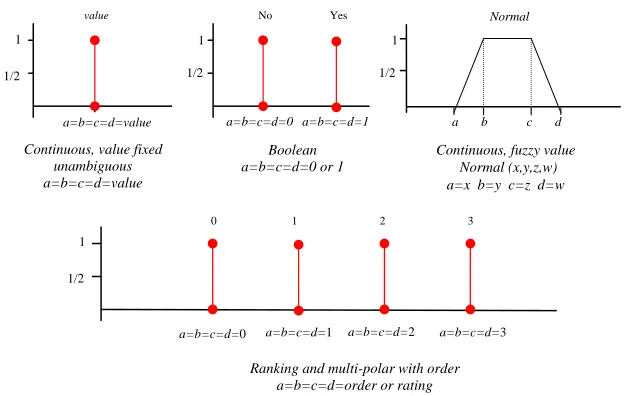
By usingtrapezoid numbers, the FRT technique relaxes the restriction, of the classical repertory grid, that the ratings must be crisp numbers in a predefined range. In fact, trapezoid numbers enable the FRTs to provide categorical and numerical data types that may be given by means of linguistic terms (as shown inFig. 1).
For instance, in the FRT developed in our accommodation rentingscenario shown inTable 1, takingaccommodationA1as an example, its attributedistrict-type
is rated on a 0–4 ratingscale (this ratingprovides an indication of user’s preferences: 0—Does not like it and 4—Likes it). This room has nonew-furniture nor an air-conditioner(both boolean attributes) but has aphone(boolean attribute), its
rental-rate is cheap (continuous attribute), and it is located in the St. Dennis district
(similar ratingscale to the lodgingtype attribute). Each value is expressed by a membership function that is determined from the construct type (see Fig. 1) and direct interaction with the user.
Continuous, value fixed unambiguous a=b=c=d=value 1 1/2 a=b=c=d=value Boolean a=b=c=d=0 or 1
a=b=c=d=0 a=b=c=d=1
1
1/2
Ranking and multi-polar with order a=b=c=d=order or rating
a=b=c=d=0 a=b=c=d=1 a=b=c=d=2 a=b=c=d=3
1
a b c d
Continuous, fuzzy value Normal (x,y,z,w) a=x b=y c=z d=w
1
1/2
1/2 value No Yes
0 1 2 3
[image:5.468.77.389.402.600.2]Normal
AR
TI
CL
E
IN
P
RE
S
[image:6.468.70.603.128.341.2]S
Table 1
FRT developed in our accommodation rentingscenario for acquiringrewards associated with each accommodation
A1 A2 A3 A4 A5 A6 A7
Lodging type Room in guest house Room in guest house Flat Shared house Apartment Shared room Shared house
a¼b¼c¼d¼2 a¼b¼c¼d¼2 a¼b¼c¼d¼3 a¼b¼c¼d¼1 a¼b¼c¼d¼4 a¼b¼c¼d¼0 a¼b¼c¼d¼1
New Furniture No No No No No Yes No
a¼b¼c¼d¼0 a¼b¼c¼d¼0 a¼b¼c¼d¼0 a¼b¼c¼d¼0 a¼b¼c¼d¼0 a¼b¼c¼d¼1 a¼b¼c¼d¼0
Air conditioningNo No Yes No Yes No No
a¼b¼c¼d¼0 a¼b¼c¼d¼0 a¼b¼c¼d¼1 a¼b¼c¼d¼0 a¼b¼c¼d¼1 a¼b¼c¼d¼0 a¼b¼c¼d¼0
Rental-rate Cheap Cheap Expensive Normal Very expensive Very cheap Normal
a¼300 a¼300 a¼550 a¼400 a¼650 a¼100 a¼400
b¼350 b¼350 b¼600 b¼450 b¼700 b¼150 b¼450
c¼400 c¼400 c¼650 c¼550 c¼1000 c¼300 c¼550
d¼450 d¼450 d¼700 d¼600 d¼1000 d¼350 d¼600
Phone Yes Yes No No Yes No No
a¼b¼c¼d¼1 a¼b¼c¼d¼1 a¼b¼c¼d¼0 a¼b¼c¼d¼0 a¼b¼c¼d¼1 a¼b¼c¼d¼0 a¼b¼c¼d¼0
District St. Denis Basset Highfield St. Denis Basset Bitterne Basset
a¼b¼c¼d¼1 a¼b¼c¼d¼4 a¼b¼c¼d¼2 a¼b¼c¼d¼1 a¼b¼c¼d¼4 a¼b¼c¼d¼0 a¼b¼c¼d¼4
J.J.
Castro-Sc
hez
et
al.
/
Int.
J.
Human-Co
mputer
Studies
61
(2004)
3
–
3
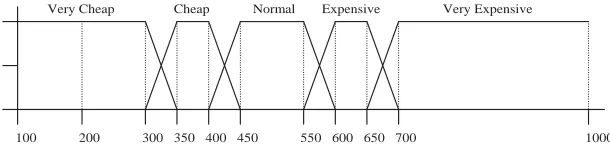
In the example shown inTable 1, duringthe course of developingthe FRT, the attributerental-ratetakes on linguistic terms since the user found it more natural to describe it with a vague value. In particular, the set of linguistic terms that the attributerental-ratetakes on is shown inFig. 2.
2.4. Assessing similarity
In order to assist in the further elicitation of attributes (or elements), or to refine the values already given to defined attributes, it is necessary to assess the pairwise similarity of known elements or constructions. The manner in which the FRT assesses similarity amongelements is different from that of the classic repertory grid although their interaction with the user is similar. In fact, the FRT technique uses a separation measure for assessingthe similarity between elements. The separation between two elementsexandeyagainst one construct/attributeaiis given by the area
between valueAof attributeaiofexand valueBof attributeaiofey. Formally, we
have:
Definition 1. Let trapezoid number txðaiÞ¼ ða;b;c;dÞ be the rate for attributeaiof elementexand trapezoid number tyðaiÞ ¼ ða
0;b0;c0;d0Þbe the rate for attribute a
iof
element ey. Then the measure of separation between ex and ey with respect to
txðaiÞ;tyðaiÞ andaiis:
dðex;ey;txðaiÞ;tyðaiÞ;aiÞ ¼p1þp2; ð2Þ
where
p1¼
b0cþa0d
2 ifdpa
0;
ðb0cÞ h
2 ifa
0od andcpb0;
0 otherwise;
8 > > > > < > > > > :
p2¼
bc0þad0
2 ifd
0pa;
ðbc0Þ h0
2 ifaod
0andc0pb;
0 otherwise;
8 > > > > < > > > > : Very Expensive Expensive Normal Cheap Very Cheap
[image:7.468.79.384.78.153.2]100 200 300 350 400 450 550 600 650 700 1000
h¼ b 0c
b0a0þdc;
h0¼ bc
0
baþd0c0:
In the example shown inTables 1 and 3, accommodationA2takes the linguistic
termcheap=(300,350,400,450), and A5takes the linguistic term very-expensive=
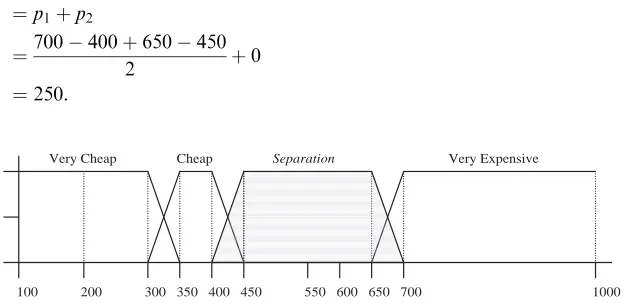
(650,700,1000,1000). Thus, by (2) the separation between these elements with respect to attributerental-rateand its two ratescheapandvery-expensive(seeFig. 3) is:
dðA2;A5;cheap; very-expensive; rental-rateÞ
¼p1þp2
¼700400þ650450
2 þ0
¼250:
Definition 2. Let trapezoid number txðaiÞ¼ ða;b;c;dÞ be the rate for attributeaiof elementexand trapezoid number tyðaiÞ ¼ ða
0;b0;c0;d0Þbe the rate for attribute a
iof
element ey. Then the normalized measure of separation between ex and ey with
respect totxðaiÞ;tyðaiÞ andaiis:
dNðex;ey;txðaiÞ;tyðaiÞ;aiÞ ¼
dðex;ey;txðaiÞ;tyðaiÞ;aiÞ dðex;ey;tmaxðaiÞ;tminðaiÞ;aiÞ
; ð3Þ
wheredðex;ey;txðaiÞ;tyðaiÞ;aiÞis given by (2),tmax(ai) is a trapezoid value whose first two parameters are not smaller than those of other possible trapezoid values that are used to rate attributeai, andtmin(ai) is a trapezoid value whose first two parameters
are not greater than those of other possible trapezoid values that are used to rate attributeai.
For example, inTable 1the normalized separation betweenA2andA5with respect
to attributerental-rateand its two rates cheapandvery-expensiveis:
dNðA2;A5;cheap; very-expensive; rental-rateÞ
Separation Very Expensive Cheap
Very Cheap
[image:8.468.77.390.218.370.2]100 200 300 350 400 450 550 600 650 700 1000
Fig. 3. Example of separation measurement between examples of accommodationA2andA5fromTable
¼ dðA2;A5;cheap; very-expensive; rental-rateÞ dðA2;A5;very-cheap; very-expensive; rental-rateÞ
¼ 250
700300þ650350 2 ¼0:71:
The overall separation between two elements is the sum of the normalized separation between those two elements against each attribute that defines them. Formally, we have:
Definition 3. The overall separation between two elementsex andeyis:
Dðex;eyÞ ¼
Pm
i¼1dNðex;ey;txðaiÞ;tyðaiÞ;aiÞ
m ; ð4Þ
wheremis the number of attributes anddNðex;ey;txðaiÞ;tyðaiÞ;aiÞis given by (3).
For example, inTable 1, the overall separation betweenA2andA5is:
DðA2;A5Þ ¼
P6
i¼1dNðA2;A5;tA2ðaiÞ;tA5ðaiÞ;aiÞ 6
¼ 2
4þ0þ1þ250350þ0þ0 6
¼0:37:
In the process of developinga FRT, thedistinctions matrix plays an important role.
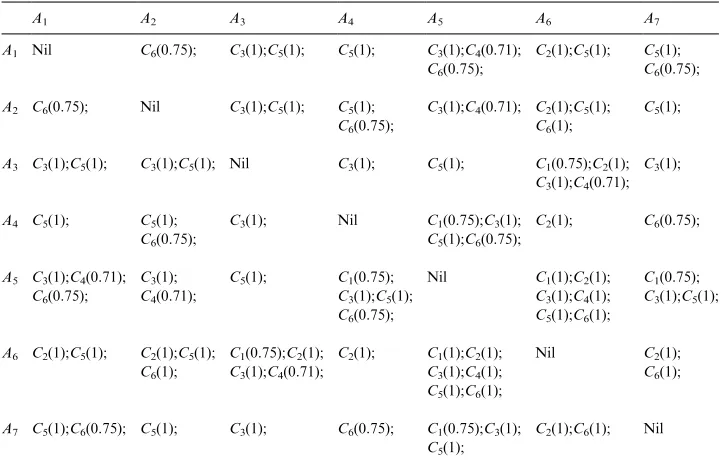
Definition 4. The distinctions matrix is a bi-dimensional matrix with nncells (see Table 2), where n is the number of FRT elements. Each cell ði;jÞ contains the attributes that can distinguish between elementseiandej, and the strength to which
they are distinguished. The strength to which a construct distinguishes between elementsei andejis the normalized separation between those two elements against
that attribute.
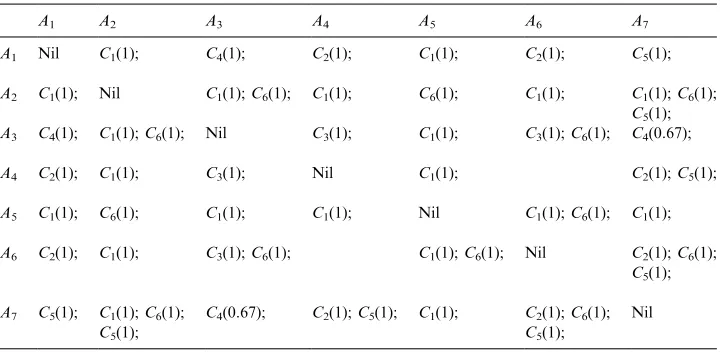
For example, in the distinctions matrix shown inTable 2, the cell (2,3) contains the followinginformation: the attributes that distinguish A2 from A3 are C3 (
air-conditioner) and C5(phone), and the strength of such distinctions are 1 (this is the
maximum strength in normalized space) becauseA3hasair-conditionerandA2does
not andA2accommodation has aphonewhereasA3does not.
2.5. The overview of our knowledge acquisition method
and FRT2 are used to acquire, from human sellers, the seller agent’s domain knowledge—rewards and restrictions associated with each product, respectively. FRT3 is used with an inductive machine learningalgorithm to acquire the buyer’s domain knowledge of preferences and requirements upon desired products.
Table 2
Distinctions matrix of the FRT shown inTable 1, with Ci(a) beingthe attributei, its meaningin the cell
(x,y) is thatiseparates elementsxandyto a degreea(see(3))
A1 A2 A3 A4 A5 A6 A7
A1 Nil C6(0.75); C3(1);C5(1); C5(1); C3(1);C4(0.71); C2(1);C5(1); C5(1);
C6(0.75); C6(0.75);
A2 C6(0.75); Nil C3(1);C5(1); C5(1); C3(1);C4(0.71); C2(1);C5(1); C5(1);
C6(0.75); C6(1);
A3 C3(1);C5(1); C3(1);C5(1); Nil C3(1); C5(1); C1(0.75);C2(1); C3(1);
C3(1);C4(0.71);
A4 C5(1); C5(1); C3(1); Nil C1(0.75);C3(1); C2(1); C6(0.75);
C6(0.75); C5(1);C6(0.75);
A5 C3(1);C4(0.71); C3(1); C5(1); C1(0.75); Nil C1(1);C2(1); C1(0.75);
C6(0.75); C4(0.71); C3(1);C5(1); C3(1);C4(1); C3(1);C5(1);
C6(0.75); C5(1);C6(1);
A6 C2(1);C5(1); C2(1);C5(1); C1(0.75);C2(1); C2(1); C1(1);C2(1); Nil C2(1);
C6(1); C3(1);C4(0.71); C3(1);C4(1); C6(1);
C5(1);C6(1);
A7 C5(1);C6(0.75); C5(1); C3(1); C6(0.75); C1(0.75);C3(1); C2(1);C6(1); Nil
C5(1);
Domain knowledge seller agent
Buyer’s profile Restrictions
FRT2 FRT1
Rewards
Use r
FRT3
Variables and values
(Seller/Buyer)
Examples
Constraints
Inductive Machine Learning algorithm
Domain knowledge buyer agent
[image:10.468.82.386.377.516.2]3. Seller’s domain knowledge acquisition
In this section we first recall the notation of the seller’s domain knowledge in our negotiation model (Luo et al., 2003b), and then discuss how to use the FRT method to acquire the rewards associated with products and the restrictions attached to products in the seller’s domain knowledge.
3.1. Domain knowledge of the seller agent
The seller agent consists of five main components: (1) the domain knowledge—a set of products plus their associated information, (2) the inference knowledge—a set of primitive actions, (3) the task knowledge—a control regime, (4) the communica-tion port—an interaccommunica-tion protocol, and (5) the workingmemory. Since this paper concentrates on discussingthe acquisition of seller’s domain knowledge, we only recall the definition of the domain knowledge and omit the other knowledge components (however, the full details can be found in Luo et al., 2003b).
Definition 5. The domain knowledge of the seller agent is the set ofproductsit holds:
G¼ fgijgi¼ ðci;ri;ui;piÞ;pi¼ ðvi1;y;vinÞ;0pipkg;
where the followinghold:
* c
iis therestrictionattached to productgithat a buyer agent must satisfy in order
to obtain the product (e.g., buyers must be over 18 years old).
* r
i is the reward associated with product gi, which the seller agent may use to
persuade a buyer agent to purchase the product.
* u
i is the profit that the seller agent gets if product gi is sold at a
parti-cular price. This is private information that the seller will not reveal to the buyer.
* p
i, called the product-attributes, is the value vector of negotiable attributes (e.g.,
price, quality, model, volume, delivery date, expiry date, after-sale service and warranty) of productgi.
* kis the total number of products the seller agent possesses.
3.2. Acquiring rewards associated with each product
According to the repertory grid method given in Section 2.1, we shall describe the procedure of acquiringthe rewards associated with each product as follows. Firstly, the elements of FRT1 are the products that a seller can offer. We denote the set of products asE. In the accommodation rentingscenario, the elements of FRT1 are available properties of the real estate agent. In the example ofTable 1,
E¼ fA1;y;A7g: ð5Þ
We assume that similar products can be offered by other sellers (the seller’s competitors).
Secondly, in constructingFRT1 the human seller is asked to describe and analyse the differences and similarities amongproducts in E. To do this, FRT1 uses the followingquestion.
How are two products similar and different from the third in the way in which they are offered to the buyer?
The human seller answers this question by usingthe attributes of the products. Thus, through interaction with the human seller, FRT1 obtains a set of attributes that identify each one of the products inE. In the accommodation rentingscenario, the acquired knowledge from FRT1 is shown inTable 1.
Thirdly, we compute the similarity amongthe acquired elements and constructs of FRT1 in order to identify the reward associated with each product.Table 2shows the distinctions matrix associated with the acquired knowledge via FRT1 in our scenario.
Fourthly, the system identifies the reward (ri) associated with each product. This
can be done via the distinctions matrix since this matrix holds the distinctions among elements inE. In fact, attributes that can distinguish a product offered by the seller from other sellers’ products, could be used by the seller as advantageous features for sellinghis products. FromTable 2, we can see that in our scenario, accommodation A6is distinguished from the others in terms of attributeC2(new-furniture) sinceA6is
the only accommodation that the seller offers with new furniture (seeTable 1). In the same scenario, althoughphone(C5) is an attribute that can distinguishA3from most
other accommodation, it cannot be considered a reward associated with accommodation A3 since it is negative for A3, i.e., it has no phone (see Table 1)
(although of course some might regard that as a positive feature).
Notice that at the current stage, our fuzzy repertory table cannot automatically distinguish between positive and negative attributes. Thus, the attributes obtained through FRT1 are just reward candidates associated with each product. As a result, the human seller must review these reward candidates and then manually select and promote appropriate attributes to be rewards.
* AccommodationA
1has noair-conditionerbut has a phone, and is located in the
St. Dennis district.
* AccommodationA
2has noair-conditionerbut has a phone, and is located in the
Bassett district.
* AccommodationA
3has anair-conditionerbut nophone. * AccommodationA
4has nonew-furniture, noair-conditioner, andno phone, and is
located in the St. Dennis district.
* AccommodationA
5has anair-conditionerand a phone. * AccommodationA
6hasnew-furniture. * Accommodation A
7has no air-conditioner and nophone, and is located in the
Bassett district.
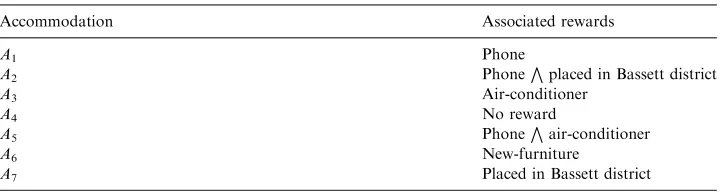
Finally, from the above information the human seller selects those attributes that distinguish one product from the others in a positive sense as the rewards associated with each product. For our rentingaccommodation scenario, Table 3 shows the knowledge about rewards associated with each product, which we acquire in this way. FromTable 3, we notice that the seller consideredlocated in Bassett districtas a reward associated toA7. This is because it is considered a desirable place to live.
3.3. Acquiring restrictions attached to each product
FRT2 is used to acquire restrictions,ci, attached to each productgioffered by the
seller. The set of elements of FRT2 is the same as that of FRT1.
Firstly, a human seller has to complete a FRT session to acquire the differences and similarities amongthe product set consideringwho is eligible to buy each product. To do so, the human seller needs to answer the followingquestion.
How are two products similar and different from the third in terms ofwho is eligible to purchase them ?
Thus, for each product, the set of features that potential buyers would demand is acquired.
Next, restrictions ci attached to each product gi can be identified through the
[image:13.468.54.415.517.613.2]distinctions matrix associated with FRT2. Table 4 shows a FRT2 example, and
Table 3
Rewards associated with each accomodation in examples ofTable 1
Accommodation Associated rewards
A1 Phone
A2 PhoneVplaced in Bassett district
A3 Air-conditioner
A4 No reward
A5 PhoneVair-conditioner
A6 New-furniture
AR
TI
CL
E
IN
P
RE
S
[image:14.468.71.613.122.346.2]S
Table 4
FRT developed for acquiringrestrictions of our buyers
A1 A2 A3 A4 A5 A6 A7
Foreigner Yes No Yes Yes No Yes Yes
a¼b¼c¼d¼1 a¼b¼c¼d¼0 a¼b¼c¼d¼1 a¼b¼c¼d¼1 a¼b¼c¼d¼0 a¼b¼c¼d¼1 a¼b¼c¼d¼1
Sex Female Any Any Male Any Male Female
a¼b¼c¼d¼0 a¼b¼c¼d¼1 a¼b¼c¼d¼1 a¼b¼c¼d¼0
Does buyer like cook? Any Any No Yes Any Yes Any
a¼b¼c¼d¼0 a¼b¼c¼d¼1 a¼b¼c¼d¼1
Rental period xo¼6 Any x>¼24 24>x>¼12 Any Any 12>x>¼6
a¼1 a¼24 a¼12 a¼6
b¼1 b¼26 b¼14 b¼8
c¼6 c¼36 c¼24 c¼12
d¼8 d¼36 d¼26 d¼14
Does buyer like pet? No No Any No Any No Yes
a¼b¼c¼d¼0 a¼b¼c¼d¼0 a¼b¼c¼d¼0 a¼b¼c¼d¼0 a¼b¼c¼d¼1
Occupation Any Student A Any A Student A
professional professional professional
J.J.
Castro-Sc
hez
et
al.
/
Int.
J.
Human-Co
mputer
Studies
61
(2004)
3
–
3
Table 5shows its associated distinctions matrix. FromTables 4 and 5, we can obtain the followinginformation (see Castro-Schez et al., 2003).
* AccommodationA
1can be rented by a tenant of any nationality but who should
be female and is not interested in keepingpets, and whose rental period should be less than 6 months.
* AccommodationA
2can be rented only by native tenants who are students and
not interested in keepingpets.
* AccommodationA
3can be rented by a tenant of any nationality but who should
be a professional and does not need to cook, and whose rental period should be longer than 24 months.
* AccommodationA
4can be rented by a tenant of any nationality but who should
be male and needs to cook.
* Accommodation A
5 can be rented only by a native tenant who should be a
professional.
* AccommodationA
6can be rented by a tenant of any nationality but who should
be a male student.
* AccommodationA
7can be rented by a tenant of any nationality but who should
be a female professional and would like to keep a pet, and whose rental period is approximately between 6 and 12 months.
The above information obtained from FRT2 is shown to the human seller to identify restrictions attached to each product accordingto the followingprinciples.
The restrictions attached to each product are the attributes that can distinguish the product from the rest of products (appear in the distinctions matrix) and that take a
Table 5
Distinctions matrix associated with FRT fromTable 4
A1 A2 A3 A4 A5 A6 A7
A1 Nil C1(1); C4(1); C2(1); C1(1); C2(1); C5(1);
A2 C1(1); Nil C1(1);C6(1); C1(1); C6(1); C1(1); C1(1);C6(1);
C5(1);
A3 C4(1); C1(1);C6(1); Nil C3(1); C1(1); C3(1);C6(1); C4(0.67);
A4 C2(1); C1(1); C3(1); Nil C1(1); C2(1);C5(1);
A5 C1(1); C6(1); C1(1); C1(1); Nil C1(1);C6(1); C1(1);
A6 C2(1); C1(1); C3(1);C6(1); C1(1);C6(1); Nil C2(1);C6(1);
C5(1);
A7 C5(1); C1(1);C6(1); C4(0.67); C2(1);C5(1); C1(1); C2(1);C6(1); Nil
value that is significant for the seller in terms of restricting the buyer who can purchase the product.
Thus, in the accommodation rentingscenario, althoughforeigneris an attribute that can distinguishA4fromA2andA5(seeTable 5), this attribute cannot be regarded as
a restriction attached to accommodation A4because it does not take a suggestive
value (it can be rented by a tenant of any nationality). However, we can say that foreigner can be regarded as a restriction attached to accommodation A2 and A5
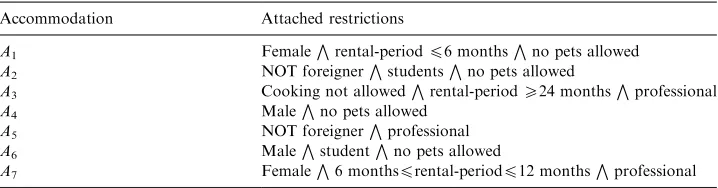
because it takes a suggestive value (it can be only rented by a native tenant).Table 6 shows the acquired information from the accommodation rentingscenario.
4. Buyer’s domain knowledge acquisition
In this section, we firstly recall the notation of the buyer’s domain knowledge, and then present our method for acquiringit from a human buyer.
4.1. Domain knowledge of the buyer agent
Our buyer agent consists of five similar components to the seller: (1) a domain knowledge model consisting of the buyer’s requirement/preference model and the buyer’s profile model,3 (2) an inference model correspondingto a set of primitive actions, (3) a task knowledge model that specifies the control regime, (4) a communication port, and (5) a workingmemory. Since this paper focuses on domain knowledge acquisition, in the following we only recall the component of buyer’s domain knowledge (however, as before, the details of other components can be found inLuo et al., 2003b).
[image:16.468.54.413.101.195.2]We use prioritized fuzzy constraints to express buyers’ requirements and preferences concerningthe desired products. The concept of prioritized fuzzy constraint problems (PFCSPs) was introduced byDubois et al., (1994, 1996);Dubois
Table 6
Restrictions attached to each accommodation after seller’s analysis Accommodation Attached restrictions
A1 FemaleVrental-periodp6 monthsVno pets allowed
A2 NOT foreignerVstudentsVno pets allowed
A3 Cookingnot allowedVrental-periodX24 monthsVprofessional
A4 Male
V
no pets allowed
A5 NOT foreigner
V
professional
A6 Male
V
studentVno pets allowed
A7 Female
V
6 monthsprental-periodp12 monthsVprofessional
and Prade, (1999); and the followingis a revised version of their formulation (see Luo et al. (2003a)for the motivation and technical details of the extension).
Definition 6. A prioritized fuzzy constraint satisfaction problem (PFCSP) is defined as a 4-tupleðX;D;Cf;rÞ;where the followinghold.
(1) X ¼ fxiji¼1;y;ngis a finite set ofvariables.
(2) D= {di|diis the domain on which the variablexi takes values,i=1,y,n} is a
finite set of alldomains associated with each variable inX. (3) Cfis a set offuzzy constraints:
Cf ¼ RfijmRf i
: Y
xjAvarðRfiÞ dj
0 @
1
A-½0;1;i¼1;y;m
8 < :
9 =
;; ð6Þ
wherevarðRfiÞdenotes the set of variables ofRif.
(4) r:Cf-½0;NÞis apriority function. This function puts the constraints into order of importance so that the most important one has the highest value.
Definition 7. The domain knowledge of the buyer agent isKD=(C,B) where:
* C=(X,D,Cf,r) is the buyer’s requirement/preference model. ðX;D;Cf;rÞ is a
PFCSP (see Definition 6).Xis the set of attributes of the products. Each domain diADis a set of possible values of an attribute of the products.Cfis a set of fuzzy constraints that express the buyer’s requirements and preferences on the attributes of the desired product. Each constraint RifACf is associated with a priority rðRfiÞA½0;þNÞ:
* B=(F,t) is a fuzzy truth proposition system, called the buyer’s profile model,
which describes the background information it uses to evaluate the seller’s offer. F¼ ffiji¼1;y;lgis a set of fuzzy propositions.t:F-½0;1is a truth function.
4.2. Buyer’s requirement and preference acquisition
We employ a new FRT, called FRT3, and an inductive machine learning algorithm (Castro et al., 1999) for acquiringfuzzy constraints that represent the buyer’s requirements and preferences. More concretely, firstly we use FRT3 to acquire the attributes and their possible values that are used by the buyer to express their requirements and preferences. Then, we apply the machine learningalgorithm mentioned above, usingthe attributes and values acquired via FTR3, to acquire the prioritized fuzzy constraints.
The process of FRT3 is as follows. Firstly, the elements of this FRT (E) are a set of standard products that could be offered by a seller or proposed by a buyer. In our example, the set consists of accommodation taken from a database whose elements are reasonably representative of the market:
Next, the human buyer is asked to describe and analyse the differences and similarities amongproducts from the setE. This is achieved by askingthe human buyer the followingquestion.
How are two products similar and different from the third in a way that would matter to you when youconsider rentingthem?
The human buyer answers this question by means of those attributes that he would use when decidingupon an offered product. Unlike FRT1 and FRT2, the element set of FRT3 is not fixed. It will vary as the FRT3 elicitation progresses. Thus, in order to acquire an attribute that can distinguish some products from other ones, the human buyer is asked the following.
What is a good qualification from this attribute? Or what would be good values for this attribute? Or what value of this attribute would be ideal?
From the setEwe can extract those products that are distinguished strongly from others in terms of this attribute value. Then, the human buyer is asked to estimate the importance or priority of this attribute when decidingwhether to purchase a product. In the early phases of FRT3 elicitation, higher priorities are recommended since human buyers often like to give the most important attributes first. This attribute can be introduced in the setXand values employed for ratingthis attribute in the set D. FRT3 is continuously developed with new examples. This process is continued until we obtain a set of examples that a buyer would be disposed to purchase or the buyer stops the process.
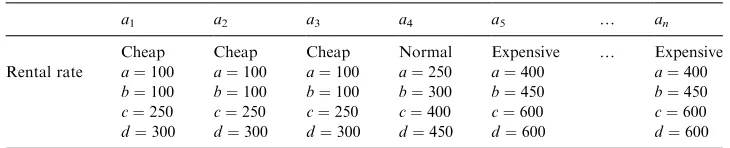
In our example of accommodation renting, the initial set E is presented to a human buyer. The obtained FRT3 is shown in Table 7. Then from Table 7, we obtain the information:rental-rateis an attribute that can distinguish in a strong and significant way between accommodation in the element setE. Further, the human buyer says that he would rentcheapaccommodation rather thanexpensive ones. Thus, this attribute is introduced in the set X. The attribute rental-rate is fuzzy continuous and its possible values are linguistic terms:
cheap¼ ð100;100;250;300Þ; normal¼ ð250;300;400;450Þ;
expensive¼ ð400;450;600;600Þ
[image:18.468.51.416.538.612.2]that constitute its domain setD.Each linguistic term, as a fuzzy set, is associated with a membership function whose parameters are given between parentheses. The
Table 7
FRT3 developed for acquiringthe buyer’s requirements, phase 1
a1 a2 a3 a4 a5 y an
Cheap Cheap Cheap Normal Expensive y Expensive Rental rate a¼100 a¼100 a¼100 a¼250 a¼400 a¼400
human buyer is asked to assign a priority to this attribute, and thus, for example, the buyer assigns 20 to the attribute priority.
Once an important attribute (i.e., rental rate) and its most desirable value (i.e., cheap) are detected, from E we can extract the products that do not meet this criterion (Castro-Schez et al., 2003). The set of extracted products is de-noted as E0. We continue to develop FRT3 with the new set of products, that isEE0:
E¼ fa1;y;anjE0jg:
The obtained FRT3 is shown in Table 8. From this table, it can be seen that distance-to-working-placeis the next attribute that can distinguish among products in E. This attribute takes the followinglinguistic terms:
near¼ ð0;0;15;25Þ; average¼ ð15;25;30;35Þ; far¼ ð30;35;50;50Þ:
The most desirable value of this attribute for the human buyer isnear meaning that the desired accommodation is located near to the workingplace. Attribute distance-to-working-placeis added intoXand its possible values are added into the attribute’s domain setD.Then, the human buyer is asked to assign a priority to this attribute, and thus, for example, he assigns the value 10. Finally, we extract fromE the accommodations that are locatedfarfrom the workingplace.
This process is repeated until the human buyer stops developingFRT3 or the human buyer is well disposed to purchase any product in FRT3. Finally, we obtain the FRT3 as shown inTable 9. The setsXandDthat are acquired by usingFRT3 are shown inTable 10.
[image:19.468.55.416.101.246.2]Next, the buyer is shown a set of products assessed accordingto the attributes acquired by FRT3. The aim is to elicit a decision as to whether he would rent the accommodation. In this way, we obtain a set of examples that can be used by the inductive machine learningmethod proposed in (Castro et al., 1999) to acquire prioritised fuzzy constraints. In this case, the examples are represented as
Table 8
FRT3 developed for acquiringthe buyer’s requirements, phase 2
a1 a2 a3 a4 a5 y am
Cheap Cheap Cheap Normal Normal y Cheap
Rental rate a¼100 a¼100 a¼100 a¼250 a¼250 a¼100 b¼100 b¼100 b¼100 b¼300 b¼300 b¼100 c¼250 c¼250 c¼250 c¼400 c¼400 c¼250 d¼300 d¼300 d¼300 d¼450 d¼450 d¼300 Distance to
work place
Far Near Average Far Near y Near
a¼30 a¼0 a¼15 a¼30 a¼0 a¼0
b¼35 b¼0 b¼25 b¼35 b¼0 b¼0
c¼50 c¼15 c¼30 c¼50 c¼15 c¼15
Table 9
FRT developed for acquiringthe buyer’s requirements, final phase
a1 a2 a3 a4 a5 y ag
Cheap Cheap Cheap Normal Normal y Cheap
Rental rate a¼100 a¼100 a¼100 a¼250 a¼250 a¼100 b¼100 b¼100 b¼100 b¼300 b¼300 b¼100 c¼250 c¼250 c¼250 c¼400 c¼400 c¼250 d¼300 d¼300 d¼300 d¼450 d¼450 d¼300 Distance to
work place
Near Near Average Near Near Near
a¼0 a¼0 a¼15 a¼0 a¼0 y a¼0
b¼0 b¼0 b¼25 b¼0 b¼0 b¼0
c¼15 c¼15 c¼30 c¼15 c¼15 c¼15 d¼25 d¼25 d¼35 d¼25 d¼25 d¼25 Rental period xo¼6 xo¼6 xo¼6 6oxo¼
12
6oxo¼ 12
xo¼6
a¼0 a¼0 a¼0 a¼6 a¼6 y a¼0
b¼0 b¼0 b¼0 b¼6 b¼6 b¼0
c¼6 c¼6 c¼6 c¼12 c¼12 c¼6
d¼6 d¼6 d¼6 d¼12 d¼12 d¼6
House condition
Very Good
Very Good
Good Good Very
Good
Very Good a¼b¼
c¼d¼4
a¼b¼ c¼d¼4
a¼b¼ c¼d¼3
a¼b¼ c¼d¼3
a¼b¼ c¼d¼4
y a¼b¼ c¼d¼4
Table 10
Buyer’s requirements
Variable Variable type Definition domain Priority
Rental-rate Continuous {cheap(100,100,250,300), 20
(d) (fuzzy) normal(250,300,400,450),
expensive(400,450,600,600)}
Distance to work place Continuous {near(0,0,15,25), 10 (Minutes walk) (fuzzy) average(15,25,30,35),
far(30,35,50,50)}
Rental-period Continuous {xp6(0,0,6,6), 5
(months) (crisp) 6oxp12(6,6,12,12), xX12(12,12,24,24)}
House condition Ranking{very-bad(0,0,0,0), 0.5
(crisp) bad(1,1,1,1),
suitable(2,2,2,2),
good(3,3,3,3),
[image:20.468.52.414.420.612.2]ðvn;y;v2;v1:outputÞ;whereviis the value that the input variable (attribute)Vitakes in the example, and the output is the decision that the buyer makes about the product (purchase, not purchase).
In our scenario, we show the buyer the accommodationsfa1;a2;y;a30gthat have been taken randomly from the initial setE. InTable 11, we show information about each accommodation and the decision that the buyer takes. Then, we apply the machine learningalgorithm to the example set shown in Table 11 we obtain the followingrules.
R0: If distance to work place is near and rental-rate is cheap then rent the
accommodation.
R1: Ifrental-periodis not more than 6 months andrental-rateischeapthen rent the
[image:21.468.57.413.103.428.2]accommodation.
Table 11
Examples to be used by the inductive machine learningalgorithm
House condition Rental-period Distance towork place Rental-rate Decision
1 xp6 7 125 Purchase
1 xp6 10 100 Purchase
1 xp6 15 220 Purchase
2 xp6 10 200 Purchase
3 xp6 12 210 Purchase
4 xp6 10 230 Purchase
1 6oxp12 5 180 Purchase
2 6oxp12 10 175 Purchase
3 6oxp12 17 200 Purchase
4 6oxp12 2 240 Purchase
3 xX12 15 200 Purchase
3 xX12 5 210 Purchase
2 xp6 10 100 Purchase
1 xp6 13 150 Purchase
4 xp6 8 170 Purchase
1 xp6 45 120 Purchase
3 xp6 25 200 Purchase
2 xp6 27 175 Purchase
4 xp6 11 200 Purchase
4 xp6 40 180 Purchase
1 xp6 12 560 Do not purchase
3 6oxp12 40 120 Do not purchase
1 6oxp12 35 100 Do not purchase
2 6oxp12 37 200 Do not purchase
4 6oxp12 36 210 Do not purchase
1 6oxp12 28 220 Do not purchase
1 xX12 37 110 Do not purchase
4 xp6 7 310 Do not purchase
3 xp6 27 470 Do not purchase
R2: Ifrental-rateisnormalorexpensivethen do not rent the accommodation.
R3: Ifrental-periodis between 6 and 24 months and distance to the work place is
normalorfar then do not rent the accommodation.
From the above rules, we can obtain the constraint setCf.
R0f: Distance to work place must benearandrental-ratemust be cheap.
R1f: Rental-periodmust not be more than 6 months andrental-ratemust becheap.
R2f: Rental-ratemust not benormalnor expensive.
R3f: Rental-periodmust not be between 6 and 24 months or distance to the work
place must not benormalorfar.
The priority associated with each constraint is then calculated by combiningthe priority associated with each variable (attribute) of the constraints and some measurement about the goodness of the rule from which the constraint is extracted. As a measure of the goodness of each rule, we employ the following fitness function taken from the genetic algorithm presented inCastro et al. (2001):
fðRiÞ ¼epðetdcenÞ etscetdc
; ð7Þ
whereepis the number of examples in the trainingset, which are correctly classified,
enis the number of examples which are erroneously classified,etscis the total number
of examples from the same class that exist in the trainingset, andetdc is the total
number of examples from different classes that exist in the trainingset.
From this it can be seen that function (7) prefers rules that classify the largest number of examples incurringthe lowest number of errors. For this example, the goodness associated with constraintsRf0 andRf1 are as follows.
* fðRf
0Þ ¼0:8 (ep¼16;en¼0;etdc¼10;etsc¼20).
* fðRf
1Þ ¼0:7 (ep¼14;en¼0;etdc¼10;etsc¼20).
We then combine this information by means of the followingformula:
rðRfiÞ ¼maxfrðviÞAvarðRf
iÞg fðRiÞ; ð8Þ
whererðviÞ is the priority of the variable/attribute vi, and varðR
f
iÞ is the set of all variables of constraints Ri
f
. Thus, in our example, the priorities associated with constraintsRf0 andRf1 are 15 and 13, respectively.
4.3. Buyer’s profile acquisition
* When a proposition refers to the buyer’s likes or preferences, the buyer estimates
the fuzzy truth of this proposition by usinga ratingscaleð1;y;nÞ;and the fuzzy truth assigned to the proposition takes its normalized rating.
* When a proposition refers to personal information, its truth is 1 or 0.
[image:23.468.53.413.103.185.2]In our example, the information that the registration form must hold is shown in Table 12(accordingto Sections 4.1 and 4.2.). After the human buyer fills in the form, we can obtain the information about the buyer’s profile model as shown inTable 13.
5. Why the fuzzy repertory table?
In this section we justify why the fuzzy repertory table technique is chosen to acquire the domain knowledge for the seller and buyer agents of our negotiation model.
Many manual and automatic methodologies have been developed for acquiring various kinds of domain knowledge for knowledge intensive systems. Some examples of such knowledge acquisition techniques are card or concept sorting (McDonald et al., 1986;Schreiber et al., 2000), the laddered grid (Shadbolt and Burton, 1989; Schreiber et al., 2000), interviewing(Gammack and Young, 1985; Evans, 1988; Graessar and Gordon, 1991;Schreiber et al., 2000), and the repertory grid technique. Amongthese techniques, we believe that our variant of the classical repertory grid, the fuzzy repertory table technique, is the most appropriate for acquiringthe necessary domain knowledge from the seller and buyer agents’ owners. Our rationale are given below.
Table 13
A typical Buyer’s profile
Proposition Phone Air-conditioner New-furniture Dislike-pet
Truth 0.6 0.2 0.1 0.9
Proposition Dislike-cookingDistrict Bassett Male Foreigner
Truth 0.3 0.5 1 1
Notice the personal information that has a truth value of 0 is omitted from the table. Table 12
Information associated with all products and buyer profiles
Likes or preferences information Personal information
Phone Male
Air-conditioner Female
New-furniture Native
Dislike-pet Foreigner
Dislike-cookingStudent
The family of repertory grid techniques are useful for a number of reasons. (1) They have a solid foundation in human psychological theory—Kelly’s Personal Construct Theory(Kelly, 1955). (2) Their utility in elicitingand acquiringknowledge from human users has been demonstrated (Boose and Bradshaw, 1987; Bradshaw et al., 1993;Gaines and Shaw, 1993, 1997). (3) They are relatively easy to formalize or implement, and so are easily employed by computer systems that aim to acquire knowledge in an automated way. (4) Little training is needed for users to master the technique (Schreiber et al., 2000). (5) Their dynamic and incremental nature makes them appealingto users. (6) They can analyse the acquired knowledge and thus reveal implied knowledge (e.g., the similarity or distinction between pieces of knowledge, hierarchical knowledge structures and entailment rules). When using other techniques, such as protocol analysis or card sorting, knowledge engineers have to analyse the acquired knowledge manually after the automated acquisition systems have done their jobs. This is usually a laborious process for knowledge engineers (Schreiber et al., 2000). (7) They enable us to obtain information about the attributes that can distinguish one product from others in a clear way. This is exactly what we want in developingour seller’s and buyer’s domain knowledge models.
Although many variation of the repertory grid exist (Cornisi, 1987), for our purposes they have the followinglimitations (Castro-Schez et al., 2003).
* Classic or Kelly’s repertory grid (Kelly, 1955) with bipolar distinctions. If the
technique is used for our purpose, users have to assign to each product one or the other pole of the distinction. This is not always possible because there are some attributes that could take intermediate states between left and right distinction poles. For instance, the attributeaccommodation-qualitycan be rated between the left pole good and the right pole bad in our accommodation renting scenario.
* Extended classic repertory grid (Kelly, 1969). Here, users have to use values,
chosen from a predefined rating scale, to rate each element against a given construct accurately. In other words, users have to make crisp distinctions. However, this is not always possible. For instance, users might not be able to rate the attributerental-rateon a scale from 1 to 5 (where the minimum value 1 of this scale meanscheapand the maximum value 5 meansexpensive).
* Bathia’s approach(Bhatia and Yao, 1993). This approach allows users to rate an
element by means of an interval rather than a crisp value. For instance, the user can assign the attribute rental-rate an interval value: [200,400]. However, the approach does not allow the user to rate elements by means of linguistic terms that are usually represented by trapezoid values instead of interval values.
* Gaines’ approach (Gaines and Shaw, 1980). In this approach, the concept of a
fuzzy set is introduced to represent each construct pole. When usingthis kind of repertory grid, for a given construct an assignment of a rating for an element determines the element’s membership degree in the fuzzy set that defines each construct pole. For instance, the rating2 for the attributerental-rateis interpreted as membership degree 0.8 of the fuzzy setcheap(i.e.,mcheap(2)=0.8), and it can
mexpensive(2)=0.2). In other words, the attributerental-rateis still rated by crisp
values instead of fuzzy linguistic terms that we need.
* Ford’s approach(Ford et al., 1991). The focus of the technique is on clarifyingthe
logical rationale in the process of knowledge acquisition. By using this approach, users can obtain rules with uncertainty. However, when ratingan element they also have to choose values from a predefined ratingscale.
* Hwang’s approach (Hwang, 1995). The approaches mentioned above do not
represent linguistic information in an explicit way. Nevertheless, in real life people are often notoriously unwillingto give precise numerical rates, while they seem quite prepared to give qualitative ratings which usually are expressed by linguistic terms (Zadeh, 1975a, b). In order to address this issue, Hwangextends the repertory grid technique to the fuzzy table. In the fuzzy table, constructs are fuzzy attributes that can be rated by means of fuzzy linguistic terms from a finite set. For example, the attribute rental-rate can take the followingfuzzy linguistic terms: low, middle, high, each of which is associated with a membership function. In this way, Hwang’s fuzzy table is the most appro-priate for coping with linguistic information. However, a repertory grid that only considers fuzzy linguistic terms is still inappropriate for our purposes because not everythingis vague (for example, the attributes sexand colour are not vague).
Our FRT has none of the limitations mentioned above and thus is an appropriate method for our purposes. In more detail, the specific reasons for employingthe FRT approach are as follows.
* FRT is suitable for processing, in a uniform manner, the most frequent attributes
types that buyers and sellers use when they talk about a product duringthe course of a negotiation. In fact, the FRT allows the following types of attributes. (1) Ordered-discrete or ordinal type. For example,districtwhere the accommodation is located,accommodation-type (e.g., shared-house, flat,apartment, shared-room, etc.). (2)Unordered-discrete or nominal type. For example, accommodation-state(rented,availableandreserve),buyer’s-occupation(worker,studentand
unemployed). (3) Boolean type. For example, has-air-conditioner?, has-phone?,
furnished?, etc. (4)Ranked type. For example,accommodation-quality (the quality of a district where the accommodation is placed, etc). (5)Continuous type. For example,rental-rate.
* FRT allows interval and fuzzy linguistic terms to be assigned to continuous and
ranked variables (attributes). For example, in FRT, the attributerental-ratecan be rated by the linguistic term cheap, and the attribute rental-period could be between 6 and 12 months. Also, it allows the expert to assignany,severalor no
values to one attribute. In this way, the vagueness inherent in many human
judgements and preferences can be handled well by FRT.
* FRT employs trapezoidal functions (1) to represent any type of value (seeFig. 1).
same time; and (4) uniform: it can be used by an inductive learningalgorithm (Castro et al., 1999, 2001).
6. Conclusions and future work
In this paper, we have presented a process of knowledge acquisition that is designed to provide autonomous software agents with sufficient domain knowledge to negotiate on behalf of their human users using a particular bilateral multi-issue negotiation model.
The general class of repertory grid techniques was selected as being appropriate since they have a good history of use in KA contexts where human users have to express relationships between objects and any preferences that might hold over them. Moreover, repertory grids have one other important characteristic—they are capable of makingexplicit what is often implicit or tacit knowledge that a human might have towards objects in the world. Indeed, this was its original use in psychology when it was used to uncover the attitudes that subjects held about their social world.
A key innovation in this paper is the use of the Fuzzy Repertory Table for acquiring the necessary domain knowledge for negotiating agents. This was motivated primarily by a recognition that many judgements and preferences that we needed to capture could not easily be expressed in terms of numerical ratings or rankings. Rather, a more faithful representation would be able to allow the users to specify the linguistic terms and values that they would use in the domain. These linguistic terms may be realized as clear crisp values; however, in other cases the representation is best captured in terms of a function that captures the essential vagueness of the term.
In the expository example used in this paper it is clear how the KA steps proceed and how the knowledge acquired maps to the knowledge requirements of the negotiating model. In adopting the FRT it is clear that there is an initial overhead in terms of the amount of KA that is required to capture the semantics of the terms that are to be used in any particular domain. In an application area such as our accommodation rentingscenario it is reasonable to suppose that general attributes and their possible values do exist across different types of potential buyer and seller. In fact it may be that the initial KA overhead is somethingthat all domains will require in which agents operate automated negotiation. The important variations may be in the priorities that any individual attaches to the features of the products and their associated rewards.
There are, however, a number of issues that require further investigation.
* Despite progress in defining a KA process for our negotiating agents there is a
* We have only modelled the process of acquiringdomain knowledge for our
negotiating agents. As we analyse a wider class of agents, agent tasks and negotiation strategies we are likely to find the need to acquire knowledge that relates to the task and inference layers of CommonKADS. As we consider the knowledge requirements of a wider range of negotiating agents we will undoubtedly need to bringa wider range of KA techniques to bear on the problem of populating the knowledge bases of our agent proxies and configuring their behaviours.
* Various types of tradeoffs play a very important role in negotiations. However,
this issue is not handled in this paper. Although we have studied the issue in the context of our negotiation model elsewhere (Luo et al., 2003c, d), it is still worth exploringfurther in the context of more widespread ranges of models.
* In many negotiations people typically have a best alternative to a negotiated
agreement (BATNA). This represents the walk-away-point beyond which the individuals prefer no deal to the deal beingoffered. BATNA is not represented in our negotiation model. However, since it is very important our negotiation model should be extended in this direction and thus we need to study the associated knowledge acquisition processes.
Acknowledgements
The authors would like to thank the anonymous referees for their insightful comments that have significantly improved the quality of the paper. The work was supported by Hewlett Packard Research Labs and a grant from the University of Castilla-La Mancha, Spain.
References
Atkin, R., 1974. Mathematical Structure in Human Affairs. Heinemann, London.
Bhatia, S.K., Yao, Q., 1993. A new approach to knowledge acquisition by repertory grids. In: Bhargava, B., et al. (Eds.), CIKM 93: Proceedings of the Second International Conference on Information and Knowledge Management, Washington, DC, ACM, New York, pp. 738–740.
Boose, J.H., Bradshaw, J.M., 1987. Expertise transfer and complex problems: usingAQUINAS as a knowledge acquisition workbench for knowledge-based systems. International Journal of Man— Machine Studies 26, 3–28.
Bradshaw, J.M., Ford, K.M., Adams-Webber, J.R., Boose, J.H., 1993. Beyond the repertory grid: new approaches to constructivist knowledge acquisition tool development. International Journal of Intelligent Systems 8 (2), 287–333.
Castro, J.L., Castro-Schez, J.J., Zurita, J.M., 1999. Learningmaximal structure rules in fuzzy logic for knowledge acquisition in expert systems. Fuzzy Sets and Systems 101, 345–353.
Castro, J.L., Castro-Schez, J.J., Zurita, J.M., 2001. Use of a fuzzy machine learningtechnique in the knowledge acquisition process. Fuzzy Sets and Systems 123 (3), 307–320.
Castro-Schez, J.J., Castro, J.L., Zurita, J.M., 2003. Fuzzy repertory table, a method for acquiring knowledge about input variables to machine learning algorithms. IEEE Transactions on Fuzzy Systems 2003, accepted.
Dubois, D., Prade, H., 1999. Qualitative possibility theory and its applications to constraint satisfaction and decision under uncertainty. International Journal of Intelligent Systems 14, 45–61.
Dubois, D., Fargier, H., Prade, H., 1994. Propagation and satisfaction of flexible constraints. In: Yager, R., Zadeh, L. (Eds.), Fuzzy Sets, Neural Networks and Soft Computing. pp. 166–187.
Dubois, D., Fargier, H., Prade, H., 1996. Possibility theory in constraint satisfaction problems: handling priority, preference and uncertainty. Applied Intelligence 6 (4), 287–309.
Evans, J., 1988. The knowledge elicitation problem: a psychological perspective. Behavior and Information Technology 1 (2), 111–130.
Ford, K.M., Petry, F.E., Adams-Webber, J.R., Chang, P.J., 1991. An approach to knowledge acquisition based on the structure of personal construct systems. IEEE Transactions on Knowledge Data Engineering 3 (1), 78–87.
Gaines, B.R., Shaw, M.L.G., 1980. New directions in the analysis and interactive elicitation of personal construct systems. International Journal Man–Machine Studies 13, 81–116.
Gaines, B.R., Shaw, M.L.G., 1986. Induction of inference rules for expert systems. Fuzzy Sets and Systems 18 (3), 315–328.
Gaines, B.R., Shaw, M.L.G., 1992. Integrated knowledge acquisition architectures. Journal of Intelligent Information Systems 1 (1), 9–34.
Gaines, B.R., Shaw, M.L.G., 1993. Basingknowledge acquisition tools in personal construct systems. Knowledge Engineering Review 8 (1), 49–85.
Gaines, B.R., Shaw, M.L.G., 1997. Knowledge acquisition, modeling and inference through the World Wide Web. International Journal of Human–Computer Studies 46 (6), 729–759.
Gammack, J., Young, R., 1985. Psychological techniques for eliciting expert knowledge. In: Bramer, M. (Ed.), Research and Development in Expert Systems. Cambridge University Press, London, pp. 105–112.
Graessar, A.C., Gordon, S.E., 1991. Questions answering and the organization of the world knowledge. In: Kesesen W., Ortony, A., Craik, F. (Eds.), Memories, Thoughts, and Emotions. Essays in Honor of George Mandler. Earlbaum, Hillsdale, NJ.
Hwang, G., 1995. Knowledge acquisition for fuzzy expert systems. International Journal of Intelligent Systems 10, 541–560.
Jennings, N.R., 2000. On agent-based software engineering. Artificial Intelligence 117 (2), 277–296. Jennings, N.R., 2001. An agent-based approach for building complex software systems. Communications
of the ACM 44 (4), 35–41.
Jennings, N.R, Faratin, P., Lomuscio, A.R., Parsons, S., Sierra, C., Wooldridge, M., 2001. Automated negotiation: prospects, methods and challenges. International Journal of Group Decision and Negotiation 10 (2), 199–215.
Kelly, G.A., 1955. The Psychology of Personal Constructs. Norton, New York.
Kelly, G.A., 1969. A mathematical approach psychology. In: Maher, B. (Ed.), Clinical Psychology and Personality: The Selected Papers of George Kelly. Wiley, New York.
Luo, X., Leung, H.-F., Lee, J.H.-M., Jennings, N.R., 2003a. Prioritised fuzzy constraint satisfaction problems: axioms, instantiation and validation. Fuzzy Sets and Systems 136 (2), 155–188.
Luo, X., Jennings, N.R., Shadbolt, N.R., Leung, H.-F., Lee, J.H.-H., 2003b. A fuzzy constraint based model for bilateral, multi-issue negotiation in semi-competitive environments. Artificial Intelligence 148 (1-2), 53–102.
Luo, X., Jennings, N.R., Shadbolt, N., 2003c. Acquiring tradeoff preferences for automated negotiations: a case study. Proc. 5th International Workshop on Agent Mediated Electronic Commerce, Melbourne, 41–48.
Luo, X., Jennings, N.R., Shadbolt, N., 2003d. Knowledge-based acquisition of tradeoff preferences for negotiating agents. Proc. 5th International Conference on Electronic Commerce, Pittsburgh, 138–144.
McDonald, J., Dearholt, D., Paap, K., Schvanevedt, R., 1986. A formal interface design methodology based on user knowledge. CHI’86 Proceedings, pp. 285–290.
Schreiber, G., Akkermans, H., Anjewierden, A., Hoog, R., Shadbolt, N., Van de Velde, W., Wielinga, B., 2000. Knowledge Engineering and Management: The CommonKADS Methodology. Massachusetts Institute of Technology Press, Cambridge, MA.
Shadbolt, N., Burton, A.M., 1989. The empirical study of knowledge elicitation techniques. SIGART Newsletter 108, 15–18.
Shaw, M.L., 1980. On Becominga Personal Scientist: Interactive Computer Elicitation of Personal Models of the World. Academic Press, London.
Slater, P. (Ed.), 1977. Dimensions of Intrapersonal Space by Grid Technique, Vol 2: Dimensions of Intrapersonal Space. Wiley, London.
Zadeh, L.A., 1975a. The calculus of fuzzy restrictions. In: Zadeh, L.A., et al. (Ed.), Fuzzy Sets and Applications to Cognitive and Decision Making Processes. Academic Press, New York, pp. 1–39. Zadeh, L.A., 1975b. The concept of a linguistic variable and its application to approximate reasoning. Part