
The role of career development in relation to the developmental contextual position of young people in New Zealand : considerations for policy development and career services in New Zealand secondary schools : thesis presented in partial fulfilment of the
254
0
0
Full text
(2) The role of career development in relation to the developmental contextual position of young people in New Zealand Considerations for Policy Development and Career Services in New Zealand Secondary Schools. Thesis presented in partial fulfilment of the requirements for the degree of Doctor of Philosophy in Education.. Diana J. Mclntyre Massey University Palmerston North New Zealand. 1998.
(3) Abstract This is a study of young peoples' career development needs and awareness and the relationship to personal development at the interface of school provision and wider economic, political and educational change that impinge on those relationships.. It is. theoretically embedded within the developmental contextual position of adolescent development, but much of the study is concerned with generating a comprehensive data base to inform policy development and practice considerations in careers assistance in New Zealand secondary schools. It begins, therefore, with an overview of the analytical framework of developmental contextualism, and goes on to explore more fully the dimensions presumed to be operating in relation to the career development ofNew Zealand youth.. In doing so, it contributes a. multidisciplinarian perspective, the essence of which it is argued, is an integral and necessary consideration in the provision of a developmentally appropriate and socially accountable approach to careers services in secondary schools.. An examination of senior secondary school students' career development characteristics and experiences to which schools are in a position to respond forms the central empirical study of the latter part of this thesis.. School careers staff, parents' and students' believed. that schools were important environments for young people's career exploration and development and that an integrated, comprehensive careers service was an acceptable responsibility of secondary schooling. considered to be well resourced.. The careers information bases in schools were. Other dimensions, including career education, career. advice and career counselling were nominated the most crucial areas needed for improvement. Limited opportunity for professional development and training in careers work was considered by staff to be the greatest barrier toward the provision of developmentally appropriate careers assistance. Other barriers included limited time allocation for careers work, low status in the school and unclear specifications regarding the role of careers staff and career services..
(4) Parents did not feel adequately informed about the nature and role of careers assistance in schools and this was considered a hindrance toward constructive involvement with their childrens career development. For the. majority of students concern around career-related issues represented the. source of considerable anxiety in their life.. Careers assistance was highly valued by these. young people, with most expressing concern about access to good quality careers advice and careers counselling.. Limited access to specialised assistance at the personal level was. reflected by students' self reports on measures of career development and personal coping resources. Generally, the young people reported that they had not engaged adequately in appropriate career planning activities; had few 'useful' career exploration experiences; possessed insufficient knowledge about the nature and requirements of the world of work or occupations; and were not particularly knowledgeable about what to consider in making career-related (including education, training and work) decisions. Statistically significant relationships were found between scores on indices of career development and scores on a measure of how students coped with career-related concerns. While most young people approached career problems constructively, those students who were less likely to have engaged in useful planning and exploration and who had limited knowledge of the world of work generally were more likely to approach career development concerns non-productively, such as worrying about what might happen. or. closing oneself off from the problem. Perhaps the most salient theme to emerge in this thesis is the conviction that the career development of young people is a social as well as a personal process. Both the individual and society have much to gain from the young person's capacity for realism and purpose concerning school and post-school pathways and ultimately in the possession of a beginning repertoire of personal resources to manage career transitions in future journeys during their adult years.. Ultimately, the complex interaction of individuals and society in relation to. career pathways demand school-based career services which are clearly defined in policy, operationalised in official documentation, adequately resourced in relation to personnel and training and properly integrated alongside existing school practices.. ll.
(5) Acknowledgrp:en�,. We live in challenging and inspiring times of change, many aspects of which are documented in this thesis.. The process of writing about these issues has underli ned. for me the inseparabil ity of human development and the developing context and how important it is to take seriously the irreducibility of human experience, not only in science, but also i n policy and practice. My deepest appreciation and admiration go to my supervisors, Gary Hermansson and S ue Webb, both of whom provided unlimited kindness and patience when it all mattered the most. I am especially appreciati ve of their encouragement, expertise, and overwheJmjng confidence in my work and for helping me to tame my creative surges without breaking my spirit. Many other people have offered their friendship and generosity. I would not have been able to write this thesis and keep up with 'life' if it had not been for the unfai l i ng support, integrity and grounding of Joan Daniels. Special mention is due to Doris Cuthell for her belief in the value of this work and encouragement in appreciating the need for quality career services. Doris has provided much inspiration and guidance as our paths have crossed and recrossed at various points during the past six years. I wou l d like to give special thanks to Gaylene Holmes also for sharing her passi o n for careers work.. I have had endless fascinating discussions about the n ature. and potential of career development with Gaylene, and have learned much from her loyal ty and understanding of the career counselling profession. S pecial thanks must go to the staff, senior students and parents of Wanganui High School and Wanganui City Col lege during 1 994- 1 996 for sharing their school and life experiences. They not only made my research possible, but also offered a valuable and personally enriching experience.. I learned enormously from them.. I particularly. appreciated the support and kjndness of Joseph Driessen (WHS) and B ob Wilson (WCC) whose assistance throughout the research in the schools was highly valued and much appreciated.. l1l.
(6) Page. 1. Part 1 : Introduction. 2. CHAPTER 1 : Overview. 2. 1 . I Introduction. I. I. I The Conceptual Framework. 3 4. I.2 Scope and Objectives. 5. I.2.I Objectives of the Thesis. 6. I.3 Sections of the Thesis I.3.1 Part One: Introduction. 6. I.3.2 Part Two: Ecological D i mensions of Adolescent Career Development in New Zealand (A Conceptual Synthesis). 6. I.3.3 Part Three: Adolescent Career Development in the Secondary School Environment (An Empirical Case Study). 8. I.3.4 Part Four: Epi logue. 9. CHAPTER 2: The Developmental-Contextual Approach. 10. 2. I Introduction. 10. 2.2 The Ecological Framework. 10. 2.2. I 'lnterconnectedness'. 11. 2.2.2 Subjective Meaning of Experience. 15. 2.2.3 Ecological Transition. 15. 2.3 Developmental Contextuali sm. 16. Part 2: Ecological Dimensions of Career Development for the Adolescent in New Zealand (A Conceptual Synthesis). 19. CHAPTER 3 : The B ig Picture. 20. 3. I Introduction. 20. 3.2 The New Zealand Economy. 21. 3.2. I The Changing Economy. 23. 3.2.2 Changing Employment Patterns. 24. 3.2.3 The Nature of Work. 25. IV.
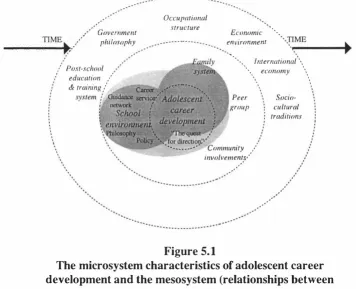
(7) 3.2.4 Links to Personal Development. 26. 3.3 The Nature of the State in New Zealand. 27. 3.3.1 Era of the Welfare State. 28. 3.3.2 The Role of Government. 28. 3.3.3 Emerging New Right Neocl assicism. 30. 3.3.4 Changing Expectations of Government. 32. 3.4 The System of Education and Training in New Zealand. 33. 3.4.1 A System Down-Under. 33. 3.4.2 Links t o the Changing Economy. 33. 3.4.3 The 'People' Factor'. 35. 3.5 An Era of Reform. 37. 3.5.1 Philosophical Considerations. 37. 3.5.2 The Picot Report. 38. 3.5.3 'Learning for Life'. 39. 3.5.4 The New Zealand Quali fications Authority. 40. 3.5.5 The National Qual ifications Framework. 41. 3.5.6 The 'Seamless' Education System. 41. 3.5. 7 The New Zealand Curriculum Framework. 42. 3.5.8 The Role of Careers Assistance in Secondary Schools. 43. CHAPTER 4: Careers Assistance in New Zealand Secondary Schools. 45. 4.1 Introduction. 45. 4.2 Early Developments. 46. 4.3 The Transition Education Experience. 49. 4.4 Aspects of Transition Education Practice. 59. 4.4.1 The Link Initiative. 60. 4.4.2 School-Industry Links. 64. 4.5 Recent Developments. 69. CHAPTER 5: The Nature of Adolescence and the Role of Career Development. 75. 5.1 Introduction. 75. 5.2 The Nature of Adolescent Development. 76. 5 .2. 1 The Quest for Identity. 77. 5 .2.2 Patterns of Identity Formation and Expression. 79. V.
(8) 5. 2.3 L inks to Maturational Changes. 82. 5. 2. 4 The Role of the Family. 82. 5.2 . 5 The School Environment. 83. 5. 3 Career Development: An Expression of Personal Self-Meaning. 84. 5. 4 Career Development during Adolescence. 86. 5.4. 1 The Definitional Landscape of Career Development. 88. 5.4. 2 Stages of Career Development. 88. 5. 4. 3 Career Development Challenges. 89. 5. 4.4 The Quest for Direction. 90. 5. 4. 5 The Importance of Exploration. 91. 5.4. 6 Career Maturity. 94. 5. 4. 7 The Role of Family. 97. 5.4. 8 The Role of School. 1 02. Part 3: Adolescent Career Development in the Secondary School Environment (An Empirical Case Study). 1 07. CHAPTER 6: Prelude to the Case Study. 1 08. 6. 1 Introduction. 1 08. 6. 2 Assumptions, Aims and Research Questions. 1 10. 6. 2. 1 Assumptions. Ill. 6.2 . 2 Aims and Research Questions. 111. CHAPTER 7: Case Study Methodology. 1 13. 7. 1 Introduction. 1 13. 7.2 Research Design. 1 13. 7. 3 Participants. 1 14. 7. 3. 1 Schools. 1 14. 7.3.2 Staff. 1 15. 7. 3. 3 Students. 1 16. 7.3. 4 Parents. 1 17 1 18. 7.4 Data Collection Techniques 7.4. 1 School Admi n istrative Records and Documentation. VI. 1 18.
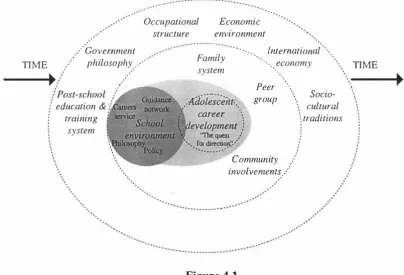
(9) 7. 4. 2 Pri v i leged Observation or Observer-as-Participant. 1 18. 7. 4. 3 Semi -Structured Interviews. 1 19. 7.4. 4 Focu s Group Interviews. 1 22. 7. 4. 5 Self-Administered Questionnaires. 1 24. 7.4. 5. 1 Phase One: General Information and Personal Characteristics. 1 24. 7. 4. 5. 1. 1 Demographic Characteristics. 1 25. 7. 4. 5. 1 . 2 School Subject Choices. 1 25. 7. 4. 5. 1 . 3 Thoughts about Future Work Roles. 1 26. 7. 4. 5. 1.4 Personal Development. 1 26. 7. 4. 5.2 Phase Two: Career Maturity. 1 28. 7. 4. 5.2. 1 CDI-A Scales. 1 28. 7.4.5.2.2 Occupational Group Preference Form (OGPF). 1 30. 7.4. 5. 2.3 Career Planning (CP) Scale. 1 30. 7. 4. 5. 2.4 Career Exploration (CE) Scale. 131. 7. 4. 5. 2.5 World of Work Information (WW) Scale. 131. 7.4. 5.2.6 Career Decision-making (DM) Scale. 1 32. 7. 4. 5. 3 Phase Three: School Career Service Experiences 7.4.6 Note about Methodological Limitations 7. 5 Data Collection Process. 1 32 1 33 1 34. 7.5. 1 Fi rst Contact and Boundary Setting. 1 35. 7. 5. 2 Evaluability Assessment. 1 36. 7. 5. 3 Pi lot Testing (Student Surveys). 1 37. 7. 5.4 Student Survey. 1 38. 7. 5. 5 Focus Group Interviews (Students). 1 40. 7. 5. 6 Focus Group Interviews (Parents). 141. 7. 6 Analysis of Data. 141. 7.6. 1 Preliminary Editing. 141. 7.6. 2 Coding. 1 43. 7. 6.3 Data Analysis System. 144. 7.6.4 A nalysis of Results. 1 44. VII.
(10) CHAPTER 8 : Results and Discussion. 1 47. 8. 1 Introduction. 1 47. 8. 2 Senior Secondary School Students' Career Development Needs. 1 48. 8. 2. 1 School Perceptions. 1 48. 8. 2. 1 . 3 Philosophy. 1 48. 8. 2. 1 . 4 Nature and Location of the Schools' Careers Service. 1 49. 8. 2.2 Parents' Perceptions. 1 52. 8. 2.3 Career Sal ience among Students. 1 55. 8. 2.4 Career Maturity. 161. 8. 3 Links to Personal Development. 1 67. 8. 3. 1 Coping Strategies. 1 67. 8. 3. 2 Relationship to Career Maturity. 1 69. 8. 4 Experience of Careers Assistance. 171. 8. 4. 1 School Perceptions of the Careers Service offered to Senior Students. 171. 8. 4. 2 Stu dents' Perceptions of Career Guidance Received. 1 77. 8. 4. 3 Students' Evaluation of the School Careers Service. 181. Part 4: Epilogue. 1 87. CHAPTER 9: Summary and Conclusions. Appendices. 1 88. 203. SECTION A I: Student Survey Questionnaires. 204. SECTION A2: Supplementary Results. 208. 218. References. VIll.
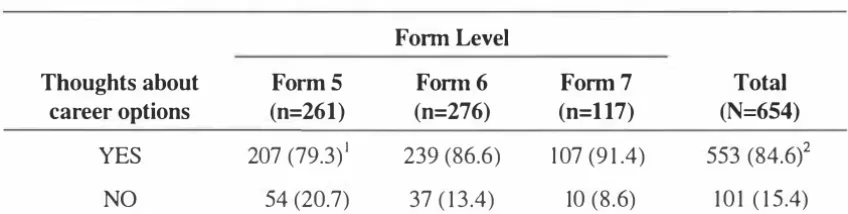
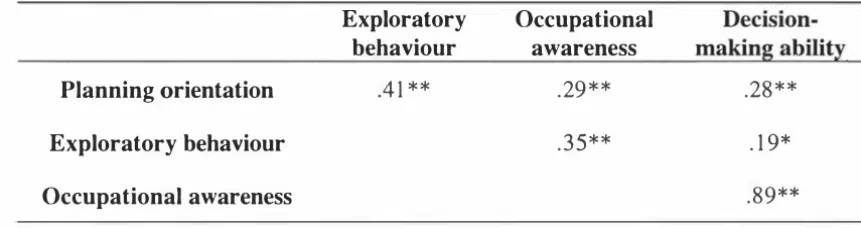
(11) Tables Table. Page. 7. 1 Form level and gender of participating students. 1 17. 8 . 1 Thoughts about future work options. 1 55. 8.2 Rel ationships amon g career maturity variables. 1 62. 8 . 3 Structural discriminant function coefficients for each of the career development variables in the separation of students at each form level. 1 64. 8.4 Relationship of coping strategies to career maturity, expressed as a correlation coefficient. 1 70 .. ....- ---. lX.
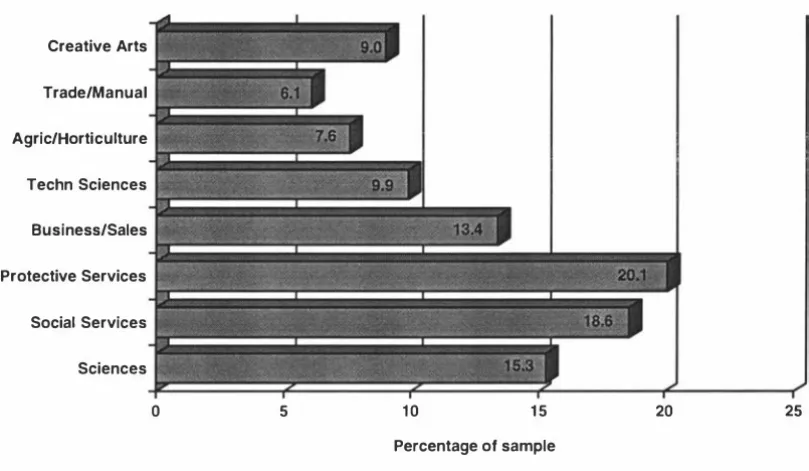
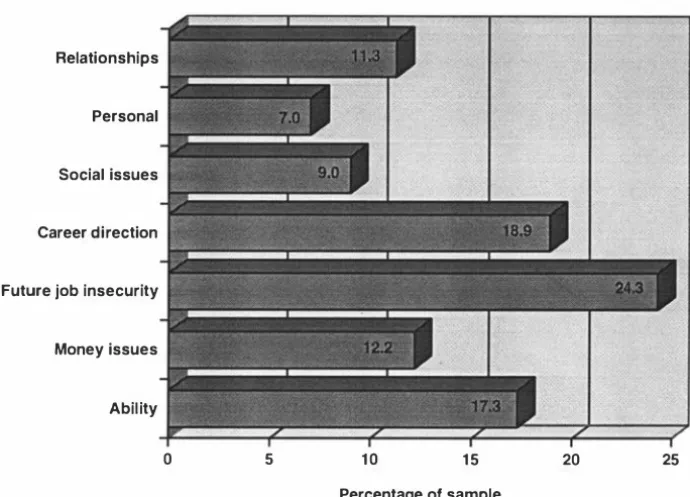
(12) 2. 1 The ecology of adolescent career development in New Zealand. 14. 3 . 1 M acro and exosystem features of adolescent career development i n New Zealand. 20. 4. 1 The microsystem characteristics of careers services i n New Zealand secondary schools. 45. 5 . 1 The microsystem characteristics of adolescent career development and the mesosystem (relationships between personal, family and school) influences. 75. 6.2 Microsystem (school and adolescent career development) and mesosystem therelationship between the two) foci of the empirical i nvestigation. 1 10. 8 . 1 Occupational field of (most) preferred job. 1 56. 8.2 Main concern expressed by students'. 1 58. 8.3 Comparison of average scores on indices of career maturity between students at each form level. 1 65. 8.4 Average scores on i ndices of coping across Form levels. 1 68. 8.5 Most helpful people-oriented source in making decisions around school subject options and post-school education, training and work options. 1 79. 8 . 6 Most helpful information-based source in making key decisions around school subject options and post-school education, training and work options. 1 80. 8.7 Most helpful hands-on source i n making key decisions around school subject options and post-school education, training and work options 181 8 . 8 Students' indication of needed i mprovements in the school career assistance they experienced. 1 82. 8.9 Areas of i mprovement in school career services suggested by students. 1 83. X.
(13) Page. =A�P�P�e�n�d�ix�l=:�S=t=u=d=e�n=t�S�u=r�v�e�v�O�u=es=t=io=n=n=a=i=r=es�---- 204 SECTION A l . l Career Development Study (Part One): About Myself SECTION A l .2 Career Development Study (Part Two): My Career Development (Changes to the Career Development Inventory- Australia) SECTION A l .3 Career Development Study (Part Three): My Career Guidance Experience Appendix 2: Supplementary Results. 204 205. 207. 208. A2. 1 Basic statistical results on indices of career development and coping styles. 208. A2.2 Occupational field of most preferred work option at each Form level. 208. A2.3 Main concern expressed at each Form level. 209. A2.4 Average scores and degree of variability on indices of career development for each Form level. 209. A2.5 Average scores and degree of variability on indices of coping across Form level. 210. A2.6 Type of careers assistance received by students in choosing school subjects. 210. A2.7 Type of careers assistance received by students in considering jobs or job training. 21 1. A2.8 Type of careers assistance received in considering post-school education. 212. A2.9 Most helpful source of careers assistance when choosing school subjects. 213. A2. 1 0 Most helpful source of careers assistance when considering job or job training options. 214. A2. 1 1 Most helpful source of careers assistance when considering post-school education. 215. A2. 1 2 I ndication of the need for improvement in school career services. 216. A2. 1 3 Suggestions for improvement in school career services. 217. XI.
(14) fu. P:.NRT 1 .. In traduction. 1.
(15) Overview 1.1 I ntroduction. The past decade has seen arguably the most far reaching reforms in New Zealand' s learning and work systems. In the global context, such reforms are common amongst advanced industrial societies. Within this context, Watts ( 1 996) has argued the case for a redefinition of 'career' as a "lifetime of progression in learning and work" (p.44) and a process now forged by the individual, not foretold, as had been the case for previous generations. One implication is that secondary schools are now charged with facilitating the young person's readiness, not only for movement to the post-school environment, but for c ontinued learning and career transitions throughout their working lives. Careers assistance has been a feature of the secondary school environment for decades, but largely as an ancillary service and typically as a 'quick ftx' students received just before leaving school.. Much of this reflects a largely reactive, unsystematic and. professionally uninformed approach, which for a long time has been the character of careers assistance in New Zealand secondary schools. In the face of this, in July of 1 996, the Minister of Education ( 1 996a) declared the statutory right of all secondary school students to developmentally appropriate careers assistance.. This declaration followed on the heels. of reform in the country's learning and work systems (Hawke, 1 988; Learning for Life II, 1 989; Ministry of Education, 1 993a, 1 993b) with accompanying national reviews in the areas of youth employment (Prime Ministerial Task Force on Employment, 1 994a, 1 994b) and career information and guidance provisions (Career Information and Guidance Review Panel, 1 995). The challenge now is to provide informed national policy guidelines on career development that are responsive to the career development needs and awareness of young people at school and beyond. This thesis was undertaken to examine the necessary components of the task through a developmental contextual analysis of the career development characteristics of New Zealand adolescents. 'Developmental Contextualism' (Vondracek, Lemer & Schulenberg, 1 986), which has its conceptual roots in the ecological orientation towards human development (Bronfenbrenner, 1 979) accepts that development occurs in a context and that this context 2.
(16) must be understood and integrated in any policy intended for practice. Perhaps the most challenging aspect of a developmental contextual position is the necessity for a multidisciplinary approach.. In advocating a multidisciplinary approach to c areers. assistance, not only are young people's individual characteristics and needs salient but so too are historical, political, economic, educational and social factors. Thus, one of the goals of this thesis was a synthesis of the literature and issues reflecting the various contexts responsive to young people's career development needs.. A second goal was to explore. this awareness in school settings and to assess empirically the career development characteristics of students to which school environments are in a position to respond. The first goal involved a comprehensive integration of literary discussion comprising a review of policy, practice and theory bringing together information sources considered relevant to a developmental-contextual analysis of the area. In the writer's awareness, this is the first time this has occurred in a single document in New Zealand. The intention has been to provide an expansive informed data-base for national policy targeting careers services in secondary schools, and also, a comprehensive learned source for further debate and discussion. The second goal was pursued through an empirical study of a sample of secondary school seniors, with the purpose of providing a starting point for further research toward developmentally appropriate careers assistance in this country's secondary schools. Indeed, as previous reviews of careers services have indicated, it is the dearth of such a data-base that h as limited the potential of both policy and practice in careers assistance in New Zealand (Bloor & B rook, 1 993; Career Information & Guidance Review Panel, 1 995 ; Gordon, 1989; Hesketh & Kennedy, 199 1 ; Khan, 1986; Miller, Manthei & Gilmore, 1 993).. As a corollary, reaching the potential of careers assistance in New Zealand. secondary schools rests upon the future use of such data-bases. I. 1. I The Conceptual Framework. The developmental contextual position (Vondracek, Lerner & Schulenberg, 1 986) draws from Bronfenbrenner's ( 1979) ecological theory, addressing the interaction of the developing person with the changing environment. This perspective is embedded in the position that health and well-being from the level of the person to that of society are intimately connected to, and affected by, the environment in which we live. 3. This.
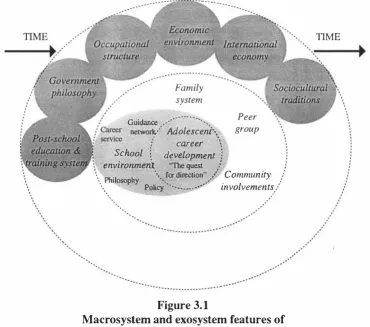
(17) perspective is particularly relevant to the development of informed national policy and practice guidelines for career development which ultimately are situated at the interface of personal and societal needs. Central to a developmental contextual orientation is the notion of interrelationship between systems, extending from the most individual of behaviours to the most encompassing of societal influences. In the context of adolescent career development, the connections are between the developing adolescent, the family, the school system, and the larger historical, political, economic, educational and social forces.. Not only do these. change, but so too do the connections and interactions between them. The chaiienge is, therefore, to identify educational policies and practices that promote change and in a direction that extends opportunity for the young, enhancing their weii-being, not only i n the present but in terms of future development as well. 1.2. Scope and Objectives. The starting point of this thesis is that career development occurs within a context and that positive career information and guidance policy formulation must be sensitive to the effect of macro-level decisions on the micro-level experiences of youth. According to Bronfenbrenner ( 1 979):. The ecology of human development involves the scientific study of the progressive mutual adaptation between an active growing human being, and the changing properties of the immediate settings in which the developing person lives as this process is affected by relationships between these settings and by the larger contexts in which the settings are embedded (p. 2 1 ). I n this study, the primary "setting" is viewed as the school. Although educational policies are far from synonymous with "larger contexts", they are typicaiiy seen as the instruments used by schools to improve schooling outcomes and to protect against or offset the impact of social, economic and other forces on the career development patterns of young people. One such 'other force' is the family, and, in this study, elements of the family setting that impact on the young person's emergent career development and awareness are considered in relation to experiences within the school setting.. 4.
(18) This work herein is approached with both descriptive and exploratory purposes in mind. On the one hand, it is intended to provide sound, comprehensive information about the career development needs and concerns of secondary school students, and the implications their for continued healthy development. On the other, it has been designed to enable ecological analyses of the relationships between personal, family and school variables in the broader context of educational, social, economic and political characteristics that interact with those relationships to influence adolescent career development and awareness. The value of adopting a developmental contextual framework is to ensure the inclusion of relevant personal and environmental variables and to provide parameters about the generalisability of findings.. This is consistent with Bronfenbrenner' s ( 1 979). understanding of ecological research: An ecological experiment is an effort to investigate the progressive accommodation between two or more environmental systems or their structural components . . . . . .It is from this perspective that the primary purpose of the ecological experiment becomes not hypothesis testing, but discovery the identification of those systems' properties and processes that affect and are affected by the behaviour and development of the human being (pp.36-37). With this ecological approach in mind, the objectives of the study were as follows: 1 .2. 1 Objectives of the Thesis (I) To provide a conceptual synthesis of the context of adolescent career development in. New Zealand, including the historical, political, economic, social, educational, familial and developmental dimensions. In order to accommodate the mandate targeted by this objective, the synthesis is presented in three chapters, making up the second part of the thesis. It includes discussion of: (i) the 'big picture' ; an overview of the country's economy, polity, and learning and work systems in which the adolescent is embedded; (ii) the nature of careers assistance in New Zealand secondary schools, capturing the various influences in the evolution and provision of existing careers services in these settings;. 5.
(19) (iii) the nature of adolescence and the capacity of career development, which together define the developmental parameters of relevance to an informed policy for intervention in the career realm.. (2) To undertake an empirical case study to explore the capacity of secondary school settings to facilitate the career development needs of their senior students.. This. objective comprised two steps: first of all, to consider career development as an aspect of overall personal development during this life stage, and then, to explore components of careers assistance that schools might reasonably be expected to provide.. (3) To provide informed comment and direction for consideration in the formation of policy and practice guidelines for career services in secondary schools at the national level. 1.3 Sections of the Thesis. In meeting these objectives, the thesis is presented in four parts. 1 .3. 1 Part One: Introduction. Part One provides an introduction to ecological principles and the developmental contextual position which guides development of the thesis. This dynamic interactionist framework, it is argued, is a considerable advance on conventional unidirectional models which, invariably, have limited the potential of careers assistance in schools in this country and by corollary, the capacity of career development for young people and in a related sense the nation's social and economic well being. 1 . 3.2 Part Two: The Ecological Dimensions of Adolescent Career Development in New Zealand (A Conceptual Synthesis). Part Two consists of three chapters which provide a conceptual synthesis of the ecological dimensions thought to be relevant to adolescent career development in this country. As such, it brings together discussion, policy documentation, theoretical positions and empirical literature relevant to the topic. Together, the chapters comprising Part Two provide the 'informed' substance upon which the assumptions of the empirical study are based, and �pon which recommendations for national guidelines are developed.. 6.
(20) The first of the chapters in Part Two (Chapter Three), is concerned primarily with z;features of the outer circle illustrated in Figure /.1 . It describes the wider macro-level influences which provide the policy context for careers assistance in New Zealand secondary schools. It begins, therefore, with an analysis of the country's economic history, which sees the evolution from a relatively insulated, high-income economy dependent on exports of agricultural commodities during the first half of this century, to a small advanced capitalist trading nation more closely linked to international competition, trends and developments in the post World War Two era.. Tt then moves on to examine the way in. which major shifts in the nature of the State, and in the relationship between State and economy, have been reflected in the reform of post-compulsory education and training in New Zealand. As a result, careers services in secondary schools have emerged to assume an important role in helping young people to make informed decisions regarding school and post-school pathways. Much of the 'importance' of careers services in schools, however, remams an ideological position reflected in educational policy statements, with little operational guidance or direction for translation into practice. This is notwithstanding the attendant danger of repeating a cycle of largely reactive, unsystematic and non-professional approaches which characterise the history of careers assistance in New Zealand secondary schools. Tt is this 'danger' which underlies much of the motivation for this research. To identify the situation, Chapter Four documents the nature and evolution of career services in New Zealand secondary schools, much of which is reflected in the wider macro-level trends discussed in Chapter Three. The final chapter of Part Two (Chapter Five), provides an analysis of the characteristics of adolescent development, including the young person's inner world, associated family relationships and school experiences, in relation to career development needs during adolescence and links to future career journeys in adulthood. The quest for a sense of 'internal coherence' and 'meaningful relatedness' is presented as the central developmental challenge during adolescence. Development in the career realm is presented as a central part of this process. The chapter develops the argument that young people's readiness to confront the challenge of personal meaning and connectedness in career direction mirrors the quality of development that emerges from the experience. This, in turn, sets a pattern for being able to confront and deal with similar challenges in future 7.
(21) career journeys i n adulthood. Alongside family dynamics, the nature and quality of school based careers assistance are presented as powerful settings which influence and are influenced by young people's readiness for career development challenges. 1.3. 3 Part Three: Adolescent Career Development in the Secondary School Environment: An Empirical Case Study. Part Three comprises the empirical case study section, w ith Chapter S ix marking the transition.. This chapter draws upon the preceding discussions in to formulate. assumptions that guide the analysis, and provides a statement of the specific research questions which determine the focus for empirical analysis of adolescent career development needs.. At the heart of this chapter is the belief that both the individual and. the country's learning and work environments have much to gain from the young person's readiness to make meaningful and informed decisions around school and post-school pathways. Access to developmentally appropriate and professionally informed careers assistance is presented as a basic educational right of all young people in New Zealand and as an integral and fitting responsibility of the secondary education system in particular. The approach to the analysis of empirical data is described in Chapter Seven, and includes considerations on sampling for the research; the research participants; assessment and analysis of information to address the research questions; issues and considerations in the collection of this information; and, integral to these areas, methodological issues that may limit the generalisability of findings. Chapter Eight integrates a summary of the results connected to students' assessed career development, alongside focus group contributions from parents and school staff, with a discussion of the literature upon which the assumptions for the analysis are based. The chapter is presented i n five sections to capture (i) the nature and role of existing career services in participating schools, (ii) the career development characteristics of students, (iii) the relationship of career development to personal development, (iv) career guidance experiences, and (v) suggestions for improvement of school-based careers services.. 8.
(22) 1.3.4 Part Four: Epilogue. The final chapter (Chapter Nine) presents a summary of the developmental contextual position of young people in New Zealand; the capacity of career development; the role of the school environment; and the place of state policy and school charters to support and guide the provision of developmentally appropriate and informed careers services in schools. The chapter then reflects upon salient issues arising from the empirical case study in Part Three, linking these back to those identified in the synthesis of literature on the ecology of adolescent career development (Part Two). A key goal in this process is to distinguish particularly urgent issues for discussion and to locate possible directions for further research. Finally, the chapter closes with a discussion of developmental-contextual considerations which might inform national career development guidelines for the nature and delivery of career services in the country's secondary schools.. 9.
(23) The Developmental Contextual Approach 2.1 Introduction. The central belief of this thesis is that the ultimate intervention strategy for career guidance and counselling practitioners and for educational policy makers alike is to identify and encourage the career development strengths of young people, empowering them to take charge of their situation and to change aspects of environments that hinder the realisation of pathways toward healthy adult career development. Contributions toward improvement in policy and practice are best investigated within an ecological framework of adolescent career development. This Chapter presents an overview of Bronfenbrenner's ( 1979) characterisation of the ecology of human development, and the adaptation of this model to career development (Lemer & Lemer, 1 983; Vondracek, Lemer, & Schulenberg, 1 986).. Together, these. contributions provide the conceptual framework used in this study in which the career development characteristics, experiences and needs of secondary school students are explored and discussed. 2.2 The Ecological Framework. Bro nfenbrenner ( 1 979) refers to ecology as the properties of the i mmediate settings in which the person lives and the larger contexts in which these settings are embedded. The essence of an ecological orientation to human development is in recognising that development takes place within a context, and that the various levels of context are interconnected and i nteract dynamically with one another, as they affect and are affected by the developing person . To quote Bronfenbrenner (1979): A theoretical conception of the environment extending beyond the behaviour of individuals to encompass functional systems both within and between settings, systems that can also be modified and expanded, contrasts sharply with prevailing research models. These established models typically employ a scientific lens that restricts, darkens, and even blinds the researcher's vision of environmental obstacles and opportunities and of the remarkable potential of. 10.
(24) human beings to respond constructively to an ecologically compatible milieu once it is made available. As a result, human capacities and strengths tend to be underestimated (p.7). 2.2. 1 'Interconnectedness '. Implicit within this view of development is the principle of 'interconnectedness' . Bronfenbrenner's. framework envisions a series o f nested, interconnected systems as. representing the structure of the ecological environment. They comprise the microsystem, mesosystem, exosystem and macrosystem.. Bronfenbrenner ( 1 979) stated that "the. ecological environment is conceived as a set of nested structures, each inside the next, like a set of Russian dolls" (p.3). Using another analogy, Garbarino ( 1 982) suggested that the ecological perspective on human development can be seen as offering "a kind of map for steering a course of study and intervention" (p.25). The potential impact of this awareness of the environment on the course of contemporary developmental research, career guidance policy and career development intervention is significant. A microsystem represents one of a person's immediate settings, and includes the network of activities, roles and interpersonal relationships associated with that setting. For the adolescent, microsystems include home, school and local community, in which the young person participates as child, student and citizen. For the purpose of one-dimensional presentation, if the school system (microsystem) is viewed as a central focus of influence in the adolescent's life, the mesosystem, the exosystem and the macrosystem can be visualised as concentric circles surrounding the school. The mesosystem consists of the network of social systems containing the developing person at a particular point in their life. It comprises the linkages and processes taldng place between two or more settings containing the adolescent, involving relationships that may conflict with or complement each other. A key mesosystem variable in adolescent career development is the relationship between home and school. Young and Friesen ( 1 986) report an incident where a Grade 3 female student wanted to play drums in a school band. The teacher objected on the grounds that girls did not play the drums; his opinion provoking her to confer with her parents. When their advice that she take a defiant stand on her own proved unsuccessful, the parents themselves consulted with the teacher and the principal, establishing a link between the two microsystems that not only enabled 11.
(25) the girl to achjeve the goal but also to participate in an extended ecological field of action. Importantly, the parents viewed this incident as relevant to and important for the cruld' s career development. The 'outermost' structure in Bronfenbrenner's framework is the macrosystem. The macrosystem differs from the preceding forms in that it refers to 'invisible' , abstract prototypes, such as a culture's value system, that set the pattern for structure and activities. B ronfenbrenner ( 1 979) defines the macrosystem as "the consistency observed within a given culture or subculture in the form and content of its constituent micro-, meso- and exosystems, as well as any belief systems or ideology underlying such consistencies" (p. 258).. The macrosystem is, in effect, the overarching 'blueprint' of cultures and. subcultures. In this case there are cultural norms and societal influences that interact to affect the pattern of adolescent career development.. An example in the New Zealand. context is the introduction of market principles in recent educational reform, which reflects the broader sociopolitical trend toward a market-driven economy, and, as education policy discussion documents in this area have described, a conceptual move from social dependability to individual responsibility (e.g. Ministry of Education, 1 993a). The exosystem, is the 'visible' or 'concrete' representation of macrosystem characteristics.. These 'manifestations' of the macrosystem embrace specific social. stmctures that do not themselves contain the developing person but "in which events occur that affect what happens in the person's environment" ( Bronfenbrenner, 1 979, pp.7-8). The Ministry of Education, whose policies impact on adolescents' post-school pathways but with whom these young people typically have no interaction, is one such example. An illustration is the introduction of the youth income support strategy (Study Right), offering financial incentives for young people to stay in the education and training system, and analogous 'disincentives' for following alternate pathways. Recent examples include the abolition of the unemployment, sickness and Domestic Purposes benefits for under- 1 8 year olds and the corresponding availability of student allowances for young people staying at school or moving on to post-school education and training. In September of 1 997 the Minister for Education, Wyatt Creech ( 1 997) announced an increase in Family Support payments for parents of 1 6 and 1 7 year olds, with the expressed intention of encouraging low income families to keep young people in school beyond the compulsory leaving age (i.e., 1 6 years of age).. In the same media release, Creech ( 1 997) explained that as from 12.
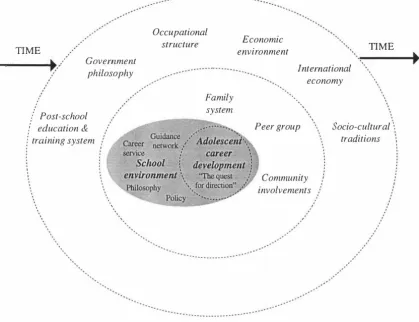
(26) January 1 , 1 998, all 1 6 and 1 7 year old students in New Zealand would only be able to receive state income support if they were legally married, in a defacto relationship with dependent children, or eligible for an independent circumstances allowance (a living allowance for young people estranged from their families). The concept of interconnectedness applies both within and between systems, and it is such a central part of B ronfenbrenner' s ( 1 979) conceptualisation that he goes so far as to acknowledge that his theory is "a theory of environmental interconnections and their impact on the forces directly affecting psychological growth" (p.8). The assumption is that key developmental phenomena occur at multiple, interrelated levels of analysis and that development, likewise, is understood only by examining the interaction among the various levels as they impact on the person's developmental trajectory. Such a view is particularly relevant to this research because it is stressed that multiple contexts contribute to adolescent career development. As stated, this thesis is undertaken with an intention of contributing an informed perspective for the development of national policy for career services in secondary schools. A model of the systems and elements that are presumed to be operating is shown in Figure 2. 1 . The contextual elements that provide the specific focus for the conceptual synthesis are represented in the outer circle, although links with the school environment, the family system and, to a lesser extent, the young person's peer group associations, commu nity involvements and part time work experiences are alluded to also.. The focus of the. empirical study is represented by the shaded area capturing adolescent career development characteristics and the school environment. As suggested by the ecological illustration in Figure 2. 1 , the focus of the analysis is the adolescent's career development in the context of the various settings and processes in which the young person has developed and is developing. With this in mind, the ecological target is the young person's microsystem experiences within the school setting. The mesosystem consists of the linkages between this system and other systems in the young person' s experience, namely, family dynamics, peer group and other social influences, and, most primary, the 'inner world' of the young person, all of which capture the combination of developmental characteristics and needs. The exosystem is represented by policy and practice e lements of the educational and occupational systems in which New Zealand adolescents are embedded.. Macrosystem variables include educational values and 13.
(27) philosophy, which mirror w ider historical, social and economic values of New Zealand society, and that affect the provision of career information, guidance, counselling and education services in secondary schools.. TIME. Economic. Occupational. .·. ·.. TIME. en vi ronmen t. structure. lntemational economy Government. Fam ily. philosophy. system •. Post-compulso education. r;:/. & ;'. .·. Guidance • • network /.:: / ·. Career. se�i�,. training system !. .. ,. � '. Sch(JO[Jl. \.'· '-.. Philosophy '. •.. · care, er. ,5deyelopment , r_. t m vtronment.,�-, .. ·;&.'J;j;;��iit··. 'The quest·. for (!irection". _. ·. Sociocultural traditions. Peer g roup \. '.. 'r. : ••�--�. / '1./. . : ' · ·..:.� ..• / Commun ity . Pohcy · . . . . . . . . · involvements. The career development characteri stics of adolescence.. These are part of the. young perso n ' s. overall. developmental. characteri stics.. The overarching macrosystems of adolescent career development.. These capture societal v a l ues and. ideologies, the essence of which are 'concretised' in the exosystem by policy and practice, for example.. The 'seltings' (microsystems) in which the adolescent is developing. The young person moves between these settings continuous l y . The nature of these interactions (mesosystem) work. s i m ultaneou s l y. to. influence. developmental characteristics.. Figure 2.1 The ecology of adolescent career development in Ne w Zealand. 14. the. young. person's.
(28) 2.2.2 Subjective Meaning of Experience. A second feature of an ecological framework is its 'unorthodox' (Bronfenbrenner, 1 979) view of development: Development is defined as a person's evolving conception of the ecological environment, and his [sic] relation to it, as well as the person' s growing capacity to discover, sustain, or alter its properties (p.9). The emphasis that is placed on the way the environment is perceived, and the meaning it has for the developing person, appears to have had much less impact on c areer development research than perhaps it deserves. In Pmt One of his book, 'The Ecology of Human Development', Bronfenbrenner ( 1 979) stresses this point in relation to social science research generally, no fewer that 20 times.. Two quotations will illustrate the. degree of importance he attributes to this: Very few of the external influences significantly affecting human behaviour and development can be described solely in terms of objective physical conditions and events; the aspects of the environment that are most powerful in shaping the course of psychological growth are overwhelmingly those that have meaning to the person in a given situation (p.22) . This means that it becomes not only desirable but essential to take into account in every scientific inquiry about human behaviour and development how the research situation was perceived and interpreted by the subjects of the study (p.30). Clearly, an ecological approach to human development assumes profound implications for the carrying out of career development research. In the empirical study comprising Part Three of this thesis, it is the perceptions of school staff, parents' and students' in relation to the school's career guidance service (the service as perceived rather than as it may exist in 'objective' reality), that will be the focus of analysis. 2.2.3 Ecological Transition. A third concept in Bronfenbrenner's model deserves special mention because it is particularly germane to adolescent career development. The concept is referred to by Bronfenbrenner ( 1 979) as. 'ecological transition ' .. He describes this as occurring. "whenever a person's position in the ecological environment is altered as the result of a change in role, setting, or both" (p.26). 15.
(29) An ecological transition can thus be seen as occurring during the process of movement from dependent school life in adolescence to independent post-school life, representing change within the adolescent and change within their environment, but also, the mutual accommodation between the young person and the environment in which they live. B ronfenbrenner ( 1 979) stresses that ecological transitions constitute "both a consequence and an instigator of developmental. processes" (p.27). Hence, the. developmental implication of the process for the young people targeted in this thesis. The degree to which secondary school seniors are in a position to cope with changes in the movement from school to post-school life affects the quality of development that emerges from this transition experience. The concept of ecological transitions and the implications for immediate and future development of young people highlights the importance of the pre-transition environment and young people's position within it. It is this pre-transition environment, namely the school career education and guidance service, the young person's position within this environment and their. level of career development,. that provides the focus for the. empirical study. 2.3. Developmental Contextualism. The application of an ecological perspective. m. career development was first. articulated by Lerner and Lerner ( 1 983) and developed by Vondracek, Lemer and Schulenberg ( 1 986) to encourage awareness amongst developmental psychologists and human developmentalists of the centrality of the career development process in human development. They introduced the concept of developmental contextualism to complement Bronfenbrenner' s ( 1 979) emphasis on the context of development giving an emphasis on development in context.. In doing so, the authors stress the importance of understanding. the individual's role in shaping the context as much as understanding the role of the context in shaping the individual. In the words of Vondracek, et a] ( 1 986): The organism in developmental contextualism is not merely the host of the elements of a simplistic environment. Instead, the organism is itself a qualitatively distinct level within the multiple, dynamically interacting levels forming the context of life. As such, the organism has a distinct influence on the multilevel context that is influencing the organism. As a consequence the organism is, in short, not a host, but an active contributor to its own development (pp.33-34). 16.
(30) The developmental contextual approach has been associated with a "distinguishable shift in thinking among career developmental theorists toward adopting more of the transactional world view and its assumptions" (Jepsen, 1 990, pp. 1 46- 1 47). It offers the possibility of integrating developmental perspectives with other perspectives that view various features of the context as critical in the determination of career behaviour and development. This view, that career development is an outcome of the dynamic interaction between the developing person and the ever-changing context, is a reflection of the evolution in life-span developmental psychology (cf. Peterson, 1 996) generally, but a timely move for conceptualising career development in particular.. This situation was well. articulated by Super ( 1 98 1 ) in an earlier endorsement of comprehensiveness and complexity in the approach to careers: Theorists still tend to focus, perhaps legitimately in view of the size of their problem, on segmented theories. Each is thus generally considered to neglect other aspects of theory, other aspects of career development, and career behaviour. Those who do seek to encompass more suffer from the appearance of superficiality. But some day global theories of career development will be made up of refined, validated, and well assembled segments, cemented together by some synthesising theory to constitute a whole that will be more powerful than the sum of its parts (p. 39). The value of a developmental contextual framework for approaching the process of career development during adolescence is the simultaneous focus on both the developing adolescent and the various changing contexts surrounding the young person. The framework is a considerable advance on conventional models of understanding and researching adolescent career development in New Zealand.. Whilst several studies have. explored the young person's contribution to their own career development (e.g., B ethune & Ballard, 1 985; B loor, 1 992; Hesketh, 1 980, 1 982), the traditional unidirectional. paradigm, sets forth an image of the school as a static instmment of the state that acts upon compliant individuals to reproduce unequal stmctures in society. (Abigail, 1 983;. Gordon, 1 989; Khan, 1 986; Korndorffer, 1 987; Nash, 1 98 1 ) . An ecological approach challenges this view of the role of school and adolescent.. It calls for a conception of. secondary school students as active and responsible participants in their own career development, and an image of schools as dynamic, fluid organisations that mirror the w ider historical, social and economic environment within which they are embedded.. The. insistence on a dynamic interactionist perspective thus overcomes the inordinate focus of. 17.
(31) the conventional model on young people's environments and the accompanying emphasis on a unidirectional relationship in their career behaviour. As a corollary, neither young people nor schools alone are a focus for change. Change comes from the simultaneous consideration of young people' s changing career development needs with the capacity and l imitations of secondary school environments.. 18.
(32) PART 2. Ecological dimensions of Career Development for young people in New Zealand A Conceptual Synthesis. 19.
(33) The Big Picture 3.1 Introduction. This chapter offers an ecological analysis of the overarching macrosystems of career development in New Zealand and the exosystem expression of these in the four broad areas of the country ' s (i) economy, (ii) poli ty, (iii) occupational i nfrastructure, and (iv) education and training system, alongside related areas of sociocultural traditions and international economy . Together, they constitute dimensions of the dark shaded ' outer circle' in Figure 3 . 1 . A premise of this chapter is that advances in the provision of school-based career services depend partly on a systematic understanding of the ecological c ontext in which this provision has emerged and exists. Consequently, the discussions herein adopt an historical perspective, with most topics being e xplored within the chronological period from World War 11 to the present, although at times it has been necessary to examine important developments that occurred earlier this century also.. TIME. Family system Peer. Guidance •• ·•• ·•• • • . · netwo ·· Adolescent\. � :'. School. \. environmen�. career. development "The quest. ·· ··. . . .. ·. \. l /. \ for direction" / '.._ Philosopby ·•• . Policy • • . . ...... �· '-. �. group. .. Community. .. mvolvements/ /. -�/ · .·. ·.. ' ·. ·.. ·. .. .. .. ..·. Figure 3.1 Macrosystem and exosystem features of adolescent career development in. 20. NZ.
(34) The analysis commences with the country' s economic infrastructure, the essence of which reflects changing needs in human resource development. Associated changes i n the role of the S tate are then explored alongside changes in the accompan ying phi losophical orientation of policy formul ation, the n ature of which exert considerable influence on career development initiatives in this country. These h ave been particularly profound in rel ation to the n ation ' s education and train in g system in recent years. The n ature o f this system i s then examined, before moving on to trace emergent policy initiatives which recognise a greater role for career guidance services i n the post-reform era. These initiatives will be discussed more fully in the fol lowing chapter which expl ores the development and nature of career guidance services in the country ' s secondary schools. 3.2 The Ne w Ze aland Economy. New Zeal and is a relatively small advanced capital ist trading nation. From the ti me of European settlement in the mid-nineteenth century until the l ate 1 960s, the nation functioned as something of an offshore fann for Britain. An extensive supply of temperate pastoral l and, together with its small popu l ation, enabled the n ation to export l arge quantities of pastoral products in exchange for the goods and services which m ade for an internationally comparable h igh standard of living ( Raynor & Lattimore, 1 99 1 ).. A protected economy was adopted as a means of fostering. m anufacturing development and employment, and maintaining external bal ance. The domin ance of agricultural commodity exporting coupled with import controls led to the dem and for a predominantly semi-skilled human resource base capturing assembly and processing skills (New Zealand Planning Council, 1 989).. It also led to a low. demand for professional and managerial personnel . In this context, early New Zeal and w as able to maintain high per capita incomes and ful l employment despite a relati vely undeveloped skill base. In his analysis of the country ' s involvement in the i nternational economy, Wooding ( 1 993) cl aimed it was likely that the nation h ad close to the high est materi al standard of living in the world during the first half of the twentieth century. This w as particularly evident during commodity booms such as th at which occurred during the Korean w ar in 1 950-5 1 :. 21.
(35) Helped by the wool boom generated by the Korean War, New Zealand gained a level of income per capita close behind the United S tates and Canada in 1 95 0 (Wooding, 1 993, p.93). The international context began to change toward the close of the 1 960s . The changes had a considerable effect on New Zeal and's economic infrastructure and in the rel ated area of human resource development needs .. Surpluses generated by the. Common Agricultural Pol icy of the European Economic Community (EEC), coupled with B ritain ' s entry i nto the EEC in 1 973 (Hawke, 1 985), exposed the vulnerabil i ty of New Zealand' s tradi tional rel i ance on a narrow range of agricultural exports (Raper, 1 993 a). The combi ned i mpact on the country ' s economy of the 1 973-74 oil shoc k and the col lapse of the commodity price boom of earlier decades was dramatic, as i mport prices rose relative to export prices and the terms of trade (the quantity of i mports a given quantity of exports will buy) fel l (Gou ld, 1 982). Consequently, Raper ( 1 993a) aptly referred to this period as 'the end of the golden weather' in his discussion of the country ' s post-war economic history. The world recession of 1 974 can be seen as the crucial turning point for changes in the direction of New Zealand' s economy, separating as it did "an epoch of unprecedented growth and prosperity from an epoch of stagnation, decl ining incomes, and rising unemployment" (Raper, 1 993a, p. l ) . Raper was careful t o point o u t that this change paral leled the post- 1 973 trends o f all advanced capital ist societies. The 'oil shocks' in particular resu lted in an enormous redistribution of weal th and income from i mporting countries to the Organisation of Petroleum Exporting Countries (OPEC) . A consequence of this was that the cost of manufactured goods i ncreased fol lowed by a contraction in the size of markets. This contributed to the 'slowing. down'. (Wooding,. 1 993). of the. international. economy.. Although. unemployment and inflation, two of the key i ndicators of economic performance, had been experienced by countries in varying degrees during the 1 960s, the exogenous shocks of the 1 970s, such as stagflation and the increased price of oil exacerbated existing conditions and precipitated a crisis internationally. As explained by Gamble ( 1 986), changing world circumstances provided an opportunity in politics "for both practical and ideological intervention" (p.3 1 ).. 22.
(36) Following this 'end of the golden weather' , capitali st economies l ooked for new policies and the political agenda was open to new ideas. Thi s was manifest in New Zealand by a shift in the underlying analytical framework for pol icy-making, a shift which was to have an enormous impact on the role of post-compulsory education and training, and on the nature of resulting career development policy initiatives. The character of this policy shift and the impl ications for the country ' s human resource development is the focus of the next section. The present section continues with a discussion of the 'new' economic environment, an environment within which young New Zealanders are embedded and to which career development pol icy needs to be responsive. 3.2. 1 The Changing Economy. The essence of the ' new' econom1c environment was captured in the New Zealand Plann ing Counci l ' s publ ication , 'Tomorrow ' s Skills' (Hai nes & Cal lister, 1 989). The report has since become a key reference document in the restmcturing of post-compulsory education and training in this country. occurnng. m. It detailed the changes. the country ' s econom ic environmen t, and stressed the necessity,. educational ly as well as economical ly, for New Zealanders to adapt to them.. It. discussed the need to upgrade skills across the entire economy and identified potenti al growth areas in the occupational structure and the types of skills required to ensure that growth did occur.. The New Zealand education system was impl icated in the. process, and in the conclusion of the report Haines and Callister asserted that "it is in everyone ' s interest that 'tomorrow ' s school s' produce tomorrow ' s skil l s" (p.25). At the core of Haines and Callister' s report is a picture of an economy that is now quite different from the past, with the most obvious change being increased exposure to the emergent global marketplace. The long-standing basis of previous New Zealand economic policy had been to protect local production and employment by isolating the domestic economy from overseas changes (Hawke, 1 987). A change in policy direction, which fol lowed the election of the fourth Labour Government in 1 984, encouraged the emergence of an economy more closely linked to international competition, trends and developments. According to Haines and Callister ( 1 989), the New Zealand economy could no longer rely on traditional markets for the bulk of its. 23.
(37) agricultural products, and primary products and manufacturing were no longer the major export earners.. The decl ine of traditional markets in Britain coincided w i th. growth and development i n Pacific and Asian markets. 3.2.2 Changing Employment Patterns. These changes in the economy are reflected in changing employment opportun i t ies. In a separate report, Haines ( 1 989) noted that two major trends have emerged in the New Zealand economy. These are the growth of the service sector, which is in line with overseas economic trends (cf. , OECD, 1 990; Reich, 1 99 1 ), and the demand for more highly skilled workers. The changed international context, and the reforms imposed in response to these changes, have had an incredible impact on human resource development needs. As many workers throughout New Zealand have discovered, formerly stable employment opportun i t i es have undergone rapid changes, with the most visible signs being structural unemployment and a constricting job market. This has been particul arly evident amongst the young, the unskil led and ethnic minorities (Prime Ministeri al Task Force on Empl oyment, 1 994). It is, as Handy ( 1 99 1 ) reasoned, the era of the 'Shamrock organisation ' , the Shamrock being the three-leaved clover-like plant which is Ireland ' s national emblem. By analogy, Handy ( 1 99 1 ) viewed the worl d of work as comprising three distinc t groups, or, leaves. The first is what Handy referred t o as the professional core, the 'essential' people, made up of qual ified professionals, technicians and managers. They are the smal lest yet the most powerful group: B e tween them they own the organisational knowledge which distinguishes t h at organisation from its counterparts. Lose them and you lose some of yourself. They are, therefore, precious or should be, and hard to replace. Organisations increasingly bind them to themselves with hoops of gold, w i th high salaries, fringe benefits and German cars. In return the organisation demands of them hard work and long hours, commitment and flexibility. Not for these people are there still 40-hour weeks and 45-week years - few take all their holiday entitlements, few see their houses or their families in dayl ight. They are expected to go there, do this, be that, as the o rganisation requires. In return they are increasingly well-paid (Handy, 1 99 1 pp.72-73). '. 24.
(38) The second leaf of the workforce Handy ( 1 99 1 ) identified as the 'contract workers ' , the 'specialists' in 'non-essential' work within the organisation, who therefore "do it better for less cost" (p.73). Handy estimated that about 80% of an organisation ' s was probably carried out by people outside the organi sation : I t can get exotic: smart Londoners can now get their typing done more cheaply and as quickly in Taiwan as in London using the new communications technology, while the New York Insurance Company has located its New Jersey claims office in Casteisland in Co. Kerry, Ireland, where the people are clever but also cheaper than in New Jersey (Handy, 1 99 1 , p.74). The third leaf of the Shamrock is the flexible labour force, "all those part time workers and temporary workers who are the fastest growing part of the employment scene" ( Handy, 1 99 1 , p.74).. Th is, according to Handy, was a natural part of the. 'switch' to a service-based industry.. In New Zealand, this 'switch' has been wel l. documented (Hai nes & Cal l ister, 1 989; New Zealand Planning Council, 1 989; Smith, 1 993a). In a report published by Statistics New Zealand, Smith ( 1 993a) identified one of the country ' s main employment trends in the past 30 years as the growth of people in part-t i me and casual work . In 1 96 1 it accou nted for five percent of all paid work. By 1 99 1 it had increased to 1 8 percent of the paid labour force, a trend that Smith ( 1 993a) described as being 'fuelled' by the expansion of the service sector which "employs two ou t of every three workers" in the country (p. l 7) .. Alongside an. increasing part-time l abour force, the report documented an emergent trend toward a preference for short-term contract work . Other forms of flexible working, such as casual and temporary contracts, flexitime, shiftwork and job sharing have grown. m. tandem with the ongoing 'pruning' of permanent, ful l -time posts (Smith, 1 993a). 3.2.3 The Nature of Work. At the same time, the nature of the actual work force has changed in a number of ways. Rapid and comprehensive technological developments demand both higher level and broader ranges of skills. Alongside these 'visible' changes have been the changes in attitude. For Handy ( 1 99 1 ) these are evident in the l anguage we now use at work:. 25.
(39) Organi sations used to be perceived as gigantic pieces of engineering, with largely interchangeable human parts. We talked of their structures and their systems, of inputs and outputs, of control devices and of managing them, as i f the whole was one large factory. Today the language is not that of engineering but of poli tics, with tal k of cultures and networks, of teams and coal itions, of influence or power rather than control, of leadership not management (Handy, 1 99 1 , p.7 1 ). Many of the changes in the nature of work have been captured in a survey of the New Zealand financial service sector (MacPherson, 1 990), which also reflected the emergence of the 'Shamrock' organisation. In her survey, MacPherson di scovered that the pressures of technological change and international competition had resulted in maj or skill, organisational and labour force adjustments. Such adjustments i ncluded: (i) the virtual elimination of low-skil led, low-level staff through the computerisation of routine, repetitive manual tasks; (ii) an increase in the level of formal , preparatory education required for entry level positions, due to increased levels of cognitive skills and responsibi lity demanded of staff; (iii) expansion of the tasks of middle management.. Where this group formerly. performed disti nct tasks on an individual basis under close supervision, they were now required to work together, share information and take initiatives; (iv) movement towards a multi-entry point recruitment system as an alternat i ve t o i nternal promotion; (v) the shortening of hierarchical lines. The emphasis on an educated staff, capable of self-management had lessened the need for supervisors or assistant managers; and (vi) increased use of part-time or contract workers to cope with, for example, periodic fluctuations i n the demand for services. 3.2.4 Links to Personal Development. Many of these characteristics mmor those throughout the Western world (OECD, 1 990). Taken together, changes in the occupational structure and resulting employment patterns have introduced a discernible sense of uncertain ty in human resource development across the entire occupational spectrum. The implications of these changes have created an analogous impact on personal career development. The. 26.
(40) stable sense of self which accompanied the one-track career pattern of previous generations is now likely to be compromised by the need to engage in career exploration and decision-making throughout adul t life (Marshall & Tucker, 1 992). Likewise, many individuals are faced with the task of developing new careers in adul thood, as their ski l l s and training become outmoded or their job prospects di sappear. It is within this context that current career development pol icy for youth has emerged. Policy is formulated with particular purported desirable outcomes, such as an international ly competitive economy and self-confident and resourceful peopl e t o cope with that. It incorporates values and philosophies which are part o f i t s context. It is to the nature of this context that the discussion now turns, the intention being to describe the historical antecedents which have led to recent educational reform and thus, to an environment in which career guidance services in secondary schools have been recogni sed as key instmments in l i nking education to the economy. 3.3 The Nature of the State in New Zealand. One essential ingredient in understanding the nature of educational policy, including that of career development policy in New Zealand, is understanding the essence of the State . New Zealand had been regardect as a 'welfare state ' for much of this century (Oi i ver, 1 987), but more recently, the concept of wel fare has changed from one encompassing the social democratic philosophy of universal state provision, captured by Keynesian pol itics, to the 'safety net' model of New Right neoclassicism, where the State adopts a minimalist approach and considers itself responsible only for the 'deserving poor' (Wilkes, 1 993). An. awareness of these developments is i mportant in examining an ecological. map of adolescent career development in New Zealand. Recent reforms in the nation ' s education and trai ning mirror this policy shift which, in turn, has challenged the traditional ethos aroun d the character and role of human resource development. Such change is evident in the language used in accompanying policy documents: an emphasis on reducing 'dependence on the State' , increasing 'personal responsibility ' (Ministry of Education, 1 993a, 1 993b) and the need for individual ' s to be 'self-steering' (Career Information and Guidance Review Panel, 1 995). The following discussion examines. 27.
(41) the n ature of the State in New Zealand during the post-war period. A primary aim is to identify its changing role in the formulation of publ ic pol icy, the forum through which educational policy, and that of career development in particular, is generated. 3. 3. 1 Era of the Welfare State. The social democratic model of the State developed in New Zealand during the years following World War II (Wil kes, 1 993). The State' s responsibility to its citizens during this period was essential ly captured by three assumptions (Davidson, 1 989), which, importantly, then provided the 'mindset' for expectations of the S ta te in ensuing years.. First, citizens were viewed as having a social right to an adequate. standard of income, nutrition, health, housing and education .. Second, as a. consequence, the right to State assistance was given on the basis of citizenship. Third, the S tate provided the means for establ ishing an adequate standard of living for its citizens "through extraction (taxation or levies) and disbursement or expenditure, or by allocating such costs and benefits to other groups through legislation" (Davidson, 1 989, p . 1 1 ) . 3.3.2 The Role of Government. The government is perhaps the most visible ' face' of the State, yet, as Dale ( 1 982) pointed ou t, it is not the whole of the State, in as much as the State is able to keep functioning in the absence of, or during a change, of governments. Rather, the role of government is to "medi ate the State and its subjects to each other" (p. 1 39). This is achieved through organisational bureaucracy and the judiciary. It was such mediation, with the coming of power of the first Labour Government in 1 93 5 , which produced a series of social and economic strategies aimed at bringing universal ism (assistance for all) to New Zeal and. The Social Security Act of 1 93 8 increased pensions, introduced a national health service and added to the family allowance, which became universal in 1 946.. In 1 939, expenditure from the. Public Works Fund was five times that in 1 93 5 (Rudd, 1 993). B arriers to benefits which i ndigenous Maori had long suffered were removed, State education to age 1 9 years for all New Zealand citizens and low cost loans to buy state housing were made avail able. The implementation of a 'full employment ' policy was possible with buoyant. 28.
(42) markets and a strongly growing economy. Thus, the State aimed to achieve economic equi ty through "universali ty, homogeneity and consistency" (Wilkes, 1 993, p.203). Oliver ( 1 987) suggested that the social pol icies established in the 1 930s and 1 940s "created an expectation that governments [would] intervene to prevent distress and promote wel l being" (p. 3 1 ) . Education was seen as a basic human right, as the 'equaliser' through which self development and social mobility were possible for anyone who wished to take advantage of the opportunities offered to them (Renwick, 1 986).. Accordingly, education policy was conveyed in liberal, humanist terms of. 'equality of opportunity ' , a value clearly demonstrated by the Labour Government with the abol ition of the Proficiency Examination in 1 936, thus opening the way for universal secondary schooling.. The 'democratic' approach in post-compulsory. education was consol idated in the Thomas Report of 1 944 (cited in Department of Education, 1 959), which argued for a "generous and well-balanced education" (p.5). Such an education would aim, firstly, at the full preparation of the adolescent as a person ; and, secondly, at preparing him [sic] for an active pl ace in our New Zealand society as a worker, neighbour, home maker and citizen . Up to a point one aim implies the other; and such qual ities as strength and stabil ity of character are fundamental to both (Department of Education , 1 959; p.5). Whilst the democratic view described the New Zealand situation in the ensuing decades, the onset of the prolonged economic crisis in the mid- 1 970s ' forced' the S tate to become much more actively concerned with facil itating the process of generating capital .. Mulgan ( 1 9890 explained this as an ongoing and dynamic process. of the State, the character of which was reflective of historic and worldwide trends. In New Zealand business associations were particularly influential : Business associations have an inherent structural advantage . . . . . . because the state is structurally l imited and constrained by its fiscal dependence on revenue derived from the taxation of i ncomes generated in the process of capital accumulation - a process which the state cannot itself directly control in a private enterprise economy - every occupant of state power is basically interested in promoting those conditions most conducive to accumulation (Raper, 1 993b, p. 1 50).. 29.
Figure

+7
Outline
The Big Picture 3.1 Introduction
Careers Assistance in New Zealand Secondary Schools
those in the final years of secondary education Third, the moratorium status tended to peak during the senior years at high school , when youth were more actively
Prelude to the Case Stu.dy 6.1 Introduction
Case Study Methodology
Results and Discussion
Related documents
Study on risk assessment of toxic chemical in natural environment Identification and offering appropriate procedures in risk management Toxicology and toxicity evaluation of
The paper is discussed for various techniques for sensor localization and various interpolation methods for variety of prediction methods used by various applications
Hence, in spite of VAD being present in children younger than 6 months (Humphrey, et al., 2000), supplementation in neonates, 1-5 month old children and women (for their own sake
diagnosis of heart disease in children. : The role of the pulmonary vascular. bed in congenital heart disease.. natal structural changes in intrapulmon- ary arteries and arterioles.
To study the relationship between nitric oxide and sperm capacitation in vitro , and to provide a theoretical basis for the use of NO-related preparations in improving sperm
When tested with simulated data, the ROC curves and true positive comparison indicate that a kernel size of roughly 0.20 should show an improvement over CCA (Figure 4), but
Methods: A follow-up study 5.5 years after the explosion, 330 persons aged 18 – 67 years, compared lung function, lung function decline and airway symptoms among exposed
