The Ecce and Logen Partial Evaluators and their Web Interfaces
Michael Leuschel
∗ University of D¨usseldorf, GermanyDan Elphick
University of Southampton, U.K.Mauricio Varea
University of Southampton, U.K.Stephen-John Craig
University of D¨usseldorf, GermanyMarc Fontaine
University of D¨usseldorf, GermanyAbstract
We presentECCEandLOGEN, two partial evaluators for Prolog us-ing theonlineandofflineapproach respectively. We briefly present the foundations of these tools and discuss various applications. We also present new implementations of these tools, carried out in Ciao Prolog. In addition to a command-line interface new user-friendly web interfaces were developed. These enable non-expert users to specialise logic programs using a web browser, without the need for a local installation.
Categories and Subject Descriptors D.1.2 [Programming Tech-niques]: Automatic Programming; D.1.6 [Programming Tech-niques]: Logic Programming; F.4.1 [Mathematical Logic and Formal Languages]: Mathematical Logic —logic programming; I.2.2 [Artificial Intelligence]: Automatic Programming; I.2.3 [ Ar-tificial Intelligence]: Deduction and Theorem Proving —logic pro-gramming
Keywords Partial evaluation, partial deduction, Prolog, program transformation, logic programming, web programming
1.
Introduction
Partial evaluation [18] is an automatic technique for program opti-misation which works by specialising a given source program for a particular application. The main idea is to pre-evaluate the given source program as much as possible, given part of the input values for the program. Partial evaluation thus generalises traditional com-piler optimisation techniques such as inlining and constant folding. It can obtain bigger improvements than these techniques, but it is also more difficult to control.
Partial evaluators can be broadly classified intoonlineand of-flinesystems, depending on how the specialisation process is con-trolled. An offline system works in two phases: the first phase pro-duces an annotated version of the source program. In the second
∗All the authors have been partially supported by the Information Society
Technologies programme of the European Commission, Future and Emerg-ing Technologies under the IST-2001-38059 ASAP project.
Permission to make digital or hard copies of all or part of this work for personal or classroom use is granted without fee provided that copies are not made or distributed for profit or commercial advantage and that copies bear this notice and the full citation on the first page. To copy otherwise, to republish, to post on servers or to redistribute to lists, requires prior specific permission and/or a fee.
PEPM ’06 January 9–10, Charleston, South Carolina, USA. Copyright c2006 ACM 1-59593-196-1/06/0001. . . $5.00.
phase the annotated source program, together with the partial in-put, can be used to efficiently generate the specialised program. An online system, on the other hand, requires no preliminary annota-tion phase and takes all its decisions automatically during speciali-sation.
Both the online and offline approach have advantages and dis-advantages when compared against each other. Online systems are easy to use and since all processing takes place in one run, they can use highly flexible strategies forlocalandglobal controlthat make full use of all available information. Thus online systems can, in principle, achieve better specialisations than (pure) offline sys-tems, where the binding time analysis has to be independent of the actual values of the available input. The drawback of this is the higher complexity of the specialisation. The advantage of offline specialisers is that, once a suitable annotation of the source pro-gram is found, propro-grams can be specialised much faster than with online specialisers. On reason is that it is possible to generate a spe-cialised specialiser for a given source program via self-application or by using the cogen approach. The presence of the annotation makes it also more easy to predict the actual outcome of the spe-cialisation (i.e., it can be determined whether a certain computation will be specialised away in all cases).
In this paper we present two specialisers:ECCE, an online spe-cialiser andLOGEN, a specialiser based on offline BTA but ex-tended with some features of online specialisers.
2.
The Ecce System
ECCE is an online specialiser for logic programs. Its input are pure Prolog programs (with built-ins, as long as they are used in a declarative manner). The control ofECCEis separated into two components [38]:
• Theglobal control(also called control of polyvariance) decides
whichspecialised predicates are present in the residual program and ensures that all calls that occur at runtime are an instance of some specialised atom.
• Thelocal control(also called unfolding) is responsible for the construction of the residual clauses for each specialised atom.
Some of the particularities of theECCEsystem are:
– For the local controlECCEuses determinacy (with lookahead) to decide which atoms should be unfolded and homeomorphic embedding (see, e.g., [23]) to ensure termination (i.e., decide which ones should not be unfolded).
[10] are used to capture the specialisation performed for an atom, and are used to control the polyvariance: if two atoms have a different characteristic tree then they are specialised in a different way and combining them would result in a loss of specialisation. The homeomorphic embedding relation is used to ensure that only finitely many atoms are specialised. For generalisation, the most specific generalisation (msg) [21] is used.
– ECCEcaters forconjunctive partial deduction[26, 8]. Essen-tially, this makes it possible to specialise a conjunction of atoms together rather than in isolation, opening up the door for opti-misations such as deforestation (getting rid of intermediate data structures) and tupling (merging multiple visits of the same data structure).
– Redundant argument filtering [35] is another ingredient of
ECCE which filters out various useless arguments in the spe-cialised programs.
Various abstract interpretation techniques have been integrated intoECCE(more specific version calculation [37] in [25], and reg-ular types in [27]). It is also possible to develop custom local and global control predicates, as well as override various other compo-nents of ECCE. Note that ECCE does not support non-declarative Prolog programs (i.e., Prolog programs which rely on the left-to-right selection rule): while this restricts the applicability ofECCE,1 it also enablesECCEto perform more powerful optimisations (e.g., replacing infinite by finite failure). However,ECCEis still guaran-teed (in default settings) to preserve the order of solutions.
2.1 Applications ofECCE
Evaluations ofECCE’s performance on a variety of benchmarks can be found in [33] and in [20, 8] for the conjunctive partial deduction component. Results are compared, amongst others, againstMIXTUS
[42],SP[10] andPADDY[40].
There have been many applications of ECCE outside of the classical objective of speeding up logic programs. For example,
ECCE has been applied to program inversion [14], inductive the-orem proving [31] and to solve planning problems of the fluent calculus [22].
Furthermore,ECCEhas been used for infinite state model check-ing in general [34] and for the coverability problem of Petri nets [30, 29] in particular. It has been shown that a special case of the control algorithm ofECCE corresponds to the Karp-Miller proce-dure for Petri nets. Recently,ECCEhas also been applied for verifi-cation of Object Petri nets in [9].
In [36] it was shown that by changing ECCE’s post-processor it was possible to obtain a precise slicing algorithm for logic pro-grams. Finally,ECCEhas been used as a pre-processor for termina-tion analysers [43], with the aim of proving more programs termi-nating.
2.2 A modular implementation in
Ciao Prolog
ECCEwas originally implemented in BIM Prolog and later ported to SICStus. The majority ofECCE’s evolution has taken place while being written in SICStus Prolog. On the advent of the ASAP EU project we decided twofold: (a) to port the tool another time, to Ciao Prolog, while maintaining compatibility with SICStus Prolog, and (b) to use modularity, in order to obtain a cleaner implemen-tation ofECCE. As a further advantage, Ciao’s compiler,ciaoc, allows to easily create stand-alone executables and command-line tools. TheECCEexecutable operates in three different modes:
– in interactive mode,
1For non-declarative programsMIXTUS[42] orLOGENare better
alterna-tives.
– in scripted mode for benchmarking, and – via a command-line interface (CLI).
In theinteractivemode, users interact with the tool via a text-mode menu. The text-modefor benchmarkingwas created to automate the interaction withECCEfor specialising a larger number of exam-ple files for specific specialisation queries and automatically eval-uate the performance improvements. Finally, an extensive CLI was added toECCEin order to efficiently operate the tool from different front-ends. Figure 1 shows the different switches that can be used in this mode.
2.3 ECCE’s Web Interface
Based on the new command-line interface we have developed a web interface forECCE. The new GUI makes it possible to employ and controlECCEvia the Internet using any ordinary web-browser without the need for a local installation. This section gives a brief outline of the web interface and describes the steps that take place during a typical web-ECCEsession.
First the user has to provide ECCE with a Prolog source-program. This can be done by uploading a program, by choosing one of the ready-made examples or by typing the code in a small text-area. Limited editing of the current program is also possible in this text-area.
After that, the user can enter the goal-predicate that is required for some of the transformations and toggle several options that control internal settings ofECCE. For almost all applications the default-settings are already the best choice.
When all preparations are done, the user can start one of several source-to-source transformations and analyses by simply pressing the corresponding submit button.
At the moment, there are five different transformations and analyses that can be carried out. These are:
SpecialisationTellsECCEto specialise the source programPfor
a given goalG(and all its instances).
SlicingStrips out useless code, by analysing what clauses ofPare needed to compute the answers ofG. It runs the same algorithm as forspecialise, but uses a different code generator [36].
Most Specific VersionComputes the most specific version [37] of
the program, by performing a bottom-up abstract interpretation, keeping a single success pattern per predicate and using the
msgto combine multiple success patterns. This can also be run automatically as a post-processing, as described in [25].
Redundant Argument FilteringThis allows to run the first
algo-rithm presented in [35], without having to specialise the pro-gram (by default the algorithm is run automatically after spe-cialisation, together withinverse redundant argument filtering).
Inverse Redundant Argument FilteringThis runs the second
al-gorithm from [35], weeding out further redundant arguments.
The GUI displays the result of the transformation in a small text-area underneath the source-program. For slicing operations, the output is mapped back to the original prolog-program and unused code is greyed out. All output prolog-programs can be downloaded from the GUI for further processing by the user.
% ./ecce --help
ECCE: The online partial evaluator for pure Prolog (c) Michael Leuschel 1995-2005
USAGE:
ecce [OPTIONS] FILE OPTIONS:
-pe "GOAL" partially evaluate FILE for GOAL
-slice "GOAL" slice FILE for GOAL
-msv run MSV Analysis on FILE
-raf GOAL run RAF Argument Filtering on FILE for GOAL
-far run FAR Argument Filtering on FILE
-o FILE write specialised program to FILE
-dot FILE write specialization graph to dot FILE (before post-processing)
-v verbose mode
-t perform self-test
-d print debugging information
-i stay in interactive mode after performing OPTIONS
-config OPT change default control settings, OPT=classic,fast,mixtus,minimal,classic-fast,deforest
[image:3.612.52.304.67.414.2]-pp OPT change default postprocessor settings, OPT=off,max
Figure 1. ECCE’s Command-line Interface
Options
Source
GUI
CLI
ecce
User Expert
User
Plug-ins rul
[image:3.612.55.292.253.405.2]. . .
ResultsFigure 2. Overall Architecture
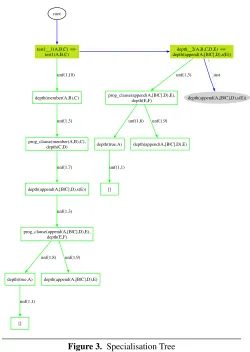
for which no code was generated, either because the node was ab-stracted or because it is an instance of another node. After a spe-cialisation has been computed, clicking on a button opens a window with the specialisation tree.
A major concern of any web interface is security. During spe-cialisationECCEevaluates predicates of the Prolog code submitted by the user. To ensure that malicious Prolog code cannot corrupt the web server,ECCEcontains a whitelist of built-in predicates and the conditions, under which it is safe to evaluate them. In addition the computation time and the memory usage of individual specialisa-tion processes is limited to avoid overloading the web-server. (for complex specialisation tasks users should download and install a local copy ofECCE.)
The implementation of the web interface is based on the scripting-language PHP. It doesn’t rely on any particular features of the web browser and should be compatible with any reasonable browser. To view specialisation trees a svg-plugin is needed.
The web interface is modular and can easily be ported, e.g. for a local installation. In addition, the interface has scope for ex-tendingECCE’s functionality by appending extra modules that also perform source-to-source transformations. We call these modules
plug-ins, and the system already has incorporated several, e.g. the Regular Unary Logic (RUL) analysis (with and without magic-set transformation) of [11], Non-Determinisitc Finite Tree Automaton (NFTA) of [12] (again with and without magic-set transformation), and CiaoPP with default Analysis and Specialisation options [41].
test1__1(A,B,C) == test1(A,B,C)
depth(member(A,B),C) unf(1,10)
depth__2(A,B,C,D,E) == depth(append(A,[B|C],D),s(E))
prog_clause(member(A,B),C), depth(C,D)
unf(1,3)
depth(append(A,[B|C],D),s(E)) unf(1,7)
prog_clause(append(A,[B|C],D),E), depth(E,F)
unf(1,3)
depth(true,A) unf(1,8)
depth(append(A,[B|C],D),E) unf(1,9)
[] unf(1,1)
prog_clause(append(A,[B|C],D),E), depth(E,F)
unf(1,3)
depth(append(A,[B|C],D),s(E))
depth(true,A) unf(1,8)
depth(append(A,[B|C],D),E) unf(1,9)
[] unf(1,1)
inst root
Figure 3. Specialisation Tree
3.
The Logen System
Let us now turn our attention to the second tool:LOGEN, a partial evaluator developed using the cogen approach.
[image:3.612.315.565.256.608.2]However, obtaining an efficient cogen by self-application is a dif-ficult task, This has led several researchers to write thecogenby hand [16, 17, 3, 1, 13, 44], rather than trying to obtain it by self-application. In the setting of logic programming this idea has led to
theLOGENsystem [19, 28].
Specialised Program Source
Program BTA
Annotated Source Program
Partial Evaluator for Source Program
(Generating Extension)
Specialised Program Static
Input
Dynamic
Input Output
Logen
Logen Annotation
Editor
[image:4.612.60.296.135.399.2]User
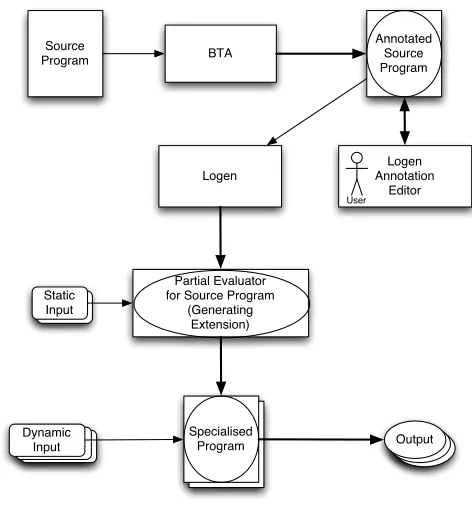
Figure 4. Illustrating theLOGENsystem and thecogenapproach
Figure 4 (from [24]) highlights the way the LOGEN system works. Typically, a user would proceed as follows (more details can be found in [24] from which part of the material is taken):
– First the source program is annotated using a binding-time analysis (BTA), which produces an annotated source program. The annotation essentially marks program points and predicate arguments as static or dynamic. This annotated source program can be further inspected, which allows the user to edit and manually refine the annotations to get better specialisation. – Second, theLOGENcompiler generator is run on the annotated
source program and produces a specialised specialiser for the source program, also called agenerating extension.
– This generating extension can now be used to specialise the source program for some static input. Note that the same gener-ating extension can be used for different static inputs (i.e., there is no need to regenerate the generating extension unless the an-notated source program changes).
– As soon as the remainder of the input is known, the specialised program can be run and will produce the same output as the original source program. Note again, that the same specialised program can be run for different dynamic inputs; the specialised program only has to be regenerated if the static input changes (or the original program itself changes).
The particularities of theLOGENsystem are:
– Efficient specialisation through the use of specialised specialis-ers.
– Support for partially static data, with user-definable binding-types. For example, the following defines a list of variable bindings, with statically known variable names but unknown (at specialisation time) variable values:
:- type env ---> [] ;
[ bind(static,dynamic) | type(env)].
– Support for almost full Prolog, e.g., the if-then-else, negation, disjunction, findall, the cut, built-ins, modules, higher-order calls,...
– An automatic BTA [6] which ensures termination of the un-folding process. The BTA uses the binary clause semantics to identify potential infinite loops in the specialised specialiser. In addition,LOGENcontains two simple BTAs which annotate ev-erything as static and unfold/call or dynamic and memo/rescall respectively. These can be used in circumstances where the au-tomatic BTA cannot be used, e.g., in cases where the source pro-gram is large and the automatic BTA is too expensive. The auto-matic BTA can also be used just to propagate the static/dynamic information without trying to infer terminating clause annota-tions.
– A watchdog mode which detects non-terminating annotations as well as support for online unfold annotations and online binding-types using online control techniques such as the homeomorphic embedding relation.
– Extensions for Constraint Logic Programming [5], as well as support for co-routining (whendeclarations) [4] are available. – A self-tuning resource aware specialisation method that adapts
the annotations for a particular architecture and set of represen-tative sample queries [7].
3.1 Applications ofLOGEN
Various experimental evaluations of theLOGENsystem have been reported; see for example [28]. In essence, specialisation without the binding-time analysis turns out to be very fast (several orders of magnitude faster than online specialisers). The quality of the specialisation of course depends highly on the annotation, but the experiments show that with the proper annotations specialisation can be on par with online specialisers.
LOGENhas been applied to numerous interpreters. [24] contains
a systematic study on how to applyLOGENto interpreters in gen-eral, and how to achieve “Jones optimality” in particular.
In [2]LOGENhas been succesfully applied to a flexible meta-interpreter for access control checks on deductive databases. By specialisation of this interpreter one obtains flexible access control with virtually zero overhead.
In [45]LOGENhas been used towards the goal of provably cor-rect compilation by specialising denotational semantics language specifications expressed in Horn logic and definite clause gram-mars. In particular, the semantics for the SCR specification lan-guage was expressed, andLOGENgenerated target code in a prov-ably correct manner.
LOGENhas also been used as a preprocessor to achieve
effi-cient model checking for domain specific specification languages. For example, in [34] a CTL model checker was specialised for par-ticular systems and specific temporal logic formulas. In [30, 29]
LOGENwas used to precompile a Petri net interpreter for later
in-finite model checking. In [9] an interpreter for Object Petri nets was specialised together with the CTL model checker to achieve efficient verification.LOGENis also currently being applied to im-prove the efficiency of the expressive pointcut language for aspect-orientation from [39]. Recently, in the ASAP project (EU FET IST-2001-38059)LOGENwas used to specialise an emulator (written by Kim Henriksen and John Gallagher) for the machine language of PIC processors, for analysis purposes [15].
3.2 Re-implementation in Ciao
with similar motivations as forECCE. Of crucial importance was the fact that with Ciao Prolog one can include the compiler in runtime systems2enables a user to produce generating extensions which are
fully stand-alone, without any further need for theLOGENsystem. Indeed, this is one of the often cited advantages of the COGEN
approach, which has thus come true in this new version.
% logen --help
Usage: logen [Options] File.pl ["Atom."] Possible Options are:
--help: Prints this message
-w: watch mode (supervise specialization) -W: watch non interactive; halt at first alarm -c: run cogen only (not the .gx file) -s: run silently
--safe: run gx in safe sandbox mode -v: print debugging messages -vv: print more debugging messages -vvv: print even more debugging messages --compile_gx: compile the gx file using ciaoc -m: display memo table
-g: display gx file
--logen_dir ARG1: path to logen files -o ARG1: GX filename
--spec_file ARG1: Spec filename --ciao_path ARG1: Ciao binary directory --simple_bta ARG1 ARG2 ARG3: Run simple bta -d: debug mode for GX file
-d2: even more debugging messages in GX file --single_process: run logen in single process
Figure 5. LOGEN’s Command-line Interface
3.3 LOGEN’s Web Interface
Previous versions ofLOGENhad various graphical front ends, im-plemented in Tcl/Tk, XEmacs, and Python/Tk respectively. Distri-bution and installation of these front ends was not always unprob-lematic, and we have now moved to a more elegant web interface, providing a user-friendly interface for runningLOGENand editing the annotations. A main advantage of the web interface over the earlier interfaces is its portability and the ability to runLOGEN re-motely without local installation (even though we also cater for local execution).
The web interface provides a way to annotate programs and then specialise them. Colour coding is used to provide visual feedback about the annotations (e.g., static parts are marked green, dynamic parts red). The web interface also ensures that the source file and the annotation file are kept in sync: if the user changes the source file the changes will be detected and only the changed parts have to be re-annotated.
Security:Security was an important aspect in the design
pro-cess of the web interface, as allowing untrusted users acpro-cess to a
LOGEN system installed on a web server could open up security
holes: in particular we need to prevent the execution of unsafe Pro-log code submitted by users (e.g.,system(’rm *.*’)). To do so, we have extendedLOGEN to producesafegenerating extensions. In such asafegenerating extension, everycallto a Prolog predi-cate, is first checked against a whitelist of safe predicates. Trying to call an unsafe predicate will cause the process to be aborted and trigger a warning message.
Our whitelist also allows using thecallpredicate and solution aggregation predicates such asfindallandbagof, but only if the predicate argument is itself in the whitelist.
2Academic licenses of SICStus Prolog do not allow the distribution of the
Prolog compiler in packaged runtime systems. Unfortunately, the automatic BTA still requires SICStus Prolog since we do not have a robust convex hull solver in Ciao Prolog yet. This is packaged up as a separate binary, which does not require access to the Prolog compiler.
Besides arbitrary code execution, the interface also has to han-dle accidental or deliberate denial of service (DOS) attacks due to infinite unfolding or memoization. As a counter measure, spawned processes are automatically killed when a time limit is exceeded, but currently there is a risk that too many simultaneous connec-tions could overload the server and cause even legitimate processes to time out without completing.
The interface can also be used offline on a local machine as long as it has a web server. For this usage safe mode can be disabled. (But it is advised to carefully restrict access to trusted users only through server mechanisms in this case.) The specialisation time-out can be extended in the case of more CPU-intensive code.
Displaying and Editing Annotations: As already shown in
Figure 4, the annotation system maintains two files: a source file (Figure 7 shows append) and an annotation file (Figure 8). Our in-terface preserves the formatting of the source code and overlays the annotations using colours and underlining to distinguish the differ-ent types. Converting the source and annotation file to HTML is a two-stage process shown in Figure 6. First an XML representation (Figure 9) is created using a Prolog program that matches the an-notations to the source code. This process keeps the structure and comments from the original source code. The XML is then pro-cessed by an XSL transform which creates HTML code containing style sheet information and Javascript hooks as shown in Figure 10. Having two stages simplifies each stage and allows a separa-tion of skills, where a Prolog programmer can create simple struc-tured XML in the first stage, while web programmers can control the second without intimate knowledge of Prolog.
Annotation Reader
XSLT (highlighter) program.pl
program.pl.ann
XML
HTML
Figure 6. Converting source and annotation files to HTML
append([],Y,Y).
append([X|Xs],Y,[X|Zs]) :-append(Xs,Y,Zs).
Figure 7. Prolog source forappend.pl
logen(append/3,append([],A,A)).
logen(append/3,append([B|C],A,[B|D])) :-logen(memo,append(C,A,D)).
:- filter
append(dynamic,dynamic,dynamic).
Figure 8. Annotation file forappend.pl
Javascript is used extensively so that programs can be annotated without repeated loading of new pages from the server. Instead clicking on an annotated predicate brings up a menu of possible annotations and selecting one changes the HTML code locally on the server; the changes are only sent to the server when the user has finished. The annotations are sent to the server as a flat list of the form:
[unfold, unfold, memo, call]
<?xml version="1.0" encoding="UTF-8"?> <article>
<source><head>append</head>([],Y,Y). <head>append</head>([X|Xs],Y,[X|Zs])
:-<memo>append</memo>(Xs,Y,Zs). </source>
<filters> :- filter
<filter>append</filter>(dynamic,dynamic,dynamic). </filters>
</article>
Figure 9. XML produced by the annotation reader. (Some tags
used only for syntax highlighting have been removed to aid clarity)
<pre class="source">
<span class="head">append</span>([],Y,Y).
<span class="head">append</span>([X|Xs],Y,[X|Zs]) :-<span class="memo" id="ann16"
onclick="return dropdownmenu(this, event)" onmouseover="mouseoverAnn(’ann16’)" onmouseout="mouseoutAnn(’ann16’)" >append</span>(Xs,Y,Zs).
</pre> ... <pre> :- filter
<span class="filter">append</span>(dynamic, dynamic, dynamic).
</pre>
Figure 10. HTML produced fromappend.pl
annotate, which parses and appends the result to the annotation file.
4.
Conclusion
In conclusion, theECCE system provides advanced specialisation for pure Prolog programs. Being an online specialiser, its usage is simple and accessible to non-expert users. The development of the web interface provides an even simpler way of using the system, requiring no local installation and providing easy access to various options of the system. TheECCEsystem has been applied to numerous case studies, and has found many applications outside of its original goal area of specialising programs, in particular for the analysis and verification of systems expressed as Prolog rules.
Since the appearance of the first version ofLOGENin 1996 in [19] the system has now achieved a certain maturity and has been applied to numerous case studies. It is now in a state where it can be used by programmers who are not researchers in partial eval-uation. Indeed, the first version ofLOGENwas efficient, but only supported a small subset of Prolog and all annotations had to be provided by hand.LOGEN now supports almost full Prolog, pro-vides a command-line interface, has considerable support for anno-tating source code and especially the web interface has lowered the entry threshold for using the system. We hope that theLOGEN sys-tem will thus prove to be valuable to researchers and programmers alike.
More information about the tools can be found at the main web sites for our tools:
•http://stups.cs.uni-duesseldorf.de/~pe/ecce
•http://stups.cs.uni-duesseldorf.de/~pe/weblogen
The choice on which tool to use depends on the particular applica-tion.ECCEis a fully automatic online specialiser. It is hence easier to use by inexperienced users, but more difficult to tweak in case specialisation does not proceed as desired.ECCEuses more refined control techniques and can perform conjunctive partial deduction, whichLOGENcannot. Because of the additional annotation phase,
LOGENis more difficult to master by inexperienced users, but the
outcome of the specialisation is easier to tweak and predict. The specialisation phase ofLOGEN is very efficient, with very little overhead compared to ordinary evaluation.LOGENcan deal with almost full Prolog, whereasECCEonly deals with declarative Pro-log programs. The latter restricts the range of programs to which
ECCEcan be applied, but it also allowsECCEto perform more pow-erful optimisations.
Acknowledgements
We wish to thank all the people who have been involved in the development of theECCEandLOGENtools and their mathematical foundations. In particular, we wish to thank Danny De Schreye, Jesper Jørgensen and Bern Martens for their initial work onECCE
and LOGEN. Furthermore, we are grateful for the contributions
of Morten-Heine Sørensen as well as Laksono Adhianto, Andr´e de Waal, John Gallagher, Robert Gl¨uck, Stefan Gruner, Helko Lehmann, Germ´an Puebla, and Germ´an Vidal. We also would like to thank the partners of the ASAP project, in particular the people from UPM for their support and improvements to Ciao Prolog, and Kim Henriksen and Andrew Moss for their feedback onLOGEN.
References
[1] L. O. Andersen. Program Analysis and Specialization for the C Programming Language. PhD thesis, DIKU, University of Copenhagen, May 1994. (DIKU report 94/19).
[2] S. Barker, M. Leuschel, and M. Varea. Efficient and flexible access control via logic program specialisation. InProceedings PEPM ’04, pages 190–199, New York, NY, USA, 2004. ACM Press.
[3] L. Birkedal and M. Welinder. Hand-writing program generator generators. In M. Hermenegildo and J. Penjam, editors,Proceedings PLILP’91, LNCS 844, pages 198–214, Madrid, Spain, 1994. Springer-Verlag.
[4] S. Craig.Practicable Prolog Specialisation. PhD thesis, University of Southampton, U.K., June 2005.
[5] S. Craig and M. Leuschel. A compiler generator for constraint logic programs. In M. Broy and A. V. Zamulin, editors,Proceedings of PSI’03, LNCS 2890, pages 148–161. Springer-Verlag, 2003.
[6] S.-J. Craig, J. Gallagher, M. Leuschel, and K. S. Henriksen. Fully automatic binding-time analysis for Prolog. In S. Etalle, editor, Proceedings LOPSTR 2004, LNCS 3573, pages 53–68. Springer-Verlag, August 2004.
[7] S.-J. Craig and M. Leuschel. Self-tuning resource aware specialisa-tion for Prolog. InProceedings PPDP ’05, pages 23–34, New York, NY, USA, 2005. ACM Press.
[8] D. De Schreye, R. Gl¨uck, J. Jørgensen, M. Leuschel, B. Martens, and M. H. Sørensen. Conjunctive partial deduction: Foundations, control, algorithms and experiments. The Journal of Logic Programming, 41(2 & 3):231–277, November 1999.
[9] B. Farwer and M. Leuschel. Model checking object Petri nets in Prolog. InProceedings PPDP ’04, pages 20–31, New York, NY, USA, 2004. ACM Press.
[10] J. Gallagher and M. Bruynooghe. The derivation of an algorithm for program specialisation. New Generation Computing, 9(3 & 4):305– 333, 1991.
[12] J. P. Gallagher and K. S. Henriksen. Abstract domains based on regular types. In B. Demoen and V. Lifschitz, editors,Proceedings ICLP 2004, LNCS 3132, pages 27 – 42, January 2004.
[13] R. Gl¨uck and J. Jørgensen. Efficient multi-level generating extensions for program specialization. In S. Swierstra and M. Hermenegildo, editors,Proceedings PLILP’95, LNCS 982, pages 259–278, Utrecht, The Netherlands, September 1995. Springer-Verlag.
[14] R. Gl¨uck and M. Leuschel. Abstraction-based partial deduction for solving inverse problems – a transformational approach to software verification. InProceedings of the Third International Ershov Conference on Perspectives of System Informatics, LNCS 1755, pages 93–100, Novosibirsk, Russia, 1999. Springer-Verlag.
[15] K. S. Henriksen and J. P. Gallagher. Analysis and specialisation of a PIC processor. InProceedings of the IEEE International Conference on Systems, Man & Cybernetics (2), pages 1131–1135, The Hague, The Netherlands, 2004.
[16] C. K. Holst. Syntactic currying: yet another approach to partial evaluation. Technical report, DIKU, Department of Computer Science, University of Copenhagen, 1989.
[17] C. K. Holst and J. Launchbury. Handwriting cogen to avoid problems with static typing. InDraft Proceedings, Fourth Annual Glasgow Workshop on Functional Programming, Skye, Scotland, pages 210– 218. Glasgow University, 1991.
[18] N. D. Jones, C. K. Gomard, and P. Sestoft. Partial Evaluation and Automatic Program Generation. Prentice Hall, 1993.
[19] J. Jørgensen and M. Leuschel. Efficiently generating efficient generating extensions in Prolog. In O. Danvy, R. Gl¨uck, and P. Thiemann, editors,Partial Evaluation, International Seminar, LNCS 1110, pages 238–262, Schloß Dagstuhl, 1996. Springer-Verlag.
[20] J. Jørgensen, M. Leuschel, and B. Martens. Conjunctive partial deduction in practice. In J. Gallagher, editor,Proceedings LOP-STR’96, LNCS 1207, pages 59–82, Stockholm, Sweden, August 1996. Springer-Verlag.
[21] J.-L. Lassez, M. Maher, and K. Marriott. Unification revisited. In J. Minker, editor,Foundations of Deductive Databases and Logic Programming, pages 587–625. Morgan-Kaufmann, 1988.
[22] H. Lehmann and M. Leuschel. Solving planning problems by partial deduction. In M. Parigot and A. Voronkov, editors,Proceedings LPAR’2000, LNAI 1955, pages 451–468, Reunion Island, France, 2000. Springer-Verlag.
[23] M. Leuschel. Homeomorphic embedding for online termination of symbolic methods. In T. Æ. Mogensen, D. Schmidt, and I. H. Sudborough, editors,The Essence of Computation - Essays dedicated to Neil Jones, LNCS 2566, pages 379–403. Springer-Verlag, 2002.
[24] M. Leuschel, S. Craig, M. Bruynooghe, and W. Vanhoof. Specializing interpreters using offline partial deduction. In M. Bruynooghe and K.-K. Lau, editors,Program Development in Computational Logic, LNCS 3049, pages 341–376. Springer-Verlag, 2004.
[25] M. Leuschel and D. De Schreye. Logic program specialisation: How to be more specific. In H. Kuchen and S. Swierstra, editors, Proceedings PLILP’96, LNCS 1140, pages 137–151, Aachen, Germany, September 1996. Springer-Verlag.
[26] M. Leuschel, D. De Schreye, and A. de Waal. A conceptual embedding of folding into partial deduction: Towards a maximal integration. In M. Maher, editor,Proceedings JICSLP’96, pages 319–332, Bonn, Germany, September 1996. MIT Press.
[27] M. Leuschel and S. Gruner. Abstract partial deduction using regular types and its application to model checking. In A. Pettorossi, editor, Proceedings LOPSTR’2001, LNCS 2372, pages 91–110, Paphos, Cyprus, 2001. Springer-Verlag.
[28] M. Leuschel, J. Jørgensen, W. Vanhoof, and M. Bruynooghe. Offline specialisation in Prolog using a hand-written compiler generator. Theory and Practice of Logic Programming, 4(1):139–191, 2004.
[29] M. Leuschel and H. Lehmann. Coverability of reset Petri nets and other well-structured transition systems by partial deduction.
In J. Lloyd, editor,Proceedings of the International Conference on Computational Logic (CL’2000), LNAI 1861, pages 101–115, London, UK, 2000. Springer-Verlag.
[30] M. Leuschel and H. Lehmann. Solving coverability problems of Petri nets by partial deduction. In M. Gabbrielli and F. Pfenning, editors, Proceedings PPDP’2000, pages 268–279, Montreal, Canada, 2000. ACM Press.
[31] M. Leuschel and H. Lehmann. Inductive theorem proving by program specialisation: Generating proofs for Isabelle using Ecce (invited talk). In M. Bruynooghe, editor,Proceedings LOPSTR’03, LNCS 3018. Springer-Verlag, 2004.
[32] M. Leuschel and B. Martens. Global control for partial deduction through characteristic atoms and global trees. In O. Danvy, R. Gl¨uck, and P. Thiemann, editors,Partial Evaluation, International Seminar, LNCS 1110, pages 263–283, Schloß Dagstuhl, 1996. Springer-Verlag.
[33] M. Leuschel, B. Martens, and D. De Schreye. Controlling gener-alisation and polyvariance in partial deduction of normal logic pro-grams.ACM Transactions on Programming Languages and Systems, 20(1):208–258, January 1998.
[34] M. Leuschel and T. Massart. Infinite state model checking by abstract interpretation and program specialisation. In A. Bossi, editor,Proceedings LOPSTR’99, LNCS 1817, pages 63–82, Venice, Italy, 2000.
[35] M. Leuschel and M. H. Sørensen. Redundant argument filtering of logic programs. In J. Gallagher, editor,Proceedings LOPSTR’96, LNCS 1207, pages 83–103, Stockholm, Sweden, August 1996. Springer-Verlag.
[36] M. Leuschel and G. Vidal. Forward slicing by conjunctive partial deduction and argument filtering. In M. Sagiv, editor,Proceedings ESOP 2005, LNCS 3444, pages 61–76. Springer-Verlag, April 2005.
[37] K. Marriott, L. Naish, and J.-L. Lassez. Most specific logic programs. Annals of Mathematics and Artificial Intelligence, 1:303–338, 1990.
[38] B. Martens and J. Gallagher. Ensuring global termination of partial deduction while allowing flexible polyvariance. In L. Sterling, editor, Proceedings ICLP’95, pages 597–613, Kanagawa, Japan, June 1995. MIT Press.
[39] K. Ostermann, M. Mezini, and C. Bockisch. Expressive pointcuts for increased modularity. In A. P. Black, editor,European Conference on Object-Oriented Programming (ECOOP), LNCS 3586, pages 214–240. Springer-Verlag, 2005.
[40] S. Prestwich. Online partial deduction of large programs. In Proceedings PEPM’93, pages 111–118. ACM Press, 1993.
[41] G. Puebla, E. Albert, and M. Hermenegildo. A generic framework for the analysis and specialization of logic programs. In A. Serebrenik and S. Munoz-Hernandez, editors,Proceedings of the 15th Workshop on Logic-based methods in Programming Environments, Sitges, Spain, October 2005.
[42] D. Sahlin. Mixtus: An automatic partial evaluator for full Prolog. New Generation Computing, 12(1):7–51, 1993.
[43] L. Tamary and M. Codish. Abstract partial evaluation for termination analysis. In7th International Workshop on Termination (WST 2004), June 2004.
[44] P. Thiemann. Cogen in six lines. InInternational Conference on Functional Programming, pages 180–189. ACM Press, 1996.