ePrints Soton
Copyright © and Moral Rights for this thesis are retained by the author and/or other
copyright owners. A copy can be downloaded for personal non-commercial
research or study, without prior permission or charge. This thesis cannot be
reproduced or quoted extensively from without first obtaining permission in writing
from the copyright holder/s. The content must not be changed in any way or sold
commercially in any format or medium without the formal permission of the
copyright holders.
When referring to this work, full bibliographic details including the author, title,
awarding institution and date of the thesis must be given e.g.
AUTHOR (year of submission) "Full thesis title", University of Southampton, name
of the University School or Department, PhD Thesis, pagination
A Trust and Reputation Model for
Agent-Based Virtual Organisations
by
Jigar Patel
A thesis submitted in partial fulfillment for the degree of Doctor of Philosophy
in the
Faculty of Engineering and Applied Science School of Electronics and Computer Science
ABSTRACT
FACULTY OF ENGINEERING AND APPLIED SCIENCE
SCHOOL OF ELECTRONICS AND COMPUTER SCIENCE
Doctor of Philosophy
by Jigar Patel
The aim of this research is to develop a model of trust that will endeavour to assure good
in-teractions amongst autonomous software agents in complex, networked environments. In this context, we identify the following as key characteristics. Firstly, such environments are open,
meaning that agents are free to enter and exit the system at their will, so an agent cannot be aware
of all of its interaction partners. Furthermore, there is a possibility that these interaction partners may be malicious or colluding agents. Secondly, the openness and dynamism of these
environ-ments means agents will need to interact with other agents, with which they have had no past
experience. Even in this context, an agent must be able to accurately assess the trustworthiness of another. Thirdly, the distributed and heterogeneous nature of these systems influences any
model or application developed for such environments. Specifically, this often requires models
and applications to be decentralised. Lastly, many of the interactions that occur between agents in such systems are in the context of a virtual organisation (VO). Here VOs are viewed as
collec-tions of agents belonging to different organisacollec-tions, in which each agent has a specific problem
solving capability which when combined provides a particular service to meet the requirements of an end user. Now, VOs are social structures, and the presence of certain inter-agent
relation-ships may influence the behaviour of certain members. For this reason it is important to consider
not only personal experiences with an individual to determine its behaviour, but to also examine the social relationships that it has with other agents.
Against this background, we have developed TRAVOS (A Trust and Reputation Model for
Agent-Based Virtual Organisations) which focuses, in particular, on providing a measure of trust for an agent to place in an interaction partner. This measure of trust is calculated by considering
the past experiences between the agent and its interaction partner. In instances when there is no
personal experience, the model substitutes past experience with reputation information gathered from other agents in the society or from special reputation broker agents. Reputation is gathered
in a way that filters out biased or false opinions. In addition to this, the model is constrained by
issues of scalability and decentralisation. Furthermore, by extending TRAVOS we developed a set of mechanisms (TRAVOS-R) related to learning and exploiting the social relationships
present in VO-rich environments. More specifically, TRAVOS-R presents a novel approach to learning the type of relationship present between two agents, and uses this knowledge to adjust
The TRAVOS models have been tested empirically and have significantly outperformed other
similar models. Moreover, to further evaluate the applicability of our approach a realistic system evaluation was also carried out, which involved applying our models in an industrial application
of agent-based VOs.
In undertaking this research, we have shown that trust is a key component of networked systems and that a computational trust model can be used by agents in large, dynamic, uncertain and open
environments to account for the uncertainty inherent in their social decision-making processes.
More specifically, we have shown that by using personal experience, opinions from others, and knowledge of social relationships, an agent is able to arrive at a more accurate trust value, and,
Nomenclature x
Acknowledgements xii
1 Introduction 1
1.1 Managing Interactions in Human Societies . . . 2
1.2 Trust in Computer Systems . . . 4
1.3 Research Aims . . . 5
1.4 Research Contributions . . . 7
1.5 Thesis Structure . . . 8
2 Literature Review 10 2.1 Agent Basics . . . 10
2.2 Multi-agent Systems . . . 12
2.2.1 Multi-agent Systems in Open and Complex Environments . . . 12
2.2.2 Multi-agent Systems in Grid Based Virtual Organisations . . . 13
2.3 Grid Computing and Virtual Organisations . . . 14
2.3.1 The Grid Architecture . . . 16
2.3.2 Current Issues in Grid Computing . . . 18
2.3.3 Trust Issues in Grid Computing . . . 19
2.3.4 Trust Issues in VO Formation . . . 21
2.3.5 Trust Issues in VO Functioning . . . 23
2.3.6 Trust Issues in VO Restructuring . . . 25
2.3.7 Trust Issues in VO Disbanding . . . 26
2.4 Computational Models of Trust . . . 27
2.4.1 Centralised Models of Trust . . . 28
2.4.1.1 SPORAS . . . 30
2.4.1.2 HISTOS . . . 31
2.4.1.3 The Beta Reputation System . . . 31
2.4.2 Distributed Models of Trust . . . 32
2.4.2.1 Marsh’s Trust Model . . . 34
2.4.2.2 A Cognitive Trust Model . . . 35
2.4.2.3 REGRET . . . 36
2.4.2.4 An Evidential Model of Distributed Reputation Management 37 2.4.2.5 FIRE . . . 38
2.4.2.6 CREDIT . . . 39
2.4.2.7 Incentives for Agents . . . 40
2.5 Summary . . . 40
2.5.1 A View of Trust . . . 40
2.5.2 Model Requirements . . . 42
3 TRAVOS: A Trust and Reputation Model for Agent-Based Virtual Organisations 45 3.1 Agent Behaviour . . . 46
3.2 Basic Notation . . . 47
3.3 Modelling Direct Trust . . . 48
3.3.1 The Beta Distribution . . . 49
3.3.2 Calculating Direct Trust . . . 49
3.4 Modelling Reputation . . . 52
3.4.1 Combining Opinions . . . 52
3.4.2 Handling Inaccurate Opinions . . . 54
3.4.2.1 Our Approach . . . 56
3.4.2.2 Recording Opinion History . . . 57
3.4.2.3 Calculating The Probability Of Accuracy . . . 58
3.4.2.4 Adjusting the Opinion . . . 60
3.5 Combining Direct Trust and Reputation . . . 62
3.6 Modelling Confidence . . . 63
3.7 Summary . . . 65
4 Evaluation of TRAVOS 67 4.1 Empirical Evaluation . . . 68
4.1.1 Experiment Methodology . . . 68
4.1.2 TRAVOS Agents Performance . . . 69
4.1.3 TRAVOS Against the Beta Reputation System . . . 71
4.1.4 Summary . . . 72
4.2 System Evaluation . . . 73
4.2.1 An Agent-Based Virtual Organisation Scenario . . . 74
4.2.2 Applying TRAVOS in the Scenario . . . 77
4.2.2.1 Calculating Trust and Confidence . . . 78
4.2.2.2 Calculating Reputation . . . 79
4.2.2.3 Coping With Inaccurate Opinions in the VO . . . 80
4.2.3 Implementing TRAVOS . . . 81
4.2.3.1 Trust Component Design . . . 82
4.2.3.2 Interaction Protocols . . . 84
4.3 Summary . . . 86
5 Extending TRAVOS to Incorporate Social Relationships 88 5.1 Background . . . 89
5.1.1 Setting Prior Information . . . 90
5.1.2 Selecting the Best Source of Opinions . . . 91
5.1.3 Adjusting Trust Levels and Opinions . . . 91
5.2 Relationship Analysis . . . 92
5.2.1 Transient Relationships . . . 96
5.3 A Scenario for Relationships . . . 98
5.4.1 Basic Notation . . . 99
5.4.2 Observing Actions . . . 100
5.4.3 Learning a Transient Relationship . . . 101
5.4.4 Learning the Permanent Relationship . . . 103
5.5 Relationship-Based Heuristics . . . 105
5.5.1 Opinion Provider Competes with Trustee . . . 106
5.5.2 Opinion Provider Cooperates with Trustee . . . 107
5.5.3 Opinion Provider Depends on Trustee . . . 108
5.5.4 Trustee Depends on Opinion Provider . . . 110
5.6 Summary . . . 111
6 Evaluation of TRAVOS-R 112 6.1 Empirical Evaluation Methodology . . . 112
6.1.1 Consumer and Service Provider Agents . . . 113
6.1.2 Relationships Within the Service Provider Agent Population . . . 114
6.1.3 Simulating Agent Interactions . . . 115
6.2 Evaluating Different TRAVOS-R Bootstrap Configurations . . . 116
6.2.1 Types of TRAVOS-R Agents . . . 117
6.2.2 Experimental Process . . . 118
6.3 Evaluating TRAVOS-R in Different Environments . . . 120
6.3.1 Creating Different Environments . . . 120
6.3.2 Changing the Service Provider Population Composition . . . 121
6.3.3 Changing the Number of Signals Observed . . . 124
6.3.4 Changing the Number of Experience Interactions . . . 126
6.3.5 Changing the Number of Opinion Experience Interactions . . . 127
6.4 System Evaluation of TRAVOS-R . . . 131
6.4.1 A Modified Agent-Based Virtual Organisation Scenario . . . 132
6.4.2 Applying TRAVOS-R in the Scenario . . . 133
6.4.3 Learning Transient Relationships Through Observations . . . 134
6.4.4 From Transient Relationships to Permanent Ones . . . 136
6.4.5 Applying a Relationship-Based Heuristic . . . 138
6.5 Summary . . . 141
7 Conclusions 144 7.1 Implications of TRAVOS and TRAVOS-R . . . 144
7.2 Further Research . . . 147
A Results From Evaluating TRAVOS-R with Different Bootstrap Configurations 149
2.1 The main stages of a virtual organisation’s lifespan. . . 15
2.2 The Grid architecture (adapted from (Foster and Kesselman, 2004)). . . 16
2.3 Examples of social structures in virtual organisations. . . 24
2.4 A centralised trust system (adapted from Jøsang et al. (2006)). . . 29
2.5 A decentralised trust system (adapted from Jøsang et al. (2006)). . . 33
2.6 The modular view of trust. . . 41
3.1 Three example beta plots with different parameter settings. . . 50
3.2 A special case of a beta curve resulting in a uniform distribution. . . 50
3.3 Changes to the beta distribution (representing the expected behaviour of a trustee) as the truster observes five outcomes from timet0tot5. . . 51
3.4 Three separate opinions and the reputation that is calculated once the three opin-ions are combined. . . 53
3.5 How inaccurate opinion can affect the reputation of a trustee. . . 55
3.6 An accurate opinion yields a large value of ρ: The beta curve is drawn from outcomes of past interactions where the opinion provider gave a similar opinion toRˆt a3,a2. . . 59
3.7 An inaccurate opinion yields a small value ofρ: The beta curve is drawn from outcomes of past interactions where the opinion provider gave a similar opinion toRˆt a3,a2. . . 59
3.8 Beta plots showing the effect of combining two different opinions on the com-bined distribution. . . 61
3.9 Confidence is the area under the beta distribution bounded by the upper and lower limits, calculated by adding and subtracting the error from the trust valueτ. . . 64
4.1 TRAVOS component performance. . . 70
4.2 TRAVOS reputation system vs BRS. . . 72
4.3 A Screenshot of the CONOISE-G system. . . 74
4.4 The main agents in the scenario, and the interactions between them. . . 75
4.5 CONOISE-G system architecture. . . 82
4.6 The subsections of the trust component and their interactions . . . 83
4.7 Direct interaction based trust. . . 85
4.8 Obtaining reputation information from peers. . . 85
4.9 Populating the reputation brokers — A subscription mechanism. . . 86
4.10 Obtaining reputation information from the reputation brokers. . . 86
5.1 The utility gained by two interaction partners (agents A and B) after interacting to achieving a goal G. . . 94
6.1 The probability distribution used by the simulation to generate one of twelve signals based on the relationship present between two interacting agents. . . 115 6.2 Relationship given signal distributions used in three different configurations of
TRAVOS-R. . . 117 6.3 Plots showing how different configurations of TRAVO-R performed in
environ-ments with 100% ASP population (on the left) and a 100% BSP population (on the right). . . 119 6.4 Plots showing the results obtained from environments containing a 100% Biased
population. . . 122 6.5 A TRAVOS consumer agent’s opinion provision history bins for an opinion
provider that provides inaccurate opinions using a static strategy. . . 123 6.6 A TRAVOS consumer agent’s opinion provision history bins for an opinion
provider that provides inaccurate opinions using a dynamic strategy. . . 124 6.7 Plots showing the results obtained from varying the number of signals observed
in environments where there is high and low trust information. . . 125 6.8 Plots showing a subset of results obtained from varying the number of
experi-ence interactions between the opinion providing population. . . 128 6.9 Plots showing how increasing opinion experience interactions leads to TRAVOS
outperforming TRAVOS-R. . . 129 6.10 Plots showing how TRAVOS-R outperforms TRAVOS in environments where
the majority of opinion providers are biased, regardless of increasing opinion experience interactions. . . 130
A.1 Results of evaluating different TRAVOS-R configurations in environments con-sisting of 100% accurate opinion providers. . . 150 A.2 Results of evaluating different TRAVOS-R configurations in environments
con-sisting of 100% biased opinion providers. . . 151
B.1 Results of evaluating TRAVOS and TRAVOS-R in environments where the number of experience interactions is 0, the number of opinion experience in-teractions is 0, and the percentage of accurate (honest) opinion providers varies from 0% to 100%. . . 154 B.2 Results of evaluating TRAVOS and TRAVOS-R in environments where the
number of experience interactions is 0, the number of opinion experience inter-actions is 10, and the percentage of accurate (honest) opinion providers varies from 0% to 100%. . . 155 B.3 Results of evaluating TRAVOS and TRAVOS-R in environments where the
number of experience interactions is 0, the number of opinion experience inter-actions is 20, and the percentage of accurate (honest) opinion providers varies from 0% to 100%. . . 156 B.4 Results of evaluating TRAVOS and TRAVOS-R in environments where the
number of experience interactions is 10, the number of opinion experience in-teractions is 0, and the percentage of accurate (honest) opinion providers varies from 0% to 100%. . . 157 B.5 Results of evaluating TRAVOS and TRAVOS-R in environments where the
B.6 Results of evaluating TRAVOS and TRAVOS-R in environments where the number of experience interactions is 10, the number of opinion experience inter-actions is 20, and the percentage of accurate (honest) opinion providers varies from 0% to 100%. . . 159 B.7 Results of evaluating TRAVOS and TRAVOS-R in environments where the
number of experience interactions is 20, the number of opinion experience in-teractions is 0, and the percentage of accurate (honest) opinion providers varies from 0% to 100%. . . 160 B.8 Results of evaluating TRAVOS and TRAVOS-R in environments where the
number of experience interactions is 20, the number of opinion experience inter-actions is 10, and the percentage of accurate (honest) opinion providers varies from 0% to 100%. . . 161 B.9 Results of evaluating TRAVOS and TRAVOS-R in environments where the
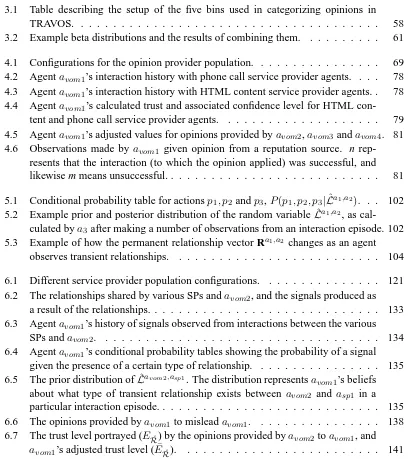
3.1 Table describing the setup of the five bins used in categorizing opinions in TRAVOS. . . 58 3.2 Example beta distributions and the results of combining them. . . 61
4.1 Configurations for the opinion provider population. . . 69 4.2 Agentavom1’s interaction history with phone call service provider agents. . . . 78
4.3 Agentavom1’s interaction history with HTML content service provider agents. . 78
4.4 Agentavom1’s calculated trust and associated confidence level for HTML
con-tent and phone call service provider agents. . . 79 4.5 Agentavom1’s adjusted values for opinions provided byavom2,avom3andavom4. 81
4.6 Observations made by avom1 given opinion from a reputation source. n
rep-resents that the interaction (to which the opinion applied) was successful, and likewise m means unsuccessful. . . . 81
5.1 Conditional probability table for actionsp1, p2andp3,P(p1, p2, p3|Lˆa1,a2). . . 102
5.2 Example prior and posterior distribution of the random variableLˆa1,a2, as cal-culated bya3after making a number of observations from an interaction episode. 102
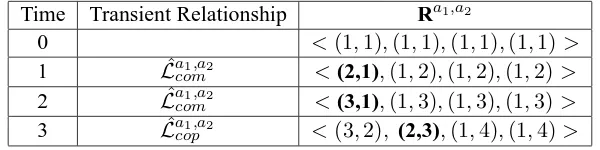
5.3 Example of how the permanent relationship vector Ra1,a2 changes as an agent observes transient relationships. . . 104
6.1 Different service provider population configurations. . . 121 6.2 The relationships shared by various SPs andavom2, and the signals produced as
a result of the relationships. . . 133 6.3 Agentavom1’s history of signals observed from interactions between the various
SPs andavom2. . . 134
6.4 Agentavom1’s conditional probability tables showing the probability of a signal
given the presence of a certain type of relationship. . . 135 6.5 The prior distribution ofLˆavom2,asp1. The distribution representsa
vom1’s beliefs
about what type of transient relationship exists between avom2 and asp1 in a
particular interaction episode. . . 135 6.6 The opinions provided byavom1to misleadavom1. . . 138
6.7 The trust level portrayed (ERˆ) by the opinions provided byavom2toavom1, and
avom1’s adjusted trust level (E¯Rˆ). . . 141
[image:11.596.120.529.214.673.2]CHAPTER 3
A A set of agents
a1, a2, ..., an Individual agents
Oatx,ay Outcome of interaction between agent ax and agentay, as
per-ceived byaxat timet.
Ot0:t
ax,ay A set of outcomes of interactions between agentaxand agentay,
as perceived byaxfrom timet0to timet
mt
ax,ay Total number of successful interactions between agent ax and
agentay, as perceived byaxat timet
ntax,ay Total number of unsuccessful interactions between agentax and
agentay, as perceived byaxat timet Rt
ax,ay A tuple(m
t ax,ay, n
t
ax,ay) representing the history of interactions
between agentaxand agentay, as perceived byax, at timet
Bax,ay The behaviour of agentaxtowards agentay
τax,ay The level of trust agentaxhas in agentay
τadx,ay The level of direct trust agentaxhas in agentay
τarx,ay The reputation level of agentay as calculated byax
τacx,ay The level of combined trust agentaxhas in agentay
γax,ay The level of confidence agentaxhas inτax,ay α, β Parameters for the Beta probability density function
ˆ
mtax,ay Total number of successful interactions between agent ax and
agentay, as reported by agentaxat timet
ˆ
ntax,ay Total number of unsuccessful interactions between agentax and
agentay, as reported by agentaxat timet
ˆ
Rt
ax,ay A tuple( ˆm
t ax,ay,nˆ
t
ax,ay)representing agentax’s opinion of agent ay, at timet
ρtax,ay The probability of accuracy of opinions provided by agentay, as
perceived by agentax, at timet
H A set containing a history of opinion provision from a particular
opinion provider
h A subset ofHthat contains similar opinions
CHAPTER 4
S A set of service provider agents
s1, s2, ..., sn Individual service provider agents C A set of service consumer agents
c1, c2, ..., cn Individual consumer agents O A set of opinion provider agents
o1, o2, ..., on Individual opinion provider agents
oa An opinion provider agent that provides accurate opinions
on An opinion provider agent that provides noisy opinions
ol An opinion provider agent that provides false opinions
CHAPTER 5
Lax,ay
type A permanent relationship of a type betweenaxanday
ˆ
Lax,ay
type A transient relationship of a type betweenaxanday
com Label for a competitive type of relationship
cop Label for a cooperative type of relationship
dep Label for a dependence type of relationship
P Set containing all observable results (p1, p2, .., pn) of an
interac-tion.
Rax,ay The permanent relationship vector, which represents the beliefs
an agent has about the permanent relationship betweenaxanday
δax,ay The confidence an agent has in its beliefs about the permanent
relationship betweenaxanday
ERˆt
ax,ay The level of trust inay, as portrayed in the opinion provided by ax
¯
ERˆt
ax,ay The adjusted level of trust portrayed by an opinion
CHAPTER 6
nei The number of experience interactions between a service provider
and the rest of the service providers in the population
noi The number of opinion experience interactions betweens agents
in the service provider population (that provide opinions) and the
consumer agent
nsi The number of signal experience interactions between a
Having been through the Ph.D experience, I can say that contrary to popular belief (and
aca-demic requirement) no thesis is ever the product of one person’s efforts. This one was no differ-ent – my apologies if I have inadvertdiffer-ently omitted anyone to whom acknowledgemdiffer-ent is due.
First and foremost, I would like to express my heartfelt gratitude to my supervisors Professor
Nick Jennings and Professor Michael Luck for their guidance, constant encouragement, and
insightful advice (on the research and, on occasions, life generally). Without their Herculean editorial efforts this thesis would be a labyrinth of words for the reader. It is only through
their constant review and revision that my written word has become strong and my arguments
clear. I give credit to them for the flashes of literary genius you may encounter, and accept full responsibility for any omissions, mistakes and errors you will encounter.
I would also like to acknowledge the people without whose help and advice this thesis would
not have been possible. I start with a hearty thanks to W.T. Luke Teacy – a valued friend, colleague and co-author, who began this journey with me, and has often carried me through
the more difficult times, always presenting himself as a perfect and patient board which I can
bounce my rough ideas against. Others include: Stephen Marsh for his views on trust and its darker sides; Gopal Ramchurn, Trung Huynh, and Jordi Sabater for their insights into the
domain of computational trust in agent-based systems; Professor Victor Lesser for the invaluable
discussions that provided encouragement for the research; Professor Carles Sierra, Dr. Nathan Griffiths, and Tomas Klos, all of whom provided me with valuable feedback on my work; and
finally, Rajdeep Dash and Paritosh Padhy for reviewing my chapters when I was too afraid to
submit them to my supervisors.
I gratefully acknowledge the financial support provided by the CONOISE-G project, which is
funded by the DTI and the Welsh E-Science Centre. Additionally, the project has provided me
with the context for my research, and a project team consisting of Alun Preece, Stuart Chalmers, Nir Oren, Timothy Norman, Peter Gray, Gareth Shercliff, Patrick Stockreisser, Jianhua Shao,
Alex Gray and Simon Thompson – All of whom have patiently listened to my presentations,
and given me advice.
During my time as a Ph.D student, I have had the pleasure of working within the IAM Group at the Univeristy of Southampton, a terrific place where the doors are always open. The joy outside
of research can be attributed to many individuals, including: Steven Kumarappan, Lakhdip Nagra, Ruple Vaid, Raviraj Shah, Nimet Patel, Rupesh Patel and Shivam Desai - friends who
were, and still are, always ready to provide a much needed distraction. In particular, I would like
to show gratitude to Pawandeep Panesar, who gave me the strength to tackle the most arduous tasks with a smile, a strength I hope I carry throughout my life.
In closing, I would like to thank my family for their support through the three years. My father
showed a keen interest in my work; my mother, who despite my telling her, cooked copious
– Thomas Jefferson,
Third president of the United States (1743 - 1826).
Introduction
Modern computing has evolved from single computer systems to large scale networked and
dis-tributed systems capable of providing on-demand access to a range of computing facilities (for example the Web, the Grid and peer-to-peer networks). The change has been fueled by the need
of the users to find and access information distributed across different systems, applications
and even different geographical locations. This wave of new technologies has brought with it a number of new challenges associated with the ability to model, design and build such complex
distributed systems. To tackle these challenges, it has been argued that agent-based computing
provides a promising point of departure (Jennings, 1999). In this context, a software agent can be viewed as an autonomous entity capable of flexible problem-solving, and, generally
speak-ing, agent-based solutions involve several such agents (i.e. a multi-agent system (Wooldridge, 2001)) interacting to provide a solution for a given problem. Agents are well suited to a variety
of applications (see Jennings (1999) and Luck et al. (2005) for a review) although they are
par-ticularly appropriate for applications that involve open, complex and distributed computation, and communication across networked computers (Jennings, 2001).
Until relatively recently, most agent systems have been closed, in that the number of agents and
their interactions are predefined by the system designer. This type of system is self-contained and insulated from the external world. Moreover, within the system, the agents are aware of all
the other agents, resulting in comparatively little uncertainty in their decision-making processes.
However the ability of autonomous agents to act in a rational, flexible way in uncertain
environ-ments has started to result in the application of agent-based computing to the domain of complex and open computer systems. Here, open systems are viewed as those that can be influenced by
events outside the defined system boundary, and in these systems it is difficult to monitor the agents and their interactions. Typically, agents can enter and leave the system at will, so that
at any given time a single agent within the system will not know all the other agents that are
present. Furthermore, agents in an open system are not guided by a universal protocol, nor do they have predefined and universal capabilities. So, in addition, agents are unable to determine
the capabilities and behaviour of others, resulting in a system where some (malicious) agents
may take advantage of others by behaving in a deceitful way. However, even with this
uncer-tainty in the environment, agents must be able to make decisions and successfully interact with other agents. In such cases, examples of successful interactions include optimal partner
selec-tion for collaboraselec-tion, task delegaselec-tion to individuals who will perform the activity efficiently and
effectively, and fulfilling an agreement between two or more partners. Achieving such success is a challenging task, however against this background, we seek to develop an infrastructure that
assures good interactions between the agents within the system, by addressing the uncertainty
present in their decision-making.
The remainder of this chapter provides motivation behind using the concept of trust to address
the problem described above. Having provided the motivation, in Section 1.2 we describe the
role of trust in computer systems, and in Section 1.3 present our research aims. The chapter concludes by providing a summary of the key research contributions and an overview of the
whole thesis.
1.1
Managing Interactions in Human Societies
Agent-based systems share a number of common problems with human societies, such as
prob-lems with communication, collaboration, negotiation and assurance of good interaction between individuals (human or agent). Now, humans exist in a society, and likewise agents exist in their
own virtual society; it is within this virtual community that there is a need to assure good
in-teractions. Therefore, when seeking to engender successful interactions in agent systems, it is natural to look to their human societal counterpart for inspiration. More specifically we examine
the role that trust, security and legal contracts play in assuring good interactions.
First let us consider the notion of trust and reputation. Often in human societies we make decisions with incomplete information. For example, we may decide to buy a product from a
website; the decision to buy this product will typically include an assessment of the likelihood
(uncertainty) of receiving the item ordered, receiving the item in the specified delivery time, or receiving the item at all. We can determine this uncertainty by obtaining and evaluating
information that can help make good (or bad) predictions about the aspects of the decision that
are uncertain. In our example we can consult the past history of purchasing products from the website or we can ask friends who may have ordered from the same website. In the former
case, if each time the company has delivered the item in a good condition within the specified
time then we may predict that this is the most likely outcome in the future. In the latter case, if the majority of the friends reply saying that each time they dealt with the website they were
pleased with the service, then we may predict that this is the most likely outcome for us in the
future. As a final option, we may look to examine the social connections the website has with other companies, or the connections between us and employees or managers of the website. For
we may expect such (good) experiences if the website owner happens to be a family member or
a close friend.
More generally, it can be said that in the human decision-making process we assess uncertainty
in the decision by using the concept of trust (Williams et al., 1988). Here, trust is a degree of
belief in the actions of other people affecting one’s own state and choice of action, and it forms an integral component of our reasoning and rationale (Dasgupta, 1990). In this context, evaluating
the trustworthiness of another allows us to cope with the uncertainty in the decision-making
process. The concept of trust is illustrated in the example discussed previously. When we place an order through the website, we trust that the company will deliver the product to us in the
condition and at the time specified when placing the order. If the company succeeds in fulfilling
the contract, then we would consider increasing our assessment of the trustworthiness of the company; likewise if the company breaks the contract then we would decrease our assessment
of the trustworthiness of the company. In this way, the trustworthiness of an entity is dependent
on its behaviour. If it behaves well, or as expected, it earns our trust. On the other hand if it does not, then it risks losing our trust.
However, in an open community it is likely that we will interact with many entities with which
we may not have shared an interaction history. We can modify the description of the example to reflect this; suppose that we will be placing an order on a website belonging to a company from
whom we have not ordered previously. In this case, we cannot use the outcomes of the previous
orders to judge the trustworthiness of the company, because there are no such past orders, but we still have to answer the question of how much trust to place in this new company. Here the
answer comes from a variety of sources, such as the opinions of others about the company, or the rating ascribed to the company by a governing body of the industry. Typically, if we do
not have enough information to form an opinion about an entity, we consult our peers for their
opinion. The common opinion of others regarding an entity is known as the reputation of the entity, which may be used in the absence of trust formed from personal opinions.
As we have discussed, trust and reputation are affected by the past actions of individuals.
How-ever, there is another important factor in determining the level of trust to place in another. As humans we implicitly evaluate the trustworthiness of others, often by examining the social
struc-ture that surrounds the individual. For example, we may examine the social status (a CEO of a
company), the role (a doctor at a hospital) and relationships (a friend of the family) of individ-uals in determining their trustworthiness.
Now, while trust allows us to account for uncertainty, it is not the only method employed in
human societies. Thus, we now turn to the issue of security and legal contracts since these are alternative methods that can help us to reduce uncertainty in decision-making.
Firstly, the concept of security provides an alternative to trust. By securing something we
re-strict access to only those that have permission. For example, consider a private golf club that requires membership to allow access to its facilities. In an open society this creates an authority
pro-vides the issuer with the opportunity to assess the intentions, capabilities and behaviour of the
seeker. With the golf club, the owner of the club issues membership cards to those that seem fit and capable of paying the appropriate fees. Employing security mechanisms assures that those
that have permission are likely to behave in a certain way, reducing the uncertainty about their
behaviour. For example the club owner is unlikely to give membership to younger individuals that may cause a disturbance on the golf course. However, the problem with security is that,
essentially, it relies on a centralised authority to specify and enforce a certain protocol.
Secondly, the uncertainty in decision-making can be reduced by introducing legal contracts that guide interactions between individuals. For example an employee may have a legal contract
with an employer that may specify how and when the employee is paid and what the employee’s
working hours are. A contract aims to specify the expected behaviour of the parties that are bounded by it. In doing so, a contract creates an environment in which individuals have to
con-form to a certain specification, and where those that do not concon-form are punished. For example,
the employment contract described above may contain clauses that specify compensation for the employee if the employer breaks any part of the contract. Legal contracts reduce uncertainty by
restricting the behaviour to that which is deemed legal (allowed).
In summary, we have discussed how security and legal contracts can help individuals, in human societies, address the uncertainty in making their decision. However, this relief in uncertainty is
at the expense of either creating a closed system through security or by relying on conformance
to legal contracts. Trust offers a method of addressing the uncertainty without such restrictions. Specifically, we have described how trust forms an integral part of decision making in human
communities; it acts as the social glue that binds individuals within the society, by allowing us to make decisions depending on the actions of other individuals in light of uncertainty. Given this,
we believe that applying the social concepts of trust and reputation in open computer systems can
similarly increase the effectiveness of decision-making under uncertainty and help assure good interactions between individual components of the open system. For this reason, we choose the
concept of trust as our tool to address some of the problems in assuring good interactions in
computer systems.
1.2
Trust in Computer Systems
Computational systems are moving towards large-scale, open, dynamic and distributed
archi-tectures, harbouring numerous self-interested agents, often belonging to different organisations. The Grid (Foster and Kesselman, 2004) is perhaps the most prominent example of such an
en-vironment and, for this reason, is the one we focus on primarily in this research. Others include
peer-2-peer computing (Oram and Oram, 2001), pervasive computing (Schmeck et al., 2002), E-Business (Kalakota and Robison, 1999) and the Semantic Web (Berners-Lee et al., 2001) and,
infrastructure enabling complex computing facilities for advanced sciences and engineering. As
described by Foster et al. (2004), autonomous agents are key to realizing the vision of the grid, as they provide the intelligent and autonomous processes that make use of the computing
facili-ties. Typically, such agents are owned by real life stakeholders, who profit from their actions in
the virtual world. With the presence of many agents in the environment, it is likely that agents from different stakeholders will find themselves working together to achieve a goal. However,
even though the agents are working together, each has its own set of goals, and this can lead to
self-interested behaviour. The concept of self-interest is introduced by the translation of social ties that exist between agents’ stakeholders in the real world to agents in the virtual world. Thus,
we often find that agents in Grid systems are able to form and maintain social ties and a social structure within their virtual community that mirrors the real world. Here, the self-interest
in-troduces the possibility of agents interacting in a way to maximise their own gain (potentially at
the cost of another), to provide the optimum profits for their stakeholders. In a Grid context, it is therefore essential to ensure good interaction between agents so that no single agent can take
advantage of other agents in the system.
In more detail, many of the interactions between agents in the Grid are conducted in terms of virtual organisations (VOs) (Foster et al., 2004). Specifically, VOs are collections of agents
(representing individuals or organisations), each of which has a range of problem-solving
capa-bilities and resources at their disposal. A VO is formed when there is a need to solve a problem or provide a resource that no single agent in the Grid can address. Such VOs often have
vari-able lifespans, the duration of the time that they operate as coalitions, so that they are highly
dynamic social structures. Typically agents that form VOs share certain types of relationships. For example an agent in a VO may depend on another to provide a particular part of a solution
to a problem or before forming a VO two agents may compete to win the contract to supply a
particular resource. In addition to these properties, they vary in scale, scope, purpose and struc-ture. Moreover, in the Grid, the problems of assuring effective and good interactions between
the individual agents are further complicated due to the size of the system and the large number
of agents and interactions between them. Nevertheless, solutions to these problems are integral to the wide-scale acceptance of the Grid and agent-based virtual organisations.
Against this background, we argue that the concept of trust is key to assuring good interactions
between agents in this domain. Specifically, it can be utilised to account for uncertainty about the willingness and capability of other entities to perform actions as agreed, and not defecting
when it proves to be more profitable.
1.3
Research Aims
Trust provides a mechanism, influenced by an individual’s personal and social experience, to
context of VOs and Grid computing provides an additional set of issues over and above those of
traditional multi-agent systems. We can therefore state the general aim of this thesis as follows:
To develop a model of trust, which takes into account environmental and other avail-able information, and aids decision-making in open and dynamic environments, particularly in relation to the formation and management of agent-based virtual organisations.
In particular, this general aim can be broken down as follows:
Aim: 1
We aim to establish a model that determines a trust level for an individual by exam-ining the past behaviour of that individual. More specifically, we aim to consider
the outcomes of past interactions with an agent to calculate a trust level.
Aim: 2
In open systems, and especially in the Grid, it is likely that agents will often be
required to interact with others they have not yet had any experience with. For this
reason we aim to enhance the above model by considering, in trust determination, the opinions of others that may have interacted with the individual.
Aim: 3
By introducing opinions into trust determination, we increase the likelihood of
in-troducing bias and errors, because opinions given by others are shaped by their subjective experiences. For this reason, we aim to ensure that the model of trust is
capable of not being misled, and minimises the error introduced by opinions from
others, by judging the manner in which individuals provide opinions.
Aim: 4
Since trust is not only influenced by the personal experience and opinions of others,
but also by social structures within a society, we aim to consider the role of social structures in the trust model. More specifically, we see to exploit these structures to
help minimise the errors introduced by the opinions of others.
Aim: 5
To further enhance the decision-making process, we aim to incorporate into the model a confidence level that represents how much confidence an individual should
place in the determined trust value. We believe that such a metric will allow the
agent to reason when further evidence is needed in determining a trust level.
Aim: 6
problems that the model must address. One such problem is the nondeterministic
nature of the distributed system; at any point in time it is difficult to determine which network nodes are accessible and which are not. To this end, it is essential
that the trust model can cope with the absence of network nodes it relies on, and
is therefore distributed and robust (able to cope with network failure) due to the nature of its application domain. Furthermore, the large number of agents within
the Grid, and the ability of this number to grow dynamically, requires the model to
be scalable.
1.4
Research Contributions
The research reported in this thesis outlines how trust is conceptualised, so that a computational model of trust can be designed for open and dynamic computer systems such as the Grid. In
addition to developing and deploying a computational trust model for open, dynamic and
large-scale agent-based systems, this work is the first to directly incorporate social information (the knowledge of social relationships that are present between agents in an environment) into aspects
of trust calculation. From the contemporary trust models that do consider social information,
none detail the manner in which the such information is obtained and translated to a form that can be used in calculating a level of trust. Through our work we further advance the claim that
social information is an important facet in determining trustworthiness.
In more detail, through this work we advance the state of the art in the following ways:
• We develop the first probabilistic model of trust for agent-based systems that supports
dynamic VO formation and management by agents, giving agents the ability to account
for uncertainty in their decision-making processes by assessing the trustworthiness of others. This work has previously been reported by Patel et al. (2005a) and Teacy et al.
(2006, 2005).
• We develop a novel component that is used to adjust erroneous opinions provided by
other agents, so that an agent is not misled. Many other models attempt to filter and adjust opinions, but through empirical evaluation we show that our approach outperforms other
approaches. The results of this empirical evaluation have previously been reported by
Teacy et al. (2006, 2005).
• We describe how to implement a computational trust model, for the first time, in a realistic
industrial multi-agent system used for providing tailored multimedia service packages
through the Grid. Details of this have previously been reported by Patel et al. (2006,
2005b,c), Shao et al. (2004) and Nguyen et al. (2006).
• We develop a mechanism with which an agent is able to obtain the social information
process by which an agent is able to learn the social relationships present in a multi-agent
system.
• We specify a novel set of relationship-based heuristics that allow an agent to adjust, in the
trust calculation, opinions provided by others, so that the agent is not misled by any bias
that maybe introduced by the presence of certain social relationships.
• We demonstrate, through empirical evaluation, the value of using social information in
a trust model to enhance its performance. Our evaluation is the first to show that there are certain environments in which using social relationships is advantageous and others in
which it is not.
1.5
Thesis Structure
This thesis describes the techniques and tools developed in meeting the aims described
previ-ously. We start the presentation of the work with a review of the relevant literature in the field.
The purpose of this review is twofold. Firstly, it serves the purpose of providing the reader with background to the problem and its domain. Secondly, through the review of the literature
we elicit a list of requirements for a computational trust model that we aim to develop. More
specifically, Chapter 2 begins with a general discussion of agents and multi-agent systems that describes how this software paradigm is suited to open complex systems such as the Grid.
Build-ing upon this, through the analysis of the Grid computBuild-ing architecture, and its primary mode of use (VOs), we enumerate a number of trust related issues. We then examine the state of the art in
computational trust models, from a variety of domains, to discover how some of the previously
enumerated trust issues are addressed. Finally, the chapter concludes with a summary, which presents our working definition of trust and a list of requirements for our trust model.
In Chapter 3 we present TRAVOS — our novel trust and reputation model for agent-based virtual
organisations. The chapter describes the core components of the model: (i) a mechanism that allows an agent to convert personal experience with an interaction partner to a level of trust that
can be placed in that partner, (ii) a mechanism that allows this level of trust to be calculated in
the absence of personal experience, through utilising the opinions of other agents in the system, and (iii) the mechanism used to adjust opinions that may otherwise mislead an agent.
Initially, we validate our approach, in Chapter 4, by showing how the different components of
TRAVOS perform by evaluating them in a bespoke simulation environment. We describe how, using the simulation, we compare our approach to the most closely related model from the
liter-ature and show how our mechanisms are superior. We provide further validity for our approach
by presenting a system evaluation of TRAVOS. More specifically, we present a scenario for trust in an agent-based virtual organisation, and using this scenario we show a walk through to show
how TRAVOS can be used in such a system. Finally, we conclude the chapter with a description
In Chapter 5 we extend the TRAVOS model by incorporating mechanisms that make use of
so-cial information to make the trust calculations richer. We describe a method of allowing agents to learn the inter-agent social relationships that are present in multi-agent systems, and,
further-more, we outline a set of relationship-based heuristics that can be used to make the mechanism
of adjusting the opinions of others more effective. We conclude the chapter, aided by a modified scenario, with a demonstration of the application of the heuristics, showing that they can prevent
an agent being misled by biased opinions.
In Chapter 6 we show that the use of social information in a trust model enables it to more accurately estimate the behaviour of agents. Again, this is done through empirical evaluation
in a modified simulation environment. Through discussion of the results obtained, we conclude
when it is wise to adopt an approach that makes use of social information, and when it is not. Furthermore, by use of a scenario, we show exactly how our approach can be used by an agent,
in a VO environment, so that it is not misled by others.
Literature Review
The aim of this research is to develop a model of trust that helps assure good interactions in
the context of agent-based virtual organisations (VOs) in the Grid. In this chapter therefore, we review the literature concerning agents and multi-agent systems, Grid computing and VOs, the
broad subject of trust, and the state of the art models of trust in the agent and Grid communities.
To this end, the purpose of this chapter is to present such a review.
Initially, we examine the field of agents and multi-agent systems (Section 2.1), with the aim of
establishing the characteristics of agent-based systems, and seeing how these characteristics are suited to large scale open and distributed systems (Section 2.2). We then present an analysis of
Grid computing and VOs that develops a clearer picture of the application domain, and brings
to light problems that may be encountered in developing a solution (Section 2.3).
The field of research concerned with trust is diverse. Trust is a concept that humans use
implic-itly in day-to-day activities (as per Section 1.1). However even though it is used extensively, the definition of trust, both in human and virtual societies, still remains elusive. Before embarking
on developing a model of trust, therefore, it is necessary to understand the various views on
trust, and hence Section 2.4 provides a review of trust related literature.
We conclude the chapter by highlighting the open issues not addressed by the current state of
the art computational trust models, and provide a summary of detailed requirements for this research.
2.1
Agent Basics
In the software domain, the term “agent” is quite often misinterpreted as it has numerous def-initions. Smith et al. (1994) define agents to be “computer programs that simulate a human
relationship by doing something that another person could do for you”. Russell and Norvig
(2003) take a more simple view of an agent; they define it to be anything that perceives its
envi-ronment, and then acts accordingly upon that environment through effectors. Currently there is
no general consensus across the agent community on the definition of an agent, but the
descrip-tion provided by Wooldridge and Jennings (1995) is probably the most widely accepted. Here, an agent is a software-based computer system that has the following properties:
• Autonomy – An agent should have the ability to function without intervention and have
control over its own actions and internal state.
• Socialability – An agent should have the ability to interact with other agents and humans
using a defined communication language.
• Reactivity – An agent should have the ability to perceive its environment and act in
re-sponse to the changes in that environment.
• Proactivity – An agent should have goal-based behaviour that enables it to be proactive
and not just react to external stimuli. The agent’s goals should drive its actions.
The confusion over the concept of an agent is not only caused by the numerous definitions, but is also added to by the presence of many agent architectures that offer particular methodologies
for building software agents. Here we briefly discuss agent architectures to help develop a more complete understanding of agents, which is required to consider the issues discussed in Section
2.3 and 2.4. It is important to review the different architectures because the trust model that will
be developed in this research will be embedded within an agent architecture (see Section 4.2).
Architectures exhibit certain characteristics that help specify how the main problem is broken into smaller problems, that a single (or multiple) agents can solve. Typically they provide a
description of the overall behaviour of an agent by describing the internal components and the interactions between these components. In addition, they provide the algorithms that bring about
actions the agent performs and its future state, from the agent’s percepts and current internal
state. It must be noted that many agent architectures exist in the literature, perhaps the three most widely used and accepted classes being the Deliberative (see Wooldridge (2001), Weiss
(1999) and Rao and Georgeff), Reactive (see Brooks (1991)) and Hybrid architectures, but it is
outside the scope of this work to examine each in detail. Instead, here, we briefly consider the requirements a computational trust model may have on the architecture of the agent it is to be
embedded in.
Typically (as can be seen through the discussion presented in Section 2.4 most computational trust models contain both reactive aspects (for example an agent can be configured not to interact
with others with a trust value lower than a threshold) and deliberative aspects (for example
an agent can deliberate over a trust value for a particular agent and decide that it needs more evidence to calculate a more accurate trust value). To this end, when we arrive at implementing
our model in an agent architecture we choose to do so in an architecture based on the hybrid
2.2
Multi-agent Systems
In a distributed system, it is common to have more than one agent (forming a multi-agent sys-tem). Luck and d’Inverno (2004) define a multi-agent system as one “in which several distinct
components, each of which is an independent problem-solving agent, come together to form some coherent whole”. In a multi-agent system there is no goal that drives the whole system;
instead each agent entity has its own goal. This means that the agents have to cooperate and
coordinate within the multi-agent system and therefore form a coherent system that serves the
end-user. This coordination and cooperation is a necessity to “avoid duplication of effort,
un-wittingly hindering other agents in achieving goals and to exploit other agents’ capabilities”.
For example, we can consider a football team as a multi-agent system, where each player has
their own special ability and plays a part in trying to make the team win. The players are likely to cooperate and coordinate in such a way that no one player ends up running with the ball at
all times, and not every player flocks to the ball. In such scenarios, and as we have done so far, multi-agent systems are shown as teams of agents working together in an effort to achieve
a common goal. While this is true of traditional multi-agent systems, these systems are now
becoming open with agents owned by different stakeholders. In such systems, agents may still work together to achieve a common goal, but they are motivated by their own goals and utility,
leading to selfish behaviour (as described in the following sections).
2.2.1 Multi-agent Systems in Open and Complex Environments
In open multi-agent systems, agents can enter and leave when they want, in turn creating a
dynamic environment. In these systems, agents typically represent different competing
organ-isations and, for this reason, we assume that these agents are self-interested. Here, the notion of self-interest means that an agent will act in a manner which maximises its own utility given
its own goals. The reasons for the applicability of agents to open and complex are given below
(adapted from (Jennings and Wooldridge, 1998)):
Open systems — The structure of an open system is capable of changing rapidly. Typically,
the entities within an open system are heterogeneous, having been developed by different
people at different times. The entities present at any given time in the open system are not known in advance, undergo continual change, and are considered dynamic. Even with the
presence of these characteristics, an open system must operate without much interference from users or system designers. A multi-agent system offers the ability to model these
entities as autonomous agents, capable of negotiating and communicating on their own
without user intervention.
Complex systems — Modularity and abstraction are techniques that help reduce the
it down into smaller problems. Agent-based systems are inherently modular and can
of-fer this characteristic to complex systems, with each smaller problem being solved by a single agent, and the overall solution being produced by the interaction of these problem
solving agents. This model of problem-solving enables the system designers to abstract
the complex software as a virtual community of interacting problem solvers.
2.2.2 Multi-agent Systems in Grid Based Virtual Organisations
The Grid is an open and complex distributed computing environment and, having justified the use of agents in an open and complex domain, it can be said that agent-based systems exhibit
characteristics that are well suited to the domain of the Grid (Foster et al., 2004). More
specif-ically, a Grid-based virtual organisation (VO) system can be modelled as a multi-agent system in which:
1. agents are owned by different organisations;
2. agents have different problem-solving capabilities; and
3. agents have the choice of interacting and cooperating with each other.
However, using an agent-based approach has certain drawbacks. Its inherently distributed
na-ture, and the presence of many individual problem-solving agents, means there is no overall system control. A further disadvantage, due to its scale, is that each agent only has a localised
viewpoint of the entire system. This means that computational power has to be used to allow an
agent to interact with all other agents in order to build up a more complete view of the system (in the majority of cases this will not be required because each agent is responsible for part of
the system and does not have the need to develop a system wide view). In addition to these natural limitations of agent systems, the application of agents to large-scale open distributed
environments introduces further challenges. Ramchurn et al. (2004a) identify a number of these
new challenges:
1. Agents are likely to represent different stakeholders and each is likely to have its own
aims and objectives. This will be the case in a VO, as each entity may belong to different
organisations.
2. Agents are capable of leaving and re-entering the system under a new identity to avoid
penalty for past actions.
We believe the above challenges can be met by using a computational model of trust, as
dis-cussed in Section 2.5. However, before we move to a discussion about how some of these challenges may be addressed by use of a trust model, we examine the nature of the Grid, and
the specific characteristics of VOs, with respect to issues concerned with trust and behaviour of
agents.
2.3
Grid Computing and Virtual Organisations
The state of the art Grid has evolved over the last decade from numerous different systems (for example (FARNER, 1995) and I-WAY (Foster et al., 1996)). The earliest efforts were named
“metacomputing” and involved linking various supercomputing sites. These early
metacomput-ing projects were created in order to give high performance applications access to large com-putational resources. The state of the art Grid is defined by Foster and Kesselman (2004) as a
computing system that solves the problem of coordinated resource-sharing and problem-solving
in dynamic, multi-institutional VOs. The current Grid infrastructure requires an extensible and robust architecture, in which much consideration has to be given to interoperability, protocols,
services and APIs to aid the formation and operation of dynamic virtual organisations.
Grid computing has developed in response to address the specific needs of a computing in-frastructure that supports VO-like structures. In the Grid, electronic agents owned by different
organisations can work in collaboration to achieve a collective goal. In fact, VOs are a key to
realising the grand vision of the Grid and provide the principal style of use for Grid technology. In more detail, Foster et al. (2001) describe a VO, in the context of a Grid, as a set of individuals
and/or institutions defined by a set of sharing rules (which define access to various resources by
consumers and suppliers within the system). The VO can be seen as having a definite lifespan, consisting of a few key stages shown in Figure 2.1, and described below:
1. Formation — When a need arises, a VO is formed. A group of agents form a collective
that is capable of addressing a special need that cannot be addressed by each of the agents on their own. This stage can be described as partner selection, because each of the agents
is surveying prospective partners with which they will form a VO.
2. Functioning — During the functioning phase of the life cycle, the agents collaborate with
the other VO members under a set agreement (or contract).
3. Restructuring — Under certain conditions it may be necessary to restructure a VO. For example, restructuring may occur if the initial requirements for the VO change or if a
particular member of the VO provides a service below an acceptable level and is asked to
4. Disbanding — This is the final stage of a VO life cycle. This occurs upon completion of
an agreement, after which the agents are not under any contractual obligation to work as a collaborating collective. The disbanding may also be necessary if it is computationally
less expensive than major restructuring.
FORMATION FUNCTIONING DISBANDING
RESTRUCTURING Agents work together to achieve a common goal.
FREE AGENTS IN THE MULTIAGENT SYSTEM Agents come together
for a common purpose.
Agents work together to achieve a common goal.
Agents fulfill their purpose and achieve their goals.
Agents removed and added to maintain functionality
and performance.
FIGURE2.1: The main stages of a virtual organisation’s lifespan.
The introduction of VO structures across a distributed domain has certain requirements and
some common concerns. These are outlined below (adapted from Foster et al. (2001)):
1. VOs require highly flexible sharing relationships. The rules and policies that define the sharing of resources among the constituents of a VO have to allow for the complex sharing
relationships that are defined within the VO.
2. VOs require sharing of resources across a spectrum of systems, ranging from peer-to-peer
to client-server.
3. A VO may require a sophisticated and precise level of control over how shared resources are actually utilised.
4. There are also few restrictions on how many and what type of resources may be shared. Therefore, the mechanisms using these resources have to be flexible.
5. Finally, the VO may have to support a diverse set of usage modes, ranging from
performance-sensitive to cost-performance-sensitive. This gives rise to issues of accounting, quality of service, scheduling and co-allocation.
The stages in the VO life cycle and the exploitation of VO-like structures require a new type of technology, which is capable of meeting the requirements and common concerns outlined
analysis of the Grid architecture that describes the key components, and elicits the issues that
impact on the trustworthiness of individual entities found within VOs that make use of the Grid.
2.3.1 The Grid Architecture
The Grid architecture offers a collection of fundamental components, and interactions between these components, that collectively meet the requirements of VOs (Foster et al., 2001). In more
detail, Foster et al. adopt an hourglass model to specify the layers of the Grid architecture, as
shown in Figure 2.2). This architecture classifies the components into a set layers, which help in identifying the general requirements for the components, resulting in an open architecture that
allows the creation of solutions that meet VO requirements.
The narrow neck of the hourglass is a set of abstractions and protocols, which are important for two reasons. Firstly, much of the high-level behaviour found at the top of the hourglass can be
mapped onto this narrow neck. Secondly, the core abstractions and protocols can themselves
be mapped onto many different underlying technologies that enable the overall operation of the Grid. Specifically, the resource and connectivity protocols are designed so that they can be
implemented over a range of diverse resources found in the fabric layer. A range of services
and behaviours, which are found in the collective layer, can be constructed from the resource and connectivity protocols. Our work is situated in the application layer, which utilises the
capabilities offered by the collective layer. More specifically, the trust model will be embedded
into an agent-based application within the application layer. We do not work at the lower layers, but a description of all layers is included for completeness of the context.
FREE AGENTS IN THE MULTIAGENT SYSTEM
APPLICATION
COLLECTIVE
RESOURCE
CONNECTIVITY
FABRIC THE GRID PR
O
TOC
OL AR
CHITECTURE
FIGURE2.2: The Grid architecture (adapted from (Foster and Kesselman, 2004)).
The fabric layer consist of the geographically distributed resources, for which the Grid system
to house the components that implement the local resource-specific operations that a resource
is capable of performing. The decision of how much of the functionality of a resource is to be implemented in the fabric component is a trade-off between enabling more complex sharing
relationships in VOs and the complexity of deploying the Grid architecture. In order to keep the
deployment of the Grid architecture simple, and enable the core operations that users may re-quest from a resource, the fabric components are required to implement at least two main
mech-anisms. Firstly, they are required to implement enquiry mechanisms that enable the resource
to communicate its structure, state and capabilities. Secondly, they are required to implement resource management mechanisms to allow control over quality of service.
The connectivity layer consists of core communication and authentication protocols for
Grid-specific transactions. This layer is responsible for enabling easy and secure communication within the Grid. The communication protocols provide methods of data exchange between
fabric layer resources. These protocols are primarily drawn from the internet, transport and the
application layers of the internet layered protocol architecture (Baker, 1995). The authentication protocols provide secure mechanisms for verifying the identity of users and resources. These
protocols are required to have certain characteristics in order to support VO environments; these are summarised below (from (Butler et al., 2000)):
1. Single sign on — Users should be able to log on only once and gain access to a variety of
resources they are authorised to access.
2. Delegation — A user must be able to execute a program that is capable of accessing the
resources the user is authorised on. Additionally, the program should be able to delegate subsets of these rights to other programs based on certain conditions.
3. Integration with various local security solutions — Grid-based security solutions must
be able to interoperate with various local security solutions, thus they must provide a
mapping onto the existing local security infrastructure.
4. User-based trust relationships — The authentication solution should allow the user to access a variety of resources without requiring the security administrators of the resource
providers to interact with each other.
The resource layer is a collection of protocols that builds upon the protocols of the connectivity layer. This collection provides the abstraction above the fabric layer functions, and mechanisms
for secure negotiation, initiation, control, accounting and payment of operations of resources
found in the fabric layer. Each of the protocols can be classified into two main classes:
1. Information protocols – These are used to obtain information about a resource (for