the Schrödinger Equation
Explicitly Correlated Wavefunctions
Mohammad Mostafanejad
Research School of Chemistry
College of Physical and Mathematical Sciences
A thesis submitted for the degree of
Master of Philosophy
of the Australian National University
November 2016
© Copyright by
I hereby declare that to my best knowledge, the contents of this thesis are original and
have not been submitted in whole or in part for consideration for any other degree or
qualifi-cation at ANU, or any other university. Also, necessary citations have been carefully and
explicitly made throughout the text whenever they referred to the work of other persons. This
dissertation contains fewer than 60,000 words excluding appendices, bibliography, footnotes,
tables, figures and equations.
Mohammad Mostafanejad
I would like to thank ANU for the IPRS scholarship. Inspiring and fruitful discussions with
our sabbatical visitors Prof. Patrick Bultinck from Ghent University which led to an
inter-esting project on the performance of the Hylleraas-configuration interaction wavefunction,
and Prof. Vitaly Rassolov from University of South Carolina which resulted in a deeper
understanding of mine about the electron correlation problem and correlation operators are
also acknowledged. I am indebted to our physicist visitor Prof. Nimrod Moiseyev for the
fascinating discussion about complex and stability analyses and sending me valuable papers
from his PhD project. I am also grateful to Dr. Andrew Thomas Beresford Gilbert for his
expertise in mathematics who was a great source of learning for me and Dr. Marat Sibaev for
The notions of electron correlation and correlation problem arising in the framework of
approximate solutions to the Schrödinger equation are presented. Then, we briefly review the
original ideas of explicit inclusion of the interelectronic distance,r12, into the wavefunction
as a solution to this problem.
Exemplifying the efficiency of the explicit correlation for achieving high accuracy, we
analyze the Nakatsuji’s free-complement (FC) method. We demonstrate that at each FC
order, fewer number of complement functions is required to get lower energies compared
with those resulting from the conventional FC method. Applying the FC method to the triplet
excited state of the He atom, we have discovered the appearance of permanents in addition to
the determinants in the FC expansion of the wavefunction. These permanents are shown to
be important for the energy convergence.
To achieve a better understanding about the explicitly correlated methods, especially,
the R12 and F12 methods, we analyzed three possible candidates with various correlation
theory of the Frost and Braunstein (FB). We revisit CMO theory within both restricted (R)
and unrestricted formalisms (U). We also introduce the unrestricted FB (UFB) ansatz for
the first time and derive the necessary expressions for both RFB and UFB overlap, kinetic,
nuclear-attraction and interelectronic Coulomb repulsion matrix elements. All integrals have
been obtained in closed form except one for which, we have used an accurate one-dimensional
quadrature.
Finally, we investigate the potential energy curve (PEC) of UFB for H2at small,
inter-mediate and large internuclear distances. Then, we compare its performance with that of
RFB, restricted Hartree-Fock (RHF), unrestricted Hartree-Fock (UHF) and configuration
interaction (CI) wavefunctions. Reproducing the RFB results for a much wider range of
bond lengths in H2reveals that the calculations of FB contain significant errors. We have
also found a pole in the RFB linear correlation coefficient. Our UFB ansatz provides
signifi-cant improvement over the RFB where passing the symmetry breaking point it completely
removes the hump in the RFB PEC. The UFB ansatz also shows surprising features such
as the presence of multiple solutions, non-smooth PEC, symmetry-broken solutions that
are higher in energy than the restricted solution and RFB→UFB stability in the presence of lower UFB solutions. These phenomena can have significant impacts on the explicitly
correlated calculations such as R12 and F12 within the unrestricted framework. Also, a
detailed discussion on the large-Rasymptotic analysis of these five wavefunctions shows
that none of these PECs has the correctO(R−6)decay within the minimal basis model. The UFB energy, however, demonstrates dispersion-likeO(R−8)decay which is an improvement over the CI and UHF with exponential decays. Considering the generalized FB (GFB)
List of Figures xiii
List of Tables xv
List of Abbreviations and Nomenclatures xvii
1 Electron Correlation and Explicitly Correlated Wavefucntions 1
1.1 Introduction to the Correlation Problem . . . 2
1.1.1 Electron Correlation in Statistical Sense . . . 3
1.1.2 Hartree Product and Slater Determinants . . . 5
1.1.3 Electron Correlation in Qualitative Sense . . . 9
1.1.4 Electron Correlation in Quantitative Sense . . . 10
1.2 Explicit Correlation in Electronic Wavefunctions . . . 11
1.3 Concluding Remarks . . . 13
2.1 Introduction . . . 16
2.2 Free-Complement Method and Scaled-Schrödinger Equation . . . 19
2.2.1 Free-Complement Electronic Energies . . . 21
2.2.1.1 Hydrogen Molecular Ion: The Ground State . . . 21
2.2.1.2 Helium Atom: The Ground State . . . 25
2.2.1.3 Helium Atom: The Triplet Excited State . . . 29
2.2.2 Examples of Compact Explicitly Correlated Wavefucntions: A Case Study . . . 33
2.3 Concluding Remarks . . . 36
3 Investigation of the Frost-Braunstein Wavefunction for H2: Theory 39 3.1 Introduction . . . 40
3.2 Theoretical Framework . . . 41
3.2.1 Restricted Hartree-Fock . . . 42
3.2.2 Unrestricted Hartree-Fock . . . 44
3.2.3 Configuration Interaction . . . 45
3.3 Frost-Braunstein Wavefunction . . . 47
3.3.1 Frost-Braunstein Integrals . . . 48
3.3.1.1 Overlap and Coulomb Repulsion Integrals . . . 49
3.3.1.2 Kinetic Integrals . . . 55
3.3.1.3 Nuclear-Attraction Integrals . . . 57
3.4 Concluding Remarks . . . 66
4 Investigation of the Frost-Braunstein Wavefunction for H2: Application 67 4.1 Introduction . . . 69
4.2 STO-nG Basis Sets . . . 71
4.3.1 Restricted Hartree-Fock . . . 74
4.3.2 Unrestricted Hartree-Fock . . . 76
4.3.3 Configuration Interaction . . . 77
4.3.4 Restricted Frost-Braunstein . . . 79
4.3.5 Unrestricted Frost-Braunstein . . . 81
4.4 Potential Energy Curves . . . 84
4.4.1 UFB/STO-1G Energy Curve: A Simple Model . . . 85
4.4.2 Spectroscopic Parameters . . . 87
4.4.3 Correlation Energies . . . 88
4.5 Asymptotic Analysis . . . 90
4.5.1 Restricted Hartree-Fock . . . 92
4.5.2 Unrestricted Hartree-Fock . . . 93
4.5.3 Configuration Interaction . . . 95
4.5.4 Generalized Frost-Braunstein . . . 97
4.6 Concluding Remarks . . . 100
5 Conclusion 103
6 Responses to Examiners’ Questions 107
References 111
Appendix A The One- and Two-Electron Integrals Over Slater-Type Orbitals for
H2 119
Appendix B The Abscissas and Weights of the Gaussian Quadrature for theU1
Appendix C Asymptotic Expressions for Coulomb Integrals Over Slater
Func-tions: Derivation 127
Appendix D The Optimized Exponents and Coefficients of the Normalized STO–
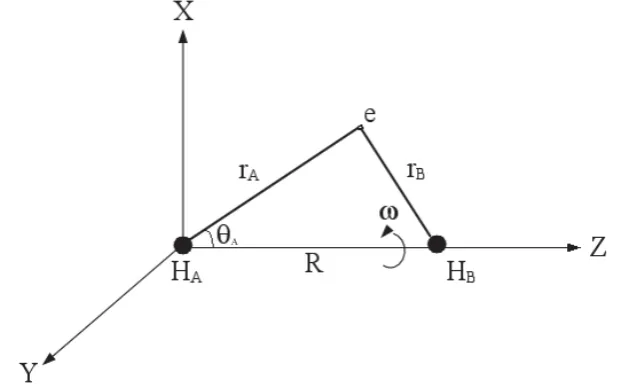
2.1 The hydrogen molecular ion H+2 aligned on the Z axis in the elliptic
coordi-nate system. . . 22
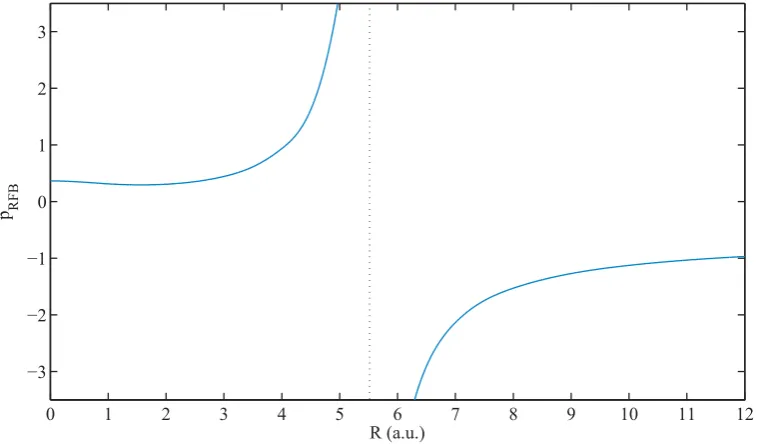
4.1 Variation of pRFB with the bond lengthR. . . 79
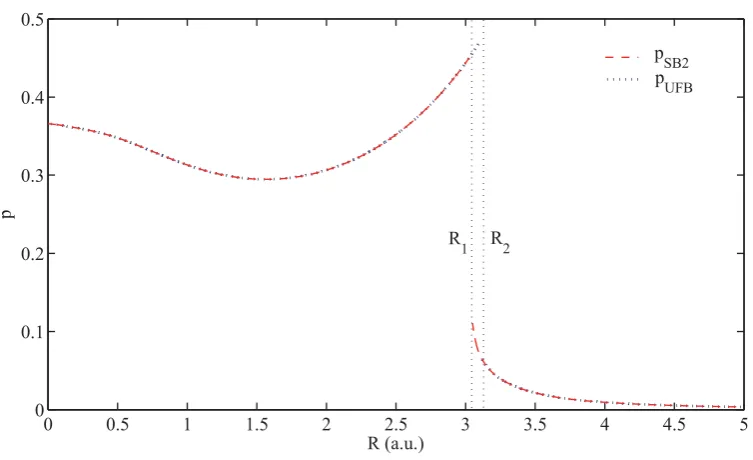
4.2 Variation of pUFB andpSB2 with the bond lengthR. . . 82
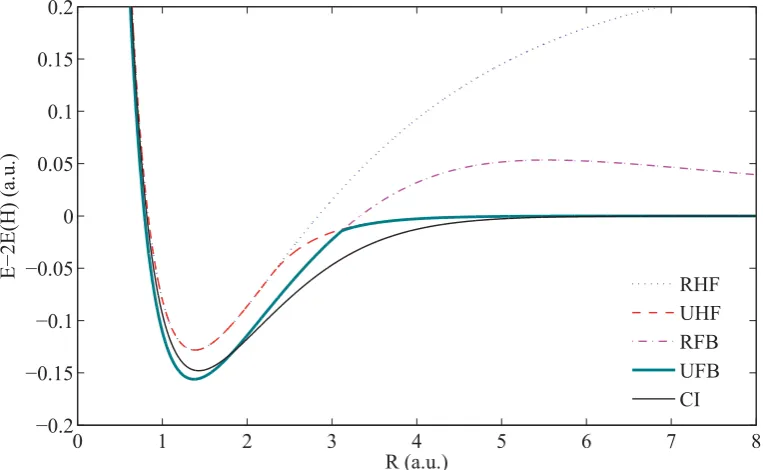
4.3 Single-ζ RHF, UHF, RFB , UFB and CI potential energy curves for H2. . . 84
4.4 Variation of the RFB and symmetry broken STO-1G electronic energies withR 85
4.5 Variation of the UFB/STO-1G energy function with mixing parametert . . 86
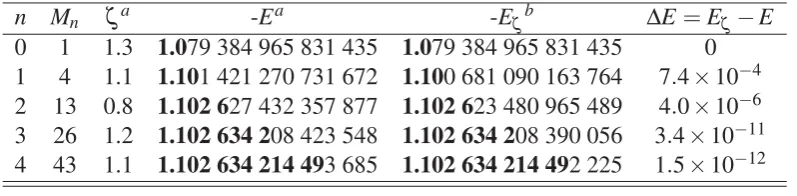
2.1 The free-complement ground state (X2Σ+g) electronic energyE, and exponent ζ, for the hydrogen molecular ion H+2 atR=2. . . 23
2.2 The free-complement singlet ground state (1S) electronic energy E, and
exponentζ, for the helium atom. . . 27
2.3 The first triplet excited state (3S) FC electronic energy (E orEb)a of the helium atom with the electronic configuration 1s2s. . . 31
2.4 The variational electronic energyE, exponentsζ andβ and linear correlation
coefficient pfor the singlet ground state of the helium atom. . . 35
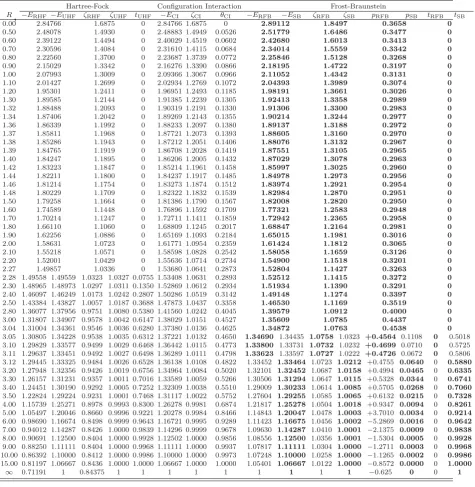
4.1 Single-zeta electronic energiesE, exponentsζ, mixing parameterst, and
lin-ear coefficients pfor H2at bond lengthR. The boldface numbers correspond
to the lowest energy UFB solution. . . 75
4.2 Equilibrium bond length Re, harmonic vibrational frequencyωe and well
the interval[0,1]. . . 125
D.1 The optimized coefficientscμ and exponentsαμ for the normalized STO–8G
List of Abbreviations
and Nomenclatures
Acronyms / Abbreviations
AO Atomic Orbital
BO Born-Oppenheimer
CC Coupled Cluster
CCS Coupled Cluster Singles
CCSD Coupled Cluster Singles and Doubles
CHGF Confluent Hypergeometric Function
CI Configuration Interaction
CMO Correlated Molecular Orbital
CSF Configuration State Function
FB Frost-Braunstein
FCI Full-Configuration Interaction
GTO Gaussian-Type Orbital
HF Hartree-Fock
HP Hartree Product
ICI Iterative Configuration Interaction
ISE Inverse Schrödinger Equation
LSE Local Schrödinger Equation
LYP Lee–Yang–Parr
MO Molecular Orbital
PEC Potential Energy Curve
RFB Restricted Frost-Braunstein
RHF Restricted Hartree-Fock
SB Symmetry-Broken
SCF Self-Consistent Field
SE Schrödinger Equation
SSE Scaled Schrödinger Equation
STO Slater-Type Orbital
UFB Unrestricted Frost-Braunstein
CHAPTER
1
Electron Correlation and Explicitly Correlated
Wavefucntions
of the wavefunction, i.e., the slow convergence of the energy to the basis set limit, the origins of the ideas of introducing the interelectronic distance into the wavefunction were discussed. Atomic units have been used throughout this thesis.
1.1
Introduction to the Correlation Problem
As one of the most fundamental characteristics of the many-electron systems and based on
the probabilistic interpretation of the quantum mechanics, [1] the electron correlation can
find its roots in the correlation concept arising in probability theory [2, 3]. This issue is
of crucial importance in quantum chemistry possibly because most popular approximate
methods in this field are based on independent particle model or mean–field approach to
describe theN-electron systems. [1, 4] Therefore, because of relying on the independent
particle or mean–field models, one makes an error that is considered ascorrelation problem.
[1, 5, 6] There are two main sources responsible for the electron correlation: [1, 5]
i. Fermi Correlation: Electrons as countable but indistinguishable fermions should obey
Fermi statistics and satisfy the Pauli principle meaning that theN-electron wavefunction
should be antisymmetric with respect to the simultaneous exchange of the (spatial and
spin) coordinates of any pairs of electrons.
ii. Coulomb Correlation: Electrons as charged particles repel each other through
(pair-wise) Coulombic electrostatic forces.
In relation to the concept of electron correlation, one can refer to the Löwdin’s classical
definition of thecorrelation energywhich is the difference between the exact non-relativistic
energy and the restricted Hartree-Fock (RHF) energy: the lowest variational energy obtainable
with a single-determinant wavefunction. [7] Pople and Binkley extended the scope of this
definition to the unrestricted HF (UHF) wavefunctions. [8] However, these definitions
encourages the quantum chemistry community to abandon these traditional definitions in
favor of a modern definition of the correlation energy which intrinsically arises in the
second-quantization formulation in Fock-space using the cumulants [9–14] of the density matrices.
[1]
1.1.1
Electron Correlation in Statistical Sense
Let us assume two variables, say,x1andx2in a two-variable distribution with the (joint or
pair) probability distribution functionP12(x1,x2). The individual (or marginal) probability distribution functions for each variable can be obtained by integrating out the other variable,
i.e., [3]
P1(x1) =
P12(x1,x2)dx2 or P2(x2) =
P12(x1,x2)dx1 (1.1)
The two variables,x1andx2are independent from each other if [15, 16]
P12(x1,x2) =P1(x1)P2(x2) (1.2)
For distinguishable particles, the individual probability distribution functionsP1(x1)and
P2(x2)can be different from each other and hence, the pair probability distribution function
P12(x1,x2)may be different for every particle pair. [5] Let Ψ(x1,x2,x3,...,xN) be anN
-electron wavefunction in which,xicollectively shows the spatial,riand spin,ωicoordinates.
The electrons are indistinguishable particles and therefore, P1(x1) =P2(x2). Hence, the normalized one-electronρ(x)and pair densitiesρ2(x1,x2)can be defined as
ρ(x) =NP1(x1) (1.3)
where
P1(x1) =
dx2···
dxN Ψ∗(x1,x2,x3,...,xN)Ψ(x1,x2,x3,...,xN) (1.5)
P12(x1,x2) =
dx3···
dxN Ψ∗(x1,x2,x3,...,xN)Ψ(x1,x2,x3,...,xN) (1.6)
Here,P1(x1)shows the probability of finding an electron atx1, and the pair densityP12(x1,x2) is the probability of finding an electron atx1and simultaneously, another electron atx2. [5]
When the electrons are (statistically) uncorrelated or independent, one can write
ρ2(x1,x2) = N−1
N ρ(x1)ρ(x2) (1.7)
In the non-relativistic regime, each electron can be described by a spin-orbitalχ(x)which is the product of a spatial functionψ(r)of the position vectorrand one of the two orthonormal spin functionsα(ω)(spin-up) orβ(ω)(spin-down),i.e.[17]
χ(x) = ⎧ ⎪ ⎪ ⎪ ⎪ ⎨ ⎪ ⎪ ⎪ ⎪ ⎩
ψ(r)α(ω)≡ψ(r) or
ψ(r)β(ω)≡ψ(r)
(1.8)
Also, an equivalent notation has been presented in Eq. 1.8 by which, each spin-orbital is
1.1.2
Hartree Product and Slater Determinants
The general form for the Hartree product (HP) can be written as [1, 5, 17]
ΨHP(x
1,x2,x3,...,xN) = N
∏
i=1
χi(xi) (1.9)
where χ(x) are orthonormal spin-orbitals. The form of the HP wavefunction implicitly assigns each electron to a specific spin-orbital and thus, incorrectly assumes that the electrons
are distinguishable particles. Hence, for every pair of electronsiand j, there is a different set
of one- and two-particle probability distribution functions
Pi(xi) =χi∗(xi)χi(xi) (1.10a)
Pj(xj) =χ∗j(xj)χj(xj) (1.10b)
Pi j(xi,xj) =Pi(xi)Pj(xj) (1.10c)
Here, the contentious issue of the presence of the electron correlation in the electronic HP
wavefunction arises. Based on Eqs. 1.10a-1.10c, a large group of quantum chemists believe
that the HP wavefunction is statistically uncorrelated. [17] However, the second group of
scientists, for which, we directly quote Hättiget al.’s [5] comments as an example, show
that the HP wavefunction for an electronic system is statistically correlated. Considering
Eqs. 1.10a-1.10c, they say: "Since for every pair (of electrons), the two-particle probability
distribution function factorizes into a product of one-particle distribution functions, one may
be tempted to say that the electrons are statistically uncorrelated (Eq. 1.2). This is only true
if the electronic coordinates are treated as distinguishable. However, because electrons are
Eq. 1.7. For the HP wavefunction, the density and pair density functions take the form of
ρ(x1) =
N
∑
i=1
Pi(x1) (1.11)
ρ2(x1,x2) =
N
∑
i,j=1
i=j
Pi j(x1,x2) (1.12)
which leads to
ρ2(x1,x2) =ρ(x1)ρ(x2)−
N
∑
i=1
Pi(x1)Pi(x2) (1.13) Regarding Eq. 1.13, Hättiget al.[5] then add: "Thus, the electron pair probability distribution
derived from a Hartree product wavefunction is statistically correlated." Note that in Eq.
1.12, one must exclude the i= j term from the summation. In order to provide further understanding of the nature of the correlation, existing in HP wavefunction, the authors of
Ref. [5] present another example in which, they consider HP wavefunction for a specific
state of bosonic particles. In this bosonic system, all particles can occupy the same orbitals.
It can be easily shown that in such a system, described by the HP wavefunction, the particles
are statistically uncorrelated. [5] Kutzelnigg also comments on this issue using the same
strategy. [1] He mentions: "With the just given definition of independent electrons (Eq. 1.7),
even a Hartree product does not generally describe independent electrons, since the density
and the pair density given by Eqs. 1.11 and 1.12, respectively, do not satisfy Eq. 1.7." [1] He
refers to the ground state of the two-electron atom described by the HP wavefunction and the
electron gas described by a HP of plane wave states as exceptions where the HP can describe
them as systems of independent particles. [1]
There are positive [1] and negative criticisms [1, 5] about the HPs. The criticisms are
i. The HP does not fulfill the Pauli principle and implies that the electrons are
dis-tinguishable particles. There is a different effective one-particle operator for each
spin-orbital.
ii. The HP is not invariant with respect to a unitary transformation among the occupied
spin-orbitals. [1]
iii. The HP wavefunction is an eigenfunction of the ˆSzoperator but not an eigenfunction
of the total spin operator ˆS2, generally.
As noted by Slater, [19], an improvement over the HP ansatz can be made by using
a linear combination of HPs [17] which satisfies the Pauli principle. Considering a set
of M (orthonormal) spatial orbitals {ψi|i=1,2,...,M}, one can construct a set of 2M
(orthonormal) spin-orbitals{χi|i=1,2,...,2M}. Using this set of spin-orbitals, a Slater
determinant, describing the simplest antisymmetric wavefunction [20] for a N-electron
system, can be constructed as [4, 17]
Ψ(x1,x2,...,xN) =
1 √
N!
χi(x1) χj(x1) ... χk(x1) χi(x2) χj(x2) ... χk(x2)
..
. ... ...
χi(xN) χj(xN) ... χk(xN)
(1.14)
= √1
N! A
N
∏
i=1
χi(xi) (1.15)
in which, theN-electron antisymmetrizer,A, is defined as [1, 5]
A=
∑
N!q=1
where depending on the parity of the permutation,Pq, the Levi-Civita symbolεtakes the
value of [3]
εq=
⎧ ⎪ ⎨ ⎪ ⎩
+1 even permutation
−1 odd permutation
(1.17)
Compared with the HP, the wavefunction approximated by the Slater determinant(s) satisfies
the Pauli principle and is invariant under the unitary transformation among the occupied
spin-orbitals, [1]. The Slater determinants are the eigenfunction of ˆSz operator, and also,
the eigenfunctions of the total spin operator ˆS2 for electronic states with closed-shell or
high-spin open-shell configurations. However, for low-spin open-shell configurations, one
can use configuration state functions (CSFs) that can be the eigenfunctions of both ˆSz and ˆS2
operators. Generally, CSFs are defined as the linear combination of the Slater determinants.
[21]
For a wavefunction approximated by a single Slater determinant, the one-electron and
pair densities can be expressed as
ρ(x) =NPi(x) = N
∑
i=1
χi(x)χi∗(x) (1.18)
ρ2(x1,x2) =ρ(x1)ρ(x2)− N
∑
i=1
Pi(x1)Pi(x2)
=
∑
Ni,j=1 i=j
χi(x1)χj(x2)χi∗(x1)χ∗j(x2)−χi(x1)χj(x2)χj∗(x1)χi∗(x2) (1.19)
Note that the inclusion of the i= j term in Eq. 1.19 leaves the pair density unchanged because this contribution would be canceled between the first (direct) and second (exchange)
terms in the square brackets. Therefore, one can safely remove thei= jrestriction from the summation. However, exclusion of the self-pairing contribution in the HP case was necessary
because of the Pauli principle. [1] Considering a Slater determinant for a two-electron
wavefunction and Eq. 1.19, one can easily verify that there is a finite probability of finding
electrons of parallel spins,ρ2(r1,r1) =0 and one can speak of the existence of theFermi hole around each electron. [5, 17] Kutzelnigg criticizes statements such as "there is a negative
Fermi correlation for electrons with the same spin and no correlation for electrons with
opposite spin." [1] He shows that what is crucial is not the individual spins of the electrons
but the total spin to which, their spins are coupled.
1.1.3
Electron Correlation in Qualitative Sense
The conceptual explanation and pictorial intuition can be achieved for the electron correlation
using simple descriptors which are based on the pair density functions and arise in both
Fermi and Coulomb correlation contexts. These are [1, 5]
i. Radial (or in-out) correlation: If an electron spends most of its time close to a nucleus,
it is more probable for the other electron(s) to be found far out from the nucleus.
ii. Angular correlation: If one electron is on one side of the nucleus, the other electron is
more likely to be found on the opposite side.
iii. Left-right correlation: If an electron spends most of its time close to a nucleus, it is
more probable for the other electron to be found close to the other nucleus.
The radial and angular descriptors are convenient for describing the electron correlation
in atoms or for regions which are close to nuclei in molecules. The left-right correlation,
however, is useful for describing the electron correlation in the regions between atoms in
molecules. [5] To exemplify these concepts, one can consider the leading configuration in
the ground state of the H2molecule, which is 1σg2, the admixture of which with the 2σg2and
1πu2configurations can account for the radial and angular correlation, respectively. [1] In chapter 4, we will see in the configuration interaction (CI) calculation on the ground
state energy of the H2molecule that mixing the 1σg2state with 1σu2state leads to a negative
to each other in space. This correlation is purely due to the Coulombic repulsion force
between the electrons. [5] From this CI picture, in which different CSFs can mix, the notion
ofstatic correlationemerges. On the other hand, one can speak ofdynamic correlationwhen
(compared to the mean-field picture) an electron can "feel" the instantaneous interaction with
another electron when they are in similar regions of space.
1.1.4
Electron Correlation in Quantitative Sense
Probability theory not only provides us a way to define the electron correlation from the
statistical point of view, but also a tool to "measure" it. Considering the two variablesxand
yof individual probability densitiesP1(x)andP2(y), respectively, and the joint probability densityP12(x,y), one can define the mean valuesx andy , the variancesσx2andσy2[3]
x =
∞
−∞x P1(x)dx y = ∞
−∞y P2(y)dy (1.20a) σ2(x) = ∞
−∞(x− x ) 2P
1(x)dx σ2(y) =
∞
−∞(y− y ) 2P
2(y)dy (1.20b)
and covariance, cov(x,y), as [3]
cov(x,y) =
∞
−∞ ∞
−∞(x− x )(y− y ) P12(x,y)dxdy (1.21)
It can be easily shown that the normalized covariance (or correlation coefficient,τ) is bounded
between -1 and 1. [3], In other words
τ= cov(x,y)
σ(x)σ(y); −1≤τ≤+1 (1.22)
measures of the electron correlation such as radial,τr, and angular,τa, correlation coefficients,
the vector variablesr1,r2 andr1·r2can be used inτ instead of the variablesx,yandxy, respectively. [15, 16] For example, for the ground state of the helium atom, the radial and
angular correlation coefficients are equal toτr=−0.112 andτa=−0.054, respectively. [1]
Other measures of correlation such as correlation entropy have also been proposed for the
quantitative description of the electron correlation. [22]
1.2
Explicit Correlation in Electronic Wavefunctions
After about nine decades from the discovery of the most fundamental equation in quantum
mechanics, the Schrödinger equation (SE), [23] the mystery of having the exact solution to
this equation, describing the correlated motion ofNinteracting particles, stands still except
for a small number of special cases. Considering the astonishing technological advancements
in the computational resources and albeit of numerical accuracy that one can achieve for
some small systems, even for the helium atom, [24] the exact analytic solution to SE is still
unknown. Consequently, adopting pragmatic approximations for solving the SE has been the
main focus of the quantum chemistry community so far. [4]
In construction of the trial wavefunction for variational calculations, one should retain as
many symmetries and properties of the exact wavefunction as possible. [4] For instance, the
wavefunction of fermions should be antisymmetric with respect to the permutation of any
pair of electrons. Some of the properties of the exact wavefunction have more crucial impacts
on the variational calculations with trial wavefunctions than the others, especially, when one
deals with highly accurate calculations. For example, based on the Kato’s analysis of the
properties of the exact wavefunction [25] near Coulomb singularities, [26] the eigenfunctions
of the N-electron SE are continuous and have bounded continuous first derivatives. [6]
The results of his work showed that the structure of the first derivative of the wavefunction
wavefunctions with the same types of singularities would be a more efficient approximation
to the exact solution. [6]
In 1927, for the first time, Slater proposed an approximate wavefunction including
the interelectronic distance which turned out to be a proper candidate for both core and
Rydberg limits of a two-electron atom. [27] About the same time, Hylleraas performed a
calculation on the ground state of the helium atom. [28] Hylleraas’ calculation showed that
compared with the slow convergence rate for the energy of the CI-type expansions, a rapid
convergence to the basis set limit can be achieved for the energy using explicitly correlated
wavefunctions. Adopting a three-term wavefunction, he managed to achieve a variational
energy ofE =−2.90243. [28] Following Hylleraas’ ideas, James and Coolidge designed a 13-term explicitly correlated wavefunction and used it for the ground state of the H2
molecule to obtainE=−1.173465 atR=1.4. They also generalized Hylleraas’ expansion for Li atom [29] which has been considered as the essence of the Hylleraas-configuration
interaction (Hy-CI) method [5] introduced by Preiskorn and Wo´znicki. [30] Since then, there
were numerous improvements in the field of explicitly correlated calculations in general
and on Hylleraas-type expansions, in particular. An interesting survey can be found in Refs.
[5, 6, 31]. Because of the complexity and difficulty of the many-electron integrals arising in
the explicitly correlated methods, the application of these methods has been mainly restricted
to highly accurate calculations on small systems.
Recent developments, however, have been mostly focused on invention of the practically
affordable methods for larger systems. The key paper on this route was published in 1985
by Kutzelnigg [32] who introduced the R12 method to show that the augmentation of the
reference determinant in the traditional CI expansion with the linearr12 correlation factor,
satisfying the cusp condition, results in the rapid convergence of the energy to its basis
set limit value. [32] Kutzelnigg not only presented his result for the He atom and
systems. [5] Today, the R12 and (and its modified modern version F12) method [33, 34]
and its combinations with various standard correlated methods such as second-order
Møller-Plesset (MP2) perturbation and coupled cluster (CC) theories, [35] armed with mathematical
approximations and numerical methods to avoid direct calculation of many-electron integrals,
[5] have made it possible to have an acceptable balance between accuracy and computational
resources for larger systems of chemical interest.
1.3
Concluding Remarks
A brief introduction to the correlation problem in quantum chemistry is presented.
Consider-ing both qualitative and quantitative aspects of the electron correlation, different definitions
and concepts such as statistical interpretation of the electron correlation, radial, angular,
left-right, static and dynamic correlation were discussed. Regarding the slow rate of convergence
of the energy toward its basis set limit value in the CI-type expansions of the wavefunction,
the explicit insertion of the interelectronic distance in the wavefunction has been considered
as an efficient solution.
In the next chapter, we consider the free-complement (FC) method, which is based on the
theory of the structure of the exact wavefunctions presented by Nakatsuji. Through a careful
analysis, we will discuss the strengths and weaknesses of the FC method to be able to think
about the best way to construct a compact but efficient ansatz which is generalizable for large
CHAPTER
2
Structure of the Exact Wavefunction: Free
Complement Method
number. It can be shown that at a specific FC order, lower energies can be obtained using fewer complement functions. In the study of the first triplet excited state of the He atom, we have found that in addition to the determinants, permanents also appear in the FC expansion of the wavefunction. We have demonstrated that the presence of permanents in the FC expansion is important for the energy convergence. However, they have either been overlooked in Nakatsuji’s works or discarded because of their computational costs without any comments. These results led us to think about designing a new correlation factor F(r12)with which one can have an optimally compact and efficient wavefunction.
2.1
Introduction
In 2000, H. Nakatsuji began to report a series of studies under the topic of the structure of
the exact wavefunction. [36–40] He based the foundation of this research on the fact that the
exact"Hamiltonian is composed of only one- and two- particle operators and there are no
physical operators that involve more-than-three body interactions". [36] That is
H =F+G (2.1)
in which, the one-electron operatorF and two-electron operatorG have been defined in the
first-quantization as
F =
∑
i
−1 2∇
2
i −
∑
i∑
AZA/riA (2.2)
G =
∑
i>j
or in the second-quantized form as
F =
∑
PQ
fPQa†PaQ (2.4)
G = 1
2
∑
PQgPQRSa †Pa
†
RaSaQ (2.5)
where in Eqs. 2.4 and 2.5, summations are over all spin-orbitals. [4, 41] Here, the creation
operatora†, and annihilation operatora, satisfy the anticommutation relations
a†PaQ+aQa†P= [a†P,aQ]+ =δPQ
a†Pa†Q+a†QaP† = [a†P,a†Q]+ =0
aPaQ+aQaP= [aP,aQ]+ =0
(2.6)
He then proposed two theorems to indicate the possibility of the description of the exact
wavefunction in terms of single and double excitations. [36] The first theorem is
Theorem 2.1.1 The wavefunctionΨthat satisfies both conditions
Ψ|(H −E)a†PaQ|Ψ =0 (2.7a)
Ψ|(H −E)a†Pa†RaSaQ|Ψ =0 (2.7b)
is exact in a necessary and sufficient sense.
and the second theorem states that
Theorem 2.1.2 Assume thatΨhas the variables of the order of only singles and doubles
whereΦiis the given reference wavefunction. IfΨsatisfies the variational condition for the
coefficients cPQand cPRQS, i.e.,
∂Ψ
∂cPQ =a
†
PaQΨ (2.8b)
∂Ψ
∂cPRQS =a
†
Pa†RaSaQΨ (2.8c)
thenΨis exact in the sufficient sense.
Note that theorem 2.1.2 is not a necessary condition because the space defined byΨin this theorem may be smaller than the real space of the exact wavefunction. Proof of both theorems
is presented by Nakatsuji. [36] Based on theorem 2.1.2, he considered the variational
exponential ansatz [36, 38, 39] and examined coupled-cluster singles (CCS), coupled-cluster
singles and doubles (CCSD) and full-configuration interaction (FCI) wavefunctions for these
conditions. [36] After this analysis, he proposed an ansatz based on the structure of the exact
wavefunction which satisfies both theorems 2.1.1 and 2.1.2. This is the starting point for his
free complement (FC) method’s proposal.
In his second paper in this series, Nakatsuji generalized the second theorem by dividing
the Hamiltonian intoND parts to obtain a set ofND equations which are equivalent to the
Schrödinger (SE) equation. [37] In this way, the FC method could be generalized to calculate
the exact wavefunction with ND variables where 1≤ND ≤m2+
m(m−1) 2
2
in which, m
is the number of active orbitals. [37] This method has been applied to molecular systems
using finite basis-sets. [40] Armed with inverse Schrödinger equation (ISE) [42] and scaled
Schrödinger equation (SSE) [43] which are equivalent to the SE and are proposed to remove
the nuclear and electronic singularity problems, the FC method has been further generalized
to its final form. This method is now considered as an analytic way of generating arbitrarily
accurate wavefunctions and energies the scope of which is again restricted to small systems
When the analytic form of the overlap and Hamiltonan matrix elements are not available,
Nakatsuji proposes the use of local SE (LSE) with the standard Monte Carlo sampling.
[44–46] In the present thesis, in order to be able to propose a compact form for an accurate
wavefunction for molecular systems, the analytic solutions to the explicitly correlated
prob-lems will be the main focus. Consequently, integral-free methods such as FC-LSE will not
be considered further.
2.2
Free-Complement Method and Scaled-Schrödinger
Equa-tion
We now embark on a more detailed analysis of the FC method within the framework of the
SSE. [24] The original form of SE
HΨ=EΨ (2.9)
where the general Hamiltonian defined in Eq. 2.1, has nuclear (Eq. 2.2) and electronic
(Eq. 2.3) singularities. Since the right-hand side of Eq. 2.9 has no singularities, these sharp
changes must be canceled out in the left hand side of this equation. In the case of the exact
wavefunction, satisfying the Kato’s cusp conditions, [26] no such singularities exist in the
SE. However, in case of an approximate wavefunction, this precise cancelation does not
happen and some of the matrix elements (e.g., those involving−1/rmfactor wherem≥3 or matrix elements in different ansätze) may diverge. [43] In the ISE scheme, one usesH −1 instead ofH and therefore, no such difficulties regarding to the singularities occur. [42]
One of the issues which arises in the ISE approach is that one needs to know how to write
the inverse Hamiltonian in closed form. [42] The SSE is free from such problems [43] and
can be written as
in which,gstands for the scaling factor which is a function of electron coordinates. [43]
This multiplicative operator,g, does not generally commute with Hamiltonian and is always
non-zero except at singular pointr0where it can be zero. Thegfactor also satisfies
lim
r→r0
gV =0 (2.11)
whereV is the potential operator in the Hamiltonian. This condition is necessary because
gshould not eliminate information at singularity. There are various possible forms forg
function, [47] however, Nakatsuji favors the following form [24]
g=
∑
i
∑
AriA+
∑
i>jri j (2.12)
The construction of the FC wavefunction in the SSE framework begins with the simplest ICI
(SICI) formula
Ψn+1= [1+Cng(H −En)]Ψn (2.13)
whereCnis the variational parameter at each ordern. The FC wavefunction is guaranteed
to converge to the exact solution of the SSE without encountering the singularity problem.
[43, 47] Applying thegandgH operators forntimes onΨ0in Eq. 2.13, the right-hand side of this equation becomes a sum of analyticalcomplement functionsφi
Ψn= Mn
∑
i=1
c(in)φi(n) (2.14)
Here, the coefficients {c(in)} are determined variationally [47] and Mn is the number of
complement functions. This is important to note that when one usesgandgH operators in
Eq. 2.13, some diverging functions are also generated in Eq. 2.14. Nakatsuji points out that
they should be discarded because the wavefunction must be integrable and finite. [24, 47]
the basis (complement) functions. [24] The functional form of the complement functions is
determined by the form of the initial wavefunctionΨ0. [24]
2.2.1
Free-Complement Electronic Energies
In the present section, we apply the FC method to calculate the energy of the H+2 molecular
ion [48, 49], and He atom in both singlet ground [47] and triplet excited states. [50] We also
use spatial representation for constructing our initial wavefunctions because of its simplicity
and convenience in the absence of external fields. [18]
2.2.1.1 Hydrogen Molecular Ion: The Ground State
The H+2 molecular ion is a special case of a molecular system for which, the exact solution
to the non-relativistic SE is known. [48, 49, 51] Because of the Born-Oppenheimer (BO)
approximation, this three-body problem can be reduced to one-body two-center problem in
(confocal spheroidal or) elliptic coordinate system shown in Fig. 2.1. [52]
λ =rA+rB
R , μ =
rA−rB
R , ω (2.15)
whereλ,μ andω are defined on the ranges of[1,∞),[−1,1]and[0,2π], respectively and the volume element isR3(λ2−μ2)/8. [52] Also,rAstands for the distance of the electron from centerA,rBis the distance of the electron from centerBandRis the distance between
two centersAandB(Fig. 2.1). In this coordinate system, the Hamiltonian operator can be
written as
H =− 2
R2(λ2−μ2)
∂ ∂λ
λ2−1 ∂ ∂λ +
∂ ∂ μ
1−μ2 ∂ ∂ μ +
λ2−μ2 (λ2−1)(1−μ2)
∂2 ∂ω2
− 4λ
R(λ2−μ2)
Fig. 2.1 The hydrogen molecular ion H+2 aligned on the Z axis in the elliptic coordinate system.
where the first line of Eq. 2.16 comes from the kinetic part and the second line results from
the nuclear-attraction term. [49] We need to choose an appropriate gfactor to eliminate
the singularity issue arising from the nuclear attraction term in the Hamiltonian. Therefore,
based on Eq. 2.12, thegfactor takes the form of [49]
g=− 1 VNe =
Rλ2−μ2
4λ (2.17)
The sign of theVNe is inverted to makegpositive everywhere except at singularity. Using
spatial notation, [18] the initial wavefunctionΨ0forX2Σ+g (or 1σg) gerade ground state of
H+2 can be constructed as
Ψ0=exp[−ζ(rA+rB)] =exp(−ζλ) (2.18)
wavefunction
Ψ=
∑
Mni=1
ciλmiμniexp(−ζλ) (2.19)
in which,mican be a positive or negative integer andnican be zero or positive even integer
for the gerade ground state (X2Σ+g) of H+2. [49] Considering the general form of the FC wavefunction, the Hamiltonian and overlap matrix elements over complement functions{φi}
become
φi|H|φj =
R3 8 2π 0 1 −1 ∞ 1
λmiμnie−ζλ
H λmjμnje−ζλλ2−μ2 dλ dμ dω (2.20a)
φi|φj =
R3 8 2π 0 1 −1 ∞ 1
λmiμnie−ζλ
λmjμnje−ζλλ2−μ2 dλ dμ dω (2.20b)
The explicit forms for the integrals can be obtained using a symbolic mathematical program
package such asMathematica[53] or can be found in Nakatsuji’s paper. [48] Solving the
generalized eigenvalue equation and diagonalizing the Hamiltonian matrix with respect to
[image:43.595.107.506.486.584.2]the overlap matrix gives the energies that are shown in Table 2.1.
Table 2.1 The free-complement ground state (X2Σ+g) electronic energyE, and exponentζ, for the hydrogen molecular ion H+2 atR=2.
n Mn ζa -Ea -Eζb ΔE=Eζ−E
0 1 1.3 1.079 384 965 831 435 1.079 384 965 831 435 0 1 4 1.1 1.101 421 270 731 672 1.100 681 090 163 764 7.4×10⁻⁴ 2 13 0.8 1.102 627 432 357 877 1.102 623 480 965 489 4.0×10⁻⁶ 3 26 1.2 1.102 634 208 423 548 1.102 634 208 390 056 3.4×10⁻¹¹ 4 43 1.1 1.102 634 214 493 685 1.102 634 214 492 225 1.5×10⁻¹²
aRefs. [48, 49] bE
ζ is the FC energy calculated using a fixed value ofζ =1.3 for the exponent.
The first row of this table shows a simple variational calculation usingΨ0 in minimal basis model. In order to find the optimized energy and the exponent for the minimal basis,
one can normalizeΨ0
1=Ψ0|Ψ0 = R 3 8C
2 2π 0
1
−1
∞
1 exp(−2ζλ)
to get
Ψ0=
24ζ3e2ζ
πR3(4ζ2+6ζ+3)
1/2
exp(−ζλ) (2.22)
Assumingζ >0, the Hamiltonian matrix element in Eq. 2.20b becomes
E= Ψ0|H |Ψ0
Ψ0|Ψ0 = R3
8
24ζ3e2ζ
πR3(4ζ2+6ζ+3)
2π
0
1
−1
∞
1
exp(−ζλ)H exp(−ζλ)λ2−μ2 dλ dμ dω
= 6(ζ(2ζ+1)(ζ−2R)
4ζ2+6ζ+3)R2
(2.23)
The potential energy curve (PEC) is produced after adding the 1/Rnuclear repulsion term
to the optimized electronic energy at each specific bond length. At Re ≈2.00, [54] the
optimized exponent and the electronic energy for the minimal basis model areζ =1.3337··· andE =−1.079 754 641···, respectively. Note that the difference in the calculated energy presented here compared with that demonstrated in the first row of the Table 2.1 comes
from the difference between the number of digits considered for ζ in the corresponding
calculations.
The FC energies in the fourth column of Table 2.1 were reproduced using the optimal
values forζ reported in Refs. [48, 49] and agree perfectly with the energies presented in
these references. The number of accurate digits, shown in boldface, increases as the structure
of the FC wavefucntion converges to the exact solution of the SE with increasing the FC
order,n.
The FC energies calculated using the fixed exponentζ =1.3 and energy differences are collected in fifth and sixth columns of Table 2.1, respectively. These values demonstrate
that fixing the exponent to its initially optimized value has small effect on the calculated
FC energy at higher orders. In fact, the number of accurate digits remains unchanged in
and keep it fixed during the FC calculations. The initial guess exponents can be obtained in
a minimal–basis variational calculation or can be estimated from Slater’s rules [55]. This
eliminates the cost of non-linear optimization which is both time-consuming and difficult at
higher orders.
2.2.1.2 Helium Atom: The Ground State
Since the ground state of the helium atom has zero spatial angular momentum orSsymmetry,
we adopt Hylleraas{s,t,u}interparticle coordinates defined as
s=r1+r2
t=r1−r2 u=|r1−r2|=r12
(2.24)
to solve the SSE (or equivalently SE) using FC method. In this coordinate system, [56] the
nucleus is considered to be fixed at the origin. Hence, the Hamiltonian can be written as
H =−
∂2 ∂s2+
∂2 ∂t2+
∂2 ∂u2
−2s(u 2−t2)
u(s2−t2) ∂2 ∂s∂u−2
t(s2−u2) u(s2−t2)
∂2 ∂u∂t −
4s s2−t2
∂ ∂s
−2
u
∂ ∂u+
4t s2−t2
∂ ∂t−
4sZ s2−t2+
1
u
(2.25)
where the last two terms in this equation belong to the Coulomb potential
V =VNe+Vee=− 4
sZ s2−t2+
1
u (2.26)
in which,Zis the nuclear charge. The remaining terms in Eq. 2.25 come from the kinetic
part. According to Eq. 2.12, we choosegsuch that
g=
8s s2−t2
where for the He atom,Z=2. The sign of theVNeis inverted to makegpositive everywhere
except at singularity. Neglecting the spin part, our initial guess in spatial form would be the
product of two atomic orbitals (AOs) for two electrons
Ψ0=exp[−ζ(r1+r2)] =exp(−ζs) (2.28)
Applying theg andgH operators onΨ0 in Eq. 2.13 and removing the duplications and singular terms, one finds that Eq. 2.14 becomes
Ψ1=
c1s0t0u0+c2s−1t2u0+c3s1t0u0+c4s0t0u1 exp(−ζs) (2.29)
continuing the FC process to higher orders,i.e., applyinggandgH operators in a consecutive
way, one discovers that the generated FC wavefunctions have the general form of
Ψ=
∑
Mni=1
cislitmiuniexp(−ζs) (2.30)
whereci is the variational parameter. For singlet state, li runs over all integers while, mi
is a non-negative and even integer andni runs over all non-negative integers. [47] By the
present choice of thegfactor (Eqs. 2.12 and 2.27), the negative powers of the variables
are also generated in the{s,t,u}expansion of the FC wavefunction (Eq. 2.30). In 1957, Kinoshita [57] reported the importance of the inclusion of the negative powers ofsin the
wavefunction expansion for which, the resulting energy was remarkably improved compared
with the ansätze that were bereft of these terms.
Instead of the tedious way of applying the FC operators, Nakatsuji proposed a
combina-tion of equalities and inequalities- the condicombina-tions imposed on{li,mi,ni}for generating the
ramifications for the first triplet excited state of the helium atom. This issue will be discussed
in the next subsection.
The general Hamiltonian and overlap matrix elements over the complement functions
{φi}become [56]
φi|H|φj =2π2
∞
0
s
0
s
t
slitmiunie−ζs
H sljtmjunje−ζss2−t2 u du dt ds (2.31a)
φi|φj =2π2
∞
0
s
0
s
t
slitmiunie−ζs
sljtmjunje−ζss2−t2 u du dt ds (2.31b)
The explicit forms for the integrals can be achieved usingMathematica[53] or can be looked
up in Nakatsuji’s paper. [47] Diagonalizing the Hamiltonian matrix with respect to the
[image:47.595.144.468.423.517.2]overlap matrix gives the energies that are shown in Table 2.2.
Table 2.2 The free-complement singlet ground state (1S) electronic energyE, and exponent ζ, for the helium atom.
n Mn ζ -E -Eζa ΔE=Eζ−E
0 1 1.688 2.847 656 250 2.847 656 250 0 1 4 1.690 2.901 338 005 2.901 337 708 3.0×10⁻⁷ 2 16 1.736 2.903642 984 2.903638 631 4.4×10⁻⁶ 3 37 1.779 2.903 720 264 2.903 719 381 8.8×10⁻⁷ 4 71 1.837 2.903 724019 2.903 723761 2.6×10⁻⁷
aE
ζ is a FC energy calculated using a fixed value ofζ=27/16 for the exponent.
Here, the boldface digits show the exact and accurate digits (after rounding up to a
specific decimal place) in the energy. NormalizingΨ0=Ce−ζs (Eq. 2.28) using Eq. 2.31b and solving the equation forC,
1=Ψ0|Ψ0 =2π2C2
∞
0
s
0
s
t e
one can find thatC=ζ3/π. Assumingζ >0, the minimization of the energy with respect to ζ using Rayleigh-Ritz technique [3]
E= Ψ0|H|Ψ0
Ψ0|Ψ0 =2π2
∞
0
s
0
s
t
s2−t2 u
ζ3 π e−ζs
H
ζ3 π e−ζs
du dt ds
=ζ2−27 8 ζ
(2.33)
gives the well-known [58] values ofE=−(27/16)2andζ =27/16 for the helium atom. The first-order FC energy (second row in Table 2.2) can be obtained through
diagonaliza-tion of the 4×4 Hamiltonian matrix with respect to the overlap matrix in the generalized eigenvalue equation. The process is almost the same for higher orders as well. The fifth
col-umn of the Table 2.2 shows the FC energiesEζ calculated using the fixed value ofζ =27/16 for the exponent. As is shown by the last column of the Table 2.2, the non-linear optimization
of the exponent can contribute to the energy at sixth decimal place or higher. Thus, depending
on the accuracy that we are seeking and/or the number of non-linear parameters that may
be optimized, fixing the exponent(s) to a reasonable value makes the FC calculations faster
because the bottleneck of the FC calculations becomes the diagonalization of the Hamiltonian
matrix.
In Table 2.2, one can see that as we increase the order, the energy and the structure of
the FC wavefunction become closer to being exact as it is guaranteed by the theorems 2.1.1
and 2.1.2. Comparing the data in Tables 2.2 and 2.1 and considering the boldface digits, one
can see that the convergence rate for the H+2 is faster than that of the helium atom. This is
possibly because of the presence of the electronic cusp in the He atom. Although initially, the
rate of convergence in terms of acquiring more accurate digits is quite rapid with increasing
add only one more exact digits (at the tenth decimal place) to the energy. As discussed by
Bartlett, [59] Gronwall [60] and Fock, [61, 62] fulfilling the three-body collision conditions
may become an important factor for obtaining highly-accurate results. Nakatsuji adopted
various ansätze inserting the interelectronic distance in the logarithmic form into the initial
wavefunction to achieve an accuracy of over 40 digits in the energy of the ground state of the
helium atom usingMn=22709 complement functions generated at the order ofn=27. [47]
It is important to note that at a specific FC order, lower energies can be obtained using
fewer complement functions. For instance, the energy of the first-order FC wavefunction
(Table 2.2) with four terms (E =−2.9013) can be compared with that of the optimized three-terms Hylleraas wavefunction (E =−2.9024)) [63]. We have verified this fact for second-order where lower energy was obtained with the number of terms fewer than 16.
Although the structure of the FC wavefunction converges to that of the exact wavefunction
at then→∞limit, one can be more efficient by generating fewer but energetically more important functions.
2.2.1.3 Helium Atom: The Triplet Excited State
The FC method is equally applicable to both ground and excited states in the sense that
when one tries to find the variational energies by diagonalizing aMn×MnHamiltonian, the
approximate ground and excited state energies (of the same symmetry) are obtained within
a same eigenvalue problem. [50] Therefore, similar to the helium in the ground state, we
can use the FC method to calculate the first triplet excited state energy with the electronic
configuration 1s2s. The Hamiltonian operatorH and thegfactor remain the same as those
introduced in Eqs. 2.25 and 2.27 for {s,t,u} coordinate system. As noted by Nakatsuji, [50], in order to calculate the energy of the 1sNsstate of the helium atom, at least aboutN
because of the antisymmetric spatial part of the triplet state [18] and also the fact that the 2s
orbital is more diffuse than the 1sorbital. Dropping the spin part, the initial wavefunction
can be expressed as
Ψ0=
e−αr1 e−βr1
e−αr2 e−βr2
=
e−α(s+t)/2 e−β(s+t)/2 e−α(s−t)/2 e−β(s−t)/2
(2.34)
The normalization factor forΨ0can be found through
1=Ψ0|Ψ0 =2π2C2
∞ 0 s 0 s t
e−α(s+t)/2 e−β(s+t)/2 e−α(s−t)/2 e−β(s−t)/2
2
s2−t2 u du dt ds (2.35)
to give the normalizedΨ0as
Ψ0=
2π2
1
α3β3− 64
(α+β)6
−1/2
e−α(s+t)/2 e−β(s+t)/2 e−α(s−t)/2 e−β(s−t)/2
(2.36)
Assumingα >0 andβ >0, the Rayleigh-Ritz expression for obtaining the variational energy
is
E =Ψ0|H |Ψ0
Ψ0|Ψ0 =2π2
2π2
1 α3β3−
64
(α+β)6
−1 × ∞ 0 s 0 s t
s2−t2 u
e−α(s+t)/2 e−β(s+t)/2 e−α(s−t)/2 e−β(s−t)/2
H
e−α(s+t)/2 e−β(s+t)/2 e−α(s−t)/2 e−β(s−t)/2
du dt ds
=α2
2 + β2
2 −2α−2β+
αβα3+8α2β+32α2β2+8αβ2+β3 α4+8α3β+30α2β2+8αβ3+β4
(2.37)
Minimizing the energy expression with respect to the exponentsα andβ can result in the
β =0.3210··· to arbitrary accuracy. The difference between the variational energy value presented here and the energy value reported in the first row and third column of the Table
[image:51.595.192.425.567.663.2]2.3 comes from the different number of digits considered for the exponents.
Table 2.3 The first triplet excited state (3S) FC electronic energy (E orEb)aof the helium atom with the electronic configuration 1s2s.
n Mn -E Mn b -Eb ΔE=Eb−E
0 1 2.160 644 009 1 2.160 644 009 0
1 4 2.161 240 437 5 2.163 221 387 -0.001 980 950
2 16 2.168 856 982 21 2.173 532 754 -0.004 675 772
6c 5724 2.175 229 378 236 791 305 738 966 – – –
aThe exponents of the 1sand 2sorbitals were optimized for the minimal basis and kept fixed toα=1.97
andβ =0.32 during the FC calculations.
bThe primed values were calculated using FC wavefunctions that included the permanents in addition to
the usual complement functions generated during the FC process.
cRef. [48] The initial wavefunctionΨ
0included 6 exponential functions in this calculation.
Beginning the FC procedure by applying the gand gH operators onΨ0 in Eq. 2.34 and removing the duplications and singular terms, one finds that the general form of the
FC wavefunction becomes different from our expectations. That is, in addition to having
a usual sum over antisymmetric determinants of Slater orbitals inΨ0, the symmetric anti-determinants or "permanents" also appear in the FC expansion.
Before presenting a simple definition for the permanents, we shall consider the Laplacian
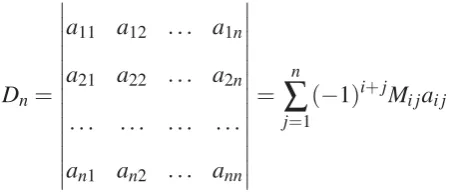
development of a generaln×ndeterminantDnin terms of minorsMi j [3]
Dn=
a11 a12 ... a1n
a21 a22 ... a2n
... ... ... ...
an1 an2 ... ann
=
∑
nj=1
(−1)i+jMi jai j (2.38)
where the minorMi j, corresponding to the elementai j, is defined as a determinant of order
The factor(−1)i+jMi j is calledcofactorof the element ai j. In this way, determinants (as
well as permanents) are polynomials in entries of the matrix. [3]
Permanents can be considered as an analog of a determinant in which, all signs in the
expansion by minors in Eq. 2.38 are taken as positive. For example, the permanent of a 2×2 matrixAwill be
perm(A) =
a11 a12
a21 a22
+ +
=a11a22+a12a21 (2.39)
where the "perm()" as well as the vertical bars with plus signs, | |
+ +, indicate permanents.
[64, 65] After this short digression, we get back to the FC expansion (Eq. 2.14) which now
includes both determinants and permanents
Ψ=M
n
∑
i=1
cislitmiuni
e−α(s+t)/2 e−β(s+t)/2 e−α(s−t)/2 e−β(s−t)/2
+
cislitmiuni
e−α(s+t)/2 e−β(s+t)/2 e−α(s−t)/2 e−β(s−t)/2
+ + (2.40)
wheremiandmirun over odd and even positive integers, respectively. Also,liandlivary
over all integers andniandnirun over all non-negative integers. Note that the multiplications
of either the odd polynomial part with permanents or even polynomial part with determinants
generates correct symmetry for the spatial part of the triplet state. The new FC wavefunction
Ψshould be compared with that which results from applying Nakatsuji’s rules and conditions (Table 1 in Ref. [50]) imposed on{li,mi,ni}using different numbers of exponential functions
inΨ0. Based on his FC method, we have used the minimum number of exponential functions (N =2) in the initial wavefunction to calculate the energy of the 1s2s triplet state of the helium atom. The results of these calculations are gathered in Table 2.3. This table clearly
shows that including the permanents in the FC calculations although is not favorable from
FC wavefunction seems necessary for obtaining a faster convergence to the desired accuracy
in the calculated energy values.
2.2.2
Examples of Compact Explicitly Correlated Wavefucntions: A
Case Study
Seeking the optimal forms for theN-term Hylleraas [66–68, 63] and the Kinoshita
wave-functions, [67, 69, 70], Koga performed several investigations with different optimization
techniques on these two wavefunctions for the helium atom and helium-like ions. He showed
that, for positive integer values of{li,mi,ni}in Eq. 2.30, the optimal form of aN-term
Hyller-aas wavefunction depends on the nuclear chargeZ. [68, 63] The reason of this observation
has been related to the different significance in the radial and angular correlation effects. In
this way, based on Eq. 2.24, it may be inferred that the terms including the variablessand
tcontribute mainly to the radial correlation energy whereas terms involving the variableu
mainly contribute to the angular correlation energy. [68, 63]
An important lesson than can be learnt from Koga’s studies on the N-term Hylleraas
wavefunctions is that the perturbational approaches are inappropriate for finding the optimal
form of the Hylleraas expansion shown in Eq. 2.30. [68, 63] This is because of the fact that
the terms that appear in the optimalN-term Hylleraas expansion does not necessarily appear
in the optimalN-term expansion of the same form whereN>N. [68, 63] Konget al.[6] performed an experiment (Tables 2 and 3 in Ref. [6]) on the calculation of the energy of the
helium atom using the 3-term Hylleraas expansion of the form