Spin-R esolved (e, 2e) C ollisions
A thesis submitted for the degree of Doctor of Philosophy of
The Australia National University
by
Yiqing Shen, B.Sc., M.Sc.,
in the
Electron Physics Group
Atomic and Molecular Physics Laboratories
Research School of Physical Sciences and Engineering
The Australian National University
D eclaration
I certify th a t th is thesis does not incorporate w ithout acknow ledgem ent any m a te ria l previously su b m itted for a degree or diplom a in any university; an d th a t to th e b est of my knowledge an d belief it does not contain any m a te ria l previously published or w ritte n by a n o th er person except w here due reference is m ade in th e text.
A cknow ledgem ents
F irstly , I w ould like to th a n k m y su p erv iso r (C hair), P ro fesso r E rich Weigold, for his in v alu ab le lead ersh ip and support th ro u g h o u t th e whole period of th is project. I would also like to th a n k my supervisor, Dr. S tephen B uckm an, for providing p ractical guidance, assistan ce, an d su ggestions afte r I tran sfe rred to ANU. M any th an k s to both of my supervisors for th e ir careful reading of th is m anuscript.
The experim ents of th is th esis would not have been successful w ith o u t a m u ltitu d e of co n stru ctiv e a ssista n ce an d suggestions from D rs J u lia n Lower, B ernd G ran itza, and Xuezhe Guo. The enjoyable cooperation w ith th ese th ree academ ics are greatly acknowledged. I would also like to th a n k Ms Joanne H u rn for h er help and care during the period of th is PhD course, a n d M r S te p h an e M azevet for m any stim u la tin g discussions ab o u t th e theoretical p a rt of th is work.
I am also in d eb ted to P rofessors H u b e rt K lar, Don M adison, a n d Ia n M cC arthy for providing unpublished theoretical d ata and useful discussion. M any th a n k s to my adviser, D r Malcolm Elford, for ad\dce about th e thesis. I would like also to acknowledge th e technicians and secretaries (both a t F lin d ers and a t ANU), who have been helped me d uring th e experim ental sections and in p rep a ratio n of th is m anuscript, and other helpful sta ff and stu d en ts whose nam es are too m any to enum erate here.
I would also like to express my g ratitu d e to M cPhail’s fam ily for providing family-like support after I had my baby daughter. M any th a n k s to D r Anne- M arie Grisogono for h e r en couragem ent of com bining m otherhood w ith g rad u ate studies.
A bstract
This th e sis p re se n ts th e re s u lts from th e trip le d ifferen tial cross section (TDCS) m e a su re m e n ts, o b tain ed from a n (e,2e) ex p erim e n tal a p p a ra tu s incorporated w ith a polarised electron beam source, a polarised sodium atomic beam source, and an electron polarisation polarim eter. The form at of th is th esis is in six chapters. C h ap ter 1 gives a b rief introduction to th e previous w ork in th is field of research , and th e m otivation of the p resent work.
C hapter 2 sum m arises th e theories of electron-im pact ionisation w ith atom s and th e electron polarisation phenom ena of electron-atom scatterin g processes.
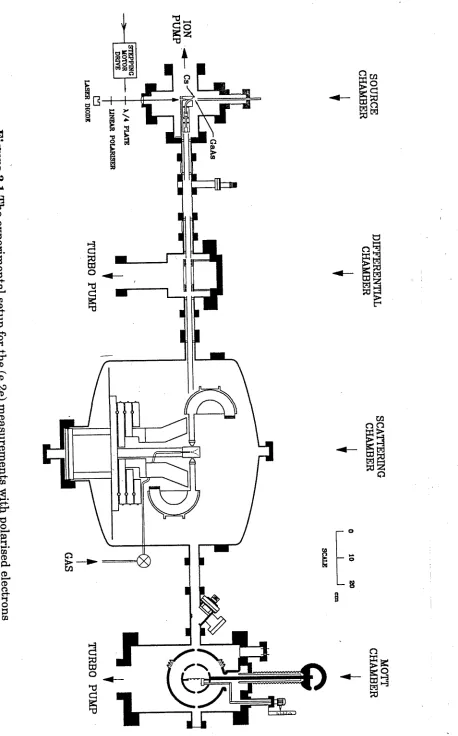
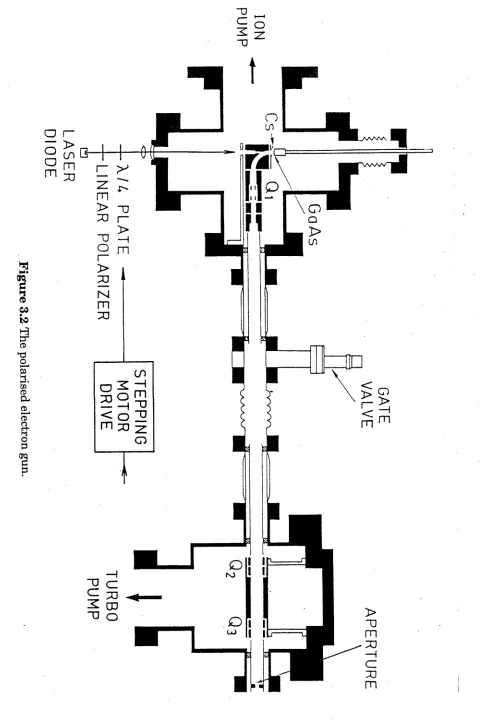
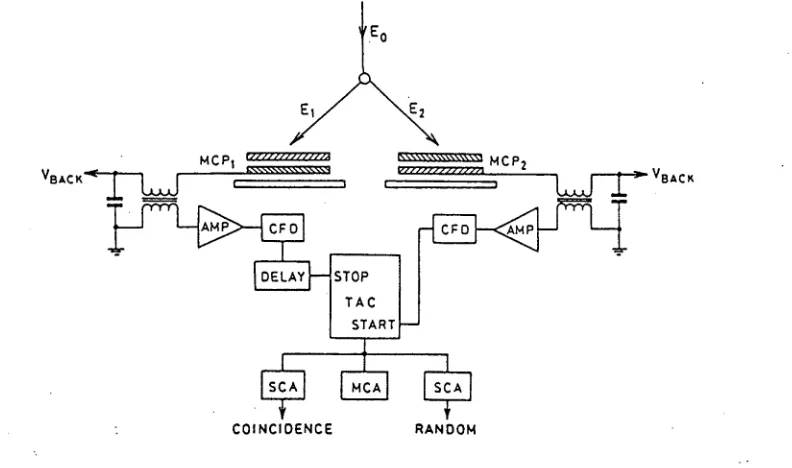
In c h ap ter 3, a detailed description of th e experim ental ap p aratu s, in clu d in g th e GaAs p o larised electron source, th e re ta rd in g -p o te n tia l polarim eter, and th e (e,2e) spectrom eter, is presented.
polarised sodium atomic beam is reported in chapter 5. In th is experim ent, th e electron im pact energy w as 605 eV. The electron beam (unpolarised), sodium beam , an d th e la s e r beam in te rse c te d a t rig h t an g les in th e in teractio n region. W ith rig h t-h a n d circularly polarised laser-lig h t, th e sodium ato m s w e re a lig n e d a n d o rie n te d to th e e x cite d s ta te ,
3p(l = 1, mi = +1). The electron m om entum distribution of th is state, as well
as th e random ly oriented ground s ta te 3s, were probed. The experim ental resu lts, th e com parison th eo re tic al calculations, and th e discussion are presented in th is chapter. The recent theoretical prediction of orientational (e,2e) dichroism, as well as some experim ental techniques are also discussed in this chapter as possible fu tu re perspectives.
C ontents
D eclaration... i
Acknow ledgem ents... ii
Abstract... iii
1 Introduction... 1
2 Theoretical Background... 5
Part 1 Electron-Atom Ionisation...5
2.1 Introduction... 5
2.2 Electron Momentum Spectroscopy... 9
2.2.1 Investigation of the ion-target overlap function... 11
2.2.2 Information from EMS... 12
2.2.3 Geometries for EMS study... 13
2.3 Study of the Electron-Atom Ionisation Process... 15
2.3.1 Born approximations... 16
2.3.2 Wavefunction approximations... 18
2.3.3 Exchange effects... 19
Part 2 Electron Polarisation Phenom ena... 22
2.4 Introduction... 22
2.5 Description of Polarised Electrons... 23
2.6 Spin-Orbit Interaction... 25
2.6.1 Behaviour of the polarisation in scattering... 27
2.6.2 Spin-dependence of the differential cross section... 28
2.7 Exchange... 29
2.7.1 Spin-dependence of the differential cross section... 31
2.8 The Fine-Structure Effect... 32
2.9 Polarisation Phenomena Driven From Collision Processes... 35
2.9.1 Elastic and inelastic scattering processes... 35
2.9.2 Ionisation processes... 36
3 E x p er im e n ta l C o n sid e r a tio n s... 39
3.1 Introduction... 39
3.2 Polarised Electron Gun... 42
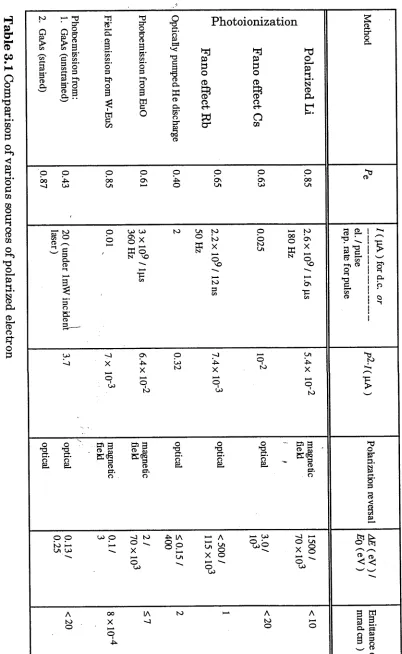
3.2.1 Survey of polarised electron sources... 42
3.2.2 Apparatus... 47
3.2.3 Optical pumping system... 49
3.2.4 Spin polarisation... 50
3.2.5 Photoemission from NEA surfaces... 54
3.2.6 Preparation of NEA GaAs photocathode... 55
3.2.7 Electron transport optics... 58
3.3 Electron Polarimeter... 62
3.3.1 Introduction... 62
3.3.2 Principals... 62_ 3.3.3 Spherical retarding-potential polarimeter... 66
3.3.4 Performance... 68
Measurement of scattering asymmetries... 68
Calibration procedures... 71
3.3.5 Results and discussion... 72
Energy resolution... 72
Electron polarisation... 73
Efficiency, precision and accuracy....7... 74
Depolarisation processes... 76
3.4 (e,2e) Collision System... 77
3.4.1 System geometry... 77
3.4.2 Vacuum unit... 79
3.4.3 Electron spectrometers... 81
Electron analyser... 81
Position sensitive detector... 83
3.4.4 Coincidence measurements... 85
Energy signal processing... 85
Timing signal processing... 86
4 (e,2e) M ea su re m en ts W ith P o la r ise d E lec tro n s
A nd X en o n A to m s... ... 92
4.1 Introduction... 92
4.2 The "Fine-Structure Effect"... 92
4.2.1 Intuitive explanation... 92
4.2.2 Theoretical models... 98
4.3 Experimental Details... 99
4.3.1 Interaction region... 99
4.3.2 Adjustment of the spectrometers... 101
4.3.3 Time-of-flight correction... 104
4.3.4 Circuit description... 106
4.3.5 Data collection... 109
4.4 Measurements and Discussion... 110
4.4.1 (e,2e) collision experiment... 110
4.4.2 Elastic scattering experiment... 114
4.4.3 Angular resolution... 116
4.4.4 Results and discussion... 117
4.5 Summary... 130
5 (e,2e) C o llisio n s W ith E lec tro n s A nd P o la r is e d S o d iu m A to m s... 132
5.1 Introduction... 132
5.2 Sodium Target Preparation... 133
5.2.1 Theoretical principals... 133
Optical pumping... 135
Alignment and orientation... 137
Depopulation and depolarisation... 139
5.2.2 Experimental Design... 141
Recirculating sodium oven... 141
Laser pumping system... 144
5.3 (e,2e) Experimental Set Up... 146
5.3.1 Kinematics and geometry... 146
5.3.2 Electron gun... 149
5.3.3 Energy and angular resolutions... 151
5.4 Results and Discussion... 152
5.5 Future Perspectives... 157
5.5.1 Theoretical predictions: orientational dichroism... 157
S eparate oven cham ber... 162
Optical collim ation... 163
D ual-laser optical pum ping... 163
6 Summary... 166
C hapter 1
Introduction
E lectron-im pact ionisation is one of th e m ost in te restin g subjects in th e field of ato m ic physics. Io n isa tio n cross sectio n s a re of g re a t im portance not only for fu n d am en tal research in atom ic physics b u t also for m an y o th e r a re a s su ch as p la s m a p hysics, u p p e r a tm o sp h e ric physics, etc.
For a single direct ionisation process th e reaction-is
e (Eo,ko) + A -» A + (e,q) + e (Ea , k a ) + e (Eb, k b),
w here Ei are th e kinetic energies of th e electrons and th e ir m om enta,
e and q are th e binding energy and th e recoil m om entum of th e ion A +.
The existence of th re e freely m oving particles im plies th a t four different cross sections can be defined: th e to ta l cross section o { E 0), th e single, double, and trip le differential cross sections:
d a d 2o , d 3c7
« ~ . a n d ^ * .
d E d E d k dEad k ad k b
The e a rlie st io n isatio n stu d ies w ere of to ta l cross sections, u sing p a ra lle l p la te co n fig u ratio n s (T ate a n d S m ith 1932), or u sin g m ass spectrom eter (Fite an d B rackm ann 1958), for th e collection of th e produced ions. These to ta l cross sections provided m uch im p o rtan t inform ation for m any applications b u t gave very little inform ation on th e dynam ics of the ionisation process itself, or on th e stru c tu re of th e targ et.
in te n sity d istrib u tio n of one of th e outgoing electrons as a fu n ctio n of energy an d angle. An exam ple of th ese m easu rem en ts is th a t of O pal et a l . (1972). A lth o u g h th e s e m e a s u re m e n ts , e sp e c ia lly th e DD CS
m e a su re m e n ts, provide some im p o rta n t in fo rm atio n on th e io n isatio n m echanism (Opal et al. 1972) an d th e stru c tu re of the ta rg e t (Bonham and W ellen stein 1977), th ey do n o t provide com plete in fo rm a tio n on th e collision. For in stan ce, th e DDCS m easu rem en ts only provide inform ation on one outgoing electron, w hile th e energy and m om entum inform ation of th e o th er electron is in te g ra te d . C onsequently, th e loss of in fo rm atio n about the ionisation process is obvious.
The m ost com plete k in em atic description of an ionisation ev en t is th e trip le differential cross section (TDCS) which d eterm in es th e energy and m om entum of all particles involved in the collision. The experim ental m easu rem en ts and theoretical calculations of the TDCS have been carried out for about 25 years. The m easu rem en t of this cross section req u ires th e coincident detection of both outgoing electrons, so th e term (e,2e) cross section h as been used to describe th is TDCS. Because th e electron-atom io n isatio n process involves a t le a st th re e bodies, all of w hich in te ra c t th ro u g h th e long ran g e Coulomb forces, th e theoretical description of th e io n isatio n m ech an ism re q u ire s a solution to th e m an y body Coulomb problem. The (e,2e) cross section therefore provides very strin g e n t te s t of v arious th eo re tic al m odels of th e m any body problem (E h rh a rd t et al.
1986). The (e,2e) cross section depends not only on th e dynam ics of th e ionisation processes b u t also on th e stru c tu re of ta rg e t and ion. In certain regions of th e collision, th e io n isatio n m ech an ism can be d escrib ed accu rately , an d th e (e,2e) cross section can th e n be u sed to provide s tru c tu ra l inform ation. In such cases th e (e,2e) cross section is u sed to probe th e m o m en tu m space w avefunctions of electrons in ato m s an d m o lecu les, a n d is o ften calle d e le c tro n m o m e n tu m sp e ctro sc o p y (M cCarthy an d Weigold 1988).
The aim of th is th esis is to explore the spin-dependence of (e,2e) ionisation processes and e x tra ct th e stru c tu ra l inform ation of a polarised ta rg e t, by using polarised electrons and polarised atom s. The outline of th e th esis is as follows.
C h ap ter 2 provides a sum m ary of th e theoretical background for the experim ents. I t stre sse s firstly , th e th eo retical approaches for electron m om entum spectroscopy an d th e electron-atom ionisation processes an d secondly, th e s p in -d e p e n d e n t in te ra c tio n s a n d e le ctro n p o la ris a tio n phenom ena derived from collision processes.
C h ap ter 3 gives th e d etails of th e experim ental a p p a ra tu s for th e (e,2e) e x p e rim e n t w ith a p o larise d electro n source. T he a p p a r a tu s in clu d es th re e p a rts , th e GaAs p o larised electro n source, th e (e,2e) collision system , and th e M ott polarim eter.
The (e,2e) m easu rem en ts w ith polarised electrons and xenon atom s are described in ch ap ter 4. The aim of th is experim ent is to in v estig ate the
n
spin-dependence of the TDCS in the xenon fine stru ctu re sta te s 5 P y2 and 52P 3/2 by changing th e p o larisatio n of th e incident electrons. A coplanar asy m m etric geom etry is u sed in th e m ea su re m e n ts w ith th e in cid en t energy of E 0 = 147 eV. T he ex p erim e n tal re s u lts a re com pared w ith re c e n t th e o r e tic a l c a lc u la tio n s a n d a d e ta ile d d isc u ssio n of th is com parison is given.
Chapter 2
Theoretical Background
Part 1:
Electron-Atom Ionisation
2.1 Introduction
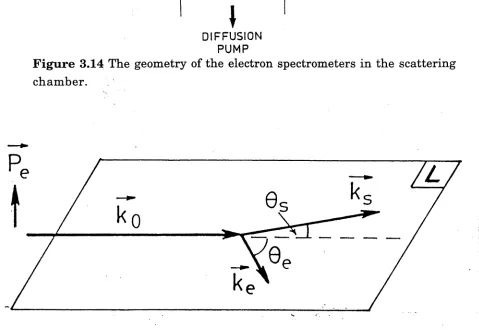
A schem atic of th e electron-atom io n isatio n process is show n in figure 2.1. The in cid en t electron, w ith energy E 0 a n d m o m en tu m kQ, im pacts upon th e atom T. One electron a, is scattered w ith energy E a and m o m entum k a th ro u g h an angle 0a w ith respect to th e direction of the in cid en t electron. The o th er electron b, th e ejected electron, is ionised from th e atom w ith energy an d m om entum of E b and k b, respectively. C onventionally th e scattered electron a is assum ed to be the one of higher energy, i.e., E a > E b. It is convenient to define the scatterin g plane as the plane of th e incident and scattered electrons (k0, ka ). The direction of th e ejected electron is 6b in th e scatterin g plane, and cp out of th is plane. W ith th e energy and m om entum conservation law s, one h as
E 0 = Ea + E b + e, (2.1)
K = K + k b+<l, (2.2)
w here e is th e binding energy of th e ejected electron, q is th e ion recoil m o m e n tu m .
F ig u r e 2.1. Schem atic of electron-atom ionisation. The incident electron im pacts th e ta rg e t T and produces one scattered electron a and one ejected electron b from th e targ et. (k0, k a ) is th e sc atterin g plane.
The TDCS expression in term s of th e kinem atic variables is given in atom ic u n its { h - m - e - 1) by
<i5cr
dkadkbdEa O.V
(2.3)
w here Tf0 is th e T -m atrix elem ent for th e reaction from an in itial sta te of |o) to a fin al ion s ta te | /*), X in d ic a te s a n av erag e a n d sum over respectively in itial- and fin al-state degeneracy. The T -m atrix elem ent is defined as
T fo = (0-f ( k a , k b , e f )\T\<P:(ka>k b , k o )). (2.4)
0 ± forms a complete orthonorm al set of vectors for both incom ing "+" and outgoing collision particles.
If one expresses th e T -m atrix in term s of th e G reens function, and expands it according to th e L ip m an n -S ch w in g er approach, th e n th e T- m a trix is
T = V + VG°V + VG°VG°V+- • (2.5)
T his series is called th e Born series. It can be found in m any q u an tu m scatterin g textbooks (e.g. Taylor 1972). G° is th e free G reens function, and V includes all th e scatterin g potentials of th e m any-body system . The low- order term s in eq. (2.5) lead to the various Born approxim ations.
V" — V^g + + Vpe. (2.6) If one includes all the correlations of th e reaction into the p e rtu rb a tio n of th e w avefunctions, th en
(2.7)
*F+ ) and lF ~) are th e m any-body w avefunctions of th e in itia l (+)
to a w here
an d final (-) channels, respectively. Then the (e,2e) ionisation collision can be considered as a tra n s itio n of th e system from an in itial sta te
final state
fo
j. The tra n s itio n am plitude is
*7|vK
(2.8)In th e la s t two decades, ionisation theories have developed rapidly. T heoretical tre a tm e n ts can q u a n tita tiv e ly an d q u a litativ ely explain th e experim ental phenom ena, depending on th e im pact energy ran g e an d the electro n m o m en tu m tr a n s fe r ran g e. T he excellent review a rtic le s of M cC arthy and W eigold (1991) and E h rh a rd t et al. (1986) give a detailed discussion of th e electron-atom ionisation process, from both th eo retical a n d e x p e rim e n ta l a sp e c ts. In th e p re s e n t th e s is , th e th e o re tic a l background is based on th e conditions rele v an t to th e experim ents in the th esis. T hus th e th eo re tic al tre a tm e n t is classified in term s of im p act energy and m om entum tran sfe r.
One im p o rta n t fea tu re in classifying th e ionisation collision is the in cid en t energy. The ionisation process is very different in th e region of high energy ( E 0 > 4 0 e ), in te rm e d iate energy (5 £ < E 0 <20e), an d low to n ear-th resh o ld energy ( E 0 <5e). (Note: regions as defined by E h rh a rd t et
al. 1986). A nother im p o rtan t featu re is th e m om entum tra n s fe r K , w here
K = ko - V (2.9)
K can also be divided into a high m om entum tra n s fe r region, say K > 6 a.u., a m edium to low m om entum tra n s fe r region, say 0.2 < i f < 1 a.u., an d th e lim itin g case of K —» 0. (Note: h ere th e region d e fin itio n of M cC arth y a n d W eigold 1991, an d E h r h a r d t et al. 1986 hav e been com bined).
sim ple model, th e s tru c tu re of th e ion core can be com pletely stu d ied by th e (e,2e) m easu rem en ts. These experim ents are som etim es referred to as th e so -c alled b in a r y (e,2e) e x p e rim e n ts or e le c tro n -m o m e n tu m spectroscopy (EMS). In th e p resen t thesis, the (e,2e) experim ent w ith laser excited and polarised sodium atom s is designed in th is region. One of the m ost im p o rtan t geom etries, th e non-coplanar sym m etric (e,2e) geom etry is used. T h a t is, 0a = 0b an d E a = E b, a t h ig h -in cid en t a n d outgoing en erg ies (M cC arthy a n d W eigold 1988, 1976). D etails ab o u t electron- m om entum spectroscopy are given in section 2.2.
In th e region of in te rm e d iate to low energy an d sm all m om entum tra n s fe r, th e io n is a tio n collision rev e als rich in fo rm a tio n a b o u t th e collision processes. The long-range Coulomb forces betw een th e sc atterin g electron, ta rg e t electron an d th e ion core are of equal im portance in th e reactio n . The e lectro n -electro n exchange processes a re n o t negligible w h en th e en erg y of th e in c id e n t electro n is low. M any th e o re tic a l tre a tm e n ts h av e been developed to explain th e th ree-b o d y s c a tte rin g process. The collision m e a su re m e n ts provide a s trin g e n t te s t of th ese theories and deepen th e u n d e rstan d in g of the dynam ics of th e ionisation process. In th is th esis, th e electron-xenon (e,2e) collision w ith a polarised incident electron beam of energy E 0 = 147eV, lies w ith in th is region. The low energy, coplanar asym m etric geom etry is used in th e m easu rem en ts. The u se of th e p o larised in cid en t beam opens a new d im en sio n for a n a ly s in g th e d y n am ics of th e io n isa tio n process. T he th e o re tic a l background of th is experim ent is given in section 2.3.
In th e lim iting case of K —» 0 and high im pact energies, i.e., 6a ~ 0
and ka ~ k0, th e (e,2e) cross section is proportional to th e optical oscillator
2.2 Electron Momentum Spectroscopy
If the m om entum tra n s fe r K is large enough, th e (e,2e) reaction can be tr e a te d as th e in c id e n t electro n e n c o u n te rin g one of th e ta r g e t electrons, and knocking it out w ith o u t affecting th e rem ain ion. T his is th e binary encounter approximation, in which the reaction op erato r T is ta k e n to be th e electron-electron collision operator t:
Tfo = ( ^ f (k a>kb,£f)\t\<I,o ( K > h ’ko'>) ^
= ( k a>k b’f \ t \°k o)>
w here | f , k a, k h) and |ok0) denote the w avefunctions of th e final s ta te and th e in itia l s ta te , respectively. The ^-operator com m utes w ith th e ion- w avefunction | f ) since it operates only in the space of the incident electron and th e electron th a t is rem oved from the target.
B ecause th e two outgoing electrons a re in d istin g u ish a b le , ts is u su ally used to denote th e antisym m etric ^-operator for to tal electron spin S:
% = ^[ l +C-D8 ^ ab
w here th e space-exchange operator P ab is defined as P a b t t K ’ h ^ = o )
-(2.11)
(2.12)
As th e incident electron h as high energy, one can assu m e t h a t th e collision tim e is sh o rt enough to neglect th e response of th e ta rg e t, th u s th e in cid en t electron and two outgoing electrons can be tre a te d as free electrons. The plane w avefunction \k) = elk'r can be used for th e incident electron an d two outgoing electrons, assu m in g th a t a t high en erg ies th e continuum electrons do not feel th e p o ten tial of th e ta rg e t atom or final ion. Then,
T ^ \ k a, k b, k 0) = (kak bf\ts \ok0). (2.13)
This is the plane-wave impulse approximation (PWIA) (Hood et al. 1973). The PWIA am plitude m ay be rea rran g e d as th e product of two factors:
T (ff ( k a , k b, k 0) = ( k ’\ts \k ){k ak bf\ok<1), (2.14)
k ' = \ { k a - k b),
k = \ ( k 0 - q ) ,
q = k 0 - k a - k b.
(2.15)
T his facto risatio n is exact for plane w aves b u t an ap p ro x im atio n if the electron waves are d istorted from plane waves.
To include th e disto rtio n of the incident and two outgoing electron w avefunctions by th e p o ten tial due to th e rem a in d e r of th e system , th e plane waves m ay be replaced by distorted waves
wave impulse approximation (DWIA) is:
XK~ '(&)). The d i s t o r t e d
-rp(S)
1 fo (ka , k „, k 0) = (k'\ts \ k)(zw (ka ) x (- \ k b) f oX(- \ k 0)(2.16)
In th e im pulse ap p ro x im atio n (PWIA or DWIA), th e ta rg e t an d th e ion s tru c tu re a p p ears only in th e form of the ion-target overlap (/*|o), w hich is a o n e-electro n fu n ctio n . In th e DWIA th e s tr u c tu r e fa c to r is a "distorted" s tru c tu re factor since it depends on th e w aves %±. In th e PWIA, u sin g th e expression for ion-recoil m om entum q , th e stru c tu re factor is sim ply
( k ak b f \ oko) = {<lf\°) =
{<l\v)s
V(q)- (2.17)T hus, if the im pulse approxim ation is valid, the reaction is a perfect probe for th e overlap function \J/(q), since the cross section is th e product of its absolute sq u are an d a know n factor, eq. (2.14), th e ee-collision factor. As th e in cid en t electrons a re un p o larised , th e electron spin degeneracy is unresolved. The ee-collision factor in th e differential, cross section is th e absolute sq u are of th e half-off-shell Coulomb t-m atrix elem ent ( k ' Sum m ed and averaged over th e final and initial spin states, it is
fee
1 2 ^ v 1 _ 1
1_
( 2 / r 2 )2 e x p ( 2 7 r v ) - l 1 H
o*
* 1
5S
-o
-r x cos v ln
V
K
h
2 N
I2
(2.18)
2.2.1 Investigation of the ion-target overlap function
The w eak-coupling expansion of th e ion eig en state | f ) is a lin e a r com bination of configurations consisting of a hole in orbital y/j coupled to a ta rg e t eigenstate a .
I
n
i tif)ja ja
y / j + a (2.20)
T he ta r g e t e ig e n sta te m ay of course be ex p ressed a s a lin e a r c o m b in a tio n of i n d e p e n d e n t - p a r t i c l e c o n f ig u r a tio n s , i.e. th e configuration-interaction (Cl) rep resen tatio n . If in itial ta rg e t correlations a re negligible, th e low est ta r g e t configuration, i.e. th e H a rtre e -F o c k configuration is a good ap p ro x im atio n for th e in itia l sta te . T his is th e target Hartree-Fock approximation (THFA).
In th e w eak coupling ap p ro x im atio n , only th e ion co n fig u ratio n re s u ltin g from th e rem oval of one electron from a ta rg e t configuration contributes to the ion-target overlap, which is th en given by
(<lf\o) = l t (f0)( q \ Y j ) . j
(2.21)
The lin e a r com bination above could be rep resen ted in term s of a single n o rm a lis e d fu n c tio n y/iy w h ic h is calle d th e c h a r a c te r is tic , or experim ental orbital i, defined by
(q f \o ) = t\f0 }{ q \ v i ). (2.22)
T herefore, th e d ifferen tial cross section for io n isin g a n electron from a ch aracteristic orbital xgi is expressed, w ithin th e PWIA as
~ = (2*)4 f e ß ^ N , \(kak b I Vi(q)k0f , (2.23)
d k adk^dhja %
w h e re
(2.24)
o rth o n o rm ality of th e ta rg e t eig en states a, one finds th e spectroscopic
<•
sum ru le,
I S ^ = l. (2.25)
f
The physical im portance of th e TDCS is th a t it provides a direct m e a s u re m e n t of th e a b s o lu te s q u a re of th e m o m e n tu m o rb ita l w avefunction \f/t; T he m ag n itu d e of th e TDCS for ejecting a n o rb ital electron from th e m anifold i is proportional to th e spectroscopic factor S j p . This tech n iq u e is called "E lectron M om entum Spectroscopy", or,
EMS (M cCarthy and Weigold 1976, 1988).
2.2.2 Information from EMS
E le ctro n c o rre la tio n s in th e ion r e s u lts in m an y ion s ta te s f belonging to each m anifold i whose sym m etry is given by th e one-hole c o n fig u r a tio n i. F rom eq. (2.20), each s ta te of th e m an ifo ld i is characterised by its coefficient The EMS differential cross section for ionisation to th e s ta te f is directly proportional to th e spectroscopic factor
S {p \ th a t is th e p ro b ab ility of th e s ta te f c o n ta in in g th e one-hole
configuration i (eqs. 2.23 an d 2.24). Therefore, EMS gives very d etailed inform ation about fin al-state correlations. It is w orth pointing out th a t the p h o to elec tro n cross sectio n a re not d irec tly p ro p o rtio n a l to th e s e probabilities (Am usia and K heifets 1985).
U sually th e EMS m easu rem en ts have two aspects. One aspect is to probe th e m om entum d istrib u tio n of th e one-hole configuration \y/i(q)\ by v arying th e angle of one electron detector. The other-is to d eterm in e th e spectroscopic factors S-P for different sta te s f a t different binding energies
spectroscopic factor S - ^ of each ion sta te f. Then, one is able to check the spectroscopic sum rule (eq. 2.25) by a complete set of for a m anifold i, an d use th is spectroscopic sum ru le to n o rm alise th e re la tiv e trip le d ifferen t cross sectio n for d iffe re n t m e a s u re m e n ts u n d e r th e sam e conditions. T h en a c h a ra c te ris tic o rb ita l i is ex p erim e n tally defined, w here energy £; is
e, = I SL'V
f
If th e definition is in d ep en d en t of ex p erim en tal conditions, such as th e in cid en t energy, th e o rb ital an d its corresponding spectroscopic factors can be purely defined experim entally.
In some special cases, like th e 2p s ta te of th e helium ion, in itia l electron co rrelatio n h a s to be included in th e consideration. F o r such s ta te s (q f\o) is very sen sitiv e to th e coefficients of th e h ig h e r ta rg e t configurations. A nalysis of such ion s ta te s req u ire s d etailed C l w ave functions for both ta rg e t and ion. In cases such as this, EMS can provide a sensitive probe for ta rg e t ground sta te correlations.
2.2.3 Geometries for EMS study
T here are several kinds of geom etries useful in electron m om entum spectroscopy. One is th e non-coplanar sym m etric (e,2e) geom etry for high energy incident and outgoing electrons. The typical experim ental se ttin g is (Weigold et al 1973):
E a = E b = % f Z ,
ea
= 6b B4 5 ° , (2.27)and th e out-of-plane azim u th al angle (p of th e electron b is varied to vary th e ion-recoil m om entum q .
As th e incident energy is high enough, one h as
K I = N s f l * o l >
k o - k a\ = \k o - k b\ = \K \> (2.28)
2 n K ~ k b
fe e = (2.29)
One notices th a t th e g reat advantage of EMS m easu rem en ts in th is non-coplanar geom etry is th a t th e m ag n itu d e of th e m om entum tra n s fe r K is not only m axim ised, which is optim um for EMS conditions, b u t also kept constant as th e incident energy E 0 is fixed. As a re su lt f ee is constant (independent of angle) an d th e differential cross section as a function of q
is d irectly p ro p o rtio n al to th e s tru c tu re factor y/(q) in th e facto rised im pulse approxim ation. The azim u th al angle (p is the only variable for q . The m agnitude of th e recoil m om entum q is approxim ately given by
q = k0 sin^(p, (2.30)
and th e direction of q is in the plane norm al to the incident beam k0, w ith the angle of / r - 0 / 2 w ith respect to th e norm al axis, h = [k0 x ß a ) /\k0 x k a\,
to the scatterin g plane.
This geom etry w as first used to probe the stru c tu re of hydrogen a t 400, 800 and 1200 eV incident energies (Lohm ann and Weigold 1981). The re s u lts show excellent a g reem en t w ith th e calculated w avefunctions of hydrogen, confirm ing th e v alid ity of th e im pulse ap proxim ation a t high e n erg ies a n d d isp la y in g th e im p o rtan c e of th e EM S m eth o d . EM S m e a su re m e n ts have become a tool for th e in v estig atio n of atom ic an d m olecular electronic stru c tu re s. It h as also been applied to in v estig ate th e electronic s tru c tu re s of solids (W eigold 1995). As one of th e f u rth e r ap p licatio n s, th e la s e r a ssiste d sodium EM S m ea su re m e n t gives m ore in fo rm atio n on th e s tru c tu re of sodium , not only on th e u s u a l ground sta te , b u t also on an excited and oriented state. This ex p erim en t will be described in detail in ch ap ter 5.
A nother geom etry for EMS study is th e coplanar, asym m etric (e,2e) geom etry for collisions a t very hig h in cid en t energies, u su a lly sev eral keV. A highly asym m etric condition is chosen so th a t k ~ k , k »kb. The m om entum tra n s fe r is also large. If th e scatterin g angle 6a is chosen to
be 0ee, w hich satisfied th e condition
E a = E 0 cos2 6ee, (2.31)
can be applied as well. The ee-collision factor f ee is th e sam e as th a t in eq. (2.29), and th e differential cross section m easurem ents can be used to give stru c tu re inform ation as well. The ad v an tag e of th is geom etry is th a t th e coincidence signal co u n trate is m uch h ig h er in th e asym m etric condition th a n t h a t in th e n o n -co p la n ar sy m m etric condition. T he s tr u c tu r a l inform ation of v arious noble gases h as been investigated in th is geom etry (Daoud et al., 1985; L ahm am -B ennani et al., 1986; Avaldi et al., 1987).
The (e,2e) electron m om entum spectroscopy experim ents described above have th e common fe a tu re s of large m om entum tra n s fe r an d high energy. B ecause th e dynam ics of th e ionisation collision is clear in th is regim e, th e d ifferen tial cross sections obtained only yield th e electron m om entum d istrib u tio n of th e targ e t. The ionisation process is only a tool an d little in fo rm a tio n is o b tain ed on th e dynam ics of th e collision. Inform ation about th e ionisation collision process is obtained in th e low m om entum tra n s fe r region, described in th e following section.
2.3 Study of the Electron - Atom Ionisation Process
In th e low energy region electron im pact ionisation involves a th ree body problem w ith th re e slowly m oving charged p a rticles in th e final c h an n el in te ra c tin g v ia in fin ite -ra n g e Coulomb forces. F rom 1969, E h rh a rd t and his coworkers s ta rte d th e first coplanar asym m etric (e,2e) m e a s u re m e n t on h e liu m w ith low im p a c t e n e rg ie s. S in ce th e n , experim ental w ork on electron-im pact ionisation h as developed rapidly, accom panied by th e o re tic a l tre a tm e n ts of th e problem w ith d ifferen t approaches. T his h a s resu lte d in a b e tte r u n d erstan d in g of th e ionisation process.
The coplanar asym m etric (e,2e) geom etry h as been developed to be one of th e m ost im p o rta n t geom etries for stu d y in g th e electron im pact ionisation process a t low and in term ed iate energies. In th is geom etry, two electrons a re d istin g u is h a b le b ecause of th e asy m m etric se ttin g . The “sc attere d ” electron is detected a t a sm all angle 9a an d hig h energy E a w ith th e coincidence m ea su re m e n t of a n o th e r “ejected” electron detected at low energy E b and v ario u s angles 6b on th e sam e sc a tte rin g p lan e
coincidence co u n trate. The following th eo retical discussion refers m ainly to the coplanar asym m etric geom etry.
2.3.1 Born approximations
The T -m atrix can be expressed in a Born series, as in tro d u ced in section 2.1 (eq. 2.5), provided it is convergent:
(2.32)
T f o =(&-f (ka , k h,ef ) V + VG 0V + VG0VG0V + - & : ( k a ,k h,k0)
= ( ¥ -h kaIV + VG °V + VG°VG°V+■
w h e re y/^ a n d (pQ a re th e ta r g e t c o n tin u u m a n d g ro u n d s ta te s , respectively. The, s ta te s of th e in cid en t electron \k0) an d th e sc a tte re d electron \ka ) are considered to be free from th e scatterin g p o ten tial V so th ey a re tre a te d as p lan e w aves. The in te ra c tio n b etw een th e ta rg e t electron and th e ion core V Te is included in th e ta rg e t w avefunctions, so the scatterin g potential is V = V PT + V Pe. U sing th e first term of eq. (2.32), th e T -m atrix is
Tfo = (v'Ä^al'^Pe 1^0 00 )• (2.33)
V PT v an ish es due to orthogonality of different ta rg e t sta te s. T his is th e F irst Born A p p ro xim a tio n (FBA). At high energy an d large m om entum
th e slow incom ing electron, th e ta rg e t electron an d th e recoil ion. The TDCS d istrib u tio n in both th e b in ary and recoil regions show th a t in th e low or in term ed iate energy range, th e TDCS is no longer sym m etric about th e m om entum tra n s fe r direction K . This violates th e validity of th e FBA in th e low an d in te rm e d ia te energy range. It is a stro n g sign of h ig h er order effects in th e sc atterin g dynamics.
The trip le differential cross section for atom ic hydrogen w ith in th e Second Born A pproxim ation (SBA) can be expressed as (Byron et al. 1980)
dkaanbaaa > (2.34)
w hen only th e d irect sc a tte rin g is considered and f BA is th e s c a tte rin g am p litu d e of th e firs t B orn approxim ation. The second B orn s c a tte rin g am plitude is
w here rep resen ts the in term ed iate ta rg e t states. The term f B% can be u n d e rsto o d as a re p re s e n ta tio n of two se p a ra te in te ra c tio n s of th e incom ing electron w ith th e in te rac tio n p o ten tial V. In th e first step th e ta rg e t is excited into an in term ed iate s ta te En (bound or continuum ) an d th e electron tra n s fe rs a m om entum k0 - k to th e ta rg e t electron, an d in th e second step th e ta rg e t is ionised in to th e co n tin u u m s ta te w ith m o m en tu m kb an d th e m o m entum tra n s fe r is k - k b. Since only th e continuum sta te w ith electron m om entum kb can be detected, all possible in te rm e d ia te s ta te s m u st be sum m ed over and all possible m o m en ta k
m u st be in teg rated over.
T he second B orn ap p ro x im atio n of B yron, Jo a c h a in a n d P ira u x (1980, 1982) h a s been applied to th e ionisation of atom ic hydrogen an d helium by electrons of in te rm e d ia te energies, e.g. , E o = 250, 500eV etc., (E h rh a rd t et al. 1982b, 1986). In th e in te rm e d ia te energy region, th e calculations describe q u ite well th e sh ifts of th e b in ary an d th e recoil peaks to larg er angles, th e asym m etry of the recoil peak and th e ratio s of th e in te n s itie s of th e b in a ry to recoil peak s for d ifferen t s c a tte rin g p a ra m e te rs .
1
(2.35) k2 — k% + 2E n - \ e
2.3.2 Wavefunction approximations
The T -m atrix Born series (eq. 2.5) can be tran sfo rm ed to th e Born series of th e three-body w avefunctions. If th e re is a p o ten tial U in th e sc a tte rin g p o ten tial w hich satisfies th e L ippm ann-S chw inger approach, th en th e in itial channel three-body w avefunction can be w ritte n as
0 * ( k o )) + G°U
I
0 Z ( k o)) + G°UG°u\ < ( f e 0 )}+ ■d - G ^ r 1
0+
k
j
(2.36a) (2.36b)
The series (2.36a) for (k 0)j is th e Born series. Eq. (2.36b) expresses the tran sfo rm atio n of the plane wave sta te {k0 )^ = | k0, (f)0 ) into a distorted wave s ta te ifr£ ( k 0)j by m ean s of a d isto rtio n o p erato r U. T his is th e distorted wave approxim ation. W ith th is approxim ation th e in cid en t and sc attere d electrons can be described by "distorted-w aves" Xk a n d Xk > respectively. The Xk0 is tre a te d analogous to th e case of electron-atom sc a tte rin g . Since th e c h an n el H a m ilto n ia n co n tain s a p a r t U of th e in teractio n p o ten tial V", i.e.,
v = u + w , (2.37)
the T -m atrix elem ent in th e distorted-w ave rep resen tatio n is
Tfo (2.38)
w h ere W is a p a rt of th e in te ra c tio n p o ten tial, V , ta k in g aw ay th e distortion p a rt U. In th e case of scatterin g , it h as been show n (B ray et al. 1989) th a t the low-order approxim ations converge rapidly in th e distorted- w ave re p re s e n ta tio n w h ere a local, c e n tra l p o te n tia l U is used. A convenient definition of U is th e ground-state average potential
U = {<to\W\<!>0), (2.39)
B rau n er, Briggs and K lar (1989) (referred to as BBK) consider th e s c a tte rin g am p litu d e w ith th e em p h asis on th e final s ta te th ree-b o d y w avefunction, i.e.,
Tf0 = f ( k a , k b,£f)\VPT + V Pe\(f)0k 0^, (2.40)
w here th e w avefunction WJ for th ree charged particles is th e product of th e asym ptotic forms for each of th e th ree Coulomb two-body subsystem s. T herefore, it satisfies exact Coulomb boundary conditions. T he form of th is approxim ate w avefunction is
xF J ( k a , k b ) = (2n)~3 N exp(i k ar a + i k brb)
(2.41)
• C (ccpp, k a , r a )C ( ccep, k b, rb) C (ccpe, k ab, rab).
T his is th e B B K approximation, w here the Coulomb p a rt (phase factors) of th e three-particle w avefunction is defined as
C ( a , k , r) = r ( l - i a ) e x p ( - — na) 1F 1( ic c ;l;- i( ^ r + k r ) ) , (2.42)
2
w ith
1 a PT - - ~ r ~ y
K
^ ab 2 ^ a ^ ’ r<:Lb ru - r.
(2.43)
r a and r b denoting th e positions of th e ta rg e t electron an d th e projectile electron w ith resp ect to th e nucleus of m ass M T in th e centre-of-m ass system , th e n o rm alisatio n factor is
N - Np tN PeNTe, (2.44)
w here N tj = exp( - n / 2 ) T ( 1 - i a tj ).
T h is ap p ro x im ate approach is a very prom ising direction in c alcu latin g th e electron-atom ionisation process especially for th e low energy region (B rau n er et al. 1991).
2.3.3 Exchange effects
1) direct scattering:
f = ( ¥ 7 (0 ,1 ,2)|V|<j£ (0,1,2)), (2.45)
2) exchange scatterin g :
^ = ( f 7 ( i , o , 2 ) | y | 0 o+(o >i,2 )}, (2.46)
3) cap tu re scatterin g :
Ä = ( f 7 ( i , 2 , o ) | y K ( o , i , 2 ) } . (2.47)
w here "0" is th e incident electron, "1" and "2" denote th e ta rg e t electrons in th e helium atom .
In th e electro n io n isatio n collision th e exchange effects become m ore an d m ore im p o rta n t as th e in cid en t energy is red u ced from th e in te rm e d ia te en erg y to low energy region. C oplanar asy m m etric (e,2e) m e a su re m e n ts h av e been c arried out on hydrogen an d h eliu m in th e in te rm e d ia te energy region (Lohm ann et al. 1984; E h rh a rd t et al. 1982a, 1985, 1986). B oth th e sim plified second B orn approach (SB2) an d full eikonal series B orn approach (EBS) can very well reproduce th e b in ary an d recoil peaks of hydrogen a t E 0 = 250 eV. As it is show n in eq. (2.34), th e sim plified second B orn ap p ro ach only ta k e s th e d irect s c a tte rin g am p litu d e f into account (Byron et al. 1980), while th e fu rth e r developed E ikonal series Born approach includes the exchange am plitude g, an d the th ir d term of th e B orn series (Byron et al. 1983). T h ere is n o t m uch difference b etw een th e se two ap p ro ach es a t E 0 - 250 eV. T h is is a n exam ple to in d ic a te th e exchange te rm h a s not m uch effect in th e in te r m e d ia te e n e rg y reg io n . T h e o re tic a l c a lc u la tio n s h a v e show n (P h illip s an d McDowell 1973) th a t th e c o n trib u tio n of th e exchange am p litu d e, g, (and th e cap tu re am plitude h, in th e case of helium ) to the trip le d ifferen tial cross section is about two orders of m ag n itu d e low er th a n th e direct sc atterin g am plitude, f, in the in term ed iate energy range.
T his is a stro n g in d icatio n of th e im portance of exchange effects a t low energies. As th e in cid en t energy is low, th e reaction tim e b etw een th e incom ing electrons and th e ta rg e t electrons is m uch longer th a n th a t in th e in te rm e d ia te energy ran g e. The exchange am p litu d e, w hich h a s a to tally different an g u la r dependence, becomes com parable w ith th e direct sc atterin g am plitude.
Part 2:
Electron Polarisation Phenomena
2.4 Introduction
E le c tro n -a to m io n is a tio n p rocess is m a in ly g o v ern ed by th e C oulom b forces b etw een th e ch arg ed p a rtic le s. T he s p in -d e p e n d e n t in te ra c tio n s , su ch as th e sp in -o rb it an d exchange in te ra c tio n s a re m a s k e d by th is m u ch s tro n g e r C oulom b in te r a c tio n . W ith th e developm ent of polarised electron sources and polarisatio n an aly sers, th e study of these w eak interactions has become possible.
S p in -d ep en d en t s c a tte rin g stu d y h a s been c arried out w idely in elastic, in elastic , an d su p e rela stic sc a tte rin g processes, e x p erim en tally an d theoretically. The study of p o larisatio n phenom ena in electron-atom io n isatio n processes is still in an early stage. In order to o b tain a clear p ic tu re of sp in -e ffe cts in e le ctro n -ato m io n is a tio n p ro ce sses, i t is w orthw hile to review th e common p o larisatio n phenom ena in electron- ato m collision p ro cesses by d is e n ta n g lin g d iffe re n t s p in -d e p e n d e n t in te rac tio n s u sin g th e sim plest sc a tte rin g model. These sp in -d ep en d en t interactions are generally classified by K essler (1985, 1991) as
1. Spin-orbit interaction:
In electron collisions w ith high-Z ta rg e ts , th e in te ra c tio n b etw een th e orbital a n g u la r m om entum of th e incident electron an d its spin plays an im p o rta n t role. The sc a tte rin g cross section is sp in -d ep en d en t, a n d the electron p o larisatio n can be changed by th e sc atterin g process. This spin- orbit in te ra c tio n h a s been w idely in v e stig a te d in elastic an d in e la stic sc atterin g events. As an im p o rtan t application in elastic sc atterin g (M ott sc atterin g ), th e sp in -d ep en d en t cross-section m e a su re m e n ts hav e been successfully used to determ ine th e p o larisatio n of a n electron beam (see section. 3.2).
2. Exchange interaction:
3. F in e-stru ctu re effect:
If the collision atom is not in itially polarised, b u t th e fin e-stru ctu re sta te s of tra n s itio n s a re e x p e rim e n ta lly resolvable, p o la risa tio n p h en o m en a such as spin-up-dow n asy m m e trie s a re still observable for each fine- stru c tu re state. This is due to th e in terp lay of fine-structure sp littin g w ith exchange process, called th e “fin e-stru ctu re effect”.
In th e following sections, s ta rtin g from th e description of polarised electrons, th e d etailed description of th ese th re e sim plified p o larisatio n p h e n o m e n a w ill be given. In m o st ele ctro n -ato m co llisio n s, sp in - dependent in teractio n s are en tan g led together. In th e la s t section of th is c h ap ter, th e u n d e rs ta n d in g of com bined p o la risa tio n p h e n o m e n a in sc a tte rin g processes (elastic an d in e la s tic sc a tte rin g ) an d io n isatio n process will be discussed.
2.5 Description of Polarised Electrons
The form al d escrip tio n of p olarised electrons can be d raw n from textbooks (e.g. K essler 1985): the electron spin sta te % is rep resen ted by th e spin operator s = sxex + syey + szez in a (ex ,ey ,ez) coordinate system (see fig u re 2.2). T he sp in o p e ra to r sa tis fie s th e c o m m u tatio n re la tio n s characteristic of a n g u la r m om enta:
[sx>s;y] Sx Sy Sy Sx i hsz (etc. by cyclic perm utation). (2.48)
It h a s th e re la tio n to th e P a u li o p e ra to r o of s = (h/2)o. T he P a u li m atrices are u su ally defined as
"0 n 0 1 * • f l o N
— , 0"A. — , <7- =
a o, ’ y V1 ° , 2 ^0 ~b
(2.49)
Therefore, one is able to define th e spin s ta te as a lin e ar superposition of two possible orientations of the electron spin:
/
w here a ( i \
\ o ,
«1
and ß + 02
f°l
(°)
a^a + a^ß, (2.50)Since
l 0 N
,0 - b
UJ
+1- a and a zßf l
o Y o )
eigenvalues of + 1 an d - 1 , respectively. The sta te a is defined as "spin- up", th e sta te ß is as "spin-down" in the direction of ez .
F ig u re 2.2 The coordinate system (ex ,ey ,e2) for electron spin P (l).
One free electro n is alw ays in a p u re sp in s ta te w ith th e probability |a-jj of finding th e electron in th e spin-up s ta te and possibility |a2|2 in th e spin-down state. The sta te % is assum ed to be norm alised, i.e.,
N 2 + K | 2 = l- (2.52)
The direction P {l) of th is spin s ta te is defined by th e angles of i) and <p in the (ex ,ey ,ez) coordination system as
— = ta n — e1<p , (2.53)
a x 2
A / *\
or the opposite direction - P .
A beam of p o larised electrons contains electrons of d ifferen t spin o rien tatio n s. Suppose th e re are N electrons, each electron i h as a spin state x^l\ its polarisation is defined by the operator a as
P?ex + P<% + P (% , (2.54)
p {i)
r x
p d)
y
p(i)
, d V
,(i):
.ay
( aaA
a 2
a(i) \ al
( • (i) ^
~ i a 2
i a a)
v
i a l J( a f ^ - a {l)
\ a 2 J
a ^ + ^ a ® ,
i i a V ' a V - a W a ® , ,
,(i)
(2.55)
The sta tistical polarisation of th ese A/- electrons is 1 w ...
P = — X P (i).
N i t (2.56)
T ak in g its sim p le st form by choosing th e d irectio n of th e r e s u lta n t polarisation as ez , i.e., Px = Py = 0, it gives
P = Pzez N\
N ' Z ’ (2.57)
w here N*
i = l 2
and
i— 1
(2.58) iV^ and N i are th e num bers of electrons in spin-up and spin-down sta te s
in ez direction over the to tal num ber of electrons N , respectively. W ith the
n o rm a lis a tio n co n d itio n , eq. (2.52), N = N ^ + N ^ . O ne o b ta in s th e m agnitude of th e polarisation as
P
Nr^Ni
N r + N t ' (2.59)
This is the definition of th e polarisation of an electron beam , w hich will be used frequently th ro u g h the thesis.
2.6 Spin-Orbit Interaction
The Schrödinger eq u atio n of an electron in e x te rn al electric an d m agnetic fields E and B is expressed in atom ic u n its (fi = e = m e = 1) as (Kessler 1985)
— ( p + A / c)2 - (p + — o B — E p + ~q- a (E x p )
_2 2c 4cz 4cz
= Wys,
w here i/a is th e electron sta te , p is th e electron m om entum o p erato r, (f)
an d A are th e electric an d m agnetic p o ten tials, o re p re s e n ts th e spin
n
operator, W + c is the to tal energy.
The first two term s on th e left side of eq. (2.60) are identical to the Schrödinger e q u atio n w ith o u t considering th e re la tiv istic effects. The th ir d te rm co rresp o n d s to th e in te ra c tio n en erg y - p B b e tw ee n a m a g n e tic d ipole, w hose m o m en t is re p r e s e n te d by th e o p e ra to r
p = - (j/2c = - s/c , an d th e external m agnetic field B. The fo u rth term is a relativ istic correction to th e energy and h as no classical analogue.
The la s t term corresponds to th e spin-orbit coupling if th e electron is in collision w ith an atom . According to M axwell's electrodynam ics, th e vectors of th e electrom agnetic field depend on the reference system . An observer on an electron m oving w ith velocity v relative to an electric field E
finds a m agnetic field B ' = - c~lv x E = c~l ( E x p ) . In o th er w ords, in th e electron re s t fram e, an electron moving relative to th e electric field of an atom ic nu cleu s experiences th is m agnetic field B' . T he energy of th e electron, due to its m agnetic m om ent p, in th is field is
- p B = - a - ( E x p ) .
2c V ’ (2.61)
By changing th e fram e of reference, the tim e tran sfo rm atio n changes th e precession frequency of th e electron spin in th e m agnetic field (Thom as p recessio n ). T h u s, th is te rm becom es exactly th e la s t te rm in th e H am ilto n ian operator. It is called the spin-orbit potential Vso, as it arises from th e in te rac tio n of th e spin w ith th e m agnetic field produced by th e orbital m otion of th e electron. In th e event of electron-atom collision, th e in cid en t electron m oves in th e cen tral Coulomb p o ten tial Vc(r) of th e nucleus w here E = [ dVc/ d r ) ( r/ r ) , the spin-orbit potential is
V =y so d V ^ r
4cz l dr r x p
1 1 dVn
2c2 r (s-l). (2.62)
It is noted th a t th is spin-orbit p o ten tial Vso, in th e case of th e Coulomb p otential, decreases m ore quickly w ith increasing distance r th a n does the Coulomb p o te n tia l its e lf an d can th erefo re be neglected a t fairly larg e d is ta n c e s from th e n u c le u s. S ince th e C oulom b p o te n tia l Vc is proportional to th e n u clear num ber Z of the atom, Vso is proportional to Z
The spin-orbit in te rac tio n is very im p o rtan t in collision processes. F or electro n s of d ifferen t sp in s ta te s th is sp in -d ep en d en t s c a tte rin g p o ten tial V so cau ses a difference in th e d ifferen tial s c a tte rin g cross sections. B ecause Vso is due to th e in teractio n of th e m agnetic field B' , upon th e m agnetic m om ent of incident electron, it affects the electron spin o rien tatio n as well. S c a tterin g p a ra m e te rs, f ' = \ f ' \ e yx an d g ' - \g'\eiy<1, a re u sed to define th ese sp in -d ep en d en t collision processes (th e prim es are used to d istin g u ish different p a ra m eters from those of th e exchange in te rac tio n ). T hey include th e sc a tte rin g am p litu d es \f'\, \g'\ a n d th e p h a s e d ifferen ce Y\~Y2- T h ese th r e e p a ra m e te r s a re n o t d ire c t e x p e rim e n ta l o b serv ab les. H ow ever, th e m e a s u re m e n ts of e le ctro n p o larisatio n and cross section are able to reveal th e inform ation on spin- o rb it in te rac tio n . In th e follow ing exam ple, a p olarised electro n beam being ela stic a lly sc a tte re d from a sp in less atom ic beam , th e physical relatio n s betw een experim ental observables and p a ra m eters \f'\, \g'\ and
Yi - 72 can be determ ined completely.
F ig u r e 2.3 C om ponents of an a rb itra ry in itial polarisation P . k an d k ' are th e electron wave vectors before and after scattering.
2.6.1 Behaviour o f the polarisation in scattering
T he in cid en t an d s c a tte re d electrons have m o m en ta k a n d k \ respectively. The in itial p o larisatio n of an electron beam is P = Pn + Pp , w here Pn is th e com ponent p erp en d icu lar to th e sc atterin g plane (k , k') and P p is th e com ponent th a t lies w ith in the scatterin g plane (see figure 2.3). A fter elastic s c a tte rin g by a sp in less atom ic beam , th e sc a tte re d electron obtains a polarisation (e.g., K essler 1991)
[Pn + S ( 6 ) } n + T(e)Pp + U m n x P p )
1 +P nS (6 ) (2.63)
: f V ' ~ f V
S (0) = i
/|2 I _,i2
l/f+l*
,|2 , T ( 0 )irr-k
/ y * + r V
i/f+i*
/|2 , C/(0) =l/f+l*
/|2 ’ (2.64)and h = { k x k' )/\k x fc'| is a u n it vector norm al to th e scatterin g plane.
T he s c a tte r in g does n o t only ch an g e th e m a g n itu d e of th e p o larisatio n b u t also th e direction. The vector com ponent S ( 9 ) n is added
to Pnhy p e rp e n d ic u la r to th e sc a tte rin g plane. The com ponent in th e
s c a tte rin g p lan e is red u ced from P p to T { 6 ) P p ( |T |< 1 by definition). T here is an ad d itio n al com ponent, in th e direction p e rp e n d icu lar to its o rig in a l p la n e (P n , P p ), d e te rm in e d by U(d) in th e f in a l s ta te polarisation. All of th ese com ponents are modified by th e common factor
1 + PnS ( 9 ) . T he key p o in t in c h an g in g th e p o la ris a tio n d u rin g th e
s c a tte rin g is d eterm in ed by th e spin-flip am plitude, g ' , as one can see from eq. (2.64), i f g ' = 0, S = U = 0, T = 1 so th a t P ' - P .
If th e incident electron is unpolarised, P = 0, th e final p o larisatio n is not zero,
P' s (f l ) A = - w | r (yl2~/ 2 ) ”
-i / -i
(2.65)
The sc a tte rin g process can produce polarised electrons, th e direction is norm al to th e sc a tte rin g plane. This m ag n itu d e of p o larisatio n , S( 0) , is called th e S h erm an function.
2.6.2 Spin-dependence of the differential cross section
The spin-dependence of th e cross section can be w ritte n in th e form of th e in itial polarisation P, and the S herm an function S( 6) as
o (9,(p) = cr0( 9 ) [ l +S ( Q) P- n ] , (2.66)
w h e re
<7O(0) = f oO(e,cp)ä<P = (2.67)
A _ — Z k = PnS ( e ) . . (2.68)
CJT + (J |
By m easu rin g th e cross section asym m etry A and th e S h erm an function
S(Q), one is able to obtain the in itial polarisation Pn . This is th e basic idea
of analysing electron polarisation by M ott polarim etry (see c h ap ter 3). T hus th e complete set of observables yielding the m axim um possible in fo rm a tio n for th e e lectro n -ato m e la stic s c a tte rin g p rocess is: th e differential cross section cr(6,(p), th e S h erm an function S( 9) , T{6) and
U(6). The th ree p aram eters in eq. (2.64) are not independent, i.e.,
S 2 + T 2 + U 2 = 1. (2.69)
T herefore, th e com plete set of observables corresponds to th e com plete inform ation of th ree variables |/‘/|,|g '|, and y{ - y'2.
2.7 Exchange
In section 2.3, th re e different sc a tte rin g processes are m en tio n ed for ionisation collisions, th ey are: th e direct scatterin g process (2.45); the exchange sc atterin g process, w here th e em itted and scattered continuum electrons are exchanged (2.46); th e cap tu re sc atterin g process (only for atom s w ith m ore th a n one valence electron), w here two ta rg e t electrons are em itted and the incident electron is captured (2.47). T hree respective s c a tte rin g a m p litu d e s, f = \f\e1Yl, g = |g|e1/2, an d h, a re to re p re s e n t th e se th re e collision processes. The exchange am p litu d e te n d s to be im p o rta n t a t low im p act energy. G e n era lly sp eak in g , th e exchange process could h a p p e n in an y collision ev en t, how ever, only w ith th e p o larise d beam tec h n iq u e s can th e exchange process be th o ro u g h ly studied.
A ssum ing th a t th e in itia l directions of th e polarised electron an d atom are p a ra lle l or a n tip a ra lle l to each other, th e possible d irect and exchange tran s itio n s a re illu stra te d .
P rocess A m p litu d e Cross section
e
T
+A 4 - -> eT
+ A 4- f \ f t (2.70)e t + A l ^ e i + A t ~ g \ g f , (2.71)
e t +AT —> e T +A T f ~ g \ f - g \ 2 > (2.72)
e l + A t -» e l + A t f i f f
,
(2.73)e i + A t e t +A l ~ g
K
(2.74)64- + a 4- —^ 64* + A 4' f ~ g \ f - g \ 2 - (2.75)
In th e se rea ctio n s eT an d e l re p re s e n t th e sp in -u p a n d spin-dow n electrons, respectively, A t and A l are for th e respective sp in -u p an d spin-down collision targ et. E quations (2.70), (2.71), and (2.72) are reactions for spin-up in c id e n t electrons, w hile th e o th er th re e are for spin-dow n in cid en t electrons. T h ere are couple of m ethods for in v e s tig a tin g th e ex ch an g e in te r a c tio n in th e collision, d ep en d in g on e x p e rim e n ta l conditions. O ne can e ith e r p re p a re spin p o larised in c id e n t electro n s, in itially polarised atom s, or both, for th e collision. In in v estig atin g th e final s ta te , one can e ith e r m ea su re th e spin-dependence of th e cross section, an aly se th e sp in p o larisatio n of th e outgoing electrons, or th e p o larisatio n of th e final ta rg e t. Choosing th e g en eral case: th e in cid en t electro n h a s th e p o la risa tio n of P e a n d th e in itia l ta r g e t h a s th e polarisation of P a, th e spin-dependent elastic sc atterin g cross section and the final electron polarisation are given by (Kessler 1991),
c r ( Q )
=
<j 01
+ P e P af i
1
G °J J
►' _ v
p a +
2 A
p e _ i fe-.- f g P e x P a
y
i + p e p a
\
\flM
'
(2.77)
w here <j0 is th e cross section for unpolarised electron sc a tte rin g from an