White Rose Research Online [email protected]
Universities of Leeds, Sheffield and York
http://eprints.whiterose.ac.uk/
This is an author produced version of a paper published in British Journal of Social Psychology.
White Rose Research Online URL for this paper:
http://eprints.whiterose.ac.uk/76350/
Paper:
Prestwich, AJ, Kenworthy, JB, Wilson, M and Kwan-Tat, N (2008) Differential relations between two types of contact and implicit and explicit racial attitudes.
British Journal of Social Psychology, 47 (4). 575 - 588.
Reproduced with permission from the British Journal of Social Psychology © The British Psychological Society 2008. A published version of the article is available on the Society‟s website at http://bpsoc.publisher.ingentaconnect.com/content/bpsoc/bjsp
Volume, 47 (4), 575-588.
http://onlinelibrary.wiley.com/doi/10.1348/014466607X267470/abstract
Andrew Prestwich
Institute of Psychological Sciences, University of Leeds, UK Jared B. Kenworthy
Department of Psychology, University of Texas at Arlington, USA Michelle Wilson and Natasha Kwan-Tat
Department of Psychology, University of Essex, UK
Author Note
Abstract
Contact with outgroup members has been associated with more favourable explicit attitudes towards the outgroup in general, largely via the mediation of reduced intergroup anxiety. In addition, there is now a growing body of evidence suggesting that contact relates to
automatically activated evaluations termed implicit attitudes. However, research has not fully illuminated the mechanisms through which contact with outgroup members impacts on implicit attitudes. A study investigating this issue assessed White participants‟ (N = 105) explicit attitudes, implicit attitudes, intergroup anxiety, and contact quantity and quality regarding Asians. Greater contact quality was related to more positive explicit attitudes, while contact quantity was associated with more positive implicit attitudes. Both effects were mediated by reduced intergroup anxiety.
Differential relations between two types of contact and implicit and explicit racial attitudes Reduced levels of prejudice have been consistently associated with greater contact between social groups, particularly in the presence of a number of facilitating conditions (Pettigrew & Tropp, 2006). These conditions include the group members perceiving equal status within the contact situation, possessing common goals that are attained through cooperation, and having contact that is supported by authorities or norms (Allport, 1954; Pettigrew & Tropp, 2006). Encouraging contact with outgroup members changes attitudes through both cognitive and affective mechanisms (see Brown & Hewstone, 2005). Contact should increase knowledge of the outgroup and reduce ignorance and negative stereotype use. Whilst there is meta-analytic evidence (see Pettigrew & Tropp, 2006) to suggest that increasing knowledge through contact has some, albeit quite small, impact, affective changes are more important. Specifically, contact works, in part, by reducing intergroup anxiety (Stephan & Stephan, 1985), which often arises from the anticipation of negative
consequences during interaction (Pettigrew & Tropp, 2000; Pettigrew & Tropp, 2006). However, studies that have investigated the relations between contact and attitudes, and their mediating pathways, have largely focused on explicit attitudes rather than implicit attitudes.
Implicit Attitudes and Explicit Attitudes
Explicit attitudes are feelings or evaluations that are consciously accessible, controllable, and self-reported. These explicit attitudes can be contrasted with implicit attitudes, which reflect automatically activated evaluations that occur effortlessly, quickly, without intention (Bargh, Chaiken, Govender, & Pratto, 1992; Fazio, 1986), and are often assessed by reaction-time based measures such as the Implicit Association Test (Greenwald, McGhee, & Schwartz, 1998). The relationship between implicit attitudes and explicit
(e.g., Dovidio, Kawakami, Johnson, Johnson, & Howard, 1997; Egloff & Schmuckle, 2002). Indeed, there is evidence that measures of implicit attitudes have incremental validity, explaining variance in behaviour over and above that explained by measures of explicit attitudes (e.g., Richetin, Perugini, Prestwich & O‟Gorman, 2007). These findings could imply that these two types of measures tap two independent representations (e.g., Dovidio, Kawakami, & Gaertner, 2002; Wilson, Lindsey, & Schooler, 2000) and therefore, the development of these attitudes, and the factors that influence them, might differ.
Attitude Development and Contact
While explicit attitudes can be formed quite quickly, implicit attitudes are seen as being a consequence of associations within the environment and developed over a long-period of time (Devine, 1989; Karpinski & Hilton, 2001; Rudman, 2004)1. Explicit attitudes are sensitive to one‟s motivations to retrieve and evaluate information, but implicit attitudes
are likely to be influenced less by such factors and they can be activated regardless of whether a person considers them to be valid or invalid. Indeed, they have been so well-learned that encountering a member of the outgroup is enough to trigger racial prejudice in individuals who might not consider themselves prejudiced (Fazio, Jackson, Dunton & Williams, 1995; Greenwald, McGhee, & Schwartz, 1998) by biasing the interpretation of ambiguous information, directing attention to attitude consistent information, or
spontaneously driving behaviour (see Fazio & Olson, 2003).
The well-learned associative basis of implicit attitudes has meant that they have often been described as difficult to change (e.g., Devine, 1989; Wilson et al., 2000; but see
youth with negative words before measuring implicit and explicit attitudes (see also, for example, Dasgupta, & Greenwald, 2001; Dijksterhuis, 2004; Olson & Fazio, 2006). Outside of the laboratory, the natural pairings of outgroup members with positive stimuli (or at least non-negative stimuli) is likely to take time, and thus should be particularly influenced by the amount of contact that an individual has with outgroup members.
In their value-account model, Betsch, Plessner, and Schallies (2004) argue that a summation rule is applied for implicit attitude formation, whereas an averaging rule is used for explicit attitude formation (see also Betsch, Kaufmann, Lindow, Plessner, & Hoffmann, 2006). In addition, there is evidence suggesting that implicit attitudes are impervious to the averaging rule (e.g., Betsch, Plessner, Schwieren, & Gütig, 2001). According to summation principles, attitudes are the result of the sum of an entire set of information that is capable of evoking any sort of affective reaction. Implicit attitudes towards different ethnic groups should thus be sensitive to the number of experiences one has with such groups (i.e., the quantity of contact). Under the averaging rule, attitudes are based on the average of a weighted sample of evaluations of the attributes of the attitude object. Accordingly, explicit attitudes towards ethnic groups should be less sensitive to the total amount of information (i.e. the quantity of contact), and more strongly influenced by one‟s evaluation of consciously available information such as the quality of one‟s contact experience with the social group.
Contact-Attitude Pathways: The Role of Intergroup Anxiety
Intergroup anxiety, or anxiety stemming from contact with outgroup members (Stephan & Stephan, 1985), has been linked to negative reactions towards outgroups (e.g., Stephan & Stephan, 1985, 1989, 1992). Indeed, it appears to play a more important role than does increased outgroup knowledge in the relationship between contact and reduced
misunderstanding or embarrassment; it is thought to be associated with information processing biases, such as expectancy-confirming cognitive processing; and may be worse when people have had little contact with outgroup members (Stephan & Stephan, 1985). Alternatively, positive contact with outgroup members (both greater amounts of contact and better quality contact) is beneficial for prejudice reduction (Islam & Hewstone, 1993). However, earlier research in this field focused on explicit attitudes.
Recently, a number of studies have found and explored the relations between contact and implicit attitudes towards social groups (Aberson & Haag, 2007; Aberson, Shoemaker, & Tomolillo, 2004; Greenwald, McGhee, & Schwartz, 1998; Henry & Hardin, 2006; Lemm, 2006; Tam, Hewstone, Harwood, Voci, & Kenworthy, 2006; Turner, Hewstone, & Voci, 2007), but they have not fully identified the pathways through which these associations emerge. As a result, the process by which contact with racial outgroups reduces implicit racial attitudes is unclear. Both explicit and implicit attitudes influence prejudiced actions (e.g., Dovidio, Kawakami, & Gaertner, 2002) and thus it is important to identify means by which such attitudes can be changed.
Contact has been argued to impact on explicit attitudes by reducing intergroup anxiety (see Brown & Hewstone, 2005; Kenworthy, Turner, Hewstone, & Voci, 2005). However, in the studies that have examined the interrelationships between intergroup contact, intergroup anxiety, and implicit attitudes (see Aberson & Haag, 2007; Tam et al., 2006; Turner et al., 2007), none have demonstrated that intergroup anxiety mediates the link between contact and implicit attitudes. There are compelling reasons, however, why ruling out this mediated pathway, on the basis of these three studies, might be premature.
play a less powerful role in determining behaviour and attitudes than in inter-racial group contexts where anxiety is likely to be higher. Another reason why Tam et al.‟s findings might not be directly relevant to a generalized model linking anxiety and implicit attitudes is that their measurement of anxiety was assessed with respect to one‟s grandparents, and not to elderly people in general. This methodology may have precluded a reasonable test of the additive model of implicit attitude formation, as described above. Furthermore, in the two studies by Turner et al. (2007) that have some relevance to our research (Studies 2 and 3), in which opportunity for contact (which approximates the construct of actual quantity of contact), intergroup anxiety, and implicit attitudes were assessed, somewhat ambiguous measures of intergroup anxiety were used. Specifically, children were asked, “Imagine being moved to a new school where you were the only person in your class who was Asian/White. How would you feel?”, rendering unclear the degree to which participants‟ reported
anticipated anxiety related to moving to a new school or to being in the presence of ethnic outgroup members.
Second, the measure used to assess contact quantity in Aberson and Haag‟s (2007)
research had problems associated with its reliability. Its relatively low reliability coefficient (α=.59) suggests that it might not be as sensitive an instrument as necessary for a strong test of the relationship between contact quantity and implicit attitudes. In addition, Turner et al. (2007) assessed opportunities for contact (rather than actual quantity of contact) using two items in Study 2 and a single item in Study 3.
friendship; extended contact) to a number of endogenous variables (self-disclosure; intergroup anxiety; explicit attitudes) in both Studies 2 and 3. Consequently, given these authors‟ relatively small sample sizes (Ns = 77, 153, 96, 164 respectively) in proportion to
their relatively complex models with many parameters, a direct and simple test of anxiety as mediating the link from contact quantity to implicit attitudes – comparable to our study here – does not exist in the extant literature. It may be the case that the other variables account for
the variance in the complex models, ruling out anxiety as a mediator not by logical necessity or theory, but by lack of power.
Finally, in these previous articles (Aberson & Haag, 2007; Tam et al., 2006; Turner et al., 2007), anxiety and quantity of contact were significantly correlated (negatively). Further, the correlation between anxiety and implicit attitudes was directional (p = .17) in Aberson and Haag‟s work, and small-to-moderate in Turner et al.‟s (2007) research (p = .14, Study 2;
p = .20, Study 3). These correlations suggest that mediation is not necessarily precluded on the basis of existing empirical data. In any case, there are broader, theoretical grounds to support a mediated pathway from contact to implicit attitudes via intergroup anxiety, as discussed here below.
First, implicit attitudes and experiencing emotions such as fear and anxiety both seem to involve the same region of the brain: the amygdala. During emotional experiences
correlations have been reported between responses on measures assessing implicit attitudes and amygdala activity (Cunningham et al., 2004, reported a correlation of r = .79, while Phelps et al. (2000) reported a relationship of r = .58). Second, evoking fear or anxiety has also been reported to lead to heuristic, quick-fire processing due to a depletion of cognitive resources (e.g., Baron, Inman, Kao, & Logan, 1992; Wilder, 1993). Rapid processing, and becoming more influential in determining behaviour when cognitive resources are
constrained (Friese, Hofmann, & Wänke, 2008; Hofmann, Rauch, & Gawronski, 2007), are key features of implicit attitudes. Third, reduction in implicit bias has been linked to
affective, rather than cognitive, processes. Specifically, Rudman, Ashmore, and Gary (2001) reported being enrolled on a conflict and prejudice course reduced anti-Black implicit and explicit biases. Moreover, reductions in negative implicit attitudes were related to affective factors including a fear reduction index but not cognitive factors (reductions in explicit biases were related to cognitive but not affective factors). Thus, there is a range of evidence
suggesting a link between implicit attitudes and affective processes including anxiety, but whether this relationship is causal, and the direction of this relationship (anxiety → implicit attitudes, implicit attitudes → anxiety, or both), is not known. Greater levels of contact with outgroup members has been associated with reduced intergroup anxiety (see Paolini et al., 2004) and this could, in turn, influence one‟s implicit attitudes.
The Current Study
The study to be reported here examined the relationship between interracial group contact (both its quantity and quality), explicit attitudes, implicit attitudes, and intergroup anxiety. Research on contact theory has predominantly focused on explicit prejudice, but there is at least some evidence linking contact with implicit attitudes. This study examined how different types of contact (its quantity and quality) relate to explicit and implicit
preliminary evidence that, within the domain of relations with grandparents (Tam et al., 2006), and for children of different ethnic groups (Turner et al., 2007), contact quantity is associated with implicit attitudes and contact quality with explicit attitudes, this was not fully consistent with results obtained within other intergroup contexts (Aberson & Haag, 2007). In their white, US, undergraduate and largely female sample, Aberson and Haag showed that contact quantity and contact quality did not independently predict implicit attitudes towards African Americans but the quantity x quality interaction did predict implicit attitudes. The interrelationships between such variables within alternative samples and with different ethnic target groups are unknown. Furthermore, given the inconsistencies in previous studies, and their associated limitations, more research concerning the relations between different types of contact and different types of attitudes and their mediated pathways is warranted.
The development of implicit attitudes is likely to be a relatively passive process. There is evidence that they can be changed outside of conscious awareness (e.g.,
Dijksterhuis, 2004), and this process requires the repeated pairing of the outgroup with positive, or at least non-negative, stimuli. Given this finding in the light of Betsch et al.‟s (2004) value-account model, it was predicted that the quantity of contact should be particularly related to implicit attitudes. As explicit attitudes are more likely to follow an averaging principle rather than an aggregation rule (Betsch et al., 2004; Anderson, 1971), explicit attitudes should be relatively less associated with the quantity of one‟s experiences with outgroup members and more so with information regarding the outgroup that can be consciously evaluated, such as the average quality of their interactions (see also Tam et al., 2006; Turner et al., 2007).
predicted that the relationship between contact and explicit attitudes should be mediated by intergroup anxiety. Additionally, due to the apparent link between implicit attitudes and affective processes relevant to anxiety (e.g., Phelps et al., 2000; Rudman et al., 2001), we expected that the effect of outgroup contact on implicit attitudes towards these outgroups will also occur via the mediation of intergroup anxiety.
Method
Participants
One hundred and five White participants (mean age = 24.22 years, SD = 8.99 years, 50 females, 66 students) who participated voluntarily.
Procedure
Participants were informed that the study concerned social perceptions and experiences, and that it involved two tasks: a computer-based task (IAT) that „measured social perceptions at different levels of processing‟, and a questionnaire measuring „your attitudes towards, and your relations with, social groups‟. They were assured that they were free to withdraw from the study at any time, and that their answers were anonymous and confidential. Following their consent, participants completed the IAT and questionnaire in a counterbalanced order, to control for order effects. No systematic order effects emerged. In the questionnaire, participants were informed that the questionnaire would ask them about their feelings towards Asians and that, for the purpose of this questionnaire, the term Asians refers to Indian, Pakistani, and Bangladeshi people who are living in the UK. Within the questionnaire, participants were presented with the measure of explicit attitudes, then the contact quantity and quality items, followed by the index of intergroup anxiety. At the end of the study, all participants were debriefed.
Measures
Predictor variables. A general contact measure was used to assess contact quantity and quality. All items used 7-point bipolar scales (0-6). Participants were told, „We are interested in the amount and type of contact you have generally experienced with Asians.‟ In
addition, for contact quantity, they were informed, „Thinking of social contact- whether at home, or at work, or somewhere else- how much contact do you have with Asians in
general?‟ They were presented with three items: „At meetings or events?‟ (none at all-a great deal); „Just chatting to people?‟ (never-very often); „Over all social situations?‟ (none at all-a great deal). Two items assessed contact quality: „In general, when you meet Asians, do you find the contact pleasant or unpleasant?‟ (very unpleasant-very pleasant); „In general, when you meet Asians, do you find the contact rather positive or negative?‟ (very negative-very
positive). Responses were averaged with a higher score reflecting greater contact quantity and quality.
Mediator variable. An eleven-item measure of intergroup anxiety was used (see Britt et al., 1996). All items (e.g., „I would feel nervous if I had to sit alone in a room with an Asian person and start a conversation‟; „I experience little anxiety when I talk to Asians‟)
were assessed on 5-point scales (1-5; disagree strongly-agree strongly). Appropriate items were reversed before all items were averaged, such that higher scores reflected greater levels of intergroup anxiety.
Implicit attitudeswere assessed using the IAT (Greenwald et al., 1998).The IAT in this study incorporated the standard seven-block sequence (cf. Greenwald, Nosek & Banaji, 2003). The task requires rapid sorting of target words, presented in a random order and representing two concept categories and two attribute categories. The target concept was
Asian and its contrast was White, whereas the attribute categories were pleasant and
unpleasant; five exemplars were selected in the basis of a pilot study to represent each category (Asian: Mohammed, Tariq, Abdul, Ameeta, Latifah; White: James, Michael, David, Sarah, Victoria; pleasant: Love, Peace, Joy, Pleasure, Rainbow; unpleasant: Evil, Cancer, Vomit, Death, Agony). On each trial, participants received accuracy feedback with the presentation of a red X when they made an incorrect response. Participants then had to correct their response in order to continue to the next trial. Practice blocks (stages 1-2 and stage 5) each incorporated 20 trials, while participants were required to respond to 62 trials (the first 2 of which were to be discarded) within each critical block (stages 3-4 and 6-7). The order in which participants completed these critical blocks was counterbalanced. The order did not moderate any of the reported effects and thus it is not discussed further. IAT scores were calculated such that a positive score reflected positive implicit attitudes towards Asians, and followed the new scoring algorithm as recommended by Greenwald et al. (2003), who showed that it improved the power, reliability, and validity of IAT effects.
Results
types of attitudes. We met the regression assumptions of homoscedasticity, uncorrelated residuals, and normality, and there were no influential outliers within the dataset.
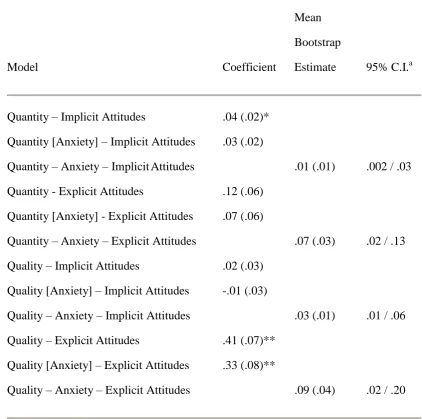
Next, bootstrapping analyses were conducted to examine (a) the direct and total effects of quality and quantity of contact on implicit and explicit attitudes, and (b) the
indirect effects of contact via intergroup anxiety (see Table 2). Detecting both an effect to be mediated and a statistically significant indirect effect using bootstrapping analyses is a powerful way to test for mediation (see Preacher & Hayes, 2004). In addition to there being a significant direct relationship between the predictor (contact quantity; contact quality) and the outcome (implicit attitudes; explicit attitudes) variables, a mediated relationship is denoted by additionally having a significant indirect effect (denoted by mean bootstrapped estimates of the indirect effects excluding zero).
In the two instances where there were significant direct effects to be mediated (contact quantity → implicit attitudes: t(105) = 1.99, p < .05; contact quality → explicit
attitudes, t(105) = 5.34, p < .001), the indirect paths (via intergroup anxiety, see Table 2) excluded zero and were thus reliable estimates (see Preacher & Hayes, 2004; Shrout & Bolger, 2002). While the significant effect of contact quantity on implicit attitudes was reduced to non-significance when controlling for intergroup anxiety (denoting full mediation), contact quality remained a significant predictor of explicit attitudes when controlling for intergroup anxiety (denoting partial correlation). In addition, in the two instances where the direct effects were not significant (contact quantity → explicit attitudes; contact quality → implicit attitudes), the indirect paths (both via intergroup anxiety) were
both significant.3 Additional regression analyses, using centred predictors, revealed that the cross-product interaction between contact quantity and contact quality did not significantly predict implicit attitudes, β = .13, p = .19, nor explicit attitudes, β = -.01, p = .94.
In this study, we present further evidence that contact with outgroup members is associated with more positive attitudes towards that outgroup in general. The majority of studies investigating this issue have focused on explicit attitudes. Here, we demonstrate an additional association between contact and implicit attitudes (see Tam et al., 2006; Turner et al., 2007). Moreover, the data suggest that explicit attitudes are more strongly associated with the quality of one‟s interactions with outgroup members, rather than the actual amount of
contact. For implicit attitudes, the opposite pattern emerged. Contact quantity, but not its quality, was significantly related to implicit attitudes. As well as implying that the type of contact, its quality or general quantity, can relate differentially to implicit and explicit attitudes, the pathways were mediated by reduced intergroup anxiety.
The importance of contact quality, relative to contact quantity, shown in our study implies that, for explicit attitudes, the amount of contact is less important and that explicit attitude change can occur quickly on the basis of new information and experiences. However, the non-significant relationship between contact quality and implicit attitudes, and the
significant relationship between contact quantity and implicit attitudes, suggests that the development of more positive implicit attitudes towards outgroup members, relative to ingroup members, is likely to be a slower process. These findings are in line with Betsch et al.‟s (2004) value-account model, which explains implicit attitude formation in terms of the
The lack of a significant interaction between the two types of contact appears
surprising as one would not expect that frequent negative contact experiences with members of different groups would not lead to positive implicit attitudes (see also Aberson & Haag, 2007). However, this might be attributable to our sample as it did not contain participants that reported frequent but negative contact with the outgroup. All of the participants that reported frequent contact (higher than the mid-point on the scale) had, at least, above average contact quality experiences (3.5 or above on the 1-7 scale).
Intergroup anxiety has been previously presented as a mediator of contact-attitude relations (e.g., Kenworthy et al., 2005). Specifically, greater contact leads to less negative attitudes via decreased levels of intergroup anxiety. Whereas past research has focused primarily on explicit attitudes (but see Aberson & Haag, 2007; Tam et al., 2006; Turner et al., 2007), the results of this study imply that a similar pathway exists between contact quantity and implicit attitudes.
Intergroup anxiety might not be the sole affective reaction relevant to changes in implicit attitudes. There is evidence that amygdala activation is associated with a number of different emotions (Zald, 2003). Further, more generic affective indices distinct from fear or anxiety have also been correlated with implicit bias reduction (Rudman et al., 2001).
However, in the context of intergroup contact, where the reduction of intergroup uncertainty and anxiety have such strong associations with contact (see Brown & Hewstone, 2005; Pettigrew & Tropp, 2006), anxiety is likely to be one of the principal affective reactions that mediates the effect of intergroup contact on implicit racial attitudes.
Implicit attitudes have been linked to affect before (e.g., Cunningham et al., 2004; Phelps et al., 2000; Rudman et al., 2001) and it seems that implicit racial attitudes, and perhaps other types of implicit attitudes, could be changed by targeting one‟s anxieties or
investigate this issue and to identify the exact mechanisms through which affect-targeted strategies might influence implicit attitudes. Additionally, it should be noted that in this study contact quality was not conceptualized as cross-group friendships. Instead, we tested contact quality as any form of positively-valenced intergroup interaction. It might be argued that as friendships represent a key form of contact (see Turner et al., 2007; Vonofakou, Hewstone, & Voci, 2007), had quality been expressed in these terms then the relationships between contact quality and implicit (and perhaps explicit) attitudes might have been stronger. Further
research might examine this issue.
References
Aberson, C.L., & Haag, S.C. (2007). Contact, perspective taking, and anxiety as predictors of stereotype endorsement, explicit attitudes and implicit attitudes. Group Processes and Intergroup Relations, 10, 179-201.
Aberson, C.L., Shoemaker, C., & Tomolillo, C. (2004). Implicit bias and contact: The role of interethnic friendships. The Journal of Social Psychology, 144, 335-347.
Allport, G.W. (1954). The nature of prejudice. Reading, MA: Addison-Wesley.
Anderson, N.H. (1971). Integration theory and attitude change. Psychological Review, 78, 171-206.
Bargh, J.A., Chaiken, S., Govender, R., & Pratto, F. (1992). The generality of the automatic attitude activation effect. Journal of Personality and Social Psychology, 62, 893-912. Baron, R.S., Inman, M.L., Kao, C.F., & Logan, H. (1992). Negative emotion and superficial
social processing. Motivation and Emotion, 16, 323-346.
Betsch, T., Kaufmann, M., Lindow, F., Plessner, H., & Hoffmann, K. (2006).
Different principles of information integration in implicit and explicit attitude formation. European Journal of Social Psychology, 36, 887-905.
Betsch, T., Plessner, H., & Schallies, E. (2004). The value-account model of attitude formation. In G.R. Maio, & G. Haddock (Eds.), Contemporary perspectives on the psychology of attitudes (pp. 251-273). Hove: Psychology Press.
Betsch, T., Plessner, H., Schwieren, C., & Gütig, R. (2001). I like it but I don‟t know why: A value-account approach to implicit attitude formation. Personality and Social Psychology Bulletin, 27, 242-253.
Brown, R. & Hewstone, M. (2005). An integrative theory of intergroup contact. In M. Zanna (Ed.), Advances in experimental social psychology (Vol. 37, pp. 255-343). San Diego, CA: Academic Press.
Cunningham, W.A., Johnson, M.K., Gatenby, J.C., Gore, J.C., & Banaji, M.R. (2003). Component processes of social evaluation. Journal of Personality and Social Psychology, 85, 639-649.
Cunningham, W.A., Johnson, M.K., Raye, C.L., Gatenby, J.C., Gore, J.C., & Banaji, M.R. (2004). Separable neural components in the processing of black and white faces.
Psychological Science, 15, 806-813.
Dasgupta, N., & Greenwald, A.G. (2001). On the malleability of automatic attitudes: Combating automatic prejudice with images of admired and disliked individuals.
Journal of Personality and Social Psychology, 81, 800-814.
De Houwer, J., & De Bruycker, E. (2007). The Implicit Association Test outperforms the Extrinsic Affective Simon Task as an implicit measure of interindividual differences in attitudes. British Journal of Social Psychology, 46, 401-421.
Devine, P.G. (1989). Automatic and controlled processes in prejudice: The role of
stereotypes and personal beliefs. In A.R. Pratkanis, S.J. Breckler, & A.G. Greenwald (Eds.), Attitude structure and function (pp. 181-212). Hillsdale, NJ: Erlbaum.
Dijksterhuis, A. (2004). I like myself but I don‟t know why: Enhancing implicit
self-esteem by subliminal evaluative conditioning. Journal of Personality and Social Psychology, 86, 345-355.
Dovidio, J.F., Kawakami, K., Johnson, C., Johnson, B., & Howard, A. (1997). On the nature of prejudice: Automatic and controlled processes. Journal of Experimental Social Psychology, 33, 510-540.
Egloff, B., & Schmuckle, S.C. (2002). Predictive validity of the Implicit Association Test for assessing anxiety. Journal of Personality and Social Psychology, 83, 1441-1455. Fazio, R.H. (1986). How do attitudes guide behavior? In R.M. Sorrentino & E.T. Higgins
(Eds.), Handbook of motivation and cognition (pp. 204-243). New York: Guilford. Fazio, R.H., Jackson, J.R., Dunton, B.C., & Williams, C.J. (1995). Variability in automatic
activation as an unobtrusive measure of racial attitudes: A bona fide pipeline?
Journal of Personality and Social Psychology, 69, 1013-1027.
Fazio, R.H., & Olson, M.A. (2003). Attitudes: Foundations, functions, and consequences. In M. Hogg & J. Cooper (Eds.), The Sage handbook of social psychology (pp. 139-160). London: Sage Publications.
Friese, M., Hofmann, W., & Wänke, M. (2008). When impulses take over: Moderated predictive validity of explicit and implicit attitude measures in predicting food choice and consumption behaviour. British Journal of Social Psychology, 47, 397-419. Garavan, H., Pendergrass, J.C., Ross, T.J., Stein, E.A., & Risinger, R.C. (2001). Amygdala
response to both positively and negatively valenced stimuli. Neuroreport, 12, 2779-2783.
Gawronski, B., & Bodenhausen, G.V. (2006). Associative and propositional processes in evaluation: An integrative review of implicit and explicit attitude change.
Psychological Bulletin, 132, 692-731.
Greenwald, A. G., Nosek, B. A., & Banaji, M. R. (2003). Understanding and Using the Implicit Association Test: I. An Improved Scoring Algorithm. Journal of Personality and Social Psychology, 85, 197-216.
Henry, P.J., & Hardin, C.D. (2006). The contact hypothesis revisited. Psychological Science,
17, 862-868.
Hofmann, W., Gawronski, B., Gschwendner, T., Le, H., & Schmitt, M. (2005). A meta-analysis on the correlation the Implicit Association Test and explicit self-report measures. Personality and Social Psychology Bulletin, 31, 1369-1385.
Hofmann, W., Rauch, W., & Gawronski, B. (2007). And deplete us not into temptation: Automatic attitudes, dietary restraint, and self-regulatory resources as determinants of eating behavior.
Journal of Experimental Social Psychology, 43, 497-504.
Islam, R. M., & Hewstone, M. (1993). Dimension of contact as predictors of intergroup anxiety, perceived outgroup variability and outgroup attitudes: An integrative model. Personality and Social Psychology Bulletin, 19, 700-710.
Karpinski, A., & Hilton, J.L. (2001). Attitudes and the implicit association test. Journal of Personality and Social Psychology, 81, 774-788.
Kenworthy, J., Turner, R. N., Hewstone, M., & Voci, A. (2005). Intergroup contact: When does it work and why. In J. Dovidio, P. Glick, & L. Rudman (Eds.), On the nature of prejudice: 50 years after Allport (pp. 278-292). Malden, MA: Blackwell.
Kling, A.S., & Brothers, L.A. (1992). The amygdala and social behavior. In J.P. Aggleton (Ed.), The Amygdala: Neurobiological Aspects of Emotion, Memory and Mental Dysfunction (pp. 353-377). New York: Wiley-Liss, Inc.
LeDoux, J.E. (1996). The Emotional Brain. New York: Simon and Schuster.
Olson, M.A., & Fazio, R.H. (2006). Reducing automatically activated racial prejudice
through implicit evaluative conditioning. Personality and Social Psychology Bulletin,
32, 421-433.
Paolini, S., Hewstone, M., Cairns, E., & Voci, A. (2004). Effects of Direct and Indirect Cross-Group Friendships on Judgments of Catholics and Protestants in Northern Ireland: The Mediating Role of an Anxiety-Reduction Mechanism. Personality and Social Psychology Bulletin, 30, 770-786.
Pettigrew, T.F., & Tropp, L.R. (2000). Does intergroup contact reduce prejudice? Recent meta-analytic findings. In S. Oskamp (Ed.), Reducing prejudice and discrimination
(pp. 93-114). Hillsdale, NJ: Erlbaum.
Pettigrew, T. F., & Tropp, L.R. (2006). A meta-analytic test of intergroup contact theory.
Journal of Personality and Social Psychology, 90, 751-783.
Phelps, E.A., LaBar, K.S., Anderson, A., O‟Connor, K.J., Fulbright, R.K., and Spencer, D.D. (1998). Specifying the contributions of the human amygdala to emotional memory: A case study. Neurocase, 4, 527-540.
Phelps, E.A., O‟Connor, K.J., Cunningham, W.A., Funayama, E.S., Gatenby, J.C., Gore,
J.C., & Banaji, M.R. (2000). Performance on indirect measures of race evaluation predicts amygdala activation. Journal of Cognitive Neuroscience, 12, 729-738. Preacher, K.J., & Hayes, A.F. (2004). SPSS and SAS procedures for estimating indirect
effects in simple mediation models. Behavior Research Methods, Instruments, & Computers, 36, 717-731.
Richetin, J., Perugini, M., Prestwich, A., & O‟Gorman, R. (2007). The IAT as a predictor of
Rudman, L.A. (2004). Sources of implicit attitudes. Current Directions in Psychological Science, 13, 79-82.
Rudman, L.A., Ashmore, R.D., & Gary, M.L. (2001). “Unlearning” automatic biases: The malleability of implicit prejudice and stereotypes. Journal of Personality and Social Psychology, 81, 856-868.
Shrout, P.E., & Bolger, N. (2002). Mediation in experimental and nonexperimental studies: New procedures and recommendations. Psychological Methods, 7, 422-425.
Stephan, C. W. & Stephan, W. G. (1992). Reducing Intercultural Anxiety through
Intercultural Contact, International Journal of Intercultural Relations, 16, 89-106. Stephan, W.G., & Stephan, C.W. (1985). Intergroup anxiety. Journal of Social Issues, 41,
157-175.
Stephan, W. G. & Stephan, C. W. (1989). Antecedents of intergroup anxiety in Asian-Americans and Hispanic-Asian-Americans. International Journal of Intercultural Communication, 13, 203-219.
Tam, T., Hewstone, M., Harwood, J., Voci, A., & Kenworthy, J. (2006). Intergroup contact and grandparent-grandchild communication: The effects of self-disclosure on implicit and explicit biases against older people. Group Processes and Intergroup Relations, 9, 413-429.
Turner, R. N., Hewstone, M., & Voci, A. (2007). Reducing explicit and implicit outgroup prejudice via direct and extended contact: The mediating role of self-disclosure and intergroup anxiety, Journal of Personality and Social Psychology, 93, 369-388. Vonofakou, C., Hewstone, M., & Voci, A. (2007). Contact with out-group friends as a
predictor of meta-attitudinal strength and accessibility of attitudes toward gay men.
Wilder, D.A. (1993). The role of anxiety in facilitating stereotypic judgments of out-group behavior. In D.M. Mackie & D.L. Hamilton (Eds.), Affect, cognition, and
stereotyping (pp. 87-109). San Diego, CA: Academic Press.
Wilson, T.D., Lindsey, S., & Schooler, T.Y. (2000). A model of dual attitudes.
Psychological Review, 107, 101-126.
Wright, S.C., Aron, A., McLaughlin-Volpe, T., & Ropp, S.A. (1997). The Extended Contact Effect: Knowledge of cross-group friendships and prejudice. Journal of Personality and Social Psychology, 73, 73-90.
Zald, D.H. (2003). The human amygdala and the emotional evaluation of sensory stimuli.
Footnotes
1
More recent evidence suggests that implicit attitudes can be changed more quickly. A key means to change implicit attitudes is evaluative conditioning (see Gawronski & Bodenhausen, 2006, for a review). Evaluative conditioning requires repeatedly pairing the attitude object (or group) with positively (or negatively) valenced material. However, in real life contexts, these experiences, via contact with racial outgroup members, would be likely to occur over a long period of time (arguably years). Furthermore, we are not aware of any evidence that changes in implicit attitudes, achieved within the laboratory using evaluative conditioning techniques, lasts over a period of 24 hours (for a demonstration of change over 24 hours, see Dasgupta & Greenwald, 2001; and even this does not actually assess stability at the level of the individual).
2
The split-half reliability of the IAT was also calculated (r = .85 applying the Spearman-Brown correction) and was similar to that reported in other IAT studies and superior to that associated with alternative measures of implicit attitudes (see De Houwer & De Bruycker, 2007).
3
A series of path analyses, using the Maximum Likelihood method, were conducted with Lisrel 8.70 to determine whether versions of potential models comprising direct paths (i.e., unmediated) between the predictor and criterion variables provided a significantly improved fit of the model. This would be indicated by a significant chi-square difference between the models. A model including direct paths between each predictor and criterion (a fully unmediated model) displayed excellent fit, χ2
(1) = 0.34, p = .95, RMSEA = 0.000, CFI = 1.00.Simpler models involving fewer direct paths, however, are preferred when the removal of such paths does not lead to a significant change in fit. Removing direct paths between contact quality-implicit attitudes, quantity-implicit attitudes and quantity-explicit attitudes did not significantly reduce the fit of the model, Δχ2
removing the direct path between contact quality and explicit attitudes did significantly change the fit, Δχ2
(1) = 13.65, p < .001. Consequently, the model comprising a mediated pathway between contact quantity and implicit attitudes and an unmediated, direct path between contact quality and explicit attitudes, was accepted. In this model, χ2(6) = 2.62, p = .85, RMSEA = 0.000, CFI = 1.00, 7% of the variance in implicit attitudes was explained, along with 22% of the variance in explicit attitudes.
4
We tested the reverse mediational model by switching contact quantity with implicit attitudes and contact quality with explicit attitudes within the path model showing the best fit (see footnote 3). This reverse mediational model, χ2(6) = 5.61, p = .47, RMSEA = 0.000, CFI = 1.00, although showing good fit, was inferior to original model. As well as suggesting that the flow is from contact to attitudes, it could also imply that the path from anxiety to implicit attitudes is more reliable than the equivalent path from implicit attitudes to anxiety.
Comparing across these two models, the path from intergroup anxiety to implicit attitudes (β
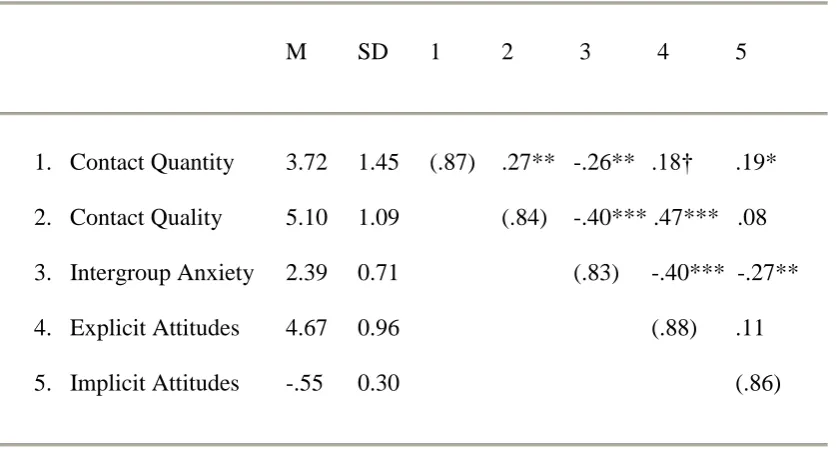
Table 1
Summary of Descriptive Statistics and Correlations Among Study Variables
M SD 1 2 3 4 5
1. Contact Quantity 3.72 1.45 (.87) .27** -.26** .18† .19* 2. Contact Quality 5.10 1.09 (.84) -.40*** .47*** .08 3. Intergroup Anxiety 2.39 0.71 (.83) -.40*** -.27** 4. Explicit Attitudes 4.67 0.96 (.88) .11
5. Implicit Attitudes -.55 0.30 (.86)
Table 2
Direct, Total, and Indirect Effects of Quantity and Quality of Contact via Intergroup
Anxiety
Mean Bootstrap
Model Coefficient Estimate 95% C.I.a
Quantity – Implicit Attitudes .04 (.02)* Quantity [Anxiety] – Implicit Attitudes .03 (.02)
Quantity – Anxiety – Implicit Attitudes .01 (.01) .002 / .03 Quantity - Explicit Attitudes .12 (.06)
Quantity [Anxiety] - Explicit Attitudes .07 (.06)
Quantity – Anxiety – Explicit Attitudes .07 (.03) .02 / .13 Quality – Implicit Attitudes .02 (.03)
Quality [Anxiety] – Implicit Attitudes -.01 (.03)
Quality – Anxiety – Implicit Attitudes .03 (.01) .01 / .06 Quality – Explicit Attitudes .41 (.07)**
Quality [Anxiety] – Explicit Attitudes .33 (.08)**
Quality – Anxiety – Explicit Attitudes .09 (.04) .02 / .20
Note. Estimates (standard errors in parentheses) are based on 2,000 bootstrap samples. Effect of mediator controlled in square brackets.
a