www.ijemst.com
Classroom Observations and Reflections:
Using Online Streaming Video as a Tool
for Overcoming Barriers and Engaging
in Critical Thinking
Angela T. Barlow1, Michael R. McCrory2, Stephen Blessing3
1
Middle Tennessee State University
2Blue Mountain College 3Coffee County School District
To cite this article:
Barlow, A. T., McCrory, M. R., & Blessing, S. (2013). Classroom observations and
reflections: Using online streaming video as a tool for overcoming barriers and engaging in
critical thinking.
International Journal of Education in Mathematics, Science and
Technology, 1
(4), 238-258.
This article may be used for research, teaching, and private study purposes.
Any substantial or systematic reproduction, redistribution, reselling, loan, sub-licensing,
systematic supply, or distribution in any form to anyone is expressly forbidden.
Authors alone are responsible for the contents of their articles. The journal owns the
copyright of the articles.
Volume 1, Number 4, October 2013, Page 238-258
ISSN: 2147-611X
Classroom Observations and Reflections: Using Online Streaming Video as
a Tool for Overcoming Barriers and Engaging in Critical Thinking
Angela T. Barlow*1, Michael R. McCrory2, Stephen Blessing3
1
Middle Tennessee State University
2Blue Mountain College 3Coffee County School District
Abstract
In typical school settings, teachers are not afforded the opportunity to observe the instructional practices of their peers. Time constraints, opportunity, and willingness to participate in observational practices are just three of the factors that may limit teachers’ engagement in this type of activity. To provide teachers with opportunities to observe a standards-based, elementary mathematics classroom, online streaming videos of instruction were disseminated to third grade teachers within a single school. As they viewed each video, the participants were presented with the opportunity to read the teacher’s introduction explaining the focus of the video and engage in discussion around each video through text. Discussions included posting their own comments, reading other participants’ comments, or posing questions. The purpose of this research was to examine the properties and/or qualities of the online streaming video that attracted the participants to use it, to identify the remaining obstacles that prevented the participants from utilizing the technology, and to explore the potential of online streaming video for engaging teachers in critically thinking about instruction and in turn impacting beliefs. Data was gathered in the form of surveys, interviews, and online comments. Results are provided and future research directions are given.
Key words: Mathematics education, Professional development, Online video, Critical thinking, Beliefs
Introduction
With the release of Principles and Standards for School Mathematics (PSSM) in 2000, the National Council of Teachers of Mathematics (NCTM) established a vision for school mathematics, in which the classroom engages students in the mathematical processes of problem solving, communicating about mathematics, representing mathematical concepts, reasoning and proof, and forming connections among mathematical ideas. Such a classroom is often referred to as a standards-based classroom. Equipping teachers with the knowledge and skills necessary to develop a standards-based classroom has been the focus of professional development since the release of PSSM (Balfanz, Mac Iver, & Byrnes, 2006; Heck, Banilower, Weiss, & Rosenber, 2008). This focus has intensified with the introduction of the Common Core State Standards for Mathematics (CCSSI, 2010), as its Standards for Mathematical Practices have these same mathematical processes as a foundation.
In order to accomplish change in classroom practices, it is necessary to consider the teachers’ beliefs concerning classroom practices with respect to teaching mathematics and the impact these beliefs have on decisions that are made (Stuart & Thurlow, 2000). The key belief components that teachers hold can be sorted into three categories: their view or conception of the nature of mathematics; their model or view of the nature of mathematics teaching; and their model or view of the process of learning mathematics (Ernest, 1988). These belief components are shaped by the hours spent in a classroom setting while students themselves. It is thought that these beliefs may remain dormant during preservice training at the university and can become a major force once the teacher is in his or her own classroom (Raths, 2001). In other words, a teacher may rely more upon how they were taught as students as opposed to the pedagogy to which they are exposed in methods classes. The result is the need for professional development that supports teachers in establishing a new vision of their roles as mathematics teachers (Sowder, 2007).
* Corresponding Author: Angela T. Barlow,[email protected]
While there are possibly many factors that contribute to a teacher’s willingness and ability to develop a standards-based classroom, teacher educators recognize that many teachers have never seen such a classroom in action (Franke, Kazemi, & Battey, 2007). As a result, a goal of professional development should be to support teachers in establishing a vision of such a classroom (Borasi & Fonzi, 2002). To this end, most would argue that teachers need opportunities to observe these classrooms in action. Finding the time and opportunity to visit the classrooms of colleagues, however, is often a difficult obstacle to overcome. The purpose of this qualitative study was to examine the potential that online video streaming holds for circumventing lack of time and opportunity as barriers to observation of standards-based classrooms. In addition, the researchers sought to examine the impact of this learning opportunity on teachers’ beliefs as well as the level of critical thinking exhibited by the teachers in this online setting. Such reflection has been noted as a key element of professional development for teachers considering the establishment of their own standards-based classroom (Sowder, 2007). To guide the research, the following questions were posed.
1. What properties or qualities of online streaming video enable teachers to utilize it as a means for viewing a standards-based elementary mathematics classroom?
2. What are the barriers that prevent teachers from viewing video via online video streaming? 3. What level(s) of critical thinking are demonstrated in online video comments?
4. Does viewing instruction via online video streaming support change in teachers’ beliefs about teaching and learning mathematics?
Given the previously identified barriers, the significance of this study lies in its potential to establish online streaming video as a viable option to engage teachers in critically thinking about standards-based elementary mathematics lessons and supporting shifts in their beliefs.
Video as a Tool
“Video is generally thought to be a valuable medium for exploring teaching and learning because it captures much of the richness of the classroom setting” (Sherin, Linsenmeier, & van Es, 2009, p. 214). When compared with watching classroom lessons in person, videos provide the benefit of being able to pause the lesson, re-watch selected lesson components, and reflect on critical instances (Sherin et al., 2009). Through this process, videos of instruction provide teachers with a means for expanding their understanding of mathematics teaching and learning (Smith, 2001).
In selecting videos of instruction, Sherin and colleagues (2009) described three key issues to be considered. First, the authenticity of the featured instruction must be considered. Research by Brophy (2004) and Merseth (1996) demonstrated the need for videos to feature authentic classrooms that are similar to the classrooms of the teachers viewing the video. Second, teachers benefit from knowledge of the classroom context from which the video was taken (Sherin et al., 2009). Third, the intent of the video must be considered. In helping teachers develop their understanding of mathematics teaching and learning, videos can be separated into two categories (Brophy, 2004; Carter, 1999; Wang & Hartley, 2003). In the first category, “exemplars,” the video is intended to demonstrate an instructional strategy or setting that the teacher could potentially emulate in his or her own classroom. Such video may support teachers in envisioning their new roles as mathematics teachers, as described by Sowder (2007). This is in contrast to the second category, “problem situations,” which aims to provide teachers with a classroom-based dilemma to be resolved (Brophy, 2004; Carter, 1999; Wang & Hartley, 2003). Here, the intent is to provide a context for reflecting on practice (Sherin et al., 2009).
With calls for research on the use of video as a learning tool (e.g. Lundeberg, Levin, & Harrington, 1999; Morris, 2008), mathematics education researchers have begun investigating the impact of video on both preservice and inservice teachers (Borko, Jacobs, Eiteljorg, & Pittman, 2008; Kazemi, Lenges, & Stimpson, 2008; Morris, 2008; van Es & Sherin, 2008). A review of the literature revealed two studies that used video with inservice teachers for purposes similar to that of the present study. Each of these is described below.
In the first of these studies, Borko et al. (2008) utilized video from teachers’ classrooms as a means for engaging them in discussions about the teaching of mathematics. The two-year professional development program utilized video as a medium for facilitating teacher discussions about their classrooms and problem solving. As part of the program, teachers met in groups and discussed video taken from their own classrooms. The researchers reported that over the course of the two years the participants grew in terms of ability to examine video and reflect upon its contents.
classrooms, teachers examined and discussed children’s mathematical thinking. Findings of the study indicated that, through their participation in the video club, teachers grew in their ability to notice and discuss children’s thinking.
In each of these cases, the use of video allowed the teachers to overcome the obstacle of opportunity, therefore achieving the goals of the professional development projects in which they participated. There are three key components to these studies, however, that must be noted as these components might have become obstacles in a different setting. First, the teachers welcomed the videoing of their classrooms. Second, the video of the teachers’ classrooms produced video of a standards-based classroom. Third, there was a common time available for teachers to meet to view and discuss the classroom videos. If similar conditions are not present, what avenues are available for engaging teachers in observation of a standards-based classroom? Answering this question motivated the work of the researchers in this study.
Practical Inquiry Model
Although identifying online streaming video as an option for overcoming the barriers associated with viewing standards-based instruction is a key component in this study, the level of critical thinking evidenced by the teachers upon viewing the videos was also of interest. To address this, the researchers sought to have a means for examining the written comments posted by participants in response to the videos. In 2004, Garrison, Anderson, and Archer introduced the practical inquiry model. Researchers (e.g. Arnold & Ducate, 2006; Bai, 2009; Fahy, 2005) have used this model as a framework for assessing the level of critical thinking provided in online discussions. The model consists of four phases, namely triggering, exploration, integration, and resolution. These phases will be briefly described in the paragraphs that follow. Although the use of the model is not limited to the field of education, the examples provided will focus on teacher responses to a fictitious scenario.
In the triggering phase, the teacher recognizes and/or questions an issue that arises in a given context. For example, a question such as, “I wonder why the students were having difficulty with the multiplication?” would be classified as triggering. In this example, the teacher has communicated her recognition and curiosity regarding the students’ work.
Statements categorized as being in the exploration phase indicate that the teacher has begun to explore or investigate the issue, therefore moving beyond the initial recognition. Here, the teacher may offer suggestions or provide conclusions related to the issue. For example, if the teacher stated, “The students probably do not have a strong background in modeling multiplication. Does that seem right?” the response would be classified as exploration. The teacher has thought about the issue previously recognized and made a proposal as to why the issue might have arisen in an attempt to explain its occurrence.
In the next phase, integration, the teacher reflects on the connection between the issue recognized in the triggering phase and the possible reason provided in the exploration phase. Through this reflection, the teacher develops some understanding of the proposed reason and decides whether he or she agrees, offering some support to his/her reasoning. Continuing the previous example, the teacher might say, “I agree with this idea. Often, teachers rush to memorization of facts and skip modeling of multiplication. Students, then, do not have a chance to develop a real understanding of what multiplication means.” Notice that in this statement, the teacher has not only proposed a potential reason behind the issue but also has included justification.
In the final phase, resolution, the teacher tests the idea(s) asserted in the integration phase, therefore resolving the issue that was initially recognized. While actually testing the ideas may not be possible, the proposal of how to test the ideas is also classified as being in the resolution phase. For example, the teacher might state, “I think the teacher in that classroom could spend some time letting students model multiplication with pictures and then have the students try the problem again to check for understanding of multiplication.” Here, the teacher has described a means for testing the ideas previously identified.
Methodology
Subjects
In August 2008, the researchers invited third grade teachers at one elementary school to participate in the study. Located in a small town in the southeastern United States, the elementary school included students in grades two and three, with an approximate enrollment of 560 students. The student population was 47% Caucasian, 46% African American, 4% Asian, and 3% Hispanic. Each year, third grade students complete the state’s mandatory assessments in mathematics and language arts. For the 2008-2009 school year, third grade scores in mathematics were as follows: 7.5% minimal, 31.7% basic, 43% proficient, and 17.7% advanced.
All third grade teachers who taught mathematics (n = 10) agreed to participate in the study. Although participation was voluntary, participants were provided with the incentive of receiving continuing education units (CEU’s) based on the level of participation in the study. All ten teachers were Caucasian/white, and only one was male. Table 1 provides information regarding the number of years of the participants’ teaching experience.
Table 1. Teacher Experience by Participation Years of Teaching Experience
Participation 0 - 5 6 - 10 11 - 15 16 - 20 21 – 25
Yes 1 1 1 1 1
No 1 2 2 0 0
Instruments and Data Sources
In answering the research questions, the researchers utilized surveys, interviews, and online comments. Each of these will be described in the paragraphs that follow.
Survey 1
The researchers created Survey 1 (see Appendix A) to gain background information on the participants as well as an understanding of participants’ technology use. Section 1 of the survey included seven questions that enabled participants to identify the grade level taught, age range, academic preparation, teaching experience, and confidence in mathematics skills and teaching skills. Due to the nonambiguous nature of this information, close-ended questions were appropriate. The last question of Section 1 allowed the participant to indicate whether or not he or she had viewed the online video. Based on this response, the participant was directed to complete either Section 2 or Section 3 of Survey 1.
Participants who indicated that they had watched at least one online video were directed to complete Section 2. In this section, the researchers wanted participants to describe their motivation behind watching the videos as well as how they were utilizing the information from the videos. In addition, participants could identify the features of the video that made it accessible to them. In effect, this section was specifically designed to answer the first research question. Due to the exploratory nature of this research question, the researchers utilized open-ended prompts.
Survey 2
The researchers created the second survey (see Appendix B) to gauge the number of participants who had watched the online video but without posting comments. This survey consisted of two close-ended questions. Due to the nonambiguous nature of this information, the researchers felt that the use of close-ended questions was appropriate.
IMAP Web-based Beliefs Survey
The Integrating Mathematics and Pedagogy (IMAP) Web-based Beliefs Survey was used to assess beliefs about mathematics, learning and/or knowing mathematics, and children’s learning and doing mathematics. Such beliefs are likely to impact teachers’ classroom practices (Ambrose, Clement, Philipp, & Chauvot, 2004). Unlike Likert-scale surveys, the IMAP Web-based Beliefs Survey requires teachers to respond to videos and learning scenarios, thus providing a context for evidence of beliefs to be revealed. The survey includes rubrics for scoring teachers’ open-ended responses. The specificity of the rubrics lends itself to inter-rater reliability (Ambrose et al., 2004).
Interview Protocol
The researchers were particularly interested in the participants’ perspectives regarding the accessibility of the videos, the process of watching the videos, and how the information from the videos impacted instruction. To this end, the researchers created an interview protocol (see Appendix C) to be utilized with teachers who watched all or nearly all of the videos. The interview protocol included 11 open-ended questions that were meant to guide the interview, recognizing that participant responses might prompt the interviewer to ask additional follow-up questions.
Online Comments
In addition to surveys and interviews, participants posted online comments to the video streaming site upon viewing each video. The researchers created one transcript for each video by copying participants’ comments verbatim into a Word document. Comments within the transcripts appeared in the order in which they were posted.
Procedures Used
In August 2008, the researchers met with third grade teachers at the identified elementary school to invite them to participate in the study as well as to collect initial data. This meeting occurred two days prior to the first day of the school year. Participants completed the IMAP Web-based beliefs survey (Ambrose et al., 2004) at this meeting.
engaged in the process standards (NCTM, 2000). Therefore, the availability of videos of standards-based instruction overcame the obstacle of lack of standards-based instruction for viewing. Furthermore, this video represented an authentic classroom similar in context to that of the participants.
With the availability of video secured, the authors sought to address the issues of opportunity and time. What opportunities do teachers have to observe the happenings of someone else’s classroom? Where does a teacher find the time to observe a class or watch videos of a class? The authors hypothesized that by utilizing online streaming video teachers would have the opportunity to view classroom video at their convenience, therefore overcoming these obstacles.
In September 2008, the teachers at the school in which the video was being captured completed a training session conducted by two of the authors. The purpose of this training session was to train them on the use of the online video streaming system being utilized in the project. This training included watching a sample video followed by small group discussions regarding the contents of the video and a demonstration of how to post comments to the video. All teachers agreed to participate and received a detailed handout describing the process of using the online video streaming system. In addition, participants signed an agreement of confidentiality, stating that they would not share their user names and passwords with persons not participating in the project.
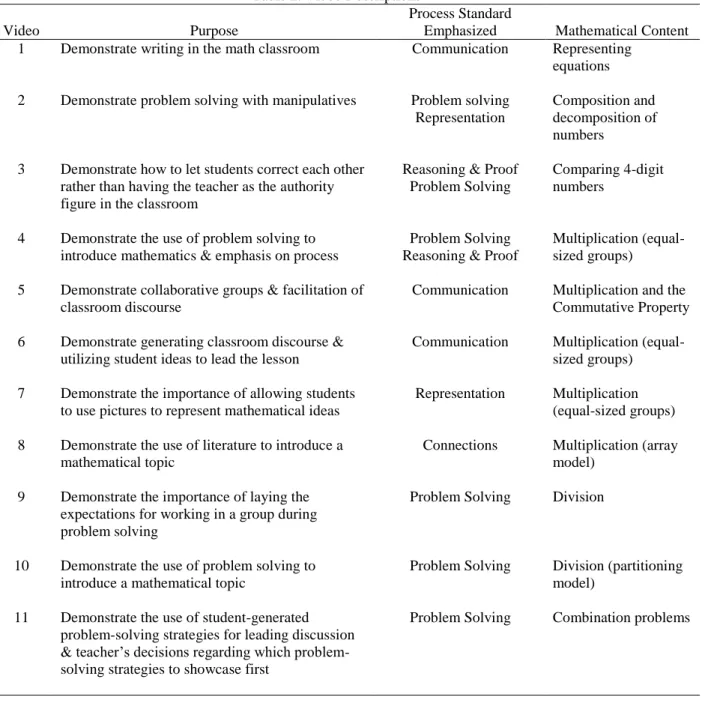
Table 2. Video Descriptions
Video Purpose
Process Standard
Emphasized Mathematical Content 1 Demonstrate writing in the math classroom Communication Representing
equations 2 Demonstrate problem solving with manipulatives Problem solving
Representation
Composition and decomposition of numbers
3 Demonstrate how to let students correct each other rather than having the teacher as the authority figure in the classroom
Reasoning & Proof Problem Solving
Comparing 4-digit numbers
4 Demonstrate the use of problem solving to introduce mathematics & emphasis on process
Problem Solving Reasoning & Proof
Multiplication (equal-sized groups) 5 Demonstrate collaborative groups & facilitation of
classroom discourse
Communication Multiplication and the Commutative Property 6 Demonstrate generating classroom discourse &
utilizing student ideas to lead the lesson
Communication Multiplication (equal-sized groups) 7 Demonstrate the importance of allowing students
to use pictures to represent mathematical ideas
Representation Multiplication (equal-sized groups) 8 Demonstrate the use of literature to introduce a
mathematical topic
Connections Multiplication (array model)
9 Demonstrate the importance of laying the expectations for working in a group during problem solving
Problem Solving Division
10 Demonstrate the use of problem solving to introduce a mathematical topic
Problem Solving Division (partitioning model)
11 Demonstrate the use of student-generated problem-solving strategies for leading discussion & teacher’s decisions regarding which problem-solving strategies to showcase first
After the training session, the researchers began posting videos online. A new video was posted approximately every two weeks. The video posting process began with the selection of the lessons for editing. Since the study and the lessons were occurring simultaneously, it was not possible to have the sequence of edited videos planned prior to the start of the study. Instead, the lessons were selected and videos were edited as the study progressed. In selecting lessons for potential editing, the teacher reflected weekly on the most recent lessons, identifying lessons to be edited based on their potential for demonstrating different means for engaging students in the Process Standards. In this sense, videos were being used as exemplars (Carter, 1999). Table 2 contains a description of the purpose of each video utilized in the study along with the Process Standard being emphasized and the mathematical content of the lesson. Initial videos were selected to demonstrate strategies that could be utilized in teachers’ classrooms without significantly changing the current instructional mode. For example, the first video highlighted the use of a writing prompt, an instructional technique that could easily be incorporated into any lesson. As the videos progressed, the emphasis shifted toward an end goal of teaching through problem solving, an instructional mode that would require significant changes in most of the participants’ classrooms. With the lesson selected and the purpose of the video identified, the researchers reviewed the lesson video to identify how to edit the video. The goal in editing was to produce a video clip that allowed participants to examine the featured aspect of the lesson without having to watch the entire lesson. For example, in the first video featuring student responses to a writing prompt, it was not necessary for the edited video to include other parts of the lesson such as the warm-up for the lesson or the actual time spent with students writing. Instead, the video was edited to showcase the teacher introducing the writing prompt, the students displaying and sharing their work via a document presenter, and the teacher utilizing the work to establish expectations for student writing. As a result of the editing process, video clips were typically under 10 minutes. Edited video clips were then posted to the online video streaming website.
With each video that was made available for viewing, the teacher posted an initial comment that described the content of the video, how it linked to the grade-level objectives, and the content in the video on which to focus. This initial comment supported participants in understanding the context of the lesson. Once the initial comment was posted, the researchers sent an e-mail to participants, alerting them that a new video had been posted for viewing. In order to participate in the project and earn CEU’s, participants were expected to go online, view the video, and post a comment. The posted comments enabled the researchers to track who was viewing the videos. Worth noting is the fact that it was possible for participants to view videos without posting a comment. In these instances, the online video streaming program tracked how many views were made in which the viewer did not post a comment. It was not possible, however, to know who had viewed the video.
After five videos had been posted (approximately half-way through the project), the researcher e-mailed participants, asking them to complete Survey 1 (see Appendix A). Surveys were placed in participants’ school mailboxes along with an envelope in which to place the survey. Four days later, the researcher visited each participant to collect the survey.
At the conclusion of the school year, participants responded to Survey 2 (see Appendix B) as well as the IMAP Web-based Beliefs Survey (Ambrose et al., 2004). In addition to these surveys, one of the researchers interviewed the two participants that had viewed and commented on every video posted utilizing the Interview Protocol (see Appendix C). Each interview lasted approximately 20 minutes. Interviews were audio recorded and then later transcribed verbatim by the researchers. Finally, the researchers copied the participants’ online video comments into a Word document to create the video transcripts.
Data Analysis
Since Survey 1 contained responses to open-ended questions, the researchers utilized qualitative methods for analyzing the data. The researchers independently reviewed the responses using open coding (Charmaz, 2002; Strauss & Corbin, 1990). The researchers then met to compare and agree upon the codes that emerged from the data. With the agreed upon codes in place, the researchers independently reviewed and coded the survey responses a second time. Finally, the researchers met to compare analyses and to reach consensus regarding any discrepancies. A similar process was employed for analyzing the interview transcripts. Responses to Survey 2 represented categorical data. Frequencies were recorded based on the responses.
post) for each of seven beliefs statements. The researchers recorded the resulting scores in a table and examined the table for trends or patterns that were present in the data.
Finally, the comments posted by participants on the online video streaming site were reviewed using open coding (Charmaz, 2002; Strauss & Corbin, 1990). The researchers then met to compare the codes that had emerged from the comments. Once the researchers agreed upon the codes, they assembled a list of the codes with descriptors of each code (see Appendix D). Separately, the researchers utilized the agreed upon codes to code the participants’ comments. The researchers met again to agree upon the codes of the participants’ comments.
With the comments coded, the researchers separately examined the response codes in relation to the practical inquiry model (Garrison et al., 2004). As such, the practical inquiry model provided a lens for viewing the level of critical thinking evidenced within the participants’ comments. Through an examination of code descriptions and sample participant responses, the researchers independently matched response codes with the four phases of the model. Next, the researchers met to agree upon the match between response codes and the phases of the model. In addition, the alignment of codes with the practical inquiry model was sent to a colleague for review. This colleague had utilized the practical inquiry model in her research and had developed a deep understanding of its phases and their representations within online discussions. The colleague confirmed that the codes generated from the online comments appropriately aligned with the assigned phases of the practical inquiry model.
Finally, the researchers computed the percentages of responses falling in each of the four phases of the model. In doing so, the researchers noted that participants often posted a single comment that contained responses representing multiple codes and multiple phases from the model. In this case, the participants’ overall response was labeled according to the highest phase from the practical inquiry model. Researchers considered responses labeled as triggering or exploration to represent low levels of critical thinking. Alternatively, the researchers considered responses in the integration or resolution phases as representing high levels of critical thinking. In some instances, participants posted comments that simply summarized the events of the lesson. The researchers elected not to label these as representing high or low levels of critical thinking, as they did not exhibit the characteristics of critical thinking.
Results
In this section, the results of data analyses will be shared. The results will be organized around the research questions. In addition, limitations of the study will be shared.
What properties or qualities of online streaming video enable teachers to utilize it as a means for viewing a standards-based elementary mathematics classroom?
Data taken from responses to the initial survey were examined to answer this question. At the point in the study when this survey was completed, five of the ten participants had utilized the online video-streaming program. All five of these participants agreed that the technology had allowed them to participate more in the project than they might have been able to do without it. When asked about the features of the technology that enabled them to participate, three of the five participants indicated time as a feature of the online video streaming that allowed them to participate in the program. Participants indicated that the online aspect allowed them the opportunity to view the videos “on their own time.” Of interest, though, is that the convenience factor was valued for different reasons. One teacher saw the convenience as important because it did not require her to be out of her own classroom. In contrast, a second teacher noted that being able to watch the video on her own time allowed her to watch the video without being rushed.
Follow-up interviews with two of the participants confirmed that an appealing characteristic of the online video streaming technology was its convenience. One participant stated the following:
I come [sic]in early in the morning so I would have time and peace and quiet to turn it on and . . . view it. . . . I’d be writing notes and taking things down and writing stuff so that I could try it with my kids. The other participant stated the following:
for different perspectives on it. . . . Except not always did I sit down and do it all four times at once. Sometimes I’d watch it at least 2 times the first time and then it may be a day before I went back and watched it again because things had to work around in my mind as I was thinking about it.
Regardless of the underlying reasons, from these responses one may conclude that one property of the online video streaming that enabled the participants to view standards-based instruction was that it provided access to the videos at the teacher’s convenience.
What are the barriers that prevent teachers from viewing video via online video streaming?
As with the previous question, data taken from the initial survey were utilized to answer this question. When the initial survey was administered, approximately mid-way through the project, five out of the ten teachers had not utilized the online video streaming technology for the purposes of viewing the videos. When asked for the main reasons for opting not to participate, all five of the participants noted time as the issue. These responses, however, fell into two categories.
Category 1: Not a Priority
For three of the participants, the time issues seemed to indicate that participating in the project was not a priority. For example, one participant wrote, “Time constraints. Would love to participate, but have other paperwork to get done for job requirements.” It would appear that the online accessibility and convenience factor that attracted others to participate did not appeal to these participants.
Category 2: Personal Technology Problem.
For the remaining two participants, time was given as a reason for being unable to participate in viewing the videos. Both of these participants, however, indicated that problems with technology access at home also prevented them from participating. For example, one participant wrote, “1. No time during day to fully watch video. 2. Trouble with computer at home.” The other participant seemed to indicate a sincere desire to view the videos. This participant wrote, “I do not have the internet at home. I am waiting for the holidays so that I have uninterrupted, quiet, quality time to view the observations.”
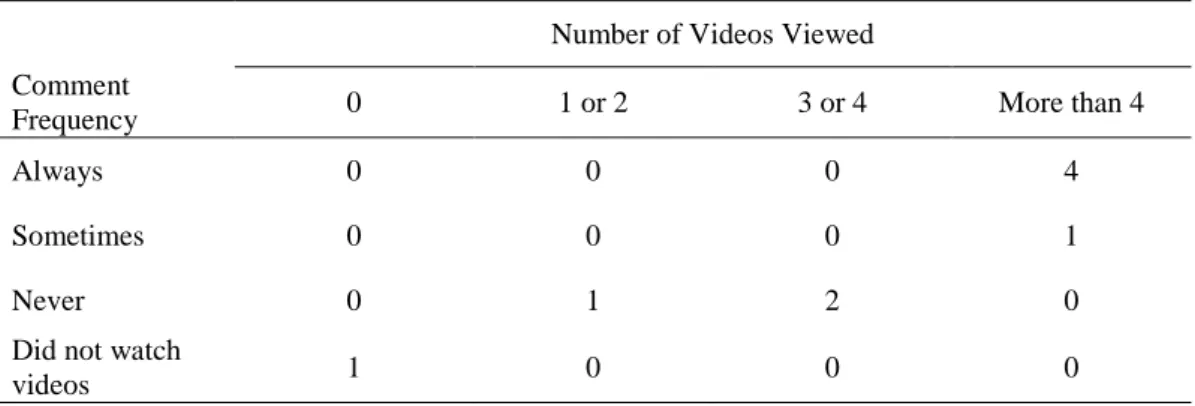
At the conclusion of the study, nine of the participants completed Survey 2. (Note: One participant was sick and therefore unable to complete the survey.) Results can be found in Table 3. As indicated here, by the end of the project, all but one participant had utilized the online video streaming for viewing video of the standards-based classroom. This would seem to indicate that by the end of the project the characteristics of the online video streaming had overcome previously cited obstacles. One interesting aspect revealed itself in this survey, however, and that was the frequency of participants posting comments. Three participants reported that they had watched videos but never commented while one participant posted comments sometimes.
Table 3. Video Viewing by Frequency of Comments Number of Videos Viewed
Comment
Frequency 0 1 or 2 3 or 4 More than 4
Always 0 0 0 4
Sometimes 0 0 0 1
Never 0 1 2 0
Did not watch
videos 1 0 0 0
What level(s) of critical thinking are demonstrated in online video comments?
from Table 2). In this video, the teacher asked the students to represent and solve 2000 – 1 utilizing the base-10 blocks. Prior to this lesson, students had had opportunities to compose and decompose four-digit numbers and had modeled addition and subtraction of four-digit numbers, with and without regrouping. They had not, however, modeled subtraction involving multiple zeros. In the video excerpt, participants had the opportunity to view the introduction of the problem by the teacher, a limited amount of group interaction as students worked the problem, and one group presentation of their strategy for solving the problem. In addition, the group fielded student questions. In total, the video was just over eight minutes long.
Table 4. Sample Video Transcript
Teacher Comment Code(s) Category
Sydney I5 can tell that the students have a true understanding of base-ten
blocks and how they represent numbers. They also understand place value and how to trade cubes for flats, flats for sticks, and sticks for units.
The teacher only poses the question and lets the students use the base-ten blocks to figure out the problem. She is only making sure they have the correct supplies and asked questions to guide them but not give them the answer. The students explain the answer and then evaluate each other with questions. It5 is evident that students must
have a good understanding of place value and how to use base-ten blocks to work addition and subtraction problems.
5,5 High
Julie I6H do have the problem of giving the students too much information
when they are stuck. I can see that you should ask the students more questions to keep them thinking, and chances are they will discover the solution themselves.
6H High
Paige These5 students have a great understanding of base ten blocks and how
to trade. With very little prodding, they were able to show understanding of the problem, and gave a good explanation of the problem to classmates. How4 much time is spent practicing with base
ten blocks before doing this type of problem?
5,4 High
Shannon The5 group really had a great understanding of place value and were
able to explain their answers to the other students when asked "How did you use the flats and units?" I3 agree with [Julie] and need6H to ask
more questions to have8 students think more about the problem and
solution, rather than just giving them more information. In this video, [The teacher] let the students do the "teaching", only prodding them with questions and having the students figure out the solution and explaining their reasons for their answer.
5, 3, 6H, 8 High
Jessica I saw an opportunity for the students to share what they were doing with the teacher while they were working. This8 is a way for more
students to share with the teacher, especially since only one group shared with the class. [The teacher] kept the students moving along with the activity without interrupting their thought process. She also encouraged the students to keep trying when they faltered. I6H am
unsure when to step in or not. I want to give the students the time they need to explore and I am afraid that I might interrupt their process.
8, 6H High
base-ten blocks and place value. Other statements such as, “The teacher only poses the question and lets the students use the base-ten blocks to figure out the problem,” were descriptive of the video and therefore not coded. By reflecting on students’ mathematical understandings and providing support for this reflection, Sydney’s comment fell in the integration category of the practical inquiry model. Therefore, the comment was classified as high.
The second participant to comment on the video was Julie. In her comment, Julie identified an issue within her own instructional practices that resulted from watching the video. In addition, she described how the instructional practice should be corrected and what the impact would be. In doing so, this comment was coded with “6H – Self Reflection – Thinking about changes she needs to make to her own practices.” By proposing changes to be made in her own practice, Julie’s comment may be classified as being in the resolution phase of the practical inquiry model. Therefore the comment was classified as high.
Paige was the third participant to view and comment on the video. Like Sydney, Paige stated that the students understood the base-ten blocks and how to trade. She justified this statement noting that the students worked with little prodding and that they provided good explanations. This statement was therefore coded with “5 – Reflecting on students’ mathematical thinking/processes.” Paige also asked a question about the students’ work with base-ten blocks that occurred prior to the video. This question was coded with “4 – Question for Instructor” which fell in the triggering phase of the practical inquiry model. Although this aspect of the comment was at the low level in terms of critical thinking, the entire comment was categorized as being at the high level based on the initial part of the comment.
Shannon provided the next comment on the video. Her response contained elements of not only codes 5 and 6H but also 3 and 8. By agreeing with Julie, Shannon referenced something another teacher said which is categorized as integration according to the practical inquiry model. In addition, she provided justification for the teacher’s actions in the video which is also at the integration level. This comment was categorized as high in terms of critical thinking.
Finally, Jessica’s comment also provided justification for the teacher’s action, thus receiving a code of 8. In addition, she reflected on uncertainties within her own instructional practices, which received a code of 6H. As before, both of these indicated high levels of critical thinking and thus the comment was categorized as high. Across all video transcripts, the participants posted a total of 43 comments. Of these comments, the researchers categorized 38 comments (88%) as representing a high level of critical thinking.
The researchers categorized two of the online comments (5%) as representing a low level of critical thinking. The first of these responses follows
I6L have used stories to introduce a math concept. I found your idea to use a visual of the story useful. I
would have the class discuss the math concepts within the story, but did not have a visual ready to use also.
This participant has identified a teacher action that she believes to be useful, but without providing a justification as to why this action is useful. The comment received the code “6L – Self Reflection – Identifying her own teaching practices in the video.” Without providing justification, this code falls in the exploration phase of the practical inquiry model, which is considered low in terms of critical thinking.
The other statement categorized as low level in terms of critical thinking came from Julie who described the video and then posed a question.
I did have problems hearing some of the children's comments. I kept hoping to hear one of them use the expression "groups of", and [the student] came through with flying colors with his comments. Have4
the students been taught the commutative property of multiplication, yet, or is this leading into it? Julie’s description of the video received no code. Her question that was directed toward the teacher in the video was coded with 4, representing a low level of critical thinking.
Does viewing instruction via online video streaming support change in teachers’ beliefs about teaching and learning mathematics?
To answer this question, researchers examined the results of the pre- and post-administrations of the IMAP Web-based Beliefs Survey. Table 5 provides the percentages of each score for each of the beliefs statements.
Table 5. Results of the IMAP Web-based Beliefs Survey Belief Scores*
0 1 2 3 4
Belief 1 – Mathematics is a web of interrelated concepts and procedures (and school mathematics should be too).
Pre 78% 0% 11% 11% ---
Post 22% 67% 11% 0% ---
Belief 2 – One’s knowledge of how to apply mathematical procedures does not necessarily go with understanding of the underlying concepts.
Pre 67% 11% 22% 0% 0%
Post 33% 33% 0% 22% 11%
Belief 3 – Understanding mathematical concepts is more powerful and more generative than remembering mathematical procedures.
Pre 0% 33% 22% 44% ---
Post 0% 56% 0% 44% ---
Belief 4 – If students learn mathematical concepts before they learn procedures, they are more likely to understand the procedures when they learn them. If they learn the procedures first, they are less likely ever to learn the concepts.
Pre 22% 11% 44% 22% ---
Post 0% 0% 33% 67% ---
Belief 5 – Children can solve problems in novel ways before being taught how to solve such problems. Children in primary grades generally understand more mathematics and have more flexible solution strategies than adults expect.
Pre 44% 22% 33% 0% 0%
Post 22% 11% 11% 44% 11%
Belief 6 – The ways children think about mathematics are generally different from the ways adults would expect them to think about mathematics. For example, real-world contexts support children’s initial thinking whereas symbols do not.
Pre 44% 11% 44% 0% 0%
Post 22% 44% 22% 11% 0%
Belief 7 – During interactions related to the learning of mathematics, the teacher should allow the children to do as much of the thinking as possible.
Pre 44% 56% 0% 0% ---
Post 33% 0% 44% 22% ---
* 0 = No evidence of holding belief, 1 = weak evidence of holding belief, 2 = evidence of holding belief, 3 =
Scores of 0 and 1 indicate that the participant either failed to provide evidence or provided weak evidence, respectively, of holding the designated belief. A score of 2 indicates that the participant provided evidence of holding the belief. For some beliefs, the highest score possible is a 3, indicating that the participant provided strong evidence of holding the belief. For other beliefs, the highest possible score is a 4. In this case, a 3 indicates that the participant provided strong evidence of holding the belief in some instances whereas a 4 indicates that the participant provided consistently strong evidence of holding the belief. It should be noted that a score of 0 does not necessarily mean that the participant does not hold the belief. Rather, it means that the participant failed to provide evidence of holding the belief within the contexts presented on the survey.
A review of Table 5 reveals that with the exception of Belief 3, participants provided stronger beliefs in each of the statement on the post-survey as compared to the pre-survey. These shifts in belief scores are particularly noteworthy for Beliefs 4, 5, and 7.
Limitations
Before discussing the results, the limitations of the study should be described. First, due to the qualitative nature of this research study there is the potential for researcher bias. The researchers have worked, however, to eliminate this bias by conducting analyses independently followed by discussion to move toward agreement. In addition, credibility of the findings is offered through the use of the practical inquiry model (Garrison et al., 2004), a model that has been used in similar settings for similar purposes and has with it descriptors of its phases. Furthermore, analyzing the open-ended responses from the IMAP Web-based beliefs survey with its detailed rubrics results in high inter-rater reliability, thus reducing the potential of bias.
Recognizing that qualitative research is not designed to produce generalizable results, the researchers have sought to strengthen the transferability of the results by providing thick descriptions of the procedures and analyses associated with the work.
Discussion and Conclusion
To support teachers in establishing standards-based classrooms, teacher educators have identified videos as a mechanism for helping teachers observe standards-based instruction (LeFevre, 2002; Seago & Mumme, 2002). In using videos, availability of classroom footage as well as time and opportunity for viewing the videos become barriers that must be addressed. This study examined the potential that online streaming video might hold in addressing these barriers as well as the support it provided for engaging teachers in critically thinking about instruction and the resulting impact on teachers’ beliefs about instruction.
The convenience factor of the technology used to disseminate the videos proved to be the primary characteristic that enabled teachers to view the video of standards-based mathematics instruction. This feature allowed them to view and comment at their own pace and on their own schedule, as there were no penalties for late or missing comments. For those who wanted to better themselves as teachers through observation, the technology eliminated many of the barriers facing them. This desire for growth could be seen in their survey comments. When asked for their main reason for their participation, one wrote, “I am participating to learn more about the standards and the problem-solving approach to teaching so I can be a better teacher.” Yet another demonstrated an attitude desirable in all educators: “I consider myself a lifelong learner and view this as a chance to learn more.” One of the five did mention the CEU’s as a main reason for their participation but also listed the gain of additional methods of mathematical instruction. These participants each demonstrated an earnest desire to grow as professionals and have not allowed time to be a constraint on that desire.
At the midpoint of the study, half of the participants had not utilized the technology for viewing videos. These participants cited time as the barrier, although this time factor was linked either to participation in the project as not being a priority or personal technology issues that prevented them from viewing the videos away from school. Interestingly, time was the most common theme in the writings of those that had utilized the technology for viewing videos and those that had chosen not to do so. This midpoint data seemed to indicate that the desire to participate may be the biggest motivation and constraint for both viewers and non-viewers, respectively. It also pointed to the need to provide teachers with information regarding avenues for accessing the internet outside of school as well as technological support for the teacher at his or her home.
online video streaming technology had overcome the issues of time and opportunity. As such, online video streaming may be considered a viable option for engaging teachers in observations of standards-based elementary mathematics lessons. One must next consider the level of critical thinking exhibited in this online setting.
When considering the levels of critical thinking demonstrated by participants’ online video comments, it appears that online streaming video engages teachers in critically thinking about standards-based instruction. It is worth noting, however, that the interpretation of these results is limited by the failure of some participants to post comments after viewing video. The researchers can only hypothesize as to why participants did not post comments. Possible reasons might include lack of familiarity with the online posting process, insecurity related to having others read their comments, or even a lack of critical thinking regarding the video. Had all participants been required to post, similar results regarding the high levels of critical thinking might not have been obtained. Yet, for those teachers who appear to be motivated to think about practice, online video streaming may be a viable avenue for critically thinking about instructional practices. These results seem to support the results of Borko et al. (2008) who found that video was an effective means for facilitating teacher reflection on practice. Given the high level of critical thinking demonstrated in the online setting, the strong impact of the learning experience on participants’ beliefs about mathematics instruction seemed to be a natural outgrowth of the experience. The strongest impact was seen for Beliefs 4, 5, and 7 which focus on developing conceptual understanding before procedural skills, allowing students to solve problems without being told how to do so beforehand, and allowing children to do as much of the thinking as possible, respectively. Given the emphasis in the selected videos on problem solving, student communication, and student representation of ideas (see Table 3), it seems logical that these changes in beliefs were supported by the opportunity to critically think about the instruction featured in this online setting.
Recommendations
In reflecting over the results of this study, the researchers provide the following directions for future research. First, the study should be replicated utilizing a larger sample. When working with this larger sample, technology support should be provided for teachers in the form of at-home technology support as well as awareness of technology availability outside of the home (e.g., public libraries). By addressing these technology issues with a larger sample, generalizable results may be obtained. In addition, future work should examine the reasons behind teachers’ failure to post online comments after viewing the videos. Of particular interest is whether or not this lack of posting is an indicator of a lack of critical thinking about the content of the videos. Finally, although this study examined the impact of the work on participants’ beliefs, future studies should take this a step further by following the participants into their classrooms to document impact on instruction. Should this future work confirm the findings of this study, the researchers suggest that online video streaming should become a part of professional development programs aimed at engaging teachers in critically thinking about instructional practices in the mathematics classroom.
References
Ambrose, R., Clement, L., Philipp, R. A., & Chauvot, J. (2004). Assessing prospective elementary school teachers’ beliefs about mathematics and mathematics learning: Rationale and development of a constructed-response-format beliefs survey. School Science and Mathematics, 104, 56-70.
Arnold, N., & Ducate, L. (2006). Future foreign language teachers’ social and cognitive collaboration in an online environment. Language Learning & Technology, 10(1), 42 – 66.
Bai, H. (2009). Facilitating students’ critical thinking in online discussions: An instructor’s experience. Journal of Interactive Online Learning, 8, 156 – 164.
Balfanz, R., Mac Iver, D. J., & Byrnes, V. (2006). The implementation and impact of evidence-based mathematics reforms in high-poverty middle schools: A multi-site, multi-year study. Journal for Research in Mathematics Education, 37, 33 – 64.
Borasi, R., & Fonzi, J. (2002). Professional development that supports school mathematics reform. Foundations series of monographs for professionals in science, mathematics and technology education. Arlington, VA: National Science Foundation.
Borko, H., Jacobs, J., Eiteljorg, E., & Pittman, M. E. (2008). Video as a tool for fostering productive classroom discussions in mathematics professional development. Teaching & Teacher Education, 24, 417-436. Brophy, J. (2004). Using video in teacher education. San Diego, CA: Elsevier.
(Eds.), Who learns what from cases and how?: The research base for teaching and learning with cases.
Mahwah, NJ: Lawrence Erlbaum Associates.
Charmaz, K. (2002). Qualitative interviewing and grounded theory analysis. In J.F.Gubrium & J.A. Holstein (Eds.). Handbook of interview research: context and method, 675-693. Thousand Oaks: Sage.
Common Core State Standards Initiative (CCSSI) (2010). Common core state standards for mathematics. Common core state standards (College- and career-readiness standards and K–12 standards in English language arts and math). Washington, D.C.: National Governors Association Center for Best Practices and the Council of Chief State School Officers. Available at http://www.corestandards.org.
Ernest, P. (1988). The impact of beliefs on the teaching of mathematics. In P. Ernest (Ed.), Mathematics teaching: The state of the art (pp. 249-254). London, England: Falmer Press.
Fahy, P. J. (2005). Two methods for assessing critical thinking in computer-mediated communications (CMC) transcripts. International Journal of Instructional Technology and Distance Learning, 2(3), 13 – 28. Franke, M. F., Kazemi, E., Battey, D. (2007). Understanding teaching and classroom practice in mathematics. In
F. K. Lester, Jr. (Ed.), Second handbook of research on mathematics teaching and learning (pp. 225-256). Charlotte, NC: Information Age Publishing.
Garrison, D. R., Anderson, T., & Archer, W. (2004). Critical thinking, cognitive presence, and computer conferencing in distance education. The American Journal of Distance Education, 15, 7 - 23.
Heck, D. J., Banilower, E. R., Weiss, I. R. & Rosenberg, S. L. (2008). Studying the effects of professional development: The case of the NSF's local systemic change through teacher enhancement initiative.
Journal for Research in Mathematics Education, 39,113 – 152.
Kazemi, E., Lenges, A., & Stimpson, V. (2008). Adapting cases from a Developing Mathematical Ideas seminar to examine the work of teaching closely. In M. S. Smith & S. N. Friel (Eds.), Cases in mathematics teacher education: Tools for developing knowledge needed for teaching (pp. 21-34). San Diego, CA: Association of Mathematics Teacher Educators.
LeFevre, D. M. (2002, April). Video records of practice as a tool for learning practice: What is to be learned?
Paper presented at the annual meeting of the American Educational Research Association, New Orleans, LA.
Lundeberg, M. A., Levin, B. B., & Harrington, H. L. (1999). Who learns from cases and how? The research base for teaching and learning with cases. Mahwah, NJ: Lawrence Erlbaum Associates.
Merseth, K. K. (1996). Cases and case methods in teacher education. In J. Sikula, T. J. Buttery, & E. Guyton (Eds.), Handbook of research on teacher education (pp. 722–744). New York: Macmillan Library Reference.
Morris, K. A. (2008). What would you do next if this were your class? Using cases to engage preservice teachers in their new role. In M. S. Smith & S. N. Friel (Eds.), Cases in mathematics teacher education: Tools for
developing knowledge needed for teaching (pp. 9-20). San Diego, CA: Association of Mathematics Teacher Educators.
National Council of Teachers of Mathematics. (2000). Principles and standards for school mathematics. Reston, VA: Author.
Raths, J. (2001). Teachers’ beliefs and teaching beliefs. Early Childhood Research & Practice, 3(1). Available at: http://ecrp.uiuc.edu/v3n1/raths.html.
Seago, N., & Mumme, J. (2002, April). The promises and challenges of using video as a tool for teacher learning. Paper presented at the annual meeting of the American Educational Research Association, New Orleans, LA.
Sherin, M. G., Linsenmeier, K. A., van Es, E. A. (2009). Selecting video clips to promote mathematics teachers’ discussion of student thinking. Journal of Teacher Education, 60, 213–230.
Smith, M. S. (2001). Practice-based professional development for teachers of mathematics. Reston, VA: National Council of Teachers of Mathematics.
Sowder, J. T. (2007). The mathematical education and development of teachers. In F. K. Lester, Jr. (Ed.),
Second handbook of research on mathematics teaching and learning (pp. 157-224). Charlotte, NC: Information Age Publishing.
Strauss, A. & Corbin, J. (1990). Basics of qualitative research: grounded theory procedures and techniques. Newbury Park, CA: Sage.
Stuart, C. & Thurlow, D. (2000). Making it their own: Preservice teachers’ experiences, beliefs, and classroom practices. Journal of Teacher Education, 51, 113–121.
Wang, J., & Hartley, K. (2003). Video technology as a support for teacher education reform. Journal of Technology and Teacher Education, 11(1), 105–138.
van Es, E. A., & Sherin, M. G. (2008). Mathematics teachers' "learning to notice" in the context of a video club. Teaching & Teacher Education, 24, 244-276.
Appendix A
Section 1
Your role at OE: 2nd Grade Teacher 3rd Grade Teacher Administration/Other
Age Range: 20-25 36-40 51-55
26-30 41-45 56-60
31-35 46-50 61+
Highest Degree Earned: Bachelors Masters Doctoral
Year Completed:
Years Experience Teaching: 0-5 16-20
(Check One) 6-10 21-25
11-15 25+
Self Evaluation of Math Skills (Check One):
Lower 1 2 3 4 5 Higher
Self Evaluation of Math Teaching Skills (Check One):
Lower 1 2 3 4 5 Higher
Complete the following sentence by checking one of the following options:
I have watched and posted comments on ______ of the videos posted on the website for this study.
0 1 or more
If you checked the box by "0", please skip Section 2 and proceed to Section 3 on the back of this survey.
If you checked "1 or more", please proceed to Section 2 on the back of this survey. You do not need to complete Section 3
All information given on this survey is given on an anonymous basis. No personal information will be
shared with the Oxford Elementary staff or any other parties. Any papers or reports generated from
this survey will have any identifiable information removed.
Participation is optional but thoughtful, honest answers would be very much appreciated.
Section 2
Is this your first exposure to a standards-based classroom? Yes No
What are the main reasons for your participation in the observations and reflections?
How have posting and reading other's comments affected your thoughts on the videos?
How has watching the video(s) influenced your teaching methods?
Has the use of this technology allowed you to participate more than you might have without it?
Yes No
If yes, what in particular has made it more accessible to you?
Section 3
Have you ever observed a standards-based classroom? Yes No
What are the main reasons that you have opted not to participate in the observations/reflections?
If these obstacles were removed, how would your participation change?
Are you generally comfortable using technology like that being used in these excercises?
Yes No
255
IJEMST (International Journal of Education in Mathematics, Science and Technology)
What are the main reasons for your participation in the observations and reflections?
How have posting and reading other's comments affected your thoughts on the videos?
How has watching the video(s) influenced your teaching methods?
Has the use of this technology allowed you to participate more than you might have without it?
Yes No
If yes, what in particular has made it more accessible to you?
Section 3
Have you ever observed a standards-based classroom? Yes No
What are the main reasons that you have opted not to participate in the observations/reflections?
If these obstacles were removed, how would your participation change?
Are you generally comfortable using technology like that being used in these excercises?
Appendix B
Last 4 digits of your Social Security Number _______________ Date ______________ How many videos did you watch via the online program Voicethread? (Check one)
___0 videos ___1 or 2 videos ___3 or 4 videos ___More than 4 videos Did you post comments when you watched the videos? (Check one)
Appendix C
Did the online technology aspect of this project assist your participation? In what way? What was your process for watching the videos?
How were information and ideas that you gained from the videos used in your classroom? When you watched the videos, what were you looking for, specifically?
What was your primary motivation for participating in this research project? How has your participation influenced your teaching?
Without mentioning names, why do you think the participation rate was low among the teachers? What would you have like to have gotten out of this experience but didn’t?
If this project were to continue, would you to participate? Why or why not? Would you be interested in having your own lessons videotaped?
Appendix D Coding Descriptors
1. Adapting an idea (High)
Indicating a plan to use something from the lesson in her own classroom
Indicating that she has already done something from the lesson in her classroom
2. Complementing the lesson (Low)
Indicating that she “liked” something about the lesson
3. Comment to other teacher (High)
Referencing something another teacher said
There is a clear indication that the response is linked to something another teacher has said.
4. Question for Instructor (Low)
A question is posed directly to the instructor in the video.
The question may be about the lesson itself or the students in the video.
5. Reflecting on students’ mathematical thinking/processes (High)
Using the context of the video as a means for thinking about their own students
Commenting on the students’ thought processes but providing more than a general “they understand it” sort of statement
6. Self-reflection
Identifying her own teaching practices in the video (Low)
Thinking about changes she needs to make to her own practices (High)
7. Suggestions (High)
Offering a suggestion as to how to improve the lesson or pedagogy or to address the students’ misunderstandings (Integration – High)
8. Justifications (High)
Providing support for the actions in the video