Towards an integrated learning environment for mathematics
Christian Bokhove1, Gerard Koolstra1, Peter Boon2, and André Heck31
St. Michaël College, Zaandam, the Netherlands {cbokhove,gkoolstra}@stmichaelcollege.nl 2
Utrecht University, Freudenthal Institute, [email protected] 3
University of Amsterdam, Amstel Institute, [email protected]
In recent years the mathematical community has been enriched with various computer programs that facilitate and improve the learning of mathematics. Although many practical and didactical problems still exist, computer aided learning has become a valuable addition to education. How-ever, these successes also lead to high expectations of teachers and learners. For a teacher it would be nice if he or she could review after a computer aided lesson what the students actually did, what progress they made, which problems arose during learning and to which mathematical subjects attention must be paid in the next lessons. A teacher also wants to reuse ICT-components and to exchange learning materials with colleagues without many conversion problems. Learners expect that they can consult their earlier work and intelligent feedback on this work.
In this paper we will present the work realized in the GALOIS Project. This project aimed to realize an integrated learning environment for mathematics at secondary school level in which
• students can practice mathematics anytime and anywhere;
• mathematical assignments can be generated ‘at random’, so that the amount of exercise material becomes nearly infinitely large;
• activities and answers of students are stored;
• intelligent feedback on students’ work is given automatically.
These goals have been reached by using open source technologies and open standards. Existing technologies have been translated and extended into concepts that work in the practice of school mathematics. We have developed ICT-rich learning materials, such as SCORM compliant exercise material that can be used in any virtual learning environment (VLE) and applets for learning alge-bra that can be customized by the teacher, and we have tried them out in classroom. We will discuss our development work and our experiences.
ICT tools that help to develop mathematical understanding and mathematical skills
In recent years the mathematical community has been enriched with various computer programs that facilitate and improve the learning of mathematics. New programs include digital chapters for existing schoolbooks, many Java applets, dynamic software for geometry and statistics, and many more. Some software is incorporated into a full curriculum. Although many practical and didactical problems still exist, computer aided learning seems to be a valuable addition to mathematics education. In the GALOIS project we paid a lot of attention to the use of
• the ‘Digitale Wiskunde Oefenomgeving’, DWO [Digital Mathematical Exercise Environment], developed at the Freudenthal Institute;
• mathematical Java applets developed at the Freudenthal Institute, called WisWeb applets [1];
• the custom-made JavaScript-based testing and assignment environment DITwis [2];
• an existing VLE, in our case the open source system Moodle [3], in which our ICT tools were fully integrated.
In this section we will only briefly discuss the WisWeb-applets; DITwis will be exemplified in the section where we discuss the role of intelligent feedback. In this paper we will not pay attention to the DWO, but we refer the interested reader to [4].
given to the students, their work is checked and feedback is provided. Figure 1 illustrates the ‘Area Algebra’ applet, in which a geometric model is used to verify equivalence of algebraic expressions. The task is mainly to find the correct expressions for areas and edges of rectangles. Feedback in this applet is direct: green marks and red crosses indicate which part of the answer is correct and incor-rect, respectively. Red, orange and green circles around the assignment numbers indicate wrong, incomplete and correct answers. This stimulates the students to go on and try another exercise, and to get as many correct answers as possible. In the GALOIS project we mainly focussed on the use of exercise applets; at the project website www.galoisproject.nl you can play with some of them.
Fig. 1. ‘Area Algebra’ applet with immediate feedback
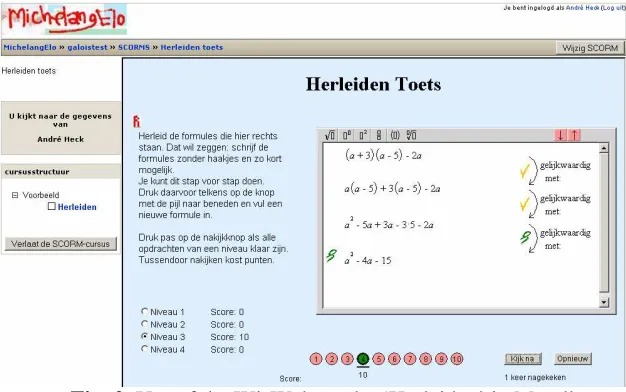
[image:2.612.197.416.178.331.2]Another exercise applet, embedded in a VLE, is shown below in Figure 2. This applet presents a mathematical expression that is to be simplified step by step. In the version shown, a student has to do the calculation himself at each step and the program only verifies whether intermediate expressions are still equivalent and gives the user immediate feedback. In another version, the computer could perform the calculation at each step, thus allowing the student to concentrate on the solution strategy. In the first version, a gaming feature could be added by letting students earn points for entering correct intermediate results. Using help or letting the computer perform an intermediate step would cost points. The idea is that changing a set of mathematical exercises into a game with various levels motivates students to work hard.
Fig. 2. Use of the WisWeb-applet ‘Herleiden’ in Moodle.
[image:2.612.149.462.472.668.2]applets [6]: “It was found that the use of applets has add-on value: they are fun and motivate students; they allow students to work at their own level of thinking and thus better address individual difference between students; the visual, interactive and dynamic features of applets makes the mathematics more easy to understand; thanks to the calculation power of the applets one can focus on the mathematical concepts and models; students are more creative and get more self esteem; the applets form a model students can fall back on; the practice and feedback features are much more powerful than pencil-and-paper exercises. However, to take fully advantage of these opportunities of applets, applets should be integrated in the daily mathematics class routine. Using the computer should not be a voluntary thing that is extra beyond regular math class’.”
Integration of mathematical applets in a VLE
The last finding listed in the previous section, which means in fact a change in the ‘didactic contract’, played an important role in the GALOIS project. The successes with mathematical applets and other ICT tools lead to high expectations of students and teachers. For a teacher it would be nice if he or she could review after a computer aided lesson what the students actually did, what progress they made, which problems arose during learning and to which mathematical subjects attention must be paid in the next lessons. Also, if assignments were given outside of class, this mechanism of ‘student tracking’ would aid a teacher in determining student ability. An even more basic advantage would be the possibility of seeing whether a student has actually done his or her homework. This added bonus is often overlooked.
All this would enable teachers to use their actual ‘contact time’ more efficiently. On the other hand, students also benefit from monitoring student performance: a digital archive of computer based activities gives these activities a firm place in the curriculum and improves the learning process while it enables students to review mistakes made and stores feedback. This systematic approach within one learning environment enhances the already positive effects of direct, instantaneous feedback.
Many Virtual Learning Environments (VLE) store student work, and it seems that the use of VLE’s in secondary education in the Netherlands is on the rise. Nonetheless, with these environments, schools still have to add their own educational tools and lecture notes. Reuse of ICT-components and exchange of learning materials with colleagues without conversion problems promotes this. One could even argue that a VLE only deserves its name when one can actually learn within the system, which implies that an integrated learning environment actually has content. A logical next step in creating an integrated learning environment for mathematics is to see whether mathematics programs can communicate with standard VLE’s to store user feedback and aid sharing of content.
There are a couple of requirements when aiming to integrate applets into an existing learning environment:
• An applet and the VLE have to be able to communicate with each other.
• It should be possible to share the content in various VLEs, for it could very well be that existing programs and learning environments change over the years.
• It should be possible to use this mechanism for other applets or programs.
One of the applets we made SCORM compliant is the applet called ‘Herleiden’, shown in Fig-ure 2. This applet was actually used in a fourth grade class to practise rewriting of given expressions and to reinforce symbol sense. Examples of given assignments concern expanding and rewriting expressions like (a b b c+ )( + −) 2ac and 2 2
(2x+y) −(2x−y) . Many students had problems with this type of assignments, despite the attention given to formula manipulation in the years before and the suc-cesses at that time. A common mistake in teaching and learning: not only does one have to teach a certain mathematical skill or ability, it also has to be maintained. Practice makes perfect, but in this case it would be helpful if students can practise a lot without giving the teacher an unnecessary extra workload. A web-based exercise program makes this possible. In our school situation, stu-dents could practise rewriting formulas during computer workshops at school as well as at home. Student scores and results were stored in the system, which enabled the teacher to see whether stu-dents have a good command of this skill. Within MichelangElo, the name St. Michaël College in Zaandam gave to their incarnation of Moodle, it is also possible to export results to text and excel format. With slight modifications they can even be imported into existing school administration systems. When giving assignments, there naturally are students who do not do their homework. Low scores easily reveal this. Moodle’s internal messenger can be used to address these students. Problems are also discovered easily, especially because ‘the road to an answer’ is also stored in the VLE. For example, some students still made the common mistake to rewrite 2
(2a+b) as 2 2
4a +b . This
misconception was addressed in the next lesson by using the area model to explain why this equivalence doesn’t hold.
We noticed in practice that students at all age levels were highly motivated by this novel way of practising an otherwise difficult and boring subject. The short-term effect of using the applets in the VLE was that students seemed to get a better understanding of the structure of formulas and that the teachers could monitor student performances and address common mistakes more easily. All this happened within a VLE that was already in use at our school and that both teachers and students were familiar with.
It would be even better if an applet could be configured within the learning environment in such a way that custom assignments can be made. This possibility has been successfully explored in the last phase of the GALOIS project in 2007.
Intelligent Feedback with DITwis
Question. With a certain product there is a chance of 25% that it doesn’t function. A random sample
of 12 products is drawn. Calculate the probability that exactly 4 products do not function. Round your answer to five decimal places.
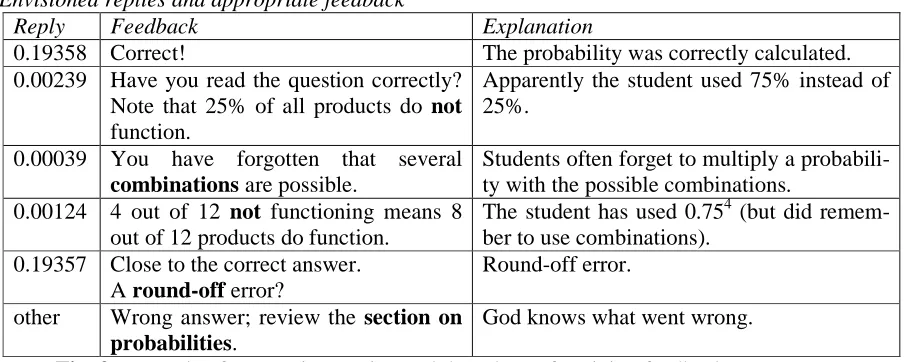
Envisioned replies and appropriate feedback
Reply Feedback Explanation
0.19358 Correct! The probability was correctly calculated. 0.00239 Have you read the question correctly?
Note that 25% of all products do not function.
Apparently the student used 75% instead of 25%.
0.00039 You have forgotten that several
combinations are possible.
Students often forget to multiply a probabili-ty with the possible combinations.
0.00124 4 out of 12 not functioning means 8 out of 12 products do function.
The student has used 0.754 (but did remem-ber to use combinations).
0.19357 Close to the correct answer. A round-off error?
Round-off error.
other Wrong answer; review the section on
probabilities.
[image:4.612.80.541.522.703.2]God knows what went wrong.
In the GALOIS project we also made use of a custom-made JavaScript-based testing and assign-ment environassign-ment [2]. This system responds to student answers by providing a (limited) form of intelligent feedback; Figure 3 shows a typical example. The numbers used in the question text are randomly chosen and this is taken into account in the marking and the feedback. At first, DITwis was developed as an independent means to practice and test certain concepts without teacher’s in-tervention. However, we wanted to know whether integration of DITwis into a VLE would be beneficial. Again we made this program SCORM compliant and we used the system in a third grade and a fourth grade class. The advantages of integration soon became apparent, as well as (hopefully temporarily) some disadvantages: better insight in student work and problems that students face; technical difficulties sometimes resulting in information not being stored; the possibility of practising anytime, anywhere; the added bonus in the communication facilities of a standard VLE.
Conclusion
Existing mathematical tools become even more powerful and useful when results and performance of students can be tracked online in a virtual learning environment with which teachers and students are familiar. Use of a common standard, in this case SCORM, enables the sharing of content, but also of storing student performance. Students know that they can be and are monitored by their teacher. Together with other features in virtual learning environments, especially for communi-cation, students are stimulated to do their homework, or even more than that. Students do not seem to mind this ‘big brother is watching you’ concept. On the contrary, they seem to appreciate the fact that a teacher has good insight into common mistakes and can use this knowledge to address certain problems more effectively. They also seem to find that computer practice prepares them better for written exams than making assignments from a book. Computer aided learning is also seen as a more ‘fun’ way of practising otherwise boring subjects. Direct feedback adds to this appreciation as well as the fact that small mistakes can easily be corrected. Giving students hints and enabling a ‘trial and error’ approach makes it possible for students to explore different strategies for solving a given problem. This also poses a danger; this is why applets without these facilities have also been developed.
In our opinion, digital assignments and diagnostic testing add to the motivation and performance of students in mathematics education. By making use of computers, the extra time involved for teachers is acceptable. Contact time can effectively be reorganised because students that need extra attention are signalled earlier. One of the success factors of the use of ICT would be that all teachers in an organization agree on the vision they have on mathematics education. Ideally, less experienced teachers would be supported by experienced teachers and experiences are shared alike to evaluate and improve the use of ICT in the classroom. From technological point of view, SCORM contributes to the realisation of meaningful ICT-rich education.
References
[1]WisWeb-site: www.wisweb.nl
[2]Digitale Interactieve Testen bij WISkunde [Digital Interactive Tests for Mathematics]: http://wiskunde.stmichaelcollege.nl/DITwis/
[3]Modular Object-Oriented Dynamic Learning Environment (Moodle): www.moodle.org
[4]Bokhove, C., Koolstra, G., Heck, A. & Boon, P. (2006). Using SCORM to Monitor Student Performance: Experiences from Secondary School Practice. In LTSN MSOR CAA Series, April
2006. http://mathstore.ac.uk/articles/maths-caa-series/apr2006/
[5]Boon, P.B.J. & Drijvers, P.H.M. (2005). Algebra en applets, leren en onderwijzen [Algebra and applets, learning and teaching], FI/ISOR, www.fi.uu.nl/publicaties/literatuur/6571.pdf
[6]Reeuwijk, M. van (2004). School Algebra Struggle, what about algebra computer games?.
ICME 10 Proceedings, Topic Study Group 9, Copenhague, Denmark, 4-11 July 2004.