City, University of London Institutional Repository
Citation
: Morgan, G., Herman, R. and Woll, B. (2002). The development of complex verb
constructions in British Sign Language. Journal of Child Language, 29(3), pp. 655-675. doi:
10.1017/S0305000902005184
This is the unspecified version of the paper.
This version of the publication may differ from the final published
version.
Permanent repository link:
http://openaccess.city.ac.uk/365/
Link to published version
: http://dx.doi.org/10.1017/S0305000902005184
Copyright and reuse:
City Research Online aims to make research
outputs of City, University of London available to a wider audience.
Copyright and Moral Rights remain with the author(s) and/or copyright
holders. URLs from City Research Online may be freely distributed and
linked to.
City Research Online:
http://openaccess.city.ac.uk/
[email protected]
DOI :.\S Printed in the United Kingdom
The development of complex verb constructions in
British Sign Language*
G A R Y M O R G A N , R O S A L I N D H E R M A N
B E N C I E W O L L
City University,London
(ReceivedMay. RevisedNovember)
This study focuses on the mapping of events onto verb-argument structures in British Sign Language (BSL). The development of complex sentences in BSL is described in a group ofchildren, aged
;–;, using data from comprehension measures and elicited sen-tence production. The findings support two interpretations : firstly, in the mapping of concepts onto language, children acquiring BSL over-generalize the use of argument structure related to perspective shifting ; secondly, these overgeneralizations are predicted by the typological characteristics of the language and modality. Children under age;, in attempting to produce sentences encoded through a perspective shift, begin by breaking down double-verb constructions (AB verbs) into components, producing only the part of the verb phrase which describes the perspective of the patient. There is also a prolonged period of development of non-manual features, with the full structure not seen in its adult form until after;. The errors in the use of AB verbs and the subsequent protracted development of correct usage are explained in terms of the conceptual–linguistic interface.
[*] Aspects of the reported work were presented at a workshop organised by Nini Hoiting and Dan Slobin entitled ‘ Signed languages : developmental and cross-linguistic issues ’ at the VIIIth International Congress for the Study of Child Language, July, Donostia, The Basque Country. We are grateful to the workshop organisers, participants and audience for their comments. We especially thank the children and adults who gave up their time to participate in this study. We are also indebted to Sallie Holmes for collecting the data on the Herman, Holmes and Woll assessment project as well as to Graham Welton for help in coding and transcription of the verb sentences. The authors would like to thank Neil Smith, Isabelle Barrie're, Shula Chiat, Dick Hudson, Judy Kegl, Penny Roy, Dan Slobin and two anonymous reviewers for essential comments on earlier versions of this paper. The subsequent interpretation of these comments is the sole responsibility of the authors. Address for correspondence : Gary Morgan, Dept. of Language & Com-munication Science, City University, London, ECVHB, UK. e-mail : g.morgan!city. ac.uk
The study of signed languages over the pastyears has forced researchers to ask questions concerning the effects of modality on the acquisition process. Theories involving universal stages and strategies have been evaluated by studying children’s development of a language produced and received in a different modality to spoken language (see Meier, for more details). The study of verb-argument structures in children’s sign language development has reinforced the notion of an abstract link between form and representation.
The paper is organized as follows : the first section reviews current work on the mapping between conceptual and linguistic representations in language acquisition. Within this framework we describe aspects of signed languages, which employ spatial grammar, as well as non-manual morphology. Fol-lowing this we provide an overview of previous research on the acquisition of spatial grammar, non-manual morphology and the mapping of verb agree-ment relations through complex verb constructions. This leads to a de-scription of the present study ofchildren aged between;and;and their different performances in comprehension and production tests of simple and complex sentences. In the final section we discuss the de-velopment of abstract patterns for mapping specific conceptual categories onto BSL verb structures.
The mapping problem in language acquisition
A major theme in current language acquisition research centres on the ‘ mapping problem ’ (Pinker, ; Chiat, ). Put simply, how do children learn to map conceptual representations they understand, recognise and think about, onto the specific morphosyntactic devices available in their language ? Different psycholinguistic models have focused on different parts of this mapping. Levelt () and Levelt, Roelofs & Meyer () have concentrated on the retrieval and production of linguistic forms from the conceptualizer to the formulator. Others have focused on the form of the conceptual representation itself as it reaches the linguistic system (Pinker,
; Jackendoff,) and the role of semantic representation in mapping conceptual categories onto linguistic forms (especially argument structures). We focus on the interaction between conceptual categorization, semantic representation and argument structure. The semantic core of a sentence in any language is its verb. Conceptual categories and the verbs which encode them involve participants which carry thematic roles, such as agent, theme, source, goal, patient and experiencer. The verb’s arguments are realized as different constituents.
Children must learn which concepts may be appropriately mapped onto
which verbs and also which arguments are needed and how the arguments are linked with the syntax e.g. ‘ Sue broke the chair ’ and ‘ The chair broke ’. In English much meaning is derived from constituent order. In other languages events and arguments can be coded with the help of word endings and inflections.
Children developing spoken language between ages ; and ; are reported to produce the different argument structures of their language with very few errors (Pinker, ). They do occasionally apply systematic argument structures from the adult language to verbs whose meanings and structures do not fit that pattern e.g. ‘ Daddy go me round ’ (from Bowerman,
). The early correct mapping of concepts onto verb-argument structure has been explained by theories of ‘ bootstrapping ’, where knowledge of semantic or syntactic structure enables the child to break into the relationship between concept and linguistic form (e.g. Gropen, Pinker, Hollander & Goldberg,; Fisher, Hall, Rakowitz & Gleitman,).
Children have to work out the specific way their target language links meaning to form. In () the meaning of ‘ ask ’ contains two thematic roles, the agent and the patient. These thematic roles are mapped onto the syntactic functions. Word order and morphological agreement provide the intended interpretation.
() The girl asks the boy
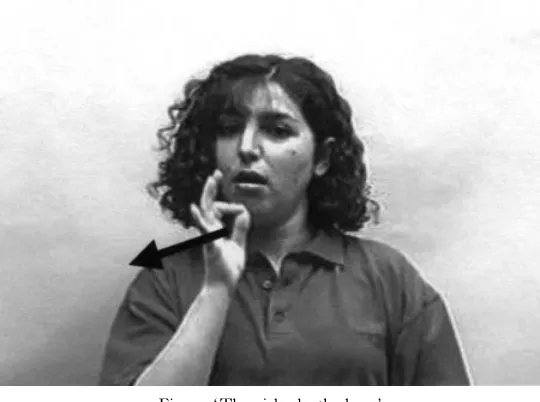
The same meaning in BSL requires a different linguistic mapping. In signed languages, morphological agreement is realised by the movement of the verb stem between locations in front of the signer (sign space) which have been previously indexed as subject (agent) and object (patient). This is shown in an English gloss in (). The movement of the sign between locations in sign space is shown in figure".
() BOYj IXj GIRLk IXk kASKj ‘ The girl asks the boy ’
Alternatively the same meaning can be expressed through a verb with a perspective shift as in (). The signer still uses locations in sign space but now a perspective shift marker (F) carried on the face, head or upper body indicates the verb’s meaning is from the perspective of the subject (agent).
[] Signed sentences that appear in the text follow standard notation conventions. Signs are represented by upper-case English glosses. Repetition of signs is marked by ‘j’. ‘ IX ’ is a pointing sign. Semi circles represent the sign space with the flat edge nearest to the signer’s perspective. Arrows indicate the direction of the agreement verb’s movement. The use of movement is also shown through subscripted indexes on the verb sign. Above the glosses, eye-gaze markers such as closes (66), direction (left\right or neutral space) and gaze towards the addressee ( ) are indicated by a vertical line across the affected segment.
Fig.. ‘ The girl asks the boy. ’
Fig.. ‘ The girl asks the boy. ’
The movement of the sign between the signer and the third person location as well as head turn is shown in figure.
() BOYj IXj GIRLkFkASKj ‘ the girl asks the boy ’
[image:5.612.152.465.78.281.2] [image:5.612.173.443.309.510.2]In () the signer shifts reference to portray the agent’s point of view ; there is no point into sign space (IX) associated with the agent. This option is very frequent in signed discourse (Morgan,,; Janzen, O’Dea & Shaffer,
). As examples ()–() show, the specific forms available in a given language for concept mapping may differ for the same event. BSL uses devices in a spatial grammar, simultaneously combined with linguistic markers carried on the face and head. In mapping intended meaning onto BSL verbs, children must work out how both sets of devices are integrated, in contrast with the sequential ordering of English.
As indicated previously, the use of correct verb-argument structures has been reported in children acquiring spoken languages before;, although there are some structures which take longer to master. For example, the semantic alternation mapped through the passive voice is later to appear in some languages (Harris, ) although only in certain syntactic contexts (Sudhalter & Braine,; Pinker, Lebeaux & Frost,), and not in all languages (e.g. Pye,; Allen,). This suggests acquisition is related to specific cues in the language being acquired. Equally the use of some constructions e.g. the inalienable possessive (‘ he washed himself on the foot ’) is also a late development (e.g. Carpentier,) related to the difficulty of matching concept and linguistic structure.
In BSL there is a special construction in which an agent affects a body-part of a patient. This is realised by means of a polymorphemic verb (termed AB verb here) and two perspective shifts realised by non-manual markers.
Before describing the development of the AB verb in BSL, we review developmental data from children acquiring American Sign Language (ASL), focusing on two main features of signed languages that are involved in the AB verb structure.
BSL and modality specific language forms
BSL and other signed languages exploit two linguistic devices which contrast with all spoken languages. The first is a linguistically organized sign space. The second feature is the use of non-manual morphology to articulate parts of the linguistic message.
Sign space and verb agreement morphology. There are three basic classes of
verbs in BSL depending on what information they carry : plain verbs – which can be modified to show manner, aspect and the class of direct object ; agreement verbs – which can be modified to show manner, aspect, person, number, and class of direct object ; and spatial verbs–which can be modified to show manner, aspect and location (Sutton-Spence & Woll,).
AB verbs come from the class of agreement verbs such as GIVE, ASK or EXPLAIN. These signs can include morphosyntactic information either through movement between indexed locations in sign space or between the signer and shifted reference points in the context of perspective shift (see
examplesandpreviously). Verb agreement morphology in BSL is fairly restricted, being used only with transitive verbs with eventive meanings.
The signer’s own body is normally associated with the agentive role in the event being described (see also Padden,; Kegl,). As a consequence subjects are less overtly marked than objects in BSL sentences. When a participant is physically present, the verb is moved between either the signer’s own body location and the present participant (e.g. ‘ you give me\I give you ’) or between an abstract third person indexed location and the present participant (e.g. ‘rd person gave you\you gaverd person ’).
Research on spoken language acquisition shows children begin using argument structures at the same age that they are producing multi-word utterances. This is also reported in languages where morphology is quite complex (Slobin,; MacWhinney,; Hirsh-Pasek & Golinkoff,). Research (mainly on ASL) has shown that young children acquiring sign languages do not initially have control of inflectional morphology in signed languages ; they use word order before this. Meier (in press) has argued that this is because verb agreement in ASL is not suffixal, syllabic or stressed and therefore the markers of agreement are not discrete affixal language units. This may influence the emergence of verb agreement, although the de-velopmental sequence of language milestones is parallel to spoken languages. In studies of ASL, Meier (), Newport & Meier () have demon-strated that children initially use word order without inflections. Signs in ASL and BSL may appear grammatically uninflected (as in English) in contrast to Spanish and Greek. The first uses of sign inflections to indicate arguments begin with reference to present participants. Meier found that children only begin to use agreement morphology at about ;–; with many verbs remaining uninflected up till ; and for more complex morphology, acquisition continues beyond;. There are examples of child errors resembling those reported for spoken language acquisition, such as errors of omission (uninflected citation forms) of second and third person arguments. Although less common, errors of commission are also reported (Casey, ), such as overgeneralizing agreement to verbs that do not require agreement e.g. EAT, DRINK, SLEEP in ASL. Casey () reports errors of misagreement between the ages of;and ;, where verbs are moved towards the location of their subjects rather than towards the verb’s object argument.
The use of sign space for agreement with non-present participants is a late development, with children showing a prolonged period of acquisition that continues past age;(Loew,; Morgan,,). Loew found that children used agreement verbs but failed to identify their arguments. Within a single discourse, children sometimes allocated more than one referent to a single locus, that is verbs linked to different referents all agreed with the same location in signing space. Although there have been studies of agreement in
discourse, there has been an absence of data in the literature on intra-sentential verb agreement for non-present reference.
These studies show that, as in the acquisition of spoken languages, children developing signed languages begin with a bias towards simple conceptual-linguistic mappings in their first verbs. Single argument structure is acquired before double argument structure. More complex morphology, as in the AB verb structure, takes longer to master, related to conceptual and linguistic complexity. During signed-language development children may over-generalize verb agreement patterns.
Non-manual morphology. The second feature important in complex
sentences in BSL is the use of non-manual morphology. Specific markers serve not only affective functions, as they do in spoken language discourse, but also constitute a part of the grammar of signed languages. Particular constellations of non-manual markers signal structures such as conditional clauses, topics, negation, interrogation, and relative clauses. In certain contexts e.g. negation, the non-manual marker may be the only mor-phological indicator. The markers can occur with a single manual lexical sign or across multi-sign propositions, having phrasal and clausal scope.
Development work has shown that children between the ages of;and
; acquire the manual and non-manual aspects of ASL as separate morphemes. Grammatical non-manual markers appear subsequently as bound morphology. The ‘ hands before faces ’ order is attested across different grammatical contexts (Anderson & Reilly, ). For example, within single sign utterances the use of head shakes to mark negation and upper face markers to mark interrogatives are absent in young children’s negations and questions. Manual signs such as NO, DON’T-WANT or WH-question signs are produced without the accompanying head shake and upper face markers, contrasting with the adult language where both channels are combined. When non-manual morphemes first appear, errors are com-mon.
The development of non-manual morphology continues into the school years (;–;). Anderson & Reilly () compare precedence of manual over non-manual morphology with general acquisition strategies, for example the use by children of lexical items, such as ‘ yesterday ’ or ‘ last night ’ to signal past time, before acquiring the past tense marker ‘ -ed ’ (Brown,). The linear or lexical strategy, therefore appears to be a general strategy not bound to modality. Acquisition of non-manual morphology, as with verb agreement (Meier, in press), progresses in a gradual analytic manner.
To summarize, children developing signed languages need to learn the correct mappings between conceptual categories, semantic representations and linguistic forms (including verb and non-manual morphology). Children must find and exploit generalized patterns in the linking of concept and linguistic form.
With this background we will now describe the specific linguistic structures investigated in the present study : the use of both sign space and non-manual markers in simple and complex sentences.
AB verb constructions
Adult signers use AB verbs to describe events where an action is performed by an individual on a specified body part of another individual. Examples of these events can be translated into English as ‘ the boy taps the girl on the shoulder ’, ‘ the girl combs the boy’s hair ’ or ‘ the boy puts a hat on the snowman’s head ’. Although these examples are syntactically different from each other in English they map onto a single BSL structure. Semantic information is expressed across both the manual and non-manual articulators. The AB verb is an example of a polymorphemic verb form with a verb stem and modifications. The verb stem is modified in order to carry the extra semantic information of the affected patient and specifies the affected body-part.
These -participant events require the signer to locate two referents in sign-space through spatial indexing, but then to articulate the main verb from two shifting perspectives. The first perspective specifies an agent and action e.g. ‘ boy taps ’, ‘ girl combs ’, ‘ boy puts a hat ’ ; the second specifies the action, the experiencer, and the body-part affected e.g. ‘ tap girl’s shoulder ’, ‘ comb boy’s hair ’, ‘ put hat on snowman’s head ’. In () an adult signer describes a picture of a girl hitting a boy in the face.
()
< 66 ;
G I R Lj B OY- P E R S O N - L E F Tk jH I Tk jG E T- FAC E1- H I Tk
‘the girl hit the boy in the face’
The sentence is shown in a video-clip in figure.
In () there are no index points, instead the signer uses a sign meaning ‘ person ’ at the same time as she signs BOY. The person sign is located in the left side of sign space. The signer inflects the verb between the location on the left and her own body to contrast the two referents and so there is no need for index points. The affected body-part can also be specified through a lexical sign such as FACE, HEAD or SHOULDER after the verb sign HIT, POUR-WATER, or TAP. However, adult native BSL signers use an incorporated body part in the verb stem rather than a separate lexical sign. This two-part verb construction has been described previously in other signed languages to encode perspective shifts (e.g. ASL : Bellugi, van Hoek,
GIRL BOY-PERSON-LEFT HIT GET-FACE-HIT
Fig.. AB verb video clip. ‘the girl punched the boy in the face’
Lillo-Martin & O’Grady, ; Kegl, ; Italian Sign Language : Pizzuto, Giuranna & Gambino,; Swedish Sign Language : Ahlgren & Bergman,; Danish Sign Language : Engberg-Pedersen,). For ASL, Bellugiet al. () have described AB verbs as being similar to serial verb constructions, where what is a single clause semantically is expressed syntactically by a sequence of juxtaposed separate verbs, all sharing the same subject or agent but each with its own additional arguments (Muysken & Veenstra, ). However, AB verbs carry both subject and object argu-ments ; the verb is doubled rather than being part of a sequence of separate signs. Kegl () again for ASL, suggests they are akin to passives (see below for more details of this comparison).
Stative verbs in BSL cannot be used with an AB verb structure as in :
() *GIRL F LIKE BOY F GET-LIKED ‘ the girl likes the boy ’.
Non-stative transitive verbs which are not directed towards a specific location on the patient’s body are also ungrammatical if produced as AB verb structures as in ().
() *BOY F LOOK GIRL F GET-LOOKED-AT ‘ the boy looked at the girl ’.
In addition to these restrictions, this class of verbs follows an invariant AB order, with the reversed, BA order, ungrammatical. The AB verb con-struction also has specific features in relation to incorporation of negation, aspect and interrogative markers.
An important part of the structure is the non-manual marker of shifted reference, transcribed as an eye-close (66) and\or a perspective shift (F). The non-manual markers are produced simultaneously with the onset of the perspective shift prior to the verb. In contrast to the normal agreement verb pattern in () and (), signers invariably show the experiencer’s affected
[image:10.612.157.462.75.192.2]body-part on their own bodies, shifting to the perspective of the experiencer of the action. We assume that there is a pre-verbal representation of the event at what Levelt has termed (Levelt,; Levelt
et al.). This is shown in ().
() Concept of performing an action on body-part(s) of another person’s body
In BSL the conceptual category is mapped onto the thematic roles of agent, patient and affected body-part at , as in (). The thematic roles link to the argument structure by encoding a switch in perspective. The ‘ act on ’ and ‘ get acted on ’ are expressed in succession.
() X act on Y (shift in perspective) body-part of Y get acted on by X This semantic representation is mapped onto the argument structure of the AB verb :
() jPAINTk F jGET-FACEl-PAINTEDk verb-part A-perspective-shift-verb-part B
The argument structure encodes three arguments, shown above as agent, patient and affected body part (the body part is subscripted with ‘ l ’). These cannot be mapped through a single verb. In the AB construction the extra argument of the affected body part is mapped onto the B-part of the verb. The non-manual markers encode the perspective shift, with eye-gaze towards either the right or left of the sign space indicating the point of view of the agent or patient. These markers appear across the manual aspects of the utterance.
The use of AB verb constructions involves an exchange of reference locations in sign space and therefore brings a number of specific requirements to processing, production and acquisition, in particular the ability to maintain two perspectives on an event.
Perspective shifting and the active\passive alternation
The active\passive alternation is a grammatical distinction linked to how a verb is combined with its arguments (Bybee, ). Across different languages, passive meaning is mapped onto argument structure through inflections, case marking and\or word order. At the semantic level the choice of active\passive dictates the perspective from which the event is to be viewed. In the active the agent is the proto-typical focus of the semantic representation and exerts a high degree of control, but in the passive construction the agent becomes demoted from this focus position.
Kegl () has analysed passives and also AB verbs in ASL in terms of ‘ control hierarchy ’ shifts. The referent that is co-indexed with the signer’s own body is highest in a focus hierarchy, but when the signer shifts to show the affected body part, this must reflect the patient’s perspective. This leads to a shift in the hierarchy.
Kegl’s suggestion that in ASL there are constructions akin to the English passive voice has been recently revisited (Janzenet al.,). Although we argue that in BSL it is more appropriate to view the AB verb as a shift between two perspectives, rather than an active\passive alternation, part of the AB verb involves a semantic hierarchy shift. The verb specifies an active meaning in the A-part e.g. ‘ he paints her ’. The presence of an agent in this first part of the construction is coded by a transitive verb inflection. In the second part of the construction the agent is still understood to be carrying out the action but with much weaker focus compared with the now promoted patient. The movement of the B-verb is associated with the agent, even though it has been demoted in the control hierarchy, whereas the patient is in a prominent focus position, as the main perspective. The B-part of the verb moves from a location previously associated with the agent. This resembles a passive construction with the added incorporation of the affected body part.
This perspective shift constitutes the conceptual complexity. In the AB verb a split occurs between the signer’s own body acting as patient, and the signer’s moving arm and hand carrying some information about the agent’s actions. The B-part of the verb therefore carries information of all the thematic roles, but without the A-part : the agent’s role is under-specified.
By comparing the passive in ASL with the AB verb we see the underlying similarities in the semantic alternation that takes pace. The semantic hierarchy of mapping the agent on the signer’s own body and the patient at a location in sign space, gets realigned. Mapping of the AB verb requires the signer to use the verb’s movement in two ways in order to describe two perspectives within the same situation. Importantly the agreement relations do not change although the perspective does. Thus the AB verb represents a marked structure compared to the more typical agent perspective.
Children’s use of AB verbs
There are some studies of the development of AB verbs. Attempts by young children to use AB verb constructions in ASL result in interesting mor-phological innovations, similar to those made by children acquiring spoken languages with complex verb morphology. In Bellugiet al. (), children acquiring ASL were asked to describe a picture showing a boy painting a girl’s face. One child ( ;) was reported as signing PAINT-FACE on both sides of her own face to encode the shift between two perspectives.
In previous studies of children acquiring BSL, AB verbs appeared around the same time as in studies of ASL (ages;–;) but with a regular error in the use of this form (Morgan , ). Compared to AB verbs produced by adult BSL signers, children before;produced fragmented utterances where only one part of the AB verb structure was produced.
Looking in more detail at examples taken from Morgan () from a child aged ;in (), only the A-part of the verb pair is produced, without an expressed object or receiver of the action carried on the B-part of the AB verb, so the sentence is incomplete from the adult’s perspective. This child uses an eye-close to mark a perspective shift but there are no other non-manual markers, and eye gaze is maintained towards the addressee. The child has recognised that two instantiations of the verb PAINT are required, but omits the crucial modification on the second verb to encode the perspective shift.
down 66
() PAINT BOYj F PAINTjGIRLk PAINTk ‘ Painting away the boy paints, the girl paints ’
A more common but perhaps surprising error type produced by children under;is shown in () from a child aged;and () from a child aged
;. The children first sign the B-part of the AB verb with direct object agreement but without the A-part of the verb. This use of an inflection onto the signer’s own body without previous mention of an external agent would in adult signing be interpreted as a reflexive i.e. ‘ the boy painted himself ’. The missing non-manual markers do not resolve this confusion.
66 neutral
() GIRLjPAINT-FACEjBOYk PAINT-FACEk ‘ the girl paints her face the boy paints his face ’
66 addressee 66
() THROW-ON-BODYj SOAKING PAINTjj
‘ throws water on herself, soaking wet then paints and paints ’
These two examples reveal that the children, by using the B-part of the construction, are attempting to encode the perspective shift, but have not yet mastered the full linguistic realization of the conceptual structure. In children aged ;–; there were examples of the correct AB verb con-struction where adultlike inflectional morphology was present but non-manual morphology was absent. The children analysed and mastered the full manual component before adding the non-manual perspective shift markers. Only the oldest children correctly combined the non-manual markers with the AB verb. The question remains as to why the youngest children show only the object or patient perspective (B) while omitting the subject
perspective (A). In order to address this question, the present study was devised.
Subjects
Data came fromnative signing children. There weregirls andboys. All the children had parents who were fluent in BSL. Twenty-seven (%) of the children had deaf parents. The other three children had hearing parents who used BSL at home or work. For example one hearing mother was a qualified BSL interpreter and worked in a deaf school. Subjects were split intoage groups made up of ten children each :;–;,;–;and
;–;. The group sizes, age ranges, child and parental hearing status are shown in Table . All children were assessed using subtests from the
.Subjects
Group Group Group
N
Age range ;–; meanl;
;–; meanl;
;–; meanl;
Male\female M\F M\F M\F
Child\family D\D D\D D\D
Hearing status H\D H\D H\D
(D)eaf\(H)earing D\H D\H
Snijders-Oomen Test of Non-Verbal Abilities (Snijders, Tellegen & Laros,
) and found to have non-verbal development within the normal range.
Procedure
Data obtained from a BSL assessment project (Herman, ) were re-analysed. A deaf adult collected all data. The same comprehension and production tasks were undertaken with adult deaf native signers as controls.
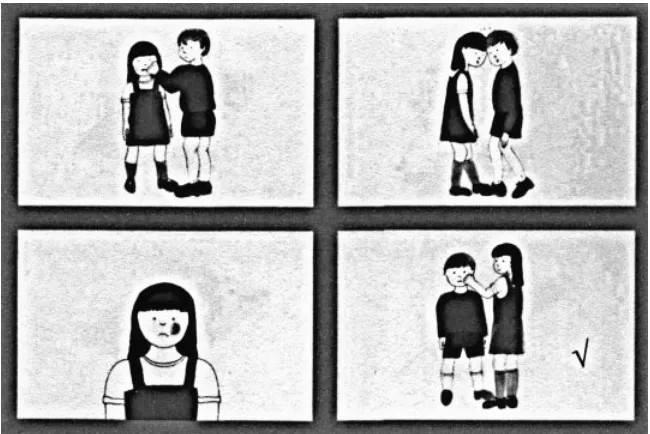
In the sentence-comprehension task each child watched a series of short signed sentences on video and was asked to select the corresponding picture from a choice of four alternatives in front of them, as can be seen in figure; therefore there was a one in four level of chance. Foils included the same event but with a different agent, a related event with a reciprocal, and a stative meaning.
In the sentence production task in the original test, each child was asked to describepictures from the same set as the comprehension test. Here we analyse two of these sentences :
P) shows an adult handing a book to a child
Fig.. Picture stimulus used in sentence comprehension task.
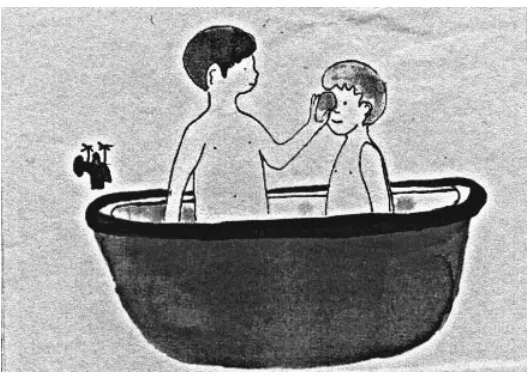
P) depicts two children playing in the bath ; an older boy washes a younger boy’s face.
The first sentence (P) represented a simple transitive verb inflection. This construction was selected for analysis as it was expected that children would master this before the more complex AB verb. The production stimulus for Pis shown in figure.
Subsequent transcription, coding and analysis was undertaken by trained deaf and hearing coders with inter-coder reliability established at over%.
Theadult signer controls all selected the correct target picture from four alternatives. In production they all produced AB verbs with accompanying non-manual markers of perspective shift. The adults all marked the contrast between perspectives by an eye-gaze movement along the horizontal plane (e.g. right to left), and an eye close at the moment of shift. They also combined correct use of the verb agreement morphology with subtle non-manual markers of perspective shift. The child data on the comprehension of the two AB verbs are presented in Table.
The data indicate a clear increase in comprehension of the two sentences with increasing age (χ#ln, dfl,p n). Children as young as; correctly identify the AB verb’s meaning. Because of the alternative choices in the test, the full set of thematic roles has to be extracted from the AB verb’s
[image:15.612.146.471.76.293.2]Fig.. Picture stimulus used in sentence production task.
.AB verb comprehension scores for two sentences
Age group N
Sentence POUR-WATER-ON-HEAD
(%)
Sentence HIT-FACE
(%)
;–;
;–;
;–;
.AB verb correct production scores and patterns of sentence production types
Age group N
Sole A-part (%)
Sole B-part (%)
A-part with separate lexical item (%)
Full AB verb (%)
;–;
;–;
;–;
argument structure to correctly select the target item. When compared with their errorful productions, there is a clear asynchrony, suggesting that there are more demands made on the youngest children in mapping from the conceptual system to the linguistic, than in the other direction. In the P sentence the developmental progression in use of the B and AB forms was
[image:16.612.176.441.73.261.2]found to be highly significant (χ#ln, dfl, p n). Table summarizes the results for the production data.
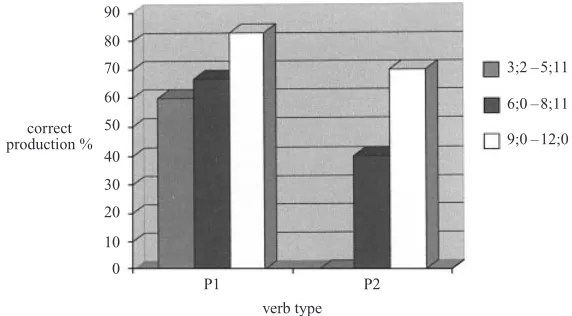
In comparing the success in production of the simple transitive sentence and the AB verb sentence (Pand P), there was a similar developmental trend for both sentences. This is illustrated in figure.
P1 P2
3;2 – 5;11
6;0 – 8;11
9;0 – 12;0
verb type 90
80
70
60
50
40
30
20
10
0 correct production %
Fig.. Comparison of production accuracy on Pand Psentences across groups.
The Psentence was easier to produce, reaching% (\children) correct in group . The simple sentence involves less non-manual mor-phology and is produced from the sole perspective of the agent. The P sentence, which required the AB verb, was more difficult for the children to produce, with none of the youngest children and only% (\children) of the oldest children achieving the adult target. As predicted those children who did not use the simple verb correctly were also unable to produce the AB verb structure.
In the Psentence% (\) of group(ages;–;) used only the B-part of the AB verb. The specific error identified in previous studies was confirmed in this age group. The youngest children not only omit perspective shift markers but also the A-part of the verb. An example is shown in () from a child aged (;) :
neutral () WASH-FACEj ‘ wash his face ’
The one child who did not use only the B-part of the AB verb was the youngest child in the sample (;). He correctly produced the Psentence, but in the Ptask he produced only the A-part of the verb, with the patient and affected body part both under-specified. Although this is an error, the
[image:17.612.164.450.147.305.2]child seems to have created a less developed construction than the slightly older children.
() jWASH ‘ washes ’
In group(ages;–;),% of the children correctly produced the P sentence. The bias towards producing the B-part of the AB verb inflection in the Psentence also appeared, but in a smaller percentage (% (\)) of the children. One child produced the sole A-part of the AB verb. Although
% (\) correctly produced the AB verb inflection there was a marked absence of non-manual markers of perspective shift, as in ().
neutral () jWASHk jGET-FACEl-WASHEDk
‘ he washes him on the face ’
One child who produced the B-part of the AB verb was questioned by the tester (A), who had interpreted the child’s utterance as a reflexive, ‘ he washes himself on the face ’. The child indicated that she definitely did not intend this meaning, but was still unable to modify her response. This coupled with data from the comprehension test suggests that the developmental problem lies not in understanding the event but in getting the complete conceptual-linguistic mapping. The dialogue is repeated in ().
() C : WASH-FACEk ‘ washes his face ’
A : WASH-FACEkSELFk? ‘ washes his own face ? ’ C : NO WASH-FACEkBOYk ‘ no, washes his face the boy ! ’
One of the children attempted to encode the location of the affected body part by mapping out the face location through the A-part of the verb followed by the separate lexical sign FACE, rather than through an incorporated locative. This sequential ordering of thematic roles is successful although un-adult-like and ungrammatical.
() jWASHk FACE ‘ he washes the face ’
In group(ages;–;),% (\) of children correctly produced AB verbs, one child used the A-part of the AB verb, one child produced a lexical locative as in (), and one child (;) used the B-part of the AB verb. All of the children correctly produced the Psentence, although one child (;) when signing the Psentence attempted to apply the AB verb pattern. () MOTHERjFjGIVE-BOOKlCHILDkFjGET-BOOKl-GIVENk
‘ the mother gives the child a book ’
When the AB verb was used, the use of non-manual markers still appeared un-adult-like. Eye-closes to mark the perspective shift were absent in some children’s productions as in () above. In others, the subtle changes in head and eye-gaze orientation observed in adult productions were only partially seen. The gradual acquisition of the AB verb’s manual and non-manual morphology, with one child in the oldest age group still producing the B-part of the verb, is strong evidence for the complexity of the mapping of this structure in BSL.
These results support those of Morgan (, ). The developmental difference in performance on both parts of the experiment indicate that children acquiring BSL first use verbs to describe-participant conceptual representations (e.g. ‘ the mother gives a child a book ’) by inflecting signs to show person agreement within a canonical two-argument verb structure. Other types of conceptual categories require more extensive use of the verb morphology system of BSL. An event where an affected body-part is incorporated into a transitive verb e.g. ‘ the boy paints the girl on the face ’ requires signers to shift perspective between the agent and the experiencer of the action. That is, in BSL, signers map these events across an argument structure that encodes both agent and patient viewpoints. In English this is achieved through the embedding of a prepositional phrase into a verb phrase (‘ on the face ’). In BSL the same event is mapped onto a two-part AB verb structure. The manual part of the construction is combined with information produced on other parts of the signer’s body, especially changes in eye-gaze and upper-body orientation. These non-manual features are essential for full realisation of the perspective shift.
While children as young as ; correctly interpret AB verbs, the ap-propriate AB verb’s argument combinations are a late development in the same children’s production. In the first stage of development there are occasional examples of use of the A-part of the verb. Future research will test children younger than this age group. Following this there is a systematic pattern of argument omission in production. Children attempt to map the three thematic roles contained in the event (agent, patient and affected body part) onto a two-argument verb structure. This strategy allows the core event to be expressed rather than distributing the full event structure across both parts of the verb.
An analysis of these errors in the use of the AB structure before they are fully acquired reveals consistent patterns in children’s approach, attempting to map the semantic agent demotion onto a canonical (but incorrect) -argument transitive verb structure. Some of the children produce a serial ordering of thematic relations, a similar finding to those reported by Meier () and Newport & Meier () for early uses of ASL verb agreement
and also to the findings on the acquisition of ASL non-manual morphology (Anderson & Reilly, ). In producing the construction in this way processing demands are presumably reduced.
There are two reasons for the late development of the AB verb. Firstly, the linguistic structure to be produced is a complex and unusual one, leading children to use an unmarked argument structure rather than the marked AB verb construction. This overgeneralization of argument structure is also found in young children’s spoken language (Bowerman,; Pinker,). The youngest signers correctly choose the indirect object as the overtly expressed element of the phrase although this is incorrect in this type of utterance. This preference continues in older children, although it is gradually replaced by an A-part verb with lexical marker and in the majority of children the adultlike AB verb from;onwards.
Secondly, the comprehension data (as well as self reports) point to the interplay between the conceptual, semantic and syntactic representations. The comprehension task provides the opportunity for the child to use alternative but related linguistic representations of the event in order to arrive at the target response. The sentence with the AB verb may be represented as two predicates (e.g. a mini narrative). This would allow the child to interpret the linguistic message without processing the complex AB verb’s argument structure.
A major part of the AB verb is its encoding of a semantic re-alignment (Kegl,; Janzen,et al.,). In BSL there is a required shift from agent’s to patient’s perspective, with the hierarchical pattern of agents represented on the signer’s own body needing to be temporarily modified. Before children have mapped this shift onto the AB verb they use a strategy of representing only one perspective. Thus they map the specific conceptual representation of the agent affecting the patient’s body part onto the B-part of the AB verb. In this way they preserve the consistency of showing salient referents on their own body, but in doing so produce ungrammatical structures. The selection of the B-part may be related to a strategy of coping with the general cognitive demands of simultaneously holding two different perspectives on the same event (Piaget & Inhelder,).
A more linguistic analysis relates to devices available in BSL. The full conceptual category is mapped onto both manual and non-manual mor-phology. It has been shown in other domains of signed-language grammar, that children have difficulty in combining these two channels. The com-plexity of the mapping prolongs acquisition. During this process children analyse the construction piecemeal, producing parts of the AB verb and\or parts of the non-manual morphology.
Identifying the paths children take in recruiting already existing linguistic devices for new conceptual-syntactic mappings is of theoretical importance. We are currently looking at this sensitive period (around ;–;) for the
development of different but related linguistic devices and plan to analyse the use of sign space for mapping other morpho-syntactic contrasts to relate development to the verb structures focused on in this study. Another area for future research is to look at the different contexts of perspective shifting (e.g. in inter-sentential positions), with plain verb types and\or in different conceptual categories.
The developmental patterns observed in BSL acquisition therefore sup-port current notions that the mapping between conceptualization and linguistic form is solved to some extent by the child looking for general abstract patterns. Although BSL provides a modality-specific mapping system, the underlying conceptual representations it encodes are constrained by modality-independent aspects of children’s language development.
R E F E R E N C E S
Ahlgren, L. & Bergman, B. (). Reference in narratives. In I. Ahlgren, B. Bergman & M. Brennan (eds), Fifth International Symposium on Sign Language Research. Spain : In-ternational Sign Language Association.
Allen, S. E. M. (). Aspects of argument structure acquisition in Inuktitut. Amsterdam : Benjamins.
Anderson, D. E. & Reilly, J. S. (). The puzzle of negation : how children move from the communicative to grammatical negation in ASL.Applied Psycholinguistics,–. Bellugi, U., van Hoek, L., Lillo-Martin, D. & O’Grady, L. (). The acquisition of syntax
and space in young deaf signers. In K. Mogford-Bevan & D. Bishop (eds), Language development in exceptional circumstances. Mahwah, NJ : Erlbaum.
Bowerman, M. (). Evaluating competing linguistic models with language acquisition data : implications of developmental errors with causative verbs.Quaderni di Semantica,
–.
Brown, R. ().A first language. Cambridge, MA : Harvard University Press.
Bybee, J. L. (). Morphology : a study of the relations between meaning and form. Amsterdam\Philadelphia : Benjamins.
Carpentier, C. (). E;tude grammaticale du langage des enfants de,etans. Travail de fin d’etudes, Institut de Psychologie, Universite de Lie'ge.
Casey, S. (). Relationships between gestures and signed languages : indicating participants in actions. Paper presented at theth International Conference on Theoretical Issues in Sign Language Research, Amsterdam, The Netherlands.
Chiat, S. ().Understanding children with language problems. Cambridge : CUP. Engberg-Pedersen, E. (). Point of view expressed through shifters. In K. Emmorey & J.
Reilly (eds),Language,gesture and space. Mahwah, NJ : Erlbaum.
Fisher, C., Hall, D., Rakowitz, S. & Gleitman, L. (). When it is better to receive than to give : syntactic and conceptual constraints on vocabulary growth.Lingua,–. Gropen, J., Pinker, S., Hollander, M. & Goldberg, R. (). Affectedness and direct objects :
the role of lexical semantics in the acquisition of verb-argument structure.Cognition,
–.
Harris, M. (). The influence of reversibility and truncation on the interpretation of the passive voice by young children.British Journal of Psychology,–.
Herman, R. (). The need for an assessment of British Sign Language development.
Deafness&Education(),–.
Hirsh-Pasek, K. & Golinkoff, R. M. (). The origin of grammar : evidence from early language comprehension. Cambridge, MA : MIT.
Janzen, T., O’Dea, B. & Shaffer, B. (). The construal of events : passives in American Sign Language.Sign Language Studies(),–.
Kegl, J. (). Predicate argument structure and verb class organisation in the ASL lexicon. In C. Lucas (ed.),Sign Language research : theoretical issues. Washington DC : Gallaudet University Press.
Levelt, W. J. M. ().Speaking : from intention to articulation. Cambridge, MA : MIT. Levelt, W. J. M., Roelofs, A. & Meyer, A. S. (). A theory of lexical access in speech
production.Behavioural and Brain Sciences,–.
Loew, R. (). Roles and reference in American Sign Language : a developmental perspective. Unpublished doctoral dissertation, University of Minnesota.
MacWhinney, B. (). Hungarian language acquisition as an exemplification of a general model of grammatical development. In D. I. Slobin (ed.), The crosslinguistic study of language acquisition, vol.. Hillsdale, NJ : Erlbaum.
Meier, R. P. (). Icons and morphemes : models of the acquisition of verb agreement in ASL.Papers and Reports on Child Language Development,–.
Meier, R. P. (). Language acquisition by deaf children.American Scientist,–. Meier, R. P. (). The acquisition of verb agreement : pointing out arguments for the
linguistic status of Agreement in American Sign Language. In G. Morgan & B. Woll (eds),
Directions in the study of signed language acquisition. John Benjamins.
Morgan, G. (). The development of narrative in British Sign Language. In C. Schelletter, C. Letts & M. Garman (eds),Issues in normal and disordered child language : from phonology to narrative. Reading : FECS press.
Morgan, G. (). The development of discourse cohesion in British Sign Language. Unpublished doctoral dissertation : University of Bristol.
Morgan, G. (). Event packaging in British Sign Language discourse. In E. Winston (ed.),
Story telling and conversation : discourse in deaf communities. Washington D.C. : Gallaudet University press.
Muysken, P. & Veenstra, T. (). Serial verbs. In J. Arrends, P. Muysken & N. Smith (eds),Pidgins and creoles : an introduction. Philadelphia : John Benjamins.
Newport, E. L. & Meier, R. P. (). The acquisition of American Sign Language. In D. I. Slobin (ed.),The crosslinguistic study of language acquisition. Vol.: The data. Hillsdale, NJ : Erlbaum.
Padden, C. (). Some arguments for syntactic patterning in ASL.Sign Language Studies
,–.
Piaget, J. & Inhelder, B. A. (). The child’s conception of space. London : Tavistock. Pinker, S. ().Learnability and cognition : the acquisition of argument structure. Cambridge :
CUP.
Pinker, S., Lebeaux, D. S. & Frost, L. A. (). Productivity and constraints in the acquisition of the passive.Cognition,–.
Pizzuto, E., Giuranna, E. & Gambino, G. (). Manual and non-manual morphology in Italian Sign Language : grammatical constraints and discourse processes. In C. Lucas (ed.),
Sign language research,theoretical issues. Washington : Gallaudet University Press. Pye, C. (). Precocious passives (and antipassives) in Quiche Mayan. Paper presented at
the Child language Research Forum : Stanford University. Stanford, CA.
Slobin, D. I. (). Universal and particular in the acquisition of language. In E. Wanner & L. R. Gleitman (eds),Language acquisition : the state of the art. New York : Cambridge University Press.
Snijders, J. T., Tellegen, P. J. & Laros, J. A. ().Snijders-Oomen non-verbal intelligence test. Manual and research report. Groningen. Wolters-Noordhoff.
Sudhalter, V. & Braine, M. D. S. (). How does comprehension of passives develop? A comparison of actional and experiential verbs.Journal of Child Language,–. Sutton-Spence, R. & Woll, B. ().The linguistics of British Sign Language : an introduction.
Cambridge : CUP.