City, University of London Institutional Repository
Citation
:
Dissado, L. A., Wise, N. and Fothergill, J. (1999). Electrical tree structures
generated by the ab-initio discharge-avalanche model. Conference on Electrical Insulation
and Dielectric Phenomena (CEIDP), Annual Report, 2, pp. 605-608. ISSN 0084-9162
This is the unspecified version of the paper.
This version of the publication may differ from the final published
version.
Permanent repository link:
http://openaccess.city.ac.uk/1355/
Link to published version
:
Copyright and reuse:
City Research Online aims to make research
outputs of City, University of London available to a wider audience.
Copyright and Moral Rights remain with the author(s) and/or copyright
holders. URLs from City Research Online may be freely distributed and
linked to.
City Research Online:
http://openaccess.city.ac.uk/
[email protected]
Electrical Tree Structures Generated by the Ab-Initio Discharge-Avalanche
Model
L.A. Dissado, N. Wise and J.C. Fothergill Department of Engineering
University of Leicester Leicester LE1 7RH ENGLAND
Abstract
Initially the discharge-avalanche model for electrical tree formation [1] treated the local Poisson fields as being derived from the applied Laplace field via a modification factor that was regarded as a random variable in time and space. Recently we have removed this approximation [2] by calculating the local Poisson fields from the space charge arrangement produced by discharges in the tree tubules and avalanches in the surrounding polymer. This ‘ab-initio’ version of the model has now been fully implemented. The ac-cycle is divided into 16 time segments. In each time segment tube-discharges are allowed to occur if the potential difference along a tube is greater than an onset threshold. Positive space charge is regarded as being deposited on the tube walls in the form of positive ions. Negative charge is allowed to penetrate the polymer where it can be used to initiate avalanches and thereby generate damage. The avalanches compete with a field dependant mobility in rearranging the charge around the tree tips. Field dependant displacement of positive charge on the tubule walls is included along with charge recombination. The overall effect is of a space charge distribution and hence local field, which fluctuates during propagation due to the mechanism itself. Calculated structures will be presented and the relative magnitudes of the model factors related to the structures discussed. The calculated length-time plots and discharge patterns associated with the structures will also be discussed.
Theoretical Background
The fundamental feature of the discharge-avalanche (D-A) model [3] is that discharges in tree tubules drive electron avalanches into the surrounding polymer, which cause damage. It is postulated that the damage generated is proportional to the number of ionisations produced over the avalanche path-length of Lb
(considered to be 10 m.) Such damage is accumulated until it reaches a critical level for which the avalanche path converts to a tubular extension to the tree, i.e. a new branch. The expression for the fraction of critical damage, fav, generated in an avalanche initiated by Nb
electrons is:
fav = (Nb/Nc)[exp{(Lb/ ) exp(-I Lb/ V)} –1] (1)
Here Nc is the number of ionisations equivalent to the
critical level of damage. I is the ionisation potential of the polymer (~9eV), is the ionisation path-length parameter, and V is the potential difference driving the avalanche over the distance Lb. In our previous
work we regarded and Nb/Nc to be material properties
and assigned them values by referring to experimental data. These assumptions have been modified in the current ab-initio version of the D-A model. Each avalanche is presumed to cause damage along its path, so we consider that it is physically unrealistic to expect to remain unchanged as the damage accumulates. Thus we allow to increment after each avalanche event according to the amount of damage generated.
new = old +favLb (2)
The initial value of (i.e. 0) prior to any avalanche
damage can now be set to the path-length for electron scattering (e.g. 5nm at T=25 C in PE) and hence avoids a parameterisation based on tree measurement. In some cases this is a known thermally dependent material property [4]. In this formulation the polymer comprising the path over which avalanches take place becomes progressively of lower density (bigger ) as the damage accumulates, until eventually the path is an extension to the tree when is equal to or greater than Lb. Because of the super-exponential form of equation
does mean that the passage of an avalanche in one place will enhance the ionisations for a subsequent avalanche in the same place. In the ab-initio model there is no random selection of direction for the tubule extending damage, all possible extensions experience such avalanches as can take place, and the amount of damage is determined by the local field through equation [1]. It is only in this sense that the amount of energy delivered by the applied power source is divided among the available directions [5]. Another feature of the ab-initio model is that the charges available to initiate avalanches are calculated from the tube discharges (for avalanches into the polymer) or previous charge movement (for back avalanches). Thus Nb is
determined within the model separately from Nc. We
have therefore taken Nc to be essentially the number of
bonds in a tubule volume, i.e. Nc = 1013. This value can
be regarded as a material property and altered accordingly. The remaining factor in equation [1] is V. This is calculated directly from the space charges and the applied field. The boundary conditions are satisfied by placing image charges on both the needle electrode (assumed to be a hyperboloid) and the plane electrode.
Features of the Computation
The complexity of the computation arises from the need to calculate V’s along all the possible avalanche paths from charges deposited by discharges, rearranged by other avalanches or high field mobility, displaced on the tubule walls and recombined. As a starting point we have assumed that avalanches are caused by discharges and hence can only occur when a tube discharge abuts the point at which the avalanche initiates or terminates. In other words the avalanche is essentially the extension of the tube discharge into the polymer. The sequence of calculations in a given time interval is as follows:
i) Starting from the tube joining the needle, tubes are tested to see if the defined initiation voltage is exceeded. If so then an amount of negative charge is moved to the tubule end dependent upon the excess of actual voltage over the threshold. An equal amount of positive charge is placed on the tubule walls at a defined position [6] in the tubule. The end of the tube at which the charge is placed is determined by the sign of the potential across it.
ii) Connected sequences are actively sought. That is to say if one tube discharges then the
tubes at the end of that tube are examined to see if the discharge may continue down them. iii) Negative charge is deposited at all tubule
joints and at the tube tips, and is arranged such that the charge positions are determined by the local fields at those points.
iv) A fraction of the negative charge (at the tips or within the polymer) is used to initiate an avalanche. The avalanche charges are placed at a set distance from the tree, and damage is accumulated along the path.
v) Local fields are calculated. If the critical field Emc for high mobility [7] is exceeded, charges
are displaced as directed by the field until the field is reduced to Emc. Charges can be moved
beyond the avalanche path in this way. Wherever positive and negative charge are brought into coincidence full recombination occurs.
vi) Positive charge is displaced on the tubule walls according to a drift velocity expression. Wherever positive wall charge and negative charge at the joints come into coincidence, charge recombination occurs. If charges reach the electrode (positive charge on negative half-cycle; negative charge on positive half-cycle) neutralisation occurs. This procedure is repeated for each time segment throughout the cycles of the calculation.
The computation generates images of the propagating trees. Discharges that are in sequence are identified together with their direction (i.e. to or from the needle electrode). Charge concentrations at the tubule tips can be displayed as well. The tree length is determined and can be outputted together with the number and size of discharges in any given time segment.
Results and Discussion
FIGURE 1. Bush-like tree structure as calculated
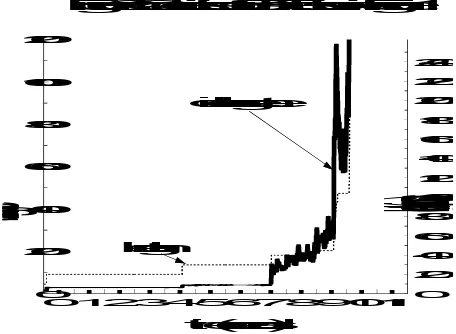
These structures show some discharge sequences, but none that run from the needle to the tree periphery, at least once a reasonable size tree is generated. Substantial numbers of isolated tree discharges occur however. During the propagation of these structures overall charge neutrality is lost and a net charge is produced at the tips of the tree tubules, which can be carried over into the succeeding half-cycle. Negative tip charges favour forward avalanches, which tend to cause extensive damage in the nearby polymer, thus producing rapid growth. A lot of tree extensions also occur close to the needle electrode where the needle divergence has a strong effect. The contribution of back avalanches to tree extension depends upon the availability of initiating electrons. In our early computations, the number of available electrons was quite high, and the structures grew in all directions rapidly. If this availability is low, the occurrence of net positive tip charges can strongly inhibit further propagation, i.e. tree growth stops. Figure 2 contains the discharge-time plot driving the propagation of a computed bushy tree structure. These discharges are not assumed but calculated within the model. The number of discharges increases as the tree length increases and the number of branches increases. The simulations were generally terminated when a tree grew to such a size as it took an excessive amount of
computer time to calculate further time-steps.
Such a plot is typical of the early stages of trees that tend towards a bushy form [8], which are noted for the relatively rare appearances of any bursts of high activity. The discharge activity produced by the model that resulted in this plot showed that though most of the tree was active no really long sequences were produced. This is consistent with the usual interpretation of discharge behaviour in bushes. It was, however, noted that new growth was preceded and accompanied by increased activity. As yet we have no feature in the model which would allow the discharges to age the tubules in any way. There is thus no way that new growth can be stimulated without altering the charge distribution.
If back avalanches are restricted such that only one electron is available to begin each avalanche, the structures produced tended towards a more branch-like form. These structures were usually very short, growing only by a few tubule lengths, but all these tubules grew in the forward direction only. The structures grew only up to the point where the field due to the applied voltage was unable to drive large avalanches. Damage in the nearby polymer continued to accumulate, but at an extraordinarily slow rate. A structure such as this is shown in figure 3, together with a length/discharge time plot for its growth. The changes to the model required to create such a drastic change in tree structure include the reduction of electrons available to initiate back avalanches, reduction of sideways avalanches in long stream discharges, and a modification of some key variables in the model. The value of Emc was initially chosen to be
400kV/mm for which very little charge was displaced. Reduction to 200kV/mm does not show any significant difference. The other change that has been implemented so far is a change to the mobility of the
01234567891011
time(seconds)
0 200 400 600 800 1000 1200
discharges / cycle
0 20 40 60 80 100 120 140 160 180 200 220 240
length (microns)
Figure2:CharacteristicsofBushTreeshowninFigure1
length
dischargerate
020406080100120140160180
time(seconds)
0 10 20 30 40 50 60 70 80
discharges / cycle
0 5 10 15 20 25 30
length (microns)
dischargerate
length
[image:4.612.329.555.263.423.2] [image:4.612.86.314.534.701.2]wall charge. Increasing the wall charge mobility allows positive charges to reach the needle electrode and neutralise on the negative half-cycle leaving a large negative tip charge and hence inhibiting further discharges on the half-cycle, but increasing the magnitude of outward avalanches. On the positive half-cycle the electrons in the discharge recombine with the needle electrode leaving positive ions behind, giving a net positive charge. Near to the needle electrode its divergence emphasises forward growth and the tree extends along the axis of the needle. Growth stops however, when the tree has grown by three tube-lengths. At this time the wall charge recombines with any negative tip charge most of the time leaving a net positive charge on the tip. The development of further avalanches now depends crucially on the availability of initiating charge, which for our current set of variables is very low. Thus further extension is inhibited. Reducing the mobility of the wall charges tends to produce a net zero charge at the tree tip and hence tree growth depends solely on the applied field. Again linear growth up to a certain point occurs. It would seem from the current results, that the production of branch tree structures requires a balance of wall mobility with the availability of initiating electrons for back avalanches.
Acknowledgements
We gratefully acknowledge the support of EPSRC and National Grid plc ltd (UK) for this work under grant no: GR/L01589
References
[1] L.A.Dissado and P.J.J.Sweeney, Phys.Rev. B48, 16261-16268. 1993
[2] L.A.Dissado, J.C.Fothergill and K.S.Bromley, Ann. Rep. CEIDP, 649-652. 1998
[3] L.A.Dissado, S.J.Dodd, J.V.Champion, P.I.Williams and J.M.Alison, IEEE Trans. Diel&EI-4 259-279. 1997
[4] Y.Tanaka, N.Ohnuma, K.Katsunami, Y.Ohki, IEEE Trans. EI-26, 258-265. 1991
[5] A.S.Malinovski, M.D.Noskov, M.Sack and A.J.Swab, Proc, ICSD’98 (Trondheim), 305-308. 1998
[6] K.S.Bromley, L.A.Dissado and J.C.Fothergill, IEEE, 98CH36132, 295-300. 1998.
[7] H.R. Zeller and W.R. Schneider, J. Appl. Phys., 56, 455-459. 1984.