Reliability in composites–a selective review and survey of current
development
M. Chiachioa,∗, J. Chiachioa, G. Rusa
aDept. Structural Mechanics and Hydraulic Engineering, University of Granada.
E.T.S de Ingenieros de Caminos, Canales y Puertos. Campus de Fuentenueva s/n, 18071 Granada, Spain
Abstract
As a response to the rampant increase in research activity within reliability in the past few decades, and to the lack of a conclusive framework for composite applications, this article attempts to identify the most relevant reliability topics to composite materials and provide a selective review. Available reliability assessment methods are briefly explained, referenced and compared within an unified formulation. Recent developments to confer efficiency in computing reliability in large composite structures are also highlighted. Finally, some general conclusions are derived along with an overview of future directions of research within reliability of composite materials and their influence on design and optimization.
Keywords: A. Lamina, A. Laminate, C. Statistical methods, C. Reliability
1. Introduction
The need to incorporate uncertainties in engineering design has long been recognized. In contrast to the traditional approach of using safety coefficients, the probabilistic design allows the estimation of reliability by considering the stochastic variability of the data for which designs are qualified to have a given reliability value [1]. The performance is generally evaluated by means of a variable such as the displacement of a point, the maximum stress, etc., or by a set of them. Variability in the performance of composite materials arises mainly from the variability in constituent properties, fibre distribution, structural geometry, loading conditions and also manufacturing process. As an orthotropic material, this variability can lead to a catastrophic failure mainly when inaccuracy arises in loading direction or fiber orientation, while the traditional approach of safety factors could result in a costly and unnecessary conservatism [2], which is a serious drawback for making composites competitive and sustainable.
In the recent decades, a large number of articles have been reported to cover probabilistic failure and reliability in composites. The first contributions were in the form of probabilistic
∗Corresponding author. e-mail: [email protected]
strength over aircraft applications [3, 4]. Shortly later, theβ-method by Hasofer Lind [5] was applied to laminated plates [6]. Wetherhold and Ucci [7] evaluated reliability methods used in composites through an example and Soares [8] made an overview and gave a perspective about deriving reliability from ply to laminate level.
However, due to the inherent variability in the material behavior, reliability in composites requires that several decisions are adopted. The reasons for that are multiple: 1) there are a wide range of possibles failure functions to adopt, 2) numerous influencing random variables need being incorporated, 3) several reliability methods arise and 4) there are different ways to consider reliability for a laminate, as shown in Figure 1.
According to Soares [8], several results have been reported, but unfortunately, a lack of consensual framework is observed in literature for the use of methods, failure criteria, statistical description of mechanical variables and even for conclusions. These, together with new trends to confer efficiency in reliability calculation require the need for a thorough and up-to-date review of the literature in this area.
Hence, as a first step to provide a basis for a discussion about this claim, the present paper reviews some fundamental concepts of reliability from an orthotropic material perspective. This work highlights the results where connections between reliability and failure criteria in composites are most striking. It also gives a concise background of reliability methods with special emphasis to those that already have a fruitful impact on composite applications, and identify results which evaluate the influence of such variability in methodology. Section 3 gives a set of examples where ideas of reliability in composite laminates have demonstrated advantages for laminate design and optimization, and identifies areas of particular potential for further development. In Section 4, some basic notions of techniques to confer computa-tional efficiency are recalled. It is also shown how they provide a framework for reliability assessment of large structural composites systems. Section 5 briefly concludes.
In Table 1, additional information related to the decision topics is provided, that helps to derive a perspective of reliability in composites.
This work is not only focused on reliability procedures but also in reliability based design and safety factor calibration, which are topics where reliability calculation is crucial.
Throughout the paper, methods and techniques to assess reliability from literature are expressed within an unified formulation which helps this review to be read with independence of the references.
2. Reliability formulation. Ply level
The essence of the structural reliability problem is the probability integral:
Pf =
Z
X|g(X)≤0
fX(X)d(X) (1)
whereX={x1, . . . , xn}T is a vector of random variables that represent uncertain quantities
influencing the state of the structure, fX(X) is the probability density function (PDF) and
For a mathematical analysis, is necessary to describe the failure domain g(X)≤0 in an analytical form, which is widely named as limit state function (LSF). The next section 2.1 is dedicated to expose different formulations of the LSF used for reliability in composites. Methods of resolving the integral in Equation 1 will be commented in section 2.2.
Both mentioned topics about Equation 1, together with the discussion about what to consider as random variables, cover almost all of the literature discussion on composites reliability.
2.1. Concept of failure
Failure criteria used in probabilistic analysis are the same as used in a deterministic approach, so the accuracy of reliability analysis is critically dependent on an appropriate criterion for the study conditions. Composite materials display a wide variety of failure mechanisms as a result of their complex structure and manufacturing processes. So, in literature, a wide spread of possibilities for LSF have been developed, all apparently valid depending on each specific problem [10–12]. Recently, a comprehensive review of failure theories is given by Orifici et al. [13], in which a concise way to classify them is also proposed according to whether they are based on strength or fracture mechanics theories, whether they predict failure in a general sense or are specific to a particular failure mode and whether they focus on in-plane or inter-laminar failure. Following this classification, the in-plane general strength failure criteria ranges almost all the literature in reliability, although important contributions have also been derived in composites reliability based on other LSF like damage based criteria [14], crack initiation over pipe surfaces [15, 16] and buckling failure [2, 17].
In relation to the scale level, although recent advances in multiscale failure have been reported [18, 19], the body of reliability literature takes a mesoscale or macroscopic ap-proach to the failure as the phenomenological model to analytically describe the reliability of composites.
An interesting approach which seems to be a first step to multiscale reliability evaluation of composites have been recently reported [20]. In these study, a micro and macro-scale evaluations of the Tsai-Hill LSF are critically compared in a reliability framework showing good agreement and conclude that reliability analysis starting from micro level would help benchmarking corresponding macro-level analyses.
In reliability literature, due to the complexity of the failure concept, a step by step approximation to the subject is observed, from uniaxial tension reliability [4, 21] to a more general multiaxial case in recent years.
In the latter multiaxial case, two main approaches have been proposed: the interactive and non-interactive, depending on the stress working or not collectively towards the failure of the element [22].
The non-interactive case considers reliability at each stress direction independently [22] or exclusively the most stressed direction [23, 24], in conjunction to Max Stress, Max Strain or Max Work criteria as LSF. This approach has not been extensively used in reliability due to its well-known insecure position for certain stress combinations [25].
functions as LSF for reliability [26]. This criteria takes into account the interactions between different stress components. The LSF for the Quadratic Failure Criteria in the component orientation for one ply is expressed by:
g(X) = 1−(Fijσiσj +Fiσi)60 (2)
where Fij = Fij(X), Fi = Fi(X) are the strength parameters, σi = σi(X) the stress in
the tensor component i, with i, j = 1,2,6 the stress or strain tensor components [25]; and
X={x1, . . . , xn}T the random variables written in matricial notation.
Particularly, the quadratic Tsai’s criterion has been fairly used in literature motivated by being one of the existing mature theories [27–29]. The main contributions in reliability have used the Tsai’s criterion, although not exclusively, as shown in Table 1.
Under such variability of failure criteria to define the LSF, certain authors [7, 23, 30–32] declined to probe with several possibles and compare to experimental or reference reliability data when available. In Nakayasu and Maekawa [33] a quantitative trade-off for six different failure criteria from the viewpoint of reliability-oriented design of composite materials was carried out. This work yielded an important conclusion about the need to verify the criterion suitability under specific load combinations, which also agrees with Lin [34].
2.2. Reliability methods used in composites
Methods used in literature for computation of the probability integral in Equation 1, are reviewed in subsequence chapters. To avoid duplication in the current review but conferring a sufficient conceptual framework, the methods have been presented in a concise way.
2.2.1. Fast probability integration methods (FPI)
FPI methods rely on approximating the failure surface by a predetermined geometric form for which evaluation of the integral is practical [9].
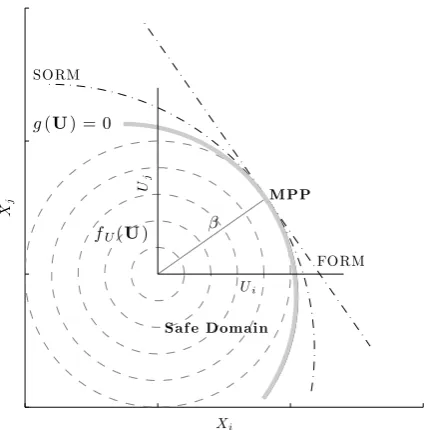
A most probable point (MPP) is searched during the evaluation, over which the failure surface is approximated by such geometric form. The distance between the origin and the MPP corresponds to the radiusβof a n-sphere beside the failure domain and tangent with it, in the MPP. In literature, this β value is called as Reliability Index and means the distance from MPP to the origin in units of standard deviation, as shown in Figure 2.
In FPI methods, first order reliability methods (FORM) and second order reliability methods (SORM) are included.
First order reliability methods. The well known technique FORM uses a linear approxima-tion of the LSF in the vicinity of the design point to evaluate the β index [5].
This method requires standard normal non-correlated variables, so the vector of random variables X must be transformed into standard non-correlated variables vector Utaking,
U=φ−1(FX(X)) (3)
whereFX(X) and φ−1 are the cumulative distribution function and the inverse of the
The reliability index β is then calculated by:
β=min(U·UT)12 (4)
which represents an Euclidean distance between the origin and the failure functiong(U), in the non-correlated normal standard space U, as shown in Figure 2.
If any correlation exists in the random variables, a Cholesky decomposition of the covari-ance matrix may be used to transform from the real space to the non-correlated standard space [35]. In case of non normal variables, Rackwitz-Fiessler Method [26] can be employed. In case of correlated and non-normal variables, the Rosenblatt transformation is recommend [36, 37].
The value of the density function integrated over the hyper volume is found to be equal to the standard normal integral (distribution function) atβ, and so, the reliability R can be expressed as,
R =φ(β) (5)
while the probability of failure is the complement,
Pf = 1−R= 1−φ(β) =φ(−β) (6)
Second order reliability methods. To improve the approximation of the failure surface beyond the level employed in FORM, additional information about the failure surface is required [9]. The SORM use theβ value in conjunction with the second derivatives ofg(X) at MPP. The method is based on a general quadratic expansion by expanding the failure surface g(X), into a second order Taylor series about the MPP. Since the curvatures may have positive, negative and zero values; parabolic, elliptic, or hyperbolic forms may result.
These methodology requires complicated integrations that restrict the applicability in the study of reliability [38]. Two simpler forms are extensively used in literature for the quadratic approximation that are relatively simple for use: the rotational paraboloid and non-central hyphersphere forms based on a predetermined axis [26].
Since only one curvature is used with the predetermined forms, a method for determining that one curvature must be selected. For conservatism, the largest positive curvature κit is used, and hence the smallest radius of curvature since r=1/κ.
The rotational paraboloid approximation gives,
Pf =
Z ∞
0 φ
β− t
2r
fχ2
n−1(t)dt (7)
wherefχ2
n−1 is the chi-square density function with n degrees of freedom.
Analogously, the non-central hypersphere approximation gives,
Pf = 1−χ2n,δ(r
2
) (8)
where χ2n,δ(r2) is the non-central Chi-Squared distribution with non-centrality parameter
2.2.2. Monte Carlo methods (MCM)
Monte Carlo method is a very simple and accurate approach mainly used as reference or exact method [9, 39, 40].
Given the joint probability density function fX(X) of X, then the failure probability in
Equation 1 can be alternatively written as,
Pf =
Z
X|g(X)≤0
fX(X)d(X) =
Z
X
I[g(X)]fX(X)d(X) (9)
whereI[g(X)] is an indicative function defined by:
I[g(X)] =
1 if g(X)≤0
0 if g(X)>0 (10)
Using the indicative function, it is possible to evaluate the probability integral in Equa-tion 1 over the whole domain and not only over the failure domain. This probability integral in Equation 9 can be viewed as a mathematical expectation ofI[g(X)] withXdistributed as
fX(X), and this perspective leads to the direct Monte Carlo method, wherePf is estimated
as a sample average of I[g(X)] over independent and identically distributed samples of X
drawn from the PDFfX(X), as follows:
Pf =E
I[g(Xj)] ' 1
ns ns
X
j=1
Ig(Xj) (11)
wherens is the number of simulations, Xj the vector of random variables of the jth sample.
The error of this method is only dependent on ns and so it is extremely robust with respect
to applications. The term Pj
nsI[g(X
j)] represents the sum of the number of simulations
(nf) in the failure domain, and so Equation 11 may be also be written as,
Pf '
nf
ns
(12)
This method has a serious drawback in cases of small failure probabilities, by the fact that the total number of required simulations increases drastically. Hence, attention has been focused on developing more efficient simulation methods.
For the structural reliability problem, the most promising technique appears to be the importance sampling method (MC-IS) [41]. This method reduces the variance of the estimate by sampling more frequently from inside the failure domain.
Following the same concept of failure probability as a mathematical expectation, Equa-tion 9 may be also written as follows:
Pf =
Z
X|g(X)≤0
fX(X)d(X) =
Z
X
I[g(X)]fX(X)
h(X)
| {z }
H(X)
h(X)d(X) = EH(Xj)
where H(X) is called theimportance sampling quotient and Xj distributed ash(X). h can
be selected to shift and spread the simulations close to the failure domain. his assumed to be appropriately chosen such thatH has finite variance under h.
2.2.3. Analytical methods
In order to confer more simplicity in reliability calculations, some analytical approaches have appeared for composites applications. Only few of this approaches have been suc-cessfully developed, and in their range of application, they have been demonstrated good agreement as compared to MCM, taken as a reference.
Edgeworth expansion method (EDW) and Pearson’s empirical distribution (PRS). In Philip-pidis and Lekou [42] two analytical approaches, namely a functional expansion technique and the introduction of Pearson’s semi-empirical distribution function, were developed for off-axis UD FRP composites for the general plane stress. In that work, only strength pa-rameters were considered as random variables, each following a Weibull distribution.
The quadratic version of the failure tensor polynomial in the principal material coordinate system under plane stress conditions, was considered as follows:
g(X) = 1−(Fijσiσj +Fiσi) (14)
with X = XT the strength random variables, Fij = Fij(XT), Fi = Fi(XT) the strength
parameters [25] for one ply and
σi stress tensor components, considered as deterministic values.
The purpose of this two analytical approaches, was to determine the CDF (Fg) of the
failure condition g(X), by which the failure probability P(g 60) can be obtained.
The EDW, that was previously introduced in off-axis composites for the case of uniaxial tension [43, 44], was used to predict the cumulative probability of complex systems in terms of individual component moments [45]. The failure function in Equation 14, was expanded in a multivariable Taylor series in term of central moments of the random variable,g. This is given by:
F(g) = Φ(g)− 1
3!
µ3
µ32/2
Φ3(g) + 1 4!
µ4 µ2 2
Φ4(g) + 10 6!
µ3
µ32/2
Φ6(g) +. . . (15)
whereµk are the centralk-moments of the LSFg and Φn(g) is the nthderivate of the normal
CDF Φ(g).
In PRS method, the unknown CDF of the failure condition is alternatively fitted by empirical statistical distributions once the central moments of g are calculated. As an ex-ample in Philippidis and Lekou [42], the group of distribution families proposed by Pearson, called as Pearson Families generated as a solution to the differential Equation 16 [48], were considered by proper choice of the parametersλ and bi (i= 0,1,2).
df(g)
dg =
(g−λ)
b0+b1g+b2g2
f(g) (16)
The Pearson distribution families include the Normal, Beta (Pearson Type I), and Gamma Distribution (Pearson Type III). From Equation 16, after some detailed algebraic manipulations, the constant parameters can be expressed in terms of the central moments of the distribution function.
By using the coordinate transformation k=g−λ, Equation 16 reads:
df(g)
dk =
k
B0+B1k+B2k2
f(g) (17)
whereBi are certain algebraic linear combinations ofbi and λ for simplicity.
If the roots of the polynomial in the denominator of Equation 17 are real and of the opposite sign, the distribution f(g) reduces to Beta distribution B(p, q), whit parameters
p, q found by equating the Pearson distribution’s moments with that of the failure function. Finally, for evaluating the cumulative distribution function by which can be derived the failure probability, was used the next expression:
1
B(p, q) Z z
0
zp−1(1−z)q−1dz (18)
with (p, q > 0,0 ≤ z ≤ 1) and z as a algebraic function of roots of the polynomial in the denominator of Equation 17.
In this work, several comparisons between analytical EDW, PRS, MCM and a semi-determinisitic failure analyses, were made considering different fibre angle and assumptions for the Tsai-Wu failure domain. The results obtained with the analytical approaches were shown to be in excellent agreement with experimental or Monte Carlo data.
g(X) = 1− Y
ij
σij +
Y
ijkl
σijσkl+. . .
!
i, j, k, . . .=x, y, z, . . .;
(19)
whereX=
Q
ij,
Q
ijkl, σij, σijkl
; withQ
ij,
Q
ijkl,. . . the strength tensors andσij,σijkl,. . .,
the tensor of the applied stress state.
The following matrix columns were introduced by the rules,
[st] = [s1, s2, . . . , sn] = [σij, σijσkl. . .]
[ρt] = [ρ1, ρ2, . . . , ρn] =
" Y
ij
,Y
ijkl
. . . #
(20)
where sm are components characterizing all necessary combinations of the stresses in
in-creasing order, ρm are the strength characteristics and n is the number of elements in the
matrices.
Thus, Equation 19 may be presented as,
g(X) = 1−
n
X
m=1 ρmsm
!
(21)
which is useful in a probabilistic framework, since this allows one to consider g as a linear function of random parameters of the problem as follows:
g = 1−[p˜t] [˜s] = 1− n
X
m=1 ˜
pms˜m
!
(22)
In this formulation, the random matrices [˜s], [˜p] may be determined by the mean matrices-column [¯s], [¯p] and the correlation matrices [Ks], [Kρ], respectively; all of them considered
as initial data.
Therefore, basic statistical characteristics of g, such the first two moments: µ1 and µ2, can be obtained as,
µ1 = 1−
n
X
m=1 ¯
pms¯m
!
(23)
µ2 =
n
X
m0=1
n
X
m00=1
{Ksm0,m00p¯m0p¯m00+Kpm0,m00s¯m0¯sm00+Ksm0,m00Kpm0,m00} (24)
whereKsm0,m00,Kpm0,m00 are the correlations between random variablessm0,sm00 andpm0,pm00
respectively; with (m0, m00 = 1, . . . , n).
R=P{g 60}= Z 0
−∞
fg(g)dg (25)
where fg is the probability density function of g. The only assumption of this approach is
connected with a type of distribution g: Normal, Weibull, Gamma Function, etc. In all of the remaining methods cited above, reliability calculation requires an assumption regarding the type of the distributions for strength and/or stress, whereas Gurvich’s method requires those in the type of distributiong. An interesting discussion between this analytical method in relation to the others is done at the end of Gurvich’s work.
2.2.4. Numerical methods
In a numerical scheme, particularly in the context of finite element modeling, the stochas-tic finite element modeling (SFEM) are receiving special attention for reliability, due to the technological advances in the available computational power [50]. SFEM involves finite ele-ments whose properties are random. These new advances have been carried out in an effort to generate statistics from a response vector for each node [51, 52].
There are three main variants of SFEM in the literature: a) the perturbation approach [53] which is based on a Taylor series expansion of the response vector, b) the spectral stochastic finite element method (SSFEM) [54] where each response quantity is represented using a series of random Hermite polynomials and c) Monte Carlo simulations (MCS) [55–57] based on independent sampling of the response vector.
In composites applications, Lin [34] used the stochastic finite element method (SFEM) to predict the reliability of angle-ply laminates with different types of buckling failure modes subject to in-plane edge random loads. This author also provides a comparison of different reliability methods and different failure criteria using (SFEM) to derive for the statistics of the First-Ply-Failure (FPF) load by mean-centered second-order perturbation technique. The results were compared with experimental FPF load data of centrally loaded composite plates with different lamination arrangements to study the accuracy of the methods.
Onkar et al. [32] used SFEM by the first order perturbation techniques and studied the form to generate statistics for the failure load index using Tsai-Wu and Hoffman as failure criterion in orthotropic plates with random material properties and random loads. In this case, the results were compared with analytical solutions.
Ngah and Young [1] demonstrated an application of SSFEM in a composite panel subject to random loads and constitutive properties. Covariance and probability density functions were derived for different approximation schemes. A comparative study of accuracy and computationally effort of SSFEM versus MCS, was also presented.
2.2.5. Comparison between reliability methods
Due to the wide range of reliability approaches and the lack of results coincidence when they are applied to composites, several authors have declined to contrast different well accepted reliability methods to a specific composite application or to check one proposed method to a experimental data. All examples encountered in literature, use at least MCM as a reference.
In Ucci [38] the FPI methods and MCM was presented, and a comparison between them was done considering both Tsai-Wu and Tsai-Hill as failure criteria in different loading levels and ply angles. A sensitivity study was done to evaluate the influence of each stochastic variable in the reliability calculation.
The comparisons were performed over three main fields: accuracy, conservatism and computational speed.
For accuracy, FPI was observed to derive satisfactory accuracy in cases of low stresses and moderate fibre angle (it is pointed out the interval 30◦−40◦), when preferably using Tsai-Wu as failure criteria. In extremely low or high orientation angles, near 0◦ and 90◦, planar FPI were seem to be quite accurate.
When studied the conservatism, the report concluded the need to consider the curvature in the MPP. Particularly, for planar FPI, independently of the accuracy, the conservatism would be depend upon the curvature is safe or unsafe.
In computational speed, this work does not give substantial conclusions as compared to others [61] cited in section 4. However, an interesting result about computational cost as compared to MCM was implicitly derived through reduction of variables to be sampled in MC-IS by a sensitivity analyses, by the fact that depending on each specific case, the bulk of the reliability value depends upon several localized stochastic variables.
That conclusion was later explicitly pointed out by Di Sciuva and Lomario [2], who compared FORM methods with MCM and explicitly pointed out for Directional Cosines, using important factors, as an efficient method to reduce the stochastic variables to be sampled in MCM without significant less of accuracy. In this work, a laminated composite flat plate loaded by compressive distributed forces acting in its mid-plane was studied, with the LSF defined analytically for buckling load.
The results showed acceptable level of accuracy when FORM methods were used in this specific case, in which the buckling LSF fits well to linear. Directional Cosines were pointed out to be efficient for this calculation.
In Lin [34] three different methods, MCM, FORM and first-order second moment method, were used to calculate the reliability and compared to experimental FPF of centrally loaded laminated composite plates with different lay-ups.
In [47] the EDW previously introduced by Philippidis [42], was compared to MCM and FORM with Tsai-Hahn as failure function for FPF noting that the EDW estimation overrate the structural load carrying capacity of the laminated plate.
3. Reliability and design of composites laminates
Since a laminate can be viewed as a mechanical set of plies, whole laminate reliability may consider systems reliability.
An accurate evaluation of laminate reliability is essential almost all in those areas where reliability determines the final composite design, like reliability based design and safety factor calibration, which are designing tools fully used in research and industry.
3.1. Laminate reliability
In composites, Soares [8] presented an overview of methods used for laminates and pointed out two main approaches: the bounding and system reliability formulation [22]. The former establishes an interval in which relies the actual reliability, while in system reliability is considered the progressive failure process. The vast majority of authors use bounding formulation for laminate failure consideration in reliability subject. Most of them, for simplification in a safe position, propose lower bound reliability with FPF as LSF, which implies the ply considered as failure unit. For this reason and to provide a basis for a dis-cussion about this claim, its timely to consider the subject again in the form of fundamental concepts.
3.1.1. Bounding formulation
The starting point for such bounding formulation is the definition of the unit of failure as the unit statistically homogeneous for the failure. Two such units have been proposed: the ply units and modal units [22]. The first one assumes that individual plies are the failure units while the modal failure units allow the recognition of three potential modes of failure within each ply: longitudinal, transverse and shear; resulting in 3n failure units for an n-ply laminate. Obviously that last failure unit implies non interaction between longitudinal, transverse and shear effects which assumes non-interactive failure, exposed in Section 2.1.
The upper bound reliability limit, considers that ultimate failure of the laminate will not occur until every individual unit had failed. Thus, the probability of failure for the laminate is given by the product of probabilities of failure for the individual units. In terms of reliabilities, this gives the following expressions:
RU ply = 1− n
Y
i=1
(1−Ri) Non-Interactive (26a)
RU modal = 1− n
Y
i=1 Y
j=1,2,6
Rij Interactive (26b)
As lower bound reliability, a series system formulation is proposed, so that the failure of the whole laminate is subject to the failure of the weakest unit. In reliability terms,
RLply = n
Y
i=1
Ri Non-Interactive (27a)
RLmodal = n
Y
i=1 Y
j=1,2,6
Rij Interactive (27b)
whit the same meaning for Ri and Rij as described above.
The most representative works that belong to bounding approach are cited by Soares [8] review. Those up to Soares [8] are nextly introduced in which interesting conclusions about composites design are also highlighted.
Kam and Chang [31] used experimental distributions of FPF load for validation of differ-ent types of baselines probability density functions on the bounding failure probability over centrally loaded graphite-epoxy laminated composite plates with different lamination ar-rangements. The failure data were compared with those obtained analytically with a F.E.A for stress calculations, in both interactive and non interactive failure criteria. Results showed that, in general, differences between the experimental and theory are small (less than 12%) irrespective to the types of probability distributions used for modeling the lamina strength parameters and FPF load.
More recently, Frangopol and Recek [62] presented a benchmark study of laminate fail-ure probability by MCM considering random loads with Tsai-Wu as failfail-ure criterion. Two main cases were studied: uniaxial loaded single-layer laminate plate of graphite/epoxy and two layers laminate plate of glass epoxy, each one subjected to uniaxial and biaxial ten-sion. In such two cases, the material strength parameters were considered as deterministic, and stresses as lognormal distributed random variables since no information on the type of distribution for principal stresses was available for this study.
As a first conclusion of these work, the importance of the mean value of the principal stress, specially in tension-tension case, was shown and the low influence of coefficient of correlation between principal stresses on the probability of failure, was also highlighted.
Another important conclusion was pointed out about the effects on reliability of addi-tional layers in a composite laminate. In presence of new layers, the plate does not necessarily increases the reliability but it’s depends on the fibre orientation and its thickness ratios. The special case of two orthogonal layers was studied, showing that the weakest more stressed lamina approximately determines the whole reliability, which implicitly supports the weakest link hypothesis in this specific case.
3.1.2. System reliability formulation
In system reliability formulation, the approach consists in considering the step by step failure process of the laminate. The bounding formulation just described, does not attempt to represent the whole collapse process of the laminate. Indeed, such approach establishes an interval in which relies the desired reliability value. Although an attempt to precisely describe probabilistic failure of a laminate would be really impacting and necessary, the methodology of system reliability has been shortly explored in literature.
In Yang and Ma [4] was derived the full quantity loading method for reliability analysis of a composite structural system with consideration of stiffness degradation process of set of whole plies.
Gurvich and Pipes [63] also utilized a mesoscale approach for progressive failure of com-posite laminates with both in plane and bending loads which call attention the search for computational efficiency by agreeing individual plies into sublaminates as whole units for the step-by-step failure. This author also made a comparative study contrasted with ex-perimental data considering step-by-step failure process over weakest link assumption, and concluded the weakest link assumption lead to lower failure results with increasing the ma-terial strength scatter.
Wu and Robinson [64] proposed a micromechanical approach in which the laminate is treated as a mechanical system and accounted local load sharing and sizing effects.
In system reliability, the scale of the approach influences the reliability, so exploring multiscale probabilistic failure seems to be an interesting way to derive a robust framework for progressive failure of composites. Recent works about uncertainty quantification at different scales [18–20] and propagation of uncertainties from micro-to-macroscale [65] in composites, provide a basis for this claim.
3.2. Reliability based design
Due to the well-known high specific stiffness, strength and corrosion resistance, compos-ite laminates are often selected for high-responsibility structural applications like aircraft, automobile, machinery and marine. Nowadays new applications in all-composite bridges [66], off-shore and civil engineering are emerging [67–69]. In these applications requiring big amount of composites materials, design optimization plays an important role through providing tools to rationally select the best over a wide range of choices in enhancing the structure’s performance [70–73]. Over such named conventional optimization problem, the probabilistic optimum design is an increasing issue, in which how to obtain the best lam-inate structure under a reliability constraint or how to get the maximum reliability under the constraint of structure cost is the key question. This problem is called the Reliability Based Design Optimization (RBDO) [74], in which an accurate calculation of reliability is crucial in final composite design, as follows in next equation:
min
X,π F(µX,π) s.t:
β(X,π)6βt
πl6π 6πu
where βt is the target reliability index, π ∈Rn is a vector of deterministic design variables
and µX is the realization of the vector of random design variables X ∈ Rm. F(µ
X,π)
is the function describing the structural performance, which is usually considered a struc-tural weight or cost function; although some recent works have also considered others like frequency response [75], structural efficiency [76] or even statistical robustness [77].
The first efforts to apply RBDO in laminate design, derived results that clearly remark the difference between deterministic and probabilistic designs [21, 78].
An open question remains about which random variables X to be considered into the optimization problem, specifically those in relation to laminate design like fiber orientation, ply ratios, laminate arrangement, etc. In Eamon and Rais-Rohani [79], a probabilistic sensitivity analysis was derived to determine the influence of uncertainty in each candidate variable on β. Other related works have declined to include these variables as uncertain parameters into the optimization problem [14, 80]. In Miki et al. [81], a simultaneous optimization of fiber angles and ply ratios was corroborated, which concords with Frangopol and Recek [62]. The cross-ply configuration was pointed out to be optimal or near optimal for the case where does not exist uncertainty in shear stress.
The above cited works consider the formulation of the reliability-based optimum under a hard constraint, in the sense that constraints are clearly specified and if the solution is outside the constraint range, even if the deviation is very little, an unacceptable solution is derived. A recent approach that complements this work is the soft constraint RBDO, by which fuzzy reliability optimum models are established. This method provides with an especially useful tool in designing optimum laminated composites, owing to the fact that due to its complex manufacture process, a laminate can be influenced by many factors including probabilistic variables and also fuzzy ones [82].
3.3. Reliability based safety factors
Because of possible lack of statistical data from the strength of materials used and the applied loads, design concepts based on traditionally safety factors have also been studied. In this approach, the effectsEof actions on a structure and the resistanceS to these effects, verify a criterion in the form:
E < S
γ (29)
Several authors made a direct comparison between probabilistic and safety factor based deterministic design [47, 78, 81] where important differences in failure prediction, sometimes in a insecure position, are highlighted.
One successful approach to minimize that differences leads to obtain safety factor from probabilistic previous calibration, which is frequently namedreliability based safety factor.
Zhu [83] proposed a first approach to reliability based safety factor for aircraft composite structures and a method was presented to compare such safety factor to those used in metallic aircraft design.
Richard and Perreux [15] utilized the same concept as describe above for safety factor calibration, but in a damaged elasto-viscoplastic model for composites in a thermodynamic framework for long term applications over a pipe for fluid transportation.
An extension of this work for strongly non linear behavior caused by damage, was done by Carbillet et al. [84] who also took into account for possible correlations between the different variables and spatial variability of material properties for a [0◦,90◦]S composite
plate, showing up an important effect on safety factor calibration.
4. Computational efficiency
The structural integrity analysis of composite structures based on probabilistic concepts is a time consuming process unless inaccuracy FPI methods were employed, and the problem can be exacerbated by the convergence difficulties associated to the non-linearity or complex non explicit LSF. Other methods employing simulation procedures, such as MCM or MC-IS, may have a prohibitive computational cost in large structural systems even if the structural evaluation is accelerated by a vectorized manner, by techniques such as Neumann Series Expansion [52, 85] or by reducing the stochastic variables to be sampled, as previously mentioned [2, 7].
In literature, there have been advised two efficient ways to reduce the computational cost: a) by using new efficient reliability algorithms and b) by reducing the effort of evalu-ation the LSF. In the former, new reliability algorithms have proved to save great amount of computation time. Special attention require SUBSET Simulation [86] and 2SMART al-gorithms [87], which confer large efficiency as compared to crude MCM, overall for small failure probabilities and high dimension problems [88]. Nowadays they appear integrated on a OpenSees computational platform called FERUM, as acronym of Finite Element Re-liability using Matlab® [89], that is a high versatile reliability tool. Unfortunately, these algorithms have not been sufficiently exploited in composites.
In relation to the second approaches, the Response Surface Method (RSM), and more recently, Artificial Neuronal Networks (ANN), have also emerged as feasible alternatives.
Evolutionary strategies like Genetic Algorithms (GA) are also computation techniques fully employed nowadays in reliability although their well-known high computational cost, which contrasts with the aim of this chapter. However, the existence of multiple design points MPP in the LSF, especially when linking reliability and optimal design, makes necessary the employ GA. The next chapters are dedicated to application of this techniques in composites reliability.
4.1. Response surface methods (RSM)
When the LSF is substituted by simple functions, generally by explicit polynomial ex-pressions, the method is called Polynomial Based Response Surface Method or simply RSM. Those that the LSF is approximated with training sampling data in contrast to the last one, are called Artificial Neuronal Network (ANN)-based response surface methods [24].
4.1.1. Polynomial based response surface
In the original conceptual form of the Response Surface technique, polynomials are used to approximate real LSF. So an important requirement for the LSF is to be smooth around the area of interest. In order to obtain the Response Surface, some regression analysis (for instance the Least Square Method) must be accomplished. As states in Gomes and Awruch [85], the main point resides in to adjust the polynomials to the L.S.F using the sample points, by using some of the several fitting techniques such as a) the central composite design [91, 92] b) the fractional factorial design [93], c) the random design, d) the partially balanced incomplete box design [94] and e) Bucher and Bourgund’s [95] proposal.
With this method, the L.S.F is assimilated as follows:
g(X) =a+
n
X
i=1
bixi+ n
X
i=1
cix2i (30)
with a, bi and ci the polynomial constants to be calculated.
As a consequence of Equation 30, only 2n+1 samples must be taken along the coordinates axes of each variable at a distancexi =Ui(±h), whereUi is the probabilistic transformation
of the variablexi from the real space to the non-correlated Gaussian space, withh being an
arbitrary factor.
In composites, Chen et al. [17] derived the longitudinal ultimate compressive strength of a composite stiffened ship’s hull, by a polynomial type with quadratic terms RSM.
The reliability analysis was carried out by FORM, and interesting conclusions about ship hull compression dimensioning was derived with the help of a sensitivity analyses.
In the same way, but in an effort to confer computational efficiency in a RBDO problem, Young et al. [76] have recently proposed the polynomial RSM by regression analysis in a complex LSF with Eulerian fluid interaction of a Hexcel (IM7-8552) CFRP marine propeller. A FORM was used to evaluate the influence of uncertainties in material and load parameters and thus to optimize the design parameters, obtaining in this case high accuracy contrasted to MCM.
4.1.2. ANN based response surface
as efficient as desirable [24]. Several authors have compared between both methods, show-ing that the ANN-based response surface method is more efficient than polynomial-based response surface method [85].
ANN are computational models based in parallel distributed processing with interesting properties such as the ability to learn, to generalize, to classify and to organize data. There are two main models developed for different specific computational tasks:
those with a supervised training and networks without a supervised training. Networks may be also divided in feed forward, feedback architectures and a combination of both archi-tectures. In reliability, Perceptron Multilayer Neural Networks and Neural Networks with Radial Basis Functions are mostly used. Both types of Networks have a supervised training, feed forward architecture and are universal tools for function approximation. To avoid du-plication in literature, a concise introduction of ANN in reliability, done by Hosni Elhewy et al. [24], is recommended. More details about different aspects of Neural Networks are given in the work of Haykin [97].
In composites, ANNs have been used in a wide range of applications like fatigue life prediction, dynamic mechanical properties, processing optimization, numerical modeling, damage detection, delamination, among others [98–101]. But only few works have been encountered in reliability applications for composites, precisely where the computational efficiency of using ANNs can be fully amortized.
Recently, Lopes et al. [61] use artificial neural network (ANN) to generate sample data for the LSF (Tsai-Wu) in stead of FEA, in which high computational efficiency is demonstrated, particularly for low failure probability values regardless the method employed for reliability evaluation. In this work were used two ANN for comparison: the Multilayer Perceptron Network and the Radial Basis Network. The results demonstrated that only 0.02% of MCM using FE as reference CPU time is required for reliability calculation employing an ANN with high accuracy.
4.2. Genetics algorithms
The (GA) are heuristic algorithms based on the rules of Darwin’s principle of natural selection to improve a population of solutions by reproduction and selection operations [102], that are specially useful for mathematical optimization processes. In reliability calculations, due to the need to search a minimum distance in the standard normal space of random variables, an optimization problem is defined for which GA are a feasible tool [103].
The failure probability is obtained through a natural selection process following a search path until failure is reached. The main advantage of GA as compared with FPI methods, is that it does not involve the difficulties of computing the derivatives of LSF with respect to the random variables with the added benefit of identifying global optimum values of the LSF [104].
structures optimization and in [70, 71] for those cases when the stacking sequence is also involved into the problem definition.
In literature, new modifications to the original form are continuously appearing to im-prove the algorithm efficiency [107–109]. Among them the hybrid GA, which use comple-mentary techniques to improve the genetic search [110, 111], are specially useful for complex reliability problems [112–116].
GA are particularly advantageous when linking reliability and design optimization of composites due to the existence of discontinuities in the derivates of LSF and also for the possible presence of multiple MPP [117]. Gen and Yun [105] provide a survey of GA-based approach for various reliability optimization problems including examples of the hybrid GA approach.
In composites, Concei¸cao [104] proposed a formulation for the simultaneous solution of the reliability index evaluation and the optimization of composites structures with geomet-rically non-linearties. This formulation was derived based on a proposed hierarchical genetic algorithm (HGA), that is a particular case of parallel genetic algorithm [118] using a network of interconnected sub-populations with independent evolution.
In Ge et al. [80], the Particle Swarm Optimization (PSO) algorithm is utilized to search for the optimal solutions of a RBDO problem of composite laminates. Together with GA, PSO is a type of population-based evolutionary algorithms with the main difference that PSO retains memory of known good solutions as the search for better generations continues. Hence, PSO has a higher speed of convergence than traditional GA [119, 120], although GA determines values more accurately than does the PSO algorithm [121, 122].
More recently, Gomes et al. [123] addresses the problem of RBDO using GA for the composite optimization process and two types of ANN to sample the LSF: Multilayer Per-ceptron and Radial Basis ANN. This methodology demonstrates that is possible to obtain large computational time savings without loss of accuracy, even when dealing with non-linear behavior in large composite structures.
5. Concluding remarks
In the past few decades, numerous studies have been conducted on the reliability of com-posite materials and the corresponding applications. The inherent statistical scatter in the material properties together with their complex mechanical performance, makes reliability in composites a matter of decisions.
Methods, assumptions and applications of reliability of composites have been reviewed to confer a perspectival framework that helps to adopt these decisions. Both traditional approaches and new trends in reliability computation have been exposed.
The following general concluding remarks are extracted:
• Due to the large number of variables involved in the mechanical description of com-posites as compared to traditional materials, importance measures related to input parameters become a necessary exercise to derive an adequate reliability result. Par-ticularly important is the influence of stiffness randomness description over reliability based design, as recent results demonstrate. Those cases in which stochastic descrip-tion of certain mechanical variables are not available or incomplete, statistical uncer-tainty analysis by incorporation available prior or interval probability [80, 124] are prolific ways to carry out the problem.
• Several works remark the convenience of studying the suitability of reliability method over the failure criterion chosen for a specific situation and compare to experimental or reference reliability data when available. Certain stress levels and fiber orientations require a specific reliability method to ensure accuracy. In case of utilization of safety factors in stead of a reliability method, a reliability based calibration may warrant good results.
• More research effort is need about the progressive failure of composite laminates and its relationship with reliability, in order to help optimizing composite design in a prob-abilistic framework. In this scenario, the consideration of other failure modes than fracture, like stiffness and/or strength reduction by mechanical damage and delamina-tion, is also necessary. This framework would help to derive a reliability formulation over the lifetime of composites.
• Large composite structures require efficient techniques for reliability computation. Re-cent studies have proved Artificial Neuronal Networks (ANN’s) as an advantageous technique. Genetic Algorithms (GA) are also relevant tools for those cases where reli-ability is inside on a complex design optimization problem. New relireli-ability algorithms available on OpenSees computation platforms like FERUM, should also be explored in composite reliability. These new algorithms together with ANN’s for LSF evaluation, is a suggestion that may drastically reduce the computational cost for large composite structures systems and provide sufficient accuracy for small probabilities cases.
Acknowledgements
References
[1] M. Ngah, A. Young, Application of the spectral stochastic finite element method for performance prediction of composite structures, Composite Structures 78 (3) (2007) 447–456.
[2] M. Di Sciuva, D. Lomario, A comparison between Monte Carlo and FORMs in calculating the relia-bility of a composite structure, Composite Structures 59 (1) (2003) 155–162.
[3] L. Yang, Reliability of composite laminates, Mechanics of Structures and Machines 16 (4) (1988) 523–536.
[4] L. Yang, Z. Ma, A method of reliability analysis and enumeration of significant failure modes for a composite structural system, Computers & Structures 33 (2) (1989) 337–344.
[5] A. Hasofer, N. Lind, Exact and invariant second-moment code format, Journal of the Engineering Mechanics Division 100 (1) (1974) 111–121.
[6] I. Cederbaum, et al., Reliability of laminated plates via the first-order second-moment method, Com-posite Structures 15 (2) (1990) 161–167.
[7] R. Wetherhold, A. Ucci, Probability methods for the fracture of composite materials, Composite Structures 28 (1) (1994) 113–119.
[8] C. Soares, Reliability of components in composite materials, Reliability Engineering & System Safety 55 (2) (1997) 171–177.
[9] O. Ditlevsen, H. Madsen, Structural reliability methods, vol. 315, 1996.
[10] S. P.D., A. Kaddour, M. Hinton, Recommendations for Designers and Researchers Resulting from the World-Wide Failure Exercise, Composites Science and Technology 64 (3-4) (2004) 589–604.
[11] M. Hinton, A. Kaddour, S. P.D., A Further Assessment of the Predictive Capabilities of Current Failure Theories for Composites Laminates: Comparison with Experimental Evidence, Composites Science and Technology 64 (3-4) (2004) 549–588.
[12] A. Kaddour, M. Hinton, S. P.D., A Comparison of the Predictive Capabilities of Current Failure Theories for Composite Laminates, Composites Science and Technology 64 (3-4) (2004) 449–476. [13] A. Orifici, I. Herszberg, R. Thomson, Composite Structures 86 (1-3) (2008) 194–210.
[14] F. Richard, D. Perreux, A reliability method for optimization of [+ϕ,−ϕ]n fiber reinforced composite
pipes, Reliability Engineering & System Safety 68 (1) (2000) 53–59.
[15] F. Richard, D. Perreux, The safety-factor calibration of laminates for long-term applications: behavior model and reliability method, Composites Science and Technology 61 (14) (2001) 2087–2094.
[16] J. Rousseau, D. Perreux, An experimental and theoretical study of the processing method influence on the performances of a composite structure: case of filament winding, Ph.D. thesis, Universit de Besanon, Besanon, FRANCE (Universit de soutenance), 1997.
[17] N. Chen, H. Sun, C. Guedes Soares, Reliability analysis of a ship hull in composite material, Composite structures 62 (1) (2003) 59–66.
[18] S. Sriramula, M. K. Chryssanthopoulos, Quantification of uncertainty modelling in stochastic analysis of FRP composites, Composites Part A: Applied Science and Manufacturing 40 (11) (2009) 1673–1684. [19] F. Laurin, N. Carrre, J.-F. Maire, A Multiscale Progressive Failure Approach for Composite Laminates Based on Thermodynamical Viscoelastic and Damage Models, Composites Part A: Applied Science and Manufacturing 38 (1) (2007) 198–209.
[20] A. Shaw, S. Sriramula, P. D. Gosling, M. K. Chryssanthopoulos, A critical reliability evaluation of fibre reinforced composite materials based on probabilistic micro and macro-mechanical analysis, Composites Part B: Engineering 41 (6) (2010) 446–453.
[21] L. Yang, Z. Ma, Optimum design based on reliability for a composite structural system, Computers & Structures 36 (5) (1990) 785–790.
[22] D. Thomas, R. Wetherhold, Reliability analysis of continuous fiber composite laminates, Composite Structures 17 (4) (1991) 277–293.
[23] T. Kam, S. Lin, K. Hsiao, Reliability analysis of nonlinear laminated composite plate structures, Composite Structures 25 (1-4) (1993) 503–510, ISSN 0263-8223.
[25] S. W. Tsai, Strength & Life of Composites, Composites Design Group, Aero & Astro Dept.Stanford University,CA, USA, 2008.
[26] B. Fiessler, R. Rackwitz, H. Neumann, Quadratic limit states in structural reliability, Journal of the Engineering Mechanics Division 105 (4) (1979) 661–676.
[27] M. Hinton, A. Kaddour, S. P.D., A comparison of the predictive capabilities of current failure theories for composite laminates, judged against experimental evidence, Composites Science and Technology 62 (12-13) (2002) 1725–1797.
[28] M. Hinton, A. Kaddour, S. P.D., Evaluation of failure prediction in composite laminates: background to part B of the exercise, Composites Science and Technology 62 (12-13) (2002) 1481–1488.
[29] M. Hinton, A. Kaddour, S. P.D., Evaluation of failure prediction in composite laminates: background to part C of the exercise, Composites Science and Technology 64 (3-4) (2004) 321–327.
[30] C. Boyer, A. B´eakou, M. Lemaire, Design of a composite structure to achieve a specified reliability level, Reliability Engineering & System Safety 56 (3) (1997) 273–283, ISSN 0951-8320.
[31] T. Kam, E. Chang, Reliability formulation for composite laminates subjected to first-ply failure, Composite Structures 38 (1-4) (1997) 447–452.
[32] A. Onkar, C. Upadhyay, D. Yadav, Probabilistic failure of laminated composite plates using the stochastic finite element method, Composite Structures 77 (1) (2007) 79–91.
[33] H. Nakayasu, Z. Maekawa, A comparative study of failure criteria in probabilistic fields and stochastic failure envelopes of composite materials, Reliability Engineering & System Safety 56 (3) (1997) 209– 220.
[34] S. Lin, Reliability predictions of laminated composite plates with random system parameters, Proba-bilistic Engineering Mechanics 15 (4) (2000) 327–338.
[35] M. Shinozuka, Basic analysis of structural safety, Journal of Structural Engineering 109 (3) (1983) 721–740.
[36] M. Rosenblatt, Remarks on a multivariate transformation, The Annals of Mathematical Statistics 23 (3) (1952) 470–472.
[37] M. Hohenbichler, R. Rackwitz, Non-normal dependent vectors in structural safety, Journal of the Engineering Mechanics Division 107 (6) (1981) 1227–1238.
[38] A. Ucci, Probability techniques for reliability analysis of composite materials, Master’s thesis, State University of New York at Buffalo, 1992.
[39] C. Hurd, A Note On Early Monte Carlo Competitions and Scientific Meetings, Annals of the History of Computing 7 (1985) 141–155.
[40] N. Meteopolis, S. Ulam, The monte carlo method, Journal of the American Statistical Association 44 (247) (1949) 335–341.
[41] A. Harbitz, An efficient sampling method for probability of failure calculation, Structural safety 3 (2) (1986) 109–115.
[42] T. Philippidis, D. Lekou, Probabilistic failure prediction for FRP composites, Composites science and technology 58 (12) (1998) 1973–1982.
[43] R. Wetherhold, Reliability calculations for strength of a fibrous composite under multiaxial loading, Journal of Composite Materials 15 (3) (1981) 240.
[44] C. H., Mathematical Methods of Statistics, Princeton University Press, USA, 1971.
[45] G. Hahn, S. Shapiro, Statistical Models in Engineering, John Wiley & Sons. New York, NY, USA, 1994.
[46] T. Philippidis, D. Lekou, A probabilistic approach to failure prediction of FRP laminated composites, Mechanics of Advanced Materials and Structures 5 (4) (1998) 371–382.
[47] D. Lekou, T. Philippidis, Mechanical property variability in FRP laminates and its effect on failure prediction, Composites Part B: Engineering 39 (7-8) (2008) 1247–1256.
[48] M. Kendall, A. Stuart, J. Ord, Kendall’s advanced theory of statistics, Oxford University Press, Inc. New York, NY, USA, 1987.
[50] G. Stefanou, The stochastic finite element method: past, present and future, Computer Methods in Applied Mechanics and Engineering 198 (9-12) (2009) 1031–1051.
[51] T. Crestaux, et al., Polynomial chaos expansion for sensitivity analysis, Reliability Engineering & System Safety 94 (7) (2009) 1161–1172.
[52] V. Papadopoulos, M. Papadrakakis, Stochastic finite element-based reliability analysis of space frames, Probabilistic Engineering Mechanics 13 (1) (1998) 53–65.
[53] M.Kleiber, The Stochastic Finite Element Method, 1992.
[54] R. Ghanem, P. Spanos, Stochastic Finite Elements: A Spectral Approach, 1991.
[55] P. Spanos, A. Kontsos, A multiscale Monte Carlo finite element method for determining properties of polymer nanocomposites, Probabilistic Engineering Mechanics (23) (2008) 456–470.
[56] J. Guoliang, C. Lilt, D. Jiamei, Monte carlo finite element method of structure reliability analysis, Reliability Engineering & System Safety 40 (1) (1993) 77–83.
[57] G. Van Vinckenroy, The use of Monte Carlo techniques in statistical finite element methods for the determination of the structural behavior of composite materials structural components, Composite Structures 32 (1-4) (1995) 247–253.
[58] H.-C. Noh, Stochastic finite element analysis of composites plates considering spatial randomness of material properties and their correlations, Steel and Composite Structures 11 (2) (2011) 115–130. [59] H.-C. Noh, T. Park, Response variability of laminate composite plates due to spatially random material
parameter, Computer methods in applied mechanics and engineering 200 (2011) 2397–2406.
[60] H.-C. Noh, A formulation for stochastic finite element analysis of plate structures with uncertain Poisson’s ratio, Computer methods in applied mechanics and engineering 193 (2011) 4857–4873. [61] P. Lopes, H. Gomes, A. Awruch, Reliability analysis of laminated composite structures using finite
elements and neural networks, Composite Structures 92 (7) (2009) 1603–1613.
[62] D. Frangopol, S. Recek, Reliability of fiber-reinforced composite laminate plates, Probabilistic Engi-neering Mechanics 18 (2) (2003) 119–137.
[63] M. Gurvich, R. Pipes, Probabilistic analysis of multi-step failure process of a laminated composite in bending, Composites Science and Technology 55 (4) (1995) 413–421.
[64] E. Wu, C. Robinson, Computational micro-mechanics for probabilistic failure of fiber composites in tension, Composites Science and Technology 58 (9) (1997) 1421–1432.
[65] C. C. Ant´onio, L. N. Hoffbauer, From local to global importance measures of uncertainty propagation in composite structures, Composite Structures 85 (3) (2008) 213 – 225.
[66] T. Keller, Use of Fibre Reinforced Polymers in Bridge Construction.Structural Engineering Documents No7, Tech. Rep., IABSE-AIPC-IVBH, 2003.
[67] V. M. Karbhari, L. Zhao, Use of composites for 21st century civil infrastructure, Methods 185 (2000) 433–454.
[68] L. C. Hollaway, The evolution of and the way forward for advanced polymer composites in the civil infrastructure, Construction and Building Materials 17 (2003) 365–378.
[69] S. Pendhari, T. Kant, Y. Desai, Application of polymer composites in civil construction: A general review, Composite Structures 84 (2) (2008) 114–124.
[70] H. Ghiasi, D. Pasini, L. Lessard, Optimum stacking sequence design of composite materials Part I: Constant stiffness design, Composite Structures 90 (1) (2009) 1–11.
[71] H. Ghiasi, K. Fayazbakhsh, D. Pasini, L. Lessard, Optimum stacking sequence design of composite materials Part II: Variable stiffness design, Composite Structures 93 (1) (2010) 1–13.
[72] R. Lopez, M. Luersen, E. Cursi, Optimization of laminated composites considering different failure criteria, Composites Part B: Engineering 40 (8) (2009) 731–740.
[73] L. Iuspa, E. Ruocco, Optimum topological design of simply supported composite stiffened panels via genetic algorithms, Computers & Structures 86 (17-18) (2008) 1718–1737.
[74] M. a. Valdebenito, G. I. Schu¨eller, A survey on approaches for reliability-based optimization, Structural and Multidisciplinary Optimization 42 (5) (2010) 645–663.
[76] Y. Young, J. Baker, M. Motley, Reliability-based design and optimization of adaptive marine struc-tures, Composite Structures 92 (2) (2010) 244–253.
[77] C. Ant´onio, L. Hoffbauer, An approach for reliability-based robust design optimization of angle-ply composites, Composite Structures 90 (1) (2009) 53–59.
[78] Y. Murotsu, M. Miki, S. Shao, Reliability design of fiber reinforced composites, Structural safety 15 (1-2) (1994) 35–49.
[79] C. D. Eamon, M. Rais-Rohani, Integrated reliability and sizing optimization of a large composite structure, Marine Structures 22 (2) (2009) 315–334.
[80] R. Ge, J. Chen, J. Wei, Reliability-based design of composites under the mixed uncertainties and the optimization algorithm, Acta Mechanica Solida Sinica 21 (1) (2008) 19–27.
[81] M. Miki, Y. Murotsu, T. Tanaka, S. Shao, Reliability-based optimization of fibrous laminated com-posites, Reliability Engineering & System Safety 56 (3) (1997) 285–290.
[82] W. Junhong, Fuzzy Reliability-Based Optimum Design, Acta Mechanica Solida Sinica 19 (3) (2006) 255–263.
[83] T. Zhu, A reliability-based safety factor for aircraft composite structures, Computers & Structures 48 (4) (1993) 745–748.
[84] S. Carbillet, F. Richard, L. Boubakar, Reliability indicator for layered composites with strongly non-linear behavior, Composites Science and Technology 69 (1) (2009) 81–87.
[85] H. Gomes, A. Awruch, Comparison of response surface and neural network with other methods for structural reliability analysis, Structural safety 26 (1) (2004) 49–67.
[86] S. Au, J. Ching, J. Beck, Application of subset simulation methods to reliability benchmark problems, Structural Safety 29 (3) (2007) 183–193.
[87] J. E. Hurtado, Filtered importance sampling with support vector margin: A powerful method for structural reliability analysis, Structural Safety 29 (1) (2007) 2 – 15.
[88] S. Au, J. L. Beck, Estimation of small failure probabilities in high dimensions by subset simulation, Probabilistic Engineering Mechanics 16 (4) (2001) 263–277.
[89] A. D. Kiureghian, Structural reliability software at the University of California , Berkeley, Structural Safety 28 (2006) 44–67.
[90] R. Meyers, A. Khuri, W. Carter Jr, Response surface methodology: 1966-1988, Technometrics 31 (2) (1989) 137–157.
[91] G. Box, D. Behnken, Some new three level designs for the study of quantitative variables, Technomet-rics 2 (4) (1960) 455–475.
[92] L. Faravelli, Response-Surface Approach for Reliability Analysis, Journal of Engineering Mechanics 115 (1989) 27–63.
[93] M. Kaufman, V. Balabanov, A. Giunta, B. Grossman, W. Mason, S. Burgee, R. Haftka, L. Wat-son, Variable-complexity response surface approximations for wing structural weight in HSCT design, Computational Mechanics 18 (2) (1996) 112–126.
[94] K. Hinkelman, Design and analysis of experiments., John Wiley & Sons. New York, NY, USA, 1994. [95] U. Bucher, et al., A fast and efficient response surface approach for structural reliability problems,
Structural Safety 7 (1) (1990) 57–66.
[96] S. S., M. Y., Structural reliability analysis using a Neural Network, JSME International Journal, Series A 40 (3) (1997) 242–246.
[97] S. Haykin, Neural networks: a comprehensive foundation. 1999, Printice Hall, New Jersey, USA, 1999. [98] A. Vassilopoulos, E. Georgopoulos, V. Dionysopoulos, Artificial neural networks in spectrum fatigue
life prediction of composite materials, International Journal of Fatigue 29 (1) (2007) 20–29.
[99] M. Lefik, D. Boso, B. Schrefler, Artificial Neural Networks in numerical modelling of composites, Computer Methods in Applied Mechanics and Engineering 198 (21-26) (2009) 1785–1804.
[100] H. El Kadi, Modeling the mechanical behavior of fiber-reinforced polymeric composite materials using artificial neural networks–A review, Composite structures 73 (1) (2006) 1–23.
[102] D. Goldberg, Genetic algorithms in search, optimization, and machine learning, Addison-Wesley Pro-fessional, 1989.
[103] S. Shao, Y. Murotsu, Approach to failure mode analysis of large structures, Probabilistic Engineering Mechanics 14 (1-2) (1999) 169–177.
[104] C. Concei¸cao, A hierarchical genetic algorithm for reliability based design of geometrically non-linear composite structures, Composite Structures 54 (1) (2001) 37–47.
[105] M. Gen, Y. Yun, Soft computing approach for reliability optimization: State-of-the-art survey, Relia-bility Engineering & System Safety 91 (9) (2006) 1008–1026.
[106] F. Almeida, A. Awruch, Design optimization of composite laminated structures using genetic algo-rithms and finite element analysis, Composite Structures 88 (3) (2009) 443–454.
[107] C. Park, W. Lee, W. Han, A. Vautrin, Improved genetic algorithm for multidisciplinary optimization of composite laminates, Computers & Structures 86 (19-20) (2008) 1894–1903.
[108] J. Wang, M. Ghosn, Linkage-shredding genetic algorithm for reliability assessment of structural sys-tems, Structural safety 27 (1) (2005) 49–72.
[109] L. Deng, M. Ghosn, S. Shao, Shredding genetic algorithm for reliability analysis of structural systems, Structural Safety. v27 27 (2005) 113–131.
[110] C. Lee, Y. Yun, M. Gen, Reliability optimization design for complex systems by hybrid GA with fuzzy logic control and local search, IEICE TRANSACTIONS on Fundamentals of Electronics, Communi-cations and Computer Sciences 85 (4) (2002) 880–891.
[111] J. Renders, S. Flasse, Hybrid methods using genetic algorithms for global optimization, Systems, Man, and Cybernetics, Part B: Cybernetics, IEEE Transactions on 26 (2) (1996) 243–258.
[112] J. Cheng, Hybrid genetic algorithms for structural reliability analysis, Computers & Structures 85 (19-20) (2007) 1524–1533.
[113] C. Lee, M. Gen, W. Kuo, Reliability optimization design using a hybridized genetic algorithm with a neural-network technique, IEICE TRANSACTIONS on Fundamentals of Electronics, Communications and Computer Sciences 84 (2) (2001) 627–637.
[114] C. Lee, M. Gen, Y. Tsujimura, Reliability optimization design using hybrid NN-GA with fuzzy logic controller, IEICE Transactions on Fundamentals of Electronics, Communications and Computer Sci-ences 85 (2) (2002) 432–446.
[115] Y. Yun, M. Gen, S. Seo, Various hybrid methods based on genetic algorithm with fuzzy logic controller, Journal of Intelligent Manufacturing 14 (3) (2003) 401–419.
[116] J. Wang, M. Ghosn, Hybrid data mining/genetic shredding algorithm for reliability assessment of structural systems, Journal of structural engineering 132 (2006) 1451–1461.
[117] C. Concei¸c˜ao Ant´onio, Optimisation of geometrically non-linear composite structures based on load-displacement control, Composite structures 46 (4) (1999) 345–356.
[118] S. J, Parallel genetic algorithms: theory and applications, frontiers in artificial intelligence and appli-cations, 1992.
[119] R. Perez, K. Behdinan, Particle swarm approach for structural design optimization, Computers & Structures 85 (19-20) (2007) 1579–1588.
[120] C. Elegbede, Structural reliability assessment based on particles swarm optimization, Structural safety 27 (2) (2005) 171–186.
[121] E. Elbeltagi, T. Hegazy, D. Grierson, Comparison among five evolutionary-based optimization algo-rithms, Advanced Engineering Informatics 19 (1) (2005) 43–53.
[122] K. O. Jones, Comparison of Genetic Algorithm and Particle Swarm Optimization, in: International Conference on Computer Systems and Technologies, CompSysTech2005, 2005.
[123] H. M. Gomes, A. M. Awruch, P. A. M. Lopes, Reliability based optimization of laminated composite structures using genetic algorithms and Artifical Neural Networks, Structural Safety 33 (2011) 186– 195.
Laminate Model Mechanical Modeling& Statistical Analysis
Limit State Function g(X)
(Ply Level) Component
Reliability Assessment Method to solve
Equation 1:
Decision 3
Random Variables X
Joint PDF: fX(X)
(Laminate Level) System Reliability Assessment
Decision 1
Decision 2
[image:26.595.65.528.110.342.2]Decision 4
Figure 1: Schematic representation of a reliability problem in composites.
Xi Xj
g(U) = 0
SORM
FORM
β
M PP
fU(U)
Saf e Domain Ui Uj
[image:26.595.191.407.422.637.2]