City, University of London Institutional Repository
Citation
:
Bishop, P. G. & Cyra, L. (2010). Overcoming Non-determinism in Testing Smart
Devices: A Case Study. Lecture Notes in Computer Science, 6351, pp. 237-250. doi:
10.1007/978-3-642-15651-9_18
This is the accepted version of the paper.
This version of the publication may differ from the final published
version.
Permanent repository link:
http://openaccess.city.ac.uk/14340/
Link to published version
:
http://dx.doi.org/10.1007/978-3-642-15651-9_18
Copyright and reuse:
City Research Online aims to make research
outputs of City, University of London available to a wider audience.
Copyright and Moral Rights remain with the author(s) and/or copyright
holders. URLs from City Research Online may be freely distributed and
linked to.
City Research Online:
http://openaccess.city.ac.uk/
[email protected]
Overcoming Non-Determinism
in Testing Smart Devices: a Case Study
Peter Bishop1,2, Lukasz Cyra2
1 Centre for Software Reliability, City University, London Northampton Square, London, EC1V 0HB, United Kingdom
2 Adelard LLP
Northampton Square, London, EC1V 0HB, United Kingdom
{pgb, lc}@adelard.com
Abstract. This paper presents a case study in “black-box” assessment of a “smart” device where, based only on the user manuals and the instrument itself, we try to build confidence in smart device reliability. To perform the black-box assessment, we developed a test environment which automates the generation of test data, their execution and interpretation of the results. The assessment was made more complex by the inherent non-determinism of the device. For example, non-determinism can arise due to inaccuracy in an analogue measurement made by the device when two alternative actions are possible depending on the measured value. This non-determinism makes it difficult to predict the output values that are expected from a test sequence of analogue input values. The paper presents two approaches to dealing with this difficulty: (1) based on avoidance of test values that could have multiple responses, (2) based on consideration of all possible interpretations of input data. To support the second approach we use advanced modelling and simulation techniques to predict all the likely interpretations and check whether any of them is observed at the smart device output.
Keywords: testing, non-determinism, smart instruments, safety.
1 Introduction
The justification of smart instruments has become an important topic in the nuclear industry [1]. These instruments have operational and safety benefits as they are more accurate and require less calibration, but since they are programmable devices, there is a potential for software defects within the device, which could result in unpredictable behaviour.
solely on publicly available artefacts—typically the user manuals (for operation and maintenance) and the instrument itself.
In this paper we describe the test environment we have developed to automate the process of test data generation, test execution and result checking. This was used to perform a range of automated black-box tests on a commercially available smart device. We found that a key difficulty in automating these tests was the non-deterministic response of the smart device to certain input values. We describe the strategies we have used to overcome this problem.
2 Non-determinism in Smart Devices
Smart instruments are physical devices to which we feed the input and read the corresponding output. For the purpose of this section we are assuming that a smart device:
• has an analogue input to measure some plant parameter
• has a configurable alarm, which is set on when the input value exceeds a certain limit
• has a configurable deadband, to avoid “jitter” the alarm is only turned off when the input value drops below the deadband
No matter what test environment we use to analyse such an instrument, non-determinism is unavoidable. It arises from a number of different sources that are inherent to smart devices. In particular:
• smart device accuracy • smart device sample rates • smart device response lags
In addition, the test harness can be a further source of uncertainty when checking the correctness of the results.
2.1 Smart Device Accuracy
Alarm state
Off On
Measured input
Alarm Limit Deadband
Time
Non-deterministic value
Either alarm state possible
[image:4.595.182.411.147.316.2]Time
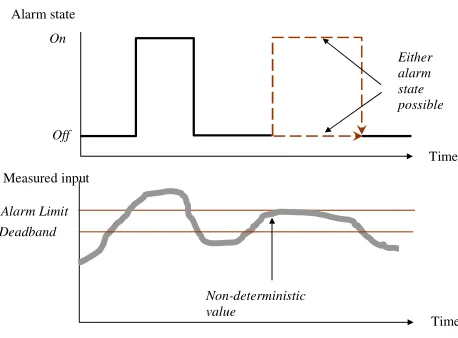
Fig. 1. Non-determinism due to smart device inaccuracy
The smart device measurement inaccuracy is represented by the thick grey line. If the internally measured value could lie on either side of the alarm limit (due to smart device measurement inaccuracy) then two alternative alarm states are possible. The test results only become deterministic when the measured value ensures that only a single alarm state is possible (e.g. when the measured value drops well below the deadband).
2.2 Discrete Sampling Intervals
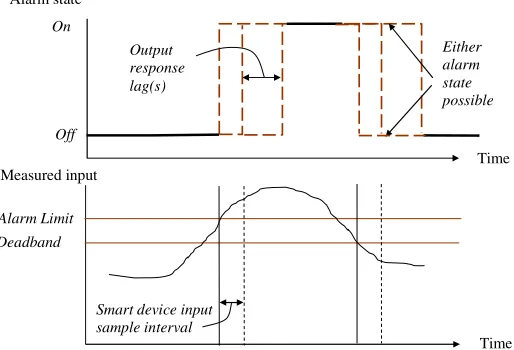
A similar non-determinism problem arises if smart device measurements are only performed at discrete time points (see Fig. 2).
Alarm state
Off On
Measured input
Alarm Limit Deadband
Time
Smart device input sample interval
Either alarm state possible
Time
[image:4.595.182.412.504.663.2]It can be seen that the device will not “see” a short excursion above the alarm limit if the measurement samples straddle the excursion (solid lines) but the device would see the excursion if a sample coincided with the excursion (dashed lines). As we have no way of knowing when the samples occur within the smart device, we cannot determine which alarm state is expected even if the test equipment and smart device were absolutely accurate.
2.3 Smart Device Lags
Even if the alarm activation decision is deterministic, there is still uncertainty about when the expected response will appear at the smart device output. This is illustrated in Fig. 3 below.
Alarm state
Off On
Measured input
Alarm Limit Deadband
Time
Smart device input sample interval
Either alarm state possible
Time
[image:5.595.169.426.315.490.2]Output response lag(s)
Fig. 3. Non-determinism due to uncertain response times
This arises from:
• uncertainty about when the smart device samples the input • lags introduced by internal filtering algorithms
• uncertainty about the computation time taken to decide the alarm state
• variation in the time needed to physically switch an alarm relay to another state
2.4 Non-determinism in the Test Harness
The test harness is also a source of non-determinism due to:
• Finite accuracy. This increases the uncertainty in the measured value as seen by the smart device.
deactivate a test relay, and this can extend the apparent time taken by the device in responding to the event.
3 Testing Non-deterministic Systems
To test smart instruments we have to address all the types of non-determinism described above. We can do it in the following way:
• smart device accuracy – by taking one of the approaches: (1) avoidance of inputs which are “close” to an alarm limit (i.e. beyond the inaccuracies introduced by the smart device and the test harness) or (2) detailed analysis of all the possible interpretations of the inputs by the device to assess which outputs may be correct • smart device sample rates – by holding the test value steady for a fixed “settling
time” before reading the result
• smart device response lags – by holding the test value steady for a fixed “settling time” before reading the result
• test harness – by allowing for the operation of test relays in the “settling time” (lags in the test relays) and taking the steps mentioned in bullet 1 (finite accuracy) Avoidance of inputs which are “close” to an alarm limit should, in theory, ensure that the smart device will respond in a deterministic way where each input measurement is interpreted as being definitely above or below the decision point. So we should be able to predict the alarm output values for each.
However this restricts the scope for realistic testing and may make the detection of some bugs impossible, e.g. a device may enter erroneous state after receiving a value which is interpreted as equal to the decision point. If we wish to simulate typical plant operation we should allow any realistic sequence of input values, including
• continuously changing values • inputs close to the alarm limit
If this is allowed, then analysis of the smart device outputs becomes much more difficult. The test result checker has to:
• identify when input values can result in different responses (given the uncertainties in accuracy and timing in the smart device)
• maintain different execution threads for the different input interpretations • accept a set of output results that agree with any current thread
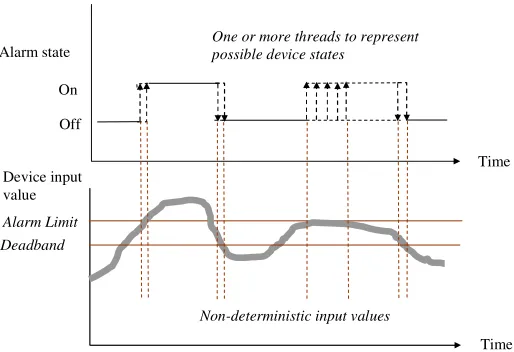
This mechanism is illustrated in Fig. 4. If the actual result does not correspond with a given thread, the thread is discarded. If all the threads are removed this way, the result checker indicates a potential error.
Alarm state
Device input value
Alarm Limit Deadband
Time
Non-deterministic input values
Time Off
On
[image:7.595.168.425.153.329.2]One or more threads to represent possible device states
Fig. 4. Handling non-deterministic test results
4 Black-box Testing Case Study
The smart device chosen for this study is a smart sensor alarm unit that can measure a plant parameter and raise an alarm if a programmable limit is violated. The smart sensor used in this study can monitor a wide range of plant measurements (via thermocouple, resistance, or 4-20mA input signals). The device controls four relay outputs to annunciate different alarm states.
The smart device can be configured to: • use different plant input sensors
• trigger an alarm on high or low measured values
• avoid alarm “jitter” by specifying latching, alarm delays and deadbands • detect rapid rates of change
• raise an alarm if internal errors are detected
The device also has LED status indicators which reflect the current state of each alarm relay. There is a push-button input that can be used to manually reset alarms that are configured to latch to the “on” state. The device can be configured via front panel pushbuttons and a display screen. It can also be programmed via configuration software running on a PC connected to the device by a serial interface.
5 Test Harness
Offline test data generator(s)
Test data
file On-line test
execution Test result checker
Test
result file Discrepancy
[image:8.595.127.468.155.222.2]reports
Fig. 5. Test harness elements
The harness comprises:
• An off-line test data generator. This produces test cases according to some strategy. The results are stored in a test data file.
• An on-line test execution system, which reads the test data file, applies the test to the smart device and records the result.
• An off-line result checker, which takes the test data file, computes the expected results and compares this against the result generated by the smart device.
We chose to use off-line test generation and checking because this gives us additional flexibility. If there are errors in the checker, the test result file is still valid, so we only need to fix the checker.
5.1 Test Data Generator
We developed an application for test data generation. The application generates tests using two different strategies:
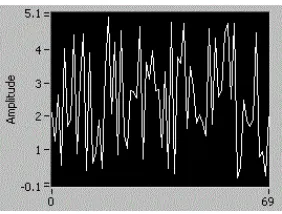
• Statistical tests. This is an approximation of plant transients where the input increases to some limit with random fluctuations. An example of a transient is depicted in Fig. 6.
Fig. 6. Simulated transient test sequence
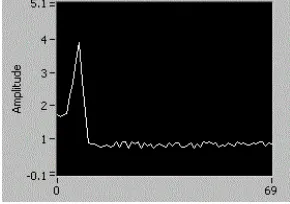
[image:8.595.230.375.490.592.2]Fig. 7. Random test sequence
5.2 On-line Test Execution System
The on-line test execution system comprised:
• a PC with analogue and digital interfaces connected to the smart device
• a LabVIEW program to read the data file with test cases to the smart device and record the results
PC
Smart Alarm device
Alarm relays Test value
from analogue output
Test relay control lines
Relay Relay
Test value manual reset
Analogue output
Measured value (smart device) Alarm states
Test value feedback
Fig. 8. Test harness schematic
[image:9.595.134.449.376.566.2]The test execution system is composed of:
• a personal computer, which runs a LabVIEW application controlling test execution and another application for configuring the smart sensor
• a card with relays extending the PC interface (InLog PCX-4288)
• a data acquisition device extending the PC interface (National Instruments USB-6008/6009)
• a smart sensor undergoing tests
• an analogue lab board providing voltage source for testing the state of the smart sensor
In this configuration, the test signal error was about ±10mV (around 0.2% of the full scale value).
The hardware was controlled by two Microsoft Windows application written in LabVIEW [3]. We developed:
• a manually operated test-bench application • an automated test execution application
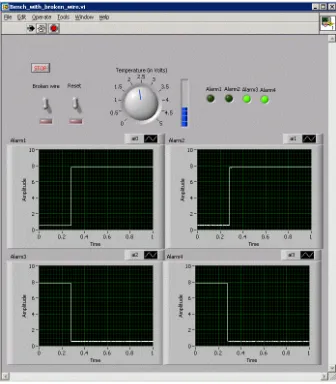
[image:10.595.219.387.403.595.2]The test-bench application was used to check out the hardware of our test execution system. It has a knob to adjust the input, diagrams, indicator lamps presenting the state of the alarms, and switches to simulate “broken wire” and pressing the reset button of the smart sensor. It also has four charts which display a diagram with the output from the alarms.
Fig. 9. Test-bench application (GUI)
The test execution application performs a set of pre-defined tests stored in a file created by the application for test data generation. The application has the following functionality:
• It reads output (i.e. the state of the analogue output and the state of the alarms) in a loop and writes it together with the corresponding input to a file.
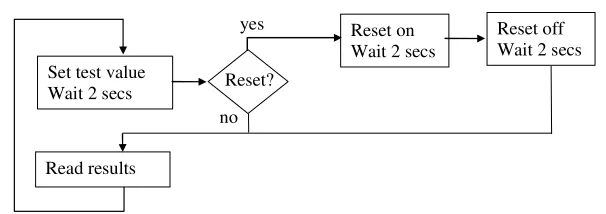
The model of the application is given in Fig. 10.
Set test value
Wait 2 secs Reset?
Read results
Reset on
Wait 2 secs Reset off Wait 2 secs yes
[image:11.595.143.446.186.293.2]no
Fig. 10. Test execution application model
Execution of one test takes 2s or 6s depending on whether a reset is part of the test. We found that we needed 2s for simulating the input because with shorter delays (e.g. 1s) behaviour of the smart sensor was unpredictable, i.e. many errors were recorded which could not be reproduced with the delay of 2s. We needed an additional 4s for simulating the reset button because the relay card we used is slow and with shorter delays it would be hard to be sure that the reset operation was simulated properly. A timing accuracy of 2s is acceptable for the device we have been analysing, but we plan to perform a more accurate response time analysis in subsequent research.
Apart from these two applications, we used another one developed by the manufacturer of the smart sensor in order to configure the smart device via a PC and read the state of the process variable of the device.
5.3 Test Analysis
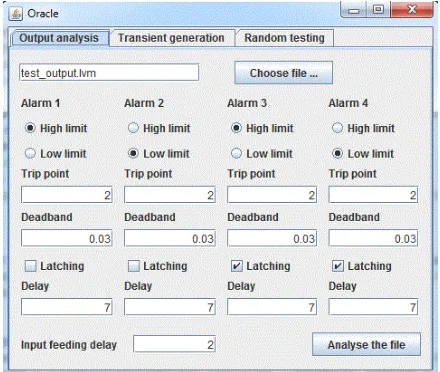
We implemented an off-line test results checker (an oracle) as an application. The result checking process is identical no matter which test data generation procedure is used. It takes the test result file comprising a sequence of smart sensor inputs and outputs and then checks if they agree with the internal model of the device built into the application. The model is a finite state machine defined based on the behaviour specified in the user manual. As the documentation is not precise, the model must try to take the weakest assumptions possible, i.e. permit all behaviours which do not conflict with the manufacturer’s documentation. If the outputs of the oracle and the actual result disagree, the checker generates a list of potential errors.
Fig. 11. Result checker interface
Given the input data, smart device configuration and delay data, the oracle can compute the result and compare it with the actual result. This is not as straightforward as it may first appear, as discrepancies can be generated if the expected result is not unique. Section 2 discusses the possible sources of non-deterministic results. The result checker has to identify all the possible interpretations of the inputs, and based on this data calculate all the possible states of the modelled device. If any of the threads has output values that match the test result, the result is accepted. If none of the states resulting from the inputs corresponds to the test result, a discrepancy is identified.
Our non-deterministic model initially assumed that the test value measured by the smart device is unchanged between test input changes. However, by monitoring the smart device display, we established that the measured value does in fact differ on successive internal measurements made by the device. This inherent variability due to periodic internal sampling had to be included in the non-deterministic result checking model by computing new threads at each potential sample point (using a configurable sample rate).
6 Testing and Test Results
We applied three test strategies to derive test cases for the device:
• Statistical testing. We generated and executed 4600 simulated plant transient test sequences. For realistic plant transients, this should give 99% confidence in 10-3
failures per demand if no discrepancies are detected by the result checker. Execution of one set of transients takes 8 days of continuous execution by the testing harness.
• Negative testing. We tested the device with:
− out of range inputs (20% above and below the accepted range) − valid, equivalent inputs and checking for variation in the output
− testing functional independence (i.e. where changes in the device configuration influence unrelated functionality)
− random testing (this time addressing independence and consistency of the behaviour of alarms)
− testing based on transients (this time addressing independence and consistency of the behaviour of alarms)
[image:13.595.142.446.300.381.2]Execution of the tests led to identification of a few potential discrepancies. Statistics about the detection rates for each of the strategies are presented in Table 1.
Table 1: Discrepancy detection rates
Number of discrepancies for a sampling rate Test strategy
non 1/sec 2/sec 30/sec
Statistical testing 25 13 10 10 Random testing 0 0 0 0 Negative testing 1 1 1 1
The table shows the number of discrepancies detected for each of the strategies in the function of the assumed device sampling rate. We can see that the number of discrepancies detected falls when we assume that the device may change interpretation of a constant input. The number of discrepancies becomes constant once the sampling rate is increased to 2/sec, which may correspond to the actual sampling rate of the device.
For each of the discrepancies detected we were able to identify the corresponding inputs and outputs and present them in the context of adjacent inputs and outputs using our analysis tool. An example is shown in Fig. 12.
Fig. 12. Discrepancy analysis
[image:13.595.130.489.506.644.2]we change some the assumptions made about the behaviour of the device. Some of the potential explanations are given below:
• We had assumed that all alarms use the same interpretation of the process variable. The data captured seems to suggest however that each of the alarms may interpret the input independently, e.g. an input value close to the limit may be interpreted by one of the alarms as being above and by another as being below the limit.
• Our test automation system assumes 2 seconds is sufficient time to wait for a stable response, however, for a small fraction of inputs, it seems this delay is insufficient. • We might have assumed too small a range around a decision point where the
interpretation of inputs is considered to be non-deterministic.
7 Discussion
From our case study it is clear that black-box testing is a non-trivial task. The number of discrepancies detected is very dependent on the accuracy of the model checker and its coverage of all sources of non-determinism in the expected result. We have independent evidence for believing that the smart device does in fact implement its alarm logic correctly, so the residual discrepancies are likely to be due to other sources of non-determinism that have not been included in the model checker.
Clearly we can continue to refine the model checker of smart device behaviour to reduce the discrepancies even further, but we need to consider whether this is a realistic approach. Effectively, we are inventing a smart device design that can explain the observed discrepancies, but in a black-box context, we can never be sure the inferred design is actually valid.
What we really need is a result checker that does not need to know about internal details (such as the sampling rate of the device) but is based solely on the published behaviour. One possible avenue that we intend to explore is the idea of defining a set of “invariant behaviours” derived from the public documentation, e.g.:
Test_input >> alarm_lim Alarm=ON
Test_input << alarm_lim_deadband Alarm=OFF
Note that the >> operator is used to denote “definitely greater given the published inaccuracy, and the condition has remained true for the smart device’s published maximum response time”.
If we do this, we have to accept that there are points in the test sequence where none of the invariants will apply and the model-checker simply has to ignore the results generated—discrepancies can only be checked when the invariant condition is active. There could also be difficulties with this approach because it assumes test points where the answer is unique, i.e. the possible states of the smart device converge to a single state. This may not always be true. For example:
• An alarm is configured to latch permanently if the limit is exceeded • The test sequence rises up to the limit then falls
expressed in some form of timed temporal logic [4]. We hope to investigate the feasibility of this approach in further research.
8 Conclusions
The paper presents a case study in which a test harness for a smart device was developed and used to execute a set of black-box test cases defined using several test strategies.
We showed that non-determinism of the smart device response makes the testing significantly more difficult. We have sought to address this problem by designing the result checker to explicitly allow for non-determinism. When a potentially non-deterministic test condition is detected, the result checker creates different “threads” representing alternative potential states of the device. Normally the threads recombine at a later point in time, when the input leaves the area “close” to limits because the threads will converge to an identical internal state. For example, after a certain amount of time above a trip limit, all threads will be in the alarm state.
This strategy has proved to be quite successful, but there are still some residual discrepancies that we suspect are false positives. These could probably be removed by increasing the complexity of the non-deterministic model of the device, but it is difficult to justify the model given that the device is a black-box.
In the next stage of research we plan to investigate less strict forms of model checking where we ignore all test cases where there is any uncertainty about the expected results.
Acknowledgments. The authors wish to acknowledge the support of UK C&I
Nuclear Industry Forum (CINIF) who funded the research presented in this paper.
References
1. Bishop, P., Bloomfield, R., Guerra, S., Tourlas, K.: Justification of Smart Sensors for Nuclear Applications, SAFECOMP 2005, LNCS 3688, pp. 194-207, Springer-Verlag, Berlin/Heidelberg, Germany (2005)
2. R Alur, TA Henzinger, A Really Temporal Logic, Journal of the ACM (JACM), Volume 41 , Issue 1, pp. 181 – 203 (January 1994)
3. National Instruments, LabVIEW, http://www.ni.com/labview (visited on 24/02/2010) 4. M Krichen, S Tripakis1, Black-Box Conformance Testing for Real-Time Systems, Lecture