8-13-1951
The beta-spectra of P-32 and P-33
Erling N. Jensen
Iowa State College
R. T. Nichols
Iowa State CollegeJ. Clement
Iowa State CollegeA. Pohm
Iowa State CollegeFollow this and additional works at:
http://lib.dr.iastate.edu/ameslab_iscreports
Part of the
Atomic, Molecular and Optical Physics Commons,
Nuclear Commons, and the
Quantum Physics Commons
This Report is brought to you for free and open access by the Ames Laboratory at Iowa State University Digital Repository. It has been accepted for inclusion in Ames Laboratory ISC Technical Reports by an authorized administrator of Iowa State University Digital Repository. For more information, please [email protected].
Recommended Citation
Jensen, Erling N.; Nichols, R. T.; Clement, J.; and Pohm, A., "The beta-spectra of P-32 and P-33" (1951).Ames Laboratory ISC Technical Reports. 27.
14.3-day beta activity, as determined from several Kurie plots, was found to be 1.704 +/- 0.008 Mev. The Kurie plots gave excellent straight lines from the maximum beta-energy to about 0.26 Mev. In phosphorus samples prepared from neutron irradiated sulfur an additional beta-activity was observed having a maximum energy of 0.26 +/- 0.02 Mev and a half-life of 24.8 +/- 0.5 days. This low-energy beta-group was also observed in phosphorus samples prepared from sulfur and lithium chloride irradiated with X-rays having a maximum energy of 68 Mev. The low-energy beta-group was not observed in phosphorus samples prepared from sulfur irradiated with deuterons or phosphorus irradiated with neutrons . The low-energy beta-group is ascribed to P-33.
Keywords
Ames Laboratory, Atomic Research, Physics Disciplines
Atomic, Molecular and Optical Physics | Nuclear | Physics | Quantum Physics
THE BETA-SPECTRA OF P
32AND p
33By
Erling N. Jensen
R. T. Nichols
J. Clement
A. Pohm
August 13, 1951
Ames Laboratory
Work performed under Contract No. W-7405-eng-82. ·
by
Erling N.
Jensen~R. T. Nichols, J. Clement and A. Pohm
Institute for Atomic Research and Department of Physics,
Iowa State College,*
Ames~Iowa
August 13, 1951
Abstract
The beta-spectrum of p32 has been examined with a
thin-lens spectrometer.
The maximum energy of the 14.3-day
beta-a
c
tivity, as determined from several Kurie plots, was found
to be 1.704
~0.008 Mev.
The Kurie plots gave excellent
straight lines from the maximum beta-energy to about 0.26 Mev.
Ir. phosphorus samples prepared from neutron irradiated sulfur
an additional beta-activity was observed having a maximum
energy of 0.26
~0.02 Mev and a half-life of 24.8
~0.5 days.
This low-energy beta-group was also observed in phosphorus
sample
s prepared from sulfur and lithium chloride irradiated
with X-rays having a maximum energy of 68 Mev.
The low-energy
beta-group was not observed in phosphorus samples prepared from
sulfur irradiated with deuterons or phosphorus irradiated with
ne
utrons
.
The low-energy beta-group is ascribed to p33.
The beta-radiations
from
p32 have been examined with
various types of spectrometers by a number of investigators. 1
1
L. M. Langer and H. C. Price, Jr., Phys. Rev. 76, 641 (1949).
Peacock, Jones, Overman, Plutonium Project Report Mon
N-432,
56 (1947).
K. Siegbahn, Phys. Rev. 70, 127 (1946); Nature
153, 221 (1944).
C. M. Witcher,
Phy~Rev.
60, 32 (1941).
~L.Lawson, Phys. Rev. 56, 131 (1939).
E.~.Lyman, Phys.
Rev. 51, l (1937).
-Since the more recent of these investigations have shown that
the Kurie plot of the p32
spectrum
is a good straight line, it
was felt that this would be an excellent beta-spectrum with
which to check the performance of a thin-lens spectrometer. 2
2Jensen, Laslett, and Pratt, Phys. Rev. 75, 458 (1949).
The initial work on the beta-spectrum of p32 was done in Dec.
1948.
Since then the spectrometer has been modified to
in-corporate ring focusing.3
In
determining the beta-spectrum of
3pratt, Boley, and Nichols, Rev. Sci. Instr. 22, 92
(1951).
Keller, Koenigsberg,
and
Paskin, Rev. Sci. Instr. 21, 713
(1950).
p32 a low-energy beta-component was observed in the Oak Ridge
carrier-free samples which has a half·- life of 24
,
8
::l0.
5
days
and a maximum beta-energy of 0.26
::l0.02 Mev.
This half-life
Laboratory at Iowa State College.4
4Ames
Laboratory of the
U.
S. Atomic Energy Commission, Progress
Reports in Physics, ISC-46, June 16, 1949; ISC-73, March 23,
1950; ISC-104, September 25, 1950; ISC-135, March 15, 1951.
The results of a part of this work was reported at the
Washing-ton,
D.
C.
meeting of the Am. Phys. Soc., April, 1951; Bull.
Am. Phys. Soc. 26, No.
3,
24 (1951).
At the same meeting
Sheline,
Holtzman, and Fan reported on a p33 activity which
was formed by gamma reactions on sulfur and chlorine; Bull.
Am. Phys. Soc. 26, No.3, 24 (1951).
During the progress of this investigation Agnew5 and
5H.
M. Agnew, Phys. Rev. 77, 655 (1950).
Warshaw, Chen, and Appleton6 have reported on the
beta-6warshaw, Chen, and Appleton, Phys. Rev. 80, 288 (1950).
spectrum
of
·
p32 and observe a distinct excess of electrons in
the
momentum spectrum below about 300 kev.
Agnew5 states that
"the
p32
was followed for five half-lives with no change in the
Fermi
plot." Warshaw et g.6 state that "the spectrum has been
followed for several half-lives with no change in shape." The
data presented in this paper are in disagreement
~iththese
results since the half-life of 24.8
tl0.5 days for the
low-energy
beta-group is appreciably different from the 14.3-day
half-life of p32 .
our
·
data indicate that there is an
observ-able difference in shape of the beta-spectrum at low energies
over
a
period of one half-life of p32.
The low-energy beta-group present in the Oak Ridge
carrier-free p32 is believed to be due to p33.
This assignment is based
•
chloride irradiated with X-rays, from the Iowa State College
Synchrotron, having a maximum energy of 68 Mev.
Recently Yaffe and Brown7 have reported that they have
7 L. Yaffe and F. Brown, Bull. Am. Phys. Soc. 26, No. 1, 45 ( 1951) •
prepared p33 by the reaction p3 2 (n, ~)p33. They found a
half-life of 22 % 5 sec for this activity. Their results are based
on the assumption that their target material was pure p32.
The data presented in this paper indicate that p32 prepared by
neutron irradiation of sulfur also contains initially about
2.5 atoms of p33 per 100 atoms of p3 2 • Hence, in irradiating
p3 2 with neutrons i t is possible to form both p33 and p34. We
have found a half-life of 24.8 ~ 0.5 days for p33. Bleuler
and zHnti8 have reported a half-life of 12.4 sec for p34. It
8E. Bleuler and W. zllnti, Helv. Phys. Acta 19, 137 (1946).
seems
p~ssible
that the activity reported by Yaffe and Brown7is that of p34 and not p33.
All of the phosphorus samples examined with the thin-lens
spectrometer were mounted on thin Formvar-polystyrene films
having a surface density of about 40 ,)-'- g/cm2 • The G-M counter
window was a Formvar film of surface density about 0.3 mg/cm2 .
No corrections have been made for the absorption due to the
G-M counter window. The resolution of the spectrometer (full
Fig. 1
Fig. 2
.Fig. 3
II. Beta-Spectrum of p32
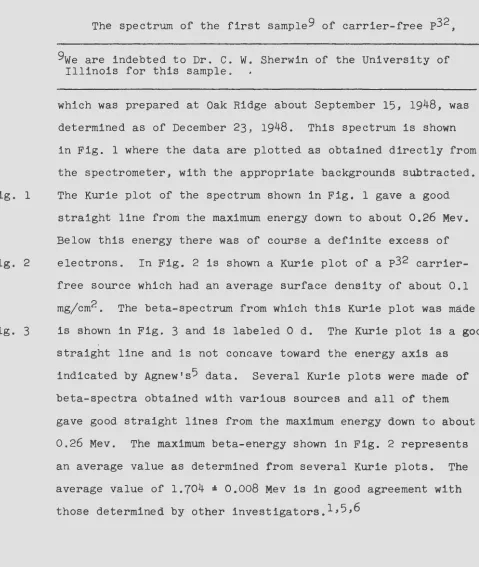
The spectrum of the first sample9 of carrier-free p3 2 ,
9we are indebted to Dr. C. W. Sherwin of the University of Illinois for this sample.
which was prepared at Oak Ridge about September 15, 1948, was
determined as of December 23, 1948. This spectrum is shown
in Fig. 1 where the data are plotted as obtained directly from
the spectrometer, with the appropriate backgrounds subtracted.
The Kurie plot of the spectrum shown in Fig. 1 gave a good
straight line from the maximum energy down to about 0.26 Mev.
Below this energy there was of course a definite excess of
electrons. In Fig. 2 is shown a Kurie plot of a p32
carrier-free source which had an average surface density of about 0.1
mgjcm2 . The beta-spectrum from which this Kurie plot was made
is shown in Fig. 3 and is labeled 0 d. The Kurie plot is a good
straight line and is not concave toward the energy axis as
indicated by Agnew•s5 data. Several Kurie plots were made of
beta-spectra obtained with various sources and all of them
gave good straight lines from the maximum energy down to about
0.26 Mev. The maximum beta-energy shown in Fig. 2 represents
an average value as determined from several Kurie plots. The
average value of 1.704 ~ 0.008 Mev is in good agreement with
[image:9.564.46.525.82.649.2]25 I&J
....
i20 2 p32 a:: I&J CL. en 15....
z ;:::) 0 0 LL. 010 en 0 I&J a:: 0 z;:::) 5 :r
OL---~~---~----~~----~---.---,,-~---J----~
0 2 3
I I
0 2 3 4 I
4
I 5
5 7 I
I 6
Figo
1. Beta-spectrum of carrier-free P32 which had decayed for
about 99 dayso
A second beta-group is apparent at the
low-energy end of the spectrtimo
I is the current in
1.5
2.0
2.!5
3.0
3.5
4.0
4.5
Energy in mel units
Figo
2oKurie plot of P
32 oThe beta-spectrum from which this
Kurie plot was made is shown in Figo 3 and labeled 0 d ..
The maximum beta-energy of
1~704*
Oo008
Mev represents
• 139d
Sn(n,p)P32
FROM OAK RIDGE PILE
0~~--~----~----~----~----~----,---r~--~
0
2
3 4 5 67
X to' Hp [image:12.564.14.553.25.706.2]III. The Low-Energy Beta-Group
A. Half-life and Maximum Beta-Energy
The spectrometer source from which the spectrum shown in
Fig. l was obtained was followed for
36
days, during which timethree additional beta-spectra were obtained. In each
succeed-ing spectrum the low-energy beta-group became more prominent
in comparison to the p32 beta-component.
The second and third samples of carrier-free p3 2
were received dir-ectly from Oa.l< Ridge and their initial spectra
determined as of July 29, 1949 and April
7,
1950 respectively.The secona sample was followed with the spectrometer for
57
days, during which time four beta-spectra were determined.
The third sample was followed for 139 days, during which time
seven beta-spectra were determined. Six of these spectra are
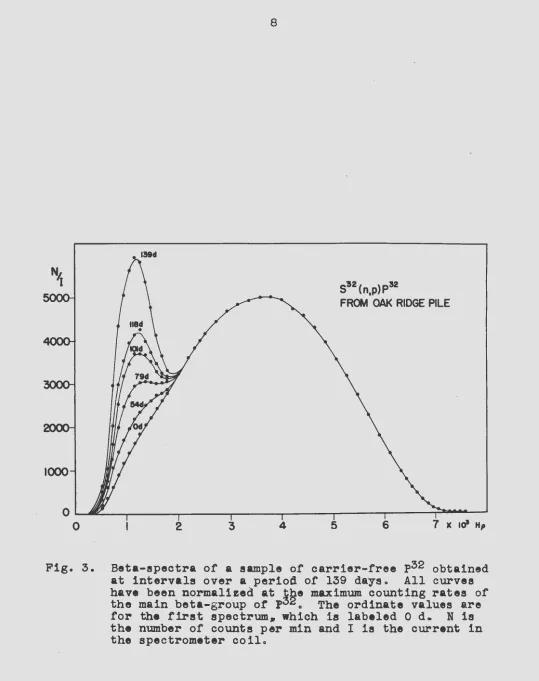
shown in Fig.
3
and have been normalized at the maximumcount-ing rates of the p32 beta-spectrum. The ordinates of the graph
are applicable to the curve labeled 0 d. The first spectrum
and the one determined 54 days later (labeled 0 d and 54 d
respectively in Fig. 3) were obtained with one spectrometer
source, while the other curves were obtained from a second and
somewhat thicker spectrometer source, both of which were
pre-pared from the third sample of carrier-free p32. Samples one
and two gave beta-spectra similar to those shown in Fig.
3.
In the first beta-spectrum determined on samples two and three
the low-energy beta-group could not be observed with certainty
and could readily be attributed to the effect of a thick source.
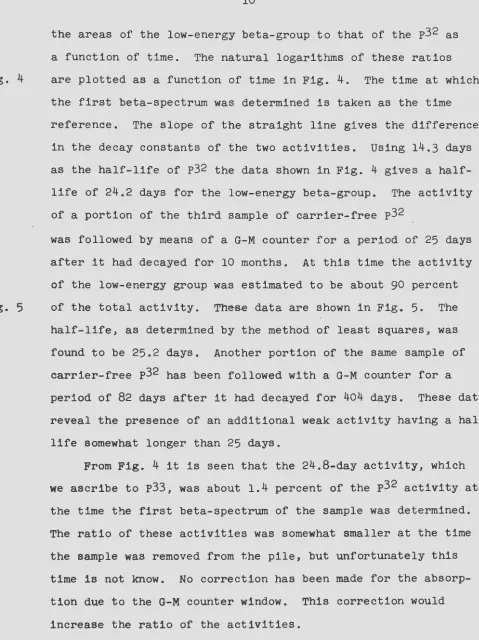
The half-life of the low-energy beta-group was determined
Fig. 4
Fig.
5
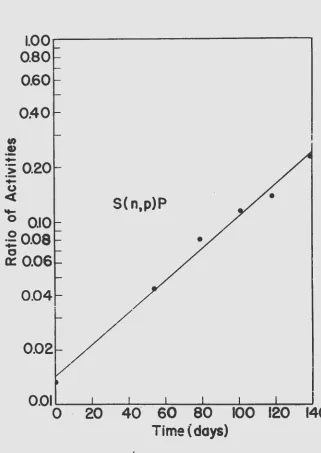
are plotted as a function of time in Fig. 4.
The time at which
the first beta-spectrum was determined is taken as the time
reference.
The slope of the straight line gives the difference
in the decay constants of the two activities. Using 14.3 days
as the half-life of p32 the data shown in Fig. 4 gives a half
·
-life of 24.2 days for the low-energy beta-group.
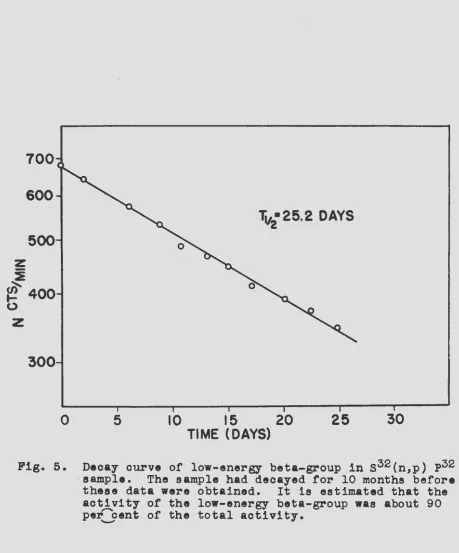
The activity
of a portion of the third sample of carrier-free p32
was followed by means of a G-M counter for a period of 25 days
after it had decayed for 10 months.
At this time the activity
of the low-energy group was estimated to be about 90 percent
of the total activity.
Thesedata are shown in Fig. 5.
The
half-life, as determined by the method of least squares, was
.
found to be 25.2 days.
Another portion of the same sample of
carrier-free p32 has been followed witn a G-M counter for a
period of 82 days after it had decayed for 404 days.
These data
reveal the presence of an additional weak activity having a
half-life somewhat longer than 25 days.
From Fig. 4 it is seen that the 24.8-day activity, which
we ascribe to
p33,
was about 1.4 percent of the p32 activity at
the time the first beta-spectrum of the sample was determined.
The ratio of these activities was somewhat smaller at the time
the sample was removed from the pile, but unfortunately this
time is not know.
No correction has been made for the
absorp-tion due to the G-M counter window.
This correction would
[image:14.564.40.519.45.685.2]Fig .. 4.
1 . 0 0 . . . - - - ,
(I)
CD
·-~
0.80
0.60
0.40
0
0.10
~0.08
0
0::
0.06
S( n,p)P
.
[image:15.566.122.443.152.605.2]700
z
:E
600
500
~
~
400
0z
300
0
5
10
15
20
25
30
TIME (DAYS)
[image:16.564.46.505.89.642.2]The maximum energy of the low-energy beta-group, which was determined from the various beta-spectra and Kurie plots by noting the energy at which the low-energy beta-group became apparent on the respective curves, was found to be 0.26 ~ 0.02 Mev. An effort was made to obtain Kurie plots of the low-energy beta-group, but these were unsatisfactory due to the thick sources used.
By deflection of the beta-particles in a magnetic field itwas found that the low-energy beta-group consists of
negative electrons. 91oud chamber pictures obtained with a sample of p32 that had decayed for 12 months, at which time it was estimated that the activity of the low-energy group was about 96 percent of the total activity, also confirmed the fact that the radiation consists of negative electrons.
There is a possibility that the low-energy beta-group
could be due to a contaminant that is not sufficiently removed
by the chemical purification process of the neutron irradiated
sulfur. The first consideration is that of s35. However, the half-life and maximum beta-energy of s35 are 87.1 days and
0.166 Mevl0 respectively. This possibility is excluded since
l 0way, Fano, Scott, and Thew, Nuclear Data, Nat. Bur. Standards Circular 499 (1950).
these values are not in agreement with those of the low-energy beta-group given above. s37 is not a possibility since its
half-life is only 5.0 min. 10 In fact there is no known
beta-activity with a half-life of 24.8 :1: 0.5 days and maximum
during chemical purification would perhaps be considerably
greater than in the carrier-free p32. One such waste fraction
was obtained from Oak Ridge and its spectrum determined with
the spectrometer. This sample was rather weak, but practically
all of the activity was due to p32. The low-energy group was
present, but not to any greater extent than in other
carrier-free p3 2 samples. He~ce, the low-energy beta-group does not
appear to be due to a contaminant in the target material.
The carrier-free p3 2 produced at Oak Ridge is formed by a
s32(n,p)p32 reaction. Since the isotopes of sulfur are 32
(95.00%), 33(0.74%), 34(4.24%), and 36(0.017%) 11 the nuclear
11 Way, Wood, and Thew, Nuclear Data, Supplement 1, Nat. Bur.
Standards Circular 499 (1951).
reactions s33(n,p)p33, s34(n,p)p34, and s36(n,p)p36 would also
be possible. p3 4 is known to have a half-life of 12.4 sec8
and is therefore eliminated as a possibility. This leaves the
' possibility of the low-energy beta-group as being due to p33
or p36. Since s36 has a very low abundance the cross section
for the s36(n,p)p36 reaction would have to be very large if
the low-energy beta-group were due to p36. This is, of course,
a possibility. Another possibility is that p33 is formed by a
second order (n,
V)
reaction on p32. This is very unlikelyunless p32 has an extremely large thermal neutron cross section.
neutronsjcm2 jsec the thermal neutron cross section of p32 would
have to be about 31,000 barns in order for the activity of the
p33 to be one percent of the p3 2 activity at the end of the
irradiation time.
B. Beta-Spectra of p3 2 Prepared by MethodB other than S(n,p)P
Radioactive p3 2 can also be prepared by a p3l(n, )f)p32
reaction. 12 . Since stable phosphorus consists of a single
12seren, Friedlander, and Turkel, Phys. Rev. 72, 888 (1947).
isotope, 13 p32 is the only isotope formed by a (n, y) reaction.
13 F. W. Aston, Mass Spectra and Isotopes ( E. Arnold and
Co.,
London, 1942)-.--It would be possible to form p33 by a second order (n,
V)
reaction on p3 2 . If p33 were to be detected in the spectrometer
by this reaction the cross-section for the p32(n, y)p33 reaction
would have to be very large. For a 14 day irradiation of p3l
at a flux of 3 x 10¹³ neutronsjcm2 jsec the thermal neutron
cross section of p3 2 would have to be about 980 barns in order
for the activity of the p33 to be one percent of the p32
activity at the end of the irradiation time. The thermal
neutron cross section of p3l is 0.15 barn. 14
14H. Pomerance, ORNL-577, 25 (1949) and ORNL-366, 43 (1949).
A sample of p32, prepared by a p3l(n, \()p32 reaction, was
obtained from Oak IUdge. As reported previouslyl5 this sample
Fig.
6
sulfur. However, the data were not conclusive since the sample
had a low specific activity and therefore could not be followed
in the spectrometer for a sufficiently long period of time.
Two other higher specific activity sources of p32, prepared by
a p3l(n, ~)p32 reaction, were obtained, one from Oak Ridge and
one from Chalk River. The low-energy beta-group was not observed
in either one of these samples. The appearance of the low-energy
beta-group in the first p3 2 sample prepared by a p3l (n,
¥')
p32reaction is unexplained.
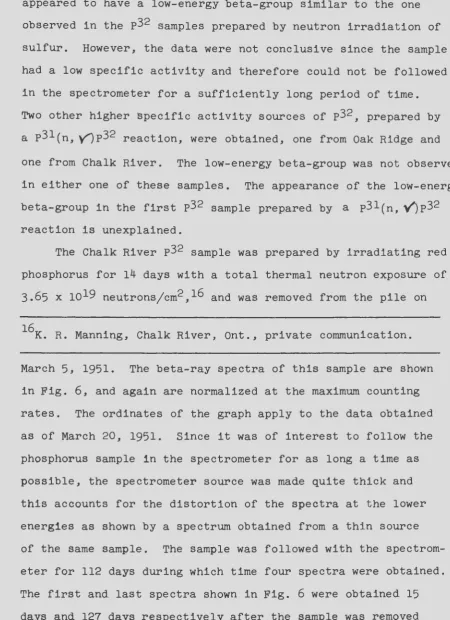
The Chalk River p32 sample was prepared by irradiating red
phosphorus for 14 days with a total thermal neutron exposure of
3.65 x 10 1 9 neutronsjcm2 , 1
6
and was removed from the pile on16
K. R. Manning, Chalk River, Ont., private communication.
March 5, 1951. The beta-ray spectra of this sample are shown
in Fig.
6,
and again are normalized at the maximum countingrates. The ordinates of the graph apply to the data obtained
as of March 20, 1951. Since it was of interest to follow the
phosphorus sample in the spectrometer for as long a time as
possible, the spectrometer source was made quite thick and
this accounts for the distortion of the spectra at the lower
energies as shown by a spectrum obtained from a thin source
of the same sample. The sample was followed with the
spectrom-eter for 112 days during which time four spectra were obtained.
The first and last spectra shown in Fig. 6 were obtained 15
[image:20.562.67.518.74.695.2]N/1
10,000
9000
8000
7000
6000
1000
p31 <
n.r
> p32FROM CHALK RIVER PILE
o 3-20-51 (Od)
+ 4-12-51 (23d)
~ 5-17-51 (58d)
• 7-10-51 (112d)
OL-~--~---
~---.---,,---.---r----~~~--0 2 3 4 6 7 X 10³ Hp
Fig. 6.
Beta-ray spectra of p32 sample prepared by a p3l(n,()p32
reaction.
These four spectra were obtained over a period
of
112 dayso
The spectra have been normalized at the
maximum counting rates ..
The
ordinates
apply to the
spectrum determined as of March 20$
195lo
The distortion
of
the spectra at low energies is due to a thick sourceo
The last spectrum was determined
127
days after the sample
was
removed
from the pileo
N is
the
number of counts per
[image:21.564.28.546.17.724.2]of the low-energy beta-group observed in the Oak Ridge
carrier-free p3 2 prepared by neutron irradiation of sulfur. The
spectrum shown in Fig.
6
which was determined as of July 10,1951 had a maximum N/I value of 43.8.
The second sample of p32 prepared by a p3l(n, y)p3 2
reac-tion, which was received from Oak Ridge, was followed with the
spectrometer for a period of
47
days during which time threespectra were obtained. The first and last spectra of this
sample were obtained 45 days and 92 days respectively after
the sample was removed from the pile. As in the case of the
Chalk River sample the three spectra were essentially identical
and there was no evidence of the low-energy beta-group. It is
therefore concluded that the low-energy beta-group observed in
the Oak Ridge carrier-free p32, which is prepared by neutron
irradiation of sulfur, is not present in p3 2 samples pr~pared
by a p3l(n,~)p32 reaction.
Since the low-energy beta-group is present in p3 2 samples
prepared by neutron irradiation of sulfur but is not present
in p32 samples prepared by neutron irradiation of phosphorus
i t follows that the low-energy beta-group cannot be due to a
second order (n, ~) reaction on p3 2 . If this were the case
the low-energy beta-group would be much more prominent in the
Chalk River sample than in the Oak Ridge p3 2 samples prepared
by neutron irradiation of sulfur due to the higher neutron
flux of the Chalk River pile. However, it does not rule out
Fig. 7
or possibly p36 as a result of (n,p) reactions on s33 and s36
respectively.
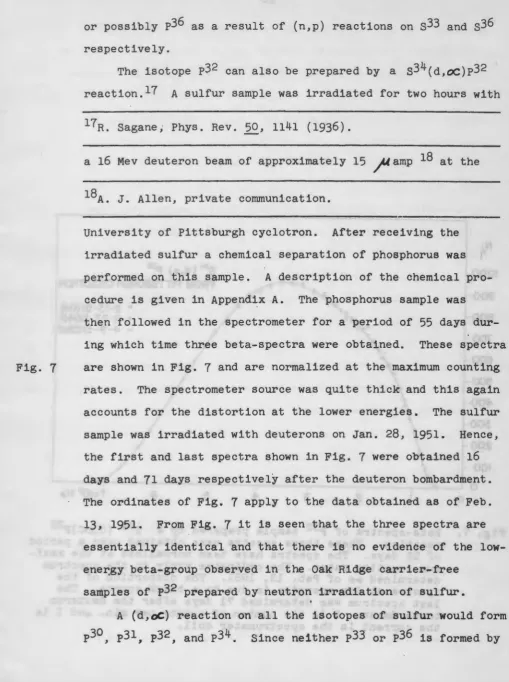
The isotope p3 2 can also be prepared by a s34(d,oc)p32
reaction.l7 A sulfur
sample
was irradiated for two hours with
17R. Sagane;
Phys.
Rev.
50,
1141 (1936).
a
16
Mev deuteron beam of approximately 15
~amp
18 at the
l8A.
J.
Allen, private communication.
University
of Pittsburgh cyclotron.
After receiving the
irradiated
sulfur a chemical separation of phosphorus was
performed on this sample.
A description of the chemical
pro-cedure is given in Appendix A.
The phosphorus sample was
then followed in the spectrometer for a period of 55 days
dur-ing which time three beta-spectra were obtained.
These spectra
are shown in Fig. 7 and are normalized at the maximum counting
rates. The spectrometer source was quite thick and this again
accounts for the distortion at the lower energies.
The sulfur
sample was irradiated with deuterons on Jan.
28,1951.
Hence,
the first and last spectra shown in Fig. 7 were obtainedl6
days and 71 days respectively after the deuteron bombardment.
The ordinates of Fig. 7 apply to the data obtained as of Feb.
13, 1951.
From Fig. 7 it is seen that the three spectra are
essentially identical and that there is no evidence of the
low-ener:gy beta-group observed in the Oak Ridge carrier-free
samples of p32 prepared by neutron irradiation of sulfur.
[image:23.560.15.525.47.730.2]~I
1000
900
800
700
600
500
400
200
100
0
0
2
3
4g34 (
d,a)p32
FROM PITTSBURGH CYCLOTRON
5
6o 2-13-51 (Od)
• 2-27-51(14<1) + 4-9-5t(55d)
7xl~ Hp
Fis. 7.
Beta-spectra of
p32sample prepared by a
s34(d,cC
-
) r
2reaction.
These three spectra were obtained over a period
of 55
day~.The spectra have been normalized at the
maxi-mum counting rates.
The ordinates apply to the spectrum
determined
a~of Feb. 13, 1951.
The distortion of th
spectra at low energies is due to a thick sour
c
e.
.
The
last spectrum was determined 71 days after the deutaron
bombardment.
N is the number of counts per
min~4nd I
i~this reaction and since p32 is the only activity apparent in Fig. 7 i t follows that these data are also consistent with the possibility that the low-energy beta-group observed in p3 2
samples prepared by neutron irradiation of sulfur is due to
p33 or possibly p36.
Another method of forming p3 2 is by a (
y-
,p) reaction onsulfur. This reaction on all the isotopes of sulfur would form
p3l, p32, p33 and p35. Perlmanl9 has repo.rted that at 50 Mev
l9M. L. Perlman, Phys. Rev. 75, 988 (1949).
and 100 Mev the ( V',pn) yield on the reaction Ge7°( '(",pn)Ga68
is of the same order as ( ~,p) yields on five isotopes reported
by Perlman and Friedlander. 20 Other (y',pn) reactions have been
20
M. L. Perlman and G. Friedlander, Phys. Rev.~. 442 (1948).
reported by Hoffman21 £A4°( Y',pn)cl38J, Moses22 £wl82( y,pn)
21M. Hoffman, Bull. Am. Phys. Soc. 26, No.3, 24 (1951). 22A. J. Moses, Masters -Thesis, Iowa State College (1950).
Tal80_7, and Katz and Penfold2 3 f s 3 2 ( y,pn)p3°J. Moses22 also
2 3L. Katz and A. S. Penfold, Phys. Rev. 81, 815 (1951).
found that the yield for the ( '(",pn) reacti;n on w18 2 was of the
same order as the ( ~,p) reaction on W at maximum X-ray energies
of 30 Mev and 68 Mev. Hence, in irradiating sulfur with X-rays
one would expect to form p30, p3l, p32, and p34 by ( '(",pn)
reac-tions. The radioisotopes expected to be formed by irradiating sulfur with X-rays, and having appreciable half-lives, are those
of p32 and p33.
Fig.
8
separation is given in Appendix B.
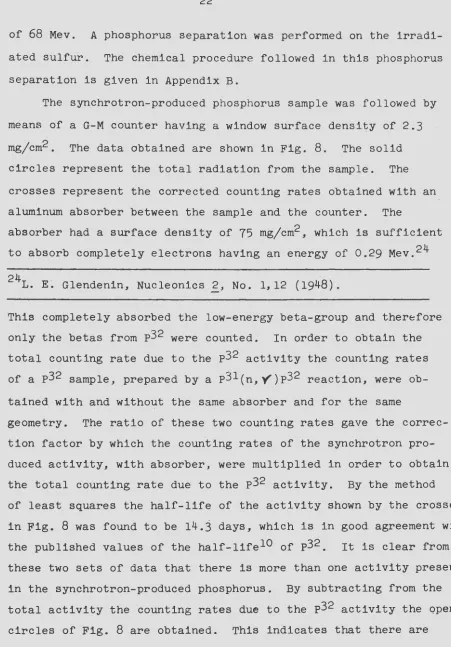
The synchrotron-produced phosphorus sample was followed by
means of a G-M counter having a window surface density of 2.3
mgjcm2 . The data obtained are shown in Fig.
8.
The solidcircles represent the total radiation from the sample. The
crosses represent the corrected counting rates obtained with an
aluminum absorber between the sample and the counter. The
absorber had a surface density of
75
mgjcm2 , which is sufficientto absorb completely electrons having an energy of 0.29 Mev. 2 4
24L. E. Glendenin, Nucleonics
_g,
No. 1,12 (1948).This completely absorbed the low-energy beta-group and therefore
only the betas from p3 2 were counted. In order to obtain the
total counting rate due to the p32 activity the counting rates
of a p32 sample, prepared by a p31 (n, "(') p32 reaction, were
ob-tained with and without the same absorber and for the same
geometry. The ratio of these two counting rates gave the
correc-tion factor by which the counting rates of the synchrotron
pro-duced activity, with absorber, were multiplied in order to obtain
the total counting rate due to the p3 2 activity. By the method
of least squares the half-life of the activity shown by the crosses
in Fig.
8
was found to be14.3
days, which is in good agreement with the published values of the half-lifelO of p32. It is clear fromthese two sets of data that there is more than one activity present
in the synchrotron-produced phosphorus. By subtracting from the
total activity the counting rates due to the p3 2 activity the qpen
[image:26.564.76.527.49.696.2]~ 400 ::) z
z
20""-..
~ z ::)
0
u
2
100
PHOSPHORUS ACTIVITY PRODUCED
IN SULFUR BY SYNCHROTRON BEAM
• TOTAL ACTIVITY
+ pit ACTIVITY
o P33 ACTIVITY
4 8 12 16 20 24 28 32 36 40 44 48 52 ~ 60 64 68
TIME (DAYS)
Fig~
So
Phosphorus activities produced in sulfur irradiated
with X-rays from the synchrotrono
The solid circles
represent the total activity while the crosses
re-present
~hecorrected counting rates obtained with a
75 mg/cm aluminum absorber.
The ODen circles, which
were obtained by subtracting the p3Z activity t'rom
the total
ac~ivity,represent the activity of the
This is in good agreement with the half-life values of 25.2
and 24.2 days found for the low-energy beta-groups in the
carrier-free p3 2 prepared by neutron irradiation of sulfur. A
previous run on sulfur irradiated with X-rays from the
synchro-tron gave half-life values of 14.4 days for the p32 activity
and 25.2 days for the low-energy beta-group.
After corrections were applied for the counter window,
air absorption, cellophane covering of the source and self
scattering due to source weight 2 5 to the initial activities of
2 5Engelkemeir, Seiler, Steinberg, and Winsberg, National Nuclear Energy Series 9, paper 4, 56 (1951).
p3 2 and the low-energy beta-group as given by Fig.
8
it wasfound that the initial activity of the low-energy beta-group
was 45 percent of the total activity. This is about the
activity expected for a 30 hr irradiation of sulfur on the
assumption that the cross sections for (
y,p)
on s33 and s34and (
~,np)
on s3 4 are all equal. This activity is much larger than the 1.4 percent found i~ the phosphorus samples preparedby neutron irradiation of sulfur. This is to be expected
since the abundances of s33 and s34 are 0.74 percent and 4.24
percent respectively.
A sample of lithium chloride was al~o irradiated with the
X-rays from the synchrotron at the same time as the sulfur
sample was irradiated. 'J'he phosphorus separation performed
Fig. 9
was followed by means of the same G-M counter and in precisely
the same manner as the phosphorus sample obtained from the
synchrotron irradiation of sulfur. These data are shown in
Fig. 9. In this case the half-life of the p3 2 activity was
deter-mined as 15.2 days while the low-energy beta-group was found to
have a half-life of 24.7 days which is in excellent agreement
with that determined from Fig. 8. The phosphorus activities
are presumably due to the reactions cl35( ~,2p)p33, cl35( ~,n2p)
p32, and Cl37( yr,oe)p33. Again applying the appropriate
cor-rections i t was found that the initial activity of the
low-energy beta-group was 48 percent of the total activity.
C. Discussion
In the experiments described above radioactive phosphorus
has been produced by five different reactions. In all of these
reactions, except p3l(n, ~)p32, a phosphorus separation was
made on the irradiated material before the radiations were
examined. Table I gives a summary of the results and the
possible isotopes formed by each reaction. The isotopes p3°
and p34 can be eliminated fr·om consideration since their
half-lives are 2.18 min26 and 12.4 seeS respectively. The only other
26J. Cichocki and A. Soltan, Compt. rend. 207, 423 (1938).
isotope, in addition to p3 2 , that is present in all three
reac-tions £s(n,p)P, S( V",P )P, and C
<
y,2p~
y,n2p PJ
in which thelow-y,pn
y,
oCenergy beta-group is present is that of p33. Neither p35 nor
2000
1000
800
600
~
PHOSPHORUS ACTIVITY PRODUCED IN CHLORINE fJY SYNCHROTRON BEAM
• TOTAL ACTMTY
+
P• ACTIVITY ACTIVITYz 100 :::>
8
8060
loL-~-.~--~~~~--~,--.~--~,--.-.--.-,--r~--1
0 4 8 12 16 20 24 28 32 36 40 44 48 52 TIME (UAYS)
[image:30.564.20.546.26.697.2]Table I
Summary of results on phosphorus activities
produced by various reactions
Reaction
Presence
Presence of
Possible formation
of p32
low-energy
of phosphorus
beta-group
isotopes
l .
S(n,p)P
Yes
Yes
32,
33,
34,
36
2. p31 (n,
Y')p32
Yes
No
32
3. S ( d,oc) P
Yes
No
30,
31, 32,
34
4. S( '('
,p)P
v'
,pn
Yes
Yes
30,
31, 32, 33, 34, 35
(y,2p'
34,
5. C
y,n2p P
Yes
Yes
31, 32, 33,
35
[image:31.570.8.557.32.699.2]due to p33. The p33 is formed by the reaction s33(n,p)P33.
Our results indicate that p33decays by negatron emission with
a maximum beta-energy of 0.26 ~ 0.02 Mev and a half-life of
24.8 ~ 0.5 days. This half-life value is the mean of the five
experimental values. The ratio of the initial activity of p33
to p3 2 in carrier-free p32 is about 1.4 percent.
Using a maximum beta-energy of 0.26 Mev, a half-life of
24.8 days and an f value of 0.055, obtained from the graphs by
Feenberg and Trigg, 2 7 it is found that p33 has a log ft value
2 7E. Feenberg and G. Trigg, Revs. Modern Phys. 22, 399 (1950).
of 5.1. According to Nordheim28 this is a normal allowed
28L. W. Nor dh i e
m,
Phys. Rev. 1_, 8 2 4 ( 9 195 0) .transition. The spin of s33 is known to be 3/2. 2 9,·3° The
2 9c. H. Townes and S. Geschwind, Phys. Rev. 74, 626 (1948).
3°Eshbach, 'Hillger, and Jen, Phys. Rev.
80,
1106 ( 1950) .magnetic moment3° of s33 indicates a d 3/ 2 state. According to
the nuclear shell model,3l a regular filling of the levels
3lM. G. Mayer, Phys. Rev. 78, 16 (1950).
would give a d 3/ 2 state to the p33 nucleus. The decay of p33
would then be a normal allowed transition in which the orbital
such a transition the values of log ft range mostly from 4.8
to 5.5. 2 8 The experimental value of 5.1 for log ft is in good
agreement with these values. However, p31 is known to have a
spin of l/2 with a
s
1; 2 state. On the basis of the nuclearshell model one would expect p33 to have a
s
112 state also.The decay of p33 would then involve a transition in which the
orbital momentum changes by two units with a spin change of one
unit. Transitions of this type have log ft values 2 8 mostly in
the range 6.5 to 7.5, but with some stragglers. The
experi-mental value of 5.1 for log ft is not in agreement with these
values. These considerations add confirmation to the d 3/ 2
state of p33.
During the early part of the work on the beta-spectrum of
p32, when it erroneously appeared that the low-energy
beta-group was present in p3l irradiated with neutrons, i t was
thought that perhaps the low-energy beta-group was due to a
daughter product of p32 . At this time Dr. L. G. Elliott of
Chalk River, Ont. suggested the possibility of simultaneous
emission of two electrons or of two quanta between two states
having zero spin and opposite parity. Koenigsberg and Keller32
32E. Koenigsberg and J. M. Keller, private communication. These calculations were made following the theory of R. G. Sachs, Phys. Rev. 57, 194 (1940).
have calculated that for the case under consideration here the
transition probability of two quanta emission is about 2.2 x
103 times as large as for two electron emission. Also no net
possibility of an isomeric state in sulfur a large batch of
carrier-free p32 was allowed to decay for l l l days at Oak
Ridge. Samples from this batch were obtained when i t was
first set aside and then l l l days later after the batch had
been put through a second chemical purification process
which presumably removed any sulfur present. This should have
altered the ratio of the activity of the low-energy beta-group,
to that of p32 if there is an isomeric state in sulfur. From
the beta-spectra·of these samples i t was found that the ratio
of the activities was not changed due to the second chemical
purification. The nuclear shell model3l indicates that one
would not expect to find an isomeric state in sulfur. The
fact that the Low-energy beta-group is not observed in all of
the reactions in which p32was observed, even though the samples
I I
were followed for many half-lives, eliminates the possibility
of the low-energy beta-group as being due to a daughter product
of p32.
The results of this paper in which the low-energy
beta-group is asc.ribed to p33 with a maximum beta-energy of 0. 26
*
0.02 Mev and a half-life of 24.8
*
0.5 days are indisagree-ment with those reported by Yaffe and Brown7 in which they give
a half-life of 22
*
5 seconds for p33. Their assignment of p33is based on the assumption that their target material was pure
p32 • Our results indicate that p32 prepared by neutron
atoms of p3 2 . It is possible that the activity measured by
Yaffe and Brown was that of p34 produced by a p33 (n, '(") p34
reaction. The p33 would not be observed unless the activity
was followed for seyeral half-lives of p3 2 .
Sheline, Holtzman and Fan33 have recently reported
observ-33 sheline, Holtzman, and Fan, Phys. Rev.
,
(
).
ing a low-energy beta-group in sulfur and chlorine irradiated
with the 48 Mev X-ray spectrum of the University of Chicago
Betatron and also in old Oak Ridge carrier-free p3 2 samples.
They also assign the low-energy beta-group to p33 and give a
maximum beta-energy of 0.27 :!: 0.02 Mev and a half-life of
25 -:t. 2 days. Our results are in good agreement with these.
IV. Acknowledgments
~he authors wish to express their appreciation to Dr.
L. J. Laslett for many helpful suggestions and his assistance
in obtaining part of the data, particularly the determination
of the charge of the p33 rad~ation; to Dr. A. F. Voigt and
Messrs. L. Mcisaac and A. Richardson for the chemical
separa-tion performed on the deuteron bombardment of sulfur and
preparation of spectrometer sources; to Dr. D. S. Martin, Jr.
and Messrs. F. J. Hughes and W. R. Da~iels for the chemical
separations performed on the synchrotron bombardments of
sulfur and lithium chlori.de and the obtaining of the data on
these phosphorus samples; to Dr. D. J. Zaffarano and the
preparation of some of the spectrometer sources; to Dr. R.
Stokes and Mr. M. Hoffman for the cloud chamber determinations;
to Mr. L. Newkirk for making the coincidence measurements; to
Messrs. R. E. Kesterson, W. E. Lewis, and J. T. Jones, Jr. for
assistance in obtaining part of the data; to Messrs. E. R. Rathbun,
Jr. and J. H. Talboy, Jr. for construction of the G-M counters
used in the spectrometer; to Dr. A. J. Allen, University of
Pittsburgh, for the deuteron irradiation of sulfur and to
Messrs. R. K. Sheline, R .. B. Holtzman and Chang-Yun Fan for
sending us a copy of their manuscript prior to publication.
The authors are very grateful to Dr. A. F. Rupp,
superin-tendent, Radioisotope Development Department, of the Oak Ridge
National Laboratory for his generous cooperation in supplying
us with the desired radioactive samples.
A new electronic current control for the thin-lens
spectrometer.has been designed, constructed and put into
opera-tion by Mr. A. Read and for this the authors wish to express
their appreciation.
Appendix A
The following phosphorus separation34 was performed on
34The chemical procedure for this phosphorus separation was received, by private communication, from J. H. Gillette, superintendent Radioisotope Control Department, Oak Ridge National Laboratory.
sulfur (approximately two grams) was melted in a pyrex beaker
and poured into another beaker containing 15 ml of boiling
fuming nitric acid. The mixture was boiled for one hour, after
which time the sulfur had settled to the bottom. The
super-natant liquid was poured off and boiled again to oxidize any
colloidal sulfur and also to remove excess N02 . When this
solution became clear, two mg of La(No3 ) 3 were added. This was
followed by a careful neutralization with NH40H until the
precipitation of La(OH) 3 was complete. The precipitate was
filtered on a medium sintered glass disk and washed with dilute
NH40H. Following the washing, the precipitate was dissolved
with 10 ml of hot
6
N HCl and washed with sufficient water to·give a final concentration of 0.1 N in HCl. This solution was
passed through a Dowex-50 column to replace the metal cations
by hydrogen ions. To the effluent one mg of P, as H3 Po4 , was
added and the solution evaporated to dryness at 90 - 100°C.
The residue was dissoived in a minimum amount of water and
filtered to remove any resin so~idB. The filtrate was
evap-orated to near dryness and mounted on a Formvar-polystyrene
film.
Appendix
B
The separation of phosphorus from sulfur irradiated with
X-rays from the Iowa State College synchrotron was essentially
a boiling nitric acid extraction described by Cohn35 and
it was desirable to remove any trace amounts of other
radioiso-topes which might have been formed. To accomplish this 10 mg
each of cupric, chromic, arsenate and phosphate ions were added
as carriers. The solution was diluted with 3 N HCl and saturated
with H2S. After standing for several hours the copper and arsenic
sulfides were removed by centrifuging. The supernatant liquid
was boiled in order to remove the excess H2S. HCl was then
re-moved by boiling with H2so4 and the solution was neutralized
with NH3 . The chromium was oxidized to chromate with Na202.
The solution was acidified with HCl and FeCl 3 solution was added.
An excess of NH3 was added in order to precipitate hydrated
Fe(OH) 3 • This was dried and mounted for counting since the
phosphorus was carried in the precipitate as FeP04.
The chemical treatment of the irradiated LiCl was identical
with that for the sulfur with the exception that the first step,
the nitric acid extraction, was omitted. The rest of the
pro-cedure of Kenny and Spragg was used, however, as well as the
carrier separation described above.