International Journal of Innovative Technology and Exploring Engineering (IJITEE) ISSN: 2278-3075, Volume-8 Issue-12, October 2019
Abstract: Cloud computing is considered to be technological revolution in the past decade, due to its reliability and flexibility in enabling anything-as-a-service to the end users based on the key principle of utility computing. With the advent of IoT and Real-time data processing continuous usage of cloud services have incremented the dependency levels of Cloud Data Centres which in a while required high processing power as well as it will be hazardous to the environment. Addressing this problem several research studies have identified FoG Computing as a next generation computing platform that enhances the performance of the cloud servers by processing the data at the edge devices. This paper presents a novel fog computing framework that enhances the performance of the data migration reducing the effort on cloud servers.
Keywords : Data Migration, FoG Computing, Fog Terminal node, Latency, Throughput
I. INTRODUCTION
With the growing demand in the technology, there is lot more need to define a precise meaning of the fog computing model. Bonomi et al. [1] in his research study define fog computing as a high virtualized platforms that enable communication in between the devices and traditional cloud data centres in the form of computational cost, networking and storage services. The research study specified in [2] has elaborated in detail about the computational complexity involved in the service delivery mechanism to the geographically distributed and hierarchically organised cloud sub terminals. In general, Fog characteristics include a wide range of interoperability among the devices, enabling
communication among mobile nodes, supports
geographically distributed computation and moreover it provides the federation QoS properties among FoG terminals. Cloud based system structure can give solid processing capacity with the end goal that the terminal hubs are not pestered processing their errands locally [1]. Moving the organize abilities, for example, processing and reserving from nearby side to the cloud server empowers organize administrators to deal with the framework in an effective and brought together way. In any case, with the hazardous
Revised Manuscript Received on October 05, 2019.
O.Geethanjali Dept. of CSE, Sri Venkateswara College of Engineering
(SVCE), Tirupati, Andhra Pradesh, India. Email: geethanjaliorugunta@
gmail.com
P M D Ali khan, Dept. of CSE, Sri Venkateswara College of Engineering (SVCE), Tirupati, Andhra Pradesh, India.Email:alikhan.p@svcolleges. edu.in
B Ramakantha Reddy, Dept. of CSE, Sri Venkateswara College of Engineering (SVCE), Tirupati, Andhra Pradesh, India. Email:ramakantha [email protected]
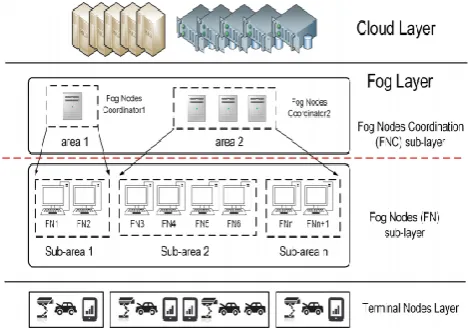
development of terminal hubs such as PDAs, self-ruling vehicles, keen home gadgets, and so on., enormous data should be handled in time. This realizes an overwhelming weight on the transmission connect to the cloud server, and long separation between terminal hubs and the stationary cloud server additionally prompts inadmissible assignment preparing delay, poor help to versatility, and the issue of security [2]–[4]. In future 5G framework, a lot of fog hubs are expected to be conveyed in the entire system [5] as show in Fig. 1. Administrations including registering, handing-off, reserving, control and so on can be deftly sent on these pervasive cloud hubs with system work virtualization (NFV)
and programming characterized arrange (SDN)
advancements [6], [7], along these lines applications [2], [8]. With numerous close by cloud hubs around the terminal hub, this fog empowered assignment offloading design can accomplish a superior postpone execution than those of neighbourhood registering and distributed computing [2], [5]. The issue of vitality utilization has consistently been pulling in extraordinary consideration in the structure and the board of fog processing organize [8]. An undertaking determination and planning plan called CoESMS is presented in [9], which limits the in general vitality utilization and make span through game hypothetical models. Asset the board advancement and the stage configuration are examined to accomplish the tradeoff between errand delay and the comparing vitality utilization [10]–[12].
Yan et al. propose conservative vitality effectiveness as the execution record of 5G innovations in [13], which takes the range productivity, vitality effectiveness and cost into record to assess the far reaching increase of the progressed 5G advances. In any case, in a cloud figuring system, some portion of the cloud hubs might be specific neighborhood servers with solid figuring capacity and a lot of intensity supply. The others might be little arrange hubs with constrained power supply or indeed, even be battery-controlled, for instance, the omnipresent brilliant telephones that might be inactive some of the time, to which the battery life is very essential. Assignment offloading plan that emphasis on limiting errand deferral or all out vitality utilization may lead to very overwhelming weights on the cloud hubs closest to the terminal hub. Thinking about the diverse figuring capacity also, maintainability of the cloud hubs, it's of extraordinary need to arrive at a reasonable vitality utilization among cloud hubs when seeking after superb system execution. What's more, inquire about work on programming model for IoT application has additionally been completed lately. For model, the creators of [9] proposed a structure dependent on MapReduce for information handling at the
edges utilizing portable specialists. The creators of [10] presented a circulated rationale
A Novel Technique to Improve the Performance
of fog Computing using fog Terminal Nodes
for IoT administrations dependent on OSGi to improve modularization programming. The creators [11] presented a programming model utilizing portable cloud for enormous scale applications on IoT. Be that as it may, existing plans referenced before can't meet the new necessities of IoT application in shrewd lattice, particularly the disseminated coordination inside cloud processing hubs. In this manner, we propose a programming model explicitly for the proposed cloud based design in the keen lattice.
Fig 1. Terminal Nodes enabled FoG Computing Architecture
II. LITERATURESTUDY
Linquan Zhang et al. proposed Timely employment contemplates, Cost Minimizing the transfer into the haze of colossal, Dynamically Generate, geo scattered data for handling utilizing a Map Reduce structure. Focusing on a haze of different DC's, we model a Cost Minimizing Data Migration Challenge and propose two separate calculations: an Online Lazy Migration calculation and a Randomized Fixed Horizon Control calculation. To advance the server farm alternative for data conglomeration and handling at any predefined minute, just as the information transmission ways. Cautious Comparisons in practical conditions between these on the web and disconnected calculations are performed through extensive examinations that demonstrate the online calculations near disconnected ideal productivity. Jiong Jin et al. This article gives a structure through the IoT to acknowledge Smart Cities. The structure covers the whole urban administration framework, running from the tactile and systems administration structure to information the board, cloud based mix of particular frameworks and administrations. This keen city IoT Vision is applied to a contextual investigation of clamor mapping to exhibit a new system for current exercises that can be custom fitted to improve and convey critical city offices.
Tara Salman et al. proposed several ITU, IETF, and IEEE specifications that allow IoT to grow rapidly. These standards involve protocols for communication, network, session and routing layer designed to satisfy IoT demands. In relation to the present problems in IoT, the debate also involves Management and Security protocols that provide insights into the present studies solve difficulties of this kind. Antonio M. Ortiz et al. proposed Addresses a comprehensive Social Internet of Things perspective and main insights for true pervasive computing. Then, along with the developmental
history of IoT studies from the Intranet of Things to Social IoT, a literature review is provided. Actually, this paper offers a specific Social IoT design and discusses technology enabling, study difficulties and Open challenges.
X. Zheng et al. Security is one of the serious issues in Internet of Things (IoT) inquire about. The quick development in the quantity of IoT gadgets, the heterogeneity and multifaceted nature of these articles and their systems have made verification a difficult undertaking. Different requirements, for example, restricted computational capacity and power, and little stockpiling of some inserted gadgets make usage of complex cryptographic calculations troublesome. So far there has been no settled mechanical standard to address this issue. As of late, Kalra and Sood, and in this manner Chang et al. endeavored to take care of the verification issue by proposing key understanding plans for IoT gadgets. In any case, the security of their plans was dubious. In this paper we show that these plans are unreliable. We stretch out upon their work to display a plan that empowers inserted gadgets to discuss safely with a server on an IoT arrange. We demonstrate the security of this plan utilizing formal techniques and show this under the obstinacy of some well-characterized difficult issues. We additionally talk about some handy angles identified with the execution of the plan
III. PROPOSEDSYSTEM
Fog Terminal node architecture is depicted in figure.1, it briefly describes various layers involved in the architecture developed. Initially it is comprised with three layers that include cloud layer, fog layer and terminal layer. The very base layer is the terminal layer that includes terminal nodes that are responsible for transmitting the sensor data. Further in the fog layer, the fog nodes will be responsible to extend the capability of the cloud servers and process the data. Finally in the cloud layer in included with the powerful servers that are used for the purpose of transmitting and processing the required data.
The fundamental target of the proposed design is upgrade the exhibition of haze layer. Differentiated and the standard haze figuring model, our mist layer is disengaged into haze center points (FN) sub-layer and mist centers coordination (FNC) sub-layer. With figuring and limit capacity, the haze centers in the FN sub-layer give a framework for migrating getting ready reason to the edge of the orchestrate. The FN sub-layer in like manner has the accumulation limit with respect to the identified data from the terminal centers layer. Ensuing to being amassed and analyzed, a part of the data is continued back to the dynamic centers in terminal centers layer to complete the steady response and strategy to the emergency event. The rest of the data is transmitted to the FNC sub-layer.
A large number of those IoT applications are circulated frameworks in the brilliant matrix. A run of the mill programming system for such frameworks is WoTKit processor dependent on WoTKit stage [13] also, NR of IBM [14]. WoTKit is created on JAVA Spring structure, where designers can run information stream programs by making joins among modules. Be that as it may, WoTKit is planned for arrangement on server
International Journal of Innovative Technology and Exploring Engineering (IJITEE) ISSN: 2278-3075, Volume-8 Issue-12, October 2019
application. The NR structure was intended for application-level improvement in a solitary registering unit, including hubs of info, yield, handling and visual creating condition dependent on Web. Albeit a few highlights towards circulated processing has been added to the NR system [15], the conventional programming model based on solicitation reaction can't accomplish constant handling for the keen matrix. Along these lines, we propose another programming model which depends on information stream programming [13].
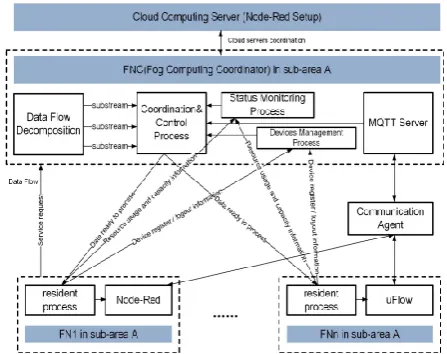
An outline of the proposed dispersed coordination dataflow programming model is appeared in Fig. 2. With the control of FNCs, cloud servers and cloud hubs dispersed in various geographic regions can perform information investigation and procedure of utilization benefits together. We expect that there are two kinds of processing hubs: one has rich figuring asset, which uses Node-Red as dispersed information stream registering structure; different has restricted asset, which employments uFlow as stream handling system.
The occupant forms in each disseminated figuring hub are in charge of gathering data, for example, asset what's more, limit. The gathered data is then answered to the upper layer with the goal that the FNC can settle on better choice and guidance. In the wake of getting substream and information, a cloud hub makes an interpretation of the information stream into directions that can be distinguished also, executed at terminal hubs. Take the case of electric vehicle leaving administrations. At the point when a vehicle under the influence of a sub-region fog hub applies for a stopping administration, the FNC of this sub-region will dispatch the solicitation to all fog hubs inside this sub-region. After dispersed coordinative handling by all cloud hubs, the FNC can give the best stopping data for the requester. In the wake of handling by the cloud hubs locally, the FNC should report all the factual information to cloud servers for future investigation.
[image:3.595.61.285.480.657.2]
Fig 2 Fog Node Architecture
A test exists because of the portability of terminal hubs. The last information stream made by the FNC may not fit the current system condition. For this situation, cloud hubs need arrange without anyone else's input to fix this circumstance, which is characterized as cloud registering hubs movement. As per the initiator of movement, we can partition the relocation into two kinds: one is started by FN; the other is started by terminal hubs. Two APIs utilized during the procedure of relocation are characterized as shown below.
Algorithm: Data Migration among FoG Terminal nodes
1. Select the nodeID of the terminal to which the data is to be migrated
2. Compute the latency LTof the terminal node with nodeID
3. Evaluate LT based on the threshold latency TLT
4. If LT< TLT
5. Return;
6. Else
7. Select the best terminal node Tn from the node group N
8. N = N-Tn
9. Initialize the communication by passing the message to Tn
10. Await for the response Rp
11. If Rp is True
12. M=Start_Migration(nodeID) 13. Elseif
14. N is empty
15. Warn(Migration_not Possible)
end
IV. EXPERIMENTALANALYSIS
We utilize an electric vehicle clever administration to assess the proposed cloud based design and the programming model. The assessed framework is made out of electric vehicles, charging heaps, a local organizer, a territorial application server, a cloud administration focus, a correspondence intermediary server and essential correspondence systems. Accept that electric vehicles report ongoing data and solicitation for administrations through detecting gadgets at the edge of keen framework correspondences arrange. The charging heap gadgets are situated at the edge of the arrange as cloud registering gadgets. Such a fog hub forms the information as per the set up application rationale. It additionally transmits the prepared information through the correspondence intermediary administration to the application server of the district or the remote cloud administration focus as per control of the zone organizer.
Fig 3: Simulation of Fog Environment
The provincial application server has a cloud administration focus that gives administrations to clients. The thing that matters is that the local application server concentrates more on giving some topographically related or exacting prerequisites of latency sensitive administrations, (for example, route, wise stopping, and so on.). While the cloud focus server gives some postponement tolerant investigation and determining
administrations.
[image:3.595.306.536.497.661.2]set based on densities of charging heaps and the spans of traffic stream.
(a)
(b)
Fig: 4(a) Performance Evaluation; 4(b) Fog Terminals
V. CONCLUSION
This paper introduces a Fog computing based architecture that could be utilized for efficient data migrations while utilizing IoT applications. In addition it also includes an efficient data migration algorithm that migrates the data efficiently among fog terminals.The real contrast between our proposed engineering and the conventional one is the presentation of cloud hub coordination, which goes for better joint effort among fog hubs to meet different necessities in the shrewd framework.
As exhibited by assessment and trial results, our proposed design and programming model can altogether lessen administration idleness contrasted with the conventional fog based engineering. Later on work, we will assess the framework with a progressively useful correspondence convention, and study the ideal asset portion in this design. We will likewise consider hubs with rapid portability in more IoT applications.
REFERENCES
1. K. Manoj, T. S. Sandeep, D. N. Sudhakar Reddy and P. M. D.
Alikhan, "Genuine ratings for mobile apps with the support of authenticated users’ reviews," 2018 Second International Conference on Green Computing and Internet of Things (ICGCIoT), Bangalore, India, 2018, pp. 217-221.
2. B. V. Yuvaraju, L. Venkiteela and K. M. Kumar, "A Presumptuous Encephalon Electronic Brain Computing in Gaming Gadgets," 2018 International Conference on Soft-computing and Network Security (ICSNS), Coimbatore, India, 2018, pp. 1-6.
3. Kandala H., Tripathy B.K., Manoj Kumar K. (2018) A
Framework to Collect and Visualize User’s Browser History for Better User Experience and Personalized Recommendations. In: Satapathy S., Joshi A. (eds) Information and Communication Technology for Intelligent Systems (ICTIS 2017) - Volume 1. ICTIS 2017. Smart Innovation, Systems and Technologies, vol 83. Springer, Cham.
4. K. M. Kumar, H. Kandala and N. S. Reddy, "Synthesizing and
Imitating Handwriting Using Deep Recurrent Neural Networks and Mixture Density Networks," 2018 9th International Conference on Computing, Communication and Networking Technologies (ICCCNT), Bangalore, 2018, pp. 1-6.
5. Basi Reddy A., Liyaz P., Surendra Reddy B., Manoj Kumar K.,
Sathish K. (2019) Advanced Spatial Reutilization for Finding Ideal Path in Wireless Sensor Networks. In: Singh M., Gupta P., Tyagi V., Flusser J., Ören T., Kashyap R. (eds) Advances in Computing and Data Sciences. ICACDS 2019. Communications in Computer and Information Science, vol 1046. Springer, Singapore.
6. T. S. Sandeep, K. Manoj, N. S. Reddy and R. R. Kumar, "Big Data
Ensure Homologous Patient Enduring Therapy Time Forecast Algorithm by Healing Facility Echelon Recommendation," 2018 Second International Conference on Green Computing and Internet of Things (ICGCIoT), Bangalore, India, 2018, pp. 320-325.
7. Praveen Kumar, R., Manoj Kumar, K., Tejasree, S., Aswini, R.:
Review on cost effective anddynamic security provision strategy of staging data items in cloud. Res. J. Pharm. Biol. Chem.Sci. (RJPBCS) 7(6), 1592–1597 (2016). ISSN: 0975-8585.
8. M. Chiang and T. Zhang, “Fog and IoT: An overview of
researchopportunities,” IEEE Internet of Things Journal, vol. 3, no. 6, pp. 854–864, Dec 2016.
9. K.Manoj Kumar and M.Vikram, "Disclosure of User’s Profile in
Personalized Search for Enhanced Privacy," International Journal of Applied Engineering Research (IJAER), Vol. 10, no. 16, pp. 36358-36363, 2015.
10. K. M. Kumar, S. Swarnalatha, "Effective implementation of data
segregation & extraction using big data in E - health insurance as a service," 2016 3rd International Conference on Advanced Computing and Communication Systems (ICACCS), Coimbatore, 2016, pp. 1-5.
11. S. A. Razvi, S. Neelima, C. Prathyusha, G. Yuvasree, C. Ganga and K.
M. Kumar, "Implementation of graphical passwords in internet banking for enhanced security," 2017 International Conference on Intelligent Computing and Control Systems (ICICCS), Madurai, 2017, pp. 35-41.
12. Praveen Kumar Rajendran, A. Asbern, K. Manoj Kumar, M. Rajesh,
R.Abhilash,“Implementation and Analysis of MapReduce on Biomedical BigData,” Indian Journal of Science and Technology (IJST), ISSN/E-ISSN: 0974-6846 / 0974-5645, Vol. 9, Issue.31, pp. 1-6, August 2016.
13. G. Bhavana and K. M. Kumar, "Cardiac disease monitoring based on
ZigBee technology," 2017 International Conference on Energy, Communication, Data Analytics and Soft Computing (ICECDS), Chennai, 2017, pp. 392-395.
14. Y. C. Chen, Y. C. Chang, C. H. Chen, Y. S. Lin, J. L. Chen, and Y.
Y.Chang, “Cloud-fog computing for information-centric
internet-of-things
applications,” in ICASI’17, May 2017, pp. 637–640.
15. I. Satoh, A Framework for Data Processing at the Edges of
Networks.Berlin, Heidelberg: Springer Berlin Heidelberg, 2013, pp. 304–318.
16. E. Ahmed, A. Naveed, A. Gani, S. H. A. Hamid, M. Imran, and M. Guizani, “Process state synchronization for mobility support in
mobile cloud computing,” in 2017 IEEE International Conference
onCommunications (ICC), May 2017, pp. 1–6.
AUTHORSPROFILE
O.Geethanjali received her Bachelor Engineering in
Computer Science from Sri Venkateswara
International Journal of Innovative Technology and Exploring Engineering (IJITEE) ISSN: 2278-3075, Volume-8 Issue-12, October 2019
Mr. P. M. D. Ali Khan working as Associate Professor in Department of Computer Science and Engineering (CSE) at Sri Venkateswara College of Engineering (SVCE),Tirupati, India. .He has vast experience in research and teaching.He attended various Workshops, Seminars and FDPs across India.He published various research papers in Scopus Indexed Journals and presented many papers in IEEE,National and International Conferences. His Research Interests include Data mining,Big Data.