Abstract: This work figures the conceptual background of impedimetric measurements. Impedance measurement is a convenient approach for exploring the change in electrical behavior of diverse materials. An overview of in practice impedance analysis on CHI660D electrochemical work station is presented. Detection of microorganism causing foodborne diseases using IDE and other methods, toxic metal ion quantification, environment pollutant monitoring are described applications in this work. This work also reviewed the noticeable development in impedance measurement devices based on AD5933 such as bio-impedance measurement and explosive material detection. Biological signals are detected by transducing them into electrical analogy, detection of which is not a big issue. The main challenges are to convert biological signal into electrical information. Electrochemical sensors present captivating techniques to determine the content of sample under test. Electrochemical sensing platforms come up with an appealing methodology to interpret the concentration of biological sample as these sensors directly translate biological information to an electronic one. Huge amount of sensing platforms and corresponding devices has been developed. EIS is a rapid and easily computerized technique used to characterize biomolecules, inorganic materials, having a wide range of applications. The measured impedance spectra are generally fitted to an analogous electrical circuit model which constitutes an electrical documentation of the SUT by disclosing its behavior and properties. Quick, highly selective/specific and sensitive techniques to quantify biological and biochemical molecules and other target species are of great importance in biomedical and biotechnological application. Recent developments trends for handy, portable, fast and precise impedance analyzer is discussed. AD5933 evolution kit is reviewed.
Keywords: AD5933, Biomolecules, CHI660d, EIS, Electrochemical sensors, IDE,
I. INTRODUCTION
Biosensors, itself is an interdisciplinary branch of study. A device that takes information from chemical reaction and them alter that signal by electronic means. In this section, biosensor methodology, their characteristics and scope is discussed.
1Crossponding author
Revised Manuscript Received on August 10, 2019
Nitin Kumar Sharma1, Department of Electronics and Communication
Engineering, GJUS&T, Hisar, Haryana, India Email: [email protected]
Kuldeep Singh2, Department of Electronics and Communication
Engineering, GJUS&T, Hisar, Haryana, India. Email: [email protected]
Ahimanyu Nain3, Department of Electronics and Communication
Engineering, GJUS&T, Hisar, Haryana, India Email: [email protected]
Nisha Rani4, Department of Electronics and Communication
Engineering, GJUS&T, Hisar, Haryana, India. Email: [email protected]
Anuj Singal5, Department of Electronics and Communication Engineering, GJUS&T, Hisar, Haryana, Email: [email protected]
A. DEFINITION AND ELEMENT
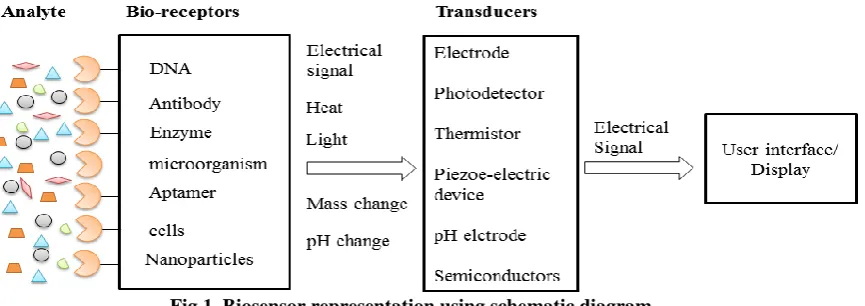
Analytical research related to biosensors has gained a tremendous growth over last 2-3 decades. Biosensors basically defined as a device that changes biological signals into other processable information [3]. A biosensor is a combination of following components-
Analyte: These are microorganism and
biomolecules that are required to be detected. For example in glucose sensor, glucose is the analyte. Bioreceptor: These are the molecules that are
specific to the analyte deployed. The interaction of bioreceptor with the analyte results in the signal formation that can be referred as biorecognition. This signal may be in the form of light, temperature, change in mass and pH, charge etc. Transducer: It is the important part of sensing that
convert one form of energy into other. Transducer in biosensor converts bio-recognition into a detectable signal. Mostly electrical and optical signal are produced by the transducer. The produced signal is in correlative relation to the aggregation of analyte-bioreceptor interaction. Electronic system: This section provides the signal
conditioning. Signal conditioning refers to multistage amplification and analog to digital conversion with a complex circuitry. The whole electronics system consists of signal conditioning circuitry, processor to provide control, and display unit. It is a hardware-software combination that showcases the results in a human understandable manner [6].
Disease and environmental monitoring, detection of pollutants and new drug discovery are some important application of biosensors [1]. Microorganism and bio-markers which are indicators of disease found in body fluids (urine, blood, saliva, sweat etc.) can be detected effectively using biosensors [6].
B. CLASSIFICATION
Biosensors may be categorized on the basis of used type of bioreceptors and transducers. Bioreceptros are specific to the analyte of interest and produce a signal for the transducer to be measured.
Impedimetric Sensors: Principles, Applications and
Recent Trends
Impedimetric Sensors: Principles, Applications and Recent Trends
On the basis of bioreceptor type being used, biosensors are classified into four main classes: Ab-Ag, cells, nucleic acid/DNA, enzymes. The symbolic description of biosensor is conveyed in the Fig 1. Biosensors can also be classified
on the basis of bio-transducer type being used. Transducers can also be called as electrode, detector and sensor. The
[image:2.595.92.525.107.260.2]mainly employed
Fig 1. Biosensor representation using schematic diagram transducers for biosensing are as follow:
Electrochemical, optical, Piezoelectric and calorimetric transducing techniques are most commonly employed for the biosensing application. Further electrochemical is mostly employed because of its favorable advantages over others. Potentiometric, Amperometric and conductometric are such electrochemical techniques.
Among different types of biosensing paradigms, electrochemical sensors are very attractive and mostly used because they can be easily performed without requiring any complex and time consuming process with no/few reagent used.[7]. These techniques are usually inexpensive and easily designed. They have vast range of applications in clinical, agriculture, environmental and industrial analyses [5].
II. ELECTROCHEMICAL SENSORS
Electrochemical bio-sensors showcase appealing method to analyze the biological concentration because of direct transformation of biological events to electronic information. Over the past 20-30 years a huge increment can be shown in electrochemical sensors development [3]. In 1955/56 oxygen sensor by Clark firstly sparked the research and further development in the area of biosensing [3]. There are 3 main electrochemical biosensing techniques- potentiometric, amperometric and impedimetric.
C. POTENTIOMETRIC
Potentiometric electrochemical cell measures the gathering of electron or voltage at working cell compared with reference electrode with no significant charge carrier are flowing across them [3]. There are three basic types of potentiometric sensor such as ion selective electrode (ISE), coated wired electrode and field effect transistors (FETs) [5]. pH electrodes are mostly potentiometric devices. For Several ions like fluorine, cyanide, sodium, potassium, calcium, and ammonium ion or gases like CO2 and NH3, ion selective and gas selective electrodes are available. The distinction in potential value of working and reference cell have relation with concentration (ion activity or gas fugacity) which is governed by Nernst-Donnan Equation [2].
D. AMPEROMETRIC
This technique is laid on the principle of current quantification produced by the oxidation and reduction of electro-active biomolecules. It is generally carried by providing a steady potential on working cell or on assemblage of electrode in respect of the reference electrode. Oxidation and reduction rate of that electroactive species and the change in steady state current is based on the mass analyte concentration [2]. Amperometry also be known as voltammetric measurement [7]. But there is a difference in operation in between. In case amperometry, current is measured at a constant voltage given to the cell, on the other hand, if current is measured over a controlled potential variation, this is voltammetric method [3].
E. IMPEDIMETRIC
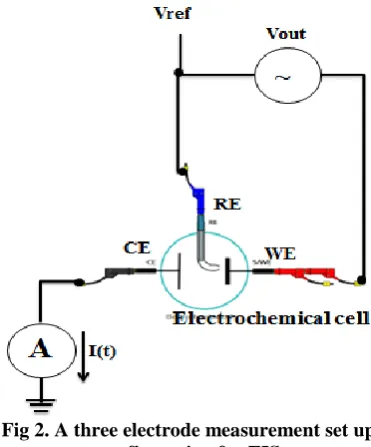
Fig 2. A three electrode measurement set up configuration for EIS
Cyclic (CV), differential pulse (DPV) voltammetry, bulk electrolysis (BE), square (SWV), and AC impedance
spectroscopy are some most commonly used
electrochemical techniques. Standard EIS system generally is a 3-electrode system arrangement. Working cell, auxiliary/counter cell and reference electrode are the 3-electrode of the system and 3-electrode equivalent circuit configuration is shown in Fig 2.In impedance measurement, an AC voltage signal is given to the working electrode that changes its polarity being +vely and –vely in a periodic manner. Counter electrode is always provided equal and opposite polarity in respect of working electrode. A constant potential is set for the reference electrode which compensates the uneven charging effects in the cells and kept near the working electrode.
Observation of alteration in the electrical/electrochemical impedance of the solution because of growth of bacteria and increment in the compounds that the bacteria produced was the first detection of microbes using impedance spectroscopy. This type of detection is known as electrochemical impedance spectroscopy. As descried in Bard and Faulkner (2001).
III. FUNDAMENTAL OF ELECTROCHEMICAL
IMPEDANCE SPECTROSCOPY
EIS is a convenient and appealing methodology that can be deployed in vast range of applications such as microorganism presence examination, food prone pathogen detection, corrosion monitoring, human body analysis, heavy metal ion detection, characterization of different layers on the electrode surfaces, characterization of solid electrolytes, food and dairy products monitoring etc. [8]. EIS facilitates us with label free detection of Ab-Ag interaction with requiring any other pre-treatment process as well [10]. EIS is a less destructive process, used for observing of biological interaction and interfacial properties of the modified electrode as compared to CV and DPV. The term mentioned “spectroscopy” interprets study of any particular over collection of frequency value. The impedance of a system is analyzed by providing a little magnitude voltage signal with varying frequency. The frequency range may be from 10 mHz to 100 kHz.
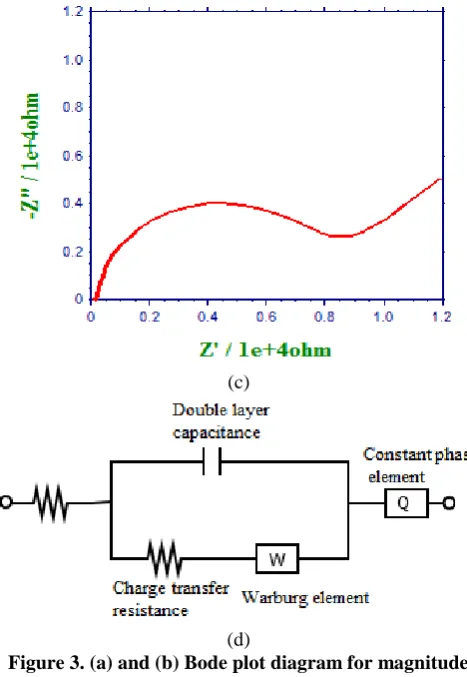
When AC current drifts from a network consisting of resistors, capacitors and inductor or composition of them, the total resultant is a complex resistance which is called as impedance. Magnitude and phase of the resultant (impedance) depends on the electronic components and the frequency sweep range if the AC signal given to that electrode. As inductive behavior is not shown in electrochemistry, we only consider the resistive (real) and capacitive behavior of electrochemical cell [9]. Such a simple equivalent circuit is descried in figure 3d.
The impedance value is determined by the providing a excitation voltage of time function V(t) and measuring a induced response signal as a current-time function I(t). The impedance is then calculated.
Excitation voltage signal = Vm.sin(ωt), Response current signal = Im.sin(ωt+ ) and Calculated impedance is
Impedance is a complex quantity so Z can be written as = Re(Z) + j.Img(Z)
(a)
Impedimetric Sensors: Principles, Applications and Recent Trends
(c)
(d)
Figure 3. (a) and (b) Bode plot diagram for magnitude vs. freq. and phase vs. freq. respectively, (c) and
corresponding Nyquist plot and (d) is electrical equivalent Randles circuit.
F. DATA PRESENTATION
Experimental results can be presented in 2-ways (i) Nyquist plot (ii) Bode plot. In Nyquist representation real segment of impedance is plotted on horizontal-axis and imaginary part is plotted on vertical-axis. y-axis is negative and every individual point on the plot is interprets impedance for single frequency. In bode graph, x-axis is log scale frequency. Magnitude and phase of complex quantity (impedance) are individually plotted on the y-axis. bode plot communicates about frequency information which is a drawback of Nyquist plot.
EIS behavior of the electrochemical cell monolayer and interfacial structure are effectively described by equivalent circuits. Each component of these equivalent circuits relate to properties of different layers of the electrochemical cell. EIS on electrochemical workstation system “CHI 660D” from CH instruments, Inc. shown in figure 4(a) was carried with help of [Fe(CN6)]3-/4- (which is a redox couple), on screen printed electrode with a 3-electrode arrangement as described in figure 4(b). The reading is taken over a group of successive frequency values of 1Hz to 100kHz of applying 5 mV voltage, to the electrode.A simplified electrical analogous circuit that comprises fluid resistance, a doublly layered capacitor, Warburg and polarization charge transfer resistance has shown in figure 3(d) this is called Randles equivalent circuits.The impedance measurement to observe the behavior was shown by Nyquist and bode plot and corresponding equivalent electrical circuit. And these are presented in the figure 3(c) and 3(a), (b) respectively.
(a)
(b)
Figure 4 (a) Electrochemical workstation CHI 660D from CH Instrument, Inc. (b) screen printed carbon electrode with reference (white), working (green),
counter (red) electrodes.
IV. IMPLEMENTATION PARADIGM OF
IMPEDANCE SPECTROSCOPY
As we know nowadays biosensor are quite used in biomedical diagnosis. From last decades more work is proposed in the detection of diseases causing microorganisms. Some other area are also need monitoring using biosensing techniques and EIS provide a good method for this purpose.
G. MICROBIAL DETECTION
[image:4.595.333.518.49.353.2] [image:4.595.49.283.54.393.2]At frequency lower than the 1MHz the circuit can be simplified by neglecting the medium capacitance [8]. An impedance biosensor for the application of bacterial cells determination is created by immobilizing Ab on the electrode surface which are specific for the target bacterial cell. The add on of desired bacteria cells on the modified sensor probes results alteration in the electrical parameters of the sensor because cell membrane has some insulating properties. The measured impedance is a function of frequency range. The impedance measurement can be referred as Faradaic or non-Faradaic impedance calculation on the basis of using or not using redox probe. Non-Faradaic measurement in which redox probe is not used impedance signals directly intact bacteria cells that are physically tied to the sensor surface, possessing the insulating outcomes of the cell membranes. The impedance may be altered by growth, number, and morphological behavior of attached cells. On the other hand, in redox probe or Faradaic measurement electrode senses the biological changes by measuring changes in faradaic impedances. This technique is an attractive way to detect the Ab-Ag evolution, biotin-avidin composites, oligonucleotide-DNA interaction etc. on sensor surface by checking interfacial properties of electrodes.[4].
Figure 5. A simplified equivalent circuit of two electrode system in liquid electrolyte for impedance measurement. The EIS using first bio-sensor for bacterial detection was detailed in [11] with the concept of biosensor built on the Faradaic impedance measurement with [Fe(CN6)]
acting as redox probe. The paper present, detection of E. coli was carried with using modified indium tin oxide (ITO) cell impedance biosensor chips. An epoxysilane monolayer was formed to anchor antibodies onto the ITO chip, Atomic force microscopy was deployed to characterize the epoxy-silane monolayer, Abs, and E.coli cells bind to Ab. This is a label dependent and Faradaic impedance detection method. This biosensor has low LOD of 6.0×10³ and a linear response range of charge transfer resistance over different concentration range from 6.0×10⁴ - 6.0×10⁷ cells mL-1. Abs are most common bioreceptor for the bacterial detection and it is also referred as immunosensors. However bioreceptors like nucleic acid, bacteriophages and lectins were also used [11]. Salmonella typhimurium is a gram-negative bacteria having a rod like shape. Detection of the bacteria using impedance spectroscopy always has major focus. In this paper, a stable, sensitive and label free quantification of S. typhi was carried with immobilization of anti-salmonella Abs on a modified GCE. The GCE was modified by GNPs and poly (amidoamine)-multiwalled carbon nanotubes-chitosan nano-cluster. The steps of layers of immunesensor
are characterized by cyclic voltammetry and EIS. The modification of GCE, provide enhanced responsiveness of the immunosensor. EIS detect linear association of change in electron transfer resistance and the Salmonella concentration with a range of 1.0×10³ to 1.0×10⁷ colony forming uni/ mL-1 with a detection limit of 5.0×10³ [14].
a. IMPEDANCE ANALYSIS USING IDE
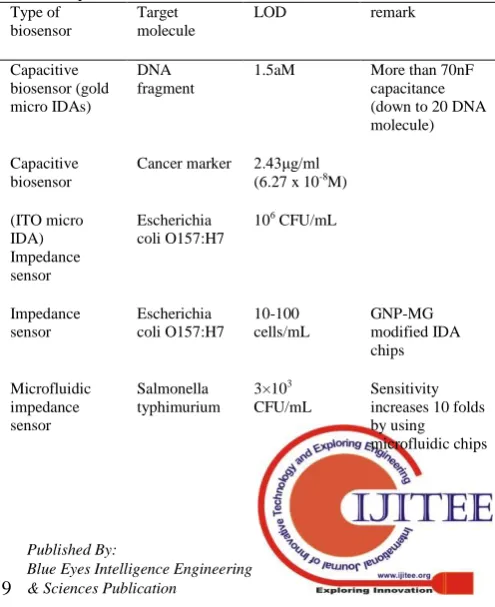
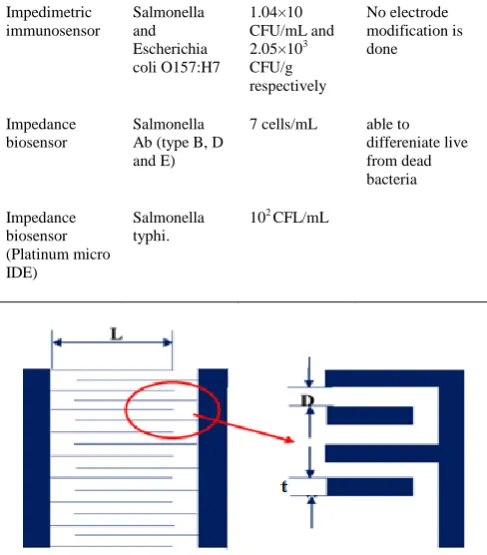
Interdigitated microelectrode array have low resistance, high S/N ratio, low settling time and less solution volume required as compared to conventional electrodes.[4]. Different biosensing platforms are being realized, some are interdigitated arrays instead of single electrode, capacitive interdigitated sensors are widely used ones. Table 1. Lists some electrode cells with their required molecule and LOD. IDAs generally have pair of electrode strips, each electrode strips further have multiple electrodes as shown in figure.6. These 2 set of microelectrodes can be act like as two poles of a bipolar impedance computation setup. These multiple electrode can be referred as finger electrode. The distance between successive finger electrode may be in micro or nanoscale. These electrodes have significant advantages over conventional electrodes with fast equilibration and no need of surface modification sometimes also [15].
They reported a novel immunosensor based on the impedance spectroscopy which rapidly detects the typhoid causing bacteria with very less sample volume required (10µL). Au NPs are used to tag bacteria for the signal amplification and selectivity enhancement. And this Ab-Ag bioconjucted sensor electrode then subjected AC current applied across IDA. Paper reported a sensing platform of very low LOD of 102 CFU/mL [17]. Only Capacitance measurement is used to detect specific biomolecules, DNA fragments, proteins etc. with the help of Ab-Ag interaction properties. Sometimes it is termed as a affinity-based capacitive biosensor. Dielectric properties, surface charge distribution and alteration in the electrical conductivity can be examined with the analyte binding on the electrode surface.[21]
Table 1. Different types of biosensors with the kind of electrode deployed and related target molecule with their sensitivity and LOD. References [15, 17, 19, 20, 21, 22, 23].
Type of biosensor
Target molecule
LOD remark
Capacitive biosensor (gold micro IDAs)
DNA fragment
1.5aM More than 70nF
capacitance (down to 20 DNA molecule)
Capacitive biosensor
Cancer marker 2.43μg/ml (6.27 x 10⁻⁸M)
(ITO micro IDA) Impedance sensor
Escherichia coli O157:H7
106 CFU/mL
Impedance sensor
Escherichia coli O157:H7
10-100 cells/mL
GNP-MG modified IDA chips
Microfluidic impedance sensor
Salmonella typhimurium
3×10³
CFU/mL
[image:5.595.302.550.531.835.2]Impedimetric Sensors: Principles, Applications and Recent Trends
Impedimetric immunosensor
Salmonella and Escherichia coli O157:H7
1.04×10 CFU/mL and 2.05×10³
CFU/g respectively
No electrode modification is done
Impedance biosensor
Salmonella Ab (type B, D and E)
7 cells/mL able to differeniate live from dead bacteria
Impedance biosensor (Platinum micro IDE)
Salmonella typhi.
[image:6.595.46.290.49.327.2]102 CFL/mL
Figure 6. Dimensional representation of the simplified interdigitated electrode.
Immobilization of bioreceptors element (e.g. Abs), assembled in a fine layer onto the electrode surface can be referred as capacitive affinity biosensors. Interdigitated fingers like pattern (as shown in figure 6.) on the electrode provides the greater surface area for sensing operation of bio-molecules. The basic capacitance equation is as we know-
o and r - vacuum permittivity and relative permittivity of the channel between coupling plates, respectively.
A - domain area of electrode plate d - distance between couping plates
checking variation in the dielectric constant of the interdigitated capacitance cell is the main sensing principle. The capacitance equation for IDE capacitive sensor can be stated by equation-
η is number of finger, is permittivity of coated film, l is the length of the IDE, t thickness of each finger electrode of IDE, d is the separation between these finger electrodes.
H. CORROSION MONITORING USING EIS
EIS has great advantages over other electrochemical techniques. EIS provides a non-destructive mechanism for the analyzing wide range of material, including presence of surface film coating and anodized coating thin films, concrete attributes, interfacial corrosion mechanism and mass exchange phenomena. This method also provides detailed information about the rate of corrosion, kinetics of reaction, analysis of localized corrosion [25].
In this study, an impedimetric sensor was developed using screen-printing technique for corrosion monitoring. The sensor was patterned as a single comb like wiring of silver. The impedance of the sensor was examined in different
conditions such as wet, dry. The impedance is also examined in the presence of dry sulfur gas for the frequency scan from 10 mHz to 10 kHz having voltage modulation amplitude of 10mV [26].
The electrical behavior of steel and concrete were reported as exclusively resistive. Due to heterogeneity of the structure, the resistivity of concrete also depends on the location and position. However, with the existence of the diffusion components, capacitors and pseudo-capacitors the interface is examined to be reactive in nature. The magnitude of real and imaginary part of the ohmage and phase associated with it permits to quantify the corrosion and its position or location [24].
Corrosion detection is effectively performed with the help of EIS. Many work in corrosion and coated films like study extensively used impedance technique. Corrosion detection of the reinforced concrete is studied in vast literature. Atmospheric corrosion on various metal surfaces is also analyzed. Magnesium electrode is immersed in sodium sulfate solution to analyze electrochemical impedance spectra. Thickness of thin oxide film, resistivity due to metal-oxide interface, electrolyte –oxide interface, surface area exposed to electrolyte are some important parameters which were obtained through EIS data analysis [28]. This paper investigates about the effect of corrosion of the reinforced concrete and steel structures situated in marine environment. This study helps in improving of the above in the detailed conditions with different pH levels. Three sample of concrete with different fly ash compositions were exposed in the oceanic environment and keep maintaining pH levels of 1, 4, 7, 10 and 13 for 90 days. The equivalent circuit to the best fit for the obtained Nyquist plot is proposed in this work when acidic and alkaline aggressive state is given to the concrete samples. The pH level of oceanic environment plays a conclusive on the corrosion process and concrete. At pH 1 significantly low impedance and drastic deterioration is observed. On the opposite side, at pH 13 (alkaline nature), high impedance value is observed which also interprets less decay of concrete samples. Higher fly ash composite concrete also reflects additional impedance result with lower corrosion rate [27].
V. TOXIC HEAVY METAL ION DETECTION
When the metal ions concentration goes beyond the permissible toxicity range according to the WHO, it has adverse effect on human and environment as well. That’s why rapid and reliable heavy metal ions detection with very low LOD is of great interest. Atomic absorption spectroscopy (AAS), cold vapor atomic absorption spectrometry (CV-AAS) inductively coupled plasma mass spectroscopy (ICP-MS), chronoamperometry, and XRF spectroscopy techniques are deployed to quantify metal ions [31]. These techniques have disadvantages like long process time laborious process, need expensive materials and trained professionals [30].
Conventional quantificational methods for the detection are though reliable and accurate but their set up very complex and sluggish. Even many electrochemical sensor and electrochemiluminescence detection methods are also in the queue but they suffer from poor reusability and selectivity [47].
a. BIOSENSOR BASED CONCEPTS FOR HEAVY
METAL DETERMINATION
This mercury ion detection based on thymine-Hg2+-thymine complexion using a strong electrochemical technique is ultrasensitive and selective. Other classic approaches for the mercury ion detection need skilled personnel pretreatment time and complex instrumentation. EIS can be deployed to analyze the differce in surface charge and shape of molecule or ion on the electrode surface [34].Copper is broadly used metal and can get into natural environment easily by various routes. Prescribed low amount of copper intake is essential for body. However, excessive concentration is toxic to human health and may cause liver and kidney damage [37]. In this report, a novel method for copper ion detection was submitted using gold nano-clusters (GNCs) and DNA-zyme and analyzing the imepadimetric behavior of the modified electrode using EIS. GNCs were worked as a sensing probe to cripple the DNAzyme. In the existance of the Cu2+, DNAzyme was activated and split the substrate strand in two DNA fragments that resulted change in the interfacial Rct of the electrode in the presence of [Fe(CN)6]4-/3- redox probe. Rct value decrease with the DNA-Cu2+ interaction and change in its value was found in correspondence with the Cu2+ concentration ranging from 0.1nM to 400nM. The biosensor for the copper detection is highly selective and sensitive with LOD of 72.5pM.[47]. An electrochemical biosensor for the determination of Pb2+ and Hg2+ using DNA probe, lead specific DNAzyme and mercury specific oligonuceloitides was proposed. The interaction between Pb2+, Hg2+ and DNA results in decrease in the Rct, which was tracked by EIS technique [29], [36].
b. ELECTRODE MODIFICATION FOR TOXIC
METAL DETECTION
In heavy metal ion detection a lot of research has been done through the electrode modification. EIS was extensively used for the characterization of the modified electrode. As it is very simple and inexpensive procedure to do so. Such characterization of modified electrode for the toxic metal ion quantification was proposed in [35], [31]. The determination of charge transfer resistance using EIS computation also has been used to observe the sensor performance, for further development and to compare the sensitivity of these sensors [31].
A highly selective detection mechanism was proposed for Zn2+, Pb2+, Cd2+, Cu2+, Hg2+ heavy metal ions using electrochemical methods. EIS is used to characterize the modification of the GCE. Here the GCE was modified with g-AlOOH@SiO2/Fe3O4. Difference in the charge transfer resistance was observed due to the hierarchical structure of the AlOOH. This structure act like a barrier and block the redox couple to interact with the sensor surface resulted in further increase in the charge transfer resistance. This modification is further confirmed using cyclic voltammetry using [Fe(CN)6]3-/4-.[35]. Bismuth film electrodes are used for the EIS measurement for medium containing Zinc, lead, cadmium as bismuth has very low toxicity and wide operational voltage window. Bi-film modified electrode were applied using EIS technique to investigate what was happening during the deposition and stripping action at different potential values [31].
The flexible screen printed electrochemical cell on a polyethylene terephthalate (PET) film was used to detect toxic metal ion with very low LOD. The EIS response of these printed electrodes demonstrates highly sensitive nM-level concentration of lead and cadmium nitrates. EIS reading was recorded and presented in this work as it was observed that electrode impedance changes it value from 18% to 52% for 1nM and 1µM concentration of lead nitrate, comparing with DI water [30].
Here electrochemically synthesized polyaniline composite with carbon nanotubes was reported. Electroactive nature of both the species was studied using EIS and CV. This sensing mechanism was highly selective for the determination of Ni ions in the range of 1 gm/L to 1gm/500L [32].
VI. RECENT DEVELOPMENT IN EIS: AD5933
IMPEDANCE ANALYZER
Impedance measurement setups available as electrochemical work station are bulky lab equipment and expensive also [43]. For example: CHI 660D from CH instruments, Inc. performs impedance measurement with high accuracy and more functionality but it is bulky and non-portable and costly equipment. In some medical applications where impedance is analyzed, lab impedance equipment such as HP4194 Precision Impedance Analyzer[44] and CHI660D provide a high accurate results and analysis for wide scale of frequency from 40 Hz - 110 MHz. Bulky size and expensiveness make these workstations of no use for the low cost medical application. For such small scale applications low cost, small sized, portable impedance analyzer was proposed in lot of research paper using integrated circuits. Evolution in ICT (information and communication technology) enables constant upgradation in the field of sensor technology. IOT permits physical entity to be detected and managed remotely via a network infrastructure such as embedded computing system. The advent technologies allow to exchange data without human interaction and at low cost wirelessly [40].
Impedimetric Sensors: Principles, Applications and Recent Trends
[image:8.595.51.286.98.260.2]Deploying the bench-top lab equipment a large frequency sweep is performed on the other hand this commercial device sweeps a smaller frequency values from 10 kHz to 100 kHz and used to perform specific application.
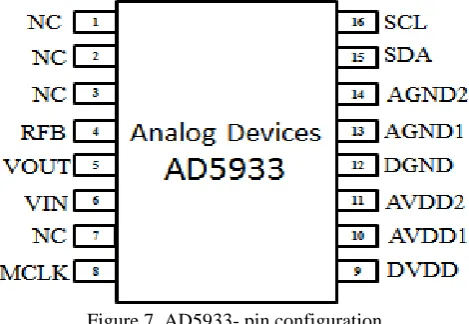
Figure 7. AD5933- pin configuration
AD5933 is an IC with 16 small metal pins. For having easier access to the input/outputs of the chip it is mounted on an evolution board with external circuitry that provide support in measurement and microcontroller embedded on the board govern the chip and computer.[44]. Evolution board of AD5933 from the Analog Devices is a 12 bits impedance analyzer with the additional circuitry is embedded onto a single board including processor, frequency generator, 1 MSPS analog to digital convertor. The board was provided system clock with the help of 16 MHz surface mount crystal. I2C interfacing is used to communicate between AD5933 and USB microcontroller. For this interfacing a graphic user interface is on board or run from the PC. Using AD5933 evolution board circuitry impedance can be analyzed with a maximum frequency of 100 KHz providing a programmable excitation output voltage. 1 kΩ to 10MΩ value range of impedance can be measured, with additional circuitry this measurement range can be lower down from 100Ω to 1000Ω. The AD5933 has a direct digital synthesizer (DDS) with a phase accumulator of 27-bits and thus resulting a impedance spectrum with resolution of less than 0.1 Hz. AD5933 chip is a 16 pins SSOP package as shown in the figure 7. The IC package has four non-contact pins. All supply pins should be connected to a solo supply in the scale 2.7 V to 5.5 V and also is prescribed to ground all ground connects together.
I. ANALOG FRONT END AND IMPEDANCE MEASUREMENT
AD5933 IC chip is employed by a voltage controlled oscillator for providing excitation signals. It also has 27 bit DDS and a sine voltage Vout generator, programmable gain amplifiers DAC and ADC, low pass filter and 1024 point DFT engine. Impedance is measured by analyzing current across the unknown impedance and then this current is converted to voltage by CVC at the receiver end and this voltage is given to 12 bit internal ADC and further to DFT engine which withdraw real and imaginary values of the impedance and store it in the register and accessed by the I2C interface [43]. A portion of AD5933 block diagram is shown in figure 8 that measures the impedance in certain conditions and above explanation can be perceived in better way. AD8606 are used at the analog front end in AD5933 evolution board. These are low offset voltage, large bandwidth and stable unity gain single-supply amplifiers
[45]. As EIS is a very useful techniques in the analytical study, these portable, low cost, highly accurate and specific sensors for impedance measurement have huge number of application in the field of electrochemical analysis, impedance spectroscopy and measurement for different biosensors, proximity sensors, corrosion monitoring, environmental, fruits life and agriculture monitoring, explosives detection, bio-impedance measurement, biomedical and automotive sensing platforms etc. Few of the recent work using AD5933 are discussed in this section. The size and cost of the sensors drastically reduced by using a common signal processing components for both fluorescence and impedance sensing of label free cell culture assay. This work encourages researchers to develop new device in future with advance electronics with more precisely and sensitively [41].
J. BIO-IMPEDANCE MEASUREMENTS USING AD5933
Bio-impedance measurement is a medical application used to analyze body composition, pulmonary edema, respiration rate, BMI, body temperature and lungs composition.[38]. BIM also works on the basic principle of Ohm’s law. Different potential value at different frequency was applied and current is measured. Resultant change in impedance is recorded.[44] a good complex but efficient spectrometer was proposed using AD5933. Reduced size, low power consumption and ease of Bluetooth connectivity helps to develop portable and wearable BIM devices [38]. AD5933 is an IC with 16 small metal pins. For having easier access to the input/outputs of the chip it is mounted on an evolution board with external circuitry that provide support in measurement and microcontroller embedded on the board govern the chip and computer.[44] A comparative work was done for BIM analysis of the bicep brachii using HP4194A (expensive and desktop workstation) as a control device and low cost alternative AD5933 impedance convertor as an experimental device. Identical replication of experiments was performed on both of them. The analysis was carried over frequency scope of 10 kHz to 100 kHz. The overlay plots of the resultant impedance data graphs were found in similar fashion. Thus this study interprets towards the potential to further development in effective commercial products for the biomedical applications [44]. Generally Ad5933 chip for impedance analysis is not meant for 4-electrode interface specially in frequency lower than 100 kHz. But in bio-impedance measurement applications two electrode setup shows some notable errors during analysis. In this work, 4-electrode interface for the bio-impedance measurement performed with galvanostatic and potentiostatic excitation can be obtained by external circuitry [42].
VII. TNT DETECTION
TNT is a common explosive which is misused by terrorists to endangering public. TNT has low molecular mass- 227.13g/mol. Sniffer dogs are extensively used conventionally for the TNT detection. Because of their ability of biological olfactory sensing, well trained dogs can distinguish explosive molecule from a complex environment with great selectivity and sensitivity. But this method is very costly, time consuming and can be deployed for a short time period. Remarkable work had been done so for to evolve electronic sensors using techniques such as electrochemical, ion spectrometer, QCM, SPR. [48]. These techniques are also suffered with time taking processes. Professional attention is needed to operate required equipments. So need arises for the evolution of a high responsiveness, less
complex and low cost technique for TNT
determination.[16].
Previously screen printed electrode were developed for impedance analysis to monitor the TNT concentration in water using bio-sensing methods. For this purpose a smartphone based setup using AD5933 and Arduino microcontroller were deployed for AC impedance reading over the range of 10 Hz to 20 kHz and 30 kHz. This work uses a immobilized peptide on electrode surface to bind TNT and can be called as biosensor. The desirable informatics signals were conveyed to smartphone application on the real time basis. This work proposed a platform to detect TNT with low LOD of 1µM [53], [48]. A highly sensitive approach for TNT detection with 0.15 pM LOD, was proposed by forming a assembled ternary sensing layer. Ternary layer plays a pivotal role in the sensitivity and selectivity enhancement by providing OH -rich hydrophilic environment and minimum defects compact surface area. The increase in ∆Rct value was noticed with a linear relation with TNT concentration in log-scale ranging from 0.44 to 18.92 pM. This sensing platform can also serve to other biosensor fabrication [16].
VIII. CONCLUSION
Research and development in the field of sensing is very popular interdisciplinary scientific area of biological science and engineering. Impedance measurement is a concept of transduction providing effective and efficient methodology for detection. Impedimetric sensing provides ease of developing simultaneous detection of different biospecies using electrode array. This multiplexing analysis is also provides a label free, non-destructive detection method. EIS is a very sensitive technique can determine desirable molecule at very low LOD.
Advancement in the polymer and nanotechnology science has paved the way for further improvement for novel affinity based impedance measurement. Impedance microbiology to determine the growth of bacteria is a classic method which gives automated results in approximate 24 hours, even much faster than other techniques. Now the impedance measurement is entering into very fast, miniaturized sensing platforms based on microdevices and microchips, which are highly specific, sensitive and have needed small volume of SUT. These EIS based portable devices offers possibility to develop low cost, highly precise, specific purpose based electronic system such as for corrosion and heavy metal ion online monitoring etc. Further efforts should be put into for improving current
scenario in impedance based detection and make it a successful commercial useable product.
ACKNOWLEDGEMENT
Author would like to thank CSIR-IMTECH, Chandigarh and Dr. Vijayender Bhalla (senior scientist at CSIR-IMTECH) for their kind help and support to carry out this work.
REFERENCE
1. Lee Y.H, Mutharasan R. (2005), Biosensors, Sensor Technology Handbook (pp. 161-180).
2. Thévenot DR, Toth K, Durst RA, Wilson GS. Electrochemical biosensors: recommended definitions and classification. Analytical Letters. 2001 Mar 31;34(5):635-59.
3. Grieshaber D, MacKenzie R, Voeroes J, Reimhult E. Electrochemical biosensors-sensor principles and architectures. Sensors. 2008;8(3):1400-58. https://doi.org/10.3390/s80314000
4. Yang L, Bashir R. Electrical/electrochemical impedance for rapid detection of foodborne pathogenic bacteria. Biotechnology advances. 2008 Mar 1;26(2):135-50.
5. Stradiotto NR, Yamanaka H, Zanoni MV. Electrochemical sensors: a powerful tool in analytical chemistry. Journal of the Brazilian Chemical Society. 2003 Apr;14(2):159-73.
6. Bhalla N, Jolly P, Formisano N, Estrela P, Introduction to Biosensors, Eassy in BioChemistry, 2016.
7. Yilong Z, Dean Z, Daoliang L. Electrochemical and other methods for detection and determination of dissolved nitrite: A review. Int. J. Electrochem. Sci. 2015 Feb 1;10:1144-68.
8. Grossi M, Riccò B. Electrical impedance spectroscopy (EIS) for biological analysis and food characterization: a review. Journal of Sensors and Sensor Systems. 2016;6:303-25.
9. Park SM, Yoo JS. Peer reviewed: electrochemical impedance spectroscopy for better electrochemical measurements
10. Daniels JS, Pourmand N. Label‐free impedance biosensors: Opportunities and challenges. Electroanalysis: An International Journal Devoted to Fundamental and Practical Aspects of Electroanalysis. 2007 Jun;19(12):1239-57.
11. Ruan C, Yang L, Li Y. Immunobiosensor chips for detection of Escherichia coli O157: H7 using electrochemical impedance spectroscopy. Analytical Chemistry. 2002 Sep 15;74(18):4814-20. 12. Guan JG, Miao YQ, Zhang QJ. Impedimetric biosensors. Journal of
bioscience and bioengineering. 2004 Jan 1;97(4):219-26.
13. Wang X, Zhao Z, Wang Y, Lin J. A Portable Impedance Detector of Interdigitated Array Microelectrode for Rapid Detection of Avian Influenza Virus. InInternational Conference on Computer and Computing Technologies in Agriculture 2014 Sep 16 (pp. 247-256). Springer, Cham.
14. Dong J, Zhao H, Xu M, Ma Q, Ai S. A label-free electrochemical impedance immunosensor based on AuNPs/PAMAM-MWCNT-Chi nanocomposite modified glassy carbon electrode for detection of Salmonella typhimurium in milk. Food chemistry. 2013 Dec 1;141(3):1980-6.
15. Ghosh Dastider S, Barizuddin S, Yuksek NS, Dweik M, Almasri MF. Efficient and rapid detection of Salmonella using microfluidic impedance based sensing. Journal of Sensors. 2015;2015.
16. Li Y, Zhao M, Wang H. Label-free peptide aptamer based impedimetric biosensor for highly sensitive detection of TNT with a ternary assembly layer. Analytical and bioanalytical chemistry. 2017 Nov 1;409(27):6371-7.
17. Pal N, Sharma S, Gupta S. Sensitive and rapid detection of pathogenic bacteria in small volumes using impedance spectroscopy technique. Biosensors and Bioelectronics. 2016 Mar 15;77:270-6. https://doi.org/10.1016/j.bios.2015.09.037
18. Zulkifli SN, Rahim HA, Lau WJ. Detection of contaminants in water supply: A review on state-of-the-art monitoring technologies and their applications. Sensors and Actuators B: Chemical. 2018 Feb 1;255:2657-89.
Impedimetric Sensors: Principles, Applications and Recent Trends
20. Li Q, Yang Y, Hu F, Cai Y, Liu X, He X. Rapid detection of Escherichia coli O157: H7 by a fluorescent microsphere-based immunochromatographic assay and immunomagnetic separation. Analytical biochemistry. 2019 Jan 1;564:32-9.
21. Mazlan NS, Ramli MM, Abdullah MM, Halin DS, Isa SS, Talip LF, Danial NS, Murad SA. Interdigitated electrodes as impedance and capacitance biosensors: A review. InAIP Conference Proceedings 2017 Sep 26 (Vol. 1885, No. 1, p. 020276). AIP Publishing. 22. Pandey A, Gurbuz Y, Ozguz V, Niazi JH, Qureshi A.
Graphene-interfaced electrical biosensor for label-free and sensitive detection of foodborne pathogenic E. coli O157: H7. Biosensors and Bioelectronics. 2017 May 15;91:225-31.
23. Yang L, Li Y, Erf GF. Interdigitated array microelectrode-based electrochemical impedance immunosensor for detection of Escherichia c oli O157: H7. Analytical chemistry. 2004 Feb 15;76(4):1107-13. https://doi.org/10.1021/ac0352575
24. Ribeiro DV, Abrantes JC. Application of electrochemical impedance spectroscopy (EIS) to monitor the corrosion of reinforced concrete: a new approach. Construction and Building Materials. 2016 May 15;111:98-104.
25. Hamdy AS, El-Shenawy E, El-Bitar T. Electrochemical impedance spectroscopy study of the corrosion behavior of some niobium bearing stainless steels in 3.5% NaCl. International Journal of Electrochemical Science. 2006 Aug 1;1(4):171-80.
26. Shitanda I, Okumura A, Itagaki M, Watanabe K, Asano Y. Screen-printed atmospheric corrosion monitoring sensor based on electrochemical impedance spectroscopy. Sensors and Actuators B: Chemical. 2009 Jun 4;139(2):292-7.
27. Goudar SK, Das BB, Arya SB. Combined Effect of Marine Environment and pH on the Impedance of Reinforced Concrete Studied by Electrochemical Impedance Spectroscopy. InSustainable Construction and Building Materials 2019 (pp. 635-649). Springer, Singapore.
28. Gomes MP, Costa I, Pébère N, Rossi JL, Tribollet B, Vivier V. On the corrosion mechanism of Mg investigated by electrochemical impedance spectroscopy. Electrochimica Acta. 2019 Mar 14. https://doi.org/10.1016/j.electacta.2019.03.080
29. Shi L, Liang G, Li X, Liu X. Impedimetric DNA sensor for detection of Hg 2+ and Pb 2+. Analytical Methods. 2012;4(4):1036-40. https://doi.org/10.1021/ac2014096
30. Avuthu SG, Narakathu BB, Eshkeiti A, Emamian S, Bazuin BJ, Joyce M, Atashbar MZ. Detection of heavy metals using fully printed three electrode electrochemical sensor. InSENSORS, 2014 IEEE 2014 Nov 2 (pp. 669-672). IEEE.
31. Petovar B, Xhanari K, Finšgar M. A detailed electrochemical impedance spectroscopy study of a bismuth-film glassy carbon electrode for trace metal analysis. Analytica chimica acta. 2018 Apr 3;1004:10-21. https://doi.org/10.1016/j.aca.2017.12.020
32. Patil HK, Deshmukh MA, Bodkhe GA, Shirsat MD. Sensitive detection of heavy metal ions: An electrochemical approach. International Journal of Modern Physics B. 2018 Jul 30;32(19):1840042.
33. Bansod B, Kumar T, Thakur R, Rana S, Singh I. A review on various electrochemical techniques for heavy metal ions detection with different sensing platforms. Biosensors and Bioelectronics. 2017 Aug 15;94:443-55.
34. Cao RG, Zhu B, Li J, Xu D. Oligonucleotides-based biosensors with high sensitivity and selectivity for mercury using electrochemical impedance spectroscopy. Electrochemistry Communications. 2009 Sep 1;11(9):1815-8.
35. Wei Y, Yang R, Zhang YX, Wang L, Liu JH, Huang XJ. High adsorptive γ-AlOOH (boehmite)@ SiO 2/Fe 3 O 4 porous magnetic microspheres for detection of toxic metal ions in drinking water. Chemical Comm. 2011;47(39):11062-4.
36. Gumpu MB, Sethuraman S, Krishnan UM, Rayappan JB. A review on detection of heavy metal ions in water–an electrochemical approach. Sensors and actuators B: chemical. 2015 Jul 5;213:515-33.
37. Wuana RA, Okieimen FE. Heavy metals in contaminated soils: a review of sources, chemistry, risks and best available strategies for remediation. Isrn Ecology. 2011 Oct 24;2011.
38. Ferreira J, Seoane F, Ansede A, Bragos R. AD5933-based spectrometer for electrical bioimpedance applications. InJournal of Physics: Conference Series 2010 (Vol. 224, No. 1, p. 012011). IOP Publishing.
39. Chang BY, Park SM. Electrochemical impedance spectroscopy. Annual Review of Analytical Chemistry. 2010 Jul 19;3:207-29. https://doi.org/10.1146/annurev.anchem.012809.102211
40. Ghaffari S, Caron WO, Loubier M, Rioux M, Viens J, Gosselin B, Messaddeq Y. A wireless multi-sensor dielectric impedance spectroscopy platform. Sensors. 2015 Sep;15(9):23572-88.
41. Hefele M, Wirths W, Brischwein M, Grothe H, Kreupl F, Wolf B. Measuring fluorescence-lifetime and bio-impedance sensors for cell based assays using a network analyzer integrated circuit. Biosensors and Bioelectronics. 2019 Mar 15;129:292-7.
42. Pliquett U, Barthel A. Interfacing the AD5933 for bio-impedance measurements with front ends providing galvanostatic or potentiostatic excitation. InJournal of Physics: Conference Series 2012 (Vol. 407, No. 1, p. 012019). IOP Publishing. http://dx.doi.org/10.1088/1742-6596/407/1/012019
43. Al-Ali A, Elwakil AS, Ahmad A, Maundy B. Design of a Portable Low-Cost Impedance Analyzer. InBIODEVICES 2017 Feb (pp. 104-109).
44. Garcia A, Sabuncu AC. Electrical System for Bioelectric Impedance using AD5933 Impedance Converter. SMU Journal of Undergraduate Research. 2019;2(1):3.
45. AD5933 Evolution board user guide UG-364, Analog Devices https://www.analog.com/media/en/technical-documentation/user-guides/UG-364.pdf
46. Hussain J, Husain I, Arif M, Gupta N. Studies on heavy metal contamination in Godavari river basin. Applied Water Science. 2017 Dec 1;7(8):4539-48.
47. Hu W, Min X, Li X, Yang S, Yi L, Chai L. DNAzyme catalytic beacons-based a label-free biosensor for copper using electrochemical impedance spectroscopy. Rsc Advances. 2016;6(8):6679-85. http://dx.doi.org/10.1039/C5RA20641C
48. Zhang D, Jiang J, Chen J, Zhang Q, Lu Y, Yao Y, Li S, Liu GL, Liu Q. Smartphone-based portable biosensing system using impedance measurement with printed electrodes for 2, 4, 6-trinitrotoluene (TNT) detection. Biosensors and Bioelectronics. 2015 Aug 15;70:81-8.
AUTHORS PROFILE
First Author
Nitin Kumar Sharma pursuing the M.Tech degree in ECE from the Department of Electronics and Communication Engineering, Guru Jameshwer University of Science &Technology, Hisar. Prior to this, he received the Bachlor of Technology degree in ECE from MDU, Rohtak India. He has qualified UGC-NET and GATE exam. He was intern at CSIR-IMTECH, sector-39, Chandigarh for six months. He has worked on different biosensor fabrication for detection of Salmonella Typhimarium bacteria cell. He has strong interest in the field of semiconductor electronics and 2D materials like grapheme and nanoparticles. He has also interest to do research in VLSI technology and electromagnetic theory.
Second Author
Dr. Abhimanyu Nain is currently working as an Assistant Professor in the Department of Electronics and Communication Engineering at Guru Jambheshwar University of Science & Technology (GJUS & T), Hisar, India. He obtained his B.Tech (Honors), M. Tech (Honors) and Ph.D. under the discipline Electronics and Communication Engineering. His research areas include Optical Communication and Wireless Communications.
Third Author
Areas of Research
Microelectronics and VLSI Design Tools and Technology, FPGA Design, DFT, MEMS, MEMS Sensor, Optical Communications and Optical ICs.
FOURTH AUTHOR
Nisha Rani pursuing the Master of Technology degree from the Department of Electronics and Communication Engineering, Guru Jambheswer University of Science and Technology, Hisar. Prior to this, she received the Bachelor of Technology degree in ECE from GJUST, Hisar, India, in 2016. She was intern at CSIR-IMTECH, sector-39, Chandigarh for six months. She learnt how to make gold nanoparticles and silver nanoparticles during her project period. She has done experiment to modifying screen printed electrode and found batter results. She has work experience on fabrication of the second generation thin film solar cell and third generation dye sensitized solar cell.
Fifth Author