Abstract: From the past few decades, a number of researchers are working on concrete by diffusing some substances such as industrial wastes and natural pozzolanic material in order to reduce the pollution as well as the economy. Hence, to minimize the environmental impact due to industrial waste, present work is initiated. This research paper informs about the modification of cement by adding two different mineral admixtures to it and examines how mechanical properties and microstructure of concrete are improved by this alteration. Bauxite residue (BR) and Metakaolin (MK), which are finer than ordinary Portland cement, are introduced as secondary and tertiary mineral admixtures. Apart from normal concrete, four BR-MK concrete mixes are prepared by partially replacing the cement with BR-MK blend at intervals of 5%, 10%, 15% and 20%. BR-MK blend is prepared by adding bauxite residue and metakaolin in equal proportions. Slump cone test, compressive, flexural and split tensile strength tests are conducted to know the workability as well as mechanical resistance of concrete. In order to know the microstructure of concrete SEM and XRD analyses are executed to the BR-MK concrete mix having higher compressive strength and to the normal concrete mix. Results are showing that BR-MK concrete mix with 15% replacement level has shown greater improvement in microstructure and mechanical properties of concrete.
Key points: Bauxite Residue (BR), Metakaolin (MK), Workability, Mechanical Properties, Micro structure.
I. INTRODUCTION
Cement is an essential ingredient for producing concrete but huge amount of carbon dioxide is being emitted every year because of its production, so carbon dioxide emission minimization is presently an important issue of study. It is estimated that the amount of carbon dioxide emitting from the cement industry is equal to the amount of clinkers produced [1]. Hence reducing the cement production decreases the emission of carbon dioxide and it can be achieved by using supplementary cementitious materials (any material having pozzolanic properties) as a partial or full replacement to
Revised Manuscript Received on June 05, 2019.
Kotha Bala Tripura Sundari, Civil Engineering, VFSTR Deemed to be University, Guntur, A.P, India.
Venkeswaram Ramanjaneyulu, Civil Engineering, Narasaraopeta College of engineering, Narasaraopeta, A.P, India.
Chandolu Raaga Praneetha, Civil Engineering, VFSTR Deemed to be University, Guntur, A.P, India.
Chava Venkatesh, Civil Engineering, VFSTR Deemed to be University, Guntur, A.P, India.
Polu Sathish, Civil Engineering, VFSTR Deemed to be University, Guntur, A.P, India.
cement. From past couple of decades a lot of research work is going on to find out various techniques and methodologies for producing supplementary cementitious materials from numerous industrial wastes [2-7].
Bauxite residue is the most hazardous industrial pollutant obtained from alumina industries. More than 120 million tons of Bauxite Residue which requires huge space for its disposal is produced from alumina refinery plants every year across the world. No vegetation can survive in this Bauxite residue disposed of lands and water bodies as it is highly alkaline in nature. Thus a number of researchers are working on recycling the bauxite residue and few are effectively using it in concrete production [8-11]. Theoretically, any material having chemical constituents similar to cement can be used as supplementary cementitious material or cement can be partially replaced with that material. Many researchers mentioned that the chemical constituents and chemical composition of bauxite residue change from one location to another location and it also varies with techniques used to refine the bauxite ore to produce alumina. The Main chemical constituents of Bauxite residue are aluminium oxide, ferric oxide, silicon dioxide, titanium dioxide, sodium oxide which are similar to cement and makes it the most suitable material for partially replacing with cement. Out of all chemical elements; Iron oxide is the one which gives it dark red colour that’s why it is also called as red mud. Because of its high pH value, it can be a good corrosion inhibitor and has good compatibility with concrete as well as reinforcement [12-15]. It is also observed that beyond the optimum replacement level, raising the dosage of bauxite residue results in strength decrement [15].
Another mineral admixture used in the present work is metakaolin, it is a pozzolanic material obtained by calcination of kaolinite clay at a temperature range of 6000C – 9000C without emitting carbon dioxide thus it is an eco-friendly material [16]. Silicon dioxide, aluminium oxide, ferric oxide, calcium oxide, potassium oxide are the main chemical constituents. As metakaolin is an Al-Si rich material, it is suitable for producing high strength high performance concretes, and self-compacting concrete with good enough strength [17-19]. Many experimental papers had been published on metakaolin as a combination with the industrial wastes, because of its good compatibility with them [20-21]. As Metakaolin and bauxite
residue are finer than
Influence of Br-Mk Blend on Micro Structure,
Workability and Mechanical Properties of
Concrete
cement, incorporation of these two mineral admixtures into concrete result in enhancement of impermeability.
II. MATERIALS AND METHODOLOGY
A. Materials
Ordinary Portland cement of grade – 53 conforming to IS 12269-1987 with fineness of 5% and specific gravity 3.1 is used throughout the investigation also other physical properties such as standard consistency, initial setting time and final setting time of cement are determined as described in IS 4031 (Part IV) - 1988 and IS 4031(Part V) -1988 respectively. Well graded river sand conforming to zone II and crushed stones passing through 20mm sieve and retained in 4.75 sieves are used. Their physical properties such as water absorption and specific gravity are obtained as per IS 2386 (Part III) –1963. Bauxite residue used in this work is obtained from bauxite tailings at NALCO refinery plant, Orissa, India and its chemical composition is evaluated by performing EDS (energy dispersive spectroscopy) analysis and displayed in the table-1. Metakaolin conforming to ASTM C 618N, which is commercially available in Ahmadabad, India is used in this project.
B. Specimen preparation
Three types of specimens, cube, cylindrical and rectangular moulds are used to cast test specimens. After 24 hours all the casted test specimens are taken out from moulds and placed in normal tap water for curing. The cubes of size 150 mm are used to conduct compressive strength test and cylinder of 150 mm Ø and 300 mm height are used to perform split tensile strength, where rectangular prism with width and thickness of 100mm and height is 500mm are used as test specimens for the flexural strength test. A sample size of 1cm × 1cm ×0.5 cm from the core of the test specimen is used for SEM analysis. Before the sample is used for analysis, it’s surface is grinded to make it smooth then washed and dried in oven @1050 C for
2 hours to remove the surface dust and moisture content to promise that it does not mislead the results. Whereas a core concrete sample from test specimen is finely powdered used for XRD analysis.
C. Mix proportions
In this investigation, M35 grade concrete is designed as described in IS 10262-2009 and used. Five concrete mixes are prepared by partially replacing the cement with BR-MK blend with intervals of 0%, 5%, 10%, 15% and 20%. Quantities of all materials used in each concrete mix to produce 1 cubic meter of concrete are given in table-2.
D. Test methods
Slump cone test is performed to determine the workability of fresh concrete by following the IS 1199-1959 guidelines. Characteristic compressive test of concrete cube specimens are obtained as per IS 516-1959. As per IS 5816-1999 split tensile strength of concrete is determined while the guidelines of IS 516-1959 are used to estimate the flexural strength of concrete. SEM (Scanning electron microscope, MODEL: VEGA 3 LMU) coupled with EDS (energy dispersive spectroscopy) is used to perform SEM analysis. Compressive, split tensile and flexural strength of concrete are determined at the ages of 7 days as well as 28 days and microstructure analysis is obtained from 28 days cured test specimens.
I.Chemical compositions of materials
Material OPC (%) RM (%) MK (%)
SiO2 20.93 17.90 51.26
Al2O3 4.73 28.24 44.63
CaO 63.29 2.90 0.08
Fe2O3 3.95 23.79 0.61
Na2O 0.22 10.83 0.12
K2O - - 2
TiO2 2.49 7.50 5.96
LOI 0.04 0.66 1
II.Mix calculations
S.No Mix Id Cement* BR-MK
Blend* Water*
Fine aggregate*
Coarse
aggregate* Admixture*
1. 0% 383.16 0 153.264 677.89 1278.74 3.83
2. 5% 364.002 19.16 153.264 677.89 1278.74 3.83
3. 10% 344.84 38.32 153.264 677.89 1278.74 3.83
4. 15% 325.69 57.47 153.264 677.89 1278.74 3.83
5. 20% 306.52 76.64 153.264 677.89 1278.74 3.83
*All are in kilograms for producing 1m3 concrete
III. RESULTS AND DISCUSSIONS
A. Workability and Mechanical properties
In this work, various concrete mixes are prepared by diffusing BR-MK blend into concrete as a partial replacement to cement at different replacement levels of 0%, 5%, 10%, 15% and 20%. The slump cone test results are shown in fig. 1 and from these results, it is detected that workability of
concrete goes on decreasing with increasing the quantity of BR-MK blend. The reason behind this reduction is that the water content used for preparing the concrete is absorbed by the BR-MK particles whose specific surface area is much greater than cement particles. Mechanical properties such as compressive, split tensile
be seen that 15% is the optimum dosage and at this replacement level, after 28 days of curing concrete shows 23.46%, 21.59% and 20% of enhancement in all mechanical based strength tests respectively than the normal concrete mix. Strength properties of concrete are enhanced as finer particles of BR-MK blend filled the micro pores present in concrete. However, from these mechanical properties results it is also observed that there is a reduction in values of mechanical properties of concrete by increasing the dosage of BR-MK blend beyond the optimum level (15%). When the cement is replaced beyond the optimum dosage, the finer particles tend to agglomerate and resulting in reduced mechanical properties. Increasing the dosage of BR-MK blend causes the scarcity of calcium which is necessary to form sufficient amount of C-S-H gel during the hydration process and it is another reason behind this strength reduction.
[image:3.595.46.291.242.703.2]Fig. 1: Slump cone test results
Fig. 2: Compressive strength results
Fig3: Split tensile strength results
Fig. 2: Flexural strength results
B. Microstructure analysis
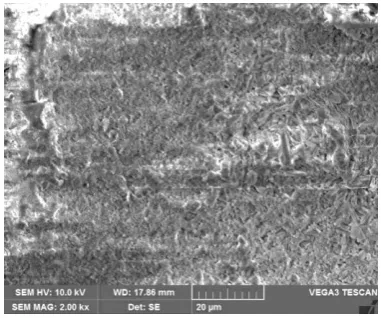
XRD and SEM analysis are performed on normal concrete as well as BR-MK concrete with 15% dosage are presented in this section. The SE (secondary electron) images of normal concrete, as well as BR-MK concrete from SEM analysis, are displayed in figures 5 and 6 and they depict the variation in morphology of both mixes. The SE image of BR-MK concrete illustrate that, there are more hydration products than in normal concrete which causes strength enhancement. The formation of C-S-H gel is identified by using the ratios of Ca/Si and (Al+Fe)/Ca from EDS. The stability of C-S-H gel is inversely proportional to Ca/Si i.e., more the ratio less will the stability of C-S-H gel vice-versa.
Fig. 5: SE image of normal concrete
Fig 6: SE image of BR-MK concrete
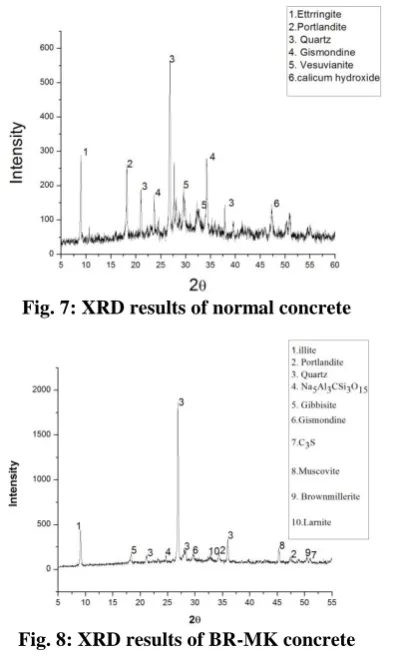
XRD analysis is
[image:3.595.331.522.385.544.2]dosage BR-MK mix and normal mixes are illustrated in figures 7 and 8. The hydration products (in the form of minerals) developed in each mix is presented as a legend in both images. Normal concrete mix is dominated by peak intensities of Ettringite(1), Portlandite(2), Quartz(3), Gismondine(4), Vesuvianite(5), Calcium Hydroxide(6). while the BR-MK mix is dominated by peak intensities of Illite(1), Portlandite(2), Quartz(3), Na5Al3CSi3O15(4), Gibbisite(5), Gismondine(6), C3S(7), Muscovite(8), Brownmillerite(9), Larnite(10). When both BR-MK blend and cement have participated in the hydration process they produced illite, Gibsite, Muscovite and Brownmillerite which are generally not produced in cement hydration. Especially the presence of C3S and Larnite signifying the strength enhancement of BR-MK concrete than normal concrete as they are the mineral forms of C-S-H gel.
Fig. 7: XRD results of normal concrete
Fig. 8: XRD results of BR-MK concrete
IV. CONCLUSIONS
Based on the current experimental work some important conclusions arrived are given below
The slump value of concrete decreases with increase in the dosage of BR-MK blend as the BR-MK blend is having greater specific surface area than cement.
The concrete with 15% BR-MK blend shows the enhanced mechanical properties. Beyond this replacement concrete mechanical properties are getting diminished with increase in dosage of BR-MK blend.
Comparing to normal concrete, the finer particles of BR-MK blend filled the micro pores and results in dense structure of BR-MK concrete. This is the main reason for the strength enhancement.
Agglomeration effect came into picture with increase in the dosage of BR-MK blend beyond optimum dosage (15%). This effect is the main reason behind the formation of large voids which in turn reduced the strength of concrete. Usage of Bauxite residue in concrete production reduces
some amount of CO2 emission.
ACKNOWLEDGMENT
We are thankful to CoExAMMPC, Department of Science and Humanities, VFSTR Deemed to be University, Vadlamudi, Guntur, A.P, India, for their technical support and a special thanks toDr. P.K. Pattajoshi and V.Krishna Kumari, AGM (Chemical) - R&D, NALCO, India,
F
or providing red mud.REFERENCES:
1. I. Nikbin, M. Aliaghazadeh, S. Charkhtab, and A. Fathollahpour, ―Environmental impacts and mechanical properties of lightweight concrete containing bauxite residue (red mud),‖ Journal of Cleaner Production, vol. 172, pp. 2683–2694, 2018.
2. M. P. Kumar, K. Mini, and M. Rangarajan, ―Ultrafine GGBS and calcium nitrate as concrete admixtures for improved mechanical properties and corrosion resistance,‖ Construction and Building
Materials, vol. 182,pp.249–257,2018,
https://doi.org/10.1016/j.conbuildmat.2018.06.096
3. A. Mohan and K. Mini, ―Strength and durability studies of SCC incorporating silica fume and ultra fine GGBS,‖ Construction and
Building Materials, vol. 171, pp. 919–928, 2018.
https://doi.org/10.1016/j.conbuildmat.2018.03.186
4. R. Pode, ―Potential applications of rice husk ash waste from rice husk biomass power plant,‖ Renewable and Sustainable Energy Reviews,
vol. 53, pp. 1468–1485,
2016,http://dx.doi.org/10.1016/j.rser.2015.09.051
5. M. Balapour, E. Hajibandeh, and A. Ramezanianpour, ―Engineering Properties and Durability of Mortars Containing New Nano Rice Husk Ash (RHA),‖ High Tech Concrete: Where Technology and
Engineering Meet, pp. 199–206,
2017,http://dx.doi.org/10.1016/j.conbuildmat.2016.03.136
6. A. Cheng, R. Huang, J.-K. Wu, and C.-H. Chen, ―Influence of GGBS on durability and corrosion behavior of reinforced concrete,‖ Materials Chemistry and Physics, vol. 93, no. 2-3, pp. 404–411, 2005.doi:10.1016/j.matchemphys.2005.03.043
7. P. Mehra, R. C. Gupta, and B. S. Thomas, ―Assessment of durability characteristics of cement concrete containing jarosite,‖ Journal of
Cleaner Production, vol. 119, pp. 59–65, 2016,
10.1016/j.jclepro.2016.01.055
8. S. Samal, A. K. Ray, and A. Bandopadhyay, ―Proposal for resources, utilization and processes of red mud in India — A review,‖ International Journal of Mineral Processing, vol. 118, pp. 43–55, 2013, http://dx.doi.org/10.1016/j.minpro.2012.11.001
9. M. Amrutha, M. Ramakrishna, ―Red mud as a construction material by using bioremediation,‖ International Research Journal of Engineering andTechnology, vol. 05, 2018.
10. S. T. ., ―Study On Mechanical Properties Of Red Mud As A Partial Replacement Of Cement With Hydrated Lime For M40 Grade Concrete With Superplasticiser,‖ International Journal of Research in
Engineering and Technology, vol. 05, no. 04, pp. 40–47, 2016.
11. W. Liu, J. Yang, and B. Xiao, ―Application of Bayer red mud for iron
recovery and building material production from alumosilicate residues,‖ Journal of Hazardous Materials, vol. 161, no. 1, pp. 474–478, 2009, doi:10.1016/j.jhazmat.2008.03.122
12. M. Abdel-Raheem, Santana L. M. Gómez, Cordava M. A. Piñeiro, and Martínez B . Olazaran, ―Uses of Red Mud as a Construction Material,‖ Aei 2017, 2017.
13. U. Bertocci, ―A Comparison of Electrochemical Noise and Impedance Spectroscopy for the Detection of Corrosion in Reinforced Concrete,‖ Electrochemical Noise Measurement for Corrosion
Applications, 2011.
reinforced concrete,‖ Cement and Concrete Research, vol. 42, no. 1, pp. 124–133, 2012, DOI: 10.1016/j.cemconres.2011.09.002
15. D. Ribeiro, J. Labrincha, and M. Morelli, ―Effect of red mud addition on the corrosion parameters of reinforced concrete evaluated by electrochemical methods,‖ Revista IBRACON de Estruturas e
Materiais, vol. 5, no. 4, pp. 451–467, 2012.
16. A. S. Gill and R. Siddique, ―Durability properties of self-compacting concrete incorporating metakaolin and rice husk ash,‖ Construction
and Building Materials, vol. 176, pp. 323–332, 2018,
10.1016/j.conbuildmat.2018.05.054
17. S. N. Manu and P. Dinakar, ―Fresh and Mechanical Properties of High
Strength Self Compacting Concrete Using Metakaolin,‖ RILEM
BookseriesCalcined Clays for Sustainable Concrete, pp. 509–515,
2015.
18. V. Sivakumar, O. Kavitha, G. P. Arulraj, and V. Srisanthi, ―An
experimental study on combined effects of glass fiber and Metakaolin on the rheological, mechanical, and durability properties of self-compacting concrete,‖ Applied Clay Science, vol. 147, pp. 123–127, 2017, http://dx.doi.org/10.1016/j.clay.2017.07.015
19. ―Properties of High-Performance Concrete Containing High -
Reactivity Metakaolin,‖ Journal of the Korea Concrete Institute, vol. 14, no. 3, pp. 349–356, 2002, 10.4334/jkci.2002.14.3.349
20. V. Kannan, ―Strength and durability performance of self compacting
concrete containing self-combusted rice husk ash and metakaolin,‖ Construction and Building Materials, vol. 160, pp. 169–179, 2018, https://doi.org/10.1016/j.conbuildmat.2017.11.043