Abstract: Chemical foam is being used more frequently with Earth Pressure Balance (EPB) shields to achieve underground works, which present a rising interest in the excavation technique. During tunneling with an Earth Pressure Balance shield in clayey soil, clogging of the clay occurs, leading to blocking the cutting head and clog then the shield chambers. Surfactants are commonly used as conditioning agents to reduce clay stickiness. This treatment leads to a change in the mechanical properties of conditioned soil. This paper aims tostudy the shear strength behavior of foam-conditioned soil basing on triaxial tests in the undrained consolidated conditions. Experimental results are modeled using the finite element code COMSOL Multiphysics with the aim of analyzing the effect of the percentage of foam on the shear strength behavior. The soil mixture made from 40% of kaolinite and 60% of sand was conditioned with a foaming agent based on anionic surfactant. Consolidated undrained triaxial tests have been performed in order to explain the effect of foam. Results show that foam reduces the shear stress thanks to their weak stiffness. Shear strength stress is affected by the percentage of the foam in the mixture before shearing by reduce the shear strength of the conditioned soil. Soil-foam mixture has been modeled as a medium containing spherical pore inclusions with a low stiffness compared to the stiffness of unconditioned soil. Stiffness of bubbles inclusions was identified using one of the known homogenization models for composite materials. Results show that the reduce shear stress strength is affected by the percentage of inclusions in the matrix. It confirms the friction angle of composite material decrease as function of the percentage of gas bubbles inclusion in the matrix.
Index Terms: Tunneling, conditioned soil, foaming agent, shear strength, experience, triaxial tests, modeling.
I. INTRODUCTION
Shield construction technology is increasingly developing, and has been widely used to facilitate excavation
Revised Manuscript Received on September 07, 2019
Moez SELMI, 1Tunis El Manar University, National Engineering School of Tunis, Civil engineering Laboratory,Tunis, Tunisia.
2Université de Lyon, Ecole Nationale d'Ingénieurs de Saint-Etienne,
Laboratoire de Tribologie et Dynamique des Systèmes, Saint Etienne, France
Mariem KACEM, Université de Lyon, Ecole Nationale d'Ingénieurs de Saint-Etienne, Laboratoire de Tribologie et Dynamique des Systèmes, Saint Etienne, France
MehrezJamei, Tunis El Manar University, National Engineering School of Tunis, Civil EngineeringLaboratory,Tunis, Tunisia.
Philippe DUBUJET, Université de Lyon, Ecole Nationale d'Ingénieurs de Saint-Etienne, Laboratoire de Tribologie et Dynamique des Systèmes, Saint Etienne, France
in the poor mechanical characteristics of soils in complex geological formations with large groundwater level [1-2]. In order to ensure tunneling advances in a stratum containing different types of soil, the excavationof soil must be performed by adding modified material to change physical and mechanical properties making a soil with good plastic flow state, low friction angle and in some cases with low permeability. The importance of soil conditioning practice for EPB methods has conducted to high research efforts around the world [1]. Since the state of the art established by Milligan (2000) [2], many laboratory tests using newly developed devices [3], have brought insight into the working mechanisms of the different products and into the resulting soil behavior of different soils [4]. These advances have resulted in the analysis of working mechanisms and the development of new chemical compositionsof surfactant as product [2]). Also, of high interest was the surveying and modeling of the soil behavior in the pressure chamber [5].
Soil conditioning agents were used in the objective to transform the excavated soil into a workable soil with the desired hydrological, physical and mechanical properties. Improving the stability of the tunneling face and materials flow during excavation process are some of the benefits of using soil-conditioning agent in EPB tunneling [6]. Conditioning soil operation was performed through foam injection to the face tunnel, in excavation chamber and screw conveyor. The selection of foam types depends essentially on soil type and geological conditions (permeability of soil and ground water)[6–8]. In these projects, a significant amount of soil conditioned with foam agent was produced. These types of soils exhibit a different behavior from the initial soil thanks to foam’s bubbles introduced into the excavated soil [2,9]. Foam used, is commonly defined as a dispersion of gas bubbles in a liquid [10–12]. Injected in the clay soil, foam’s gas bubbles are dispersed in the clay matrix of the soil like spherical inclusions surrounded by clay particles [13]. However, in the case of purely sandy soil, Mori et al. (2018) suggested that the foam can be considered as fluid mixed with water. The mixing fluid occupies the porous volume and it was usually studied as compressible fluid.
Few works investigate the become of soil-foam system after excavation. Previous researches have shown that a soil-foam mixture can be remarkably stable in soil for a few days [13–15]. Some works
have also examined
Experimental and Modeling of Shear
Mechanical Behavior of Soil Conditioned With
Foaming Agent
the foam degradation over time,and no relation between the micro-properties and the macro-properties were investigated. This new structure of the soil-foam mixture would essentially affect the stress of the mixture due to the presence of highly compressible gas bubbles.
The aim of this study is to interpret the effect of a conditioning agent CLB F5TM on shear strength of the conditioned soil through undrained consolidated triaxial tests with measurement of interstitial pressure. The effect of foam is related to the behavior of the foam. So, the stiffness of the foam-soil mixture and the shear strength are related to the percentage of gas bubbles generated by the foam in the mixture after conditioning procedure. Finite element simulationsusing the Comsolmultiphysic software were used to clarify the interpretation of the role of foam percentages on shear stress. This was ensured by using a mixture of two phases, amatrix phase which presents a saturated soil with initial properties (friction angle, Young modulus, density) and empty spherical inclusions.
II. MATERIALSANDEXPERIMENTAL
METHODS
[image:2.595.301.553.62.183.2]The grain size distribution of the soil used in this research is shown in fig. 1. This soil is composed by 40% of Kaolinite mass and 60% of sand mass. It represents fine soil that needs a conditioning with foam during the digging process by Earth Pressure Boring (EPB) machine (Maild, 2007), due to its clogging risk.
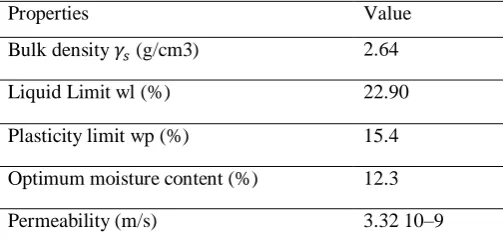
Fig. 1. Particle size distribution of studied soil To characterize the studied soil, some physical properties are measured and shown in Table 1. The soil is characterized by a medium plasticity, according to technical guidelines on embankment and capping layers construction (abbreviated to its French acronym GTR NFP 11-300), with an index of plasticity, IP (IP = = 7.5%) and low permeability(Table 1).
Permeability (m/s) 3.32 10–9
Soil is conditioned with a surfactant CLB F5TM/AC (CONDAT).This surfactant is used mainly in low permeability soils with a high content of fines such as silts and clays[17].The procedure of conditioning by the foaming agent consists to define the volume percentage of foam injected in the soil before conditioning procedure FIR (Eq. 1):
Foam Injection Ratio (FIR):FIR=
*100% (1)
where is the foam volume, the conditioned soil
volume
FIR values are recommended according to the slump- values which are generated between 3 and 6 cm using mini slump test[18]. Three FIR values were used in this study for conditioning soil (100%, 120% and 150%).The mixing of the foam with the soil is ensured by using cement paste mixer. Mixing operation is stopped when the foam is perfectly homogenized with the soil. Typically, mixing process takes 3 minutes to check the integration of foam’s gas bubbles into the soil with low amounts of two kilograms of soil.
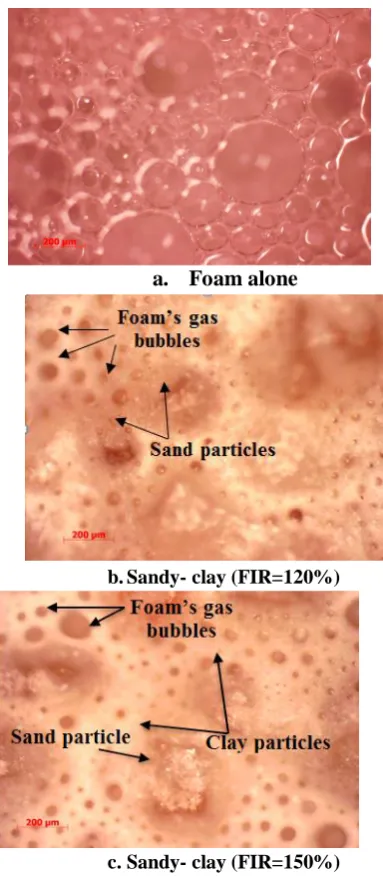
The constitutive micro-structure of the mixture material was analyzed using Scanner Optical microscope (SOM) (Axio Imager -ZEISS). Fig 2.a shows the structure of foaming agent alone after 5 min of its preparation. Foaming agents are defined as a dispersion of gas bubbles in a liquid. The dimensions of the bubbles are in size range of 1 to 1000 μm. Foams typically contain very small bubbles separated by thin films of liquid (Fig 2.a).
After mixing operation, foam’s gas bubbles are formed in the conditioned soil. The volume of gas bubbles in the prepared samples depends on the percentage of foam injected FIR (Fig 2.b and Fig2.c). It is noted that a significant amount of injected foam is degraded during the mixing process.
Basing on the SOM observations, the undissolved gas bubbles of the foam were considered as a discontinuous medium with porositydistributed in a saturated soil matrix. In fact, the gas bubbles produced by foam are extremely different from the conventional gas, which fits inside the normal void space without affecting the soil skeleton. The foam is distributed in the soil mixing as air bubbles that are totally covered by an extremely thin liquid film. The bubbles are typically wider than the normal void space in the clay soil and cannot be considered
[image:2.595.48.266.515.664.2]a. Foam alone
b.Sandy- clay (FIR=120%)
[image:3.595.82.274.55.494.2]c.Sandy- clay (FIR=150%) Fig. 2. Microscopic observations: effect of foam on
Sandy-clay mixture
To identify the effect of the foam on soil shear strength undrained consolidated triaxial testwas performed on unconditioned and conditioned soil. The water pressure was measured during the undrained compression tests using pressure transducer 28-WF630Xat the level of the porous stone placed at the bottom of the sample (Fig 3). Tests were carried out in a conventional shear cell with cylindrical sample size (35mm as diameter and high of 70 mm, Fig.3).
[image:3.595.320.554.58.163.2]After soil conditioning, samples are confined to a lateral stress of 50 kPa. Tests carried out on reconstituted soils in order to analyze the effect of foam on mechanical soil properties, the different samples are prepared under the same conditions. The samples were prepared by compaction at initial a given density and placed into the triaxial cell, saturated and consolidated under a low confinement pressure of 50 kPa.
Fig. 3 Triaxial shear device: consolidated undrained experience
Numerical simulations of the triaxial tests were carried out using the Comsolmultyphysics software. The formulation used for structural analyses in Comsol for both small and finite deformation is totally Lagrangian. The Green-Lagrange strain tensor ( is related to the gradiant of the desplacement ( ) by the folowing equation:
(2)
The soil matrix was considered as an elastoplastic material. For a linear elastic material, the total stress tensor (S) and strain tensor relationship is given by (eq. 3):
(3)
Where, C is 4th order elasticity tensor, and are initial stress and strain, and is the inelastic strain.
The Mohr-Coulomb criterion was used for the soilmatrix,which expressed the shear strength inMohr-plane as:
(4)
Where,cis the cohesion and the friction angle.
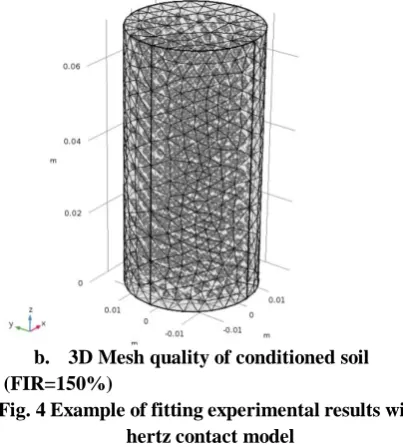
A3D model was considered for the modeling.The dimensions and boundary conditions wereconsidered the sameas those for experimental samples(fig.4). Therefore, the bottom of the sample was assumed to be fixed and the top platen was moved by the prescribed displacement until the sample reached its maximum displacement fixed at 25 % of axial strain deformation. The confining pressure was equal to 50 kPa. For the soil-foam mixture spherical inclusions with a diameter 1 mmwere insinuated in the matrix. The percentage and properties of these spherical inclusions werefixed for each test.
b. 3D Mesh quality of conditioned soil (FIR=150%)
Fig. 4 Example of fitting experimental results with the hertz contact model
III. RESULTSANDDISCUSSION
To interpret the effect of foam gas bubbles on shear behavior, we have started by measuring the volume percentage of the foam in the soil after the conditioning procedure. These parameters were measured in the case after the saturationofeach sample with a total volume . The tested sample was then oven-dried for 24 hours to deduce the different volumes of solid particles, water and gas. The total volume of a saturated soil-foam mixture is described by Eq.5.
(5)
The mass of water in the sample is deduced by the difference between the total mass (Wt) and the mass of the sample after drying in the oven (Ws). In this case, the mass of the gas bubbles is equal to zero.
Afterwards, Vsand Vw can be determined by Eq. 6and Eq. 7 respectively.
Vs= (6)
Vw = (7)
Where and represent respectively the density of the solid grains and the density of the water.
Finally, the volume of the gas bubbles is deduced using Eq. 8.
(8)
The evolution of volume percentage of gas bubbles in the
soil ( ) function of FIR shows a linear tendency for FIR
[image:4.595.63.265.60.284.2]more than 80% and more a less 0 otherwise. In fact, during the process of mixing at atmospheric conditions foam bubbles can be destroyed reducing the volume of foam in the soil (Fig.5).
Fig. 5. Evolution of volume percentage of foam’s gas bubbles in the soil function on FIR
Undrained consolidated triaxial shear tests were carried out on unconditioned soil and soil conditioned with different percentage of FIR at a confining pressure of 50 kPa. Results show a significant decrease of the deviatoric stress of conditioned soil as function of the FIR increase. We note that we have a decrease of 50% in the deviatoric stress in the case of FIR=150% (Fig.6).
Fig. 6Stress-strain evolution for conditioned soil with different foam fraction FIR (
The results show that the tested soil exhibited normally consolidated behavior. Considering that the soil without cohesion, the effect of the FIR on the friction angle was computed using Eq. 9:
(9)
Where and are the major and minor principal stress
at failure and the friction angle As expected, a reduction
[image:4.595.320.568.330.501.2]Fig.7. Friction angle evolution at the critical state function of FIR
Following the experiences, numerical model was used to simulate the effect of foam gas bubbles on conditioned soil. Therefore, the mechanical properties of foam gas babbles in the soil matrix were deduced.
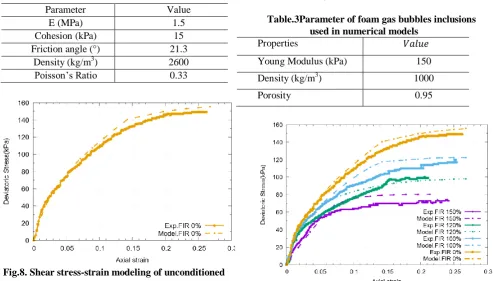
[image:5.595.321.552.65.251.2]Firstly, numerical tests were carried out to model the experimental tests of unconditioned soil. To simulate the shear behavior of the unconditioned soil, numerical values of friction angle, cohesion, Young's modulus and Poisson ratio are fixed to correlate the experimental deviatoric stress displacement curve (Table 2). Fig. 8 and fig. 9 show the numerical simulation of triaxial test in Comsol Multiphysics using these parameters. Experimental and numerical curves are compared.
[image:5.595.68.308.434.704.2]Table 2. Numerical parameters of material used to model unconditioned soil
Fig.8. Shear stress-strain modeling of unconditioned soil for 3=50 kPa
Fig.9. Variation of effective elastoplastic Stress of soil model at confining pressure of 50 kPa
[image:5.595.62.556.438.719.2]To simulate the effects of foam bubbles in the soil, the same parameters of the unconditioned soil were conserved and spherical inclusions with different percentage were introduced into the matrix.These inclusions were periodically distributed in the matrix. Properties of inclusions used are summarized in table.4. Young modulus and porosity of bubbles are obtainedto simulate the behavior of the soil conditioned with FIR = 150%. This parameter was conserved for the other percentages of foam (FIR = 120%, FIR = 100%). The results showed a good tendency of behavior of soil gas bubbles mixing (Fig.10). Modeling results show also the decrease shear strength as function of FIR.
Table.3Parameter of foam gas bubbles inclusions used in numerical models
Properties
Young Modulus (kPa) 150
Density (kg/m3) 1000
Porosity 0.95
Fig.10 Numerical simulations of inclusions percentage effect on shear behavior at
confining pressure of 50kPa
Parameter Value
E (MPa) 1.5
Cohesion (kPa) 15
Friction angle (°) 21.3
Density (kg/m3) 2600
[image:5.595.298.549.468.719.2]Through this study, several findings are revealed. Triaxial test on conditioned soil shows the decrease of shear strength stress in the matrix caused by the very low compressibility and zero shear of gas bubbles. The bulk modulus of bubbles produced by foam decrease the bulk modulus of soil-foam mixture. Numerical simulation of foam’s effect from a matrix-inclusions model shows the effect of percent inclusions on shear stress in the sample.
The knowledge of the behavior of the soil-foam mixture and their evolution over time allows the control of the embankments coming from the tunnel and promotes the possibility of the reuse of soil in other civil engineering projects. This process permits to improve the environmental control by the optimization of the use of the excavated material.
ACKNOWLEDGMENTS
This work was financially supported by the “PHC Utique” program of the French Ministry of Foreign Affairs and Ministry of Higher Education and Research, as well as the Tunisian Ministry of Higher Education and Scientific Research in the project number 15G1116. Furthermore, the travel and work were carried out with the financial support of the Rhône-Alpes Region. The authors are grateful to the CONDAT Company, which provided the CLB F5TM/AC surfactant.
REFERENCES
1. Y. Yang, G. Wang, H. Li, X. Huang, The new clay mud and its improvement effects of tunnels, Applied Clay Science. 79 (2013) 49–56. 2. B. Maidl, M. Herrenknecht, U. Maidl, G. Wehrmeyer, Mechanised
Shield Tunnelling, 2012.
3. E. Pujades, E. Vázquez-Suñé, L. Culí, J. Carrera, A. Ledesma, A. Jurado, Hydrogeological impact assessment by tunnelling at sites of high sensitivity, Engineering Geology. 193 (2015) 421–434. doi:10.1016/j.enggeo.2015.05.018.
4. R. ZUMSTEG, M. PLöTZE, A. PUZRIN, Reduction of the clogging potential of clays: new chemical applications and novel quantification approaches, Géotechnique. (2013). doi:10.1680/geot.sip13.p.005. 5. S. Jefferis, A. Merritt, Exploiting physico-chemical modification of soils
in closed face tunnelling, in: Coupled Phenomena in Environmental Geotechnics, 2013. doi:10.1201/b15004-73.
6. D. Peila, C. Oggeri, R. Vinai, Screw Conveyor Device for Laboratory Tests on Conditioned Soil for EPB Tunneling Operations, Journal of Geotechnical and Geoenvironmental Engineering. 133 (2007) 1622–1625.
7. M. Thewes, C. Budach, Soil conditioning with foam during EPB tunnelling / . Konditionierung von Lockergesteinen bei Erddruckschilden, Geomechanics and Tunnelling. (2010). doi:10.1002/geot.201000023.
8. L. Borio, D. Peila, Study of the permeability of foam conditioned soils with laboratory tests, American Journal of Environmental Sciences. 6 (2010) 365–370. doi:10.3844/ajessp.2010.365.370.
9. M. Thewes, C. Budach, A. Bezuijen, Foam conditioning in EPB tunnelling, in: Geotechnical Aspects of Underground Construction in Soft Ground, 2012: pp. 127–135. doi:10.1201/b12748-19.
10.K. Khristov, D. Exerowa, G. Minkov, Critical capillary pressure for destruction of single foam films and foam: effect of foam film size, Colloids and Surfaces A: Physicochemical and Engineering Aspects. 210 (2002) 159–166.
11.S.A. Koehler, S. Hilgenfeldt, H.A. Stone, Generalized view of foam
16. L. Mori, M. Mooney, M. Cha, Characterizing the influence of stress on foam conditioned sand for EPB tunneling, Tunnelling and Underground Space Technology. 71 (2018) 454–465.
17. D. Baderna, E. Lomazzi, A. Passoni, A. Pogliaghi, M.I. Petoumenou, R. Bagnati, M. Lodi, A. Viarengo, S. Sforzini, E. Benfenati, R. Fanelli, Chemical characterization and ecotoxicity of three soil foaming agents used in mechanized tunneling, Journal of Hazardous Materials. 296 (2015) 210–220.
18. C. Budach, M. Thewes, Soil conditioning with foam during EPB Tunnelling, Geomechanics and Tunnelling. (2010).
AUTHORS PROFILE
Moez SELMI is a PHD student. His research is focusedon the soil treatment and porous media. He graduated from the National Engineering School of Tunis as a civil engineer. He started his research experience with a project in the National School of engineering of Saint-Etienne (ENISE) where he studied the revalorization of excavated soil following the digging of tunnels on soft ground. Currently he is a civil engineering PhD student jointly supervised by the National engineering School of Tunis, Tunis El-Manar university and the National School of Engineering of Saint-Etienne, Lyon university. His research mainly focuses on studying the behavior of soil conditioned with foam agent within the framework of soil excavated by Earth Pressure Balance Shield tunneling based on experimental tests and numerical simulations with the finite Elements Method.
Mariem KACEM is currently Associate Professor in civil engineering and environmental geotechnical engineering. She is working at the laboratory of tribology and systems dynamics, Lyon university, National engineering school of Saint-Etienne, France.Mariemkacem’s research fields are environmental engineering, transport in porous media, multiphase extraction.The current projects are hydro-mechanical properties degradation of soils treated with surfactant products, SVE and MPE, soil vapor extraction
and multiphase extraction
,
particles transport on soil and Pollutant transport and transfer on soil. She participated in the organization of several conferences and scientific meetings. She was chair of2nd Scientific Meeting: Workshop on Rehabilitation of polluted Sites and Soils (R2S).
Philippe DUBUJET is currently Full Professor in civil engineering and environmental geotechnical engineering. He is working at the laboratory of tribology and systems dynamics, Lyon university, National engineering school of Saint-Etienne, France. Philippe dubujet’s research fields are environmental engineering, transport in porous media, multiphase extraction. The current projects are hydro-mechanical properties degradation of soils treated with surfactant