COUNCIL OF THE EUROPEAN UNION
Brussels, 9 March 2004
7108/04 ADD 1
DEVGEN 60 ONU 17 ECOFIN 81
COVER NOTE
from : Secretary-General of the European Commission, signed by Mrs Patricia BUGNOT, Director date of receipt : 5 March 2004
to : Mr Javier SOLANA, Secretary-General/High Representative Subject: Commission Staff Working Paper
ANNEX: EU follow – up to the Barcelona Commitments and operationalisation of the Monterrey consensus
Delegations will find attached Commission document SEC(2004)246.
________________________
COMMISSION OF THE EUROPEAN COMMUNITIES
Brussels, 5.3.2004 SEC(2004)246
COMMISSION STAFF WORKING PAPER
ANNEX: EU follow – up to the Barcelona Commitments and operationalisation of the Monterrey consensus
COMMISSION STAFF WORKING PAPER
ANNEX: EU follow – up to the Barcelona Commitments and operationalisation of the Monterrey consensus
Summary of replies to a survey with Member States (November 2003)
1. Commitment I: Increase the volume of EU Official Development Assistance to
0.39% of GNI by 2006, and eventually to 0.7% of GNI... 3
2. Commitment II: Coordination and Harmonisation ... 7
3. Commitment III: Untying ... 19
3.1. State of play on untying within the Union ... 20
3.2. Potential for further action ... 20
4. Commitment IV: Trade Related Assistance... 21
5. Commitment V: Global Public Goods. ... 22
6. Commitment VI: Innovative Sources of Financing ... 23
7. Commitment VII: Reform of the International Financial System ... 24
1. COMMITMENT I: INCREASE THE VOLUME OF EU OFFICIAL DEVELOPMENT
ASSISTANCE TO 0.39% OF GNI BY 2006, AND EVENTUALLY TO 0.7% OF GNI
Commitment: “In pursuance of the undertaking to examine the means and timeframe that will allow each of the Member States to reach the UN goal of 0.7% ODA/GNI, those Member States that have not yet reached the 0.7% target commit themselves – as a first significant step – individually to increase their ODA volume in the next four years within their respective budget allocation processes, whilst the other Member States renew their efforts to remain at or above the target of 0.7% ODA, so that collectively an EU average of 0.39% is reached by 2006. In view of this goal, all the EU Member States will in any case strive to reach, within their respective budget allocation processes, at least 0.33% ODA/GNI by 2006.”
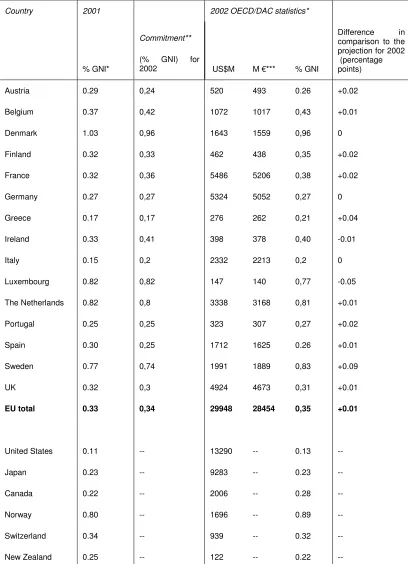
Table 1: EU ODA in 2002: actual aid volumes compared to projections, and to the 2001 volumes
Country 2001 2002 OECD/DAC statistics*
% GNI*
Commitment**
(% GNI) for
2002 US$M M €*** % GNI
Difference in comparison to the projection for 2002 (percentage points)
Austria 0.29 0,24 520 493 0.26 +0.02
Belgium 0.37 0,42 1072 1017 0,43 +0.01
Denmark 1.03 0,96 1643 1559 0,96 0
Finland 0.32 0,33 462 438 0,35 +0.02
France 0.32 0,36 5486 5206 0,38 +0.02
Germany 0.27 0,27 5324 5052 0,27 0
Greece 0.17 0,17 276 262 0,21 +0.04
Ireland 0.33 0,41 398 378 0,40 -0.01
Italy 0.15 0,2 2332 2213 0,2 0
Luxembourg 0.82 0,82 147 140 0,77 -0.05
The Netherlands 0.82 0,8 3338 3168 0,81 +0.01
Portugal 0.25 0,25 323 307 0,27 +0.02
Spain 0.30 0,25 1712 1625 0.26 +0.01
Sweden 0.77 0,74 1991 1889 0,83 +0.09
UK 0.32 0,3 4924 4673 0,31 +0.01
EU total 0.33 0,34 29948 28454 0,35 +0.01
United States 0.11 -- 13290 -- 0.13 --
Japan 0.23 -- 9283 -- 0.23 --
Canada 0.22 -- 2006 -- 0.28 --
Norway 0.80 -- 1696 -- 0.89 --
Switzerland 0.34 -- 939 -- 0.32 --
New Zealand 0.25 -- 122 -- 0.22 --
* OECD/DAC: “Net Official Development Assistance in 2002”, 28 January 2004
** Commission Staff Working Document “Follow-up to the International Conference on Financing for Development (Monterrey - 2002) -Monitoring the Barcelona Commitments”, presented to the General Affairs and External Relations Council in 18 May 2003
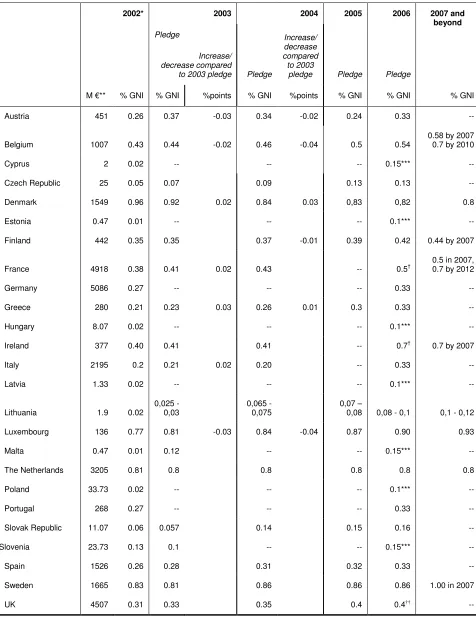
Table 2: Projected EU Official Development Assistance 2002 - 2007
2002* 2003 2004 2005 2006
Pledge
Increase/ decrease compared
to 2003 pledge Pledge
Increase/ decrease compared to 2003
pledge Pledge Pledge
2007 and beyond
M €** % GNI % GNI %points % GNI %points % GNI % GNI % GNI
Austria 451 0.26 0.37 -0.03 0.34 -0.02 0.24 0.33 --
Belgium 1007 0.43 0.44 -0.02 0.46 -0.04 0.5 0.54
0.58 by 2007 0.7 by 2010
Cyprus 2 0.02 -- -- -- 0.15*** --
Czech Republic 25 0.05 0.07 0.09 0.13 0.13 --
Denmark 1549 0.96 0.92 0.02 0.84 0.03 0,83 0,82 0.8
Estonia 0.47 0.01 -- -- -- 0.1*** --
Finland 442 0.35 0.35 0.37 -0.01 0.39 0.42 0.44 by 2007
France 4918 0.38 0.41 0.02 0.43 -- 0.5† 0.5 in 2007,
0.7 by 2012
Germany 5086 0.27 -- -- -- 0.33 --
Greece 280 0.21 0.23 0.03 0.26 0.01 0.3 0.33 --
Hungary 8.07 0.02 -- -- -- 0.1*** --
Ireland 377 0.40 0.41 0.41 -- 0.7†
0.7 by 2007
Italy 2195 0.2 0.21 0.02 0.20 -- 0.33 --
Latvia 1.33 0.02 -- -- -- 0.1*** --
Lithuania 1.9 0.02
0,025 -
0,03
0,065 -
0,075
0,07 –
0,08 0,08 - 0,1 0,1 - 0,12
Luxembourg 136 0.77 0.81 -0.03 0.84 -0.04 0.87 0.90 0.93
Malta 0.47 0.01 0.12 -- -- 0.15*** --
The Netherlands 3205 0.81 0.8 0.8 0.8 0.8 0.8
Poland 33.73 0.02 -- -- -- 0.1*** --
Portugal 268 0.27 -- -- -- 0.33 --
Slovak Republic 11.07 0.06 0.057 0.14 0.15 0.16 --
Slovenia 23.73 0.13 0.1 -- -- 0.15*** --
Spain 1526 0.26 0.28 0.31 0.32 0.33 --
Sweden 1665 0.83 0.81 0.86 0.86 0.86 1.00 in 2007
UK 4507 0.31 0.33 0.35 0.4 0.4††
2002 ODA M€
2002 ODA % GNI
2006 ODA %GNI****
2006 ODA M€****
EU 15 28 421 0.348 0.43 38 131
EU 10 108 0.03 0.11 389
EU 25 28 529 0.335 0.42 38 520
* Data for 2002: Current Member States: OECD/DAC statistics for ODA in 2002. Acceding Countries: Data based on the assumption that the ODA/GNI ratio for 2001 mentioned in the report on assessing the study “The Consequences of Enlargement for Development Policy”, prepared for the European Commission by Development Strategies, IDC, 31 August 2003, will remain constant. Exchange rate for conversion to EUR: 1 USD = 0.8813 EUR (28 December 2001). Assumes a 2% p.a. nominal growth in GNI and constant prices.
** Exchange rate of 31 December 2002: 1 USD = 0.949 EUR
*** Estimated ODA/GNI ratio based on the study on the “Consequences of Enlargement for Development Policy” mentioned under * above.
**** Assuming a 2% p.a. growth in GNI and constant prices (2002).
†
Based on the ODA/GNI ratio stated in the 2003 report on the EU follow-up to the Barcelona commitments (no revised figure provided by the Member States in question for 2004)
2. COMMITMENT II:COORDINATION AND HARMONISATION
Commitment: ”To take concrete steps on co-ordination of policies and harmonisation of procedures before 2004, both at EC and Member States level, in line with internationally agreed best practices including by implementing recommendations from the OECD Development Assistance Committee Task Force on donor practice”.
In order to investigate what type of further measures that Member States are willing to take to step up coordination and harmonisation, a detailed set of questions were asked. The replies to the questions as well as a summary of specific observations made are set out in the table below.
Agrees/Yes Disagrees/No No position Conclusion/observation/comments
Ready to engage in country-by-country
monitoring of EU coordination and
harmonisation
Austria, Belgium, Estonia, Finland, Latvia, Lithuania, Luxembourg, Germany, Greece, Ireland, Italy, Malta, Netherlands, Portugal, Spain
Slovakia Czech Rep, Hungary, Poland, Slovenia, UK
Regular monitoring generally found useful to identify obstacles to coordination and keep an eye on the progress made. Current practice in the MEDA region could be taken as a model and extended; in the first instance to the four pilot countries.
Those undecided believe that standardised EU approaches should not be used or monitored independently of wider coordination initiatives.
Ready to engage
in annual
reporting on EU coordination, to gather EU input for discussion on coordination in int’l fora
Austria, Belgium, Czech Rep, Denmark, Estonia, Finland, Germany, Hungary, Ireland, Italy, Latvia, Lithuania, Luxembourg, Malta, Netherlands, Poland, Portugal, Spain, UK
Greece, Slovakia France, Sweden (only to the extent that general reporting motivates EU donors to take part in wider coordination processes), Slovenia
Agrees/Yes Disagrees/No No position Conclusion/observation/comments
Ready to use EC Communications on
sector/thematic policies as common policy reference
documents also for bilateral assistance.
Austria, Belgium, Czech Rep, Denmark, Greece, Italy, Lithuania, Luxembourg, Malta, Poland, Spain, Sweden
Estonia, Finland, France, Ireland, Italy, Netherlands, Portugal, Slovakia, UK
Latvia, Slovenia
Germany: In principle YES; in reality NO
Those in favour stress the importance of DAC work for common policies and the inclusion of other donors in the work. Some against point to diversity among the donors (capacity and focus). France: complementarity does not require common policies.
Willing to move towards one
common EU
multiannual strategic programming document per partner country
Austria, Belgium, Estonia, Latvia, Germany, Hungary, Lithuania, Luxembourg, Italy, Malta, Poland, Spain, Sweden
Czech Rep, Finland, Greece, Ireland, Italy, Netherlands Portugal, Slovakia
France, Denmark, Slovenia, UK,
Those in favour stress importance of flexibility and linking the process to the PRSPs. A certain national visibility must be ensured. Those against refer either to the CSP as a Community instrument only, or prefer to work on the basis of the PRSP.
Those undecisive are generally in favour of more donor-wide cooperation/programming on country level based on country leadership and based on PRSP.
Willing to agree and subsequently
share the
following
components of multiannual prg documents:
Make shared political analysis
Austria, Belgium, Czech Rep, Denmark, Estonia, Finland, Germany, Greece, Hungary, Ireland, Italy, Latvia, Lithuania, Luxembourg, Malta, Netherlands, Poland, Portugal, Slovenia, Spain, UK
Agrees/Yes Disagrees/No No position Conclusion/observation/comments
Shared analysis on the poverty situation
(including e.g. gender
diagnostic)?
Austria, Belgium, Czech Rep, Denmark, Estonia, Finland, Germany, Greece, Hungary, Ireland, Italy, Latvia, Lithuania, Luxembourg, Malta, Netherlands, Poland, Portugal, Slovakia, Slovenia, Spain, UK
Sweden Denmark, Netherlands, UK, Sweden: Multi-donor: YES, but not EU-exclusive. Provided that country-owned PRSP forms the basis of such analysis and that the host-country takes leading role
Shared analysis of the PRSP and the options contained therein?
Austria, Belgium, Czech Rep, Denmark, Estonia, Finland, Germany, Greece, Hungary, Ireland, Italy, Latvia, Lithuania, Luxembourg, Malta, Netherlands, Poland, Portugal, Slovenia, Spain, UK
Slovakia Slovenia, Sweden Denmark, Netherlands, UK, Sweden: Multi-donor: YES, but not EU-exclusive
Shared diagnostic of the macroeconomic situation?
Austria, Belgium, Czech Rep, Denmark, Estonia, Finland, Germany, Greece, Hungary, Ireland, Italy, Latvia, Lithuania, Luxembourg, Malta, Netherlands, Poland, Portugal, Slovakia, Slovenia, Spain, UK
Agrees/Yes Disagrees/No No position Conclusion/observation/comments
Shared coherence analysis (impact of totality of EU policies that affect the partner country)
Austria, Belgium, Czech Rep, Denmark, Estonia, Finland, Germany, Greece, Hungary, Ireland, Italy, Latvia, Lithuania, Luxembourg, Malta, Netherlands, Portugal, Slovakia, Slovenia, Spain, UK
Poland Sweden Denmark, Sweden: Multi-donor yes, but not EU-exclusive
Shared donor matrix
Austria, Belgium, Denmark, Estonia, Finland, Germany, Hungary, Ireland, Latvia, Lithuania, Luxembourg, Malta, Netherlands, Portugal, UK
Greece, Italy, Poland, Slovakia, Spain
Slovenia, Sweden Hungary: step by step.
Denmark, Netherlands, UK, Sweden:: Multi-donor yes, but not EU-exclusive. Include also Worldbank, regional development banks, other donors like NORAD, CIDA, Japan, Swiss etc
Shared results indicators
Austria, Belgium, Denmark, Estonia, Germany, Hungary, Ireland, Italy, Latvia, Lithuania, Luxembourg, Malta, Poland, Portugal, UK
Finland, Greece, Netherlands, Slovakia, Spain
Czech Rep, France (only in the 4 pilot countries), Slovenia, Sweden
Ireland: No added value in an EU group which would exclude Norway, Switzerland and others who share our values on harmonization.
Netherlands, UK, Sweden: Joint efforts should include all donors (and possibly other partners) and not be restricted to EU donors. Indicators be drawn from the PRSP.
Through what mechanism should any joint analytic/diagnost ic/programming
outputs be
approved?
Approved locally between EU Ambassadors and the EC Head of Delegation represented in the
country: Belgium, Denmark,
Finland, France, Ireland, Italy Luxembourg Netherlands, Poland, Portugal, Slovakia, Slovenia, Spain, Sweden, UK
Agrees/Yes Disagrees/No No position Conclusion/observation/comments
Possibility to use
such joint
“products” in bilateral aid programming (no institutional constraints)
Denmark Estonia, Finland, Greece, Hungary, Ireland, Italy, Latvia, Lithuania, Luxembourg, Netherlands, Poland, Slovakia, Slovenia, Spain, Sweden, UK
Belgium, Germany, Portugal
Austria, Czech Rep, France, Malta
Germany: In German development co-operation the decision making is not yet decentralised to field offices. If joint approval is to be located at HQ level (EC management committee as applicable) we do not see constraints. If joint approval will be delegated to field offices we do see constraints since development officials are represented only in a few countries.
Malta: Not enough human resources, financial constraints, limited number of embassies (i.e. no embassies in most recipient countries) more short term than long term volunteers.
Portugal: The financial instalments and cash flow forecasts are subject to prior annual approval by the Parliament.
Member States working on basis of multi-annual programming
for their
bilateral aid
Austria, Belgium Finland, Denmark, France Germany, Ireland, Luxembourg, Italy, Netherlands, Portugal, Slovakia, Spain, Sweden, UK
Czech Rep, Lithuania, Hungary, Estonia, Latvia, Malta (not yet), Poland (not yet), Slovenia
Most accession countries have declared an interest to move towards multiannual programming.
Member States using the EU Common
Framework for Country
Strategy Papers as a tool for bilateral
Austria, France, Germany, Greece, Italy, Malta, Portugal, Spain
Belgium (not yet), Denmark, Finland, Hungary, Luxembourg, Ireland, Italy, Netherlands, Poland (not yet) , Slovakia, Slovenia, Sweden, UK
Agrees/Yes Disagrees/No No position Conclusion/observation/comments
Bilateral programmes linked to MDGs
Austria, Belgium, Czech Rep, Denmark, Estonia, Finland, France, Germany, Greece, Hungary, Ireland, Italy, Lithuania, Malta, Netherlands, Portugal, Sweden, UK
Latvia, Luxembourg, Poland, Slovakia, Slovenia, Spain
Spain refers to focus in MICs. Poland will base future programming on MDGs.
Member States using results indicators in bilateral aid
Austria, Belgium, Denmark, Finland, Germany, Ireland, Luxembourg Netherlands, Sweden, UK
Czech Rep, Estonia, France, Greece, Hungary, Italy, Latvia, Lithuania, Poland, Portugal, Slovakia, Slovenia, Spain
Agrees/Yes Disagrees/No No position Conclusion/observation/comments
Member States using the set of
10 core
indicators (tool prepared by the Commission together with Member States)
Belgium Austria, Denmark, Finland, Germany, Ireland, Luxembourg, Netherlands, Sweden, UK
Sweden Austria: 10 core results indicators considered to be too vague Finland: We are in the process of developing country profiles with MDG indicators and indicators from the Finnish development policy white paper.
Denmark: The 10 core results indicators are used as guiding indicators. However, the results indicators reflected in the country strategies are based on the partner countries’ own programming framework (PRS and sector plans).
Germany: DAC-Guidelines on Poverty Reduction and our own results focussed framework commissioned for TC; our own country and sector strategy papers are oriented towards results of given PRSP´s .
Ireland: We draw on work going on within PRSP processes and do not commission work ourselves
Netherlands: does not see the value added for the recipient country to use a sub-set of indicators. Could disturb local strategy processes. Prefer the use of the result indicators as agreed in each PRSP, even if these differ from one country to another.
Sweden: has not yet used the indicators in question
Member States that explicitly align bilateral
Austria, Belgium, Denmark, Finland, France, Germany, Greece, Ireland, Italy,
Rep, Estonia, Hungary, Latvia, Lithuania, Poland, Slovakia,
Agrees/Yes Disagrees/No No position Conclusion/observation/comments
Member States
basing the
conditionality in bilateral aid on the PRSP
Denmark, Finland, France, Germany, Greece, Italy, Portugal, Sweden
Austria, Belgium, Ireland, Luxembourg, Netherlands, Poland, UK
Member States
making the
choice of
priority sectors on basis of PRSP
Austria (partly), Belgium, Denmark, Finland, France, Germany, Greece, Ireland, Italy, Luxembourg, Netherlands, Portugal, Sweden, UK
Member States drawing the results
indicators from PRSP
Austria (partly), Belgium, Denmark, Finland, France, Germany, Ireland,
Netherlands, Sweden, UK
Greece, Italy, Luxembourg, Poland, Portugal
Member States which align their bilateral
multiannual prg with the PRSP calendar
Denmark, Finland, France, Germany, Greece,
Luxembourg, UK
Austria, Italy, Poland, Portugal
Agrees/Yes Disagrees/No No position Conclusion/observation/comments
Member States which align the
sector and
budgetary support reviews with the PRSP calendar
Denmark, Finland, France Germany, Greece, Ireland, Italy, Netherlands Portugal, Sweden, UK
Austria, Luxembourg, Poland
Not yet but moving in this direction: Belgium, Germany
Member States
basing the
monitoring of bilateral aid on the partner government’s national reporting
Austria, Denmark, France, Germany, Greece, Ireland, Luxembourg Netherlands, Sweden, UK
Belgium (not systematically), Finland, Italy, Poland, Portugal
Germany: Depends on quality of national reporting. Netherlands: partially
Member States requiring
additional and/or separate
reporting in addition to the national
reporting
Austria, Belgium, Denmark, Finland, France Germany, Italy, Luxembourg, Portugal
Greece, Ireland, Netherlands, Poland, Sweden
Finland: The answer is yes in cases where we are supporting SWAP or budget support. In project support (which is still the majority) the answer is yes only to the policy/sector part. * Depends on the country in question.
Agrees/Yes Disagrees/No No position Conclusion/observation/comments
Member States
having the
flexibility to use implementation procedures other
than own
procedures
Denmark, Estonia, Finland, Germany, Greece, Ireland Latvia Lithuania, Luxembourg Netherlands, Poland, Sweden, UK
Austria, Belgium, Czech Rep, Hungary, Italy, Malta, Portugal, Slovakia, Slovenia, Spain
Finland: May require updating of national procedures.
Denmark: Harmonise donor support based on partner country procedures!
Poland: Poland is going to set new procedures in the area of development co-operation.
Latvia: Implementation procedures, including flexibility to apply other than our own, are expected to be finalised within the next year Czech Rep: The standard PCM has already been introduced in the CZ system. However, the CZ system is not yet ready for other implementation procedures.
Slovakia: State budget law.
Agrees/Yes Disagrees/No No position Conclusion/observation/comments
Member States that agree to establish the
core EU
minimum requirements
for aid
implementation procedures (on headquarters’ level), which
would be
applicable to EU aid (EC and bilateral) in all partner
countries
Estonia, Greece,Hungary, Latvia, Lithuania,
Luxembourg, Poland, Malta
Denmark, Finland, Ireland, Netherlands, Sweden argue for using the partner country’s own procedures
UK, : The first option is to help build partners’ capacity to manage development resources using their own procedures. Where this is not yet feasible, common donor systems, whether among EU Member States or more widely, have value as a significant step towards this goal.
Member States with a policy of geographical and/or sectoral concentration
all
Member States facing legal constraints for making changes
in the
Belgium, Denmark, Estonia, Finland, France, Germany, Greece, Latvia, Lithuania, Luxembourg, Netherlands, Portugal
Austria, Hungary, Ireland, Italy, Poland, Sweden, UK
Agrees/Yes Disagrees/No No position Conclusion/observation/comments
Degree of
deconcentration:
Multi-annual strategy/program ming decisions are taken….
In the field: none In the capital: Austria, Belgium, Denmark, Finland, Germany, Greece, Hungary, Ireland, Italy, Latvia, Lithuania,
Luxembourg, the Netherlands, Portugal, Slovakia, Slovenia, Spain, Sweden, UK
Project and programming planning
decisions are taken…. :
In the field: Denmark, Netherlands, Sweden, UK (partly)
In the capital: Austria, Belgium, Czech Rep, Estonia, Finland, Germany, Greece, Hungary, Ireland, Italy, Latvia, Lithuania, Luxembourg, Portugal, Slovakia, Slovenia, Spain
UK: levels of delegated authority depends on the size of the programme.
Project
/programme
financing
decisions are
taken …..
In the field: Sweden, UK(partly )
In the capital: Austria, Belgium, Czech Rep, Denmark Estonia Finland, Germany, Greece Hungary Ireland, Italy Latvia Lithuania,
Luxembourg, Netherlands, Poland, Portugal, Slovakia, Slovenia, Spain
3. COMMITMENT III:UNTYING
Commitment: To implement the DAC recommendation on untying of aid to Least Developed Countries and continue discussions in view of further untying bilateral aid. The EU will also consider steps towards further untying of Community aid while maintaining the existing system of price preferences of the EU-ACP framework.
Untying of aid was recognised in Monterrey as one of the significant means to improve the effectiveness of aid. In order to support its added value, the European Union agreed in Barcelona:
• to implement the DAC recommendation on untying of aid to Least Developed Countries,
• to continue discussions in view of further untying bilateral aid,
and to consider steps towards further untying of Community aid.
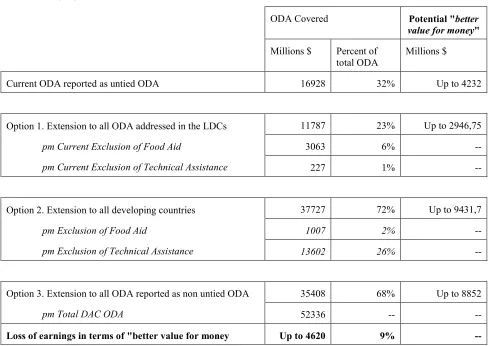
• Today, about one-third of DAC total ODA is reported as untied. Based on the World Bank
[image:20.595.70.558.363.709.2]estimate of a potential added value up to 25%, the part of ODA reported as tied aid still represents a loss of earnings in terms of “better value for money” of about 4.6 Bn $ and 10% of the world wide ODA.
Table 3: Untying of EU ODA
ODA Covered Potential "better
value for money"
Millions $ Percent of total ODA
Millions $
Current ODA reported as untied ODA 16928 32% Up to 4232
11787 23% Up to 2946,75
3063 6% --
Option 1. Extension to all ODA addressed in the LDCs
pm Current Exclusion of Food Aid
pm Current Exclusion of Technical Assistance 227 1% --
37727 72% Up to 9431,7
1007 2% -- Option 2. Extension to all developing countries
pm Exclusion of Food Aid
pm Exclusion of Technical Assistance 13602 26% --
35408 68% Up to 8852
Option 3. Extension to all ODA reported as non untied ODA
3.1. State of play on untying within the Union
EU Member States have reiterated their commitment to the OECD/DAC recommendations
on the untying of Official Development Assistance (ODA) to Least Developed Countries (LDC). They are applying these recommendations to their ODA. The European Community has also agreed in 2003 to implement the DAC Recommendations in the Community Aid. They are currently being introduced in the Community legislative system.
Half of the MemberStates have completely untied their development aid (Belgium, Ireland, France, Luxembourg, Netherlands, Sweden, and UK). A significant part of Austrian and German Aid is untied. All Member States’ aid is partially untied. Due to the rules of the European Economic Community, public procurements of the Member States are open to each other. It represents a complete untying of EU aid between the fifteen which already correspond to half of the DAC membership and 55% of the DAC ODA.
The European Community Aid has been untied to a significant degree for more than 25 years. About one third of the EC aid is completely untied regarding donors and about 19 % of EC aid is completely untied regarding both donors and recipient countries.
In November 2001, the Commission presented a proposal for complete untying of Community aid. The Conclusions of the GAER Council in May 2003 and the Resolution of the European Parliament endorsed the Commission’s approach. It implies a further untying through the adoption of a horizontal regulation for the instrument falling under the EC budget and the renegotiation of relevant annex to the Cotonou Agreement for the instrument falling under the EDF. In this regards two formal proposals have been presented by the Commission in early 2004 and introduced in the legislative process.
3.2. Potential for further action
There is a general movement in the European Union in favour of further untying. A majority of Member States (Austria, Belgium, Denmark, Finland, France, Germany, Ireland, Luxemburg, Netherlands, Sweden, and UK) have introduced in 2003 or before, concrete measures on untying bilateral aid that go beyond the DAC Recommendations. The percent of fully untied Member States has passed from 20% in 2002 to 46% in 2003.
Most Member States, with the exclusion of Spain and Greece, are ready to enter into a discussion within the OECD on the broadening of the scope of the DAC Recommendations before 2006. The majority agrees to start discussions on possible options such as the extension of the scope beyond LDCs to all developing countries, or to consider covering food aid and/or technical assistance. Most countries- with the exception of France - also agree to opening discussion on the access to recipient countries. This is indeed a key issue, since the experience with the openness of calls for tender under the European Development Funds has shown that it is possible for the operators from developing countries to gain a significant share of the action. ACP countries have gained 23.6% of the contracts, amounting to € 1.415 billion between 1985 and 2000.
the impact of food aid. Fully untying of the current 1007 million USD of food aid would correspond in terms of better value to a potential increase up to 251 additional million USD. Several Member States also expressed the views that further discussions should be based on an Evaluation of the impact of the existing DAC Recommendation. The OECD/DAC Working Party on Aid effectiveness has opened a discussion on this, while the Commission is currently preparing a study on the issue of the benefits of further untying.
The DAC Recommendations do not apply to the new Member States as none of them is yet member of the DAC. With the exception of Lithuania and Poland, they are not ready to open debate at this stage.
4. COMMITMENT IV:TRADE RELATED ASSISTANCE
Commitment: To increase assistance for long-term trade-related capacity building, productive capacity and measures addressing supply-side constraints in developing countries, as well as to provide immediate support for trade-related technical assistance in order to improve the negotiating capacity of developing countries in trade negotiations, including by commitments made at the WTO pledging Conference in Geneva on 11 March 2002.
Last year’s report on follow-up to the Barcelona Commitments showed that a considerable number of actions had been launched by the EC and Member States. The report however expressed a serious concern on the efficiency of the increased action due to lack of co-ordination among the EU MS and in the wider donor community. The lack of co-co-ordination has led to duplication and generally poor level of complementarity.
The lack of coordination in the TRA is clearly and directly linked to the wider issue of co-ordination as described in Commitment II.
Most MS see scope for better co-ordination at EU level, but also highlight the importance of wider donor co-ordination using the WTO and OECD instruments like OECD Joint Database. Most MS are aligning their TRA priorities and planning to be consistent with the Communication on Trade and Development (COM 513). This together with the recent Commission Guidelines for Technical Assistance should progressively lead to somewhat better coherence and coordination of EU TRA activities. This alone would not however be enough.
The Trade and Development Expert Group working under the 133 Committee will need to continue and intensify its discussions on complementarity and better coordination of bilateral EU activities. This Expert Group also acts as a good forum for improved exchange of information among the MS and should be purposefully used for that function.
5. COMMITMENT V:GLOBAL PUBLIC GOODS.
Commitment: To further work towards a participatory process at the global level, including the proposal of setting up a task force open to all actors on a temporary basis, designed to lead to the identification of relevant Global Public Goods.
In the Council Conclusions on Monterrey and the World Summit on Sustainable Development (WSSD) in Johannesburg, the EU confirmed its commitment to tackling the issue of Global Public Goods (GPGs). Even though its proposal for the establishment of a global, participatory process on GPGs was not taken up in the final outcome documents of either event, an International informal Task Force on GPGs was launched at the WSSD by France and Sweden, in collaboration with the UNDP.
During the almost two years of existence of the Task Force, the Commission and several EU Member States, the so called “Friends of the International Task Force on GPGs”, have actively supported it and have indicated an interest in being part of the Task Force itself. For the time being, only France and Sweden are members. The Danish Council for International Development cooperation organised an international seminar on GPGs on spring 2003. Germany carried out an international workshop on GPGs in November 2003 and supports the Task Force politically and financially, and the Commission is in close contact with the Task Force on a regular basis.
A number of Member States (Denmark, France, Germany, Portugal, Spain, the Netherlands) and Poland consider that the result of the International Task Force should be the principal basis for elaborating an EU position on the provision of GPGs and their financing. There is clearly a feeling that the global process on GPGs is not fully open and inclusive at present, while the interest from those Member States that are not in the core group is on the rise. On the other hand, Germany and Belgium propose that the work of the Task Force should be simultaneously underpinned and complemented by discussions and initiatives in the EU and in single EU Member States, including other stakeholders (government bodies, civil society and private actors).
Germany announces the organization and hosting of the mid-term-review-meeting of the Task Force friends-group in November 2004. The Commission agrees with Germany on the importance of practical policy advice for the effective provision of GPGs. In the future, if other Member States are interested, the Commission might usefully take on a coordination role in terms of the EU’s approach to GPGs.
6. COMMITMENT VI:INNOVATIVE SOURCES OF FINANCING
Commitment: To further explore innovative sources of financing and taking into account the conclusions of the Commission Globalisation Report.
In Barcelona, the Member States committed themselves to “further explore innovative sources of financing and taking into account the conclusions of the Commission Globalisation Report”. In 2002, six Members indicated that they were pursuing such initiatives. Their effort focused on international taxation mechanisms, public/private partnership and the HIPC initiative for the cancellation of poorest countries’ debt.
Eight countries (including both Member States and new Member States) indicated that they have taken the initiative to further explore innovative source of financing during the year 2003 and that they will continue being involved in such research in the year 2004. Proposals include:
• International levies. Germany calls for further clarifying the concept of user taxes for
environmental goods. France will continue to support initiatives in the matter during 2004.
• De-tax. In 2004, Italy will start an experimental use of De-Tax for domestic proposes is
included in the Financial Decree attached to the 2004 Financial Bill. Portugal already provided for tax deductions for private contributions to developmental NGOs in 2003 and will continue to do so in 2004. Also Poland expressed its interest in exploring this option starting from the fiscal year 2004.
• Public/Private Partnership. Throughout the year 2003, Finland enhanced project
planning in individual cases particularly in the water sector. For the year 2004, it plans to further develop policies and approaches regarding partnerships with the private sector.
Denmark also recognizes the importance of involving the private sector in development work. Since 1999, Germany has fostered partnerships with the private sector in the field of bilateral development co-operation. Public-private partnership has being carried out in circa 60 countries.
• International Financing Facility for ODA. France and UK are the main promoters of
this initiative and those who have supported it within G7 and EU. France calls for a multilateral donors’ agreement in order to overcome domestic institutional constraints. UK would seek to raise the amount of development aid from US$50 to US$100 bn/year in 2015. Also, UK supported IFF as an important agenda item at the Annual Meetings of the World Bank and IMF in Dubai in September 2003.
7. COMMITMENT VII:REFORM OF THE INTERNATIONAL FINANCIAL SYSTEM
Commitment: to influence the reform of the International Financial System by combating abuses of financial globalisation, strengthening the voice of developing countries in international decision making and, while respecting their respective roles, enhancing the coherence between the UN, International Financial Institutions and the WTO. The 2003 report concluded that the uncoordinated initiatives by several MS in the preparation for the governing boards of the WB and IMF have not produced good results.
As regards increasing the voice of the poor, there are two separate issues: the first, more short-term one, is the capacity building to improve the developing countries’ conditions of participation in the decision making at country and institutional levels; the second is the change in the voting structures of the boards, which is bound to take more time to resolve. Some MS question the utility entering into a discussion of the second issue.
MS’s opinions on the necessity of finding common positions in the discussions in the boards are divided. The MS which find themselves in constituencies together with non-EU MS have clearly divided loyalties, but this is not seen necessarily as detrimental to the common goal of increasing the voice of the poor. There are doubts in some MS on the utility of pushing the voting structure changes as most decisions in the boards are taken by consensus and as the largest shareholder continues to oppose.
UK’s perception is that seeking for an EU common position is not desirable as that would produce agreement only on the lowest common denominator and the UK sees themselves as more ambitious that other MS on this issue.
8. COMMITMENT VIII:DEBT RELIEF
Commitment: to pursue the EU efforts to restore debt sustainability in the context of the enhanced Heavily Indebted Poor Countries (HIPC) initiative, so that developing countries, and especially the poorest ones, can pursue growth and development unconstrained by unsustainable debt dynamics.
Already by May 2003, all the current Member States of the Union had made the necessary provisions to ensure their own participation in the HIPC initiative.
Three of the acceding countries have also made a contribution to HIPC. Poland participates within the framework of HIPC for Mozambique and Nicaragua, Hungary made a contribution of 6 million Special Drawing Rights (SDR) in 2000 we made a contribution of 6 million SDR to the HIPC Initiative and Latvia plans a payment of 142,000 SDR for 2004. The Czech Republic and Hungary are currently considering further participation.
Some of the current and future Member States provide or consider debt relief beyond the requirements of the HIPC scheme:
• Spain already goes systematically beyond the minimum HIPC effort by providing 100 %
debt cancellation on all so-called pre-‘Cut-Off-Date’ (COD) debt. On a case-by-case basis, debt relief on post-COD is provided.
• Denmark provides 100 per cent debt relief to HIPCs on bilateral ODA-loans as well as on
official bilateral guaranteed credits contracted before September 1999. Since 1978 Denmark has cancelled ODA loans to all LLDCs and to bilateral cooperation countries at a total amount of DKK 4,600 mio.1 Denmark has committed a contribution of DKK 120 mio. to the HIPC Trust Fund for the period 2003-2006.
• Poland participates in a debt relief initiative for Serbia and Montenegro;
• The UK writes off 100% of all debts owed the UK government when countries qualify for relief. This covers ODA and non-ODA debts, and pre and post cut-off-date debts. The UK is also the second largest bilateral contributor to the HIPC Trust Fund. Our total bilateral pledges to date are $316m.
• The Netherlands provides 100 % cancellation of the consolidated stock of debt of
non-ODA commercial debt (export credits which were reinsured by the State) at the
completion point. HIPC-countries having a long term development relationship with the Netherlands receive 100 % cancellation of the consolidated debt service from this debt at the decision point. Apart from Paris Club commitments the Netherlands regularly grants bilateral debt relief to non-HIPC countries, especially on ODA-debts (e.g. Sri Lanka, Jamaica).