RIT Scholar Works
Theses
4-16-2019
Website Fingerprinting using Deep Learning
Payap Sirinam
Follow this and additional works at:
https://scholarworks.rit.edu/theses
This Dissertation is brought to you for free and open access by RIT Scholar Works. It has been accepted for inclusion in Theses by an authorized administrator of RIT Scholar Works. For more information, please [email protected].
Recommended Citation
Website Fingerprinting using Deep Learning
by
Payap Sirinam
A dissertation submitted in partial fulfillment of the
requirements for the degree of
Doctor of Philosophy
in Computing and Information Sciences
B. Thomas Golisano College of Computing and
Information Sciences
Rochester Institute of Technology
Rochester, New York
by
Payap Sirinam
Committee Approval:
We, the undersigned committee members, certify that we have advised and/or supervised
the candidate on the work described in this dissertation. We further certify that we have reviewed
the dissertation manuscript and approve it in partial fulfillment of the requirements of the degree
of Doctor of Philosophy in Computing and Information Sciences.
______________________________________________________________________________
Dr. Matthew Wright Date
Dissertation Advisor
______________________________________________________________________________
Dr. Leonid Reznik Date
Dissertation Committee Member
______________________________________________________________________________
Dr. Sumita Mishra Date
Dissertation Committee Member
______________________________________________________________________________
Dr. Peizhao Hu Date
Dissertation Committee Member
______________________________________________________________________________
Dr. Jeff Pelz Date
Dissertation Defense Chairperson
Certified by:
______________________________________________________________________________
Dr. Pengcheng Shi Date
© 2019 Payap Sirinam
iv
by
Payap Sirinam
ABSTRACT
Website fingerprinting (WF) enables a local eavesdropper to determine which websites a user is visiting over an encrypted connection. State-of-the-art WF attacks have been shown to be effective even against Tor. Recently, lightweight WF defenses for Tor have been proposed that substantially degrade existing attacks: WTF-PAD and Walkie-Talkie. In this work, we explore the impact of recent advances in deep learning on WF attacks and defenses. We first present Deep Fingerprinting (DF), a new WF attack based on deep learning, and we evaluate this attack against WTF-PAD and Walkie-Talkie. The DF attack attains over 98% accuracy on Tor traffic without defenses, making it the state-of-the-art WF attack at the time of publishing this work. DF is the only attack that is effective against WTF-PAD with over 90% accuracy, and against Walkie-Talkie, DF achieves a top-2 accuracy of 98%. In the more realistic open-world setting, our attack remains effective. These findings highlight the need for defenses that protect against attacks like DF that use advanced deep learning techniques.
Since DF requires large amounts of training data that is regularly updated, some may argue that is it is not practical for the weaker attacker model typically assumed in WF. Additionally, most WF attacks make strong assumptions about the testing and training data have similar distributions and being collected from the same type of network at about the same time. Thus, we next examine ways that an attacker could reduce the difficulty of performing an attack by leveraging N-shot learning, in which just a few training samples are needed to identify a given class. In particular, we propose a new WF attack called Triplet Fingerprinting (TF) that uses triplet networks for N-shot learning. We evaluate this attack in challenging settings such as where the training and testing data are from multiple years apart and collected on different networks, and we find that the TF attack remains effective in such settings with 85% accuracy or better. We also show that the TF attack is also effective in the open world and outperforms transfer learning.
v
Firstly, I would like to express my sincere appreciation to my advisor Prof. Dr. Matthew Wright for the continuous support of my Ph.D. study and related research, for his patience, motivation, and immense knowledge. His guidance helped me in all the time of research and writing of this dissertation. I could not have imagined having a better advisor and mentor for my Ph.D. study.
Besides my advisor, I would like to thank the Ph.D. program director and the rest of my dissertation committee members: Prof. Dr. Pengcheng Shi, Prof. Dr. Leon Reznik, Prof. Dr. Sumita Mishra, and Prof. Dr. Peizhao Hu, for their good moral, insightful comments and encouragement.
My sincere thanks also goes to all faculty members of my old university: the University of Texas at Arlington and all faculty members at RIT. I could not be here without all of them. I thank my fellow in the Center for Cybersecurity for the stimulating discussions, for the sleepless nights we were working together before deadlines, and for all the fun we have had in the last three years.
vi
For my Grandfather, whom I love and miss so much, I dedicate this dissertation to your soul.
Contents
1 Introduction 1
2 Background and Literature Review 10
2.1 Tor Anonymity System . . . 10
2.2 Website Fingerprinting and Threat Model . . . 11
2.3 Website Fingerprinting Attacks . . . 14
2.4 Website Fingerprinting Defenses . . . 16
2.5 Deep Learning . . . 17
2.6 Website Fingerprinting using Deep Learning . . . 20
2.7 Attack Performance Metrics . . . 21
2.7.1 Closed-world Evaluation . . . 21
2.7.2 Open-world Evaluation . . . 21
3 Website Fingerprinting Attacks 23 3.1 Data Collection . . . 24
3.1.1 Open-world dataset. . . 24
3.1.2 Defended dataset. . . 25
3.2 Experimental Evaluation . . . 26
3.2.1 Implementation . . . 26
3.2.2 DF’s Hyperparameter Tuning . . . 28
3.2.3 Differences Between DF and AWF . . . 30
3.2.4 Closed-world Evaluation on Non-defended Dataset . . . 32
3.2.5 Training Cost . . . 35
3.2.6 Closed-world Evaluation on the Defended Dataset . . . 35
3.2.7 Open-world Evaluation . . . 36
3.2.8 A Deeper Look at W-T . . . 41
3.3 Discussion . . . 41
3.4 Conclusion . . . 43
4 Improved Website Fingerprinting Attacks 46
4.1 WF Attacks’ Previously-handled Assumptions . . . 47
4.1.1 Closed- vs Open-world Scenario . . . 47
4.1.2 User’s Internet Browsing Behavior . . . 48
4.1.3 Traffic Parsing and Background Traffic . . . 49
4.2 Possible Improvement of WF Attacks . . . 49
4.2.1 Replicability . . . 49
4.2.2 Bootstrap Time . . . 51
4.2.3 Flexibility . . . 53
4.3 WF Attack’s Goals of Improvements . . . 55
4.4 N-Shot Learning . . . 55
4.4.1 NSL Implementation . . . 56
4.5 Triplet Networks Implementation in WF attacks . . . 66
4.5.1 TF’s Hyperparameter Tuning . . . 66
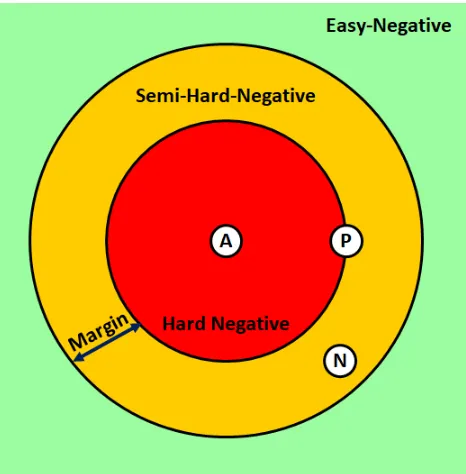
4.5.2 Semi-Hard-Negative Mining . . . 68
4.5.3 Model Training and Testing . . . 70
4.6 Experimental Evaluations . . . 73
4.6.1 Dataset . . . 73
4.6.2 Statistical soundness . . . 74
4.6.3 Exp1: WF attacks regardless of website’s labels . . . 75
4.6.4 Exp2: WF attacks with different data distributions . . . 79
4.6.5 Exp3: Traditional Transfer Learning vs TF Attack . . . 81
4.6.6 Exp4: Open-World Scenario . . . 85
4.6.7 Exp5: TF Attack agaisnt WTF-PAD Defense . . . 87
4.6.8 Exp6: Top-n and k-Way Accuracy . . . 89
4.7 Discussion . . . 92
4.8 Conclusion . . . 93
5 Website Fingerprinting Defenses 96 5.1 WF Defenses Mechanisms and Frameworks . . . 96
5.1.1 Supersequence Defenses . . . 97
5.1.2 Adaptive-flow Defenses . . . 97
5.2 WF Defenses against WF attacks using DL . . . 98
5.2.1 Failure Cause of WTF-PAD . . . 98
5.2.2 Key Challenges and Expected Design . . . 99
5.2.3 Transparent Interpretable Defense . . . 100
5.3 WF Defenses through Visual Explanation . . . 101
5.3.1 Visual Explanation for Images . . . 101
5.3.2 Motivation . . . 102
5.4 Grad-CAM as examiner . . . 106
5.4.1 Relative Importance Scores Characteristic . . . 106
5.4.2 Fingerprintability Score . . . 109
5.5 CAM-Pad WF Defense . . . 111
5.5.1 Initial Design: CAM-Pad as Controller . . . 112
5.5.2 More generic CAM-Pad Defense . . . 113
5.5.3 CAM-Pad Defense Design . . . 115
5.6 Evaluation . . . 116
5.6.1 Dataset . . . 116
5.6.2 Closed-World Results . . . 117
5.6.3 Revisit: CAM-Pad as Examiner . . . 118
5.6.4 Open-World Results . . . 120
5.6.5 CAM-Pad Defense against TF Attack . . . 122
5.7 Conclusion . . . 123
Appendices 132 A DF Model’s Architecture 133 B Open-World ROC curve 137 C Dataset’s Distribution Analysis 139 C.1 Basic Network Traffic Statistic . . . 139
C.1.1 Common Websites in Wang and AWF datasets . . . 139
C.1.2 Aggregation Analysis of Wang and AWF datasets . . . 140
1.1 Possible local and passive network adversary that can perform
WF attacks. . . 2
2.1 Tor Anonymity System. . . 11
2.2 The WF attack workflow: Black arrow represents the processes of creating the WF classifier. Red arrow demonstrates how the adversary performs WF attack by using the trained classi-fier that he previously prepared to predict the website that the client may visit. . . 12
2.3 Autoencoder (AE). . . 17
2.4 Denoising autoencoder (DAE) . . . 18
2.5 A basic architecture of convolutional neural networks (CNN) . 19 3.1 Comparison between AWF and DF models . . . 31
3.2 Closed World: Impact of the number of training epochs on the DF model’s accuracy and error rate . . . 34
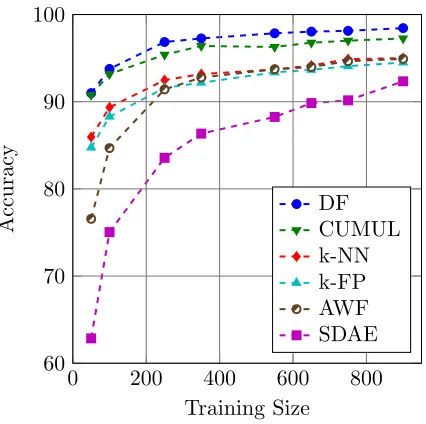
3.3 Closed World: Impact of numbers of training traces on classifi-cation accuracy . . . 34
3.4 Open World: The impact of the amount of unmonitored train-ing data on TPR and FPR (Non-defended dataset). . . 38
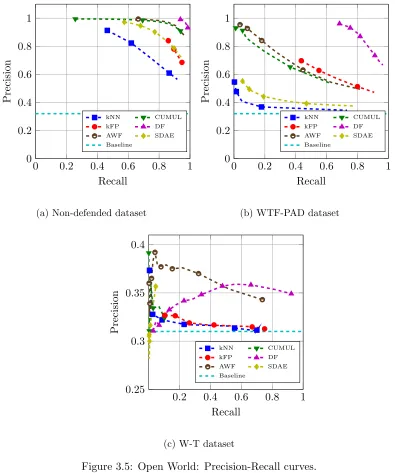
3.5 Open World: Precision-Recall curves. . . 40
4.1 The WF attack model for the targeted attack in Tor . . . 50
4.2 The WF attack model for non-targeted attack in Tor . . . 50
4.3 The WF attack model showing the process of training the WF classifier and using it to predict the unknown network trace. . . 54
4.4 Siamese networks using the CNN model for each subnetwork. . 59
4.5 The training phase of Siamese networks and their implementa-tion for a classificaimplementa-tion task . . . 61
4.6 The example of how to generate the triplets as inputs used for training the triplet networks. . . 63 4.7 The training phase of triplet networks and their implementation
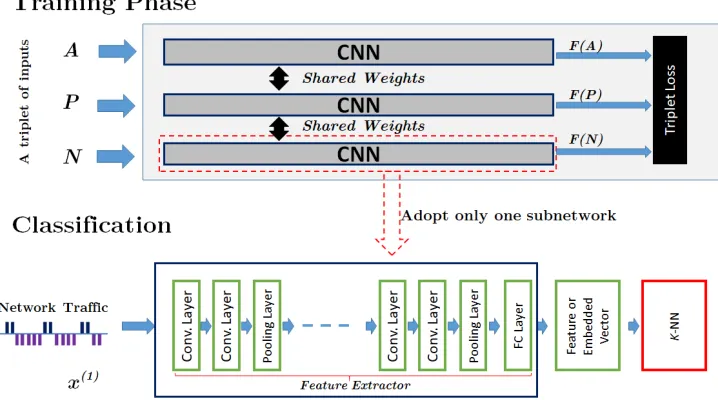
for a classification task. . . 64 4.8 The learning process during training the model: The triplet loss
minimize the distance of the network traffic examples that are from the same website and maximize network traffic examples from the different websites. . . 65 4.9 The corresponding location of the expected A, P and N
ex-amples in the embedding space with respect to the semi-hard-negative mining. . . 70 4.10 NSL classification process (Newly-training) . . . 71 4.11 NSL classification process (Testing) . . . 72 4.12 The process of training and re-training the pre-trained model
(traditional transfer learning approach) . . . 82 4.13 Open-world: Precision and Recall (WF attacks regardless of
website’s labels) . . . 88 4.14 Open-world: Precision and Recall (WF attacks with different
data distributions) . . . 89 4.15 The Top-n (Left) and the k-Way (Right) accuracy of WF
at-tacks regardless of website’s labels (Non-defended dataset). . . 91 4.16 The Top-n (Left) and the k-Way (Right) accuracy of WF
at-tacks regardless of website’s with different data distributions (Non-defended dataset). . . 91
5.1 The supersequence defenses framework example (Walkie-Talkie) 97 5.2 The adaptive-flow defenses framework example (WTF-PAD) . . 98 5.3 The process of how the Grad-CAM technique can be applied to
provide visual explanation for the given DL model . . . 102 5.4 The work diagram demonstrating how to use the DF model with
the Grad-CAM technique to generate a visual representation of the relative importance score’s graph from each network traffic trace . . . 103 5.5 Relative Important Score/Website’s Traces: The work diagram
of generating the Grad-CAM relative importance score’s graphs from the overall network traffic inputs of the given website . . . 104 5.6 The examples of importance scores among different websites . . 107 5.7 The comparison between characteristics of relative important
5.8 The notations used to calculate FP-SD to measure the finger-printability score of each website . . . 109 5.9 The FP-SD scores for each website with different datasets . . . 110 5.10 The example of the padding mechanism base on the relative
importance scores. . . 112 5.11 The example the final sequence of global relative important
scores used for performing padding mechanisms in the CAM-Pad defense. . . 114 5.12 Visual explanation of Extend Bursts and Break Bursts padding.
The direction of the arrow represents the direction of the packet, incoming or outgoing. . . 116 5.13 The comparison between characteristics of relative important
scores extracted from Non-Def, WTF-PAD, W-T and CAM-Pad datasets . . . 118 5.14 The FP-SD scores for each website with different datasets
(CAM-Pad dataset included) . . . 119 5.15 Precision and Recall curves of the CAM-Pad defense compared
to other WF defenses . . . 121
A.1 Our design of DF model’s architecture used in WF attacks . . 136
B.1 ROC curve in Open-world scenario . . . 138
C.1 The box plot of the basic statistical analysis in term of the number of packets for all websites in the Wang and the AWF datasets . . . 143 C.2 The box plot of the basic statistical analysis in term of the
number of bursts for all websites in the Wang and the AWF datasets . . . 144 C.3 Similarity measurement by using the intrasimilarity and the
List of Tables
3.1 Summary of the dataset used in the experiments . . . 25 3.2 Hyperparameters selection for the DF model from the extensive
candidates search method . . . 29 3.3 Closed World: Accuracy on the non-defended dataset for
state-of-the-art attacks. . . 33 3.4 Accuracy in a closed-world scenario on defended datasets, SDAE,
DF, and AWF vs. the state-of-art WF attacks . . . 36
4.1 The effect on the attack performance obtained by training in one TBB version and testing in a different version [25]. . . 51 4.2 Bootstrap time required to create the WF classifier using the
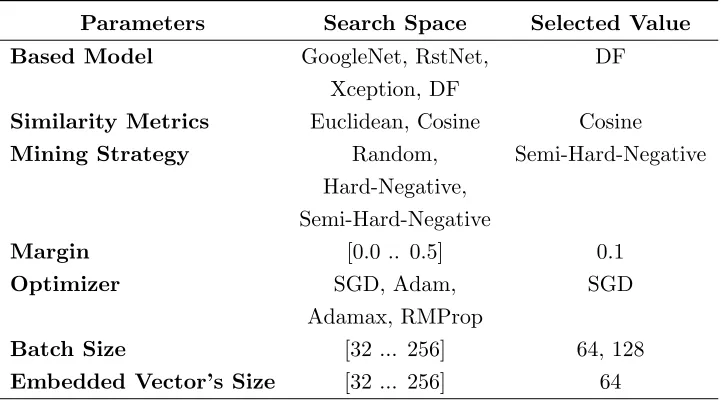
AWF model with GPU utilization. The crawling rate is ap-proximately 2,000 instances/day/computer and the number of instances required for training is 500,000 instances. . . 52 4.3 Hyperparameters selection for the triplet networks from the
ex-tensive candidates search method . . . 67 4.4 The performance of WF attacks regardless of websites’ labels
(Accuracy of the attack) . . . 76 4.5 The impact of including different portions of the websites that
the user may visit during the training phase. . . 78 4.6 The performance of WF attacks with different distributions of
training and testing datasets (Accuracy of the attack) . . . 80 4.7 The performance of WF attacks regardless of website’s labels
using transfer learning techniques (Accuracy of the attack) . . 83 4.8 The performance of WF attacks with different distributions of
training and testing datasets using transfer learning techniques (Accuracy of the attack) . . . 84 4.9 Open-World: Results when tuned for precision and tuned for
recall for WF attacks regardless of website’s labels . . . 86
4.10 Open-World: Results when tuned for precision and tuned for recall for WF attacks regardless with different data distributions 86 4.11 The performance of the TF attack against WTF-PAD defense
(Accuracy of the attack) . . . 90
5.1 The overall FP-SD scores measuring the average FP-SD scores of all websites with in the Non-Def, WTF-PAD and W-T datsets111 5.2 Deep Fingerpinting attack accuracy against WF defenses.
Re-sults for all expect the CAM-Pad defense using REB and the CAM-Pad defense using RBB are sourced from Sirinam et al. [45].117 5.3 The overall FP-SD scores measuring the average FP-SD scores
of all websites with in the Non-Def, WTF-PAD, W-T and CAM-Pad datasets . . . 119 5.4 Open-World: Results when tuned for precision and tuned for
recall for the DF attack against Non-Def, WTF-PAD, W-T and CAM-Pad datasets . . . 120 5.5 The performance of the CAM-Pad defense against the DF and
TF attack . . . 122
C.1 The comparison between the average number of incoming and outgoing packets for common websites in the Wang and the AWF datasets . . . 141 C.2 The comparison between the average number of incoming and
outgoing bursts for common websites in the Wang and the AWF datasets . . . 142 C.3 The aggregation analysis of the basic network statistical
analy-sis for all websites in Wang and AWF datasets (the average of the number of incoming and outgoing packets vs. the average of the number of incoming and outgoing bursts) . . . 143 C.4 The comparison between the intrasimilarity and the
Introduction
“Even if you are not doing anything wrong, you are being watched and recorded.”
Edward Snowden
In recent years, technology has become an integral part of life for many people around the world. With this integration, personal and meta informa-tion are being exposed more than ever. This allows many entities to obtain and infer a lot of useful and sometimes private information about users. On top of that, we have learned from Edward Snowden that the Internet surveillance has been performing by different agencies who were spying on our communica-tions for various purposes [17]. To protect Internet users’ privacy, there have been privacy enhancing technologies that have been proposed such as I2P [60], AN.ON [18], Tor [14] and so on. With more than eight million daily users, Tor has emerged as the de-facto tool to anonymously browse the Internet [3, 32].
Tor is, however, known to be vulnerable to traffic analysis. In particular, website fingerprinting (WF)is a traffic analysis attack with the potential abil-ity to break the privacy that Tor aims to provide. WF allows the attacker to identify web pages in an encrypted connection by analyzing patterns in network traffic. This allows a local and passive network adversary as demon-strated in Figure 1.1, such as a user’s Internet service provider, someone sniff-ing the user’s wireless connection and so on to identify the websites that the user has visited despite her use of Tor.
WF exploits the fact that differences in website content (e.g., different images, scripts, styles) can be inferred from network traffic, even if traffic has been encrypted. From a machine learning (ML) perspective, WF is a classification problem: the adversary trains a classifier on a set of websites,
Figure 1.1: Possible local and passive network adversary that can perform WF attacks.
extracting network traffic features that are unique to each website. To deploy the attack, the adversary uses the classifier to match traces of a victim to one of those websites. The effectiveness of WF depends heavily on both the classifier algorithm and the set of features used. Thus, the attacker needs to perform feature engineering process in which he has to sophisticatedly select, hand-craft and test the set of features that could possibly be the meaningful representative features for the data input he would like to classify. Previous WF attacks use a set of hand-crafted features to represent Tor traffic, achieving 90%+ accuracy against Tor using classifiers such as Support Vector Machine (SVM) [35],k-Nearest Neighbors (k-NN) [54], and random forests [20].
In response to these attacks, a number of defenses have been proposed. WF defenses add dummy packets into the traffic and/or add delays to real pack-ets, aiming to hide features exploited by WF attacks such as traffic bursts and packet lengths. Notably, Tor Project developers have shown an interest in de-ployingadaptive padding as a possible defense [38, 39]. Based on this, Juarez et al. proposed WTF-PAD and showed that it effectively defends against WF attacks with reasonable overheads, such that it would be practical for deploy-ment in Tor [26] 1. Recently, Wang and Goldberg proposed another effective and low-overhead defense called Walkie-Talkie (W-T) [57]. These proposals raise the question of whether attacks could be improved to undermine the
118-FEB-19: The main part of WTF-PAD has been merged into Tor 0.4.0.1 as an
effectiveness of the new defenses, a question we address in this work.
While the state-of-the-art attacks use classifiers that are popular in many applications,deep learning(DL) has shown to outperform traditional machine learning techniques in many domains such as speech recognition, visual object recognition, and object detection [30]. Furthermore, DL does not require selecting and fine-tuning features by hand [40]. This has motivated us to explore whether we can leverage DL to improve classification results against non-defended and defended Tor traffic and formulated our first and second research questions (RQ).
• RQ1: How can the WF attack be implemented with DL techniques and what are appropriate approaches and models of DL that can effectively improve the performance of the WF attack?
• RQ2: How effectively can the WF attack using DL techniques perform against undefended and defended traffic in both closed-world and more realistic open-world settings?
We conducted experimental evaluations to answer RQ1 and RQ2 as de-scribed in Chapter 3. We answer the research questions by the key contribu-tions and findings of our work including:
• We proposeDeep Fingerprinting (DF) attack, a new state-of-the-art WF attack based on a Convolutional Neural Network (CNN) designed using cutting-edge DL methods. The attack uses a simple input format and does not require handcrafting features for classification. We describe how DF leverages advances from computer vision research for effective and robust classification performance.
• To study the attack in detail, we experiment in a closed-world setting using a new dataset that we collected with 95 websites and 1,000 traces per website. We find that our DF WF attack is more accurate against Tor than the state-of-the-art attacks with 98.3% accuracy. We also show results for how the number of training epochs and training dataset size affect the classification accuracy.
• To investigate in a more realistic setting, we use an open world with 20,000 unmonitored websites. On non-defended traffic, the attack achieves 0.99 precision and 0.94 recall. On traffic defended with WTF-PAD, the attack yields 0.96 precision and 0.68 recall. We also examine the possibilities for attacking weak implementations of W-T.
• Based on our experimental findings, we propose a number of new direc-tions to explore in both attack and defense.
Overall, we find that the new DF WF attack undermines at least one defense that had been considered seriously for deployment in Tor [38, 39]. We have disclosed our findings to the Tor Project, and they have expressed their concerns about WTF-PAD, setting the stage for more exploration of the design of realistic defenses.
This DF work has accepted to be published and presented in the 25thACM SIGSAC Conference on Computer and Communications Security (CCS 18) at Toronto, Canada in 2018 (Acceptance Rate: 16.6%). Moreover, the paper was selected asa finalist for an Outstanding Paper Award, placing it in the top one percent of all submitted papers.
However, the research work to answer RQ1 and RQ2 has introduced us with other interesting and open questions to be further explored. First, we criticize that even if the results of WF attacks using DL are effective, there are some interesting viewpoints related to the set of WF assumptions and the threat models that we used. We realize that these assumptions have been commonly used in the previous work. However, we are convinced that the further investigation on the realistically implemented assumptions need to be addressed. The WF research have made the assumptions that perhaps provide too simple environments of the attacks and unrealistic advantage to the attacker. This has motivated us to further study and investigate the WF attacks with more realistic assumption and formulate theRQ3which is
• RQ3: How can the WF attacks using deep learning be improved with more realistic assumptions?
which avoid considering the data staleness issue and the practical deployment of the attack andFlexibility and Transferability: the model does not consider the case that there are newly add/remove website’s classes and the ability of using the pre-trained model in WF attacks. We investigated the possible improvements from these assumptions and defined the WF attacks’s goals of improvements including:
• Replicability: The improved attacks should be robust against the ad-verse effect from the data mismatch issue resulted from different distri-butions of training and testing data.
• Bootstrap Time: The attacker should be capable of training on one dataset and can be effectively later used for the new dataset, avoiding the large amount of time for training the new classifier from scratch.
• Flexibility and Transferability: The improved attacks should effec-tively predict the network traces regardless of the website’s labels used to initially train the classifier. Moreover, the attacker should be able to directly adopt the pre-trained model and adjusted it to his new task without requiring to re-train the whole new model.
• Performance of the attack: Under the above improvements with more challenging scenarios, the performance of improved attacks can still remain effective.
We propose the novel WF attack’s framework that can meet the aforemen-tioned goals of improvements, namely, theTriplet Fingerprinting (TF) at-tack. The attack is based on the implementation of the ML technique called N-Shot Learning (NSL) with triplet networks. Moreover, we design a set of comprehensive experimental evaluations and demonstrate that the TF attack can further improve the WF attacks with respect to the given goal of improve-ments, also overcome or mitigate the adverse effects under different scenarios with more challenging limitations. According to our experimental results, we answerRQ3 according to our findings and contributions as following:
and Transferability,Bootstrap TimeandPerformance of the attack goals of improvement.
• To evaluate theReplicabilityimprovement, we extensively add more chal-lenging scenario in which the training and testing data are different in term of their distributions. We show that even if the pre-trained model using NSL is trained from the dataset collected from the different TBB versions with over 3-year different period compared to the current time that the model is adopted to perform WF attacks, the attacker can use this pre-trained model with only 5 network traffic examples/website (5-Shot Learning) and achieve moderately effective attacks with almost 85% accuracy.
• In comparison to the traditional transfer learning, we shows that pre-trained model with NSL can significantly perform better when the num-ber of available training data is small under the scenario that the training and the testing data distributions are similar. Moreover, we show that the pre-trained model with NSL significantly outperforms the traditional transfer learning in all settings under more challenging scenario in which the training and the testing data distributions are different. The results confirm that the TF attack can provide the Replicability improvement by mitigating the adverse effect of data mismatch issue.
• In more realistic open-world setting, we show that the TF attack still remain effective. Overall, the performance of the TF attack attains over 0.9 precision and 0.8 recall when tuned for precision. The results demonstrate that the TF attack has become the potential threat for the current Tor’s users since there is no effective WF defense that is now realistically deployed in Tor.
• We also demonstrate the performance of the TF attack against the WTF-PAD defense. The results show that the TF attack cannot undermine the WTF-PAD defense, however, it can outperform some of the previously-proposed state-of-the-art WF attacks, setting up the new direction of research to improve the WF attacks using NSL to undermine the WF defenses.
• Finally, we provide the discussion to demonstrate other benefits of using NSL to develop WF attacks.
According to our findings, theRQ3is now answered by our newly-proposed TF attack that can improve WF attacks with more realistic assumptions and under more challenging scenarios. To the best of our knowledge, we are the first in the WF research who study and evaluate how to apply NSL to improve WF attacks. Moreover, the results mostly show effective performance of the attacks, providing promising research’s directions to further investigate how to apply NSL to develop better WF attacks in the future.
The next RQ that we are interested in is from the answers of RQ2 show-ing that WF attacks usshow-ing DL, especially with the DF attack can effectively undermine the WTF-PAD defense. This raises the question of how we could improve those defenses against the WF attacks using DL to protect the user’s Internet privacy. Thus, it formulates theRQ4 which is
• RQ4: How should the WF defenses be improved to maintain a suffi-cient level of security and remain practical in term of network overheads against WF attacks using DL?
To answer RQ4, we first conduct an insight investigation to answer the question why the WTF-PAD cannot effectively defend against the WF attacks using DL. We analyze the failure cause of the WTF-PAD and found that the failure of WTF-PAD results from the major advantages of DL that is the ability to learn the hidden features. Moreover, we further investigate key challenges and expected designs derived from the failure cause of the WTF-PAD. We found that it is difficult to use the traditional WF defense approach by identifying the set of features and trying to conceal them since those features are hidden in deep neural networks (DNNs). Thus, we propose the key challenges and expected design of the new WF defense against WF attacks using DL including:
• Features knowledge: The new WF defense cannot relies on determin-istic feature knowledge used for the WF attack since it is hidden inside the DNN.
• Overhead of defense: The new WF defense need to be lightweight and require small to moderate bandwidth and latency overhead to ensure the quality of service in Tor.
• Transparent interpretable defense: The defense does not only relies on the accuracy score to justify its performance, but also can explain why the defense can successfully prevent the WF attack with other additional explanations.
We propose the novel WF defenses that meet all expected design mentioned above called the CAM Pad defense. Given by our experimental results, we answerRQ4 based to the findings and contributions of our work including:
• We show that the design of the CAM-Pad defense does not rely on the feature knowledge which is hidden in the DNNs. On the other hand, the defense simply uses the combination of the global relative importance scores extracted from a visual explanation technique in ML called Grad-CAM to stochastically add dummy packets. Moreover, the defense is based on dynamic-flow defense making it practical in term of deploya-bility as it can be applied to any websites in both static and dynamic ones.
• We evaluate performance of the CAM-Pad defense against the state-of-the-art WF attacks called the DF attack. In closed-world scenario, the accuracy of the DF attack significantly drops down from 98.4% to 66.7% for the CAM-Pad defense. Compared to the WTF-PAD defense, the CAM-Pad defense is much more effective. Overall, the security comes at the cost of 83% additional bandwidth overhead and 28% additional la-tency overhead. In more realistic open-world scenario, the precision and recall are significantly dropped compared to WTF-PAD defense to the point that the attacker cannot effectively perform WF attacks anymore.
• We further evaluate the performance of the CAM-Pad defense against the TF attack designed to perform under more realistic scenario. In closed-world setting, the accuracy of the TF attack drops down to 10%, inferring that the CAM-Pad defense is even more robust under realistic scenario.
According to our findings, theRQ4is now answered by our newly-proposed CAM-Pad defense that can effectively prevent the state-of-the-art WF attacks. Moreover, the results suggest that this approach is competitive against other efficient defenses, though further work is still necessary. Going forward, it will be necessary to further explore the trade-off between security and over-heads which will help up to design more flexible and tunable WF defenses. Furthermore, moving this defense out of the realm of simulation to real imple-mentation is necessary to show the full effectiveness of our proposed defense.
Finally, this work was accepted to be published and presented in the 2018 IEEE Western New York Image and Signal Processing Workshop (WNY-ISPW).
In conclusion, the primary focus of this dissertation is to comprehensively investigate, develop, and evaluate the use of DL techniques to perform WF attacks in an accurate, efficient, and more realistic manner. Moreover, we also propose the study on how to develop the WF defense which is robust to WF attacks using DL.
The remainder of the dissertation is organized as following: Chapter 2 presents the background and literature review. Chapter 3 addresses RQ1
Background and Literature
Review
“If you know the enemy and know yourself, your victory will not stand in doubt; if you know Heaven and know Earth, you may make your victory complete.”
Sun Tzu, The Art of War
In this section, we present literature review including necessary background and related work. The contents are categorized into subsequent sections. We explain about Tor anonymity system in Section 2.1, website fingerprinting (WF) and treat model in Section 2.2, WF attacks in Section 2.3, WF de-fenses in Section 2.4, deep learning (DL) in Section 2.5, WF using DL in Section 2.6 and attack performance metrics used in WF in Section 2.7. Note that this chapter only describes the fundamental background and literature review to provide the general understanding of WF literature. The additional background and literature review will be further described in each subsequent chapter to provide specific background knowledge and literature review for each research question.
2.1
Tor Anonymity System
Since so much of users’ personal lives is conducted online, privacy for web browsing has become increasingly important. A widely used technology for protecting the privacy of users’ web browsing behavior is the Tor anonymity systems. Tor is one of the low-latency anonymity systems that enables users to communicate in a manner that is untraceable by adversaries [14]. With
Figure 2.1: Tor Anonymity System.
more than eight million daily users, Tor has emerged as the de-facto tool to anonymously browse the Internet [3]. Tor seeks to frustrate attackers from linking communication partners, or from linking multiple communications to or from a single user. Tor provides anonymity to Internet users by concealing users location as well as other forms of identifying factors such as Internet Protocol (IP) address.
Tor is a distributed overlay network mainly designed to anonymize TCP-based applications especially a user’s web-browsing Internet behavior. Its design is based on the idea of mixes to create a circuit; a private network pathway, in which a client randomly select three nodes (network relays) that forward network traffic between the client and a server, then incrementally establishes a Tor circuit. The circuit is extended one hop at a time to create a chain of relays including a guard node, a middle node and an exit node as shown in Figure 2.1. With a telescopic circuit creation and sophisticated encryption processes, each node along the way knows only which node gave it data and which node it is giving data to. No individual node knows the complete path that a data packet has taken. For example, the guard node only knows the client and the middle node, the middle node only knows the guard node and the exit node, and the exit node only knows the middle node and the web server. Therefore, if the adversary can compromise one of the Tor’s nodes, he cannot link the client to the website she is surfing, thus the adversary fails to learn the user’s Internet browsing behavior.
2.2
Website Fingerprinting and Threat Model
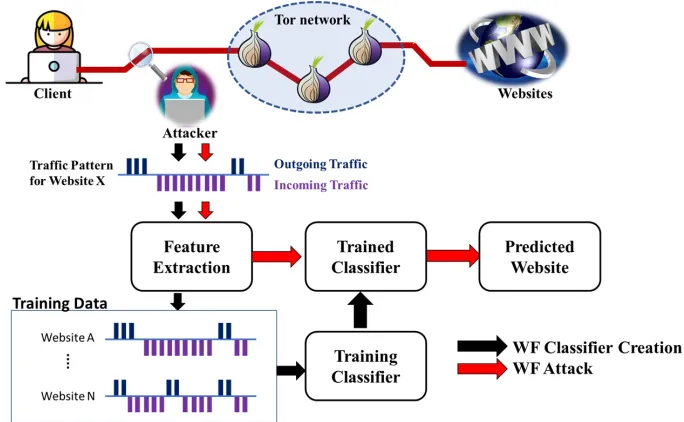
Figure 2.2: The WF attack workflow: Black arrow represents the processes of creating the WF classifier. Red arrow demonstrates how the adversary performs WF attack by using the trained classifier that he previously prepared to predict the website that the client may visit.
Prior work has shown that, under certain conditions, such a local and passive adversary can identify the pages visited by a Tor user by exploiting patterns in network traffic [9, 20, 22, 35, 36, 40, 45, 55, 56].
In this work, we assume a network-level adversary that is: local, meaning that he has access only to the link between the user and the entry node to the Tor network, andpassive, i.e., he can record network packets but not modify, delay, drop or decrypt them. Potential adversaries that might be in a position to deploy a WF attack include: eavesdroppers on the user’s local network, local system administrators, Internet Service Providers (ISP), Autonomous Systems (AS) between the user and the entry node, and the operators of the entry node.
The attack scenario as demonstrated in Figure 2.2 is as follows: the client surfs the set of websites he is interested in detecting over the Tor anonymity system, then he intercepts the traffic between the client and the Tor network. We assume the adversary knows the client’s identity and only aims at identi-fying the website. Note that the adversary can trivially obtain the client’s IP address as long as he has access to the TLS connection between the user and the entry node. Beyond the entry node, Tor has stripped a layer of encryption and the IP of the client is no longer present in the headers of network pack-ets. In addition, there are other possible threat models with different types of attack for example global adversaries that do traffic analysis can deploy more effective attacks than WF such as traffic correlation attacks [44, 48, 62] and fall out of Tor’s original threat model. However, our dissertation will mainly focus on WF threat model as described above.
Within this scenario, we draw on prior work to make several assumptions about the attacker goals and capabilities.
Closed- vs Open-world Scenario:
A closed-word scenario assumes that the user can only visit a small set of web-sites and that the adversary has samples to train on all of them [10, 22, 23, 47]. However, this assumption was criticized for being unrealistic [25, 38], as the world of websites that can be potentially visited is so large that not even the most powerful adversaries have the resources to collect data and train for every website. Subsequent studies have considered an open-world scenario, a more realistic setting in which the adversary can only train on a small fraction of the websites the user can visit. We use closed-world experiments for detailed comparison of different machine learning (ML) algorithms and parameter set-tings, and we further compare the results of open-world experiments for a more realistic evaluation of the attack.
Website vs Webpage Fingerprinting:
In an abuse of language, most authors in the field use “website fingerprinting” to refer to the fingerprinting of only the homepage of those websites. There is research that has attempted to fingerprint pages that are linked from the homepage [9], but virtually all studies on website fingerprinting train and test the attacks on homepages. Although, it is arguable that the user can arbitrarily visit any web pages inside a particular website, the attacker can still perform website fingerprinting attacks. In this case, the attacker who is interested in set of particular web pages in which the set should be more specific and deterministic, can train the classifier to recognize those set of web pages instead of the homepage. However, for comparison with prior work, we make same assumptions by using a homepage of each website used for training and testing in our evaluation.
Traffic Parsing:
As pointed out by Juarez et al. [25], the attacker is assumed to be able to parse all the traffic generated by a web visit and isolate it from other traffic (e.g., traffic generated by visits in other tabs, non-HTTP traffic over Tor, and so on). We note that the adversary is able to do so only if he deploys the attack from an entry node under his control. In that case, the adversary can select a domain’s traffic by its Tor circuit ID. Concurrent and subsequent visits to the same domain would still go through the same circuit. If the adversary is eavesdropping the link between the client and the entry, all Tor traffic is multiplexed in the TLS connection to the entry. However, recent research has developed techniques to parse visits from multiplexed TLS traffic [56]. As with prior work, we assume that such parsing has already been done or is not needed.
2.3
Website Fingerprinting Attacks
90% accuracy by two classifiers using edit-distances [9, 55]. These attacks, however, imposed high computational costs on the adversary, which makes them impractical for real-world deployment.
Recently, a new series of WF attacks have been proposed with advanced feature sets and more sophisticated classifiers that maintain the accuracy at 90% while reducing the cost of the attack [20, 35, 54]. These attacks have become the state-of-the-art WF attacks and are used to benchmark other attacks and defenses. We mainly use these state-of-the-art WF attacks to perform evaluation forRQ1,RQ2 and RQ4.
k-NN.
Wang et al. [54] proposed thek-NN attack. This approach consists in applying a k-Nearest Neighbors (k-NN) classifier, including features such as packet ordering, number of incoming and outgoing cells and numbers of bursts. These features are used in combination to form a distance metric (e.g., Euclidean distance) to measure the similarity between different websites. k-NN exhibits very good performance: in a closed-world setting with 100 websites, it achieved 91% accuracy, and in an open-world setting with 5,000 websites, it achieved 86% True Positive Rate (TPR) and 0.6% False Positive Rate (FPR).
CUMUL.
Panchenko et al. [35] proposed an attack based on a Support Vector Machine (SVM) classifier and devised a novel feature set based on the cumulative sum of packet lengths constructed as follows: the first coordinate in the feature vector is the length of the first packet in the traffic trace and the i-th coordinate is the sum of the value in the (i−1)-th coordinate plus the length of the i-th packet, where lengths for incoming packets are negative. The attack achieved 91% accuracy in a closed-world setting. In the open-world, they study two different scenarios: multi-class, where each monitored website is treated as a different class, andtwo-class, where the whole set of monitored pages is treated as a single class. The open world results are 96% TPR and 9.61% FPR for multi-class and 96% TPR and 1.9% FPR for two-class.
k-FP.
by the leafs of the trees in the random forest. The authors argue this represen-tation is more effective for WF than the one based on the original features. To solve the open world problem, they feed these new feature vectors to ak-NN classifier. They also analyze the importance of their features and ranked them. The results show that the top 20 most important features involve counting the number of packets in a sequence and leak more information about the identity of a web page than complex features such as packet ordering or packet inter-arrival time features. k-FP achieved 91% accuracy in a closed-world setting and 88% TPR and a 0.5% FPR in an open-world setting.
2.4
Website Fingerprinting Defenses
The fundamental strategy to defend against WF attacks is to add dummy packets and/or delay packets. Thiscover traffic makes WF features less dis-tinctive, thus increasing the rate of classification errors committed by the ad-versary. The first defense that used this strategy against WF was BuFLO [15], proposed by Dyer et al., whose strategy was to modify the traffic to make it look constant rate and thus remove packet-specific features. However, coarse features such as total volume, size and time were hard to conceal without in-curring high bandwidth overheads [15]. Tamaraw [7] and CS-BuFLO [8] tried to solve this problem by grouping websites that are similar in size and padding all the websites in a group to the greatest size in that group. Even so, these defenses still require more than 130% extra bandwidth than non-defended Tor and, on average, pages load between two to four times slower [7, 8, 15].
Recently, two lightweight countermeasures have been proposed for deploy-ment in Tor for their low latency overhead: WTF-PAD and Walkie-Talkie.
WTF-PAD.
Figure 2.3: Autoencoder (AE).
Walkie-Talkie.
Walkie-Talkie (W-T) [57] has the Tor browser communicate with the web server inhalf-duplex mode, in which the client only sends a request (such as for an image file) only after the server has fulfilled all previous requests. As a result, the server and the client send non-overlapping bursts in alternate directions. Moreover, the defense also adds dummy packets and delays to createcollisions, in which two or more websites have the same features as used by the adversary’s classifier. The key idea is that the traces that result from half-duplex communication can be transformed to create a collision with less padding than it would with full-duplex traces. W-T provides strong security guarantees with 31% bandwidth overhead and 34% latency overhead.
Despite the low cost of these two defenses, their evaluations have shown that each defense can significantly reduce the accuracy of the attacks to less than 30%.
As of today, WTF-PAD and W-T are the main candidates to be implemented in Tor. In this project, We will mainly use them to perform evaluations as they are the main candidates to be deployed in Tor.
2.5
Deep Learning
In our work, we first study on two deep learning techniques that previous work have shown to be promising for WF attacks.
Stacked Denoising Autoencoders (SDAE)
x
’
x
y
z
L (x, z)H
qD fΘ
gΘ
’
Figure 2.4: Denoising autoencoder (DAE)
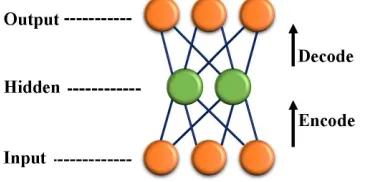
output layers. In AE, the input data is firstencoded, passing it through a layer of neurons to a more condensed representation (the hidden layer). The AE then performsdecoding, in which it attempts to reconstruct the original input from the hidden layer while minimizing error as demonstrated in Figure 2.3.
A Denoising Autoencoder (DAE) then uses the basic concept of AE but also adds noise (corruption) to the input. Figure 2.4 shows how the DAE architecture is applied. Given inputx, noiseqD is added to createx0. The AE
then mapsx0 toy (via encoderfθ) and attempts to reconstructx via decoder gθ0, producing reconstruction z (denoising) while optimizing error measured by lossLH(x,z). These processes allow the DAE to generalize well and allow
us to make predictions in the future on data the model has never seen. The DAE tries to reconstruct the original values from the noisy inputs, which helps it to better generalize and thus handle a wider variety of inputs after training. SDAE combines (stacks) multiple DAEs by overlapping a hidden layer as an input of the next DAE.
Vincent et al. showed that SDAE achieves lower classification error rates for image classification compared to SVM, Deep Belief Networks (DBN), and Stacked Autoencoders (SAE) [52].
Convolutional Neural Networks (CNN)
Feature Extraction
Fully Connected Layers
Classification
Figure 2.5: A basic architecture of convolutional neural networks (CNN)
a CNN [29, 31]. The architecture consists of two major components: Feature Extraction andClassification.
InFeature Extraction, the input is first fed into aconvolutional layer, which comprises a set of filters. Each region of input is convolved with each filter, essentially by taking the dot product of the two vectors, to get an intermediate set of values. These values are input to anactivation function– this is similar to neurons being activated based on whether or not the filtered input has certain features. Having more filters means being able to extract more features from the input. The output of the activation function is then fed into apooling layer.
The pooling layer progressively reduces the spatial size of the representa-tion from the feature map to reduce the number of parameters and amount of computation. The most common approach used in pooling isMax Pooling, which simply selects the maximum value in a spatial neighborhood within a particular region of the feature map to be a representation of the data. This has the advantage of being invariant to small transformations, distortions and translations in the input, since the largest signals in each neighborhood are retained.
The final part of the feature extraction component (Optimized techniques in Figure 2.5) mainly consists of a stochasticdropout function andBatch Nor-malization that help improve classifier performance and prevent overfitting.
2.6
Website Fingerprinting using Deep Learning
Many applications have adopted deep learning (DL) to solve complex problems such as speech recognition, visual object recognition, and object detection in images [30]. DL does not require selecting and fine-tuning features by hand. In the WF domain, there are four works that have begun to examine the use of DL.
Abe and Goto studied the application of Stacked Denoising Autoencoders (SDAE) [4] to WF attacks. They showed that SDAE is effective with 88% accuracy in the closed world and 86% TPR and 2% FPR in the open world. Although most work in deep learning recommends large data sets be used, their work was successful with only a small dataset.
Rimmer et al. proposed to apply DL for automated feature extraction in WF attacks [40]. The results show that the adversary can use DL to automate the feature engineering process to effectively create WF classifiers. Thus, it can eliminate the need for feature design and selection. In the closed-world scenario, their CNN-based attack (which we refer to as Automated Website Fingerprinting, or AWF) trained on 2,500 traces per website could achieve 96.3% accuracy. In their open-world evaluation, SDAE performs the best of their models with 71.3% TPR and 3.4% FPR when optimizing for low FPR. However, AWF could not outperform state-of-the-art WF attacks such as CUMUL.
Recently, Bhat et al. [6] and Oh et al. [34] have released preliminary re-ports on their explorations of a CNN variant and unsupervised DNNs with au-toencoders, respectively. While both papers include interesting contributions, neither paper reports accuracy rates as high as those shown in our results. Additionally, neither attack was shown to be effective against WTF-PAD.
2.7
Attack Performance Metrics
In this section, we define and justify the metrics we have used to evaluate the success of the attacks. There are two scenarios under which WF attacks are evaluated: closed-world and open-world.
2.7.1 Closed-world Evaluation
In the closed-world scenario, we assume that the user is limited to visiting a fixed set of websites, and the attacker knows this set and can train his classifier on it. In this scenario, the success of the attacker is simply measured as the ratio of the number of correctly classified traces to the total number of traces, we call this ratio the attack’saccuracy.
Accuracy= Pcorrect
N (2.1)
Pcorrect is the total number of correct predictions. A correct prediction
is defined as the output of the classifier matching the label of the website to which the test trace belongs. N is the total number of instances in the test set.
2.7.2 Open-world Evaluation
In the open-world scenario, the user may visit any of a large number of web-sites. Since the attacker cannot effectively train on so many websites, he selects a relatively small set to train his classifier on (the monitored set). For experimentation, we model the rest of the Web using a set of websites that the attacker does not try to identify with WF (the unmonitored set). Note that the unmonitored set is more larger than the monitored set in our exper-iments. The main purpose of this evaluation is to examine the capability of the WF classifier in recognizing a few monitored websites out of a large set of unmonitored websites, we measurePrecision and Recall in this scenario.
P recision= T P
T P +F P (2.2)
Recall= T P
T P +F N (2.3)
• T P is the total number of test samples of monitored websites that are correctly classified as monitored websites.
• T N is the total number of test samples of unmonitored websites that are correctly classified as unmonitored websites.
• F P is the total number of test samples of unmonitored websites that are misclassified as monitored websites.
• F N is the total number of monitored websites that are misclassified as unmonitored websites.
Website Fingerprinting
Attacks
“Victory usually goes to the army who has better trained officers and men.”
Sun Tzu, The Art of War
In this chapter, we aim to answer the RQ1 and RQ2 by presenting our work that has been done in three stages. The first stage describes the dataset preparation that was used in the experiments to ensure the validity and ethi-cal consideration in our research. The second stage presents the experimental evaluations and their results including the design of our newly-proposed WF attack using deep learning (DL) and the evaluation of website fingerprint-ing (WF) attacks usfingerprint-ing DL in comparison to the current state-of-the-art WF attacks. The evaluation was also extensively performed to measure the effec-tiveness of WF attacks using DL in more realistic assumption including WF attacks against a defended dataset and in an open-world setting.
Moreover, we propose the novel state-of-the-art WF attack and its design called the Deep Fingerprinting Model (DF)attack that can significantly out-perform the current state-of-the-art WF attacks. Finally, the third stage pro-vides a discussion and conclusion to demonstrate interesting viewpoints and observation obtaining from our research and also the answers to ourRQ1and
RQ2. The discussion part constitutes what we are interested in investigating forRQ3and RQ4.
3.1
Data Collection
For the closed-world dataset, we visited the homepage of each of the top Alexa 100 websites 1,250 times and dumped the traffic generated by each visit separately using tcpdump. We used ten low-end machines in our university’s campus to collect the data. We have followed prior work’s methodology for data collection [25, 55]; on each machine, the visits were sequential and were ordered according to Wang and Goldberg’s batched methodology to control for long- and short-term time variance [55]. More specifically, we split the visits to each website in five chunks, so that the websites are accessed in a round-robin fashion: in each batch we access each website 25 times. As a result of batching, the visits to a website are spread over time. The rationale for this is twofold: i) to avoid having our IP addresses banned by the web servers; and, ii) to capture variants of the websites over time for more robust training and testing.
We usedtor-browser-crawler[25] to drive the Tor Browser to visit web-sites. This allows for more realistic crawls than using tools likewget orcurl
because the setting resembles a real user browsing the Web with Tor. We ac-knowledge that to be more realistic, our crawler should model user browsing behavior when crawling websites. However, modeling user behavior in Tor is challenging, as user statistics are not collected for privacy reasons. Virtually all existing datasets collected for WF follow the same simplistic user model we use in this study.
After the crawls were finished, we discarded corrupted traffic traces. For instance, we removed traces that did not have any incoming or outgoing pack-ets or were too short – less than 50 packpack-ets. After removing corrupted traces, we only kept the websites, or classes, that had at least 1,000 visits. We ended having 95 websites with 1,000 visits for our closed-world evaluations. We refer to the set of the data used for closed-world evaluations as the closed-world dataset.
3.1.1 Open-world dataset.
Table 3.1: Summary of the dataset used in the experiments
Dataset Closed-world data Open-world data
Sites Instance(s)/site Sites Instance(s)/site
Non-Defended 95 1,000 40,716 1
Defended WTF-PAD 95 1,000 40,716 1
Walkie-Talkie (W-T) 100 900 40,000 1
returning an access denied error message, a timeout error, or a blank page. Moreover, many of the websites were behind Cloudflare’s CDN, which presents a CAPTCHA to connections coming from Tor exit relays. We removed those websites from our dataset by comparing their homepage’s screenshot with each of: a blank page, an access denied page, a CAPTCHA page, and a timeout error page. The final dataset has a total of 40,716 traffic traces.
3.1.2 Defended dataset.
To evaluate the defenses, we produced datasets with traces defended by each defense: for BuFLO, Tamaraw and WTF-PAD, we generate the defended traces by padding them according to the defense protocols, using the scripts and simulators provided by the authors [7, 15, 26]. Walkie-Talkie (W-T), how-ever, cannot be completely simulated, as half-duplex communication is hard to model. We thus performed a new crawl with a Tor Browser in half-duplex mode. Since the implementation of half-duplex for the original implementation of W-T was done in an outdated version of the Tor Browser, we had to imple-ment half-duplex in the latest version of Tor Browser at the time of our crawls (Tor Browser Bundle version 7.0.6). With this modified Tor Browser, we col-lected closed- and open-world datasets of size similar to the undefended ones. W-T also requires padding the bursts in the half-duplex traces. To that end, we followed the mold-padding strategy as described in the W-T paper [57]. Finally, we end up with 90,000 closed-world dataset and 40,000 open-world dataset for W-T traffic traces which is significantly larger than the original dataset proposed by Wang et al. [57].
The summary of the dataset used in this section is described in Table 3.1. Note that some of the dataset will be later used for further evaluation forRQ3
3.2
Experimental Evaluation
In this section, we first describe how we implement WF attacks using DL and define data representation to formulate the data input used for training and testing models. Then, we provide the process of creating our newly-proposed DF attack and intuitive explanations on each selected model’s architecture and hyperparameters used in the model. Finally, we comprehensively evaluate the performance our DF attack to other state-of-the-art WF attacks in closed-world and more realistic open-closed-world scenarios against both non-defended and defended datasets.
3.2.1 Implementation
Our implementation of the DF model uses the Python deep learning libraries Keras as the front-end and Tensorflow as the back-end [2]. The source code of implementations is now publicly available in https://github.com/ deep-fingerprinting/df.
Data Representation
In WF, a website trace is represented as a sequence of tuples <timestamp,
±packet size>, where the sign of packet size indicates the direction of the
packet: positive means outgoing and, negative, incoming.
Prior work in WF has shown that the most important features are derived from the lengths of traces in each direction [20, 54]. Wang et al. [54] simpli-fied the raw traffic traces into a sequence of values from [−1, +1], where they ignored packet size and timestamps and only take the traffic direction of each packet. However, we performed preliminary evaluations to compare the WF attack performance between using packet lengths and without packet lengths, i.e., only packet direction, as feature representations. Our result showed that using packet lengths does not provide a noticeable improvement in the ac-curacy of the attack. Therefore, we follow Wang et al.’s methodology and consider only the direction of the packets.
closed-world dataset, only 8,121 were longer than 5,000 cells and had to be truncated, while the rest were padded.
SDAE
We reproduced Abe and Goto’s results [4], as described in Chapter 2. Fol-lowing guidance from the authors, we successfully re-implemented their SDAE neural network on the same architecture and dataset they used. We achieved 89% accuracy, a slightly higher accuracy than the one Abe and Goto reported in their paper. We believe that using different Python DL modules (Kera and Tensorflow) and randomly initializing the weights accounts for this difference. Furthermore, we slightly changed their SDAE model’s hyperparameters to improve its performance in our experiments.
AWF
Rimmer et al. provided us with their source code to re-produce their results. We strictly followed their proposed hyperparameters and evaluate the model in our dataset to make a fair comparison for our model and the previous state-of-the-art WF attacks. Although we used smaller open worlds than previous works, we evaluated all attacks and defenses under the same conditions, which allows us to compare among them.
DF
To develop our DF model to effectively perform WF attacks on both non-defended and non-defended dataset, we have followed techniques in the deep learn-ing literature [27, 29, 49] to improve the performance of the model, such as using the appropriate number of convolutional layers, mitigation and preven-tion of overfitting [46] and a suitable activapreven-tion funcpreven-tion for our WF input data [33]. These studies helped us design the sophisticate architecture and tune our model’s hyperparameters that best fit for WF.
functions during hyperparameter tuning and it performed the best among all the functions we tested (see Section 3.2.2). Although the traditional tanh func-tion can also handle negative inputs, it is vulnerable to thevanishing gradient issue [5], which slows down optimization.
Another difference between traffic and image data is that images are two-dimensional, whereas our data is a vector. This means that filter and pool sizes cannot be two-dimensional (e.g., 2x4) but have to be cast to one dimension (e.g., 1x4).
3.2.2 DF’s Hyperparameter Tuning
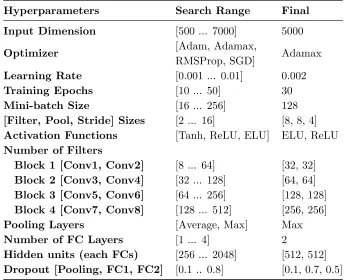
A fundamental process in supervised classification is to tune the hyperparam-eters of the classification model, such as the kernel used in an SVM or the number of hidden layers in a CNN. This process involves adjusting the trade-off between variance, bias and classification performance, so that the model fits the training data while still generalizing to samples that it has not been trained on. For DF, however, the large amount of training data and the large number of hyperparameters the model has render an exhaustive search pro-hibitive in terms of computational resources. To demonstrate our attacks, we thus only aim at a good-enough classifier and we acknowledge that someone with more resources might be able to optimize our model further.
To select the hyperparameters for our models, we perform an extensive search through the hyperparameter space, in which we build each layer of the deep learning model block by block. In each building block, we vary the hyperparameters to estimate the gradient of the parameter and determine whether we must increase or decrease its value. Once this process is done, we select the best top-n parameters and use them as the initial parameters for the optimization in the next block. When all layers are set, we select the best combination of hyperparameters.
Table 3.2: Hyperparameters selection for the DF model from the extensive candidates search method
Hyperparameters Search Range Final
Input Dimension [500 ... 7000] 5000
Optimizer [Adam, Adamax,
RMSProp, SGD] Adamax
Learning Rate [0.001 ... 0.01] 0.002
Training Epochs [10 ... 50] 30
Mini-batch Size [16 ... 256] 128
[Filter, Pool, Stride] Sizes [2 ... 16] [8, 8, 4]
Activation Functions [Tanh, ReLU, ELU] ELU, ReLU
Number of Filters
Block 1 [Conv1, Conv2] Block 2 [Conv3, Conv4] Block 3 [Conv5, Conv6] Block 4 [Conv7, Conv8]
[8 ... 64] [32 ... 128] [64 ... 256] [128 ... 512]
[32, 32] [64, 64] [128, 128] [256, 256]
Pooling Layers [Average, Max] Max
Number of FC Layers [1 ... 4] 2
Hidden units (each FCs) [256 ... 2048] [512, 512]
Dropout [Pooling, FC1, FC2] [0.1 .. 0.8] [0.1, 0.7, 0.5]
Evaluating Overfitting
Even though deep neural networks (DNNs) are a powerful supervised classifi-cation model, they are, as with as most machine learning models, vulnerable to overfitting. Overfitting occurs when the model errs on samples that it has not been trained on, meaning that the model cannot generalize. For small datasets, overfitting can be measured with cross-validation techniques. For large datasets like ours, however, we can just split the data into three mutu-ally exclusive sets: training, validation and testing, with a ratio of 8:1:1. We then measure the difference in error rate between different sets. In case of overfitting, the model would achieve a substantially higher accuracy on the training set than on the testing set.
the model randomly selects hidden units, including their incoming and outgo-ing connections, and temporarily removed them from the network while train-ing. BN normalizes the fully-connected and convolutional layers’ outputs and helps accelerate learning while also reducing overfitting. Moreover, we analyze the error rates between training and testing datasets during hyperparameter tuning to ensure that our model is not overfitting.
Figure 3.2 depicts the training and testing error rates. The difference between training and testing error of the DF model is less than 2%, suggesting that overfitting is unlikely.
3.2.3 Differences Between DF and AWF
We now explain the significant differences of the DF model compared to the AWF model proposed by Rimmer et al. [40] that help explain the superior performance of DF.
Basic Block Design.
The basic block is the group of convolutional layer(s), max pooling layer, filters and activation layer(s) that perform feature extraction in a CNN. Generally, the basic block is repeatedly appended to create deeper networks.
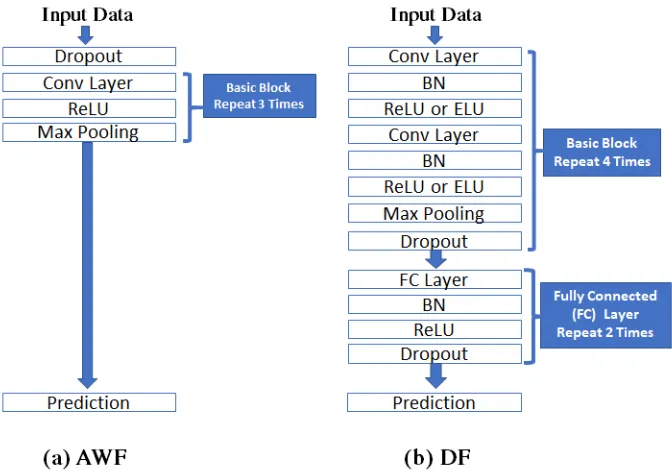
We observe that the AWF model is similar to Imagenet [29], one of the earliest CNN models proposed in 2012. The basic block of this model only contains one convolutional layer followed by one max pooling layer as shown in Figure 3.1(a). In contrast, our DF model is inspired by modern large image classification networks such as VGG [27], GoogleNet [49] and ResNet [21] that apply at least two consecutive convolutional layers before a max pooling layer as shown in Figure 3.1(b). Max pooling typically reduces the data to a smaller size, so it is not possible to have deeper networks when pooling after every convolutional layer. Adding more convolutional layers in each basic block thus enables more convolutional layers in total and a deeper network with more effective feature extraction.
Overfitting Concerns.
Figure 3.1: Comparison between AWF and DF models
from the input and may not be sufficient to prevent overfitting. In DF, we used overfitting-contention mechanisms that are applied in the state-of-the-art CNN networks for computer vision, including a batch normalization (BN) layer that is added right after each convolutional layer and a dropout layer after the activation function, as explained in Section 3.2.2. With these mechanisms, the DF model shows no evidence of overfitting in our experiments.
Varying Hyperparameters
the number of filters at higher layers to improve the ability to encode richer representations.
Activation Function.
The AWF model only uses the ReLU activation function. ReLU is popular in CNNs, but it maps all negative values to zero. Our input formats include negative values that represent incoming packets, so using ReLU in convolu-tional layers close the input can substantially reduce the information available to deeper layers in the model. In the DF model, the activation function in the first basic block is ELU, which can learn a data representation containing neg-ative values to ensure that the model can learn all meaningful representations from the input.
Fully-connected Layers.
The AWF model directly connects the last max pooling layer to the prediction layer, a densely connected layer with an output size equal to number of classes. In more recent CNNs, there are a set of fully connected (FC) layers that follow the convolutional layers and precede the prediction layer. The FC layers play an important role in the learning and classification processes of the model. Essentially, the convolutional layers perform feature extraction, but that means that it is important to carefully design the classifier that uses the extracted features, which is the role of the FC layer. In the DF model, we add two FC layers with the combination of BN and dropout to prevent the overfitting that normally occurs in FC layers.
Overall, our DF model was specifically designed to effectively perform WF attacks by leveraging the state-of-the-art techniques from computer vision research. We provide a thorough explanation on how the DF model was de-veloped and a visualization of the DF model in Appendix A to allow other researchers to gain better understanding and reproduce our work. Our experi-mental results confirm that DF performs better than AWF model in defended and non-defended and on both closed-world and more realistic open-world scenarios. These results help to illustrate the impact of the DL architecture design on the performance of the attacks.
3.2.4 Closed-world Evaluation on Non-defended Dataset
Table 3.3: Closed World: Accuracy on the non-defended dataset for state-of-the-art attacks.
Classifier SDAE DF AWF k-NN CUMUL k-FP
Accuracy 92.3% 98.3% 94.9% 95.0% 97.3% 95.5%
with the state-of-the-art WF attacks: k-NN, CUMUL,k-FP, AWF, and SDAE. We re-evaluate these attacks on our non-defended dataset and apply k-fold cross-validation for training their classifiers and testing their performance, as was done in the papers presenting these attacks [20, 35, 54].
Table 3.3 shows the accuracy results. Our DF model attains 98.3% accu-racy, which is better than the other attacks and higher than any previously reported result for a WF attack in Tor. Our DF model performs better than AWF. Our results for AWF (94.9%) are a bit lower than the reported results by Rimmer et al. (96.5%), we believe this is due to the larger dataset used by them. We observe that CUMUL,k-FP, k-NN and SDAE benefit from the larger training data set