Ames Laboratory ISC Technical Reports Ames Laboratory
9-1-1954
Improved calcium fluoride shapes
D. R. WilderIowa State College E. S. Fitzsimmons Iowa State College
Follow this and additional works at:http://lib.dr.iastate.edu/ameslab_iscreports Part of theCeramic Materials Commons, and theMetallurgy Commons
This Report is brought to you for free and open access by the Ames Laboratory at Iowa State University Digital Repository. It has been accepted for inclusion in Ames Laboratory ISC Technical Reports by an authorized administrator of Iowa State University Digital Repository. For more information, please [email protected].
Recommended Citation
Improved calcium fluoride shapes
Abstract
The properties of calcium fluoride are discussed with relation to utilization in refractory crucibles or liners. Conventional methods of slip casting and dry pressing are found to be practical. Expansion, shrinkage, density, and porosity characteristics of the fired material are considered.
Keywords
Ames Laboratory
Disciplines
Ceramic Materials | Engineering | Materials Science and Engineering | Metallurgy
UNITED
U N C L A S S I F I E D
---ISC-514
S T A
T
E S A T 0 M I C E N E R G YIMPROVED CALCIUM FLUORIDE SHAPES
by
D. R. Wilder and E. S. Fitzsimmons
September l, 1954
Ames Laboratory at
Iowa State College F. H. Spedding, Director
Contract W-7405 eng-82 U N C L A S S I F I E D
2 ISC-514
This report is distributed according to the category Metallurgy
ISC-514 3
IMPROVED CALCIUM FLUORIDE SHAPES
by
D. R. Wilder and E. S. Fitzsimmons
ABSTRACT
The properties of calcium fluoride are discussed with relation to utilization in refractory crucibles or liners. Cbnventional methods of slip casting and dry pressing are found to be practical. Expansion, shrinkage, density, and porosity characteristics of
the fired material are considered.
I. INTRODUCTION
Calcium fluoride, with a melting point of approximately 1350•c, has long been employed as a flux and mineralizer in cement and
other .products. Its .use as a refractory is limited by its melting point and also to conditions permitting the presence of fluorides and for which the common oxide materials are unsuitable • . These requirements occur in certain bomb reductions and in the melting of some metals.
This brief, exploratory study was made to ascertain the feasibility of application of conventional forming procedures to calcium fluoride. The techniques employed are possible in many laboratories and are suited to occasional production of small pieces.
Some of the properties which govern the usefulness of the resulting specimens were also determined.
II. PREVIOUS INVESTIGATIONS
The literature contains much information pertaining to the fluxing and mineralizing action of CaF2(l,2,3), but little mention is made of the refractory properties. Dony-Henault and Polydoroff
4
ISC-514Allison and Murray (7) studied many of the fundamental
properties of CaF2 in a sintering investigation. They found the
coefficient of thermal expansion varied from approximately
21 x 10-6 to 26 x 10-6 depending on the density of the specimen
considered.
Murray and Taylor (8) found free lime formation to be
respon-sible for failure in crucibles formed from technical grade CaF2
containing small amounts of silica. Tricalcium silicate was
formed during firing and decomposed to form free lime when cooled.
Subsequent hydration of the free lime caused disintegration.
III. INVESTIGATION
All of the material employed was chemically pure reagent
grade calcium fluoride.* The powder was placed in fired calcium
fluoride crucibles and calcined for one hour at 1000°C. The
calcine was then dry milled in a porcelain ball mill for 23 and 48
hours at 60 rpm. It was washed from the mill and dried. The
particle size distributions were determined by the hydrometer
method (9) and are shown in Figure 1.
Pellets were formed from the dried powder in g hardened steel
die. The pressures employed were approximately 10,000; 20,000; and
30,000 psi. A 10% water addition was made to facilitate pressing.
The dry pressed bars used for thermal expansion were formed at
approximately 6,600 psi with a similar water addition.
Bar shaped. specimens were also slip cast in plaster molds
from both ~article distributions using hydrochloric acid and
ammonium hydroxide to adjust the pH. In preparing these slips,
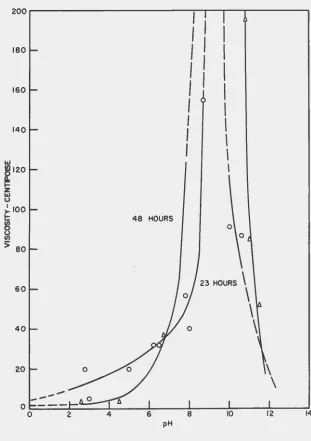
the variation in viscosity _with pH was studied with a MacMicheal
viscosimeter.
IV. RESULTS
The pH-viscosity relation occurring in aqueous suspensions of
calcium fluoride is noted in Figure 2 for one specific gravity.
The same general curve was also found to occur at lower specific
gravities. The influence of particle size is especially noticeable
in these curves. The most satisfactory pH for slip casting was
found to be approximately 5 for this specific gravity. This gave
casts which were fairly rapid, freed from the mold in a reasonable
length of time, and gave less mold attack than more acidic slips.
The specific gravity of 2.1 was found to be satisfactory for the
casting of small crucibles and solid shapes.
The linear shrinkage occurring on firing dry pressed and slip
cast calcium fluoride in air is shown in Figure 3. All specimens
were held at temperature one hour. The highest shrinkage occurs
in the pellets compacted at the lowest pressure, 10,000 psi. This
ISC-514
EQUIVALENT DIAMETER(")
Figure 1 - Particle Size Distributions. Ball Milled Calcium Fluoride.
[image:8.601.74.532.125.553.2]6 ISC-514
200
I
I
I
I I
180
I
I
I
I
I
I
160
I
I
I
I
I
I
140
I
I
I
I
loJgl20 I
z
loJ
(,)
~100
1- 48 HOURS
iii
0
(,)
en
> 80
23 HOURS \
60
\
\
40
\
14 pH
[image:9.599.77.388.164.605.2]ISC-514 7
14
12
6 48 hr
10,000 psi
1&.1 0 23 hr
Cl)
48 hr
c
'
~ 20,000 psi
z
G: () 23 hr :J:
'
48 hrCl)
8 30,000 psi
G:
•
23 hrc
1&.1
z + 48hr
:::;
at 6
4
TEMPERATURE •c
8 ISC-514
is as expected since the dry pressing compaction is additive to ·
the compaction or sintering produced by elevation in temperature. When the compacts are measured after pressing, ·the additional dimensional change produced by heat treatment will be less in
the compacts of original greatest density. As will be seen later, the highest shrinkage does not indicate greatest density nor ·
lowest porosity in a pressure sensitive material such as calcium fluoride.
The shrinkage occurring in slip cast bars is average as compared to the dry pressed specimens. Crucibles cast from this same batch were found to be water tight and relatively impervious.
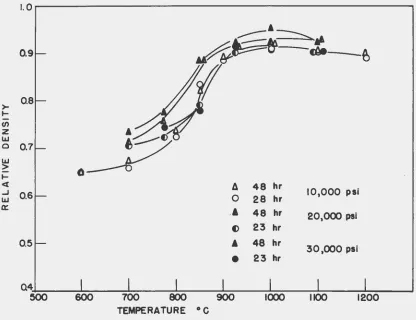
The relative density was determined on a basis of 3.18 gm/cc as the theoretical crystal density. The results of this determina-tion are shown graphically in Figure 4. The highest values are all very close, the maximum density developed is with the finest
material compacted under the greatest pressure. This maximum is achieved at about 1000°C and has a shrinkage, as noted in Figure 3, of a little over 8%. The slight indication of a bloating condition, not apparent in the pieces, but obvious from the decrease in the relative densities above 1000°C makes it desirable to fire at this temperature. Higher firing does not improve the properties.
The total porosities; i.e., all open and closed pores in the fired volume, are plotted in Figure 5. Again a minimum is found at approximately 1000°C. Many of the points are below 10%,
indicat-ing a very dense body. Many of these specimens would be water tight under moderate pressures.
Thermal expansion data for the bars formed are shown in Figure 6. The variation is slight betweeQ the different forming and firing conditions. The average coefficient of thermal expan-sion, between 500°C and 900°C is approximately 27.9 x 10⁻⁶. This indicatgs low thermal shock resistance as compared to values of
8 x 10- for alumina and 14 x 10-6 for magnesia (10).
V. CONCLUSIONS
1. Calcium fluoride may be slip cast in aqueous suspensions. For the particle distributions studied, a pH of 5 and specific gravity of 2.1 were found satisfactory. Particle size has a
noticeable effect on the viscosity at any pH.
2. Dry pressing was found to be a satisfactory method of forming. Increased compacting pressures increased the density and
decreased the total porosity. Specimens fired to 1000°C were quite dense and had low porosity.
ISC-514 9
1.0
----·~
A~--'-&
f
>-...
.~
(/)
z
LU
8~
0
LU
>
...
<1: A 48 hr
...J
0 hr 10,000 psi
LU 28
a:
'
48 hr 20,000 psiC> 23 hr
A 48 hr
30,000 psi
•
23 hr Q4500
[image:12.595.100.516.217.537.2]TEMPERATURE
oc
10 ISC-514
'
60
~ 48 hr
0 23 hr 10,000 psi
'
48 hr() 2 3 hr 20,000 psi
'
48 hr4
•
2 3 hr 30,000 psi
>-.... IJ)
0
~
..J
<X
....
~ ~
500 600 700 800 900 1000 1100 1200
[image:13.595.56.564.226.559.2]TEMPERATURE oc
ISC-514 11
2.2 0 DRY PRESSED FIRED 1000°C
6 SLIP CAST 1000°C
a
DRY PRESSED 1200°C
r¢
2.0 D SLIP CAST 12 0 0°C
0
1.8 D
b.
1.6
p
D
1.4 b.
z
2 ~
...
c b.
(.!)
z
0
.J 11..1
~
0
[image:14.597.74.544.158.616.2]900
12 ISC-514
4. Thermal expansion was found to be quite similar in all of the specimens measured. Thus changes in forming procedure or
firing temperature are not successful in reducing the suscepti-bility of calcium fluoride to thermal shock.
1.
2.
VI. LITERATURE CITED
Wilhelm;Eitel, The Physical Chemistry of the Silicates, Univer-sity of ChicagoP'ress, Chicago, Illinois, p. 1592 (1954).
c.
Booth and W. J. Rees, "Basic Refractories, 'Their Use in the Linings of Induction Furnaces," Iron Steel Inst. (London)Carnegie Schol. Mem. 26, 57-122 (1937).
3. V. F. Zhuravlev, I. G. Lesokhin, and R. G. Tempel'man, "Kinetics in the Formation of Calcium Aluminates and the Role of
Mineralizers," Zhur. Priklad. Khim. (J. Applied Chern.) 21,
887-902 (1948).
4. 0. Dony-Henault and B. Polydoroff, "Preliminary Statement on the Preparation of New Ceramic Linings Made from Metallic Fluorides," Bull. Classe Sci. Acad. Roy. Belg. 28, No. l/3,
67-72 (1942). -- .
5. C. Eichner and R. Caillat, "Manufacture of Objects in Fritted Pure Calcium Fluoride, 11 Bull. Soc. Chern. France, p. 139 (1951).
6. P. M. J. Gray, "The Production of Pure Cerium Metal by Electroly-tic and Thermal Reduction Process," Trans. Int. Mining Met.
(London) 61, p. 4 (in Bull. No. 542, 141-170 (1952)).
7. E. B. Allison and P. Murray, "A Fundamental Investigation of Sintering Phenomena," Atomic Energy Research Establishment Report M/R 1099 (1953).
8. P. Murray and J. Taylor, "Free Lime in Sintered Calcium Fluoride Crucibles,11 Atomic Energy Research Establishment Report M/R
1097 ( 1953) .
9. A. Casagrande, Hydrometer Method for Determination of Fineness Distribution in Soils, Julius Springer, Berlin (19341.