Open Access
Debate
Functional illness in primary care: dysfunction versus disease
Nefyn Williams*
1, Clare Wilkinson
1, Nigel Stott
2and David B Menkes
3Address: 1Department of Primary Care and Public Health, Cardiff University, North Wales Clinical School, Wrecsam, UK, 2Department of Primary
Care and Public Health, Cardiff University, UK and 3Department of Psychological Medicine, Waikato Clinical School, University of Auckland, New
Zealand
Email: Nefyn Williams* - [email protected]; Clare Wilkinson - [email protected]; Nigel Stott - [email protected]; David B Menkes - [email protected]
* Corresponding author
Abstract
Background: The Biopsychosocial Model aims to integrate the biological, psychological and social components of illness, but integration is difficult in practice, particularly when patients consult with medically unexplained physical symptoms or functional illness.
Discussion: This Biopsychosocial Model was developed from General Systems Theory, which describes nature as a dynamic order of interacting parts and processes, from molecular to societal. Despite such conceptual progress, the biological, psychological, social and spiritual components of illness are seldom managed as an integrated whole in conventional medical practice. This is because the biomedical model can be easier to use, clinicians often have difficulty relinquishing a disease-centred approach to diagnosis, and either dismiss illness when pathology has been excluded, or explain all undifferentiated illness in terms of psychosocial factors. By contrast, traditional and complementary treatment systems describe reversible functional disturbances, and appear better at integrating the different components of illness. Conventional medicine retains the advantage of scientific method and an expanding evidence base, but needs to more effectively integrate psychosocial factors into assessment and management, notably of 'functional' illness. As an aid to integration, pathology characterised by structural change in tissues and organs is contrasted with dysfunction arising from disordered physiology or psychology that may occur independent of pathological change.
Summary: We propose a classification of illness that includes orthogonal dimensions of pathology and dysfunction to support a broadly based clinical approach to patients; adoption of which may lead to fewer inappropriate investigations and secondary care referrals and greater use of cognitive behavioural techniques, particularly when managing functional illness.
Background
Our conceptual models of illness shape our consulting behaviour [1]. This paper aims to stimulate debate by developing the biopsychosocial model in primary health care, particularly with regard to undifferentiated illness.
Starfield's definition of primary care [2] as '...first contact, continuous, comprehensive and co-ordinated care pro-vided to populations undifferentiated by gender, disease system or organ system' has achieved international accept-ance. Such a broadly defined discipline requires a broad working definition of health or illness, yet such breadth is
Published: 15 May 2008
BMC Family Practice 2008, 9:30 doi:10.1186/1471-2296-9-30
Received: 4 October 2007 Accepted: 15 May 2008
This article is available from: http://www.biomedcentral.com/1471-2296/9/30
© 2008 Williams et al; licensee BioMed Central Ltd.
not always evident in daily practice. A particular challenge to conventional practice is posed by medically unex-plained physical symptoms (MUPS), estimated to consti-tute one in five primary care consultations [3], and a persistent cause of presentation in 2.5% [4]. Despite notional acceptance of the biopsychosocial model, con-temporary practice tends to frame such presentations as either psychological or physical, which is compounded by current classification systems [5]. Newer approaches include: assessing, organising and treating these biologi-cal, psychological and social components within a four-dimensional grid [6]; addressing unmet psychiatric needs delivered either by psychiatrists in a collaborative care model [7], or by training primary care clinicians in a re-attribution programme [8]. In these interventions the emphasis is shifted from physical to the psychological, but true integration remains elusive. In order to make the biopsychosocial model easier to use in everyday practise, we suggest that illness in primary care be considered in two interacting dimensions:
1. Pathology; characterised by demonstrable structural change in tissues and organs
2. Dysfunction; arising from disordered physiology or psychology, which may occur independent of pathologi-cal change
Appropriate care requires that both dimensions are appraised by a skilled clinician, mindful that both may manifest, and interact, in the psychosocial context of the individual patient. Before discussing the implications of this approach for clinical practice, medical education and research, we first consider the development of the biopsy-chosocial model from general systems theory.
Discussion
General Systems Theory
General systems theory offers an intuitively appealing model for understanding illness presenting in primary care. In contrast to determinism, which states that every event has an antecedent cause, nature is seen as a dynamic order of interacting parts and processes [9]. In this hierar-chy of systems (e.g., biochemicals to organelle, cell, tissue, organ, organism, family, community, society), there is both vertical and horizontal interaction. For example, the endocrine system interacts with both the nervous and immune systems. Each level has properties not present in its individual parts, but arising from the relationship between the parts. Thus people are more than the sum of their organs and tissues, and society more than the sum of its individuals. If equilibrium is disturbed, reactive forces reverberate in the system until a new equilibrium is estab-lished. This model can explain how each level in the hier-archy interacts with increasing complexity, and forms a
continuum from the sub-cellular level to the roles and relationships constituting society [10]. It even works to promote concepts of global connectedness [11]. Addi-tional explanatory detail is needed at the level of the indi-vidual human being, arguably the level of greatest complexity gain due to sentience and self-concept [12,13].
The biopsychosocial model
General systems theory provides a structure for systematic thinking about a complex world, and has been used in health care to describe how the physical, psychological and social components of illness can be considered together in primary care [10,14-16], and other branches of medicine [17]. The resulting biopsychosocial model attempts to integrate these three components of illness, and can be distinguished from the biomedical model, where psychosocial aspects are considered separately, if at all [18,19]. A biopsychosocial approach requires broad definitions of health [20,21], provides a framework to address functional illness consisting of MUPS and func-tional somatic syndromes, as well as the importance of life events and spiritual or existential aspects of care.
Medically Unexplained Physical Symptoms (MUPS)
GPs are often presented with illness which defies biomed-ical understanding and thus differentiation because it is self-limiting; distorted by early treatment or changed cir-cumstance; intermediate between existing labels; a mild or atypical variant of known pathology; not yet under-stood; or some combination of these [22-24]. Diary stud-ies reveal that individuals tend to develop a new physical symptom on average every five to seven days; the vast majority of which do not result in a consultation. Those consulting doctors are more likely to have had a recent stressful life event [22]. Similarly, individuals with high levels of subjective distress are more likely to notice and complain about internal bodily sensations [25,26]. Psy-chological distress is linked to both the number and sever-ity of unexplained symptoms [27] and health care use [28]. MUPS are common and are often associated with psychological morbidity, but most patients presenting with them do not have definite psychiatric illness [29,30].
Functional somatic syndromes
dys-function' by osteopaths who treat spinal areas by manipulation, 'instability' by spinal surgeons who fuse spinal vertebrae, 'somatisation' by psychiatrists and 'ill-ness behaviour' by psychologists. Many of these syn-dromes have common core clinical features [22,31], and often co-exist [32,33], so it is uncertain how much they are distinct clinical entities, or variations on a theme of general body distress [33-36]. As with MUPS, these syn-dromes tend to have a strong psychological component. A stepped care approach has been advocated using: non-pharmacological treatments such as exercise and cognitive behavioural therapy, which are more effective than pas-sive treatments such as injections and operations, and pharmacological treatments targeted on the central nerv-ous system such as tricyclic antidepressants [37].
Psychosocial factors
Psychosocial factors are also important in disease of known pathology. Social isolation, unemployment and other stressful life events are independently associated with higher mortality from all causes [38]. Depression predicts reduced survival following myocardial infarction [39,40], possibly due to an association with fatigue [41] or non-compliance [42], although other studies have failed to replicate this finding [43]. The well-established link between poverty and ill health cannot be fully explained by health behaviours or specific aetiological factors [44,45]. In a more positive sense, social capital has a pervasive beneficial effect on quality of life, measures of physical health, and resilience to stress [46]. Psychological factors, notably stress, are known to affect the neuroendo-crine and immune systems [47] and have been linked to cancer and HIV progression [48,49]. Similarly, psycholog-ical disorder appears to enhance the development of inflammation and infection in atherosclerotic plaques [50] and activate autoimmune disease such as rheumatoid arthritis [51]. Neuroendocrine and immune effects of extreme stress or depression may be better understood as normal-range responses to the human condition, which in turn have deleterious effects on physical health.
Social context
One of the most important functions of medicine through the ages has been as a source of refuge for the sick. This includes hospital admission for healing, relief or protec-tion; official sanction of the sick role in terms of certifica-tion or sick pay; refuge from distressing symptoms and the fear of serious disease by the provision of reassurance, symptom relief, and sometimes cure [52].
Spiritual dimension
The biopsychosocial model also has an interpretative function, in that it can be used as a source of meaning to individuals' experience of illness [53]. The need to find deeper meaning to life, illness and death is an ancient
characteristic of Homo sapiens, and the abstract thought
involved in this process appears unique to our species. Closely aligned to the phenomenon is an instinct for spir-itual practice and religious worship. Spirspir-itual or existen-tial discomfort is rarely formally considered by doctors, except in palliative care [54], or dynamic psychotherapy. Spiritual needs have been defined by one author [55] as "the needs and expectations that all humans have to find meaning, purpose, and value in life". These belief systems may or may not be part of religious faith, but 'spiritual care' is about helping people whose sense of meaning and purpose is challenged by their experience of illness [55].
Difficulties using the biosychosocial model
The biomedical model can be easier to use
Although integrating biological, psychological and social components of illness can accommodate the complexity of MUPS and functional syndromes, it is frequently mis-understood or inadequately applied in clinical practice. It is often viewed as abstract and impractical, perhaps because there is misleading simplicity in the key compo-nents of the model.
In routine clinical care, the biological, psychological and social components of illness may be interpreted and man-aged separately rather than in an integrated manner. Sig-nificant symptoms of anxiety or depression are present in 25–52% of primary care patients [56,57], but many go unrecognised because over half present with physical rather than psychological symptoms [58-60], and genuine integration of treatments aimed at both soma and psyche is the exception rather than the rule. This is partly due to time constraints [61], and because clinicians are creatures of habit, using rules of thumb or heuristics to guide their assessments or management decisions, which in turn are heavily influenced by their medical training, methods of classification [62] and clinical experience [63]. Unsurpris-ingly, many doctors find dualistic practice easier and less
stressful. The biomedical model, in which "disease can be
viewed independently from the person who is suffering from it, and from his or her social context" [10] remains deeply entrenched in contemporary medical practice and teach-ing.
preva-lent in large numbers of the asymptomatic general population, such as cervical and lumbar spondylosis on plain radiographs [64], or intervertebral disc abnormali-ties on magnetic resonance imaging (MRI) [65].
Over-enthusiastic pathological diagnoses can be damag-ing to patients in a number of ways, especially when patients collude with or even drive the process. Patients may be over-investigated, referred for unnecessary opin-ions and procedures, which may have serious adverse con-sequences[66] and waste resources [67]. Pathological labelling can increase psychological morbidity and the likelihood of somatic fixation [68]. Abnormal ideas about the aetiology of symptoms can lead to unnecessary sur-gery [69] and inappropriate self-management. For exam-ple, as a consequence of being told from radiographic findings that musculoskeletal symptoms are due to 'wear and tear', patients commonly avoid beneficial physical activity. Similarly, anxiety symptoms attributed to a stress-ful stimulus often lead to avoidance, the exact opposite of what behavioural therapy has demonstrated to be helpful.
Defining illness too narrowly in pharmacological terms
There may be a temptation in practice to explain illness entirely in pharmacological and biochemical terms. For example, sumatriptan is useful in acute migraine by inter-acting with serotonin receptors, so discussion of migraine aetiology and management may be restricted to the serot-onin system. A similarly restricted view on the aetiology of depression and schizophrenia results from focusing on the mode of action of antidepressants and antipsychotics on monoamine neurotransmitters [70].
Dismissing illness when pathology has been excluded
Non-pathological conditions can be just as disabling as pathologies when generic outcome measures are com-pared across different conditions [71,72]. Despite this, there is a tendency for medical practitioners, after exclud-ing important pathological diagnoses, to discount patients' symptoms and lose interest in their care. Quali-tative studies report that doctors may resort to 'victim blaming' after pathology is excluded [73]. These reactions not only damage the doctor-patient relationship, but encourage abnormal illness behaviour, notably including the quest for 'legitimate' symptoms and investigations, thereby worsening outcomes [74,75].
Explaining all undifferentiated illness in terms of psychosocial factors When no pathological cause can be found for unex-plained symptoms, it is tempting to conclude that 'it is all in the mind', especially when there is a strong link with psychological distress. The success of cognitive behav-ioural therapy, psychiatric consultation within primary care [7] and re-attribution [8] to treat unexplained symp-toms has led many to presume that psychological and
social factors are paramount, but psychological therapies may be rehabilitative in some patients irrespective of the primary cause of their symptoms. There is also evidence of disturbed physiology in many cases of unexplained symp-toms such as fatigue [76]. Moreover, the possibility of undifferentiated illness reflecting a missed physical diag-nosis should always be considered [77]. Evidence that psychological therapies may affect brain function in a manner similar to that caused by drug treatments suggests common pathways of symptom genesis and relief [78], and reinforces hypotheses of functional integration of physiology and psychology.
Classification systems for functional illness
Mental disorders are very prevalent in primary care and commonly occur together. Functional illness often exists without other mental illness [30]. Traditional classifica-tion systems developed in specialised secondary care set-tings concentrate on its extreme and chronic manifestations. They tend to either classify it with psychi-atric disorders or as separate syndromes based on pre-defined checklists, prolonged symptom duration and after organ pathology has been excluded [63]. Newer classifica-tion systems are more useful for primary care in that they are split from psychiatry and milder and shorter duration of MUPS are included in a separate category [5]. However even this new classification does not aid integration and presumes that functional illness is a separate entity.
Homo Sapiens is body, mind and spirit
As discussed earlier, a narrowly defined clinical role can be easier and less stressful for doctors. Integrating the bio-logical, psychological and social components of healing is difficult enough without the added time and complexity of considering a relevant spiritual or existential dimen-sion. What insights are available from other medical sys-tems to guide us?
Insights from traditional and complementary medical systems
Reversible functional disturbance
Eastern medical traditions
Traditional Chinese medicine uses a highly integrated model of illness. Instead of diagnosing disease, traditional Chinese medical practitioners describe a 'pattern of dis-harmony' or an imbalance in the patient's body. A symp-tom is not traced back to its source, but is interpreted in terms of the patient's entire bodily pattern. A person who is well or 'in harmony' has no distressing symptoms and is in physical, mental and spiritual balance; in illness, the symptom is only one part of a complete bodily imbalance that can be seen in other aspects of the individual's life and behaviour [81]. Similar principles of maintaining an energetic equilibrium are involved in Ayurvedic medicine [82].
Somatic dysfunction
Osteopathy also has an integrated model of illness, based on the concept that symptoms can arise from abnormal functioning of the musculoskeletal system, not dependent on structural pathological processes [83]. Pathology can be defined by its location, structural change, and how this disturbs physiological processes; dysfunction, by contrast, is the result of the interplay of different structures in vari-ous locations. The diagnostic task in pathological diagno-sis is to localise the lesion exactly, and to determine its nature; in dysfunction to determine the chain of abnor-mal physiology and psychology, and to assess the impor-tance of the individual links which may be useful in explanation or management. Pathological disease alters the anatomy, sometimes microscopic, of affected tissue; whereas dysfunction in the absence of pathology is a dis-order of physiology or psychology. By analogy with com-puters, pathology is a problem with hardware; dysfunction with software. Modern technology enables clinicians to diagnose pathological conditions more effec-tively, and with more objectivity. In dysfunction technol-ogy is of limited use, integrative clinical skills and effective communication are decisive [84].
Contrasting pathology with dysfunction
Dysfunction in any body system
We propose that the concept of dysfunction can be expanded to include functional syndromes in all of the body's systems, including the brain. Most psychological disturbance is a variant, or an extreme version of com-monly experienced cognitions, emotions or behaviours. There is a continuum with normality. In primary mood and anxiety disorders, no structural pathological changes in the brain have been found, although abnormalities of neurotransmitter function have been postulated [85] and are consistent with the observed effects of some treat-ments [86]. In common mental disorders, including mood, substance use and personality disorders, it is impossible to localise the problem to any single brain structure; the disorders, or at least their manifestations,
are often reversible. In contrast, pathological disease brings about irreversible structural change in the brain's morphology, such as in chronic organic brain syndromes (including dementia caused by stroke, demyelination or Alzheimer-type degeneration) and probably also schizo-phrenia [87]. This distinction between pathology and dys-function is not completely clear cut, because in some cases dysfunction appears to progress to structural pathology. There is evidence, for example, that untreated depression or seizures may lead to irreversible brain changes [88,89].
Pathology and dysfunction as separate dimensions
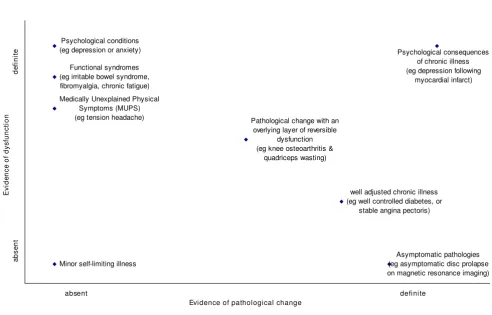
Evidence for links between body and mind continues to accumulate, vitiating the previously predominant Carte-sian dualistic model [22]. One consequence is the biopsy-chosocial model described above. We propose a further extension for the classification of unexplained symptoms and functional syndromes. Although it seems intuitive that illnesses may arise predominantly from the psyche or the soma, functional illness initiation and progression typically involves both domains. Our proposed classifica-tion thus includes orthogonal dimensions of pathology and dysfunction (Figure 1). For this purpose pathology is narrowly defined as pathological processes that cause gross or microscopic structural change in any of the body's tissues, including the brain, resulting in abnormality of function. Dysfunction, by contrast, is abnormal function-ing of the body, caused by, or manifested as disturbed physiological or psychological processes independent of known structural pathology.
Summary
The biological, psychological and social components of illness are seldom managed as an integrated whole in con-ventional medical practice. Traditional and complemen-tary medical systems appear better at integrating these three components. As an aid to integration, pathology characterised by structural change in tissues and organs is contrasted with dysfunction arising from disordered phys-iology or psychology.
Abbreviations
MUPS: Medically Unexplained Physical Symptoms; HIV: Human Immunodeficiency Virus; MRI: Magnetic Reso-nance Imaging; NICE: National Institute of Clinical Excel-lence.
Competing interests
The authors declare that they have no competing interests.
Authors' contributions
This debate paper arose from a series of discussions between NW and CW concerning the nature of dysfunc-tion in complementary medicine and its relevance to
pri-mary care, particularly in relation to medically unexplained symptoms and psychological disturbance. NW wrote an initial draft which was amended by CW and then passed on to NS and DM who made substantial con-tributions and changes.
Acknowledgements
We would like to acknowledge colleagues from the Department of Primary Care and Public Health, Cardiff University for their comments and sugges-tions on various drafts of this paper.
References
1. Kleinman A, Eisenberg L, Good B: Culture, illness and care. Clin-ical lessons from anthropologClin-ical and cross-cultural research. Ann Int Med 1978, 88:251-258.
2. Starfield B: Is primary care essential? Lancet 1994,
344:1129-1133.
3. Peveler R, Kilkenny L, Kinmouth A: Medically unexplained physi-cal symptoms in primary care: a comparison of self-report screening questionnaires and clinical opinion. J Psychosom Res 1997, 42:245-252.
4. Verhaak PFM, Meijer SA, Visser AP, Walters G: Persistent presen-tation of medically unexplained symptoms in general prac-tice. Fam Prac 2006, 23:414-420.
5. Rosendal M, Fink P, Falkoe E, Hansen HS, Olesen F: Improving the classification of medically unexplained symptoms in primary care. Eur J Psychiat 2007, 21:25-36.
[image:6.612.58.550.75.390.2]Hypothetical scatter plot of dysfunction versus pathology in primary care consultations
Figure 1
Hypothetical scatter plot of dysfunction versus pathology in primary care consultations. Dysfunction. abnormal functioning, either physiological or psychological, which is reversible and not dependent on pathological processes. Pathology: abnormal functioning caused by structural pathological change, either gross or microscopic.
Psychological conditions (eg depression or anxiety)
Functional syndromes (eg irritable bowel syndrome, fibromyalgia, chronic fatigue)
Medically Unexplained Physical Symptoms (MUPS) (eg tension headache)
Minor self-limiting illness
Pathological change with an overlying layer of reversible
dysfunction (eg knee osteoarthritis &
quadriceps wasting)
Psychological consequences of chronic illness (eg depression following
myocardial infarct)
well adjusted chronic illness (eg well controlled diabetes, or
stable angina pectoris)
Asymptomatic pathologies (eg asymptomatic disc prolapse on magnetic resonance imaging)
absent definite Evidence of pathological change
E
v
id
e
n
c
e
of
dy
s
fun
c
ti
on
a
b
s
e
n
t
d
e
fi
n
6. de Jonge P, Huyse FJ, Slaets JPJ, Sollner W, Stiefel FC: Operational-ization of biopsychosocial case complexity in general health care: the INTERMED project. Aust NZ J Psychiatry 2005,
39:795-799.
7. Feltz-Cornelis CM van der, van Oppen P, Ader HJ, van Dyck R: Ran-domised controlled trial of a collaborative care model with psychiatric consultation for persistent medically unex-plained symptoms in general practice. Psychother psychosom 2006, 75:282-289.
8. Fink P: Assessment and treatment of functional disorders in general practice: the extended reattribution and manage-ment model – an advanced educational program for nonpsy-chiatric doctors. Psychosomatics 2002, 43:93-131.
9. von Bertallanfy L: General systems theory New York: George Braziller; 1968.
10. McWhinney IR: A textbook of family medicine 2nd edition. New York: Oxford University Press; 1997.
11. Wroe M, Doney M: The rough guide to a better world London: Rough Guides Ltd; 2004.
12. Galin D: The structure of subjective experience: Sharpen the concepts and terminology. In Toward a science of consciousness: The first Tucson discussions and debates. Complex adaptive systems Edited by: Hameroff SRK, Alfred W, Scott AC. Cambridge MA US: MIT Press; 1996:121-140.
13. Chambers T: Theory and the organic bioethicist. Theoretical Med Bioethics 2001, 22:123-134.
14. Stott NCH, Davis RH: The exceptional potential in each pri-mary care consultation. J Roy Coll Gen Prac 1979, 29:201-205. 15. Report 27 – The nature of general medical practice London: RCGP; 1996. 16. Olesen F, Dickinson J, Hjortdahl P: General practice – time for a
new definition. BMJ 2000, 320:354-357.
17. Waddell G: A new clinical model for the treatment of low back pain. Spine 1987, 12:632-644.
18. Engel GL: The need for a new medical model: a challenge for biomedicine. Science 1977, 196:129-135.
19. Engel GL: The clinical application of the biopsychosocial model. Am J Psychiatry 1980, 137:535-543.
20. World Health Organisation: Constitution Geneva: WHO; 1946. 21. Seedhouse D: Liberating medicine Chichester: John Wiley & Sons;
1991.
22. Hungin P: The therapeutic illusion: self-limiting illness. In Oxford Textbook of Primary Medical Care 1st edition. Edited by: Jones R, Britten N, Culpepper L, Gass DA, Grol R, Mant D, Silagy C. Oxford: Oxford University Press; 2004:210-214.
23. Kroenke K, Mangelsdorff D: Common symptoms in ambulatory care: incidence, evaluation, therapy and outcome. Am J Med 1989, 86:262-266.
24. Crimlisk HL, Bhatia K, Cope H, David A, Marsden CD, Ron MA:
Slater revisited: 6 year follow-up study of patients with med-ically unexplained motor symptoms. BMJ 1998, 316:582-586. 25. Pennebaker JW: The psychology of physical symptoms New York:
Springer-Verlag; 1983.
26. Barsky AJMD, Borus JFMD: Functional Somatic Syndromes. Ann Intern Med 1999, 130:910-921.
27. Katon W, Sullivan M, Walker E: Medical symptoms without iden-tified pathology: Relationship to psychiatric disorders, child-hood and adult trauma, and personality traits. Ann Intern Med 2001, 134:917-925.
28. Frostholm L, Fink P, Christensen KS, Toft T, Oernboel E, Olesen F, Weinman J: The patients' illness perceptions and the use of primary health care. Psychosom Med 2005, 67:997-1005. 29. Burton C: Beyond somatisation: a review of the
understand-ing and treatment of medicaly unexplained physical symp-toms (MUPS). Br J Gen Prac 2003, 53:231-239.
30. Toft T, Fink P, Oernboel E, Christensen K, Frostholm L, Olesen F:
Mental disorders in primary care: prevalence and co-mor-bidity among disorders. Results from the functional illness in primary care (FIP) study. Psychol Med 2005, 35:1175-1184. 31. Aaron LA, Buchwald D: A review of the evidence for overlap
among unexplained clinical conditions. Ann Intern Med 2001,
134:868-881.
32. Jones R, Lydeard S: Irritable bowel syndrome in the general population. BMJ 1992, 304:87-90.
33. Wessely S, Nimnuan C, Sharpe M: Functional somatic syn-dromes; one or many? Lancet 1999, 354:936-939.
34. Fink P, Toft T, Hansen MS, Ornbol E, Olesen F: Symptoms and syn-dromes of bodily distress: an exploratory study of 978 inter-nal medical, neurological and primary care patients.
Psychosomatic Med 2007, 69:30-39.
35. Nimnuan C, Rabe-Hesketh S, Wessely S, Hotopf M: How many functional somatic syndromes? J Psychosom Res 2001,
51:549-557.
36. Kanaan RAA, Lepine JP, Wessely SC: The association or other-wise of the functional somatic syndromes. Psychosom Med 2007, 69:855-859.
37. Henningsen P, Zipfel S, Herzog W: Management of functional somatic syndromes. Lancet 2007, 369:946-955.
38. Fiscella K: Is lower income associated with greater biopsycho-social morbidity? Implications for physicians working with underserved patients. J Fam Pract 1999, 48:372-377.
39. Frasure-Smith N, LesPerance F, Telajic M: Depression following MI. JAMA 1993, 270:1819-1825.
40. Guck TP, Kavan MG, Elsasser GN, Barone EJ: Assessment and treatment of depression following myocardial infarction. Am Family Physician 2001, 64:641-648.
41. Irvine J, Basinski A, Baker B, Jandciu S, Paquette M, Cairns J, Connolly S, Roberts R, Gent M, Dorian P: Depression and risk of sudden cardiac death after acute myocardial infarction: testing for the confounding effects of fatigue. Psychosom Med 1999,
61:729-737.
42. Ziegelstein RC, Fauerbach JA, Stevens SS, Romanelli J, Richter DP, Bush DE: Patients with depression are less likely to follow rec-ommendations to reduce cardiac risk during recovery from a myocardial infarction. Arch Int Med 2000, 160:1818-1823. 43. Lane D, Carroll D, Ring C, Beevers DG, Lip GY: Mortality and
quality of life 12 months after myocardial infarction: effects of depression and anxiety. Psychosom Med 2001, 63:221-30. 44. Sloggett A, Joshi H: Higher mortality in deprived areas:
com-munity or personal disadvantage? BMJ 1994, 309:1470-1474. 45. Smith GD, Morris J: Income inequality and mortality: why are
they related? BMJ 1996, 312:987-988.
46. Kawachi I: Social capital and community effects on population and individual health. In Socioeconomic status and health in industrial nations: Social, psychological and biological pathways Edited by: Adler NE, Marmot M, McEwen BS, Stewart J. New York: New York Academy of Sciences; 1999:120-130.
47. Haleem S, Kaplan H, Pollack M: Moderating effects of gender and vulnerability on the relationships between financial hardship, low education and the immune response. Stress Med 2000,
16:167-177.
48. Garsson B, Goodkin K: On the role of immunological factors as mediators between psychosocial factors and cancer progres-sion. Psychiatry Research 1999, 85:51-61.
49. Leserman J: The Effects of Stressful Life Events, Coping, and Cortisol on HIV Infection. CNS Spectrums 2003, 8:25-30. 50. Sher L: The role of the immune system and infection in the
effects of psychological factors on the cardiovascular system.
Can J Psychiatry 1998, 43:954-955.
51. Zautra AJ, Hoffman JM, Matt KS, Yocum D, Potter PT, Castro WL, Roth S: An examination of individual differences in the rela-tionship between interpersonal stress and disease activity among women with rheumatoid arthritis. Arthritis Care Res 1998, 11:271-279.
52. Stott NCH: Primary health care; bridging the gap between theory and practice Berlin: Springer-Verlag; 1983.
53. Toon PD: Towards a philosophy of general practice: a study of the virtuous practitioner Occasional Paper 78: RCGP; 1999.
54. Zhukovsky DS: A model of palliative care: the palliative medi-cine program of the Cleveland Clinic Foundation. World Health Organisation Demonstrations Project 2000, 8:268-77.
55. Murray SA, Kendall M, Boyd K, Worth A, Benton TF: General prac-titioners and their possible role in providing spiritual care: a qualitative study. Brit J Gen Prac 2003, 53:957-959.
56. Spitzer RL, Williams JB, Kroenke KE, Linzer M, deGruy FV, Hahn SR, et al.: Utility of a new procedure for diagnosing mental disor-ders in primary care. The PRIME-MD 1000 study. JAMA 1994,
272:1749-1756.
Publish with BioMed Central and every scientist can read your work free of charge "BioMed Central will be the most significant development for disseminating the results of biomedical researc h in our lifetime."
Sir Paul Nurse, Cancer Research UK
Your research papers will be:
available free of charge to the entire biomedical community
peer reviewed and published immediately upon acceptance
cited in PubMed and archived on PubMed Central
yours — you keep the copyright
Submit your manuscript here:
http://www.biomedcentral.com/info/publishing_adv.asp
BioMedcentral
58. Goldberg DP, Bridges K: Somatic presentations of psychiatric illness in primary care setting. J Psychosom Res 1988, 32:137-144. 59. Bridges K, Goldberg D, Evans B, Sharpe T: Determinants of
soma-tization in primary care. Psychol Med 1991, 21:473-483. 60. Zimmerman C, Tansella M: Psychosocial factors and physical
ill-ness in primary care: promoting the biopsychosocial model in medical practice. J Psycosom Res 1996, 40:351-358.
61. Zantinge EM, Verhaak PFM, Kerssens JJ, Bensing JM: The workload of GPs: consultations of patients with psychological and somatic problems compared. Br J Gen Prac 2005, 55:604-614. 62. Kahneman D, Tversky A: On the reality of cognitive illusions.
Psych Review 1996, 103:582-591.
63. Fink P, Rosendal M, Olesen F: The classification of somatisation and functional somatic syndromes in primary care. Aust NZ J Psychiatry 2005, 39:772-781.
64. Van Tulder MW, Assendelft WJJ, Koes BW, Bouter LM: Spinal radi-ographic findings and non-specific low back pain. Spine 1997,
22:427-434.
65. Jarvik JG, Hollingworth W, Heagerty P, Haynor DR, Deyo RA: The longitudinal assessment of imaging and disability of the back (LAIDBack) study. Spine 2001, 26:1158-1166.
66. Mayou R, Sharpe M: Treating medically unexplained physical symptoms. BMJ 1997, 315:561-562.
67. Law GT, Wong CY, Chan YC, Shum TT, Lok PS, Wong KY: Cost-effectiveness of CT thorax and bronchoscopy in haemoptysis with normal CXR for exclusion of lung cancer. Australasian Radiology 2002, 46:381-383.
68. Kouyanou K, Pither CE, Wessely S: Iatrogenic factors and chronic pain. Psychosom Med 1997, 59:597-604.
69. Fink P: Surgery and medical treatment in persistent somatiz-ing patients. J Psychosom Res 1992, 36:439-447.
70. Healy D: Let them eat Prozac Toronto: James Lorimer; 2003. 71. Creed F, Ratcliffe J, Fernandez L, Tomenson B, Palmer S, Rigby C,
Guthrie E, Read N, Thompson D: Health-related quality of life and health care costs in severe, refractory irritable bowel syndrome. Ann Intern Med 2001, 134:860-868.
72. Fanuele JC, Birkmeyer NJO, Abdu WA, Toteson TD, Weinstein J:
The impact of spinal problems on the health status of patients: Have we underestimated the effect? Spine 2000,
25:1509-1514.
73. Pill R, Stott N: Concepts of illness causation and responsibility: some preliminary data from a sample of working class moth-ers. Soc Sci Med 1982, 16:43-52.
74. Smith RC: A clinical approach to the somatizing patient. J Fam-ily Prac 1985, 21:294-301.
75. Pridmore S, Skerritt P, Ahmadi J: Why do doctors dislike treating people with somatoform disorder? Australasian Psychiatry 2004,
12:134-138.
76. Chaudhuri A, Behan PO: Fatigue in neurological disorders. Lan-cet 2004, 364:978-988.
77. de Torrente de la Jara G, Pecoud A, Favrat B: Musculoskeletal pain in female asylum seekers and hypovitaminosis D3. BMJ 2004,
329:156-157.
78. Beutel ME, Stern E, Silbersweig DA: The emerging dialogue between psychoanalysis and neuroscience: neuroimaging perspectives. J Amer Psychoanalytic Assoc 2003, 51:773-801. 79. Sharpe M, Carson A: "Unexplained" somatic symptoms,
func-tional syndromes, and somatization: do we need a paradigm shift? Ann Intern Med 2001, 134:926-930.
80. Sollner W, Stix P, Stein B, Franz M, Lampe A, Herzog T: Quality cri-teria for psychosomatic consultation-liaison service. Wiener Medizinische Wochenschrift 2002, 152:528-534.
81. Kaptchuk TJ: Chinese medicine: the web that has no weaver London: Rider; 1983.
82. Chopra A, Doiphode W: Ayurvedic medicine. Core concept, therapeutic principles, and current relevance. Med Clin North Am 2002, 86:75-89.
83. Greenman PE: Principles of manual medicine 2nd edition. Baltimore MA: Williams and Wilkins; 1996.
84. Lewit K: Manipulative therapy in rehabilitation of the locomotor system 2nd edition. Oxford: Butterworth-Heinmann; 1991.
85. Diehl DJ, Gershon S: The role of dopamine in mood disorders.
Comprehensive Psychiatry 1992, 33:115-120.
86. Yatham LN, Liddle PF, Shiah IS, Lam RW, Ngan E, Scarrow G, Imperial M, Stoessl J, Sossi V, Ruth TJ: PET study of [18F] 6-fluoro-L-dopa
uptake in neuroleptic and mood-stabilizer-naiive
first-epi-sode nonpsychotic mania: Effects of treatment with dival-proex sodium. Amer J Psychiatry 2002, 159:768-774.
87. Haroutunian V, Davis KL: Introduction to the Special Section: myelin and oligodendrocyte abnormalities in schizophrenia.
Int J Neuropsychopharm 2007, 10:499-502.
88. Palsson S, Aevarsson O, Skoog I: Depression, cerebral atrophy, cognitive performance and incidence of dementia. Popula-tion study of 85-year-olds. Brit J Psychiatry 1999, 174:249-253. 89. Lloyd AJ, Grace JB, Jaros E, Perry RH, Fairbairn AF, Swann AG,
O'Brien JT, McKeith IG: Depression in late life, cognitive decline and white matter pathology in two clinico-pathologically investigated cases. Int J Geriatric Psychiatry 2001, 16:281-287. 90. Thomas KB: General practice consultations: is there any point
in being positive? BMJ 1987, 294:1200-1202.
91. Dowrick C, Katona C, Peveler R, Lloyd H: Somatic symptoms and depression: diagnostic confusion and clinical neglect. Br J Gen Prac 2005, 55:829-830.
92. Turnbull N, Shaw EJ, Baker R, Dunsdon S, Costin N, Britton G, Kuntze S, Norma R: Chronic fatigue syndrome/myalgic encephalomyelitis (or encephalopathy): diagnosis and management of chronic fatigue syn-drome/myalgic encephalomyelitis (or encephalopathy) in adults and chil-dren London: Royal College of General Practitioners; 2007.
Pre-publication history
The pre-publication history for this paper can be accessed here: