This is a repository copy of Monopole black hole skyrmions. White Rose Research Online URL for this paper:
http://eprints.whiterose.ac.uk/102584/ Version: Submitted Version
Article:
Moss, I.G., Shiiki, N. and Winstanley, E. orcid.org/0000-0001-8964-8142 (2000) Monopole black hole skyrmions. Classical and Quantum Gravity, 17 (20). pp. 4161-4174. ISSN 0264-9381
https://doi.org/10.1088/0264-9381/17/20/301
Moss, I.G., Shiiki, N. and Winstanley E. (2000) Monopole Black Hole Skyrmions. Class.Quant.Grav.17:4161-4174 DOI: 10.1088/0264-9381/17/20/301
[email protected] https://eprints.whiterose.ac.uk/ Reuse
Unless indicated otherwise, fulltext items are protected by copyright with all rights reserved. The copyright exception in section 29 of the Copyright, Designs and Patents Act 1988 allows the making of a single copy solely for the purpose of non-commercial research or private study within the limits of fair dealing. The publisher or other rights-holder may allow further reproduction and re-use of this version - refer to the White Rose Research Online record for this item. Where records identify the publisher as the copyright holder, users can verify any specific terms of use on the publisher’s website.
Takedown
If you consider content in White Rose Research Online to be in breach of UK law, please notify us by
arXiv:gr-qc/0005007v1 2 May 2000
Monopole Black Hole Skyrmions
I. G. Moss1∗ ,N. Shiiki1 † and E. Winstanley1,2‡
1. Department of Physics, University of Newcastle Upon Tyne, NE1 7RU U.K. 2.Department of Physics (Theoretical Physics), 1 Keble Road, Oxford, OX1 3NP U.K.
(May 2000)
Abstract
Charged black hole solutions with pion hair are discussed. These can be used to study monopole black hole catalysis of proton decay. There also exist multi-black hole skyrmion solutions with BPS monopole behaviour.
Pacs numbers: 0470D, 0420J, 1239D
Typeset using REVTEX
∗email: [email protected]
†email:
I. INTRODUCTION
It is known that baryons can emerge as solitons in an effective meson field theory. In these models the baryon number is identified with a topological charge. Since this identification was originally made by T.H.R.Skyrme 40 years ago [2], the soliton solution is called the skyrmion.
Skyrmion models provide a useful way of analysing the monopole catalysis of proton decay, as originally pointed out by Callan and Witten [3]. The decay process can be allowed because, in the presence of a monopole, the baryon number is no longer equal to the topo-logical charge of the meson field. In fact, there exist non-topotopo-logical solitons with non-zero baryon number which can decay without topological problems.
Skyrmions have also been used to examine the absorbtion of baryons by microscopic black holes [4–6]. Solutions representing skyrmions partially absorbed by Schwarzschild black holes provide a semiclassical framework to study the absorption rate of a proton by a black hole of comparable size. However, this process is rather insignificant because black holes of the size of a proton have large fluxes of Hawking radiation which swamp the proton decay.
In this paper we analyse black hole solutions with skyrmion hair and magnetic charge, providing the semiclassical framework in which to study monopole black hole catalysis of proton decay. The flux of Hawking radiation from these holes is less than ordinary holes and even vanishes in extremal cases [7]. The black hole mass for abelian monopoles has the lower bound
M = √p
G =pmpl ≈2.54×10
−7Kg , (1)
where e is a rationalised electric charge in gaussian units determined from the Dirac quan-tisation condition (ep= 1) as p≈ 11.7 and mpl is the planck mass which is approximately
2.1768×10⁻⁸Kg. This kind of small black hole may be considered to have been created in
the early universe and remain as a stable relic today. More complicated monopole solutions are also possible in Grand Unified Theories, depending on the details of the Higgs sector [8], but we will restrict attention to the simplest case.
In the extreme case, M =pmpl, we find the remarkable situation that multiple black hole
solutions are possible in which the gravitational, electromagnetic, and strong forces between the monopoles are all in balance. In this respect the solitons behave in an analagous way to BPS monopole solutions in the Yang-Mills-Higgs system [9].
We find that the non-topological skyrmion solutions are stable within the confines of our model. This is, in part, due to the fact that we have not included the electron. The black hole cannot swallow the proton whole because this would tip it over the extremal limit. Light, charged particles are therefore needed to carry away the proton’s charge when it decays. We discuss a way of including this effect in the conclusion.
II. THE LAGRANGIAN
some of the terms in the Lagrangian which couple the chiral field to electromagnetism can be deduced from current algebra techniques and were constructed by Callan and Witten [3].
The Lagrangian can be divided into into four parts,
L=L1+L2+L3+L4 (2)
where the meson parts are
L1 =
F2 π
16tr
U−1D
µUU−1DµU
+ 1 32a2tr
[U−1D
µU, U−1DµU]
L2 =
e 16π2ǫ
µνρσA µtr
n
Q∂νUU−1∂ρUU−1∂σUU−1+U−1∂νUU−1∂ρUU−1∂σU
o
+ ie
2
8π2ǫ µνρσ(∂
µAν)Aρtr
Q2∂σUU−1+Q2U−1∂σU +
1
2Q∂σUQU −1
− 1
2QUQ∂σU −1
and the free actions are
L3 =−
1 16πFµνF
µν,
L4 =
1
16πGR. (3)
The quantity Q is the charge matrix of quarks and D is a covariant derivative defined by
Q=
2
3 0
0 −13
!
(4)
DµU =∂µU −ieAµ[Q, U]. (5)
The abelian gauge fieldAµ and electric charge e are in unrationalised units, and ¯h=c= 1.
In the spherically symmetric case with a magnetic charge the gauge field has the form
A=p(1−cosθ)dφ+ Φdt (6) where p is a magnetic charge and the Dirac quantisation condition is pe = 1. The usual Skyrmion has a magnetic moment which would interact with a magnetic monopole and break the spherical symmetry. We use instead a non-topological ansatz for the chiral field,
U =eif(r,t)σ3
. (7)
Despite the fact that this field is made up of neutral pions and commutes with the charge matrixQ, it has a non-zero total electric and baryonic charge due to the effects of anomalies, as we shall see in the next section.
III. BARYON NUMBER AND ELECTRIC CHARGE
The gauge invariant baryon current was constructed by Callan and Witten
jBµ = ǫ
µναβ
48π2
h
trU−1∂
νUU−1∂αUU−1∂βU (8)
+3ieAνtrQ(U−1∂αUU−1∂βU −∂αUU−1∂βUU−1) (9)
+3ie∂νAαtrQ(U−1∂βU +∂βUU−1)
i
Only the third term survives for the chiral field anzatz (7), with a resulting baryon charge
nB =
ep
2π [f(∞)−f(0)] . (11)
The solution with the boundary conditions f(0) = 0 and f(∞) = 2π posesses unit baryon number and hence it can be interpreted as a baryon surrounding the monopole.
If the field anzatz (7) is substituted into the meson and electromagnetic interaction terms in the Lagrangian, they become
L1 =−
Fπ2
8 (∂f)
2, (12)
L2 =−
e2
8π2EiB
if, (13)
L3 =
1 8π
E2−B2, (14)
where the index i = 1,2,3 and the electromagnetic fields Ei and Bi are defined by F0i =
(−gtt)1/2Ei and Fij =ǫijkBk. When combined,
L2+L3 =
1
8π E − e2
2πBf
!2
− 1
8πB
2
1− e
4
4π2f 2
!
(15)
The extrema of the action occur when the electric field is given by
E = e
2
2πBf (16)
This situation is reminisent of the factorisation of the Lagrangian that occurs for a BPS monopole [9].
The electric field implies a total charge
q= e
2p
2πf (17)
or asymptotically
q∞=nBe (18)
and thenB = 1 solution can therefore be interpreted as a proton.
If a black hole appears in the background, the inner boundary condition for the field f should be imposed not at the origin but at the event horizon r = r+. Thus the baryon
number in the presence of an event horizon will be defined as
nB =
ep
2π [f(∞)−f(r+)] . (19) If f(r+) = 0 the baryon number is still an integer and conserved. This configuration
baryon number and electric charge. This configuration will be interpreted as a proton par-tially swallowed by the black hole. In particular, f(r+) = 2π means that the black hole has
swallowed a whole proton leaving nothing outside the horizon.
It is interesting to observe that, while the baryon number disappears inside the horizon, the electric charge of the black hole can still be measured outside, turning the monopole black hole into a dyon black hole. Therefore, while the baryon number conservation is violated, charge conservation is not violated.
IV. EXTREMAL BLACK HOLE SOLUTIONS
In the extremal case we can obtain a general solution based on the Papapetrou-Majumbar metrics [10,11]. We begin with the background metric fixed and later generalise to solve the full Einstein equations with chiral matter. The Papapetrou Majumbar metrics have the form
ds2 =−U−2dt2+U2(dx2+dy2+dz2) (20)
where
U = 1 +
nM
X
n=1
GMn
Rn
(21)
and Rn is the ordinary Euclidean distance from the point massMn located in three
dimen-sional space. We also associate these point masses with magnetic charges Pn = G1/2Mn,
and the magnetic field
B =G−1/2U−1∂U. (22)
The matter lagrangian obtained earlier (12) has the form
L=−1
8F
2
π(∂f)2−
1 8πB
2
1 +α2f2 (23)
where we will set
α = e
2
2π, µ
2 =πGF2
π (24)
The skyrme field equation obtained from the Lagrangian on this background becomes
−µ2∂2f +α2U−2(∂U)2f = 0 (25)
We loose no generality by taking equal charges Pn =p. The solution with baryon number
nB =nM is then
f = 2πU−s (26)
s=−1 2 +
s
1 4 +
α2
µ2 (27)
Since Fπ ≪mpl, we can use s≈α/µ for the pion model.
For a single black hole, the Reissner-Nordstrom coordinateris related toRbyR =r−r+
and we obtain
f = 2π
1− r+ r
s
. (28)
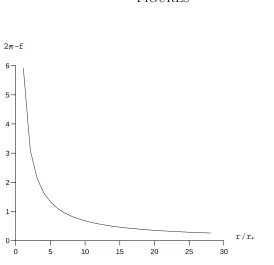
The field is effectively expelled by the black hole and vanishes on the horizon r=r+.
The mass of the chiral field configuration can be obtained by integrating the Lagrangian (23),
mf =
1 8F
2 π
Z
Σf ∂if dS
i (29)
where Σ is a large surface containing all of the masses. This gives
mf = 2π3sFπ2G
X
n
Mn≈π3/2nBeFπ (30)
The total mass in the chiral field is much less than one baryon mass per mass point. We can see how it is energetically favourable for a free skyrmion to change its internal configuration from the original Skyrme form to the simpler form used here when it comes into contact with a black hole monopole. The topological description of this transformation for a single monopole is exactly as described in reference [3].
It is interesting to see that the electrostatic energy cancells due to the factorisation occuring in the lagrangian (15). The chiral field mass is independent of the separation of the holes and therefore there are no forces between then. This is similar to situation for BPS monopole solutions [9], and suggests that there is a solution of the full Einstein-matter system. This existence of this solution will now be demonstrated.
The spatial part of the Einstein tensor for the matric (20) is
Gij =−2U−2(∂iU)(∂jU) +U−2(∂U)2gij (31)
and the Ricci scalar is
R =−2U−1∂2U (32)
Substituting the Einstein tensor for the Lagrangian (23) into the Einstein equations gives
U−1∂2U =−µ2(∂f)2 (33)
U−2(∂iU)(∂jU) =−µ2(∂if)(∂jf) +GBiBj(1 +α2f2) (34)
These make up a complete system of equations when we include the Maxwell equation
∂(UB) = 0 (35)
u=−µ−1logU (36) The system of equations becomes equivalent to an ordinary differential equation with inde-pendent parameter u,
f′′+µ
1 +f′2
f′
−α2b2f = 0 (37)
where
b2 = 1 +f ′2
1 +α2f2. (38)
The horizon corresponds to u → −∞ and the far region to u → 0. The horizon must therefore be at a critical point of the first order system corresponding to (37). There is only one critical point, (f, f′) = (0,0), hence
(f, f′)
→(0,0) as u→ −∞. (39) Since the critical point is a saddle, the solution is unique and exists for all values of µ. Having obtained the unique solution to (37), we then define
V(u) = 1 +µ
Z 0
u b(x)e
−µxdx. (40)
It is easily seen from (36) that
∂iV =V′∂iu=UB (41)
Hence the Maxwell equation implies ∂2V = 0 and we can write
V = 1 +X
n
GMn
Rn
(42)
Inverting (40) gives u(V).
V. SPHERICALLY SYMMETRIC SOLUTIONS
In the non-extremal case we shall consider spherically symmetric metrics which can be parameterised in the form
ds2 =−∆ r2e
2δdt2+r2
∆dr
2+r2dΩ2 (43)
where ∆ andδare functions ofrandt. After inserting the metric and the other field ansatz¨e (6)-(7) into the Einstein field equations, one obtains
∆eδf′′
−λ
2
r2e δf =
−2r
4
∆3e
−δ∆ ˙˙f
−r
4
∆e
−δδ˙f˙+ r4
∆2e
−δf¨ (44)
δ′ =µ2r r4
∆e
−2δf˙2+f′2
!
(45)
e−δ ∆e
δ
r
!′
= 1−µ
2λ2
r2 f 2
−Gp
2
where µand λ are constants,
µ2 =πFπ2G, λ2 = e
4p2
4π3F2 π
(47)
The electric charge within a sphere of radiusr is given by equation (17).
For very small µ, which is the case for pions, the chiral field has little effect on the background metric and we may take δ = 0 and express ∆ in terms of the mass M, electric charge Q and magnetic chargep of the black hole as
∆ =r2−2GMr+G(Q2+p2). (48)
The skyrme field equation (44) on this background is therefore
(∆f′)′
− λ
2
r2f = 0, (49)
This should be solved subject to the boundary condition onf∞ which fixes the total charge,
q∞= e
2p
2πf∞=nBe. (50)
The non-extremal black hole posseses two horizons at r=r− and r=r+ (r+> r−), related
to the mass and charge by
GM = 1
2(r−+r+), GQ
2 =r−r
+−Gp2. (51)
The solution to equation (49) can be obtained analytically,
f = 2πnB
Pq
r
++r− r+−r− −
2r+r− r+−r−
1 r
Ps
r
++r− r+−r−
(52)
where Ps(z) is a Legendre function and
s =−1
2 +
s
1 4 +
λ2
r+r−
(53)
The black hole becomes a dyon with electric charge related to the value of f at the event horizon,
Q= nBe Ps
r
++r− r+−r−
. (54)
This relation can be solved, together with (51), to obtainQ≡Q(M), showing the existence of a one parameter family of solutions (nB and p being regarded as fixed). In particular,
Q → 0 as M approaches the extremal limit pmpl and the meson field is expelled from the
Larger values of µ may be realised for a hypothetical model where U is unrelated to pions and this is discussed below. We will consider a static solution. We can replace ∆ by a mass function m(r), defined implicitly by the relation
∆ =r2
−2Gmr+G(p2+q2) (55)
where the charge is given by equation (17). The equations become
m′ = ∆ 2Grδ
′+µ2λ2f f′ (56)
δ′ =µ2r(f′)2 (57)
f′′+ ∆′ ∆ +δ
′
!
f′
− λ
2
r2∆f = 0 (58)
Suitable boundary conditions are f →2π and δ →0 as r→ ∞. In the numerical results the fields are scaled to the horizon size,
ˆ r= r
r+
, mˆ = Gm r+
(59)
The solutions are parameterised by a parameter ˆp, defined by
ˆ
p2 = Gp
2
r2 +
(60)
which is restricted to ˆp≤1.
The extremal black hole solutions have ∆+= ∆′+= 0. The regular solution to equation
(58) has,
f+= 0, Q=
e
2πf+ = 0, pˆ= 1. (61)
FIGURES
0 5 10 15 20 25 30 0
1 2 3 4 5 6
r/r+
2 -f
FIG. 1. Skyrme field f as a function of ˆr =r/r+ for an extremal hole andµ= 10−4.
For the non-extremal solution, we begin the integration of the field equations close to the horizon, with
ˆ
m= ˆm0+ ˆm1(ˆr−1) + ˆm2(ˆr−1)2+· · · (62)
δ=δ++δ1(ˆr−1) +· · · (63)
f =f++f1(ˆr−1) +· · · (64)
whereδ+andf+are shooting parameters determined so as to satisfy the boundary conditions
at infinity.
As can be seen from the above expansion, the skyrme field must have a nonzero value at the horizon otherwise the only allowed solution is the trivial one. Consequently the nonextremal black hole acquires an electric charge
Q= e
2πf+, (65)
0 5 10 15 20 25 30
-2.5 -2.0 -1.5 -1.0 -0.5
[image:12.612.140.442.83.308.2]0.0 r/r+
FIG. 2. Backreaction δ (×103) as a function of ˆr = r/r+ for a non-extremal black hole,
ˆ
p=pmpl/r+ = 0.9. Results for µ= 10−3 andµ= 10−4 are shown.
0 5 10 15 20 25 30 0.0
0.2 0.4 0.6 0.8 1.0
r m
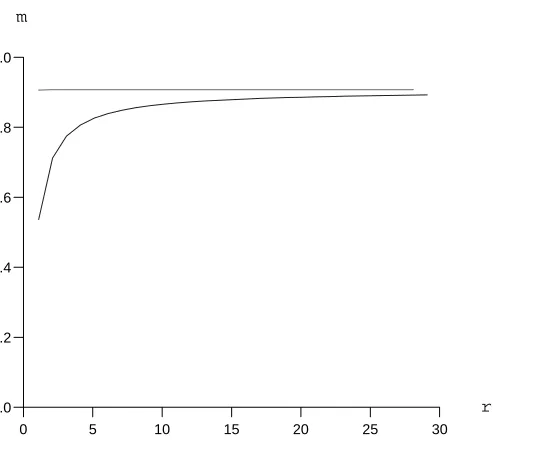
FIG. 3. Mass functionm as a function of ˆr for ˆp= 0.9. Results forµ= 10−3 and µ= 10−4 are
shown
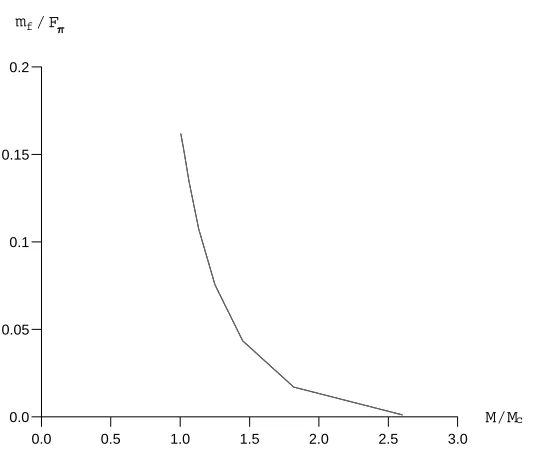
We have a single one parameter family of solutions with ˆp≤1. In fig.(4)-(5), we plot the horizon radius r+ and skyrmion mass mf as functions of black hole mass M. Figure (4) is
related to the entropy of the black hole (4πr2
+). The other figure shows how the proportion
[image:12.612.146.425.396.623.2]0.0 0.5 1.0 1.5 2.0 2.5 3.0 0
1 2 3 4 5
[image:13.612.145.397.87.322.2]M/Mc rh/Mc
FIG. 4. Horizon radiusr+/Mc as a function of the black hole massM/Mc forµ= 10−4.
0.0 0.5 1.0 1.5 2.0 2.5 3.0 0.0
0.05 0.1 0.15 0.2
M/Mc /
mf F
FIG. 5. Skyrmion massmf as a function of the black hole massM/Mc forµ= 10−4.
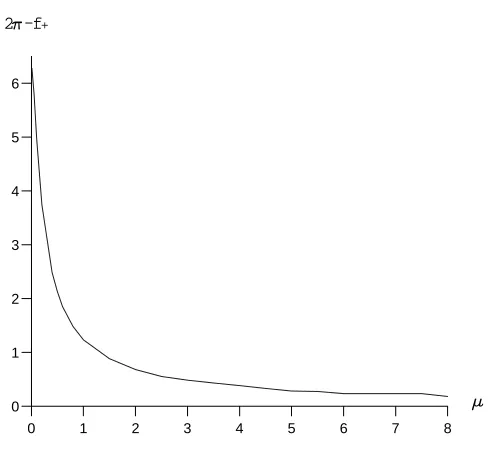
[image:13.612.137.406.394.628.2]extent. On the other hand for largeµthe gravitational interaction is dominant so that most of the skyrmion is absorbed by the black hole.
0 1 2 3 4 5 6 7 8 0
1 2 3 4 5 6
[image:14.612.142.394.134.365.2]2 -f+
FIG. 6. The value of f at the horizon for various values of µ.
VI. STABILITY ANALYSIS
In this section we show that the skyrmion solutions which we have obtained are stable under spherically symmetric linear perturbations. We shall begin with the analysis of a skyrmion on the fixed background.
In the fixed background case the skyrme field is the only perturbed field and can be expanded about the skyrmion solution f0 by writing
f(r, t) =f0(r) +eiωtξ(r). (66)
Equation (66) is inserted into equation (49) to obtain the eigenvalue equation
−(∆0ξ′)′+
λ2
r2ξ =
r4
∆0
ω2ξ, (67)
where the background equation has been used.
If ω is real and ω2 > 0 the solution is stable, and if ω is imaginary and ω2 < 0 it is unstable since the mode can grow or decay exponentially under the small perturbation. To show which is the case we multiply both sides of equation (67) by ξ and integrate in r from the horizon to infinity
Z ∞
r+
"
∆0
2 ξ
′2+ λ2
r2ξ 2
#
dr=ω2
Z ∞
r+ r4
∆0
where integration by parts and boundary conditions have been used. It can be seen that the integrands of both sides are positive definite, which means thatω2 >0. Hence the skyrmion
on the fixed background is linearly stable .
Next we analyse the stability of the skyrmion with backreaction. In this case we have to expand the metric as well as the skyrme field around the classical solutions f0, δ0 and ∆0
f(r, t) =f0(r) +f1(r, t)
δ(r, t) =δ0+δ1(r, t)
∆(r, t) = ∆0+ ∆1(r, t).
These are substituted into eq.(44)-(46) to obtain the following coupled equations up to first order
h
(∆0δ1f0′ + ∆0f1′ + ∆1f0′)eδ0
i′
− λ
2
r2 (δ1f0 +f1)e δ0 = r
4
∆0
e−δ0f¨
1 (69)
δ′
1 = 2µ2rf0′f1′ (70)
2µ2λ2
r2 f0f1+
∆0
r δ ′
1
!
eδ0 =− ∆ 1 r e δ0 ′ . (71)
Equation (71) can be integrated with the help of the static field equation,
∆1 =−2µ2r∆0f0′f1 . (72)
Substituting equation (70) and equation (72) into equation (69) one obtains the first order equation forf1
∆0eδ0f1′
′
−
"
2µ2r∆0eδ0f0′2
′
+λ
2(M c)2
r2 e δ0
#
f1 =
r4
∆0
e−δ0f¨
1 . (73)
Settingf1(r, t) =ξ(r)eiωt one obtains an eigenvalue equationforξ,
−∆0eδ0ξ′
′
+
"
2µ2r∆0eδ0f0′2
′
+λ
2(M c)2
r2 e δ0
#
ξ =ω2 r
4
∆0
e−δ0
ξ . (74)
We introduce the tortoise coordinater∗ such that
dr∗ dr =
1 ∆0eδ0
(75)
and r∗ runs from
−∞ to +∞ as r runs from r+ to +∞. Then eq.(74) is reduced to the
Sturm-Liouville equation
− d
2ξ
dr∗2 +Uξ =ω
2r4ξ, (76)
where
U =
"
2µ2r∆0eδ0f0′2
′
+λ
2
r2e δ0
#
On the left-hand side we have r4, which makes the equation different from the previous
eigenvalue equation. However, since r4 remains positive through the whole space, the same
conditions for stability as the ordinary eigenvalue equation can be applied. As can be seen by examining U, U → 0 as r → r+, (i.e. r∗ → −∞), U → U∞ > 0 as r → ∞, and U > 0
in between. In addition the solution does not change its shape for any value of the coupling constant µ. Therefore we can safely conclude that a skyrmion with backreaction is also linearly stable.
VII. CONCLUSION
We are now able to describe some of the features of the interaction between a slowly moving proton and a black hole monopole. The free skyrmion has a magnetic moment and, if it has the correct orientation, it will be attracted to the monopole. When the proton approaches the black hole monopole, the fields rearrange themselves into the energetically prefered configuration of skyrmion hair solution described in this paper.
The skyrmion solution on the fixed black hole background was obtained analytically in both extremal and nonextremal cases. In the extremal case, the baryon number and electric charge are expelled by the horizon and the system represents protons bound to monopole black holes. We found a general solution on the Eintein equations in the extremal case with many similarities to the BPS monopole system.
In the nonextremal case, the monopole black hole partially swallows the proton and transforms to a dyon black hole, leaving fractional electric charge and baryon number outside the horizon. However, Hawking radiation cannot be ignored in this case.
We have also obtained numerical skyrmion solutions in the nonextremal case with grav-itational backreaction. The effect of the backreaction is important only for very massive skyrmions i.e. very large coupling constant. The results are qualitatively similar to the solutions without backreaction.
Since the solutions are stable, baryon decay can only take place when extra particle fields are included in the model. If we introduce a charged field φ on the fixed background, then following the proceedure described in reference [3], the equations become (approximately)
(∆f′)′
− λ
2
r2(f −φ) =−
r4
∆f ,¨ (78)
(∆φ′)′+λ
2
r2(f −φ) =−
r4
∆φ,¨ (79)
The stability arguments no longer apply. The dynamical process of a black hole swallowing a proton can be examined by solving these time-dependent field equations numerically.
ACKNOWLEDGMENTS
REFERENCES
[1] Witten E, Nucl.Phys. B223 (1983) 433
[2] Skyrme T H R, Proc.Roy.Soc. A260(1961) 127
[3] Callan C G, Jr. and Witten E,Nucl.Phys. B239 (1984) 161 [4] Luckock H and Moss I G,Phys.Lett. B176 (1986) 341
[5] “Black Hole Skyrmions” Luckock H, String Theory, Quantum Cosmology etc. Eds. H. J. de Vega and N Sanchez (World Scientific, 1987)
[6] Droz S, Heusler M and Straumann N,Phys. Lett.B268(1991) 371; Bizon P and Chmaj T, Phys. Lett. B297(1992) 55
[7] Gibbons G W, Commun. Math. Phys. 44 (1975) 245
[8] Lee K, Nair V P and Weinberg E J,Phys. Rev. Lett. 68 (1992) 1100; Lee K, Nair V P and Weinberg E J, Phys. Rev.D45(1992) 2751; Breitenlohner P, Forgacs P and Maison D, Nucl. Phys. B383(1992) 357
[9] Bogomol’nyi E B,Sov. J. Phys. 24 (1977) 97 [10] Majumbar S DPhys. Rev. 72 (1947) 390