153
Classification of Tweets about Reported Events
using Neural Networks
Kiminobu Makino, Yuka Takei, Taro Miyazaki, Jun Goto
NHK Science & Technology Research Laboratories 1-10-11 Kinuta, Setagaya-ku, Tokyo, Japan
{makino.k-gg, takei.y-ek, miyazaki.t-jw, goto.j-fw}@nhk.or.jp
Abstract
We developed a system that automatically ex-tracts “Event-describing Tweets” which in-clude incidents or accidents information for
creating news reports. Event-describing
Tweets can be classified into “Reported-event Tweets” and “New-information Tweets.” Reported-event Tweets cite news agencies or user generated content sites, and New-information Tweets are other Event-describing Tweets. A system is needed to classify them so that creators of factual TV programs can use them in their productions. Proposing this Tweet classification task is one of the contri-butions of this paper, because no prior papers have used the same task even though program creators and other events information collec-tors have to do it to extract required
informa-tion from social networking sites. To
clas-sify Tweets in this task, this paper proposes a method to input and concatenate character and word sequences in Japanese Tweets by using convolutional neural networks. This proposed method is another contribution of this paper. For comparison, character or word input meth-ods and other neural networks are also used. Results show that a system using the proposed method and architectures can classify Tweets with an F1 score of 88 %.
1 Introduction
Many companies including news agencies have increasingly been extracting news information from postings on Social Networking Sites (SNSs) such as Twitter and Facebook and using it for various purposes (Neubig et al., 2011; Iso et al., 2016). However, choosing important information for news reports from Twitter is very tough, be-cause Twitter contains a vast amount of posts. For this reason, many researchers have stud-ied how to extract important posts for each purpose (Papadopoulos et al., 2014; Litvak et al.,
2016; Zhou et al., 2016; Vakulenko et al., 2017). A system using Neural Networks (NNs) has been developed by using models that are trained by ex-tracting Tweets in factual TV program produc-tion, and these systems extract “Event-describing
Tweets (EVENT)” which include incidents or
ac-cidents information for news reports from a large amount of Tweets (Miyazaki et al., 2017). How-ever, there are many Tweets, so there can be many
extracted Tweets which include EVENT for news
reports about any event. Hence, people have
diffi-culty monitoring all EVENT. In addition, EVENT
are used differently in different types of programs. For these purposes, it is better to display only Tweets suitable to the program contents.
For example, program creators who want to ob-tain primary reports of an event posted by Twitter users do not require Tweets put out by news agen-cies and User Generated Content (UGC) sites or Tweets that quote or cite them. The part of new information of these Tweets is able to be gotten by crawling each site, so no longer these Tweets do not include new events information for pro-gram creators. We call these Tweets “I:
Reported-event Tweets (REPORTED)” and others “II:
New-information Tweets (NEW).” Both types of Tweets
are requested for different reasons. Only types of Tweets suitable to creators’ purpose need to be
displayed, but extracting EVENT and classifying
them are essentially different processes.
For these reasons, this paper uses a two-stage
processing system that separates EVENT from a
large amount of Tweets by using an existing
sys-tem and classifies them into REPORTEDand NEW
(Sec-tion 5). Evalua(Sec-tion results show that the proposed method outperformed the conventional methods in all NN architectures (Section 6).
This paper makes two contributions. One is proposing a new task for classifying extracted
EVENT into two classes: REPORTED and NEW.
TV program creators need to do this task for pro-gram production automatically and do it first to track reports about an event. However, there have been no prior studies about this task. The other is proposing a new method for NN architectures that inputs entire character sequences and entire word sequences in parallel and concatenates them in the intermediate layer and evaluating its performance. This method can utilize the advantages of charac-ter sequences (i.e., there are fewer unknown char-acters than unknown words and it does not need morphological analyzers even when in Japanese which is very difficult to divide words especially for noisy texts) and word sequences (i.e., words are more effective than characters for the task). The method can be used for any other tasks that need to both character and word sequences.
2 Related Work
There are many related works such as related tasks that use Twitter datasets or classify texts and re-lated methods that have NNs architectures using both characters and words in Natural Language Processing (NLP).
Related tasksinclude topic detection on
Twit-ter task (Papadopoulos et al., 2014; Litvak et al., 2016; Zhou et al., 2016; Vakulenko et al., 2017), binary classification of Tweets (Rosenthal et al., 2017), classification of news related or
po-litical stance Tweets (Ghelani et al., 2017;
Johnson and Goldwasser, 2016; Volkova et al.,
2017), classification of news related
arti-cles (Ribeiro et al., 2017), and other classifica-tions in NLP. Binary classification of texts and classification of news related texts and articles are most closely related to this task. However, none of these studies focused on classifying
extracted EVENT into REPORTEDor NEW. Since
no classification method meets the requirements
of this paper (i.e., extraction of REPORTED to
obtain primary reports and extraction of NEW to
collect opinions about reported events or gather follow-up Tweets), no prior research on the same task exists.
For related methods, in NLP using
ma-All Tweets
Ⅰ: REPORTED Ⅱ: NEW
non-EVENT EVENT
Ⅰ-①: with explicit sources Ⅰ-②: without explicit sources
Extraction
[image:2.595.323.513.66.150.2]Classification
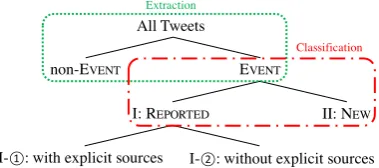
Figure 1: Overview of our Tweets classification.
chine learning, there is one NLP
config-uration that uses a word sequence as in-put and characters as supplemental informa-tion (Ma and Hovy, 2016; Gr¨onroos et al., 2017; Heyman et al., 2017; Lin et al., 2017) and another that switches between the character NN and the word NN (Vijayaraghavan et al., 2016). However, the character sequence is one semantic vector set for the entire sequence. There is one NLP con-figuration that uses gated recurrent units for a word sequence and for CNN output of a charac-ter sequence(Liang et al., 2017). However, it does not purely combine characters and words in paral-lel and takes time to process because it includes re-current architectures and is not for noisy texts. No method combining the output of an entire purely character sequence and an entire purely word se-quence in parallel with a CNN for noisy texts has been studied and evaluated to the best of the au-thors’ knowledge.
3 Task Description
The purpose of our system is classification of
Tweets for different types of programs.
Fig-ure 1 shows the overview of our Tweets
clas-sification. Extracting EVENT is not a novel
task (Miyazaki et al., 2017), so the proposed task
in this paper is classifying EVENTinto REPORTED
and NEW.
3.1 Classification of REPORTEDand NEW
REPORTED are less numerous than NEW. This
is because NEWinclude information about events
I-⃝1 REPORTEDwith explicit sources EVENTthat are tweeted from or quote news agencies, UGC sites, e.g. or others andincludeexplicit sources
“Small plane crash. Four people dead on impact. — XXX news I wonder if the plane broke down from the nose.” I-⃝2 REPORTEDwithout explicit sources EVENTthat are tweeted from or quote news agencies, UGC sites, e.g. or others anddo not includeexplicit sources
“Small plane crash. Four people dead on impact. I wonder if the plane broke down from the nose.”
[image:3.595.312.530.179.270.2]II NEW Any other EVENT
Table 1: Types of EVENT(example is manually translated by author).
and NEW will be hard to monitor and gather in
real-time. Similarly, creators who want to collect opinions about reported events or gather follow-up
Tweets will not need NEW, which are the
major-ity of EVENT. Therefore, depending on the
cre-ator’s intention, either NEWor REPORTEDshould
be displayed in real-time. For these reasons, a classification task is needed.
3.2 Two Types of REPORTED
There are two types of REPORTED. One is RE
-PORTED with explicit sources (I-⃝1 ), which cite
news agencies, UGC sites, or other information dissemination agencies, so Tweet-classification systems are expected to easily detect these Tweets
by keyword filtering using source names. The
other is REPORTED without explicit sources
(I-2
⃝), which do not cite explicit sources because
Twitter users can remove source names. They
have a distinctive stylistic character (in Japanese, they often contain sentence ending with a noun or noun phrase and often include date, time, etc.) and can be detected manually. However Tweet-classification systems cannot detect them by sim-ple methods including keyword filtering using source names.
Table 1 shows three types of training data (de-scribed in Section 6.1) manually classified by hu-mans. Both I-⃝1 and I-⃝2 are REPORTED, and this
system only classifies Tweets intotwo classes: I:
REPORTEDand II: NEW. This is because I-⃝1 and
I-⃝2 seem to be used the same way. However,
ex-tracting I-⃝2 is expected to be harder than
extract-ing I-⃝1 , because sources are grounds for
decid-ing whether a Tweet quotes a source or not. For only evaluating the characteristic difference (Sec-tion 6), I are classified into I-⃝1 and I-⃝2 .
4 Configuration of Our System
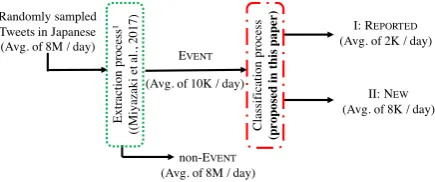
The structure of our system for classifying EVENT
about reported events is shown in Figure 2. Inputs of this system are 10 % of all randomly sampled Tweets in Japanese. The extraction process
ex-Randomly sampled Tweets in Japanese (Avg. of 8M / day)
non-EVENT (Avg. of 8M / day)
EVENT
Ⅰ: REPORTED (Avg. of 2K / day)
Ⅱ: NEW (Avg. of 8K / day) (Avg. of 10K / day)
C
la
ss
if
ic
at
ion
pr
oc
es
s
(p
rop
os
ed
in
t
h
is
p
ap
er
)
E
xt
ra
ct
ion
pr
oc
es
s
1
((
M
iya
za
ki
e
t a
l.
, 2017
)
Figure 2: Structure of our system for classifying
EVENTabout reported events.
tracts EVENT and removes non-Event-describing
Tweets (non-EVENT). The EVENT for news
re-ports are then input in the classification process,
which classifies them into REPORTEDand NEW.
The extraction process needs to separate the
0.1% of EVENT from the 99.9% of non-EVENT.
Because there are so many non-EVENT, the
traction process needs extensive training. To
ex-tract EVENT and classify them into REPORTED
and NEWin one process, the system is trained for
classification by using Tweets required for
train-ing with a large amount of non-EVENTunrelated
to classification. Moreover, when systems are ex-tended to classify other types of Tweets or relearn
how to classify EVENT about reported events,
they need extensive training for Tweet extraction and classification. However, it is not realistic to do such retraining every time classification is ad-justed in accordance with a program creator’s re-quest. For these reasons, this paper uses a two-stage processing system that includes an extrac-tion process and a classificaextrac-tion process.
4.1 Extraction Process
The extraction process uses an existing
Int
.
la
ye
r
(B
i-LS
TM)
O
ut
put
l
aye
r
(F
F
N
N
)
𝒉"#$%&' 𝒉()*
Output (Softmax)
Input
l
aye
r
(F
F
N
N
)
O
ne
-hot
ve
cr
or
iz
e
Int
.
la
ye
r
(F
F
N
N
)
𝒉#+*.
{𝒉.#+}
{𝒙.}
∈ ℝ34 ∈ ℝ4 ∈ ℝ3
∈ 𝑛×ℝ4
∈ 𝑛×ℝ7
𝑁: No. of input layer dimensions
𝑛 : Max no. of sequences
𝑚: No. of int. layer dimensions
𝑡 : Sequential index Character
[image:4.595.111.478.63.136.2]sequences input
Figure 3: Structure of extraction process.
FFNN, and classified as important (EVENT) or
unimportant (non-EVENT). Dimensions of each
intermediate layer are set to 200.
In this paper, a model that is trained by su-pervised training using 19,962 Tweets manually extracted in TV program production for positive samples and 1,524,155 randomly sampled Tweets for negative samples is used. The model which has a 74.4 % F1 score is used. Whether the priority is precision or recall can be changed by varying the threshold of the output depending on the purpose1.
4.2 Classification Process
The classification process classifies EVENT into
REPORTED and NEW by several classification methods using three types of manually classified training data as shown in Table 1. For reasons al-ready mentioned in Section 3.2, this process
clas-sified EVENTinto REPORTEDand NEW.
Input in the classification process is limited to
EVENT extracted from the extraction process, so
the classification process needs much less train-ing data than the extraction processes. There is a trade-off between the hardware burden caused by the volume of training data, structures of NNs and the improvement of classification accuracy by advanced processing. However, the classification process does not need extensive training and so can use computationally heavy methods within the range where the test phase is performed in real-time. In this paper, the accuracy and leaning speed of these methods are evaluated in experiments.
5 Classification Methods using NNs
For methods to classify REPORTEDand NEW,
sev-eral inputs including the proposed method and
several NN architectures are used. In machine
1
The extraction process is neither the purpose nor the con-tribution of this paper. This existing method was used only for convenience. The performance evaluation of this paper is for the classification process. When EVENTextracted by any methods are input, the methods are expected to perform approximately the same for the classification process.
Int
.
la
ye
r
(F
F
N
N
)
O
ut
put
l
aye
r
(F
F
N
N
)
𝒉"#$. 𝒉&'$
S
eque
nt
ia
l
pr
oc
es
s
𝑚: No. of int. layer dimensions
Binary output (Softmax)
𝒉)) ∈ ℝ,
Char. or Word sequences input
∈ ℝ, ∈ ℝ
[image:4.595.318.516.186.272.2]-Eq. (1) Eq. (2)
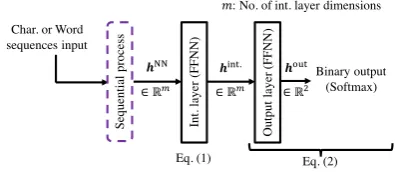
Figure 4: Overview structure using each character se-quences or word sese-quences.
learning using sentences, an input sequence is gen-erally divided into characters or words, vectorized, serialized, and used. The contributions of the both words and characters are evaluated by these three methods.
5.1 Conventional Character Input NN /
Word Input NN
Figure 4 shows an overview of a structure using ei-ther character sequences or word sequences. First, sentences are input to a sequential process NN and
output ashNN∈Rm, wheremis the intermediate
size. Second, hNN is inputed to the intermediate
layer FFNN (Wint. ∈ Rm×m, bint. ∈ Rm) and output ashint.∈Rm. Finally,hint.is input to the output layer FFNN (Wout ∈ R2×m, bout ∈ R2) and the Softmax function and output as binary of classification results. At the training phase, loss is calculated by the cross entropy function between output of the Softmax function and one-hot vec-tor of a correct answer. At the test or use phase, output is calculated by an argmax function of the Softmax function output. A series of processes is obtained as follows,
hint. = a(Wint.hNN+bint.) (1)
output = softmax(hout)
= softmax(Wouthint.+bout),(2)
where a(·) is an activation function and we use
2015). For converting sentences into char-acter sequences, sentences are separated into
individual characters. For converting
sen-tences into word sequences, sensen-tences are sepa-rated using the Japanese morphological analyzer MeCab (Kudo et al., 2004) with the customized system dictionary mecab-ipadic-NEologd (Sato, 2015).
5.1.1 FFNN for Sequential Process
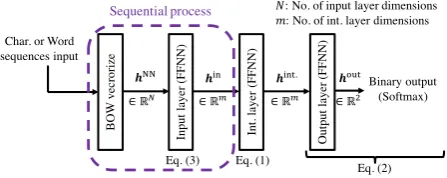
Figure 5 shows the structure of character or word sequences input only using the FFNN. A BOW
(Bag of Words / characters) vectorxBOW ∈ RN
is input to the input layer FFNN (Win ∈Rm×N,
bin ∈ Rm) and output ashin ∈ Rm, whereN is
the number of input layer dimensions, so FFNN architectures do not include sequential architec-tures. A series of processes is obtained as follows,
hFFNN=hin = a(WinxBOW+bin). (3)
Then,hFFNNis fed to Equation (1) ashNN.
5.1.2 LSTM for Sequential Process
Figure 6 shows the structure of character
or word sequences input using a LSTM
for the intermediate layer. One-hot
vec-tor {xt} =
{
x0∈RN,x1∈RN,· · ·}
is input to the input layer FFNN (Win,
bin) one by one, and output sequences are
{hint } = {hin0 ∈Rm,hin1 ∈Rm,· · ·}. After that, the output sequences are input to the intermediate layer LSTM using an attention mechanism (Bahdanau et al., 2014) one by one,
and the output vector is hLSTM ∈ Rm. In
accordance with LSTM mechanisms, all series of input are used for training. A series of processes is obtained as follows,
hint = a(Winxt+bin) (t∈[0, n))(4)
zt = tanh(Wzhint +Rzhinct−1.+bz)(5)
it = σ(Wihint +Rihinct−1.+bi)
ft = σ(Wfhint +Rfhinct−1.+bf)
ct = it⊗zt+ft⊗ct−1 ot = σ(Wohint +Rohinct−1.+bo) hinct . = ot⊗tanh(ct)
αt =
exp(hincl−1.·hinct .)
Σlj−=1texp(hincj .·hinct .)
hLSTM = a
(
ol−1+a
(
Σlj−=01αjhincj . ))
,
where n is the maximum number of input
se-quences and W∗ ∈ Rm×m, R∗ ∈ Rm×m, and
Int
.
la
ye
r
(F
F
N
N
)
O
ut
put
l
aye
r
(F
F
N
N
)
𝒉"#$. 𝒉&'$
𝑁: No. of input layer dimensions 𝑚: No. of int. layer dimensions
Binary output (Softmax) 𝒉**
Char. or Word sequences input
Input
l
aye
r
(F
F
N
N
)
𝒉"#
BO
W
ve
cr
or
iz
e
Sequential process
∈ ℝ- ∈ ℝ- ∈ ℝ.
∈ ℝ/
Eq. (1)
[image:5.595.311.535.67.156.2]Eq. (2) Eq. (3)
Figure 5: Structure of FFNN using each character se-quence or word sese-quence.
b∗ ∈ Rm in Equations (5) are LSTM parameters
(∗ is each layer name and z is the tanh layer, i
the input layer, f the forget layer, and o the
out-put layer). Then,hLSTMis fed to Equation (1) as
hNN.
[image:5.595.308.533.567.687.2]5.1.3 CNN for Sequential Process
Figure 7 shows the structure of character or word sequences input using a CNN for the intermedi-ate layer. When using word input, this process is same as (Zhang and Wallace, 2017). First, one-hot vector{xt} is input to the input layer FFNN (Win, bin) one by one, and output sequences are
{hint }the same for the LSTM. After that, the out-put sequences are inout-put to the intermediate con-volutional layer (each Wpj ∈ Rm×m,bp ∈ Rm) using l kinds of filters (filter index is p = [0, l),
each filter size is k, and the index in each
fil-ter isj = [0, k)) with zero padding and input to
max-pooling in each filter. Output is l kinds of
vectors {hpool,p ∈ Rm}, which are all input to
the intermediate layer FFNN (WCNN ∈ Rm×lm,
bCNN ∈Rm). In accordance with the CNN
archi-tectures, a part of a time series relies onk. A series of processes is obtained as follows,
hint = a(Winxt+bin) (t∈[0, n)) (6)
hConvt .,p = a
( Σkj=0−1
(
Wpjhint+j+bp
))
(7) (
p∈[0, l),hinq =Om (q ≧n))
hpool,p = max t
{
hConvt .,p
}
(8)
hCNN = a(WCNN
[
hpool,0;· · · ;hpool,l−1
]
+bCNN). (9)
Then,hCNNis fed to Equation (2) ashint..
5.2 Proposed Concat Input NN (iii)
Int . la ye r (L S T M ) O ut put l aye r (F F N N )
𝒉"#$% 𝒉&'(
Binary output (Softmax) Input l aye r (F F N N ) O ne -hot ve cr or iz e Sequential process Int . la ye r (F F N N ) 𝒉)*(.
{𝒉-)*}
{𝒙-}
∈ ℝ2 ∈ ℝ2 ∈ ℝ3
∈ 𝑛×ℝ2
∈ 𝑛×ℝ6
Eq. (4) Eq. (1)
Eq. (2) Eq. (5)
𝑁: No. of input layer dimensions 𝑛 : Max no. of sequences 𝑚: No. of int. layer dimensions 𝑡: Sequential index Char. or Word
[image:6.595.88.504.62.289.2]sequences input
Figure 6: Structure of LSTM using each character sequence or word sequence.
𝒉"#$
𝑁: No. of input layer dimensions 𝑛 : Max no. of sequences 𝑚: No. of int. layer dimensions 𝑡: Sequential index 𝑙: No. of filters 𝑝: Filter index Binary output
(Softmax) Char. or Word
sequences input Input l aye r (F F N N ) O ne -hot ve cr or iz e Sequential process Int . la ye r (F F N N ) 𝒉,--.
{𝒉012} {𝒙0}
P ool ing la ye r Int . la ye r (C onv .) 𝒉 0 ,"25.,7
{𝒉8""9,7}
∈ 𝑙×ℝ= ∈ ℝ
= ∈ ℝ> ∈ 𝑙×𝑛×ℝ=
∈ 𝑛×ℝ= ∈ 𝑛×ℝ?
O ut put l aye r (F F N N )
[image:6.595.121.397.65.155.2]Eq. (7) Eq. (8) Eq. (9) Eq. (2) Eq. (6)
Figure 7: Structure of CNN using each character sequence or word sequence.
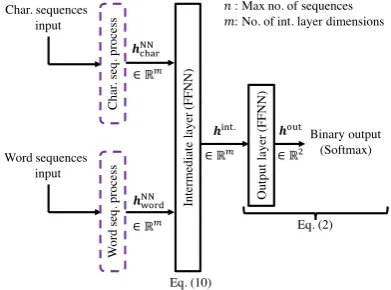
the intermediate layer. In Section 5.1, all archi-tectures use only a character or word sequence. However, character sequences have the advantages of there being fewer characters than words and of expressing the input sentence without using high-dimensional input layers. Moreover, in the case of using a written language that does not have spaces between words such as Japanese, morphological analyzers are needed to divide words. Tweets are noisy, so they are very difficult to morphologically analyze accurately. Thus, performance from char-acter sequences does not depend on morpholog-ical analyzer performance, which is another big advantage. However, sentences are written by us-ing word sequences, and characters are involved in many words that cover a large number of mean-ings. In contrast, one word has a limited number of meanings and plays a bigger role in each sen-tence. For these reasons, the proposed method is expected to exploit the advantages of both charac-ters and words.
Figure 8 shows the structure of character and word sequences input and concatenated at the in-termediate layer. Each sequential process NN is described in Section 5.1.1-5.1.3 and surrounded by broken-line boxes in Figures. 5-7 for charac-ter sequences and word sequences independently. Output of the each sequential process ishNN. Af-ter that, characAf-ter and word sequences are concate-nated, and the subsequent process is the same as that in Section 5.1. A series of processes is
ob-Int er m edi at e la ye r (F F N N ) O ut put l aye r (F F N N )
𝒉"#$. 𝒉&'$
C ha r. s eq. pr oc es s Binary output (Softmax) Char. sequences input W or d se q. pr oc es s Word sequences input
𝒉()*+,,
𝑛 : Max no. of sequences 𝑚: No. of int. layer dimensions
∈ ℝ2 ∈ ℝ3
∈ ℝ2
Eq. (10)
Eq. (2) 𝒉4&+5,,
∈ ℝ2
Figure 8: Overview of structure inputting both charac-ter and word sequences.
tained as follows,
hint. = a(Wint.[hcharNN;hNNword]+bint.)(10)
where the intermediate layer FFNN is (Wint. ∈
Rm×2m,bint. ∈ Rm). Then,hint.is fed to Equa-tion (2).
6 Experimental Evaluation
The performances of classification methods are
evaluated in an experimental evaluation. For
[image:6.595.319.515.345.490.2]I-⃝1 I-⃝2 II Total Date
Train. 4,273 5,027 35,370 44,670 Jun., 2017 Test 844 1,184 7,972 10,000 Jul., 2017
Table 2: No. of each Tweets.
594 sources of REPORTED from training data are
used for the keyword filtering baseline and Lin-earSVC modules of scikit-learn (Pedregosa et al., 2011) are used for the SVM baseline. Thus, data
include REPORTED of various sources. In
addi-tion, the Word2Vec vector for the SVM baseline is the average of each 200–dimension word vector that is made with a Wikipedia dump corpus by us-ing Word2Vec skip-gram modules (Mikolov et al., 2013).
6.1 Experimental Conditions
For both training data and test data, EVENT for
news reports extracted by the extraction process in Section 4.1 are used. Training data is all 44,670 Tweets obtained in the extraction process on June 6th, 8th, 10th, and 12th, 2017. Test data is 10,000 randomly sampled Tweets obtained in the extrac-tion process output Tweets on July 6th, 8th, 10th, and 12th, 2017. Output data is annotated into three categories I-⃝1 : REPORTEDwith explicit sources,
I-⃝2 : REPORTED without explicit sources, and II:
NEW by an annotator person. Table 2 shows the
amount of each type of annotated data. Table 3 shows the configuration of experimental parame-ters.
6.2 Experimental Results
Table 4 shows precision, recall, and F1 score for each method with input as character, word, or character and word. Table 5 shows recall
perfor-mance of using REPORTEDto evaluate the
perfor-mance with and without explicit sources. False
negatives are judged for only REPORTEDand
can-not be divided into REPORTED with and without
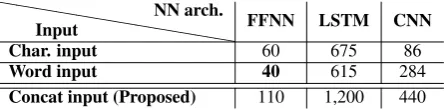
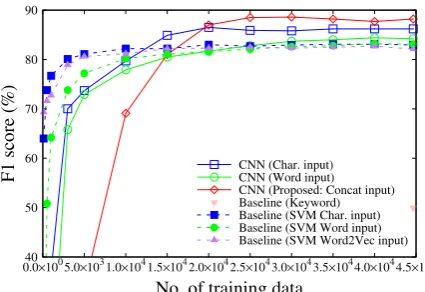
explicit sources, thus precision and F1 score can-not be used in this evaluation. Table 6 shows the time required to learn each NN. Finally, Figure 9 shows the F1 score of SVM baseline methods and CNN architectures trained by each number of ran-dom sampled training data.
From Table 4, the keyword baseline method has 94.1% precision and 34.0% recall. From Table 5,
its recall is 73.5 % lower when using only I-⃝2
than when using only I-⃝1 (3.4 % vs. 76.9 %).
All NN architectures outperform all baseline
methods. Although word input using FFNN,
which has the lowest F1 score of the NN archi-tectures, has the same precision as the SVM word input baseline method, which has highest F1 score of the baseline methods, it has higher recall (76.7 % vs. 75.7 %) and F1 score (84.2 % vs. 83.6 %).
Its recall is 22.5 % lower when using only I-⃝2
than when using only I-⃝1 (67.3 % vs. 89.8 %).
In each NN architecture, the F1 score for char-acter input is 0.3–2.0% higher than for word in-put. When both characters and words are input, LSTM has the highest F1 score, 0.5-2.2% higher than those of other NNs. When the conventional method is used, the highest F1 score so far is 86.7 % for LSTM architecture using character input. For this LSTM recall is 15.8 % higher when us-ing only I-⃝1 than when using only I-⃝2 (94.6 %
vs. 78.8 %).
The proposed concat input method has a higher F1 score than character input for each NN ar-chitecture. Especially, F1 scores for the LSTM and CNN architectures improved from 86.7 % and 86.2 % to 88.2%. With the proposed concat input method, the difference between recall for CNNs with and without explicit sources is only 18.5 % (95% vs. 76.5%), whereas it is 22.1% and 23.8% with character and word input NNs. In addition, the training time of the CNN architecture is almost 1/3 that of the LSTM architecture, as shown in Ta-ble 6.
From Figure 9, baseline SVM methods have higher F1 scores than CNN architectures when they are trained by using fewer than 10,000 train-ing data. However, CNN architectures have higher F1 scores than SVM methods when they are trained by using more than 25,000 training data. The architecture using the proposed method has a lower F1 score than other architectures when trained by using fewer than 13,000 training data but has the highest F1 score when trained by using more than 20,000 training data.
6.3 Experimental Result Discussion
For the keyword baseline method, since Tweets with the same source used as training data can be detected for I-⃝1 in test data, there are few false
detections and overall precision is relatively high. However, the keyword baseline method can barely detect Tweets for I-⃝2 . In contrast, all other
meth-ods can obtain recall rates of at least 67 % for
I-2
meth-Deep learning framework Chainer (Tokui et al., 2015) Gradient descent algorithm Adam (Kingma and Ba, 2014)
No. of iterations 5
Dim. of each int. layer 200
Mini batch size 100
Dropout (Srivastava et al., 2014) ratio 0.5 (except for the conv. layer and the pooling layer) Each CNN filter size 2, 2, 3, 3, 4, 4 (for CNN (Zhang and Wallace, 2017))
Initial values of NNs random
[image:8.595.98.496.62.177.2]Unknown elements (character and word) Elements that appear fewer than 10 times in training data Classification I: REPORTEDand II: NEW(described in Section 4.2) Evaluating measures The macro average of 20 trials precision, recall, and F1 score
Table 3: Configuration of experimental parameters.
Input NN arch. Pre. Rec. F1
FFNN 92.1 79.3 85.2
Char. input LSTM 86.6 85.4 86.7
CNN 94.3 79.9 86.2
FFNN 93.3 76.7 84.2
Word input LSTM 90.3 83.0 86.4
CNN 93.8 76.9 84.2
FFNN 93.2 79.6 85.8
Concat input LSTM 91.3 85.5 88.2
(Proposed) CNN 93.0 84.2 88.2
Baseline (Keyword) 94.1 34.0 50.0
Baseline (SVM Char. input) 90.1 76.9 83.0
Baseline (SVM Word input) 93.3 75.7 83.6
[image:8.595.308.528.220.366.2]Baseline (SVM Word2Vec input) 85.8 80.6 83.1
Table 4: Macro average performance of proposed clas-sification methods (%).
ods are effective for the Tweet classification task in this paper. Moreover, all NN architectures have higher F1 score than SVM methods. This result indicates NN architectures are more effective than SVM methods for the task, especially when they have enough training data.
The CNN or LSTM architectures have higher F1 scores than the FFNN architecture for almost all kinds of input. From this fact, incorporating time series into the learning structure contributes
to classifying REPORTEDand NEW. CNN
archi-tectures have a higher precision but a lower re-call than LSTM architectures. Especially for
I-2
⃝, which is expected to present a higher degree
of difficulty than I-⃝1 , CNN architectures using
character or word input have 67.0 –70.7% recall whereas LSTM architectures have 75.6–78.8 % recall. These results are due to the difference in structure: a CNN uses time series only within the filter size, whereas an LSTM uses the time series of the entire sequence.
In all NN architectures, the proposed concat in-put method has the best F1 score, followed by character input and word input. It is considered that the advantage of the character sequences
de-Input NN arch. I-⃝1 I-⃝2 I
FFNN 92.0 70.3 79.3
Char. input LSTM 94.6 78.8 85.4
CNN 92.8 70.7 79.9
FFNN 89.8 67.3 76.7
Word input LSTM 93.5 75.6 83.0
CNN 90.8 67.0 76.9
FFNN 92.0 70.8 79.6
Concat input LSTM 95.3 78.5 85.5
(Proposed) CNN 95.0 76.5 84.2
Baseline (Keyword) 76.9 3.4 34.0
Baseline (SVM Char. input) 89.3 68.1 76.9
Baseline (SVM Word input) 87.9 67.1 75.7
[image:8.595.71.296.221.367.2]Baseline (SVM Word2Vec input) 88.5 74.9 80.6
Table 5: Macro average recall performance for types of each test data (%).
hhhhhhhInput hhhhhNN arch.
FFNN LSTM CNN
Char. input 60 675 86
Word input 40 615 284
Concat input (Proposed) 110 1,200 440
Table 6: Training time of NNs (seconds).
scribed in Section 5.2 exceeds the advantage of the word sequences, and in the proposed concat input method, both elements are automatically se-lected, so NN architectures are trained more ef-fectively. The CNN architecture was particularly improved, with its recall increasing to 84.2 % for all reported Tweets (I) and to 76.5 % for I-⃝2, only
slightly lower than the recall for the LSTM archi-tecture. As a result, when the proposed concat input method is used, though the CNN architec-ture requires only 37 minutes at 5 epochs, it has almost the same F1 score as the LSTM architec-ture because the concat input method utilizes the advantages of character sequences (i.e., there are fewer unknown characters than unknown words), and word sequences (i.e., words are more effective than characters for the task).
[image:8.595.309.532.419.474.2]40 50 60 70 80 90
0.0×1005.0×1031.0×1041.5×1042.0×1042.5×1043.0×1043.5×1044.0×1044.5×104
F1 score (%)
No. of training data
[image:9.595.77.290.72.218.2]CNN (Char. input) CNN (Word input) CNN (Proposed: Concat input) Baseline (Keyword) Baseline (SVM Char. input) Baseline (SVM Word input) Baseline (SVM Word2Vec input)
Figure 9: Macro average F1 score for each training data size reduced by all samples.
gathered on the basis of feedback from the TV pro-gram production, so training each time the kind of classification changes is also assumed. Under these conditions, a short training time is highly convenient and is a big advantage. From this re-sult, a CNN using the proposed method has the best balance of speed and accuracy, so it is the most suitable for our system.
CNN architectures trained by using a few train-ing data (less than 10,000) have lower F1 scores than SVM methods, seems to be caused by CNN architectures having many training parameters. Specifically, the CNN architecture using the pro-posed method has the lowest F1 score when it has the most training parameters. However, it has the highest F1 score when it is trained by using a lot of training data. When collecting at least 10,000 and ideally more than 30,000 training data, NN archi-tectures are effective for the classification task in this paper.
7 Conclusion
We developed a system to classify extracted “Event-describing Tweets” for news reports into “Reported-event Tweets” to obtain reports after a primary report or collect opinions and “New-information Tweets” to obtain primary reports and for tracking reports of the same event. A con-volutional neural network could classify Tweets with an F1 score of 88 % by using our pro-posed method, which inputs character and word sequences, concatenates them in the intermediate layer, and outputs them within 37 minutes train-ing time. However, systems ustrain-ing the proposed method also incorrectly extracted Tweets
References
Dzmitry Bahdanau, Kyunghyun Cho, and Yoshua
Ben-gio. 2014. Neural machine translation by jointly
learning to align and translate. In Proceedings of
the 3rd International Conference on Learning Rep-resentations, ICLR 2015, pages 1–15.
Djork-Arn´e Clevert, Andreas Mayr, Thomas Un-terthiner, and Sepp Hochreiter. 2015. Rectified
fac-tor networks. In Advances in Neural Information
Processing Systems 28, NIPS 2015, pages 1855– 1863. Curran Associates, Inc.
Nimesh Ghelani, Salman Mohammed, Shine Wang, and Jimmy Lin. 2017. Event detection on curated
tweet streams. In Proceedings of the 40th
Inter-national ACM SIGIR Conference on Research and Development in Information Retrieval, SIGIR ’17, pages 1325–1328, New York, NY, USA. ACM.
Stig-Arne Gr¨onroos, Sami Virpioja, and Mikko Ku-rimo. 2017. Extending hybrid word-character neural machine translation with multi-task learning of
mor-phological analysis. In Proceedings of the Second
Conference on Machine Translation, WMT, pages 296–302. Association for Computational Linguis-tics.
Geert Heyman, Ivan Vuli´c, and Marie-Francine Moens.
2017. Bilingual lexicon induction by learning to
combine word-level and character-level
representa-tions. InProceedings of the 15th Conference of the
European Chapter of the Association for Computa-tional Linguistics: Volume 1, Long Papers, EACL 2017, pages 1085–1095. Association for Computa-tional Linguistics.
Hayate Iso, Shoko Wakamiya, and Eiji Aramaki. 2016. Forecasting word model: Twitter-based influenza
surveillance and prediction. InProceedings of
COL-ING 2016, the 26th International Conference on Computational Linguistics: Technical Papers, pages 76–86. The COLING 2016 Organizing Committee.
Kristen Johnson and Dan Goldwasser. 2016. “All
I know about politics is what I read in Twitter”: Weakly supervised models for extracting politicians’
stances from twitter. In Proceedings of COLING
2016, the 26th International Conference on Compu-tational Linguistics: Technical Papers, pages 2966– 2977. The COLING 2016 Organizing Committee.
Diederik P. Kingma and Jimmy Ba. 2014. Adam: A
method for stochastic optimization. In
Proceed-ings of the 3rd International Conference on Learn-ing Representations, ICLR 2015, pages 1–15.
Taku Kudo, Kaoru Yamamoto, and Yuji Matsumoto.
2004. Applying conditional random fields to
japanese morphological analysis. InProceedings of
Empirical Methods in Natural Language
Process-ing, EMNLP, pages 230–237.
Dongyun Liang, Weiran Xu, and Yinge Zhao. 2017. Combining word-level and character-level represen-tations for relation classification of informal text. In
Proceedings of the 2nd Workshop on Representa-tion Learning for NLP, pages 43–47. Association for Computational Linguistics.
Bill Y. Lin, Frank Xu, Zhiyi Luo, and Kenny Zhu. 2017. Multi-channel bilstm-crf model for emerg-ing named entity recognition in social media. In
Proceedings of the 3rd Workshop on Noisy User-generated Text, pages 160–165. Association for Computational Linguistics.
Marina Litvak, Natalia Vanetik, Efi Levi, and Michael
Roistacher. 2016. What’s up on twitter? catch
up with twist! In Proceedings of COLING 2016,
the 26th International Conference on Computational Linguistics: System Demonstrations, pages 213– 217. The COLING 2016 Organizing Committee.
Xuezhe Ma and Eduard Hovy. 2016. End-to-end se-quence labeling via bi-directional lstm-cnns-crf. In
Proceedings of the 54th Annual Meeting of the As-sociation for Computational Linguistics (Volume 1: Long Papers), ACL ’16, pages 1064–1074. Associ-ation for ComputAssoci-ational Linguistics.
Tomas Mikolov, Ilya Sutskever, Kai Chen, Greg Cor-rado, and Jeffrey Dean. 2013. Distributed represen-tations of words and phrases and their
composition-ality. InProceedings of the 26th International
Conference on Neural Information Processing Systems -Volume 2, NIPS’13, pages 3111–3119, USA. Curran Associates Inc.
Taro Miyazaki, Shin Toriumi, Yuka Takei, Ichiro
Ya-mada, and Jun Goto. 2017. Extracting
impor-tant tweets for news writers using recurrent neural network with attention mechanism and multi-task
learning. In Proceedings of the 31st Pacific Asia
Conference on Language, Information and Compu-tation, PACLIC 31, pages 363–369. The National University (Phillippines).
Graham Neubig, Yuichiroh Matsubayashi, Masato Hagiwara, and Koji Murakami. 2011. Safety infor-mation mining — what can nlp do in a disaster— . In Proceedings of 5th International Joint Con-ference on Natural Language Processing, IJCNLP 2011, pages 965–973. Asian Federation of Natural Language Processing.
Symeon Papadopoulos, David Corney, and Luca Maria Aiello. 2014. Snow 2014 data challenge: Assess-ing the performance of news topic detection
meth-ods in social media. In Proceedings of the SNOW
2014 Data Challenge.
Fabian Pedregosa, Ga¨el Varoquaux, Alexandre Gram-fort, Vincent Michel, Bertrand Thirion, Olivier Grisel, Mathieu Blondel, Peter Prettenhofer, Ron Weiss, Vincent Dubourg, Jake Vanderplas, Alexan-dre Passos, David Cournapeau, Matthieu Brucher,
Scikit-learn: Machine learning in python. J. Mach. Learn. Res., 12:2825–2830.
Swen Ribeiro, Olivier Ferret, and Xavier Tannier. 2017. Unsupervised event clustering and aggregation from
newswire and web articles. In Proceedings of the
2017 EMNLP Workshop: Natural Language Pro-cessing meets Journalism, pages 62–67. Association for Computational Linguistics.
Sara Rosenthal, Noura Farra, and Preslav Nakov. 2017. Semeval-2017 task 4: Sentiment analysis in twitter. In Proceedings of the 11th International Workshop on Semantic Evaluations (SemEval-2017), pages 502–518.
Toshinori Sato. 2015. Neologism dictionary based
on the language resources on the Web for
Mecab.
https://github.com/neologd/mecab-ipadic-neologd. Accessed: 2018-02-01.
Nitish Srivastava, Geoffrey Hinton, Alex Krizhevsky, Ilya Sutskever, and Ruslan Salakhutdinov. 2014. Dropout: A simple way to prevent neural networks
from overfitting. J. Mach. Learn. Res., 15(1):1929–
1958.
Seiya Tokui, Kenta Oono, Shohei Hido, and Justin
Clayton. 2015. Chainer: a next-generation open
source framework for deep learning. In
Proceed-ings of NIPS 2015 workshop on machine learning systems (LearningSys).
Svitlana Vakulenko, Lyndon Nixon, and Mihai Lupu. 2017. Character-based neural embeddings for tweet
clustering. InProceedings of the Fifth International
Workshop on Natural Language Processing for So-cial Media, pages 36–44. Association for Computa-tional Linguistics.
Vladimir Vapnik and Aleksander Lerner. 1963. Pattern
recognition using generalized portrait method.
Au-tomation and Remote Control, 24:774–780.
Prashanth Vijayaraghavan, Ivan Sysoev, Soroush
Vosoughi, and Deb Roy. 2016. Deepstance at
semeval-2016 task 6: Detecting stance in tweets
us-ing character and word-level cnns. Inthe 10th
Inter-national Workshop on Semantic Evaluation, volume
abs/1606.05694 ofSemEval-2016, pages 413–419.
Svitlana Volkova, Kyle Shaffer, Jin Yea Jang, and Nathan Hodas. 2017. Separating facts from fiction: Linguistic models to classify suspicious and trusted
news posts on twitter. In Proceedings of the 55th
Annual Meeting of the Association for Computa-tional Linguistics (Volume 2: Short Papers), ACL ’17, pages 647–653. Association for Computational Linguistics.
Sida Wang and Christopher D. Manning. 2012. Base-lines and bigrams: Simple, good sentiment and
topic classification. InProceedings of the 50th
An-nual Meeting of the Association for Computational Linguistics: Short Papers - Volume 2, ACL ’12, pages 90–94, Stroudsburg, PA, USA. Association for Computational Linguistics.
Ye Zhang and Byron Wallace. 2017. A sensitivity anal-ysis of (and practitioners’ guide to) convolutional
neural networks for sentence classification. In
Pro-ceedings of the Eighth International Joint Confer-ence on Natural Language Processing (Volume 1: Long Papers), IJCNLP 2017, pages 253–263. Asian Federation of Natural Language Processing.
Deyu Zhou, Tianmeng Gao, and Yulan He. 2016. Jointly event extraction and visualization on twitter
via probabilistic modelling. In Proceedings of the