system
.
White Rose Research Online URL for this paper:
http://eprints.whiterose.ac.uk/78940/
Article:
Borile, C, Muñoz, MA, Azaele, S et al. (2 more authors) (2012) Spontaneously broken
neutral symmetry in an ecological system. Physical Review Letters, 109 (3). 038102. ISSN
0031-9007
https://doi.org/10.1103/PhysRevLett.109.038102
[email protected] https://eprints.whiterose.ac.uk/ Reuse
Unless indicated otherwise, fulltext items are protected by copyright with all rights reserved. The copyright exception in section 29 of the Copyright, Designs and Patents Act 1988 allows the making of a single copy solely for the purpose of non-commercial research or private study within the limits of fair dealing. The publisher or other rights-holder may allow further reproduction and re-use of this version - refer to the White Rose Research Online record for this item. Where records identify the publisher as the copyright holder, users can verify any specific terms of use on the publisher’s website.
Takedown
If you consider content in White Rose Research Online to be in breach of UK law, please notify us by
Spontaneously Broken Neutral Symmetry in an Ecological System
C. Borile,1M. A. Mun˜oz,2S. Azaele,3Jayanth R. Banavar,4and A. Maritan1
1Dipartimento di Fisica ‘‘G. Galilei’’ and CNISM, INFN, Universita` di Padova, Via Marzolo 8, 35131 Padova, Italy 2Instituto Carlos I de Fı´sica Teo´rica y Computacional, Universidad de Granada, 18071 Granada, Spain 3
Institute of Integrative and Comparative Biology, University of Leeds, Miall Building, Leeds LS2 9JT, United Kingdom 4Department of Physics, University of Maryland, College Park, Maryland 20742, USA
(Received 15 March 2012; published 20 July 2012)
Spontaneous symmetry breaking plays a fundamental role in many areas of condensed matter and particle physics. A fundamental problem in ecology is the elucidation of the mechanisms responsible for biodiversity and stability. Neutral theory, which makes the simplifying assumption that all individuals (such as trees in a tropical forest)—regardless of the species they belong to—have the same prospect of reproduction, death, etc., yields gross patterns that are in accord with empirical data. We explore the possibility of birth and death rates that depend on the population density of species, treating the dynamics in a species-symmetric manner. We demonstrate that dynamical evolution can lead to a stationary state characterized simultaneously by both biodiversity and spontaneously broken neutral symmetry.
DOI:10.1103/PhysRevLett.109.038102 PACS numbers: 87.23.Cc, 05.50.+q
Neutral models have been proposed to capture the statistical structure of tropical forests [1]. Even though the approach is highly debated [2], the neutral hypothesis has led to a general and fundamental framework to study both the statics [3] and the dynamics [4] of ecosystems using general tools borrowed from stochastic processes and nonequilibrium statistical mechanics. The fundamental as-sumption of neutral theory [1] is that within a trophic level any individual or organism behaves independently of the species it belongs to. In other words, the dynamics of the system is unaffected by interchanging or permuting species labels of individuals. By using this extremely simplifying hypothesis, many empirically measured statistical patterns can be well reproduced [3–5]. Going one step further, a model can be symmetric—but, strictly speaking, non-neutral—a generalization of neutrality, where the dynam-ics may depend, for instance, on the local or global density of individuals in a community, but no change occurs on the behavior of a population and on its effects on others in the community upon switching two arbitrary species’ labels [3]. In this Letter, we address the following issues: (i) Within a generalized neutral framework—allowing for intraspecific density-dependent demographic rates [6]—are species able to coexist in a stable way up to the temporal scale of speciation that eventually averts mono-dominance and extinction? (ii) Can this generalized neutral symmetry be spontaneously broken so that non-neutral behavior of species can emerge from an underlying sym-metric dynamics?
In order to illustrate this, we consider a simple stochastic model, a variant of the (multispecies) voter model [7,8], defined as follows: at every vertex of a regular lattice of linear sizeLinddimensions reside a fixed numberM of individuals belonging to one of Sspecies. At every time step, an individual is picked at random and killed, and its
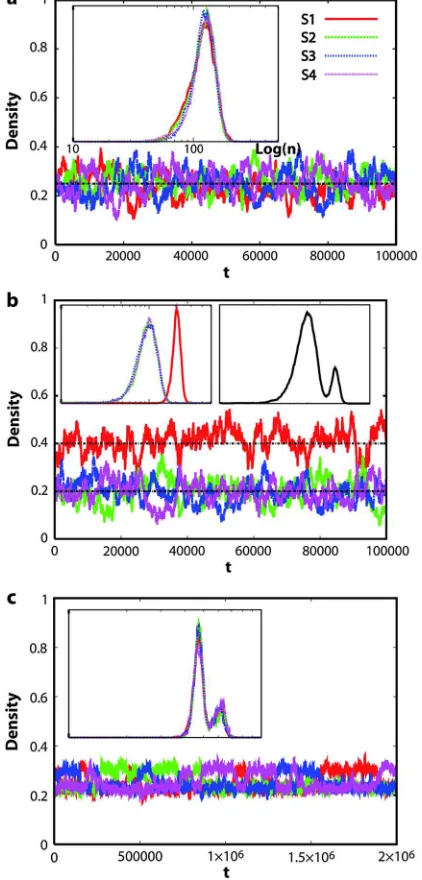
place is filled by copying one of its neighbors, selected according to a probabilistic rule to be defined in detail below. For illustration, let us consider a generic system of S¼4species and global dispersal where the neutral sym-metry is not broken [see Fig. 1(a)]. The fraction of each species’ population fluctuates around the same average,
symmetry characterizing the model. The idea that dynamical symmetry among species can be broken is not new in popu-lation biology. For instance, speciation can be interpreted as a form of bifurcation [9]. However, here we introduce a new concept in community ecology borrowed from the statistical mechanics of phase transitions [10], i.e., sponta-neously broken neutral symmetry. As shown in Fig. 1(c), when the symmetry of the model is broken spontaneously, species behave as in the nonsymmetric case on time intervals shorter than the characteristic temporal scale, which will be calculated later on. On larger time scales, instead, species’ identities can be swapped, and eventually neutral dynamics is recovered. These large temporal scales are also compa-rable to those at which speciation can occur thereby sustain-ing biodiversity.
We now turn to the mathematical details of our model. Letn
x 0be the population at sitexof theth species,
where ¼1;. . .; S,Sbeing the total number of species. Thus PS
¼1nx ¼Mholds for allx, and the total number
of individuals in the whole community is N ¼ML2. In the following, we shall also use the alternative variable
x ¼nx=M, the fraction or density of individuals of the
th species at sitex. Suppose that at timetand sitexan individual belonging to a certain species is picked at random for removal. Then, callthe label of the species of the individual from one of the neighboring sites ofx, sayy, selected to replace the individual. Note that the dynamics keep the total population per site constant at every time step. Thus, a generic n
z evolves according to
n
z !n0z¼nz þx;zð;;Þ: (1)
The effective transition rate for this process is proportional to the population of theth species at sitex,nx, and to the
population of the th species in the chosen neighboring site,ny. Mathematically, this means that the probability of
colonization is Pðnx !n0xÞ ¼Kxynxny. If the
propor-tionality constant, Kxy, is chosen independently of the
population of species atxandyand independently of the kind of species involved, we get a voterlike model [7,8] with neutral dynamics (the standard voter model has M¼1; i.e., only one individual is allowed to live on each site). In this case, regardless of the initial conditions, an infinite-size system would inexorably evolve toward a monodominant state, i.e., an absorbing state, where only one of theSspecies survives. This is a trivial example of spontaneously broken neutral symmetry. In a more realistic perspective, however, different competing effects influence species interactions favoring or hampering colonization [11], such as, for instance, the Janzen-Connell effect in tropical forests [12], stating that the reproduction rate of a given species decreases with its local population size, or the Allee effect, a positive density dependence in a small density range [13,14]. Altogether, these effects may result in an effective, in general nonlinear and nonmonotonic [11,13,14] dependence on the population sizes, so that
FIG. 1 (color online). Example of the evolution of a neutral ecological model with four species with global dispersal (see the main text) for (a) neutral symmetry. All the species are indis-tinguishable and fluctuate around the average value1=4. In the inset (colors are the same as in the main picture), we show the probabilities PiðnÞ, and the superposition is perfect within
statistical errors. (b) Nonsymmetric dynamics. Species 1 has a different set of birth and death rates with respect to the other three species, and fluctuates around an average density of2=5, while the others fluctuate around 1=5. The probability P1ðnÞ
differs from the others, as shown in the left inset; in the inset on the right, the global probabilityPðnÞis shown. (b) Spontaneously broken neutral symmetry. Here, the system behaves differently, depending on the observation window of its evolution: for small time scales, the system appears nonsymmetric, whereas, for longer time scales, the symmetry is recovered. Unlike case (b), all the species show a bimodal distribution. The probabilityPðnÞ in this case superpose virtually exactly on the probabilitiesPiðnÞ.
The total population isN¼512individuals for cases (a) and (b), andN¼2048individuals for (c).
[image:3.612.69.280.51.491.2]we encode in the proportionality constant Kxy, now
dependent, in principle, on the population sizes at both positions x and y. However, if the dynamics has to be neutral or symmetric, thenKxy (i) cannot depend
explic-itly on the species’ labels and and (ii) can at best depend only on the densities of speciesand. Indeed, because the population of every site is fixed, we obtain the constraintP
Þ;x ¼1 ðx þxÞ, which is valid for
every x and plays an important role in the calculations. In order to keep the discussion simple, we consider the caseKxy ¼KxyðyÞ, where y represents the density of
speciesatyreplacing one individual of speciesatx. To get an insight into the evolution of the ecosystem described above, following the standard approach for sta-tistical mechanics systems, we assume infinite dispersal or, equivalently, a well mixed system. This assumption— referred to as the mean field limit in the physics literature—is useful to simplify the treatment, while still capturing the qualitative behavior of the model in any finite dimension. In this case, the description is simple since x ¼ for all ¼1;. . .; S, the average birth rate of a
generic speciesis proportional toðtÞKððtÞÞ, and the
time derivative of PS
¼1ðtÞ has to vanish. Thus, the evolution equation for the average density ðtÞ can be
derived by a standard Kramers-Moyal expansion [15] of the master equation of our system up to the second order:
_
¼Nð1ÞKðÞ X
Þ
KðÞ
þ
ð1ÞKðÞ þ X
Þ
KðÞ1=2; (2)
where¼ðtÞ is a Gaussian white noise-correlated in time. Focusing on the deterministic evolution, we set from here on ðtÞ 0. This is equivalent to neglecting fluctuations—of Oð1=NÞ smaller than the deterministic term—in the analytical treatment. The simulations are performed by means of Gillespie’s algorithm [16] consid-ering directly the full master equation of the system.
The neutrality or symmetry of the dynamics is reflected in the stationary states obtained when dtdðtÞ ¼0. Note
that the drift term on the right-hand side of Eq. (2) cannot be derived from a potential function, and therefore the stationary states cannot be thought of as minima of an analytical function. However, regardless of the form of K, there are always Sþ1 steady states: one neutral-symmetric case,¼1=S, ¼1;2;. . .; S, andS
mono-dominant situations, where only one of the’s is 1 and the remaining ones are 0. By using local stability analysis, one can prove that the monodominant states are stable only whenKð1Þ> Kð0Þ, whereas the conditionK0ð1
SÞ<0
guar-antees the stability of the symmetric coexistence. If the function KðzÞ is linear, Eq. (2) has no other stationary stable solutions. However, in a more general nonlinear
case, new stable solutions can show up. It is this nonline-arity that allows a spontaneous breaking of the neutral symmetry. The simplest situation of coexistence within a broken-symmetry scenario is obtained when a given spe-cies has density ’ >1=S and all the other species have the same density ¼ ð1’Þ=ðS1Þ<1=S, which can occur in S different ways. These densities correspond to the stationary solutions of Eq. (2) ifKð’Þ ¼Kð Þand are also stable whenK0ð Þ<0andK0ð’Þ<K0ð Þ=ðS1Þ.
We now discuss three paradigmatic cases.
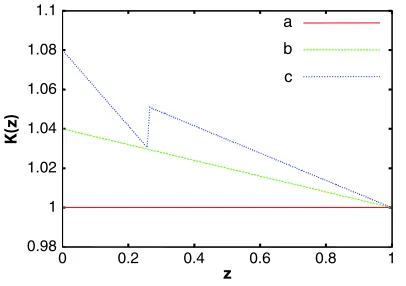
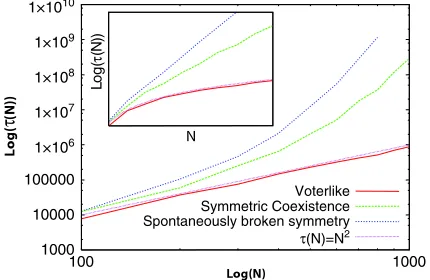
(A) K¼constant.—This corresponds to the classic voter model [7,8] [see Fig.2(a)]. The deterministic evolu-tion, given by Eq. (2), is trivial because any initial value of the population of each species remains invariant across evolution. However, the stochastic dynamics lead to a monodominant state with only one surviving species, a trivial case of spontaneously broken neutral symmetry. For a finite system size, the timeðNÞto reach one of the Sabsorbing states, starting from a random initial condition, scales as ðNÞ N , where ¼2, as shown in Fig. 3
(purple line) wherelogðNÞversuslogN is plotted. (B) KðzÞ ¼aðbzÞ with a, b >0.—This is a more interesting case [see Fig. 2(b)], in which the colonization ability of a given species at some position decreases as its population—at the same position—increases (negative density dependence), and becomes zero when it reaches the maximum value b. Therefore, abundant species are relatively not as effective in colonizing different regions compared to those with small populations. The symmetric state is the stable stationary state of the deterministic evolution, whereas the S monodominant states are un-stable. When the full stochastic dynamics is considered, the symmetric stationary state is typically reached after an initial transient (depending on initial conditions). Once the stationary state is reached, it lasts for a typical time
0.98 1 1.02 1.04 1.06 1.08 1.1
0 0.2 0.4 0.6 0.8 1
a b
c
[image:4.612.338.541.45.188.2]ðNÞ expfNg, as shown in Fig.3(green line), and then the system evolves toward one of the S monodominant states through a gradual extinction of species (observe that this exponential behavior is at variance with what happens in theK¼constant case, whereðNÞ N ). The constant >0 depends on the specific choice ofKðzÞ. The expo-nential behavior can be easily understood by focusing on the limiting case ofS¼2species, where a description in terms of a potential exists. Introducing a density dependence in the voter model dynamical rule generates an effective potential in the equations of motion for ,
¼1;2, that in the case of linearKðzÞdiscussed above has a minimum for¼1=2[17–20]. Thus, applying the well-known Arrhenius law and noting that the stochastic term is of order 1=N smaller than the deterministic part [see Eq. (2)], we recover the exponential behavior for ðNÞ. For time scales much smaller thanðNÞor for all times in the infinite size limit, N! 1, an active stationary state exists where all species symmetrically coexist. Therefore, negative density dependence strongly enhances species coexistence.
We have calculated the relative species abundance (RSA) in the steady state, i.e., the probabilityPðnÞto find a species with populationn. The populationnðtÞof theth species is
followed for a sufficiently long time, and the frequency, PðnÞn, in each intervalðn; nþnÞis recorded and the
RSA is obtained asPðnÞ ¼PS
¼1PðnÞ=S. In the neutral or symmetric case, P is independent of and the
corre-sponding RSA is equivalent to those in Fig. 1(a). Note that at variance with the K¼constant case—where the RSA is not well defined as a consequence of the lack of metastable active states [21]—in the caseKðzÞ ¼aðbzÞ
[see Fig. 1(a)], we obtain a mode, as typically found in the RSA of several tropical forests [1,3,4] and other ecosystems [22].
(C)KðzÞhas theS shape shown in Fig.2(c)[11,14] in
order to satisfy the stability conditions for the broken symmetry scenario given above [this particular shape is for convenience, but it is also valid forKðzÞof the generic cubic form KðzÞ ¼az3þbz2þczþd with suitably chosen coefficients; note that a cubic nonlinearity in den-sity dependence is usually called a Nagumo term and is employed to describe populations experiencing the Allee effect [13]]. Here, broken-symmetry coexistence is the stable stationary state of the deterministic evolution. Turning on the stochastic dynamics—after an initial tran-sient—the system reaches one of theSstationary states of the deterministic dynamics with broken symmetry. Again, on a typical time scale ðNÞ expf0Ng, there is gradual
extinction of species, till one gets a monodominant situation. Once more, the constant0>0depends on the
specific choice of KðzÞ. When the system is in a broken-symmetry case, the species whose density fluctuates around the average’ >1=Sinterchanges with one of the S1species fluctuating around the average ¼ ð1’Þ= ðS1Þ<1=Son time scalesswitchðNÞ expfksNg. Thus,
in a finite systemN <1and on a time scaleswitchðNÞ the ecosystem looks neutral or symmetric; i.e., the species behave like they were interchangeable. However, for time scales switchðNÞ or for all times within an infinite system N¼ 1, the neutral symmetry is spontaneously broken and the ecosystem looks as if the species were not all interchangeable. We have calculated the probability, PðnÞ, that theth species has populationnon a time scale
smaller thanswitchðNÞso as to exhibit the characteristics of a broken-symmetry state. The results are indistinguishable from those of the case where there is no neutral symmetry [Fig.1(b)], in which we run the model with two different functions KðzÞ depending on species label: for¼1we set KðzÞ ¼K1ðzÞ ¼a1b1z with a1 ¼3 and b1 ¼2, while for ¼2;3;4 we set KðzÞ ¼K2ðzÞ ¼a2b2z witha2¼2:5andb2 ¼1:5. The RSA for the spontaneous symmetry breaking case calculated for time scales switchðNÞ is displayed in the inset of Fig. 1(c), where two peaks appear, showing that one of the species behaves differently from the others. In a more general pattern of spontaneous symmetry breaking, one can have up to S distinct P’s producing an S-peak RSA. Multiple peaks
would be resolved in the RSA depending on the width and separation of the peaks: this scenario is consistent with some recent studies on several different ecological com-munities [23], pointing out the possibility of a multimodal distribution ofPðnÞin real systems.
In conclusion, we have shown that a simple nonequilib-rium microscopic model for a generalS-species ecological community driven by a density-dependent but other-wise completely neutral or symmetric dynamics—i.e., the
1000 10000 100000 1×10⁶ 1×10⁷ 1×10⁸ 1×10⁹ 1×10¹⁰ 100 1000 τ Voterlike Symmetric Coexistence Spontaneously broken symmetry τ(N)=N2
Lo g ( τ (N ))
FIG. 3 (color online). Mean time to extinction ðNÞ for the three different definitions of KðzÞ in Fig. 2, calculated in the mean field approximation and plotted in a double logarithmic scale varyingNfromN¼100toN¼1000. ForK¼const(red solid line),ðNÞ Nwith’2(red dotted line) as expected
for a voterlike model, while the two cases ofK¼baz(green dashed line), where we chosea¼0:04andb¼1:04, andKðzÞ allowing for a spontaneous breaking of the neutral symmetry (blue dotted line) show an exponential behavior ðNÞ ekN.
In the inset, we show the same plot in a logarithmic-linear scale, to emphasize the exponential growth.
[image:5.612.67.282.48.188.2]dynamic rules governing the stochastic microscopic pro-cess are insensitive to the species’ labels—can show a rich and stable heterogeneous biodiversity even at very long times. The striking fact is that species can behave distinctly by spontaneously breaking the neutral symmetry.
[1] S. P. Hubbell,The Unified Neutral Theory of Biodiversity and Biogeography(Princeton University, Princeton, NJ, 2001). [2] D. Alonso, R. S. Etienne, and A. J. McKane,Trends Ecol.
Evol.21, 451 (2006).
[3] I. Volkov, J. R. Banavar, F. He, S. P. Hubbell, and A. Maritan,Nature (London)438, 658 (2005).
[4] S. Azaele, S. Pigolotti, J. R. Banavar, and A. Maritan,
Nature (London)444, 926 (2006). [5] J. Chave,Ecol. Lett.7, 241 (2004).
[6] P. Chesson,Annu. Rev. Ecol. Syst.31, 343 (2000). [7] T. M. Liggett, Interacting Particle Systems
(Springer-Verlag, New York, 1985).
[8] R. Durrett and S. Levin,Phil. Trans. R. Soc. B343, 329 (1994).
[9] I. Stewart, T. Elmhirst, and J. Cohen, Bifurcation, Symmetry and Patterns, Trends in Mathematics (Birkha¨user, Basel, 2003), Part 1.
[10] J. Zinn-Justin, Quantum Field Theory and Critical Phenomena(Clarendon, Oxford, 2002).
[11] J. Molofsky, R. Durrett, J. Dushoff, D. Griffeath, and S. Levin,Theor. Popul. Biol.55, 270 (1999).
[12] J. S. Wright, Oecologia130, 114 (2002).
[13] M. Kot,Elements of Mathematical Ecology (Cambridge University Press, Cambridge, England, 2001).
[14] C. M. Taylor and A. Hastings, Ecol. Lett. 8, 895 (2005).
[15] C. W. Gardiner, Handbook of Stochastic Methods
(Springer, Berlin, 1985), 2nd ed.
[16] D. T. Gillespie,J. Phys. Chem.81, 2340 (1977).
[17] O. Al Hammal, H. Chate´, I. Dornic, and M. A. Mun˜oz,
Phys. Rev. Lett.94, 230601 (2005).
[18] F. Va´zquez and C. Lo´pez, Phys. Rev. E 78, 061127 (2008).
[19] C. Castellano, M. A. Mun˜oz, and R. Pastor-Satorras,Phys. Rev. E80, 041129 (2009).
[20] L. Dall’Asta, F. Caccioli, and D. Beghe`,
arXiv:1012.1209v1.
[21] R. Dickman and R. Vidigal, J. Phys. A 35, 1147 (2002).
[22] I. Volkov, J. R. Banavar, S. P. Hubbell, and A. Maritan,
Nature (London)450, 45 (2007).