Optimal Negotiation of Multiple Issues in Incomplete Information Settings
Shaheen Fatima and Michael Wooldridge
Department of Computer Science
University of Liverpool
Liverpool L69 7ZF, U.K.
shaheen,mjw
@csc.liv.ac.uk
Nicholas R. Jennings
School of Electronics and Computer Science
University of Southampton
Southampton SO17 1BJ, U.K.
[email protected]
Abstract
This paper studies bilateral multi-issue negotiation between self-interested agents. The outcome of such encounters de-pends on two key factors: the agenda (i.e., the set of is-sues under negotiation) and the negotiation procedure (i.e., whether the issues are discussed together or separately). Against this background, this paper analyses such negoti-ations by varying the agenda and negotiation procedure. This analysis is carried out in an incomplete information setting in which an agent knows its own negotiation param-eters, but has incomplete information about its opponent’s. We first determine the equilibrium strategies for two negoti-ation procedures: issue-by-issue and package deal. On the basis of these strategies we determine the negotiation out-come for all possible agenda–procedure combinations and the optimal agenda–procedure combination for each agent. We determine those conditions for which agents have identi-cal preferences over the optimal agenda and procedure and those for which they do not, and for both conditions we show the optimal agenda and procedure.
1. Introduction
Negotiation is a process by means of which agents commu-nicate and compromise to reach mutually beneficial agree-ments [10, 8]. The simplest from of negotiation involves two agents and a single issue. The outcome of single issue negotiation depends on the agents’ strategies, that, in turn, depend on the protocol and the information that agents have about the negotiation parameters (i.e., their reserve prices, their discount factors, their deadlines, and their utility func-tions) [9]. However, for multi-issue negotiation, the out-come also depends on two additional factors: the agenda and the negotiation procedure [14, 5, 16]. The agenda spec-ifies what issues should be included in the negotiation1,
1 Note that the term agenda is generally used to mean the set of issues
while the negotiation procedure specifies how the issues on the agenda will be settled. Generally speaking, there are two ways of negotiating multiple issues [6]. One approach is to discuss all the issues together as a package deal. The other approach is to settle each issue independently of all the other issues. This is called issue-by-issue negotiation. These two procedures, viz., issue-by-issue and package deal, yield different outcomes [6]. Consequently, the participants need to decide not only the agenda, but also the procedure they will use to settle the issues on the agenda.
In order to develop software agents that negotiate over multiple issues optimally, we need to identify general rules that can be used to determine the optimal agenda and proce-dure. Moreover, these rules need to be determined in the ab-sence of complete information, since in most practical ap-plications, agents do not have complete information about each other. To this end, this paper studies bilateral multi-issue negotiation between self interested agents in an in-complete information setting, and determines the optimal agenda and procedure for each agent in various scenarios.
Existing work on multi-issue negotiation has one of two key limitations. Either it is based on the complete informa-tion assumpinforma-tion, or else it focuses solely on the issue-by-issue procedure or solely on the agenda (see Section 4 for details). This paper overcomes these limitations and thereby makes two important contributions to the state of the art in multi-issue negotiation. First, it treats both the agenda and the procedure as variable parameters and determines the op-timal agenda and procedure for each agent in various sce-narios. Second, it focuses on an incomplete information set-ting, in which neither agent has complete information about its opponent’s preferences over possible outcomes.
The remainder of the paper is organised as follows. Sec-tion 2 describes the negotiaSec-tion model. SecSec-tion 3 obtains the optimal agenda and procedure for each agent. Section 4 dis-cusses related work, and Section 5 concludes.
2. The negotiation model
Let denote the buyer and
denote the seller (i.e., ’s op-ponent). We use the term information state to refer to the information that an agent has about the negotiation param-eters. Agent ’s (
’s) information state is denoted (
). For our analysis, we consider the case where each agent has complete information about its own parameters but has in-complete information about its opponent’s. This is defined more precisely in the following subsections.
2.1. Single issue negotiation
Consider two agents negotiating over a single issue ( ) that represents, say, the price of an object. Let
denote agent ’s deadline by when it must have completed its negotia-tion. Also, let
(that lies in the interval) denote the factor by which its utility gets discounted over time and
denote its reserve value. The deadline, discount factor, and reserve price for agent
are denoted
, , and
respec-tively. Agents’ utilities at price and at time, are defined as follows:
"! #
%$ if&'
if('
)
!
$ if &'
if('
An outcome is individual rational if it gives an agent a util-ity that is no less than its utilutil-ity from the conflict outcome. Let
* + -, (
.
+ -, ) denote the maximum possible utility that agent (
) can get from an outcome that is individual ra-tional to both agents. Agent gets
+
-, for /021
and
34 . Analogously,
gets 5
+
, for 6721
and37 . Assume that the agents use Rubinstein’s alternating of-fers protocol [9]. At the beginning of negotiation, an agent makes an offer that gives it a high utility and then yields util-ity to its opponent by making offers that give it successively lower utility as negotiation progresses. This decrease is due to the competitive nature of the encounter and the fact that agents need to offer deals that are more likely to be accepted by their opponent if they are to come to an agreement. The generation of offers, i.e., how much an agent yields2
de-pends on the negotiation parameters. Exactly which of the three actions (viz., accept, quit, or counter-offer) an agent takes and how it generates offers is defined by the agent’s strategy.
An agent defines its strategy on the basis of the infor-mation it has about its opponent. For our analysis, we con-sider the case where each agent knows its own parameters, but has incomplete information about its opponent’s. The
2 See [2] for details on the different ways of yielding.
agents’ information states are defined as follows:
98:1
21 <;
98:1
21 ;
Thus each agent knows its opponent’s reserve price but does not know its opponent’s deadline, discount factor, and util-ity function.
Agent ’s strategy (denoted=
) is a mapping from the history of negotiation and agent ’s information state to the action that it takes at time period during negotiation. Thus action,>
$
, that agent takes at time is defined as:
=
?
$
A@
BC Quit if('
Accept if*
ED
$
F *
D
$EGIH KJLM OfferD
$EGIH
atNJ4 otherwise
where?
$
is the history of negotiation and is a sequence of the formD
H
D
O
D
P
RQQRQRD
$
, whereD
$
is the offer made by agent at time. Action>
$
is defined analogously. Let=
S2T
=
S denote the equilibrium
3strategy profile. Let
U
$
denote the offer that agent makes at time in equilib-rium (note that we use the upright boldface font for offers that are made at equilibrium). On the basis of =
S we de-fine agent ’s yield-factor,V
$
, at time as:
V
$
* + -,
! *
U
$
+ -,
(1)
where W
+ -, is agent ’s maximum possible utility. The yield factor for
is defined analogously.
2.2. Multi-issue negotiation
Consider the case where there are two issues ( andX ). Let
denote agent ’s discount factor for both issues and
its deadline for completing negotiation on both issues. Sim-ilarly, agent
’s deadline and discount factor are denoted as
and
respectively. The reserve prices for issue and issueX are denoted as21
and 21
Y for agent , and 21
and21
Y for agent
. An agent’s utility for agendaZ[\X^] is the sum of its utilities from issue and issueX . Agents’ information states are defined as follows:
_8 21
`:1
Y
21
`21
Y
;
_8 21
`:1
Y
21
`21
Y
;
Definition 1 An agenda,a , is a set of issues that are in-cluded for negotiation. A negotiation procedure specifies how the set of issues on the agenda will be negotiated (i.e., if the issues will be negotiated one-by-one or whether all is-sues will be negotiated together as a package deal).
Multi-issue negotiation can be performed using two pro-cedures: package deal or issue-by-issue (as discussed in Section 1). The latter can, in turn, be done using two ap-proaches. First, all issues can be discussed in parallel and independently of each other. We call this parallel issue-by-issue negotiation. The second approach is to negotiate the issues sequentially, one after another. For package deal, an offer includes a value for each issue under negotiation. Thus for two issues an offer is a pair of values, one for each issue. Agents are allowed to either accept a complete offer or re-ject a complete offer. This allows trade-offs to be made be-tween issues. Furthermore, an agreement has to take place either on all the issues or none of them. On the other hand, for issue-by-issue negotiation each issue is dealt with sep-arately and an agreement can take place either on a sub-set of issues or on all of them. For our present analysis we consider the parallel approach for issue-by-issue negotia-tion and compare it with the package deal4.
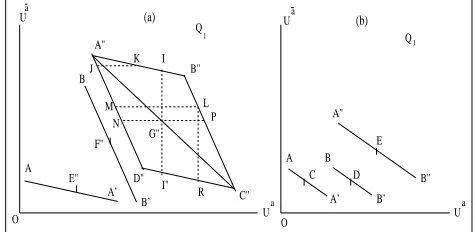
Before obtaining the optimal agenda and procedure, we first describe the multi-issue negotiation protocol we use for our study and the agents’ strategies. Consider the package deal procedure first. Assume that the agents use the same protocol as for single issue negotiation described in Sec-tion 2.1, but instead of making an offer on a single issue, an agent offers a set of pairs (a pair consists of an offer for issue and issue X ), all of which give it equal util-ity. This is because when there is more than one issue, an agent can make trade-offs across issues, resulting in a set of pairs, all of which give it equal utility. As an example, Fig-ure 1(a) illustrates the utility frontiers for two issues: and
X . The segment
is the utility frontier for issue and
X\X
that for issueX . The utility frontier for agendaZMW`X^] is
X
(i.e., the sum of all possible utilities from is-sue and issueX ). For example, the points along (see Figure 1(a)) are pairs of values for issue and issueX that give equal utility to agent
but different utilities to agent . Out of all possible pairs along the only one that lies on the segment
X
is , and this is Pareto-optimal. However, for our incomplete information setting, since an agent does not know its opponent’s utility function, it does not know which of the possible pairs along is Pareto-optimal. Agent
therefore performs trade-offs5 across
and X and offers a set of pairs that correspond to points along instead of a single pair.
Theorem 1 For the package deal procedure, agent ’s
4 Future work will deal with the sequential issue-by-issue approach. 5 Recall that although an agent does not know its opponent’s utility, it
knows its own utility function and can therefore perform trade-offs across issues.
equilibrium strategy is as follows:
>
$NH @
BC Quit if
!
*(
Accept if offer received is better than counter offer Counter-offer
$
at otherwise
where
$
is a set of pairs of the formED
$
D
Y
$
that satisfy the following constraint, :
Y
ED
$
D
$
Y
+ -,
!
V
$
T
Y
+ -,
where W
Y
+ ,
*
+ -,
J
*
Y
+ -, 21
J 21
Y
!
21
J 21
Y
. W
Y
+ -, is the maximum possible cumula-tive utility agent can get from both issues. The equilibrium strategy for agent
is defined analogously.
Proof: Consider agent . Since has a single deadline for both issues, it quits if
!
2(
. The second action (i.e., ac-cept) depends on the relative utilities of the offer agent re-ceives at time period
!
to the counter offer it can send at time . If the highest utility from the set of offers it re-ceives is greater than the utility of its counter offer, it ac-cepts. Otherwise it makes its counter offer. We show that, in equilibrium, agent counter offers a set of pairs of the form
ED
$
D
Y
$
that satisfy constraint , using proof by contra-diction. Agent ’s utility from such a pair is:
Y ED
$
D
Y
$
21
!
D
$
J 21
Y
!
D
Y
$
R
$
21
$
J :1
Y
$
!
ED
$
J D
Y
$
$
Assume that ED
$
D
Y
$
is not an equilibrium offer. This implies that agent can improve its utility (from the fi-nal outcome) by making a counteroffer at that gives it a utility different fromW
Y
ED
$
D
Y
$
. Let
$
Y
$
de-note such a pair. Assume that there is a single issue
with a reserve price of 21
21
J 21
Y to agent and
21
21
JL:1
Y to
. Also assume that the discount factor and deadline for issue
are
and
respectively to agent and
and
respectively to
. In other words, at time , the utility from offerD
$
for the single issue
is analogous to the utility from offer
$
Y
$
for issues andX . Also, we know from Equation 1 that for single is-sue negotiation over
, agent offersD
$
at time where
D
$
gives it a utility of:W ED
$
*
+
-,
!
V
$
W
+
-, whereW
+
-, is the maximum possible utility to from is-sue
. We therefore have:
+
-,
21
!
:1
21
J 21
Y
!
21
J 21
Y
(2)
SinceV
$
is the yield factor in equilibrium for single issue negotiation, it is optimal for agent to offerD
$
at time for the single issue
. This implies that the offer
$
Y
$
(that corresponds to the offerD
$ Y $ D $
. We therefore have:
$ Y $ D $ + -, ! V $ + -, Y + -, ! V $ Y + -, D $ D Y $
This implies that a pair
$ Y $
, that results in agreement and gives agent a utility greater than its utility from agree-ment that results fromD
$ D Y $
, does not exist. All pairs of the formD
$ D Y $
that satisfy therefore form an equilib-rium for package deal. Agent
’s equilibrium strategy can be obtained analogously.
We now turn to the parallel issue-by-issue procedure. For this procedure, each issue is discussed in parallel using the single issue negotiation protocol described in Section 2.1.
Theorem 2 For the parallel issue-by-issue procedure,
agent ’s equilibrium strategy is defined as follows:
> $KH @ B C Quit if ! *('
Accept issue if W D $KH ! [F * ED $ Accept issueX if
W ED Y $NH ! [F W ED Y $ Counter-offerD $
if is not agreed Counter-offerD
Y
$
ifX is not agreed
whereD $ andD Y $
satisfy the following constraints:D
$ * + -, ! V $ W
+ -, andD
Y $ * Y + -, ! V $ W Y
+ -, . Agent
’s equilibrium strategy is defined analogously.
Proof: Unlike package deal, an agent here can accept a
part of the offer it receives (i.e., only one of the two issues) or the complete offer (i.e., both issues). Assume that agent
plays its equilibrium strategy but deviates and offers
$
instead ofD
$
for issue . There are two possible re-lations between the corresponding utilities:\
$ ( * ED $ or * $ * ED $
. For competitive negotiation, if $ ( ED $
for agent , then \ $ \ ED $ for
. Moreover, since
plays its equilibrium strategy, it is possible that the offer
makes in the next time period gives it a utility higher than
$
but lower than.
D
$
. This implies that, at time,
re-jects the offer
$
but accepts D
$
. Furthermore, if hap-pens to be
’s deadline (that does not know) then quits. Thus, if offers
$
, negotiation can end in a conflict but would otherwise have resulted in an agreement if offered
D
$
. This gives inferior utility to both agents. Thus it is not optimal for to offer
$
. On the other hand, if
W $ * D $ for agent we know that
. $ ( \ ED $ for agent . Since
follows its equilibrium strategy, it accepts \ $ , but might otherwise not do so if agent offeredD
$
. This re-sults in inferior utility to agent relative to its equilibrium utility and a superior utility to agent
. It is therefore not op-timal for agent to offerW
in this case either. In
[image:4.612.316.554.33.149.2]U O a A B C" A" K I E" L G" B’ B" N P I" R Ua O Ua A B A" B" B’ A’ E C D (a) Ua (b) F" M D" J A’ Q 1 Q 1
Figure 1. Agents’ utilities in scenario
H
.
other words, if agent
follows its equilibrium strategy, then agent is better off by offeringD
$
. The same argument ap-plies to the offerD
Y
$
for issueX . Agent therefore offers
D $ andD Y $
for issues andX in equilibrium. Agent
’s equilibrium strategy are obtained analogously.
3. Optimal agenda and negotiation procedure
The negotiation outcome depends on both the agenda and the negotiation procedure. The optimal agenda and proce-dure are defined as follows.
Definition 2 An agenda,a
(a
) , is agent ’s (agent ’s) optimal agenda if, for either the issue-by-issue or the pack-age deal procedure, it gives the pack-agent the maximum utility between all possible agendas.
An agent’s utility from an agenda depends on the set of pos-sible outcomes that both agents prefer over no deal (i.e., the zone of agreement for the agenda). On the basis of the zone of agreement for individual issues, we first list all possible scenarios in which negotiation can take place. We then find the optimal agenda, for each agent, for each possible sce-nario. The zone of agreement indicates outcomes that are in-dividual rational to both agents. If agents’ utilities are mea-sured along the two axes, an issue has a zone of agreement if its utility frontier lies in quadrant
H
. Each issue under ne-gotiation may or may not have a zone of agreement. Thus for two issues we have four possible scenarios:
H
Both issues have a zone of agreement.
O Only issue
has a zone of agreement.
P
Only issueX has a zone of agreement.
Neither issue nor issueX has a zone of agreement.
3.1. Scenario
In this scenario, the utility frontiers for both issues lie in quadrant
H
Ua 1 Q
O Ua
A
A’ I
E E’
C
G F
F’
B C’ G’
Q 3
2 Q
Q 4
[image:5.612.318.553.35.149.2]D
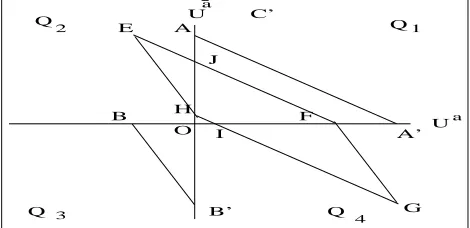
Figure 2. One sided gain to agent in O
.
following ones) an increase in one agent’s utility marks a decrease in the other agent’s utility (i.e., negotiation is com-petitive). In all the figures, the origin represents the conflict outcome. Segment"
represents the utility frontier for is-sue andX.X
that for issueX . When both issues are ne-gotiated, the utility frontier is shown as
X
which represents the sum of utilities from issues andX . Since the utility from agreement on each issue is higher than the conflict utility, each agent prefers to reach an agreement on both issues. In other words, when both issues have a zone of agreement, the optimal agenda includes both issues since each agent’s cumulative utility from the two issues is greater than its utility from a single issue, irrespective of the nego-tiation procedure (i.e.,a
4a
9Z[W`X^] ).
When the optimal agenda includes more than one issue, these issues can be negotiated one-by-one or as a package deal (as per Section 2.2). These two procedures can gener-ate different outcomes, and consequently give different ities to the agents. The one that gives an agent a higher util-ity is its optimal procedure. For a given agenda, the out-comes generated by the two procedures depend on two fac-tors: the corresponding equilibrium strategies and how the agents value the two issues (i.e., equally or differently). Agent is said to value issue more (less) than
if the increase in ’s utility for a unit change in its allocation of the surplus for issue is higher (lower) than the increase in
’s utility for a unit change in
’s allocation for the is-sue. Let *
denote the increase in agent ’s utility due to a unit change in its allocation for issue . Also, let
de-note
*
\
. We refer to
as the agents’ comparative interest in issue . Thus if
W
\
( , agent values issue more than
, and if it equals 1 then the agents value the issue equally. For example, in Figure 1(b), (
Y
).
Theorem 3 If
Y
, each agent’s utility from the pack-age deal is no worse than its utility from parallel issue-by-issue negotiation. If
Y
, package deal and parallel issue by issue negotiation generate the same outcome.
Proof:
Y
: This situation is depicted in Figure 1(a).
U
U O
Q Q
a
C’ A
A’
B’ E
F
G H
B
I J
a
1 2
Q
4
Q 3
Figure 3. Agents’ utilities in scenario O
.
The two segments"
andX.X
denote agent ’s and agent
’s utilities for issues and X respectively. The origin represents the conflict outcome. When the agenda includes both issues, the agents’ combined utilities from the two is-sues lie in the region
X
. Consider parallel issue-by-issue negotiation first. We know from Theorem 2 that in the equilibrium for this procedure, the offer agent makes at time is of the form
U
$
U
Y
$
. For
, it is
U
$
U
Y
$
. We also know thatU
$
U
$
is the offer that
would make if only the single issue was being negotiated. The equilibrium time of agreement for single issue negotiation (denoted
S ) depends on the relation between the agents’ deadlines and their discount factors (see [9] for details). Re-call that each agent has a single deadline for both issues (
for agent and
for
). Furthermore, each agent has the same discount factor for both issues (i.e.,
and ). Con-sequently, if the equilibrium time of agreement for single is-sue negotiation is
S , the time of agreement for each issue, for parallel issue-by-issue negotiation is also
S. Let
and
denote the equilibrium outcomes if each issue is negoti-ated using the single issue protocol of Section 2.1. Then the point
shows each agent’s cumulative utility from both issues for parallel issue-by-issue negotiation.
Consider package deal, where an agent offers a set of pairs that give it equal utility. Recall that the offer that an agent, say , makes at time gives it a utility of
\ Y
+ -,
!
V
$
* Y
+
, . If at time
S it is agent ’s turn to make an offer that corresponds to
, it offers a set of pairs that lie along
, and if it is
’s turn, it offers a set of pairs that lie along
1 . At all time periods
(where
S ) each agent makes offers that give it a higher utility than
. Let denote the offers made by
at time
and denote those made by . This results in an agreement at time
at . However, if the offer that
makes at time
!
gives
a higher util-ity than
, and the offer that makes at
!
gives a higher utility than1 , agreement takes place at time
S , ei-ther at
(if it is agent ’s turn to offer at S ) or at
1 (if it
’s turn to offer at
S ). Thus, an agreement for package deal can occur anywhere along segment
X
[image:5.612.71.286.35.148.2]
X 1 dominate for both agents, the package deal gives each agent a utility that is no worse than its utility for the parallel issue-by-issue procedure. Thus if
Y
, pack-age deal gives each pack-agent a utility that is no worse than its utility from issue-by-issue negotiation.
Y
: The two segments "
andX.X
denote and
’s utilities for issues andX respectively (see Fig-ure 1(b)). When the agenda includes both issues, the agents’ combined utilities from the two issues lie along
X
. Since no trade-offs are possible along
X
, each agent always offers a single pair. An agreement for package deal therefore takes place at time
S and gives each agent a utility that is the sum of its utilities from the equilibrium outcome for single issue negotiation on andX . Thus if
Y
, each agent gets equal utility from parallel issue-by-issue ne-gotiation and package deal.
3.2. Scenarios
and
In scenario O
, issue has a zone of agreement but issue
X does not. Thus both agents prefer an agreement on is-sue to no deal. For issueX , agents can have three possi-ble preferences. First, may prefer an agreement on issue
X to no deal, while
prefers no deal to an agreement on is-sueX . Second,
may prefer an agreement on issueX to no deal while prefers no deal to an agreement. Finally, nei-ther agent may prefer an agreement on issueX to no deal. An agent’s optimal agenda depends on these preferences.
Theorem 4 In scenario O
, there are two possible optimal agendas for the two agents:
1. a
ZMWX ] , a
Z[W] ) or (a
Z[*] ,a
Z[\X^] ) 2. a
4a
9Z[*]
Proof: Since in scenario O
issueX does not have a zone of agreement, the only possible agendas areZM*] andZ[\X^] , one of which is optimal. The outcome for agenda Z[\X ] can differ from the outcome for agendaZM*] in two ways. First, agendaZMW`X^] can either increase the utility of one of the agents relative to agendaZ[W] and reduce that of the other (i.e., result in one sided gain to one of them). Sec-ond, agenda ZMWX ] can reduce the zone of agreement for issue and result in decreased utility to both agents. We an-alyze each of these two cases.
1. Figure 2 illustrates the case where agendaZ[\X ] im-proves the utility of a single agent.
represents the utility frontier for issue and
X that for is-sueX . The origin is the conflict outcome. Here both agents prefer an agreement on issue to no agree-ment, while only prefers an agreement on issueX to no agreement. The utility frontier for agendaZMWX ] is
and the corresponding zone of agreement
is . Consider parallel issue-by-issue negotia-tion for agendaZMWX ] . Let denote the equilibrium outcome and
S the time of agreement for single issue negotiation on . Since issueX does not have a zone of agreement, separate negotiation on it results in con-flict. therefore represents the combined utility from both issues for the parallel issue-by-issue procedure.
On the other hand, for package deal, the set of of-fers made by
at time (
) give it a utility of .
Y + -,
! \ Y
+ , V
$
. But . Y
+ , .
+ , J
Y
+
-, and
Y
+
-,
. Thus
Y
+
-,
+
-, . This implies that an offer that
makes at time for sin-gle issue negotiation over gives it the same utility as the offer it makes at time for package deal. But for , *
+ -,
( and *
Y
+ -,
( . An offer that would make at time (
) for single issue negotiation over would give it a utility of
W
+ -,
!
*
+ -,
V
$
, while the offer it makes at time for package deal gives it a utility of
Y
+ -,
!
Y
+ ,
V
$
. Since
Y
+ -,
(
*
+ -, , an offer that makes at time
for package deal gives it a utility greater than its utility from its corre-sponding offer for the single issue . Let
represent the offer made by and that made by
, at equilib-rium time
S for the single issue
. From the above analysis it follows that the offers
makes at S for package deal lie along
and those that makes lie to the right of
. Let
represent the offers made by at
S for the package deal. Since
for agent , an agreement does not take place at time
S and negoti-ation proceeds to the next time period. Let
denote the offers made by
at time
(where
(0
S ). Since ’s utility at is greater than its utility at
, ac-cepts the offer at . Thus an agreement takes place at some point along
. Since
dominates for , and dominates
for
, the agents’ optimal agen-das are a
Z[\X ] and a
ZM*] . In general, if the utility frontier of issue X lies in quadrant , gets one-sided gain from agendaZ[W`X^] relative to agendaZ[W] . In the same way it can be seen that if the utility frontier for issueX lies in quadrant
O , agenda
Z[\X ] improves
’s utility and reduces that of rel-ative to agendaZM*] . In this case, the optimal agendas area
9Z[\X^] anda
ZM*] .
2. Second, agendaZ[\X ] can reduce the zone of agree-ment and decrease the utility of both agents relative to agendaZ[W] (see Figure 3(a)). Here
andX\X
are the utility frontiers for issues and X . Both parties prefer an agreement on issue to no agreement, while neither prefers an agreement on issueX to no agree-ment. The utility frontier for agendaZ[\X ] is
and
is the corresponding zone of agreement. Since the points on "
dominate those that lie in the region
de-U Q Q
Q Q
A
B
’
’
A
C
B
a
4 3
2 1
a
U
O A"
[image:7.612.317.582.26.270.2]B"
Figure 4. Agenda ZMW`X^] creates a zone of
agreement in scenario .
creases the utility of both agents. Thus, if the utility frontier for issueX lies in quadrant
P
, both agents prefer agendaZ[W] toZ[\X ] . Thusa
7a
0Z[W] .
Thus in scenario O
, agents may have similar, as well as conflicting, preferences over the optimal agenda. First, the optimal agenda for both agents isZ[W] if agendaZ[W`X^] ei-ther destroys or reduces the zone of agreement giving infe-rior utility to both agents. Second, agendaZ[\X ] can im-prove the utility of one agent and reduce that of the other, givinga
ZMWX ] anda
Z[*] .
As for scenario
H
, the optimal procedure for agenda
Z[W`X^] is the package deal if
Y
. If
Y
, both procedures generate the same outcome. Scenario P
is anal-ogous to scenario O .
3.3. Scenario
In scenario , neither issue has a zone of agreement and the utility frontier for neither issue lies in quadrant
H
(see Fig-ure 4).
represents the agents’ utilities for issue and
X those for issueX . The origin represents no deal. Agent would not agree to any of the outcomes on
, since none of them is better than no deal. Likewise,
would not agree to any of the outcomes on
X . Since settlement is prefer-able to no agreement only in quadrant
H
, there are no set-tlement points for either issue. Each of the two issues, if dis-cussed separately, would therefore result in conflict. How-ever, negotiating the issues together is equivalent to taking the sum of utilities. Thus
X
is the zone of agree-ment for agendaZ[\X^] . Including both issues thus creates a zone of agreement and gives each agent a higher utility relative to no deal.
Theorem 5 In scenario , the optimal agenda is identi-cal for the two agents and is eithera
0a
ZMWX ] or
Condition Optimal Optimal procedure
Agenda
Y
if
Y Y
!
if
#"
prefers agreement
$
! if
on issueY
to no deal
Y Y
!
if
while
does not neither agent prefers
$
agreement on issueY
$
to no deal
#%
prefers agreement
Y
! if
on issue
to no deal
Y Y
!
if
while
does not neither agent prefers
&
Y
agreement on issue
Y
to no deal
('
Y
creates a
Y
!
zone of agreement
&
Y
otherwise
)
[image:7.612.71.286.35.156.2]
)
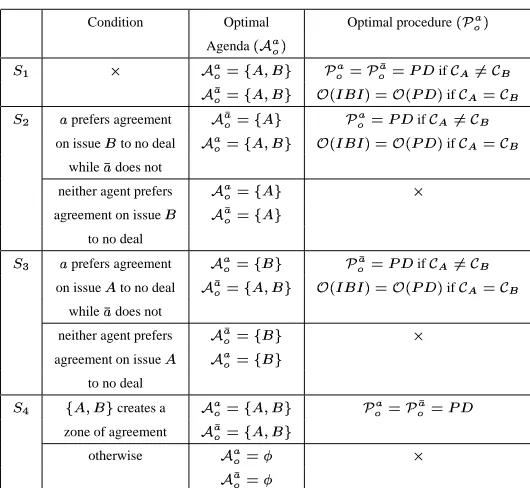
Table 1. Optimal agenda and negotiation pro-cedure for the four scenarios.*6 1
denotes
the outcome for the package deal and*
X
that for the parallel issue-by-issue procedure.
a
4a
,+ .
Proof: Out of the four possible agendas, viz.,+ ,Z[W] ,Z[X ] , orZMWX ] , the two agendasZM*] andZ[X ] always result in conflict. However, if the sum ofZM*] andZ[X ] creates a zone of agreement, both agents get a higher utility from agenda
Z[\X^] relative to the conflict outcome (see Figure 4). The optimal agenda is thusa
7a
Z[W`X^] . But if the util-ity frontiers for issues andX are
andX
respec-tively, the sum of Z[*] andZMX^] does not create a zone of agreement. In this case, both agents prefer no deal to possi-ble outcomes for agendaZMWX ] anda
La
-+ .
It is clear that ifa
0a
_Z[\X^] , then package deal is the optimal procedure for both agents.
These results are summarised in Tab. 1. As can be seen, the optimal procedure depends on the agents’ comparative interests, while the optimal agenda depends on the negotia-tion scenario. Furthermore, it is possible for agents to have identical preferences over the optimal agenda and procedure in each of the four scenarios.
4. Related research
pro-cess of negotiation by assuming that agents have complete information. Second, they treat the agenda and procedure as fixed parameters. For instance, Fershtman [5] extends Ru-binstein’s complete information model [11] for dividing a single pie into two pies. It treats the agenda and the negoti-ation procedure as fixed parameters, imposes an agenda ex-ogenously, and studies the relation between the agenda and the outcome of the bargaining game for the sequential issue-by-issue procedure. It shows that the negotiation outcome, and, consequently, the agents’ utilities, can be changed by changing the orderin which the issues are negotiated. Simi-lar work in a complete information setting includes [7] but this makes the agenda endogenous. [15] treats the agenda as a variable parameter and shows how the negotiation out-come changes by changing the agenda. However, this work does not study how the negotiation procedure affects the outcome. Moreover, it is based on the complete informa-tion assumpinforma-tion.
Multi-issue negotiation models that deal with incomplete information include [1, 3, 4]. For instance, [1] develops a model that has an endogenous agenda. It extends Rubstein’s model for single pie bargaining with incomplete in-formation [12] by adding a second pie. Similar work on endogenous agendas includes [3, 4]. However, while [1] considers uncertainty over deadlines, [3, 4] treats the op-ponent’s deadline and reserve price as uncertain informa-tion. Furthermore, [3] treats each agent’s information as its private knowledge, that is not known to its opponent. Al-though the above models deal with incomplete information, they treat both the agenda and the procedure as fixed param-eters. In short, the work referenced above treats the issues to be negotiated as fixed and studies the relationship between the order (defined either exogenously or endogenously) in which the issues are discussed and the outcome of negoti-ation. In contrast, our work has the dual aim of determin-ing the optimal agenda and procedure by treatdetermin-ing both the agenda and procedure as variable parameters. Furthermore, we do not make the complete information assumption.
5. Conclusions and future work
This paper analysed the process of bilateral multi-issue ne-gotiation by fixing the protocol and varying the agenda and negotiation procedure. We determined equilibrium strate-gies for two negotiation procedures: package deal and issue-by-issue. On the basis of these strategies, we determined the outcomes for all possible agenda–procedure combinations. Finally we showed the optimal agenda–procedure combina-tion, for each agent, in various scenarios. Our study shows that although agents are self-interested, it is possible for them to have identical preferences over the optimal agenda and procedure in each possible scenario.
There are several interesting directions for future work.
First, our analysis focussed on two issues. It is therefore im-portant to generalise it to cover more than two. Second, our study shows that although agents may have similar prefer-ences over the agenda–procedure combination, they cannot recognise such scenarios due to lack of complete informa-tion. We therefore need to design a mechanism that allows them to do this and thereby get improved utilities.
References
[1] M. Bac and H. Raff. Issue-by-issue negotiations: the role of information and time preference. Games and Economic
Be-havior, 13:125–134, 1996.
[2] P. Faratin, C. Sierra, and N. R. Jennings. Negotiation deci-sion functions for autonomous agents. International
Jour-nal of Robotics and Autonomous Systems, 24(3-4):159–182,
1998.
[3] S. S. Fatima, M. Wooldridge, and N. R. Jennings. Optimal negotiation strategies for agents with incomplete informa-tion. In J. J. Meyer and M. Tambe, editors, Intelligent Agents
VIII. Agent Theories, Architectures and Languages, number
2333 in LNAI, pages 377–392. Springer Verlag, 2002. [4] S. S. Fatima, M. Wooldridge, and N. R. Jennings. An agenda
based framework for multi-issue negotiation. Artificial
Intel-ligence Journal, 152(1):1–45, 2004.
[5] C. Fershtman. The importance of the agenda in bargaining.
Games and Economic Behavior, 2:224–238, 1990.
[6] C. Fershtman. A note on multi-issue two-sided bargain-ing: bilateral procedures. Games and Economic Behavior, 30:216–227, 2000.
[7] R. Inderst. Multi-issue bargaining with endogenous agenda.
Games and Economic Behavior, 30:64–82, 2000.
[8] S. Kraus. Strategic negotiation in multi-agent environments. The MIT Press, Cambridge, Massachusetts, 2001.
[9] M. J. Osborne and A. Rubinstein. A Course in Game Theory. The MIT Press, 1994.
[10] H. Raiffa. The Art and Science of Negotiation. Harvard Uni-versity Press, Cambridge, USA, 1982.
[11] A. Rubinstein. Perfect equilibrium in a bargaining model.
Econometrica, 50(1):97–109, January 1982.
[12] A. Rubinstein. A bargaining model with incomplete informa-tion about time preferences. Econometrica, 53:1151–1172, January 1985.
[13] T. Sandholm and N. Vulkan. Bargaining with deadlines. In
AAAI-99, pages 44–51, Orlando, FL, 1999.
[14] J. C. Schelling. The strategy of conflict. Oxford University Press, 1960.
[15] J. K. Sebenius. Negotiation arithmetic: Adding and sub-tracting issues and parties. International Organization,
37(2):281–316, 1983.
[16] X. Zhang and V. Lesser. Multi-linked negotiation in multia-gent systems. In Proceedings of the First International
Con-ference on Autonomous Agents and Multi-Agent Systems,