ORIGINAL ARTICLE
INTRODUCTION
Evisceration is the removal of the intraocular tissues without the optic nerve, sclera and the extraocular
muscles (1). Painful blind eye, endophthalmitis, acute ocular trauma and disfiguring blind eye are major reasons for evisceration (2).
Irreversible loss of visual function and the evisceration procedure, which leads to a major change in facial appearance, must be considered as both physical and psychological trauma for patients. For some patients, the evisceration procedure not only means they lose their eye and eyesight but have also lost a part of their face and
ORIGINAL ARTICLE
Eye Prosthesis in Patients with Evisceration Improve
Quality of Life and Internalizing Symptoms While
Social Functioning is Unaffected: A Prospective Study
Corresponding author: Meliha Zengin Eroglu,
Haydarpasa Numune Training and Research Hospital, Department of Psychiatry, Istanbul, Turkey
E-mail: [email protected]
Received: July 05, 2018 Accepted: September 26, 2018
Citation: Zengin Eroglu M, Ersanli A. Eye Prosthesis in Patients with Evisceration Improve Quality of Life and Internalizing Symptoms While Social Functioning is Unaffected: A Prospective Study. Psychiatry and Behavioral Sciences 2018;8(4):164-70.
https://doi.org/10.5455/PBS.20180705091222
ABSTRACT
Objective: Patients, who undergo evisceration, often experience psychosocial problems because of their facial disfigurement. Our purpose is to assess pre and post-operative quality of life and psychological changes such as level of anxiety and depression of these patients.
Methods: Thirteen female and thirteen male patients, who applied to the Ophthalmology Clinic of the Istanbul Haydarpaşa Numune Training and Research Hospital for an evisceration procedure, were included in this study. The study was designed as prospective. The socio-demographic data of the patients was assessed for both ophthalmological and psychiatric examinations. The Structured Clinical Interview for DSM-IV Axis I Disorders (SCID-I), Short Form-36 quality of life questionnaire (SF-36), Beck Anxiety Scale (BAS), and Beck Depression Inventory (BDI) were administered prospectively during the pre-evisceration period and post-implantation of eye prosthesis period.
Results: The results indicated that 53.8% of the patients reported general changes in their lives after their loss of vision. Fifty percent of patients reported a loss in their daily living activities, 34.6% of patients reported loss in their jobs and 19.2% of patients divorced from their spouses or partners. The mean time from the development of vision loss to the evisceration procedure was 14.7±14.1 (min 0-max 54) years. The scale scores of the BAS and BDI were statistically significant before the evisceration procedure and after the implantation of an eye prosthesis (p=0.000, p=0.000 respectively). There was a statistically significant difference in the sub-scale scores in the quality of life questionnaire before the evisceration procedure and after implantation of the eye prosthesis, except for the social functionality sub-scale.
Discussion: Loss of vision has deep impacts on people’s life. Implantation of eye prosthesis does not contribute to visual function, but positively contributes to patients’ psychological status and quality of life. A multidisciplinary approach is needed at this long path from vision loss to eye implantation.
Keywords: Evisceration, loss of vision, eye prosthesis, quality of life, psychiatric disorder
Meliha Zengin Eroglu1 , Aysegul Ersanli2
thus a part of their personality (2). In addition, the psychological state before and after evisceration may result in further challenges during this process.
Unless someone is born with congenital anomalies, people are born “complete,” meaning having two eyes, two ears, a mouth, a nose and the other sense organs. People are used to see their faces complete and symmetrical when they look in the mirror (3). However, any loss of facial organ, in particular an eye, can make people feel incomplete, repulsive or even scary and eventually unhappy. Individuals may have different emotional reactions such as anger, sadness, anxiety, uncertainty, hope and optimism when they face to trauma. Such reactions may often cause an unhealthy state, considered as a psychiatric disease which requires clinical support.
Patients with visual loss are individuals who already have significant losses in their psychological and social lives. Loss of vision can affect many daily activities of a person such as reading, driving, seeing the face of a family member clearly, cooking, sewing or having any need of the ability for clear vision (4). Loss of the job, partner, relations or facial esthetic is the compelling aspects of the visual loss. Even if the orbitofacial disfigurement has came out due to the treatment of a disease such as cancer, patients have some difficulties in their social relationships (5). Their lives are directly affected by the increasing dependence to family members (6). A study from Turkey shows that self efficacy, level of coping skills and level of environmental sufficiency of blind individuals were lower than the ones of individuals with low vision and control group (7). All these factors make individuals, with visual impairment, more susceptible to psychiatric illnesses. Psychiatric disorders such as adjustment disorder, depression, behavioral disorder, high level of anxiety and personality disorders are frequently came out in this group of patients (7-9). At this point, eye prosthesis implementation may have a direct effect on patient’s total body health and quality of life. But it has some difficulties in its own process as mentioned above.
Currently eye prosthesis with advanced technology can be as natural as healthy eye. It simulates the
characteristics of the other eye and helps in restoring the normal facial appearance. Although it does not help to repossession of visual functionality, the eye prosthesis restores the normal eye movements during the speech and improves the facial expression. So it may help enhancement on life quality of patients.
The aim of this prospective study is to determine changes in the life quality of a patient group before the evisceration and after eye implantation procedure.
METHODS
and first, second, and forth week after the evisceration. Eye prostheses were implanted at the forth week.
Psychiatrist evaluated the patients just before evisceration and six months later after evisceration. So the study consisted of two steps. The Structured Clinical Interview for DSM-IV Axis I Disorders (SCID-I) was applied during the examination. The self-reported Beck Depression Inventory (BDI), Beck Anxiety Scale (BAS) and SF-36 Quality of Life questionnaire (SF-36) were applied at both two steps. All patients were evaluated by sociodemographic form, including some open-ended questions about life quality. There was no drop out of patients within the study period.
Psychometric scales
The socio-demographic data collection form, developed by us, was used during the study. Patient’s data such as age, gender, marital status, and number of children were collected. In the next part, patients were asked questions related to the reason for their loss of vision, the duration of their condition, the course of their disease, their previous operations, and the implications of their disease on their lives. It was not asked to patients whether the blind eye is dominant eye or not. The patients were specifically asked whether the loss of their vision had generally changed their lives or resulted in problems in their business, their relationships with spouses or partners or in their daily and social lives.
Structured Clinical Interview for DSM-IV Axis I Disorders (SCID-I): This is a structured clinical interview, composed of six modules, applied by the interviewer to investigate the diagnosis of Axis I psychiatric disorders. It investigates 38 axes I disorders with diagnostic criteria and 10 axis I disorders without diagnostic criteria in total, and takes an average of 30–60 minutes to apply the interview. It was developed by First et al. in 1997 (11). The Turkish validity and reliability study was conducted by Özkürkçügil et al. under the title structured clinical interview for DSM-IV Axis-I disorders (12).
The Beck Depression Inventory (BDI): BDI is one of the most commonly used inventories in depression-related investigations. It is self-reported by the patient, and has
21 questions in total (15 regarding psychological symptoms and 6 regarding somatic symptoms). Each item is scored 0–3 points. The depression score is obtained from the total of these scale values. The highest possible score is 63 and the lowest is 0. A high total score indicates a high level or severity of depression. According to Hisli’s validity and reliability study the cut-off value of scale is identified as 17. The study indicates that a score of 17 or over distinguishes depression severity that requires treatment with 90% accuracy (13, 14).
The Beck Anxiety Scale (BAS): It has 21 questions and each answer is scored between 0–3 points. A high total score indicates the severity of the individual’s anxiety. The validity and reliability study was determined by Ulusoy et al (15).
The SF-36 Quality of Life Questionnaire: SF-36 was developed by Ware in 1987 and the validity and reliability study was conducted by Koçyiğit et al. (16). It consists of eight-scaled scores: physical functioning, physical role functioning, bodily pain, general health perception, vitality, mental health, social role functionality, and emotional role functionality. Each subscale is scored between 0–100 points. A higher score on the scale indicates a better health status, whereas a lower score indicates impairment.
Statistical analysis
The SPSS-22 statistical package program was used to analyze the data. A Ki-square test was used to compare categorical variables, incidence, and rates. Continuous data was given with mean ± standard deviation. In comparison of the continuous variable of mean values of both groups, t test was used and the Mann-Whitney U test was used in absence of parametric assumptions. The Wilcoxon signed-rank test (two-tailed) was used as nonparametric test equivalent to the dependent t-test to investigate any change in scores from one time point to another.
RESULTS
socio-demographic characteristics, the average age was 50.7±17.1 years (range 21-73 years old). Regarding relationship status, 69.2% of the patients were married, 19.2% were separated/ divorced, and 11.5% were single. Regarding to education, 34.6% were educated to a literate level, 46.2% were primary school graduates, 11.5% had graduated high school, and 7.7% were university graduates. 61.5% were employed and the rest were unemployed.
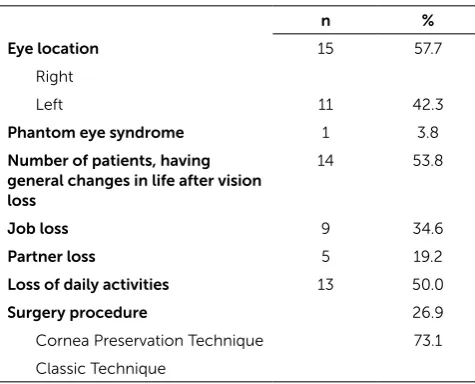
Regarding the operation, 42.3% of the patients had lost their left eye and 57.7% their right eye. The average age of the vision loss was 36.0±22.0 years (min 2- max 72 years old). Regarding lifestyle, 53.8% (n=14) of the patients stated that loss of vision had caused a general change in their lives, 34.6% (n=9) had lost their jobs, 19.2% (n=5) had separated/divorced from spouses or partners and 50% (n=13) had changed their daily activities. It was noted that the patients underwent evisceration 14.7±14.1(min 0-max 54 years) years after losing their vision. The main reason for evisceration was phthisis bulbi (38.5%). Regarding the procedure of the operation, 73.1% (n=19) of the patients had undergone evisceration without cornea preservation (classic technique), and 26.9% (n=7) with cornea preservation technique. Post-operation, 38.5% of the patients complained about pain and 23% about pain and nausea (Table 1).
The initial psychiatric evaluation (before evisceration) revealed that 42.2% (n=11) of the patients had various psychiatric conditions (26.9% depression, 11.5% anxiety disorders and 3.8% bipolar disorder. Second psychiatric evaluation (after six months later evisceration) detected that 34.5% (n=9) of the patients had various psychiatric conditions. Types and rates of psychiatric disorders were 26.9% depression, 3.8% bipolar disorder, and 3.8% substance addiction.
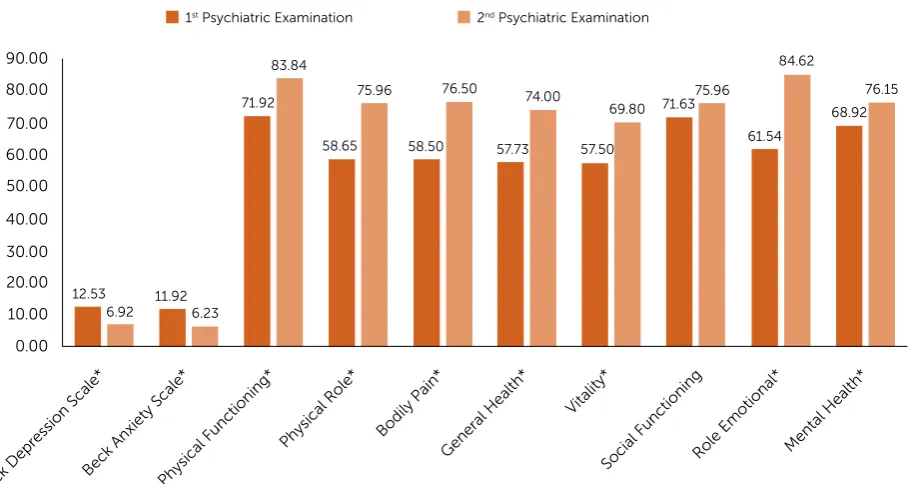
The comparison of BAS, BDI and SF-36 scale scores at first and second psychiatric examination revealed statistically significant differences in all parameters except in the social functionality subscale of SF-36. The BAS and BDI scores were high before to evisceration, while the SF-36 scores were high at second psychiatric examination (Fig. 1).
DISCUSSION
Our study demonstrates that implantation of eye prosthesis affect positively patients’ quality of life in general terms (Fig. 1). According to our data, the life quality of patients improves and the levels of anxiety and depression decrease after eye prosthesis. But the adaptation process after the loss of an eye is a very challenging process. Evisceration causes significant changes in the lives of these patients in many aspects. Patients might withdraw from their families and social circles while trying to adapt themselves to their new situation.
The studies about anophthalmic patients share data from different parts of the world, such as North Europe, the Far East, and the USA, reflecting different social and cultural presentations (17-19). There are very few studies about the life quality of anophthalmic patients. These studies assess patients’ quality of life mainly after eye amputation. However, our study draws attention in another direction and we assessed the quality of life of patients both before evisceration and the consistency of eye prosthesis (six months later evisceration).
Another study with a similar design evaluated the impact of enucleation on uveal melanoma patients (20). In this study, the patients were evaluated with the BDI and SF-36 before enucleation and post-enucleation after
Table 1: Relationship of burden severity with some variables
n %
Eye location 15 57.7 Right
Left 11 42.3
Phantom eye syndrome 1 3.8
Number of patients, having general changes in life after vision loss
14 53.8
Job loss 9 34.6
Partner loss 5 19.2
Loss of daily activities 13 50.0
Surgery procedure 26.9
Cornea Preservation Technique 73.1
three months and after one year. Before the surgery, patients were sensitive about the diagnosis and treatment. The BDI showed minimal-to-mild changes. Three months after the surgery, the scores showed that depression had developed to mild-to-severe and the difference was statistically significant. The authors attributed this difference to the state of the disease which was evident in post-enucleation at three months. The patients were assessed once more at one year post-surgery. The level of depression of 14 out of 16 patients was minimal. Unlike from this study, we assessed the patients before evisceration and six months after evisceration. However, it is not possible to compare the two studies, since the patients were assessed in different periods and on different scales and the reason for enucleation in the first study was melanoma, a life threatening disease. For instance, no patients had been diagnosed with a malignant disease in our study. Therefore, our patient group might have interpreted evisceration in a more traumatic way, whereas the patients in the first study might have considered the procedure as a part of their recovery from a fatal disease. We also believe that the age, adaptation period, and cultural differences might have affected the results of the assessment.
Personal perception, experience and structure of personality may be considered to be influential at manifestation of psychopathologies because there is no direct relationship between psychiatric disorders and life stress. The age of losing vision affects the psychological structure and psychosocial development of the person. Individuals who have congenital loss of vision and those who subsequently experience loss of vision show different attitudes. There is a direct acceptance of loss of vision at the beginning in individuals who have congenital loss of vision. They defined that they felt more fortunate than those who had lost sight afterwards. This was due to the fact that they reported that they did not feel as if they had a visual loss. Depression and trauma often accompany to subsequently experiencing of visual loss (21, 22). We could not show the effect of the age of losing vision at life quality in our study because of our small sample.
In Denmark, the life quality of patients who underwent an eye amputation was assessed in a study, which revealed that patients experienced significant changes in their lives. For instance, 25% of the patients reported business life changes such as retirement or part-time employment (17). Likewise, a 2008 study, conducted in Korea, compared the life quality between anophthalmic patients
90.00
80.00
70.00
60.00
50.00
40.00
30.00
20.00
10.00
0.00
Beck Depr
ession Scale*
Beck Anxiety Scale* Physical F
unctioning*
Physical Role* Bodily Pain*General Health*
Vitality*
Social F unctioning
Role Emotional* Mental Health* 12.53
6.92 11.92
6.23 71.92
83.84
1 Psychiatric Examination 2 Psychiatric Examination
58.65 75.96
58.50 76.50
57.73 74.00
57.50
69.80 71.63 75.96
61.54 84.62
68.92 76.15
Figure 1: Comparison of BAS, BDI and SF-36 Scale Scores between 1st and 2nd Psychiatric Examinations. BDI: Beck
and healthy individuals. The study found that anophthalmic patients had less scores in all eight subscales of SF-36 (18).
Another study that was performed on patients who underwent eye amputation in 1988, confirmed that 37% of the patients suffered from changes in their lives, 10% of the patients experienced business problems and 17% of the patients suffered from anxiety and self-image problems (23). Likewise Coday et al. reported in their study that patients who underwent eye amputation were exposed to changes in their lives; 23% of the patients experienced business problems, 39% had difficulty driving, 40% suffered from social problems and 50% experienced trouble in their sports and hobbies (19). Our study demonstrated that 53.8% (n=14) of the patients experienced a general impact in their lives, 34.6% (n=9) lost their jobs, 19.2% (n=5) lost their spouses or partners and 50% (n=13) of the patients had difficulties in their daily life activities. Kondo and et al. found that people who had evisceration-enucleation in one eye had general physical and mental health-related quality of life (HRQOL) points nearly equivalent to the normal binocular group. However, the National Eye Institute Visual Function Questionnaire (NEI VFQ) indicated that the eviscerated-enucleated people had visual deficiencies compared to the healthy group (15).
We reported only one phantom eye syndrome in our study. “Phantom eye syndrome” is defined as a visual hallucination, and “hallucination” is defined by some authors as an unreal sensory perception of an organ in the absence of external stimulation (16, 17).
Blind individuals showed lower self-efficacy, inadequacy of coping skills, higher levels of social anxiety, lower perceived social support and lower social participation than healthy individuals (7). 42.2% (n=11) of our study sample had psychiatric disorder and psychiatric treatment at first psychiatric examination and 34.5% (n=9) at second one. Both having psychiatric medical treatment and implantation of eye prosthesis might be affected the patients’ psychopathology. Depression and bipolar disorder have usually long courses. So the rates of these disorders didn’t change before and after surgery procedure. However, because of the reduction of uncertainty about the process, the rate of anxiety disorder
was reduced at the sample. But we have no explanation about de nova substance use disorder after evisceration. Although there are studies, reporting an increase of psychopathology at visually impaired children and adolescents, some studies report that rate of depression and quality of life are similar to their healthy peer (24, 25). In a study blind adolescents and healthy aged peers were compared in terms of quality of life, psychosocial and school functionality. It was found that the level of quality of life in visually impaired adolescents was similar to that of healthy aged peers and psychosocial,and school activities were found to be significantly lower (24).
Organ loss also includes other losses such as functional loss, sensory loss and bodily image loss. Individual differences observed in the reactions before and after amputation might be linked to many interrelated factors, for example role change, age, personal traits, medical history, rehabilitation expectations, previous losses, the family’s approach, coping methods, social support, cultural factors, business and economic conditions, etc. Treatment teams should be ready to cooperate with the department of psychiatry in case they experience difficulties understanding the reactions of patients and their families to evisceration and post-operative treatment and to increase patients’ compliance.
Small sample sizes, lack of psychiatric evaluation after evisceration, absence of knowledge about dominant eye are primary strengths of the study. Powerful aspects of the study are its interesting subject, lightening feature about a neglected area and follow up style.
believe that only such a comprehensive approach can facilitate this challenging process.
Ethics committee approval: This study was approved by the local
clinical research ethics committee (Haydarpasa Numune Training and Research Hospital), and written informed consent was obtained from all the participants prior to the commencement of the study. The study was conducted in accordance with the Declaration of Helsinki.
Conflict of Interest: There is no conflict of interest with any
financial organization regarding the materials discussed in the manuscript.
Financial Disclosure: None declared.
REFERENCES
1. Schaefer D. Evaluation and management of the anophthalmic socket and socket reconstruction. Smith's ophthalmic plastic and reconstructive surgery 2nd ed St Louis: Mosby 1998. 2. Rasmussen MLR. The eye amputated–consequences of
eye amputation with emphasis on clinical aspects, phantom eye syndrome and quality of life. Acta Ophthalmol 2010;88(thesis2):1-26. [CrossRef]
3. Belon HP, Vigoda DF. Emotional adaptation to limb loss. Phys Med Rehabil Clin Am 2014;25(1):53-74. [CrossRef]
4. Unluçerci C. Eye Health, Causes, Precautions and Treatments of Eye Diseases. Istanbul: Association for the Protection of Eye Health and Visually Impaired Person Service 2007. (Turkish). 5. Bonanno A, Esmaeli B, Fingeret MC, Nelson DV, Weber
RS. Social challenges of cancer patients with orbitofacial disfigurement. Ophthalmic Plast Reconstr Surg 2010;26(1):18-22. [CrossRef]
6. Fahim AT, Daiger SP, Weleber RG. Nonsyndromic retinitis pigmentosa overview. 2017.
7. Ozkan E. Investigation of The Self Efficacy, Social Anxiety, Coping Skills and Environment Effect of Social Participation in Adult Blind People and People with Low Vision. (Master). Ankara: Hacettepe University; 2013.
8. Haymes SA, Johnston AW, Heyes AD. Relationship between vision impairment and ability to perform activities of daily living. Ophthalmic Physiol 2002;22(2):79-91. [CrossRef]
9. Cetinkaya S, Ozec AV, Ozdemir D, Kavakci O, Sumer H, Erdogan H. Coping strategies with depression and anxiety in
glaucoma patients. Cumhuriyet Medical Journal 2013;35(1):39-50. (Turkish) [CrossRef]
10. Taskiran Comez A, Akcay L, Ozgur O, Dogan O. Evisceration with and without cornea preservation with posterior sclerotomies. Acta Ophthalmol 2013;91(5). [CrossRef]
11. First M, Spitzer R, Gibbon M, Williams J. Structured clinical interview for DSM-IV clinical version (SCID-I/CV, Version 2.0). New York: Biometrics Research Department, New York State Psychiatric Institute 1997.
12. Ozkurkcugil A, Aydemir O, Yildiz M, Danaci E, Koroglu E. Adaptation and reliability study of structured clinical interview for DSM-IV axis I disorders. Ilac ve Tedavi Dergisi 1999;12(4):233-6. (Turkish)
13. Beck A, Ward C, Mendelson M, Mock J, Erbaugh J. An inventory for measuring. Arch Gen Psychiatry 1961;4(6):561-71. [CrossRef]
14. Hisli N. A reliability and validity study of Beck Depression Inventory in a university student sample. J Psychol 1989;7(23):3-13. (Turkish)
15. Ulusoy M, Sahin NH, Erkmen H. Turkish version of the Beck Anxiety Inventory: psychometric properties. J Cogn Psychother 1998;12(2):163.
16. Kocyigit H. Reliability and Validity of the Turkish Version of Short Form-36. Ilac ve Tedavi Dergisi 1999;12(2):102-6. (Turkish).
17. Rasmussen ML, Ekholm O, Prause JU, Toft PB. Quality of life of eye amputated patients. Acta Ophthalmol 2012;90(5):435-40. 18. Ahn JM, Lee SY, Yoon JS. Health-related quality of life and
emotional status of anophthalmic patients in Korea. Am J Ophthalmol 2010;149(6):1005-11.e1. [CrossRef]
19. Coday MP, Warner MA, Jahrling KV, Rubin PA. Acquired monocular vision: functional consequences from the patient’s perspective. Ophthalmic Plast Reconstr Surg 2002;18(1):56-63. 20. Amaro T, Yazigi L, Erwenne C. Depression and quality of life
during treatment of ocular bulb removal in individuals with uveal melanoma. Eur journal Cancer Care(Engl) 2010;19(4):476-81. [CrossRef]
21. Schinazi VR. Psychosocial implications ofblindness and low-vision. Working paper CASA Working Papers (114). London, UK: Centre for Advanced Spatial Analysis (UCL); 2007. 22. Thurston M, Thurston A, McLeod J. Socio-emotional effects of
the transition from sight to blindness. British Journal of Visual Impairment 2010;28(2):90-112. [CrossRef]
23. Linberg JV, Tillman WT, Allara RD. Recovery after loss of an eye. Ophthalmic Plast Reconstr Surg 1988;4(3):135-8. [CrossRef]
24. Wong HB, Machin D, Tan SB, Wong TY, Saw SM. Visual impairment and its impact on health-related quality of life in adolescents. Am J Ophthalmol 2009;147(3):505-11. e1. [CrossRef]