THESES SIS/LIBRARY TELEPHONE: +61 2 6125 4631
R.G. MENZIES LIBRARY BUILDING NO:2 FACSIMILE: +61 2 6125 4063
THE AUSTRALIAN NATIONAL UNIVERSITY EMAIL: [email protected]
CANBERRA ACT 0200 AUSTRALIA
USE OF THESES
This copy is supplied for purposes
of private study and research only.
Passages from the thesis may not be
copied or closely paraphrased without the
'The big ones swallow the small ones.' Or do they? The language policy
and practice of ethnic minority education in
the Lao PDR: A case study
from Nalae.
A thesis submitted for the degree of Doctor of Philosophy of The Australian National University
by
Angela Rose Cincotta
Acknowledgements
I would like to thank all those institutions and individuals who contributed to the completion of this study, including: the Lao Ministry of Education and the Lao National Research lnstitute for Educational Sciences for their administrative suppoti and endorsement; the
Luang Nam Tha Provincial Education Service for assistance with communications and health care; the Nalae District Education Bureau for access to facilities and for support and assistance throughout the fieldwork; Ministry of Education staff for generously giving their time for interviews; Or James Chamberlain and Dr Richard Noonan for the sharing of ideas
and doctm1ents; Elisabeth Preisig and Souksavang Simana for assistance with K.mhmu language learning materials; the staff and students of all participating schools for their openness and enthusiasm; the residents of participating villages for their hospitality and
generosity; and most importantly, the teachers and students of the three case·study classrooms, whose dedication to their work and interest in this study were inspirational and
whose patience will not be forgotten. Special thanks go to my invaluable counterparts and friends at the Nalae District Education Bureau, Phaengphet and Haksuan, without whom I
could not have done this work. Thank you also to Shio, for everything.
This thesis is the original work of the author, Angela Rose Cincotta. All sources have been acknowledged.
Angela Rose Cincotta
Abstract
The Lao People's Democratic Republic is one of the most ethnically and linguistically
diverse nations in Southeast Asia. Since 1975, the Communist government has touted as its hallmark a discourse of interethnic equality and solidarity, particularly in the field of education. However, a critical reading of government policies and planning measures over the past 30 years reveals a persistent discourse of ethnic Lao cultural and linguistic centrality.
This thesis seeks to identify the various Lao government discourses on language, ethnicity and education, then to explore how these divergent official discourses are reproduced, adapted or contested on the ground through language practice in ethnic minority classrooms.
1t begins with a discourse analysis of selected policy texts, then moves on to an analysis of the code-switching practices of teachers and students in three ethnic minority primary school classrooms in relation to the official discourses. The thesis aims both to increase our
understanding of language, ethnicity and education in the Lao context and to contribute to academic discussions on the relationship between the Slate, minority languages, education and power. It is based on one year's fieldwork in the ethnic Kmhmu primary school
classrooms of Nalae district, northwestern Laos, and four years' previous experience working in the Lao education sector.
Contents
Acknowledgements ... II Abstract ... IV
1 Introduction ... 1
1.1 The research questions ... 1
1.2 Rationale ... 3
1.3 The researcher's experience in the Lao context ... 6
1.4 Theoretical framework and methods ... 7
1.5 Outline of the thesis ... 8
1.6 Ethnic groups in the study ... 9
1.7 Education and ethnicity in Laos ... 11
2 Methods ... 17
2.1 lntroduction ... 17
2.2 Official endorsement and collaboration ... ; ... 18
2.3 Research design ... 18
2.3.1 2.3.2 2.3.3 2.4 2.4.1 2.4.2 2.5 2.6 2.6.1 2.6.2 2.6.3 2.6.4 Ethnography ... 18
Beyond ethnography ... 20
Ethnography or ethnographic case studies? ... 21
Research site and participants ... 22
Selection of the research site ... 22
Selection of participating classrooms ... 23
Research ethics ... 26
Research, part one: the policy ... 28
Selection of policy texts ... 28
Analysis of policy texts ... 30
Policy interviews ... 32
2.7 Research, part two: the community ... 33
2.8 Research, part three: the classroom ... 34
2.8.1 Classroom visits ... 34
2.8.2 Classroom data collection ... 34
2.8.2.1 The observation code ... 35
2.8.2.2 Video recordings ... 36
2.8.3 Transcription of classroom data ... 37
2.8.4 Analysis of classroom data ... 37
2.8.5 Teacher interviews ... 41
2.9 Reliability and validity of the research ... 42
2.9.1 The community and classroom research ... 42
2.9.2 The policy research ... 44
2.10 A note on language ... 44
2.10.1 Language proficiency of the researcher ... 44
2.10.2 Transcriptions and orthographies ... 45
3 Language policy, ethnic minorities and education: A review of the literature ... 47
3.1 Introduction ... 47
3.2 The state, minorities, and national identity ... 48
3.3 Language and power In the state ... SO 3.4 Ethnic minorities, minority policy and language in Laos ... 53
3.5 Education in Laos ... 61
3.6 Reading Discourse Analysis ... 68
3.7 Discourse in the classroom ... 75
4 Solidarity and power: Discourses on language, ethnicity and education at the national level 4.1 Introduction ... 77
4.1.1 Reading policy ... 77
4.2 Ethnic minorities, language and education in Laos: A historical overview ... 79
4.2.1 Traditional Lao polities ... 80
4.2.2 The French colonial period ... 81 4.2.3 The Royal Lao Government ... 85
4.2.4 The Pathet Lao ... 87
4.2.5 The Lao People's Democratic Republic ... 91
4.3 Policy discourses ... 93
4.3.1 Selective diversity ... 93
4.3.2 Lao as the language and culture of development ... 102
4.3.3 The state as agent ... 109
4.3.4 'The big ones swallow the small ones': the naturalisation of cultural and linguistic domination ... 112
4.3.S Diversity as a problem ... 113
4.3.6 Minority languages as secondary and instrumental ... 115
4.4 Conclusion ... 118
5 Language and ethnicity at the local level: An introduction to Nalae ... 121
5.1 lntroductlon ... 121
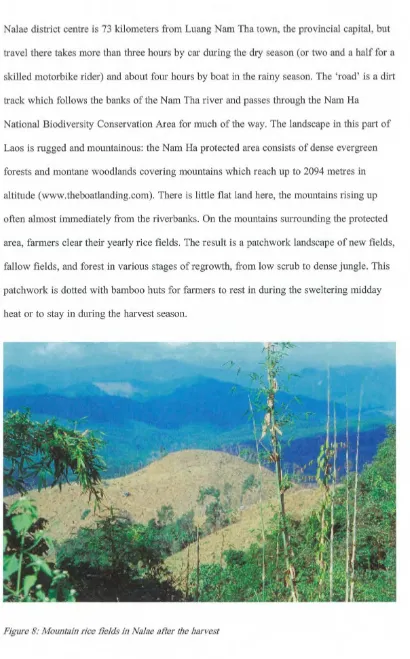
5.2 The geography of Nalae ... 122
5.3 Ethnicity and interaction in Nalae ... 125
5.3.1 Ethnic groups ... 125
5.3.1.1 Ethnic composition of the district ... 125
5.3.1.2 The Kmhmu ... 126 5.3.1.3 The Tai Lue ... 130 5.3.1.4 Other groups ... 131
5.3.2 Distribution of villages ... 132
5.3.3 Historical interactions between ethnic groups ... 135
5.3.3.1 Within Nalae ... 136
5.3.4 lnterethnlc relations in Nalae today ... 141
5.4 Language in Nalae ... 146
5.4.1 Languages and dialects of Nalae ... 146
5.4.1.1 Lue/Lao ... 146
5.4.1.2 Klnhn1u ... 148
5.4.2 Language contact in Nalae ... 149
5.4.3 Language proficiency across groups ... 152
5.4.4 Language domains or switching? ... 155
5.4.4.1 Kmhmu use in Nalae ... 155
5.5 Language choices in community and classroom: An overview of the literature .157 5.5.1 Language In community and classroom: the literature on Laos ... 157
5.5.2 Language choice in bilingual communities: the early literature ... 158
5.5.3 Code switching: key contributions ... 160
6 Saisana: vigilance, resistance and acquiescence ... 174
6.1 lntroduction ... 174
6.1.1 Saisana ... 174
6.1.2 Ha:d Kha:o village and school ... 175
6.1.3 Students' Lao language proficiency ... 176
6.1.4 Outline of the chapter ... 177
6.2 Salsana's classroom language ... 177
6.2.1 Monolingual Lao vigilance ... 177
6.2.1.1 Kmhmu switches as backstage language ... 177
6.2.1.2 Kmhmu for interpersonal, non-academic purposes ... 182
6.2.1.3 Rejection of Kmhmu responses ... 183
6.2.1.4 Lao as safetalk ... 188
6.2.2 Student resistance ... 196 6.2.2.1 Students' and parents' use of Kmhmu for metacommunicative purposes
6.2.2.2 Students' and parents' use of Kmhmu for managerial purposes ... 204
6.2.2.3 Students' on-stage interactions in Kmhmu ... 207
6.2.3 Teacher acquiescence ... 210
6.3 Saisana's community language ... 213
6.4 Conclusion ... 216
7 Khamsuk: Pragmatic bilingualism ... 218
7.1 7.1.1 7.1.2 7.1.3 7.1.4 7.1.S 7.1.6 7.2 7.2.1 7.2.2 7.2.3 7.2.4 7.3 7.3.1 7.3.2 7.3.3 7.3.4 7.4 7.5 Introduction ... 218
Khamsuk ... 218
Khamsuk's Kmhmu language proficiency ... 218
A note on transfer and borrowing in Khamsuk's Kmhmu ... 219
The village and school ... 222
Students' Lao language proficiency ... 223
Outline of the chapter ... 223
Lao as Ideal language ... 224
Lesson and activity frames ... 224
Reformulations ... 230
School discourse related code choice ... 238
Routine classroom language ... 241
Pragmatic bilingualism ... 243
The interpersonal and beyond ... 243
Kmhmu for complex elaboration ... 245
Kmhmu for text scaffolding ... 256
Acceptable necessity ... 261
Khamsuk's community language ... 262
Conclusion ... 265
8 Ceng: Signalling Lao status, sharing Kmhmu identity ... 266
8.1.l Ceng ... 266
8.1.2 Ceng's Kmhmu and Lao language proficiency ... 266
8.1.3 Ban Phu: Khi:ao village and school ... 268
8.1.4 Students' Lao language proficiency ... 270
8.1.5 Outline of the chapter ... 270
8.2 Signalling Lao Status ... 271
8.2.1 Routine classroom language ... 271
8.2.2 8.2.3 8.2.4 8.3 8.3.1 8.3.2 8.3.3 8.4 8.5 School discourse related code choice ... 275
Explicit Lao language teaching ... 279
'On-stage' Lao and 'back-stage' Kmhmu ... 285
Sharing Kmhmu identity: Kmhmu dominance in the classroom ... 291
Borrowing from Lao as contact induced ... 292
Proportion of classroom communication in Kmhmu ... 294
Interpersonal dimensions of code choice ... 299
Ceng's language In the community ... 305
Conclusion ... 315
9 Conclusion ... 317
9.1 9.2 9.2.1 9.2.2 9.2.3 9.3 9.3.1 9.3.2 9.4 9.5 Looking back on official discourses ... 317
Looking back on classroom language: policy and practice ... 321
Classroom case study one ... 321
Classroom case study two ... 323
Classroom case study three ... 325
Theorizing the policy-practice relationship ... 328
Rethinking policy ... 328
Official policy and teacher policy: Conceptualizing the divide ... 329
Language-in-education planning in Laos: Looking back, looking forward ... 335
References ... 344
Appendix 1: Classroom observation codes ... 356
Appendix 2: Sample lesson analysis table ... 358
Appendix 3: Latin orthography for Lao ... 371
Consonants ... 371
Voweis ... 373
Diphthongs I Triphthongs ... 374
Appendix 4: Latin orthography for Kmhmu ... 375
Consonants ... 375
Vowels ... 377
1 Introduction
This is a study of language, education, ethnic minorities and the Lao state. Its aim is twofold. Firstly, it seeks to identify the discourses on education, ethnic minority peoples and their languages which are articulated within the structures of the Lao state. In order to do this, it looks to policy texts, their interpretations by key actors working within the agencies of the state, and the policies' implementation (or otherwise) on the ground. It does this in tandem with an analysis of the historical context of ethnic relations in Laos.
The second aim of the study is lo explore whether the state's discourses on language, ethnicity and education are reproduced by ethnic minority students and their teachers through classroom language use. The study considers code-switching practices in particular, and supports this analysis with the analysis of ethnic relations in the local community and of teachers' own comments on the topic.
1.1
The research
questions
The Lao People's Democratic Republic is a small, landlocked country of fewer than six million people which lays nestled in the fertile river valleys and rugged mountains between China, Vietnam, Cambodia, Thailand and Myanmar. With around 85% of its population engaged in subsistence agriculture (World Bank, 2005: 5), and ranked 130 out of 177 countries on the UNDP Hwnan Development Index (UNDP, 2007- 2008), it is one of the least economically developed countries in Southeast Asia. However, with up to 230 ethnic groups, it is one of the region's richest in ethnic and linguistic diversity. The ethnic Lao comprise approximately fifty percent of the population (Lao National Statistics Centre, 2005)1, and the wider Tai family to which they belong approximately seventy-one percent (Gordon, 2005), while the remainder of the population belongs to three ethnolinguistic
1
families: Austroasiatic, Hmong-Mien and Sino-Tibetan, and a myriad of smaller language groups.
The Communist government of the Lao P.O.R., since coming to power in 1975, has ruticulated a concern with ethnic minorities which appears greater than that of previous regimes (Stuart-Fox, 2003). This concern has been expressed in the proliferation of policy documents addressing minority issues, the appointment of ethnic minority cadres and staff to its Party and government agencies, the creation of a multiethnic national image in
government sponsored visual media, and collaboration on a host of internationally funded development projects which target ethnic minority communities.
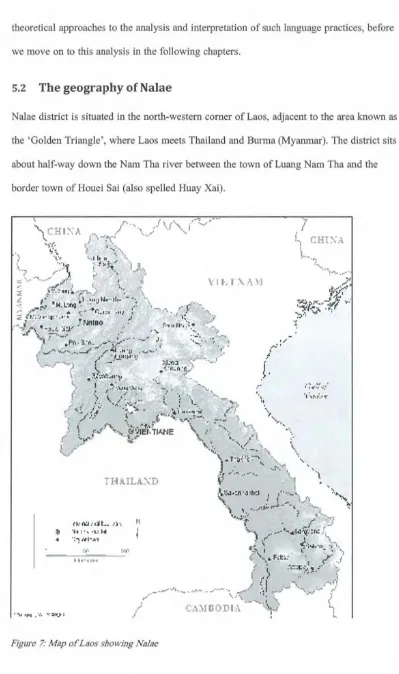
Yet this heightened concern with ethnic minorities in Laos is accompanied by discourses of ethnic Lao centrality apparent in those same policy documents, cultural representations and planning initiatives. A closer reading of government policy reveals a tension between the rhetoric of interethnic equality and solidarity, and Lbe ideology of a culture hierarchy with the ethnic Lao at the top. Likewise, an examination of planning measures in minority education reveals a discourse of ethnic Lao cultural and linguistic dominance.
This leaves us with the question of whether there is a dominant official discourse on ethnic minority cultures and languages in the Lao PDR and what it might be, and if not, how apparently contradictory discourses are reconciled by government actors. It also prompts us to ask whether and how the ambiguities and tensions in official discourses are expressed or resolved on the ground by ethnic minority people themselves.
code-switching practices, as these code choices demonstrate the roles attributed to each language resulting from teachers' discourses on language use - whether or not these are consistent with the discourses articulated in the official policies. The thesis seeks to answer the following questions:
1. What arc the official discourses on minority peoples, languages and education in the Lao P.D.R. as expressed in policy documents, readings by key actors, and
educational platming initiatives?
2. How do teachers and students in ethnic minority communities reproduce, adapt or contest these discourses through their classroom language use, specifically through code-switching between Lao and the minority language, and what do they have to say about these responses?
3. What can we learn from this about ethnicity, language and education in Laos and about the nature of majority-minority cultural and linguistic relations more generally?
1.2
Rationale
To date, almost no academic research has been carried out in the field of ethnic minority education in Laos. Several reports by international donor agencies and non-government organizations working in Laos have addressed issues in ethnic minority education, one of which focused exclusively on language in education (c.f. Power, 2002), and the remainder of which included sections on minority education in general ( c.f. ADB, 1993, UNICEF, 1996, ADB, 2000, ADB, 2001, Norway and Education, 200 I, World Bank, 2005, World Bank and Lao Ministry of Education, 2007). However, none of these reports was based on extended ethnographic research or systematic linguistic data collection, none was in-depth or comprehensive, and none was an academic study. Only one academic paper has been published on the topic of minority education in Laos (Kosonen, 2005), and even this is a
c
(
brief overview of the context in comparison to other countries in the region, rather than an in-depth study of the Lao education policies and practices.
Despite this lack of academic research, there are currently several bi-and multi-lateral education development projects in the Lao education sector which focus on or include ethnic minority components2
• In addition to this, there are many non-government organizations implementing smaller minority education projects, including Save the Children (UK) and Norwegian Church Service, among others. There is also an AusAID-funded program aimed at unifying education development approaches within the Lao Ministry of Education. That is, there are enormous efforts being made to improve education for ethnic minorities in Laos without any detailed understanding of what the Lao government's policy and planning orJcntatlon is, and how teachers and students are currently responding to it In classrooms. Understanding the Lao ethnic minority and language-in-education policy context, including its tensions, ambiguities and shifts, would assist aid donors, development workers and their Lao counterparts in collaborative policy development efforts.
To date there has been considerable confusion and lack of consensus in this area. Multi-million dollar education development project proposals from AusAID and the World Bank, to give just two examples, have been subjected to prolonged negotiations, significant revisions, and delays in commencement due to the conflicting goals of donors and the government3; key planning documents such as Education For All have been subject to different readings among government and foreign stakeholders (c.f. Cincotta, 2006); and
2
These include projects financed by the ADB, the EU, the World Bank, and the World Food Program, with an AusAID financed project and a Swedish International Development Agency funded project having been completed In 2007, and an Agence Franr;aise de Developpement project completed in mid-2008.
3
donor-initiated policy discussions have been refused permission at the last minute4• Increased understanding of the Lao government's orientation to language, education and ethnic minorities would constitute a first step in improved collaboration and cooperation between the aid donors and recipients in this context.
Furthermore, many of the intended outcomes of the education development projects which arc implemented, and of the Lao government's own education initiatives, focus on the improvement of educational cufficula and materials, teaching methods, enrolment, retention. performance, and completion rates for ethnic minority students. Yet neither the Lao
government nor the donors have detailed information on what is currently occurring in ethnic minority classrooms, why, and bow it is effective or ineffective. Understanding how teachers and students in these contexts respond to the policy would allow for improved language-i11-education planning, teacher recruitment and deployment, teacher training programs, and cu1Ticulum and materials design: that is, it would guide the Lao Ministry of Education in devising and implementing planning measures which are in line with teachers' and students' actual needs tmd preferences.
On a more academic level, understanding of the official Lao policy discourses and how these are reproduced (or not) at the local level can contribute to our understanding of the nature of cultural and linguistic domination by majority groups within the nation state. Much has been said about structure and agency and the degree to which members of minority groups reproduce or resist their own economic and ideological subjugation. The present study contributes to this discussion. It also adds to the literature on code-switching both generally and more specifically in the classroom. lt idenUfies some practices previously not emphasized in the literature and questions common characterizations of the role of minority languages in formal teaching and learning.
4
Finally, the study paints a picture of three unique individuals, their language practices and beliefs, and the conununities and classrooms in which they live and work. It is as much a story of these people and my time with them as it is a contribution to education development in Laos or to academic discussion and debate.
1.3
The researcher's experience in the Lao context
My relationship with Laos began at the end of J 999, when I went there as an Australian Volunteer Abroad to write curriculum, train teachers and tee1ch in the English Department at the National University of Laos. l quickly developed a love for the country and after two years at the University decided to stay on. 1 moved to the countryside outside Vientiane to establish and run a language 1rnining program for a Luxembourg government-funded project there.
After six months doing this, I began work for the Lao-Australia Basic Education Project, a country-wide ethnic minority education development project fonded by the Australian government aid agency, AusAID. l was based first in Salavan in the far South of the country, then in Luang Nam Tha in the northwest, both times at teacher training institutions. As part of this job, I was also fortunate enough to travel to some of the most remote parts of the country to work with ethnic minority teacher trainees and teachers in their own villages. 1t was at this time that I learned first-hand of the great chaJlenges facing ethnic minority teachers and students in Laos, and of their great creativity and resilience.
Jn 2005 1 carried out one year of fieldwork in Nalae district, Luang Nam Tha province, a
district which I had visited several times while working for the LA BEP project and where I
had friends and professional contacts. I returned to Nalae for some additional fieldwork in 2007 and since then have remained in touch with my friends and colleagues there by phone - a luxury which we did not have until 2007 - and by old-fashioned mail.
Fortunately my Lao language proficiency allows me to do this with ease. I speak, read and write Lao fluently and have taught Lao language in the Faculty of Asian Studies at the
Australian National University for several semesters. My Kmhmu is less fluent as, apart from some initial and rudimentary research in Australia, I only learned the language during my fieldwork in Nalae. However, J an1 proficient enough to understand most of what occurs in the classroom in Kmhmu without assistance and to carry on everyday conversations in the language. More will be said on language issues In the research in chapter two.
1.4
Theoretical framework and methods
This research combines textual analysis and ethnographic methods
to
paint a picture of both the macro and micro levels of language, ethnicity and education in Laos. It draws on insights from the fields of history, anthropology, discourse analysis, descriptive linguistics, and interactional sociolinguislics and in turn may have a contribution to make to more than one of these fields.The section of the thesis addressing policy discourses uses Critical Discourse Analysis of selected policy texts and of interviews with key Lao government officials, together with a synthesis of relevant information from the historical and anthropological literature on Laos. TI1e section concerned with classroom language practice is based on ethnographic data collection in local classrooms and interviews with teachers, in addition to ethnographic observation of the local community more generally. Analysis of the classroom data was
A detailed description of the theoretical framework for the study is given in chapter three, the Literature Review, while a detailed discussion of the research methods is provided in chapter two. the Methods.
1.5
Outline of the thesis
The following chapter of this thesis is the Methods chapter, which presents the details of how the study was carried out and the rationale for this. It covers the research design, research affiliations and ethical procedures, the research site and participants, data collection and analysis methods, reliability and validity, and ends with a note on language.
Afler this is a brief review of the literature relevant to this study. As the study aims lo provide a holistic plcn1re of both language policy and practice in ethnic minority education in Laos, the literature reviewed in this chapter is drawn from a broad base. Other relevant literature is also discussed throughout the thesis as it becomes relevant. ln particular, the literature on code-switching is discussed in chapter five, immediately before the thesis moves on to the analysis of classroom code-switching practices.
Following on from the Literature Review is the chapter titled 'Solidarity and Power: Discourses on Language, Ethnicity and Education at the National Level'. This chapter discusses the policy arow1d ethnic minorities and ethnic minority education in Laos. It begins with a historical overview of ethnic relations in Laos then moves on to a discussion of discourses articulated in current policy documents, and by their main producers and consumers.
discusses language in Nalae and concludes with a review of the literature which will be relevant to the subsequent discussion of code-switching.
The next chapter, 'Saisana: Vigilance, Resistance and Acquiescence' is the first of the
classroom case studies. It presents the case of a teacher whom T have called Saisana and her first and second grade students. In chapter seven, 'Khamsuk: Pragmatic Bilingualism',
Saisana's case is contrasted with the case of Khamsuk and hjs class. Tn chapter eight, 'Ceng:
Signalling Lao Status, Sharing Kmhmu Identity', both cases are again contrasted with the
case of an ethnic Kmhmu teacher and his students.
The final chapter of U1e thesis is the Conclusion, which draws together the analysis of policy
and of classroom practice. It reviews the policy discourses and the classroom practices before thcoriziug the policy-practice relationship, coll1rnenting on the state of
lang11agc-in-education policy and planning in Laos today, and suggesting topics for future research.
Before moving on to the next chapter, some background information on ethnicity and
education in the Lao PDR is provided in order to familiarize the reader with the context of
the study.
1.6
Ethnic
groups in the study
Issues around ethnicity in Laos will be explored in depth in the chapters which follow;
however, a brief introduction to the context may be useful to the reader at thjs stage. It was
noted above that there are up to 230 ethnic groups in Laos. In fact, the number cited ranges from the official govcmmont number of 49, to Ethnologue's total of 82 (Gordon, 2005), to
Chamberlain's estimate of 230 (ADB, 2001: iii) depending on the source. This is due to poor or insufficient linguistic data collection in the country, differences in the definition of
what constitutes an ethnic (or a linguistic) group, and in some cases, inaccmate analyses and
Tai-Kadai - 71 %, Austroasiatic - 24. l %, Hmong-Mien - 4%, and Sino-Tibetan - 1 % (Gordon, 2005), although these figures too are contested.
The Tai-Kadai group in Laos includes the ethnic Lao, the politically dominant ethnic group in the country and the group generally considered to be the majority, although the ethnic Lao do not in fact constitute a numerical majority on their own. The Tai-Kadai group in Laos also includes the traditionally upland-dwelling Black Tai, Red Tai, White Tai, Tai Leu, Phuan, and Meuy, among others.
The Lao language is closely related to Thal, both in its spoken and written forms, although Lao speakers tend to understand Thai better than the inverse due to greater exposure through popular media. Members of the Tai-Kadai family in Laos traditionally speak dialects (or languages) close enough to each other to allow for some mutual understanding, although in some cases this is minimal.
The Tai group which inhabits the area where this research was carried out is not the Lao but the Tai-Lue (Lii, Lu). Traditionally, the Tai-Lue speak a language which, although closely related to Lao, would be difficult to comprehend for a Lao speaker with no prior exposure. However, most young Tai-Lue today speak a mixture of Luc and Lao with the degree of Lue influence often depending on the perceived linguistic competence of their listeners.
Vietnamese, although their language is not mutually intelligible with either of these and is traditionally without a scripf.
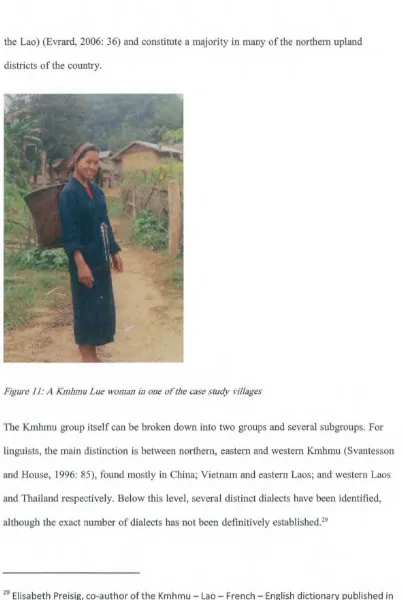
More will be said on the Kmhmu language in chapter five. However, for now it should be noted that this language is in a different family from Lao (and Lue) and thus not related or muwally intelligible, apart from some loan words which have moved in both directions. Many Kmhmu people, especially in the area where this research was carried out, speak very little or no Lao and for Kmhmu children entering school in the villages, Lao is effectively a foreign language.
1.7
Education and ethnicity in Laos
The Lao school system is three-tiered, with five years of primary schooling, five years of lower secondary, and three years of upper secondary, all officially delivered in the Lao language. Jn reality only a small fraction of the Lao population completes this cycle. Although Lao education indicators have been improving over the past forty years, they remain behind the indicators for its neighbours in the region, and abysmal in comparison to indicators for industrialized nations. There is also enormous discrepancy in the educational attainments of different groups in Laos, with ethnic minorities falling far behind their ethnic Lao counterpa11s on all counts.
On average, a Lao person aged between 18 and 60 years has received 5.5 years of
schooling. This is a marked improvement on the average of 2 years in 1960. However, when disaggregated the current average becomes approximately 8.5 years for an urban 18 year old
5
Lao and Latin script orthographies have now been developed for Kmhmu but are not in usage among Kmhmu people aside from some researchers in the Lao capital and their small sample groups.
f
of the ethnic Tai6 group, just over 4 years for a rural non-Tai 18 year old man, and less than 2 years for a rural non-Tai 18 year old woman (World Bank, 2005: 3).
In fact, in 2002-2003, over 70% of rural non-ethnic Tai women had never been to school (ibid: 16). In 2005-2006, the net primary school enrollment rate for Lao children was 83.9%, which is slightly behind Cambodia and Myanmar (World Bank and Lao Ministry of Education, 2007: 9). However, when disaggregated the rate was 90% for urban Tai males and approximately 92% for urban Tai females, around 81 % and 80% respectively for their rural counterparts, 60% for rural non-Tai males and only 51 % for rural non-Tai females. When poverty is added to the equation, the enrollment rate is a shocking 46% for poor, rural non-Tai females (ibid: 12).
These low educational levels for ethnic minorities, especially women, are reflected in literacy rates. The available figures show that 72.9 % of Tai self-report as literate, with a rate of 84.4% for males and 62.3% for females. However, the rate is only 36.9% for the Mon-Khmer family, with 55.6% for males and a 1nere 19.9% for females. For the Hmong-Mien family the overall rate is even lower, at 26.5% (m
=
45.7, f=
8.1), and for the Tibeto-Burman family it is the lowest, at 17% (m=
22.3, f=
12%) (ADB, 2002: 24).The low primary school enrollment rates for rural ethnic minorities are certainly related to school access: 86.4% of ethnic Tai children have access to a primary school compared to 79.3% of non-Tai children (World Bank, 2005: 38). However, these figures hide the disparity in types of schools to which Tai and non-Tai children have access. While 8.7% of Tai children have access to a complete primary school (i.e. with all five grades), 011ly 4.7% of non-Tai children have the same (ibid: 44). While the difference may not seem great, most Tai children reside in less remote, lowland areas and are thus likely to have access to a
nearby complete school, while the nearest complete school may be a few hours' to one day's walk away for rural ethnic minority children. Tai children in urban areas are also more likely to have access to a school with electricity: almost half of urban primary schools (thus majority Tai) have electricity while less than one tenth of rural schools (including minority schools) do (World Bank, 2005: 41 ).
Low enrollment rates among ethnic minorities arc not only related to issues of access. They are also caused by the inability of parents, especially those with large families, to pay for school materials and uniforms; the need for families to engage their children in agricultural and domestic labour; and sometimes, especially for girls, the perceived lack of usefulness of formal schooling (Lao Ministry of Education, 2002: 46).
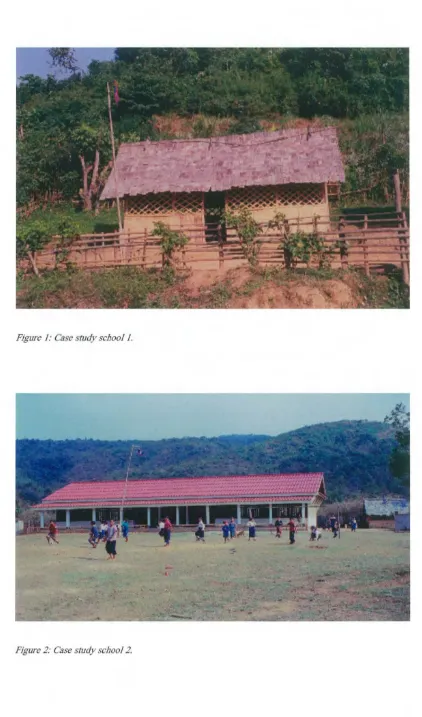
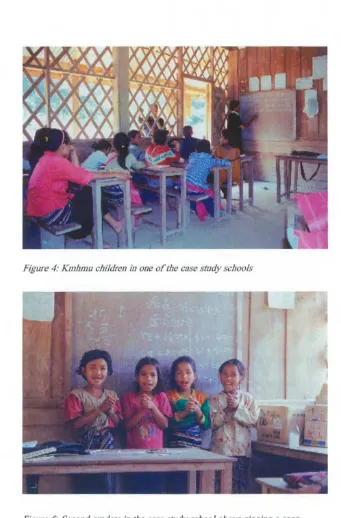
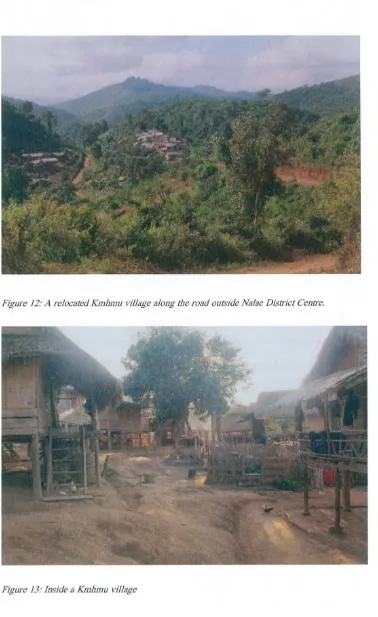
Research has also shown the physical condition of school buildfags to affect enrollment (c.f. World Bank, 2005: 67). Although much effort is being put into building new schools in Laos, the typical highland village primary school is still made of wood or bamboo with open windows and a tin or thatched roof - the former sweltering in the hot season and the latter often in need of repairs in the rainy season. There are usually homemade wooden benches and desks, and a damaged blackboard. Some might argue that the conditions are not very different from those in students' homes. However, students are not required to sit in one spot and pay attention for long periods in their homes, nor are parents required to deliver formal lessons there.
Figure 1: Case study school 1.
Figure 3: Case study sc/Jool 3.
Most children in highland schools do not own their own textbooks but share with two or more of their classmates. It is not uncommon for the teacher to have the only textbook for a subject and to dictate or copy onto the board from that. Most schools do not have additional teaching materials or equipment unless provided by a donor-funded project, although larger
schools may have a wordboard, an abacus, and some wooden counting sticks.
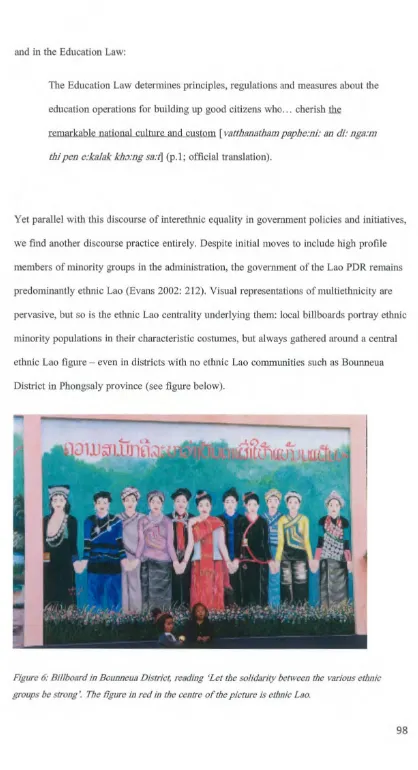
Despite this disadvantage and the sometimes negative perceptions of schooling, especially for girls in ethnic minority conununities, schools in remote highland areas arc full and the teachers and students there continue their daily efforts to work through the national ctuTiculum against all odds.
(
Figure 4: Kmhmu children in one of the case study sc/Joo/s
2
Methods
z.1
Introduction
The purpose of this study, as discussed in the previous chapter, is to investigate the
discourses and practices around minority languages in Laos on the national, local, and
classroom levels and to explore the relationships between them. Because the study aims to
achieve a deep understanding of the social and cultmal forces involved and to present what
Clifford Geertz called 'thick description' of the processes being investigated, the overall
design of the research is ethnographic. However, as the study is multi-levelled, exploring
government policy, commtrnity speech practices and classroom language patterns, it is
necessary to draw from a range of disciplines to arrive at an appropriate design for lhe data
collection and analysis. The study thus draws 011 the disciplines of policy analysis,
discourse analysis, antlu·opology, interactional sociolinguistics, classroom ethnography,
microethnography, and critical post-structuralist approaches to the study of code switching
practices. Much of the methodology and analysis has also been developed as grounded
theo1y, emerging from the forms and patterns of the data rather than being imposed upon
them.
The data sources and methods employed for the study included the following:
• collection and analysis of government policy texts addressing ethnic minority, language
and education issues;
• interviews with Ministry of Education officials regarding the pol icy texts;
• observation of language use and attitudes to ethnic minorities and langtrnges in the local
community;
• observation, recording, analysis and interpretation of language use in ethnic rni11ority
classrooms;
This chapter will describe the design and implementation of the research, including the selection of the research site and participants, procedures for ethical acceptability, methods for data collection and analysis, validity and reliability, and technical issues around
transcription and orthographies, before the next chapter moves on to an analysis of the data.
2.2
Official
endorsement
and collaboration
ThJs research was carried out with the official permission of the Lao Ministry of Education and under the supervision of the National Research Institute for Educational Sciences (Laos). Supervision involved initial consultations with Institute officials on the research and a final report (in English) and presentation (in Lao) by the researcher. At the research site, the Provincial Education Service of Luang Nam Tha provided a communication channel with the national level authorities and day-to-day support and collaboration were provided by the District Education Bureau of Nalae. This included the provision of accommodation, access to office equipment, initial accompaniment on school visits, assistance with
transcription and translation of Kmhmu, and other advice and assistance as required. Official endorsement and supervision was necessary for the undertaking of the research, but did not impact on the research design or methods, as NRIES had no involvement beyond initial consultations and the final report.
2.3
Research design
2.3.1 Ethnography
as a participant observer (or at times simply as an observer). It is also due to the ultimate
aim of ethnographic work being what Clifford Geertz, borrowing from Gilbert Ryle, termed
'thick description' (Geertz, 1975): that is, a description which is context-based and considers
all possible meanings of what has been observed.
The effectiveness of qualitative methods such as ethnography in educational research also
lies in their ability to describe actual practice in schools and its convergence and divergence
from policy (Vulliamy, 1990: 17). As Hornberger explains, an ethnographic approach:
'offer[s] unique insights into (Language Policy and Planning) processes through
thick descriptions of policy interpretation and implementation at the local level.
Historical and intertextual analyses of policy texts can capture the confluence of
histories, attitudes and ideologies that engend1;:r a language policy but, alone, cannot
account for how the creation is interpreted a11d implemented in the various
contextual layers through which a language policy must pass' (Hornberger, 2007:
511).
This is not true of quantitative methods, including sociological methods such as
questionnaires and surveys, which often start from the assumption that the policy is being
implemented. The more accurate picture drawn by ethnographic studies in turn informs the
development of more appropriate education policy. A further advantage of ethnographic
design is that, in educational contexts where little or no research has been carried out (such
as the Lao one), it can identify questions for future large-scale quantitative investigations
where desired (ibid: 18).
It is for these reasons that an etlmographic model was adopted for the present research. The
use of the term 'ethnographic' here should be clarified, however. The study grew out of four
years experience working in the education sector in Laos and involved a one year sojourn in
educational context there. However, as the classroom research was canied out in seven schools, including three focal schools, it was not possible to be immersed in any of these classroom environments on a daily basis.
Lutz (1993) distinguishes between trne eUUlographies, in which the researcher is immersed in the specific research context every day for an extended period of time, and studies which employ 'ethnographic methods' but only involve occasional or periodic visits to the research site. According to this distinction, the present study can be considered an ethMgraphy of the broader context, but a study which simply employed 'ethnographic methods' in the seven classroom contexts. However, this should not be taken to imply that the study was what has sometimes been called 'blitzkrieg ethnography' (Rist, 1980). Each classroom case study presented here is based on frequent and regular observation over the period of one year, as is explained in section 2.8. l below.
A further issue in calling the research an ethnography, or even simply 'ethnographic', is that classroom contexts do not generally allow the researcher to adopt the prescribed role of the ethnographer as participant observer. Although some researchers have participated in the primary school classroom as students (e.g. Homberger, 1988) in order to remain true to the spirit of participant observation, it is generally accepted that participation as a student in these contexts is problematic (Wolcott, 1988). Certainly participation as a teacher would impact strongly on the behaviour of the other teachers being observed and on the children's
attitudes to the researcher, and is thus ruled out. For these reasons, the role of the
ethnographic researcher in educational settings has been referred to as 'privileged observer' (Wolcott, 1988). It is in this role that I attended lessons in the seven classrooms in Nalae.
2.3.2 Beyond ethnography
interpretation of this data as was possible. The specific means I used to do that will be discussed in the following sections. However, it is important to note here that the research design did not involve only classroom ethnographic methods, but included the collection and analysis of policy documents and the interviewing of education officials and teachers. These techniques arc commonly used in tandem with ethnographic observation in order to provide additional and supporting data. In this case, they were necessitated by the multileveled nature of the research question and allowed for the richest possible data collection, analysis and interpretation.
2.3.3 Ethnography or ethnographic case studies?
Until this point, the classroom component of the research has been described as ethnographic in design (albeit incorporated with other elements). I lowever unlike most etlmographic research, which is carried out in one setting over an extended period, this research was carried out in several classrooms. It might be more appropriate, then, to describe the design of the classroom research as a series of ethnographic case studies.
There were several reasons for carrying out a multi-sited study as opposed to a single sited one. Firstly, my prior knowledge of the context suggested that there was a wide range of approaches being taken to language use in the classroom. A series of case studies would capture some of this diversity among teachers and settings. Secondly, I (perbaps like most outsiders to these classroom contexts) assumed that one of the greatest differences in language use would be between ethnic minority teachers and lowland Lao teachers. It was thus important to include at least one member of a minority group and one lowland Lao teacher in my study. The third reason relates to the generalisability of the study.
Case studies have been criticised, mostly by proponents of 'scientific' research designs, for their apparent lack of generalisability due to the small sample size - usually of one. This
criticism has been countered with several arguments. Firstly, as Spindler argues:
An in-depth study that gives accurate knowledge of one setting not markedly dissimilar from other relevant settings is likely to be generalisable in
substantial degree to those other settings .. .it is better to have in-depth, accurate knowledge of one setting than superficial and possibly skewed or misleading information about isolated relationships in many settings (Spindler 1982 in Yul Jiamy, 1990: 12).
A further argument for the generalisability of case studies is that any setting can be typical or atypical and this is not readily predictable at the outset; it is up to the reader of the research to determine a posteriori to what degree the case st11dy is relevant to his or her own context (Walker, 1993: 167). Other educational researchers have argued that any case study can be rendered more generalisable by taking one of three approaches: designing it to ensure that the setting is typical and/or carrying out multi-sited studies; selecting a topic and site which is relevant to future trends; or selecting a site which is ideal in some way and can thus be used as a model for other settings (Hitchcock and Hughes, 1989: 326). The option of carrying out a multi-sited study in order to increase generalisability was taken here.
2.4
Research site and participants
2.4.1 Selection of the research site
The research site, Nalae district in Luang Nam Tha province, northwestern Laos (see chapter five for map), was a place already familiar to me before beginning this research. I had visited the district several times for my work with an AusAJD funded education
development project and had worked with the staff of the District Education Bureau there. However, the selection of Nalae as the research site was the outcome of a long process of elimination.
• that the district be populated mostly by ethnic mi11orities, and thus representative
of upland districts in Laos;
• that the 'minority' language (i.e. not Lao) be one which could be learned to a
moderate degree of proficiency in a short time;
• that there be year-round access by road or river;
• that the provincial and district education authorities be interested in the research,
cooperative and reliable;
• that, if possible, the education authorities be people with whorl.'\ I had already
worked (true of 17 districts in Laos).
These criteria privileged Mon-Khmer speaking districts, as Mon-Khmer languages have
relatively simple syntax which is generally quite simllm· to Lao, a language with which 1
was already very familiar (see section 2.10. I below). However, they ruled out some of the
southern Mon-Khmer districts of the country, which were inaccessible except on foot for
months at a time dming the rainy season. Other districts were not ideal due to my lack of
close familiarity with the education authorities there.
In the end, there were two districts which met all these criteria and with which I was very
familiar. After a phone call or meeting with the Head of each District Education Bureau
(DEB), I selected Nalae due to the supportiveness and capability of the staff there and my
greater familiarity with it. This selection was endorsed by the National Research Institute for
Educational Sciences under the Lao Ministry of Education.
2.4.2 Selection of participating classrooms
The multi-sited design of this study was not chosen in order to carry out controlled
comparison of language use patterns between classrooms with different characteristics, for
example ethnic minority and majority teachers or remote and road-side locations. Rather, it
was intended to give a fuller picture of the diversity of classroom language practices. For
classrooms. It was considered important, however, to include classrooms which differed
from each other in significant ways in order to maximize the possibility of finding different
language practices.
For this reason, i1 was ensured that each criterion below was met by at least one classroom,
aJthough of course each classroom would have its own particular configuration of sewral of
these criteria:
Ethnic minority teacher Ethnic majority teacher
Remote location (no road or frequently Non-remote location (along main road or
impassable secondary road; over three hours under three homs wulk from district centre)
walk from district centre)7
Formally qualified teacher8 Unqualified teacher
Grades l - 2 Grade 3
Grades 1 to 3 were prioritized for selection as it was assumed that students in the higher
grades would have a much higher proficiency in the Lao language and there would thus be
less mother tongue instruction (although this assumption was subsequently proven to be
wrong). No classes with a teacher who had less than three years teaching experience were
chosen, as it was assumed that less experienced teachers would be less likely to have
developed teaching styles which they considered effective and more likely to feel sel
f-conscious under observation.
7 Villagers from villages under three hours walk from the district centre, Including young girls
and boys, frequently visit the centre on their rest days, whereas those from villages further than this are less likely to visit frequently.
8
When discussed with staff at the DEB, the list of criteria above yielded eight classrooms for
potential inclusion in the study, each in a different school and village. After meetings with
the respective village authorities and teachers (see section 2.5 below), all of these
classrooms were selected for inclusion, however persistent problems with the road leading to
one of the villages, which was five hours away on foot, led to the classroom in tJ1at village
being excluded after the first visit. Even with the exclusion of this village, each of the eight
characteristics listed above was still represented in the sample.
The remaining seven classrooms were each visited periodically during the first three months
of the research, which corresponded to the last three months of the academic year. In the
new academic year, three of the seven case study classrooms were selected as 'focal case
studies' due to the possibility of frequent access, and the apparent naturalness of the teachers
while being observed.9 The four non-focal classrooms were visited two or three times each
during the first semester of the new academic year, while the three focal classrooms were
visited regularly (see section 2.8.1 below for details on classroom visits).
The three focal classrooms had the following characteristics:
9
Some of the teachers in the larger group appeared nervous or asked during or after observation whether the way they were using the languages was 'right'. The three focal case
study teachers neither appeared nervous nor asked about the correctness of their language
Classroom 1 Classroom 2 Classroom 3
Lowland Lao teacher Lowland Lao teacher Kmhmu teacher Non-remote, roadside Non-remote 2.5 hours walk Non-remote, roadside
from centre
Mulligrade 1-2 Multigradc 3-4 Multigrade 1-2
Unqualified teacher Unqualified teacher Unqualified teacher
It can be seen from this comparison that the three focal classrooms differed on some important characteristics, such as teacher ethnicity and grade, but were similar in other regards. This allowed for the identification of differences in language use, were these to be linked to classroom characteristics 10
, while still permitting some comparison across case studies. The inclusion of the non-focal classrooms made it possible to determine whether very different language practices were occurring in classrooms with other characteristics, such as remote location and qualified teachers, although it was found that in fact they were not.
2.5
Research ethics
Before this research was implemented, it was approved by the Human Ethics Committee of the Australian National University. Standard ethical considerations were addressed,
including: informed consent; privacy; impact on the participants and research community, particularly on V1.1lnerablc participants such as children; cultural, social and legal constraints; and stakeholder risks and benefits.
10
However, ethics procedures differed from Australian n01ms in the process of obtaining informed consent. As many of the research participants were children under the age of seven, especially in the Lao context it was not considered appropriate to ask their consent
directly. Nor in the Lao context could their parents be asked directly by the researcher, as political protocols require that permission be gained from the top down.
Thus permission for the research was obtained at the national, provincial, and district levels. then sought from the village authorities. This last step involved meeting with the village Head or, in his absence, the representative of the Lao Front for National Construction or the
Lao Women's Union, who together with the Head constitute the administrative unit of the village. Head teachers and class teachers were also present at the meetings, which were often also attended by several other villagers. At these meetings, a DEB official and 1
explained the nature and purpose of the research in Lao and Kmhmu. Village authorities were then asked to pass this information on to the villagers at a village meeting and ask their
consent, then to relay the outcome of this meeting to the DEB. Consent was not obtained in writing as most villagers, including some village Heads, were illiterate and also due to the unfamiliarity of such a procedure in the Lao context.
Teachers were asked separately and directly for their consent after I explained the research in detail, including where and how the data would be viewed or published. They were not asked to sign consent forms due to their unfamiliarity with these and the fear of signing
official documents which can occur in Socialist contexts like Laos. Teachers were informed that they could withdraw from the study at any time.
An ethical issue of particular concern to me was that my presence in schools and villages
not be taxing on teachers and villagers (or on the DEB official accompanying me).
sometimes basic items of clothing to the household. J also paid a per-diem rate to
accompanying DEB officials equivalent to the rate paid by local development projects.
It was also important to me that teachers, students, villagers, and counterparts at the DEB
receive something from the research not only indirectly and in the long term. I thus provided
one-on-one feedback for teachers once the research had been completed; delivered a one-day
training workshop for all teachers involved in the research and their colleagues from the
same schools; provided ongoing English language and IT assistance and donated two printer
cartridges to the District Education Bureau; hosted a dinner for all participating teachers in
the district centre at the end of the research period; and took up a collection among friends
and relatives which provided stationery and sports equipment for each non-focal classroom
and new desks and chairs for each focal classroom. These gifts were selected in consultation with the Head of Nalae DEB and were not made public or presented until the research had
been completed.
2.6
Research, part one: the policy
Tt was noted above that the classroom component of th is research was complemented by a
study of the policy context in which this teaching and learning occurs. The policy
component of the research was based on the selection and analysis of Lao government
policy texts and interviews with their primary producers and consumers, officials at the Lao
Ministry of Education (MoE).
2.6.1 Selection of policy texts
Much discourse analysis over the past two decades has emphasized the importance of
considering texts not as isolated and atemporal uoits of analysis but as links in an
intertextual chain (e.g. Fairclough, l 992b ). The notion of intertextuality - that all texts are
created (both by writers and readers) in relation to other texts within an order of discourse
question of how the boundaries of a text are to be defined in relation to other texts, and once
this is done, which texts are to be included in the analysis.
The view espoused here is that there is no set definition of a text, nor any predetermined
specification for which texts are relevant to any particular social question. Rather, it is a
matter of exploring the associations, definitions and interpretations made within texts and by
their producers and consumers outside the text. The question is: what is a text - and then
what is a relevant text - for the actors within our realm of interest? Of course, the inclusion
of any text in a study can be constrained by access to information, both knowledge of the
existence of texts and the relationships between them as well as the ability to procure
desired texts (an illustration of Foucault's 'struggle over discourse' at work). These are all
issues which impacted on text selection in the present study.
In this study, each text is defined as such due to the way in which it is presented and
referred to by its producers and consumers: policy texts are djstinguished as individual units
by value of their titles, their policy numbers, their distribution separately from other texts,
and (oral and written) referral to them individually by officials in the Ministry of Education
(MoE). The texts were selected on the basis of I) referral to them by actors in this social
context including Ministry officials, Lao and foreign development workers, and foreign
consultants; ru1d 2) my professional experience of their primacy in the context of language
and education in Laos (through working under the MoE).
However, I acknowledge that this is not a complete 'set' of texts, or that any such thing
exists, as texts refer to each other in a complex and ever expanding network. Nor can it be a
'definitive' set of texts, as this would raise the question of definitive of what and for whom.
It is however a sample of key texts which might help us make sense of the processes with
which the present research is concerned from a particular perspective.
The texts included in this study are: the Lao Constitution (People's Supreme Assembly 1996); the 'Resolution of the Central Party Organization Concerning the Affairs of Various
Minorities, Especially the Hmong Minority' (Central Party Organization 1981); the 'Resolution of the Central Party Organization Concerning Ethnic MiJ1ority Affairs in the New Era' (Central Party Organization 1992); the Education Law (Ministry of Education 2002/2005); the Education for All National Plan of Action (Ministry of Education 2005), and 'Papers from the Meeting on Ethnic Minority Affairs in Provincial Governance' (Lao Front for National Construction 1996 ).
2.6.2 Analysis of policy texts
The model used here for text analysis is based on Fairclough's Critical DiscoW"se Analysis ( 1989, Fairclough, 1992a), though taking into account some of the common criticisms of CDA and espousing flexibility in the selection of analysis tools.
One tendency which has been identified as a weakness of much CDA analysis is the presentation of the analyst's reading of the text as the sole possible reading, excluding the possibility for multiple readings by different producers and consumers (Widdowson, 1995, ,
1996, , l 998). As Blommaert and Bulcaen put it, 'Texts arc found to have a certain ideological meaning that is forced upon the reader' (Blommaert and Bulcaen, 2000: 455). This fault is avoided in the present analyses by taking into consideration not only the analysts' reading of the texts, but their produccrn' and consumers' readings, most particularly through the use of interviews (see the following section).
Another criticism of CDA is that it relies on less than rigorous analysis of social contexts,
Although some Critical Discourse Analysts have insisted on a single, systematized framework for text analysis (e.g. Van Leeuwen, 1993, , 1996, Martin, 2000), generally based on the Systemic Functional Linguistics of Michael Halliday (e.g. Halliday, 1985), Fairclough himselfrecognizes the value in allowing for a diverse range of methodologies for analysis (Chouliaraki and Fairclough, 1999: J 7). ln fact, each instance of text analysis is diITerent depending on the particular text and context, and on the goals and interests of the
analyst. As Fowler and Kress have explained:
There is no analytic routine through which a text can be run, with a critical description issuing automatically at the end. (Fowler and Kress, 1971: 197)
They argue that in each case, the discourse analyst begins with the hypothesis that the text in question has a social signification and then proceeds to find the analytical tools which are best suited to his or her exploration of this hypothesis (ibid.). He or she makes an individual choice of linguistic features for analysis rather than modeling linguistic analysis solely on any other linguist's work or following any notion of a 'complete set of analytical tools' as a recipe for insightful analysis.
2.6.3 Policy interviews
Hodge and Kress write that:
"those who read [a text] may or may not be the same as those who were invented by the original act of discourse, and they may be more or less obedient. The meanings that they construct arc therefore not precisely in the text. But nor arc they precisely
'out' of the text, or 'in' any other text. These meanings are realized in other texts which readers produce, which may or may not emerge in speech or in writing, and which arc never transparent, never produced in social isolation' (1993: 175).
Thus the discourse analyst cannot deduce how meaning is made by consumers of a text only through his or her own analysis of that text. Rather, he or she can arrive at some
understanding of these meanings by carrying out a 'reading of readings': that is, 11 reading of consumers' reading of the text. Of course this process could be infinitely regressive - a reading could always be done on each reading -but this does not diminish the value of the additional dimension one meta-reading provides. A reading of readings is particularly useful in cases such as the present one, where the discourse analyst is working cross-culturally.
These issues are addressed in the present research by the use of interviews with policy producers and consumers. The interviews are not subjected to a detailed discourse analysis per sc. However, they arc used to facilitate the exploration of how the policy documents are
read by their primary (producers and) consumers, Ministry of Education officials. They arc also used to uncover which policy discourses are shared, which contested and how, by those
2.6.4 Selection of interviewees
As with the selected texts, the selected interviewees cannot be considered a complete 'set'. Rather, they provide another point from which discourse analysts (including readers of discourse analysis) can engage in the process of making meaning of the policy texts and practices. The selected interviewees were people identified from my own professional experience in the context and by Lao Ministry of Education staff as key producers and consumers of the policy texts. They included people in positions of authority with decision-making powers who both write and make decisions regarding the implementation of the policies.
Interviewees included the Head of the Gender and Ethnic Minority Unit, MoE; the Deputy Head of General Education, MoE; the Head of Teacher Training, MoE; the Director of National Research Institute for Educational Sciences; and the Head of the Ethnic Minority Education Unit, MoE. Unfortunately, however, it was not possible to interview tbe writers of the Party policy documents as authors' names were not provided on the documents and a significant amount of time has elapsed since their production, rendering it difficult to determine authorship. All interviews were recorded and transcribed in full.
2.7
Research, part two: the community
ln order to understand the discotu-ses around language (including the language practices) of teachers and students in classrooms, it was necessary to gain an understanding of language discourses in the wider communities in which those teachers and students lived. For this reason (and for my own enjoyment), 1 lived and worked closely with local people in Nalae every day, whether this was in the district centre or in the outlying villages, aiming to take on as fully as possible the role of participant observer.
Although I rented a small house on my own and had research equipment there, I spent most of my time in the district centre at the District Education Bureau or at friends' and
once back in my home, wrote field notes not only on how they used language, but on what they said about it and about being Kmhmu or Lao in Nalae. Similarly, when in the villages I stayed in the homes of teachers or village Heads and bathed, ate, and socialized with them and their families - experieoces which added to the richness of my data on language, ethnicity and education in Na lac and to the richness of my own experience there.
2.8
Research, part three: the classroom
2.8.1 Classroom visits
Dw·ing the initial three months of the research, visits were made to at least two classrooms each week, including focal and non-focal classes. With the beginning of the new academic year and the selection of the focal classes, an alternate weeks system was adopted: one w~ek would be spent making visits to focal classrooms and the next week spent transcribing the lessons recorded there. Occasional visits to non-focal classrooms or unexpected events sometimes disturbed this routine, but it was for the most part maintained. At the beginning of the research or for visits to the further villages, 1 was accompanied to the village by a DEB official who did not observe lessons. However, after the first couple of months (sooner for the nearby villages) 1 was allowed to visit the three focal classrooms on my own.
On each classroom visit, I was generally able to video record up to three hours of lessons. Additional recording was impossible due to the lack of electricity in the villages, limited electricity in the distTict centre (for charging batteries), and a limited number of batteries.
2.8.2 Classroom data collection
2.8.2.1 The observation code
Some researchers who have used ethnographic methods in classroom contexts argue that units of analysis should be based oo how participants themselves name their behavior (e.g. Mehan, 1979: 27-28). Other researchers have attempted to devise inventories of classroom behaviors which can be applied universally regardless of who the particular participants (or
'subjects') are (e.g. Sinclair and Coulthard, 1975). The first approach is considered
inappropriate here as the unit of interest in the present study - the code switched utterance -generally occurs too frequently and too spontaneously for teachers and students to be acutely aware of and thus able to comment on (Heller, 1988a: 6). The second approach is
also considered inappropriate as regular behaviors can vary greatly from context to context, except at the most general of levels. I thus developed my own system of naming and manually recording classroom language behaviors, which can be classified as a 'category' system (Chaudron, 1988: 17).
111is 'category' system of coding not only recorded selected behaviors every time they occurred, but recorded all speech behavior in the classroom using a series of codes. The
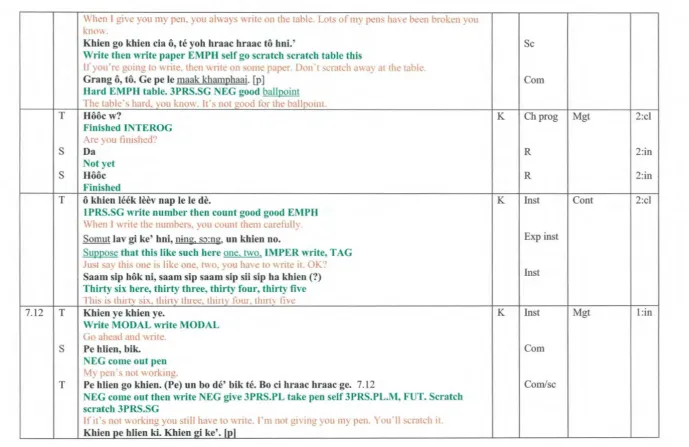
codes are listed in appendix one. The coding system noted the time (in increments of approximately 5 minutes or when something especially noteworthy occurred), the participant (teacher, student, students, with numbers to differentiate students where necessary) speech
behavior (what the speaker was actually doing with each utterance), language (Lao or Kmhmu), and any other issues of interest, including but not limiled to movement, gesture and prosody, for example:
(