An examination of the role of an affective opponent-process
in the maintenance of negative intrusive thoughts.
Garry Stevens
Submitted as partial requirement for the degree of
Master of Clinical Psychology
Australian National University
ACKNOWLEDGEMENTS
I would like to thank my supervisor, Dr Mark Dickerson for his advice, support
and encouragement which was unremitting throughout the completion of this
thesis.
Thanks also to Ross Cunningham for advice on s t a t i s t i c a l analyses,
Martin Schaefer for technical assistance and to Dr Steve Provost and Kath Ward
for their insights into the opponent process theory and it s application.
I
remain indebted to Gaby Deschamps for her e f f i c i e n t typing of the various
drafts of this manuscript.
Finally my thanks to Zina Kaleniuk for being my
friend throughout.
ABSTRACT
The present investigation sought to determine whether the opponent process
theory of acquired motivation (Soloman and Corbit, 1974; Soloman, 1980) could
provide a theoretical account for the maintenance of intrusive thoughts and
obsessions.
Ten subjects experiencing negative intrusive thoughts of a high
frequency, participated in an habituation training procedure which involved
exposure to their thoughts over several t r i a l s .
I t was predicted that the
intensity of negative affect would decrease with ongoing exposure.
In
accordance with opponent process theory, i t was further predicted that a mood
change
in the opposite direction would occur upon termination of these
thoughts.
Using subjective mood scales i t was demonstrated that the engaging of negative
intrusive thoughts successfully induced negative affect.
However, there was
no evidence to support the presence of affective habituation or contrast
phenomena.
These findings were consistent with earlier results observed by
Ward (1988).
I t was suggested that further c l a r i f i c a t i o n of the opponent
process theory is required before a d e f in i ti v e application to intrusive
thoughts may be attempted.
TABLE OF CONTENTS
1 . INTRODUCTION
1.1 Overview 1
1.2 The Opponent Process Theory o f Acquired Motivation 3 1.3 Theoretical Models o f Obsessions, Compulsions and In t r u s i v e
Thoughts 9
1.4 In t r u s i v e Thoughts and Opponent Process Theory 15 1.4.1 Habituation to In t ru s i v e Thoughts 16 1.4.2 A f f e c t i v e Contrast and Withdrawal 18 1.4.3 Evidence from Mood Induction Procedures 18 1.5 The Potential Role o f Cognitive N eu tra lisin g 20
1.6 The Present Study 23
2 . METHOD
2.1 Subjects 26
2.2 Apparatus 26
2.2.1 In t r u s i v e Thoughts Questionnaire 26
2.2.2 I n t r u s i v e Thoughts Diary 27
2.2.3 Mood Assessment Instruments 28
2.2.3.1 The P r o f i l e o f Mood States (POMS) 28 2.2.3.2 Visual Analogue Mood Scales 28
2.2 .3.3 The Stroop Task 29
2.2.4 Pre-Test Questions 32
2.2.5 Relaxation Exercises 33
2.2.6 Post-Test Questions 34
2.3 Procedure 34
3. RESULTS
3.1 In t ru s i v e Thoughts Questionnaire 38
3.2 Pre-Test Questions 39
3.3 POMS 40
3.4 Post-Test Questions 40
3.5 Visual Analogue Mood Scales 42
3.5.1 In di vi dua l Results 46
3.6 The Stroop Task 48
4. DISCUSSION 52
REFERENCES 61
APPENDICES 72
Appendix 1 I n t r u s i v e Thoughts Questionnaire Appendix 2 I n t r u s i v e Thoughts Diary
Appendix 3 Procedure
Appendix 3A General In s t ru c ti o n s Appendix 3B Pre-Test Questions Appendix 3C POMS
Appendix 3D Visual Analogue Scales Appendix 3E Stroop - Physical Appendix 3F Stroop - Social
Appendix 3G Experimental In s t ru c ti o n s Appendix 3H Post-Test Questions
Appendix 4 Results - I n t r u s i v e Thoughts Questionnaire
LIS T OF TABLES
TABLE 1:
TABLE 2:
TABLE 3:
Page
Group r e s u l t s f o r the p o s i t i v e and negat ive analogue mood scales 42
I n d i v i d u a l r e s u l t s f o r the analogue mood scales 46
Group r e s u l t s f o r the Stroop Colour-Naming Task 48
[image:6.566.59.556.145.797.2]1
I N T R O D U C T I O N
1.1
O V E R V I E W
The present study addresses an unusual proposition; can we become addicted to
our own thoughts? Intrusive thoughts, clinical obsessions and compulsions are
recurrent and compelling phenomena sharing drive features similar to other
addictive and impulsive behaviours. Yet intrusive thoughts and obsessions are
not regarded as
'addictive'
because they provide no apparent source of
pleasure
which we would normally associate with the maintenance of such
behaviours (Ward, 1988).
Intrusive thoughts are repetitive, involuntary cognitions that occur in the
form of thoughts,
images or
impulses and may be either
pleasant or
unpleasant.
They include intrusive mental activities such as perpetual day
dreaming and persistent worries (Rachman,
1981).
They are regarded as
obsessions if they are experienced as egodystonic, occur at a high frequency,
are significantly distressing and disrupt normal social functioning. They are
frequently associated with compulsive behaviours, which are
performed to
reduce discomfort arising from the obsession and are negatively reinforced as
a coping strategy (DSM-lll-R, 1987).
Impulsive behaviours such as excessive drinking or gambling have come to be
regarded as addictions because they share
features
characteristic of drug
abuse models
of
addiction
(e.g.
Kagen
and Squires,
1985).
Defining
characteristics include an inability to stop the behaviour,
to engage in
increasing levels of the activity, the development of psychological symptoms
if use
is
prevented
and
impaired
social
or
occupational
performance
(DSM-lll-R, 1987).
Obsessions and compulsions share these features and yet a
'addictive' behaviours.
Thus, while gambling or drug taking provide pleasure
and are egosyntonic, obsessions and compulsions are typically regarded as
senseless and, apart from tension reduction, provide no identifiable source of
pleasure.
To
establish
such
an
affective
basis
within
obsessional
symptomology would question this distinction and have considerable theoretical
implications.
Current methodologies examining the nature of obsessions have accepted the
negative maintenance view of the disorder and considered only negative
emotions associated with them.
Numerous studies have observed anxiety and
tension reduction in association with obsessions and compulsions (e.g. Rachman
and Hodgeson, 1980; Emmelkamp, 1982 and Foa and Steketee, 1985) and a similar
affective status associated with negative intrusive thoughts (Rachman and
Hodgeson, 1980).
Yet the pervasive failure to examine potential sources of
positive emotion means that the affect-based distinction between addictive
behaviours and obsessions is based on an assumption that has not been
empirically v a lidated.
Recent studies by Edwards and Dickerson (1987b) and Legg-England and Dickerson
(1988) have questioned this assumption.
They found that pleasant intrusive
thoughts were similar to unpleasant intrusive thoughts in that they increased
arousal, were emotionally intense and equally hard to control. Significantly,
subjects reported that they 'enjoyed'
the former category of thought.
Unfortunately full scale measures of both positive and negative emotion were
not used and so an accurate range of data on the affect induced by intrusive
thoughts was not attained.
In order to make a valid affect-based distinction
between addictive behaviours and intrusive thought phenomena, future research
into the latter will need to consider a full range of emotional responses.
The aim of this study was to consider both positive and negative emotions
associated with intrusive thoughts.
I f i t can be shown that positive as well
as negative emotions are associated with negative intrusive thoughts then
their maintenance and treatment could
be
studied
from
an
'addictions'
perspective.
While Edwards et. a l . (1987b) were able to establish that
intrusive thoughts can e l i c i t positive emotions,
a specific theoretical
account of how positive affect could be derived from negative intrusive
thoughts is s t i l l needed.
Soloman's (1980) 'opponent-process theory' provides
such an explanation.
I t postulates that negative affective states are capable
of inducing positive affective secondary responses as a form of homeostasis.
This may lead to the maintenance of an aversive i n i t i a t i n g behaviour via a
positively reinforcing postreaction, as might be seen in a c t i v i t i e s such as
sky-diving
(Epstein,
1967,
cited
in
Soloman,
1980)
or
blood
donation
( P il ia v i n , Callero and Evans, 1 982)..
The present study follows an earlier attempt by Ward (1988) to establish a
possible source of positive affect as a factor maintaining intrusive thoughts
and incorporates a number of methodological refinements based on the results
of that study.
As with the earlier attempt, the present thesis proposes that
opponent-process theory is consistent with current theoretical accounts of
intrusive thought phenomena, as well as existing empirical evidence.
Although
the relevant li te ra tu re
indicates
the possible existence of an opponent
process associated with intrusive thoughts, conclusive evidence
is
s t i l l
lacking.
The current research design is presented as a further test of the
proposition that negative intrusive thoughts are maintained by an affective
opponent process.
1 . 2 THE OPPONENT PROCESS THEORY OF ACQUIRED M OTIVATION
In his opponent process theory, Soloman (1980) postulates that emotional or
hedonic processes are involved in every case of acquired motivation.
Three
-affective phenomena are assumed to be operative within this system;
(1)
affective contrast, (2) affective habitation (tolerance) and (3) affective
withdrawal (abstinence syndrome).
Soloman points to heroin addiction as one
of the most obvious examples of this dynamic.
Initial doses of an opiate
produce a highly
pleasant sensation called a ' rush'.
With
the metabolic
destruction of the drug the user then experiences a secondary aversive state
characterised by mild physiological and psychological discomfort.
Affective
contrast such as this may also be observed where the i nit ial stimulus has been
unpleasant.
Epstein
(1967)
reported
the dramatic example
of military
parachutists who showed extreme fear responses during their f i r s t few jumps
but became elated with their completion.
With the repeated presentation of affective stimuli subjects rapidly habituate
demonstrating decreased responding to such stimulation.
With opiate use this
is i ni t i a l l y realised as a lessening of the euphoric state following the
initial rush experience. After a number of doses in succession addicts
typically do not experience this euphoria. Affective habituation
has then
occurred with the decline of the init ial hedonic state.
The withdrawal syndrome is the third affective phenomena considered by the
opponent process
theory and considers the accentuation of
the secondary
affective state which occurs in conjunction with the habituation process.
For
the
heroin
addict
abstinence
after
routine
dosing
produces
extreme
physiological and psychological discomfort which includes nausea, muscular
aches and cravings for the drug.
From an i n i t i a l l y pleasant state, withdrawal
is
experienced
as highly
aversive.
Thus
a
shift in
reinforcement
contingencies usually emerges from the (reduced) positive reinforcement of the
initial affective response towards avoidance of withdrawal symptoms, which
negatively reinforces ongoing use.
Affective withdrawal also develops in behaviours where the ini t i al experience
is unpleasant.
In such cases subjects may experience a small amount of rel i ef
after the unpleasant activity but are unlikely to continue in the absence of
extraneous pressures to do so.
This may typically occur when social pressures
or personal beliefs lead to repetition of the activi ty (e.g. drug use, blood
donation; Soloman, 1980; Piliavin, et. al . 1 982).
With ongoing repetition
there will again be a shift in reinforcement contingencies with a decline in
aversiveness and the emergence of a withdrawal syndrome with a positive
valence.
Experienced parachutists for example, no longer report intense fear
but a level of tension and a ' t h r i l l ' during the f ree- fal l followed by intense
social interaction and euphoria after a safe landing.
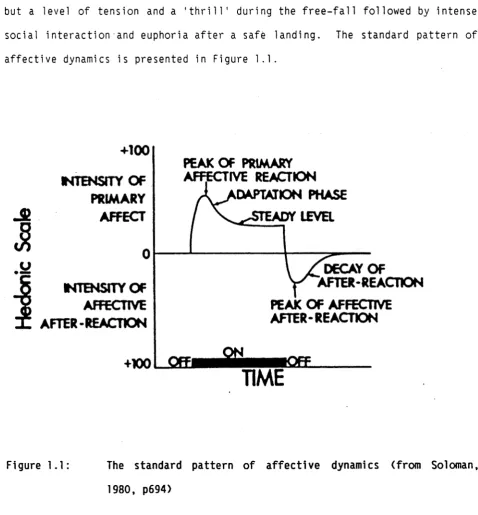
The standard pattern of
affective dynamics is presented in Figure 1.1.
+100
NTENSITY OF
PRIMARY
J2
s
AFFECT
$
u
0
&
isrrmsmr
o f" 5
AFFECTIVE
X AFTER-REACTION
PEAK OF PRIMARY
PEAK OF AFFECTIVE
AFTER-REACTION
+100
OFFi
TIME
The standard pattern of a ffe c tiv e dynamics (from Soloman,
1980, p694)
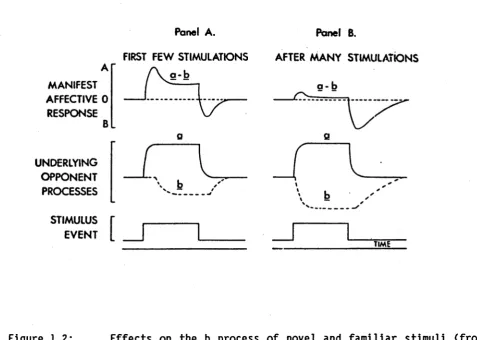
[image:11.566.47.526.272.787.2]Soloman and Corbit (1973, 1974) devised a simple th e o re ti c a l model to account f o r the a f f e c t i v e dynamics observed in the examples above. This a f f e c t control system has a single negative feedback loop and assumes an operation si m i l a r to other homeostatic mechanisms such that the brains of mammals function to oppose extreme or prolonged emotional arousal. To t h i s extent the a b i l i t y to maintain a f f e c t i v e s t a b i l i t y is presumed to have an adaptive fun ction. The theory suggests that a primary a f f e c t i v e response, called an 'a' process, is e l i c i t e d by any Pavlovian UCS, operant r e i n f o r c e r or innate releaser. The a process is a stable, unconditional reaction which correlates with the i n t e n s i t y , q u a l i t y and duration of the s t i m u l i . The a process in turn arouses an opposing ' b ' process which is hypothesised to be o f sluggish latency, slow to reach i t s peak and slow to decay a f t e r the o r i g i n a l sensory input has been terminated and the a process has stopped. Since the b process acts to oppose the a process, growth in strength by the former is associated with a weakening o f the l a t t e r .
According to the model, the manifest emotional state of the subject may be computed as the absolute difference between the two underlying processes. I f a > b then the subject is said to be experiencing an emotional state, known as State A; and i f b > a then the subject is in State B. Each o f these manifest states w i l l be s i m i l a r in q u a l i t y to t h e i r underlying processes but w i l l not necessarily be o f the same magnitude. With the onset of the s ti m u li there w i l l be a peak in emotional State A which ra p id ly subsides as the b process is i n i t i a t e d . With the o f f s e t of the s t i m u l i , the a process is terminated and the true q u a l i t y o f the b process may be observed with the manifest B state being t o t a l l y due to the opponent process from t h i s poi nt.
Soloman (1980) has f u r t h e r postulated that s i g n i f i c a n t changes to the opponent process occur as a r e s u l t of repeated exposure to the stimulus. S p e c i f i c a l l y ,
-while the a process is unaffected by repeated exposure, i t is assumed that the b process is strengthened by use and weakened disuse. I t is as a d i r e c t re s u l t of t h i s strengthening of the b process that a f f e c t i v e habituation and withdrawal occur; the former, s pe c if ic to State A, occuring when the magnitude and i n t e n s i t y o f the a process are reduced by the accentuating b process, which functions to drag i t down. Thus i f State A o r i g i n a l l y had a po si tiv e hedonic tone, i t w i l l become less pleasant with repeated exposure. The strengthening of the b process also produces the a f f e c t i v e withdrawal syndrome as the manifest B State grows in both i n t e n s i t y and duration. With repeated presentations the refore , a B State experienced as pleasurable would become more so, w h i l s t an aversive postreaction would s i m i l a r l y accentuate. Figure 1-2 shows a comparison o f the ef fe c ts on the b process o f the presentation of both f a m i l i a r and r e l a t i v e l y novel s t i m u l i .
Panel A. Panel B.
FIRST FEW STIMULATIONS
A '
MANIFEST AFFECTIVE 0 RESPONSE
B .
UNDERLYING OPPONENT PROCESSES
AFTER MANY STIMULATIONS
STIMULUS r EVENT [ ___I
TIME
Figure 1.2: Effects on the b process of novel and fa m ilia r stimuli (from
Soloman, 1980, p700.)
[image:13.566.46.524.375.715.2]-An important q u a l i f i c a t i o n to the e ff ec ts of repeated exposure on the accentuation of the opponent process, is Soloman's suggestion that the in te r v a l s between successive exposures must be shorter than the time normally required to allow the b process to decay to i t s baseline value. Thus the b
process w i l l only accentuate i f presentations occur wi thi n a cer tai n i n te r - s ti m u l u s i n t e r v a l . An i n t e r m i t t e n t drug user f o r example w i l l experience a f u l l rush and minimal withdrawal. On the other hand, an habitual user, who doses w it h in the withdrawal phase (b process) to avoid i t s aversive a f f e c t s , w i l l experience no 'hi gh ' and a subsequent accentuation of withdrawal, prolonging the cycle o f maintenance.
Starr (1978) has provided empirical evidence f o r t h i s phenomena showing tha t dis tr ess c a l l i n g in ducklings (aversive B state) was only accentuated by one minute separations from t h e i r mother while longer durations outside t h i s c r i t i c a l decay duration produced no changes in responding. He f u r t h e r observed that an enhancement of the q u a l i t y of the stimulation could produce an increase in the c r i t i c a l decay duration o f the b process. S i m i l a r l y , he noted that responding did not re v er t to baseline levels fo ll o w in g a period o f non-exposure but showed a more rapid return to previous levels of response i n t e n s i t y upon re-exposure. Starr referred to t h i s la te n t maintenance of response function as the 'savings p r i n c i p l e ' . Soloman (1980) suggested a general p r i n c i p l e f o r opponent processes based on these f i n d i n g s , suggesting that they are strengthened by use and approach asymptotes having values tha t are a d i r e c t fun cti on o f the q u a l i t y , i n t e n s i t y , and duration o f each exposure and an inverse fun cti on o f the in te rs ti m u lu s i n t e r v a l . They are also subject to more rapid accentuation f o ll o w in g re-exposure where there has been a previous h i s t o r y o f responding.
Since i t s f i r s t presentation (Soloman and C or b it , 1973) and subsequent
-elaboration (Soloman, 1980) opponent-process theory has been applied to a v a r ie t y of human behaviours to explain the motivation f o r such diverse a c t i v i t i e s as c ig a re tte smoking (Soloman and C orb it, 1973), job s a t i s f a c t i o n
(Landy, 1978), alcohol use (Shipley, 1982) and exercise dependence (Thompson and Blanton, 1987). Recent studies supporting the predictions of the opponent-process theory have t y p i c a l l y used subjective ratings to assess mood
status, the dependent var ia bl e; as in the assessment of examination stress (Craig and Siegal, 1 979), blood donation ( P i l i a v i n , et. al . 1 982), breast feeding (Myers and Siegal, 1985) and food tastes (Rozin and Vollmecke, 1986). However, performance measures such as speech rate (Williams, 1980) and naming latencies (Tyson and Flemming, 1987), and physiological measures o f skin conductance (Yelan, 1985) and s a l i v a t io n response (Rozin, Reff, Mark and Schul 1 , 1984) have also been used successfully as indices of the dependent v a r i a b l e .
1 . 3 THEORETICAL MODELS OF OBSESSIONS, COMPULSIONS AND IN T R U S IV E THOUGHTS
The central hypothesis of the current thesis considers the p o s s i b i l i t y th a t obsessive-compulsive thoughts and behaviour are maintained via an a f f e c t i v e opponent process. Given i t s focus on the a f f e c t i v e dynamics associated with negative in tr u s i v e thoughts i t is necessary to examine current th e o re ti c a l models o f obsessions and i n tr u s i v e thoughts and consider the r e l a t i o n s h i p between them.
Psychodynamic formulations of obsessive-compulsive disorder (OCD) were f i r s t to emerge (e.g. Freud, 1896) but have generally f a i l e d to f i n d empirical support and have t y p i c a l l y yielded poor treatment outcomes (Cawley, 1974). Behaviourally oriented approaches have enjoyed f a r greater success both e m p i r i c a l l y and as an applied treatment methodology (Foa, Steketee, Grayson and Doppelt, 1983). These have t h e i r genesis in the work o f Mowrer (1960) who
proposed a two-stage theory o f a c q u i s i ti o n and maintenance o f OCD. In the f i r s t stage obsessions are c l a s s i c a l l y conditioned when a neutral event becomes associated with fear by being paired with s ti m u li which evoke discomfort or anxiety. Through an associative process, concrete ob jec ts, thoughts and images a l l acquire the a b i l i t y to produce discomfort. In the second stage, avoidance responses develop, including compulsive r i t u a l s and escape behaviours, which reduce discomfort and are thereby negatively reinforced, leading to t h e i r maintenance as a coping stra teg y. These strategies are only e f f e c t i v e in the short term however, preventing longer term exposure which would lead to habituation and t h e i r eventual e x t i n c t i o n .
Despite some c r i t i c i s m o f the fear a c q u i s i ti o n phase o f t h i s process (e.g. Gray, 1975; Rachman and Wilson, 1980) recent theories have maintained the essential elements of the two-stage model, pe rta in ing to onset and maintenance, while expanding upon the conditions p e r ti ne nt to these phenomena (e.g. Rachman and Hodgeson, 1980; Salkovskis, 1985). Rachman has extended the model beyond the c l i n i c a l population, pointing to major s i m i l a r i t i e s between normal i n tr u s i v e thoughts and c l i n i c a l ruminations. Evidence from several studies has shown that unwanted i n t r u s i v e thoughts are a common experience and occur in 80-97% of the normal population, (e.g. Rachman and De S i lv a , 1978; Parkinson and Rachman, 1981; Salkovskis and Harrison, 1984; Legg England and Dickerson, 1988).
Rachman and De Silva (1978) established that ' i n t r u s i v e unacceptable thoughts' experienced by normal subjects were s i m i l a r to c l i n i c a l obsessions in t h e i r form, content, meaningfulness and r e la t i o n s h i p to t r i g g e r i n g s t i m u l i . They note that experienced c l i n i c i a n s were unable to d i s t i g u i s h them on these indices alone. C l i n i c a l obsessions do, however d i f f e r in t h e i r frequency, duration and i n t e n s i t y . They also cause more d i s t r e s s , are harder to dismiss, are less acceptable, more unpleasant and provoke more urges to n e u tr a l i s e .
-These re su lts ind ic a te , e s s e n t i a l l y , that normal and abnormal thought phenomena such as these do not d i f f e r q u a l i t a t i v e l y in terms of the form or content of the experience, but do so q u a n t i t a t i v e l y in terms o f the fac to rs r e l a t i n g to the emotional response they e l i c i t ( i . e . i n t e n s i t y and subsequent duration and frequency). Thus, Rachman and De Silva (1978) deduced tha t i n t r u s i v e thought phenomena occur on a continuum, with c l i n i c a l obsessions being a more severe manifestation of thoughts experienced by the normal population. Salkovskis (1985, 1989a) has suggested that i t is differences in cog nitive appraisal o f the content o f the thought which lead to q u a n t it a t i v e differences in the emotional response to these s t i m u l i .
Rachman and De Silva (1978) in e s ta bl is hi n g a th e or e ti c al r e la t i o n s h i p between c l i n i c a l obsessions and unwanted i n t r u s i v e thoughts, have s i g n i f i c a n t l y expanded the population av ai lab le f o r study. In o u t l i n i n g his model o f OCD (Rachman and Hodgeson, 1980), Rachman has f u r t h e r elucidated t h i s r e l a t i o n s h i p , o u t l i n i n g the conditions under which normal i n t r u s i v e thought phenomena may take on c l i n i c a l s i g n if ic a n c e . Based on the three systems analysis of Lang, obsessions are conceived o f having c o g n it iv e , behavioural and psychophysiological components (Lang, Malamed and Hart, 1970). The cog nitive component has two fa ce ts , 1) the subjects perceived loss of control and 2) subjective reports o f d i s t r e s s . The behavioural component includes overt compulsive r i t u a l s and avoidance behaviours which reduce discomfort and are negatively re inf or ced . The psychophysiological component considers ty p i c a l f i g h t or f l i g h t responses and is derived from emotion and fear theories (e.g. Lang, 1979).
Rachman argues that while most people p e r i o d i c a l l y experience unwanted i n t r u s i v e thoughts, in the absence o f lowered a f f e c t and cer tai n predisposing f a c t o r s , such thoughts produce l i t t l e emotional disturbance and are r e a d i l y
[image:17.566.49.533.319.736.2]assimilated. However during or a f t e r periods of dysphoria and/or exposure to stress, these thoughts or urges may become frequent, in tr u s i v e and discomforting. During times o f heightened arousal they take on the properties o f noxious s timu li causing d is tr e s s . In th i s sense they come to resemble phobic s t i m u l i , provoking avoidance behaviour and a f a i l u r e to habituate leading to t h e i r maintenance.
A number of predisposing fac to rs have been described by Rachman, the presence o f which may exacerbate c l i n i c a l obsessions or r e s u l t in i n t r u s i v e thoughts taking on a c l i n i c a l status where t h i s was not previously the case. These include 1) dysphoric mood state, 2) exposure to stress, 3) personally i d i o s y n c ra t ic perceptions o f ' u n a c c e p t a b i l i t y ' ( i . e . high standards o f conduct or m o r a l i t y ) , 4) s e n s i t i v i t y to danger signals and 5) pe rso na lity f a c t o r s . Thus a tendency to neuroticism and a pre disp ositio n toward the attainment o f a high standard of conduct is l i k e l y to produce unwanted i n t r u s i v e thoughts at times o f high stress and/or dysphoric mood. Obsessions are th e re a ft e r maintained by a cycle of events whereby in tr u s i v e thoughts produce psychological and somatic disturbance as well as a perceived loss of c o n tr o l . This generates f u r t h e r dysphoria, producing greater s u s c e p t i b i l i t y to the i n t r u s i v e thought and the subsequent r e p e t i t i o n of the cycle (Rachman and Hodgeson, 1980.)
A central tenet o f Rachman's model is that i t is the unpleasantness o f the thought which p r i m a r i l y determines the persons a b i l i t y to control i t . Studies by Salkovskis and Harrison (1984) and Clarke (1986a) have supported such a r e l a t i o n s h i p , although Parkinson and Rachman (1981) observed a f a c t o r i a l separation between unpleasantness and c o n t r o l l a b i l i t y , questioning i t s v a l i d i t y . Other fi n d i n g s have indicated that i t is not the inherent 'unpleasantness' o f the thought, per se, which determines c o n t r o l l a b i l i t y but
it s emotional intensity.
Thus Clarke and De Silva (1985) argue that unwanted
intrusive thoughts are events that are of a primarily anxious nature and
observed that emotional intensity and c o n t r o l l a b i l i t y were the most salient
defining features of intrusive thoughts.
Recent findings by Edwards and
Dickerson (1987b) and Legg-England
and
Dickerson
(1988),
that
pleasant
intrusive thoughts associated with high levels of arousal are as d i f f i c u l t to
control
as
unpleasant
intrusions,
adds
further weight
to this
theory
suggesting that emotional intensity of a positive valence, similarly leads to
impaired con trol.
Salkovskis
(1985,
1989a)
has outlined a
cognitive
behavioural
model
of
obsessions
which
expands
upon
the
basic
structure
of
the
behavioural
paradigm.
Like Rachman,
he assumes
that
most people experience
intrusive
thoughts, but emphasises the role of cognitions in determining which thoughts
w i ll persist.
He argues that negative affect temporally associated with an
intrusive thought is not the result of the thought i t s e l f but of negative
automatic thoughts (Salkovskis, 1985), or the system of appraisal (Salkovskis,
1989b) by which the intrusive thought is evaluated.
More spe cif ic a lly he
suggests that this
appraisal centres on cognitive beliefs in
responsibility
for the prevention
of harm, which produce distress and lead to compulsive
r i t u a l s .
Such
responses
relieve
distress
associated
with
feelings
of
responsibility but reinforce the
belief that responsiblity was actually
involved.
This leads to the maintenance of both the thought and compulsion
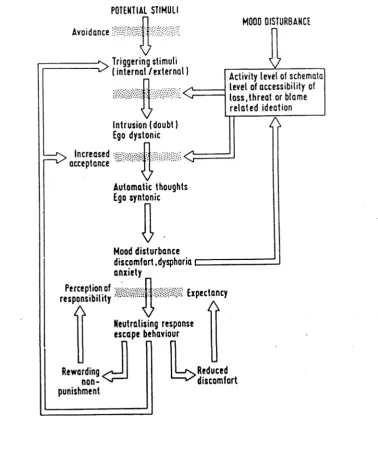
which come to be regarded as valid. Fig 1.3 shows the cognitive behavioural
model of the development of Obsessive-Compulsive Disorder.
-Figure 1.3:
POTENTIAL STIMULI
Avoidance
V
Triggering stimuli
/ i n i p r n n l / pvf prni
( in tern al /e x te r n a l)
:c
V
Intrusion (d o u b t) Ego dystonic
— Increased ^ acceptance
v
Autom atic thoughts Ego syntonic
V ■
Mood disturbance discomfort.dysphoria anxiety
Perception of responsibility
A
MOOO DISTURBANCE
V
Activity level of schemata level of accessibility of loss .th re a t or blame re la te d ideation
A
V
Expectancy
A
Neutralising response escape behaviour
Rewarding ^ — n o n - ^ punishment
L _ R e d u c e d ^ d is c o m fo r t
Cognitive and behavioural facto rs mediating
obsessive-compulsive symptomology (from Salvkoskis, 1985, p578)
Within the model Salkovskis emphasises the crucial role played by neutralising
[image:20.566.124.503.88.556.2]thoughts, regarded as f u n c t i o n a l l y equivalent to overt compulsive r i t u a l s , has been recognised f o r some time. They have been variously described as 'anxiety-reducing obsessions', 'cov ert compulsions' (Wolpe, 1958) 'c o g n it iv e r i t u a l s ' (Robertson, Wiggenson and Kaplan, 1983) and as a form of cognitive ' n e u t r a l i s i n g ' (Salkovskis, 1985). Yet despite t h e i r long-term recognition as a c l i n i c a l e n t i t y and the success o f behavioural interventions with obsessive-compulsive diso rde r, such treatment has yielded conspicuously poor outcomes in the treatment o f pure obsessional ruminations. Salkovskis argues that in such cases behavioural methodologies such as exposure and response prevention have been i n a p p r o p r ia te l y applied and that exposure to the thought and cognitive response prevention applied to cognitive r i t u a l s is necessary to achieve habituation and a lowering o f frequency. Supporting evidence f o r the fun ctio n of cog nitive r i t u a l s has come from a treatment study by Kirk (1983) who demonstrated that the ap p li ca ti o n of thought stopping to n e u tr a l i s in g cognitions (r at he r than the obsessions) resulted in rapid habituation and successful treatment outcomes.
1 . 4 IN T R U S IV E THOUGHTS AND OPPONENT PROCESS THEORY
In t ru s i v e thoughts are, by d e f i n i t i o n , associated with mood states o f a non-neutral valence. Rachman (1981) defines i n tr u s i v e thoughts as:
" r e p e t i t i v e thoughts, impulses or images that are unacceptable and unwanted. . . land which] i n t e r r u p t ongoing a c t i v i t y , are at t ib u te d to an inte rna l o r i g i n and are d i f f i c u l t to c o n t r o l . " p.91.
Thus, i n t r u s i v e thoughts are d i f f e r e n t i a t e d from spontaneous cognitions related to routine a c t i v i t i e s by v i r t u e of t h e i r recurrence, n o n -v o l it io n a l q u a l i t y and associated hedonic tone. Their content is t y p i c a l l y evaluated as pleasant or unpleasant, w h i l s t features of t h e i r presentation, namely a lack
-of p r e d i c t a b i l i t y and c o n tr ol , -often provide a f u r t h e r source -of d is tr e s s . Edwards and Dickerson (1987b) have provided f u r t h e r evidence suggesting tha t i n t r u s i v e thoughts are capable of inducing both p o s it iv e and negative a f f e c t i v e states. Evidence of primary a f f e c t i v e responses concomitant with i n t r u s i v e thoughts provides a necessary pre-condition f o r the te s tin g o f Solomon's theory. The a c q u is it io n of a new motivational source, of the type postulated f o r i n t r u s i v e thought phenomena, is derived from an a f f e c t i v e dynamic ( i . e . hab itua tion , contrast and withdrawal processes) which is u l t i m a t e l y dependent on an i n i t i a l mood induction, the a process.
1 . 4 . 1 . HABITUATION TO IN T R U S IV E THOUGHTS
Habituation t r a i n i n g procedures have had an obvious c l i n i c a l ap pl ic at io n in the treatment of obsessions. These methods, var ious ly labelled ' s a t i a t i o n ' (Rachman, 1971) 'paradoxical i n t e n t i o n ' (Solyom, 1972) and 'exposure' (Emmelkamp and Giesselbach, 1981) have in common the attempt to decrease discomfort associated with obsessions by allowing progressive adaptation, via exposure, to the potent emotional elements o f these s t i m u l i . With various modifications they have proven successful in reducing anxiety over repeated presentations and also decreasing the frequency o f obsessional ruminations (e.g. Foa and Steketee, 1 979; Moregan, Maier, Brown and Pollard, 1 987 and Salkovskis and Westbrook, 1989).
Consistent with the re s u l ts o f c l i n i c a l t r i a l s , Parkinson and Rachman (1980) observed s i g n i f i c a n t decrements in responding fo ll o w in g the a p p li c at io n of habituation t r a i n i n g to i n t r u s i v e thoughts experienced by n o n - c l i n i c a l subjects. In addition to decreases in subjective ratings of discomfort across t r i a l s , they also observed that the latency ( i . e . r e t r i e v a l times) of i n t r u s i v e thoughts increased. Other indices such as i n t e n s i t y , str es sfu l ness, u n a cc ep ta b ili ty , u n c o n t r o l l a b i l i t y and anxiety also decreased. This e f f e c t
-was augmented by the p r i o r use of re la x at io n t r a i n i n g which appeared to f a c i l i t a t e exposure. These re s ul ts are s i m i l a r to those o f Sutherland, Newman and Rachman (1982) who observed that repeated exposure to i n t r u s i v e thoughts led to an increase in dismissal times during a sad mood condition.
The time taken to re tr i e v e and dismiss an i n t r u s i v e thought are important in that they appear to provide an index o f habituation beyond subjective or physiological measures. This rela tes to the r e la t i o n s h i p between emotional i n t e n s i t y and c o n t r o l l a b i l i t y previously discussed. Edwards and Dickerson (1987a) observed s i m i l a r re s ul ts to those of the habituation studies when they observed that the time required to dismiss negative i n t r u s i v e thoughts was longer than f o r neutral thoughts. They also found that p o s i ti v e and negative in tr u s iv e thoughts were equally un controllable (Edwards and Dickerson, 1987b). In explaining t h e i r re s u lt s they drew upon information processing theories r e l a t i n g to at t e n ti o n a l resources (e.g.Navon and Gopher, 1979 and Salame and Badderly, 1982). They suggested that i n t r u s i v e thoughts, by v i r t u e of t h e i r complexity and high emotional i n t e n s i t y , are autom atic ally given processing p r i o r i t y . This re su lt s in an impoverished ( p a r a l l e l ) capacity to conduct other processes which might be directed at disattending the primary i nt r us iv e s t i m u l i .
The account provided by Edwards and Dickerson provides a th e o r e ti c a l explanation f o r the 1 uncontrol 1a b i 1i t y 1 observed in association with emotionally intense i n t r u s i v e cognitions. In t h i s sense also the e f f e c t o f habituation may be seen as a lowering o f a f f e c t i v e tone which allows a normal information processing capacity ( i . e . ' c o n t r o l ' ) to be re in s ta te d . A s p i ra l e f f e c t may then ensue whereby an increase in perceived control f u r t h e r lowers a f f e c t , increasing subsequent processing resources. I t also accounts f o r improved habituation with p r i o r re la x at io n (Parkinson and Rachman, 1980) and greater v u l n e r a b i l i t y to i n t r u s i v e thoughts during dysphoria (Sutherland,
Newman and Rachman, 1982). These re s u l ts are not consistent with those of Clarke (1986b), who found that repeated exposure to negative cognitions did not s i g n i f i c a n t l y influence r e t r i e v a l or dismissal times. In th i s case however, the f a i l u r e o f subjects to use t h e i r own thoughts, the small t r i a l numbers and short exposure durations, were not l i k e l y to have produced habituation in accordance with the paradigm (Rachman, 1976).
1 . 4 . 2 A FFE C TIV E CONTRAST & WITHDRAWAL
In contrast to the ava ilable evidence on habituation to c l i n i c a l and n o n -c l i n i c a l i n t r u s i v e cognitions, there has been v i r t u a l l y no examination of contrast and withdrawal processes in r e l a t i o n to these phenomena. With the exception of one study to be discussed f u r t h e r (Ward, 1988), there has been a presumption that p o s i ti v e a f f e c t is u n l i k e l y to be associated with negative cognitions, such that measures including a p o s i t i v e a f f e c t scale have not been used. In a d d it io n , a f f e c t i v e status has t y p i c a l l y been measured only during the thought, with the f a i l u r e to consider a f f e c t i v e postreactions ensuring that an opponent process would not be detected. Despite t h i s , physiological measures taken before, during and a f t e r obsessional th in k in g have shown trends consistent with an opponent process. Rabavilas and Boulougouris (1974) and Grey, Rachman and Sartory (1981) have observed increases in heart rate during obsessional ruminations which have f a l l e n below baseline upon termination of
these thoughts. While sign if ica nc e tests were not reported, and a d i r e c t coincidence should not be assumed (e.g. Lang, 1969) these trends in physiological responding are i n d i c a t i v e o f an a f f e c t i v e opponent process. A report by Rachman and Roper (1976), showing a s i m i l a r trend with s e lf - re p o rt e d measures o f discomfort in r e l a t i o n to obsessional th i n k i n g , f u r t h e r supports t h i s .
1 . 4 . 3 . EVIDENCE FROM MOOD INDUCTIO N PROCEDURES
The previous section pointed to a lack of d i r e c t evidence f o r contrast and
-withdrawal processes in r e l a t i o n to i n tr u s i v e thoughts. Furthermore, studies reporting such processes have t y p i c a l l y considered primary a f f e c t i v e sources derived from external sti mu li such as drugs and food. In t ru s i v e thoughts by contrast may be regarded as internal s t i m u l i , producing an emotional response more d i r e c t l y mediated by cognitions. Emotional responses derived in t h i s way, as in studies o f job s a t i s f a c t i o n or te st anxiety, have been shown to fo l l o w an opponent process. Evidence from mood induction experiments is of p a r t i c u l a r relevance however in that they o f f e r a close analogue to processes observed in i n t r u s i v e thoughts. S p e c i f i c a l l y , they produce a primary a f f e c t i v e state s i m i l a r to that of in st ru s iv e thoughts (Teasdale et. a l ., 1980; Clark and De S i lv a , 1985) are p r i m a r i l y derived from cognitive sti mu li (e.g. Sutherland, Newman and Rachman, 1982) and have shown some s p e c i fi c evidence of an opponent process.
Williams (1980) used a mood induction procedure devised by Thompson et. al . (1979) to determine the e f f e c t of depressed mood on speech ra te . He observed that the time taken to count to ten was s i g n i f i c a n t l y f a s t e r fo ll o w in g the completion o f a performance task, than immediately a f t e r mood induction or at baseline p r i o r to the procedure. Williams regarded th i s 'rebound e f f e c t 1 on speech rate fo l l o w i n g mood induction as evidence consistent with other opponent process phenomena observed in animals and humans.
Ranieri and Zeiss (1981, cited in Ranieri and Zeiss, 1984) conducted an exploratory study considering why people w i l l i n g l y engage in a c t i v i t i e s that make them feel sad. They found that subjects rated events occuring immediately a f t e r a 'sadness-inducing a c t i v i t y ' as s ub je c ti v e ly more pleasant than events p r i o r to t h i s a c t i v i t y . They argued that the opponent-process theory offered the best explanation f o r t h i s f i n d i n g . In a f u r t h e r experiment (Ranieri and Zeiss, 1984) using the Velten (1968) mood induction procedure, no
-evidence was found f o r an opponent process, although i t may be argued th a t a design flaw in the spacing of assessment i n t e r v a l s produced the null r e s u l t . As in the Williams study, the greatest rate of mood change was observed at 2.5 minutes fo ll o w in g mood induction, at which point Williams observed a peak decline below baseline. However since the mood induction duration in the Ranieri study was 20 minutes, twice tha t o f the Williams ind uction, i t is probable that the peak o f the b process would have been around the 5 minute mark. In f a i l i n g to measure mood u n t i l 12.5 minutes post-stimulus, i t is conceivable that the B State peaked and decayed w i th i n t h i s time, appearing at baseline when next measured.
The methodological issues considered in the Ranieri study point to the necessity of sensitive assessment i n t e r v a l s given the d i f f i c u l t y o f p r e d i c ti n g a time course f o r the B State. Whilst habituation studies would p r e d ic t an accentuated B State due to mu lt ip le presentations, mood induction procedures are only l i k e l y to achieve a small opponent process. In t h i s respect an i n i t i a l presentation is l i k e l y to produce a B State that w i l l peak and decay within the duration equivalent to that o f the i n i t i a l s t i m u l i . Whilst recurring i n t r u s i v e thoughts may be hypothesised to have an accentuated B State, as int ernal sti mu li the course and termination o f the a process i t s e l f may be d i f f i c u l t to determine. This f u r t h e r necessitates sen si ti ve measures to determine a subsequent opponent process.
1 .5 THE POTENTIAL ROLE OF COGNITIVE NEUTRALISING
The previous consideration o f cognitive n e u t r a l i s i n g , as an a c t i v i t y re q u i ri n g c l i n i c a l in te rv e n ti o n , also has im plications f o r the opponent-process account of the maintenance o f i n t r u s i v e thoughts. Salkovskis and Westbrook (1989) have r e it e r a te d the functional equivalence o f cognitive n e u t r a l i s in g with behavioural compulsions in that they terminate exposure to i n t r u s i v e
-cognitions, reduce associated negative affect and are negatively reinforced.
The
successful
application of
response
prevention
procedures
to these
cognitions (Kirk, 1983; Salkovskis and Westbrook, 1989) has supported the
theoretical account of their existence and function.
Whilst i t was also
believed that, as a factor leading to the maintenance of obsessional thinking,
cognitive neutralisers should be absent from non-clinical populations, recent
evidence suggests this is not the case.
Salkovskis and
Dent (1989) report
that in a survey of 243 non-clinical subjects,
111reported some level of
covert neutralising behaviour associated with intrusive thoughts, a prevalence
consistent with that reported in cli n ic a l populations (Rachman and De Silva,
1978).
In addition, subjects who frequently neutralised reported a higher
degree of discomfort associated with their thoughts.
Presumably neutralising
processes
have a strong negative reinforcement value in such cases,
are
quickly adopted and paradoxically produce low levels of distress thereafter.
Indeed Salkovskis and
Warwick (1988) have
reported cases in which cognitive
neutralising responses became so e f f i c i e n t that negative affect was no longer
experienced in association with intrusive thoughts.
The
high
prevalence of
neutralising
behaviour
in
both c li n ic a l
and
non-clinical subjects suggests poten tially widespread mediation of primary
affective
responses to intrusive thoughts.
This may in turn affect
any
opponent process.
Several postulates are of relevance
to this; (1) the
aprocess ( i n i t i a l l y ) correlates closely in magnitude to the intensity, quality
and duration of the provoking stimulus, (2) these primary processes are phasic
and subject to small
stimulus changes,
and
(3) opponent processes are
strengthened by use and have asymptotes that are a direct function of the
quality, intensity and duration of each exposure ( i . e . the
aprocess).
Thus
the i n i t i a l magnitude of an affective response to an intrusive thought is
regarded
as d ir e ctly proportional to it s duration and intensity, with
the
former subject to even small changes in the l a t t e r . The opponent process s i m i l a r l y correlates with the magnitude of the primary a f f e c t i v e response and is likewise subject to changes in these indices.
The previous discussion indicates that where cognitive ne u tr a li s e rs a f f e c t the i n t r u s i v e thought and reduce the emotional response to them, t h i s w i l l subsequently impact upon the opponent process, reducing or e l i m in at in g i t . This could occur via a shortening of the duration of the thought or a d i r e c t reduction o f associated a f f e c t via some semantic manifestation such that the actual duration of the thought was no longer related to i t s a f f e c t i v e po te n ti a l (Rachman, 1976). The f i r s t process would reduce the duration o f the a process, the second i t s asymptote. The aforementioned p r in c i p l e s indicate tha t e i t h e r outcome would be r e fl ec te d in the opponent process, e s s e n t i a l l y r e s u l t i n g in i t s reduction. Over time, n e u tr a l i s in g behaviour would lead to maintenance, normally s a t i s f y i n g the necessary condition f o r the accentuation o f the B State. Yet the recurrent low magnitude of the primary process presumably would ensure that i t s opponent process remained small. This l a t t e r point remains speculative as the governing theory is not yet s u f f i c i e n t l y de tailed to determine whether an a process of small magnitude which nonetheless remains constant ( i n f a i l i n g to habituate) w i l l produce a g r e a tl y accentuated B State. As a homeostatic mechanism compensating f o r a small
i n i t i a l process, th i s would appear u n l i k e l y . For present purposes, there is s u f f i c i e n t evidence to suspect that cognitive n e u tr a l i s in g exis ts as a po ten tia l confound, reducing the hypothesised maintenance role o f the opponent process. Parkinson and Rachman (1980) indicate the necessity of screening subjects f o r t h e i r presence, while Ward's (1988) f a i l u r e to do so may have been a co n tr i b u ti n g f a c t o r in her null f i n d i n g f o r an a f f e c t i v e opponent process.
1 . 6 THE PRESENT STUDY
The primary objective of the present study was to determine the presence of an
affective opponent process subsequent to primary mood induction via negative
intrusive thoughts.
I t is argued that intrusive thoughts are internal stimuli
capable of inducing mood via cognitive processes.
The primary emotional
response is thought to represent State A.
I t is expected that this w i l l
e l i c i t an opponent process with an hedonic tone opposite that of the original
response. With the termination of the intrusive thought, State B w il l rise to
it s asymptote and should be observed.
The opponent affective state w i ll then
return to baseline as long as the thought is not reaccessed.
In such an event
the A State w il l
lower and the B State w il l accentuate further, being
accessible to measurement at a later point.
The
investigation
considered
negative
intrusive
thoughts
only.
The
opponent-process theory postulates a trend which is essentially the same
whether the primary affective response has a positive or negative valency.
Whilst a specific examination of positive and negative intrusive thoughts via
the opponent process theory may point to important differences, this is not
directly germane to the central hypothesis.
The study has implications for an
affect-derived theory of obsessions, that is, negative cognitions maintained
via a post-reaction hypothesised to be positive.
Negative intrusive thoughts
are therefore the logical choice for a specific examination.
The study by Ward (1988), whilst observing mood induction, fail ed to establish
habituation or affective contrast.
Whilst the study appeared well designed to
e l i c i t and record the presence of an opponent process, it s f a i l u r e to do so
may have been due to several factors.
F i r s t l y , the subject population had
intrusive thoughts of re l a t iv e ly low intensity occurring at intervals of up to
two weeks.
In such a group the magnitude of the B State is l i k e l y to have
-been minimal by virtue of their low rate of occurrence or the 'savings'
principle noted previously (Soloman, 1980).
Secondly, i t may be argued that
the practice of asking subjects to 'think about their thought' on cue is
unlikely to produce a valid re-creation of the phenomena in either its usual
form or
intensity.
If
the
stimuli
were impoverished in this manner,
inter-stimulus intervals of one minute may also have been longer than the
decay duration, leading to a failure of the B State to accentuate.
Thirdly,
the failure to screen subjects for cognitive neutralising responses means that
if they did effectively e l i c i t the thought they may equally have neutralised
its affective impact in the time alotted, hindering the habituation process
and moderating any resultant B State.
The present study incorporated a number of methodological refinements into the
basic paradigm to address the above criticisms and maximise the potential
magnitude of the opponent process:
•
Subjects were
chosen
for
the experiment on the basis of earl i er
questionnaire responses and were those who reported a much higher
frequency of intrusive thoughts occuring at an average rate of up to one
per day. It was argued that the higher frequency and level of distress
of these thoughts was more conducive to the presence of an accentuated B
State by virtue of recurrent processing and/or a latent savings principle
that could be effectively r e- i ni t i at ed via the habituation process.
•
The method of presentation was modified in an attempt to make the thought
experiences more intense and consistent.
Subjects were exposed to edited
audiotaped presentations of themselves discussing highly salient features
of their intrusive thoughts.
Salkovskis (1983) argues that subjects
thinking tends to follow such taped material, evoking cognitive and
affective processes that are experienced as a valid recreation of the
-intrusive thought.
These changes allowed the retention of the one minute
i n t e r - t r i a l
intervals
following
Soloman's
(1980)
suggestion that
increases in stimulus duration and intensity increase the c r i t i c a l decay
duration allowing the accentuation of the opponent process.
•
Subjects were screened for the use of cognitive rit u a ls in response to
intrusive
thoughts.
Those
making
up
the
experimental
group
were
instructed in means of avoiding such strategies but to subsequently
report use where i t did occur.
In summary, the study sought primarily to test for the presence of a positive
affective opponent process in subjects who took part in an habituation
training procedure for negative intrusive thoughts.
In establishing this , the
relevant theory predicts that the following w il l be observed; (A) i n i t i a l mood
induction, (B) habituation of the primary process, and (C) affective contrast.
Specifically, i t is hypothesised that:
1)
Subjects engaging a negative intrusive thought w i ll exhibit a significant
s h i f t in mood in a negative direction away from baseline measures.
2)
The i n i t i a l mood s h i f t w i ll decrease with repeated presentations of the
stimuli and be s i g n i fi c a n tl y less than the i n i t i a l measure, in the
direction of the baseline,
when subsequently measured.
This would
constitute affective habituation.
3)
At some point after the post-stimulus rest period there w i ll be a s h i f t
in mood that s ig n i fi c a n tl y deviates from baseline measures
in the
opposite direction of the i n i t i a l mood swing. That is, an affective
contrast w il l be observed.
-2 METHOD
2 .1 SUBJECTS
A total of 118 undergraduate psychology students from the Australian National
University completed an i n i t i a l questionnaire on intrusive thoughts.
This
represented a 79% return rate on the 150 copies distributed.
Subjects were
regarded as suitable for the experimental procedure i f they experienced their
nominated thought at least five times during the previous two weeks.
Thirty
subjects experienced a thought at
this frequency, of which twelve agreed to
participate in the experiment.
One subject decided not to take part when
contacted while another subject
reported a change of circumstance which
resulted in a marked decline in the frequency of his thought and was therefore
considered unsuitable.
Ten subjects completed the experimental task.
The sample comprised 7 females
and 3 males.
Subjects
ages ranged from 19 to 53
years.
Most subjects
received course credit for completing the questionnaire but not for the
experimental procedure i t s e l f .
2 . 2 APPARATUS
2 . 2 . 1 IN T R U S IV E THOUGHTS QUESTIONNAIRE