iii
UNIVERSITI TEKNIKAL MALAYSIA MELAKA
OPTIMIZATION OF FLEXURAL STRENGTH FOR ABS
PLASTIC VIA OPTIMAL PROCESSING PARAMETERS
USING TAGUCHI METHOD
This report submitted in accordance with requirement of the Universiti Teknikal Malaysia Melaka (UTeM) for the Bachelor Degree of Manufacturing Engineering
(Product Design) with Honours.
by
CHONG SHIAU LING B071410205 940202055246
iv
DECLARATION
I hereby, declared this report entitled “Optimization of
Flexural Strength for ABS Plastic via Optimal Processing Parameters Using Taguchi Method” is the results of my own research except as cited in references.
Signature :
Author’s Name : CHONG SHIAU LING
v
APPROVAL
This report is submitted to the Faculty of Engineering Technology of UTeM as a partial fulfillment of the requirements for the degree of Bachelor Degree of Manufacturing Engineering (Product Design) with Honours. The member of the supervisory is as follow:
vi
ABSTRAK
vii
ABSTRACT
viii
DEDICATION
To my beloved parents, Chong Ngan Fatt and Lim Bee Kuan My supervisor, Mr. Salleh Bin Aboo Hassan,
And all my friends.
ix
ACKNOWLEDGEMENT
x
TABLE OF CONTENT
Declaration iii
Approval iv
Abstrak v
Abstract vi
Dedication vii
Acknowledgement viii
Table of Content ix
List of Tables xii
List of Figures xiv
List of Abbreviations, Symbols and Nomenclature xv
CHAPTER 1: INTRODUCTION 1
1.0 Introduction 1
1.1 Background of Project 1
1.2 Problem Statement 3
1.3 Objective 3
1.4 Project Scope 4
CHAPTER 2: LITERATURE REVIEW 5
2.0 Introduction 5
2.1 Plastic 5
2.1.1 Identification of Plastics 6
2.2 Thermoplastics 8
2.2.1 Engineering Plastics 9
2.2.2 Commodity Plastics 9
2.3 Acrylonitrile Butadiene Styrene (ABS) 10
2.3.1 Applications of ABS 11
xi
2.3.3 Mechanical Properties of ABS 12
2.4 Flexural Strength 14
2.4.1 Flexural Testing 14
2.4.1.1 Three-Point Flexure Test 15 2.4.1.2 Four-Point Flexure Test 15 2.4.1.3 Standard Test Methods for Flexural Properties 16
2.4.2 Flexural Strength Calculation 17
2.5 Plastic Injection Molding 18
2.5.1 Applications of Plastic Injection Molding 19
2.5.2 Injection Molding Process 19
2.5.3 Advantages of Injection Molding 21
2.5.4 Disadvantages of Injection Molding 21 2.5.5 Processing Data of Injection Molding 22 2.5.5.1 Injection Molding Temperatures 22 2.5.5.2 Injection Molding Cycle Times 23 2.5.5.3 Injection Molding Pressures 23 2.5.5.4 Injection Molding Speed 24
2.6 Taguchi’s Method 25
2.6.1 Offline and Online Quality Control (QC) 25
2.6.2 Rule of Taguchi for Manufacturing 26
2.6.2.1 System Design (Primary design) 26 2.6.2.2 Parameter Design (Secondary design) 27 2.6.2.3 Tolerance Design (Tertiary design) 28
2.6.3 Signal to Noise Ratio (S/N Ratio) 28
2.6.3.1 Smaller-the-Better 29
2.6.3.2 Larger-the-Better 30
2.6.3.3 Nominal-the-Best 30
2.6.4 Analysis of Variance (ANOVA) 31
2.6.5 Orthogonal Array (OA) 32
2.6.5.1 Determination of Orthogonal Array 33
2.7 Dog Bone Shaped Specimen 34
xii
3.0 Introduction 36
3.1 Project Planning 36
3.1.1 Flow Chart 36
3.1.2 Understanding the Title 38
3.1.3 Literature Review 38
3.1.4 Case Study 38
3.2 Experimental Planning 39
3.2.1 Materials 39
3.2.2 Shape and Size of Specimen 39
3.2.3 Machine and Equipment 40
3.2.4 Mechanical Tests 41
3.2.5 Data Analysis Software 42
3.3 Taguchi Methodology 43
3.4 Results Planning 46
3.4.1 Data Collection 46
3.4.2 Data Analysis 46
3.4.3 Conclusion and Recommendation 46
3.5 Gantt Chart 47
CHAPTER 4: RESULT AND DISCUSSION 48
4.0 Introduction 48
4.1 Design of Experiment (DOE) 49
4.2 Findings and Data Analysis of Flexural Strength 50
4.2.1 Main Effect of Means Response 51
4.2.2 Main Effect of Sound-to-Noise Ratio (S/N) Response 53 4.2.3 Analysis of Variance (ANOVA) Table for Response Function 56 4.3 Predicted Result at Optimum Setting Condition 59
CHAPTER 5: CONCLUSION AND RECOMMENDATION 60
5.0 Introduction 60
5.1 Conclusion 60
5.2 Recommendation 61
xiii
5.2.2 Mechanical Properties 61
5.2.3 Design of Experiments 62
5.2.4 Data Analysis Software
REFERENCES
62
63
xiv
LIST OF TABLES
2.1 Classification of Plastic Resin 7
2.2 Some Useful Signal-To-Noise (S/N) Ratio Formula 30
3.1 An 𝐿16 Orthogonal Array 44
3.2 Gantt Chart for Project 47
xv
LIST OF FIGURES
2.1 Structure of Three-Point Flexural Strength Test 15 2.2 Structure of Four-Point Flexural Strength Test 15
2.3 Injection Molding Machine Layout 20
2.4 Notation for Matrix Experiments 32
2.5 Dog Bone Shaped Specimen with Dimensions Description 34 2.6 Uniaxial Tensile Specimen Representative of Strain Path 35 2.7 Grooved Specimen Representative of Strain Path 1 35 2.8 Grooved Specimen Representative of Strain Path 2 35
3.1 Project Flowchart 37
3.2 Size and Dimension of Dog Bone Specimen 39
3.3 Injection Molding Machine 40
3.4 Universal Testing Machine 41
xvi
LIST OF ABBREVIATIONS, SYMBOLS AND
NOMENCLATURE
ºC - Degree Celsius
ABS - Acrylonitrile–Butadiene-Styrene ANOVA - Analysis of Variance
DOE - Design Of Experiment DWV - Drain-Waste-Vent
HDPE - High-Density Polyethylene
IR - Infrared
LDPE - Low-density polyethylene min - Minute
mm - Millimetre MPa - Mega Pascal OTHER - Other plastics OA - Orthogonal Array
PETE - Polyethylene Terephthalate
PP - Polypropylene
PS - Polystyrene
PSM - Projek Sarjana Muda PVC - Polyvinyl Chloride QC - Quality Control
QFD - Quality Function Deployment S/N - Signal to Noise
US - United States
UTeM - Universiti Teknikal Malaysia Melaka UTM - Universal Testing Machine
1
CHAPTER 1
INTRODUCTION
1.0 Introduction
This chapter is intended to provide background information of the study and general idea of the project. There are four sections cover in the chapter which are background of project, problem statement, objectives and also the project scopes.
1.1 Background of Project
2
Nowadays, manufacturers and customers concern about the product quality while high production rate and high product quality consistency can achieve the industry’s goal. The significant task is to select process parameter for achieving high performance in a molding operation. During the production, the lead of defects that affect the quality of injection-molded parts depends on many factors including material selection, mold design, and process parameter settings. Inappropriate combination processing parameters can cause a number of production problems, such as product defects, high production costs much scrap, long lead time, etc., lead to reduce the competitive price advantage, and decrease significant phases which are plasticization, injection, packing, and cooling (Xu, G. et al, 2012). As noted, many process parameters, such as the mold temperature, melting temperature, injection velocity, injection time, injection pressure, packing time, packing pressure, cooling temperature, and cooling time, as the factors influence product quality (Chen, W.C. et al, 2008). Four basic group categories of processing parameters are temperature, pressure, time, and distance involved in injection molding. Usually, the ideal process parameters are determined by use of handbook and based on previous experience. Process parameters are affected on flexural strength of the product. Flexural strength is an estimate of the technological quality of a product and a cause of influences on manufacturing cost.
3 1.2 Problem Statement
Nowadays, many industries manufacturers are widely use ABS because it is a low-cost engineering plastic that is easy to machine and fabricate. Reduction in cost of products is desirable to maximize the strength of manufactured plastic product. As the use of ABS has increased over the years, the main concern for major organization is to enhance the flexural strength of plastic products by using design of experiments. Unfortunately, no process conditions are currently known for effectively and efficiently optimize the mechanical property of ABS plastic. Even though many researcher studies about ABS, but they’re not totally focus on mechanical properties. Therefore, this project was initiated with the main purpose to find out the most significant factor that affect mechanical property in term of flexural strength in ABS plastic product via Taguchi method. The standardized approach Taguchi method can determine the best process to produce high strength products. It analyzes the relationship between controlled parameter and outcome of the product. It also provides a method for quantitatively identifying just the optimal process to make high quality product in the plastic manufacturing industry.
1.3 Objective
There are several objectives which have been identified. Those several objectives are listed as below:
To identify the most significant factor that affect mechanical property in term of flexural strength in ABS plastic product.
4 1.4 Project Scope
In order to get the best result, this project must be scoped narrower. From the background of this study:
The material use for injection molding is Acrylonitrile butadiene styrene (ABS).
The injection experiment is carry out on an injection molding machine. The material injects into injection molding with the shape that use is dog-bone
shape.
The mechanical property selected is flexural strength as the quality target for this study.
The result will be studied for experimental testing using three-point flexural test.
The Taguchi method and ANOVA is used to define the most significant factor which affect the flexural strength result.
The orthogonal array and the signal-to-noise are employed to study the performance mechanical characteristics in injection molding process.
An orthogonal array as reference to setup the experiment by using four-level array 𝐿16 .
The value of measured data and desired value is expected to be as large as possible which is larger the better to achieve the maximum strength.
5
CHAPTER 2
LITERATURE REVIEW
2.0 Introduction
This chapter describes fully referenced review from the relevant literature. It covers main sections which are plastic, flexural strength, Taguchi method and injection molding.
2.1 Plastic
Plastics transformed everyday life and become a part of our daily lives for a century of history. Plastics use in many aspects of daily life involve and it makes life more convenient. Malleable synthetic or semi-synthetic organic compounds is the main elements in plastic material and it can be molded to make solid objects. They are usually high molecular mass of organic polymers, but they often involve other essences (Lavallee, D., 2016). Many of the plastic are usually synthetic of renewable materials, most commonly derived from petrochemicals. One of the common property of all materials is plasticity that are able to irreversibly deform without breaking, but this happens to such a degree with this class of moldable polymers.
6
devices ranging through surgical equipment, drips, aseptic medical packaging and blister packs for pills and promote clean drinking water supplies. (Andrady, A.L. and Neal, M.A., 2009). However, the field of plastic surgery is more generic meaning of the word plasticity in regard to the reshaping of flesh but not named for use of plastic material. Other uses include automobiles, furniture and toys.
Bakelite is the world's first fully synthetic plastic and called ‘the material of thousand uses’, invented in New York by Leo Baekeland in 1907 (Meikle, J.L., 1995). The materials science of plastics is contributed by many chemists, including Herman Mark who has been called "the father of polymer physics" and Nobel laureate Hermann Staudinger known as "the father of polymer chemistry" (Teegarden, D.M., 2004). Regarding its slow decomposition rate, the success and dominance of plastics starting in the early 20th century due to its composition of very large molecules led to environmental concerns after being discarded as trash. One way to solve this problem was met with vast efforts toward recycling, toward the end of the century.
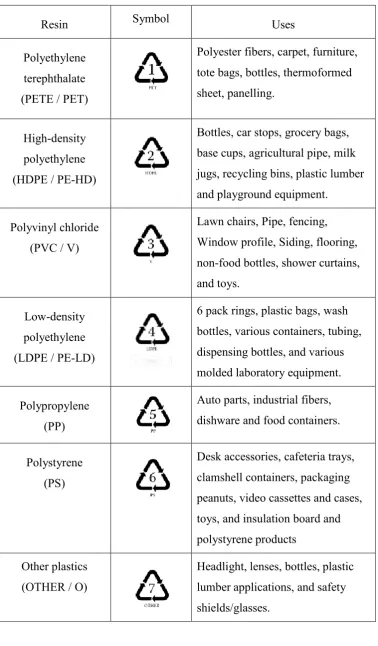
2.1.1 Identification of Plastics
7
Table 2.1: Classification of Plastic Resin (Gerdeen, J.C. and Rorrer, R.A., 2011)
Resin Symbol Uses
Polyethylene terephthalate (PETE / PET)
Polyester fibers, carpet, furniture, tote bags, bottles, thermoformed sheet, panelling.
High-density polyethylene (HDPE / PE-HD)
Bottles, car stops, grocery bags, base cups, agricultural pipe, milk jugs, recycling bins, plastic lumber and playground equipment.
Polyvinyl chloride (PVC / V)
Lawn chairs, Pipe, fencing, Window profile, Siding, flooring, non-food bottles, shower curtains, and toys.
Low-density polyethylene (LDPE / PE-LD)
6 pack rings, plastic bags, wash bottles, various containers, tubing, dispensing bottles, and various molded laboratory equipment.
Polypropylene (PP)
Auto parts, industrial fibers, dishware and food containers.
Polystyrene (PS)
Desk accessories, cafeteria trays, clamshell containers, packaging peanuts, video cassettes and cases, toys, and insulation board and polystyrene products
Other plastics (OTHER / O)
8 2.2 Thermoplastics
We can make good decisions when choosing materials by understanding of why various polymers react the way. Thermoplastics, thermosets, and elastomers is the most common three group of classified polymers. The main distinctions between material types is thermoset and thermoplastic. The thermoplastic materials is term usually refers rather than thermosetting. The prefix, “thermo” is relates to how both material types respond to heat. The relatively weak Van der Waals forces held very long chain-like molecules together in a thermoplastic material. The plastic softens to be processed when heated and liquefies as additional heat to reach the temperature above its melt point of the plastic. When cooling and the temperature drops below its melt point of the plastic, it solidifies like a glass solid (Crawford, R.J., 2013). The plastic melting and solidifying process can be repeated as the plastic temperature increases above and decreases without serve damage, allowing reprocessing and recycling.
9 2.2.1 Engineering Plastics
As a comparison, engineering plastics are a type of plastic materials which better than commodity plastics (e.g. polypropylene and polyethylene) in term of mechanical and thermal (Mittal, V., 2011). Engineering plastics include most of thermoplastics as engineering materials. Many traditional engineering materials such as glass and wood have gradually replaced by engineering plastics in many applications.
Engineering plastics are equaling or surpassing due to their light weight and strong strength and other properties. For produce complicated shapes, they also easier to manufacture in simple process step. Every type engineering plastic has a special combination of properties that may make the difference selection material in difference application. Heat resistance, chemical stability, mechanical strength, self-lubrication, rigidity and fire safety are the properties exhibited by various grades of engineering plastics.
2.2.2 Commodity Plastics
10 2.3 Acrylonitrile Butadiene Styrene (ABS)
Acrylonitrile butadiene styrene (ABS) is a terpolymer (three-way polymer), chemical formula (C8H8)x•(C4H6)y•(C3H3N)z. ABS also is an examples of engineering plastics. Styrene Acrylonitrile copolymers were available since 1940’s, but introduction of a Butadiene as a third component in the 1950s created a range of ABS plastics.
In the presence of polybutadiene, it made with combination of polymerizing styrene and acrylonitrile. The usual ratio of materials of ABS is around 15 to 35% acrylonitrile, 5 to 30% butadiene and 40 to 60% styrene (Kumar et al., 2010). The resulting polymer is consisting of short chains of polystyrene-co-acrylonitrile mixed with a long chain of polybutadiene. ABS glass transition temperature is about 105 °C (221 °F). It is amorphous and therefore has no accurate melting point. For the majority of applications, mechanical properties of ABS used vary with temperature in the range of −20 to 80 °C (−4 to 176 °F).
It is stronger than polystyrene due to the short chains bond by nitrile monomers. The reason of ABS stronger than pure polystyrene is the nitrile groups being polar attract each other and link the chains together from nearest chains. The Acrylonitrile imparts chemical resistance and surface hardness, Butadiene conduces the impact strength and over all toughness, and Styrene helps in processing. ABS integrate the strength and rigidity of acrylonitrile and styrene polymers with the toughness of poly-butadiene rubber (La Mantia, F., 2002). As a result, ABS are tough, lightweight and rigid thermoplastic that has great in term of impact and mechanical strength.