The four food systems in developing countries and the challenges of modern
supply chain inclusion for organic small-holders.
Paper for the International Rural network Conference in India, Udaipur 23-28th of August 2009
By Dr. Paul Rye Kledal Institute of Food and Resource Economics
Copenhagen University, Denmark E-mail: paul[a]foi.dk
Introduction
Global demand for organic products has remained robust, with sales increasing by over 5 billion US$ a year. Organic Monitor estimates international sales to have reached 46.1 billion US$ in 2007 - more than the triple of 2000, when sales were at 18 billion US - but expects lower growth rates due to the financial crisis. Most of the sales take place in the US and Europe (97 per cent), with a growing commodity import from the countries of the South (Willer & Kilcher, 2009).
However, the rise of an urban upper middle class in the South has itself increased the demand for organic foods in this part of the world linking organic food and farming to both new opportunities of development as well as the accusation of being ‘Healthy, but only for the Wealthy’.
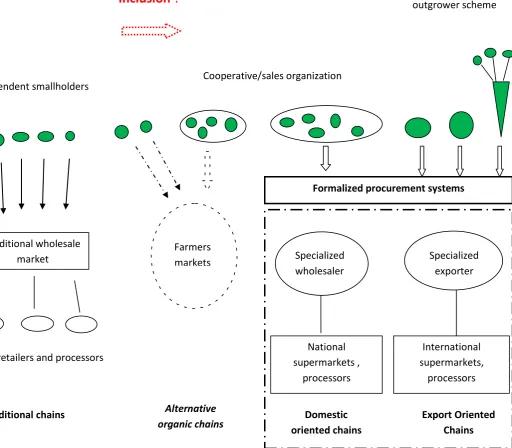
As illustrated in the figure 1 there are four different typologies of food systems closely related to the development process taking place in the South, as well as to the parallel growth of organic food commodities1.
The first is a traditional food system, characterized by a dominance of traditional, unorganized supply chains and limited market infrastructure. The second is a more structured food system, still characterized by traditional market actors, but with a more complex set of rules and regulations applied to marketplaces and a higher degree of market infrastructure. Organized supply chains operated by national and/or international supermarkets begin to capture a growing share of the market, but traditional chains are still most common and the urban domestic market is the driver. The third type is an industrialized food system, as found throughout the developed world, with strong perceptions of food safety, a high degree of coordination, a large and consolidated processing sector and organized retailers. The export market is driven by this food system. The fourth is named an alternative food system, where farmers, various types of intermediaries and consumers are able to construct semi closed circuits of exchange. These semi closed circuits are
1
The idea of four food systems when working with organic food markets in developing countries is building on the work of McCullough, Pingali & Stamoulis eds., 2008 operating with three conventional food systems prevalent in the countries of the South.
Archived
at
often based on values stressing transactional processes of trust, community, social and environmental welfare as against capitalist transaction outcomes of exchange such as competition, exclusion, price decline and concentration of production.
Figure 1:
The four food systems prevalent in developing countries and their mode of agro-supply chain organization
Alternative organic chains Traditional chains
Inclusion ?
Independent smallholders Cooperative/sales organization
Lead farmer/ enterprise with outgrower scheme
Small retailers and processors
Domestic oriented chains
Export Oriented Chains Formalized procurement systems
National supermarkets ,
processors
International supermarkets,
processors Specialized
wholesaler
Specialized exporter Traditional wholesale
market
The growth of organic production in the South is first and foremost linked to the third type: the industrialized organized food system prevalent in the North, and hence deeply export oriented. However, the rapid rise of both supermarkets and an urban upper middle class consumer segment in the South (Reardon et al, 2003) has opened up for organic food suppliers worldwide to expand sales through the organized supply chains in the second food system predominant in NIC (New Industrialized Countries) of the South. The growing sales domestically of organic foods through the formalized procurement system has in Brazil, Egypt, China and Kenya so far mainly been driven by large global supermarket chains like Carrefour (home base: France), smaller global chains like Casino and Metro (home base: France and Germany) and up-coming regional players like Grupo Pão de Acúcar (Brazil), Hyper One (Egypt), Uchumi and Nakumatt (Kenya), Lianhua, Hualian (China) and Shanghai Nonggongshang (Shanghai based) (Kledal et al, 2007; 2008 & 2009).
The fourth food system, the alternative organic market, is seldom found in poor developing countries, but exists in NIC countries like Brazil, China and India where growth in this market seems to be correlated with rising industrialization, urbanization and income as well as NGO’s counter-reacting progressively to social and environmental exclusion.
The ability of the many small-holder farmers from the traditional food system to be included into the various organized and commercialized market procurement systems, of either the domestic, export or alternative food system, depends to a large extend on how the terms of sale and cost of participation are compared to those of the traditional chain they operate in. Terms of sale matter because they determine how incentives, risks and marketing costs are distributed between buyers and sellers. While prices and quantity can be tracked easily, costs, and particularly transaction costs, are more difficult to measure and differ greatly between farmers and contexts.
With the rise of modern food systems a new set of transaction costs has arisen, because of the standards that are required in terms of quality, size and delivery. Supermarkets and agribusiness companies put ever more stringent conditions on the suppliers in order to capture markets and differentiate their products.
Increasing affluence stimulates at the same time a desire for greater choice in food products
(Dicken, 2007 p.358), and organic food products are capturing a growing share of this segment.
The new set of transaction costs can be explained by (Hayes, Hayenga and Thompson, 2000):
- The bureaucratic costs associated with managing and coordinating integrated production, processing and marketing
- The opportunity costs of time used in communicating with farmers and coordinating with them
- The screening costs linked to uncertainty about the reliability of potential suppliers or buyers and the uncertainty about the actual quality of the goods
- The transfer costs associated with the legal or physical constraints on the movement and transfer of goods. This also includes handling storage costs, transport costs etc.
Hence modern food procurement systems have become much more discriminatory towards small-holders in terms of who is able to enter the organized agro-food supply chains.
Methodology
Organic farm sector analysis has been made in
- Two developing countries (Kenya and Tanzania)
- Three NIC countries (Brazil, China and Egypt) where the latter two are transition states
Firstly the sector has been documented in terms of key crops produced, number of farms and hectares as well as market destinations. Secondly, key farm enterprises and intermediaries within packaging/processing and trading/exporting companies were found.
From the theory of transaction costs (TC) intermediaries connecting farmers to either processors and/or supermarkets and reducing farmers’ TC downstream are the nodes of importance when lessons on small-holder inclusion and constraints for suppliers operating in modern procurement systems has to be drawn.
Therefore in-depth interviews have been made with the owners or key personnel in charge of intermediaries along the various supply chains focusing on:
1) the challenges of inclusion of small-holders to secure a critical and steady mass of supply 2) the intermediaries’ own challenges of being included themselves in relation to the
requirements from the buyers downstream
Results
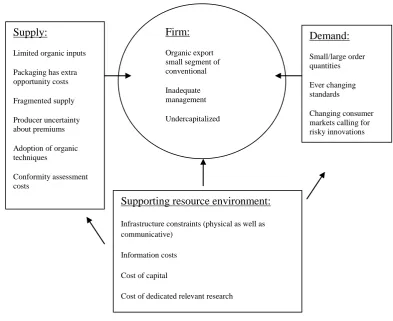
The conceptual framework applied during in-depth interviews as well as results is illustrated in figure 2.
In figure 2 below the various constraints have been organized whether they belong to the supply
system, the Firm/intermediaries themselves, the Demand system, and finally the Supporting
Figure 2:
Conceptual model illustrating constraints in the organic sector in developing countries
In the supply system organic inputs (ingredients) that have to be imported like organic sugar or enzymes, the costs and time were found to be a serious constraint. Even when a supplier of organic ingredients was found they were often expensive and their delivery schedules unpredictable.
Coordinating many smallholders raises transaction costs when trying to lower a fragmented supply. However, contract farming has the possibility of reducing TC, but needs a cost effective system of control and enforcement.
Depending on the contract scheme producers can have uncertainty about obtaining organic premiums. The level of premiums is again related to the level of risk the farmers will take and therefore also corresponding to their willingness to make investments and adapt to new organic techniques.
Among the firm/intermediary system along the supply chain the level of managerial and technical competences often limit the benefits from exporting while possibly increasing its costs.
Supply:
Limited organic inputs
Packaging has extra opportunity costs
Fragmented supply
Producer uncertainty about premiums
Adoption of organic techniques
Conformity assessment costs
Demand:
Small/large order quantities
Ever changing standards
Changing consumer markets calling for risky innovations
Supporting resource environment:
Infrastructure constraints (physical as well as communicative)
Information costs
Cost of capital
Cost of dedicated relevant research
Firm:
Organic export small segment of conventional
Inadequate management
Likewise organic exports are often a small part of the exporter’s conventional business, which in some cases makes the organic part get less priority in terms of resources and attention. On the other hand, the experience inherent in existing conventional companies introducing organic products shows that these companies have a head start compared to the ‘pure’ organic companies with no experience on export and trading.
Many companies are undercapitalized yet organic production and processing requires specialized know-how and in some cases technology which call for investment. However volumes are often low in the organic industry, risks not clear, cost of capital high, and returns are often not enough to encourage firms to make the necessary investments to increase productivity.
In the demand system the organic exporters get small order quantities that make it difficult to fill a whole container, thus making single product shipments uneconomical. This occur particular for orders targeting retail consumer markets. However, many of the small exporting companies would not be able to satisfy large orders by themselves.
Ever-changing quality, safety and certification standards are a barrier to entry that often requires development support in form of capacity building as well as financial support to enable companies to access these markets.
Consumer markets change ongoing making it difficult for companies to adjust and still have reasonable returns on investments.
In the supporting resource environment information cost on consumer trends in the North are often high, and likewise are capital costs. Similar lack of dedicated relevant research in organic production is a large constraint as well as the classical problems of weak physical and
communicative infrastructure.
Discussion
The organic sector in developing countries face to some extent many of the same problems like conventional farmers from the Traditional Market of getting included into modern agro supply chains, whether it is for a growing domestic consumer market or an export market. However, there are constraints specifically linked to the organic industry and its market development.
Table 1:
Common as well as specific development constraints faced by the conventional and organic farm sector respectively in the South, when aiming for inclusion into the modern Agro-food systems.
Common development issues Specific organic development issues
Supply system Fragmented supply,
Conformity assessment costs
Limited organic inputs Producer uncertainty on premiums
Adaptation of organic techniques,
New regulations
Intermediaries Inadequate management, Undercapitalized
Organic often a small segment, High search/information/ control costs ex ante/ex post production/transacting, High risk on capital borrowing
Demand system Small/large order,
Ever changing standards,
Different standards for different importers,
Changing consumer markets, Asymmetric bargain/trading power
Volatile export markets due to the small segment,
Regional differences on changing standards, Weak transformation of consumer trends in the North, Innovation and Agribusiness in the North
Supporting Resource Environment
Weak Infrastructure (roads, communication),
High bureaucracy for firm
registration and receiving credit,
Relevant research,
Lack of institutional ‘set up’ forwarding information and data on export markets,
Trading specificities
Capacity building and institutional inclusion ‘set up’.
For small-holder farmers trying to leave the Traditional Food System and enter the Alternative organic market or the more formalized procurement systems of either the domestic or export oriented supply chains, the entry point of departure are in most cases the intermediary.
The intermediaries can typically be grouped into three types:
- Faith-, environmental- or social oriented NGO’s - Development oriented NGO’s
- Farm associations, coops (with various degrees of farmer influence)
Within the three categories there will be overlapping in such a way that development NGO’s can be working with setting up farm associations, or one can find Faith based NGO’s working with social as well as environmental problems in their efforts of helping small-holder farmers.
The second focus point is to analyze the level of market commercialization and the type of Food system the intermediary is linking small-holders into. The formalized procurement system will demand a higher degree in terms of delivery, quality and food safety requirements, and the export oriented chain will be the toughest to enter.
The third focus point will be to evaluate if the intermediary is a new enterprise or one with former experience i.e. within conventional production and sale.
Fourth will be to evaluate the human and social capital of the intermediary and their ability to organize and optimize:
- Internal environment (management of personnel, production and sales planning)
- External environment (supplier organization, buyer requirements, bargaining experience, local authorities/development agencies/credit institutions, infra structure bottle necks etc.)
The type of food system that small-holders will be linked to, and the level of social and human capacity of the intermediary, will determine the degree of constraints, put forward in table 1 in which the actors along the agro-supply chain will encounter.
Coordination of key stakeholders along a given agro supply chain will therefore be critical to promote developmental objectives, such as growth, food security and improvement of the livelihoods of the rural poor.
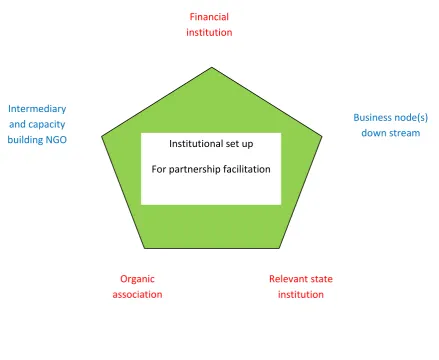
A model for an institutional partnership coordinating and integrating stakeholder interest is illustrated below.
Five key stakeholders are included to facilitate the necessary back up for overcoming the constraints put forward in table 1.
Not all five stakeholders need to be represented, but depends on the food system in which small-holder farmers are to be included as well as the need for capacity building along the supply chain. Likewise not all of the stakeholders need to continue in the institutional partnership once various constraints have been overcome. The ideal should be over time that the stakeholders from the supporting resource environment can leave the formal institutional partnership ‘set up’, and the market actors themselves have become self-governed.
Conclusion:
To promote developmental objectives, such as growth, food security and improvement of the livelihoods of the rural poor, a greater understanding of the four food systems prevalent in the South is of great importance. Inclusion of small-holder farmers into the various food systems depends to a large extent on the capacity of the intermediaries and their ability to cope with both internal as well as external constraints while linking farmers to the agro-supply chains. The greater
Intermediary and capacity building NGO
Organic association
Financial institution
[image:9.595.55.495.293.653.2]Institutional set up For partnership facilitation
Figure 3: Partnership model for facilitating small-holder inclusion to modern agro-supply chains.
Blue: market actors - Red: Supporting Resource Environment
Relevant state institution
discrepancy between the intermediary’s own social and human capital resource base as well as the supporting resource environment, and the level of requirements demanded from agro-food systems; the greater constraints the stakeholders along the supply chain will encounter and the more difficult the inclusion of small-holder farmers will be.
References:
Dicken, Peter, 2007. Global Shift – Mapping the Changing Contours of the World Economy, SAGE Publications 5th Edition.
Hayes, Dermit, Marvin Hayenga and Shelley J. Thompson, 2000. Transaction-costs economics and the evolving structure of agricultural production, IAMA World Food and Agribusiness
Congress, Chicago, Illinois, June 2000
Kledal, Paul Rye, Qiao Yu Hui, Henrik Egelyng, Xi Yunguan, Niles Halberg and Li Xianjun, 2007. Organic Food and Farming in China, in The World of Organic Agriculture – statistics and emerging trends 2007, eds. Helga Willer & Minou Yussefi, IFOAM & FiBL www.ifoam.org & www.fibl.org
Kledal, Paul Rye, Ahmed El-Araby and Sherif G. Salem, 2008. Organic Food and Farming in Egypt, in The World of Organic Agriculture – statistics and emerging trends 2008, eds. Helga Willer & Minou Yussefi-Menzler and Neil Sorensen, IFOAM & FiBL www.ifoam.org & www.fibl.org
Kledal, Paul Rye, Habwe Florence Oyiera, John Wanjau Njoroge and Eustace Kiarii, 2009. Organic Food and Farming in Kenya, in The World of Organic Agriculture – statistics and emerging trends 2009, eds. Helga Willer & Lukas Kilcher, IFOAM & FiBL www.ifoam.org & www.fibl.org
McCullough, Ellen B.; Prabhu L. Pingali & Kostas G. Stamoulis (eds.), 2008. The Transformation of Agri-Food Systems – Globalization, Supply Chains and Smallholder Farmers, Earthscan
Publications
Reardon, Thomas; C. Peter Timmer, Chistopher B. Barret and Julio Bardegué, 2003. The Rise of Supermarkets in Africa, Asia, and Latin America, in American Journal of Agricultural Economics vol 85 number 5, pp. 1140-1146