REINVENTING COMPETENCY - BASED
MANAGEMENT EDUCATION AND TRAINING -
FORGING A STRATEGIC ALLIANCE BETWEEN THE ENTERPRISE
AND AUSTRALIA'S QUEST FOR WORLD COMPETITIVE
PERFORMANCE
By:
Marcus Bowles (B.A.(Hon), Ph.D.)
Submitted in fulfilment of the requirements
for Masters of Education
University of Tasmania
Page 2
This thesis contains no material which has been submitted for the award of any degree or
diploma in any university or college and to the best of my knowledge and belief the thesis
contains no copy or paraphrase of material previously written or published by another person
unless I have made acknowledgment in the text of this work.
„Kix7/
.2 5"Marcus Bowles
Page 3
ABSTRACT
This thesis has a genesis in frustration over why so many managers in Australia are either
neglecting skills development or receiving education and training that is substantially divorced
from the competencies required within their enterprise performance context.
Outside normal research and literature review this thesis is based around material drawn from
two sources. This includes personal experience derived since 1990 from working with
enterprises and government bodies implementing training reform, and access to personal or
contemporary records held by members of those bodies involved in managing training reform.
What results is a study fundamentally influenced by the different perceptions held by enterprise
executives interested in business success and those individuals managing training reform.
Competency-based management education and training forms the central theme in this thesis.
It serves to focus the exploration of the translation of management theory into developing the
effective manager during a period of national training reform. This is not a search for a new
theory of competency-based management education and training. Rather it is a search for a
better understanding of how we can reinvent existing approaches to produce managers that can
effectively achieve enterprise performance requirements.
Through reinventing what exists the thesis illustrates it is possible to better integrate national
training reform efforts with the sourcing of management education and training required by
enterprises to achieve business success. This finding confirms the need to move debate from
the actual process of reform (means) to a more collaborative basis concerning the perceived
benefits (ends) sought by all participants. One such end advanced is the search for
Page 4
ACKNOWLEDGMENTS
To my family for their support and to Professor John Williamson who provided invaluable
Page 5
TABLE OF CONTENTS
CHAPTER 1. INTRODUCTION 1-7
CHAPTER 2. DEVELOPING A CONCEPTUAL FRAMEWORK 2-12
2.1. WHY REINVENT? 2-12
2.2. POSTULATING A MODEL TO UNIRAVEL THE RELATIONSHIPS 2-18 2.3. A NEW CONCEPTUAL FRAMEWORK TO EXAMINE CBME&T 2-20
CHAPTER 3. DEFINING THE EFFECTIVE MANAGER: MANAGEMENT THEORY AND
MANAGEMENT DEVELOPMENT 3-23
3.1. DEFINING THE EP I-E.CTIVE MANAGER 3-23
3.2. DEFINING MANAGEMENT DEVELOPMENT 3-45
CHAPTER 4. COMPETENCIES AND COMPETITIVENESS - NATIONAL VOCATIONAL EDUCATION AND TRAINING REFORM IN AUSTRALIA 4-51
4.1. WORLD COMPETITIVE PERFORMANCE AND AUSTRALIA RECONSTRUCTED 4-52 4.2. DETERMINING THE AGENDA IN NATIONAL VOCATIONAL EDUCATION AND TRAINING REFORM 4-55 4.3. TRAINING REFORM AND GLOBAL COMPETITIVENESS 4-64
CHAPTER 5. THE STANDARD PROBLEM - GLOBAL 'DRIVERS' AND TRAINING
REFORM 5-66
5.1. A COMPARATIVE VIEW: INTERNATIONAL APPROACHES TO COMPETENCY-BASED
EDUCATION AND TRAINING 1988-1992 5-66
5.2. A NATIONAL APPROACH TO IDENTIFYING COMPETENCY-BASED STANDARDS IN AUSTRALIAN ENTERPRISES
5.3. THE INDUSTRY TASK FORCE ON LEADERSHIP AND MANAGEMENT
5-74 5-88
CHAPTER 6. THE ENTERPRISE SEARCH FOR THE COMPETENT MANAGER 6-95
6.1. IDENTIFYING MANAGEMENT COMPETENCIES IN AUSTRALIAN ENTERPRISES 1988-1994 6-95 6.2. A NATIONAL APPROACH TO DEFINING AUSTRALIAN MANAGEMENT COMPETENCY STANDARDS 6-103
6.3. ENTERPRISES AND MANAGEMENT COMPETENCIES 6-112
CHAPTER 7. REINVENTING COMPETENCY - BASED MANAGEMENT EDUCATION
AND TRAINING 7-113
7.1. ENABLING COMPETITIVENESS - THE ENTERPRISE'S IMPERATIVES DRIVING A REDEFINITION OF
MANAGEMENT EDUCATION AND TRAINING 7-114
7.2. ENABLING COMPETITIVENESS - NATIONAL IMPERATIVES DRIVING A REDEFINITION OF
COMPETENCY-BASED MANAGEMENT EDUCATION AND TRAINING 7-136 7.3. A NEW CONCEPTUAL FRAMEWORK FOR REINVENTING COMPETENCY-BASED MANAGEMENT
EDUCATION AND TRAINING 7-139
CHAPTER 8. INTEGRATING NATIONAL AND ENTERPRISE NEEDS THROUGH
COMPETENCY - BASED MANAGEMENT EDUCATION AND TRAINING8-143
8.1. AN INTEGRATED ENTERPRISE APPROACH TO CBMET 8-144 8.2. IMPLEMENTING AN ENTERPRISE PERFORMANCE STANDARDS PROFILE (EPSP) AS A STRATEGIC TOOL -
THE PURITY SUPERMARKETS EXAMPLE 8-152: 8.3. IMPLEMENTATION FRAMEWORK FOR COMPETENCY-BASED MANAGEMENT EDUCATION AND TRAINING 8-160 8.4. REINVENTED COMPEL ENCY-BASED MANAGEMENT EDUCATION AND TRAINING - AN APPLIED STUDY 8-169
Page 6
Table of Figures
Figure 1: Elements Defining the Manager 2-19 Figure 2: Slocum and Lei Model for Strategic Alliances 2-20 Figure 3: Conceptual Framework for Unravelling Relationships Between
Elements 2-21
Figure 4: Katz Model for Defining a Manager 3-26 Figure 5: Management Roles in Different Size Businesses 3-33 Figure 6: Blake and Mouton Management Grid 3-36 Figure 7: Boyatzis Model for Competencies and 3-40 Figure 8: Mintzberg's Examination of Variables Impacting a Management
Job in a Given Environment 3-40
Figure 9: The Dynamic Interaction between Job Competencies & factors in a Given Performance Context 3-41 Figure 10: Boyatzis Competency Development Process 3-44 Figure 11: Defining a Manager Actions Across Different Levels of Employment 3-49 Figure 12: Reform and Raising Australia's International Competitiveness 4-55 Figure 13: The National Vocational Qualifications Framework (United Kingdom 1992) 5-68 Figure 14: Qualification Streams Under the UK System 5-70 Figure 15: New Zealand Qualifications Framework 5-72 Figure 16: The Australian Standards Framework 5-75 Figure 17: The Structure of a Competency Standard 5-77 Figure 18: Enterprise Competencies and Alignment Difficulties with Existing Standards 5-79 Figure 19: The Australian Qualifications Framework and A National Training and Education System 5-87 Figure 20: The Industry Taskforce's Emerging Senior Manager Profile 5-90 Figure 21: The Industry Taskforce's Emerging Frontline Manager Profile 5-90 Figure 22: SECV process for defining management competencies 6-98 Figure 23 Victorian Public Sector process for defining core management competencies 6-102 Figure 24: JAPSTC Management Competencies 6-107 Figure 25 Australian Public Sector Commission core competency identification process 6-108 Figure 26: Collaborating to Form An Effective Manager 7-113 Figure 27: Transformation of Management Practices 7-119 Figure 28: Quality 'Gurus' Compared 7-120 Figure 29: The Sequencing of Traditional Management Functions 7-126 Figure 30: Transforming Organisational Structures 7-127 Figure 31: Structuring Organisations to be Market - Centred 7-130 Figure 32: Discontinuity of Innovation/ Change 7-132 Figure 33: Single Loop- Double Loop Learning 7-134 Figure 34: Strategic Alliances and the Global Factors Enabling Increased Collaboration 7-137 Figure 35: A Collaborative Framework using Competency-Based Management Education and Training 7-141 Figure 36: A Collaborative Basis for Reinventing Competency-Based Management Education
and Training 8-144
Figure 37: An Integrated process for identifying enterprise competencies 8-145 Figure 38: Integrating the three levels of performance outcomes 8-147 Figure 39: The Features of Productivity 8-148 Figure 40: Enterprise Competencies as a Performance Standards Profile 8-151 Figure 41: Competency Identification as a Communication Process 8-154 Figure 42: Skills Profile for a Job 8-155 Figure 43: Person and Position Profiling to Determine Job Training Needs 8-155 Figure 44: Recognising Woolworths Competency Based Education and Training Under the Australian
Qualifications Framework 8-157 Figure 45: Enterprise Competency Standards and Selection, Recruitment and Human Resource Planning 8-158 Figure 46: Enterprise Competency Standards and Recognition of Attainment (Performance Appraisal
and Review) 8-159
Chapter 1-7
1. Introduction
This thesis is about using competency-based management education and training as a basis for
achieving enterprise business success while enhancing the global competitiveness of Australian
industry.
The central argument in this thesis falls out of the different perspectives one may achieve by
viewing learning from a national or an enterprise level. From these different perspectives it
will be argued that conduct of the national training reform agenda in Australia has failed to
develop a precise focus on what will 'drive' enterprises to support and promote
implementation. The focus has been on global or national policy and portfolio drivers for
change. While the issues driving national reform may be rational and logical it will be
advanced that they represent an insufficient basis for convincing enterprises their
business success can be promoted through the process of training reform.
This thesis will argue that the fundamental issues or imperatives, or so called 'drivers', that
impel resulting action at a national level lack integration with an enterprise executives'
strategic imperative to achieve business success. The imperatives to achieve training reform
and to implement resulting initiatives must extend beyond the national level to encompass
enterprise level needs. It will be argued that such a collaborative basis can be achieved through
a process of reinventing (Mackay, 1994:19). This involves completely rethinking or redefining
the fundamental principles impelling enterprises and the nation to achieve competitiveness. It
is through such a study of that it will be possible to focus on the diverse elements impacting the
Chapter 1-8
To argue that national training reform needs to be reinvented in order to achieve improved
outcomes this thesis must first determine what already exists. As one initiative resulting from
training reform competency-based management education and training will be used by this
thesis as basis for isolating the elements that shape how enterprises support and promote
national training reform. A study of competency-based management education and training
also invites analysis of the many elements that impinge upon, and ultimately determine how
specific enterprises respond to training. The identification of the elements to be studied, and
the relationship between these elements will be central to how this study is structured.
While focussing on what may give cause for enterprises to support training reform it is not
being argued that current reform efforts have necessarily failed to involve enterprises and
industry. As the central thesis is really heuristic the study will not always progress like the
'typical' academic paper. However, on conclusion there should be a much clearer delineation
of the relationship between the factors that drive policy and portfolio objectives, as
encompassed under the "national training reform agenda", and how they have or have not
addressed what would drive enterprises to support training reform. By using
competency-based management education and training the study can be focussed and begin to isolate
fundamental drivers that may promote national and enterprise collaboration. It is from
collaboration on training reform that the current achievements can be extended to forge
strategic alliances that meet not only national interests, but perhaps achieve national interests
through directly enabling enterprises to use training and education in a way that promote
business success.
A number of critical elements impact the thesis' study of competency-based management
Chapter 1-9
enterprises have responded to competency-based management education and training. To
permit comparative study this analysis must include pre-training reform and current enterprise
initiatives on competency identification and competency-based training and education
strategies. Determining the other elements in the study serve to build a broader 'picture' of
current developments..
A component of this thesis must be dedicated to a thorough analysis of the principles and
practices underpinning management and the act of reinventing. The thesis must define what
constitutes a manager. This is important not only because we need to know what constitutes a
manager in an enterprise. We also need to identify how the concept of 'management' has
influenced how education and training have been used to develop more effective managers.
Reinventing must be examined to establish how the study of management, training reform and
enterprise level competency-based management education and training can be integrated and
then renewed through analysis of our findings.
The structure of the thesis will systematically consider each of the key elements. First, the
thesis will establish a basis for reinventing and a determine a framework for studying all
elements and the relationship between these elements. In the ensuing chapters the thesis will
use the conceptual framework progressing on a path reflecting the heuristic nature of the study.
Chapter Three will examine what constitutes the effective manager and how management
theory has altered our definition of management development. An examination will be made
of how changes to the theory of 'management' and concepts of management development -
render inadequate current frameworks that seek to promote competency-based management
Chapter 1-10
Chapters Four and Five, respectively, will cover the national and comparative international
'drivers' impelling Australia to undertake training reform. Chapter Six will conclude the
examination of the basis for training reform by establishing how enterprises have approached
their search for the competent manager. This chapter will permit a fundamental comparison
between the strategic need for competency-based management education and training, as
perceived by enterprises, and those identified as driving the national training reform agenda.
Chapter Seven will present a basis for reinventing what previous analysis in the thesis has
established. This will involve articulating principles that can underpin a new basis for
progressing national training reform. A basis where national and enterprise collaboration on
competency-based management education and training can achieve mutual advantage.
Chapter 8 extends somewhat beyond the immediate scope of this thesis. It marks the applied
study of an Australian enterprise currently achieving enterprise competitive advantage through
the integration of national training reform initiatives. The chapter extends previous study to
evidence a strategic alliance between government and an enterprise that confirms the
fundamental principles for reinventing competency-based management education and training
which were articulated in Chapter 7.
In completing its study this thesis will conclude having established how competency based
training can forge an alliance between the national efforts to become "world competitive" and
the enterprise imperative to secure competent managers who can meet the challenges inherent
in their specific performance context. By focussing on competency-based management
education and training the thesis will highlight how it is the manager's awareness of, and
Chapter 2-11
on training reform requires managers demanding skills that underpin an enterprise's quest for
market advantage and a nation's quest for world competitiveness. (NBEET, February, 1994:42;
Cherry, 1995:34; ASTC, September, 1991:111)
It's not sufficient for this study to just reinvent existing competency-based management
education and training practices. The thesis must also illustrate how the drivers for national
training reform represent an insufficient basis for convincing enterprises that these reforms will
directly advance business success. In essence proposing principles that should underpin a
reinvented approach to competency-based management education and training must promote
wider implications for using education and training as a basis for forging strategic alliances
between government and enterprises. Ultimately the success of the national efforts to achieve
world competitiveness as advanced by national vocational education and training reforms
require Australian managers be convinced that their personal and their enterprise's business
Chapter 2-12
2. Developing a Conceptual Framework
2.1. Why Reinvent?
The choice of a path based on reinventing either technical entities or concepts (Osborne &
Gaebler, 1993:xviii) should not be taken lightly. It is a strategy that will inherently attract
criticism from those locked into existing practices and their theoretical foundations. It is
therefore necessary to clearly articulate why this thesis will choose to 'reinvent' our
understanding and application of competency - based management education and training
(CBMET).
Completing a reinvention of current approaches to competency-based management education
and training must not leave Australian managers with another construct that seeks to change
current practices. What is required is not another theory, but solutions that can assist interpret
what already exists within the manager's own, their enterprise's context. This is particularly so
in Australia where the myriad of international management literature and the reforms initiated
by government have multiplied the current ideas on what constitutes "the best" approach to
management.
In starting with an examination of reinventing, the emphasis is on renewing our understanding
of the known to develop an improved way to conduct management education and training.
This does not imply that all previous theories of management, management development, or
approaches to education and competency-based training are to be replaced with this latest
Chapter 2-13
The practice and theory underpinning why we should seek to reinvent can be explored initially
by examining why improvement, innovation, or re-engineering of existing approaches to
CBMET are not adequate solutions.
2.1.1. Improvement
Improvement is herein limited to a focus on incremental change to an existing or known
entity, component, technique, or idea that generates superior outcomes (Davenport, 1993:11).
Because such changes are based on the existing practices, they rarely generate radical cultural
change and the incremental nature of the process usually has limited impact on organisational
structures.
2.1.2. Innovation
Innovation is defined generally as the "process that begins with an inventor's insight and ends
with a new product or technique" being created (Lundstedt & Colglazier, 1982:xiii).
Innovation is not just the practical improvement of hardware. It is also the reshaping of
concepts or ideas. The innovation process forms the basis for individuals to inject ideas,
insights, pure and applied research, scientific knowledge, and technical 'know-how'.
Innovation is not held within this thesis to be the same as discovery or invention where a new
technical entity is produced. Discovery is the production of new technical or scientific
knowledge based on intuition or a rational/ analytical approach to research. (Goodman &
Lawless, 1994:40-41). This is distinct from invention, which is production of a novel technical
entity, usually the result of pure research discovery or the unique combination of established
knowledge. 1.
Innovation involves the substantial change and development to identified technology, ideas or
Chapter 2-14
considered to sit below the high risk, uncertain efforts of those seeking inventions or
discoveries, and above those undertaking improvements. Nevertheless innovation can often
involve the rejection of the known to produce a more radical change, as such innovation can
greatly effect both the organisation's culture and structure. (Davenport, 1993:11)
2.1.3. Re-engineering
Re-engineering has fundamentally dealt with the analysis of all activities associated with the
way an organisation operates and the associated radical process changes required to achieve
breakthrough outcomes. (Bowles, 1994:14) Breakthroughs are typified by changes that
generate improvements or outcomes which open new opportunities and which are a major
progression from existing or known practices. Re-engineering is usually marked by a higher
risk factor due to the desire to achieve these 'breakthrough' results.
Re-engineering texts and literature are now becoming as popular and as numerous as Total
Quality Management texts were in the late 1980s (see for example, Hammer & Champy, 1994,
Davenport, 1993, Obolensky, 1994). In terms of later study in this thesis it is important to
appreciate the belief held by those advocating process re-engineering that organisations are
failing to change sufficiently rapidly. While this may not sit quite so comfortably with the
traditional view of operations and process management theories (and indeed many practitioners
schooled in such approaches), re-engineering asserts we must completely escape a focus on
traditional management approaches if we are to achieve world competitive enterprises.
(Hammer & Champy, 1994:5)
Process re-engineering necessitates escaping the conceptual parameters imposed by past ideas
Chapter 2-15
rethink everything they do. This may mean examining the known only if we are prepared to
discard past practices thereby escaping any approach to change that is locked into incremental
or low risk solutions. Those undertaking process re-engineering must:
1. suspend reference to existing practices and traditional concepts;
2. start process design from the output service/product delivered and the requirements
of external customer;
3. define process relationships by mapping the ideal or optimal internal customer
relationships that can support external customer requirements;
4. derive ideal and optimal procedures and relationships without initial regard as to
'why we cannot do this';
5. devise new performance targets;
6. review the new performance targets against corporate or strategic targets; and
7. establish priorities and responsibilities for implementing process re-engineering
In effect, re-engineering is about escaping incremental and ad hoc change exercises and
promoting a radical re think of how organisations conduct operations. It is therefore more than
a tool or adjunct to existing management theories. Proponents view re-engineering as both
holistic in its consideration of organisational management and in how we go beyond innovation
based on known factors. It essentially promotes change to business operations and service and
product delivery processes to a point where a new basis for competitive positioning has been
created.
Theorists and practitioners within the field have debated what exactly, re-engineering entails.
Writers such as Michael Hammer and James Champy suggest that organisations have not
responded well to the imperatives of the three "Cs" - customer, competition and change.
Chapter 2-16
engineering, to be truly effective, requires the complete renewal of the corporate entity. This
requires what has been called the "big-bang" approach to re-engineering where all processes
are considered as part of the corporation re-engineering exercise.
Some writers take a more conservative approach to process re-engineering. They believe
radical change can occur through re-engineering but it can be based on innovations that better
integrate the systems supporting cumulative change to performance with the need to exceed
customer expectations. (Davenport 1993:37-43) This exercise fundamentally alters the concept
and management of operations as defined by a series of related input, transformation and
output sequences. As such to achieve an operational breakthrough the exercise of process
re-engineering goes beyond a limited reconsideration of a process in isolation from wider
corporate efforts. This also assists in defining process re-engineering as distinct from a process
'redesign' or improvement as may occur in administrative or process cycle time reduction.
Davenport in Process Innovation: Reengineering Worli_Througfa_InfolmaticN3_1_tchnalQgy
(1993) highlighted another area of contention concerning re-engineering experts. Davenport
places a heavy emphasis on using information technology to re-engineer processes. Davenport
has critically impacted management thinking since publication of the above text. This work
has provided the nexus between the concept of innovation as a radical management tool and the
concept of re-engineering processes. However, Hammer and Champy (1994) see the focus on
engineering work through information technology as limiting the definition of
re-engineering. They argue:
Chapter 2-17
It is beyond the scope of this thesis to discuss all the arguments but it is critical to note that
re-engineering is a systematic effort to stimulate process innovation. This is further accelerating
the total rethinking of management, leadership and organisational design.
2.1.4. Reinventing
The concept called reinventing has been loosely associated with the drive to re-engineer
organisations. In fact reinventing is often considered to be synonymous with re-engineering.
Reinventing has been used to underpin the need to rethink completely how organisations or
societies operate. Reinventing is fundamentally linked to the "Age of Redefinition" where
global changes challenge us to redefine things we once may have held to be absolutes. (Mackay
1994:19)
The concept has even been used especially by Osborne and Gaebler in Reinventing
Government: How the Entrepreneurial Spirit is Transforming the Public Sector (1993) when
they argue for the United States public sector to be reinvented in an entrepreneurial spirit. The
authors advanced imperatives that necessitate a fundamental redefinition of goverment.
(Osborne & Gaebler, 1993:xviii & xix) Osborne and Gaebler established the basis from which
to reinvent what existed by establishing a new paradigm based on a novel interpretation of
entrepreneurial government. (Osborne & Gaebler, 1993:16) This enabled Osborne and Gaebler
to establish or reinvent the basis for debating the definition of government in the United States
of America.
Reinventing can therefore be seen to have three critical elements:
1. an examination of the imperatives for redefining the chosen topic within a
Reinvent what Exists to Form Innovative and Improved Solutions
A Conceptual Framework to Diagnose what Exists
Map Developments and the Reasons for Existing Practices or Processes.
Chapter 2-18
2. the redefinition of the given elements that originally constituted the basis for current
practices or processes; and
3. using the first two steps as the basis for the articulation of the new, whereby a
technical entity, conceptualisation, or approach, unlike any previous is produced.
This thesis is broadly divided into three parts that cover the act of reinventing.
Next Section
Chapter 3 to 5
Chapter 6 to 8
2.2. Postulating a Model To Unravel the Relationships
This thesis will argue a need to explore reinventing competency-based management education
and training to maximise effort and enhance the collaboration to achieve competitiveness. The
study of competency-based management education and training is used as a focus point to deal
with a number of major concepts and elements that serve to hinder strategic alliances between
Enterprise Strategic Imperatives
Management Theory and Management Development
Chapter 2-19
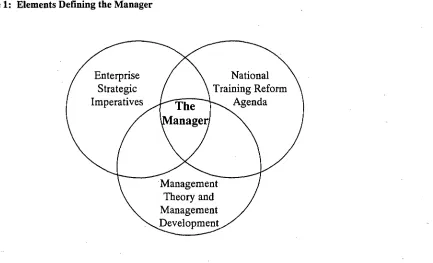
Elements in the study such as enterprise strategic imperatives, national training reform,
competency based training and education, competitiveness, management theory and
management development could all form areas of study for this thesis. Any model or tool in
this thesis needs to be assessed on its ability to untangle the relationships between such
[image:19.568.77.510.209.472.2]disparate elements.
Figure 1: Elements Defining the Manager
Only after we have examined the existing principles and processes that determined the
relationship between these elements can we fully articulate how competency-based
management education and training may best be implemented to advantage enterprises and the
individuals being developed.
The framework to be used by this thesis to examine the interrelationships between the elements
is based on the Slocum and Lei model for the design of global strategic alliances. (Slocum &
Lei, 1993:295-232) The authors devised this framework to highlight the importance of values
or the management of diversity. Their focus however is very much on devising a simple model
Choice of Strategic Affiance Configuration
Chapter 2-20
seen as the "mechanisms aiding managers' efforts to cope with accelerating rates of
environmental change and to restructure their competitive activities." (Slocum & Lei,
1993:297)
The framework is simple in construction. It seeks to detail the relationships between economic
factors and cultural values within a strategic alliance between businesses and government. (See
the figure below taken from Slocum & Lei, 1993:298)
Figure 2: Slocum and Lei Model for Strategic Alliances
It is the intention of this thesis to conduct an examination from a competency-based
management education and training perspective. Central to the thesis is the concept of strategic
alliance based on enhancing national or international competitiveness and the configuring of
systems to support business performance. In this case competency-based management
education and training is the focal point for examining how the relationship between the myriad
of elements can impact this alliance.
2.3. A New Conceptual Framework to Examine CBMET
The thesis will finally move to present a conceptual framework that explores the concept of a
strategic alliance based on an enterprise's strategic imperative for performance improvement
1.
National Training Reform Agenda
2. Enterprise - ,..
Specific
Policy and Administrative Structures
Strategic Imperatives Management
Theory & Management Development
5. Competency
[image:21.568.42.505.111.318.2]Based ... Management Education &
Trainin
6. Effectiveness o Implementation
- Market Advantag
Chapter 2-21
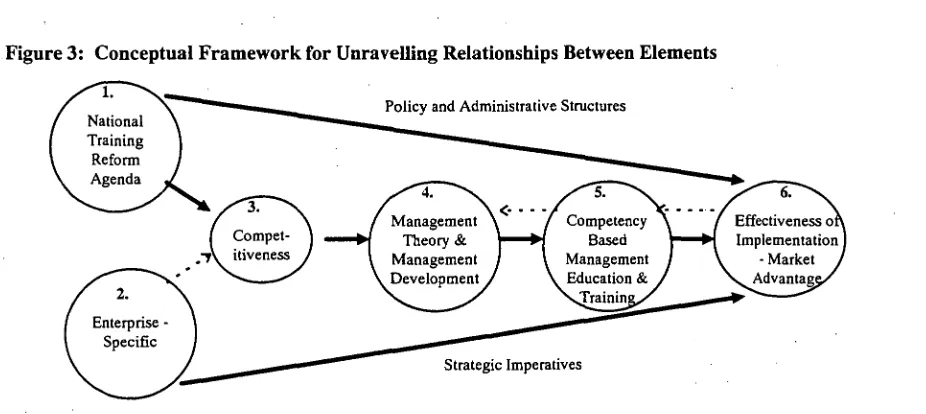
To achieve a framework for diagnosis that can unravel the relationships between the factors
within this thesis can modify the Slocum and Lei (1993:298) framework as outlined below.
Figure 3: Conceptual Framework for Unravelling Relationships Between Elements
The framework above is set to assist our investigation of the factors surrounding national
training reform and enterprise strategic imperatives. The framework also can permit this thesis
to determine the current status of the alliance on competency-based management education and
training to achieve competitiveness in both the domestic and international marketplace between
enterprises and government.
As the factors in the above figure are dynamic and relationships constantly change, this thesis
is not seeking to determine the exact configuration of the strategic alliances that can meet every
enterprises' strategic outcomes. Rather the model is heuristic. It will permit us to identify and
study the relationship between different elements. Once we understand what exists and the
basis for existing principles and practices, it will be possible to explore the potential of the use
of a revised version of the framework to renew the relationships between the factors in our
study.
Many factors inhibit the formation of alliances that can capitalise on market opportunities.
Chapter 3-22
when seeking to improve the formation of strategic alliances and to raise organisational
competitiveness. They included:
I. Creating Economies of Scale and Critical Mass
2. Learning for New Skills and Technologies
3. Shaping Industry Evolution
4. Reducing Risk
All elements will be revisited on completion of an examination of what national reforms.
However the conceptual framework above suggests any study of national strategies for
enabling strategic alliances needs to be counterbalanced by examination of the factors
motivating enterprises to forge alliances with government. To avoid dimensional descriptions
of any factors studied by this thesis, and to preserve the as yet unknown nature of the
relationships between the elements in this thesis, Slocum and Lei's four factors will have to be
revisited. Using the conceptual framework posited above this can occur after we have studied
the first four elements and aim to derive new collaboration framework for competency-based
management education and training.
It is, therefore, with the study of what constitutes a modern manager that this thesis must
commence before examining either national training reform or the enterprise search for the
Chapter 3-23
3. Defining the Effective Manager: Management
Theory and Management Development
When devising competency-based management education and training programs for an
enterprise the focus is on increasing management effectiveness. This leads us to question how
management theory and thought have come to define what constitutes an effective manager?
To establish a better understanding of current approaches to management development, we
need to come to some basis for interpreting how development activities have intended to
actually improve effectiveness. We also need to explore the basis which management theories
have provided to frame the concept of an effective manager. This will permit us to then assess
the impact the function-centred mindset of what a manger should do has had on our approach
to management education and training.
3.1. Defining the Effective Manager
This Section will explore three broad 'schools of thought' in management theory that have
dominated our approaches to developing an effective manager. We will look at how we have
defined the effective manager in terms of the Role Approach, the Trait Approach and the
Competency or Outcomes Approach. Each approach has unique characteristics but are they as
mutually exclusive in their intent as we may assume?
Regard for quality, activity-based accounting; competency-based training; workplace
agreements; best practice and benchmarking; participative management styles; and such like all
are all addressed with a mix of awe and fear. This fear is invasive. It is not necessarily just a
fear that a competitor in the marketplace will absorb the message in these areas first and get to
Chapter 3-24
individual's personal career survival depends upon the ability to respond to these new
imperatives.
Like computer sales people, management theorists and management development experts
purport a "best mix" of management practices that invariably unites to form a management
philosophy. The beauty is that sense can be made of the separate actions of a manager across a
range of functions by how the action relates to the overall philosophy. Teach a principle, and
the principle builds into an integrated approach to management in the workplace. The effort is
laudable, but has been going on since Taylor (1947), Fayol (1949), and Barnard (1938)
established their principles which were within twenty years being built into "philosophies" of
organisational theory, leadership and management. Real progress was made when theorists
such as Drucker (1954), McGregor (1960), Herzberg (1960), Likert (1960), and Cyert and
March (1963) came forward with variations, optional approaches and new management
principles.
By the early 1990s managers were faced with an overwhelming theory on every aspect on
management and organisational life. The fundamental reason for this is that the management
of organisations is so complex and open to so many variations, that it can not be explained by
one set of prevailing theories and practices. Studies of management theory serve as a necessary
basis to make sense of the topic and the act of management, but they cannot encompass the
increasingly rapid changes confronting the emerging market and workforce needs of modern
organisations.
Faced 'with the overwhelming array of different ways to manage, and the imperative to seek
Chapter 3-25
solution to improved enterprise performance. (Report of the Industry Task Force on
Management and Leadership Skills, 1995:xviii-x)
Generally, Australian managers have been oriented toward the management of structures. To
produce corporate visions that are underpinned with quantifiable and meaningful objectives.
These objectives are derived from, and implemented in business units that are increasingly
associated with satisfying particular client needs and building long term relationships with
these clients to attain that elusive "sustainable market advantage".
The changing emphasis to leading, supporting and facilitating process improvement has not
been underpinned with the realisation that structure is no longer a physical factor that can be
simply charted on office walls. Structure is treated as a result of the relationships between
processes, and between processes and external clients. Those people steering organisations are
increasingly placing their operations into a 'customer-driven' environment, and challenging
managers and staff to respond to client needs. Autonomy and flexibility are enhanced through
the formation of teams with 'ownership' of a process.
What is required is a more holistic approach to management that recognises organisational
improvement encompassing corporate, process and human dimensions.
Nevertheless, we continue to emphasise an approach to management involving some kind of
generic theme that sits astride a number of functions. We then weigh down our managers with
the "latest" philosophy or theory to extend their functional responsibilities into a wider
cross-functional, people-centred perspective. Yet we know that employers want skill sets that are not
functional, but general (eg. communication, interpersonal skills, global perspective, etc.), and
we acknowledge that it is the market and the external clients being served which should be the
Chapter 3-26
requires managers to move away from an exclusive focus on planning, control and coordination
to a cross-functional focus that vests staff with the capacity to undertake some 'traditional'
management functions.
This thesis is not about challenging the myriad of ways we teach management theories or
promote management development approaches. This thesis is about recognising that managers
make pragmatic choices based on the imperatives impacting their workplace, and any aspect of
management development must acknowledge the diversity of needs that interact to shape what
constitutes an effective manager.
What is required is a model that will permit each enterprise and individual manager to make
sense of the complexity surrounding the improvement of management performance. This
approach must be flexible and consistent, while being shaped by the outcomes which
individual and enterprise education and training are intent upon achieving.
3.1.1. The Effective Manager As Defined By the Role Approach
Blake and Mouton stated:
"Flexibility, contingency, and situational management suggest there are no principles to give guidance to managing different situations. This seems to be at variance with all forms of experience, in whatever field of human endeavour... Just as the principles of aerodynamics and nutrition must be adhered to, if results are to be sound, so must the principles underlying effective managerial behaviour be adhered to. One cannot, and does not, in whatever walk of life, suddenly abandon principles because one is faced with a new situation - and, of course, every situation is new!" (Blake and Mouton, 1981, 2-3)
Figure 4: Katz Model for Defining a Manager
Management Level
Executive
Middle
First-Une
Skill Mix (Katz:1974)
Chapter 3-27
With staff understanding vital for
implementing change, the "warm and
fuzzy" concepts of vision, values,
culture and ethics become far more
critical in orientating workplace
actions. In times of certainty and
stability, adherence to management authority can become almost ritualistic, but in times of
rapid change, leadership requires staff commitment and adherence to shifting strategic goals.
This has emphasised the role of management communication at not only the interpersonal
level, but in the setting and communication of common visions, values, and ethics. Effectively,
management communication also can be used to shape and mirror an organisation's culture.
The Role Approach to specifying what constitutes effective management derives data from the
various roles that managers assume when managing. Essentially, the Role Approach examines
what the functions of management are. The Role Approach gained momentum in the early part
of the 20th century when the French industrialist, Henri Fayol, theorised that managers perform
five basic functions:
• Planning
• Organising
• Commanding
• Coordinating
• Controlling (Fayol, 1949:3)
Fayol's theory was based on his experiences in French industry, rather than on objective
Chapter 3-28
bureaucracy, Max Weber argued that management therein involved the exercise of control on
the basis of knowledge:
"Bureaucratic administration means fundamentally the exercise of control on the basis of knowledge. This is the feature of it which makes it specifically rationaL" (Weber, 1947:340)
While many have taken issue with Weber about how rational the management of bureaucracy
sometimes is, Weber's theory was derived at a time when a rational approach to management
was emerging. It reached its pinnacle and is exemplified in the work of Frederick Taylor.
Taylor referred to his theory as "Principles of Scientific Management". It involved scientific
observation to replace what he perceived as a rule-of-thumb approach to the organisation of
work. Under scientific management, Taylor argued that the role of the manager:
"...is the scientific selection and then the progressive development of the workmen. It becomes the duty of those on the management side to deliberately study the character, the nature and the performance of each workman with a view to finding out the limitations on the one hand, but even more important, his possibilities for development on the other hand; and then, as deliberately and as systematically to train and help and teach this workman, giving him, wherever it is possible, those opportunities for advancement which will finally enable him to do the highest and most interesting and most profitable class of work for which his natural abilities fit him, and which are open o him in the particular company in which he is employed. [sic] The scientific selection of the workman and his development is not a single act; it goes on from year to year and is the subject of continual study on the part of management." (Taylor, 1947:41)
Although Taylor's theory applied to a relatively stable production environment, there is merit in
his human relations training and development approach which still applies in today's work
environment of fast and continuous change. Mary Follett (1941) extolled scientific
management because it was based on rational inquiry. In a 1925 paper titled "The Giving of
Chapter 3-29
the role of management from simply giving orders to finding the reason for an order to be
given:
"We have here, I think, one of the largest contributions of scientific management: it tends to depersonalise orders. ...one might call the essence of scientific management the attempt to find the law of the situation... Our [the manager's] job is not how to get people to obey orders, but how to devise methods by which we can best discover the order integral to a particular situation." (Follett, 1941:59)
Chester Barnard perceived the role of the manager as maintaining the organisation in operation
via a system of co-operative effort involving three major functions:
• The maintenance of organisation communication;
"We have noticed... that, when a complex of more than one unit is in question, centres of communication and corresponding executives are necessary. The need of a definite system of communication creates the first task of the organiser and is the immediate origin of executive organisation." (Barnard, 1938:217)
• The securing of essential services from individuals; and
"The second function of the executive organisation is to promote the securing of the personal services that constitute the material of the organisations.
The work divides into two main divisions; (I) the bringing of persons into cooperative relationship with the organisation; (II) the eliciting of the services after such persons have been brought into that relationship. "(Barnard, 1938:225)
• The formulation of purpose and objectives.
"The third executive function is to formulate and define the purposes, objectives, ends, of the organisation. ...purpose is defined more clearly by the aggregate of action taken than by any formulation in words; ...purpose is something that must be accepted by all the contributors to the system of efforts." (Barnard, 1938:228)
Despite the fact that Barnard wrote this over half a century ago, his emphasis on
communication, contract and objectives is still very much to the fore of modern management
Chapter 3-30
Herbert Simon argued that management and decision-making are synonymous. That is, the
manager's role is to make decisions:
"In treating decision making as synonymous with managing, I shall be referring not merely to the final act of choice among alternatives, but rather to the whole process of decision. Decision making comprises three principal phases: finding occasions for making decisions; finding possible courses of action; and choosing among courses of action. These three activities account for quite different fractions of the time budgets of executives... The three fractions, added together, account for most of what executives do." (Simon, 1960:189)
Peter Drucker traverses the various approaches to management theory and advocated in 1968 a
reconsideration of the management theory and the role of the executive.
"We have stressed the abilities of the executive, his training, and his knowledge, but not his specific attribute, which is effectiveness" (Drucker 1969:247))
Drucker advocates management by objectives which developed the Outcomes Approach.
In 1973, Henry Mintzberg intensively observed five US chief executives as they worked. This
followed a number of similar studies by Mintzberg in the late 1960s. Mintzberg aimed to
analyse what executive managers actually do, in order that he might develop a theory of
effective management. Mintzberg's observations exploded the notion that managers made
decisions after careful planning and reflective thinking. He found that managers had little time
for reflective thinking because of the number of interruptions they encountered in their work.
Rather, Mintzberg concluded that managers perform ten interrelated roles (or behaviours)
which he grouped into three categories; interpersonal, informational and decisional. Mintzberg
Chapter 3-31
INTERPERSONAL ROLES
Role Description Identifiable Activities
Figurehead The symbolic head who is required to perform a number of routine social or legal duties
Ceremony, status requests and solicitations
Leader Responsible for motivating and activating subordinates as well as for staffing, training and associated duties
Virtually all managerial activities involving subordinates
Liaison Maintains a self-developed network of outsiders and contacts who provide favours and information
Acknowledgments of mail, external board work and other activities involving outsiders
INFORMATIONAL
Role Description Identifiable Activities
Monitor Seeks and receives wide variety of special and current information to develop a thorough understanding of the organisation and the environment so as to be the nerve centre of internal and external information of the organisation
Handling mail and contracts concerned with receiving information (including periodical news and observational tours)
Disseminator Transmits information received from outsiders and subordinates to organisation members some of it being factual, some involving interpretation and integration of diverse value positions of organisational influencers
Forwarding mail into organisation for informational purposes, verbal contracts involving information flow to subordinates (review sessions and instant
communication) Spokesperson Transmits information to outsiders about
organisation plans, policies, actions and results and serves as an expert about the organisation's industry
Board meetings, handling mail and contracts involving the transmission of information to outsiders
DECISIONAL
Role Description Identifiable Activities
Entrepreneur Searches internally and externally for opportunities, initiates improvement projects to bring about change and supervises the design of certain projects
Strategy and review sessions involving initiation or design of improvement projects
Disturbance Handler Responsible for corrective action when the organisation faces important, unexpected disturbances
Strategy and review sessions involving disturbances and crises
Resource Allocation Responsible for the allocation of resources thereby making or approving all significant decisions
Scheduling, requesting authorisation, budget activities, and programming subordinates' work
Negotiator Responsible for representing the organisation at major negotiations .
Negotiation
(Mintzberg, 1973: 93)
A number of studies have tested Mintzberg's theory and the evidence generally supports
Mintzberg's roles. However, it has been found that the roles change depending on the
hierarchical position of the manager. For example, the roles of disseminator, liaison,
Chapter 3-32
management, while the role of leader seems to be practised more at lower levels than at higher
levels. This, however, might be an inditement of higher level management leadership
capacity!
Luthans (Luthans, Hodgetts & Rosencrantz, 1988) led a team study of manager's roles from a
different perspective. Luthans and his colleagues observed what managers do and then
assessed the percentage of time spent by three different category of managers in actually
performing these observed roles. The three categories he defined were:
1. Average Manager:
2. Successful Manager:
3. Effective Manager:
Managers whose performance and commitment on the job was rated as just satisfactory by their subordinates
and illustrated by the quality and quantity of work they accomplished
Managers who were fast-track promoted and therefore are assumed to be highly capable and effective
Managers whose performance and commitment on the job was rated as highly satisfactory by their subordinates
and illustrated by the quality and quantity of work they accomplished.
After studying 450 managers, Luthans and colleagues defined four managerial roles:
• Traditional Management: Decision making, planning and controlling
• Communication: Exchanging routine information and processing
paperwork
• Human Resource Management: Motivating, disciplining, managing conflict,
staffing and training
• Networking: Socialising, politicising and interacting with
Chapter 3-33
Luthans then studied the percentage of time spent by each category of manager on the
managerial roles. The results are somewhat surprising:
Average Managers Successful Managers I Effective Managers
ACTIVITY Percentage of Time
Traditional
Management 32 13 19
Communication 29 28 44
HR Management 20 11 26
Networking 19 48 11
(Adapted from Luthans, et al., 1988)
These data provide compelling evidence that different managers assume different roles to attain
a standard of performance.
The roles of manager are fairly consistent across big and small business although the
percentage of time allocated to particular roles varies between them. Note the following
differences identified by Paolillo (1984):
Figure 5: Management Roles in Different Size Businesses
SMALL BUSINESS BIG BUSINESS
Spokesperson High Resource Allocator
Entrepreneur Figurehead Leader
Liason Monitor
Mo rate Disturbance Handler Negotiator
Disseminator Low Entrepreneur
(Adapted from Paolillo, 1984:61)
Regardless of the size and type of organisation they work in, managers perform common roles.
They all make decisions, set objectives, structure work, recruit and motivate employees,
develop internal support for programs and seek efficiencies of operations. The Role Approach
Chapter 3-34
constitutes effective management. The Role Approach to management is a pervasive theme in
management literature.
3.1.2. The Effective Manager as Defined by the Trait Approach
In the first section we discussed the fact that many theorists focus on the role(s) that managers
assume in their control of the enterprise. In contrast, the Trait Approach to specifying what
constitutes effective management derives data from the traits or characteristics that managers
display when managing. Essentially, the Trait Approach asks what innate characteristics does
an effective manager display and what characteristics does an ineffective manager display?
The general answer usually includes leadership.(Conger et al.; 1988) Leadership, then, has
become the focus of the Trait Approach in an attempt to differentiate the traits of leaders and
non-leaders. Inevitably, this led to behavioural - psychological theories examining leadership
styles.
While management and leadership are interdependent, one can make a simple distinction
between the two by describing leadership as the creation of vision and orientation of action,
and management as the achievement or actions undertaken to achieve the vision.
In 1960 traits emphasising participative, and what Likert termed "supportive relationships"
began to broaden the management into a leadership arena:
"The leadership and other processes of the organisation must be such as to ensure a maximum probability that in all interactions and all relationships with the organisation each member will, in the light of his background, values and expectations, view the experience as supportive and one which builds and maintains his sense of personal worth and importance." (Likert, 1961:104)
Likert as much as any management theorist typifies the Trait Approach, but perhaps Douglas
Chapter 3-35
management practice. Managers, he theorised, display traits derived from one or the other set
of assumptions. The first set of assumptions he called Theory X:
”1. The average human being has an inherent dislike of work and will avoid it if he can...
2. Because of this human characteristic of dislike of work, most people must be coerced, controlled, directed, threatened with punishment to get them to put forth adequate effort toward the achievement of organisational objectives...
3. The average human being prefers to be directed, wishes to avoid responsibility, has relatively little ambition, wants security above all."
(McGregor, 1960:33-34)
The second set of assumptions he called Theory Y:
"1. The expenditure of physical and mental effort in work is as natural as play or rest...
External control and threat of punishment are not the only means for bringing about effort toward organisational objectives. Man will exercise self-direction and self-control in the service of objectives to which he is committed.
3. Commitment to objectives is a function of the rewards associated with their achievement...
4. The average human being learns, under proper conditions, not only to accept but to seek responsibility...
The capacity to exercise a relatively high degree of imagination, ingenuity and creativity in the solution of organisational problems is widely, not narrowly distributed in the population.
6. Under the conditions of modern industrial life, the intellectual potentialities of the average human being are only partially utilised."
(McGregor, 1960:47-48)
McGregor concluded that the traits Theory X managers displayed were those of direction and
control associated with the exercise of authority, while the traits Theory Y managers displayed
were facilitation and integration. McGregor's theory had a remarkable impact on management
Chapter 3-36
Frederick Herzberg (1960) enunciated his Motivation-Hygiene Theory on the premise that five
(motivational) factors stand out as strong determiners of job satisfaction - achievement;
recognition; work itself; responsibility; and advancement. He went on to postulate that five
different (hygiene) factors stand out as strong determiners of job dissatisfaction - company
policy and administration; supervision; salary; interpersonal relations; and working conditions.
That is, the opposite of job satisfaction would not be job dissatisfaction but rather no job
satisfaction; and the opposite of job dissatisfaction would not be job satisfaction but rather very
little job satisfaction. Therefore it follows that a manager who exhibited traits which developed
the determiners of job satisfaction (the motivators) would be more effective than the manager
who worked on eliminating the five determiners (hygienes) of job dissatisfaction. Herzberg
concluded:
"If we accept the notion that one of the most important functions of a manager is the development of future managers, the teaching of hygiene motivations becomes a serious defect to the company... The superior who is a hygiene seeker cannot but have an adverse effect on management development, which is aimed at the personal growth and actualisation of subordinates." (Herzberg, 1960:91)
Perhaps the most important work balancing a manager's concern for people or processes was
undertaken by Blake and Mouton who developed a two dimensional view of leadership style
structured in a managerial grid with two axis: concern for people; and concern for production.
The grid has nine possible positions along each axis creating 81 different positions into which a
Chapter 3-37
Figure 6: Blake and Mouton Management Grid
9
8
Concern 7 for 6 People 5
4
3
2
1
1 2 3 4 5 6 789
Concern for Production
Blake and Mouton identified five key positions on the grid:
Cell 1:1 Impoverished: Cell 9:1 Task:
Cell 1:9 Country-club:
Cell 5:5 Middle-of-the-road:
Cell 9:9 Team:
The leader exerts minimum effort to accomplish work. The leader concentrates on task efficiency but shows little concern for the development and morale of subordinates. The leader focuses on being supportive and considerate of subordinates to the exclusion of concern for task efficiency. Adequate task efficiency and satisfactory morale are the goals of this style.
The leader facilitates task efficiency and high morale by coordinating and integrating work-related activities.
Blake and Mouton conclude that a manager performs best using traits that achieve a 9:9 result.
(Blake & Mouton, 1984)
In another study of leadership traits, Warren Bennis (1985) interviewed 90 managers with the
following demographic characteristics:
• 60 private sector and 30 public sector
• median age 56 years
• average 22.5 years with the organisation
• 65% possessing undergraduate qualifications
• all were the CEO of their organisations
• 84 males and 6 females
From his observations, Bennis defined four traits common to every one of the 90 managers
studied:
Chapter 3-38
3 Management of Trust 4 Management of Self. (Bennis, 1985:126)
William Sandy identified that management requires an emphasis on flexible traits that reflect
the manager's ability to build productivity partnerships between the individual and corporate
development needs. These traits include:
Credibility - Saying what you mean and meaning what you say
Confidence - You know what to do even in the most ambiguous circumstances
Consistency - You work for the sustainable long-term, and short term needs fit within this
plan or vision
Context - You can make all the separate actions fit into a holistic strategic blueprint
(Sandy, 1990:25)
These are very interesting traits because they remove us from the mindset of managers as
simply replicating learnt behaviours to highlight that managers must respond to a number of
contingencies. In effect, managers' build from their personal experiences and develop traits in
response to the need to be effective.
Without cross-referencing their research studies, those such as conducted by Bennis and Sandy
highlight how many common aspects emerge when defining the effective modern manager by
traits. These studies also that traits can be commonly held not only across functions, but across
different countries and cultures.
3.1.3. The Effective Manager as Defined by Competency Approach
Unlike what many managers would like to believe, the search for a model to develop
competent mangers has not been a recent fad. In the late 1970s and in the early 1980s many
Chapter 3-39
in Competency-Based Measurement; W .J. Popham (1979) Criterion Referenced Measurement;
D.C. McClelland (1976)
A
Guide to Job Competency Assessment ; T. Gilbert (1978)Human
Competence; and G.O. Klemp and L.M. Spencer (1980) Job Competence. Most influential
were the earlier work by Chris Argyris (1962) • S Ile SIIo• • I • elf S!fl I *If
Effectiveness and that by Richard Boyatzis (1982) The Competent Manager: A Mode for
Effective Performance.
Boyatzis' (1982) seminal work formed the basis for defining and producing a model of
management competency-based development.
It is in Boyatzis' work that we can also find many of the shortcomings of approaches that
distinguish between competencies required for roles, traits, and the specific work context.
Boyatzis proposed a model of management training, education and development based on
competency. He stated competencies would tell us:
"...what sort of person will be effective in our organisation in specific jobs ...
a template for decisions such as selection, promotion, firing and design of and assignment to management development activities...
interpret responsibility for success or failure with respect to accomplishment of performance objectives ...
communicate to all managers how they should act and what they should be doing ...
Chapter 3-40
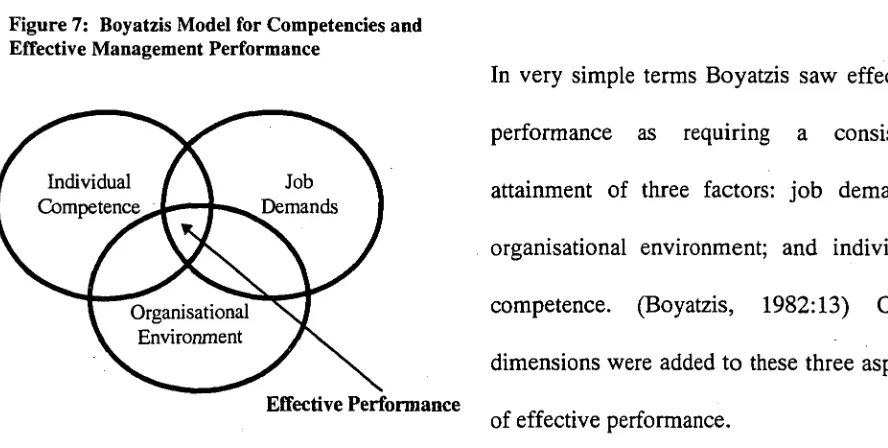
Figure 7: Boyatzis Model for Competencies and Effective Management Performance
Individual Competence
AV
Organisational Environment
Job Demands
In very simple terms Boyatzis saw effective
performance as requiring a consistent
attainment of three factors: job demands;
organisational environment; and individual
competence. (Boyatzis, 1982:13) Other
dimensions were added to these three aspects
Effective Performance
of effective performance.
The Job Demands were seen as formed around roles in planning, organising, controlling,
motivating, and coordinating. (Boyatzis, 1982:17)
The Organisational Environment was almost exclusively seen as formed around a study of
climate and culture with a heavy emphasis on theorists and concepts associated with
identifying the role/function and characteristics of management in a given organisational
environment. This was consistent with ideas advanced by such theorists as Mintzberg (1973)
and Drucker (1973).
Unlike Mintzberg's earlier contingence approach (1973:102-103) that externalised the common
variables that shaped the different ways managers performed specific work, Boyatzis' Model,
in contrast, sought to integrate organisational environment, functions, personal competencies
Chapter 3-41
Figure 8: Mintzberg's Examination of Variables Impacting a Management Job in a Given Environment
1
, Environmental Variables:
Characteristics of the milieu, the industry, the organisation
1
4 Job Variables:
The Level of the job & the function supervised
1
4 Person Variables:
Personality & style characteristics of the incumbent in the job
I
4 Situational Variables:
Temporal features of an individual job
Basic Managerial Role Requirements
Basic Characteristics of Managerial Work
One Manager's Work
Mintzberg (1973:103)
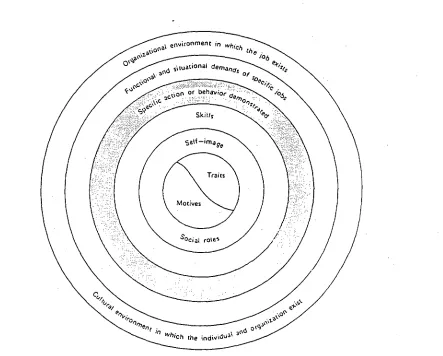
Boyatzis sought to integrate Mintzberg's model into a concept of "Individual Competence"
defining the characteristics of a manager that enabled them to perform successfully in a job.
(Boyatzis, 1982:20) This definition included the dimensions of skills, individual
characteristics and what were termed traits and motives. (Boyatzis, 1982:27, 33, 195) Later
Boyatzis went on to identify competence as a dynamic interaction between components of job
Chapter 3-42
Figure 9: The Dynamic Interaction between Job Competencies and factors in a Given Performance Context
Boyatzis found common or core management clusters could be determined by examining the
groupings of specific sets of competencies under different functions. This is an important
factor as Boyatzis was focussing on developing functional management competencies. He
stated the list of specific competencies in a discrete or highly specialised function and "is not as
important to this analysis as the predictive accuracy of the entire set". (Boyatzis 1982:203)
To assist differentiation, levels of job application were broadly grouped into entry level, middle
level, and executive level jobs. (Boyatzis, 1982:217, 219 &•222) Boyatzis identified
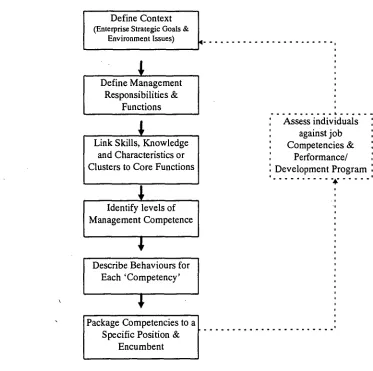
management clusters that included: