A Turbo Detection and
Sphere-Packing-Modulation-Aided
Space-Time Coding Scheme
Osamah Rashed Alamri, Bee Leong Yeap, and Lajos Hanzo,
Fellow, IEEE
Abstract—A recently proposed space-time block-coding (STBC) signal-construction method that combines orthogonal design with sphere packing (SP), referred to here as STBC-SP, has shown useful performance improvements over Alamouti’s conventional orthogonal design. In this contribution, we demonstrate that the performance of STBC-SP systems can be further improved by concatenating SP-aided modulation with channel coding and performing demapping as well as channel decoding iteratively. We also investigate the convergence behavior of this concatenated scheme with the aid of extrinsic-information-transfer charts. The proposed turbo-detected STBC-SP scheme exhibits a “turbo-cliff” atEb/N0= 2.5dB and providesEb/N0gains of approximately 20.2 and 2.0 dB at a bit error rate of10−5 over an equivalent-throughput uncoded STBC-SP scheme and a turbo-detected quadrature phase shift keying (QPSK) modulated STBC scheme, respectively, when communicating over a correlated Rayleigh fading channel.1
Index Terms—EXIT charts, iterative demapping, multidi-mensional mapping, space-time coding, sphere packing, turbo detection.
I. INTRODUCTION
T
HE ADVERSE effects of channel fading may be signifi-cantly reduced by employing space-time coding invoking multiple antennas [1]. Alamouti [2] discovered an appealingly simple transmit-diversity scheme employing two transmit an-tennas. This low-complexity design inspired Tarokhet al.[3], [4] to generalize Alamouti’s transmit-diversity scheme using the principle of orthogonal design to an arbitrary number of transmit antennas. Since then, the pursuit of designing better space-time modulation schemes has attracted considerable further attention [5]. The concept of combining orthogonal transmit-diversity designs with the principle of sphere packing (SP) was introduced by Suet al.in [6]. Orthogonaltransmit-Manuscript received April 25, 2005; revised December 22, 2005 and March 19, 2006. This work was supported in part by the EPSRC, U.K., in part by the European Union under the auspices of the Phoenix and Newcom projects, and in part by the Ministry of Higher Education of Saudi Arabia. The review of this paper was coordinated by Dr. M. Reed.
O. R. Alamri and L. Hanzo are with the School of Electronics and Computer Science, University of Southampton, SO17 1BJ Southampton, U.K. (e-mail: [email protected]; [email protected]).
B. L. Yeap was with the School of Electronics and Computer Science, University of Southampton, SO17 1BJ Southampton, U.K. He is now with Radioscape, NW1 4DS London, U.K. (e-mail: [email protected]).
Digital Object Identifier 10.1109/TVT.2006.889571
1A condensed version of this paper was presented at VTC’04 Fall, Los
Angeles, CA.
diversity designs can be described recursively [7] as follows. LetG1(x1) =x1I1, and let
G2k(x1, . . . , xk+1)
=
G2k−1(x1, . . . , xk) xk+1I2k−1
−x∗k+1I2k−1 GH2k−1(x1, . . . , xk)
for k= 1,2,3, . . . ,where x∗k+1 is the complex conjugate of
xk+1, GH2k−1(x1, . . . , xk)is the Hermitian ofG2k−1(x1, . . . , xk), and I2k−1 is a (2k−1×2k−1) identity matrix. Then, G2k(x1, x2, . . . , xk+1)constitutes an orthogonal design of size
(2k×2k), which maps the complex variables representing (x1, x2, . . . , xk+1) to 2k transmit antennas. In other words,
x1, x2, . . . , xk+1representk+ 1complex modulated symbols to be transmitted from 2k transmit antennas in T = 2k time slots. It was shown in [6] that the diversity product quantifying coding advantage2 of an orthogonal transmit-diversity scheme
is determined by the minimum Euclidean distance of the vectors (x1, x2, . . . , xk+1). Therefore, in order to maximize the achiev-able coding advantage, it was proposed in [6] to use SP schemes that have the best-known minimum Euclidean distance in the 2(k+ 1)-dimensional real-valued Euclidean spaceR2(k+1)[8]. The results of [6] demonstrated that the proposed SP-aided space-time block-coded (STBC) system of Section II, referred to here as STBC-SP, was capable of outperforming the conven-tional orthogonal-design-based STBC schemes of [2] and [3].
Iterative decoding of spectrally efficient modulation schemes was considered by several authors [1], [9]–[11]. In [12], the em-ployment of the turbo principle was considered for iterative soft demapping in the context of multilevel-modulation schemes combined with channel decoding, where a soft demapper was used between the multilevel demodulator and the channel decoder. In [13], a turbo-coding scheme was proposed for the multiple-input–multiple-output (MIMO) Rayleigh fading channel, where an additional block code was employed as an outer channel code, while an orthogonal STBC scheme was considered as the inner code.
Recently, studying the convergence behavior of iterative de-coding has attracted considerable attention [14]–[24]. In order to determine the Eb/N0 convergence threshold of randomly
constructed irregular low-density–parity-check (LDPC) codes
2The diversity product or coding advantage was defined as the estimated
gain over an uncoded system having the same diversity order as the coded system [6].
576 IEEE TRANSACTIONS ON VEHICULAR TECHNOLOGY, VOL. 56, NO. 2, MARCH 2007
transmitted over the additive-white-Gaussian-noise (AWGN) channel, the authors of [14] proposed the employment of a density-evolution algorithm, which was also employed in [15] and [16] for the sake of constructing LDPC codes capable of operating at low Eb/N0 values. Signal-to-noise-ratio
(SNR)-based measures were used in [17] and [18] for studying the convergence of iterative decoders, while the authors of [19] investigated the convergence behavior of inner rate-one codes based on a combination of SNR measures and mutual informa-tion. In [20] and [21], ten Brink proposed the employment of the so-called extrinsic-information-transfer (EXIT) characteristics between a concatenated decoder’s output and input for describ-ing the flow of extrinsic information through the soft-in/soft-out constituent decoders. A tutorial introduction to EXIT charts can be found in [23]. Additionally, several algorithms predicting the decoding convergence of iterative decoding schemes were compared in [24].
Motivated by the performance improvements reported in [6] and [12], we propose a novel system that exploits the advan-tages of both iterative demapping and decoding. The STBC-SP demapper of [6] was further developed for the sake of accepting thea prioriinformation passed to it from the channel decoder as extrinsic information. As a benefit of the proposed solution, it will be demonstrated in Section VI that the proposed turbo-detection-aided STBC-SP scheme is capable of providing
Eb/N0 gains of about 20.2 and 2.0 dB at a bit error rate
(BER) of10−5over the equivalent-throughput uncoded STBC-SP scheme of [6] and over a turbo-detected quadrature phase shift keying (QPSK)-modulated system based on the STBC schemes of [2] and [3].
This paper is organised as follows. In Section II, a brief de-scription of the orthogonal STBC design using SP modulation is presented, followed by a system overview in Section III. Section IV shows how the STBC-SP demapper is modified for exploiting thea prioriknowledge provided by the channel decoder. Section V provides our EXIT chart analysis, while our simulation results and discussions are provided in Section VI. Finally, we conclude in Section VII.
II. ORTHOGONALDESIGNWITHSP MODULATION
This section describes the STBC-SP scheme proposed in [6], considering space-time systems employing two transmit antennas, where the space-time signal is given by [2]
G2(x1, x2) =
x1 x2 −x∗2 x∗1
(1)
and the rows and columns of (1) represent the temporal and spatial dimensions, corresponding to two consecutive time slots and two transmit antennas, respectively. According to Alamouti’s design [2], for example,x1 andx2 represent
con-ventional BPSK modulated symbols transmitted in the first and second time slots and no effort is made to jointly design a signal constellation for the various combinations of x1 and
x2. For the sake of generalizing our treatment, let us assume that there areL legitimate space-time signals G2(xl,1, xl,2),
l= 0,1, . . . , L−1, where L represents the number of SP modulated symbols. The transmitter, then, has to choose the
modulated signal from theseLlegitimate symbols, which have to be transmitted over the two antennas in two consecutive time slots where the throughput of the system is given by(log2L)/2
bits-per-channel use. In contrast to Alamouti’s independent de-sign of the two time slots’ de-signals, our aim is to dede-signxl,1and
xl,2 jointly, such that they have the best minimum Euclidean
distance from all other (L−1) legitimate transmitted space-time signals, since this minimizes the system’s error probability. Let (al,1, al,2, al,3, al,4),l= 0,1, . . . , L−1 be phasor points from the 4-D real-valued Euclidean space R4, where each of the four elementsal,1, al,2, al,3,andal,4gives one coordinate of the two time-slots’ complex-valued phasor points. Hence,xl,1 andxl,2may be written as
{xl,1, xl,2}=T(al,1, al,2, al,3, al,4)
={al,1+jal,2, al,3+jal,4}. (2)
In the 4-D real-valued Euclidean spaceR4, the latticeD4is defined as a SP having the best minimum Euclidean distance from all other(L−1)legitimate constellation points inR4[8]. More specifically,D4may be defined as a lattice that consists of
all legitimate SP constellation points having integer coordinates [a1a2a3a4]uniquely and unambiguously describing the
legit-imate combinations of the two time-slots’ modulated symbols in Alamouti’s scheme but subjected to the SP constraint of
a1+a2+a3+a4=k, wherekis an even integer. Assuming
thatS ={sl= [a
l,1al,2al,3al,4]∈R4: 0≤l≤L−1}
con-stitutes a set ofLlegitimate constellation points from the lattice
D4 having a total energy of E=Ll=0−1(|al,1|2+|al,2|2+
|al,3|2+|al,4|2)and upon introducing the notation
Cl=
2L
E G2(xl,1, xl,2), l= 0,1, . . . , L−1 (3)
we have a set of space-time signals {Cl: 0≤l≤L−1} whose diversity product is determined by the minimum Euclid-ean distance of the set ofLlegitimate constellation points inS.
III. SYSTEMOVERVIEW
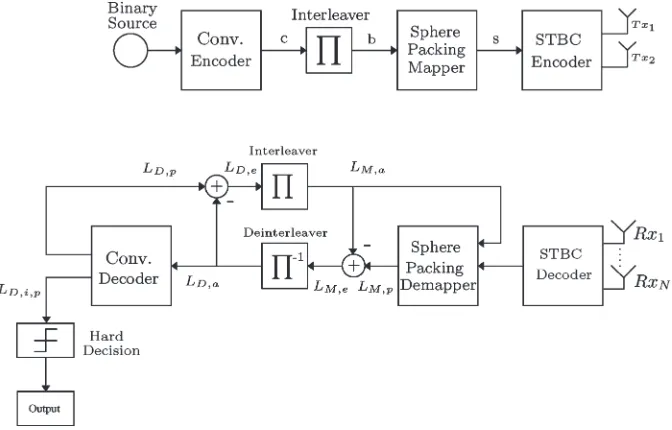
The schematic of the entire system is shown in Fig. 1, where the transmitted source bits are convolutionally encoded and then interleaved by a random-bit interleaver. A rate R= 1/2
recursive systematic convolutional code was employed. After channel interleaving, the SP mapper first maps B channel-coded bitsb=b0,...,B−1∈ {0,1}to an SP modulated symbol
s∈S such that we have s=mapsp(b), where B = log2L.
The STBC encoder then maps the SP modulated symbol s to a space-time signalCl=
2L/E G2(xl,1, xl,2),0≤l≤
L−1using (1) and (2). Subsequently, each space-time signal is transmitted overT = 2time slots using two transmit antennas. In this treatise, we considered a correlated narrowband Rayleigh fading channel, based on the Jakes’ fading model [25] and associated with a normalized Doppler frequency offD=
Fig. 1. Turbo-detection STBC-SP system.
symbol spanningT = 2time slots. The complex AWGN ofn= nI+jnQ is also added to the received signal, where nI and
nQare two independent zero-mean Gaussian random variables having a variance ofσ2n=σn2I =σn2Q =N0/2per dimension,
whereN0/2represents the double-sided noise power spectral
density expressed in watts per hertz.
As shown in Fig. 1, the received complex-valued symbols are demapped to their log-likelihood-ratio (LLR) representa-tion for each of theB coded bits-per-STBC-SP symbol. The
a prioriLLR values of the demodulator are subtracted from the
a posterioriLLR values for the sake of generating the extrinsic LLR valuesLM,e, and then, the LLRsLM,e are deinterleaved by a soft-bit deinterleaver, as shown in Fig. 1. Next, the soft bitsLD,a are passed to the convolutional decoder in order to compute the a posteriori LLR values LD,p provided by the max-log MAP algorithm [26] for all the channel-coded bits. During the last iteration, only the LLR valuesLD,i,pof the orig-inal uncoded-systematic-information bits are required, which are passed to a hard decision decoder in order to determine the estimated transmitted-source bits. The extrinsic information
LD,eis generated by subtracting thea prioriinformation from thea posterioriinformation according toLD,p−LD,a, which is then fed back to the STBC-SP demapper as the a priori
information LM,a after appropriately reordering them using the interleaver of Fig. 1. The STBC-SP demapper exploits the a priori information for the sake of providing improved
a posterioriLLR values, which are then passed to the channel decoder and, in turn, back to the STBC-SP demodulator for further iterations.
IV. ITERATIVEDEMAPPING
For the sake of simplicity, a system having a single-receive antenna is considered, although its extension to systems having more than one receive antenna is straightforward. Assuming perfect channel estimation, the complex-valued channel-output symbols received during two consecutive time slots are first diversity-combined in order to extract the estimates x˜1 and
˜
x2 of the most likely transmitted symbols xl,1 and xl,2 [2],
[1, pp. 400–401], resulting in
˜
x1=|h1|2+|h2|2·xl,1+ ´n1 (4) ˜
x2=|h1|2+|h2|2·xl,2+ ´n2 (5)
whereh1andh2represent the complex-valued channel
coeffi-cients corresponding to the first and second transmit antenna, respectively, and n´1 as well as ´n2 are zero-mean complex
Gaussian random variables with variance σ2n´= (|h1|2+
|h2|2)·σ2n. A received SP symbolr is then constructed from the estimatesx˜1andx˜2, using (2) as
r=T−1(˜x
1,x˜2) (6)
wherer={[˜a1a˜2a˜3a˜4]∈R4}. The received SP symbolrcan
be written as
r=h·
2L
E ·s
l+w (7)
where h= (|h1|2+|h2|2), sl∈S, 0≤l≤L−1, and w is a 4-D real-valued Gaussian random variable having a covari-ance matrix of σw2 ·IND =σ2n´·IND =h·σ2n·IND, where ND= 4, since the symbol constellationS is 4-D. According to (7), the conditional PDFp(r|sl)is given by
p(r|sl) = 1
(2πσ2
w)
ND 2
e− 1
2σ2w(r−α·sl)(r−α·sl)T
= 1
(2πσ2
w)
ND 2
e− 1 2σ2w
4
i=1(˜ai−α·al,i)2
(8)
578 IEEE TRANSACTIONS ON VEHICULAR TECHNOLOGY, VOL. 56, NO. 2, MARCH 2007
The SP symbol r carries B channel-coded bits b=
b0,...,B−1∈ {0,1}. The LLR-value of bit k for k= 0, . . . ,
B−1can be written as [12]
L(bk/r) =La(bk) + ln
sl∈Sk
1p(r|s l)·e
B−1
j=0,j=kbjLa(bj)
sl∈Sk 0p(r|s
l)·e
B−1
j=0,j=kbjLa(bj)
(9)
where S1k and S0k are subsets of the symbol constellation S
such that Sk
1 ={sl∈S:bk= 1}, and likewise, S0k ={sl∈
S:bk= 0}. In other words, Ski represents all symbols of the set S, where we havebk =i∈ {0,1},k= 0, . . . , B−1. Using (8), we can write (9) as
L(bk/r) =La(bk)
+ ln
sl∈Sk
1e
− 1
2σ2w(r−α·sl)(r−α·sl)T+ B−1
j=0,j=kbjLa(bj)
sl∈Sk
0e
− 1
2σw2(r−α·sl)(r−α·sl)T+ B−1
j=0,j=kbjLa(bj)
=LM,a+LM,e. (10)
Finally, the max-log approximation of (10) is as follows:
L(bk/r) =La(bk)
+ max
sl∈Sk 1
− 1
2σw2
(r−α·sl)(r−α·sl)T+
B−1
j=0,j=k
bjLa(bj)
−max
sl∈Sk 0
− 1
2σ2
w
(r−α·sl)(r−α·sl)T+
B−1
j=0,j=k
bjLa(bj)
.
(11)
V. EXIT-CHARTANALYSIS
The main objective of employing EXIT charts proposed by ten Brink [20], [21] is to predict the convergence behavior of the iterative decoder by examining the evolution of the input/output mutual-information exchange between the inner and outer decoders in consecutive iterations. The application of EXIT charts is based on two assumptions, namely, that upon assuming large interleaver lengths, 1) thea prioriLLR values are fairly uncorrelated, and 2) the probability density function of thea prioriLLR values is Gaussian.
A. Transfer Characteristics of the Demapper
As shown in Fig. 1, the inputs of the SP demapper are the noise-contaminated channel observations and thea priori
informationLM,agenerated by the outer channel decoder. The demapper outputs thea posterioriinformationLM,p, subtracts the a priori and, hence, produces the extrinsic information
LM,e, as shown in Section IV. Based on the aforementioned two assumptions, thea prioriinputLM,acan be modeled by ap-plying an independent zero-mean Gaussian random variablenA having a variance ofσA2. In conjunction with the outer channel coded and interleaved bitsb∈ {0,1}of Fig. 1 or equivalently
x∈ {−1,+1}, thea prioriinputLM,acan be written as [20]
LM,a=µA·x+nA (12)
where µA=σA2/2, since LM,a is an LLR-value obeying the Gaussian distribution [27]. The mutual information of
IAM =I(X;LM,a), 0≤IAM ≤1 between the outer coded
and interleaved bits x and the LLR values LM,a is used to quantify the information content of thea prioriknowledge [28]
IAM =
1 2 ·
x=−1,+1
+∞
−∞
pA(ζ|X=x)
× log2 2·pA(ζ|X =x)
pA(ζ|X=−1) +pA(ζ|X = +1)dζ. (13)
It was shown in [22] that the mutual information between the equiprobable bitsxand their respective LLRsLfor symmetric and consistent3L-values always simplifies to
I(X;L) = 1−
+∞
−∞
p(L|X= +1)·log2[1 +e−L]dL
I(X;L) = 1−EX=+1
log2[1 +e−L]. (14)
In order to quantify the information content of the extrinsic LLR values LM,e at the output of the demapper, the mutual informationIEM =I(X;LM,e)can be used, which could be computed as in (13) using the PDFpE of the extrinsic output, which requires the determination of the distribution pE by means of Monte Carlo simulations. However, according to [22], by invoking the ergodicity theorem in (14), namely, by replacing the expected value by the time average, the mutual information can be estimated using a sufficiently large number of samples even for non-Gaussian or unknown distributions, which may be expressed as [22]
IEM =I(X;LM,e) = 1−EX=+1log2[1 +e−LM,e]
≈1− 1
N
N
n=1
log2[1 +e−x(n)·LM,e(n)]. (15)
ConsideringIEM as a function of bothIAM and theEb/N0 value encountered, the demapper’s EXIT characteristic is de-fined as [20], [21]
IEM =TM(IAM, Eb/N0). (16)
3The LLR values are symmetric if their PDF is symmetric i.e., when we
havep(−ζ|X= +1) =p(ζ|X=−1). Additionally, all LLR values having symmetric distributions satisfy the consistency condition [22]: p(−ζ|X=
Fig. 2. SP demapper EXIT characteristics for different bits-to-SP symbol-mapping schemes atEb/N0= 2.5dB forL= 16.
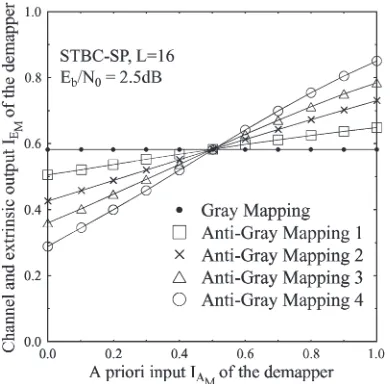
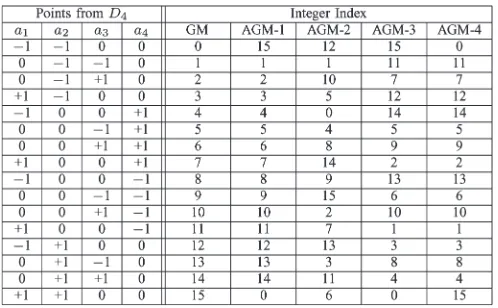
Fig. 2 shows the EXIT characteristics of the SP demapper in conjunction with L= 16 and different mapping schemes between the interleaver’s output and the STBC encoder. As expected, Gray mapping (GM) does not provide any itera-tion gain upon increasing the mutual informaitera-tion at the input of the demapper. However, using a variety of different anti-Gray mapping (AGM) schemes [12] results in different EXIT characteristics, as illustrated by the different slopes shown in Fig. 2. The four different AGM mapping schemes shown in Fig. 2 are specifically selected from all the possible mapping schemes forL= 16in order to demonstrate the different EXIT characteristics associated with different bit-to-symbol mapping schemes. There are a total of 16! different mapping schemes. Both the GM as well as the various AGM mapping schemes considered in this paper are detailed in Appendix.
B. Transfer Characteristics of the Outer Decoder
The extrinsic transfer characteristic of the outer channel decoder describes the relationship between the outer channel coded inputLD,aand the outer channel decoded extrinsic out-putLD,e. The input of the outer channel decoder is constituted by thea prioriinputLD,aprovided by the SP demapper. There-fore, the EXIT characteristic of the outer channel decoder is independent of theEb/N0-value and, hence, may be written as
IED =TD(IAD) (17)
where IAD =I(C;LD,a), 0≤IAD ≤1 is the mutual
information between the outer channel coded bits c and the LLR valuesLD,a. Similarly,IED =I(C;LD,e),0≤IED ≤1
is the mutual information between the outer channel coded bits
cand the LLR valuesLD,e.
C. EXIT Chart
The exchange of extrinsic information in the system schematic of Fig. 1 is visualized by plotting the EXIT character-istics of the SP demapper and the outer RSC decoder in a joint diagram. This diagram is known as the EXIT chart [20], [21].
Fig. 3. EXIT chart of a turbo-detected RSC channel-coded STBC-SP scheme employing AGM-3 of Fig. 2 in combination with the outer RSC code and system parameters outlined in Table I.
TABLE I
SYSTEMPARAMETERS
The outer RSC decoder’s extrinsic output IED becomes the
SP demapper’s a priori input IAM, which is represented on
the x-axis. Similarly, on the y-axis, the SP demapper’s ex-trinsic output IEM becomes the outer RSC decoder’sa priori
inputIAD.
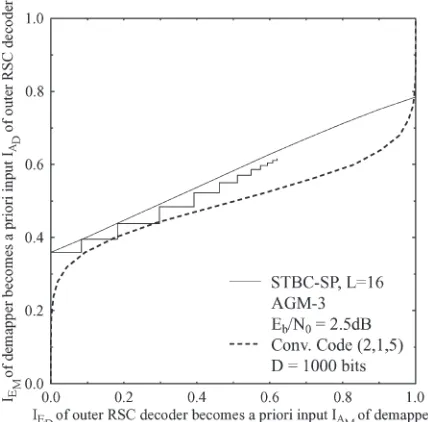
Fig. 3 shows the EXIT chart of a turbo-detection-aided channel-coded STBC-SP scheme employing the AGM-3 of Fig. 2, in conjunction with the outer RSC code and the system parameters outlined in Table I. Ideally, in order for the exchange of extrinsic information between the SP demapper and the outer RSC decoder to converge at a specific Eb/N0 value, the extrinsic-transfer curve of the SP demapper recorded at the
Eb/N0value of interest and the extrinsic-transfer-characteristic
curve of the outer RSC decoder should only intersect at a point infinitesimally close to theIED = 1.0line. If this condition is
580 IEEE TRANSACTIONS ON VEHICULAR TECHNOLOGY, VOL. 56, NO. 2, MARCH 2007
Fig. 4. Decoding trajectory of turbo-detected RSC channel-coded STBC-SP scheme employing AGM-3 in combination with the outer RSC code and system parameters outlined in Table I and operating atEb/N0= 2.5dB with an interleaver depth ofD= 106bits after ten external joint iterations.
at the beginning of Section V are satisfied. These EXIT-chart-based convergence predictions are usually verified by the actual iterative decoding trajectory, as will be discussed in Section VI.
VI. RESULTS ANDDISCUSSION
Without loss of generality, we considered a SP modulation scheme associated withL= 16using two transmit and a sin-gle receiver antenna in order to demonstrate the performance improvements achieved by the proposed system. All simulation parameters are listed in Table I.
Since the space-time signal, which is constructed from an orthogonal design using the SP scheme of (3), is multiplied by a factor that is inversely proportional to √E, namely, by
2L/E, it is desirable to choose a specific subset ofL= 16
points from the entire set of legitimate constellation points hosted by D4, which results in the minimum total energy.
It was shown in [8] that there is a total of 24 legitimate symbols4 hosted byD4having an identical minimum energy ofE= 2.
We used a computer search for determining the optimum choice of the L= 16 points out of the possible 24 points, which possess the highest minimum Euclidean distance, hence min-imizing the error probability.
Fig. 4 illustrates the actual decoding trajectory of the turbo-detected RSC channel-coded STBC-SP scheme of Fig. 3 at
Eb/N0= 2.5 dB and using an interleaver depth of D= 106 bits. The zigzag-path shown in Fig. 4 represents the actual EXIT between the SP demapper and the outer RSC channel decoder. Since a long interleaver is employed, the assumptions outlined at the beginning of Section V are justified, and hence, the EXIT-chart-based convergence prediction has been attained.
4In simple terms, the sphere centered at (0, 0, 0, 0) has 24 spheres around it,
[image:6.594.322.536.70.281.2]centered at the points(+/−1,+/−1,0,0), where any choice of signs and any ordering of the coordinates is legitimate [7, p. 9].
Fig. 5. Decoding trajectory of turbo-detected RSC channel-coded STBC-SP scheme employing AGM-3 in combination with the outer RSC code and system parameters outlined in Table I and operating atEb/N0= 2.5 dB with an interleaver depth ofD= 103bits after ten external joint iterations.
Fig. 6. Achievable extrinsic information of turbo-detected RSC channel-coded STBC-SP scheme employing AGM-3 in combination with the outer RSC code and system parameters outlined in Table I and operating atEb/N0= 2.5dB with different interleaver depths after ten external-joint iterations.
However, the decoding trajectory shown in Fig. 5 is different from the EXIT-chart prediction, because a shorter interleaver length is used. The achievable IED associated with
employ-ing different interleaver lengths is demonstrated in Fig. 6. The BER curves of the schemes characterized in Fig. 6 are shown in Fig. 7 when using ten external joint iterations, demonstrating the achievable BER difference at Eb/N0=
2.5dB when increasing the interleaver length toD= 106bits. Additionally, observe the turbo cliff taking shape atEb/N0=
2.5dB upon increasing the interleaver length.
[image:6.594.321.542.342.509.2]Fig. 7. Performance comparison of AGM-3-based RSC-coded STBC-SP schemes in conjunction withL= 16against an identical-throughput 1BPS uncoded STBC-SP scheme usingL= 4and against Alamouti’s conventional G2-BPSK scheme, after ten external-joint iterations and using different inter-leaver depths. The remaining system parameters are listed in Table I.
Fig. 8. Performance comparison of AGM-3(1)and GM(2)-based RSC-coded STBC-SP schemes in conjunction withL= 16against an identical-throughput 1BPS uncoded STBC-SP scheme(3) using L= 4 and against Alamouti’s conventionalG2-BPSK scheme(4), as well as against an RSC-coded QPSK modulated STBC scheme(5)when employing the system parameters outlined in Table I and using an interleaver depth ofD= 106bits.
correlated Rayleigh fading channel. An interleaver depth of
D= 106 bits was employed, and a normalized Doppler fre-quency of fD= 0.1 was used. The QPSK modulated STBC system employs a set-partitioning mapping scheme reminiscent of Trellis-coded modulation [29]. Observe in Fig. 8, by com-paring the two GM STBC-SP curves, that no BER improve-ment was obtained when ten turbo-detection iterations were employed in conjunction with GM, which was reported also in [12] and evident from the flat curve of the GM in Fig. 2. By contrast, AGM-3 achieved a useful performance improve-ment in conjunction with iterative demapping and decoding. Explicitly, Fig. 8 demonstrates that a coding advantage of about 20.2 dB was achieved at a BER of10−5after ten iterations by the convolutional-coded AGM-3 STBC-SP system over both the uncoded STBC-SP [6] and the conventional orthogonal STBC design-based [2], [3] schemes for transmission over the correlated Rayleigh fading channel considered. Additionally,
TABLE II
BITMAPPINGS FOR THEGMAND THEFOURDIFFERENTAGM SCHEMES
INTRODUCED INSECTIONVFORSTBC-SP SIGNALS OFSIZEL= 16
coding advantages of approximately 3.2 and 2.0 dB were attained over the 1BPS-throughput RSC-coded GM STBC-SP and the RSC-coded QPSK modulated STBC schemes, respec-tively. The employment of SP of size L= 16, as opposed to
QPSK, would double the number of metrics to be computed in the demapper.
VII. CONCLUSION
In this paper, we proposed a novel system that exploits the ad-vantages of both iterative demapping and turbo detection [12], as well as those of the STBC-SP scheme of [6]. Our investiga-tions demonstrated that significant performance improvements may be achieved when the AGM STBC-SP scheme is com-bined with outer channel decoding and iterative demapping, as compared to the GM-based systems. Subsequently, EXIT charts were used to search for the optimum bit-to-symbol mapping schemes that converge at the lowest possible Eb/N0 values. Several STBC-SP mapping schemes covering a wide range of extrinsic transfer characteristics were investigated. When using an appropriate bit-to-symbol mapping scheme and ten turbo-detection iterations, anEb/N0gain of about 20.2 dB was obtained by the convolutional-coded STBC-SP scheme over the identical-throughput 1BPS uncoded STBC-SP benchmarker scheme of [6].
APPENDIX
GMANDAGM SCHEMES FORSP MODULATION OFSIZEL= 16
In this Appendix, GM and the four different AGM schemes introduced in Section V for STBC-SP signals of sizeL= 16are described in detail. More specifically, for all mapping schemes, constellation points of the latticeD4are given for each integer
indexl= 0,1, . . . ,15. Observe that all mapping schemes use
[image:7.594.302.551.100.254.2]582 IEEE TRANSACTIONS ON VEHICULAR TECHNOLOGY, VOL. 56, NO. 2, MARCH 2007
ACKNOWLEDGMENT
The authors would like to thank the anonymous reviewers for their valuable comments that led to a substantially improved manuscript.
REFERENCES
[1] L. Hanzo, T. H. Liew, and B. L. Yeap,Turbo Coding, Turbo Equalisa-tion and Space-Time Coding: For Transmission over Fading Channels. Chichester, U.K.: Wiley, 2002.
[2] S. Alamouti, “A simple transmit diversity technique for wireless commu-nications,”IEEE J. Sel. Areas Commun., vol. 16, no. 8, pp. 1451–1458, Oct. 1998.
[3] V. Tarokh, H. Jafarkhani, and A. Calderbank, “Space-time block codes from orthogonal designs,” IEEE Trans. Inf. Theory, vol. 45, no. 5, pp. 1456–1467, Jul. 1999.
[4] ——, “Space-time block coding for wireless communications: Perfor-mance results,”IEEE J. Sel. Areas Commun., vol. 17, no. 3, pp. 451–460, Mar. 1999.
[5] B. M. Hochwald, G. Caire, B. Hassibi, and E. T. L. Marzetta, “Special issue on space-time transmission, reception, coding and signal process-ing,” IEEE Trans. Inf. Theory, vol. 49, no. 10, pp. 2329–2806, Oct. 2003.
[6] W. Su, Z. Safar, and K. J. R. Liu, “Space-time signal design for time-correlated Rayleigh fading channels,” inProc. IEEE Int. Conf. Commun., Anchorage, AK, May 2003, vol. 5, pp. 3175–3179.
[7] W. Su and X. G. Xia, “On space-time block codes from complex orthog-onal designs,”Wirel. Pers. Commun., vol. 25, no. 1, pp. 1–26, Apr. 2003. [8] J. H. Conway and N. J. Sloane,Sphere Packings, Lattices and Groups.
New York: Springer-Verlag, 1999.
[9] S. L. Goff, A. Glavieux, and C. Berrou, “Turbo-codes and high spectral efficiency modulation,” inProc. Int. Conf. Commun., New Orleans, LA, May 1994, pp. 645–649.
[10] T. Mittelholzer, X. Lin, and J. Massey, “Multilevel turbo coding for M-ary quadrature and amplitude modulation,” inProc. Int. Symp. Turbo Codes and Related Topics, Brest, France, Sep. 1997, pp. 127–134.
[11] P. Robertson, “An overview of bandwidth efficient turbo coding schemes,” in Proc. Int. Symp. Turbo Codes and Related Topics, Brest, France, Sep. 1997, pp. 103–110.
[12] S. ten Brink, J. Speidel, and R.-H. Yan, “Iterative demappping and decod-ing for multilevel modulation,” inProc. IEEE Global Telecommun. Conf., Sydney, Australia, Nov. 8–12, 1998, vol. 1, pp. 579–584.
[13] A. Sezgin, D. Wuebben, and V. Kuehn, “Analysis of mapping strate-gies for turbo-coded space-time block codes,” inProc. IEEE Inf. Theory Workshop, Mar. 2003, pp. 103–106.
[14] T. J. Richardson and R. Urbanke, “The capacity of low-density parity-check codes under message-passing decoding,”IEEE Trans. Inf. Theory, vol. 47, no. 2, pp. 599–618, Feb. 2001.
[15] T. J. Richardson, A. Shokrollahi, and R. Urbanke, “Design of capacity-approaching low-density parity-check codes,”IEEE Trans. Inf. Theory, vol. 47, no. 2, pp. 619–637, Feb. 2001.
[16] S. Y. Chung, G. D. Forney, T. J. Richardson, and R. Urbanke, “On the design of low-density parity-check codes within 0.0045 dB of the Shannon limit,” IEEE Commun. Lett., vol. 5, no. 2, pp. 58–60, Feb. 2001.
[17] H. E. Gamal and A. R. Hammons, “Analyzing the turbo decoder using the Gaussian approximation,”IEEE J. Sel. Areas Commun., vol. 47, no. 2, pp. 671–686, Feb. 2001.
[18] D. Divsalar, S. Dolinar, and F. Pollara, “Low complexity turbo-like codes,” inProc. 2nd Int. Symp. Turbo Codes and Related Topics, Brest, France, Sep. 2000, pp. 73–80.
[19] M. Peleg, I. Sason, S. Shamai, and A. Elia, “On interleaved differentially encoded convolutional codes,”IEEE Trans. Inf. Theory, vol. 45, no. 7, pp. 2572–2582, Nov. 1999.
[20] S. ten Brink, “Designing iterative decoding schemes with the extrinsic information transfer chart,”AEÜ, Int. J. Electron. Commun., vol. 54, no. 6, pp. 389–398, Nov. 2000.
[21] ——, “Convergence behaviour of iteratively decoded parallel concate-nated codes,”IEEE Trans. Commun., vol. 49, no. 10, pp. 1727–1737, Oct. 2001.
[22] M. Tuechler and J. Hagenauer, “EXIT charts of irregular codes,” inProc. 36th Annu. CISS, Princeton, NJ, Mar. 2002, pp. 748–753.
[23] J. Hagenauer, “The EXIT chart—Introduction to extrinsic information transfer in iterative processing,” in Proc. Eur. Signal Process. Conf., Vienna, Austria, Sep. 2004, pp. 1541–1548.
[24] M. Tuechler, S. ten Brink, and J. Hagenauer, “Measures for tracing convergence of iterative decoding algorithms,” in Proc. 4th Int. ITG Conf. Source and Channel Coding, Berlin, Germany, Jan. 2002, pp. 53–60.
[25] W. C. Jakes, Microwave Mobile Communications. New York: Wiley, 1974.
[26] P. Robertson, E. Villebrun, and P. Hoeher, “A comparison of optimal and sub-optimal MAP decoding algorithms operating in the log domain,” inProc. Int. Conf. Commun., Seattle, WA, Jun. 1995, pp. 1009–1013. [27] J. Hagenauer, E. Offer, and L. Papke, “Iterative decoding of binary
block and convolutional codes,”IEEE Trans. Inf. Theory, vol. 42, no. 2, pp. 429–445, Mar. 1996.
[28] T. M. Cover and J. A. Thomas, Elements of Information Theory. New York: Wiley, 1991.
[29] G. Ungerboeck, “Channel coding with multilevel/phase signals,”IEEE Trans. Inf. Theory, vol. IT-28, no. 1, pp. 55–67, Jan. 1982.
Osamah Rashed Alamrireceived the B.S. degree (with first-class honors) in electrical engineering from King Fahd University of Petroleum and Min-erals, Dhahran, Saudi Arabia, in 1997 and the M.S. degree in electrical engineering from Stanford Uni-versity, Stanford, CA, in 2002. Since October 2002, he has been working toward the Ph.D. degree at the Communications Group, School of Electronics and Computer Science, University of Southampton, Southampton, U.K.
His research interests include sphere-packing modulation, space-time coding, turbo coding and detection, adaptive receivers, and multiple-input–multiple-output (MIMO) systems.
Bee Leong Yeap received the degree (with first-class honors) in electronics engineering and the Ph.D. degree from the University of Southampton, Southampton, U.K., in 1996 and 2000, respectively.
He continued his research as a Postdoctoral Re-search Fellow with Southampton until 2004, when he joined Radioscape: a London, U.K. based consul-tancy company. His research interests include turbo coding, turbo equalization, adaptive modulation, and space-time coding. More recently, he embarked on conducting research into the implementation of digital radio receivers.
Lajos Hanzo (M’91–SM’92–F’04) received the Master’s degree in electronics and the Ph.D. degree in 1976 and 1983, respectively. He received the Doc-tor of Sciences (D.Sc.) degree from the University Southampton, Southampton, U.K., in 2004.
During his 30-year career in telecommunications, he has held various research and academic posts in Hungary, Germany, and the U.K. Since 1986, he has been with the Department of Electronics and Com-puter Science, University of Southampton, where he holds the Chair in telecommunications. He has coau-thored 15 John Wiley/IEEE Press books totaling about 10 000 pages on mobile-radio communications, published about 700 research papers, organized and chaired conference sessions, presented overview lectures, and has been awarded a number of distinctions. He is a Nonexecutive Director of the Virtual Centre of Excellence, U.K., and an enthusiastic supporter of industrial–academic liaison. He also offers a range of industrial research overview courses.