Chapter 2:
Socio-economic
impact & ‘state of
the art’ blight
management
Chapter 2: Socio-economic impact & ‘state of the art’ blight management
Introduction
Within Europe, the economic impact of late blight varies between countries and regions. This is due to a variety of factors, but in organic production systems
differences in climatic conditions, potato varieties used and agronomic techniques are thought to be important factors. As a result, the impact of the prohibition of copper-based fungicides for late blight control will also differ between countries and regions of the EU.
In 2001, a detailed inventory and survey of economic variables and agronomic techniques (including blight management systems) relating to organic potato crops grown in 2000 in seven European countries (Denmark, France, Germany,
Netherlands, Norway, Switzerland, United Kingdom) was undertaken. This made it possible to assess the effect of late blight in organic production in different regions; the efficacy of existing blight management practices; the impact of the prohibition on copper fungicides on the economic viability of different potato varieties and overall farm incomes.
In combination with information from the field trials which compared production with and without the use of copper-based fungicides (see Chapter 8: Integrated Systems Approach) the survey data were used to make cost/benefit (profit margin) analyses of currently used blight management systems. This approach helped to quantify the economic importance of blight in different regions of the EU under various scenarios, notably after the ban on copper fungicides has been implemented and to provide a focus for the target efficacy/activity of blight management and treatment systems to be developed in the project.
The survey, reported by Tamm, L., et al (2004) ‘Assessment of the Socio-Economic Impact of Late Blight and State-of-the Art Management in European Organic Potato Production Systems’, published by FiBL, Frick (CH) ISBN 3-90681-54-0 forms this Chapter. (The report can be viewed/downloaded http://www.orgprints.org/2936).
REPORT
Published by
Assessment of the Socio-Economic
Impact of Late Blight and State-of-the-Art
Management in European Organic Potato
Production Systems
Tamm L., Smit A.B., Hospers M., Janssens S.R.M., Buurma J.S., Mølgaard J.-P., Lærke P.E., Hansen H.H., Hermans A., Bødker L., Bertrand C., Lambion J., Finckh M.R., Schüler Chr., Lammerts van Bueren E., Ruissen T., Nielsen, B.J., Solberg S., Speiser B., Wolfe M.S., Phillips S., Wilcoxon S.J., Leifert C.
Funded by the European Commission under the
5th Framework Programme for Research and Technological
Development (Quality of Life) – Key Action 5 Sustainable Agriculture Archived at http://www.orgprints.org/2936
The Authors of this Report
Cyril Bertrand, Groupe de Recherche en Agriculture Biologique (GRAB), BP1222, Site Agroparc, 84911 Avignon, France
Lars Bødker, Danish Institute of Agricultural Sciences (DIAS), Research Centre Foulum, 8830 Tjele, Denmark
Jan S. Buurma, Landbouw-Economisch Instituut (LEI; Agricultural Economics Research Institute ), PO Box 29703, Burgemeester Patijnlaan No 19, NL-2502 LS The Hague, The Netherlands
Maria R. Finckh, University of Kassel, Nordbahnhofstr. 1a, 37231 Witzenhausen, Germany
Hans H. Hansen, Danish Institute of Agricultural Sciences (DIAS), Department of Crop Protection, P.O. Box 50, DK-8830 Tjele
Arne Hermans, Norwegian Centre for Ecological Agriculture (NORSOK), Tingvoll Gard, N-6630 Tingvoll, Norway
Monique Hospers, Louis Bolk Instituut (LBI), Hoofdstraat 24, 3972 LA, Driebergen, The Netherlands
Bas S.R.M. Janssens, Landbouw-Economisch Instituut (LEI; Agricultural Economics Research Institute), PO Box 29703, Burgemeester Patijnlaan No 19, NL-2502 LS The Hague, The Netherlands
Poul E. Lærke, Danish Institute of Agricultural Sciences (DIAS), Department of Crop Physiology and Soil Science, P.O. Box 50, DK-8830 Tjele
Edith Lammerts van Bueren, Louis Bolk Instituut (LBI), Hoofdstraat 24, 3972 LA, Driebergen, The Netherlands
Jerome Lambion, Groupe de Recherche en Agriculture Biologique (GRAB), BP1222, Site Agroparc, 84911 Avignon, France
Carlo Leifert, University of Newcastle, Centre for Organic Agriculture , King George VI Building, Newcastle upon Tyne NE1 7RU , UK Jens-P. Mølgaard, Danish Institute of Agricultural Sciences (DIAS), Research Centre Foulum, 8830 Tjele, Denmark
Theo Ruissen, Norwegian Centre for Ecological Agriculture (NORSOK), Tingvoll Gard, N-6630 Tingvoll, Norway
Christian Schüler, University of Kassel, Nordbahnhofstr. 1a, 37231 Witzenhausen, Germany
A. Bert Smit, Landbouw-Economisch Instituut (LEI; Agricultural Economics Research Institute), PO Box 29703, Burgemeester Patijnlaan No 19, NL-2502 LS The Hague, The Netherlands
Svein Solberg, Norwegian Centre For Ecological Agriculture (NORSOK), Tingvoll Gard, NO - 6630 Tingvoll, Norway
Bernhard Speiser, Research Institute of Organic Agriculture (FiBL), Ackerstrasse, 5070 Frick, Switzerland
Lucius Tamm, Research Institute of Organic Agriculture (FiBL), Ackerstrasse, 5070 Frick, Switzerland
Steve J. Wilcoxon, University of Newcastle, Centre for Organic
Agriculture, King George VI Building, Newcastle upon Tyne NE1 7RU, UK. Martin S. Wolfe, Elm Farm Research Centre (EFRC), Hamstead Marshall, Newbury RG20 0HR, UK
Tamm, L., Smit, A.B., Hospers, M., Janssens, S.R.M., Buurma, S., Mølgaard, J.P., Lærke, P.E., Hansen, H.H.,
Hermans, A., Bødker, L., Bertrand, C., Lambion, J., Finckh, M.R., Schüler, C., Lammerts van Bueren, E.,
Ruissen, T., Nielsen, B.J., Solberg, S., Speiser, B., Wolfe, M.S., Phillips, S., Wilcoxon, S., Leifert, C.
Assessment of the Socio-Economic Impact of Late Blight and State-of-the-Art Management in European
Organic Potato Production Systems
Tamm, L., Smit, A.B., Hospers, M., Janssens, S.R.M., Buurma, S., Mølgaard, J.P., Lærke, P.E., Hansen, H.H.,
Hermans, A., Bødker, L., Bertrand, C., Lambion, J., Finckh, M.R., Schüler, C., Lammerts van Bueren, E., Ruissen, T.,
Nielsen, B.J., Solberg, S., Speiser, B., Wolfe, M.S., Phillips, S., Wilcoxon, S., Leifert, C. This report was carried out as part of the European Project "Development of a systems approach for the
management of late blight in EU-organic potato production" (Blight-Mop; QLRT-1999-31065)
The project Blight-Mop is carried out with financial support from the Commission of the European
Communities under Key Action 5 of the Fifth Framework Programme for Research and Technological
Assessment of the Socio-Economic Impact ofLate Blight and State-of-the-Art Managementin European Organic Potato ProductionSystems
All of the statements, results etc. contained in this book have been compiled by the authors according to their best knowledge and have been scrupulously checked by the Research Institute of Organic Agriculture FiBL. However, the possibility of mistakes can not be ruled out entirely. Therefore, the editors and the authors are not subject to any obligation and make no guarantees whatsoever regarding any of the statements etc. in this work; neither do they accept responsibility or liability for any possible mistakes contained therein. The project "Development of a systems approach for the management of late blight in EU-organic potato production" (Blight-Mop; QLRT-1999-31065) is carried out with financial support from the Commission of the European Communities under Key Action 5 of the Fifth Framework Research and Technological Development Programme and co-funding by the Swiss Federal Office for Education and Science (BBW). The views expressed in this volume are those of the authors and do not necessarily reflect the views of the European Commission, nor do they in any way anticipate the Commission's future policy in this area.
Tamm, L., Smit, A.B., Hospers, M., Janssens, S.R.M., Buurma, S., Mølgaard, J.P., Lærke, P.E., Hansen, H.H., Hermans, A., Bødker, L., Bertrand, C., Lambion, J., Finckh, M.R., Schüler, C., Lammerts van Bueren, E., Ruissen, T., Nielsen, B.J., Solberg, S., Speiser, B., Wolfe, M.S., Phillips, S., Wilcoxon, S., Leifert, C. (2004): Assessment of the Socio-Economic Impact of Late Blight and Stateof-the-Art Management in European Organic Potato Production Systems. Research Institute of Organic Agriculture FiBL, Frick, Switzerland. ISBN 3-906081-54-0
© 2004, Research Institute of Organic Agriculture FiBL/ Forschungsinstitut für biologischen Landbau (FiBL), Ackerstrasse, CH-5070 Frick, Switzerland, Tel. +41 62 8657-272, Fax +41 62 8657-273, E-mail [email protected], Internet www.fibl.org
Cover: Daniel Gorba, FiBL Frick, Switzerland
Cover Pictures: Bernhard Speiser & Lucius Tamm, FiBL Frick
Layout: Helga Willer, FiBL Frick, Switzerland / Frank Wörner, FiBL Germany Printed at: Zumsteg Druck, Frick, Switzerland
Contents 1 Summary 5
1.1 Introduction 5
1.2 Results and discussion 5 1.3 Conclusions 8
2 Introduction 9
3 Organic potato growing and late blight in seven European countries: production, market and
legislation 11
S.R.M. Janssens, A.B. Smit, J.S. Buurma 3.1 Introduction 11
3.2 Methods 11 3.3 Results 11
3.3.1 Legal framework 11
3.3.2 Organic potato production 14 3.3.3 Yields, prices, and production 17 3.3.4 Important varieties 21
3.3.5 Regional distribution 22 3.3.6 International trade 26 3.3.7 Outlook 26
3.3.8 Labels 29
4 Inventory and state of the art of organic potato production techniques 31
L. Tamm, A.B. Smit, S. Philips, M. Hospers 31 4.1 Introduction 31
4.2 Methods 31 4.3 Results 32
4.3.1 Farm descriptions 32
4.3.2 Experiences on potato production 1996-2000 36 4.3.3 Potato production strategies in 2000 39
4.3.3.1 Yields, quality and market in 2000 39
4.3.3.2 Key dates of potato crop management and late blight occurrence in 2000 44 4.3.3.3 Soil fertility management strategies 2000 44
4.3.3.4 Plant material and crop management 2000 56 4.3.3.5 Crop protection management 2000 69
4.3.3.6 Pre harvest, post harvest and storage management 82 4.3.3.7 Assessment of the farmers of the 2000 season 89
5 Identification of important agronomic factors and production strategies 91
L. Tamm, A.B. Smit, S. Philips, M. Hospers 5.1 Introduction 91
5.2 Methods 91
5.3 Results and discussion 94
6 Farmers’ perceptions of present and future developments of organic potato production and
characterization and development of the market demands 97
L. Tamm, A.B. Smit, M. Hospers
6.1 Motivations and expectations of farmers 97 6.2 Education and information gathering 100
1 Summary
1.1 IntroductionIn the Europe, late blight, caused by Phytophthora infestans, is the most devastating disease affecting organic (and conventional) potato production. Under suitable environmental conditions the disease can spread rapidly and it can cause complete crop loss. The extent of economic damage varies between European regions. The extent of damage due to late blight depends on several factors: in organic production systems these factors include climate, choice of variety, soil management and use of crop protection agents. Therefore, a reduction or ban of copper use will have varying impacts in different regions. A detailed survey was conducted in 7 European countries as a subproject of the EU-funded project Blight-MOP (QLRT 31065). The survey investigated legislative, socio-economic and production
parameters. The aim of this study was: (i) to obtain an inventory of the current organic potato production techniques, (ii) to assess the impact of a potential ban of copper on yields and viability of organic potato production and (iii) to identify alternative plant protection
strategies that are used by organic farmers. This study was conducted in Denmark (DK), The Netherlands (NL), Germany (D), France (F), Great Britain (UK), Norway (N), and
Switzerland (CH). We used data obtained from interviews with organic growers and experts. These data were completed by use of background information such as late blight
epidemiology or varietal susceptibility. In each of the seven countries 15 to 20 organic farmers were interviewed in detail about structure of the farm, economy, and potato production techniques. In addition, we asked the farmers about their education, information sourcing and use of training opportunities. Emphasis was placed on the practical experience of the farmer. Furthermore, each farmer was asked for an assessment of his own motivations, the development of the market and social and political tendencies. A total of 118 farmers participated in this study. The farmers were selected in order to obtain a broad spectrum of type of production (organic and bio-dynamic), time period since conversion, and regional distribution. Farms included in this survey were certified as organic for at least 2 years. The data analysis includes: (i) statistics on yields, farm gate prices, and production techniques, (ii) an analysis of farmer observations and experiences on the extent and impact of late blight epidemics, (iii) an analysis of the farmer’s motivations, expectations and their assessment of the potential impact of a copper ban. Using multiple linear regression we identified
production factors (independent variables) which appear to consistently contribute to
production success (dependent variables). Success was judged against two criteria, gross yield (t/ha) and a wider definition which included gross yield but also profitability and nutrient-use efficiency.
1.2 Results and discussion
decreasing importance)‘production type’, ‘price’, ‘variety’, and ‘taste’. Other parameters such as ‘exterior quality’ or ‘convenience’ are considered as less important. These assessments need careful interpretation since consumer polls may show different preferences. Processors emphasise other preferences such as processing quality and variety. Organic and
conventional farmers do not grow the same choice of varieties. The varieties grown by organic farmers tend to be a compromise between robustness in production and acceptance on the market.
There are legislative differences in the countries included in this study, which have an influence on production conditions. Copper use is not possible in Scandinavian countries and in NL, copper use was allowed only as an exception in 1998. In CH and D copper use is allowed although quantities are limited by state (CH 4 kg/ha) or by label organisations (D). In F and UK copper use was not limited until 2001. At present, copper use is limited within the EU by EU regulation 2092/91 to 8 kg copper/ha and year. In NL organic potato production is further limited by legislation since potato foliage has to be destroyed as soon as late blight incidence exceeds 5%.
Experiences of farmers in organic potato production: The data given by farmers are related to their experience in the year 2000 on a specific reference plot. The reference plot was usually the largest potato field planted with the most important variety. Potato yields obtained on the reference plots in 2000 were equal to the average yields over the past 5 years given above, thus indicating representative results. However, there was a large variability in yields between individual farms. For instance, yields obtained in D varied between 5 and 35 t/ha. Surprisingly, the parameter ‘profitability’ assessed subjectively by farmers was not directly correlated with yield or farm gate price. Farmers in UK, CH, and D assessed potato production as relatively profitable, whereas N, NL, and especially DK felt that profitability was unsatisfactory.
The late blight epidemic and disease pressure vary considerably between different regions of Europe. In 2000, serious disease outbreaks were observed in NL, D, and UK, followed by N, F, CH, and DK. Not all farmers suffered yield losses due to late blight infection between 1996 and 2000, and the impact varied between individual years. However, in D, NL and UK more than 70% of the farmers suffered losses constantly throughout all years. Late blight infection in organic potato plots led to criticism by neighbours in NL, F, D, N, and CH. In these countries, between 5 and 20% of the farmers said that neighbours had personally criticized them.
Copper was used at least once between 1996 and 2000 by 60% of German farmers, 45% of the Dutch farmers (only in 1998 with exceptional permission), by 65% of the Swiss farmers, by 80% of the UK farmers and by 100% of the French farmers. Farmers in the other countries may not use copper. UK and French farmers declared that they had used up to 16 kg/ha, although the majority used less than 7 kg/ha. Swiss farmers used between 2 to 4 kg/ha whereas German farmers used in general less than 2 kg/ha. Alternative products (e.g. plant strengtheners or bio-dynamic products) have been applied, depending on country, by 30 to 60% of the farmers. However, the farmers generally did not report high efficacy rates of the applied products on incidence and severity of P. infestans. In total, 40 different products have been applied on seed tubers or foliage. These include extracts of algae, biodynamic
i) Plant nutrition and soil fertility was characterized by ‘intensity of animal husbandry on farm’, ‘intensity of soil cultivation practice’ (i.e. intensity of ploughing, weed control etc), ‘soil fertility management strategy’ (i.e. timing of application), ‘nutrient input intensity’ (i.e. total available NPK), ‘soil type and nutrient supply status’ (based on soil analyses).
ii) Agronomical techniques were characterized by the parameters ‘resistance class of variety (scale 0-9), source of seeds (certified vs. own production), ‘chitting’, ‘competition by weeds’, ‘planting week’, ‘harvest week’, ‘removal of foliage’, and ‘irrigation’.
iii) Crop protection strategy was characterized by the parameters ‘use of crop protection products/plant strengtheners’, ‘total mount of copper applied’, and ‘number of copper applications’.
iv) The regional disease pressure in the environment was described by the parameters ‘distanceto the next potato field’, ‘regional infection pressure’ (weighted by number of spray applications in conventional potato plots), and ‘first occurrence of late blight in the region’.
Data analysis indicates that some of the parameters have a strong impact on the overall success of the potato production. The variables ‘planting date’ (the earlier the better), ‘harvest date’ (the earlier the better), ‘removal of foliage’, ‘total amount of copper’ (the more the better), and ‘varietal foliar resistance’ (the more resistant the better) do correlate significantly and consistently with success if potato ‘gross yield‘ is considered as success variable. However, ‘fertilizer input intensity’, ‘planting date’ (the earlier the better), ‘removal of foliage’ (if yes), and ‘number of copper applications’ (the more the better), are identified if ‘success’ includes next to gross yield also the parameters N-use efficiency, and profitability (assessed by the farmer). This analysis suggests that some production factors, which can be altered by the producer, are responsible for differences between individual farms. The fact that these factors show up in the analysis indicates also that not all farms fully exploit the available production technology. Obviously, there is still a potential for many farms to stabilize and increase yields by the known production strategies.
Key points:
i) Reduction of growing season by early planting and chitting
ii) Use of a soil fertility strategy that leads to sufficient nutrient supply (nutrient supply is in general sub-optimal)
iii) Use of resistant or robust varieties (or strategies that lead to the same effect) iv) Efficient crop protection
The farmers’ experience expressed in the interviews corresponds in many aspects with this data analysis. However, reality often limits the extent to which these strategies can be included at farm level. For instance, choice of resistant varieties (if available on the market) is often limited by acceptance by consumers and wholesalers. In the farmers’ experience, the plant nutrition and the soil fertility management are key factors for yields but also for the susceptibility of the potato crop. Farmers find very consistently that a weak crop is much more susceptible than a vigorously growing potato crop. This suggests (mirrored by the data provided in the interviews) that organic potato crops find, in general, suboptimal nutrient availability which probably leads to physiological imbalances and, as a result, to increased susceptibility to late blight. However, the relevance of such an interaction needs verification.
Impact of copper ban on potato production: Farmers expect substantial changes in the organic production area if the scenario ‘copper ban’ becomes reality and if no alternatives are
Motivations and expectations of farmers: Besides the production technology and economy, farmers have also been interviewed in detail about their motives and expectations of the development of markets and society. When asked about their most important motives to produce organically, more than 70% of the farmers listed non-economical motives first, namely (in decreasing priority) (i) ‘to produce food which is healthy and safe’, (ii) ’to produce without exhausting natural resources’, (iii) ‘to live and work in harmony with nature and the landscape’, and (iv) ‘to leave behind a viable farm for the next generation’. The economic motives (v) ‘to obtain a reasonable income or salary from the farm’, (vi) ‘to obtain good market prices for the products grown’, (vii) ‘to retain/maintain family ownership of the farm’, and (viii) because of ‘social contacts with staff and consumers’ ranked as less
important. However, nearly all farmers mentioned the economic motives as second or third most important motive, suggesting that altruistic motives are important but only as long as economic viability is maintained. As most important opportunity for the development of organic farming, farmers listed ‘concerns about food safety in Europe’ as top reason for further increase. However, ‘scaling-up in the marketing of agricultural products’ and ‘continually decreasing producers prices for organic products’ were considered as major threats and/or challenges for the future of organic farmers.
1.3 Conclusions
This survey indicates that a region-specific optimization and integration of production technologies should lead to a substantial improvement of gross yields and yield stability in organic potato production. The survey shows also that copper has been a key component of the organic potato production system. Therefore, a ban of copper in the absence of adequate alternative production strategies (which will be developed in the Blight-MOP project would most likely lead to destabilisation of organic potato production, decrease in production area and shortage of market supply. The survey has identified key factors for successful organic potato production which need further development and exploitation. Within the Blight-MOP project, these key factors (i) crop resistance management strategies, (ii) agronomic strategies, (iii) soil fertility management, and (iv) novel crop protection strategies are fully evaluated for exploitation under various regional conditions.
Concept, design of interviews, data management and data analysis of this survey was done by Bert Smit,
Bas Janssens, Jan Buurma, Monique Hospers, Scott Phillips, and Lucius Tamm. The interviews and
background data gathering has been performed independently by all co-authors.
2 Introduction
A detailed survey of the currently used blight management systems of organic potato production and the agronomic and economic impact of the disease on organic potato
production in different regions of the EU is a prerequisite for the assessment of the impact of copper ban and/or novel alternative methods. The collection of data allows to describe the state-of-the-art technology in Europe and in order to identify key factors that lead to successful late blight control and potato production in organic systems.
The aim of this study is to obtain an agronomic/socio-economic impact assessment which quantifies:
• to what extent existing late blight control strategies are implemented in organic potato production in different regions of the EU
• the reliance on copper fungicides of existing organic production systems (the effect of such fungicides on profit margins) and the potential economic effect of the ban on copper fungicides
• the efficacy required from alternative blight management strategies (to be developed in Blight-MOP) to maintain the economic viability of EU organic potato production systems.
At regional level, data from the past five years were obtained in each of the 7 countries. Data were obtained from agricultural institutions such as extension services, research facilities, and weather forecasting organisations: The data included
• statistics on density and type of potato crops within the region (proportion of early crops, varieties etc.)
• onset of epidemic development at the regional level for the last 5 years
• market analysis based on an assessment of availability and quality of product versus market demand, prices, marketing type (direct marketing, retailers, health food shops etc.)
A total of 118 organic certified farms were selected in Denmark, France, Germany, The Netherlands, Norway, Switzerland and the United Kingdom and interviewed in detail on their experiences in organic potato production1. Farmers were selected in order to obtain a broad spectrum of type of production (organic and bio-dynamic), time period since conversion, and regional distribution. Farms included in this survey were for at least 2 years certified organic.
1 The questionnaire is available at www.orprints.org/00002936
At field level, data on unit size, variety, crop rotation, soil type, soil cultivation, and distance to nearest neighbour’s potato growing fields/area were obtained from farmers. If available, data on nutritional status of soil and crops (N, P, K), phenologyof growth as well as assessment of spatial and temporal progress of the occurrence of P. infestans between units/fields were also recorded. Records included
i) Cropping plan, acreage, rotation, farm size, other activities
ii) Varieties, type of potato (ware, starch, seed), marketing, yields, prices
iii) Inputs used, including costs (fertility inputs, crop protection agents, seed potato) and field operations
iv) Last year’s late blight infection and incidence, estimation of yield loss
v) Experiences and preferences on late blight management practices used during the past 5 years
vi) Key variables on economy
vii) Farmer preference and market demand for varieties
Data analysis included simple descriptive statistics of background data and the inventory of agronomic practices. Important variables which contribute to successful potato production where identified by means of a multiple linear regression. When necessary, principal components of groups of variables were used in this process (see respective chapters for details).
The data obtained from expert interviews as well as individual farmers were used (i) to give an overview of the organic and conventional potato production in European countries in order to describe the regional economiccontext in which an individual farmer lives (chapter 3), (ii) to provide a representative inventory of farming practices (chapter 4), (iii) to identify
3 Organic potato growing and late blight in seven European countries: production, market and legislation
S.R.M. Janssens, A.B. Smit, J.S. Buurma
3.1 Introduction
Organic potato production and marketing are likely to differ between European countries. Differences are due to climatic conditions, market demands and opportunities as well as to the legal framework. Background data were obtained by expert interviews and review of local statistical data.
The aim of this study was to obtain representative background data which are not available by means of interviews of individual farmers. The assessment included (i) a description of the legal framework of potato production in each country, (ii) information of the market organisation, (iii) statistics on organic and conventional potato production (including yields, farm gate prices), (iv) usage of varieties, (v) regional distribution of potato production, and (vi) the experts views and expectations on consumer preferences and the future development of the market.
3.2 Methods
The project partners in Denmark, France, Germany, the Netherlands, Norway, Switzerland, and the United Kingdom provided data on legislation, sector organisation, and market development based on a questionnaire. The individual partners obtained information from statistical sources (FAOstat, 2004; Foster C. & N. Lampkin, 2000. Organic an in-conversion land area, holdings, livestock and crop production in Europe. Report of FAIR3-CT96-1794) and by means of interviews with experts from advisory services, government and industry. The standardised recording protocol2 was provided by researchers from LEI.
3.3 Results
3.3.1 Legal framework
Legislation on the use of crop protection agents against Phytophthora infestans varies substantially between European countries. Depending on country, the use of pesticides is not only regulated by the legal framework but also by private standards of producers’
associations.
Organic Potato Production Systems
countries regulations do not differ between regions. However, in France, obligatory destruction of crop
waste and volunteer plants were imposed in Nord-Pas de Calais in 2001.
In conclusion, rules for late blight control differ substantially between countries. As a consequence,
farmers of different countries do not have the same opportunities to control late blight in potato crop,
Labels
All participating countries have at least two organic labels. In France and the United Kingdom the use of copper fungicides is allowed for several labels. In some countries fungicide use is not permitted at all; so differences between labels do not exist as a consequence of national regulation (Denmark, Netherlands and Norway). In Switzerland and Germany the use of copper fungicides is still permitted but the rules on use of these copper fungicides differ between labels within each country. In general, the bio-dynamic label ‘Demeter’ prohibits copper use whereas the other labels do allow the usage within the legislation.
Alternative crop protection products
An inventory is made of (alternative) copper-free products that are authorised against late blight in each
Haulm destruction
Haulm destruction in the early stages of a blight epidemic is a means to limit further spread of P.infestans. Haulm destruction at a specific level of disease is imposed in the Netherlands and UK. Table 3.3 gives an overview on regulations in European countries.
Variety
All countries provide a list of varieties which may be grown legally. These lists do not specify varieties for organic and conventional farming. The number of varieties as well as the variety names (varieties) on the free lists differ between countries.
Nutrient balance restrictions
The way the nutrient problems are handled differ between countries. In all cases the use of nutrients is restricted more or less.
3.3.2 Organic potato production
[image:16.612.113.501.77.427.2]Present state and development of organic potato production:
Figure 3.1 gives an overview of the total number of organic certified farms in each country. There is a lack of comparable data of different countries because statistical definitions between countries differ and the distinction between conventional and organic farming is not always clear within national statistics. Compared to conventional agriculture, mixed farming is more common in organic agriculture. For example, grass-clover meadow is a common and necessary part of the crop rotation in organic farming. However, it is not always clear in statistical resources which part of the temporary grassland is part of the
crop rotation (F, UK, NL). The figures given in table 3.5 were obtained from FAOstat (2004) and Lampkin & Foster (2000).
Figure 3.1. Number of organic farms per country (2000). Source: Own data from national administration and certification bodies
Table 3.5. Total area of arable crops and organic arable crops per country (1998). Sources: FAOstat and Lampkin & Foster, 2000
increased. In some countries the growth of the organic potato area exceeds the development of the organic arable area while in other countries the potato area growth stays behind the growth of organic acreage.
Table 3.7 gives an impression of the area of organic potatoes in each country. In all countries except Germany the organic potato area is rather small and less than 1000 hectares.
The proportion of potato area divided by the total arable area roughly indicates the intensity of organic potato production in different countries. Figure 3.1 gives an impression of the intensity of conventional and organic potato growing. The intensity of potato growing is considered as a risk factor for late blight infection. In most countries except the United Kingdom and The Netherlands the intensity of organic potato production is similar or less intensive as compared to conventional farming.
Use of potato
Table 3.8 indicates the relative importance of organic ware potatoes (for table and processing purposes respectively) and seed potatoes.
The majority of all organic potatoes (at least 75%) in all countries is marketed as table potato. The distribution patterns of traditional and organic potatoes differ because a greater part of all conventional potatoes is used in the processing industry or sold as seed potatoes.
Early potatoes under fleece
3.3.3 Yields, prices, and production
Yield
In all countries except Norway the average yield over 3 years of conventional ware potatoes reaches 35 to 45 tons per hectare (Fig. 3.2). The average yields of organic ware potatoes are 30% - 50% lower. In most countries the harvested yield is not completely marketable. Farmers are expected to deliver potatoes “field sorted“, i.e. to make a first rough sorting (removal of stones, rotten potatoes, etc.). The marketable part differs between countries and depends largely on national and local circumstances (e.g. stony soils, crop management, market requirements). Depending on country, between 75% and 95% of the harvested organic potato yield is marketable.
Potato prices
Respondents were asked to give price information for the October delivery. The available price information contains effects of differences in delivery time, product quality, etcetera. Nevertheless, the price information in figure 3.3 gives a good impression. Due to bad weather conditions the potato yield of 1998 was extremely low in some countries. To make the price information somewhat more reliable 3 year averages have been calculated. Nevertheless, figure 3.3 shows substantial differences between potato prices.
The price differences between organic and conventional potatoes are enormous: in some countries organic potato prices exceed traditional prices by 200% to 300% or even more. In countries of non EUmembers (Norway, Switzerland) conventional potato prices are relatively high (regulated market by limiting imports); as a consequence, price differences between organic and conventional potatoes look not as extreme as elsewhere. It is known that in an open market product prices between organic and conventional differ more than in a limited market. The extent of price differences between conventional and organic products influence the farmers’ decision to switch from conventional to organic farming.
The monetary output /ha also varies substantially between countries (Fig. 3.4). In general, organic potato production generated higher monetary output per ha than conventional
production. In these cases, higher farm gate prices compensated for lower yields. However, in Denmark monetary yield was similar in both production systems, and in France the monetary output was lower in organic than in conventional production.
Ware potato production
Respondents were asked to collect data of the national ware potato production. These figures (Table 3.9) give approximate insight in the importance of the organic ware potato production through comparison with the conventional ware potato production. Table 3.9 shows the national production of organic and conventional potatoes of each country in 1998.
Besides the differences between countries on the level of national potato production Table 3.10 shows clearly that in most countries, organic ware potato production is a small fraction (one percent or less) of the total ware potato production. Only in Denmark and Switzerland, the organic potato production fraction has exceeded the one percent level. Compared to the total potato production the extent of organic potato production is rather small. Nevertheless it is important to take into account the differences between the organic and conventional potato market. A large part of conventional potatoes is produced for the processing industry while most organic potatoes are used for fresh consumption (table potatoes). Organic potatoes are more important within the submarket of table potatoes than in the total ware potato market. In almost all countries industrial processing of organic potatoes is still unimportant.
3.3.4 Important varieties
country, partners were asked to give the national variety top five in 2000 for both
conventional and organic potatoes. The respondents were also asked to add the acreage of each variety in 2000 if available. Unfortunately, only a few countries had these acreage data available. Table 3.10 gives an overview of the most important varieties used in conventional and organic farming per country.
The combined top five lists of seven countries show an impressive number of different varieties used in practice: 26 varieties in conventional farming and 27 varieties in organic farming. Some varieties are used in both conventional and organic potato growing or in several countries. As expected, Bintje is still one of the most important multipurpose varieties but is grown in conventional farming only (four countries, three times number one). Agria is a well known alternative used in both conventional (two countries) and organic farming (four countries; in two cases number 1) as well. Nicola, Santé, Charlotte and Estima are popular varieties in organic farming. Besides international popular varieties some countries prefer other, local varieties. For instance, varieties used in Norwegian organic farming do not occur on top five lists of any other partner country. Most Norwegian varieties have been adapted to the northern conditions. Farmers select a variety because of more properties than blight resistance. However, a preliminary check on potato blight resistance of varieties listed in the Dutch variety list in table 3.10 show a higher resistance level of varieties used in organic farming.
3.3.5 Regional distribution
Denmark
The main part of the Danish potato production is concentrated in Jutland (figure 3.5).
conventional
It is remarkable that both conventional and organic potato production show almost the same figures per region. The national as well as the regional conventional potato areas are much larger than for organic potato. It is possible that potato growing in highly concentrated potato regions increases the late blight infection risk.
France
Figure 3.6. Regional production of potato in France (% of total area). Source: Own data from the processors andtraders.
Germany
Figures of the regional distribution and concentration of traditional and organic potato cropping in Germany were not available. In the opinion of the German partner in the Blight-Mop project organic potato production is less concentrated compared to traditional potato growing.
Netherlands
Figure 3.7. Regional production of potato in the Netherlands (% of total area).
Norway
In Norway almost fifty percent of the total organic potato area (160 ha) is grown in ‘other regions’ (Figure3.8). An important part (33%) of conventional potato growing is
concentrated in the Hedemark region which has less than 20% of the organic potato area. Almost the same part of the organic potatoes grow in the Oppland region. The hilly Norwegian landscape differs strongly from the flat landscape in countries like
Figure 3.8. Regional production of potato in Norway (% of total area) United Kingdom
No regional figures were received from the United Kingdom.
Switzerland
Figure 3.9. Regional production of conventional potato in Switzerland (% of total area). 3.3.6 International trade
International trade of organic potato tubers is generally expected to represent only a very small proportion of the total organic potato trade volume. However, respondents found it very difficult to obtain figures on processing, imports and exports of organic potatoes and organic potato products since trade companies are often reluctant to divulge figures or export
destinations. As a consequence, the international market of organic potatoes is not transparent and therefore it is difficult to obtain insight.
Import: Except Denmark all countries import small volumes of organic potatoes. Almost ninety percent of these imports are destined for fresh consumption or seed potatoes. Only in the Netherlands a large part of the organic potato imports are industrially processed.
Countries listed from which organic potatoes are imported: Spain, Italy, Austria, Netherlands, Israel and Denmark.
Export: A few countries (Denmark, Germany, The Netherlands, Switzerland) export organic potatoes
(fresh, seed) or organic potato products (prefried frozen).
3.3.7 Outlook Market trends
Figure 3.10. Expected developments in the organic potato market5. Source: Own data from the processors and traders.
All the respondents expect that the profitability of organic potato production will not improve in the near future. Expectations on profitability vary between stable to decreasing. These expectations are influenced by experiences of the organic potato market over the last years. For instance in Denmark, the production in 2001 decreased dramatically because of overproduction in 2000. The respondents expect the organic potato area will increase in Germany, The Netherlands, Norway and Switzerland whereas in France, United Kingdom and Denmark a stable to decreasing production is expected. However, the production of table, seed and processing potatoes has good prospects. The organic potato area is still too small to produce the minimal volumes necessary in the processing industry. An increase of area and production will improve the perspectives for the industrial processing of organic potatoes, in particular at small processing facilities. However, an increasing share of
processed potato may influence the price negatively on the long term. It is expected that both, fresh consumption and the processing of organic potatoes will increase and will remain focused on domestic trade and home market. Imports and exports of organic potatoes are considered to be increasing but less important.
Consumer preferences
The country respondents were asked what consumers in their country mostly prefer when they buy organic potatoes. The experts had to rank 3 attributes out of 9. The results presented here are not based on full scale consumer panel research but give an assessment of the experts in seven countries. Almost all respondents indicate the cropping system as the most important motive to buy organic potatoes.
Consumers intentionally select potatoes of organic origin when they buy them. The second most important motive is the price of organic potatoes. Next to these main preferences consumers also decide based on variety, taste, cooking type, outside colour and appearance. Convenience and inside colour are less important. Figure 3.11 shows the scores of consumers’ preferences on different items per country as indicated by the respondents. Interestingly, motives to purchase organic potato seem to vary between countries.
Figure 3.11. Relative importance of product attributes of potato for consumers in 7 European countries. Source: Own data from the processors and traders.
Preferences of industrial processors
Figure 3.12. Quality requirements for organic potato processors in 7 European countries. Source: Own data from the processors and traders
3.3.8 Labels
4 Inventory and state of the art of organic potato production techniques
L. Tamm, A.B. Smit, S. Philips, M. Hospers
4.1 Introduction
Within Europe the economic impact of late blight varies between countries and regions. This is due to a variety of factors including climatic conditions, potato varieties used and
agronomic techniques. So far, there is no comprehensive inventory available which describes in detail the potato production strategies which are currently used by organic farmers. As organic farming techniques have been developed to a large extent by pioneer farmers without much aid by scientists, techniques are not well described in the literature and successful techniques may be known only locally. Therefore, an in depth inventory of the potato production management is a useful tool to identify successful practices and also potential for improvements. The survey does not only include production techniques per se, but also information about the farm situation, local properties (soil, climate), social background of the farmer, and the economic context (e.g. market situation).
4.2 Methods
A total of 118 certified organic farms were selected in Denmark (n=15), France (n=15), Germany (n=15), Netherlands (n=19), Norway (n=20), Switzerland (n=19) and the United Kingdom (n=15) and interviewed in detail on their experiences in organic potato production. Farmers were selected in order to obtain a broad spectrum of type of production (organic and bio-dynamic), time period since conversion, and regional distribution. Farms included in this survey were for at least 2 years in organic agriculture and grew potato on a surface of at least 0.2 ha. Data at farm level were obtained by means of a structured interview of a stratified random set of 15 to 20 farmers in each of the 7 countries and analysis of historical data. The standardised recording protocol was prepared as a simple structured questionnaire by researchers from LEI and LBI. Data asked from the farmers included:
i) climatic conditions (local weather station data/blight forecasting systems used)
ii) agronomic techniques (crop rotation, planting dates for different cultivars, fertility inputs, weed/volunteer control, defoliation method/timing, application rates and frequency of copper/other permitted spray treatments, sanitation regimes used to prevent late blight) iii) historic data on blight incidence, including the date of onset of blight and epidemic progress recorded in potato crops over the last 5 years (extension service trial/survey data) and
iv) potato cultivars grown, yields, market demand for different varieties, farm gate prices v) Cropping plan, acreage, rotation, farm size, other activities
vi) Varieties, intended use of potato (ware, starch, seed), way of selling, yields, prices vii) Inputs used, including costs (fertility inputs, seed potato, crop protection inputs) and field operations
viii) Last year’s late blight infection and incidence, estimation of yield loss ix) Experiences of farmers with existing blight management techniques x) Farmer preference for different late blight management practices xi) Late blight management practices used during the past 5 years xii) Financial results at farm level
xiii) Farmer preference and market demand for varieties
Data were prepared for analysis in several steps. As a first step, data were transferred to excel sheets by each partner. As a second step, all original data were typed into an Access database prepared by LEI in order to avoid problems during data processing. Finally, a file ready for analysis by SPSS 10.0 was generated from the data base. This file contained a total of more than 1000 individual variables which were quantitative or categorial. Depending on the nature of the question, data were normal, binomial, or poisson distributed. The original data were submitted to thorough analysis for mistakes derived from data transfer and/or
misunderstandings. All variables and results from analysis were examined by plausibility checks. The origin of suspect data were verified in the original interview sheets if necessary. Subsequently, summary descriptive statistics of the potato production techniques were generated by means of the statistical software package SPSS version 10.0. The data analysis was conducted at FiBL.
4.3 Results
4.3.1 Farm descriptions
A total of 118 farms was selected and interviewed in 2001 by members of the partner institutions. In order to obtain a wide range of production techniques, farms were selected based on geographic distribution, size, specialization, duration since conversion, and production method (i.e. organic and bio-dynamic producers). The total farm size varied between 3.8 and 1744 ha (Table 4.1). Accordingly, areas cultivated with potato differ substantially between individual farms. The ratio ‘arable/total farm area’ gives a rough indication on how much a farm specializes on arable/vegetable crops or relatively extensive animal husbandry. Most of the farms in this survey have high to very high ratios, indicating that arable crops are important. The ratio ‘potato/area under cultivation’ indicates the intensity of potato production in the crop rotation. Typically, farms use 5 to 15% of the arable area for potato crops. However, individual farmers have intensities of up to 30 to 47%, indicating very intensive crop rotations.
In order to assess the degree of specialization on potato production, the farmers were asked to indicate the amount of time the invest in arable crops and more specifically in potato growing as opposed to the time investment in animal husbandry. As Table 4.2 indicates, there is a high variability between farms, ranging from farms where only minute amounts of time are devoted to highly specialized farms that invest - according to the farmer - up to 90% of total time in potato production. At a later stage in the data analysis, the parameter ‘time investment in animal husbandry’ was also used as a rough indicator on availability of manure for
Table 4.2 Percentage of labour time devoted on arable crops, potato cultivation and animal husbandry on interviewed farms
The selected farms represent all important organic production labels (Table 4.4). Demeter which is the international label of the biodynamic farmers totals 20% whereas the organic production totals 80% of all interviewed farms.
Table 4.4. Labels of the interviewed farmers
The interviewed farmers use the potential outlets very individually, indicating that highly market oriented producers as well as farmers who produce for local consumption are included in the survey. However, the selected farmers tend to market a large proportion via
Table 4.5. Farm outlets used by organic potato growers
4.3.2 Experiences on potato production 1996-2000
In the period from 1996 to 2000 organic farmers reached potato yields from virtually nil to more than 50 tons/ha (Fig. 4.1). The data suggest that in the UK, Switzerland and the Netherlands higher yields are reached than in Germany, France and Norway. The fact that individual years are more or less favourable for potato growing is also well reflected in these data. However, the variability between individual farms within a country is much larger that any other effect. For instance, yields varied in the Netherlands in 1996 between
Figure 4.1. Potato yields on organic farms 1996-2000. Boxes include 50% of all values; circles indicate outlier values
[image:38.612.114.498.72.332.2]Figure 4.3. Relative importance of pests and diseases 1996 - 2000. The rank indicates the pest/disease which hasbeen mentioned most often in all three categories
Between 50 and 100% of the interviewed farmers also reported that, depending on region and year, late blight epidemics caused yield losses (Table 4.6). Late blight epidemics and yield losses are experienced regularly in UK and the Netherlands, whereas the epidemic seems to occur more erratically in France or Switzerland. Organic farmers have been criticised because of late Blight epidemics by neighbouring (conventional) farmers, in particular in the
Netherlands, Switzerland and Norway (Table 4.7). This indicates that late blight epidemics, in particular if originating on organic farms, can expose farmers to criticism.
Table 4.7. Proportion of farmers who have been criticized by neighbours because of late blight outbreaks (%)
4.3.3 Potato production strategies in 2000
The inventory of the state of the art production technique is based on a detailed description of the ‘reference plot’ in the 2000 growing season. All farmers in the survey were asked to denote one particular plot as the ‘reference plot’. The plot was, according to the farmer, representative of the farm. In most cases, it was the largest plot of the farm with the most important variety.
4.3.3.1 Yields, quality and market in 2000
The potato gross yields obtained on the reference plots in 2000 varied between 5 and
Table 4.9. Farm gate prices (Euro) of the 2000 potato (seed, ware, and processing potato) derived from referenceplots
Table 4.10. Farm gate prices (Euro) of the in 2000 harvested ware potato (packaged or bulk) derived from reference plots
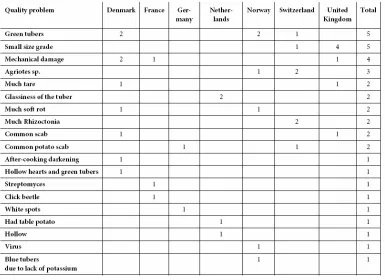
However, remarks on quality problems were only rarely followed by either price reductions or refusal of the batch, indicating that the problems were not severe.
[image:44.612.114.499.245.525.2]Table 4.11. Quality assessment of the 2000 potato harvest
Table 4.12. Quality problems reported by buyers of potato in 2000
4.3.3.2 Key dates of potato crop management and late blight occurrence in 2000
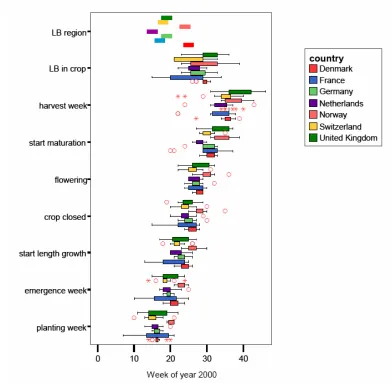
The key events of the potato management in the season 2000 are described in Figure 4.6. The relative earliness or delay of specific actions or phenological stages follow as much the geographic latitude of the countries as the relative mildness of the climate. However, there is a large variability within country. In France, for instance, the planting date may differ as much as 14 weeks. In other countries such as Denmark the planting concentrates in one single week. First occurrence of Phytophthora infestans was generally reported within the country much earlier than the epidemic started in the reference plots. Exceptions as observed in France (first regional report later than first report in reference plot) show that in some cases the observation networks might overlook an outbreak or a symptom might be misjudged.
4.3.3.3 Soil fertility management strategies 2000
Figure 4.6. Key events of the potato crop in the season 2000 (LB region: first observation of late blight within the region of the farmer; LB in crop: Late blight observed in
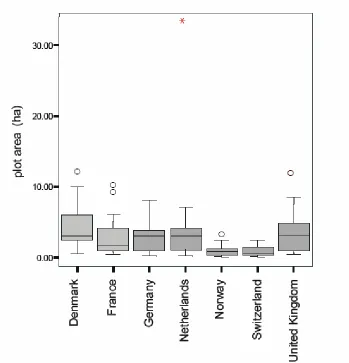
Figure 4.6. Size of selected potato reference plots in 7 European countries in 2000.
Table 4.14. Soil types on the reference plots (% of plots in specific soil type category)
Table 4.15. Part 2. Nutrient status and soil structure by soil type (% of soils in nutrient status category)
Figure 4.8. Crop rotation and green manure of 118 reference plots on 118 organic farms in DK, D, F, NL, N, CH,UK
to feed the potato crop directly, whereas other farmers intend to feed the plant via improvement of soil fertility.
Table 4.16. Manuring strategies on reference plots in 118 organic farms in DK, D, F,
If manure was applied, then more than 90% of the farmers applied one basic manure and 36% gave a second manure (table 4.17 & 4.18). Cow farmyard manure and cow slurry was most popular whereas commercial organic fertilizers were applied very rarely. Composts (green waste compost or composted manure) were applied only in few cases. After planting, approximately 20% of the farmers applied top manuring once, and a second application was very rare. Liquid cow manure and commercial fertilizers were used for top manuring. The total input of the macronutrients N, P, and K were estimated based on the data given by the farmers. The nutrient content of farmyard manures was estimated, based on data given by Walther et al., 2001. (Walther et al., 2001. Grundlagen für die Düngung im Acker- und Futterbau. Agrarforschung 8(6): 2001), and the nutrient content of commercial organic fertilizers is based on the data given in the FiBL input list (Speiser et al., 2003; see
Table 4.17. Manuring strategies on reference plots in 118 organic farms in DK, D, F, NL, N, CH, UK: Basic /preplanting manuring 1
[image:52.612.116.500.455.692.2]Table 4.19. Manuring strategies on reference plots in 118 organic farms in DK, D, F,
Figure 4.9. Manuring intensities on reference plots in 118 organic farms in DK, D, F, NL, N, CH, UK: Total applied N input (kg/ha) (basic and top manuring)
Table 4.21. Manuring strategies on reference plots in 118 organic farms in DK, D, F, NL, N, CH, UK: assessment
4.3.3.4 Plant material and crop management 2000
Table 4.22. Relative frequency (%) of potato varieties on reference plots in 118 organic farms in DK, D, F, NL, N,
varies considerably between countries. Whereas in Denmark and Norway the use of seeds produced on-farm is very popular, growers in the United Kingdom, France, Switzerland and the Netherlands prefer seeds from domestic production or import (Table 4.25). No
information is available whether the on-farm produced seed potato passed official quality control or if quality problems might be associated with on-farm produced seeds. The motive for the selection of a specific variety is mainly driven by market demand, agronomic quality and late blight resistance (figure 4.15). Costs and availability of seeds are only of minor importance. There is no common practice for seed preparation before planting. For instance, chitting of seeds is not widely used in Germany or UK, but common practice in Switzerland or France (Table 4.26). The data suggest that from the agronomic point of view, many farmers may find a potential in improving the seed preparation technique. The assessment of the seed quality before planting (Table 4.27) indicates that chitting reduces the proportion of weak chits substantially.
Table 4.24. Availability and seed costs of Potato varieties planted on reference plots in 118 organic farms in DK,
Figure 4.15. Motivation of farmers for the selection of varieties
[image:64.612.111.499.371.587.2]Table 4.27. Quality assessment of seed potato planted on reference plots in 118 organic
The seed bed preparation techniques are highly diverse on the organic farms. However, there were only 2 farms where no ploughing occurred as a first step in seed bed preparation (figure 4.16). The farmers
Figure 4.16. Seed bed preparation techniques used by 118 farmers 118 organic farms in DK, D, F, NL, N, CH, UK in 2000
Among the cultivation systems, ridge cultivation is the predominant technique, followed by row and bed
cultivation (table 4.28). The most common planting equipment is the ‘common’ planting machine,
followed by novel ‘belt-equipped’ machines. Most of the farmers own their own equipment, suggesting
Table 4.28. Potato cultivation systems on reference plots in 118 organic farms in DK, D, F, NL, N, CH, UK in 2000
Table 4.29. Potato planting techniques on reference plots in 118 organic DK, D, F, NL, N, CH, UK farms in DK,D, F, NL, N, CH, UK in 2000
The farmers were satisfied with the planting quality (table 4.30) as only few farmers assessed the planting quality as ‘poor’. However, ridge formation proved to be more demanding, as approximately 10% of the farmers complained about poor quality. Problems due to
Table 4.30. Quality assessment of potato planting on reference plots in 118 organic DK, D, F, NL, N, CH, UK farms in DK, D, F, NL, N, CH, UK in 2000
4.3.3.5 Crop protection management 2000
Epidemics due to Phytophthora infestans were observed in all countries in the season 2000 (Figure 4.17). The extent of the epidemic was particularly serious in the Netherlands, United Kingdom and Germany, whereas in Norway, Switzerland, France and Denmark, crop losses were reported by less farmers. As a rough estimate of the disease pressure in 2000, the number of sprays applied on conventional farms is given in figure 4.18 (Schepers H.T.A.M., 2001 The development and control of Phytophthora infestans in Europe in 2000 in: PAV-Special Report no. 7, Feb. 2001, pp. 9-18). These background data suggest that the disease pressure in 2000 was very high in the Netherlands, France and United Kingdom, and less severe in Denmark, Norway, Switzerland, and Germany. On more than 80% of the organic reference plots P. infestans was observed in 2000 although yield losses were not reported in all cases (Table 4.33).
When compared to other years, the season 2000 was assessed as less severe by Danish farmers, whereas French farmers observed a more severe epidemic. The first infection was observed at all phonological stages of the potato crop (table 4.34). However, in the
Table 4.33. Occurrence characteristics of epidemics of Phytophthora infestans on reference plots in 118 organic farms in DK, D, F, NL, N, CH, UK in 2000
The observations of the farmers reveal the influence of weather conditions and give some indications on the development of the late blight epidemics. The weather conditions at the first occurrence and shortly before were usually wet according to the farmers (4.35). However, up to 33% of the farmers did relate the time of first occurrence to dry weather. Reports on the spatial pattern of the symptoms when first observed shows that the symptoms were more often equally spread than sparsely scattered. This probably suggests that the first symptoms are only detected when the epidemic has already proliferated within the plot to some extent.
The source of the inoculum was often identified, in the UK by 40% of the farmers. The farmers who had
identified sources of inoculum reported as most important source long distance distribution, infected seed
tubers, and spread from susceptible varieties from conventional farms (Figure 4.19).
Figure 4.19. Inoculum sources of Phytophthora infestans identified by farmers on 118 organic farms in DK, D, F, NL, N, CH, UK in 2000
The organic farmers in this survey apply preventive as well as post-infection strategies to control late blight epidemics. Among the preventive measures, the use of resistant varieties is considered as the most important strategy, followed by usage of good quality seeds and early planting strategies (figure 4.20).
Figure 4.20. Preventive strategies to control P. infestans identified by farmers on 118 organic farms in DK, D, F, NL, N, CH, UK in 2000
[image:75.612.113.498.384.586.2]Figure 4.21. Direct control strategies to control Phytophthora infestans applied by 118 organic DK, D, F, NL, N, CH, UK farms in DK, D, F, NL, N, CH, UK in 2000
Table 4.36. Decision process for application of copper and alternative agents in 118 organic farms in DK, D, F, NL, N, CH, UK in 2000
Figure 4.22. Reasons for application of follow-up sprays to control P. infestans on 118 organic farms in DK, D, F, NL, N, CH, UK in 2000
Table 4.37. Copper use statistics for control of P. infestans in 118 organic farms in DK, D, F, NL, N, CH, UK in 1996-2000
Copper was used between 1996 and 2000 by French, German, Swiss, and UK farmers and, as an exception in 1998, also in the Netherlands. In contrast, in Denmark and Norway copper is banned and therefore not applied (table 4.37). In countries without a copper ban, copper was not used by all farmers. Copper applications were most often applied in France, whereas in Switzerland, UK, and Germany copper was applied by 33 to 73% of the farmers. The most important motivations to abstain from copper use include obviously legal restrictions (Denmark, Norway). However, the as the second most important motive farmers mentioned that ‘copper use does not fit with their view of organic farming’ (figure 4.27). Lack of necessity was mentioned only by 2 farmers as a reason for not using copper.
whereas agents such as ‘effective micro organisms’ (EM) or ‘Penac’ are controversially discussed in the organic community.
Table 4.38. Statistics on use of alternative agents/preparations for control of P. infestans
in 118 organic farms in DK, D, F, NL, N, CH, UK in 1996-2000
Table 4.40. Products (copper and alternatives) and applied quantities in 2000 for control
of P. infestans in 118 organic farms in DK, D, F, NL, N, CH, UK in 1996-2000
Figure 4.23. Copper use (total Cu/ha and year) for control of P. infestans on reference plots in France, Germany, Switzerland and United Kingdom in 2000
The farmers who applied copper or alternative products were asked to give an estimate on the efficacy in late blight control. The farmers suggest that most of the crop protection effect was due to the copper application and only minor efficacy rates were attributed to alternative products (figure 4.25). The farmers were also asked to estimate the number of additional growth days (due to delayed destruction of foliage) and the yield gain associated with the extended growth period. The farmers estimated that the yield increase was approximately 5 t/ha per 10 additional growth days (figure 4.26).
A vast majority of the farmers did observe differences in occurrence and spread of late blight epidemics between and within potato fields (table 4.41). Varietal resistance and local
Figure 4.25. Assessment by farmers on efficacy of crop protection treatments for control