Research and Information Service
Briefing Paper
Paper 111/13 29 August 2013 NIAR 402-2013
Eóin Murphy
Counting NEETs
1
Introduction
This paper provides a brief discussion regarding how the number of young people Not in Education, Employment or Training (NEETs) is calculated.
2
Current NEET figures
As noted in the DEL scoping paper on NEETs1, gathering data on this group is
inherently difficult as a result of its members being disengaged from traditional systems where data is normally gathered (such as education, training and employment).
The table below details general population figures for 19-24 year olds from the 2011 census.
1
Table 1: Population figures for 16-24 year olds.
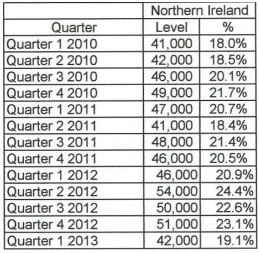
[image:2.595.155.415.237.490.2]Table 2 provides NEET figures for Northern Ireland since 2010. The figures are based on Labour Force Survey data, which will be discussed in more detail below.2
Table 2: NI NEET figures 2010 - 2013
3
NEET Calculation Methodologies
As can be seen above, there were 42,000 NEETs in NI as identified by the Labour Force Survey (LFS). This figure was based upon Labour Force Survey data and was calculated by adding together two sets of figures: 3
Economically inactive 16-24 year olds who are not in full time education; and
Unemployed 16-24 year olds who are not in full time education.Both of these figures amounted to 21,000 16-24 year olds with the sum total of 42,000 NEETs. It should be noted that the LFS was not designed to provide NEET data. As stated in the NEETs scoping document:4
2
Department for Employment and Learning correspondence
3
NISRA briefing to Committee for Employment and Learning, 22 May 2013.
4
Department for Employment and Learning, A scoping study of those young people Not in Education, Employment or Training (NEET) in Northern Ireland, http://www.delni.gov.uk/scoping-study-young-people-not-in-education_-employment-or-training-neet.pdf
Northern
Ireland Total
16-19 % of
total
20-24 % of
total
16-24 % of
total
The Labour Force Survey (LFS) gives us the overall NEET figure for both the 16-19 and 16-24 year old age group but the definitions are problematic as training is restricted to that which is government supported and
education is restricted to full time.
In addition, as the LFS is a sample survey there is an estimated level of sample survey error. As stated by NISRA:
The confidence interval for the January to March 2013 NEET figure
(42,000) derived from the LFS was 8,000. This means that the true level of those who are NEET is 95% likely to lie in the range 34,000 to 50,000.5
This is a variation of plus or minus 19%.
The size of the variation in the confidence interval would therefore call into question the accuracy of the NEET statistics being used in Northern Ireland to develop policy, especially in light of the findings of both the DEL Scoping Study and the NEETs inquiry conducted by the Committee for Employment and Learning.
Indeed, when discussing the use of LFS data to determine the number of NEETs, the scoping study found that:
It includes only those not in full time education;
Training is restricted to government sponsored training;
The definition of NEET reduces the numbers judged as being active and could therefore lead to a higher figure;
The LFS is a sample survey, with around 240-300 16-19 year olds included. As such it is not possible to disaggregate the figure (the sample size is too small) to identify who is NEET by choice (such as gap year students) and who is NEET as a result of being disadvantaged or via other barriers;
As the LFS is a sample survey, the lower the sample, the less accurate the figures; and
The LFS provides the only total NEET figure for NI.The difficulty in identifying the number of NEETs in NI is recognised by DEL. The Department commissioned research by Arad Research to examine the potential of an NI tracking system. The key recommendations of this research were:
In the short term, the Department’s Client Management System (CMS) database should be enhanced, assumed costs are not excessive, to enable it to function as a rudimentary tracking system for young people in Northern Ireland; and
In the medium term (2-3 years), a new tracking system should be established based on a specification designed by a cross-departmental group led by DEL and drawing on the National Client Caseload Information System in England.5
It is intended that a tracking system will be in place sometime in 2014. It should be noted that further work is being carried out in order to identify appropriate amendments to CMS which would allow it to operate as a rudimentary tracking system.6
CMS is intended to be replaced within the next few years by the Work Services Platform (WSP) which is being introduced as part of the introduction of Universal Credit. This system may also be used in tracking NEETs. Other options being considered include the use of Unique Learner Numbers (ULN).
Please note a copy of the Executive Summary of the Arad report is attached as Appendix 1 to this paper.
4
Other Measurements
Whilst NI does not have its own dedicated system of tracking NEETs, systems are in place in other UK regions for measuring this group.
4.1 England
England has two main measures:
The Client Caseload Information System; and
The youth cohort study.Client Caseload Information System:
The Client Caseload Information System (CCIS) holds a range of information on young people aged 13–19. It is a local database that provides local authorities in England and Wales with information so they can support young people to engage in education and training, identify those who are not participating and to plan services that meet young people’s needs.7
CCIS also enables local authorities to provide management information to Department for Education through the National Client Caseload Information System (NCCIS). This is used to:
Monitor the impact of the legislation that will require all 16-year-olds to participate in education or training from September 2013;
Produce monthly performance tables that services can use to compare and benchmark their performance against others;
Combine with other administrative data to produce education destination measures and the quarterly brief on those not in education, employment or training (NEET);6
DEL Correspondence
7
Department for Education, National Client Caseload Information System,
Produce tables relating to participation, NEET and delivery of the September Guarantee8 which are made available on the Department's website; and
Evaluate policies such as the Youth Contract and RPA local delivery projects.The youth cohort study:
As stated by the UK Data Service:
The Youth Cohort Study (YCS) began in 1985. It is a major programme of longitudinal research designed to monitor the behaviour and decisions of representative samples of young people aged 16 years onwards as they make the transition from compulsory education to further or higher
education, or to the labour market. The YCS tries to identify and explain the factors which influence post-16 transitions, for example, educational
attainment, training opportunities, experiences at school.9
This study has been used to identify the groups that make up NEETs including their individual characteristics.
4.3 Welsh “Participation of young people in education and the labour market”
This statistical first release is the definitive source of NEET estimates for Wales.10 It is published each July and contains statistics for Wales covering both participation in education and training and the labour market. It uses three sources of data in order to derive the figures:
Administrative data sources – in this case participation in different types of institution and forms of education;
ONS population mid-year estimates converted by the Welsh Government to academic age; and
Labour market data from the Annual Population Survey (APS).The statistics are a snapshot of a single point in time (in a similar manner to the Census). Other Welsh statistics use the data above and information from Careers Wales.
4.4 Scotland
Scotland applies a slightly different measure to NEETs with only those aged 16-19 able to be classified within the group.
8
An obligation by the UK Government ensure that all 16- and 17-year-olds are offered a suitable place in education or training, including in schools, colleges or work-based training
9
UK Data Service, Youth Cohort Study, http://discover.ukdataservice.ac.uk/series/?sn=2000061
10 ONS UK estimate of young people not in education, employment or training,
NEET estimates are based on the Annual Population Survey. The figure provided is reliable at a national level but is not robust at a local authority level.11
At local level a combination of school leaver destinations statistics and Department of Work and Pensions benefit statistics are used. This is sufficient to provide an estimate of NEET 16-19 year old numbers but is recognised as underestimating the number of NEETs.12
4.5 ONS UK estimate of Young People Not in Education, Employment or Training
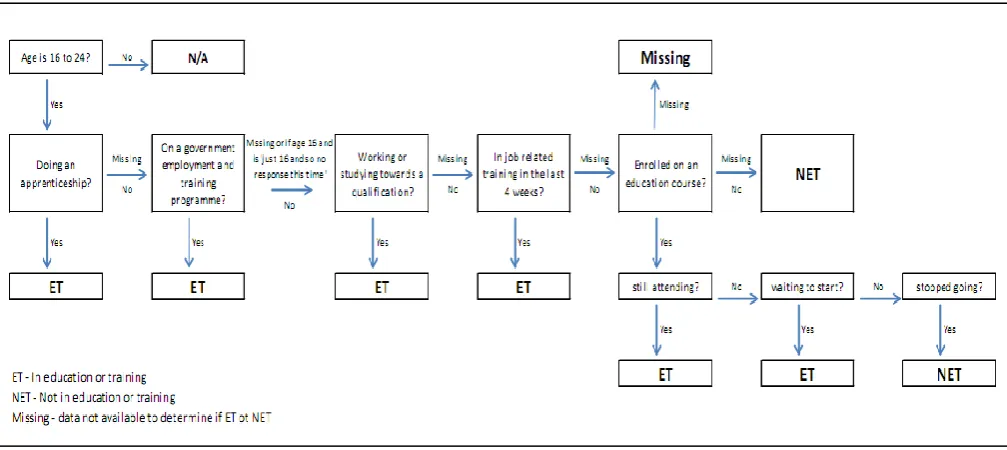
ONS published this new statistical report in May 2013 which provides quarterly estimates of NEETs. This is an estimate for all of the UK. The ONS calculates this figure by first identifying those aged 16-24 who are in education or training. Young people are defined as in education or training if they:
Are doing an apprenticeship;
Are on a Government employment or training programme;
Are working or studying towards a qualification;
Have had job-related training or education in the last four weeks; or
Are enrolled on an education course and are still attending or waiting for term to (re)start. [image:6.595.51.555.451.676.2]As such, anyone not part of one of the above groups is considered to be NEET. The flow chart below shows the process used to calculate the figure.13
Figure 1: Flow chart on NEET calculation
11
The Scottish Government, More Choices More Chances,
http://www.scotland.gov.uk/Topics/Statistics/Browse/Labour-Market/MCMCLMSTATS
12
Ibid
13ONS UK estimate of young people not in education, employment or training,
The table includes a group defined as ‘Missing’. This group corresponds to people for whom data is missing. Missing data occurs when a respondent has not answered a question or a response has not been recorded appropriately by the interviewer. The ONS splits the ‘missing’ into the valid groups based on the proportions of cases without missing data. This is done within each category defined by age, sex and economic activity.
Appendix 1: Arad Research “Research project examining the possibility of developing a
tracking system for individual young people.
Executive Summary
The Department for Employment and Learning commissioned Arad Research, in association with the University of Ulster, University of Warwick and Maguire Policy Research, to undertake a research project examining the feasibility of developing a system for tracking young people’s education, employment and training status in Northern Ireland. This report outlines the findings and recommendations of the research.
The NEET challenge
The need to address the issue of young people who are not in education, employment or training (NEET) is recognised internationally. In Northern Ireland, the ‘Pathways to Success’ strategy has been developed in order to tackle this ‘major social problem’14, with the scale of
the challenge evidenced by the rise in the proportion of 16-24 year olds who are categorised as NEET, from around five per cent in 2000 to ten per cent in 2011. The social and economic costs of being NEET to individuals and to the wider economy are well documented.
A wealth of evidence points to the over-representation of young people with specific characteristics, and who make up identifiable ‘vulnerable groups’, within the NEET category. It follows from this that the identification of these characteristics, or ‘risk factors’, can help to predict the likelihood of young people becoming NEET and therefore enable preventive measures to be introduced.
However, information on these groups of vulnerable young people is held in a number of different databases managed by different organisations and departments. This presents a challenge when seeking to identify young people NEET and at risk of becoming NEET in an effective way. In order to address this issue, ‘Pathways to Success’ has highlighted “a clear need for an identification and tracking system to be developed”.15 The strategy outlines a
Northern Ireland Executive commitment to establish such a tracking system in Northern Ireland by 2014.
Tracking systems have been used across many countries in recent years to bring together different sources of information to identify young people NEET and at risk of becoming NEET. These systems have evolved over a number of years and the evidence suggests that
14
Northern Ireland Executive (2012) Pathways to Success: Preventing exclusion and promoting participation of young people. A Northern Ireland Executive Vision, Strategy and Action Plan. Ministerial Foreword.
15
establishing and implementing a tracking system which fulfils all of the functions required in Northern Ireland will take 2-3 years. This report sets out a staged implementation plan for establishing a rudimentary tracking system based on existing systems in the short term, with further recommendations for enhancing this in future years.
Approach
The approach taken in this study has involved a literature review of existing policy and tracking systems, consultations with departmental staff and external stakeholders a stakeholder workshop and the development of cost estimates for establishing a tracking system in Northern Ireland. The fieldwork was undertaken between January 2012 and July 2012.
Findings
The research identified a clear consensus among stakeholders around the need for developing a comprehensive tracking system for young people in Northern Ireland. This system should aim to enable prevention, by being concerned with the early identification of vulnerable young people and to effect reintegration, through a focus on those who are already disengaged.
At the same time, there is a recognition of the practical benefits such a system could offer young people, practitioners, organisations and policy makers. The potential benefits include the ability to identify vulnerable young people NEET or at risk of becoming NEET; being able to monitor the education, employment and training status of whole cohorts of young people for the first time in Northern Ireland; helping to provide data that could inform referrals to interventions more effectively; and being able to use the data to help evaluate the impact of policies and interventions.
Whilst a cross-departmental approach is important, it is clear that the Department for Employment and Learning, as the organisation with lead responsibility for the ‘Pathways to Success’ strategy, and the Department for Education, as the department with responsibility for Education and Library Boards and schools that hold pupil-level data, are the key partners in the development of the system.
of the status of young people in Northern Ireland. However, as it stands, no single database holds this data in one place in order to provide a tracking system that will meet the objectives outlined in Pathways to Success.
A fundamental first step in establishing a tracking system in Northern Ireland will be the development of an information sharing protocol between DEL and DE, involving all schools and Education and Library Boards and enabling the sharing of data held on School Information Management Systems (SIMS) and the eSchools data warehouse16. Other departments which have indicated that they would benefit from being provided with educational data (e.g. DoJ and DHSSPS) should also be considered for inclusion in this agreement in future.
The study explored a number of options in relation to the development of a new system, resulting in a staged implementation plan (section 6) for enhancing existing systems and then developing a new system in future. In addition, cost estimates based on various assumptions which would require further discussion and refinement as part of the development of a detailed specification for a new system, are provided. The specification for the National Client Caseload Information System (NCCIS), which operates in England17 could be used as a guide for developing such a specification in Northern Ireland.
Recommendations
The following recommendations are made on the basis of this study. More detailed action points emanating from these recommendations and a staged implementation plan are outlined in section 6 of this report.
Recommendation 1
DEL should have the lead responsibility for taking forward the development of a tracking system for young people in Northern Ireland.
16 At the time of writing, schools currently have a data sharing agreement with DEL for the transfer of basic pupil information
from specific fields in C2k for the purpose of ensuring young people are provided with appropriate career services.
17
Recommendation 2
In the short term, the CMS database should be enhanced, assuming costs are not excessive18, to enable it to function as a rudimentary tracking system for young people in Northern Ireland.
Recommendation 3
The tracking system should initially be focused on all young people aged 14-24, with a view to expanding this to include the earlier identification of young people at risk of becoming NEET in future.
Recommendation 4
DE should play a significant role in relation to the provision of comprehensive baseline data and the identification of young people at risk of becoming NEET.
Recommendation 5
An information sharing protocol should be established and implemented between DEL and DE. This is of crucial importance to the effectiveness of any system.
Recommendation 6
Decisions on granting access to the system should be made based on the roles of individuals and organisations, with a number of departments and staff considered for potentially having access to at least some parts of the system (often referred to as ‘role-based’ access).
Recommendation 7
In the medium term, (the next 2-3 years) a new tracking system should be established in Northern Ireland based on a specification designed by a cross-departmental group led by DEL and drawing on the National Client Caseload Information System (NCCIS) in England.
Recommendation 8
A follow-up survey should be carried out 18-24 months after the tracking system has been implemented in order to measure its impact and effectiveness.
18
The costs of CMS, and of making enhancements to it, were unavailable to the research team during the timescale of the
study. These costs should be clarified by DEL prior to making an informed decision on their preferred option for taking forward a