A life in the day
of a headteacher
A study of practice and well-being
Michael Bristow, Research Officer
Gillian Ireson, Research and Development Programme Coordinator
Andy Coleman, Senior Research Officer
NCSL Research and Policy Group
Contents
List of tables and figures 7
Executive summary 8
1. Introduction 12
2. Literature review 14
2.1 Introduction 14
2.2 School leadership and key policy changes:
complexity and accountability issues 15 2.3 Well-being, job satisfaction, stress and work-life
balance beyond teaching 17
2.3.1 Johnson et al (2005) – work-related stress
across occupations 17
2.4. Well-being 19
2.4.1 What is meant by well-being? 20
2.4.2 What promotes well-being at work? 21 2.4.3 Job satisfaction and stress in relation to headship 24
2.4.4 Definitions of stress 24
2.4.5 Headteachers and stress 25
2.4.6 The relationship between stress and job satisfaction
for headteachers 28
2.5 Work–life balance 35
2.5.1 What is meant by work–life balance? 37 2.5.2 What strategies do headteachers adopt to
maintain work–life balance? 39
3. Methodology 41
3.1 Sample 41
3.2 Researchers 42
3.3 Research design measures 43
3.3.1 Piloting 43
3.3.2 Journal 43
3.3.3 Observation visit 44
3.3.4 Interview 45
3.4 Analyses 45
4. Results and discussion 47
4.1 What does the working life of a headteacher
look like in 2006? 47
4.2 Nature of the working life – overview of main tasks 47
4.3 Descriptions of the day 51
4.3.1 Demanding and pressured 51
4.3.2 Responsive and flexible 52
4.3.3 Personal relationships 53
4.3.4 Management and leadership 53
4.3.5 Other issues 54
4.4 What would headteachers change about their job? 54 4.4.1 Accountability, bureaucracy and external demands 55
4.4.2 Increased capacity 56
4.4.3 Professional development 57
4.4.4 Changing the culture of headship 57 4.5 Which elements of the job offer most reward
and satisfaction? 57
4.5.1 Developing others 58
4.5.2 The nature of the job 59
4.6 Which elements of the job offer least reward
and satisfaction? 61
4.6.1 Internal resources and contextual issues 61 4.6.2 Child- and learning related matters 62 4.6.3 External demands and bureaucracy 64
4.6.4 Others 65
4.7 What contributes to a positive work–life balance? 65
4.7.1 Health and hobbies 65
4.7.2 Family, friends and personal support 66
4.7.3 Strategies for managing work 66
4.7.4 Personal philosophy 69
4.7.5 Poor work–life balance 70
4.7.6 Coping strategies 70
4.8 What hinders work–life balance? 72
4.8.1 Pressure of work demands 72
4.8.2 Paperwork, lack of opportunities for delegation and
a need for control 72
4.8.3 Staff issues including unionisations 73
4.8.4 Other 73
4.9 Three things to improve work–life balance 74
4.9.1 Administrative support 74
4.9.2 Delegation 74
4.9.3 Reducing dependency on the head 74 4.9.4 Improved professional development 75
4.9.5 Reduced working hours 75
4.9.6 Dedicated leadership time 75
5. Conclusions and implications 76
5.1 Existing headteacher practice and the future of the role 76
5.1.1 Distributed leadership 77
5.1.2 Prioritise personal and professional lives 78 5.1.3 Deal confidently and comfortably with negative
staff, parent and pupil issues 79
5.1.4 Supportive networks and collaboratives 79 5.1.5 Positive and active life outside school 80
5.2 Future research 82
6. Acknowledgements 84
7. Bibliography 85
Appendices 90
Appendix 1 Journal instructions and example journal page 90
Appendix 2 Example observation schedule 92
Appendix 3 Example interview schedule 96
List of tables and figures
Tables
Table 1 Rankings of headteachers, teachers and teaching assistants out of 26 occupations by physical health, psychological well-being and job satisfaction
Table 2 Categories of job satisfaction and dissatisfaction for headteachers
Table 3 Characteristics of the sample headteachers by phase, government office region, gender and experience
Table 4 Summary of individual activities and broad task groups for headteachers
Table 5 Coping strategies employed by participants
Figures
Executive summary
This is a report of a study of the nature of the working lives and practices of contemporary headteachers in England conducted by the National College for School Leadership (NCSL).
At NCSL’s regional conferences in 2005, many headteachers cited relentlessness, accountability and complexity of headship as some of the major issues facing the profession. Underlying these issues, this study specifically explores the concepts of well-being, work–life balance, stress and job satisfaction. The following definitions of these concepts were used to inform the design of the study:
• well-being: ‘… positive well-being … is … something that is more than simply the absence of stress or illness, but rather involves positive enjoyment and pleasure’
Gambles et al, 2006 p 37
• work–life balance:‘… simply describes anyset of policies and practices that employers can put in place, which help people achieve better balance between work and their lives outside work and benefits the business’
Department of Trade and Industry, 2006
• stress:‘teacher stress may be defined as the experience by the teacher of unpleasant, negative emotions, such as anger, anxiety, tension, frustration or depression, resulting from some aspect of their work as a teacher’
Kyriacou, 2001 p 28
• job satisfaction:‘… the positive emotional reactions and attitudes an individual has towards their job’
Faragher et al, 2005 p 106
profoundly. Driven by changes of policy and emphasis, the tasks that headteachers are expected to undertake have changed significantly in recent years, with their work increasingly being perceived as pressured. The well-being of headteachers is affected by the operational and strategic working environment and the ethos and morale within the education system, as well as opportunities to undertake professional development.
In light of the lack of research and the fact that there have been significant changes to the role since much of the previous work was conducted, this study serves to provide timely evidence on
contemporary practice and the outlined underlying issues.
The study involved 34 practising headteachers, both novice and experienced from all phases and government regions. The study used a three-stage methodology to gather data upon their working lives: a journal of headship completed over the course of two weeks; a non-participant observation of a working day; and a follow-up interview. Research tools for each of these were constructed with the help of subject matter experts, who advised on the design and content. The fieldwork was carried out between May and August 2006. Data was analysed with the use of Excel and NVivo software.
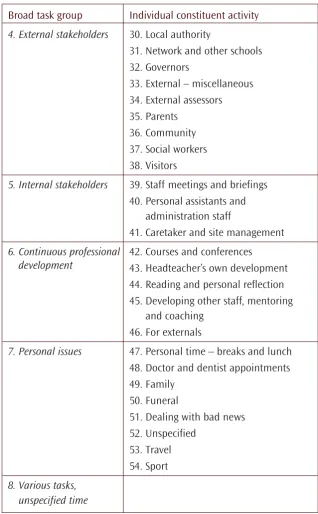
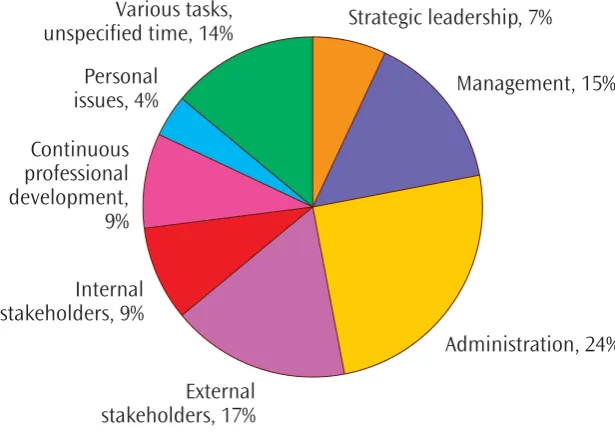
Content analysis of the participants’ journals identified 54 distinct areas of activity. These were grouped into eight meta-categories covering: strategic leadership, management, administration, external stakeholders, internal stakeholders, continuous professional development, personal issues andvarious unspecified tasks.
An analysis of the time spent on these activities revealed that participants in this study spent almost a quarter of their time undertaking administrative tasks. Meeting the demands of external stakeholders was the second most time-consuming activity.
Management-based activities, in particular management of staff, was the third highest category in terms of time spent.
working lives included personal relationships, in particular responding to the needs of others, conducting managerial tasks and engaging in leadership.
When asked what they would change about headship, participants identified accountability, bureaucracy and external demands. Additionally, increased capacity, more professional development opportunities and challenging the culture of headship were also cited.
The findings illustrate that developing others, in particular seeing children progress, develop and succeed, was one of the most rewarding and satisfying aspects of their job. Other rewarding aspects of their job included leading the strategic direction of the school and positive personal relationships. The least rewarding and satisfying elements of headship included dealing with negative staff and parent issues, and excessive bureaucracy.
Participants detailed a number of coping strategies. These included a variety of hobbies, support from family and friends, strategies for managing work, and personal philosophy: all of these contributed to a positive work–life balance. In contrast, pressure of work demands, a lack of opportunities for delegation, and negative staff and parental issues hindered the achievement of a positive work–life balance.
To improve work–life balance, participants suggested the need for increased levels of administrative support, greater distribution of leadership and a reduction in dependency on the headteacher, amongst others.
The study reveals much about the practice of headteachers and offers suggestions from heads themselves about the future of their role.
It is evident from this study that, for some, it is the best job that they could carry out – indeed, some look upon it as a vocation.
The majority of those who detailed that they relish the challenges and enjoy the variety of the role, and achieve a positive work–life balance, were more often those who had effectively distributed leadership across and within the school, who could prioritise their personal and
professional lives, could deal confidently and comfortably with negative staff, parent and pupil issues, who fostered and were part ofsupportive networks or collaboratives and who had a positive and active life outside school. These strategies offer us insights and implications for
stakeholders into how and why some headteachers manage to achieve a work–life balance, and find satisfaction and reward in their role.
1. Introduction
This is a report of a study of the nature of the working lives and practices of contemporary headteachers in England conducted by the National College for School Leadership (NCSL).
At NCSL’s regional conferences in 2005, many headteachers cited relentlessness, accountability and complexity of headship as some of the major issues facing the profession. This study specifically explores the concepts underlying these issues: well-being, work–life balance, stress and job satisfaction. The following definitions of these concepts were used to inform the design of the study:
• well-being: ‘… positive well-being … is … something that is more than simply the absence of stress or illness, but rather involves positive enjoyment and pleasure’
Gambles et al, 2006 p 37
• work–life balance:‘… simply describes anyset of policies and practices that employers can put in place, which help people achieve better balance between work and their lives outside work and benefits the business’
Department of Trade and Industry, 2006
• stress:‘teacher stress may be defined as the experience by the teacher of unpleasant, negative emotions, such as anger, anxiety, tension, frustration or depression, resulting from some aspect of their work as a teacher’
Kyriacou, 2001 p 28
• job satisfaction:‘… the positive emotional reactions and attitudes an individual has towards their job’
Faragher et al, 2005 p 106
profoundly. Driven by changes of policy and emphasis, the tasks that headteachers are expected to undertake have changed significantly in recent years, with their work increasingly being perceived as pressured. The well-being of headteachers is affected by the operational and strategic working environment and the ethos and morale within the education system, as well as opportunities to undertake professional development.
In light of the lack of research and the fact that there have been significant changes to the role since much of the previous work was conducted, this study serves to provide timely evidence on
contemporary practice and the outlined underlying issues.
The study involved 34 practising headteachers, both novice and experienced from all phases and government regions. The study used a three-stage methodology to gather data upon their working lives: a journal of headship completed over the course of two weeks; a non participant observation of a working day; and a follow-up interview. Research tools for each of these were constructed with the help of subject matter experts, who advised on the design and content. The fieldwork was carried out between May and August 2006. Data was analysed with the use of Excel and NVivo software.
This report details the findings of the work, implications for
2. Literature review
2.1 Introduction
This literature review summarises what is already known about issues of well-being, job satisfaction, stress and work–life balance in the professional lives of contemporary headteachers in England. It is not intended that this review should cover the vast body of material and evidence that has been gathered pertaining to these issues in relation to the teaching profession as a whole or beyond. Although the wider context will be explored in summary form, the focus of the review is the lives of headteachers specifically in relation to the issues
addressed here.
This review begins with a consideration of school leadership in relation to key policy changes (section 2.2) before providing a brief overview of well-being, job satisfaction and stress beyond the teaching profession (section 2.3). A multilevelled and multifaceted picture of well-being is presented in section 2.4. Features of headship that contribute
significantly to job satisfaction and that can be developed to increase it are also considered here. Finally, the review moves on to work–life balance in section 2.5 and then considers implications for professional development and future research before bringing together conclusions (section 2.6).
The research literature in relation to the above issues and focusing specifically on headship is sparse. Therefore, a search of more general research was conducted in order to place what is known about the situation of headteachers within a general picture of well-being, job satisfaction, stress, and work–life balance in other occupations. For this, the following list of keywords was compiled as a basis for the literature search:
• headteachers • non-school leaders • workload
• well-being • work–life balance • stress
It was anticipated that most of the relevant literature pertaining specifically to headteachers would be recent, arising from interest stimulated over the last decade. However, it was also decided that, because of the existence of research into the situation of classroom teachers particularly from 1990 onwards, and the changes in headteachers’ roles described and analysed since the passing of the Education Reform Act 1988 (ERA)1 and the introduction of local management of schools (LMS) in 1990 (subsequently revised in 19962), sources dating from 1990 onwards would be included.
2.2 School leadership and key policy changes: complexity and accountability issues
As Day et al (2003) have identified, beginning in 1988 with the ERA, schools have become subject to an increasing number of imposed curriculum and management innovations and quality control. As a result headteachers have found their working lives characterised by paradoxes as follows:
• an apparent increase in independence in the management of schools alongside increasing dependence upon curriculum, monitoring, assessment and inspection frameworks imposed by government
• a performance- and results-driven orientation that has the potential to create divisiveness
• new forms of accountability which are intended to enhance effectiveness, but which simultaneously increase workload and bureaucracy
• new imposed curriculum certainties which reduce teachers’ abilities to recognise and act upon differentiated student need
• increased attention to cognitive challenges that reduces attention to emotional need
Day et al, 2003 pp 13–14
stakeholders in education (including parents and governors) and increases in the management (as compared with teacher) role’ (p 197). These changes of policy and emphasis have inevitably changed the feelings of headteachers towards their role, as well as the outcomes that they accept as falling within their remit.
A global dimension is added to this debate in the papers collated as a special issue ofCambridge Journal of Education in November 2003, edited by Professor John MacBeath (MacBeath, 2003). Entitled
The Changing World of Leadership, the consequent pressures on school leaders from perspectives located in a wide variety of contexts are examined in some detail. The set of papers explores the dilemmas which are ‘seen to be exacerbated in changing and hyper-complex societies’ (p 323) ranging across Hong Kong, Ghana, Australia, North America, Scandinavia, Austria, Germany and Switzerland as well as the UK. The authors present arguments centring on the challenges posed in these specific contexts and cultures. MacBeath’s editorial identifies the striking similarities that run through their analyses and, despite the apparent wide dissimilarities of context, emphasises the greater potential in ‘the sharing of dilemmas rather than exchanging putative solutions’ (p 325). A greater appreciation of the specific challenges posed in a range of cultural situations may enable us to develop a deeper understanding of the roles of leaders and the nature of leadership.
In their classification of six models of leadership – instructional, transformational, moral, participative, managerial andcontingent – Leithwood et al (1999) underline how these apparently different approaches overlap but also have specific histories and profiles:
• Each developed in a context of organisational and broader social goals,
needs, norms, ideas and expectations, which allowed one or several approaches to dominate as an ideal, until such time as that context changed sufficiently as to more clearly favour yet another approach or approaches.
Leithwood et al, 1999 p 17
2.3 Well-being, job satisfaction, stress and work–life balance beyond teaching
It must be acknowledged that the difficulty in recruiting and retaining people for leadership roles is not confined to the teaching profession (Hartle and Thomas, 2003). Nor is this shortage restricted to the UK. Similar issues are present in the USA, Canada and Australia. The demographic timebomb of the generation born in the late 1940s and 1950s, linked to the failure to offer a range of experience and develop leadership skills in younger colleagues earlier in their careers, has created what is increasingly seen as a shortage throughout all sectors.
Although this study is not concerned to describe or analyse the situation with regard to occupations other than headship, it is nevertheless pertinent to indicate some comparisons between the issues and factors affecting headteachers and those in other occupations.
2.3.1 Johnson et al (2005) – work-related stress across occupations
A recent illuminating study is that by Johnson et al (2005), which reports the rank order of 26 different occupations by stress and job satisfaction levels, including headteachers, teachers and teaching assistants. Using the outcomes from the completion of ASSET, a shortened stress evaluation tool licensed by occupational psychologists Robertson Cooper Limited (www.robertsoncooper.com/products/Asset.aspx), the authors detail the results in relation to key factors of physical health,
psychological well-being and job satisfaction. Correlation of these factors revealed significant relationships between them, ie it was demonstrated that as physical health deteriorates, so does psychological well-being, followed by a decrease in job satisfaction.
Acknowledging the research evidence that supports the general recognition of teaching as a stressful occupation (Moriarty et al, 2001), Johnson et al draw attention to the differences between the ranking of 295 headteachers, 916 teachers and 444 teaching assistants with regard to each of the 3 key factors. The ASSET scores reveal that:
• … teachers are experiencing higher stress levels and lower job
satisfaction levels than both headteachers and teaching assistants, neither of whom score above the norm on any of the factors.
The rankings of headteachers, teachers and teaching assistants out of the 26 occupations for the 3 examined factors are shown in table 1.
Table 1: Rankings of headteachers, teachers and teaching assistants out of 26 occupations by physical health, psychological well-being and job satisfaction
Interestingly, this pattern is also evident in the relative scores of police officers and senior police officers. In both cases, the authors draw attention to the impact of the more intense ‘emotional labour’ (Zapf et al, 1999; Zapf, 2002) of both teachers and police officers as opposed to headteachers and senior police officers. In fact, the six occupations reported as being the most stressful regarding physical and psychological well-being and as having the lowest levels of job satisfaction – namely ambulance personnel, teachers, social services, customer services, call centres, prison officers andpolice – all require ‘either face to face or voice to voice interaction with clients and in each of these occupations the emotions that the employees are required to display as part of their job have to follow strict rules’ (Johnson et al, 2005 p 184). Johnson et al therefore conclude that emotional labour contributes significantly to occupational stress but that more in-depth analysis of the interaction between stressors and stress outcomes is needed.
However, this research would seem to indicate that, in terms of job satisfaction and stress, headteachers experience more job satisfaction and less stress than those who work entirely in classrooms. The authors are at pains to point out the need for further in-depth research to investigate the interrelationships and underlying causes of the different levels of these factors perceived by those employed across a wide range of occupations. The ASSET database arising from completion of the evaluation tool by more than 25,000 personnel is being interrogated
Physical health Psychological Job satisfaction
well-being
Headteachers 11 20 17
Teachers 2 2 6
Teaching 10 23 18
assistants
[image:18.595.140.455.204.323.2]and analysed further to reveal insights and answers to the questions raised so far.
In contrast to the outcomes of the Johnson et al (2005) study, the findings of the comparison of the two surveys carried out by Daniels and French (2006), arising from the concerns over the workloads of UK school leaders, indicate that:
• … it is almost universally the case that problems of controlling
workloads and securing a work–life balance are far greater for head, deputy head and assistant headteachers. The most concerning aspects of the findings are that [National Association of Head Teachers] (NAHT) members have to deal with heightened levels of red tape and have problems in planning and controlling their workloads or even identifying where, and with whom, there is scope for
negotiation over workloads.
Daniels and French, 2006 p 3
There are also concerns over the issue of gender in terms of reactions to and dealing with occupational stress. The impact on female headteachers would seem to be significant in terms of the findings of both Cooper and Kelly (1993) and Chaplain (2001). Fotinatos and Cooper (2004) identify ‘significant differences in terms of physical and psychological well-being amongst the male and female sample’ (p 14) of 2,500 subjects. In her study of gender and headship in the 21st century, Coleman (2005) includes information on the differences between male and female home and family responsibilities that impact strongly on the issue of work–life balance. Such differences between male and female headteacher responsibilities, attitudes and expectations feed into the perceptions of self-efficacy, as well as affecting recourse to palliative strategies in coping with issues of job satisfaction. They therefore require further investigation.
2.4. Well-being
In this section of the review, a general consideration of well-being, together with explicit detail of the well-being of teachers, is used in the absence of any specific literature to raise issues about the well-being of headteachers. The research report Enchanted Headteachers:
2.4.1 What is meant by well-being?
The literature presents a multilevelled and multifaceted picture of well-being. Building on a simplistic and general dictionary notion of happiness, health and prosperity, definitions incorporate emotional, physical, psychological, economic and material perspectives.
According to Day et al (2006), teachers perceived well-being as ‘the state of feeling healthy and happy’ (p 50). Moving to the perspective of headteachers, a general consideration of emotional well-being as ‘how we feel, think and behave’ (BBC Online, 2006) can be observed. A further viewpoint focuses on the positive nature of well-being, that it is ‘something that is more than simply the absence of stress or illness, but rather involves positive enjoyment and pleasure’ (Gambles et al, 2006 p 37). This last definition reflects a shift in thinking ‘from a concern with stress and illness to a focus on positive experiences’ (Day et al, 2006 p 51). In considering what this might mean for well-being in headship, this positive element suggests notions such as optimism and satisfaction, which, together with the emotional involvement underlying feelings, thinking and behaviour, would seem to be a critical part of health and happiness.
Focusing on the physical and psychological elements of positive well-being, as well as economic and material well-being, it is
acknowledged that ‘these do not necessarily go hand in hand as people living in the richest societies are not necessarily the happiest’ (Gambles et al, 2006 p 37). In developing this economic theme of well-being, the authors note that ‘participation in paid work can be a vital source of well-being at different levels … apart from income it can also
contribute to a sense of identity, fulfil social needs and often contribute to social growth. However, much depends on the nature of the work’ (p 37). In transferring the findings that ‘teachers who work in schools in more challenging socio-economic contexts are more likely to experience greater challenges to their health, well-being and thus resilience, than those who work in relatively more advantaged schools’ (Day et al, 2006 p 262) to headteachers, the nature of the economic context would seem to be linked to their well-being. Notwithstanding, this link has yet to be explored through research.
optimism. The authors note also that positive psychology, whilst being at a subjective level, is also at an individual level: it is ‘about the character strengths, the capacity for emotion and vocation, interpersonal skill, aesthetic sensibility, and perseverance, amongst others’ (p 51).
In terms of school context and well-being, the Variations in Teachers’ Work, Lives and Effectiveness (VITAE) research suggests that:
• … some teachers themselves do seek and find, in different ways, their
own sense of stability within what appears from the outside to be fragmented identities, and that the capacity to sustain such stability is directly associated with a combination of positive factors to be found within personal life situations and school working contexts.
Day et al, 2006 p 148
Consideration for headteachers was not a specific focus of this study but this inference would seem to link directly to the findings of Chaplain (2001) with regard to contrasting perceptions of job satisfaction amongst a sample of primary headteachers.
In this, three key issues surrounding well-being are highlighted. Firstly, well-being has a positive nature that incorporates optimism, enjoyment and emotional involvement. Secondly, well-being is about character strengths including emotion, vocation and interpersonal skills. Thirdly, well-being has links with personal and professional identity.
2.4.2 What promotes well-being at work?
The study Enchanted Headteachers(Woods, 2002), provides some useful indications in terms of what promotes well-being at work for
headteachers. In the study, Woods celebrates the success of these education professionals, seeking to ‘learn from headteachers who have managed to maintain their drive and commitment over a prolonged period of headship’ (p 3). The optimism, emotional involvement and enjoyment of these headteachers – all features highlighted in the analysis of well-being – will be considered in turn and the implications for the promotion of well-being at work discussed.
Firstly, if optimism is a feature of well-being, the ‘enchanted
‘we never see change as a threat, we wouldn’t be bowed down by worry, we would be optimistic, and think if it’s going to improve things, to make things better, let’s do our best with it’ (p 11). Another explained: ‘I think it [change] is constant. Anything that comes along, there’s always a new challenge that we have to address and take on board and implement. There is always something to revitalise us’ (p 12). It would appear from this that, far from the challenges of change having a negative influence on the well-being of headteachers, the direct opposite is true: that constant change is a revitalising element contributing to well-being in headship.
Emotional involvement is the second point for the consideration of promotion of well-being at work for headteachers in Enchanted
Headteachers. Woods identifies in the study four points for development in terms of emotional involvement: those of ‘personal investment in the job of being headteacher, the idea of it being my school, my staff, my kids, pressure and support [and] who says “well done” to the headteacher’ (p 19).
The last point in Woods’s list is highlighted also in response to the effective interventions for teachers in The Teachers Health and Wellbeing Study Scotland (Dunlop and Macdonald, 2004), and may provide pointers to the promotion of well-being in headship. In terms of support for teachers, the study noted that:
• … the headteacher’s role in being approachable, offering sympathy
and emotional support for teachers and adopting a collegiate approach to proactive engagement with staff was perceived as important
by teachers.
Dunlop & Macdonald, 2004, p 72
There are messages here for the support systems for headteachers. Also in the study, teachers’ interest in interventions, such as annual health reviews and training workshops, might also be appropriate in terms of the promotion of well-being for headteachers.
the profession, which looked at the risk factors for premature departure in the Netherlands, it was found to be ‘remarkable that in the
interviews all men and almost all women mention the governing body as one of the factors playing a role in their premature departure’ from school (Kruger et al, 2005 p 249).
In his consideration of the development phase of headship, Woods describes how ‘headteachers, when questioned about their time in post, see this as their most active time, when the job is at its most satisfying and rewarding’ (Woods, 2002 p 5). This is the time in post when headteachers find their work most enjoyable, taking us back to the enjoyment and pleasure in positive well-being (Gambles et al, 2006). Woods found this development phase of headship as:
• … a period of growing confidence [with] increased effectiveness and
constructive self-criticism. Headteachers have their greatest gains, their biggest successes in this period. They are building teams, delegating responsibility, showing staff they are valued in the school.
Woods, 2002 p 5
Roles such as consultant leaders provide further challenge and change, further growth in confidence, opportunities for success and contribution beyond their own school – to support the ongoing well-being of both themselves and other headteachers. And in the same way that ‘teachers’ well-being can be positively and negatively affected by a number of issues such as the management of the school, the school ethos, the level of morale amongst staff and the opportunities presented to staff to undertake professional development’ (Day et al, 2006 p 255), so it is for headteachers operating in the wider education system.
It is now worthwhile summarising the literature and findings about well-being and headship, drawing out the key details.
• Definitions of well-being are multilevelled and multifaceted. The notion of well-being has developed from one of stress and illness to one that incorporates a positive element.
• Definitions of well-being incorporate emotional, physical, psychological, economic and material perspectives.
• Responses to the challenge of change and optimism are important in promoting well-being in headship, as is the need for emotional involvement with and from a range of stakeholders, and enjoyment, satisfaction and reward.
• The well-being of headteachers is affected by the operational and strategic working environment and the ethos and morale within the education system as well as opportunities to undertake professional development activities.
2.4.3 Job satisfaction and stress in relation to headship
As Glatter and Harvey (2006) identify, the 2005 report from the School Teachers’ Review Body (STRB) drew attention to the significance of factors other than pay in the quest for applications to senior positions in schools:
• Whilst pay is cited as a factor it is the responsibilities and expectations
of deputies and heads that are the biggest source of dissatisfaction to job-holders and the most significant deterrent to aspiring leaders.
Glatter & Harvey, 2006 p 41
The current difficulties experienced in attracting applicants for headship and in retaining experienced headteachers are not new (Mercer, 1997). Therefore, an understanding of what contributes to both job satisfaction and dissatisfaction is increasingly urgent. However, as Chaplain (2001) underlines, the issue at heart may remain one of finding the balance between the perceived positive and negative aspects of the role as the responsibilities and expectations generated by policy and practice constantly shift. It is, therefore, at this point in the debate that explorations of stress in the lives of headteachers become both significant and inevitable.
2.4.4 Definitions of stress
or non-specific response to demands placed upon the human body. These demands could either stimulate or threaten the individual’ (cited in Wilson, 2002 p 4) – emphasised the importance of recognising the individual nature of the positive and negative effects of stress. Although some professionals react badly to increasing work pressures, others find that overcoming the challenge of coping in such
circumstances creates a positive sense of self-efficacy (Chaplain, 2001). However, the definition of teacher stress laid down by Kyriacou (2001), highlighting the negativity of stressful experiences, would seem to reflect most closely the usage of the term ‘stress’ in the teaching profession and therefore most relevant to this study. His definition is:
• … the experience … of unpleasant negative emotions, such as anger,
anxiety, tension, frustration or depression, resulting from some aspects of their work.
Kyriacou, 2001 p 28
Tsiakkiros and Pashiardis (2004) open their discussion of occupational stress among Cyprus headteachers with an endorsement of Selye’s characterisation of stress (Selye, 1974, cited in Tsiakkiros and Pashiardis, 2004 p 1) as ‘the spice of life’, underlining that ‘although too much stress may be damaging to our body and disastrous for our mental health, some stress may be a source of motivation and challenge if put under proper control’. Exploring how headteachers do or do not maintain equilibrium, by controlling the stresses caused by additional, different or conflicting demands placed upon them, may lead to an understanding of the complexity of an individual’s relationship to the role and identity of being a headteacher.
2.4.5 Headteachers and stress
However, the warning sounded by Hiebert and Farber (1984) should be heeded:
• … teachers read reports that teaching is stressful and start to believe it.
As a result normal upsets that are part of most jobs become mislabelled as chronic, inherent stressors, and a vicious circle begins that results in a higher incidence of self-reported stress.
cited in Chaplain, 2001 pp 11–12
Many studies over the last decade have provided extensive
Wilson (2002) provides a concise summary (pp 9–11) of the recorded causes of teacher stress, namely:
• workload
• pupils’ failure to work or behave • poor working conditions
• generally in terms of relations with colleagues • poor school ethos
• change
• raising standards • school mergers
Wilson also draws attention to the findings of Travers and Cooper (1996, cited in Wilson, 2002) who identified problematic changes causing additional pressure on the teaching profession: a lack of support from central government; constant changes within the profession; a lack of information as to how changes are to be implemented; diminishing social respect for teaching; and the move towards a national curriculum.
During the 1990s, there was a gradual upsurge in the research interest shown in the impact of these changes on headteachers as a distinct group separate from classroom-based teachers. The study by Cooper and Kelly (1993) of occupational stress amongst 2,638 headteachers of primary and secondary schools and principals of further and higher education establishments sought to assess the extent and sources of headteacher stress, to inform any effort to maximise job satisfaction and psychological well-being.
A three-stage process was undertaken, the first consisting of clinical interviews with a sample of headteachers and principals to capture data on actual and potential stressors. Next, a battery of questionnaires was prepared based on existing materials and the interview findings. The questionnaires included the independent variables of biographical measures, personality measures and work stressor measures and two further independent variables, mental health and job satisfaction. These questionnaires were then distributed to the sample headteachers and principals.
This study found that levels of job dissatisfaction and mental ill-health were highest in primary schools, with levels in secondary schools being higher than in further education (FE) and higher education (HE)
were suffering from greater job dissatisfaction than their male counterparts. However, male headteachers and principals were found to be suffering from more mental ill-health. The two chief sources of occupational stress leading to job dissatisfaction were ‘work overload’ and ‘handling relationships with staff’.
In their charting of the theoretical background to their study, Tsiakkiros and Pashiardis (2004) record the findings of other previous research. Carr (1994), when studying 94 South Australian headteachers, found that the three main factors causing stress were: the perception of a lack of support from the Education Department; coping with heavy work demands and employer expectations; and a difficulty in personal relationships with other staff. Ostell and Oakland (1995, cited in Tsiakkiros and Pashiardis, 2004) grouped problematic situations faced by headteachers under the headings of:
• organisational
• external conflicts and complaints • behavioural and special needs • internal conflicts and complaints • personnel performance
• motivation and morale • recruitment
• intrapersonal
They also identified that educational changes were reported more frequently as the main difficulty experienced by headteachers (Tsiakkiros and Pashiardis, 2004). The findings of Tsiakkiros and Pashiardis’ own research, conducted using a range of qualitative and quantitative data, arising from questionnaires with 200 Cypriot headteachers and semi-structured interviews with 11, indicate that ‘despite the high level of reported stress, Cyprus headteachers are very satisfied [with] their job’ (p 9).
• … occupational stress should be confronted by headteachers as a test that will lead them to professional maturation and as a result it should be regarded as a creative challenge which can lead through its proper management to productive results.
Tsiakkiros and Pashiardis, 2004 p 10
Questions centring on professional development in relation to job satisfaction and the management of stress will be returned to later in this review.
2.4.6 The relationship between stress and job satisfaction
for headteachers
While ‘job satisfaction’ can be defined as ‘the positive emotional reactions and attitudes an individual has towards their job’ (Faragher et al, 2005 p 106), there is debate about whether job satisfaction can be classified as a global concept or whether it is composed of facets of satisfaction with various aspects of an individual’s job. In the UK, the research of Mercer (1996; 1997) with secondary headteachers and Chaplain (2001) with primary headteachers gives clear insights into the relationship between negative stress, stress management and job satisfaction, unravelling the particular aspects of headship which contribute most significantly to an overall feeling of job satisfaction.
2.4.6.1 Mercer (1997) – secondary headteachers and job satisfaction
It would seem that, in investigating the levels of job satisfaction of headteachers and particularly the profile of these levels over time, Mercer was responding to the information flowing from the Howson report (1995, cited in Mercer, 1997) assessing the labour market for senior staff in schools and Whitaker’s analysis (1996, cited in Mercer, 1997) of the early retirement rates in the USA. Crucially though, he was also responding to the gap in research dealing with job satisfaction in the education sector. Guided by an adaptation of the Johnson and Holdaway (1994, cited in Mercer, 1997) model of job satisfaction that records factors affecting the job satisfaction and dissatisfaction of headteachers in Canada, Mercer sought to generate a more easily usable model that was specifically applicable to the UK context. Over a period of 13 months, Mercer conducted interviews with 39 secondary
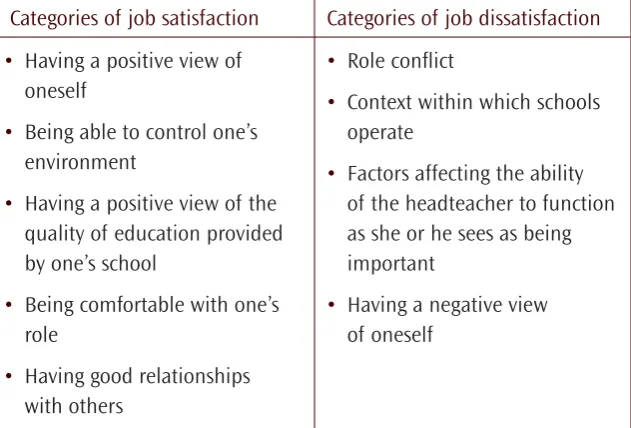
your job? Tell me about it.’ Mercer arrived at a list of 23 satisfiers and 26 dissatisfiers from which he could then create the general categories shown in table 2.
Table 2: Categories of job satisfaction and dissatisfaction for headteachers
A further analysis of the proportionality of the constituents of job satisfaction and dissatisfaction revealed the great importance of categories that involve how much in control of the situation the headteacher feels him- or herself to be. Mercer further found that by bringing the two sides of the equation of satisfaction together, all categories could be further grouped to show the three major elements in questions of job satisfaction for these secondary headteachers, namely:
• sense of efficacy • perception of self • relationships
In contrast to the Johnson and Holdaway model, Mercer’s findings locate ‘personal needs and values’ as central to job satisfaction for his sample of headteachers, with a particular emphasis on the perceptions of the individuals actually involved in terms of how far these needs and values
Categories of job satisfaction Categories of job dissatisfaction
Source: Mercer, 1997 p 62 • Having a positive view of
oneself
• Being able to control one’s environment
• Having a positive view of the quality of education provided by one’s school
• Being comfortable with one’s role
• Having good relationships with others
• Role conflict
• Context within which schools operate
• Factors affecting the ability of the headteacher to function as she or he sees as being important
are satisfied. It is likely, therefore, that it is those aspects or demands of the post that are felt to be beyond the control of the individual which result in job dissatisfaction.
Turning to the question of job satisfaction in relation to time in post, Mercer subjected his data to further analysis. In contrast to Cooper and Kelly (1993) who found that the longer that headteachers had been in post, the greater their dissatisfaction, Mercer’s study indicates a far more complex picture than the previously accepted one of ‘an initial surge of enthusiasm followed by a gradual diminution over time’ (Cooper & Kelly, 1993, p 269). Dividing his sample into cohorts according to time in post (fewer than 5 years, 5–10 years, and more than 10 years) gave Mercer 3 groups of headteachers, 13 in each with mean times in post of 1.9, 7.6 and 14.6 years. Using the 23 job satisfaction and 26 job
dissatisfaction concepts previously developed, Mercer analysed the participants’ responses according to their time in post. The data showed that the new headteachers appeared to have a high level of both satisfaction and dissatisfaction. Not surprisingly, there was a noticeable decrease in both for those who had been in post between 5 and 10 years. The pattern revealed amongst the group longest in post was contrary to findings in other research projects, in that they had experienced a rise in both satisfaction and dissatisfaction.
In relation to a sense of efficacy, the issue of staff development is prominent in the headteachers’ responses. Mercer speculates that, in this regard for those in headship for between 5 and 10 years:
• … it may be that the early idealism was replaced with the more
pragmatic reality that there is a limit to what can be done with a group of staff, that relatively early gains in staff development had been made and that more permanent gains require a continuing effort, often delegated to other staff.
Mercer, 1997 p 273
By contrast, the upturn in satisfaction amongst the most experienced group could be ‘that these individuals feel more secure in the headship, their long experience of dealing with individuals allowing them to gain satisfaction from relations which have become less threatening’ (p 273). Perhaps experience brings increased skill in dealing with staff, hence significantly enhancing the headteachers’ views of their own efficacy.
Placing his research within the timescale of the explosion of
(1997) draws further conclusions. Those interviewed in 1992–93 who had been in post for between 5 and 10 years would have been appointed between 1982 and 1987. It could therefore be argued that they were recruited into headship with a perception of the role shaped by their experience, only to find that the ‘traditional’ model no longer pertained, being replaced by the ‘new headship’ model (Ball, 1991, cited in Mercer, 1997; Evetts, 1994). Conversely, the group who had been in post for five years or under would have been under no illusions about what would be expected of them. Furthermore, the longest serving headteachers in the sample had had extensive experience as well as long-standing relationships with their local education authority,
governing bodies, parents and staff, which would have enabled them to be more robust in their dealings with the changed agenda. Mercer pays particular attention to the changes wrought in the lives of headteachers and their sense of efficacy through the introduction of LMS, drawing out the issues associated with the potential conflict for headteachers in their roles of leading professional and chief executive.
In relation to the second clustering of categories around the concept of ‘perception of self’, Mercer searches for the answer to why there should be a significant decline in satisfaction for those in the middle group. He suggests that once the honeymoon period of early headship is over, headteachers find it harder to get positive feedback, resulting in a mid-career dip in the view they hold of themselves. Greater experience and age, on the other hand, enables the third group to be less concerned with what others think and a growth in self-satisfaction. The fact that the most experienced headteachers equated the highest levels of satisfaction with the quality of education provided by their own school suggests to Mercer that they can see how their hard work over a period of years is coming to fruition, whereas the middle cohort may have lost their early sense of excitement about school improvement.
• There is an urgent need to identify the reasons for the trend towards early retirement and to put in place professional and personal support structures which might prevent this haemorrhage of experienced headteachers.
Mercer, 1997 p 280
2.4.6.2 Chaplain (2001) – primary headteachers’ stress and job satisfaction
According to Chaplain (2001), Cooper and Kelly (1993) identified that the two main sources of stress for headteachers, ‘work overload’ and ‘handling relationships with staff’, were more prevalent in primary than secondary schools. They cited a number of causes: lack of clerical support; small school size and hence lack of variety, rewards and power; relatively low school status and a perception of the less demanding nature of their job; and the amount of teaching cover that they had to provide. Chaplain’s study focused on 19 female and 17 male headteachers, aged between 33 and 54 years, in the West
Midlands–East Anglia region. Using a self-report questionnaire with open and closed questions followed by individual hour-long interviews, the study sought to discover what headteachers found most stressful and what provided most satisfaction in their everyday work.
The questionnaires revealed that 55 per cent of the primary headteachers considered being a headteacher ‘very or extremely stressful’ with a further 40 per cent rating the job as ‘moderately stressful’. The most commonly reported stressors fell in the category of ‘school structures’ (eg maintaining standards and budgets), with ‘interpersonal processes’ (eg relationships with teachers and parents) being the second, ‘external factors’ (eg legislation, governors, inspections) third and ‘personal factors’ (eg professional activities and lifestyle) fourth.
Chaplain reports the interview data under the following six headings. The potential for positive and negative outcomes in the form of stress or satisfaction for the headteacher in each of these categories is clearly illustrated.
Managing self
Applying the concepts of self-efficacy and the locus of control, Chaplain illustrates how personal control can be a double-edged sword for some primary headteachers in his sample. Whilst gaining satisfaction from the awareness of their personal ability to achieve important goals and appreciating being able to make the choices necessary to target the needs of their particular schools, the headteachers also indicated issues about feeling that they had to always be in control, which could lead to ‘overwork, fatigue, lowered self esteem and increased uncertainty’ (Chaplain, 2001 p 204).
Managing others
Recognising the importance of teamwork, high morale and enjoyment of work, a majority of the headteachers in the sample reported spending most time managing others, both adults and pupils, thus generating increased confidence and creativity in themselves as well as others. However, there was also a frequent acknowledgement that the ‘interrelationship between self-management and the management of others … could be either a source of stress or satisfaction’ (p 204). Several heads reported a lack of support from others, such as parents and the local authority, while many felt undervalued by colleagues and others. There was a real difficulty expressed in balancing personal and professional relationships, particularly where disciplinary issues arose with staff.
Managing finances
Managing the curriculum
Participating headteachers recorded very clearly their delight in
improving the curricular experience for pupils and providing them with a solid base. However, they also drew attention to the main stressors being the requirements imposed by the government, particularly the frequent changes to the national curriculum and assessment
procedures, combined with a lack of resources and staff who lacked the relevant skills and knowledge to effect the new requirements.
Managing change
The management of change, some of which was imposed, made many participant headteachers feel empowered because they were making things happen and achieving a consensus through the active
involvement of staff. They relied on the support of colleagues, governors and local authority staff as well as appropriate in-service education and training (INSET). Their priorities were to juggle the external pressures alongside the school’s own priorities, preserving good practice and sticking to principles whilst making the necessary changes in the best ways possible. Stress resulted from staff anxieties and some teachers’ lack of competence in carrying out the changed practice.
Stress and social support
Sources of great satisfaction were the quality of relationships,
enabling and empowering others, enjoying support and a shared focus. Participating headteachers particularly valued being able to access the support and advice of other heads, but were wary of intruding on their time. Some heads highlighted the support of staff in their own school.
• While recording levels of stress can be helpful, it can also obscure more complex relationships between stress and satisfaction. Heads who reported their work was very stressful could differ markedly in their levels and sources of job satisfaction.
Chaplain, 2001 p 213
It is now worthwhile summarising the literature and findings around job satisfaction, stress and headship, drawing out the key details.
• There is a continuing debate surrounding a precise definition of stress.
• Although there is a significant body of research on stress, relatively little focuses on headteachers.
• Continuing to explore how headteachers maintain equilibrium by reacting to and controlling their range of stressors may lead to a deeper understanding of the complexities of their role.
• Because their stress is multidimensional and multilevel in nature, headteachers need support in learning how to manage it effectively.
• There is conflicting evidence concerning the relationship between primary headteacher job satisfaction and time in post, indicating a need for further research.
• The major elements in questions of job satisfaction for secondary headteachers have been identified as: self-efficacy, perceptions of self and relationships.
• An overemphasis on stress can obscure more complex relationships between stress and job satisfaction. There is a need to address why headship can be simultaneously stressful and satisfying
or unsatisfying.
2.5 work–life balance
• Well-being implies a sense of balance, a capacity to manage pressures in life and work, together with a sense of control. Although, an inevitable part of work and life, there are likely to be times when everyday pressures turn into unhealthy stresses which have adverse emotional, mental or physical effects. The balance that teachers have to achieve is between the pressures at work and those in their personal life.
Day et al, 2006 p 255
‘work–life balance’ has emerged as a widely used and popular way of talking about challenges of combining paid work with other parts of life’ (Gambles et al, 2006, p 34) and currently has prime importance globally as well as in the UK education system. The shift noted previously in the concept of well-being is paralleled here, in that work–life balance seems to have replaced family-friendly policies: there has been an increase in ‘demanding working practices and
environments leading to feelings of pressure, lack of time and general “busyness”’ (p 34). Although additional workload ‘on its own is not necessarily a problem, it is commonly associated with increased stress, teacher burnout and low job satisfaction’ (Timperley & Robinson, 2000 p 47). Although focusing here on teachers, these ideas are relevant also for the wider workforce, including headteachers and other senior leaders.
Before looking specifically at the issues surrounding the work–life balance of headteachers, it is interesting to look at the terminology of the concept.
Gambles et al (2006) argue that the term ‘work–life balance’:
• … paints a superficial and oversimplistic picture of the many
challenges it seeks to address. It appears to suggest that work is not a part of life. Yet paid work – although often too much of a part – is a necessary and often meaningful and rewarding aspect of life for many people.
Gambles et al, 2006 p 34
because ‘what constitutes reasonable work–life balance varies over time and from individual to individual (Training and Development Agency for Schools (TDA), 2006b).
Another headteacher in Spencer’s article, for example, was quoted: ‘I’m single and I can’t begin to imagine how colleagues with young families do this job. I don’t have time for leisure interests because I’m too busy trying to meet everybody’s expectations.’ From a further perspective, another headteacher described how ‘it’s very important to me that I have my life, so I make a rule never to take work home and to ensure weekends are mine’. In concluding their consideration of the terminology of work–life balance, Gambles et al (2006) prefer to think in terms of harmony, of ‘harmonising paid work with other parts of life’ (p 35), implying that associated activities such as ‘friendship, leisure activities and community participation are interrelated and not antithetical to each other, or needing to be “balanced”’ (p 35).
2.5.1 What is meant by work–life balance?
In developing the idea that work–life balance has emerged ‘as a widely used and popular way of talking about challenges of combining paid work with other parts of life’ (Gambles et al, 2006 p 34), it is clear that the concept has current importance and interest. Johnson (2001) wrote:
• To state the obvious – everyone has a life and responsibilities outside
work. People want a decent job but they want it as part of fulfilled life outside the workplace. work–life balance simply describes any set of policies and practices that employers can put in place, which help people achieve better balance between work and their lives outside work and benefits the business.
Department of Trade and Industry, 2006
The Mental Health Foundation website (www.mentalhealth.org.uk) (2006) highlights the need for work–life balance, defining it as ‘how you combine work with the other areas of your life, such as childcare, socialising or exercise. work–life balance is an issue for all workers, not just parents, and deals with when we work and for how long’. This definition provides a useful basis for reflection by the headteacher with worries about the hours that they work and how sustainable their job will be over a longer number of years (Spencer, 2002).
that all teachers, including headteachers, should enjoy a reasonable work–life balance with effect from September 2003, writes of the concept:
• The national agreement defines work/life balance as being ‘about
helping teachers combine work with their personal interests outside work’ and cites working hours and workload as key, but not exclusive elements of this. Other elements include a sense of control, personal fulfilment, career development, work flexibility, physical and emotional wellbeing, and the will of both employers and employees to ensure staff enjoy a reasonable work/life balance.
TDA, 2006a
It is ironic, then, that in making provision for the 26 administrative tasks highlighted in the agreement as no longer appropriate for class teachers, ‘many of the strains of ensuring that these new requirements for staff are met have fallen upon senior leaders with no additional funding emanating from central government. Many senior leaders are still carrying out far too much administration’ (Duncan, 2006, p 3). Despite the right that is enshrined in law, that ‘all teachers and headteachers are entitled to enjoy a satisfactory balance between the demands of their professional duties and their personal interests outside work’3, according to Spencer (2002), ‘the unfortunate reality for most headteachers in 21st century Britain is a 60-hour week and any yen for a good work–life balance is killed off by 100 hours of work pending in the in-tray’. Furthermore the NAHT 24/7 report (Daniels and French, 2006) reveals that, despite the specific policies designed to address work–life balance, such as dedicated headship time introduced in 2005, more than one-third of survey respondents did not get any such time.
In what is presented by Timperley and Robinson (2000 p 58) as
‘a somewhat controversial position’ they argue that ‘increased workload and stress associated with a self-managing environment can be
the authors note that ‘workload is increased through fragmentation, duplication of effort, proliferation of new ideas and a reluctance to challenge colleagues’ (p 58). This provides food for thought, when according to Cooper (Spencer, 2002), ‘the time is more than ripe for leaders to work “smarter” not harder’.
2.5.2 What strategies do headteachers adopt to maintain work–life balance?
According to Duncan (2006), school leaders ‘need to embrace [their] accountability in a more realistic way, bearing in mind [they] are mortal and need rest and relaxation as much as fulfilling work. By changing [their] own attitudes to [their] jobs [they] will be able to influence [their] colleagues and ensure [their] schools and colleges are good environments to work in’ (p 25). Duncan offers a number of strategies, such as an early start to the working day when home circumstances permit, moving to a clear desk policy, delegation, reconsideration of meetings and training days are offered as steps towards improved work–life balance. The author also urges headteachers ‘to think “is this activity fit for purpose?” and “do I do this efficiently and effectively?”’ (p 26). Duncan gives the reader a final reminder of ‘the need to work “smarter” rather than harder’ and that school and college leaders not only have to make sure that they are doing this, but that they can be seen to be doing it (p 33).
It is now worthwhile summarising the literature and findings around work–life balance and headship, drawing out the key details.
• There is a limited field of research and literature focusing on the work–life balance of headteachers.
• work–life balance has emerged as a widely used and popular way of talking about challenges of combining paid work with other parts of life and currently has prime importance globally as well as in the UK education system.
• work–life balance varies over time and between individuals.
• The concept of harmonising, of bringing together work and activities such as friendship and participation in the community, is an
alternative perspective to work–life balance.
• Headteachers should view accountability more realistically, recognising the need for rest and relaxation as much as fulfilling work.
• The viewpoint that additional workload can be attributed to poor working practices provides food for thought in consideration of the work–life balance of headteachers.
2.6 Implications for future research
• There is an urgent need to identify the reasons for the trend towards
early retirement and to put in place professional and personal support structures which might prevent this haemorrhage of experienced headteachers.
Mercer, 1997 p 280
Conducting this literature review has repeatedly reinforced the urgent need for further empirical research into the ways in which contemporary headteachers carry out their role so that the specific and complex relationships between well-being, stress, job satisfaction and work–life balance can be thoroughly explored and understood.
Without such a body of robust evidence it will prove difficult for policy-makers and employers to address the current difficulties surrounding recruitment and retention of headteachers. Some of the literature also indicates scope for further empirical research into the ways that differences between male and female headteacher responsibilities, attitudes and expectations feed into their self-efficacy.
3. Methodology
3.1 Sample
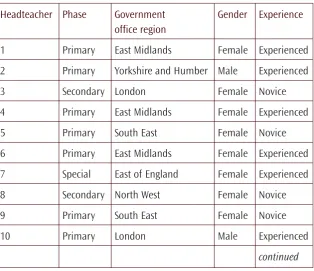
Invitations for participation were sent by email. A small sum of money for staff cover and an NCSL publication of choice were offered as incentives. A sample of 34 participant headteachers was secured. This sample covered all government office regions. 53 per cent of
[image:41.595.142.457.462.733.2]participants were female and 47 per cent male. This sample was drawn from a database of NCSL’s New Visions graduates, ie those recently appointed to a headteacher role, and NCSL’s Leadership Programme for Serving Headteachers (LPSH) graduates, ie experienced headteachers, and headteachers engaged in NCSL’s regional leadership network. In addition, headteachers were drawn from a database of NCSL non-involvement schools. The use of these sources provided a mix of new and experienced headteachers within the sample. In addition, some participants had not previously taken part in NCSL programme or research activities. The characteristics of the participants by phase, government region, gender and experience can be seen in table 3 below.
Table 3: Characteristics of the sample headteachers by phase, government office region, gender and experience
Headteacher Phase Government Gender Experience
office region
1 Primary East Midlands Female Experienced 2 Primary Yorkshire and Humber Male Experienced
3 Secondary London Female Novice
4 Primary East Midlands Female Experienced
5 Primary South East Female Novice
6 Primary East Midlands Female Experienced 7 Special East of England Female Experienced
8 Secondary North West Female Novice
9 Primary South East Female Novice
10 Primary London Male Experienced
3.2 Researchers
The project used 20 research fieldworkers. A core team of four researchers within the NCSL Research and Policy Group designed and orchestrated the study as well as carrying out fieldwork. The remaining
Headteacher Phase Government Gender Experience
office region
11 Primary West Midlands Female Experienced 12 Primary East of England Male Experienced 13 Primary East of England Male Experienced 14 Primary Yorkshire and Humber Male Novice 15 Secondary North East Female Experienced
16 Primary North East Male Experienced
17 Secondary West Midlands Male Experienced 18 Secondary East Midlands Male Experienced
19 Secondary London Male Experienced
20 Special West Midlands Female Experienced 21 Primary East of England Female Experienced
22 Secondary South West Male Experienced
23 Primary North East Female Experienced
24 Primary East of England Male Experienced
25 Special London Female Experienced
26 Primary North East Female Experienced
27 Secondary South West Male Novice
28 Secondary South East Male Experienced
29 Primary East of England Female Experienced 30 Primary West Midlands Female Experienced 31 Primary West Midlands Male Experienced
32 Primary South West Male Experienced
16 researchers were drawn from other NCSL groupings and the Department for Education and Skills (DfES) and carried out fieldwork. In order to ensure consistency, project briefings were held for all researchers following the pilot exercise (for details of the pilot,
see section 3.3.1 below). Further research support was received from a subject matter expert, a leading UK academic with extensive knowledge and expertise in the field. The researchers were in contact with the project co-ordinating team at all times during the fieldwork and advice was made available to them when queries were raised. In addition, they were encouraged to share their experiences of the project via email and through the project co-ordinating team.
3.3 Research design measures
The study employed a three-stage research methodology.
1. A journal was completed by each participating headteacher (see Appendix 1).
2. An observation or shadowing visit was made to each participating headteacher and their school (see Appendix 2).
3. An interview was held with each participating headteacher (see Appendix 3).
4. Data analysis was performed, using a matrix document outlining the central themes of the work (see Appendix 4).
The research tools were constructed with the help of a subject matter expert who advised on the design and content prior to piloting.
3.3.1 Piloting
The journal, observation visit, including the observation schedule, and interview schedule were piloted in one school. Feedback was sought and subsequently incorporated into the design of the study and the research tools.
3.3.2 Journal
A copy of the journal document was sent to each participant.