A STUDY ON
KALANJAGAPADAI
Dissertation Submitted To
THE TAMIL NADU Dr. M.G.R. Medical University
Chennai – 32
For the Partial fulfillment for the Award of Degree of
DOCTOR OF MEDICINE (SIDDHA)
(Branch – III, SIRAPPU MARUTHUVAM)
DEPARTMENT OF SIRAPPU MARUTHUVAM
ACKNOWLEDGEMENT
First, I am extremely grateful to the divine power enlightened my path with
blessings and strengthened me in all aspects towards the milestone successfully.
I
express
my
deep
sense
of
gratitude
to
our
Principal
Dr.N.Chandra Mohan Doss. M.D(S).,
and
Dr.S.Soundararajan. M.D(S).,
Vice
Principal, Government Siddha Medical College, Palayamkottai for granding
permission to execute this dissertation work in the college premises.
It is a honour for me to express my sincere thanks and gratitude to Asso.
Prof.
Dr.S.Kaniraja. M.D(s).,
Head of the department, Post Graduate Sirappu
Maruthuvam for his support and guidance to do this study.
It is my pleasure to express grateful thanks to
Dr.D.Rajasekar. M.D(S).,
lecturer and
Dr.A.S. Poongodi Kanthimathi. M.D(S).,
Lecturer Post Graduate
Sirappu Maruthuvam for rendering their valuable suggestion and guidance.
I convey my sincere thanks to
Dr.S.Ramaguru. B.Sc., M.B.B.S.,
M.S(ortho)., D.Ortho.,
Professor, Department of Orthopaedics, Department of
Sirappu Maruthuvam, Govt Siddha Medical College, Palayamkottai.
My sincere thanks to Prof.
N. Nagaprema. M.Sc.,
Head of the department,
Department of Bio-chemistry and
Mr. M. Kalaivanan. M.Sc.,
Lecturer,
Department
of
Pharmacology,
Government
Siddha
Medical
College,
Palayamkottai.
CONTENTS
PG.NO
INTRODUCTION
1
AIM AND OBJECTIVES
7
REVIEW OF LITERATURES
I.
REVIEW OF SIDDHA LITERATURES
9
II.
REVIEW OF MODERN LITERATURES
41
MATERIALS AND METHODS
66
OBSERVATION AND RESULTS
71
DISCUSSION
99
SUMMARY
105
CONCLUSION
107
ANNEXURE
ANNEXURE I
108
ANNEXURE II
125
ANNEXURE III
128
ANNEXURE IV
138
INTRODUCTION
Before entering the study let us know the basic concepts like origin
of earth, origin of life in it, origin of medicine in mankind. Knowing these
basics concepts reveals us some truths which glorify our great siddhars
that they are the pioneers to all modern scientist invariable to the
department they belong, and also invariable to the country they
belong.For many scientific evolutions even for todays nano concepts our
siddhar thoughts are the basics tools for the modern scientist which help
them in their researches.
The age of earth still is a made of great debate. Some used Bible to
calculate that the earth was created in 4004BC. Later on in the middle of
the nineteenth century, the great scientist, Charles Darwin believed that
the earth must be extremely old because he rcognised that natural,
selection and evolution required vast amounts of time. it was well
explained by our beloved siddhars which is quoted in our text THOTRA
KIRAMA ARAICHI.
The history of earth describes the most important events and
fundamental stages in the development of the planet. Nearly all the
branches of Natural science contribute in understanding the Earth’s
history. Biological and geological changes have been constantly
occurring on our planet since the time of its formation. Organisms
continuously evolve, taking on new forms or going extinct in response to
an ever changing planet. This is quoted by our siddhars as “ khw;wj;jhy; MaJ cyfk;”. Life on earth starts as small and microscopic and then into complex multicellular life’s and experienced a rapid diversification
into the most major phyla and then into chimpanzees to modern humans it
Gy;yhfp g; G+lha;g; G*tha; kukhfpg;
gy;tpUf khfpg; gwitaha;g; ghk;ghfpf;
fy;yha; kdpjuha;g; Ngaha;f; fzq;fsha;
ty;yRuuhfp Kdptuha;j; Njtuha;r;
nry;th m epd;w ,j;jgtu rq;fkj;Js;
vy;yug; gpwg;Gk; gpwe;jpisj;Njd;
(jpUthrfk;- rpt Guhzk;-26-31)
As soon as the humans originated in the earth many dramatic
changes occurred in the aspects of knowledge of the living things.
Sympathy, caring and love all these contribute more to show the
difference between the mankind and their primitives. These feelings
particularly sympathy on others pay the way for the origin of medicines.
Thus sympathy is the basic step to treatment.
Crystallization of knowledge of early humans about plants and
minerals helps to invent medicines. As soon as the man moves against the
nature the word “disease” invades the mankind. According to who the
definition of health is “health is a state of complete physical, mental and
social well being” . So any system of medicine which fulfills this
definition of health is said to be the best system of medicine. In this way
our siddha systems is found to the best system of medicine as it heals the
man in all aspects by its many wings like internal medicine, external
medicine, varma, yoga. noi illa neri(social and preventive measures by
rpj;j kUj;JtKk; kw;w kUj;Jtq;fSf;F Kjd;ik kUj;Jtkhf ,Uf;f Ntz;Lk; vd;gjw;F ,JNt jf;f rhd;W.
ekJ rpj;j kUj;Jtk; gQ;rG+jj;jpd; mbg;gilapNyNa mike;J cs;sJ. gQ;rG+jj;jpd; Nrh;f;ifahy; Ritfs; cz;lhfpwJ. (Ritfs; ghl;L)
kz;ZlNd Gdy;jPf;fhy;
Liwahfr; Nrh;e;jpl;lhy; tUNk ,dpg;G jpz;zkpyk; Jth;g;gpurk;
rjhfjpNah lhh;jPapd; jplkh Kiwg;Gk; vz;zhpa frg;GKz;lhe;
jz;zPhpy; fdypizg;gh nyOkh Kth;g;G cz;zhpa mWRitapd;
gpwg;gpnjDk; FUrpj;j Uiuj;j kiwNa
gQ;rG+jk;
Ritfs;
mtw;wpd; khWghL
Fw;wq;fspd; khWghL
Neha;fs;
vf;Fw;wk; Nflile;jJ vd;W FwpFzk;
ehbahy; mwpjy;
rkdgLj;Jk; Rit cs;s kUe;Jfs;
Neha; ePq;fy;
with the fungus infection. Researchers believe that inheritance,
atmosphere, and the immune system may also play a primary role in
psoriasis.
If you have psoriasis it will affects your immune system results an
abnormally hasty skin cell cycle and usually itchy and feel sore. The
process of having psoriasis begins at the bottom layer of the epidermis,
where keratinocytes are completed. Keratinocytes are juvenile skin cells
that fabricate keratin, a strong protein that helps the structure of hair, nails
and skin.
Generally, skin cells that are produced in the deepest layers of our
skin make their way to the outside in just a week or less. They are
full-grown, that sloughed off the skin, and replaced with novel skin cells from
underneath. Our skin cannot get rid of these cells as much as necessary
speed, so they fabricate up and doing, leading to chunky, dry patches, or
plaques, silvery, crumbling areas of dead skin.
They usually rise in your elbows, feet, palms, legs, face wrists,
lower back and knees but can also affect any area such as our scalp and
genitals but overall it can also affects our whole body. In relation with
eczema, psoriasis is more prone to be found on the peripheral portion of
the joint (psoriatic arthritis). Our fingernails and toenails can also affect
with psoriasis (psoriatic nail dystrophy or nail lesions).
Psoriasis is not curable skin disease from time to time improving
and worsening especially if you were triggered to scratch them. Some
people with psoriasis can rise in the colder winter months while others in
can explode by changes in climate, stress, infections, a drug-related rash
and dry skin and excess in alcohol.
Psoriasis can infected worldwide, whatever your gender and race,
either you are baby, teen or an adult but most of the patients can only
diagnosed in their early adult years. People with rigorous psoriasis may
have collective awkwardness, job strain, expressive anguish and other
delicate issues for the reason that the outward show of their skin.
About 25-40% of patients with psoriasis can also develop psoriatic
arthritis and still cannot be diagnosed especially if the symptoms are
placid. They usually develops between the early 30’s to the late 40’s; on
the other hand, as mentioned on the previous paragraph that it can affect
of any age of any gender worldwide and 5.7 to 7.5 millions of people in
the United States or 2 to 2.6 percent of the total population suffers
psoriasis.
There are different types of psoriasis but regardless of what type
you have it usually causes you a discomfort life. And because of
psoriasis, most patients can be awake even at night because of the itchy
feeling. The pain can be difficult to handle and some even think to finish
their life because of discomfort.
Being a patient with psoriasis will be suffers a lifelong treatment
and therapy and can losing all your financial investment just for the
AIM AND OBJECTIVES
Aim:
The aim of this dissertation is to bring out the effectiveness of a
compound herbal drug against autoimmune diseases like kalanjaga
padai.(Psoriasis) without the side effects from siddha system of medicine.
OBJECTIVES:
Primary objectives:
To evaluate the clinical efficacy of Neeradi muthu vallathy melugu
as internal medicine and kalappai kizhangu velipoochu as external
medicine For the diseases kalanjaga padai ( Psoriasis)
Secondary objectives:
- To study the efficacy of additional therapies like yoga and
azanas
In heeling the disease along with the internal and external
medicine.
- To discuss the various literary evidence in both siddha and
modern text books for the disease kalanjaga padai.
- To confirm the diagnosis in siddha system with the help of
- To know the extent of correlation of features given under
kalanjaga padai with the features of psoriasis. And there by
enlightening the highness of siddha system.
- To know the chemical and bio chemical analysis of the selected
drug.
- To study the Pharmacological analysis of the selected drug.
- To have an idea of an incidence of kalanjaga padai with
reference of age, sex, socio- economic status, and family history
related to any psychosomatic problems, land where they
(Nilam) live and (Paruva Kalam) climatic changes.
- To make an awareness among the patients in order to avoid
REVIEW OF LITERATURE
A. SIDDHA ASPECTS
fhshQ;rfg; gil
fhshQ;rfg; gil
fhshQ;rfg; gil
fhshQ;rfg; gil
NtW ngaHfs;:
NtW ngaHfs;:
NtW ngaHfs;:
NtW ngaHfs;:
‘nrk;nghl;L Njhyow;rp> nrjpy; cjpHTg; gil> rhk;gy; gil
Ez;zpa njhw;W nrjpy;gil ”
---- mUq;fiyr; nrhy; mfu Kjyp mUq;fiyr; nrhy; mfu Kjyp mUq;fiyr; nrhy; mfu Kjyp mUq;fiyr; nrhy; mfu Kjyp
‘ntz;gUr; nrjpy;> nrjpy; cjpH Neha;”
---- rpj;j kUj;Jtk; rpwg;G rpj;j kUj;Jtk; rpwg;G rpj;j kUj;Jtk; rpwg;G rpj;j kUj;Jtk; rpwg;G
Definition
According to the textbook “Siddha Maruthuvam Sirappu”
Kalanjaga padai is a chronic non - infectious, recurrent, inflammatory
disorder of the skin characterized by reddish, slightly elevated patches
covered with silvery white scales
In Siddha system, skin disorders are brought under the clinical entity “Kuttam”.
In the text book “Aathma Ratchamirthamennum Vaiththiya
Saarasangiragam” the characteristics of Kuttam are mentioned as follows:
White scaly patches will appear in Foot, Hand, Lips, Vertex, Finger and Wrists.
T.V. Sambasivam Pillai has mentioned that in Tamil medicine
‘Kuttam’ means cutaneous affections and so it’s a comprehensive term
In this book, ‘Sorikuttam’ has been compared to Psoriasis
(Sorikuttam - A Kind of leprosy with diffuse papillary eruptions without
ulceration on the entire surface of the body marked by intense itching and
burning sensation followed by exfoliation of the epidermis or brawny
scales – eczematous psoriasis, lepra icthyosis)
Classifications
In the Siddha literature “Yugi Muni Vaidhya Chinthamani” the
kuttam has been classified into 18 types:
‘Kj;jhFk; Fl;le;jhNd gjpndl;Lf;Fk; Kdpahd A+fp ehd; nrhy;yf; Nfsha; gj;jhFk; Gz;lhpff; Fl;lj;NjhL
nghUfpd;w tpw;Nghlf Fl;lkhFk; gj;jhFk; ghkf;Fl;lk;> frrh;kFl;lk;
ghpthd fh;zFl;lk;> rpFuFl;lk;
fpj;jhFk; fpUl;bzf;Fl;lk;> mTJk;guf;Fl;lk; nfbahd kz;lyFl;lK khnkd;Nd Fl;lkhk; ];ghpr Fl;lnkhL
Fbykhk; tprh;r;rpff; Fl;lkhk; tl;lkhk; tpghjp Fl;lNkhL
kUtyh fPBg Fl;l rh;kjy jpl;lkhe; Njj;jpU Fl;lNkhL
3. ghkk; - Sirangu perunoi 4. f[rh;kk; - Yaanai thol perunoi 5. fuzk; - Kaadhu perunoi 6. rpFuk; - Tholperunoi 7. fpUl;bzk; - Karuperunoi 8. mTJk;guk; – Athikkai perunoi 9. kz;lyk; - Valaya perunoi 10. mghprk; - Vali perunoi 11. tprh;r;rpfk; - Sori perunoi 12. tpghjpfk; - Senkuttam
13. rh;kjyk; - Tholvedippu perunoi 14. fpBgk; - Pandrithol perunoi 15. jj;JU - Thadippu perunoi 16. rpj;Jkh - Naa perunoi 17. rjhU - Purai perunoi 18. RNtjk; - Venkuttam
Among the eighteen types of skin diseases (kuttam) described by
Yugi, clinical features of Virpodaga kuttam, Sadharu kuttam and Thethru
kuttam resemble those of Kalanjaga padai.
jd;te;jphp itj;jpaNuhfk; -18 tif
10.tpthjpfk; 11.Njj;JU 12.Gz;lhpfk; 13.tpw;Nghlfk;
14.rh;kjyk;
15.ghkk;
16.ffhee;jp
17.ntz;
18.rpj;Jkh
Classification by Anubava Vaithiya Deva Ragasiyam;
Based on Three thodams 18 types of kuttram has been classified as
follows:
Vatham Kabala Kuttam
Pitham Avuthumbara Kuttam
Kabam Mandala Kuttam
Visharchiga Kuttam
VathaPitham Rusiya Jimmiga Kuttam
PithaKabam Saruma Kuttam Yega Kuttam
Kidiba Kuttam
Sithma Kuttam
Alasa Kuttam
KabaVatham Vibathiga Kuttam
Kakasa Kuttam
In his dictionary T. V. Sambasivam Pillai has mentioned that,
according to Tamil Medical Science kuttam is of 18 types;
1. ePh; - Leprosy with serous exudation 2. ntz; - White Leprosy
3. nrhwp - Psoriasis 4. fUq; - Black Leprosy 5. ngUk; - True Leprosy 6. nrq; - Macular Leprosy 7. nghwp - Leprosy with Granules
8. thp - Leprosy with Fissures
9. vhp - Leprosy with burning sensation 10.tpuy;Fiw - Lepra mutilans
11.ril - Leprosy with confluent ulcers 12.ahid - Thick skinned Leprosy
13.jpkph; - Anaesthetic Leprosy 14.tpuz - Ulcerated Leprosy 15.fha; - Nodular Leprosy
16.Rop - A form with sloughing ulcers 17.fpUkp - Leprosy with microbes 18.Mwh - Incurable Leprosy
Mj;kul;rhkph;jk; itj;jpa rhurq;fhuk; -4 tif 1. ntz;Fl;lk; 2. nrq;Fl;lk; 3. fUq;Fl;lk; 4. ngUtpahjp jpU %yh; jpU %yh; jpU %yh;
jpU %yh; ---- 18 tif 18 tif 18 tif 18 tif
fpue;jp Nkfj;jhy; tUgit - 6
tz;bdhy; - 8
Aetiology
In “Yugi Muni Vaidhya Chinthamani” and “Thirumoolar
Vaithiyam” we can find out the sources of information on aetiology and
clinical features of the above disorders. In “Thirumoolar Vaithiyam”, the
aetiology is given as follows;
“tpahjpAs; %thW tpsq;fpa Fl;lq;Nfs;
Rahjpf; fpue;jp Roy; Nkfj;jh yhWk;
gahjp kz;Zsg; gy tz;bdh nyl;Lk;
epahjp GOehyha; epd;wjpf; Fl;lNk”
---- jpU%yh; jpU%yh; jpU%yh; jpU%yh;
• Six types of skin diseases are caused by venereal disease
“fpue;jp Rod; Nkfj;jhyhWk;”
• Eight types of skin diseases are caused by insect bites
“gahjp kz;Zsg; gy tz;bdh nyl;Lk;”
• Four types are caused by worms infestation.
“epahjp GOehyha; epd;wjpf; Fl;lNk”
Guru Naadi Nool describes Aetiology as follows
„fpUkpahy; te;j Njhlk; ngUfTz;L
Nfl;fp yjd; gphpTjid fpukkhfg;
nghUkp tUk; thAnty;yhk; fpUkpahNy
#l;rKld; fphpirg;ghy; njhopy; nra;tPNu’ ---- FUehb FUehb FUehb FUehb
The text book “Siddha Maruthuvam Sirappu” describes the
aetiological factors of “Kalanjaga padai” as follows:
Unknown Aetiology
Genetic Cause
“Agathiyar mentioned that Kanmam (genetic predisposition) is the
main cause for kuttam in his Kanma Kandam as follows:
‘Nrh;e;j Fl;lnkhL FiwNehafs;; te;j
NrjpNfs; kyuhj tUk;g nfha;jy;
jhhpe;j rPh; nre;J tijfs; nra;jy;
jha; je;ij kdJ nehe;J Nuhfe;jhNd”
‘jhndd;w nja;tTUj; jidaopj;jy;
rhh;thd nghpNahh;fs; jikg; gopj;jy;
fhndd;w ee;jtdk; G+Q;nrbfs; ntl;ly;
fUkklh rhPuj;jpw; fhR NghNy
A+ndd;w Tlk;ngy;yhk; nkhl;L nkhl;lh
Ald; ntSj;J FiwNahAjpuQ; rpe;Jk;
thndd;w fUkq;fs; jPh;g;gjw;F
tiunahd;W nrhy;Ntd; Nfs; ee;jtd;ikNa”
o Plucking the unflowered buds
o Cruelty to animals
o Destroying statues of god
o Teasing of elderly people
The text “Agathiyar paripoornam - 400” describes the
Psycho-social causes (Kanma Varalaru)
“gotpidahy; tp\g;G+r;rp fbj;j Njh\k;
ghjfh;f;F xU ehSk; jPh;tjpy;iy
cstpidah Yhlhgpf; nfhs;s te;j
cz;ikaJ mwpahky; %h;f;fQ; nra;thh;
fstpidAe; jPh;tjpy;iy fbdnkj;j
fUizAs;s G+uzj;jpy; fz;fhl;rp
mltpid eP fhZKd;Nd mfyr; nrhy;yp
milahsk; tpuy; FWF kpd;dq;NfNs”
---- nra;As; 214 nra;As; 214 nra;As; 214 nra;As; 214
tpuy; FWFq;fhy jpkpUk; tp\k; NghNyWk;
nka;aOe;Je; jiy RoYk; ntSf;F Nkdp
gukhd Njfnky;yhe; jbj;J tPq;Fk;
ghjnky;yhk; ntbj;J kpf;F Gz;Z fhZk;
rurKld; nrhhp fug;ghd; gzk; Nghy; NjhZk;
rhe;ijahNk tpe;ijnfLj; jbj;J tPq;Fk;
ghUyfp ype;Neha;f;F kUjPahNj
In Agathiar Paripooranam 400 it has been mentioned that diseases
which are caused due to sins committed in the previous birth will be
cured only if kanmam is expiated.
‘Mr;nrd;w gjpndl;L Fl;le;jhDk;
mtuth;fs; nra;fpd;w mjh;kj;jhyhk; njr;nrd;w rpthyaj;jpYr; rpl;lq;fs;
nra;jth;fs; rpt epe;ij gz;zpdhh;fs; %r;nrd;w nghpNahiu Jbj;Njhh;fs;
%h;f;fkha; milf;fyj;ij vLf;fpd;whh;fs; Mr;nrd;w jpizastpd; Fiwe;j $yp
nfhLf;fpd;Nwhh; Fl;lj;jpw; $LthNdh”
---- A+fpKdp A+fpKdp A+fpKdp A+fpKdp----800800800 800
Excessive heat and cold, laziness, excessive sleep in day time, unbridled sexual indulgence, robbery etc..These habits are supposed
to be the factors which lower the immune mechanism of the body
(Iyarkkai vanmai) and makes the body liable to disease.
Excessive intake of food items which are hard to digest,
imbalanced food, vomiting, frequent intake of food mixed with stone and
hair.
Prolonged mental depression, intention to spoil others, greed,
abusing God and noble people, neglecting orphans and beggars, cursing
the elders and so on. These were the causes mentioned by Yugi.
In Agstiar Kanmakandam,
‘Nrh;e;j Fl;lnkhL FiwNeha;fs; te;j
jhhpj;j rpt nre;J tijfs; nra;jy;
jha; je;ij kdJ nehe;J Nuhfe;jhNd”
- mfj;jpah; fd;kfhz;lk;
• Plucking buds • Domestic violence • Hurting the parents
In Dhanvandhri Vaithiyarogam he Mentions
‘mwptpd;wp tghPj Nruhfhuk; Grpf;fyhYk;
Jiwapd;wp njhlhj njhd;iw njhl;litg; Grpf;fhYk; Fiwnfhz;l eprpj;jkhd Fykq;if aLr;rhYk;
epiwnfhz;l nghpNahh; jk;ik epe;jpj;Jg; NgryhYk;
epe;jpj;Jg; Gwj;jpahw; Nrhk epiy nflg; gphpf;fyhYk;
te;jpj;Jg; G+Uth nrd;khe;jpu ghtj;jhYQ;
re;jpf;ff;; fw;Gkhjh; jq;fisf; fUjyhYk;
njhe;jpj;j Fl;lNuhfe; njhLf;F nkd;Wiuj;jhh; Kd;Ndhh;”
- jd;te;jphp itj;jpaNuhfk;
In Manmurukiyam, he Mentions,
‘,lk; nghO JdT njhopNyhL gUtk;
vdkpit NtWgLj yhYk;
eQ;#wy; eQ;R $baJ nghWk;
gpzpAw yhWk; epwk; ngah;jLNk”
-khd; kWf;fpak;
• Change of place, food, work, climate and diurnal Toxins by animal bites
In Agasthiyar vaithyam he mentions,
‘Fay;tha; F\;lk; raq;Fd;kk; ePhpopT Ruf;fpuhzp ePuilg;G ghz;L %y tha;T
fay; thA tUq;fz;zpy; Fj;jha; fbe; jrthA
fzthf Kd; nra;j caph; tpidjhNd”
- mfj;jpah; itj;jpak;
Skin diseases
Tuberculosis
Diabetes
Fever
Diarrhea
Triggering Factors of Kalanjaga Padai are:
a) Tonsilitis (Lasuna thabitham)
b) Respiratory disorders (Puppusa pinigal)
c) Allergic disorders (Ovvamai)
d) Stress and strain
e) Anxiety, Depression
f) Seasonal variations.
g) Certain drugs (eg.) Thambira chendhooram, Chloroquin, Polio
Vaccine
Clinical Features
In the text book “Siddha Maruthuvam Sirappu” written by Dr.
R. Thiagarajan the clinical features of “Kalanjaga padai” have been
given as follows:
Erythematous slightly elevated patches of different sizes and
shapes (commonly coin shaped) covered with white silvery
scales appear all over the body. It may also occur in scalp and
face
Pinpoint bleeding appears on scratching the lesions
In children the lesions may be like water drops
In chronic cases;
Thickening of skin with fissures appears in both palms and
soles
In one fourth of the patients, nails are affected (pitting,
transverse ridges will be seen)
In 7% of the patients, joints are affected (Psoriatic arthropathy)
PSORIATIC ARTHROPATHY (Kalanjaga Vatham;):
Kalanjaga padai is often associated with painful joints known as
“Kalanjaga vatham”.It may affect any joint. The most often affected
joints are inter-phalangeal joints. The terminal interphalangeal joints are
usually involved as opposed to the proximal interphalangeal joints in
“Uthira vatha suronitham” which is identical with rheumatoid arthritis.
In these cases the affected fingers show nail changes. This condition is
termed as “Psoriatic Arthropathica”
The joints of fingers, ankles, knee and sacroiliac region are
selectively affected. Those joints are swollen and painful with psoriatic
lesions. Radiological changes are characteristic and consist of
osteoporosis followed by increased density, diminished joint space,
erosion of joint surfaces followed by eventual destruction of the ends of
bones. Ultimately, the joints become deformed.
Yugi muni describes the clinical features of Kalanjaga vatham as follows;
“thjkhq; fhy; ifapy; Fuq;fpuz;Lk;
tUj;J re;J KWf;fpNa File;J nehe;J ehjkh eil jhDe;jhd; nfhlhky;
eype;JNk Klkhfpf; fuL fl;br; NrjkhQ; rle;jhD kpf ntSj;Jj;
jpdNthL rpuq;Fkha;r; Nrl;gkhfpf; fhjkh aUrpnahL kaf;fkhFk;
‘thjkhq; fhy; ifapy; Fuq;fpuz;Lk;
tUj;J re;J KWf;fpNa File;J nehe;J”
The joints of fingers, feet, ankles, knee and sacroiliac are
selectively affected and these joints are painful.
‘ehjkh eil jhDe;jhd; nfhlhky;
eype;JNk Klkhfpf; fuL fl;br;”
The deforming erosive arthritis targets fingers and toes. Marked
cartilage destruction and bony articulation results in loss of joint space
and marked instability.
“Nrjkhe; rle;jhD kpf ntSj;Jj; jpdNthL rpuq;Fkha;r; Nrl;gkhfpf; fhjkh aUrp nahL kaf;fkhFk;
fUjpNa fhshQ;rfkhk; thjkhNk”
The whole body becomes pale (anaemic). Well-defined
erythematous papules which are sharply demarcated appear on the skin.
There is also loss of taste and giddiness.
Neha; fzpg;G tpthjk;
Neha; fzpg;G tpthjk;
Neha; fzpg;G tpthjk;
Neha; fzpg;G tpthjk;
Among the eighteen types of skin diseases (kuttam) described by
Yugi, clinical features of Virpodaga kuttam, Sadharu kuttam and Thethru
tpw;Nghlff; tpw;Nghlff; tpw;Nghlff;
tpw;Nghlff; Fl;lk;:Fl;lk;:Fl;lk;:Fl;lk;:
“GJikaha;r; rhPunkq;Fe; jpdTz;lhFk;
nghUntbaha;j; jpf;nfdj;jPf; nfhOe;J Nghy
nkJikaha; tpl;nlhpAk; ey;y ghk;gpd;
tp\g;glk; NghNy jbj;J ntSg;G khFk;
RJikaha; kpfr; nrhhpAQ; rptg;GkhFk;
Jhf;fnkhL rQ;ryKk; kpfTz;lhFk;
fJikaha; Njhnyy;yhe; jbg;Gz;lhFk;
fdj;jtpw; Nghlfkhd Fl;le;jhNd”
---- A+fp Kdp ngUEhy; 800 A+fp Kdp ngUEhy; 800 A+fp Kdp ngUEhy; 800 A+fp Kdp ngUEhy; 800
Characterized by elevated skin lesions with erythema and itching.
Burning sensation will be present on and off. Usually these entities are
associated with anxiety and despair.
rjhU rjhU rjhU
rjhU Fl;lk; Fl;lk; Fl;lk; Fl;lk;:
“vj;jhd nthpg;NghL jpdTkhFk;
vspjhd Nrl;Lkthjj; Jw;gj;jp
gj;jhd fl;bg; Gz;ZkhFk;
ghk;G Njhy; Nghw;wpiue;J gUj;Jf; fhZk;
tpj;jhd %f;NfhL fhJ fd;dk;
kpfj;Jbg;ghQ; rjhU F\;le;jhNd”
Characterized by skin lesions covered with silvery white scales,
erythema, itching, burning sensation and thickening of ears, cheeks and
nose
Njj;JU Njj;JU Njj;JU
Njj;JU Fl;lk; Fl;lk; Fl;lk; Fl;lk;:
“rh;ke;jhd; rptg;ghf tl;lzpj;Jr;
ryit Nghy; ntSf;FNk jpdTz;lhFk;
th;ke;jhd; NuhfkJ kpfTz;lhFk;
kapnuy;yhQ; RUz;LNk cz;ilahFk;
fh;ke;jhd; gpj;j Nrl;Lk kpFf;Fk;
fhae;jhd; fjpj;JNk jpkpUz;lhFk;
jh;ke;jhd; rlnky;yh %jyhFk;
jhf;fhd Njj;jpUf; F\;le;jhNd”
---- A+fp Kdp itj;jpa rpe;jhkzp 800 A+fp Kdp itj;jpa rpe;jhkzp 800 A+fp Kdp itj;jpa rpe;jhkzp 800 A+fp Kdp itj;jpa rpe;jhkzp 800
Annular erythematous lesions with whitish appearance, itching,
oedema of the body and rolling of hairs like balls are the characteristic
clinical features in this entity.
Mukkuttram Verupadugal:
3. Samanan - due to other vayus, it is affected
4. kirukaran - loss of appetite
5. Devathathan - insomnia like condition
are commonly affected
b. Pitham:
In case of kalanjaga padai
1. Anal pitham - indigestion of food
2. Ranjagam - paleness of the conjunctiva and tongue
3. Sathagam - difficulty to do the routine works
properly and sluggishness
4. Pirasagam - dryness and roughness of skin
are commonly affected
c. Kabam:
In case of kalanjaga padai,
1. Kilethagam - loss of appetite
2. Tharpagam - burning sensation of eyes may be
present
3. Santhigam - joint pain present in very few cases
are commonly affected
Udal Kattugal
Our body consists of seven udal kattugal. It gives strength and
structure to our body.In the case of Kalanjaga padai out of seven udal
kattukkal saaram, senneer, oon and enbu are commonly affected.
Saaram : Dryness, roughness, tiredness
Oon : Impairment of sense organ.
Kozhupu : Synovial Fluid Secretion affected
Enbu : joint pain present in few cases
UDAL VANMAI (Body Immunity)
The Udal Vanmai is classified into 3 types. They are,
lyarkai Vanmai
Seyarkai Vanmai
Kaala Vanmai
IYARKAI VAN MAI
Natural immunity of the body itself by birth.
SEYARKAI VANMAI
Improving the health by intake of nutritious food materials,
activities and medicines.
KAALA VANMAI
Development of immunity according to age and the
environment.
PINIYARI MURAIMAI
(Diagnostic methods adopted in Siddha system of Medicine)
Piniyari muraimai is a method of diagnosing a disease. It is based
upon three main principles. They are,
Poriyalarithal (Inspection)
Pulanalarithal (Palpation)
Vinathal (Interrogation)
Physicians 'pori' and 'pulan' are used as tools for examine the 'pori
pulan' of the patient. The above principles correspond to the
methodology of
1. Inspection,
2. Interrogation
3. Palpation in modern medicine, in arriving a clinical diagnosis of
the disease.
1. PORIYALARITHAL
Pori is considered as the five senses of perception namely,
Nose
Tongue
Eye
Skin
Ear
‘Poriyalarithal’ is examining the pori of the patient by the
• Skin is commonly affected in kalanjagapadai.
• Ear lobes are rarely affected in kalanjagapadai.
• So skin and ear is used to diagnose the disease
2. PULANALARITHAL
'Pulan' is five object of senses. They are
Smell
Taste
Vision
Sensation to touch
Hearing
Pulanalarithal' means examining the 'pulan' of the patient by the
physician for diagnosing purpose.
♦ Dryness,roughness are elicited by touching the skin
3. VINATHAL
Vinathal is gathering the informations regarding the history of the
disease, its clinical features etc., from the patient or his immediate
relatives who are taking of him, when the patient is not in a position to
speak or the patient is a child.
♦ Vinathal is use ful to know about the exacerbations based on seasonal variations
‘fhz;ly; fUjy; ciu mghtk; nghUs; xg;ghnwd;gh;
msit NkYk; xopGz;ik ikjpfr; Njhbay; ngd ehd;
fsit fhz;gh; mitapw;wpd; NkYk; miwth; mitnay;yhk;
msit fhz;ly; fUjy; ciu vd;Dk; %d;wpylq;fpLNk”
rptrpj;jpahh; msit vz; rptrpj;jpahh; msit vz; rptrpj;jpahh; msit vz; rptrpj;jpahh; msit vz; 6666
Alavai divided in to ten types. They are,
• Observation - fhz;ly;
• Inference - fUjy;
• Authority, Literature - ciu
• Preception - mghtk;
• Presumption - mUj;jhgj;jp
• Comparison - cgkhdk;
• Inference by elimination - ghhpNr\k;
• Probability - rk;gtk;
• Tradition - Ijpfk;
• Natural Inference - ,ay;G
The above mentioned "ten alavaigal" are included in three
alavaigal.
They are,
• Kaandal (Inspection by Siddha method)]
Through 'kaandal' the physician can directly see the patient,
Karuthal (Through Siddha Investigation)
Through envagai thervu and neerkuri as well as neikuri, we
can diagnose a disease by karuthal.
Urai (Text's evidence - Siddhar's)
Comparative study of the signs and symptoms of the patient
with the reference of books and come to diagnosis.
Ubamanam
It is very use ful to differentiate kalanjapadai from other skin
diseases
Iyalbu
It explains about the features of kalanjapadai
Ennvagai thervugal (eight diagnostic tools)
Siddhars have developed a unique method of diagnosing the
disease by "Enn vagai thervugal'
“ehb ];ghprk; eh epwk; nkhop tpop
kyk; %j;jpuj;ij kUj;JtuhAjk;”
- Neha; ehly; Neha; Kjy; ehly; (Kjy; ghfk;)
1. Naadi (Pulse)
In kalanjaga padai the following types of naadi could be felt. They
were,
a) Vathapitham
b) Vathakabam
c) Pithakabam
II. Sparism
In case of Kalanjaga padai slightly raised well defined dry
erythematous macules or plaques, covered with white silvery scales can
be noticed in affected areas.
III. Naa
In case of Kalanjaga padai no abnormality was seen in Naa.
IV. Niram
In case of Kalanjaga padai white patches with silvery scales could
be noticed at affected areas.
V. Mozhi
In case of kalanjaga padai, no abnormalities were observed.
VI.Vizhi
In case of Kalanjaga padai, no abnormality was seen in vizhi.
VII.Malam
In case of Kalanjaga padai constipation was reported in some
cases.
VIII.Moothiram
Collection of urine for the determination of Neerkkuri and
NEERKKURI AND NEIKURI
“mUe;J khwpujKk; mtpNuhjkjha;
m////fy; myh;jy; mfhyT+d; jtph;e;jow;
Fw;ws tUe;jp cwq;fp itfiw
Mbf; fyrj; jhtpNa fhJnga;
NjhU K$h;j;jf; fiyFl; gLePhpd;
epwf;Fwp nea;f;Fwp epUkpj;jy; flNd”
---- rpj;j kUj;Jthq;f rpj;j kUj;Jthq;f rpj;j kUj;Jthq;f rpj;j kUj;Jthq;f RUf;fkRUf;fkRUf;fk; RUf;fk
Prior to the day of urine examination the patient is instructed to
take a balanced diet. The patient should have good sleep. After waking up
in the morning, the first urine voided is collected in a clear wide mouthed
glass container and is subjected to analysis of “Neerkkuri and neikkuri”
within one and a half hour
“te;j ePh;f;Fhp iail kzk; Eiu vQ;rnyd;
iwe;jpa Ysit aiwFJ KiwNa”
---- rpj;j kUj;Jthq;f rpj;j kUj;Jthq;f rpj;j kUj;Jthq;f rpj;j kUj;Jthq;f RUf;fk;RUf;fk;RUf;fk; RUf;fk;
1. Niram - Colour
2. Edai - Specific gravity
3. Manam - Smell
In Kalanjaga padai patients straw coloured urine was noticed.
NEIKKURI:
The speciality of neikuri is stated in in the text book ‘Siddha
Maruthva Noi Naadal Noi Mudal Nadal Thirattu’ as follows:
“epwf;Fwpf; Fiuj;j epUkh zePhpw;
rpwf;f ntz;nza; Nahh; rpWJsp eLtpLj;
njd;Wwj; jpwe;njhyp Nafhjikj;jjp
dpd;wjptiy Nghk; newptpopawpaTk;
nrd;wJ GfYQ; nra;jpia AzNu”
The collected specimen as said above is to be analysed by
following method. The specimen is kept open in a glass dish or china clay
container.It is to be examined under direct sunlight, without any shaking
of the vessel.
Then add one drop of gingelly oil through the side of vessel
without disturbing the urinary specimen and the neikkuri was noted in
direct sunlight, and conclude the diagnosis as follows:
““““muntd ePz;bd/Nj thjk;
MopNghw; gutpd; m/Nj gpj;jk;
Kj;njhj;J epw;fpd; nkhopt njd; fgNk
Mutpy; MopAk; muTk;
mutpy; Kj;Jk; Mopapy; Kj;Jk;”
In my Kalanjaha padai dissertation,
♦ 60 % cases have Vatha Neer ♦ 10% cases have pitha Neer ♦ 30 % cases have Kaba Neer.
Medicine like Pranayamam, Yoga.
LINE OF TREATMENT (gpzpePf;fk; (gpzpePf;fk; (gpzpePf;fk; (gpzpePf;fk; ---- ghpfhuk;) ghpfhuk;) ghpfhuk;) ghpfhuk;)
In accordance with the Siddha system of medicine, certain basic
principles are developed before starting the specific drug therapy. These
procedures are initially followed to balance, the deranged kutrams ie.
Vatham, pitham and kabam.They are purgation, vomiting and application
of drugs on the eyes to balance the deranged vatham, pitham and kabam
respectively. This can be understood by the following verbs,
“tpNurdj;jhy; thjk; jhOk;
tkdj;jhy; gpj;jk; jhOk;
mQ;rdj;jhy; Iak; jhOk;”
In addition to this following medications are practiced in the
Siddha system.
Aga marunthugal (Internal medicines)
Internal Medicine:
Neeradimuthu Vallathy Mezhugu 500 - 700mg twice daily
External Medicine:
Kalappaikizhangu Velipoochu
Paththiyam (Dietary Regimen):
SPECIAL NON - DRUG THERAPEUTICS
Several special medicaments of non-drug therapeutics like Yoga,
Pranayamam, Asanas, Kalpa medicines are employed in Siddha system.
These are employed during diseased state and also for the prevention of
diseases during healthy days.
In Kalanjaha padai, patients are also advised to follow
Pranayamam, Yoga and Asanas for the early cure, in order to avoid the
remissions and exacerbation of this disease.
PRANAYAMAM
It is a form of Kayakalpa method. By practicing this one can
prevent any disease. This is explained in the following verse,
nra;Kiw nra;Kiw nra;Kiw nra;Kiw:
Ne Ne Ne
Neu msTu msTu msT u msT
10-30 epkplk; tiu gofyhk;
Vw;wfhyk; Vw;wfhyk; Vw;wfhyk; Vw;wfhyk;
nta;apw;fhyj;jpy; gof Vw;wJ
gad gad gad gad; :
1. clypd; ntg;gk; jzpAk;
2. ,uj;jk; Rj;jp ngWk;
3. grp ed;F vLf;Fk;
4. ehl;gl;l Njhy; tpahjp
5. mrPuzk;
6. kz;zPuy; Neha;
7. %yk; ,tw;iw Fzkhf;Fk;
8. eQ;Rjd;ikia nty;Yk; ty;yik ,jd; %yk; ngwg;gLtjhy; ,ijg; goFgth; ghk;G,Njs; fbahy; ghjpf;fgLtjpy;iy
YOGA:
Yoga is maintained by the body in a particular posture for a
It maintains normal circulation to all the organs of the body.
It is very safeguard for all the vital organs.
It avoids laziness, enhances pure mind and cleverness and
memory power. There will be no problems like psychomotive
disturbances if practised daily.
ASANAS
Regarding skin disease the following Asanas can be adviced
1. gj;khrdk; 2. rh;thq;fhrdk;
3. G+uz rtrhe;jp Mrdk;
1. 1. 1.
1. gj;khrgj;khrgj;khrgj;khrdk;dk;dk;dk;
rkjsj;jpy; rk;kzkpl;L cl;fhh;e;J tyg;ghjj;ij ,lj; njhilkPJk;> ,lg;ghjj;ij tyJ njhil kPJk; Vw;wp ,uz;L iffisAk; Kd; Gwk; xd;wpd; gpd; xd;whf Nfhh;j;J kyh;e;jpUf;FkhW ,Uj;jy;> ,jdhy; cly; eyKk; kd kfpo;r;rpAk; Vw;gLk;.
gad;: gad;: gad;: gad;:
nrhpkhd rf;jp cz;lhf;Fk;
cly; eyKk; kdkfpo;r;rpAk; Vw;gLj;Jk; Kf;Fw;wq;fSk; jd;dpiygLk;
euk;Gfs; tYtilAk; fPy;thA jPUk;
2. rh;thq;fhrdkrh;thq;fhrdkrh;thq;fhrdkrh;thq;fhrdk;
gad;: gad;: gad;: gad;:
eiu> jpiu> %g;ig khw;wp ,sik cz;lhf;Fk; clypd; vy;yh cWg;GfSk; gyg;gLk;
tPjd Nfhsq;fs; J}z;lg;gLk; ngUk; Neha; jPUk;
fUg;ig NfhshW jPUk; kyr;rpf;fy;
ehb gykpd;ik jiytyp
mypj;jd;ik
3. 3. 3.
3. G+uz rtrhe;jp Mrdk;G+uz rtrhe;jp Mrdk;G+uz rtrhe;jp Mrdk;G+uz rtrhe;jp Mrdk;
ky;yhe;J gLj;Jf; fhy;fis NeuhfTk;> iffis clNyhL gf;fthl;bYk; itj;J Neuhfg; gLj;J ,Uj;jy;.
,J fisg;igf; Nghf;Fk; Gj;Jzh;r;rpia cz;lhf;Fk; ehb kz;lyq;fs; cWjp ngWk; kNdhrf;jp tsUk;
MODERN ASPECTS
ANATOMY OF THE SKIN
The skin is an ever-changing organ that contains many specialized
cells and structures. The skin functions as a protective barrier that
interfaces with a sometimes-hostile environment.
It is also very much involved in maintaining the proper temperature
for the body to function well. It gathers sensory information from the
environment, and plays an active role in the immune system protecting us
from disease.
Understanding how the skin can function in these many ways starts
with understanding the structure of the 3 layers of skin - the epidermis,
dermis, and subcutaneous tissue
EPIDERMIS
The epidermis is the outer layer of skin. The thickness of the
epidermis varies in different types of skin. It is the thinnest on the eyelids
at 0.05 mm and the thickest on the palms and soles at 1.5 mm.
The epidermis contains 5 layers. From bottom to top the layers are
named:
o Stratum Basale
o Stratum Spinosum
o Stratum Granulosum
o Stratum Lucidum
Stratum Basale
The stratum basale is the bottom layer of keratinocytes in the
epidermis and is responsible for constantly renewing epidermal cells.
This layer contains just one row of undifferentiated columnar stem cells
that divide very frequently. Half of the cells differentiate and move to the
next layer to begin the maturation process. The other half stay in the basal
layer and divide over and over again to replenish the basal layer.
Stratum Spinosum
Cells that move into the spinosum layer (also called prickle cell
layer) change from being columnar to polygonal. In this layer the cells
start to synthesize keratin.
Stratum Granulosum
The cells in the stratum granulosum, or granular layer, have lost
their nuclei and are characterized by dark clumps of cytoplasmic material.
There is a lot of activity in this layer as keratin proteins and
water-proofing lipids are being produced and organized.
Stratum Lucidum
The stratum lucidum layer is only present in thick skin where it
helps reduce friction and shear forces between the stratum corneum and
stratum granulosum.
Stratum Corneum
Specialized Epidermal Cells
There are three types of specialized cells in the epidermis
• The melanocyte produces pigment (melanin)
• The Langerhans' cell is the frontline defense of the immune system in the skin
• The Merkel's cell's function is not clearly known Epidermal Appendages
The following glands and structures are found in the epidermis:
Eccrine Glands
These are the sweat glands. They are found in abundance
throughout the skin surface, except margins of the lip, labia minora ,
glans penis and inner aspect of the prepuce. These are also found in
highest concentration in the palm, soles and the axillae. They secrete
sweat that is a hypotonic solution, which permits evaporative cooling of
the body.
Apocrine Glands
These are the scent glands .They are found primarily in the axillae
and ano- genital region. Modified apocrine glands are found in the ear
canal, eyelids and in the breasts.
Sebaceous Glands
These are found on all parts of the body except the palms and
soles. They produce oil that lubricates and protects the skin and hair. This
Hair
Hair is found on almost every part of the body surface except on
the palms, soles and the dorsal surface of the terminal phalanges. Hair
differs in length, thickness and colour. It grows about 1-2 cm per month.
The growth of Hair is controlled by endocrine.
Nails
These are semi transparent plate like horny structures, covering the
dorsal surfaces of the distal phalanges of the fingers and toes. The
proximal edge of the nail is known as the nail root; the visible portion of
the nail is called the nail plate. It is semi transparent and looks red due to
the abundant vascular supply in the nail bed. The more opaque and rather
whitish semi lunar portion of the nail plate near its root is known as the
lunula. The surface of the skin on which the nail rests is known as the nail
bed.
DERMIS
The dermis varies in thickness depending on the location of the
skin. It is 0.3 mm on the eyelid and 3.0 mm on the back. The dermis is
composed of three types of tissues
o Collagen
o Elastic tissue
o Reticular fibers
o The lower reticular layer is thicker and made of thick collagen
fibers that are arranged parallel to the surface of the skin
Specialized Dermal Cells
The dermis contains many specialized cells and structures
• The hair follicles are situated here with the Arrector pili muscles that attaches to each follicle
• Sebaceous (oil) glands and apocrine (scent) glands are associated with the follicle.
• This layer also contains eccrine (sweat) glands, but they are not associated with hair follicles
• Blood vessels and nerves course through this layer. The nerves transmit sensations of pain, itch, and temperature
• There are also specialized nerve cells called Meissner's and Vater-Pacini corpuscles that transmit the sensations of touch and pressure
Subcutaneous Tissue
The subcutaneous tissue is a layer of fat and connective tissue that
houses larger blood vessels and nerves. This layer is important in
regulation of skin temperature and the body.
PHYSIOLOGY
1. Protective Function
It prevents the penetration of harmful substances and bacterial
2. Immunological Function
Langerhans cells play a crucial role in the contact sensitization,
immuno surveillance against viral infections and neoplasms
3. Sensory Functions
The skin is richly supplied with nerves and various types of
specialized sensory end-organs which provide information regarding
environmental changes. By this, the body can adjust its activities
accordingly.
4. Secretion and Excretion
The skin possesses various types of glands and the most important
of them are Sweat and Sebaceous glands. These glands secrete Sweat and
Sebum respectively. The substances excreted in Sweat are Sodium
Chloride, Sodium Phosphate, Sodium Bicarbonate, Keratin and a small
amount of Urea. The skin can also excrete certain drugs administered to
the individual such as Mercury, Arsenic, Iodine etc.
Sebum is composed of Fatty acids, Cholesterol, Alcohol etc. The
Sebum acts as a lubricant for the drying effects of atmosphere.
5. Synthesis of Vitamin D
Vitamin D is synthesized in the skin as a result of exposure to ultra
violet ‘B’ (UVB) radiation.
6. Body heat regulation
7. Endocrine function
Hair follicles and Sebaceous glands are the targets for androgenic
steroids secreted by the gonads
8. Storage function of skin
Blood is stored in the rich sub papillary plexus of the dermis
(approximately 1 litre). The skin is also a good store house of ergosterol
which is irradiated by the Ultra Violet light of the sun and converted into
Vitamin D
9. Absorption
The skin can absorb substances dissolved in fatty solvents. This is
the principle behind the local application and massaging of various
ointments and creams dissolved in animal fats.
10. Gaseous exchange through skin
A small amount of gaseous exchange occurs through the skin. In
man, the amount of CO2 exchanged through the skin is negligible when
PSORIASIS
General Description:
Psoriasis is an immune mediated genetically determined common
dermatological disorder which affects skin, nails, joints and has various
systemic associations. There is evidence that the disease is associated
with a high impact on the health-related quality of life and considerable
cost. Large literature has been published focusing on its varied aspects.
There is a no dearth of information available; however, many questions
remain that are still unanswered.
Although the disease can develop at any time, 10-15% of all cases
are diagnosed in children under 10, and the average age at the onset of
symptoms is 28. Psoriasis is most common in fair-skinned people and
extremely rare in dark-skinned individuals.
Normal skin cells mature and replace dead skin every 28-30 days.
Psoriasis causes skin cells to mature in less than a week. Because the
body can't shed old skin as rapidly as new cells are rising to the surface,
raised patches of dead skin develop on the arms, back, chest, elbows,
legs, nails, folds between the buttocks, and scalp.
Psoriasis is considered mild if it affects less than 5% of the surface
of the body; moderate, if 5-30% of the skin is involved, and severe, if the
disease affects more than 30% of the body surface.
Etymology:
The term psoro comes from the Greek word for itch; psoriasis corresponds to the term itchy. The term psoriasis was used as early as 1684 as the Latin term for Mange. [Mange is simply another
word for scabies, a very itchy mite infestation]
Prevalence
There is a growing number of population-based studies providing
worldwide prevalence estimates of psoriasis. Prevalence of psoriasis
varies in different parts of the world. According to published reports,
prevalence in different populations varies from 0% to 11.8%. For most of
the data given, the range extends from around 0.5% to close to 2.5%. In
the USA, the prevalence of psoriasis was estimated to be around 4.6%
while in Canada it was 4.7%. Data from Europe show little variation in
countries with a range from 1.4% (Norway), 1.55% (Croatia) and 1.6%
(UK). In East Africa, the figure was 0.7% and in the Henan district of
China only 0.7% were found affected.
Most of the data on prevalence has been derived from
hospital-based studies while there are only few well-defined large population
based studies done to find the exact prevalence of this dermatoses in the
community.
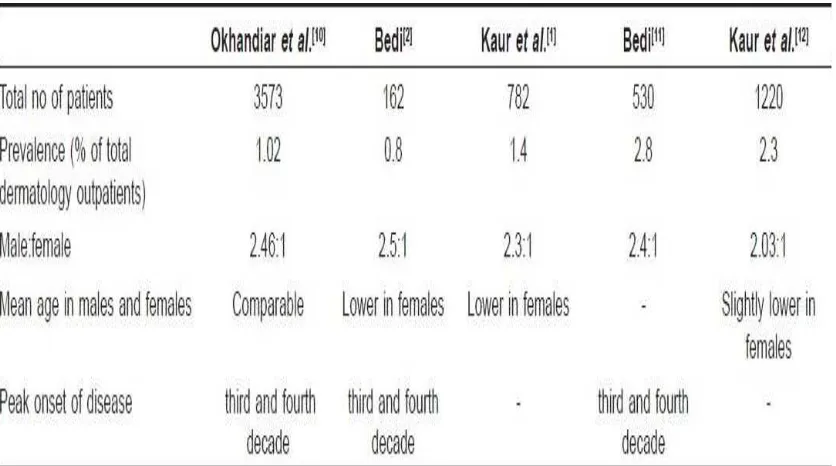
Prevalence studies from India are mostly hospital-based. presents
the comparative data from various epidemiological studies on psoriasis
from India. Okhandiar et al. collected a comprehensive data from various
medical colleges located in Dibrugarh, Calcutta, Patna, Darbhanga,
Lucknow, New Delhi and Amritsar. They found that the incidence of
overall incidence of 1.02%. They noted that the incidence in Amritsar
(2.2%) was higher as compared to other centers in Eastern India and
speculated that it may be related to different environmental conditions
(extremes of temperature), dietary habits, and genetic differences. The
ratio of male to female (2.46:1) was very high which could not be clearly
accounted for. Highest incidence was noted in the age group of 20-39
years and the mean age of onset in males and females was comparable.
In another study from North India, Bedi reported the prevalence of
psoriasis to be 0.8% among the skin patients but the sample size of the
study was very small. Male to female sex ratio was 2.5:1. In this study, it
was observed that females had lower mean age of onset compared to
males. In a latter study by Bedi, which included larger number (530) of
subjects, prevalence of psoriasis among dermatology outpatients was
found to be 2.8% while male to female ratio continued to be the same.
In a study from tertiary health care center from North India,
psoriasis patients accounted for 2.3% of the total dermatology
outpatients. Of the total psoriasis patients, 67% were men and 33% were
women, male to female ratio being 2.03:1. Ages of patients ranged from
infancy to eighth decade, mean age being 33.6 years. Children accounted
for 4.4% of total psoriasis patients. Women had slightly lower mean age
commonly accepted and validated diagnostic criteria. Furthermore, there
[image:54.612.112.530.176.409.2]is basically no reliable information on time trends of the disease.
Table 1 :Epidemiological studies on psoriasis from India
Genetic and familial incidence:
Psoriasis vulgaris is known to be associated with certain HLA
antigens and complement factors but most of the studies published are in
Western populations with only little information about Indians. Chablani
et al. in a study of 67 psoriasis subjects from Western India found
association with the A1, B17 and Cw6, but not with B13 antigens.
Pitchappan et al. reported association of HLA Bw57 and DR7 with
psoriasis vulgaris in South India. Rani et al. showed that Cw *0602 was
the main allele that had high frequency in psoriasis patients in North
Genetic predisposition has a significant role in the etiopathogenesis of
psoriasis and familial clustering of the cases has been observed. Farber et
al. reported familial occurrence in 36% of their patients. Familial
incidence is greater in childhood psoriasis compared to adult onset
psoriasis.
Indian studies report lower familial incidence of the disease. Bedi
reported positive family history of psoriasis in 14% of their patients.
While Kaur et al. reported family history in only 2% of their patients.
First degree relatives were affected in 84% of the cases while second
degree relatives in 12% cases. There are only few studies which have
made record of family history of psoriasis in their patients, so definite
statistical data on familial incidence is not available.
Quality of life
• 60 percent of people with psoriasis reported their disease to be a
large problem in their everyday life
• Nearly 40 percent with psoriatic arthritis reported their disease to
be a large problem in everyday life
• Patients with moderate to severe psoriasis experienced a greater
negative impact on their quality of life
• Psoriasis has a greater impact on quality of life in women and
younger patients
simply seen as a fault of the epidermis and its keratinocytes. The
second hypothesis sees the disease as being an immune-mediated
disorder in which the excessive reproduction of skin cells is
secondary to factors produced by the immune system
Psoriasis - an Autoimmune Disorder
• As part of its defense against foreign invaders, our body's bone
marrow and thymus gland collaborate to pump out specialized
white blood cell warriors called "T cells." Under normal
circumstances, T cells are programmed to identify and coordinate
an attack on enemy combatants.
• In psoriasis, T cells mistakenly identify skin cells as "other" and
attack them. This attack injures the skin cells, setting off a cascade
of responses in immune system and in skin, resulting in skin
damage (that is, swelling, reddening and scaling).
• In an effort to heal, skin cells begin reproducing rapidly. Activities
that should take a month take place in only days, and abnormally
large numbers of new skin cells push their way to the surface of
skin. This occurs so quickly that older skin cells and white blood
cells aren't shed quickly enough. These discarded cells pile up on
the surface of the skin, creating thick, red plaques with silvery
scales on their surface: the hallmark of the classic form of plaque
psoriasis
Factors that increase the risk of developing psoriasis include:
• family history
• stress
• injury, illness, or infection
• steroids and other medications
• race
Trauma and certain bacteria may trigger psoriatic arthritis in
patients with psoriasis.
Clinical Symptoms:
o A sharply delimited, hyperemic patch, covered with a silvery-white
layer of scales of variable thickness, is found as typical primary
eruption
o With careful scratching, small silvery-white lamellar scales come
off, more or less as from a solidified candle strip (candle grease
sign)
o Phenomenon of the last skin layer: if scratching continued, a thin,
glistening epithelial layer is revealed
o Auspitz sign: removal of this epithelial layer reveals punctuate
bleeding because of a lesion of the capillaries running out into the
tips of the papillae.
o Koebner’s phenomenon: if the skin of a psoriatic patient is
irritated (e.g. scratching) in the phase of an acute episode of
eruption, a new psoriatic focus is formed on the floor of this
epithelial lesion
Types of psoriasis:
PLAQUE PSORIASIS.
Plaque psoriasis (psoriasis vulgaris), the most common form of the
disease, is characterized by small, red bumps that enlarge, become
inflamed, and form scales. The top scales flake off easily and often, but
those beneath the surface of the skin clump together. Removing these
scales exposes tender skin, which bleeds and causes the plaques
(inflamed patches) to grow.
Plaque psoriasis can develop on any part of the body, but most
often occurs on the elbows, knees, scalp, and trunk.
SCALP PSORIASIS.:
At least 50 of every 100 people who have any form of psoriasis
have scalp psoriasis. This form of the disease is characterized by
scale-capped plaques on the surface of the skull.
NAIL PSORIASIS:
The first sign of nail psoriasis is usually pitting of the fingernails or
toenails. Size, shape, and depth of the marks vary, and affected nails may
thicken, yellow, or crumble. The skin around an affected nail is
sometimes inflamed, and the nail may peel away from the nail bed.
GUTTATE PSORIASIS.:
Named for the Latin word gutta, which means "a drop," guttate
psoriasis is characterized by small, red, drop-like dots that enlarge rapidly
and may be somewhat scaly. Often found on the arms, legs, and trunk and
sometimes in the scalp, guttate psoriasis can clear up without treatment or
PUSTULAR PSORIASIS.
Pustular psoriasis usually occurs in adults. It is characterized by
blister-like lesions filled with non-infectious pus and surrounded by
reddened skin. Pustular psoriasis, which can be limited to one part of the
body (localized) or can be widespread, may be the first symptom of
psoriasis or develop in a patient with chronic plaque psoriasis.
Generalized pustular psoriasis is also known as Von Zumbusch
pustular psoriasis. Widespread, acutely painful patches of inflamed skin
develop suddenly. Pustules appear within a few hours, then dry and peel
within two days.
Generalized pustular psoriasis can make life-threatening demands
on the heart and kidneys.
Palomar-plantar pustulosis (PPP) generally appears between the
ages of 20 and 60. PPP causes large pustules to form at the base of the
thumb or on the sides of the heel. In time, the pustules turn brown and
peel. The disease usually becomes much less active for a while after
peeling.
Acrodermatitis continua of Hallopeau is a form of PPP
characterized by painful, often disabling, lesions on the fingertips or the
tips of the toes. The nails may become deformed, and the disease can
damage bone in the affected area.
ERYTHRODERMIC PSORIASIS.
Characterized by severe scaling, itching, and pain that affects most
of the body, erythrodermic psoriasis disrupts the body's chemical balance
and can cause severe illness. This particularly inflammatory form of
psoriasis can be the first sign of the disease, but often develops in patients
with a history of plaque psoriasis.
PSORIATIC ARTHRITIS.
About 10% of partients with psoriasis develop a complication
called psoriatic arthritis. This type of arthritis can be slow to develop and
mild, or it can develop rapidly. Symptoms of psoriatic arthritis include:
• Joint discomfort, swelling, stiffness, or throbbing
• Swelling in the toes and ankles
• Pain in the digits, lower back, wrists, knees, and ankles
PATHOGENESIS
The biochemical basis for the pathogenesis of psoriasis, which is as
equally varied as the genetic basis, can be attributed to both
overexpression and underexpression of certain proteins in psoriatic
lesions. The anomalies in protein expression can be divided into three
areas:
A. Abnormal keratinocyte differentiation
B. Hyperproliferation of the keratinocyte
C. Infiltration of inflammatory elements
A. Keratinocyte Differentiation
At least six markers of abnormal keratinocyte differentiation have
been found, and all have implications in the pathogenesis of the disease.
These include aberrations of
• Keratinocyte Transglutaminase type I (TGase K) • Skin-derived Antileukoproteinase (SKALP)
• Migration inhibitory factor-related protein-8 (MRP-8) • Involucrin
• Filaggrin
• Keratin expression
TGase K - The overexpression of this enzyme causes the excessive
MRP-8 - Its biochemical function is not completely understood. It has
been found in psoriasis and other inflammatory diseases but not in normal
skin.
Involucrin - A precursor protein that helps to stabilize the CE, is also
upregulated in psoriasis vulgaris.
Keratin - Its expression is also disrupted in psoriasis. K6 and K16,
markers of abnormal hyperproliferative conditions, are up-regulated in
psoriatic epidermis, whereas K1 and K10, markers of terminal
differentiation, are down-regulated.
Filaggrin -It is normally found in the granular layer of the skin and is
absent in psoriaticlesions.
B. Hyperproliferation
It is the second category of anomalies that contributes to the
symptoms of psoriasis vulgaris. Several possible biochemical causes for
the overproduction of the keratinocytes have been found in psoriatic skin:
• Epidermal Growth Factor (EGF)
• Bone Morphogenetic Protein-6 (BMP-6) • Transforming Growth Factor-alpha (TGF-α) • Ornithine Decarboxylase
• Activating Protein (AP1)
• Mitogen-Activated Protein Kinase (MAPK)
EGF binding capacity is doubled in the upper layers of the
epidermis of psoriatic skin. This increase in binding over-stimulates the
growth of the keratinoctyes, causing hyperproliferation.
BMP-6, another growth factor, is present in newborns, but
makes it a prime candidate for a growth factor sponsoring the formation
of psoriatic lesions in humans.
TGF-α expression is up-regulated in psoriatic skin.
Ornithine Decarboxylase, an essential enzyme in polyamine
biosynthesis, is higher in lesional and nonlesional psoriatic skin.
AP1, a complex of the oncoproteins, stimulates the expression of
many genes that are important in cell proliferation and inflammation.
The last indicator, MAPK, helps to regulate cellular proliferation.
Numerous growth factors and cytokines modulate MAPK's activity,
which is higher in psoriatic fibroblasts.
C. Inflammatory Elements
The inflammatory aspect of psoriasis is physically evident by the
redness of psoriatic plaques. The biochemical basis for this inflammation
stems from several immune modulators including various cytokines
released from keratinocytes and other proteins involved in the
inflammatory response.
Among the interleukins (ILs), IL-1, IL-6, IL-7 and IL-8 are up
regulated in psoriatic skin. In addition, IL-15, which reduces keratinocyte
cell apoptosis, is elevated in psoriatic lesions. Pituitary Adenylate
Cyclase Activating Polypeptide (PACAP) is an inflammatory mediator
that is up regulated in psoriatic lesions.
All of these inflammatory factors exert specific effects on T cells,
disease where activation of T lymphocytes is central to the inflammation
in the dermal microenvironment and the epidermal hyper proliferation is
secondary to the inflammatory events that follow a Th1 type of immune
response.
T Cells
In psoriasis, the activity of T cells is the driving force for induction
and maintenance of the skin lesions.
T Cell Activation
Activation of T cells requires three steps
• Binding
• Antigen specific activation, known as signal 1
• Non-antigen specific cell-cell interaction, known as signal 2 Binding
The T cell attaches to the Antigen Presenting Cell [APC] through
surface adhesion molecules. In skin the Langerhans cell is the most
efficient Antigen Presenting Cell.
Antigen specific activation
Once the T cell-APC binding has occurred through their respective
surface adhesion molecules, the antigen is presented to the T cell by the
APC. This antigen stimulated activation leads to conversion of the naïve
T cell into an antigen specific cell that may further develop into a long
lived memory cell that circulates in the body and can recognize the same
antigen at a later date, even after several years.
Non antigen specific cell-cell interaction
This is also known as co-stimulation. If co-stimulation by other cell
cell will not respond to the antigen and will undergo apoptosis or be
rendered unresponsive to that antigen in the future (anergy).
Effector functions of activated T cells
Once the T cell is activated the next step is induction of
inflammatory responses and tissue changes leading to the clinical picture
of psoriasis.
TNF-a is strongly implicated in the pathogenesis of psoriasis and
psoriatic arthritis. TNF-a functions in a positive feedback loop by
recruiting more inflammatory cells and upgrading receptors on th