Munich Personal RePEc Archive
Equilibrium asset prices and bubbles in a
continuous time OLG model
Brito, Paulo
22 September 2008
Equilibrium asset prices and bubbles
in a continuous time OLG model
Paulo B. Brito
UECE, ISEG, Technical University of Lisbon,
[email protected]
September 22, 2008
Abstract
In a Yaari-Blanchard overlapping generations endowment economy, and
drawing on the equivalence between Radner (R) and Arrow-Debreu (AD)
equi-libria, we prove that equilibrium AD prices have an explicit representation as
a double integral equation. This allows for an analytic characterization of the
relationship between life-cycle and cohort heterogeneity and asset prices. For
a simple distribution, we prove that bubbles may exist, and derive conditions
for ruling them out.
Keywords: overlapping generations, asset pricing, bubbles, integral equations,
LambertW function.
1
Introduction
The main difficulty in modelling overlapping generation equilibrium economies are related to the consistent modelling of the dimensions of the income distribution, along the life-cycle, along age-income profiles for every moment in time, and be-tween different cohorts. This poses difficulties in defining a consistent Arrow-Debreu equilibrium, as was already noted by Shell (1971).
In the continuous time overlapping generations literature there are two main strands of models, following Yaari (1965)- Blanchard (1985) uncertain lifetime model, and Cass and Yaari (1967) finite lifetime model.
As in most continuous time OLG literature, we follow Yaari (1965)- Blanchard (1985) framework. It solves the consistency problem by dealing with a Radner, or sequential market equilibrium, economy, and by assuming a particular demographic structure. The consequence of this is that the age-structure of endowments has no effect on asset prices. We try to overcome this difficulty by generalising demograph-ics, though still assuming a constant population, and by drawing on the equivalence between Radner (R) equilibria with complete asset markets and Arrow-Debreu (AD) equilibria.
by assuming that all prices are formed at an ”Archimedian” time t= 0 1. We prove that the general equilibria in both economies are equivalent. We also prove that equilibrium AD prices have a representation as an integral equation. By assuming a simple particular case of heterogeneous age-distribution of endowments, where all endowments are distributed at a single ageα, we prove that equilibrium prices exist, but may display rational bubbles depending on the relationship of α and a critical value which depends on the elasticity of intertemporal substitution 2
Finite lifetime models of the Cass and Yaari (1967) contribution have been recently revived. For example, Demichelis and Polemarchakis (2007) present an Arrow-Debreu (AD) endowment equilibrium with a structure similar to the one pre-sented here, but within the finite lifetime framework. Though we reach a similar solution for AD prices, our approach allows for a simpler characterization of equilib-rium prices, and, in particular for an explicit derivation of conditions for existence of speculative bubbles.
In section 2 we present the R and the AD equilibria and proves their equivalence, in section 3 we prove the existence of AD prices, and in section 4 we characterise AD prices and present conditions for ruling out bubbles.
2
Radner and Arrow-Debreu equilibria
Consider an overlapping-generations (OLG) economy with an age-structured de-mography and a constant aggregate population. At each point in time people are
1
See Geanakoplos and Polemarchakis (1991) and Geanakoplos (2008).
2
distributed among homogeneous cohorts. There is inter-cohort heterogeneity be-cause the representative members of different cohorts are in different phases of their life-cycles. The dimension of a cohort t0 at time t = t0 +a is denoted by
n(a, t) =n(a, t0 +a), wheret0 is the time of birth, anda∈ [0,∞) is the age of the representative member of a cohort. In a closed economy, the dimension of cohortt0 is n(0, t0) at the time of birth, and decays along the rest of the life-cycle by mor-tality. Then n(a, t) =n(0, t−a)e−Ra
0 µ(s,t)ds, where µ(a, t)>0, is the instantaneous probability of death for people with age a at time t. Total population at time t is
N(t) =R∞
0 n(a, t)da.
We assume that both the number of new-borns and the probability of death are time-independent, n(0, t0) = n0 and µ(a) > 0. However, we do not introduce the Blanchard (1985) simplifying assumptions: µ(s) =µ= 1/n0 constant.
The previous assumptions have two implications: First, they imply that the decay factor of a cohort along the lifetime, π(a)≡e−Ra
0 µ(s)ds, only depends on age. Given intra-cohort homogeneity thenπ(a) also represents the probability of survival at age a for individual agents. Second, they imply that n(a, t) = n0π(a) is time-independent but age-dependent, and the aggregate populationn0
R∞
0 π(a)da=N is constant.
We hypothesise a single-good endowment economy, in which the representative member of cohort t0 is entitled to the lifetime exogenous stream of endowments
y(t0) = {y(a, t0 +a), a ∈ R+}, and there are no intergenerational transfers (in particular, no bequests). Therefore, the total endowment for the economy at time
t, Y(t) =R∞
The representative member of cohort t0 has preferences of the Yaari (1965)-Blanchard (1985) type: she/he has an uncertain lifetime, has an instantaneous prob-ability of survival at ageaequal toπ(a), and has an additive expected lifetime utility functional, over the lifetime path of consumption c(t0) = {c(a, t0+a), a∈R+},
U[c(t0)] =Et0
Z ∞
0
u(c(a, t0+a))R(a)da
=
Z ∞
0
u(c(a, t0+a))R(a)π(a)da, (1)
where R(a) ≡ e−Ra
0 ρ(s)ds is the psychological discount factor with ρ(t) > 0 for all
t≥0.
To complete the characterization of the economy we need to specify the structure of markets allowing for the intertemporal allocation of resources. We consider two alternative structures of markets leading to two alternative but equivalent economies: Radner and Arrow-Debreu.
In a Radner (R) economy there are financial assets, and the institutional struc-ture is characterised by the existence of a sequence of spot markets for the good and for financial assets. In addition to a financial asset, paying a rate of return r, there is also a Yaari (1965) insurance market.
Let w(a, t) denote the real stock of financial wealth for an agent with age a at time t=t0+a, using the spot price of the good as anum´eraire. The instantaneous budget constraint is given by the partial differential equation along a characteristic,
∂w ∂a +
∂w
∂t =z(a, t) + (r(t) +µ(a))w(a, t), (2)
and the rate of return r(t) are perfectly anticipated. The no bequests assumption imposes the following boundary constraints
w(0, t0) = lim
a→∞π(a)w(a, t0+a)e −Ra
0 r(t0+s)ds = 0. (3)
Definition: The General Equilibrium for the OLG Radner economy is defined by the pair of densities and trajectories(c∗
, r∗
) = {c∗
(a, t), (a, t)∈R2+},{r∗
(t), t∈R+}
,
such that {c∗
(a, t0 +a) : a ∈R+} maximises the intertemporal utility function (1)
subject to restrictions (2) and (3), for all cohorts t0 ∈ R+, and the rate of return
on the financial asset, r∗
(t), clears the good market for every t∈R+.
The equilibrium condition is
Z ∞
0
c∗
(a, t)n(a, t)da =
Z ∞
0
y(a, t)n(a, t)da. (4)
In an Arrow-Debreu (AD) economy there are, instead, forwards real markets in which contracts for future delivery of the good are traded. In particular, agents belonging to cohort t0 perform contracts, at the time of birth, for delivery of the good at every future moment along their lifetimes, such that the intertemporal budget constraint holds
Z ∞
0
π(a)p(t0, t0+a)z(a, t0 +a)da= 0, (5)
supply of the representative agent of cohort t0 in the market for delivery at time
t=t0 +a.
In a non-OLG AD economy one would assume that all markets would operate simultaneously at time t = 0, that is at the moment of birth of the representative dynasty, and there would be an infinite number of markets for delivery in every future date.
In our OLG AD economy there is a well know consistency problem, between the simultaneity of the operation of the forward markets and the need for agents to contract for all delivery of goods on all future moments along their lifetimes. If contracts are made at the time of birth, the simultaneity of operation of markets at a single point in time will not be possible because cohorts are continuously being born. This problem has been solved in the literature (see Geanakoplos and Polemarchakis (1991) and Geanakoplos (2008), that attributes this idea to I. Fisher) by assuming that prices faced by every cohort are consistent to those set at an ”Archimedian time” t= 0. At this date all pricesp(0, t) =p(t), fort∈R+ are determined. Then, prices available to cohortt0 should verify p(t0, t) =p(t)/p(t0), for t≥t0.
Definition: The General Equilibrium for the OLG Arrow-Debreu economy, in which all markets open only at time t = 0, is defined by the pair (c∗
, p∗ ) =
{c∗
(a, t), (a, t)∈R2 +},{p
∗
(t), t∈R+}
, where {c∗
(a, t0+a) : a∈R+} maximises
the intertemporal utility function (1) subject to restriction (5), for all cohorts t0 ∈
R+, where p∗(t0, t) = p∗(t)/p∗(t0), and the AD price p∗(t) clears the market for
every future t ∈R+.
Proposition 1Let
p(t) =e−Rt
0r(s)ds, t∈R+. (6)
then the OLG-Radner and the OLG-Arrow-Debreu equilibria are equivalent.
Proof The solution of equation (2) with conditions (3) is the intertemporal bud-get constraint R∞
0 e −Ra
0 r(t0+s)dsπ(a)z(a, t0 +a) = 0. This constraint is equivalent to the constraint for the representative member of a cohort in the AD economy, (5), if and only if p(t0, t0+a) = e−
Ra
0 r(t0+s)ds orp(t0, t) = e−
Rt−t0
0 r(t0+s)ds =e−
Rt
t0r(s)ds, or
p(t)/p(t0) =e−Rt
0r(s)dse
R0
t0r(s)ds. Then, the problems for the representative members
of cohortst0are equivalent in both R and AD economies. As the market equilibrium conditions are formally identical (see equation (4)) for every t ∈R+, then the two
equilibria are equivalent. ✷
3
Determination of equilibrium AD prices
As r(t) = −dlnp(t)/dt for any t ∈ R+, from equation (6), we can establish ex-istence, uniqueness, and characterise the OLG-R equilibrium from the equivalent OLG-AD equilibrium. Brito and Dil˜ao (2006) study a similar OLG-AD equilibrium but assume a logarithmic utility function and derive a representation of the equilib-rium AD prices as a linear double integral equation. Here, we assume an isoelastic utility function and get a representation of AD prices as a non-linear double integral equation.
Proposition 2Let the Bernoulli utility function be u(c) = (1−σ)−1
c1−σ
, where
integral equation
p(t)1/σ=
R∞
0 K(t−a)R(a)
1/σπ(a)da
R∞
0 y(a, t)π(a)da
, t∈R+ (7)
where
K(t−a)≡
R∞
0 y(s, t−a+s)p(t−a+s)π(s)ds
R∞
0 p(t−a+s)(σ −1)/σ
R(s)1/σπ(s)ds.
Proof The optimal consumption for cohort t0 in the OLG-AD economy, when its representative member has age a, is
c∗
(a, t0 +a) =
R(a)
p(t0, t)
1/σ R∞
0 p(t0, t0+s)y(s, t0+s)π(s)ds
R∞
0 p(t0, t0+s)(σ −1)/σ
R(s)1/σπ(s)ds
, a∈R+
If we substitute t0 =t−a, aggregate across all cohorts, impose the consistency con-dition p(τ0)p(τ0, τ1) = p(τ1), and substitute into the equilibrium condition, C(t) =
Y(t), then we get equation (7). ✷
In order to solve the integral equation (7) we consider the case of a balanced growth path with a constant population. In particular, we assume that endow-ments are separable, but are age-structured, and that the other demographic and behavioural parameters are age-independent and constant.
Proposition 3 Assume that the endowment density follows y(a, t) = φ(a)eγt,
where φ(a)6= 0∈ L1(R+), and γ ≥0. Further assume µ(a) =µ > 0, ρ(a) =ρ >0.
where η≡ρ+µ+ (σ−1)(γ+µ). Define
S(x)≡
Z ∞
0
φ(a)e−µa
1−η+x(1−σ)
η+x e
xa
da. (8)
Then, equation (7) has a solution of the form p(t) = Pn
j=1kje(xj −γ)t
, where xj ∈
{x∈X :S(x) = 0}, for j = 1, . . . , n.
Proof As in Polyanin and Manzhirov (1998, p.325), and in Brito and Dil˜ao (2006), let the general solution of equation (7) be of type f(t) = ke(x−γ)t
, where k
is an arbitrary constant. If we substitute this candidate solution into equation (7) and assume thatx+η >0 and x(1−σ) +η > 0, we find it is equivalent to equation
S(x) = 0, whereS(x) is in (7). ✷
We call characteristic equation to S(x) = 0. It does not have a closed form solution for any admissible value of the parameters. However, we can prove existence of a solution x= 0 ∈X, with very mild conditions:
Proposition 4 Assume that φ(a) 6= 0, for all a ∈ R+ and that σ > σf ≡ max{0,(γ −ρ)/(µ+γ)}. Then the characteristic equation has at least one root
x= 0.
Proof If φ(a)6= 0, we see by simple inspection that x = 0 ∈X is a root of the
S(x) = 0 only ifη >0. But η >0 if and only ifσ > σf. ✷ Ifx= 0 is the unique solution of the characteristic equation then the equilibrium AD price isp(t) =ke−γt
, and the real interest rate isr(t) =γ, for allt∈R+, as in an analogous dynastic non-OLG model. Therefore, prices are asymptotically bounded, and there are no speculative bubbles.
on the type of function φ(.). If there is no root larger than γ, then we would get limt→∞p(t) = 0 and limt→∞r(t) > 0: prices are bounded and the asymptotic interest rates are positive. If there is at least one root which is greater than γ then limt→∞p(t) =∞and limt→∞r(t)<0, and we say that rational speculative bubbles would exist.
4
AD prices and age-heterogeneity of endowments
Our approach, differently from Blanchard (1985), allows for the characterization of the consequences of different age-distribution of incomes ( or of age-dependent shocks upon it) on the dynamics of asset prices. In particular, as all roots different from zero depend onφ(a), we may relate the existence or not of speculative bubbles to the age-distribution of endowments.
Let us consider the simplest age-heterogeneous distribution such that endow-ments are only received by consumers with a specific age, a = α ≥ 0. Formally,
φ(a) =φ0δ(a−α) where δ(.) is Dirac’s delta function.
At each moment in time, t, the age- distribution of endowments across ages is totally concentrated on consumer with age α. Therefore, the AD price p(t) clears the market for time t, in which there is only one cohort in the supply side and all the other cohorts are in the demand side.
The characteristic equation is now
and still does not have a closed form solution. However, we can characterise solutions as far as the existence of bubbles is concerned:
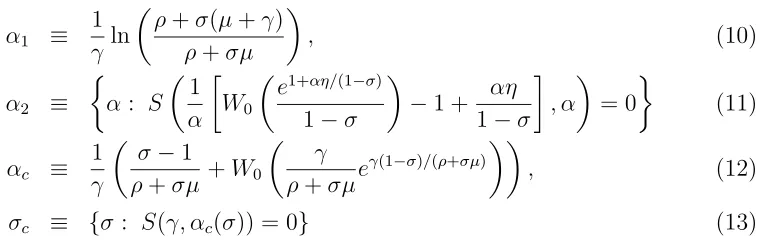
Proposition 5 Let σf < σ ≤ 1, and α ≥ α1, or 1 < σ < σc, and α ≤ α2, or
σ ≥σc and α≤α1, where
α1 ≡ 1
γ ln
ρ+σ(µ+γ)
ρ+σµ
, (10)
α2 ≡
α: S
1 α W0
e1+αη/(1−σ) 1−σ
−1 + αη
1−σ
, α = 0 (11)
αc ≡ 1
γ
σ−1
ρ+σµ +W0
γ ρ+σµe
γ(1−σ)/(ρ+σµ)
, (12)
σc ≡ {σ : S(γ, αc(σ)) = 0} (13)
where W0 is the principal branch of the Lambert-W function 3. Then, there are no
speculative bubbles.
Proof If σ > σf then η > 0, and g(x) = 0 will only have roots in the interval (−η,+∞), if σf < σ ≤ 1, or in the interval (−η,≥ η/(σ − 1)), if σ > 1. As
γ < η/(σ − 1)) then roots x > γ can exist. In the appendix we prove that if
σf < σ ≤ 1, and α ≥ α1, or 1 < σ < σc, and α ≤ α2, or σ ≥ σc and α ≤ α1 then
[image:13.595.140.520.201.326.2]there are no rootsx > γ. ✷
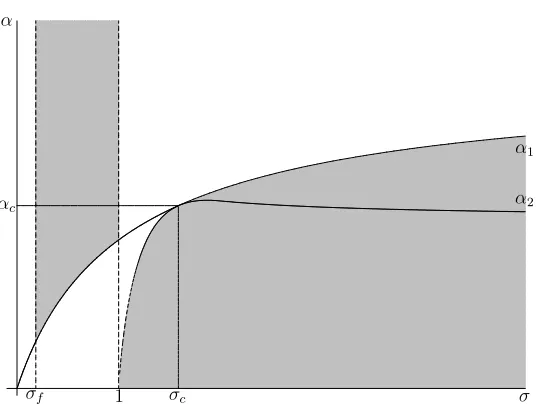
Figure 1 illustrates this result by presenting combinations of values for σ and
α such that bubbles are ruled out, for feasible values of the parameters. We see that if σf < σ ≤ 1 then endowment should be distributed after age α1 which is a function not only of σ but also of the other parameters µ and γ. If σ > 1 it should be distributed before age α2 orα1, which also depend onσ,µ and γ.
3
In order to have an intuition for this result observe that the characteristic equa-tion (9) can be written as S(x) = R∞
0 φ(a)n(a)s(x, a)da = 0, where s(x, a) is the density of net savings, which in this case is equivalent to the density of excess supply of AD contracts across all ages. Then S(.) represents aggregate savings, or the ag-gregate excess supply, in every moment in time. Then, AD prices, or interest rates, are determined such that aggregate supply across all age profiles are zero at every moment in time. Ifφ(a) is a degenerate distribution thenS(x) =s(x, α) = 0 for any moment in time. Our previous result suggests that the existence of bubbles, that is values of x > γ which clear aggregate savings, has not a single relationship with α. If the elasticity of intertemporal substitution is low (high) an increase (reduction) inα above a critical value will generate a reduction in net savings which have to be compensated by an increase in prices associated to all forward contracts to delivery in the future.
5
Conclusions
α
σ 1
σf σc
αc
α1
[image:15.595.173.441.87.289.2]α2
Figure 1: Shaded area: values of (σ, α) if γ > ρ such that there are no speculative bubbles.
References
Blanchard, O. J. (1985). Debt, Deficits and Finite Horizons. Journal of Political Economy, 93(2):223–47.
Brito, P. and Dil˜ao, R. (2006). Equilibrium price dynamics in an overlapping-generations exchange economy. Working Paper 27/2006, Department of Eco-nomics, ISEG, Technical University of Lisbon.
Cass, D. and Yaari, M. E. (1967). Individual saving, aggregate capital accumula-tion, and efficient growth. In Shell, K., editor, Essays on the Theory of Optimal Economic Growth, pages 233–268. MIT Press.
Demichelis, S. and Polemarchakis, H. M. (2007). The determinacy of equilibrium in economies of overlapping generations. Economic Theory, 32(3):471–475.
Geanakoplos, J. (2008). Overlapping generations models of general equilibrium. Discussion Paper 1663, Cowles Foundation for Research in Economics, Yale Uni-versity.
Geanakoplos, J. D. and Polemarchakis, H. M. (1991). Overlapping generations. In Hildenbrand, W. and Sonnenschein, H., editors, Handbook of Mathematical Economics, volume IV, pages 1899–1960. North Holland.
Gelfand, I. M. and Fomin, S. V. (1963). Calculus of Variations. Dover.
Polyanin, A. D. and Manzhirov, A. V. (1998). Handbook of Integral Equations. CRC Press.
Shell, K. (1971). Notes on the economics of infinity. Journal of Political Economy, 79:1002–1011.
Yaari, M. E. (1965). Uncertain lifetime, life insurance, and the theory of consumer.
Appendix
In this appendix more detailed versions of some proofs are presented.
Derivation of the instantaneous budget constraint for the OLG-R
econ-omy. The instantaneous budget constraint (2) is a first order partial differen-tial equation over a characteristic, i.e., it is defined for values of (a, t) such that
da/dt= 1. This is so because the cohort’s ’time’, a, is related to ’universal time’, t, ast=t0+a, wheret0is the date of birth of a cohort. The financial wealth of an agent belonging to cohortt0when it has ageaat timetis denoted byw(a, t) = w(a, t0+a). If we consider a small time interval ∆a =ε the flow budget constraint is,
w(a+ε, t0+a+ε)−w(a, t0+a) = [z(a, t0 +a) + (r(t0+a) +µ(a))w(a, t0+a)]ε.
This means that the variation in wealth is equal to the sum of the net inflow of the good, z(a, t0 +a) = y(a, t0 +a)−c(a, t0 +a), and with the income from asset holdings, resulting from the market interest rate and from the proceeds from the Yaari contracts. As
lim ε→0
w(a+ε, t0+a+ε)−w(a, t0+a)
ε =
dw(a, t0+a)
da = ∂w
∂a + ∂w
∂t dt da
and da = dt, along a characteristic, then we get the flow budget constraint (2) for the Radner economy.
equation, with has the general solution
w(a, t) =keR0ar(τ+t0)+µ(τ)dτ +
Z a
0
eRsar(τ+t0)+µ(τ)dτz(s, t
0+s)ds
where k is an arbitrary constant. If we set a = 0, and t = t0, and use the first boundary condition (3), then we get w(0, t0) = k = 0. If we substitute k, and multiply both terms bye−Ra
0 r(τ+t0)+µ(τ)dτ, and apply the second boundary condition (3), we finally obtain
lim
a→∞w(a, t)e −Ra
0 r(τ+t0)+µ(τ)dτ =
Z ∞
0
e−Rs
0r(τ+t0)+µ(τ)dτz(s, t0+s)ds= 0.
This is the intertemporal constraint for cohortt0 in the R economy. If is equivalent to the constraint at birth for a cohort living on the AD economy, (5), if and only if
p(t0, t0+a) = e −Ra
0 r(t0+s)ds. Asp(t0, t0+a) = p(t0, t) =e−
Rt−t0
0 r(t0+s)ds =e−
Rt t0r(s)ds,
if prices available for cohort t0 are consistent to the ”Archimedian” prices, then we get equivalently p(t) =p(t0)p(t0, t) =e−
Rt0
0 r(s)dse−
Rt
t0r(s)ds =e−
Rt
0r(s)ds. ✷
Proof of Proposition 2To obtain a representation for the AD equilibrium in terms of the endogenous variables,c(a, t) andp(t) , we solve the cohort’st0 problem, aggregate consumption for all cohorts, and use the equilibrium conditions for the spot and all the forward markets for delivery at (0,∞) which open att = 0. First, using the same method as in Brito and Dil˜ao (2006)we set the Lagrangian for a representative member of cohort t0,
L=
Z ∞
0
(1−σ)−1
c(a, t0+a)1 −σ
R(a) +λp(t0, t0+a)z(a, t0+a)
where R(a) =e−Ra
0 ρ(s)ds and π(a) =e
Ra
0 µ(s)ds and λ is a Lagrange multiplier. The first order conditions are (see Gelfand and Fomin (1963)) are
δL δc =
Z ∞
0
c(a, t0+a) −σ
R(a)−λp(t0, t0+a)
π(a)ψ(a)da= 0 (14)
∂L ∂λ =
Z ∞
0
p(t0, t0+a)z(a, t0+a)π(a)da = 0 (15)
whereδL/δc is the functional derivative for a perturbationψ(a)∈L1(R+). As the first condition, (14), should hold for any perturbation, we get the optimal consump-tion for any moment along the lifetime of cohort t0,
c∗
(a, t0+a) =
λp(t0, t0+a)
R(a)
−1/σ
, a ∈R+.
Condition (15) can be written equivalently as an equality between the mathematical expectation of the value of the lifetime optimal consumption, measured at the AD prices fort0, and human wealth , at the moment of birth, ˜c(t0) =h(t0), where ˜c(t0)≡
R∞
0 p(t0, t0+a)c ∗
(a, t0+a)π(a)da andh(t0)≡
R∞
0 p(t0, t0+a)y(a, t0+a)π(a)da. We can write ˜c(t0) =m(t0)λ−1/σ
, where m(t0)≡ R∞
0 p(t0, t0+a) (σ−1)/σ
R(a)−1/σ
π(a)da. Then, we get the Lagrange multiplier as λ∗
= m(t0h(t0))σ and the optimal instanta-neous consumption for cohortt0 along its lifetime as a linear function of the human wealth at birth,
c∗
(a, t0+a) =
h(t0)
m(t0)
R(a)
p(t0, t)
1/σ
, a∈R+.
Second, aggregate demand isC(t) =R∞
0 n(a, t)c ∗
t0 =t−a, the expression for the population densityn(a, t) =n0π(a) and the optimal consumption density just derived, we get
C(t) =n0
Z ∞
0
h(t−a)
m(t−a)
R(a)
p(t−a, t)
1/σ
π(a)da.
where h(t − a) ≡ R∞
0 p(t − a, t −a + s)y(s, t− a + s)π(s)ds and m(t −a) ≡
R∞
0 p(t−a, t−a+s) (σ−1)/σ
R(s)1/σπ(s)ds. If we introduce the consistency condition between the cohort’s t0 prices and the prices formed in the AD markets at time
t= 0, then p(t−a, t) =p(t)/p(t−a) and p(t−a, t−a+s) = p(t−a+s)/p(t−a), and the aggregate consumption becomes,
C(t) =n0p(t) −1/σ
Z ∞
0
K(t−a)R(a)1/σπ(a)da.
where
K(t−a) =
R∞
0 p(t−a+s)y(s, t−a+s)π(s)ds
R∞
0 p(t−a+s)(σ −1)/σ
R(s)−1/σ
π(s)ds.
At last, substituting consumption in the equilibrium condition for the AD markets
C(t) =Y(t) =n0
R∞
y(a, t)π(a)da, equation (7) results. ✷
Proof of Proposition 3 If we introduce in equation (7) the assumptions re-garding R(a), π(a), and y(a, t), we get the non-linear double integral equation
p(t)1/σ
Z ∞
0
φ(a)e−µa
da=
Z ∞
0
R∞
0 φ(s)p(t−a+s)e(γ −µ)s
ds
R∞
0 p(t−a+s)(σ −1)/σ
e−γ+µ
σ sds !
e−(ρ+σ(σµ+γ))ada.
solution of equation is a sum of functions of type f(t) = ke(x−γ)t
where k is an arbitrary constant. Making the substitution in equation (16), we get
Z ∞
0
φ(a)e−µa
− ξ1(x)
ξ2(x)
Z ∞
0
φ(a)e−µa
da= 0
where ξ1 =
R∞
0 e
−(η+x)/σa
da and ξ2 =
R∞
0 e
−(η+x(1−σ))/σa
da. If η+x > 0 and η+
x(1−σ)>0 then those functions are integrable, and
ξ1
ξ2
= η+x
η+x(1−σ) >0,
which leads to equation (9). The elimination of the dependence on t proves that our conjecture is right, and the existence of a solution equation (16) depends on the existence of roots to equation S(x) = 0 verifying η+x >0 andη+x(1−σ)>0. ✷
Proof of Proposition 4 First, observe that X is non-empty if and only if 0 < σ ≤ 1 and x > −η, or if σ > 1, and −η < x < η/(σ−1). Therefore, if η > 0 (η ≤ 0) then x = 0 belongs (does not belong) to the set of feasible solutions of equation S(x) = 0. If η >0, we see, by simple inspection, that x = 0 is a solution for any choice of theφ(a) function (such thatφ(a)6= 0). The necessary and sufficient condition for η >0 isσ >max{0,(γ−ρ)/(γ+µ)}. ✷
Proof of Proposition 5Consider function the characteristic equationS(x) = 0, in equation (9).
1. Proposition 4 applies here as well: if σ > σf then η >0 and x = 0 is always a root of S(x) = 0.
if 0 < σ ≤ 1, or −η < x < η/(σ−1) if σ > 1. Reasoning by contradiction: (1) if any σ > σf, and x <−η ≤0 then η+x < (η+x(1−σ))eαx <0, this implies that
S(x)<0 for allx <−η, and, therefore S(x) = 0 has no roots in this interval; (2) if
σ > 1 and x≥ η/(σ−1) then η+x(1−σ) ≤ 0 and η+x≥ ησ/(σ−1)> 0, and then S(x)>0, and S(x) = 0 has no roots in this case.
3. The former result does not exclude the possibility that there are roots of
S(x) = 0 such that x > γ, for any σ > σf. To find conditions for ruling this case out, we consider separately cases 0< σ≤1 andσ > 1 and worry only about positive roots of S(x) = 0.
First case: if σf < σ ≤ 1 then function S(x) is similar to a parabola, because limx→±∞S(x) = −∞, limx→−∞∂S(x)/∂x = 1, and limx→+∞∂S(x)/∂x = −∞. Therefore, it has one rootx= 0 and can have another root in the interval (−η,+∞), where η >0, from assumption 1. This is so because the characteristic equation has only a maximum at x=x∗
and S(x∗
)>0. To prove this observe that∂S/∂x = 0 if and only if [α(η+x(1−σ)) + 1−σ]eαx = 1, which is equivalent to (αx+y)eαx+y =
ey/(1−σ) where y≡α+η/(1−σ). If we solve for x we get
x∗
= (W(z)−y)/α= 1
α
W
1 1−σe
1−σ+αη
1−σ
− 1−σ+αη
1−σ
where, z ≡ ey/(1−σ), W is the LambertW function(see Corless et al. (1996)). If 0 < σ < 1 and η > 0 then z > 0 and W(z) = W0(z) > 0 (see again Corless et al. (1996)). And finally we getS(x∗
under whichS(γ) = S(x)|x=γ ≤0 . We readily see thatα≥α1 ≡ γ1ln ρ+σ(µ+γ) ρ+σµ is a necessary and sufficient condition for S(γ) =η+γ−(η+γ(1−σ))eαγ ≤0.
Second, if σ > 1 then function S(x) is similar to a cubic polynomial. The characteristic equation has one, two, or three roots, because limx→−∞S(x) = −∞, limx→∞S(x) = ∞, limx→−∞∂S(x)/∂x = 1, and limx→+∞∂S(x)/∂x = +∞. The other roots, in addition to x = 0 should belong to the interval (−η, η/(σ−1)). As
γ < η/(σ −1) = γ + (ρ+σµ)/(σ−1) then we may have roots belonging to the interval (γ, η/(σ − 1)). Clearly, a necessary condition ruling out roots x > γ is
S(x∗
)<0 and x∗
< γ, or S(x∗
)>0 and x∗> γ, and S(γ)≥0. In order to determine x∗
and S(x∗
), observe that if σ > 1 then y < 0 and
ey/(1−σ)<0. In Corless et al. (1996) it is proven that ifz <0 then W(z) has two branches, the principal branchW0(z) and the branchW−1(z) for 0> z≥ −e
−1 , and has not real values in the domain z < −e−1
. Also, W0(z) ∈ (0,−1), W−1(z) <−1 and that W0(−e−1
) = W−1(−e −1
) = −1. Then, there are no local maxima and minima if ey/(1−σ) <−e−1
which is equivalent to α <(σ−1) (ln (σ−1)−2)/η. This is illustrated in the next figure 2 by area lines below curve W(−1/e). If
α > (σ − 1) (ln (σ−1)−2)/η then there are two local maximum or minimum
x∗
= (W0(ey/(1−σ))−y)/αand x ∗
−1 = (W−1(ey/(1−σ))−y)/α withx ∗
> x∗ −1. If, we have values ofαsuch thatS(x∗
) = 0, then the highest value of a local extremum will coincide with a root of S(x) = 0. In particular x∗
= γ and the highest local extremum will coincide with root x = 0 if and only if S(γ) = S′
(γ) = S(x∗ ) = 0. This is the case if α =αc and σ=σc.
If instead we have S(γ) ≥ 0, S′(γ) < 0 then x∗
α
σ 1
σf σc
αc
S(γ) = 0
S′
(γ) = 0
S(x∗ ) = 0
[image:24.595.173.457.88.295.2]W(−1/e)
Figure 2: CurvesS(γ) = 0, S′
(γ) = 0 , S(x∗
) = 0 ande(1+αη/(1−σ))
(1−σ)−1
=−e−1 and values of (σ, α) such that there are no speculative bubbles.
roots for x > γ if S(x∗
)>0. This case will occur if 1 < σ < σc and α < α2 ≡ {α :
S(x∗
(α), α)>0}.
At last, if S(γ) ≥ 0 and S′(γ) > 0 then x∗