Open Access
Research article
Serum macrophage migration inhibitory factor reflects adrenal
function in the hypothalamo-pituitary-adrenal axis of septic
patients: an observational study
Takashi Miyauchi*, Ryoske Tsuruta, Motoki Fujita, Tadashi Kaneko,
Shunji Kasaoka and Tsuyoshi Maekawa
Address: Advanced Medical Emergency and Critical Care Center, Yamaguchi University Hospital, 1-1-1 Minamikogushi, Ube, Yamaguchi 755-8505, Japan
Email: Takashi Miyauchi* - [email protected]; Ryoske Tsuruta - [email protected]; Motoki Fujita - [email protected]; Tadashi Kaneko - [email protected]; Shunji Kasaoka - [email protected]; Tsuyoshi Maekawa - [email protected] * Corresponding author
Abstract
Background: The hypothalamo-pituitary-adrenal (HPA) axis modulates the inflammatory response during sepsis. Macrophage migration inhibitory factor (MIF), which counteracts the anti-inflammatory activity of glucocorticoid (GC), is one of the mediators of the development of inflammation. An inflammatory imbalance involving GC and MIF might be the cause or result of adrenal insufficiency. Our objective was to clarify the relationship between serum MIF and adrenal function in the HPA axis of sepsis patients using the adrenocorticotropic hormone (ACTH) stimulation test.
Methods: An observational study was performed in a university intensive care unit over a two-year period. Of 64 consecutive sepsis patients, 41 were enrolled. The enrolled patients underwent an ACTH stimulation test within 24 h of the diagnosis of severe sepsis or septic shock. Clinical and laboratory parameters, including serum MIF and cortisol, were measured.
Results: Based on their responses to the ACTH stimulation test, the patients were divided into a normal adrenal response (NAR) group (n = 22) and an adrenal insufficiency (AI) group (n = 19). The AI group had significantly more septic shock patients and higher prothrombin time ratios, serum MIF, and baseline cortisol than did the NAR group (P < 0.05). Serum MIF correlated significantly with the SOFA (Sequential Organ Failure Assessment) score, prothrombin time ratio, and delta max cortisol, which is maximum increment of serum cortisol concentration after ACTH stimulation test (rs = 0.414, 0.355, and -0.49, respectively, P < 0.05). Serum MIF also correlated significantly with the delta max cortisol/albumin ratio (rs = -0.501, P = 0.001). Receiver operating characteristic curve analysis identified the threshold serum MIF concentration (19.5 ng/mL, P = 0.01) that segregated patients into the NAR and AI groups.
Conclusions: The inverse correlation between serum MIF and delta max cortisol or the delta max cortisol/albumin ratio suggests that high serum MIF reflects an insufficient adrenal response in the HPA axis. Serum MIF could be a valuable clinical marker of adrenal insufficiency in sepsis patients.
Published: 21 December 2009
BMC Infectious Diseases 2009, 9:209 doi:10.1186/1471-2334-9-209
Received: 27 August 2009 Accepted: 21 December 2009
This article is available from: http://www.biomedcentral.com/1471-2334/9/209
© 2009 Miyauchi et al; licensee BioMed Central Ltd.
Background
Sepsis remains one of the main causes of death in inten-sive care units, despite enormous clinical efforts to coun-ter it. Although several new incoun-terventions for severe sepsis and septic shock have been introduced, few trials have led to a dramatic improvement in mortality [1-7].
It has recently been suggested that decreased adrenal ster-oid levels during stress (adrenal insufficiency) or tissue resistance to glucocorticoid (GC) are aggravating factors in critically ill patients [8,9]. Adrenal insufficiency, which is commonly diagnosed with the adrenocorticotropic hor-mone (ACTH) stimulation test, affects the efficacy of GC in the treatment of sepsis and other inflammatory diseases [8,9]. This observation suggests that GC remains an encouraging therapeutic agent for sepsis. Several reports have suggested that GC has beneficial effects [10,11], whereas other studies have indicated that it is not only ineffective, but also harmful [12,13]. To render GC ther-apy successful in the treatment of sepsis, it is necessary to modulate the inflammatory balance involving GC.
In the present study, we focused on macrophage migra-tion inhibitory factor (MIF) as an indicator of adrenal insufficiency. MIF was first discovered in 1966 as a T-cell cytokine released in the delayed-type hypersensitivity reaction [14]. It has been studied as an immunoneuroen-docrine mediator released by various cells, including pitu-itary cells, macrophages, monocytes, and vascular endothelial cells, in critically ill patients [15,16]. Interest-ingly, the unique characteristics of MIF specifically coun-teract GC-induced anti-inflammatory activity, and low concentrations of GC induce MIF production by macro-phages [17,18]. These facts suggest that MIF and GC are reciprocally involved in regulating the inflammatory and anti-inflammatory balance [18]. Therefore, serum MIF and GC might be indicators of the inflammatory/anti-inflammatory balance in sepsis patients.
We hypothesized that serum concentrations of MIF are associated with the changes in serum 4 cortisol that occur after ACTH stimulation in sepsis patients.
Methods
Patients
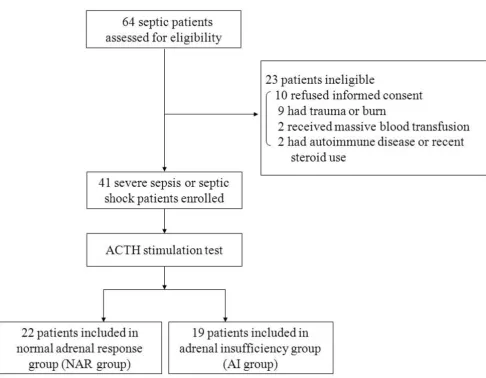
This study was approved by our Institutional Review Board in Yamaguchi University Hospital. We obtained the informed consent of the patients' families or next of kin at the time of enrolment. Patients admitted between May 2006 and May 2008, and who met the criteria for severe sepsis or septic shock, were prospectively assessed [19]. Figure 1 shows the selection of the patients. Sixty-four patients were assessed for eligibility for this study, and 23 patients were excluded. The ACTH stimulation test was performed in the 41 enrolled patients, of whom 26 had
severe sepsis and 15 had septic shock. The sites of infec-tion are listed in Table 1, as determined based on clinical manifestations, positive culture samples, X-ray films, or computed tomographic imaging.
ACTH stimulation test and patient classification
The ACTH stimulation test was performed in all enrolled patients within 24 h of the diagnosis of severe sepsis or septic shock. Synthetic ACTH (tetracosactide acetate, 0.25 mg) was administered intravenously, and serum cortisol concentrations were measured before (baseline) and 30 and 60 min after ACTH administration. The maximum increment in the serum cortisol concentration is desig-nated the "delta max cortisol." To estimate the level of free cortisol, a normalized value for serum albumin (cortisol/ albumin ratio) was used as an index of free cortisol.
Patients were divided into two groups: the normal adrenal response group (NAR group; delta max cortisol ≥ 9 μg/dL and random baseline ≥ 10 μg/dL) and the adrenal insuffi-ciency cortisol group (AI group; delta max cortisol < 9 μg/ dL or random baseline cortisol < 10 μg/dL), based on pre-vious reports (Figure 1) [8,9,20-22]. None of the patients presented a random baseline cortisol concentration below 10 μg/dL.
Blood sampling, measurement of serum MIF and cortisol, and other laboratory data
Arterial blood samples were centrifuged at 3,000 × g or 10 min after incubation for at least 30 min at 4°C. The supernatant (serum) was stored in sterile tubes and frozen at -80°C. Serum MIF concentrations were measured using an enzyme-linked immunosorbent assays (ELISA) (human MIF ELISA kit, Sapporo I.D.L., Japan). The serum sample and an enzyme-labelled antibody were injected onto a solid phase (ELISA plate) that contained a mouse mono-clonal antibody, so that the serum MIF was sandwiched between the mouse monoclonal antibody and the enzyme-labelled antibody. The plate was cleaned with washing solution to remove any unbound antibody. The bound enzyme-labelled antibody was subjected to a colorimetric reaction and the colour intensity was meas-ured at 450 nm.
standard curve, based on a range of known concentra-tions, was constructed and the unknown cortisol concen-trations were calculated using this curve. The measured cortisol value is a total one.
Statistical analysis
The data are presented as medians and interquartile ranges. Comparisons between the NAR 6 group and the AI group were made using the Mann-Whitney U test and the χ2 test. The correlations between the serum MIF
concen-trations and the other clinical and laboratory parameters were analyzed with Spearman's correlation coefficient (rs). Receiver operating characteristic (ROC) curve analy-sis was used to determine the threshold of MIF that allowed the segregation of the patients into different groups. All analyses were performed with the SPSS
soft-ware, version 11.01 (SPSS, Chicago, IL, USA). Two-sided
P values of < 0.05 were considered significant.
Results
Comparison of the NAR and AI groups
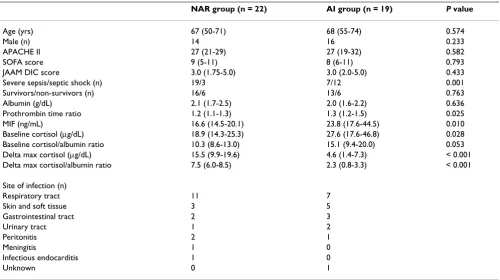
The enrolled patients were divided into two groups: the NAR group (n = 22) and the AI group (n = 19), based on the results of the ACTH stimulation test (Table 1). The number of septic shock patients was significantly greater in the AI group than in the NAR group. Mortality was not significantly different between the two groups. None of the clinical and laboratory data, with the exception of the prothrombin time ratio, were significantly different between the two groups. There was also no difference between the two groups regarding the site of infection.
[image:3.612.61.547.82.459.2]Study flow diagram
Figure 1
Table 1 presents a comparison of serum MIF, baseline cor-tisol, and the results of the ACTH stimulation test between the two groups. Serum MIF was significantly higher in the AI group than in the NAR group. Baseline cortisol was sig-nificantly higher in the AI group than in the NAR group, and the baseline cortisol/albumin ratio, which was used as an index of baseline free cortisol, was relatively but not significantly higher in the AI group. Delta max cortisol was significantly lower in the AI group, and the delta max cortisol/albumin ratio was significantly lower in the AI group than in the NAR group.
Correlations between serum MIF and clinical and laboratory parameters
[image:4.612.56.556.109.389.2]Table 2 lists the correlations between the serum MIF con-centrations and the clinical and laboratory parameters. Serum MIF correlated inversely with delta max cortisol and the delta max cortisol/albumin ratio. The Sequential Organ Failure Assessment (SOFA) score and prothrombin time ratio also correlated significantly with the serum MIF concentration. Serum MIF showed no correlation with baseline cortisol or the baseline free cortisol index.
Table 1: Comparison of the clinical and laboratory characteristics of the normal adrenal response group and the adrenal insufficiency group of patients
NAR group (n = 22) AI group (n = 19) P value
Age (yrs) 67 (50-71) 68 (55-74) 0.574
Male (n) 14 16 0.233
APACHE II 27 (21-29) 27 (19-32) 0.582
SOFA score 9 (5-11) 8 (6-11) 0.793
JAAM DIC score 3.0 (1.75-5.0) 3.0 (2.0-5.0) 0.433
Severe sepsis/septic shock (n) 19/3 7/12 0.001
Survivors/non-survivors (n) 16/6 13/6 0.763
Albumin (g/dL) 2.1 (1.7-2.5) 2.0 (1.6-2.2) 0.636
Prothrombin time ratio 1.2 (1.1-1.3) 1.3 (1.2-1.5) 0.025
MIF (ng/mL) 16.6 (14.5-20.1) 23.8 (17.6-44.5) 0.010
Baseline cortisol (μg/dL) 18.9 (14.3-25.3) 27.6 (17.6-46.8) 0.028 Baseline cortisol/albumin ratio 10.3 (8.6-13.0) 15.1 (9.4-20.0) 0.053 Delta max cortisol (μg/dL) 15.5 (9.9-19.6) 4.6 (1.4-7.3) < 0.001 Delta max cortisol/albumin ratio 7.5 (6.0-8.5) 2.3 (0.8-3.3) < 0.001
Site of infection (n)
Respiratory tract 11 7
Skin and soft tissue 3 5
Gastrointestinal tract 2 3
Urinary tract 1 2
Peritonitis 2 1
Meningitis 1 0
Infectious endocarditis 1 0
Unknown 0 1
All values are presented as medians (interquartile ranges).
[image:4.612.312.554.492.613.2]NAR: normal adrenal response; AI: adrenal insufficiency; APACHE II: Acute Physiology and Chronic Health Evaluation II; SOFA score: Sequential Organ Failure Assessment score; JAAM DIC score: Disseminated Intravascular Coagulation score established by the Japanese Association for Acute Medicine; Prothrombin time ratio: the ratio of the actual prothrombin time vs the normal control prothrombin time; MIF: macrophage migration inhibitory factor; Delta max cortisol: maximum increment in the cortisol concentration caused by the adrenocorticotropic hormone stimulation test.
Table 2: Correlations between serum macrophage migration inhibitory factor and other clinical and laboratory parameters
rs P value
APACHE II 0.144 0.371
SOFA score 0.414 0.007
JAAM DIC score 0.267 0.092
Albumin -0.290 0.860
Prothrombin time ratio 0.355 0.024 Baseline cortisol 0.212 0.182 Baseline cortisol/albumin ratio 0.237 0.135 Delta max cortisol -0.490 0.001 Delta max cortisol/albumin ratio -0.501 0.001
ROC curve analysis
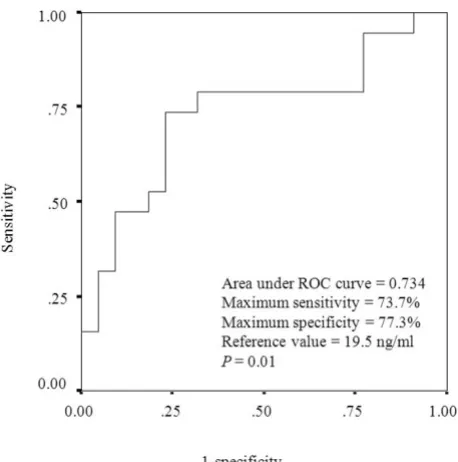
An ROC curve analysis was conducted to determine the threshold serum MIF concentration that segregated the patients into the NAR and AI groups (Figure 2). The area under the ROC curve was 0.734 and the MIF concentra-tion value with the highest sensitivity and specificity was the reference value of 19.5 ng/mL, with a sensitivity of 0.737 and specificity of 0.773 (P = 0.01).
Discussion
MIF is secreted by monocytes/macrophages after infec-tious stimulation and acts as a pro-inflammatory cytokine. An increase in MIF in critically ill patients and a correlation between serum MIF and early death in patients with severe sepsis have previously been reported [23-26]. It is noteworthy that MIF counteracts GC-induced anti-inflammatory activity and that low concentrations of GC induce MIF production by macrophages [17,18]. We spec-ulated that the serum MIF concentration might reflect adrenal function in the hypothalamo-pituitary-adrenal (HPA) axis in patients with sepsis.
The main and novel result of this study is the inverse cor-relation between the serum MIF concentration and delta
max cortisol (Table 2). A correlation between serum MIF and total baseline cortisol was reported previously [26,27]. However, this is the first report to suggest an asso-ciation between MIF and the adrenal response. In general, free cortisol is preferable to total cortisol in evaluating the adrenal function of the HPA axis, especially during exces-sive inflammation [28]. Free cortisol has physiological effects, but the direct measurement of free cortisol is com-plicated. Therefore, the ratio of total cortisol/albumin has been used as an index of free cortisol when evaluating HPA axis function [29,30]. Changes in the free cortisol index reflect the status of the inflammatory balance regu-lated by the HPA axis. In this study, a significant inverse correlation between serum MIF and the delta max corti-sol/albumin ratio was observed (Table 2). Consequently, high serum MIF is considered to be associated with insuf-ficient activation of the HPA axis in patients with severe sepsis or septic shock.
The dose of synthetic ACTH (0.25 mg) used in the present study was about 100-fold higher than the ACTH levels observed under physiological stress. Therefore, the serum cortisol concentration might reach its maximum level after the ACTH stimulation test. This means that the delta max cortisol value reflects the reserve capacity of the adre-nal gland. A low delta max cortisol suggests that the patient's adrenal glands are already highly activated and that his/her cortisol production isare insufficient to cope with the added stress. Therefore, the baseline cortisol observed in the AI group could be insufficient to accom-modate serious stress, even though it was significantly higher than that in the NAR group (Table 1). Therefore, the inverse correlation between serum MIF and delta max cortisol indicates that a high concentration of serum MIF might be associated with a relative insufficiency of innate cortisol activity or HPA axis dysfunction (Table 2).
The secretion of cortisol and the translocation of the GC receptor complex into the nucleus are impaired in criti-cally ill patients [31]. The pathophysiological condition of reduced steroid production (adrenal insufficiency) or tis-sue resistance to GC activity during critical illness is called "critical -illness-related corticosteroid insufficiency" (CIRCI) [22]. CIRCI is defined as inadequate cellular cor-ticosteroid activity for the additional stress experienced by the patient. Although the baseline cortisol concentration and baseline cortisol/albumin ratio in the AI group were higher than those in the NAR group (Table 1), they were not high enough to suppress the inflammatory response in the AI group patients. As a result, we could determine the threshold serum MIF level that defines adrenal insuf-ficiency. Using ROC curve analysis, we demonstrated that the threshold serum MIF level that segregated patients into the NAR group and AI group was 19.5 ng/mL and that the maximum sensitivity and specificity of this
[image:5.612.60.289.97.328.2]meas-ROC curve of serum MIF concentration used to segregate patients into the NAR and AI group
Figure 2
ure were 0.737 and 0.773, respectively (Figure 2). These results suggest that serum MIF is a good clinical marker of adrenal insufficiency.
In the present study, the SOFA score correlated signifi-cantly with serum MIF (Table 2). This result is consistent with previous reports that serum MIF is related to the severity of sepsis and mortality [23-26]. Macrophages con-tain a cercon-tain amount of pre-formed MIF, which is rapidly released with infectious stimulation [15]. MIF secretion from macrophages also occurred under challenge with low concentrations of lipopolysaccharide, which were 10-to 100-fold lower than the concentration necessary 10-to induce tumor necrosis factor α. MIF induced cytokine release, neutrophil accumulation, and persistent inflam-mation [15,32]. It has also been reported that the admin-istration of recombinant MIF increased the systemic toxicity of endotoxin, whereas anti-MIF antibody fully protected mice from endotoxic shock and death [17]. Consequently, we consider that the measurement of the serum MIF concentration in the early phase of sepsis is useful in detecting and even treating inflammatory imbal-ance and organ failure.
The correlation between serum MIF and the prothrombin time ratio indicates that an increase in the prothrombin time ratio predicts sequential organ failure. Moreover, the increase in serum MIF may indicate coagulopathic dys-function. MIF has recently become both an attractive marker for prognostic prediction and a therapeutic target, because levels of MIF are associated with the mechanisms of both inflammation and coagulation in sepsis [33]. The main target of sepsis treatment is inflammatory modula-tion, in which the activation of the HPA axis is involved. The relationship between MIF and delta max cortisol in the HPA axis network has been demonstrated in 10 the present study.
Because the measurement of serum MIF concentrations is not complicated, it is feasible during routine laboratory practice. Unlike the ACTH stimulation test, we can repeat-edly measure the MIF concentration within a short time period. Daily monitoring might be useful in evaluating the inflammation status and adrenal responses of criti-cally ill patients.
There are several limitations to this study. First, additional information is required to clarify the detailed mechanism involving adrenal function, the HPA axis, and MIF in crit-ically ill patients. Second, we used the cortisol/albumin ratio as the index of free cortisol to evaluate the adrenal function in the HPA axis. Although measurement of the free cortisol value is preferable, this procedure is not cur-rently widely available. However, it is probable that with improvements in laboratory techniques and increased
clinical demand, the method will become commercially available [34]. Third, the number of patients enrolled in this study was relatively small. We intend to continue this study of the relationship between MIF and the HPA axis.
Conclusions
An inverse correlation was demonstrated between MIF and delta max cortisol or the delta max cortisol/albumin ratio in patients with severe sepsis or septic shock. MIF may play an important role in sepsis as a pro-inflamma-tory cytokine and an inflammapro-inflamma-tory modulator, and may be a marker of the severity of the associated adrenal insuf-ficiency.
List of abbreviations
GC: glucocorticoid; ACTH: adrenocorticotropic hormone; MIF: macrophage migration inhibitory factor; NAR group: normal adrenal response group; AI group: adrenal insuffi-ciency group; ELISA: enzyme-linked immunosorbent assay; ROC: receiver operating characteristic; SOFA: Sequential Organ Failure Assessment; HPA axis: hypotha-lamo-pituitary-adrenal axis; CIRCI: critical-illness-related corticosteroid insufficiency.
Competing interests
The authors declare that they have no competing interests.
Authors' contributions
TM, RT, and TM designed the study. TM, MF, and TK col-lected the data. TM performed the statistical analyses and wrote the manuscript, and all authors participated in its critical revision. TM had the final responsibility for the decision to submit the manuscript for publication. All authors read and approved the final manuscript.
Acknowledgements
We thank Hitomi Ikemoto for her excellent technical assistance, Kiyoshi Ichihara for statistical advice, Masako Ueda for her special support, and the young medical staff of the Advanced Medical Emergency and Critical Care Center (AMEC3) for their contributions to this study. This study was sup-ported by grant 21791767 for Scientific Research from the Ministry of Health, Labor and Welfare, Japan.
References
1. Rivers E, Nguyen B, Havstad S, Ressler J, Muzzin A, Knoblich B, Peter-son E, Tomlanovich M: Early goal-directed therapy in the treat-ment of severe sepsis and septic shock. N Engl J Med 2001, 345:1368-1377.
2. Berghe G Van den, Wouters P, Weekers F, Verwaest C, Bruyninckx F, Schetz M, Vlasselaers D, Ferdinande P, Lauwers P, Bouillon R: Intensive insulin therapy in critically ill patients. N Engl J Med
2001, 345:1359-1367.
3. Vincent JL, Bernard GR, Beale R, Doig C, Putensen C, Dhainaut JF, Artigas A, Fumagalli R, Macias W, Wright T, Wong K, Sundin DP, Turlo MA, Janes J: Drotrecogin alfa (activated) treatment in severe sepsis from the global open-label trial ENHANCE: Further evidence for survival and safety and implications for early treatment. Crit Care Med 2005, 33:2266-2277.
Publish with BioMed Central and every scientist can read your work free of charge "BioMed Central will be the most significant development for disseminating the results of biomedical researc h in our lifetime."
Sir Paul Nurse, Cancer Research UK
Your research papers will be:
available free of charge to the entire biomedical community
peer reviewed and published immediately upon acceptance
cited in PubMed and archived on PubMed Central
yours — you keep the copyright
Submit your manuscript here:
http://www.biomedcentral.com/info/publishing_adv.asp
BioMedcentral 5. Vinsonneau C, Camus C, Combes A, Costa de Beauregard MA,
Klouche K, Pallot JL, Chiche JD, Taupin P, Landais P, Dhainaut JF: Continuous venovenous haemodiafiltration versus intermit-tent haemodialysis for acute renal failure in patients with multiple-organ dysfunction syndrome: a multicentre ran-domised trial. Lancet 2006, 368:379-385.
6. Russell JA, Walley KR, Singer J, Gordon AC, Hébert PC, Cooper DJ, Holmes CL, Mehta S, Granton JT, Storms MM, Cook DJ, Presneill JJ, Ayers D: Vasopressin versus norepinephrine infusion in patients with septic shock. N Engl J Med 2008, 358:877-887. 7. Cruz DN, Antonelli M, Fumagalli R, Foltran F, Brienza N, Donati A,
Malcangi V, Petrini F, Volta G, Pallavicini FMB, Rottoli F, Giunta F, Ronco C: Early use of polymyxin B hemoperfusion in abdom-inal septic shock. JAMA 2009, 301:2445-2452.
8. Annane D, Sébille V, Troché G, Raphaël JC, Gajdos P: A 3-level prognostic classification in septic shock based on cortisol lev-els and cortisol response to corticotropin. JAMA 2000, 283:1038-1045.
9. Gonzalez H, Nardi O, Annane D: Relative adrenal failure in the ICU: An identifiable problem requiring treatment. Crit Care Clin 2006, 22:105-118.
10. Keh D, Boehnke T, Weber-Cartens S, Schulz C, Ahlers O, Bercker S, Volk HD, Doecke WD, Falke KJ, Gerlach H: Immunologic and hemodynamic effects of "low-dose" hydrocortisone in septic shock. Am J Respir Crit Care Med 2003, 167:512-520.
11. Confalonieri M, Urbino R, Potena A, Piattella M, Parigi P, Puccio G, Porta RD, Giorgio C, Blasi F, Umberger R, Meduri GU: Hydrocorti-sone infusion for severe community-acquired pneumonia.
Am J Respir Crit Care Med 2005, 171:242-248.
12. Lefering R, Neugebauer EA: Steroid controversy in sepsis and septic shock: a meta-analysis. Crit Care Med 1995, 23:1294-1303. 13. Zeni F, Freeman B, Natanson C: Anti-inflammatory therapies to treat sepsis and septic shock: a reassessment. Crit Care Med
1997, 25:1095-1100.
14. Bloom B, Bennett B: Mechanism of a reaction in vitro associ-ated with delayed-type hypersensitivity. Science 1966, 153:80-82.
15. Calandra T, Bernhagen J, Mitchell RA, Bucala R: The macrophage is an important and previously unrecognized source of mac-rophage migration inhibitory factor. J Exp Med 1994, 179:1895-1902.
16. Nishihira J, Koyama Y, Mizue Y: Identification of macrophage migration inhibitory factor (MIF) in human vascular endothelial cells and its induction by lipopolysaccharide.
Cytokine 1998, 10:199-205.
17. Bernhagen J, Calandra T, Mitchell RA, Martin SB, Tracey KJ, Voelter W, Manogue KR, Cerami A, Bucala R: MIF is a pituitary-derived cytokine that potentiates lethal endotoxemia. Nature 1993, 365:756-759.
18. Calandra T, Bernhagen J, Metz CN, Spiegel LA, Bacher M, Donnelly T, Cerami A, Bucala R: MIF as a glucocorticoid-induced modulator of cytokine production. Nature 1995, 377:68-71.
19. The ACCP/SCCM Consensus Conference Committee: Definitions for sepsis and organ failure and guidelines for the use of inno-vative therapies in sepsis. Chest 1992, 101:1644-1655.
20. Annane D, Sébille V, Charpentier C, Bollaert PE, François B, Korach JM, Capellier G, Cohen Y, Azoulay E, Troché G, Chaumet-Riffaud P, Bellissant E: Effect of treatment with low doses of hydrocorti-sone and fludrocortihydrocorti-sone on mortality in patients with septic shock. JAMA 2002, 288:862-871.
21. Annane D, Maxime V, Ibrahim F, Alvarez JC, Abe E, Boudou P: Diag-nosis of adrenal insufficiency in severe sepsis and septic shock. Am J Respir Crit Care Med 2006, 174:1319-1326.
22. Marik PE, Pastores SM, Annane D, Meduri GU, Sprung CL, Arlt W, Keh D, Briegel J, Beishuizen A, Dimopoulou I, Tsagarakis S, Singer M, Chrousos GP, Zaloga G, Bokhari F, Vogeser M, American College of Critical Care Medicine: Recommendations for the diagnosis and management of corticosteroid insufficiency in critically ill adult patients: Consensus statements from an international task force by the American College of Critical Care Medi-cine. Crit Care Med 2008, 36:1937-1949.
23. Beishuizen A, Thijs LG, Haanen C, Vermes I: Macrophage migra-tion inhibitory factor and hypothalamo-pituitary-adrenal function during critical illness. J Clin Endocrinol Metab 2001, 86:2811-2816.
24. Bozza FA, Gomes RN, Japiassú AM, Soares M, Castro-Faria-Neto HC, Bozza PT, Bozza MT: Macrophage migration inhibitory factor levels correlate with fatal outcome in sepsis. Shock 2004, 22:309-313.
25. Sprong T, Pickkers P, Geurts-Moespot A, Ven-Jongekrijg J van der, Neeleman C, Knaup M, LeRoy D, Calandra T, van der Meer JW, Sweep F, van Deuren M: Macrophage migration inhibitory fac-tor (MIF) in meningococcal septic shock and experimental human endotoxemia. Shock. 2004, 27(5):482-487.
26. Emonts M, Sweep FC, Grebenchtchikov N, Geurts-Moespot A, Knaup M, Chanson AL, Erard V, Renner P, Hermans PW, Hazelzet JA, Calandra T: Association between high levels of blood macro-phage migration inhibitory factor, inappropriate adrenal response, and early death in patients with severe sepsis. Clin Infect Dis 2007, 44:1321-1328.
27. Maxime V, Fitting C, Annane D, Cavaillon JM: Corticoids normal-ize leukocyte production of macrophage migration inhibi-tory factor in septic shock. J Infect Dis 2005, 191:138-144. 28. Ho JT, Al-Musalhi H, Chapman MJ, Quach T, Thomas PD, Baqley CJ,
Lewis JG, Torpy DJ: Septic shock and sepsis: A comparison of total and free plasma cortisol levels. J Clin Endocrinol Metab
2006, 91:105-114.
29. De Jong MF, Beishuizen A, Spijkstra JJ, Girbes AR, Strack van Schijndel RJ, Twisk JW, Groeneveld AB: Predicting a low cortisol response to adrenocorticotropic hormone in the critically ill: a retro-spective cohort study. Crit Care 2007, 11:R61.
30. De Jong MF, Beishuizen A, Spijkstra JJ, Groeneveld AB: Relative adrenal insufficiency as a predictor of disease severity, mor-tality, and beneficial effects of corticosteroid treatment in septic shock. Crit Care Med 2007, 35:1896-1903.
31. Widmer IE, Puder JJ, König C, Pargger H, Zerkowski HR, Girard J, Müller B: Cortisol response in relation to the severity of stress and illness. J Clin Endocrinol Metab 2005, 90:4579-4586.
32. Makita H, Nishimura M, Miyamoto K, Nakano T, Tanino Y, Hirokawa J, Nishihira J, Kawakami Y: Effect of anti-macrophage migration inhibitory factor antibody on lipopolysaccharide-induced pulmonary neutrophil accumulation. Am J Respir Crit Care Med
1998, 158:573-579.
33. Gando S, Sawamura A, Hayakawa M, Hoshino H, Kubota N, Nishihira J: High macrophage migration inhibitory factor levels in dis-seminated intravascular coagulation patients with systemic inflammation. Inflammation 2007, 30:118-124.
34. Vogeser M, Mohnle P, Briegel J: Free serum cortisol: Quantifica-tion applying equilibrium dialysis or ultrafiltraQuantifica-tion and an automated immunoassay system. Clin Chem Lab Med 2007, 45:521-525.
Pre-publication history
The pre-publication history for this paper can be accessed here: