• No results found

Lecture 00 Array Stack Queue

N/A
N/A
Protected

Academic year: 2020

Share "Lecture 00 Array Stack Queue"

Copied!
39
0
0

Loading.... (view fulltext now)

Full text

(1)

String Edit Distance

(and intro to dynamic programming)

Lecture #4

Computational Linguistics

CMPSCI 591N, Spring 2006

University of Massachusetts Amherst

(2)

Dynamic Programming

• (Not much to do with “programming” in the

CS sense.)

• Dynamic programming is efficient in finding

optimal solutions for cases with lots of

overlapping sub-problems

.

• It solves problems by recombining solutions

to sub-problems, when the sub-problems

(3)

Fibonacci Numbers

(4)
(5)

Calculating Fibonacci Numbers

F(n) = F(n-1) + F(n-2),

where F(0)=0, F(1)=1.

Non-Dynamic Programming implementation

def fib(n):

if n == 0 or n == 1:

return n

else:

(6)

DP Example:

[image:6.792.162.678.209.555.2]

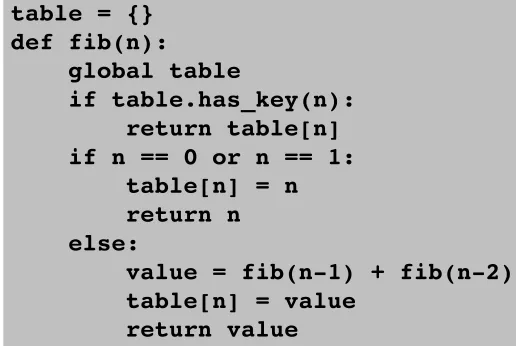
Calculating Fibonacci Numbers

table = {}

def fib(n):

global table

if table.has_key(n):

return table[n]

if n == 0 or n == 1:

table[n] = n

return n

else:

value = fib(n-1) + fib(n-2)

table[n] = value

return value

(7)

DP Example:

Calculating Fibonacci Numbers

def fib(n):

table = [0] * (n+1)

table[0] = 0

table[1] = 1

for i in range(2,n+1):

table[i] = table[i-2] + table[i-1]

return table[n]

...or alternately, in a list instead of a dictionary...

We will see this pattern many more times in this course:

(8)

String Edit Distance

Andrew

Amdrewz

1. substitute

m

to

n

2. delete the

z

Distance = 2

Given two strings (sequences) return the “distance”

between the two strings as measured by...

(9)

String distance metrics: Levenshtein

• Given strings s and t

– Distance is

shortest sequence of edit

commands

that transform

s

to

t,

(or equivalently s

to

t

)

.

– Simple set of operations:

• Copy character from

s

over to

t

(cost 0)

• Delete a character in

s

(cost 1)

• Insert a character in

t

(cost 1)

• Substitute one character for another (cost 1)

(10)

Levenshtein distance - example

• distance(“William Cohen”, “Willliam Cohon”)

2

S

O

E

C

C

C

C

C

C

C

C

I

C

C

C

C

2

1

1

1

1

1

1

1

1

0

0

0

0

N

H

O

C

_

M

A

I

L

L

L

I

W

N

H

O

C

_

M

A

I

L

L

I

W

s

t

edit

op

cost

so far...

alignment

gap

(11)

Finding the Minimum

Another fine day in the park

Anybody can see him pick the ball

Not so easy.... not so clear.

Not only are the strings, longer, but is isn

t immediately

obvious where the alignments should happen.

What if we consider all possible alignments by brute force?

How many alignments are there?

(12)

Dynamic Program Table for String Edit

E

K

c

ij

A

P

S

K

R

A

P

Measure distance between strings

PARK

SPAKE

c

ij

=

(13)

Dynamic Programming to the Rescue!

• Given some partial solution, it isn’t hard to figure

out what a good next immediate step is.

• Partial solution =

“This is the cost for aligning s up to position i

with t up to position j.

• Next step =

“In order to align up to positions x in s and y in

t, should the last operation be a substitute,

insert, or delete?

(14)

Dynamic Program Table for String Edit

E

K

A

P

S

K

R

A

P

Measure distance between strings

PARK

SPAKE

delete

insert

substitute

Edit operations

for turning

SPAKE

into

(15)

Dynamic Program Table for String Edit

E

K

???

c

31

c

30

A

c

24

c

23

c

22

c

21

c

20

P

c

14

c

13

c

12

c

11

c

10

S

c

05

c

04

c

03

c

00

K

R

A

P

Measure distance between strings

PARK

SPAKE

(16)

Dynamic Program Table for String Edit

E

K

???

c

31

c

30

A

c

24

c

23

c

22

c

21

c

20

P

c

14

c

13

c

12

c

11

c

10

S

c

05

c

04

c

03

c

00

K

R

A

P

c

02

D(i,j) = score of

best

alignment from

s1..si

to

t1..tj

= min

D(i-1,j-1), if si=tj

//copy

D(i-1,j-1)+1, if si!=tj

//substitute

D(i-1,j)+1

//insert

D(i,j-1)+1

//delete

delete

(17)

Computing Levenshtein distance - 2

D(i,j) = score of

best

alignment from

s1..si

to

t1..tj

= min

D(i-1,j-1) + d(si,tj)

D(i-1,j)+1

//subst/copy

//insert

D(i,j-1)+1

//delete

(simplify by letting d(c,d)=0 if c=d, 1 else)

(18)

Dynamic Program Table Initialized

5

E

4

K

3

A

2

P

1

S

4

3

2

1

0

K

R

A

P

D(i,j) = score of

best

alignment from

s1..si

to

t1..tj

= min

D(i-1,j-1)+d(si,tj)

//substitute

D(i-1,j)+1

//insert

(19)

Dynamic Program Table ... filling in

5

E

4

K

3

A

2

P

1

1

S

4

3

2

1

0

K

R

A

P

D(i,j) = score of

best

alignment from

s1..si

to

t1..tj

= min

D(i-1,j-1)+d(si,tj)

//substitute

D(i-1,j)+1

//insert

(20)

Dynamic Program Table ... filling in

5

E

4

K

3

A

2

P

4

3

2

1

1

S

4

3

2

1

0

K

R

A

P

D(i,j) = score of

best

alignment from

s1..si

to

t1..tj

= min

D(i-1,j-1)+d(si,tj)

//substitute

D(i-1,j)+1

//insert

(21)

Dynamic Program Table ... filling in

5

E

4

K

3

A

1

2

P

4

3

2

1

1

S

4

3

2

1

0

K

R

A

P

D(i,j) = score of

best

alignment from

s1..si

to

t1..tj

= min

D(i-1,j-1)+d(si,tj)

//substitute

D(i-1,j)+1

//insert

(22)

Dynamic Program Table ... filling in

3

3

3

4

5

E

2

2

2

3

4

K

3

2

1

2

3

A

4

3

2

1

2

P

4

3

2

1

1

S

4

3

2

1

0

K

R

A

P

D(i,j) = score of

best

alignment from

s1..si

to

t1..tj

= min

D(i-1,j-1)+d(si,tj)

//substitute

D(i-1,j)+1

//insert

D(i,j-1)+1

//delete

(23)

DP String Edit Distance

def stredit (s1,s2):

"Calculate Levenstein edit distance for strings s1 and s2."

len1 = len(s1) # vertically

len2 = len(s2) # horizontally

# Allocate the table

table = [None]*(len2+1)

for i in range(len2+1): table[i] = [0]*(len1+1)

# Initialize the table

for i in range(1, len2+1): table[i][0] = i

for i in range(1, len1+1): table[0][i] = i

# Do dynamic programming

for i in range(1,len2+1):

for j in range(1,len1+1):

if s1[j-1] == s2[i-1]:

d = 0

else:

d = 1

table[i][j] = min(table[i-1][j-1] + d,

table[i-1][j]+1,

(24)

Remebering the Alignment (trace)

D(i,j) = min

D(i-1,j-1) + d(si,tj)

D(i-1,j)+1

//subst/copy

//insert

D(i,j-1)+1

//delete

3

3

3

4

5

N

4

3

2

3

4

H

5

4

3

2

3

O

5

4

3

3

2

C

5

4

3

2

1

C

5

4

3

2

1

M

N

E

H

O

C

A

trace

indicates

where the min

value came from,

and can be used to

find edit

operations and/or

a best

alignment

(25)

Three Enhanced Variants

• Needleman-Munch

– Variable costs

• Smith-Waterman

– Find longest “soft matching” subsequence

• Affine Gap Distance

– Make repeated deletions (insertions) cheaper

(26)

Needleman-Wunch distance

D(i,j) = min

D(i-1,j-1) + d(si,tj)

D(i-1,j) +

G

//subst/copy

//insert

D(i,j-1) +

G

//delete

d(c,d) is an arbitrary

distance function on

characters (e.g. related

to typo frequencies,

amino acid

substitutibility, etc)

William Cohen

Wukkuan Cigeb

(27)

Smith-Waterman distance

• Instead of looking at each sequence in its

entirety, this compares segments of all

possible lengths and chooses whichever

maximize the similarity measure.

• For every cell the algorithm calculates all

(28)

Smith-Waterman distance

D(i,j) = min

0 //start over

D(i-1,j-1) + d(si,tj)

//subst/copy

D(i-1,j) + G

//insert

D(i,j-1) + G

//delete

G = 1

d(c,c) = -2

d(c,d) = +1

(29)

Example output from Python

s ' a l l o n g e r

0 1 2 3 4 5 6 7 8 9 10

l 1 0 0 0 0 *

0

0 0 0 0 0

o 2 0 0 0 0 0 *

-2

-1 0 0 0

u 3 0 0 0 0 0 *

-1

-1 0 0 0

n 4 0 0 0 0 0 0 *

-3

-2 -1 0

g 5 0 0 0 0 0 0 -2 *

-5

-4 -3

e 6 0 0 0 0 0 0 -1 -4 *

-7

-6

(30)

Affine gap distances

• Smith-Waterman fails on some pairs that

seem quite similar:

William W. Cohen

William W. ‘Don’t call me Dubya’ Cohen

Intuitively, a single long insertion is “cheaper”

than a lot of short insertions

(31)

Affine gap distances - 2

• Idea:

– Current cost of a “gap” of

n

characters:

nG

(32)

Affine gap distances - 3

D(i,j) = max

D(i-1,j-1) + d(si,tj)

D(i-1,j)-1

//insert

//subst/copy

D(i,j-1)-1

//delete

IS(i,j) = max

D(i-1,j) -

A

IS(i-1,j) -

B

IT(i,j) = max

D(i,j-1) -

A

IT(i,j-1) -

B

Best score in which si

is aligned with a ‘gap’

Best score in which tj

is aligned with a ‘gap’

D(i-1,j-1) + d(si,tj)

(33)

Affine gap distances as automata

-B

-B

-d(si,tj)

D

IS

IT

-d(si,tj)

-d(si,tj)

-A

(34)

Generative version of affine gap

automata

(Bilenko&Mooney, TechReport 02)

HMM emits

pairs:

(c,d)

in

state

M

, pairs

(c,-)

in state

D

, and pairs

(-,d)

in state

I.

For each state there is a

multinomial

distribution

on pairs.

The HMM can trained with

EM from a sample of pairs

of

matched

strings

(s,t)

(35)

Affine gap edit-distance learning:

experiments results

(Bilenko & Mooney)

Experimental method: parse records into fields; append a

few key fields together; sort by similarity; pick a

threshold

T

and call all pairs with distance(

s,t

) <

T

(36)
(37)

Affine gap edit-distance learning:

experiments results

(Bilenko & Mooney)

(38)

Affine gap distances – experiments

(from McCallum, Nigam,Ungar KDD2000)

(39)

Homework #2

• The assignment

– Start with my stredit.py code

– Make some modifications

– Write a little about your experiences

• Some possible modifications

– Implement Needleman-Wunch, Smith-Waterman, or Affine Gap

Distance.

– Create a little spell-checker: if entered word isn’t in the dictionary,

return the dictionary word that is closest.

– Change implementation to operate on sequences of

words

rather

than characters... get an online translation dictionary, and find

alignments between English & French or English & Russian!

Figure

table = {}def fib(n):

References

Related documents

SEARG: Southern and Eastern African Rabies Group; OIE/WAHID: World Organi- zation for Animal Health/World animal health information..

AQUIK: Ambulatory Quality indicators and figures (Germany); CDS: Swiss Conference of the cantonal health directors; CMPR: College of Primary Care Medicine; FMH: Swiss

This study aimed at assessing the proportions and risk factors of poor immune recovery in adult HIV- infected patients on 48 months of HAART attending care and treatment center (CTC)

leaves extract,with 70% ethanol/ water, as potential natural antioxidant.The phytochemical screening identified the bioactive compounds of the dry extract;

government innovation support will encourage firms to increase their innovative inputs in the?. form of innovative collaborations, the management practices of the firm itself

Government’s Capital Spending in Information Technology; The Status of General Information Technology Controls in the Government of British Columbia; and the Web Application

Child Protection, Intake Social Worker: Screen incoming reports; provide consultation to community and HSPHD staff; conduct child protection family assessments and