R E S E A R C H
Open Access
The impact of lipid-based nutrient supplementation
on anti-malarial antibodies in pregnant women in
a randomized controlled trial
Upeksha P Chandrasiri
1*, Freya JI Fowkes
2,3,4, Jack S Richards
1,2, Christine Langer
2, Yue-Mei Fan
5,6, Steve M Taylor
7,8,
James G Beeson
1,2, Kathryn G Dewey
9, Kenneth Maleta
10, Per Ashorn
5,6and Stephen J Rogerson
1*Abstract
Background:Malaria and undernutrition frequently coexist, especially in pregnant women and young children. Nutrient supplementation of these vulnerable groups might reduce their susceptibility to malaria by improving immunity.
Methods:Antibody immunity to antigens expressed by a placental-binding parasite isolate, a non-placental binding parasite isolate, merozoites and schizonts at enrolment (before 20 gestation weeks) and at 36 gestation weeks were measured in 1,009 Malawian pregnant women receiving a daily lipid-based nutrient supplement, multiple micronutrients or iron and folic acid, who were participants in a randomized clinical trial assessing the effects of nutrient supplementation on pregnancy outcomes and child development(registration ID: NCT01239693). Results:Antibodies to placental-binding isolates significantly increased while antibodies to most merozoite antigens declined over pregnancy. Overall, after adjustment for covariates, the type of supplementation did not influence antibody levels at 36 gestation weeks or the rate of change in antibody levels from enrolment to 36 weeks. A negative association between maternal body mass index and opsonizing antibodies to placental-binding antigens (coefficient (95% CI) -1.04 (−1.84,−0.24), was observed. Similarly, women with higher socioeconomic status had significantly lower IgG and opsonizing antibodies to placental-binding antigens. Neither of these associations was significantly influenced by the supplementation type.
Conclusions:In the current cohort nutrient supplementation did not affect anti-malarial antibody responses, but poor and undernourished mothers should be a priority group in future trials.
Keywords:Malaria in pregnancy, Malawi, nutrient supplements, placental-binding parasite isolate, opsonizing antibodies, immunoglobulin G isotypes, variant surface antigens, merozoite antigens, body mass index, socioeconomic status
Background
It is estimated that about 125 million pregnancies world-wide are at risk of malaria annually, significantly increas-ing maternal and child morbidity and mortality [1]. Undernutrition is prevalent in regions where women are at high risk of malaria in pregnancy [2]. This coexistence of undernutrition and malaria markedly increases the risk of adverse birth outcomes, such as intrauterine
growth restriction, compared to malaria or undernutri-tion alone [3,4]. The complex relaundernutri-tionship between malaria and nutrition has been studied [5,6], but under-standing of its mechanisms remains limited. Malaria in pregnancy predisposes women to anaemia, and may re-sult in reduced nutrient intake due to febrile illness and anorexia. Malaria also increases susceptibility to other infections through its immunosuppressive effects [7-9], whilst on the other hand both macronutrient and micronutrient deficiencies may increase the risk of in-fections including malaria [6]. This increased suscepti-bility is believed to be due to impairment of host * Correspondence:[email protected];[email protected]
1
Department of Medicine, Clinical Sciences Building, The University of Melbourne, Royal Parade, Parkville, VIC 3052, Australia
Full list of author information is available at the end of the article
immune defences [10] such as abnormalities in comple-ment activation [11] and impaired cell mediated im-munity [12] leading to reduced antibody production.
In endemic regions, pregnant women naturally acquire antibodies to malaria with repeated exposure to infec-tious mosquito bites prior to and during pregnancy. During first pregnancies, women frequently acquire anti-bodies to the pregnancy-specific antigens, primarily to VAR2CSA ofPlasmodium falciparumerythrocyte mem-brane protein-1 family of variant surface antigens (VSA). These antibodies help protect women against adverse clinical outcomes in subsequent pregnancies [13]. How-ever, undernourished women may have difficulty effect-ively maintaining or acquiring antibodies against malaria antigens.
In non-malaria-related studies both macro- and micro-nutrient supplementation have been shown to signifi-cantly improve pregnancy outcomes and maternal health [14,15]. Lipid-based nutrient supplements (LNS) are multiple micronutrient-fortified lipid-rich products that can be beneficial as prenatal supplements in vulnerable groups [16-18]. Prenatal LNS has been shown to im-prove birth length [16] and reduce weight loss in HIV-infected mothers [17], and in young HIV-exposed infants LNS is suitable as a breast milk replacement [19]. In addition, LNS may improve linear growth outcomes in young children [20,21].
The only study to date that has assessed the effects of maternal nutrient supplementation on malaria antibody levels reported that vitamin A prenatal supplements were associated with a reduction in antibody responses to a placental-binding isolate EJ-24, but no significant changes in antibody responses to non-pregnancy related parasite isolates were observed [22].
In areas with food insecurity and high malaria trans-mission, nutritional supplements could improve preg-nancy outcomes and may also lead to stronger acquired immune responses to malaria. To investigate this, anti-body immunity was measured to antigens expressed by placental-binding and non-placental-binding parasite isolates, merozoite antigens and schizont extract in preg-nant women from Mangochi, Malawi enrolled in a ran-domized controlled trial receiving daily LNS, multiple micronutrients (MMN - multi vitamin and minerals combined supplement) or iron and folic acid supple-ments (IFA – 60 mg of iron and 400 μg of folic acid). The primary aim was to determine whether LNS supple-mentation improved antibody responses to malaria in pregnancy compared to IFA or MMN.
Methods Study participants
From February 2011, 1391 pregnant women attending four antenatal clinics in Mangochi District, Malawi were
recruited to a single-blinded randomized controlled trial of nutrient supplementation to improve pregnancy outcomes and child development (registration ID: NCT01239693 [23]). Mangochi District experiences holoendemic malaria transmission and a high preva-lence of stunting (low height-for-age Z-score) and low weight-for-age among infants. Women <20 gestation weeks (gw) pregnant by ultrasound dating, aged >15 years of age and without any chronic health conditions were en-rolled in the study following informed consent. They were randomly assigned to receive one tablet of IFA, one tablet of MMN or 20 g of LNS (containing 20 mg iron and 400
μg of folic acid) daily [23]. The final maternal visit of the trial was completed in February 2013. All participants re-ceived two doses of sulphadoxine-pyrimethamine (SP) malaria intermittent preventative treatment at enrolment and at 28–34 gestation weeks [23]. The follow up of the children of the trial is currently ongoing with the last visit expected to complete by December 2015; for further de-tails [23,24].
Ethics approval
The trial was approved by the College of Medicine Re-search and Ethics Committee of Malawi, and by Tampere University Hospital Ethics Committee, Finland. Labora-tory studies were approved by the Melbourne Health Hu-man Research Ethics Committee.
Plasma sample collection and malaria detection
Preparation of recombinant malaria antigens and schizont extract
Recombinant merozoite surface protein-1, MSP-1 19 kD (3D7 clone) and full-length MSP-2 (FC27 clone) anti-gens [26] were kindly provided by Paul Gilson (Burnet Institute, VIC, Australia) and Robin Anders (La Trobe University, Australia) respectively. In addition region III-V of erythrocyte binding antigen 175 (EBA 175) [27],P. falciparum reticulocyte binding homologue 2 (PfRh2) (construct PfRh2-2030) [28] and the full length MSP-3 recombinant proteins were prepared following estab-lished protocols. The schizont extract was prepared fol-lowing the protocol described in [29].
Measuring IgG and IgG subclass antibodies to merozoite and schizont antigens, and quantitating total plasma IgG In brief, 0.5-2 μg/ml of each recombinant antigen was coated on to 384 well high protein binding black Opti-plates (PerkinElmer Inc., Massachusetts, USA). The plates were washed with PBS/Tween 20 and non-specific binding blocked with 0.1% casein on the following day. The plates were then incubated with participant sera di-luted at 1:1,000 in 0.1% casein and assayed in triplicates. Alexa Fluor 488-conjugated goat anti-human IgG (Life technologies, Australia) was used at 1:2,000 dilution to detect antigen-bound IgG. The fluorescence intensity (FI) of each well, which is proportional to the amount of IgG bound, was measured using BMG POLARstar Omega fluorimeter (BMG Labtech, Germany) in the 485–1 excitation and 520 emission spectra range.
Plasmas collected at enrolment and at 36 gw from 150 participants (50 from each supplementation group) were chosen by selecting alternate pairs of samples from 4 boxes containing equal numbers of samples from the three supplementation arms, blind to participant clinical data. These samples were used to measure IgG subclass antibodies to the above antigens. Antigens were coated at the same concentration on 384 well NUNC maxisorp plates (Thermo Fisher Scientific, VIC, Australia) and were incubated in triplicates with plasma on the following day at 1:250 dilution for IgG1and IgG3, and 1:50 for IgG2 and IgG4. Following incubation the plates were washed and incubated with respective mouse anti-human sec-ondary antibodies (IgG1 clone HP6069, IgG2 clone HP6002, IgG3 HP6047 [Life Technologies, Australia] and IgG4 clone HP6023 (Merck Millipore, Darmstadt, Germany) at 1:1,000 dilution. Tertiary antibody horse-radish peroxidase-conjugated goat anti-mouse IgG was added at 1:2,500 dilution followed by development of the assay using ABTS (2,2′-Azino-bis(3-ethylbenzo-thiazoline-6-sulfonic acid); SIGMA-Aldrich). The reac-tion was stopped using 1% sodium dodecyl sulphate, and absorbance was read on the BMG POLARstar Omega fluorimeter at 410 nm wavelength.
The total plasma IgG in the samples of the above 150 pregnant women were measured using the fluorescence assay method described above. Gamma-chain specific anti-human IgG capture antibody (SIGMA-Aldrich) was coated on to the plates at 0.5 μg/ml concentration and incubated with participants’ plasma diluted at 1:50,000. The concentration of IgG in each sample was deter-mined using a purified human IgG isotype control (Life technologies) standard curve (1μg/ml–0.016μg/ml).
Serial samples were run on the same assay. The mean FI (MFI) or optical density (OD) were reported as a per-centage of the positive control standard curve following adjustment for inter and intra plate variability. The posi-tive control was a pool of plasma collected from malaria-immune individuals. The positivity for IgG was determined as greater than mean plus three standard de-viations of the negative control (60 plasma samples col-lected from Melbourne adults).
Parasites and cell culture
Placental-bindingP. falciparumisolate, CS2 which binds to chondroitin sulphate A (CSA) expressed in placenta tissue with upregulated expression of var2csa [30] and non-placental binding P. falciparum isolate, E8B which binds to ICAM-1 and CD36 [31] were cultured as previ-ously described [32]. Pro-monocytic THP-1 cells were obtained from ATCC (Manassas, VA, USA; catalogue number TIB-202™) and maintained as previously de-scribed [33].
Opsonic phagocytosis assay for measuring functional antibodies to placental-binding and non-placental-binding malaria variant surface antigens
In order to measure antibodies that opsonize pRBCs for phagocytic clearance a high throughput assay previously established in the current laboratory was used [33], with minor modifications [34], as described [32]. The per-centage phagocytosis was determined relative to the positive control (pRBCs incubated with a pool of sera from patients with high levels of IgG to VSA). A partici-pant was considered seropositive for opsonizing anti-bodies if the percentage phagocytosis of the samples was greater than the sum of the average and three standard deviations of the percentage phagocytosis of the negative controls.
Measuring IgG to variant surface antigens expressed by placental-binding parasite isolate
Using published methods [32,35] IgG to VSA expressed by the placental-binding isolate was measured. Alexa Fluor® 647-conjugated donkey anti-rabbit antibody (Life Technologies) was used as the tertiary antibody at 4
measured and adjusted for intra and inter-plate vari-ability. The adjusted MFI for all samples were reported as a percentage of the positive control. Seropositivity to placental-binding VSA was calculated as geometric MFI greater than the mean and three standard deviations of the negative control.
Statistical analyses
All statistical analyses were performed in Stata version 13.0 (SataCorp LP, Texas, USA). Figures were created using GraphPad Prism 5. Statistical analyses were per-formed according to the pre-planned analyses for the current study approved and published in [24]. Antibody levels were compared between supplementation groups LNS versus IFA and LNS versus MMN using Mann Whitney U test. Differences between antibody levels at the two time points were determined using Wilcoxon matched-pair test. The rate of change in antibody levels was calculated as difference between antibody levels at 36 gw and antibody levels at enrolment divided by the number of weeks of the study. A rate of change of 0, suggests no change in antibody levels per week of gesta-tion. The rate of change in antibody levels was compared between LNS and IFA, and LNS and MMN, where IFA and MMN were the respective reference groups, by per-forming linear regression analysis.
Levels of antibody of each IgG subclass to merozoite and schizont antigens were compared between supple-mentation groups LNS versus IFA and LNS versus MMN using Mann Whitney U test. Comparisons were also made between antibody levels at enrolment and at 36 weeks using Wilcoxon matched-pair test.
The covariates of the association between supplemen-tation type and malaria antibody immunity were deter-mined based on their biological relevance. Covariates chosen were gravidity, maternal age, HIV infection, mal-aria infection, residence, socioeconomic status (SES), body mass index (BMI) and antibody levels at enrol-ment. Gravidity, maternal age, HIV and malaria infection were previously shown to associate with malaria anti-body immunity [36,37]. Participants’SES was calculated based on a scoring system for household assets (HHA) adapted from [38]. Participants whose HHA adjusted z-score was below the median were considered to have low SES. Body mass index (BMI) at enrolment was cate-gorized into three groups as low (<18.5 kg/m2); normal (18.5-25 kg/m2) and increased (>25 kg/m2). All the vari-ables were treated as categorical except for antibody levels at enrolment which was treated as a continuous variable. Likelihood ratio test was used to test whether the association between supplementation type and anti-body levels at 36 weeks varied with covariates chosen for the study.
Nevertheless, all of the above variables (gravidity, mater-nal age, HIV, malaria infection at enrolment, location of residence, SES, BMI and antibody levels at enrolment were included in the multivariate regression models. Multivariate linear regression analyses for continuous out-comes (antibody levels at 36 weeks and the rate of change in antibody levels) and multivariate logistic regression ana-lyses for categorical outcomes (seropositivity to malaria antigens). Differences in antibody levels among women with different BMI and SES groups were determined fol-lowing multivariate linear regression analysis, adjusting for covariates including supplementation group, as de-tailed in the table footnotes. Associations were considered statistically significant if the p value is <0.05.
Results
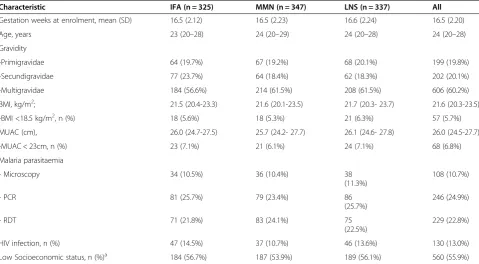
Participant characteristics
Overall 1,391 women were enrolled in the iLiNS-DYAD-M study. iLiNS-DYAD-Malaria immunity was only measured in the 1,009 enrolment and 36 weeks paired plasma samples that were available. The baseline characteristics of the participants across the supplementation arms were com-parable (Table 1). The mean (SD) gestational age in weeks at enrolment was 16.5 (2.1) for IFA, 16.5 (2.2) for MMN and 16.6 (2.2) for LNS groups (Table 1). Ap-proximately 60.2% of women were multigravidae. Pro-portion of women with BMI <18.5 kg/m2was 5.7% and MUAC < 23cm was 6.8%, who were identified as under-nourished women in the current cohort. Thirteen per-cent of women were HIV infected. The proportion of participants lost to follow up between the supplementa-tion groups was similar with an overall 6.04% lost to follow up [23].
Changes in antibody levels between enrolment and 36 weeks
Additional file 1), similar to the decline in antibody re-sponses to merozoite antigens and non-placental-binding parasite isolate VSA.
Effect of nutrient supplementation on antibody immune responses to malaria
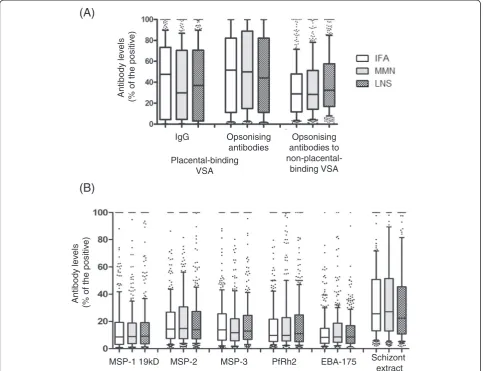
When categorized by the supplementation groups, no sig-nificant differences in the levels of antibody to placental-binding or non-placental-placental-binding isolates were observed at 36 weeks (Figure 2A). There were also no significant differences in antibodies to merozoite or schizont anti-gens, when stratified by supplementation type (Figure 2B). Following adjustment for covariates, the levels of antibody to MSP-2 and PfRh2 at 36 weeks were significantly lower in the LNS group compared to MMN −3.98 (−7.59, −0.37) and −4.44 (−8.85, −0.03), respectively (See Additional file 2).
There were no differences in the prevalence of detect-able antibody responses at 36 weeks by supplementa-tion group (See Addisupplementa-tional file 3). More than 85% of the pregnant women had antibodies to placental-binding VSA.
Effect of supplementation on the rate of change in antibodies to malaria antigens
Significant differences in the rate of change in anti-bodies to parasite isolate VSA were not found between
supplementation groups (Table 2), except for MSP-2. The rate of change in MSP-2 antibodies was signifi-cantly negatively associated with LNS group compared to MMN −0.25 (−0.46, −0.04) suggesting a faster de-cline in MSP-2 antibody responses in the LNS group (Table 2).
Modification of the association between malaria antibody levels and supplementation group by covariates
Factors that influenced the relationship between anti-body levels at 36 weeks and supplementation groups were investigated. This relationship was only affected by the antibody levels at enrolment (see Additional file 4). Levels at enrolment of opsonizing antibodies to non-placental binding and antibodies to MSP-2, MSP-3 and PfRh2 at enrolment significantly influenced the relation-ship between supplementation type and the levels of the respective antibodies at 36 weeks (0.001 < p < 0.006; Additional file 4). The effect modification by MSP-3 antibodies at enrolment was significant on the associ-ation between antibodies to MSP-3 at 36 weeks between LNS and IFA groups 3.44 (0.14, 6.75).
Effect of nutrient supplementation on IgG subclass responses to malaria
[image:5.595.58.538.100.364.2]For all the antigens tested, the highest subclass response was for IgG3 followed by IgG1 and IgG2 with almost Table 1 Baseline characteristics of study participants
Characteristic IFA (n = 325) MMN (n = 347) LNS (n = 337) All
Gestation weeks at enrolment, mean (SD) 16.5 (2.12) 16.5 (2.23) 16.6 (2.24) 16.5 (2.20)
Age, years 23 (20–28) 24 (20–29) 24 (20–28) 24 (20–28)
Gravidity
-Primigravidae 64 (19.7%) 67 (19.2%) 68 (20.1%) 199 (19.8%)
-Secundigravidae 77 (23.7%) 64 (18.4%) 62 (18.3%) 202 (20.1%)
-Multigravidae 184 (56.6%) 214 (61.5%) 208 (61.5%) 606 (60.2%)
BMI, kg/m2; 21.5 (20.4-23.3) 21.6 (20.1-23.5) 21.7 (20.3- 23.7) 21.6 (20.3-23.5)
-BMI <18.5 kg/m2, n (%) 18 (5.6%) 18 (5.3%) 21 (6.3%) 57 (5.7%)
MUAC (cm), 26.0 (24.7-27.5) 25.7 (24.2- 27.7) 26.1 (24.6- 27.8) 26.0 (24.5-27.7)
-MUAC < 23cm, n (%) 23 (7.1%) 21 (6.1%) 24 (7.1%) 68 (6.8%)
Malaria parasitaemia
- Microscopy 34 (10.5%) 36 (10.4%) 38
(11.3%)
108 (10.7%)
- PCR 81 (25.7%) 79 (23.4%) 86
(25.7%)
246 (24.9%)
- RDT 71 (21.8%) 83 (24.1%) 75
(22.5%)
229 (22.8%)
HIV infection, n (%) 47 (14.5%) 37 (10.7%) 46 (13.6%) 130 (13.0%)
Low Socioeconomic status, n (%)a 184 (56.7%) 187 (53.9%) 189 (56.1%) 560 (55.9%)
Data presented as median (Interquartile range), or number (%) unless stated. a
undetectable IgG4 responses (See Additional file 5). When categorized by the supplementation groups, sub-class responses were not significantly different. For many subclass responses, antibody levels declined significantly between enrolment and 36 weeks, in keeping with the decline in IgG to each antigen observed; this was most apparent for IgG3 antibodies.
Influence of maternal nutrition status and socioeconomic status on malaria antibody responses
Overall, higher levels of malaria antibodies were observed for women with low BMI compared to the other BMI groups (Figure 3A-C). This difference was significant for opsonic antibodies to both placental-binding; median (p-value), 52.8% (p = 0.005) and non-placental-binding iso-lates 41.0% (p = 0.001) (Figure 3B-C), and was not affected
by the supplementation type. When antibody responses were stratified by supplementation groups, significant dif-ferences in antibody levels between BMI groups within the same supplementation group were observed, although these associations were not strongly consistent (Figure 3).
Following adjustment for covariates, opsonizing anti-bodies to the placental-binding isolate, antianti-bodies to PfRh2 and schizont extract were significantly negatively associated with BMI, a unit (1 kg/m2) increase in BMI is associated with a decrease in relative antibody levels by−1.04% (95% CI:−1.84,−0.24),−0.66% (−1.32,−0.004) and−1.22% (−2.08,−0.37) respectively (Table 3).
In a univariate analysis, women with a low SES had significantly higher antibody levels to VSA compared to women with high SES, including both opsonizing anti-bodies and IgG to placental-binding VSA (p < 0.001),
(A)
IgG Opsonising
antibodies
Opsonising antibodies to non-placental-binding VSA
Antibod
y
lev
els
(% of
the
positiv
e)
Placental-binding VSA
(B)
MSP-1 19kD MSP-2 MSP-3 PfRh2 EBA-175 Schizont
extract
Antibod
y
lev
e
ls
(% of
the
positiv
[image:6.595.61.538.89.474.2]e)
and opsonizing antibodies to non-placental-binding VSA (p = 0.005) (Figure 3D-F). Both IgG and opsonizing anti-bodies to the placental-binding isolate (but not other re-sponses) remained significantly associated with SES following adjustment for covariates, coefficients −9.54 (−14.74, −4.35) and −5.47 (−10.43, −0.50) respectively (Table 3).
Discussion
The association between nutrient supplementation and malaria immunity was evaluated in 1,009 pregnant women enrolled in a randomized controlled trial com-paring LNS, MMN and IFA. Ingestion of LNS was not associated with significant increases in malaria antibody levels, a faster rate of change of antibody levels from en-rolment to 36 weeks, or likelihood of seropositivity to
malaria antigens. This study is the first to investigate the relationship between nutrient supplementation and mal-aria immunity in detail.
Antibodies were measured against VSA expressed by a placental-binding and non-placental-binding parasite isolate, merozoite antigens and schizont extract. Anti-bodies to placental-binding VSA reduced the risk of pla-cental malaria by inhibiting cytoadhesion to receptors [37], and by promoting their phagocytic clearance [39]. Antibodies to merozoite antigens can prevent invasion of pRBCs [29] inhibit intra-erythrocytic development and opsonize merozoites for phagocytic clearance [40,41] contributing to the protection against clinical malaria.
A strong increase in both total and opsonizing anti-bodies to placental-binding VSA from study entry to 36
IgG Opsonising antibodies
Opsonising antibodies to non-placental-binding VSA
Antibod
y
lev
els
(% of
the
positiv
e)
Placental-binding VSA
Antibod
y
lev
e
ls
(% of
the
positiv
e)
MSP-1 19kD MSP-2 MSP-3 PfRh2 EBA-175 Schizont extract
(A)
[image:7.595.57.541.90.461.2](B)
weeks was observed while antibodies to merozoite anti6-gens and non-placental-binding isolates declined. Several explanations are possible. First, most parasite isolates in-fecting pregnant women express antigens that are unique and are exclusively expressed during pregnancy [42]. Antibodies induced against such antigens may have a longer half-life than those directed against merozoite antigens [43]. Second, reduction in total plasma IgG at 36 weeks suggests haemodilution may have an impact on antibody levels to non-placental-binding malaria anti-gens; however, antibodies to tetanus and measles show very little decline during pregnancy [43] suggesting hae-modilution is not always a significant factor. Third, anti-bodies to antigens expressed by a placental-binding isolate appear to be maintained from previous pregnan-cies, and the majority of women in the cohort were multigravidae with high levels of these antibodies at study entry; exposure to new infections might rapidly boost antibody responses. By contrast, antibodies to merozoite antigens have been reported to fluctuate markedly with exposure during pregnancy [43]. Of note, all participants received repeated doses of SP; parasite resistance to this agent in Malawi is common, but not high-grade [44]. Parasites with SP resistance demon-strate mutations in the genes encoding P. falciparum dihydrofolate reductase (DHFR) and dihydropteroate (DHPS). In Malawian pregnant women quintuple muta-tions of DHFR and DHPS are highly prevalent, however the prevalence of more severe sextuple mutant DHPS
581 which is associated with increased placental inflam-mation is uncommon [45].
[image:8.595.63.540.106.302.2]The type of supplementation had no strong or con-sistent influence on malaria antibody levels, however a regression analysis showed a decline in antibody re-sponses to MSP-2 and PfRh2 from enrolment to 36 weeks, and an increased rate of reduction in antibody levels to MSP-2, in women who received LNS com-pared to MMN. Given the large number of compari-sons reported, these differences in the adjusted models could be due to chance. Similar differences in other anti-merozoite antibodies were not observed, and the significance of the changes is unknown. The current study also reported the effects of nutrient supplementa-tion on antibody responses in subsets of women at high risk of undernutrition and infection; those with poor nutritional status and low SES. A negative relationship was observed between malaria antibody levels and ma-ternal BMI and SES. Overall, women with a low BMI at study entry had higher antibody levels to VSA than did women with normal or increased BMI. Supplementa-tion type did not influence the relaSupplementa-tionship between antibody responses and BMI. Of all the antibody types being tested the opsonizing antibodies to VSA were the most strongly related to BMI and SES in the current cohort, suggesting that these women might be exposed to more malaria (Nkhoma M et al., unpublished work) during the current pregnancy, thereby eliciting pregnancy-specific immunity. Poorer women could have more Table 2 Association between nutrient supplementation and the rate of change in antibody levels
Rate of change in antibody levels (Percentage antibody level change per gestation week, arbitrary units)
LNS (n = 337) compared to IFA (n = 325) LNS (n = 337) compared to MMN (n = 347) Unadjusted Adjusted Adjusted
p-value
Unadjusted Adjusted Adjusted p-value
IgG to placental-binding isolate VSA −0.12 (−0.34, 0.11) −0.08 (−0.38, 0.22) 0.599 0.13 (−0.09, 0.36) 0.26 (−0.04, 0.55) 0.089 Opsonizing antibodies to
placental-binding solate VSA
−0.02 (−0.24, 0.19) −0.11 (−0.41, 0.19) 0.469 0.06 (−0.14, 0.27) 0.02 (−0.26, 0.30) 0.864
Opsonizing antibodies to
non-placental-binding isolate VSA −
0.002 (−0.12, 0.12) 0.01 (−0.16, 0.18) 0.888 −0.08 (−0.19, 0.03) 0.02 (−0.13, 0.18) 0.756
MSP-1 19kD −0.02 (−0.17, 0.12) 0.006 (−0.18, 0.19) 0.953 −0.06 (−0.19, 0.08) 0.04 (−0.14, 0.21) 0.693
MSP-2 −0.12 (−0.27, 0.03) −0.20 (−0.40, 0.02) 0.069 −0.15 (−0.32, 0.01) −0.25 (−0.46,−0.04)* 0.021*
MSP-3 −0.18 (−0.36,−0.01)* −0.21 (−0.44, 0.03) 0.080 −0.05 (−0.24, 0.14) −0.01 (−0.28, 0.27) 0.970
PfRh2 0.07 (−0.13, 0.27) 0.10 (−0.17, 0.37) 0.461 −0.21 (−0.40,−0.02)* −0.25 (−0.51, 0.02) 0.073
EBA-175 −0.06 (−0.18, 0.06) −0.04 (−0.20, 0.13) 0.639 −0.07 (−0.20, 0.05) −0.05 (−0.24, 0.14) 0.603
Schizont extract −0.03 (−0.28, 0.23) 0.13 (−0.21, 0.48) 0.450 0.003 (−0.26, 0.27) 0.10 (−0.26, 0.47) 0.583
Results presented as regression coefficients (95% confidence interval) calculated by comparing the percentage rate of change in antibody levels in LNS group compared to IFA (reference group) and LNS group compared to MMN (reference group).
The percentage rate of change in antibody levels from enrolment to 36 gw were adjusted for gravidity, maternal age, HIV, malaria infection at enrolment, malaria infection at 36 weeks, bed net use, body mass index at enrolment, socioeconomic status and location of residence.
exposure to malaria due to poor housing that allows entry of mosquitoes, and they may be less likely to own insecticide-treated bed nets. In addition poverty could lead to poor nutrient intake due to inability to afford food es-pecially during the hunger season.
The study had several limitations. The timing of nu-tritional interventions may be critical; supplementation starting prior to conception and continuing through out pregnancy and lactation may offer more benefits. In the current study the intervention started on average at 16.5 gw, following malaria peak prevalence, at around 12-17gw. Therefore the maximal benefits of the supple-mentation on malaria antibody acquisition may have been missed. Primigravidae constituted only 20% of participants, limiting our ability to examine acquisition of pregnancy-specific immunity in this group. Samples were missing for 382 of 1,391 women enrolled. Poten-tial causes include failure to attend the 36-week visit, or pre-term deliveries (prior to 37 weeks). In addition
unavailability of participant data for some of the covari-ates may have reduced the power of the multiple re-gression analyses. For analysis of BMI and malaria immunity, stratification of participants reduced the study power: for instance only 57 pregnant women were in the low BMI group.
Conclusions
Overall the current study concluded that nutrient sup-plementation of pregnant women was not associated with broad changes in antibody responses to malaria. This study is the first to investigate interactions be-tween nutrition and malaria immunity in pregnancy and further studies must be conducted to determine the role of nutrient supplementation on other compo-nents of host immune system such as cell-mediated immunity, to determine the overall influence of nutri-ent supplemnutri-entation on malaria susceptibility and mal-aria immunity.
(A)
Antibody
lev
e
ls
(% of
the
positiv
e
)
All IFA MMN LNS
Total IgG to placental-binding VSA
(B)
Opsoni
si
ng
antibodi
es
(% of
the
posi
ti
v
e
)
All IFA MMN LNS
Opsonising antibodies to placental-binding VSA
Opsoni
sing
antibodi
es
(% of
the
posi
ti
v
e
)
(C)
All IFA MMN LNS
Opsonising antibodies to non-placental-binding VSA
BMI groups
(D)
Antibody
lev
e
ls
(% of
the
positiv
e
)
All IFA MMN LNS
Total IgG to placental-binding VSA
(E)
Opsoni
sing
antibodi
es
(% of
the
positiv
e
)
All IFA MMN LNS
Opsonising antibodies to placental-binding VSA
(F)
Opsoni
sing
antibodi
es
(% of
the
positiv
e
)
All IFA MMN LNS
Opsonising antibodies to non-placental-binding VSA
[image:9.595.59.537.88.417.2]SES groups
Table 3 Relationship of maternal nutritional status and socioeconomic status to malaria antibody immunity at 36 weeks
Body mass index at enrolment (kg/m2) Socioeconomic status (high/low)
Unadjusted Adjusteda Adjusted p-valuea Unadjusted Adjustedb Adjusted p-valueb
IgG to placental-binding isolate VSA −0.88 (−1.66,−0.10)* −0.72 (−1.57, 0.12) 0.095 −13.9 (−18.25,−9.58)* −9.54 (−14.74,−4.35)* <0.001*
Opsonizing antibodies to placental-binding isolate VSA −0.86 (−1.65,−0.06)* −1.04 (−1.84,−0.24)* 0.011* −14.7 (−19.18,−10.27)* −5.47 (−10.43,−0.50)* 0.031*
Opsonizing antibodies to non-placental-binding isolate VSA −0.53 (−1.11, 0.06) 0.25 (−0.20, 0.70) 0.272 −4.07 (−7.42,−0 .70)* −0.59 (−3.38, 2.20) 0.678
MSP-1 19kD −0.08 (−0.53, 0.37) 0.45 (−0.02, 0.92) 0.060 −1.62 (−4.19, 0.96) −1.39 (−4.36, 1.57) 0.355
MSP-2 −0.40 (−0.88, 0.08) 0.14 (−0.37, 0.65) 0.595 −2.41 (−5.12, 0.30) −0.26 (−3.46, 2.94) 0.874
MSP-3 −0.01 (−0.47, 0.44) 0.06 (−0.57, 0.69) 0.856 −0.83 (−3.43, 1.77) 0.38 (−3.55, 4.31) 0.849
PfRh2 −0.30 (−0.77, 0.17) −0.66 (−1.32,−0.004)* 0.051* −0.49 (−3.17, 2.18) 0.49 (−3.64, 4.61) 0.817
EBA-175 −0.15 (−0.46, 0.16) 0.11 (−0.28, 0.50) 0.573 −1.12 (−2.89, 0.65) −0.22 (−2.66, 2.22) 0.858
Schizont extract −0.64 (−1.35, 0.07) −1.22 (−2.08,−0.37)* 0.005* −5.17 (−9.24,−1.10)* −0.55 (−6.12, 5.01) 0.845
Data presented as regression coefficient (95% confidence interval). a
Percentage antibody levels at 36 gestation week adjusted for gravidity, maternal age, HIV, malaria infection at enrolment, bed net use, location of residence, antibody levels at enrolment, socioeconomic status, supplementation group.
b
Percentage antibody levels at 36 gestation week adjusted for gravidity, maternal age, HIV, malaria infection at enrolment, bed net use, location of residence, antibody levels at enrolment, body mass index at enrolment, supplementation group.
Statistical test: Multivariate linear regression analysis. Data reported as regression coefficient (95% confidence interval) and p-values. *Significant associations.
al.
Malaria
Journal
(2015) 14:193
Page
10
of
Additional files
Additional file 1:Plasma IgG at enrolment and at 36 gestation weeks.Data presented as box plot with the whiskers representing 10th and the 90thpercentiles with outliers. Y axis presents plasma IgG concentration in g/L calculated from the standard curve created by purified human IgG. Wilcoxon matched pair test performed for comparison of antibody levels between enrolment and 36 weeks. Total plasma IgG significantly reduced (p < 0.0001) by 36 weeks compared to the levels at enrolment. Plasma IgG concentration was measured in a subset of women (n = 150).
Additional file 2:Association between nutrient supplementation and antibodies to malaria at 36 gestation weeks.
Additional file 3:Seropositivity to malaria antigens at 36 gestation weeks.
Additional file 4:Antibody levels at enrolment as effect modifiers of the relationship between antibody levels at 36 weeks and supplementation group.
Additional file 5:IgG subclass measurements for merozoite antigens and schizont extract at enrolment and at 36 weeks.Antibody IgG subclasses presented as optical density (OD) measured at 410nm, categorized by supplementation groups for antigens 1 19kD, MSP-2, MSP-3, PfRhMSP-2, EBA-175 and schizont extract (A-F). Kruskal Wallis test performed to determine subclass level differences between supplementation groups (IFA and LNS, MMN and LNS). Wilcoxon matched-pair test was performed for comparing subclass levels between enrolment and 36 gw. No significant differences in subclass levels across the supplementation groups were observed. Subclass levels at enrolment and 36 weeks were significantly different, denoted as P < 0.05 *, p < 0.005 **, p < 0.0001 ***. IFA (n = 50), MMN (n = 50), LNS (n = 50).
Abbreviations
VSA:variant surface antigens; LNS: lipid-based nutrient supplement; gw: gestation weeks; MMN: multiple micronutrient supplement; IFA: iron and folic acid; HHA: household assets; SES: socioeconomic status; BMI: body mass index; MUAC: mid-upper arm circumference; MSP: merozoite surface protein; EBA: erythrocyte binding antigen; PfRh:Plasmodium falciparumreticulocyte binding homologue.
Competing interests
The authors declared that they have no competing interests.
Authors’contributions
UPC carried out all the malaria antibody level measurements, statistical analyses and drafting of the manuscript. FJIF assisted in statistical analyses and interpretation. JSR implemented immunofluorescence ELISA and IgG subclass level measurement techniques and assisted in data analysis, CL assisted in the preparation of recombinant merozoite antigens, YF was involved in sample collection and storage logistics, SMT conducted real-time PCR runs targetingpfldhgene, JGB provided the lab facilities and materials required for recombinant merozoite protein preparation, KGD and KM were involved in the setting up of the trial and are the co-principal investigators of the trial, PA is the primary investigator of the clinical trial who was involved in study design, supervision of the clinical trial, sample and data collection. SJR supervised the laboratory work, contributed to the data analyses and interpretation and was involved in the preparation of the manuscript. All authors read and approved the final manuscript.
Acknowledgements
We thank the study participants, the local communities, the health service staff and our research personnel at the study sites as well as members of the trial’s data safety and monitoring board, and the International Lipid-based Nutrient Supplementation (iLiNS)-Project Steering Committee (http://www.ilins.org/) for their positive attitude, support and help in all stages of the study. In addition we would like to thank Steven Meshnick, Kyaw L Thwai, Wina Hasang and Philippe Boeuf for advice and technical support.
Financial support
This publication is based on research funded in part by a grant from the Office of Health, Infectious Diseases, and Nutrition, Bureau for Global Health, U.S. Agency for International Development (USAID) under terms of Cooperative Agreement No. AID-OAA-A-12-00005, through the Food and Nutrition Technical Assistance III Project (FANTA), managed by FHI 360. Additional funding was obtained from a grant to the University of California, Davis from the Bill & Melinda Gates Foundation. SJR is supported by the National Health and Medical Research Council (NHMRC) of Australia. JGB supported by Senior Research Fellowship by the NHMRC of Australia. The Burnet Institute is supported by the NHMRC IRIIS Scheme and Victorian State Government Operational Infrastructure Support.
Author details
1Department of Medicine, Clinical Sciences Building, The University of Melbourne, Royal Parade, Parkville, VIC 3052, Australia.2Macfarlane Burnet Institute of Medical Research, 85 Commercial Road, Melbourne, Australia. 3
Centre for Epidemiology and Biostatistics, Department of Epidemiology, The University of Melbourne, Melbourne, Australia.4Preventive Medicine and Department of Infectious Diseases, Monash University, Melbourne, Australia. 5Department for International Health, University of Tampere School of Medicine, Tampere, Finland.6Department of Paediatrics, Tampere University Hospital, Tampere, Finland.7Duke University Medical Center, Durham, North Carolina, USA.8Gillings School of Global Public Health, University of North Carolina, Chapel Hill, USA.9Department of Nutrition, University of California Davis, Davis, California, USA.10College of Medicine, University of Malawi, Blantyre, Malawi.
Received: 5 January 2015 Accepted: 16 April 2015
References
1. Dellicour S, Tatem AJ, Guerra CA, Snow RW, ter Kuile FO. Quantifying the number of pregnancies at risk of malaria in 2007: a demographic study. PLoS Med. 2010;7:e1000221.
2. UNSCN. Fourth report on the world nutrition situation: nutrition throughout the life cycle. Geneva: United Nations Administrative Committee on Coordination Sub-Committee on Nutrition, (ACC/SCN); 2000. 3. Kalanda BF, Verhoeff FH, Chimsuku L, Harper G, Brabin BJ. Adverse birth
outcomes in a malarious area. Epidemiol Infect. 2006;134:659–66. 4. Landis SH, Lokomba V, Ananth CV, Atibu J, Ryder RW, Hartmann KE, et al.
Impact of maternal malaria and under-nutrition on intrauterine growth restriction: a prospective ultrasound study in Democratic Republic of Congo. Epidemiol Infect. 2009;137:294–304.
5. McGregor IA. Malaria: nutritional implications. Rev Infect Dis. 1982;4:798–804. 6. Shankar AH. Nutritional modulation of malaria morbidity and mortality.
J Infect Dis. 2000;182 Suppl 1:S37–53.
7. Illingworth J, Butler NS, Roetynck S, Mwacharo J, Pierce SK, Bejon P, et al. Chronic exposure toPlasmodium falciparumis associated with phenotypic evidence of B and T cell exhaustion. J Immunol. 2013;190:1038–47. 8. Enwere GC, Ota MO, Obaro SK. The host response in malaria and
depression of defence against tuberculosis. Ann Trop Med Parasitol. 1999;93:669–78.
9. Williamson WA, Greenwood BM. Impairment of the immune response to vaccination after acute malaria. Lancet. 1978;1:1328–9.
10. Keusch GT. Immune function in the malnourished host. Pediatr Ann. 1982;11:1004–14.
11. Haller L, Zubler RH, Lambert PH. Plasma levels of complement components and complement haemolytic activity in protein-energy malnutrition. Clin Exp Immunol. 1978;34:248–52.
12. Savino W, Dardenne M. Nutritional imbalances and infections affect the thymus: consequences on T-cell-mediated immune responses. Proc Nutr Soc. 2010;69:636–43.
13. Duffy PE.Plasmodiumin the placenta: parasites, parity, protection, prevention and possibly preeclampsia. Parasitology. 2007;134:1877–81. 14. Imdad A, Bhutta ZA. Maternal nutrition and birth outcomes: effect of
balanced protein-energy supplementation. Paediatr Perinat Epidemiol. 2012;1:178–90.
and gestational age at birth in a low-income, multi-ethnic population. Br J Nutr. 2010;104:437–45.
16. Huybregts L, Roberfroid D, Lanou H, Menten J, Meda N, Van Camp J, et al. Prenatal food supplementation fortified with multiple micronutrients increases birth length: a randomized controlled trial in rural Burkina Faso. Am J Clin Nutr. 2009;90:1593–600.
17. Kayira D, Bentley ME, Wiener J, Mkhomawanthu C, King CC, Chitsulo P, et al. A lipid-based nutrient supplement mitigates weight loss among HIV-infected women in a factorial randomized trial to prevent mother-to-child transmission during exclusive breastfeeding. Am J Clin Nutr. 2012;95:759–65. 18. Chaparro CM, Dewey KG. Use of lipid-based nutrient supplements (LNS) to
improve the nutrient adequacy of general food distribution rations for vulnerable sub-groups in emergency settings. Matern Child Nutr. 2010;1:1–69. 19. Flax VL, Bentley ME, Chasela CS, Kayira D, Hudgens MG, Kacheche KZ, et al. Lipid-based nutrient supplements are feasible as a breastmilk replacement for HIV-exposed infants from 24 to 48 weeks of age. J Nutr. 2013;143:701–7. 20. Iannotti LL, Dulience SJ, Green J, Joseph S, Francois J, Antenor ML, et al.
Linear growth increased in young children in an urban slum of Haiti: a randomized controlled trial of a lipid-based nutrient supplement. Am J Clin Nutr. 2014;99:198–208.
21. Phuka JC, Maleta K, Thakwalakwa C, Cheung YB, Briend A, Manary MJ, et al. Complementary feeding with fortified spread and incidence of severe stunting in 6- to 18-month-old rural Malawians. Arch Pediatr Adolesc Med. 2008;162:619–26.
22. Cox SE, Staalsoe T, Arthur P, Bulmer JN, Tagbor H, Hviid L, et al. Maternal vitamin A supplementation and immunity to malaria in pregnancy in Ghanaian primigravids. Trop Med Int Health. 2005;10:1286–97.
23. Ashorn P, Alho L, Ashorn U, Cheung YB, Dewey KG, Harjunmaa U, et al. The impact of lipid-based nutrient supplement provision to pregnant women on newborn size in rural Malawi: a randomized controlled trial. Am J Clin Nutr. 2015;101:387–97.
24. iLiNS Project Research. [http://ilins.org/ilins-project-research/protocols] 25. Rantala AM, Taylor SM, Trottman PA, Luntamo M, Mbewe B, Maleta K, et al.
Comparison of real-time PCR and microscopy for malaria parasite detection in Malawian pregnant women. Malar J. 2010;9:269.
26. Stanisic DI, Richards JS, McCallum FJ, Michon P, King CL, Schoepflin S, et al. Immunoglobulin G subclass-specific responses againstPlasmodium falciparum merozoite antigens are associated with control of parasitemia and protection from symptomatic illness. Infect Immun. 2009;77:1165–74.
27. Richards JS, Stanisic DI, Fowkes FJI, Tavul L, Dabod E, Thompson JK, et al. Association between naturally acquired antibodies to erythrocyte-binding antigens ofPlasmodium falciparumand protection from malaria and high-density parasitemia. Clin Infect Dis. 2010;51:e50–60.
28. Reiling L, Richards JS, Fowkes FJI, Barry AE, Triglia T, Chokejindachai W, et al. Evidence That the erythrocyte invasion ligand PfRh2 is a target of protective immunity againstPlasmodium falciparummalaria. J Immunol.
2010;185:6157–67.
29. Persson KE, McCallum FJ, Reiling L, Lister NA, Stubbs J, Cowman AF, et al. Variation in use of erythrocyte invasion pathways byPlasmodium falciparum mediates evasion of human inhibitory antibodies. J Clin Invest.
2008;118:342–51.
30. Duffy MF, Byrne TJ, Elliott SR, Wilson DW, Rogerson SJ, Beeson JG, et al. Broad analysis reveals a consistent pattern of var gene transcription in Plasmodium falciparumrepeatedly selected for a defined adhesion phenotype. Mol Microbiol. 2005;56:774–88.
31. Beeson JG, Brown GV.Plasmodium falciparum-infected erythrocytes demonstrate dual specificity for adhesion to hyaluronic acid and chondroitin sulfate A and have distinct adhesive properties. J Infect Dis. 2004;189:169–79.
32. Chandrasiri UP, Randall LM, Saad AA, Bashir AM, Rogerson SJ, Adam I. Low antibody levels to pregnancy-specific malaria antigens and heightened cytokine responses associated with severe malaria in pregnancy. J Infect Dis. 2014;209:1408–17.
33. Ataide R, Hasang W, Wilson DW, Beeson JG, Mwapasa V, Molyneux ME, et al. Using an improved phagocytosis assay to evaluate the effect of HIV on specific antibodies to pregnancy-associated malaria. PLoS One. 2010;5, e10807.
34. Teo A, Hasang W, Randall LM, Feng G, Bell L, Unger H, et al. Decreasing malaria prevalence and its potential consequences for immunity in pregnant women. J Infect Dis. 2014;210:1444–55.
35. Aitken EH, Mbewe B, Luntamo M, Maleta K, Kulmala T, Friso M, et al. Antibodies to chondroitin sulfate a–binding infected erythrocytes: dynamics and protection during pregnancy in women receiving intermittent preventive treatment. J Infect Dis. 2010;201:1316–25.
36. Ataide R, Mwapasa V, Molyneux ME, Meshnick SR, Rogerson SJ. Antibodies that induce phagocytosis of malaria infected erythrocytes: effect of HIV infection and correlation with clinical outcomes. PLoS One. 2011;6, e22491. 37. Fried M, Nosten F, Brockman A, Brabin BJ, Duffy PE. Maternal antibodies
block malaria. Nature. 1998;395:851–2.
38. Filmer D, Pritchett LH. Estimating wealth effects without expenditure data– or tears: an application to educational enrollments in states of India. Demography. 2001;38:115–32.
39. Feng G, Aitken E, Yosaatmadja F, Kalilani L, Meshnick SR, Jaworowski A, et al. Antibodies to variant surface antigens ofPlasmodium falciparum-infected erythrocytes are associated with protection from treatment failure and the development of anemia in pregnancy. J Infect Dis. 2009;200:299–306. 40. Hill DL, Eriksson EM, Li Wai Suen CS, Chiu CY, Ryg-Cornejo V, Robinson LJ,
et al. Opsonising antibodies to P. falciparum merozoites associated with immunity to clinical malaria. PLoS One. 2013;8, e74627.
41. Osier FH, Feng G, Boyle MJ, Langer C, Zhou J, Richards JS, et al. Opsonic phagocytosis ofPlasmodium falciparummerozoites: mechanism in human immunity and a correlate of protection against malaria. BMC Med. 2014;12:108.
42. Doritchamou J, Bertin G, Moussiliou A, Bigey P, Viwami F, Ezinmegnon S, et al. First-trimesterPlasmodium falciparuminfections display a typical
“placental”phenotype. J Infect Dis. 2012;206:1911–9.
43. Fowkes FJ, McGready R, Cross NJ, Hommel M, Simpson JA, Elliott SR, et al. New insights into acquisition, boosting, and longevity of immunity to malaria in pregnant women. J Infect Dis. 2012;206:1612–21.
44. Taylor SM, Antonia AL, Harrington WE, Goheen MM, Mwapasa V, Chaluluka E, et al. Independent lineages of highly sulfadoxine-resistantPlasmodium falciparumhaplotypes, eastern Africa. Emerg Infect Dis. 2014;20:1140–8. 45. Gutman J, Kalilani L, Taylor S, Zhou Z, Wiegand RE, Thwai KL,et al.The
A581G mutation in the gene encodingPlasmodium falciparum dihydropteroate synthetase reduces the effectiveness of sulfadoxine-pyrimethamine preventive therapy in Malawian pregnant women. J Infect Dis.2015, 6. [Epub ahead of print].
Submit your next manuscript to BioMed Central and take full advantage of:
• Convenient online submission
• Thorough peer review
• No space constraints or color figure charges
• Immediate publication on acceptance
• Inclusion in PubMed, CAS, Scopus and Google Scholar
• Research which is freely available for redistribution