City, University of London Institutional Repository
Citation
:
Naseri, H., Koukouvinis, P., Malgarinos, I. & Gavaises, M. (2018). On viscoelastic cavitating flows: A numerical study. Physics of Fluids, 30(3), 033102. doi: 10.1063/1.5011978This is the accepted version of the paper.
This version of the publication may differ from the final published
version.
Permanent repository link:
http://openaccess.city.ac.uk/19438/Link to published version
:
http://dx.doi.org/10.1063/1.5011978Copyright and reuse:
City Research Online aims to make research
outputs of City, University of London available to a wider audience.
Copyright and Moral Rights remain with the author(s) and/or copyright
holders. URLs from City Research Online may be freely distributed and
linked to.
City Research Online: http://openaccess.city.ac.uk/ [email protected]
On viscoelastic cavitating flows: A numerical study
12
Homa Naseri, Phoevos Koukouvinis, Ilias Malgarinos and Manolis Gavaises 3
4
School of Mathematics, Computer Science & Engineering, City, University of London, 5
London, Northampton Square, EC1V 0HB, UK 6
7
Keywords: 8
Cavitation, Viscoelasticity, Phan-Thien-Tanner Fluid 9
10
Abstract
11
The effect of viscoelasticity on turbulent cavitating flow inside a nozzle is simulated for 12
Phan-Thien-Tanner (PTT) fluids. Two different flow configurations are used to show the 13
effect of viscoelasticity on different cavitation mechanisms, namely cloud cavitation 14
inside a step nozzle and string cavitation in an injector nozzle. 15
In incipient cavitation condition in the step nozzle, small-scale flow features including 16
cavitating microvortices in the shear layer, are suppressed by viscoelasticity. Flow 17
turbulence and mixing is weaker compared to the Newtonian fluid, resulting in 18
suppression of microcavities shedding from the cavitation cloud. Moreover, mass 19
flowrate fluctuations and cavity shedding frequency are reduced by the stabilizing effect 20
of viscoelasticity. Time averaged values of the liquid volume fraction show that 21
cavitation formation is strongly suppressed in the PTT viscoelastic fluid, and the cavity 22
cloud is pushed away from the nozzle wall. 23
In the injector nozzle, a developed cloud cavity covers the nozzle top surface while a 24
vortex-induced string cavity emerges from the turbulent flow inside the sac volume. 25
Similar to the step nozzle case, viscoelasticity reduces the vapor volume fraction in the 26
cloud region. However, formation of the streamwise string cavity is stimulated as 27
turbulence is suppressed inside the sac volume and the nozzle orifice. Vortical 28
perturbations in the vicinity of the vortex are damped allowing more vapor to develop in 29
the string cavity region. The results indicate that the effect of viscoelasticity on 30
cavitation depends on the alignment of the cavitating vortices with respect to the main 31
1
1. Introduction
33
Cavitation dynamics and control is the subject of ongoing research with applications in 34
pumps and propellers1–3, injector nozzles4–6 and medicine7–9. In nozzle flows, cavitation
35
vapors block the effective flow passage area, significantly reducing the nozzle 36
discharge coefficient10–13. Computational fluid dynamics (CFD) studies and X-rays of
37
cavitating flows can directly show the reduction of fluid density in a nozzle due to 38
cavitation 4,6,14–17. Fully compressible simulations of cavitating nozzle flows can reveal
39
that pressure waves produced during the bubble collapse events increase the jet 40
instabilities and promote the primary jet breakup17.
41
Fluid properties can affect the in-nozzle flow by modifying the flow turbulence and 42
cavitation. This is because formation and collapse of cavitation vapors is subject to 43
pressure fluctuations due to local flow instabilities and a two-way interaction exists 44
between cavitation and turbulence. Moreover, collapse of cavitation bubbles is a 45
primary mechanism for vorticity production and enhancement of streamwise velocity 46
fluctuations18–21. Compression and expansion of cavitation vapors results in
47
misalignment of the density gradients and the pressure gradients, hence the baroclinic 48
torque (the source term ijk 2
j k p
e /
x x
ρ ρ
∂ ∂
∂ ∂ appearing in the vorticity transport equation) is 49
increased, producing vorticity 19,20. Time-resolved X-ray densitometry of cavitation
void-50
fraction in a cavity cloud22 has identified that in addition to the re-entrant jet motion,
51
bubbly shock propagation due to reduction of speed of sound in the mixture region, is 52
responsible for the shedding of the cavitation cloud. More recently, high speed phase 53
contrast imaging using synchrotron radiation has been used to provide details on the 54
temporal evolution of cavitating vortices23.
55
In addition to compressibility effects, cavitation also modifies the size and shape of the 56
2
scales. Experimental analysis using PIV-LIF in a cavitating mixing layer has shown a 58
reduction in the size of the coherent vortices as cavitation intensifies21. Turbulence
59
anisotropy is increased as cavitation enhances the diffusivity in the streamwise 60
direction while damping the cross-stream diffusivity 21. Moreover, bubbles in vortex
61
rings can distort and elongate an initially circular vortex core, as the bubble volume 62
forces (pressure gradient, viscous and buoyancy forces) change the momentum in the 63
liquid phase 24.
64
Compared to single-phase fluids, bubbly mixtures have different bulk properties such 65
as viscosity, density and compressibility which modify the turbulent flow dynamics25.
66
Injection of gas bubbles can provide lubrication for external liquid flows and a great 67
body of research is dedicated to understanding the mechanism of drag reduction in 68
bubbly flows 25–30. The near-wall population of bubbles is an important factor for drag
69
reduction, as the bubbles located in the buffer layer region can interact and modify the 70
streamwise vortices 25. Bubbles create a lift force in the wall-normal direction which
71
disrupts the flux of energy from the large scales to the dissipative scales27.
72
Viscosity and elasticity of bubbly mixtures contribute to the resistance of such mediums 73
to deformation in fluid flow31. In fact bubbly liquids can be modelled using constitutive
74
equations to describe their viscoelastic properties32. However, not much is known
75
about the effect of viscoelasticity in turbulent cavitating flows and studies discussing 76
viscoelastic properties in turbulent flows mainly focus on turbulent drag reduction. 77
Turbulent drag reduction by viscoelastic additives was first discovered by Toms 33 in
78
1948, since then it has been numerically and experimentally studied extensively34–48.
79
Modification of fluid properties and flow turbulence is achieved even using very dilute 80
solutions of high molecular weight polymers49 or surfactant systems 50. This knowledge
81
is applied in oil delivery pipelines or district heating/cooling systems to reduce the 82
turbulent drag, heat losses and the pumping costs 51,52.
3
The drag reduction mechanism in viscoelastic fluids is related to the interaction 84
between the polymers and turbulence. Polymer viscosity as well as polymer elasticity, 85
measured in terms of relaxation time, are both shown to be effective in this mechanism; 86
however viscosity and elasticity effects form the basis for two theories describing drag 87
reduction43. In the theory based on polymer viscosity, stretching of the polymers
88
increases the total viscosity, suppressing the Reynolds stresses in the buffer layer 89
region. As a result the thickness of the viscous sub-layer is increased and the turbulent 90
drag is reduced 43,53–55. In the elastic theory, the onset of drag reduction is when the
91
elastic energy in the polymers becomes comparable to the Reynolds stresses in the 92
buffer layer at length scales larger than the Kolmogorov scale. Consequently the 93
energy cascade is truncated as the small-scales are suppressed and the viscous 94
sublayer is thickened resulting in drag reduction 43,56.
95
Literature studies that correlate viscoelasticity and cavitation mainly focus on bubble 96
dynamics in viscoelastic tissue-like medium. Microbubbles can act as ultrasound 97
contrast agents57 and bubble cluster collapse events can be used to destroy kidney
98
stones (lithotripsy)58 and malignant tissue (histotripsy)58. Viscoelasticity inhibits the high
99
velocity liquid jet formed during the bubble collapse59–63 and reduces the pressure
100
amplitudes of acoustic emissions in ultrasound induced cavitation61,64. Viscous effects
101
inhibit large bubble deformations and prevent incoherent bubble oscillations 62. In a
102
viscoelastic fluid, bubble oscillations can be damped by viscosity and compressibility 103
effects, however at large elasticity values viscous damping becomes almost negligible 104
and mainly compressibility effects are important65. When elasticity effects are small,
105
viscous damping is more dominant but compressibility can also have a substantial 106
contribution to the damping mechanism65 and should be accounted for in strong
107
collapse events66.
4
Bubble oscillations are enhanced when the relaxation time of the viscoelastic media is 109
increased65–67. At high relaxation times, bubble motion is more violent and less
110
damped, resulting in higher bubble growth rates 66. This is because when elasticity is
111
high, the surrounding fluid behaves like an inviscid medium, whereas for low relaxation 112
times (negligible elasticity) the behavior of the surrounding fluid is Newtonian 66.
113
Flow rotation and recirculation regions regularly appear in practical flow conditions 114
where pre-existing bubbles and nuclei are convected into areas of low pressure. In 115
swirling flow conditions, cavitation inception can happen in the low pressure core of 116
large scale vortices forming in regions of high vorticity. This phase change mechanism 117
is known as “vortex cavitation”68 and it can appear in propellers, turbines and hydrofoils
118
as well as inside the fuel injector nozzles where it is referred to as “string cavitation” 119
69,70. Geometric constrictions such as sharp turns at a nozzle entrance14 or a venturi
120
throat20, also generate flow instabilities that produce clouds of vapor. “Cloud cavitation”
121
regions are characterized by a re-entrant jet motion and the periodic growth and 122
shedding of the vapor clouds 71. Injection of polymers can be effective in delaying the
123
tip vortex cavitation in marine propellers 72 as the pressure fluctuations in the cavitation
124
inception region are supressed73. However studies on interaction of viscoelasticity and
125
cavitation are scarce in the literature. 126
This study aims to provide an understanding about the effect of viscoelasticity on 127
cavitating flows and demonstrate some of the physical aspects of this type of flow. In 128
particular, the effect of viscoelasticity on vapor production in cloud cavitation and string 129
cavitation mechanisms in turbulent flow conditions is investigated in two different 130
injector configurations. As it was discussed earlier, viscoelasticity can alter flow 131
turbulence and bubble dynamics, hence cavitation inception and development are also 132
expected to be altered in viscoelastic fluids due to the two-way interaction between 133
5
Numerical simulations of the Navier-Stokes equations are performed using the finite 135
volume method for the flow through a step nozzle in incipient cavitation condition and in 136
an injector nozzle that has both cloud cavitation and string cavitation structures. 137
Instantaneous and time-averaged flow and cavitation structures demonstrate the 138
differences between the inception and development of cavitation structures in 139
Newtonian and viscoelastic fluids. 140
2. Numerical framework and setup
141
Flow turbulence can be most accurately described using direct numerical simulations 142
(DNS), however this requires capturing the sharp interface between different phases 143
and a grid size set to the smallest flow scales (Kolmogorov scale) which is not currently 144
affordable. Alternatively, large eddy simulations (LES) can capture the large scale 145
instabilities and vortical structures involved in inception and shedding of cavitation 146
vapors and can be used for practical cases. The Phan-Thien-Tanner model 74 is used
147
to model the viscoelastic fluid, which provides a constitutive equation taking into 148
account the polymers microstructure. This model is based on a network theory and 149
assumes that polymer junctions constantly break and reform, so unlike viscoelastic 150
models that consider the polymers to act as elastic beads and spring dumbbells, the 151
PTT polymer network has a dynamic nature. Moreover, the PTT model has also been 152
used to predict the viscoelastic flow behavior in dilute polymer solutions 75,76.
153
To model the multiphase flow the mixture model is used which assumes a 154
homogeneous two phase flow where the mixture densityρmis computed from the vapor 155
volume fraction α:
156
m v (1 ) l
ρ =αρ + −α ρ (1)
6
where ρv and ρl are the vapor and the liquid densities respectively and the vapor 158
volume fractionα is calculated from the cavitation model presented in equation (7). 159
The mass and momentum conservation equations for the mixture are: 160
t
m m i
i ( ) 0 x ρ ρ ∂ + ∂ = ∂ ∂ u (2) 161
(
)
i jt
m i j ij
m i
eff
j i j j i i
p
x x x x x x
ρ
ρ ∂ µ ∂ ∂
∂ + = − ∂ + ∂ ∂ + + ∂ ∂ ∂ ∂ ∂ ∂ ∂ τ
u u u
u u
(3) 162
The last term in the momentum equation represents the source term from the 163
viscoelastic stress contribution.µeff is the effective viscosity which is the molecular 164
viscosity plus the turbulent viscosity. 165
Flow turbulence is modelled using the wall-adapting local eddy viscosity (WALE) model 166
developed for wall-bounded flows77 where the eddy viscosity is a function of both local
167
strain rate and rotation rate: 168
(
)
(
)
(
)
3/2 d d ij ij 2t s 5/2 d d 5/4
ij ij ij ij
L
µ
=
ρ
+
S S
S S
S S
(4) 169
The spatial operator
(
1/3)
s w
L =min d,C U is defined based of the distance from the wall 170
and Cw= 0.325, so the eddy viscosity predicts the correct y3 near-wall asymptote and
171
naturally goes to zero at the wall.Sijis the strain rate tensor and Sdij is the deformation 172 tensor: 173 j j i 1
2 x x
∂ ∂ = + ∂ ∂ i u u
Sij (5)
7
2 2 2
j
d i i
ij ij
j i j
1
1
tr
2
x
x
3
x
δ
∂
∂
∂
=
∂
+
∂
−
∂
u
u
u
S
(6) 175And δijis the Kronecker delta. 176
The cavitation model of Schnerr and Sauer 78 is employed which solves a transport
177
equation for the vapor volume fraction α using a mass transfer rate equation based on 178
the Rayleigh-Plesset equation for bubble dynamics: 179
t
V v i v l
v V
i m B l
p p
( ) 3 2
( ) (1 ) (p p)
x 3
α
α ∂ α α −
∂ + = − −
∂ ∂ ℜ
ρ ρ ρ
ρ sign ρ ρ u (7) 180 V
p is the vapor pressure, pis the local pressure and ℜB is the bubble radius taken as 181
10-6 m which is a few orders of magnitude smaller than the cell size inside the nozzles.
182
Reducing the bubble radius too much will push the mass transfer rate to infinity as the 183
phase change process tends toward thermodynamic equilibrium, however this will also 184
destabilize the solution. 185
Prediction of cavitation using mass transfer rate models has been quantitatively 186
validated by the authors recently using X-ray micro-CT measurements of vapor volume 187
fraction6 inside an orifice. By considering a mass transfer rate between the two phases,
188
the liquid/vapor mixture becomes compressible even if the pure phases are treated as 189
incompressible and the mass transfer rate is the dominant term affecting the sonic 190
velocity of the mixture79. Moreover, as the mass transfer rate tends to infinity the model
191
moves toward thermodynamic equilibrium and tends asymptotically to a barotropic 192
cavitation model. 193
The PTT constitutive model 74 assumes that the fluid element contains several polymer
194
junctions which can move by polymer extension and relaxation and the rate of “creation 195
8
j i
ij ij ij p
j i
f (tr( )). ( )
x x
λ
∇ + =µ
∂ +∂∂ ∂
u u
τ
τ
τ
(8)197
where
τ
ij is the viscoelastic stress, µpis the polymer viscosity and f (tr(τ
ij)) is: 198ij ij
p
f (tr( )) 1 ε λ (tr( ))
µ = +
τ τ (9)
199
where
λ
is the polymer relaxation time and the extensibility factorε
is 0.02 for dilute 200solutions80. For
ε
→ 0 the Oldroyd-B model is recovered and both of these models201
have been widely used in the literature to fit the experimental data of viscoelastic fluids. 202
ij ∇
τ is the Oldroyd upper convected derivative: 203
ij j i
ij k ij ik kj
k k k
( ) ( )
t x x x
∇ ∂ ∂ ∂ ∂
= + − +
∂ ∂ ∂ ∂
u u
u
τ
τ
τ
τ
τ
(10)
204
The viscoelastic stress tensor has 9 components, however since the matrix is 205
symmetric, 6 transport equations are solved to get the full solution forτ11, τ12 = τ21, 206
13
τ = τ31, τ22, τ23 = τ32 and .τ33. At the end of each iteration, the values of the 207
velocity gradient tensor are used to calculate the viscoelastic stress terms. The 208
viscoelastic stress source term (equation (3)) is then added to the momentum 209
equations in the subsequent iteration. Subgrid scale viscoelastic effects are neglected 210
in calculations since, to the best of our knowledge, no such models have been 211
developed for PTT fluids as this requires direct numerical simulation and experimental 212
data for validation. 213
A pressure based solver is employed to solve the differential equations using the 214
commercial code Fluent 17.0 with user defined functions for implementation of the 215
9
Temporal integration is performed using second order implicit backward discretization. 217
Momentum equations are solved using gamma differencing scheme81 and viscoelastic
218
stress terms are discretized with first order upwind scheme. Moreover, an artificial 219
diffusion term is added to the viscoelastic stress transport equations, such that the 220
dimensionless artificial diffusivity (D = k/uτH, where k is constant artificial diffusivity, 221
uτ is the friction velocity and H is the nozzle width) is kept below 0.1, this was 222
necessary in order to achieve a stable solution by smoothing the sharp gradients in the 223
viscoelastic stress terms 82. The vapor volume fraction transport equation is discretized
224
with the quadratic upstream interpolation for convective kinetics (QUICK) scheme to 225
achieve an accurate representation of the high density ratio field. 226
Table I. Boundary conditions at inlet and outlet surfaces. Total pressure values are taken
from the injection pressure and downstream pressure values reported in Table II
Boundary value Boundary condition
Inlet and outlet pressure Dirichlet static pressure: pstatic =ptotal−0.5 u uρ i i
Inlet normal velocity Neumann: 1
1
u 0 x
∂ =
∂
Inlet tangential velocity Dirichlet: u2 =u3 =0
Inlet and outlet viscoelastic stresses Neumann: ij i j k
k
0 x
∂
⊗ ⊗ =
∂
τ
e e e
Inlet vapor volume fraction Dirichlet: α =0
Outlet velocity Neumann: i i j
j
0 x
∂
⊗ =
∂
u
e e
Outlet vapor volume fraction
Neumann for
i i
u n >0:
i
0 x α
∂ =
∂
Dirichlet for u ni i<0: α=0
(n is the normal vector)
227
In the step nozzle test case, pressure and velocity are linked using the pressure implicit 228
with splitting of operator (PISO) algorithm which is based on a predictor-corrector 229
10
pressure correction equation which is derived from the momentum and continuity 231
equations, is then used to correct the velocities83.
232
In the injector test case, a coupled pressure based solver was used in order to achieve 233
a faster convergence rate compared to the aforementioned segregated solver. In the 234
coupled solver algorithm, the pressure and momentum are solved simultaneously and 235
the pressure corrector is used to update the velocities84.
[image:12.595.126.469.294.413.2]236
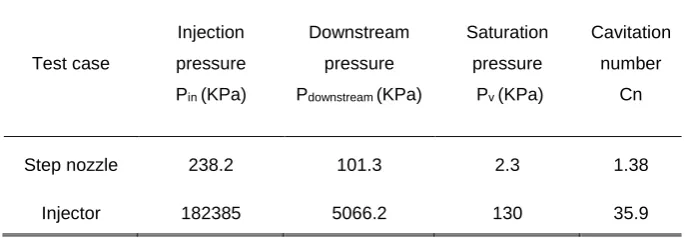
Table II. Operating conditions for the step nozzle and the injector nozzle
simulations. Cavitation number is calculated from equation (11)
Test case
Injection
pressure
Pin (KPa)
Downstream
pressure
Pdownstream (KPa)
Saturation
pressure
Pv (KPa)
Cavitation
number
Cn
Step nozzle 238.2 101.3 2.3 1.38
Injector 182385 5066.2 130 35.9
237
The polymer relaxation times chosen in this study (reported in Table III) are in the range 238
measured for dilute viscoelastic solutions in low viscosity solvents85. The molecular
239
weight of the polymer used in the non-polar solution in the study are reported 6.9 g/mol 240
and 1.6 g/mol for the polymer in the aqueous solution and the concentration range 241
corresponding to the chosen relaxation times is ~ 0.1% wt. The relaxation times are 242
large compared to the flow time scales such as the turnover time of large and small 243
eddies so it is expected that they alter the flow topology. When polymer relaxation 244
times are comparable to flow time scales, the turbulent kinetic energy cascade can be 245
altered resulting in turbulent drag reduction49,86.
246
To characterize the polymer viscosity, the viscosity ratio βis used (β=
µ
s /µ
0), where 24711
viscosities. One of the main objectives of this study is to examine how viscoelasticity 249
can affect the cavitation structures. For this purpose we conducted a preliminary study 250
on the effect of the polymer viscosity and observed clear changes (instantaneous and 251
time-averaged) in cavitation volume fraction when the viscosity of the polymer was 252
large compared to the solvent viscosity. High polymer viscosity values (when β is as 253
small as 0.2)87 can damp the turbulent shear stress and contribute to reduction of the
254
turbulent drag87.
255
Table III. Fluid properties for the step nozzle and the injector nozzle simulations. *For Diesel liquid viscosity, the Kolev correlation in equation (14) is used, βvalue is then calculated from
the average viscosity in the flow field.
Test case Fluid
Liquid
density ρl(Kg/m3)
Vapor
density ρv(Kg/m3)
Liquid
(solvent)
viscosity µ
s (Pa.s)
Vapor
viscosity µv (Pa.s)
Polymer
viscosity µp (Pa.s)
Polymer
relaxation
time
λ (s)
Step nozzle
(Newtonian) Water 998.16 1.71E-02 1.02E-03 9.75E-06 - -
Step nozzle
(Viscoelastic) β =0.1 998.16 1.71E-02 1.02E-03 9.75E-06 9E-03 4E-02
Injector
(Newtonian) Diesel 747.65 6.56 Eq 14 7.50E-06 - -
Injector
(Viscoelastic) β=0.1* 747.65 6.56 Eq 14 7.50E-06 2E-02 8E-03
256
257
2.1. Step nozzle test case
258
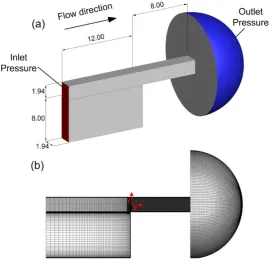
The geometry of the step nozzle is shown in Figure 1(a) which is based on an 259
experimental study88 designed to investigate cavitation in a rectangular injector.
260
Cavitation development inside the nozzle from incipient condition to fully developed 261
condition is visualized using high speed imaging, moreover laser doppler velocimetry 262
(LDV) measurements of streamwise velocity and RMS of turbulent velocity are 263
12
previously used to examine the performance of the turbulence model and the cavitation 265
model used in the current study 89. The data is only available for water and to the best
266
of author’s knowledge no studies in the literature provide similar data for viscoelastic 267
cavitating flows. 268
Cavitation starts to develop inside the nozzle as water is injected at 0.16 MPa into the 269
atmospheric pressure while the flowrate is 40 mL/s. The injection pressure is increased 270
and cavitation intensifies until fully developed cavitation conditions are reached at 0.31 271
MPa injection pressure and 62 mL/s flowrate. 272
A hemispherical outlet geometry is added to the domain with 14 mm diameter to allow 273
a uniform assignment of the outlet pressure boundary condition away from the nozzle 274
exit and boundary and operating conditions are reported in Table I and Table II. 275
In the simulation test case water flows through the nozzle with a flowrate of 48 mL/s, 276
the pressure difference across the nozzle is 1.38 bar while the injected liquid is 277
discharging into atmospheric pressure. The cavitation number (Cn defined in Equation 278
(11), Pinjection, Pdownstream and Pv are the injection, downstream and vapor pressures 279
respectively) is 1.38 and the Reynolds number based on average liquid velocity in the 280
nozzle is 27700. These values are similar to those realized in real-size diesel injectors 281
operating at nominal injection pressures and correspond to the incipient cavitation 282
regime 88:
283
injection downstream
downstream v
P
- P
Cn =
P
- P
(11)
13 285
Figure 1. (a) Geometry of the step nozzle and the relevant dimensions in mm, inlet boundary 286
(red color) and outlet boundary (blue color) surfaces are shown all the other surfaces are no– 287
slip walls (grey color) (b)Computational grid with additional refinement inside the nozzle 288
The computational grid consists of unstructured hexahedral cells and additional 289
refinement is used inside the constriction to achieve the cell size below the Taylor 290
length scale λg (approximated from the characteristic length scale L = 1.94 mm and
291
Reynolds number, λg = (10/Re) 0.5 L = 39 µm). Estimation of Taylor microscale provides
292
a guideline for grid resolution in practical LES studies90,91; by refining the mesh below
293
this value the large scale turbulent eddies are captured as λg theoretically lies in the
294
high wavenumber end of the inertial subrange. Taylor length scale characterizes the 295
mean spatial extension of the velocity gradients92,93 and is always much smaller than
296
the integral scale (but not the smallest scale)94. The cell size inside the nozzle is 20 µm
297
and it is refined to 2.5 µm near the walls, corresponding to y+ values of 0.2-1. The time
298
step corresponding to Courant-Friedrichs-Lewy (CFL) number of 0.5 is set to 1 µs in 299
the Newtonian test case and for the viscoelastic case the time step is reduced to 0.5 µs 300
[image:15.595.162.432.86.346.2]14
2.2. Injector nozzle test case
302
A common rail injector geometry section as shown in Figure 2 is simulated which has a 303
more complex flow and cavitation mechanism compared to the step nozzle. This is a 304
real-size Diesel fuel injector tip with five uniformly distributed holes and the nozzle 305
holes are slightly tapered with a
k
factor of 1.1: 306in out
D - D
k =
10
(12)
307
D
in andD
out are inlet an outlet dimeters of the hole measured in micrometers. The308
nozzle has an inlet and exit diameter of 0.37 mm 0.359 mm respectively and is 1.26 309
mm long. Nozzle hole tapering is linked to reduction of cloud cavitation but at the same 310
time, formation of vortex or string cavities (presented in results section in Figure 10) 311
inside the nozzle. By using taperd holes instead of cylindrical holes, string cavitation 312
which forms inside large scale vortices entering the nozzle from the sac volume, can be 313
intensified while cloud cavitation is reduced 70. In this test case, the fuel passes through
314
the needle passage before entering the sac volume (see Figure 2), where it recirculates 315
as it enters the nozzle. A cavitation cloud forms at the top corner of the nozzle entrance 316
due to the sharp turn in the flow streamline. Moreover, a large vortex enters the nozzle 317
from the sac volume, with string cavitation forming in the core of this vortex inside the 318
nozzle. A recent fully compressible implicit LES simulation of a 9-hole injector with 319
needle motion95 shows that elongated vortical structures which enter the nozzle from
320
the sac volume and the overall flow features are present when compared to steady 321
needle simulations at full needle lift. 322
The Reynolds number inside the nozzle and the sac volume reaches above 30,000 323
indicating the highly turbulent flow conditions of the injector. Considering the mesh 324
15
cost of simulating the complete 5 hole geometry for Newtonian and viscoelastic fluids 326
would be very high so 1/5th of the injector geometry (72˚) is simulated as shown in
327
Figure 2 (b) and periodic boundary conditions are employed on the sides of the 328
geometry. 329
330
Figure 2. (a) Simulation domain for the injector test case. Boundary condition are indicated by 331
colored surfaces; inlet and outlet boundaries are colored in red and blue respectively and the 332
green surface shows the periodic boundary (another periodic boundary with the same cross 333
section is located on the opposite side of the geometry), all the other surfaces are no–slip walls 334
(grey color), (b) The computational grid for the injector, the domain is partitioned using blocking 335
and it is hex-dominant except from an unstructured tetrahedral section in the sac volume 336
Inlet and outlet total pressures are fixed at Pinjection = 1800 bar and Pdownstreamt = 50 bar.
337
Cavitation number for this condition is Cn =35.9, which is much higher than the step 338
nozzle test case due to the higher pressure difference from the inlet to the outlet. In this 339
condition fully developed cloud cavitation is located in the top surface of the nozzle, 340
while the string cavity has a more intermittent appearance. 341
A hex-dominant block mesh is used for most parts of the geometry, except for a section 342
in the sac volume upstream of the nozzle entrance, where unstructured tetrahedral 343
mesh is used. The mesh resolution in the nozzle and the sac volume where cavitation 344
develops is 7.5 µm with additional refinement near the walls. With this resolution, large 345
[image:17.595.122.481.199.400.2]16
captured. The time step for the Newtonian flow condition is 5 ns for CFL of ~0.4 and for 347
the viscoelastic case it is reduced to 2 ns and CFL of ~0.15. 348
The pressure levels inside the injector change significantly so the subsequent changes 349
in the Diesel fuel properties are also considered. Hence the density and the viscosity of 350
the fuel are calculated as a function of pressure. The density is calculated using Tait 351
equation of state to represent the weak compressibility of the liquid Diesel: 352
n
sat sat,L
p B
ρ
1 Pρ
= − +
(13)
353
where the bulk modulus
B
is 110 MPa, the material exponent n is 7.15 and ρsat,Land 354sat
P are the liquid saturation density and saturation pressure respectively. The liquid 355
viscosity is calculated based on the correlation proposed by Kolev96 :
356
6 L
10 5
10 0.000234373 p
log 0.035065275 -
10
µ ρ
=
(14)
357
The values used for the fluid properties used in both test cases can be found in Table 358
III. 359
3. Results and discussion
360
3.1. Step nozzle
361
As the flow detaches at the entrance of the nozzle (see Figure 3) a shear layer is 362
formed between the flow passing through the nozzle and the recirculation region. 363
Cavitation vapors appear in the core of microvortices in the shear layer and they are 364
detaching and shedding from the cavity cloud in a cyclic manner. Contours of velocity 365
magnitude in the mid-plane of the nozzle for the Newtonian and the viscoelastic fluids 366
17
to have a more homogenous gradient. The black iso-lines show the areas where the 368
pressure drops below the vapor pressure, i.e. the regions of cavitation inception. The 369
cavitation inception regions appear more frequently in the Newtonian fluid and they 370
cover a larger area of the nozzle’s cross sectional area, indicating that more vapor is 371
being produced in this fluid. It is likewise reported in the literature that the minimum 372
pressure at a cavitation inception point (the core of a vortex developing in the wake of a 373
cylinder) increases as the vorticity is reduced by viscoelasticity 97.
374
[image:19.595.128.462.273.465.2]375
Figure 3. Nozzle geometry and cavitation in the shear layer (top), contours of the velocity 376
magnitude for the Newtonian and the viscoelastic fluid in the mid-plane of the nozzle, the black 377
iso-lines show regions with pressures below the vapor pressure (bottom) 378
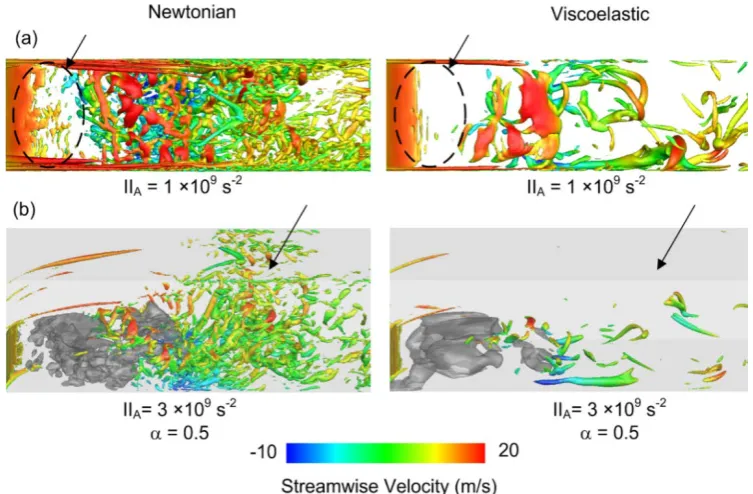
The structure of the vortical features in the flow is shown in Figure 4 by means of the 379
second invariant of the velocity gradient tensor98 calculated from i j A
1 II
2 ∂ ∂ = −
∂xj ∂xi
u u
. 380
Spanwise Kelvin-Helmholtz-like vortices form right after the nozzle inlet as shown in 381
Figure 4 (a), it can be clearly seen that significantly fewer vortices appear in the 382
viscoelastic fluid. Inhibition of shear instability by polymer injection has previously been 383
reported in the literature 99. The ‘polymer torque’, which is the contribution of the
384
viscoelastic stress to the vorticity evolution, increases the flow resistance to rotational 385
motion and can inhibit the vortex sheet roll-up97.
18
Further downstream, the vortex sheet breaks down, developing a range of small-scale 387
and large-scale structures. It is evident that in the viscoelastic fluid spanwise vortices 388
are inhibited while longitudinal vortices become more dominant. Enhancement of large 389
scale coherent structures in the mixing layer is due to hindering of development of 390
perturbations and a stronger vorticity diffusion in viscoelastic fluids100. This results in
391
slower rotational motion of the neighboring vortices and delay of vortex pairing and 392
merging, therefore the lifetime and the scale of the coherent structures is increased. 393
394
Figure 4. (a) Iso-surface of the second invariant of the velocity gradient with the value 1×10⁹ s-2
395
colored with the streamwise velocity, image shown from the top (–Y) direction (b) 3D view of the 396
iso-surface of the second invariant of the velocity gradient at 3×10⁹ s-2 colored with the
397
streamwise velocity along with iso-surface of 50% vapor volume fraction (grey color) 398
In Figure 4 (b) the iso-surface of 50% vapor volume fraction is presented along with the 399
IIA iso-surface. After the collapse of the cavity cloud in the Newtonian fluid, a strong
400
mixing region forms inside the nozzle. In the viscoelastic fluid however, the mixing is 401
weaker and mainly vortices with larger diameters are forming as local instabilities are 402
suppressed and vortical sub-structures are damped. Likewise enlargement of 403
[image:20.595.109.486.269.516.2]19
reported in turbulent channel flows 101. This is due to tendency of polymers to strongly
405
align in the streamwise direction, partially suppressing wall-normal and spanwise 406
velocity fluctuations102. Moreover, the polymer viscosity resists the extensional
407
deformation imposed by the motion of turbulent eddies103,104.
408
The turbulence kinetic energy spectrum for the Newtonian and the viscoelastic fluid is 409
shown in Figure 5, where k is the wave number and E(k) is the amplitude of the kinetic 410
energy FFT calculated inside the nozzle. The graph represents the spatial spectrum of 411
the turbulence kinetic energy, where k = 2πn/L and n and L are the incremental spatial
412
frequency number and the wavelength respectively. 413
Energy content of the low wavenumber scales is higher by ~15% in the Newtonian 414
fluid, however the decay slope is also slightly faster (-5/3 in the Newtonian fluid in 415
competition with ~-4/3 in the viscoelastic fluid) so the flow energy mainly contained 416
within the inertial subrange eddies is similar in both cases. 417
At higher wavenumbers the difference becomes more evident as the Newtonian fluid 418
has ~38% higher turbulence kinetic energy content, indicating that the small-scales in 419
this fluid are more pronounced. This observation is expected as the small-scales are 420
suppressed in the viscoelastic fluid as seen in Figure 4. This is consistent with 421
experimental measurements of power spectra in wall-bounded polymeric flows which 422
show that viscoelasticity can suppress turbulence kinetic energy at small-scales while 423
having a negligible effect on large scales105. Moreover, in viscoelastic fluids, the kinetic
424
energy removed from the large scales is partially dissipated by small-scales and 425
partially converted into elastic energy which is then transferred back into the large 426
scales. This will alter the nature of energy cascade usually seen in Newtonian fluids 427
and reduce the energy content at the small-scales106.
20 429
Figure 5. Energy spectra inside the step nozzle for the Newtonian and the viscoelastic fluid, 430
dashed lines (- - - - - and - - - - -) show indicative examples of the spectra and continuous lines (
431and
) show the mean value of the spectra for the Newtonian and viscoelastic fluid 432In Figure 6 (a) the development of the streamwise velocity component in the mid-plane 433
of the nozzle presented. The magnitude of the negative velocity in the recirculation 434
region (-0.94 ≤ Y ≤ -0.4) is larger in the Newtonian fluid on average by ~28% at X = 435
2mm and ~41% at X = 4 mm. The re-entrant jet velocity is responsible for detachment 436
and shedding of the cavity cloud 71, therefore larger velocities in the recirculation region
437
of the Newtonian fluid are indicative of a faster shedding process in this fluid. 438
In Figure 6 (b), the RMS of streamwise velocity which indicates the turbulent velocity, is 439
plotted along the nozzle. Overall the weighted average of RMS of streamwise velocity 440
over the computational cell volume inside the nozzle (0 mm < X< 8 mm) is reduced by 441
11% in the viscoelastic fluid. In Figure 6 (b), this effect is mainly visible in the lower half 442
of the nozzle (-0.94 mm ≤ Y ≤ 0 mm), corresponding to the shear layer and flow 443
recirculation regions. Theeffect of viscoelasticity on velocity fluctuations is more 444
evident in Figure 6 (c) which shows the RMS of wall-normal velocity along the nozzle. 445
Suppression of velocity fluctuations is stronger in the wall-normal direction compared to 446
the streamwise direction and overall the RMS of wall-normal velocity is reduced by 447
21
velocity fluctuations, polymers can more effectively reduce the turbulence generation 449
by vortices. 450
[image:23.595.131.456.139.681.2]451
Figure 6.Comparison of time-averaged values of the streamwise velocity, RMS of streamwise 452
velocity, RMS of wall-normal velocity and Reynolds stress (−u v′ ′) in the Newtonian and the 453
viscoelastic fluid, data are presented in the mid-plane of the step nozzle at four different X 454
22
In Figure 6 (d) the Reynolds stress in the XY plane (
−
u
′
v
′
) is plotted along the nozzle, 456positive and negative values of the Reynolds stress correspond to turbulence 457
suppression and production respectively107. Negative values of Reynolds stress are
458
produced by ejection and sweep motions which contribute to positive turbulence 459
production and in general increase drag. Positive Reynolds stress values correspond to 460
turbulence suppression and their increase generally results in drag reduction 107. It is
461
evident that in the recirculation region (-0.94 mm ≤ Y ≤ 0 mm) the Newtonian fluid has 462
about twice the amount of Reynolds stress generated in the viscoelastic fluid, resulting 463
in a higher level of turbulence generated in this region. In the bulk of the flow outside 464
the recirculation zone, Reynold stresses have a positive value with a higher magnitude 465
in the viscoelastic fluid indicating a stronger turbulence damping. Overall, stronger 466
turbulence damping and lower turbulence levels generated in the viscoelastic fluid as 467
seen in Figure 6 (b)-(d), can contribute to turbulence drag reduction and the mass 468
flowrate is increased by~2%. 469
In Figure 7 the development of cavitation inside the nozzle for the Newtonian and the 470
viscoelastic fluid is compared in terms of 25% vapor volume fraction iso-surface. 471
Cavitation is initiated in the core of microvortices forming in the shear layer and it grows 472
as larger eddies form after the vortex sheet breakdown. Following, they form a cavity 473
cloud which detaches due to the re-entrant jet motion and is convected toward the 474
nozzle exit. 475
In the Newtonian fluid, small cavitation structures can be observed (red circle 1) with 476
microcavities of various sizes (approximate diameter range of 30 µm-200 µm) shedding 477
from the cloud, however such structures are not present in the viscoelastic fluid. 478
23 480
Figure 7.Cavitation development inside the step nozzle presented by means of 25% vapor 481
volume fraction iso-surfaces, data are presented every 0.1 ms. Small microcavities shedding 482
from the cloud (red circle 1) are not present in the viscoelastic fluid, cavitation vapors can 483
initially shrink before growing (red circle 2) and larger streamwise vortices appear between the 484
detached cloud and shear layer cavitation structures (red circle 3, 4 and 5) 485
The growth of the shear layer cavitating microvortices is rather faster in the Newtonian 486
fluid; in the viscoelastic fluid it appears that the cavity initially shrinks (red circle 2) 487
before growing. This can be due to the action of viscoelastic force resisting the fast 488
deformation by liquid evaporation. Furthermore, cavitation structures in the viscoelastic 489
fluid have an elongated shape. Larger streamwise cavitating vortices appear between 490
the shear layer cavities and the detached cloud compared to the Newtonian fluid (see 491
red circles 3, 4 and 5). 492
Due to the cyclic enlargement and shrinkage of the flow recirculation zone and the 493
24
nozzle also fluctuates in a cyclic manner. The fast Fourier transform (FFT) of mass flow 495
rate time-evolution at nozzle outlet are presented in Figure 8 to indicate the dominant 496
frequencies of the mass flowrate fluctuations. The dominant frequency in the 497
Newtonian fluid is f = 168 Hz whereas in the viscoelastic fluid this values is reduced to f 498
= 57 Hz, while the peak amplitude is increased by 42%. First and second harmonics of 499
the dominant frequency can also be identified for both fluids at ~ 2f (343 Hz for the 500
Newtonian fluid and 110 Hz for the viscoelastic fluid) and ~3f (524 Hz for the 501
Newtonian fluid and 169 Hz for the viscoelastic fluid). Second harmonics with about 502
double the dominant frequency are reported in pressure signals past a cavitating 503
converging-diverging nozzle108 and in the wake of a rectangular cavitating obstacle109.
504
The reduction of the cavity shedding frequency can be due to the resistance of the 505
viscoelastic fluid to development of vortical structures and therefore suppression of 506
cavity growth in the core of vortices. Moreover, development of the cavitation cloud can 507
be delayed as the cavity volume can shrink before growing in the viscoelastic fluid due 508
to memory effects produced by fluid elasticity. In fact it was observed that some of the 509
shedding events are completely suppressed while vapor builds-up in the cloud region. 510
Therefore the subsequent shedding event is more violent in the viscoelastic fluid, thus 511
while the dominant frequency is reduced its peak amplitude is higher. 512
Unlike the Newtonian fluid, at frequencies above ~400Hz there are effectively no 513
fluctuations in the viscoelastic fluid, indicating that the viscoelastic fluid damps out the 514
high frequency fluctuations. As the small-scale microcavities shedding from the 515
cavitation cloud are suppressed (Figure 7), the subsequent velocity fluctuations due to 516
growth, collapse and oscillations of these cavities can also be inhibited, resulting in 517
25 519
Figure 8. FFT of mass flowrate fluctuations at the outlet of the step nozzle for the Newtonian 520
and the viscoelastic fluid, the dominant frequency corresponds to frequency of mass flowrate 521
fluctuations induced by cyclic growth and shedding of large cavity clouds 522
The Strouhal number for vapor cloud shedding (St ) based on the mass flowrate v 523
fluctuation frequency (f), the cavity length (L ) and the average streamwise velocity in v 524
the cavity region (U ) is defined as: v 525
v v
v
fL
St =
U
(15)
526
For the Newtonian case the Strouhal number based on the dominant frequency is 0.22 527
and in the viscoelastic fluid the Strouhal number is reduced to 0.08. For Newtonian 528
fluids, a characteristic Strouhal number of 0.2 has been identified for cavitation cloud 529
shedding in a diverging step71. The detachment and shedding of the cavitation cloud is
530
partially driven by the re-entrant jet mechanism and the Strouhal number is 531
proportional to the re-entrant jet velocity 71, hence longer shedding periods can be due
532
to reduction of the re-entrant jet velocity. Observations regarding the reduction of 533
Strouhal number by viscoelasticity due to prolonged oscillation times has been reported 534
for vortex shedding past an obstacle 110–112.
26 536
Figure 9. (a) Average liquid volume fraction (1-α) in the step nozzle mid-plane along with iso-537
surfaces of 75%, 80% and 85% average liquid volume fraction in the Newtonian and the 538
viscoelastic fluid, (b) Average liquid volume fraction (1-α) inside the cavitation region for the 539
Newtonian and the viscoelastic fluid, values taken along 4 lines passing through the cavitation 540
cloud in the nozzle mid-plane 541
Finally, the time-averaged effect of viscoelasticity on the cavitation field is presented in 542
Figure 9 by comparing the average liquid volume fraction inside the nozzle. It can be 543
seen from Figure 9 (a) that the cavitation inception point is shifted further downstream 544
the nozzle entrance; so vapor mainly starts to form at X ≈ 0.3 mm in the Newtonian 545
fluid and at X ≈ 0.8 mm in the viscoelastic fluid. Moreover the thickness of the cavity
546
cloud in this region is reduced from ~0.69 mm in the Newtonian fluid to ~0.58 mm in 547
[image:28.595.107.481.82.456.2]27
In Figure 9 (b) values of the liquid volume fraction in four locations inside the cavitation 549
cloud are compared. In all these locations the liquid volume fraction in the viscoelastic 550
fluid is constantly higher. The average vapor volume fraction in the viscoelastic fluid 551
integrated over the volume of the nozzle (0 mm < X < 8 mm) is reduced by 51%. 552
Moreover it is evident that the cavitation suppression effect is stronger at the lower half 553
of the cavity cloud -0.94 mm ≤ Y ≤ -0.5 mm (closer to the nozzle wall). Reduction of 554
near wall vorticity fluctuations inhibits the near-wall eddies in viscoelastic fluids113 which
555
can be responsible for production and transport of cavitation vapors in this region. 556
557
3.2. Injector nozzle
558
In the injector nozzle, two distinct regions for cloud cavitation and string cavitation can 559
be identified. Characteristics of different cavitation mechanisms in injector nozzles is 560
described in the literature 70,114,115. The cloud cavitation forms in a similar manner to the
561
cavitation in the step nozzle; as the fluid enters the nozzle it takes a sharp turn at the 562
entrance forming a fully developed vapor cloud which is mainly attached to the top 563
surface of the nozzle and grows and sheds in a cyclic manner. The string cavitation 564
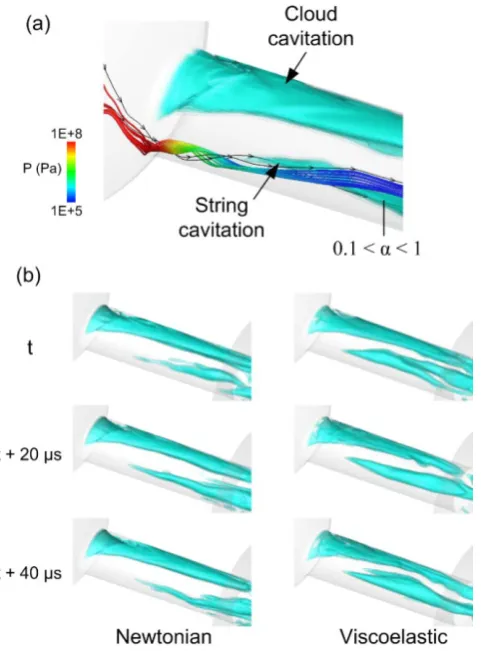
forms in the high vorticity core of a large vortex entering the nozzle from the sac 565
volume and it is located in the vicinity of the nozzle center (the streamlines and vectors 566
forming the string cavitation are presented in Figure 10 (a)). 567
The local pressure drops from 100 MPa in the sac volume to 0.1 MPa (below the 568
saturation pressure) inside the nozzle as the string cavity starts to form. The string 569
cavity has an intermittent appearance as it can distort, break-up and elongate inside 570
the nozzle, however in the viscoelastic fluid a larger and more stable vaporous core 571
appears and time averaged values of vapor volume fraction will be used to further 572
28 574
575
Figure 10. (a) Two distinct cavitation regions forming inside the injector nozzle, cavitation 576
vapors are presented using 5 translucent vapor volume fraction iso-surfaces ranging from 0.1 to 577
1, the cavitating vortex can be seen entering the nozzle from the sac volume, the vortex is 578
presented by streamlines colored with pressure (b) Indicative cavitation structures inside the 579
nozzle at 20 µs intervals for the Newtonian and the viscoelastic fluid (0.1< α <1) showing a 580
larger string cavity in the viscoelastic fluid. 581
Since the cloud cavitation and the string cavitation occur at different locations inside 582
the nozzle, it is possible to examine the effect of viscoelasticity on each cavitation 583
mechanism by geometrically separating the cavitation vapor volumes as seen in Figure 584
11 (a), which shows the separated cloud and the string cavitation structures in the 585
same time step. The time-averaged vapor volume fraction data are separated into a 586
cloud region and a string region by splitting the cross section of the nozzle into a top 587
section (cloud, Y>35 µm) and a bottom section (string, Y<35 µm) using a plane along 588
[image:30.595.180.421.119.445.2]29
calculated in slices along the nozzle and the area weighted average value is used to 590
get the total vapor volume fraction. Vapor structures in the cloud and the string region 591
marginally intersect inside the nozzle but in the vicinity of the nozzle exit this overlap 592
can contribute to ~20% variations in the average vapor volume fraction in each region. 593
The overlapping regions are identified to be located in the area approximately ±40µm 594
from the nozzle axis and are displayed in the graph as error bars. 595
The time-averaged value of the total vapor volume fraction inside the nozzle is plotted 596
for the Newtonian and the viscoelastic fluid in Figure 11 (b). It is evident that the in-597
nozzle cavitation mechanism is mainly due to cloud cavitation in the Newtonian fluid 598
and overall the vapor volume fraction in the Newtonian fluid is higher by 44%. Initially, 599
cavitation develops at the nozzle entrance due to the cloud cavitation mechanism, 600
increasing the vapor volume fraction in the nozzle up to ~0.16 in the Newtonian fluid 601
and up to ~0.08 in the viscoelastic fluid until X ≈ 0.4 mm. After this point cloud
602
cavitation declines and string cavitation starts to develop while reaching the nozzle exit. 603
In the viscoelastic fluid the vapor volume fraction of the cloud cavitation is higher than 604
string cavitation up to X ≈ 0.9 mm (70% into the nozzle length), and after this location 605
the string cavitation becomes more dominant. In the Newtonian fluid the rate of 606
reduction of the cloud cavity is ~17% faster than the rate of formation of string cavity, 607
hence the total vapor volume fraction is reduced after X ≈ 0.4 mm. Whereas in the 608
viscoelastic fluid, the string cavitation forms more abruptly at a rate ~46% faster than 609
the decline of the cloud cavity, hence the total vapor volume fraction increases steadily 610
up to X ≈ 1 mm, after this point vapor volume fraction is reduced as string cavitation
611
growth declines. 612
The main observation from comparing the changes in the vapor volume fraction in 613
different mechanisms is that viscoelasticity reduces cavitation formation in the cloud 614
30
of the cavitating vortex in the nozzle core is increased in the viscoelastic fluid which 616
can be related to the alignment of the cavitating vortex with respect to the main flow 617
direction. The string cavitation is forming in the core of the quasi-streamwise vortex in 618
the center of the nozzle, whereas the cloud cavitation vortices can have large radial 619
velocity components which are expected to be inhibited by viscoelasticity. 620
In the core of vortices the angle between the velocity vector (U) and the vorticity vector 621
(ω) tends to zero as the vectors become aligned, hence the normalized helicity (Hn),
622
which is effectively the cosine of this angle, tends towards unity 116:
623
n U. H
U
ω ω
=
(16)
624
The normalized helicity contours are plotted in Figure 11(c) in several locations inside 625
the nozzle along with black isolines of Hn = 0.95. It is evident that in the viscoelastic
626
fluid, the string cavitation core covers a larger area, whereas in the Newtonian fluid a 627
smaller vortex core can be identified. In the step nozzle test case presented in the 628
previous section, it is reported that the streamwise vortices become more dominant by 629
viscoelasticity as the smaller scale vortices are damped. In wall-bounded viscoelastic 630
flows117,118 it is reported that streamwise vortices can become elongated and larger as
631
wall-normal fluctuations are damped. It is argued that suppression of cross-stream 632
fluctuations can further inhibit their auto-generation and therefore increase the lifetime 633
and strength of the longitudinal vortices. Likewise in this case, suppression of small-634
scale eddies inside the injector nozzle can be responsible for stabilizing the local 635
turbulence in the vicinity of the string cavity, allowing the development of a larger 636
streamwise vortex and delaying the vortex breakdown, which in turn can result in 637
31 639
Figure 11. (a) Separated vapor volume fraction regions inside the injector nozzle showing the 640
cloud cavitation and the string cavitation in term of iso-surfaces of 80% vapor volume fraction, 641
(b) Development of the string cavitation (dotted lines• • • • • • and • • • • • •), the cloud cavitation (dashed
642
lines
and
) and the total vapor volume fraction (continuous lines
and
) inside the 643injector nozzle for the Newtonian and the viscoelastic fluid calculated in slices along the nozzle 644
axis using area weighted averages, error bars indicate the overlap of the vapor volume fraction 645
in the string and cloud the region in ±40µm in the vicinity of the nozzle axis,(c) Normalized 646
helicity (Hn) contours in slices inside the injector nozzle (at X = 0.2 mm, 0.5 mm, 0.8 mm and 1.1
647
mm), the black isolines show the regions of Hn = 0.95 and Hn→1 in vortex cores
648
In the cavitation model of Schnerr and Sauer 78 in equation (7), the vapor volume
649
fraction equation source term describes the mass transfer rate (R) between the two 650
phases, so the positive values of R represent the evaporation rate and the negative 651
values are the condensation rate: 652
V v l
V
m B l
p p
3 2
R (1 ) (p p)
3
α α −
= − −
ℜ
ρ ρ
sign
ρ ρ (17)
653
In Figure 12 (a) and (b) the phase change rates in the cloud cavitation and the string 654
cavitation region at one instance are compared. The mass transfer rates are higher in 655
the cloud cavitation region, reaching 15 × 106 Kg/m3.s as opposed to 0.5 × 10⁶ Kg/m3.s
[image:33.595.117.477.82.379.2]32
in the string region of the Newtonian fluid, subsequently cloud cavitation is the main 657
mechanism of vapor production as it was seen in Figure 11 (b). In the cloud cavitation 658
graph, mass transfer starts at the X = 0 mm as the fluid enters the nozzle and peaks at 659
X ≈ 0.25 mm, however the string cavitation starts effectively at X > 0.2 mm in the
660
viscoelastic fluid and X >0.4 mm in the Newtonian fluid. The evaporation and 661
condensation rates in the cloud region are reduced in the viscoelastic fluid by ~2 orders 662
of magnitude, resulting in reduction of the vapor volume fraction in this region. However 663
in the string cavitation region this trend is reversed, i.e. evaporation rate is ~9 times 664
higher and condensation rate is ~2.5 times higher in the viscoelastic fluid. 665
The difference in the effect of viscoelasticity on cloud and string cavitation regimes can 666
be linked to the alignment of the vortical structures in each region with respect to the 667
direction of the main flow. The vortex cores identified in terms of the second invariant of 668
the velocity gradient are presented in Figure 12 (c). It is evident that viscoelasticity 669
does not affect the cloud and string vortical structures in the same manner. The vortex 670
which forms the string cavitation in the vicinity of the nozzle center (see arrow 1), is 671
enlarged by viscoelasticity while the vortical structures formed at the nozzle entrance in 672
the cloud region (see arrow 2) are strongly suppressed and only remnants of the 673
vortices are visible in the viscoelastic fluid. In the cloud cavitation region, vortices form 674
in the shear layer between the recirculating flow and the main flow, therefore they can 675
have large radial velocity components as the vorticity vector is likely to be located in the 676
cross-sectional plane of the nozzle (i.e. vortices rotating out of the cross sectional 677
plane). However in the string region the cavitating vortex is positioned in the 678
streamwise direction (vorticity vector in the axial direction). Therefore, as the polymers 679
tend to align with the main flow direction102 and suppress the cross flow fluctuations87,
680
viscoelasticity tends to damp the vortices in the cloud region while stimulating the string 681
33 683
Figure 12. (a) and (b) evaporation and condensations rates computed by the mass transfer rate 684
cavitation model in the cloud and the string cavitation region, (c) vortical flow structures in the 685
vicinity of the injector nozzle entrance plotted using the contours of second invariant of the 686
velocity gradient (Q-criterion) in the nozzle mid-plane and translucent iso-surfaces of Q-criterion 687
at 5E+12 s-2
688
As it was mentioned earlier, the vortex forming the string cavitation enters the nozzle 689
from the sac volume and is formed by the swirling flow inside the sac volume 70. Hence
690
the level of turbulence upstream the nozzle entrance, can have a significant effect on 691
the strength of the cavitating vortex. In Figure 13 (a) the flow structures in the sac 692
volume in terms of the second invariant of the velocity gradient are displayed. 693
Circumferential perturbations on the interface of a cavitating vortex can cause strong 694
radial oscillations which result in splitting and collapse of the cavity core119. Moreover,
695
flow instabilities upstream the vortex can cause the divergence of the stream tubes 696
forming the vortex core, eventually breaking down the vortex 120. The turbulent eddies
697
in the sac volume in the Newtonian fluid (Figure 13 (a)) appear to breakdown the 698
[image:35.595.111.473.88.409.2]34
or delay the vortex breakdown as it prevents sharp velocity variations along the vortex 700
centerline which initiate the breakdown process 121.
701
702
Figure 13. (a) Vortex structures indie the sac volume visualized using the iso-surface of second invariant of 703
the velocity gradient at 4E+12 s-2, (b) velocity fluctuations inside the nozzle plotted in terms of RMS of X,Y
704
and Z velocity, values obtained from surface-averaged data calculated in slices along the nozzle 705
The vortex disturbance inside the sac volume is significantly lower in the viscoelastic 706
fluid compared to the Newtonian fluid in Figure 13 (a) and the large vortex entering the 707
nozzle can be clearly identified. Reduction of vortex interactions in the sac volume 708
contributes to stabilization of the cavitating vortex upstream of the nozzle entrance, 709
which in turn allows a stronger string cavity to develop inside the nozzle. The 710
fluctuations inside the nozzle in terms of RMS of the velocity components are plotted in 711
Figure 13 (b). It is evident that due to the stabilizing effect of viscoelasticity on flow 712
turbulence, all three components of velocity fluctuations are reduced in the viscoelastic 713
fluid (by 23%, 9% and 31% in X, Y and Z directions respectively). This will therefore 714
reduce the perturbations that destabilize the string cavity coherence inside the nozzle, 715
allowing the cavitation structures to last longer. 716
[image:36.595.88.491.144.395.2]