0022-538X/92/042031-06$02.00/0
Copyright ©) 1992, AmericanSocietyfor
Microbiology
Functional Comparison of
the
Basic Domains of
the
Tat
Proteins of
Human
Immunodeficiency Virus Types
1
and 2 in
trans
Activation
B.ELANGOVAN, T. SUBRAMANIAN, ANDG. CHINNADURAI*
Institute for Molecular Virology, St. Louis University School ofMedicine, 3681 Park Avenue, St. Louis, Missouri 63110
Received 28 October 1991/Accepted 2 January 1992
The trans-activatorTat proteinscodedby humanimmunodeficiency virustype1 (HIV-1) and HIV-2appear tobe similar instructureand function. However, the Tat protein of HIV-2(Tat2) activates theHIV-1 long terminalrepeat(LTR) less
efficiently
thanTatl (M. Emerman, M. Guyader, L. Montagnier, D. Baltimore, and M. A. Muesing, EMBO J. 6:3755-3760, 1987). To determinethefunctional domainofTat2 whichcontributes tothisincompletereciprocity,
wehave carried outdomainsubstitution betweenTatland Tat2by exchanging the basic domainsinvolvedinTat interaction with its targettrans-activation-response (TAR) RNAstructure. Ourresults indicatethatTatl proteins containing substitutionsof either 8or14amino acids of the basic domain ofTat2exhibited reducedtransactivationoftheHIV-1 LTR byabout1/20orone-fourth the levelinducedby wtTatl.In contrast,Tat2 containingasubstitution of the9-amino-acid basic domainofTatltransactivated HIV-1LTRlike native Tatl.Asubstitution ofthehighly conservedcoredomain of Tat2 with that ofTatl did not have any significant effect ontrans activation of the H1V-i LTR. These results indicate that the basic domain of Tat2contributes to its inefficienttransactivation of the HIV-1LTR.Mutation ofanacidic residue (Glu) locatedbetween thecoredomainand theArg-richbasicdomain of Tat2atposition77toaGly
residue increased the activity of Tat2substantially.
These results furthersuggestthat thepresenceofanacidicresidue (Glu) adjacenttoArg-rich
sequences mayatleastpartially
contributetothe reducedactivity
of the Tat2 basic domain.The human immunodeficiency viruses (HIVs) have been etiologically linked with AIDS. These pathogenic human retroviruses have been groupedundertwotypes.HIV type
1 (HIV-1) is the predominant type isolated from most
pa-tients with AIDS. HIV-2, whichwasisolatedfrompatients with AIDS in western Africa (9, 20), is less prevalent. Further, HIV-2alsoappears tobeless virulent than HIV-1. Theprimary sequences of HIV-1 and HIV-2 vary substan-tially (25). HIV-2 is morecloselyrelatedtosimian immuno-deficiencyviruses(SIVs)thantovarious strains of HIV-1. In spite of the variations in the primary sequences of their
genomes, HIV-1 and HIV-2 aresimilar ingenetic
organiza-tion. Particularly, the structure and function of various regulatory genes are conserved among thevarious primate immunodeficiency viruses (HIV-1, HIV-2, and SIV). For example, both HIV-1 and HIV-2 code for a strong trans
activator, Tat, which activates the expression of genes
linkedtothe virallongterminalrepeat(LTR). Althoughthe precise mechanism of Tat-mediated trans activation still remains unclear, a number of recent studies with the Tat proteinof HIV-1 (referredtohereasTatl)indicate thatTat
mayplay an important role at the level of transcriptional initiation andelongation (reviewed inreference 11). Unlike mostof the eukaryotictranscriptional activators, Tat func-tionsbydirectinteraction withan RNAtargettermedTAR (4, 17, 19, 28). In addition, Tat may also play a role in
translational utilization of viralmRNA under certain condi-tions (5). Although the biochemical properties of the Tat protein of HIV-2 (referred to here as Tat2) have not been extensively studied, it appearsthatTat2 may function in a mannersimilartothatofTatl. Both Tatl andTat2havean obligatoryrequirementfor TAR inmostofthe celltypes(1,
*Correspondingauthor.
3, 15, 19, 28) fortrans activation of the LTR. In addition, both Tatl and Tat2 contain protein domains that are
con-served(25) (see Fig. 1). Further,bothTatland Tat2exhibit reciprocal trans-activation effects on the HIV-1 and HIV-2
LTRs.
Inspiteof the structural and functional relatedness ofTatl andTat2,it has beenreportedthatTatl andTat2efficiently
trans activate the HIV-2 LTR, while Tat2 is less efficient
thanTatlin activation of the HIV-1 LTR(15). These results suggest that Tatl and Tat2 may have some functional
dif-ferences withregardtotheir actionon the HIV-1 LTR. On the basis of secondary structure analysis and mutational studies, it has been suggested that the TAR structure of HIV-2 (TAR2) contains two TAR elements (1, 3, 18, 30). These studies imply thatTat2 mayfunction more efficient-ly on a duplicated stem-loop structure, as in TAR2, than on a single stem-loop, as in the TAR of HIV-1 (TAR1). In supportof thisview, ithas been reportedthat the addition of a second stem-loop to TAR1 increased the responsive-ness to Tat2 (3). However, it is not known whether any
specific protein region of Tat2 isresponsible forthe differ-ential activity. A number of recent studies have revealed that an arginine-rich basic domain of Tatl specifically
binds tothe pyrimidine bulge regionoftheTAR1 structure (10,29, 34). These bindingstudieshavefurther establisheda
direct correlation between Tat-binding to TAR and trans
activation (13, 29). Since Tat appears to functionby direct interaction with TAR RNA, it is possible that the basic domain ofTat2maybe inefficient inrecognizingTARL. Here
we report the construction of chimeric Tatl and Tat2 sub-stitutionmutantsexpressing thebasic domains of Tat2 and Tatl, respectively, and show that the basic domain of Tat2 contributes to the inefficient trans activation of the HIV-1 LTR.
2031
on November 9, 2019 by guest
http://jvi.asm.org/
2032 ELANGOVAN ET AL.
MATERIALSAND METHODS
A
Plasmids and mutants. Plasmid pLTR-1 CAT, which ex-presses the bacterial chloramphenicol acetyltransferase (CAT) gene under control of theHIV-1(SF2) LTR,has been described previously (27). Plasmid pTatl expressing the tat
gene of HIV-1 (SF2) under transcriptional control of the cytomegalovirus immediate-early (CMV-IE)promoterin the vector pBC12 (24) was constructed by transferring the Tat-coding sequencesfrom apreviously described plasmid, pTat (27). Plasmid pTat2 was constructed by cloning the Tat2-coding genomic sequences (5783 to 8569) from pROD214 (15) intoa pBC12-based vector.
Mutants Tatl/2BD-A and Tatl/2BD-B were constructed by cloning the corresponding double-stranded oligonucleo-tides coding for the Tat2 basic domain sequences between the unique SaclI and Sacl sites of Tat57-A (22) and sub-sequently inserting the chimeric gene into the CMV-IE (BC12) expression vector. MutantTat2(99)wasconstructed by deleting the second exon region (sequences located between threePvuIIsites)of Tat2. MutationsTat2(99)/lBD, Tat2(99)77, and Tat2(99)/lCD were introduced by a
triple-primer polynucleotide chain reaction method (22). The DNA fragments obtained from the polynucleotide chain reaction were digested withSacI andwerecloned betweenaSacI and
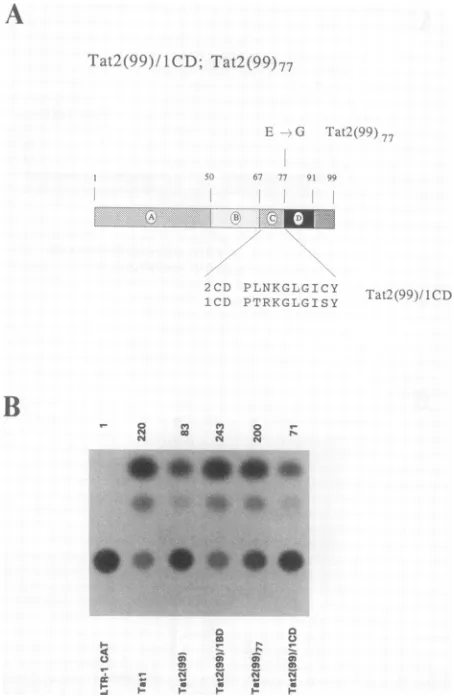
a unique PvuII site in plasmid pTat2(99). Tat2(99)/lBD contains a substitution of the basic domain of Tatl (resi-dues 48 to 57) for the corresponding Tat2 domain, located between residues 76 and 91. Mutant Tat2(99)77 contains a substitution of a glycine residue for a glutamic acid
resi-due at position 77 of Tat2. Tat2(99)/lCD contains a
substi-tution of the core domain of Tatl (residues 39 to46) for thq corresponding Tat2 domain, located between residues 67 and 76.
CAT assays. The functional activity of the various chi-meric tat geneswastested by cotransfectionof thepLTR-1 CAT plasmid and the various Tat-expressing plasmids in HeLa or COS-7 cells. Cells (1.5x 10⁶ to 2 x 10⁶/60-mm2
dish) were transfectedwith 1,ugof pLTR-1 CAT andvarious concentrations of the Tat-expressing plasmids by the cal-cium phosphate method. All transfections included 1,ug of
pRSV 1-Gal, whichexpressesthe Escherichiacoli lacZgene
under the transcriptional control of the Rous sarcomavirus
LTR as an internal control for monitoring transfection effi-ciency. CAT activities were quantified by scraping the acetylated chloramphenicol spots and counting the radioac-tivity by scintillationcounting. CAT activitiesareexpressed
relative to the basal level ofLTR-CAT expression. Immunoprecipitation and indirect immunofluorescence.
COS-7 cells (1.5 x 10⁶ to 2.0 x 10⁶/60-mm2 dish) were
transfected with1 to 2
p,g
of various Tat-expressingplas-mids. A total of 48 h after transfection, cells werelabelled
with 200 pCiof[35S]cysteine for1 h. Immunoprecipitation of
Tatl proteinswas carriedoutwithpolyclonal ratantibodies directed againstTatl (2)orwith rabbit antipeptideantibody raised againstasyntheticpeptide corresponding to
N-termi-nal 17 amino acids (26). Immunoprecipitation ofTat2
pro-teins was carriedout with rabbitpolyclonal antibodiesraised
against a synthetic peptide corresponding toamino acids 76
to 99of Tat2 (18). Indirect immunofluorescence analyses of
Tatl and Tat2 proteins in COS-7 cells transfected with
various plasmids were carried out essentially as described
previously(33). TheTatantibodieswereusedatadilution of
1:200, while the second antibody (fluorescein
isothiocy-anate-conjugated goat anti-rabbit immunoglobulin G) was
used at adilution of 1:50.
Tatl;
Tatl/2BDSac 11(48) Sac (57)
.:.:..--- ....I:. ~.. ...::::
....
1BD GRKKRRQRRR 2BD-A ERKGRRRR 2BD-B ERKGRRRRTPKKTK
B
@-
.YPt
w
.1
oI.,-11
'!w
"I
'5D: a co
m
FIG. 1. (A) Organization of Tatl and Tatl/Tat2 chimeric pro-teins. Domain map of Tatl (strain SF2) is based on previous mutational analysis (23). Tatl/2BD-A and Tatl/2BD-B contain sub-stitutions of the indicated residues of the basic domain from Tat2
(ROD214).
Mutants tatl/2BD-A and tatl/2BD-B were constructed by cloning the corresponding double-stranded oligonucleotides be-tween the uniqueSacII
and Sacl sites of mutant tat57-A as described previously (32). (B) trans activation of HIV-1 LTR byTatl/2BD
mutants. HeLa cells were transfected with pLTR-1 CAT alone or along with various Tat-expressing plasmids. CAT activities were determined 48 h after transfection as described in Materials and Methods and are expressed relative to the basal level of LTR-CATexpression.RESULTS
Effect of Tat2 basic domain on trans activation by
Tatl.
To determine whether the basic domain of Tat2 contributes to the lower level of trans activation of the HIV-1LTR, we constructed two different substitution mutants (Fig.1A) of thetatl
gene by substituting theTatl
basic domain(referred to here as 1BD) with the basic domain of Tat2 (2BD). Mutant tatl/2BD-A contains a substitution of an 8-amino-acidregion (ERKGRRRR) of Tat2 in place of the 1BD(RKKRRQRRR).
Mutant tatl/2BD-B expresses an additional
6-amino-acid
region of the 2BD (ERKGRRRRTPKKTK). The
ability
of these mutants to trans activate the expression of thereporter bacterial CAT gene linked to HIV-1 LTR(pLTR-1
CAT)was determined by DNA transfection on HeLa cells (Fig.1B). As expected from previous studies (3, 15, 18), Tat2 (wild type [wt]) trans activatedpLTR-1
CAT expression at about one-half the efficiency of Tatl. In contrast, mutant tatl! 2BD-A, which expresses the arginine-rich half ofthe 2BD, trans activatedpLTR-1CAT poorly (6% of theTatl-induced J.VIROL.UD CD Cl) r,
0 N
-dalbi..
.-Aw.,im,
WI
on November 9, 2019 by guest
http://jvi.asm.org/
[image:2.612.351.521.85.401.2]BASIC DOMAINS OF THE Tat PROTEINS OF HIV-1 AND HIV-2 2033
A
n 0
m X
N N
2 i
29
B
o;
4-W
A
0
m :_I en
Sm Tat2; Tat(99)/11BD
[image:3.612.326.536.85.414.2] [image:3.612.58.298.86.189.2],.
...
...FIG. 2. Immunoprecipitation ofTatl andTat2proteins. COS-7
cells (1.5 x 10⁵/60-mm2 dish) weretransfected with 1 to 2 ,ug of
variousTat-expressing plasmids. A total of 48 h aftertransfection, cellswerelabelled for 1 h with 200,uCi of[35S]cysteine.
Immuno-precipitations of Tatl proteinswerecarriedoutwithpolyclonalrat
antibodies directed against Tatl (2) or with rabbit antipeptide antiserum raised against a synthetic peptide corresponding to the
N-terminal 17 amino acids (26). Immunoprecipitations of Tat2
proteinswere carriedoutwith rabbit polyclonal antiserum raised againstasynthetic peptide correspondingtoamino acids 76to99of
Tat2 (18). (A) Tatl and Tatl/2BD; (B) Tat2 and Tat2/lBD. M indicates protein molecular weight markers. In panel B, Tat2(99)i 1BDwas precipitated with amixture ofTatland Tat2 antibodies.
The bracketed regions contain Tat-specific bands. Itappears that bothantibody preparationsdonothavesignificant reactivity against epitopes of the Tat2/1BD chimeric protein.
level). Inclusion of the Lys-richhalf of the 2BD(tatl/2BD-B) further increased the level oftrans activation to about 25% of the level observed withTatl. Similar relative effects on
trans activation werealso observed in COS-7 cells (results
not shown). These low levels of trans activation by the chimerictatgenesdo notappeartobe dueto anydefect in
the level of accumulation of the chimeric proteins, since COS-7 cells transfected withmutants tatl/2BD-A andtatl! 2BD-B expressed Tat protein at levels comparable to Tatl (Fig. 2A). Further,the low level oftransactivation appears to be primarily contributed to by the Tat2 basic domain, sincewe have previously shown that a heterologous basic
domain from HIV-1 Rev can efficiently substitute for the Tatlbasicdomainwhen insertedatthesamesite within the Tatl coding region (33).
Effect ofTatl basic domainontransactivationby Tat2.To further confirm thepartial functional reciprocity of the Tat2 basic domain,weconstructed asubstitutionmutant of Tat2 containingasubstitution of the 1BD(GRKKRRQRRR) (Fig. 3A) and determined itsactivity on LTR-1CATexpression.
The sequences coding for the 1BD were inserted in frame into the Tat2-coding sequences [exon 1; Tat2(99)] by
poly-nucleotide chain reaction (22). For this chimericgene con-struction,weusedatat2geneexpressing only the firstexon [tat2(99)]asthe backbone. Thetrans-activation potential of Tat2(99)/lBD was compared with those of the parental Tat2(99),Tat2(wt),andTatl (Fig. 3B). The parental Tat2(99) activated LTR-1 CAT at aboutone-fourth the efficiency of Tatl and about one-half the efficiency of Tat2 (wt).
How-ever, mutant tat2(99)/lBDtrans activated LTR-1 CATto a
level similar to that by wt Tatl, suggesting that the basic domainis theprimary determinant for the differential activ-ity of Tat2 on HIV-1 LTR. Since this Tat2 substitution mutantexhibitsnearwtTatlactivity, all theprotein regions of Tat2 other than the basic domain may be functionally equivalentto thecorresponding Tatl regions.
To ascertain that the enhancedtrans-activation potential observed withmutantTat2(99)/lBD is indeed contributedto
2BD ERKGRRRRTPKKTK 1BD GRKKRRQRRR
B
0 4 N 0
9.
*
*
I0v
a a n
_ _
_ N S tS
i v
FIG. 3. (A) Organization of Tat2 and Tat2/Tatl chimeric
pro-teins. Domainmapof Tat2 is basedonsequencesimilaritytoTatl,
shown inFig. 1A.Mutanttat2(99)wasconstructedby deletingthe
secondexonregion (sequenceslocated between threePvuIIsites)of
Tat2. Mutant tat2(99)/lBD contains a substitution of the basic
domain of Tatl (residues 48 to 57) for the corresponding Tat2
domain, located between residues 76 and 91. All Tatl and Tat2
sequences areexpressed fromaCMV-IE-basedexpressionvector,
pBC12 (24). (B) trans activation (CAT assay) of HIV-1 LTR by Tatl/2BD mutants. HeLa cells were transfected with 1 ,ug of pLTR-1 CAT (27) alone or along with 0.1 ,ug of various
Tat-expressing plasmids. CAT activitiesare asdescribed in the legendto
Fig. 1.
by the 1BD sequences, we also constructed a different
substitutionmutant[Tat2(99)/lCD]inwhichthecoredomain (domain C) of Tatl was substituted for the corresponding
Tat2 domain (Fig. 4A). Domain C is not only conserved
among the Tat proteins encoded by the various primate immunodeficiency viruses, but it is also conserved in the Tat protein encoded by a more distantly related equine
infec-tiousanemia virus (8, 14). Comparison of the trans-activa-tion potential of mutant Tat2(99)/lCD with that of the parental Tat2(99) indicates that thecoredomain of Tatl does
notenhance theactivity of Tat2 (Fig. 4B).
The above results strongly suggest that the differential activities ofTatl and Tat2areprimarily contributedtoby the basic domains of the respective Tat proteins. However, comparison of the sequences of the 1BD and the 2BD indicate that these domains share a substantial homology
(Fig. 5, boxedareas). Further, the 1BD and the 2BDhavea
similarnetcharge density (+8). However,an acidicresidue
14.3
PV lll(99)
VOL. 66,1992
on November 9, 2019 by guest
http://jvi.asm.org/
2034 ELANGOVAN ET AL.
A
'I'at2(99)/ ICD; Tat2 (99)77
i G iI1cl(2_t9) 7
2CD PLNKGLGrCY
1CCD PRTR\KGLGISY
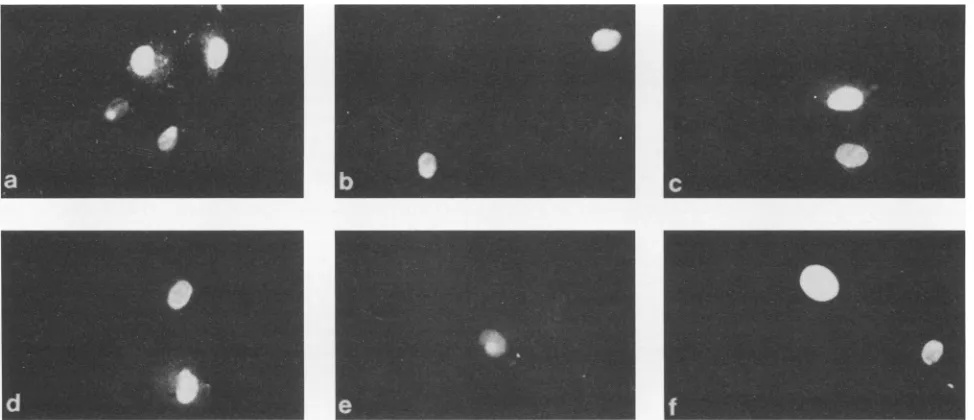
ization of Tatl protein. To determine whether the basic domain of Tatl or Tat2 has any differential effect on subcel-lular localization of Tat proteins, COS-7 cells were trans-fected with the various Tat-expressing plasmids described above [Tatl, Tat2, Tat2(99),Tat(99)/lBD, Tat(99)77, Tat(99)/ 1CD] and expression of the various Tat proteins was deter-mined by indirect immunofluorescence with antibodies spe-cific for Tatl or Tat2 (Fig. 6). These studies indicate that both the wt Tatl and the wt Tat2 as well as the various mutant Tatproteins
efficiently
localized in the nuclear and nucleolar regions. No apparent differences among the sub-cellular localization phenotypes of the various mutant pro-teins were observed.I'at)(99).ICI)
N tt.0
NE...e N*
_ :
4
07
i-n a
m c
c-o X X
_z C1 N1 N N
[image:4.612.74.301.81.429.2]a a %
FIG. 4. (A) Organization of Tat2(99) and mutants; (B) trans
activation (CAT assay) of HIV-1 LTR by Tat2(99)/lCD or
Tat2(99)77. CAT activitiesare asdescribed inthelegendtoFig. 1.
(Glu) is present at the junction of the core Tat2 domain (domain C in Fig. 4A) and the basic domain (domain D in Fig. 4A). To determine whether this acidic residue has an inhibitory role in theactivityof the2BD, weconstructed a mutant, Tat2(99)77, in which this Glu residue (position 77) wasconvertedtoaGlyresidue. AGlyresidue is alsopresent at the corresponding position in Tatl. The assay for the trans-activation potential of thismutant (Fig. 4B) indicates that ittransactivated HIV-1 LTR CATexpressiontoalevel more or less similar to that of Tatl. This result further strengthens the data presented above, which show that domain D of Tat2 contributes at least partially to the relatively inefficienttrans activation ofthe HIV-1 LTR by Tat2.
Effect of 1BD and 2BDonsubcellular localization of Tat.A number ofpreviousstudies(21, 31, 33)have shown that the basic domain isrequiredfor efficientnuclear-nucleolar
local-HIV-1 G R K K R R
Q
R
RHIV-2 E R K G R R R T P K K T K
FIG. 5. Comparison ofthe basic domainsofTatland Tat2.
DISCUSSION
Our results demonstrate that the differential activities of Tatl andTat2on the HIV-1 LTRareprimarily contributed to by the differences in the individual basic domains. This conclusion is based on our results obtained with the Tat2 substitutionmutantsexpressing the1BDaswellaswith Tatl substitution mutants expressing the 2BD. In these studies, the increase or decrease in trans activation of the HIV-1 LTRby various mutantsclearly reflected the basic domain contained. In contrast to the results obtained with the BD mutants,swappingof theconservedcoredomain (domain C) between Tatl and Tat2 did not alter the trans-activation potential significantly. However, we cannot fully rule out
any potentialeffects of other regions, such as theCys-rich domain, in the differential trans-activation property, since
we have not been able to construct a functional
Tatl/Tat2
chimeraby exchangingtheCys-richdomain. Ourconclusion thatthe 2BD contributestoinefficienttransactivationof the HIV-1 LTR by Tat2 is strongly supported by the single-amino-acidsubstitutionmutantTat(99)77,which exhibits en-hanced activity comparedwith Tat(99). It appears that the differential effects observed with variousmutantsmaynotbe attributed to other characteristics ofmutant proteins, such
as subcellular accumulation and transport to the nuclear-nucleolar locations.
Since itappearsthat the basic domainspecificallybindsto TAR, it is possible that the 1BD and the 2BD may have varied affinity for theTAR1 structure, thus contributingto the partial reciprocal activity. By functional substitution with a number of heterologous basic domains, we have postulatedthat anArg-rich motif, R/KXXRRXRR, whichis also conserved in all HIV-1isolates,isrequiredfor efficient
transactivation of the HIV-1 LTR (32).The left halfof the
2BD hasasubstantial resemblancetothe1BD (Fig. 5;boxed areas).However,substitution of theArg-richhalf of the2BD for the1BD substantiallyreducesthe trans-activation poten-tial of Tatl (6% of that of wt Tatl). This level could be further increased by inclusion of the Lys-rich half of the 2BD. This observation suggests that the overall charge density may play a role in efficient trans activation. The importanceof the overall charge density,in addition to the specific sequence requirements for efficient recognition of TAR by the Tat BD, has also been suggested by other studies (6, 7, 12, 16). Examination of 2BD sequences
indi-catesthat the 2BDconsists ofanArg-richhalf(indicated by the boxedareasinFig. 5)andaLys-richhalf(indicated bya
double underline in Fig. 5). It would be interesting to
determine whether the 2BD is a bipartite BD evolved for interaction withamore complexTAR2 structure. Itshould be noted that the Tat2 mutant[Tat2(99)] lackingthe second
exon trans activates the HIV-2 LTR atabout one-half the
B
J.VIROL.
on November 9, 2019 by guest
http://jvi.asm.org/
FIG. 6. Subcellular localization ofTatl,Tat2,and variousmutantTatproteins.COS-7cellsweretransfectedwith variousTat-expressing plasmidsandanalyzed byindirectimmunofluorescence. Panels: a, Tatl;b, Tat2; c,Tat2(99); d, Tat(99)/lBD; e,Tat(99)77; f,Tat(99)/lCD.
level of wt Tat2 (Fig. 3B). It remains to be determined whether theproteinregion encoded byexon 2has any rolein Tat2-TAR2interaction. Since exon 2 clearly is not required for trans activation of LTR-1, while it isrequired for efficient trans activation of LTR-2, it may be possible that theexon 2-encodedprotein
region
cooperateswith the basic domain orconfers a favorable structural feature for efficient recog-nition of TAR2.ACKNOWLEDGMENTS
This work was supported by research grantsAI-29541 and Al-29200.
We thank J. Nelson, K.-T. Jeang, and the AIDS Research and ReferenceProgram for TatlandTat2antibodies, M. Emermanfor pROD214, and B. R. Cullen for pBC12. We also thank L. K. Venkatesh for adviceanddiscussions.
REFERENCES
1. Arya,S.K., and R. C. Gallo. 1988. Human immunodeficiency virus type 2 long terminal repeat: analysis of regulatory eje-ments.Proc. Natl.Acad. Sci. USA 85:9753-9757.
2. Berkhout,B., A.Gatignol,A. B.Robson, and K.-T. Jeang. 1990. TAR-independentactivation of the HIV-1 LTR: evidence that Tatrequires specific regions ofthe promoter. Cell 62:757-767. 3. Berkhout, B., A. Gatignol, J. Silver, and K.-T. Jeang. 1990.
Efficient trans-activation by theHIV-2 Tat protein requires a
duplicatedTAR RNA structure. Nucleic Acids Res. 18:1839-1846.
4. Berkhout, B., R.Silverman,and K.-T.Jeang. 1989. TAT
trans-activates the humanimmunodeficiencyvirusthroughanascent
RNA target. Cell 59:273-282.
5. Braddock, M., A. Chambers, W.Wilson, M. P. Esnouf, S. E. Adams,A.J. Kingsman,andS. M. Kingsman. 1989. HIV-1 Tat "activates" presynthesized RNA in the nucleus. Cell 58:269-279.
6. Calnan, B. J., S. Biancalana, D. Hudson, and A. D. Frankel. 1991. Analysis of arginine-rich peptides from the HIV tat
protein reveals unusual features of RNA-protein recognition. GenesDev.5:201-210.
7. Calnan,B. J.,B. Tidor, S. Biancalana, D. Hudson, and A. D. Frankel. 1991. Arginine-mediated RNA recognition: the argi-ninefork. Science252:1167-1171.
8. Carroll,R., L. Martarano, and D. Derse. 1991.Identificationof
lentivirus Tat functional domainsthrough generationofequine infectious anemiavirus/humanimmunodeficiencyvirus type 1 tatgenechimeras. J.Virol. 65:3460-3467.
9. Clavel,F., M. Guyader, D.Guetard,M. Salle,L. Montagnier, and M. Alizon. 1986. Molecularcloning and polymorphism of the human immune deficiencyvirus type 2. Nature (London) 324:691-695.
10. Cordingly, M. G., R. L. LaFemina, P. L. Callahan, J. H. Condra, V. V. Sardana, D. J. Graham, T. M. Nguyen, K. LeGrow, L. Gotlib,A. J.Schlabach, and R. J. Colonno. 1990. Sequence-specific interaction of Tat protein and Tat peptides with thetransactivation-responsive sequenceelement ofhuman immunodeficiencyvirus type 1 in vitro. Proc.Natl. Acad. Sci. USA 87:8985-8989.
11. Cullen, B. R. 1990. The HIV-1tat protein:anRNA sequence-specific processivity factor?Cell 63:655-657.
12. Delling, U., S. Roy, M.Sumner-Smith, R. Barnett, L. Reid, C. A. Rosen, and N. Sonenberg. 1991. The number of positively charged amino acids in the basic domain of tat is critical for trans-activationandcomplexformation with TAR RNA. Proc. Natl. Acad. Sci. USA 88:6234-6238.
13. Dingwall,C.,I.Ernberg, M. J. Gait, S. M.Green,S.Heaphy, J. Karn, A. D.Lowe, M. Singh, and M. A. Skinner. 1990. HIV-1tat
protein stimulatestranscription by bindingtoU-richbulgein the
stemofthe TAR RNAstructure.EMBO J. 9:4145-4153. 14. Dorn, P., L.DaSilva,L.Martarano, and D. Derse. 1990.Equine
infectious anemia virustat:insightsinto the structure,function, and evolution of lentivirus trans-activator proteins. J. Virol. 64:1616-1624.
15. Emerman, M.,M. Guyader,L.Montagnier, D.Baltimore,and M. A. Muesing. 1987. Thespecificityof the human immunode-ficiency virus type 2 transactivator is different from that of humanimmunodeficiency virustype 1. EMBO J. 6:3755-3760. 16. Endo, S.-I., S. Kubota, H. Siomi,A. Adachi, S. Oroszlan, M.
Maki, and M. Hatanaka. 1989. A region of basic amino-acid clusterin HIV-1tatproteinis essential fortrans-acting activity and nucleolarlocalization. Virus Genes 3:99-110.
17. Feng, S.,and E. C. Holland. 1988. HIV-1 tattrans-activation requires the loop sequence within tar. Nature (London) 334: 165-167.
18. Fenrick, R.,M. H.Malim,J. Hauber, S.-Y. Le, J.Maizel,and B. R.Cullen. 1989.Functionalanalysisof the Tattransactivator of human immunodeficiency virus type 2. J. Virol. 63:5006-5012.
19. Garcia,J. A.,D.Harrich, E.Soultanakis,F.Wu, R.Mitsuyasu,
on November 9, 2019 by guest
http://jvi.asm.org/
[image:5.612.60.547.76.286.2]2036 ELANGOVAN ET AL.
and R. B. Gaynor.1989. Humanimmunodeficiency virus type 1: LTR TATA and TARregion sequences required for transcrip-tional regulation. EMBO J. 8:765-778.
20. Guyader, M., M. Emerman, P. Sonigo, F. Clavel, L. Montagnier, and M. Alizon. 1987. Genome organization and transactivation of the humanimmunodeficiency virustype 2. Nature(London) 326:662-669.
21. Hauber, J., M. H. Malim, and B. R. Cullen. 1989. Mutational analysisofthe conserved basic domain of human immunodefi-ciency virustatprotein.J. Virol. 63:1181-1187.
22. Kammann, M., J.Laufs, J. Schell, and B. Gronenborn. 1989. Rapid insertional mutagenesis of DNA by polymerase chain reaction (PCR). Nucleic AcidsRes. 17:5404.
23. Kuppuswamy, M., T. Subramanian, A. Srinivasan, and G. Chinnadurai. 1989. Multiple functional domains of Tat, the trans-activator ofHIV-1, defined by mutational analysis. Nu-cleic AcidsRes.17:3551-3561.
24. Malim, M. H., J. Hauber, R.Fenrick, and B. R. Cullen. 1988. Immunodeficiency virus rev trans-activator modulates the expression of the viral regulatory genes. Nature (London) 335:181-183.
25. Meyers, G., S. F. Josephs, J. A.Berzofsky,A. B. Rabson, T. F. Smith, and F. Wong-Staal.1990.HumanretrovirusesandAIDS. Los AlamosNational Laboratory, LosAlamos,N.Mex. 26. Pearson, L., J. Garcia,F.Wu, N. Modesti, J. Nelson, and R.
Gaynor. 1990. A transdominant tat mutant that inhibits
tat-induced gene expression from the human immunodeficiency virus long terminalrepeat.Proc.Natl. Acad. Sci. USA 87:5079-5083.
27. Peterlin, B. M., P. A. Luciw, P. J. Barr, and M. D. Walker.
1986. Elevated levels of mRNA can account for the trans-activationof humanimmunodeficiency virus(HIV).Proc. Natl. Acad.Sci. USA 83:9734-9738.
28. Rosen, C. A., J. G. Sodroski, and W. A. Haseltine. 1985. The location of cis-acting regulatorysequencesin the humanTcell lymphotropic virus type III (HTLV-III/LAV) long terminal repeat.Cell 41:813-823.
29. Roy, S., U. Delling, C.-H. Chen, C. A. Rosen, and N.Sonenberg. 1990. A bulge structureinHIV-1 TAR RNAis requiredfor Tat binding and Tat-mediated trans-activation. Genes Dev. 4:1365-1373.
30. Selby, M. J., E. S. Bain, P. A. Luciw, and B. M. Peterlin. 1989. Structure,sequence,andposition of thestem-loop intar deter-mine transcriptional elongation bytatthrough the HIV-1 long terminalrepeat.Genes Dev.3:547-558.
31. Siomi, H., H.Shida, M. Maki, and M. Hatanaka.1990.Effects ofahighly basic region of human immunodeficiency virustat
proteinonnucleolar localization. J. Virol. 64:1803-1807. 32. Subramanian, T., R.Govindarajan, and G.Chinnadurai.1991.
Heterologous basic domain substitutions in the HIV-1 Tat protein reveal anarginine-rich motif required for trans-activa-tion. EMBOJ. 10:2311-2318.
33. Subramanian, T., M. Kuppuswamy, L. Venkatesh, A. Srini-vasan, andG. Chinnadurai.1990. Functional substitutionof the basic domain of the HIV-1trans-activator,Tat, with thebasic domain of thefunctionally heterologousRev.Virology 176:178-183.
34. Weeks, K. M., C. Ampe, S. C.Schultz, T. A. Steitz, and D. M. Crothers. 1990.Fragments of theHIV-1 Tatproteinspecifically bind TAR RNA.Science249:1281-1285.
J. VIROL.