0022-538X/89/125208-08$02.00/0
Copyright © 1989, American Society for Microbiology
Simian Virus 40 Host
Range/Helper
Function Mutations
Cause
Multiple Defects
in
Viral Late
Gene
Expressiont
TERRYLSTACY,* MICHELE CHAMBERLAIN, ANDCHARLES N. COLE The Molecular Genetics CenterandDepartment of Biochemistry, Dartmouth MedicalSchool,
Hanover, NewHampshire 03756 Received 12May 1989/Accepted 7 September 1989
Simian virus 40 (SV40) deletion mutants dlA2459 and dlA2475 express Tantigens that lack the normal carboxy terminus. These mutants are called host range/helper function (hrlhf) mutants because they form plaquesat37ConBSC-1 and Veromonkey kidneycelllines butnotonCV-lp monkey kidneycells.Wild-type SV40canprovideahelperfunction topermitgrowthof human adenovirusesinmonkey kidneycells;thehrlhf
mutants cannot.Progeny yields ofhrlhfmutantsarealsocold sensitive in all cell lines tested. Patterns of viral
macromolecularsynthesisin three cell lines(Vero, BSC-1,andCV-1)at threetemperatures(40, 37,and32°C) wereexamined to determine the nature of thegrowthdefect ofhrlhfmutants. Mutant viral DNA replication wassimilar tothat of the wild type in all threecelllines, indicatingthat the mutations affect late events inthe
virallytic cycle.Inmutant-infected Verocells,inwhich viralyieldswerehighest,latemRNAlevelsweresimilar tothose observed duringwild-typeinfection. Levels ofvirallatemRNAfrom mutant-infected CV-1 and BSC-1 cells at32 and37°Cwerereduced relativetothose ofwild-type-infectedcells. Thesteady-statelevel of themajor
viral capsid protein, VP1,inmutant-infected CV-1 cellswasreducedtothesameextentas waslate mRNA. The
synthesisofagnoproteincould not be detected in mutant-infected CV-1 cells butwasreadilydetected in CV-1
cells infected bywild-type SV40. Primer extension analysesindicated that most late mRNAs from
mutant-infected CV-1 cells utilize startsitesdownstreamfromthe major wild-typecapsite(nucleotide 325) and the
agnoprotein initiation codon (nucleotide 335). These results indicate that deletion of the carboxyl-terminal domainof Tantigenaffects viral late mRNAproduction,bothquantitativelyandqualitatively.Theagnoprotein isdetected lateinthe wild-type SV40 lytic cycle and is thoughttoplayaroleintheassemblyormaturation of virions. Reducedhrlhfprogenyyields could result from decreased capsid protein synthesis and,inthe absence
ofdetectablelevels ofagnoprotein, from inefficientuseof availablecapsid proteins.
The simian virus 40 (SV40) large tumor (T) antigen is a
708-amino-acid polypeptide expressed throughoutthe infec-tioncycle in permissive monkey kidney cells (for a review, seereference 54). This protein is required for replication of
viral DNA (8, 34, 47, 49), autoregulation of SV40 early
transcription (1, 52), and transactivation of the SV40 late promoter (6, 25, 26). T antigen is also essentialforSV40 to
immortalizeand to transform nonpermissive rodentcellsto a
malignantphenotype (27, 50).
Tantigen is modifiedposttranslationally by
phosphoryla-tion (51),glycosylation(22),acylation(32), ADPribosylation (19), andadenylylation (5). T antigen occurs in monomeric,
dimeric, andlarger oligomeric forms andincomplexeswith
cellular proteins, including DNA polymerase a (45), p53 (33),andtheretinoblastomasusceptibility geneproduct, Rb (14). Different forms of T antigen may be involved in its
various biochemical activities. These activities include ATPase (9, 18), helicase (46), and specific binding to the
SV40 origin ofDNAreplication(23, 39, 53). Each of these
activities has been mapped to specific regions of the
T-antigen molecule (10, 13, 37). The viral DNA replication
functionrequires that these three activities be present in the sameT-antigen monomer (13, 55). Together, these domains encompass sequences extending from approximately amino acid 130through 600 (13).
The extreme carboxyl terminus of large Tantigen
medi-*Correspondingauthor.
tThis reportis dedicatedtoGeorge Khoury, whosemany inter-estsincluded the adenovirushelper function activity ofSV40 large T antigenandwhosecuriosityand support we valueddeeply.
ates a distinct function, the host range/adenovirus helper function(hrlhf). Mostmonkey cell lines infected by human adenoviruses produce very low yields of viral progeny. The block to productive adenovirus infection occurs at a late stage of the adenovirus lifecycle and can be overcome by thecarboxyl terminus of SV40Tantigen (17, 40).This can be
provided either by coinfection with SV40 or by infection
with adenovirus/SV40 hybrid viruses (for a review, see
reference 29). These hybrid viruses encode eitherlarge T
antigen, carboxyl-terminal
fragments
ofTantigen, oraden-ovirus/SV40fusion proteins containingthe carboxyl termi-nusoflarge T. We have shown that the adenovirus helper function activity ofT antigen is contained within the
car-boxyl-terminal 34amino acidsof Tantigen (11, 38).
Previously, we described deletion mutants of SV40
(dlA2459,dlA2465, anddlA2475) which donot express the
normal carboxylterminusoflargeT(12, 13,55). In addition to being defective for adenovirus helper function, these mutantsareunabletoformplaquesonCV-lpmonolayersat
37°C.Thisdefectin
plaque
formationcanbecomplemented
by SV40 mutants producing a T antigen with a normal
carboxyl terminus (55, 56) or by a mutant in which the
carboxyl-terminal 26amino acidsoflargeTarefused tothe
amino-terminal 346 amino acids of VP1, the major capsid
protein (57). This demonstrates that the hrlhffunction is
separablefrom the rest ofTantigen.
The growth characteristics ofthe hrlhfmutants are cell
line and temperature dependent (12). The mutants form
plaquesinCV-lpcellsonlyat40°C,inBSC-1 cells at 37 and
40°C, and in Vero cells at 32, 37, and 40°C. Interestingly, human adenoviruses also grow productively in Vero cells
5208
on November 10, 2019 by guest
http://jvi.asm.org/
DEFECTS OF SV40 hrlhfMUTANTS 5209 (15) but not in CV-1 or other African green monkey kidney
(AGMK) cell lines tested. The growth properties of hrlhf
mutants indicate that the adenovirus helper function of T
antigen isalso required by SV40for productive infection in
CV-1 cells. Other hrlhfmutants have been described by Manos and Gluzman (35) and by Pipas (36).
In ourinitialcharacterization ofmutant dlA2459(56), we reported that the mutant genome replicatesin CV-1 cellsat
37°C andthat adefect inlate gene expression is responsible
forthe reduced mutant progeny production. In this report, we describe the patterns of viral late mRNA and VP1
synthesis during dlA2459 and dlA2475 infections of CV-1,
BSC-1, and Vero cells at various temperatures. In Vero
cells, hrlhf mutants produced approximately normal
amountsof late mRNA, VP1, and viral progeny. In contrast,
levels of late mRNA and VP1 were reduced in
mutant-infected BSC-1 and CV-1 cells.
The agnoprotein, which is encoded in the leader region of some SV40 late mRNAs, is detected late in the SV40 lytic
cycle (23) and is thoughttobeinvolved intheassembly and
maturation of virions (3, 7, 42). We could not detect the
agnoprotein aftermutantinfection ofCV-1 cells. This agrees
withresults obtained byKhaliliet al. (27), who investigated
the properties of similarmutants. The major wild-typeSV40 latemRNA start site is locatedupstream from the
agnopro-tein initiation codon (41, 54) and, therefore, most 16S late mRNAs containthe sequences necessary to synthesize the
agnoprotein. In contrast, datapresented here indicate that
the start sites of most late mRNAs produced in hrlhf mutant-infected CV-1 cells mapped downstream of the
ag-noprotein initiationcodon. There were nodifferences in the 16SlatemRNA startsites usedbywild-type SV40andhrlhf
mutantsinVerocells. Theverylow yieldof progenyvirions inmutant-infected CV-1 cells probably results from reduced production oflatemRNASandcapsid proteins and, because ofthe absence ofagnoprotein, from the inefficient use of capsid proteins.
MATERIALSANDMETHODS
Cells,
viruses,
and plasmids. The African green monkeykidney
cell
lines CV-1,CV-lp,
BSC-1, and Vero weremaintainedinDulbecco modified minimalessentialmedium
(DMEM) supplemented with 5 or 10% fetal calf
serum-penicillin (10
U/ml)-streptomycin
(10,ug/ml)
inahumidified atmospherecontaining 7% CO2. CV-lp cellsare asubline of CV-1 cells usedforplaqueassays. CV-1 cellswereused forall otherexperiments.
The construction of mutant plasmids pdlA2459 and
pdlA2475hasbeen describedpreviously(12,55). To prepare
stocks of these mutants, Vero cells were transfected (57)
with mutant viral DNA which had been separated from
pBR322 sequences by digestion withEcoRI and recircular-izedby ligationat alowDNAconcentration (5 ,ug/ml) with
T4 DNA ligase. Stocks of SV40 wild type (WT830), a
small-plaque strain (48), wereprepared inVerocells. Cells
were infected with SV40 at amultiplicityof infection of 0.05. When most of the cells had rounded up but had not yet
detached, theywere scrapedfrom theplate, suspendedina
small volume of DMEM with 2% fetal calf serum, and
sonicated. The celldebris was removed by
centrifugation,
and the viral stocks were stored at -80°C. Titers of
wild-type and mutant stocks weredeterminedby plaqueassay on
monolayers of BSC-1cells, aspreviously described (56).
Ribonucleaseprotection analysis oflate viral mRNA.
Con-fluent
cell
cultures were infected with mutant orwild-type
virus at a multiplicity of infection of 5 and were incubated at
thetemperatures indicated inthe figure legends.
Cytoplas-micRNAwasprepared fromcellsharvested at 48 h (37and 40°C cultures) or 96 h (32°C cultures) postinfection by the method of White et al. (58). SP6 bacteriophage RNA poly-merase wasobtained from Promega Biotec (Madison,Wis.)
and used toprepare
[32P]UMP-labeled
RNA probesforuseinRNaseprotection mapping, followingthe directions pro-vided by the enzyme supplier. RNA probes were
synthe-sized from plasmid pSP64SVL (a generous gift from J.
Alwine), which contained the SV40 genome opened at its
BamHIsiteandinserteddownstreamfromthe SP6promoter in theorientation which permittedsynthesis of RNAprobes
complementary to SV40 late mRNAs. The plasmid was
linearized at the ApaI site (SV40 nucleotide 2258). After
denaturation, cytoplasmic RNA was annealed to an excess
ofprobeRNAovernightat60°C,andhybridsweredigested
at37°C withRNase A (40 ,ug/ml; Sigma Chemical Co., St.
Louis, Mo.) andT1 (2 ,ug/ml; Sigma). Protected fragments
were analyzed by electrophoresis on 6% polyacrylamide-7
Mureagels,followed by autoradiography.
Analysis of viral capsid protein. At various times after
infection,cells wereharvestedinlysingbuffer(0.15MNaCl,
0.02 MTris hydrochloride [pH 8.0], 1% Nonidet P-40)from cultures infectedwithdlA2475, dlA2459,orwild-typeSV40. Lysates from equalnumbers of infected cells were
electro-phoresed on sodium dodecyl sulfate (SDS)-polyacrylamide gels and transferred to nitrocellulose by electroblotting. Blots were incubated first with rabbit antiserum to
SDS-disrupted SV40 virions, and then with goat anti-rabbit
im-munoglobulin G conjugatedtoalkalinephosphatase(Sigma).
Immunodetection was with 5-bromo-4-chloro-3-indolyl
phosphate and Nitro Blue Tetrazolium, as described by
Blake etal. (4). The SV40antiserumrecognizes only VP1. Analysis of agnoprotein.dlA2459-, dlA2475-,or wild-type-infected CV-1 cells were pulsed-labeled with [14C]arginine (323.5 mCi/mmol; New England Nuclear-DuPont) in
argin-ine-free DMEM for 1 h. Cells were lysed in SDS
sample
buffer(7 Murea, 7 mM sodiumphosphate,
monobasic,
1%SDS, 0.1% 2-mercaptoethanol, 0.01% bromophenol blue)
and analyzed on a polyacrylamide gel containing 0.1 M
sodiumphosphate (pH
7.2)-0.1%
SDS-6 Murea-15%poly-acrylamide-bisacrylamide (30:0.8) (44).
Primerextensionanalysis. A 30-base-pair (bp)
oligonucle-otide
primer
complementary to late mRNA and extendingfrom SV40 nucleotides 1498 to 1468 was
synthesized
andlabeled byusing [a-32P]ATP andT4
polynucleotide
kinase. Samples (10 ,ug) ofcytoplasmic
RNAextracted frommutant-andwild-type-infected cellsweredenatured with
primer
in 5pl
ofhybridization buffer(80%
formamide, 40 mMpipera-zine-N,N'-bis[2-ethanesulfonic
acid] [PIPES] [pH6.7],
0.4 MNaCl,
1 mMEDTA)
at85°C
for 10minand annealedat60°C for4 h.Reaction volumeswere
brought
to50 ,ulin 50 mMTris(pH8.5)-10
mMMgCl2-40mM KCl-1mM dithio-threitol-250,uM of eachdeoxynucleotide triphosphate;
5 Uof avian
myelobastosis
virus reversetranscriptase
wasadded, and samples were incubated at 42°C for 1 h. RNA
was hydrolyzed in 0.5 N NaOH; reaction mixtures were
neutralized with 0.5 N HCl and ethanol
precipitated,
and cDNAswere analyzed byelectrophoresis
on6%polyacryl-amide-7 Mureagels.
RESULTS
The carboxyl terminus of SV40
large
Tantigen
is aseparate andseparablefunctionaldomain whichis
required
VOL.63, 1989on November 10, 2019 by guest
http://jvi.asm.org/
A
2800 Bel
ICCICTCR6TCCTCRCRTCT6TTCI!' RRTCRGCCRTRCCRC
2459--4
I270
RJTTI6T6R66TTTTRCTT6CTTTRARRRHRCCICCCACRCCTCCCCCT6A
2700 HpI
RCC16RRRCIVW!!RT6RRTGCRRITT6 6TTG T6TJTTGCR
c-terminusorlarge JTlllsitsin2475
2o60 siAPC,
GCTIITRRTGGTHTRCIRSflRdRCRRTRGCRJCRC-3'
(0 16)
B
SV40-WT
dl-2459
dl-2475 SV40-WT di-2475
"6I 670 680
THR GLY ILE ASP SER GLNSERGLNGLYSERPHEGLN ALAPROGLNSER SERGLNSER YAL
YALCYSSER-COOH
690 700
HIS ASPHISASNGLN PRO TYR HISILECYSARGGLYPHETHR CYSPHELYS LYS PRO PRO
708 SV40-WT THRPRO PRO GLU PRO GLUTHR-COH
dl-2475 LEUASN LEU PHE ILE ALA ALATYR ASN GLYIYR LYS-CWH
FIG. 1. (A)Nucleotidesequenceof the 3' end of the early region
ofthe SV40genome.Shownarethe locations of thedeletions inthe
dlA2459and dlA2475 genomes, thetermination codon for large T
antigen,and the earlymRNApolyadenylationsignal. (B)Sequence
of the carboxyl-terminal portion of the T antigens encoded by
wild-typeSV40, dlA2459, and dlA2475. The single line refers to
residuesinmutantproteins thatareidenticaltothe wildtype. The
boxedarearepresentsresiduesthatareabsent from the dIA2475T
antigen.
forproductive infection ofmostmonkey kidney cell linesby
SV40 (35, 36, 57) or human adenoviruses (16, 20). We
constructed SV40 mutants dlA2459 (55) and dlA2475 (12) whose T antigens lack this domain and have shown that these mutants have a host range andcold-sensitive
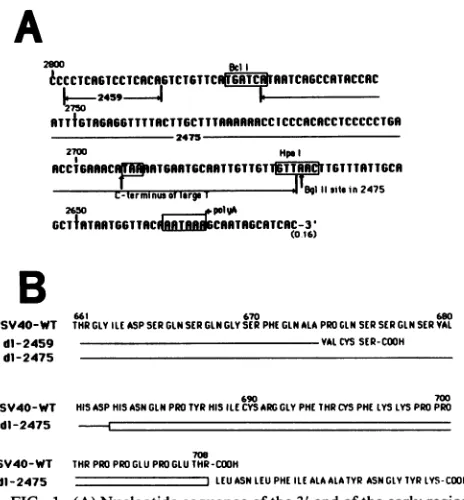
pheno-type (12, 57). Figure 1 shows thestructure of the 3' end of theearlyregion of theSV40genome,the sequencesdeleted
in the genomes ofmutants dlA2459 and dlA2475, and the
corresponding T-antigen aminoacidsequences. dlA2459has
a 14-bp deletion ofnucleotides 2798 to 2785 that causes a
readingframe shiftand theproductionofa673-amino-acidT
antigen lacking the carboxyl-terminal 35 amino acids of wild-type T antigen. dlA2475 is deleted from nucleotides 2770through2669 andproduces a682-amino-acid Tantigen
that lacks the 26carboxyl-terminal amino acids. Both
con-tainnon-wild-typeamino acidsattheir carboxyl termini.The growth characteristics ofthesetwo mutantsare verysimilar,
but the growth defect is slightly more severe for dlA2475
thanfor dlA2459. This could resultfrom dlA2475 having 12
non-wild-type amino acids at the carboxyl terminus, while dIA2459hasonly 3 non-wild-type amino acids (Fig. 1).
In our previous study (12), we reported that mutant
progenyyieldsweredecreased75-to80-fold inCV-1 cellsat
37and40°C,25-to60-fold in BSC-1cells, and about 10-fold
in Vero cells, relative to those of the wild type. In all cell
linesexamined,mutantyieldswerereducedmostseverelyat 32°C. We showed previously that dlA2459DNA replicated normally inCV-lp cells at37°C (57), andweconcluded that
thehostrange/helperfunction oflarge T antigen is required after the onset of viral DNA replication. We have since analyzed dlA2459and dlA2475DNA replication inVero and
BSC-1 cells,aswellasCV-1 cells, at37and32°C (datanot
shown). In all cases, we found that mutant viral DNA replicated nearly as efficiently as wild-type DNA. Other laboratories have analyzed similar carboxyl-terminal T-an-tigen mutants and reported them to be competent for viral
DNA replication (35, 36). In an effort to understand the molecular basis of the host range and cold-sensitive defects ofthehrlhf mutants, we compared the patterns oflate viral
macromolecular synthesis in various monkey kidney cell lines infected at different temperatures by wild-type SV40,
dlA2475, or dlA2459.
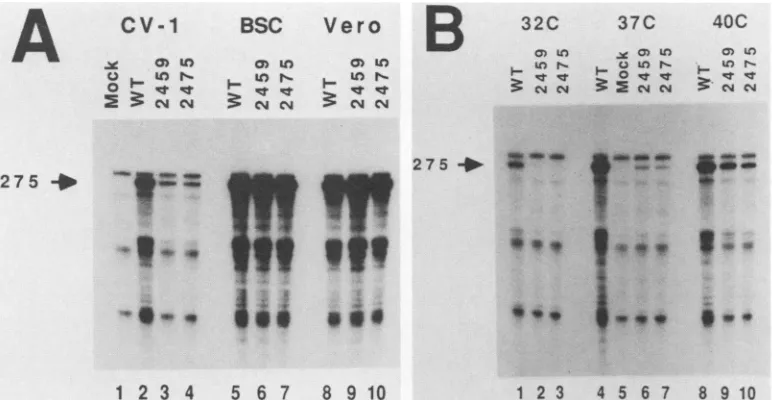
Levels of late viral mRNA. We examined late viral mRNA levels in CV-1, BSC-1, and Verocellsinfectedwith dlA2459, dlA2475, or wild-type SV40. Total cytoplasmic RNA was isolated from infected cells and hybridized to an RNA probe that protects the 3' ends of all SV40 late mRNAs. After RNase digestion, the protected fragments were analyzed on denaturing polyacrylamide gels (Fig. 2). Figure 2A shows the results of an analysis performed on RNA from mutant and wild-typeinfections of the three cell lines incubated at37°C.
Equal quantities of viral late mRNA were detected in mu-tant- and wild-type-infected Vero (Fig. 2A, lanes 8, 9, and 10) and BSC-1 (Fig. 2A, lanes 5, 6, and 7) cells. However, decreased levels of mutant viral late mRNA were observed in mutant-infected CV-1 cells at 37°C (compare Fig. 2A, lanes 3 and 4, with Fig. 2A, lane 2). This indicates that the absence of the normal carboxyl terminus of T antigen correlated with decreased levels of SV40 late mRNA in CV-1 cells but not in Vero or BSC-1 cells.
Mutant viral yields are most cold sensitive in CV-1 cells. We compared viral late mRNA levels in mutant- and wild-type-infected CV-1 cells incubated at 32, 37, and40°C (Fig. 2B). The levels of mutant viral late mRNAs were clearly affected by incubation temperature. Very little viral late mRNA frommutant-infected cells was detected at32°C(Fig. 2B, lanes 2 and 3); slightly higher levels of late mRNAs were detected inmutant-infected cultures maintained at40°C(Fig. 2B, lanes 9 and 10) than at 37°C (Fig. 2B, lanes 6 and 7). Interestingly, wild-type late mRNA production was slightly cold sensitive (compare Fig. 2B, lanes 1 and 4), which correlates with the observation that even wild-type SV40 is slightly cold sensitive in CV-1 cells (12).
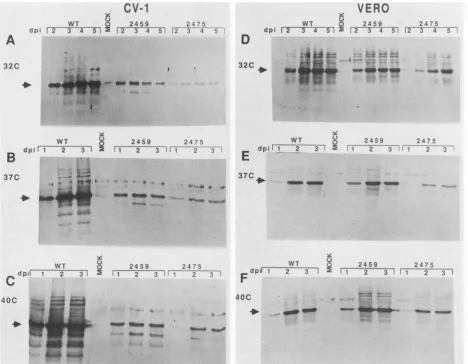
Viral capsidprotein synthesis. We compared the accumu-lation of VP1, theSV40 major capsid protein, in mutant- and wild-type-infected Vero and CV-1 cells (Fig. 3). These two celllines are the most and leastpermissive, respectively, for growth of the hrlhf mutants. Lysates for Western blotting were harvested on three consecutive days after infection at 37°C (Fig. 3B and E) and 40°C (Fig. 3C and F) and on four consecutive days after infection at 32°C (Fig. 3A and D) to accommodate the slower time course of infection at32°C.In Verocells (Fig. 3D to F), VP1accumulated to similar levels in wild-type- and mutant-infected cultures. The slightly lower levels of VP1 in dlA2475 infection versus dlA2459 (Fig. 3E) wereobserved reproducibly. In contrast, in CV-1 cells (Fig. 3A to C), VP1 accumulation during mutant infection was reduced significantly relative to that during
wild-type infection. These reduced levels of capsid protein correspond to the observed levels of late mRNA. At37°C in CV-1 cells, in which levels of mutant late mRNAs were reduced 5- to 10-fold (Fig. 2B), VP1 levels were reduced to asimilar degree. The stability of VP1 was also examined by pulse-chase labeling of mutant- and wild-type-infected Vero andCV-1 cellsincubated at different temperatures. VP1 had the same stability in mutant- and wild-type-infected cells (data notshown).
Synthesis of agnoprotein. A 61-amino-acid protein, the
on November 10, 2019 by guest
http://jvi.asm.org/
[image:3.612.64.296.66.316.2]DEFECTS OF SV40 hrlhf MUTANTS 5211
A
cV-1
o 1-
-0 le le
a
3
N cmBSC
Vero
B
0) L1)
i-c
C5
r-32C
a) to
1-_ Ln
f-to C
37C
Y LO
r-3. O et cm
40C
CD UC
U-LOfl B. IN
275~~~~ 2 7 5
2 75 + ~ =S275+ $ ~ § 2 ;
1 2 3 4 5 6 7 8 9 10 1 2 3 4 5 6 7 8 9 10
FIG. 2. RNaseprotection analysis ofSV40late mRNAs. Total cytoplasmic RNAwaspreparedfrom infectedormock-infected cultures
andannealed with [32P]-labeled antisenseRNAprobe. After hybridization, RNAwasdigestedwith RNase A and T1 and the protected RNA
hybrids wereanalyzedondenaturing6%polyacrylamide-urea gels, asdescribed inMaterials and Methods. Inhybrids between probe and SV40late mRNAs,a275-nucleotide band is protected (arrows). (A) Total cytoplasmic RNAwasprepared for protectionanalysis from CV-1
(lanes1to4),BSC-1(lanes 5to7),orVero (lanes 8to10)cells infected with wild-typeSV40(lanes 2, 5, and 8), dIA2459 (lanes 3, 6, and 9),
ordlA2475 (lanes4, 7,and10),orthe cellsweremockinfected (lane 1). (B) Total cytoplasmic RNAwasprepared for protection analysisfrom
CV-1cells infected with wild-typeSV40 (lanes1, 4,and 8), dlA2459 (lanes 2, 6, and 9),dIA2475 (lanes 3, 7, and 10),orfrom mock-infected
cells (lane 5).Incubationtemperatureswere32°C(lanes 1to3),37°C(lanes 4to7)or40°C (lanes8to10).
agnoprotein, is encoded in the leader region of the major
class ofSV40 16S latemRNAs(23).CarswellandAlwine(7)
suggested a role for this protein in the efficient nuclear localizationof VP1. A direct interaction between the
agno-protein and VP1 in the assembly of virions was suggested
from studies of pseudorevertants of mutants that do not produce the agnoprotein (3). A role for the agnoprotein in the
efficient release of virions from SV40-infected cells was proposed byResnickand Shenk (42). Since progeny fields in
CV-1 cells infected by hrlhf mutants were reduced to a greater extent (50- to 100-fold) than were the levels of VP1
(5-to10-fold),weexamined theproduction of agnoprotein in mutant-infected CV-1 cells.
The agnoprotein is rich in arginine and can be distin-guished from other cellular and viral proteins by in vivo labeling with
[14C]arginine
and fractionation ofthe small-molecular-weight proteins onpolyacrylamide-urea gels (23,44).Figure4showstheresults of suchananalysis. Although
a
[14C]arginine-labeled
protein ofthe appropriate size wasreadily detected40 hafter infection bywild-type SV40 (Fig.
4, lane 1), this protein could not be detected in mutant- or
mock-infected CV-1 cells (Fig. 4, lanes 2 to 4), even after
prolonged exposureoftheautoradiogram (datanotshown). This result confirms the finding that agnoprotein is not
produced in CV-1 cells infected by similar SV40 hrlhf
mutants(27) and suggests that thefailuretoproduce
agno-protein in CV-1 cells isageneralpropertyofmutantsof this
class.
Analysis of viral late mRNA start sites. SV40 16S late mRNAshavemultiple cap sites and therefore contain vari-ous amounts of leader sequence upstream from the VP1
coding region (41, 54).Thosethatstart ator 5' tothemajor
cap site(nucleotide 325)and have the most commonsplicing
pattern
encode the agnoprotein (Fig.SB).
This is approxi-mately 80%of 16S late mRNAs in wild-type-infected cells (41). 16S messages with other splicingpatterns
or thoseusingcap sites downstream of theagnoproteinAUG
(nucle-otide 335) do not encode the
agnoprotein.
A failure toproduceagnoprotein could reflect either defects in transla-tion of16S mRNAsencodingtheagnoproteinoralterations
in 16S late mRNA structures. To distinguish among these
possibilities,
wemapped
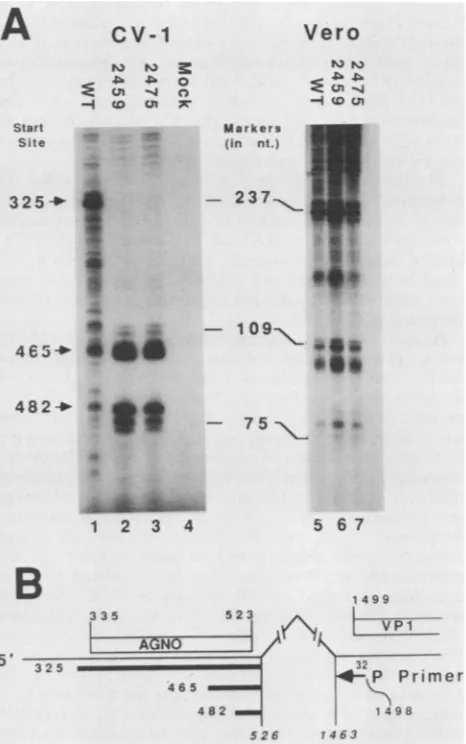
the cap sites of 16S late mRNAs present in mutant- and wild-type-infected CV-1 and Verocells by primer extension analysis. Autoradiograms of the
reverse-transcribedproductsareshown inFig. SA. In Vero
cells (Fig. 5A, lanes 5 to 7), identical patterns of primer extensionwere seenaftermutantandwild-type infections.A
major bandcorresponding to transcription initiation at
nu-cleotide 325 is indicated.
In CV-1 cells, the band corresponding to
transcription
initiationatthemajor
capsite(nucleotide
325)wasthemajor
band seen inwild-type-infected
cells (Fig. 5A, lane 1) but wasbarely detectable incells infectedby dlA2459(Fig.
5A,
lane2) ordlA2475 (Fig. 5A, lane 3). Forboth mutants, the
majorprimer extension
products
detectedcorresponded
tospecies of SV40 16S late mRNA thatare present but
rela-tivelyrareinwild-type-infectedcells and that initiate down-stream(nucleotides465 and482)of the
agnoprotein
AUGatnucleotide 335. Although start sites at nucleotides465 and 482 werereported
by Reddy
etal.(41),they
notethat thesiteatnucleotide 465 is nextto an AU sequence known to be
adjacent to capped structures on SV40 late mRNAs
(21),
whereas the start siteatnucleotide482 is not. Ourpresent data do not exclude thepossibility
that either or both of theseextension productsarosefrom premature terminationofthe cDNA.However, it isclearfromourdata that 16S late mRNAs able to encode the
agnoprotein
were very rare in mutant-infected CV-1 cells. We haverepeated
thisexperi-mentseveral times underdifferent
conditions;
wehavenever observedaprominentbandcorresponding
tothemajor
start site at nucleotide 325 in analysesusing
multiple
differentsamplesofmutantlate mRNA.
We conclude from this
analysis
thatsynthesis
of theagnoprotein does not occur atdetectable levels after
hrlhf
VOL.63, 1989
on November 10, 2019 by guest
http://jvi.asm.org/
[image:4.612.115.501.73.273.2]5212 STACY ET AL.
CV.1
WT 0 2459 2475
dpi F-2 3 4 512 [2 3 4 -5-r2 3 45
A
32C N,
,'...f~~~~~~~~~~~~~~~~~~~~~~~~~~~~~~...
*~~~~
WT 2459 2475
dpi 1 F 2 3 1F 1 2
B
...
..
:g.~~4
~ .a:. .37C
_'l.'#-': ''3~~~~~-.
*
w'.e.'i:...'.-.._
.i : . : o . ... ..'.:..:.':::~~41
VERO
WT 8 2459 2475
dpi 12 3 4 ""5T 1 2 3 4 51 [345
D
* . § ~~h~i B .,HV ie
32CVE_ T
drF
*.''
WT 0
dpiI1 2 3 2
E
37C *
-.-2459 2475
'1 2 3 fT2i -37.1
-.
WT
Cdpil 1 2 31
.40
40C
big
-_0
0 2459 2475
2
1r
3r
2 -I1F2T
3..i .... "i.!, .::: at
WT 0
Fd
pIf 2 1i 1 24592 3 1 24752 340C
* d_..
...
...~ ~ . ...
FIG. 3. Westernimmunoblottinganalysis of SV40 capsid protein accumulation. Lysates from mutant-, wild-type-, or mock-infected CV-1 (panelsAtoC, respectively) and Vero cells (panels D to F, respectively) that had been culturedat32°C (panelsAandD),37°C(panelsB and E), or 40°C (panels C and F)were electrophoresed on 8% SDS-polyacrylamide gels. After transfer to nitrocellulose, capsid protein was detected by treatment first with rabbit antiserum to SDS-disrupted SV40 virions, which recognizes only VP1, and then with goat anti-rabbit immunoglobulin G conjugated to alkaline phosphatase. Immunodetection was as described in Materials and Methods. Numbers above the lanesindicate the days postinfection (dpi) that lysates were prepared.
mutantinfectionof CV-1 cells because the 16S late mRNAs
producedlack the coding information for this protein. Both the steady-state levels and the structures of the SV40 late mRNAs were altered inhrlhf mutant-infected CV-1 cells.
DISCUSSION
SV40 deletion mutants which produce large T antigens
thatlack the normal carboxyl terminus show host range and
cold-sensitive behavior for plaque formation and progeny
yieldand are also absolutely defective for adenovirus helper
function(12). They are referred to as hrlhf mutants. In this study, we analyzed the levels of viral late mRNA and viral late proteins after mutant and wild-type SV40
infectionof three AGMK cell lines. Of the lines tested, CV-1 cells are the most restrictive and Vero cells are the most
permissive forhrlhf mutant growth. BSC-1 cells are
inter-mediate for mutant growth. Since the mutants show cold
sensitivity, someexperiments were conducted at 32, 37, and
40°C.Our results can be summarized as follows.
(i) Virallate mRNA accumulated to similar levels in Vero
and BSC-1 cells infected by hrlhf mutants and wild-type
SV40butnotin CV-1 cells(Fig. 2A).InCV-1 cellsat37°C, themutants accumulated only 10to 20%asmuch late viral mRNAaswild type. Even less late messagewaspresentat
32°C in mutant-infected CV-1 cells. The levels of mutant late messagewere somewhat greater in CV-1 cells incubatedat
400C.
(ii) The major capsid protein VP1 accumulatedtonearly
equal levels in Vero cells infected with wild-type SV40or
hrlhfmutants(Fig. 3). However,mutant-infected CV-1 cells failedto accumulate VP1 towild-type levels. The extent of the decrease in the amount of VP1 in mutant-infected CV-1 cellsreflected the decreased level of late mRNA. Therefore, the hrlhfmutation appears to affect late mRNA accumula-tion but not its translaaccumula-tion. Whether there is a defect in
transactivation,intranscriptionelongation,or at some
post-transcriptional step in mRNAmetabolism willrequire addi-tional studies.
(iii) Synthesis of the agnoprotein was detected in
wild-type-infectedCV-1 cells butnotin
hr/hf-infected
CV-1 cells (Fig. 4). Primer extension analysis showed that the agnopro-tein couldnotbeproducedatdetectable levelsduringmutant J.VIROL.:&. *4000
i..
.:i,
on November 10, 2019 by guest
http://jvi.asm.org/
[image:5.612.77.545.74.438.2]DEFECTS OF SV40 hrlhfMUTANTS 5213
U0.
4~
0~o CAi 7
A
CV-1
Vero
- 14.3 Kd 4*- Agno
6.2 Kd
1 2 3 4
FIG. 4. Analysisofthe synthesis ofthe agnoprotein. Plates (35 mmdiameter)ofconfluentCV-1 cells were infected with wild-type SV40(lane 1), dlA2459 (lane 2), ordIA2475 (lane3), orthey were mock infected(lane4). At 40 h postinfection, cells were labeled with 5 ,uCi of[14C]arginineperplate for 1 h in DMEM lacking arginine plus 2% dialyzed fetal calf serum. Lysates were harvested and analyzedon anSDS-15% polyacrylamidegelcontaining6 M urea, as described in Materials and Methods. Positions of 14C-labeled
molecular sizemarkers and the agnoprotein (Agno) are indicated.
1%)
q CD
Start
Site
4: 42
4C
4-.:.
4
42
r1-o
.~1 0
-~4 O
Markers
-'...II. (In nt.)
- 237
-N%.-*~~~~~~~~~~~~~~~
.ifi 1
09-S_
75-\
infection of CV-1 cells because of alteredpatternsofmutant late mRNA start sites. Although themutantsand wildtype showed identicalpatterns of mRNAcapsites inVero cells, almost all of the 5' ends ofmutantviral16S mRNAs in CV-1
cells mapped downstream of the agnoprotein initiation codon(Fig. 5).Themajorsites used inmutant-infected CV-1 cells are sites which areused toform minor speciesof16S
late mRNA during wild-typeinfection (41, 54).
The results ofourprimerextensionanalysesdonotagree
withconclusions reached byKhalilietal. (27), who reported
nodifferencesinlatemRNA leaderstructuresinCV-lpcells infected with wild-type SV40 and hrlhfmutants similar to
ourmutants. Theprimerused in their studies (nucleotides
460to520)wouldnothave detected late mRNAs initiatedat nucleotides 465 and 482, which we found to be the major species of 16Slate mRNA inmutant-infected CV-1 cells. We also examined the cap sites of 19S late mRNAs in mutant-andwild-type-infected CV-1 and Vero cells. In Verocells, mutantandwild-typelate 19S mRNAsusethesamecapsites withthe samefrequencies; inCV-1 cells, most mutant 19S
late mRNA start sites map downstream from the major wild-typesite (T. StacyandC. N. Cole, unpublished data). Although the conclusions reached by Khalili et al. (27) do not agree with ours, the data in their report clearly show decreaseduseof themajorcapsiteatnucleotide 325 in 19S
late mRNAisolatedfrom mutant-infectedCV-lpcells. Vero cellsaremostpermissiveforhrlhfmutantinfection; wild-typeamountsofviralDNA, late mRNA,and VP1were produced. Previous studies suggestedthatmutantviral prog-enyyieldswerereducedupto 10-fold in Vero cells relative to those of the wild type. We now believe that the actual
virion yields in mutant-infected Vero cells are higher than
yieldscalculated from standardplaqueassays.Theseplaque
assaysareperformedwith BSC-1 cells because monolayers
of Vero cells do not survive long enough for use in these assays. Approximately 15% of mutant-infected BSC-1 cells
produce sufficientvirions toformplaques, whereasplaques areformed from nearly100% ofwild-type-infectedcells(T. Stacy and C. N. Cole, manuscriptinpreparation).
Althoughthetwodeletion mutants, dlA2459 anddlA2475,
behaved similarly with respect to host range and helper
functionproperties, they arenotidentical. dlA2459, with a
i:
1 2 3 4
B
3 5 52:
5 67
149
.- ...14991
--.,--4 65
482
526 1463
FIG. 5. Primer extensionanalysis of SV40 late 16S mRNA 5' ends. (A) CV-1 and Vero cellswereinfected with wild-type SV40 (lanes 1and5), dIA2459 (lanes2and6),ordIA2475(lanes 3 and 7), or theywere mockinfected (lane 4). Cytoplasmic RNAwas har-vestedat48 hpostinfection, and primer extension reactions were
performed as described in Materials and Methods. 32P-labeled
cDNA products were analyzed on 6% polyacrylamide-7 M urea
gels. TheSV40nucleotidepositions of16S mRNAstartsites(41, 55)
areindicatedbyarrows;thepositionsofnucleic acidsizemarkers
arealso shown.(B)TheSV40late leaderregionandsplice junctions for 16S mRNAsareshown. The translation initiation and
termina-tion codonsfor theagnoproteinand the initiation codon for VP1are
shown above the line. Themajor16S mRNAcapsite at nucleotide
position 325,aswellasminorcapsitesatpositions465 and 482are
indicatedbelow the line. Thesplicedonor and acceptor sitesarein italics. The 32P-labeled 30-baseoligonucleotide primerextends from
SV40nucleotides 1498to1468.
14-bpframe-shift deletion upstream of the region encoding
thecarboxylterminus of Tantigen,canreverttoawild-type phenotypewith the deletion ofonly1morebpin thevicinity
of the original deletion, thus restoring the wild-type T-antigen readingframe. We have determined the proportion
of revertants in the progeny of a single growth cycle of dlA2459 to be approximately 1% (Stacy and Cole,
unpub-lishedresults).Theproportion dependsonthetimingof the initial reversion mutation(s) and may also involve cellular factors. In contrast, thewild-typeT-antigen carboxyl termi-nus cannot be restored to dlA2475 T antigen by a single
PON)
0;
O VOL.63, 1989on November 10, 2019 by guest
http://jvi.asm.org/
[image:6.612.325.558.82.454.2] [image:6.612.111.252.83.217.2]mutational event, since the DNA for this region is not present in dlA2475 (12). Wefindthatthis mutant reverts to
thewild-type phenotype at an extremely low rate, if at all
(Stacy and Cole, unpublished data). We consistently
ob-tained dlA2475 viral yields that were somewhat less than
dlA2459 yields, and we often observed less viral gene
product (comparedlA2475 and dlA2459VP1accumulationin Verocells in Fig. 3E). Thismayreflect theparticipation of second-site revertants during dlA2459 infection.
The late mRNAsofdlA2475 and dlA2459 also differ. The deletion of dlA2475removes sequencesnormallylocated in
the 3' untranslated region of late mRNA, between the
AAUAAA and the poly(A) tail; the deletion in dlA2459 is
located outside of sequences found in late mRNA. It is
possible that dIA2475 and dlA2459 late mRNAs are
trans-lated with somewhatdifferent efficiencies because ofthese
structuraldifferences.
Humanadenovirusesgrowproductively inVerocells (15) butnotinotherAGMKcell lines. Thisfindingsuggests that thefunctionprovided bythecarboxyl terminus ofTantigen
is not required by human adenoviruses or by SV40 for
productive infection ofVerocells. CV-1 cells,on the other hand, have more stringent requirements for productive
in-fection bybothSV40and humanadenoviruses.Theblockto productive infection of CV-1cellsbyadenovirusresultsina
reduction in the quantity and translatability of adenovirus late mRNAs (2, 30) which results in reduced amounts of
adenovirus capsid proteins, leading to reduced progeny virionformation. Adenovirus host range mutants that grow
productively in CV-1 cells have been isolated and have
mutations that map to the adenovirus 72,000-Mr single-stranded DNA-binding protein (31, 43). It is not known whetherthecarboxyl terminus ofTantigen and the altered
DNA-binding protein act through the same mechanism to
promotethe growth of adenovirus in monkey kidney cells. The fact that bothhumanadenovirusesandSV40 requirethe same region ofTantigen for productive infection of CV-1 cellsstronglysuggeststhat the samebiochemicalactivity of
T antigen is important for human adenovirus and hrlhf
mutantgrowth.
Thehrlhfmutantphenotypeiscomplex. Mutantsproduce viral DNA in CV-1 cells but fail to accumulate wild-type
levels of late mRNAs or the capsid protein VP1. These
mutants also failtoproduce the agnoprotein in CV-1 cells. ThemutantswillformplaquesonCV-1 cellsthat express the
agnoprotein constitutively; however, agnoprotein supplied in trans does not restore the mutant progeny yields to
wild-type levels (Stacy and Cole, in preparation). This
finding
suggests thatprovidingtheagnoprotein permits effi-cientuseof available capsidproteins butcannotrestorelate mRNA to wild-type levels. The primary defect caused by hrlhf mutationsis still not known. The datapresented hereindicate that these mutations result in decreased levels of late mRNA and that the late mRNAs have an altered
distribution ofcap sites. This could reflect adirecteffect of Tantigen on late transcription or an indirect effect due to alterations in the nature of the progeny DNA molecules
which serveas templates for latetranscription.
ACKNOWLEDGMENTS
Wethank the members ofourlaboratory for important discus-sionsandRoger Denome for hypercritical reading of the manuscript. We alsothankRoger Denome for valuable assistance with graphics. This workwassupportedby PublicHealthService research grant CA39259 (toC.N.C.)from the National Institutes of Health and in
part by a Cancer Center core grant (CA23108) fromthe National
Institutes of Health.
LITERATURE CITED
1. Alwine,J. C.,S. I.Reed, and G. S. Stark. 1977. Characterization of the autoregulation of simian virus 40 gene A. J. Virol. 24:22-27.
2. Anderson, K. P., and D. F. Klessig. 1983. Posttranscriptional
block to synthesis of a human adenovirus capsid protein in abortively infectedmonkey cells. J. Mol. Appl. Genet. 2:31-43. 3. Barkan, A., R. C. Welch, and J. E. Mertz. 1987. Missense mutationsin the VP1 gene of simian virus40that compensate for defects causedby deletions in the viral agnogene. J. Virol. 61:3190-3198.
4. Blake, M. S., K. H. Johnston, G. J. Russell-Jones, andE. C. Gotschlich. 1984. A rapid, sensitive method for detection of alkaline phosphatase-conjugated anti-antibody on Western blots. Anal. Biochem. 136:175-179.
5. Bradley, M. K., J. Hudson, M. S. Villanueva, and D. M. Livingston. 1984. Specific in vitroadenylylation of the simian virus 40 large tumor antigen. Proc. Natl. Acad. Sci. USA 81:6574-6578.
6. Brady, J., J. B.Bolen, M. Radonovich, N.P. Salzman, andG. Khoury. 1984. Stimulation of simian virus 40 late gene expres-sion bysimian virus 40 tumorantigen. Proc. Natl. Acad. Sci. USA 81:2040-2044.
7. Carsweli, S., and J. C. Alwine. 1986. Simian virus40 agnopro-teinfacilitates perinuclear-nuclearlocalization of VP1, the ma-jor capsidprotein. J. Virol. 60:1055-1061.
8. Chou, J. Y., and R. G.Martin. 1974.Complementation analysis of simian virus 40 mutants. J.Virol. 13:1101-1109.
9. Clark, R., D. P.Lane,and R.Tjian. 1981. Useof monoclonal antibodies as probes of simian virus 40 T antigen ATPase activity. J. Biol. Chem. 256:11854-11858.
10. Clark, R., K. Peden, J. M. Pipas, D. Nathans, and R. Tjian.
1983. Biochemical activities of T antigen proteins encoded by simian virus 40 A gene deletion mutants. Mol. Cell. Biol. 3:220-228.
11. Cole, C. N., L.V.Crawford, and P. Berg. 1979. Simian virus 40 mutants with deletions at the 3' end of the early region are defectivein adenovirus helperfunction. J. Virol. 30:683-691. 12. Cole, C. N., and T. P. Stacy. 1987. Biological properties of
simianvirus 40 host range mutants lacking theCOOH-terminus of large Tantigen. Virology 161:170-180.
13. Cole, C.N., J. Tornow, R. Clark, andR.Tjian. 1986. Properties of the simian virus 40 (SV40) largeTantigensencoded by SV40 mutantswith deletions in geneA.J. Virol. 57:539-546. 14. DeCaprio, J. A., J. W. Ludlow, J. Figge, J.-Y. Shew, C.-M.
Huang, W.-H. Lee, E. Marsilio, E. Paucha, and D. M. Living-ston. 1988. SV40 large tumorantigen forms a specific complex with theproduct of the retinoblastoma susceptibility gene.Cell 54:275-283.
15. Eron, L., H. Westphal, and G. Khoury. 1975. Posttranscrip-tional restriction of human adenovirus expression in monkey cells. J. Virol. 15:1256-1261.
16. Fey, G., J. B. Lewis, T. Grodzicker, and A. Bothwell. 1979. Characterization ofafused protein specified by the adenovirus type 2-simian virus 40 hybrid AD2+NDldp2. J. Virol. 40: 201-217.
17. Friedman, M. P., M. J. Lyons, and H. S. Ginsberg. 1970. Biochemical consequences of type 2 adenovirus and simian virus 40double infections of African green monkey kidney cells. J. Virol. 5:86-97.
18. Giacherio, D., and L. P. Hager. 1979. A poly dT stimulated ATPaseactivity associated with SV40 large T antigen. J. Biol. Chem. 254:8113-8116.
19. Goldman,N., M. Brown, and G. Khoury. 1981. Modification of SV40 T antigen by poly ADP-ribosylation. Cell 24:567-572. 20. Grodzicker, T., J. B. Lewis, and C. W. Anderson. 1976.
Condi-tional lethal mutants of adenovirus type 2-simian virus 40 hybrids.II. Ad2+ND1 host-range mutants that synthesize frag-ments ofthe Ad2+ND1 30Kprotein. J. Virol. 19:559-571. 21. Haegeman, G., and W. Fiers. 1978. Characterization of the
on November 10, 2019 by guest
http://jvi.asm.org/
DEFECTS OF SV40 hrlhf MUTANTS 5215 5'-terminal capped structures of late simian virus 40-specific
mRNA. J. Virol.25:824-830.
22. Jarvis, D. L., and J. S. Butel. 1985.Modification of simian virus 40largetumor antigen by glycosylation. Virology 141:173-189. 23. Jay, G., S. Nomura, C. W. Anderson, and G. Khoury. 1981. Identification of the SV40 agnogene product: a DNA binding protein. Nature (London) 291:346-349.
24. Jessel, D., J.Hudson, T. Landau, D. Tenen, and D. M. Living-ston. 1975. Interaction ofpartially purified simian virus 40 T antigen with circular DNA molecules. Proc. Natl. Acad. Sci. USA 72:1960-1964.
25. Keller, J. M., and J. C. Alwine. 1984. Activation of the SV40 late promoter: direct effects of T antigen in the absence of viral DNAreplication. Cell 36:381-389.
26. Keller, J. M., and J. C. Alwine. 1985. Analysis of an activatable promoter: sequence in the simian virus 40 late promoter re-quired for T-antigen-mediated transactivation. Mol. Cell. Biol. 5:1391-1399.
27. Khalili, K., J. Brady, J. M. Pipas, S. L. Spence, M. Sadofsky, andG. Khoury. 1988. Carboxyl-terminal mutantsof thelarge tumorantigen of simian virus 40: a role fortheearly protein late inthe lytic cycle. Proc. Natl. Acad. Sci. USA 85:354-358. 28. Kimura, G., and R. Dulbecco. 1973. A temperature-sensitive
mutantof simian virus40affecting transforming ability. Virol-ogy 52:529-534.
29. Klessig, D. F. 1984.Adenovirus-simian virus 40 interactions, p. 399-449.InH. Ginsberg(ed.), The adenoviruses. Plenum Pub-lishingCorp.,NewYork.
30. Kiessig,D.F.,andC. W. Anderson. 1975. Blockto multiplica-tion of adenovirus serotype 2 in monkey cells. J. Virol. 16: 1650-1678.
31. Klessig, D.F., and T. Grodzicker. 1979. Mutations that allow humanAd2 andAdS to express late genesinmonkeycellsmap in the viral geneencodingthe 72KDNA binding protein. Cell 17:957-966.
32. Klockmann, U.,and W.Deppert. 1983.Acylated simian virus40 large Tantigen: anew subclass associated with a detergent-resistant lamina of the plasma membrane. EMBO J. 2:1151-1157.
33. Lane, D.,and L. V.Crawford.1979. Tantigen is boundto ahost protein inSV40-transformed cells. Nature (London) 278:261-263.
34. Li, J. J.,and T.J.Kelly.1984.Simian virus40 DNAreplication in vitro.Proc. Natl. Acad.Sci. USA 81:6973-6977.
35. Manos,M.M.,andY.Gluzman.1985.Genetic and biochemical analysis of transformation-competent, replication-defective
simian virus40largeTantigenmutants.J. Virol. 53:120-127. 36. Pipas, J.M.1985. Mutationsnear thecarboxyl terminus ofthe
simian virus 40 large tumor antigen alter viral host range. J. Virol.54:569-575.
37. Pipas, J. M.,K.W.C.Peden,and D. Nathans.1983. Mutational analysis of simian virus40 Tantigen: isolationand characteri-zation ofmutants with deletions inthe T antigen gene. Mol. Cell. Biol. 3:203-213.
38. Polvino-Bodnar, M., and C. N. Cole. 1982. Construction and characterization of viable deletion mutantsofsimian virus 40 lacking sequencesnear the 3'endoftheearly region.J. Virol. 43:489-502.
39. Prives, C.,Y. Beck, D. Gidoni, M.Oren, and H.Shure. 1980.
DNAbinding and sedimentation properties ofSV40 T antigens synthesized in vivo and in vitro. Cold Spring Harbor Symp. Quant. Biol. 44:123-130.
40. Rabson,A.S., G.T.O'Conor, I. K. Berezesky,and F.J.Paul. 1964. Enhancement of adenovirus growth in African green monkey kidney cell cultures by SV40. Proc. Soc. Exp. Biol. Med. 116"f187-190.
41. Reddy,V.B.,P. K.Ghosh, P.Lebowitz,andS. M.Weissman. 1978.Gaps and duplicated sequences in the leaders of SV40 16S RNA.Nucleic AcidsRes.5:4195-4213.
42. Resnick, J.,and T. Shenk. 1986. Simian virus 40agnoprotein facilitates normal nuclear location of themajor capsid polypep-tide andcell-to-cell spread of virus. J. Virol. 60:1098-1106. 43. Rice, S. A., and D. F.Klessig. 1985. Isolation and analysis of
adenovirus type 5 mutants containing deletions in the gene encoding the DNA-bindingprotein. J. Virol. 56:767-778. 44. Shapiro, A. L., E. Vinuela, and J. B. Maizel. 1967. Molecular
weightestimation of polypeptide chains by electrophoresis in SDS-polyacrylamide gels. Biochem. Biophys. Res. Commun. 28:815-820.
45. Smale, S.T.,and R.Tjian. 1986.T-antigen-DNApolymerasea complex implicated in simian virus 40 DNA replication. Mol. Cell. Biol.6:4077-4087.
46. Stahl, H., Droge, P., and Knippers, R. 1986. DNA helicase activity of SV40largetumorantigen. EMBO J. 5:1939-1944. 47. Stillman, B., R. D. Gerard, R. A. Guggenheimer, and Y.
Glunnan.1985. Tantigen and template requirements for SV40 DNAreplicationinvitro. EMBOJ. 4:2933-2939.
48. Takemoto, K. K., R. L. Kirschstein, and K. Habel. 1966. Mutantsof simian virus40differinginplaquesize,oncogenicity, and heatsensitivity.J. Bacteriol.92:990-994.
49. Tegtmeyer, P. 1972. Simian virus 40 deoxyribonucleic acid synthesis: theviralreplicon. J. Virol. 10:591-598.
50. Tegtmeyer, P. 1975. Function of simian virus 40 gene A in transforming infection. J. Virol. 15:613-618.
51. Tegtmeyer, P.,K.Rundell,andJ.K.Collins. 1977. Modification ofsimian virus40proteinA.J. Virol.21:647-657.
52. Tegtmeyer,P.,M.Schwartz, J.K.Collins,and K. Rundell.1975. Regulation oftumor antigen synthesis by simian virus 40 A gene. J.Virol. 16:168-178.
53. Tjian,R.1978. The binding siteonSV40DNAfora Tantigen relatedprotein. Cell 13:165-179.
54. Tooze,J. 1981. DNA tumorviruses. ColdSpring Harbor Lab-oratory, ColdSpring Harbor,N.Y.
55. Tornow, J.,andC. N. Cole.1983. Intracistronic complementa-tion in the simian virus40 Agene. Proc. Natl. Acad. Sci. USA
80:6312-6316.
56. Tornow,J.,and C. N. Cole. 1983.Nonviablemutantsof simian virus 40 with deletions near the 3' end of gene A define a function forlargeTantigen required afteronsetof viralDNA replication. J. Virol. 47:487-494.
57. Tornow, J.,M.Polvino-Bodnar,G.Santangelo,andC. N. Cole. 1985.Twoseparable functional domains of simian virus40large Tantigen: carboxyl-terminalregion of simian virus 40 large T antigen is required for efficient capsid protein synthesis. J. Virol.53:415-424.
58. White, R.T.,P.Berg,and L. P. Villarreal. 1982. Simian virus 40-rabbitglobin recombinants lacking late mRNAsplice sites express cytoplasmic RNAs with altered structures. J. Virol. 42:262-274.
VOL.63, 1989