This is a repository copy of
Exact exchange-correlation kernels for optical spectra of
model systems
.
White Rose Research Online URL for this paper:
http://eprints.whiterose.ac.uk/145368/
Version: Published Version
Article:
Entwistle, M. T. and Godby, R. W. orcid.org/0000-0002-1012-4176 (2019) Exact
exchange-correlation kernels for optical spectra of model systems. Physical review b.
161102. ISSN 2469-9969
https://doi.org/10.1103/PhysRevB.99.161102
[email protected] https://eprints.whiterose.ac.uk/
Reuse
Items deposited in White Rose Research Online are protected by copyright, with all rights reserved unless indicated otherwise. They may be downloaded and/or printed for private study, or other acts as permitted by national copyright laws. The publisher or other rights holders may allow further reproduction and re-use of the full text version. This is indicated by the licence information on the White Rose Research Online record for the item.
Takedown
If you consider content in White Rose Research Online to be in breach of UK law, please notify us by
Rapid Communications
Exact exchange-correlation kernels for optical spectra of model systems
M. T. Entwistle and R. W. Godby
Department of Physics, University of York, and European Theoretical Spectroscopy Facility, Heslington, York YO10 5DD, United Kingdom
(Received 13 December 2018; published 3 April 2019)
For two prototype systems, we calculate the exact exchange-correlation kernelsfxc(x,x′, ω) of time-dependent
density functional theory. fxc, the key quantity for optical absorption spectra of electronic systems, is normally
subject to uncontrolled approximation. We find that, up to the first excitation energy, the exact fxc has
weak frequency dependence and a simple, though nonlocal, spatial form. For higher excitations, the spatial behavior and frequency dependence become more complex. The accuracy of the underlying exchange-correlation potential is of crucial importance.
DOI:10.1103/PhysRevB.99.161102
Time-dependent Kohn-Sham density functional theory [1,2] (TDDFT) is in principle an exact and efficient theory of the excited-state properties of many-electron systems, includ-ing a wide variety of important spectroscopies such as optical absorption spectra of molecules and solids. However, its appli-cation is restricted by the limitations of the available approx-imate functionals for electron exchange and correlation—in particular, the exchange-correlation kernel,fxc, the functional derivative of the exchange-correlation potential with respect to the electron density. To assist the construction of more powerful approximations for fxc, we calculate the exact fxc for small prototype systems, and analyze its character, in-cluding key aspects in which it differs from the common approximations.
In the Runge-Gross formulation [1] of TDDFT the real system of interacting electrons is mapped onto an auxiliary system of noninteracting electrons moving in an effective local Kohn-Sham (KS) potentialvKS=vext+vH+vxc, with
both systems having the same electron densitynat all points in space and time. Many TDDFT calculations are done within the framework of linear response theory, which describes how a system responds upon application of a weak, time-dependent external perturbation. The induced density is described by the interacting density-response function, the functional deriva-tiveχ=δn/δvext.χ is related to the noninteracting
density-response function of the KS system,χ0=δn/δvKS, by the
Dyson equation [3,4]χ =χ0+χ0(u+fxc)χ, whereuis the bare Coulomb interaction.χ0is to be obtained from a ground-state DFT calculation. χ can then be used to compute, for example, the optical absorption spectrum of the system,
σ(ω)= −4π ω
c Im[χ(x,x ′, ω
)]xx′dx dx′. (1)
In practice, bothvxcand its functional derivative fxcmust
be approximated. While there have been some successes, the commonly used adiabatic TDDFT functionals, such as the adiabatic local density approximation [5,6] (ALDA), often fail in extended systems. For example, the optical absorption spec-tra of many semiconductors and insulators are not even qual-itatively described, with excitonic effects and many-electron excitations omitted [7,8], and the optical gap underestimated.
Here, approximations for fxcachieve little improvement over the random phase approximation (RPA), in which fxc is ne-glected entirely [9]. Attempts to improve approximations for fxc include exact-exchange methods [10–15], diagrammatic expansions using perturbative methods [16,17], and adding long-range contributions [18–21]. Another approach involves calculations of the homogeneous electron gas [22–26]. Ker-nels derived from the Bethe-Salpeter equation [27–31] have had some success, but require a relatively expensive many-body perturbation theory calculation as their input, and are outside the KS TDDFT framework.
There have been a limited number of studies conducted on analyzing the character of the exact fxc, all of which focus on its frequency dependence. One approach has been to calculate the exact adiabatic fxc for model systems [32], in order to investigate its performance upon application and deduce when memory effects become important. This approach has been used in simple Hubbard systems [33,34] and extended by analyzing additional properties, such as the frequency depen-dence of the full fxcaround double excitations. Other research has explored how this frequency dependence of fxcturns the single-particle quantities of exact KS TDDFT into many-body excitations [35] and its behavior for long-range excitations has been analyzed in order to develop approximate kernels [36].
In this Rapid Communication, we explore the properties of exact xc kernels, including full spatial and frequency de-pendence, in order to inform the development of improved approximate functionals. We employ our iDEA code [37] which solves the many-electron Schrödinger equation exactly for small, one-dimensional prototype systems [38,39]. From the many-electron eigenstates of the system we calculate the exactχusing the Lehmann representation,
χ(x,x′, ω)=
m
0|nˆ(x)|mm|nˆ(x′)|0 ω−(Em−E0)+iη
+c.c.(−ω)
,
(2)
M. T. ENTWISTLE AND R. W. GODBY PHYSICAL REVIEW B99, 161102(R) (2019)
0
.
00 0
.
05 0
.
10 0
.
15 0
.
20 0
.
25 0
.
30 0
.
35
ω
(a.u.)
0
5
10
15
20
25
σ
(a
.u
.)
Exact KS
RPA ALDA
−6−4−2 0 2 4 6
x
(a.u.)
0.0 0.1 0.2 0.3 0.4
n
,V
ex
t
,V
K
S
(a
.u
[image:3.590.304.546.58.352.2].)
FIG. 1. Two interacting electrons in a harmonic potential. The inset shows the electron density (solid blue), along with the external (dotted-dashed green) and exact Kohn-Sham (dashed purple) poten-tials. In the main panel, the absorption spectra (detailing the first excitation) of the exact and Kohn-Sham systems, along with the RPA and ALDA approximations. We check that the calculated fxc
is correct by solving the Dyson equation and comparing the resultant absorption spectrum (short-dashed black) with the exact.
system, Em−E0. It is convenient to calculate Im(χ), with Re(χ) following from the Kramers-Kronig relations [40,41]. As is customary, we replaceηwith a small positive number, to broaden the absorption peaks for ease of viewing.
We then determine the exact KS potential through our reverse-engineering algorithm [42]. From the exact KS or-bitals, we calculate the exact noninteracting density-response function,
χ0(x,x′, ω)=
i,j
(fi−fj)
φi∗(x)φj(x)φ∗j(x′)φi(x′)
ω−(εj−εi)+iη , (3)
where theφiandεiare the exact solutions to the Kohn-Sham equations of ground-state DFT, and fiis the Fermi occupation (0 or 1) ofφi.
The Dyson equation may be manipulated into an expres-sion for fxc,
fxc=χ0−1−χ −1−u,
(4)
but the inverses ofχandχ0are not well defined. For instance, a spatially uniform perturbation of any angular frequency induces no change in density, so both χ and χ0 have a zero eigenvalue and therefore a zero determinant. To over-come this, we find a pseudoinverse of χ using truncated singular-value decomposition, discarding those eigenvectors with eigenvalues smallest in magnitude, which we term the eigenvalue cutoff. This procedure is repeated forχ0, discard-ing the same number of eigenvectors. From the modified re-sponse functions a kernelfxcis now well defined. We confirm the validity of this procedure by verifying that the calculated fxc, together with the unmodifiedχ0, closely reproduces the unmodifiedχ via the Dyson equation. Additionally, we en-sure that the zero-force sum rule is obeyed—a well-known property of the exact fxc[43].
−10−5 0 5 10
x
(a.u.)
−10 −5
0 5 10
x
(a
.u
.)
ω
= 0
−10−5 0 5 10
x
(a.u.)
ω
= 0.25
−1.0 −0.5
0.0 0.5 1.0
0 2 4 6 8
x
x
(a.u.)
−1.0 −0.8 −0.6 −0.4 −0.2
0.0
f
xc(a
.u
.)
0.0 0.1 0.2 0.3 ω(a.u.)
−0.80
−0.75
−0.70
(a) (b)
(c)
x= 0
x= 2
x
= 4
−u
[image:3.590.42.285.63.243.2]Re(
f
xc)
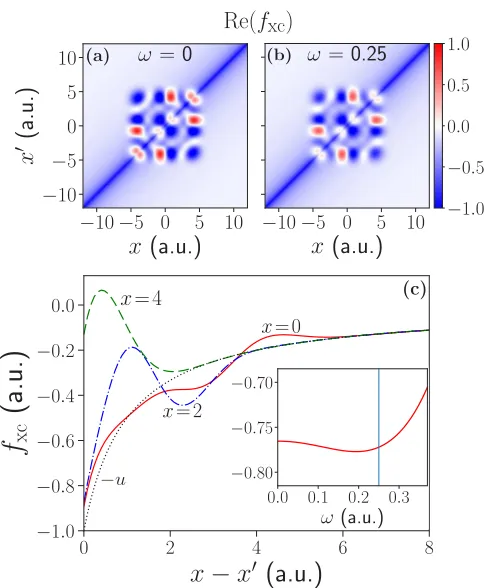
FIG. 2. The real part of the exactfxcof the harmonic well system:
(a) in the adiabatic limit (ω=0), and (b) at the first excitation (ω=0.25). (c)fxchas a rather simple nonlocal dependence, which is
similar to the negative of the Coulomb interactionu. Here we focus on fxc atω=0.25. Inset: We observe fxc to have strikingly weak ωdependence up to the first excitation (vertical line). We illustrate this by plotting its value (solid red) at a point along the main diagonal (x=x′) which corresponds to the peak in electron density in the inset
of Fig.1(x=1.7 a.u.).
We begin by considering a system of two interacting electrons confined to a harmonic well potential (ω0 =0.25 a.u.), whereω0 is the angular frequency of the well (inset of Fig.1). We compute the exact optical absorption spectrum of the system [44], with the first excitation atω=ω0 (Fig.1). Additionally, we compute the absorption spectrum of the exact Kohn-Sham system, in which the absorption frequency is slightly too low (≈0.01 a.u.). We also calculate the RPA and ALDA absorption spectra, in which the RPA and ALDA [45] kernels are combined with theexact χ0. This last point pro-vides a strong reminder of the challenge of fxc: starting from the exact Kohn-Sham orbitals, a much better absorption peak is obtained by ignoring the induced changes in the Hartree and xc potentials (χ0) than by accounting for the first exactly and either neglecting (RPA) or approximating (ALDA) the second. This highlights the importance of obtaining a good approximation to the ground-state xc potential vxc, which
leads toχ0.
We now turn to the spatial characteristics of fxc (Fig.2). Typically, several different choices of the eigenvalue cutoff yield kernels fxcwith varying degrees of spatial structure, all of which essentially yield the correct χ from the exact χ0 as set out above. Of these, we select the eigenvalue cutoff
−5.0 −2.5
0.0 2.5 5.0
x
(a
.u
.)
ω
= 0
−5.0
−2.5
0.0 2.5 5.0
x
(a
.u
.)
ω= 0.245
−5.0−2.5 0.0 2.5 5.0
x
(a.u.)
−5.0
−2.5
0.0 2.5 5.0
x
(a
.u
.)
ω= 0.255
ω
= 0
ω = 0.236
−2 −1
0 1 2
−5.0−2.5 0.0 2.5 5.0
x
(a.u.)
ω= 0.246−2 −1
0 1 2
Re(
χ
)
Re(
χ
0)
−0.4 −0.2
[image:4.590.46.285.61.376.2]0.0 0.2 0.4
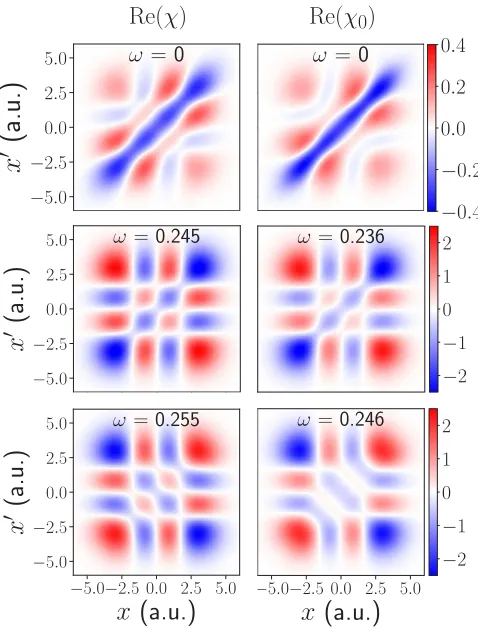
FIG. 3. The exactχ andχ0 in the harmonic well system: Left:
Re(χ) atω=0 and on either side of the transition at 0.250. Right: Re(χ0) atω=0 and on either side of the transition at 0.241. Re(χ)
and Re(χ0) exhibit remarkably similar spatial structure.
with the largest magnitude, resulting in the smoothest possible spatial structure without detriment to the exact absorption spectrum (Fig. 1). We observe that while fxc has real and imaginary parts (see later), the real part alone is sufficient to reproduce the position and weight of the first excitation (ω=ω0). Figures2(a)and2(b)show Re(fxc) atω=0 and ω0, respectively. The behavior of fxcaway from the diagonal, x=x′, represents the kernel’s nonlocality, and it is evident that this is fairly simple in nature; analysis [Fig.2(c)] shows it to be similar to the negative of the Coulomb interaction, with which it therefore tends to cancel in the expression forχ. The ωdependence of fxc up to the first excitation is seen to be extremely weak, as observed in other model systems [33–35]. We analyze this more closely in the inset to Fig.2(c).
To gain insight into these observations, we analyze the exact χ and χ0. Figure 3 shows Re(χ) and Re(χ0); up to the first excitation, these exhibit strong, but closely similar, ω dependence. The similarity arises in part from the exact many-electron wave function being well approximated by the exact Kohn-Sham wave function [46], which reflects the dominance of exchange (including self-interaction correction) in the harmonic potential system [47]. Therefore χ−1 and χ0−1 largely cancel, so that fxc is similar to−u, with weak ωdependence.
This can be demonstrated succinctly through a simple model, in which we take Eqs. (2) and (3), and replace the
0
1
2
3
ω
(a.u.)
−
3
−
2
−
1
0
1
2
3
χ
−
1
(a
.u
.)
Re Im
0 1 2 −20
−10 0 10
χ
0.0 0.5 1.0 1.5 −0.5
0.0 0.5 1.0
R
e
(
χ
−
1,χ
−
1
0
)
FIG. 4. The top inset showsχfor a simple model without spatial dependence and a single excitation atω=1; the bottom inset shows the near cancellation (solid green) between Re(χ−1) (dashed red) and
Re(χ0−1) (dotted dark red), whereχ0has an excitation at 0.9, causing
fxc to exhibit weakωdependence. In the main panel, two further
excitations atω=2 and 3 have been included, to show that Re(χ−1)
passes through zero between excitations, which leads to a nonzero Im(fxc), as does the corresponding feature inχ0−1(not shown).
spatially dependent numerators (the oscillator strengths) with scalars. Specifically, we consider a system with a single exci-tation atω=1, set the numerator equal to 1, and letη=0.05 (top inset of Fig. 4). We do the same for the Kohn-Sham system, but choose the excitation to occur at ω=0.9. By taking their inverses, we calculate Re(χ0−1−χ−1), which is theω-dependent part of Re(fxc) in Eq. (4), and find this to be small in amplitude and have a fairly weakωdependence up to the first excitations (bottom inset of Fig.4). The inclusion of higher excitations, and taking the limitη→0, change little at these low frequencies.
Including higher excitations in the modelχcauses Re(χ) to pass through zero between excitations. At these points Re(χ−1) also passes through zero, and Im(χ−1) peaks sharply (Fig. 4). As Im(fxc) = Im(χ0−1−χ−1
), we find that the fxc in our simple model only has an imaginary component when χ or χ0 passes through zero between excitations, and hence is completely real up to the first excitations (asη→0). This supports our finding in the harmonic well system, in which Im(fxc) was very small up to the first excitations, and Re(fxc) was sufficient to reproduce the peak in the absorption spectrum.
[image:4.590.308.552.64.242.2]M. T. ENTWISTLE AND R. W. GODBY PHYSICAL REVIEW B99, 161102(R) (2019)
0
.
00
0
.
02
0
.
04
0
.
06
0
.
08
0
.
10
0
.
12
ω
(a.u.)
0
10
20
30
40
50
σ
(a
.u
.)
Exact KS
0.10 0.11 0.12 0.13
0.00
0.25
0.50
σ
(a
.u
.)
−12−6 0 6 12
x(a.u.)
0.00
0.05
0.10
0.15
n
(a
.u
.)
−1.0
−0.8
−0.6
Vex
t
,V
K
S
(a
.u
[image:5.590.302.546.62.178.2].)
FIG. 5. Two interacting electrons in an atomiclike potential. The top inset shows the electron density (solid blue), along with the external (dotted-dashed green) and Kohn-Sham (dashed purple) potentials. In the main panel, the absorption spectra of the exact and Kohn-Sham systems; the bottom inset shows the third excitation (fourth in the KS system) in more detail, which is the next to appear after the first excitation.
below but still very close to the exact (bottom inset of Fig.5). Again, the closeness between the two peaks arises from the strong similarity betweenχandχ0. In order to reproduce this excitation, a smaller eigenvalue cutoff is required, leading to higher spatial frequencies in fxc[48] [Fig.6(b)].
For the atomlike system, we have investigated the extent to which local kernel approximations forfxcmay be meaningful. As we have observed fxc to largely cancel with u at low ω, we choose to focus on the Hartree exchange-correlation kernel fHxc= fxc+uwhich is more local. We incorporate the nonlocal parts of fHxc by projecting them onto a local kernel [49]. We find this largely corrects the differenceχ0−χ, and hence the position of the peak in the absorption spectrum, for the first excitation, but fails to correct the height of the peak. Such a local kernel is completely inadequate to describe the third excitation.
−20−10 0 10 20
x
(a.u.)
−20
−10
0 10 20
x
(a
.u
.)
ω= 0.045
−1.0 −0.5
0.0 0.5 1.0
−20−10 0 10 20
x
(a.u.)
−20
−10
0 10
20 ω= 0.119
−2 −1
0 1 2
(a) (b)
[image:5.590.41.284.63.243.2]Re(
f
xc)
FIG. 6. The real part of the exact fxc of the atomlike system:
(a) at the first excitation (ω=0.045), and (b) at the third excitation (ω=0.119). As in the harmonic well system, we findfxcto be nearly ωindependent and exhibit a relatively simple spatial form up to the first excitation. However, a more complex spatial structure is needed to capture higher excitations.
In summary, we have calculated the exact fxc(x,x′, ω) for two prototype systems. At low ω, we find the imaginary component offxcto be small, with the real part alone sufficient to reproduce the first excitation. Up to and including the first excitation, Re(fxc) exhibits strikingly weak ω dependence, stemming from strong, but closely similar ω dependence between the interacting and noninteracting density-response functions, boding well for the applicability of adiabatic ker-nels. Additionally, Re(fxc) here has a rather simple spatial form, which is similar to the negative of the Coulomb inter-actionu, indicating that approximations to fHxcmay be more appropriate than those forfxcalone. For higher excitations,fxc exhibits both additional spatial structure and strongerω de-pendence, indicating that more sophisticated approximations are needed. Throughout, the absorption spectrum of the exact Kohn-Sham system provides a very good starting point, signi-fying the crucial importance of an accurate approximation for the ground-statevxc.
Data created during this research is available from the York Research Database [50].
We thank Phil Hasnip for helpful discussions.
[1] E. Runge and E. K. U. Gross,Phys. Rev. Lett.52,997(1984). [2] E. K. U. Gross, J. F. Dobson, and M. Petersilka, Density
Functional Theory of Time-Dependent Phenomena, inDensity Functional Theory II: Relativistic and Time Dependent Exten-sions, edited by R. F. Nalewajski (Springer, Berlin/Heidelberg, 1996), pp. 81–172.
[3] Matrix multiplication for the spatially nonlocal quantitiesχ,χ0,
and fxc, andωdependence, are implied.
[4] M. Petersilka, U. J. Gossmann, and E. K. U. Gross,Phys. Rev. Lett.76,1212(1996).
[5] A. Zangwill and P. Soven,Phys. Rev. A21,1561(1980). [6] E. K. U. Gross and W. Kohn,Phys. Rev. Lett.55,2850(1985). [7] C. Jamorski, M. E. Casida, and D. R. Salahub,J. Chem. Phys.
104,5134(1996).
[8] N. T. Maitra, F. Zhang, R. J. Cave, and K. Burke,J. Chem. Phys.
120,5932(2004).
[9] V. I. Gavrilenko and F. Bechstedt,Phys. Rev. B55,4343(1997). [10] Y.-H. Kim and A. Görling,Phys. Rev. Lett.89,096402(2002). [11] Y.-H. Kim and A. Görling,Phys. Rev. B66,035114(2002). [12] A. Görling,Phys. Rev. A57,3433(1998).
[13] M. Hellgren and U. von Barth, J. Chem. Phys. 131, 044110 (2009).
[14] A. Ipatov, A. Heßelmann, and A. Görling, Int. J. Quantum Chem.110,2202(2010).
[15] A. Görling,Phys. Rev. Lett.83,5459(1999).
[16] I. V. Tokatly and O. Pankratov,Phys. Rev. Lett.86,2078(2001). [17] I. V. Tokatly, R. Stubner, and O. Pankratov,Phys. Rev. B65,
113107(2002).
[18] S. Botti, F. Sottile, N. Vast, V. Olevano, L. Reining, H.-C. Weissker, A. Rubio, G. Onida, R. Del Sole, and R. W. Godby, Phys. Rev. B69,155112(2004).
[19] S. Sharma, J. K. Dewhurst, A. Sanna, and E. K. U. Gross,Phys. Rev. Lett.107,186401(2011).
[20] P. E. Trevisanutto, A. Terentjevs, L. A. Constantin, V. Olevano, and F. D. Sala,Phys. Rev. B87,205143(2013).
[21] S. Rigamonti, S. Botti, V. Veniard, C. Draxl, L. Reining, and F. Sottile,Phys. Rev. Lett.114,146402(2015).
[22] V. U. Nazarov, I. V. Tokatly, S. Pittalis, and G. Vignale,Phys. Rev. B81,245101(2010).
[23] Z. Qian and G. Vignale, Phys. Rev. B 65, 235121 (2002).
[24] C. F. Richardson and N. W. Ashcroft,Phys. Rev. B50,8170 (1994).
[25] S. Conti, R. Nifosì, and M. P. Tosi,J. Phys.: Condens. Matter9, L475(1997).
[26] M. Panholzer, M. Gatti, and L. Reining,Phys. Rev. Lett.120, 166402(2018).
[27] G. Onida, L. Reining, and A. Rubio,Rev. Mod. Phys.74,601 (2002).
[28] L. Reining, V. Olevano, A. Rubio, and G. Onida,Phys. Rev. Lett.88,066404(2002).
[29] F. Sottile, V. Olevano, and L. Reining, Phys. Rev. Lett. 91, 056402(2003).
[30] G. Adragna, R. Del Sole, and A. Marini, Phys. Rev. B 68, 165108(2003).
[31] A. Marini, R. Del Sole, and A. Rubio, Phys. Rev. Lett.91, 256402(2003).
[32] M. Thiele and S. Kümmel,Phys. Rev. A80,012514(2009). [33] F. Aryasetiawan and O. Gunnarsson,Phys. Rev. B66,165119
(2002).
[34] D. J. Carrascal, J. Ferrer, N. Maitra, and K. Burke,Eur. Phys. J. B91,142(2018).
[35] M. Thiele and S. Kümmel,Phys. Rev. Lett.112,083001(2014). [36] N. T. Maitra and D. G. Tempel,J. Chem. Phys.125,184111
(2006).
[37] M. J. P. Hodgson, J. D. Ramsden, J. B. J. Chapman, P. Lillystone, and R. W. Godby, Phys. Rev. B 88, 241102(R) (2013).
[38] We perform calculations for systems of two spinless electrons interacting via the appropriately softened Coulomb repulsion [51] u(x,x′)=(|x−x′| +1)−1, and work in Hartree atomic
units:me=h¯=e=4π ε0=1.
[39] See Supplemental Material athttp://link.aps.org/supplemental/ 10.1103/PhysRevB.99.161102for the parameters of the model systems, and details on our calculations to obtain converged results.
[40] D. Pines, Elementary Excitations in Solids: Lectures on Phonons, Electrons, and Plasmons, Lecture Notes and Supple-ments in Physics (W. A. Benjamin, New York, 1964).
[41] M. Marder, Condensed Matter Physics (Wiley, New York, 2010).
[42] J. D. Ramsden and R. W. Godby,Phys. Rev. Lett.109,036402 (2012).
[43] See Supplemental Material athttp://link.aps.org/supplemental/ 10.1103/PhysRevB.99.161102for more details.
[44] For this harmonic well system, at the level of linear response theory, only one excitation appears in the absorption spectrum. [45] M. T. Entwistle, M. Casula, and R. W. Godby,Phys. Rev. B97,
235143(2018).
[46] We define this as a Slater determinant of the occupied KS orbitals.
[47] E. Richardson (private communication). [48] As expected for higher energy excited states.
[49] We fold the nonlocal fHxc with an envelope function that
suppresses the more distant nonlocal parts and projects the remainder onto the diagonalx=x′.
[50] M. T. Entwistle and R. W. Godby, Data related to “Exact exchange-correlation kernels for optical spectra of model sys-tems”, http://dx.doi.org/10.15124/56f576ee-b2de-4ca5-9251-831bfc3cae6f(2019).