Int. J. Electrochem. Sci., 12 (2017) 6492 – 6505, doi: 10.20964/2017.07.82
International Journal of
ELECTROCHEMICAL
SCIENCE
www.electrochemsci.org
Effect of Rolling method and Sensitization treatment on the
Microstructure and Passive Properties in 2101 Duplex Stainless
Steel
Jian Wang*, Ying Liu, Yongfeng Qiao, Yadi Hu, Yishi Cui, Peide Han*
College of Materials Science and Engineering, Taiyuan University of Technology, Taiyuan 030024, Shanxi, China;
*
E-mail: [email protected], [email protected]
Received: 6 February 2017 / Accepted: 18 March 2017 / Published: 12 June 2017
The manufacturing processes have an important influence on the corrosion resistance of duplex stainless steel. The present work is aimed to study the microstructure and passive properties in hot-rolled and cold-hot-rolled 2101 lean duplex stainless steel with solid-solution or sensitization treatment. The microstructure of the samples was investigated by using optical microscope (OM) and XRD characterization. It has been found that the precipitated amounts of Cr2N phase in cold-rolled samples are much more than that of hot-rolled samples. The defect and martensite also exist in the cold-rolled 2101 DSS. The chemical composition and electrochemical behavior of the passive film formed on the various specimens were further analyzed by the electrochemical impedance spectroscopy (EIS), Mott– Schottky and XPS analysis. Results indicate the solid-solution cold-rolled samples have a significant increased donor and acceptor densities and inhibition of Cr2O3 formedon the passive film, compared to the solid-solution hot-rolled samples. Moreover, the sensitized samples destroyed the Cr-containing protective passive film and possessed a less chromium oxide content than that of solid-solution samples. Especially, the sensitized cold-rolled 2101 had the enrichment of iron (Ⅲ) oxides on the passive films. The difference of composition and carrier densities on the samples leads to the various corrosion resistance.
Keywords: duplex stainless steel; rolled; sensitization; passive film; EIS.
1. INTRODUCTION
without defects and phases deterioration [2]. However, in the practical application, the stainless steel components often need to experience different manufacturing processes, such as the heat treatment for tuning microstructure[3, 4] and the cold work to harden alloys[5, 6], and it is also not inevitable for the formation of plastic deformation, defects or precipitations during these processes. There have been some publications that the heat treatments of DSS at the sensitive temperature brought in the decrease of its strength and corrosion resistance [7, 8], and the implementation of cold work results in the formation of strain-induced martensite from the transformation of austenite, inducing the materials prone to be corrosively attacked [9]. Therefore, enough attention should be paid to the effect of manufacturing processes on the microstructure and performance of DSS.
It is well known that the excellent corrosion resistances of DSS benefits from the passive film as a barrier layer against aggressive environment corrosion. The nature and stability of passive films often contain the film thickness, stoichiometry, microstructure and electronic properties [10, 11]. In order to understand the property of the passive film, the most typical method is the electrochemical studies [12-14]. Besides that, some other characterizations, like X-ray photoelectron spectroscopy (XPS) [15], Raman spectroscopy [16] and auger electron spectroscopy (AES)[17] et.al, were also presented in the reported literatures to analyze the passive films. Researches have also shown that the passive film of DSS was greatly influenced by many factors, including residual stresses, grain size, temperature and precipitated phase, et.al [18-23].
As a new developed economical steel by Outokumpu Stainless in 2002, the LDX2101 (EN 1.4162, UNS S32101) DSS with low nickel and molybdenum content has attracted people’s attention [24]. Since then, lots of studies have been implemented to explore the effect of their composition, morphology, microstructure and precipitated phase on the mechanical and corrosion properties. Few works highlighted the changes of corrosion resistance caused by phase proportion of austenite and ferrite [2]. Some studies proved that the pitting corrosion of 2101 was often initiated from the Cr2N phase due to the depletion of Cr around this phase [25, 27]. Several researches discussed the change of precipitated phase in the cold-work 2101 DSS [27]. However, the studies about the effect of rolling method and sensitization treatment on the microstructure and passive properties of 2101 DSS were still very few.
In the paper, the microstructure of hot-rolled and cold-rolled 2101 DSS with solid-solution and sensitization treatment was characterized. The relationships between the microstructure, the corrosion dynamics and passive film feature of 2101 DSS are studied at the micro-scale, by combining the electrochemical technique and X-ray photoelectron spectroscopy.
2. EXPERIMENTAL
2.1 Specimen preparation
Table 1. Chemical composition of the 2101 (wt. %)
Materials Composition in wt.%
C Si Mn P S Cr Ni Mo N
The DSS used in this study was typical 2101 and supplied by Taiyuan iron&steel company Ltd. (TISCO). The hot-rolled 2101 stainless steels plates with a thickness of 4 mm and cold-rolled 2101 stainless steels plates with a thickness of 2 mm that had been cut into small blocks with a size of 1 cm ×1 cm was first solution-treated at 1323 K for 1 h and then quenched in water. The chemical composition of the DSS is shown in Table 1. Then, sensitizing treatments were carried out on the specimens at 750 oC for 12 h. The hot-rolled and cold-rolled 2101 specimens after solid-solution or sensitization treatment were signed as HR-Sol., HR-Sen., CR-Sol., and CR-Sen., respectively. After that, each sample was mounted in epoxy resin; mechanically ground with SiC papers from 120 to 3000 grit, polished to mirror finish, and subsequently cleaned employing distilled water and ethanol. The microstructures of sample were observed at a magnification of an optical microscope (OM: DMRM, LEICA). The different phases of the specimens were determined by X-ray diffraction analysis (XRD, PANalytical X'Pert Powder).
2.2 Electrochemical measurements
The electrochemical experiments were performed in 3.5 % NaCl solution, at room temperature and atmospheric pressure employing a three-electrode corrosion cell equipped with a saturated calomel electrode (SCE) reference electrode and a platinum foil counter electrode. The specimen with an exposure area of 1 cm2 was used as a working electrode. Before the experiments, the samples were allowed to stabilize at an open circuit potential for 30 min, until the fluctuation potential within 10 mV. The polarization curves were recorded potentiodynamically at 0.5 mV s−1, the potential scanning range from less than 200 mV of open-circuit potentials to the potential when the current indicated stable pitting had occurred.
The electrochemical impedance spectroscopy (EIS) measurement was conducted to analyze the electrochemical behavior of the passive film developed on the specimen surface. The frequency ranged from 0.01 Hz up to 100 KHz, with a 10 mV applied AC amplitude. The measured EIS data was fitted by using Zview 2.70 software. The passive films were formed by anodic polarization for 1 h at a 0 V potential. After that, the Mott-Schottky measurements were carried out through a single frequency EIS at 1 kHz in the potential range of -1.0–2.0 V. The chemical composition of the passive films was studied using the X-ray photoelectron spectroscopy.
3. RESULTS AND DISCUSSION
3.1 Microstructure observation
confirmed that these precipitates were mainly chromium nitrides (Cr2N), but some chromium carbides also probably exist among them [28, 29].
Figure 1. The microstructure of 2101 steels: (a) solution annealed hot-rolled 2101, (b) solid-solution annealed cold-rolled 2101, (c) sensitizing hot-rolled 2101, (d) sensitizing cold-rolled 2101
40 50 60 70 80
0 300 600 900 1200 1500 1800
CR-Sen.
CR-Sol.
HR-Sen.
In
te
n
s
it
y
(a
.u
.)
2(degree)
HR-Sol.
[image:4.596.117.483.129.414.2] [image:4.596.147.452.492.716.2]
Figure 1c further shown the microstructure of the solution-annealed cold-rolled specimen under optical microscope, and it can be seen that the austenitic phase with a lighter color is distributed in the ferrite phase, but the microstructure of cold-rolled samples become more elongated along the cold rolling direction, compare with the hot-rolled specimens. Meanwhile, the austenite grains of cold-rolled specimen are fine and not uniform, with a narrow strip shape. Moreover, the fracture degree of the austenite grains in some regions is very large, which can be considered as a result of different local deformation. After sensitizing the cold-rolled 2101 DSS for 12 h at 750°С, as shown in Figure 1d, the Cr2N phase precipitates began to appear at the boundary of ferrite and austenite phase, but its amount is more than that of the hot-rolled specimens.
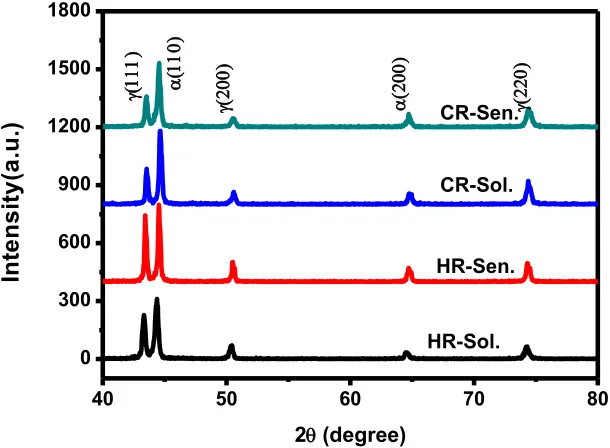
The XRD analysis was further used to detect the sample microstructure and shown in Figure 2. For the solid-solution annealed specimen, it can be seen that there is homologous diffraction peak of ferrite and austenite with the standard spectrum. However, the Cr2N precipitations were not found from the Figure 2 for the sensitized samples, which may be caused by the low precipitated content at the short time. Further, it has been proved that the austenite phase in duplex stainless steel would be transformed into ε-martensite or α′-martensite during cold deformation [30], so the XRD diffraction spectra of cold-rolled and hot-rolled 2101 samples were further compared in the Figure 2. The peak intensity ratio of the α(110)/γ(111) in the cold-rolled samples is significantly higher than that of the hot-rolled samples. Since the diffraction peak position of α′-martensite is consistent with the ferrite peak resulted from the similar body-centered-cubic (bcc) crystal structure of α′-martensite and ferrite [31], the increased peak intensity of ferrite for cold-rolled 2101 DSS may be ascribed to the formation of α′-martensite in the cold-rolled deformation. However, due to non-diffusive phase transition and unchanged chemical element of α′-martensitic transformation, it seems difficult to directly observe the diffraction peaks of α′-martensitic phase.
3.2 The electrochemical analysis
1E-9 1E-8 1E-7 1E-6 1E-5
-0.6 -0.4 -0.2 0.0 0.2 0.4 0.6
Current density(A/cm2)
P
o
te
n
ti
a
l
(v
)
[image:5.596.167.427.520.715.2]HR-Sol. CR-Sol. HR-Sen. CR-Sen.
Figure 3. The comparison of potentiodynamic polarization curves between cold-rolled and hot-rolled
[image:6.596.85.513.336.688.2]
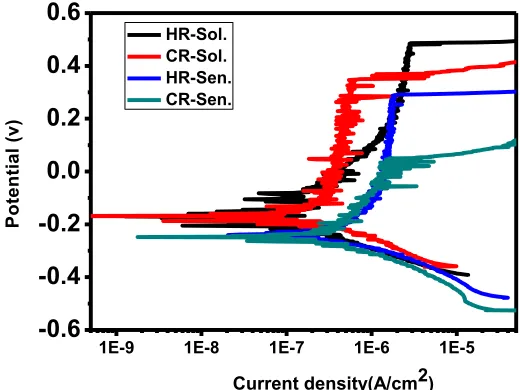
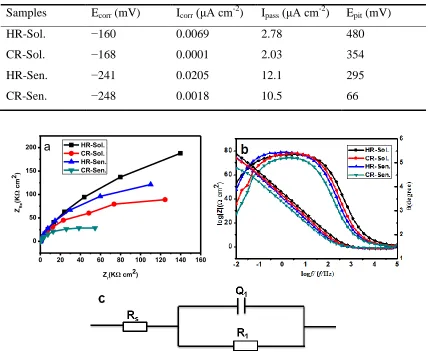
Figure 3 shows the comparison of potentiodynamic polarization curves between hot-rolled and cold-rolled 2101 duplex stainless steel after solid-solution and sensitization treatment in 3.5 % NaCl solution. The polarization curves of characteristics of the main values are listed in Table 2. It can be observed that the polarization curves of the hot-rolled samples have the best pitting potential (Epit), which are about 480 mV. However, the Epit has a slight decrease for the cold-rolled solid-solution sample. After sensitizing for 24 h, both the Epit of hot-rolled and cold-rolled sample is lower than that of corresponding solid-solution annealed sample. In a word, the pitting corrosion potential of the sample is according to the following order: HR-Sol. > CR-Sol.> HR-Sen. > CR-Sen., and the rolling method and sensitization treatment should affect the structure and composition of the passive films on the surface of 2101 DSS that leads to change of corrosion resistance. Meanwhile, the corrosion potential of sensitized samples shifted negatively, compared to the solid-solution annealed samples, which also shows the adverse influence of sensitization treatment on the corrosion resistance.
Table 2. Main characteristics of polarization curves of hot-rolled and cold-rolled 2101 duplex stainless
steel after different treatment
Samples Ecorr (mV) Icorr (μA cm-2) Ipass (μA cm-2) Epit (mV)
HR-Sol. −160 0.0069 2.78 480
CR-Sol. −168 0.0001 2.03 354
HR-Sen. −241 0.0205 12.1 295
CR-Sen. −248 0.0018 10.5 66
Figure 4. (a) Nyquist plots and (b) Bode phase plots of the passive films formed at 0 V potentials in
3.5 % NaCl solution for solid-solution annealed and sensitized hot-rolled and cold-rolled 2101 DSS, (c) the electrochemical equivalent circuit for EIS fitting
0 20 40 60 80 100 120 140 160
0 50 100 150 200
ZRe
(K
Ω
c
m
2)
Zr(KΩ cm2)
a HR-Sol.
Table 2. Electrochemical impedance parameters obtained from the fitting of EIS results
Rs Q1 R1
(Ω cm2
) YO (Ω-1 cm-2Sn) n (Ω cm2)
HR-Sol. 26.42 3.65×10⁻⁵ 0.90 5.19×10⁻⁵
CR-Sol. 27.77 5.54×10⁻⁵ 0.89 3.07×10⁻⁵
HR-Sen. 29.13 8.85×10⁻⁵ 0.85 7.53×10⁻⁴
CR-Sen. 27.97 4.56×10⁻⁵ 0.86 2.01×10⁻⁴
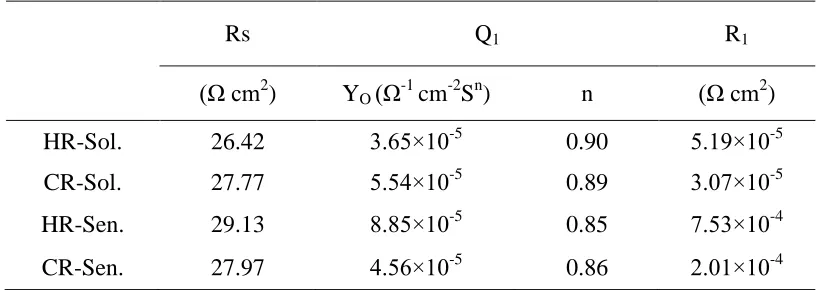
In Figure 4a, the real impedance is plotted vs. the imaginary impedance at each frequency for 2101 duplex stainless steels in 3.5 % NaCl solution. It is seen that the Nyquist diagrams of the samples have a depressed semicircle with a capacitive arc. However, the diameter of the capacitive semicircle in the cold-rolled sample is less than that of hot-rolled samples, indicating that the passive film stability of cold-rolled sample is worse than that of hot-rolled samples. Moreover, the diameter of the Nyquist plots further decrease after sensitizing the sample. Combined the bode plot of Figure 4b, the equivalent circuit in Figure 4c is proposed for fitting EIS data to quantify the electrochemical parameters. In this equivalent circuit, Rs is the solution resistance; Q1 is double charge layer capacitance; R1 is the charge-transfer resistance [19]. The electrochemical impedance parameters of the sample obtained from the fitting of EIS diagrams are shown in Table 3. According to the fitting results, the changes to the solution resistance were fairly minor for the samples, indicating no obvious change of the solution during the forming of the passive film. In addition, the charge transfer resistance of solid solution annealed sample decreases from 5.19×10⁻⁵ Ω cm2, 7.53×10⁻⁴ to 3.07×10⁻⁵, 2.01×10⁻⁴ after the sensitization that corresponds to the hot-rolled and cold-rolled 2101 DSS, and it is also clear that the charge transfer resistance of hot-rolled sample is always higher than that of the cold-rolled sample. These results indicate that the composition of the passive film changes depending on the rolling process and sensitization.
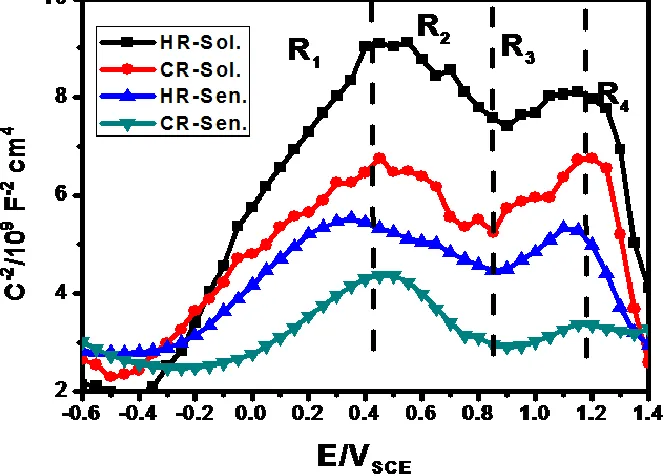
To further investigate the formation of passive film on the different solid-solution annealed and sensitized 2101, the Mott-Schottky plots as a powerful tool was used to record the carrier concentration of passive film in 3.5 % NaCl solution. Through the measurement of the capacitance of the Helmholtz layer and the space charge layer produced in the passive film, the semiconductor properties of passive films can be investigated. Given the generally large capacitance of the Helmholtz layer, it provides a slight contribution for the total capacitance; so the measured capacitance of the film/electrolyte interface is approximately equal to the space charge capacitance. Therefore, the space charge capacitance of the p-type and n-type semiconductors can be calculated by the Equations (1) and (2), respectively [32].
(1) n-type
Where ε0 is the vacuum permittivity (8.854 ×10⁻¹⁴ F/cm), εs is the relative dielectric constant, e is the electron charge (1.6×10⁻¹⁹
C), ND and NA is the donor and acceptor density, respectively, Ef is the applied electrode potential, Efb is the flat band potential, K is the Boltzmann constant (1.38×10⁻²³ J/K), T is the absolute temperature. Due to the measurement at room temperature, the kT/e can be neglected. The ND or NA can be obtained from the slope of the experimental C-2 versus E plots, based on the Eq. (1) or Eq. (2).
Figure 5. The Mott-Schottky plots of the passive films obtained in 3.5 NaCl solutions for different 2101 Dss.
Figure 5 shows Mott-Schottky plots for film formed on the different solid-solution annealed and sensitized 2101 polarized for in 3.5 % NaCl solutions polarized for 1 h at 0 VSCE, the selected potential was on account of passive region of potentiodynamic polarization plots in Figure 3. It can be seen that four obvious linear regions are presented in these plots, which have a positive and negative slope represented different capacitance. The first region (R1), with positive slope, appearing for potentials bellow 0.50 VSCE has characteristics of n-type semiconductors. For potentials comprising from 0.50 to 0.9 VSCE (R2), the negative slopes stand for n-type semiconductors. For potentials comprising from 0.7 to 1.2 VSCE (R3), the slopes of the curves become positive again. However, the slopes would be negative at potentials more positive than 1.2 VSCE (R4). Previous work on the passive film of stainless has been used to confirm that there is dual layers structure on the passive film which is composed by the chromium oxide inner layer and iron oxide outer layer. For the chromium atom, its diffusion and reaction behavior at low potential can be described as follows:
Cr → Cr3+
[image:8.596.128.460.183.421.2]
This suggests that Cr2O3 passive film was formed. However, the passive film is also prone to dissolve once the potential increases to higher value, and the subsequent reaction occur:
Cr(OH)3 + 5OH- → CrO42- + 4H2O+ 3e- (6)
For the iron atom, its anodic process at low potential is characterized as follows: Fe → Fe2+
+ 2e- (7) Fe2+ + 2OH- → Fe(OH)2 (8)
The Fe(OH)2 is easily to be oxidized to FeOOH, while FeOOH was insecure and would be further oxidized into Fe2O3 in the presence of oxygen.
4Fe(OH)2 + O2 → 4FeOOH + 2H2O (9) 2FeOOH → Fe2O3 + H2O (10)
The FeOOH was also dissolved into Fe2O42- at a higher potential: 2FeOOH + 6OH-→Fe2O42- + 4H2O + 4e- (11)
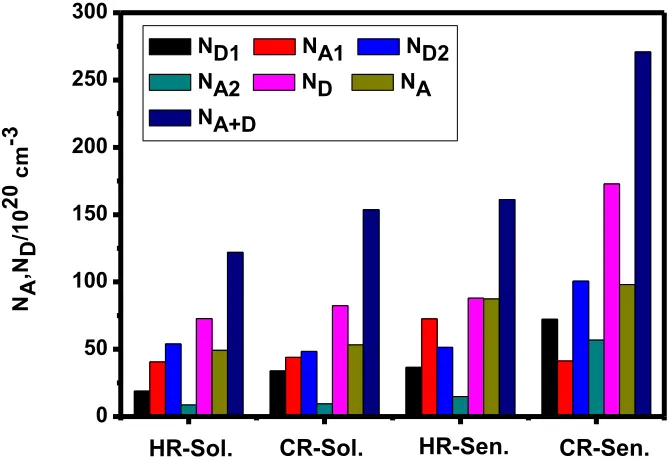
Therefore, the R1 shows the formation of n-type Fe2O3 and Fe(OH)3 on the surface, and the R2 represents the formation of p-type Cr2O3passive film. In the R3, the secondary positive slope may be ascribed to the presence of deep donor level in the band-gap, which is most probably the transformation of Fe-rich primary oxide film to iron oxyhydroxide layer FeOOH. However, the secondary negative slope of R4 should be due to the further transformation of FeOOH or Cr(OH)3 to Fe2O42- and CrO42-.
0 50 100 150 200 250 300
CR-Sen. HR-Sen.
CR-Sol.
ND1 NA1 ND2
NA2 ND NA
NA+D
N A
,N D
/1
0
20
cm
-3
[image:9.596.110.446.396.634.2]HR-Sol.
Figure 6. The acceptor concentration and donor concentration for different 2101 DSS
is always less than the total donor concentration of ND. Meanwhile, the doping concentration in sensitization samples is higher than that in solid solution samples, and the doping concentration in cold-rolled sample is also higher than that in hot-rolled samples. The doping concentration in passive film was associated with the passive film, and the samples with more doping concentration often have worse corrosion resistance. Therefore, the sensitive cold-rolled samples exhibited the worst corrosion resistance performance in 3.5 % NaCl solutions. The similar feature has been found in the 304, 316L, and 2205 DSS et. al. For example, Oguzie et al. reported that the presence of Cu in the passive film of 304, 430, 410 stainless steel increase the concentration of ND and NA values, thereby making the passive films not stability [33]. Lee et al. found that nitrogen alloying of 316L decreased the donor density and enrich the chromium on the passive film, causing the formation of a more stable passive film [34]. Lv suggested that the 2205 DSS treated by grain refinement promotes more Cr2O3 and Fe2O3 formed on the passive film, and decrease the doping concentration, which leads to a higher corrosion resistance than that of coarse grain in borate buffer solution [35].
3.3 The XPS characterization
[image:10.596.80.514.352.691.2]
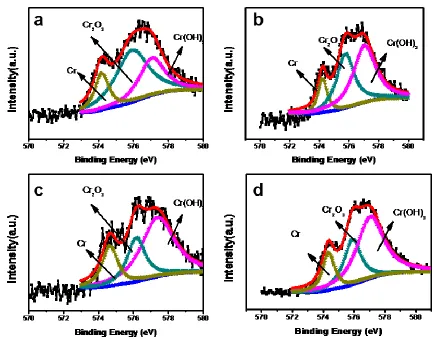
The XPS spectra of the solid-solution annealed and sensitized 2101 DSS after passivation at 0 V for 60 min in the 3.5% NaCl solutions are shown in Figure 7-8, respectively. Both the metallic and oxidized states of Cr 2p3/2 and Fe 2p3/2 are presented. It is seen from the fitting results of Cr 2p3/2 peaks that three constituent peaks was found and representing metallic state Cr(met) (574.1 eV), Cr2O3 (576.3 eV) and Cr(OH)3 (577.1 eV), respectively. However, for the Fe 2p3/2 spectra shown in Figure 8, it can be separated into three or two constituent peaks which represent the metallic state Fe (met) (707 eV) and the bivalent (Fe(II)) (709.4 eV) and trivalent (Fe(III)) (711 eV) species, corresponding to the hot-rolled or cold-rolled 2101 DSS. Moreover, the Fe(III) with a relative strong peak heights indicate that the primary iron oxidized species is Fe(III) oxides in the passive film.
Figure 8. The detailed XPS spectra of Fe 2p3/2 of the passive films formed on different DSS. (a) solid-solution annealed hot-rolled 2101, (b) solid-solution annealed cold-rolled 2101, (c) sensitized hot-rolled 2101 and (d) sensitized cold-rolled 2101.
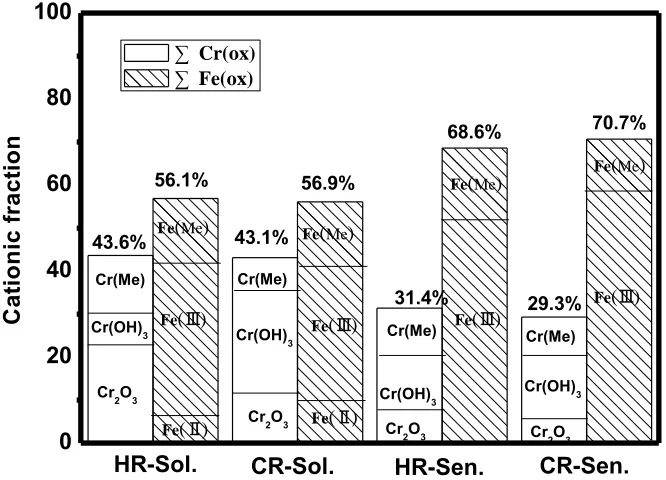
The presence of chromium in the passive film plays a key role in the corrosion resistance of stainless steel. The cationic fraction (Cx) was often used to characterize the composition of passive film. Figure 9 shows the Cx of Cr and Fe in the passive film, which is calculated using the following equation:
(12)
[image:11.596.104.492.236.555.2]
factors of Cr and Fe are 7.69 and 10.82, respectively [36]. The quantitative results suggest that the primary constituents of the passive film in sensitized hot-rolled 2101 or cold-rolled 2101 have relatively high iron oxide species, but a higher quantity of chromium oxidized specie exists in the passive film of the solid-solution annealed solution, which may be mainly caused by the chromium-depleted zone produced by the Cr2N precipitation. In order to compare the difference of chemical composition in hot-rolled and cold-rolled passive film in more detail, the percentage of chromium and iron species was also researched. As shown in Figure 9, for the solid-solution 2101 samples, the cold-rolled state has the enrichment of Cr(OH)3 and inhibition of Cr2O3, exhibiting a worse corrosion resistance than that of hot-rolled state. This may be resulted from the disorder induced by plastic deformation and the formation of the strain induced martensite. Meanwhile, for the sensitized 2101 samples, the production of Cr2N precipitations in cold-rolled state is much more than that of hot-rolled state, so it can be seen that the cold-rolled state has the enrichment of iron (Ⅲ) oxides, leading to a worse corrosion resistance. The similar phenomenon has also existed in the 2205 DSS [37] and 254SMO [36]. The cationic fraction of Cr calculated by equation of 12 is relatively high in the 2205 DSS and 254SMO, improving the stability of passive film and corrosion resistance.
Figure 9. The XPS cationic fraction (Cx) in the passive film of 2101 DSS after passivation at 0 V (SCE) in the 3.5% NaCl solutions
4. CONCLUSIONS
The effect of hot rolling and cold rolling on microstructure and corrosion behavior of 2101 DSS was evaluated by microstructural analyses combined with electrochemical methods. The Cr2N phase was precipitated after sensitizing treatment of hot-rolled and cold-rolled materials, and the precipitated amount of Cr2N phase in cold-rolled materials is more than that of hot-rolled material
0 20 40 60 80 100 ∑ Cr(ox) ∑ Fe(ox) 70.7% 31.4% 68.6% 29.3% 56.9% 43.1% 56.1% CR-Sen. HR-Sol. HR-Sen.
Fe(Me) Fe(Me)
Fe(Ⅲ) Fe(Ⅲ)
Fe(Ⅲ) Fe(Me)
Fe(Ⅱ)
Fe(Me)
Fe(Ⅲ)
Fe(Ⅱ)
Cr(Me) Cr(Me)
Cr(Me)
Cr(OH)3
Cr2O3
Cr(OH)3
Cr2O3
Cr(OH)3
Cr2O3 Cr(Me)
Cr(OH)3
[image:12.596.130.463.347.587.2]
under the same aging condition. Meanwhile, the strain-induced martensite structure was also produced by the transformation of austenite under the condition of cold deformation.
The corrosion resistance of the solution-annealed cold-rolled 2101 is lower than that of the hot-rolled 2101, which is due to the significant increased donor and acceptor densities and inhibition of Cr2O3 on the passive film induced by cold deformation and the strain induced martensite. Moreover, the sensitized sample destroys the Cr-containing protective passive film and has less chromium oxide content, leading to a worse corrosion resistance than that of solid-solution samples. The sensitized cold-rolled 2101 with the enrichment of iron (Ⅲ) oxides also leads to the decrease of corrosion resistance, compared to the sensitized hot-rolled 2101. This may be due to the formation of more chromium-depleted zone produced by precipitates.
ACKNOWLEDGEMENTS
This research was supported by the National Natural Science Foundation of China (Grant No. 51371123), the Research Fund for the Doctoral Program of Higher Education of China (20131402110003) and Shanxi Province Science Foundation for Youths (201601D202033).
References
1. J.O. Nilsson, Mater. Sci. Tech.-Lond., 8 (1992) 685.
2. J. Gao, Y. Jiang, B. Deng, W. Zhang, C. Zhong, J. Li, Electrochim. Acta, 54 (2009) 5830.
3. V. Muthupandi, P. B. Srinivasan, S. K. Seshadri, S. Sundaresan, Mat. Sci. Eng. A-Struct., 358 (2003) 9.
4. T. H. Chen, K. L. Weng, J. R. Yang, Mat. Sci. Eng. A-Struct., 338 (2002) 259. 5. S.W. Yang, J. E. Spruiell, J. Mater. Sci., 17 (1982) 677.
6. K. Elayaperumal, P. K. De, J. Balachandra, Corrosion, 28 (1972) 269. 7. G. Atxaga, A. M. Irisarri, Eng. Fail. Anal., 16 (2009) 1412.
8. G. R. Hitchcock, W. F. Deans, D. S. Thompson, A. Coats, Eng. Fail. Anal., 8 (2001) 213. 9. M. Breda, L. Pezzato, M. Pizzo, I. Calliari, Metall. Ital., 106 (2014) 15.
10. N. Ebrahimi, M. H. Moayed, A. Davoodi, Corros. Sci.,53 (2011) 1278. 11. M. Sumita, T. Hanawa, S. H. Teoh. Mat. Sci. Eng. C-Mater., 24 (2004) 753. 12. A. Kocijan, Č. Donik, M. Jenko, Corros. Sci., 49 (2007) 2083.
13. E.M.A. Martini, I.L. Muller, Corros. Sci., 42 (2000) 443.
14. C. Boissy, B. Ter-Ovanessian, N. Mary, B. Normand, Electrochim. Acta, 174 (2015) 430. 15. E. Mccafferty, M.K. Bernett, J.S. Murday, Corros. Sci., 28 (1988) 559.
16. V. Schroeder, T.M. Devine, J. Electrochem. Soc.,146 (1999) 4061.
17. S. Mischler, H.J. Mathieu, D. Landolt, Surf. Interface Anal., 11 (1988) 182.
18. V. Vignal, O. Delrue, O. Heintz, J. Peultier, Electrochim. Acta, 55 (2010) 7118. 19. J. Lv, T. Liang, C. Wang, L. Dong, J. Electroanal. Chem.,757 (2015) 263. 20. S.P. Harrington, F. Wang, T.M. Devine, Electrochim. Acta, 55 (2010) 4092. 21. T. Li, L. Liu, B. Zhang, Y. Li, F. Wang, Corros. Sci., 104 (2016) 71.
22. Y. Wang, X. Cheng, X. Li, Electrochem. Soc., 57 (2015) 56. 23. J. Lv, H. Luo, J. Mater. Eng. Per., 23 (2014) 4223.
24. P. Johansson, presented at China International Corrosion Control Conference, Beijing, China, 5-8 November, 2002.
25. F. Zanotto, V. Grassi, M. Merlin, A. Balbo, F. Zucchi, Corros. Sci., 94 (2015) 38.
27. P. Bassani, M. Breda, K. Brunelli, I. Mészáros, F. Passaretti, M. Zanellato, I. Calliari, Microsc. Microanal., 19 (2013) 988.
28. M. Knyazeva, M. Pohl, Metallogr. Microstruct. Anal., 2 (2013) 343.
29. B. Deng, Y. Jiang, J. Xu, T. Sun, J. Gao, L. Zhang, W. Zhang, J. Li, Corros. Sci., 52 (2010) 969. 30. P. Haušild, V. Davydov, J. Drahokoupil, M. Landa, P. Pilvin, Mater. Design, 31 (2010) 1821. 31. S. Pramanik, S. Bera, S.K. Ghosh, Steel Res. Int., 85 (2014) 776.
32. H. Luo, C.F. Dong, K. Xiao, X.G. Li, Appl. Sur. Sci., 258 (2011) 631.
33. E. E. Oguzie, J.B. Li, Y. Q. Liu, D. M. Chen, Y. Li, K. Yang, F. H. Wang, Electrochim. Acta, 55 (2010) 5028.
34. J. B. Lee, S. I. Yoon, Mater. Chem. Phy., 122 (2010) 194.34.
35. J. L. Lv, T. X. Liang, C. Wang, L. M. Dong, J. Electroanal. Chem., 757 (2015) 263. 36. C.T. Liu, J.K. Wu, Corros. Sci., 49 (2007) 2198.
37. H. Luo, C.F. Dong, X.G. Li, K. Xiao, Electrochim. Acta, 64 (2012) 211.