UNIVERSITI TEKNIKAL MALAYSIA MELAKA
The Development and Analyse of Cooling System for Motorcycle
Helmet
This report submitted in accordance with requirement of the Universiti Teknikal Malaysia Melaka (UTeM) for the Bachelor of Mechanical Engineering
Technology (Automotive Technology) with Honours.
by
AHMAD SYAFIQ BIN SARPUTDIN B071410058
920223-03-6089
UNIVERSITI TEKNIKAL MALAYSIA MELAKA
BORANG PENGESAHAN STATUS LAPORAN PROJEK SARJANA MUDA
TAJUK: The Development and Analyse of Cooling System for Motorcycle Helmet
SESI PENGAJIAN: 2017/18 Semester 1
Saya AHMAD SYAFIQ BIN SARPUTDIN
mengaku membenarkan Laporan PSM ini disimpan di Perpustakaan Universiti Teknikal Malaysia Melaka (UTeM) dengan syarat-syarat kegunaan seperti berikut:
1. Laporan PSM adalah hak milik Universiti Teknikal Malaysia Melaka dan penulis. 2. Perpustakaan Universiti Teknikal Malaysia Melaka dibenarkan membuat salinan untuk
tujuan pengajian sahaja dengan izin penulis.
3. Perpustakaan dibenarkan membuat salinan laporan PSM ini sebagai bahan pertukaran antara institusi pengajian tinggi.
4. **Sila tandakan ( )
SULIT
TERHAD
TIDAK TERHAD
(Mengandungi maklumat yang berdarjah keselamatan atau kepentingan Malaysia sebagaimana yang termaktub dalam AKTA RAHSIA RASMI 1972)
(Mengandungi maklumat TERHAD yang telah ditentukan oleh organisasi/badan di mana penyelidikan dijalankan)
Alamat Tetap:
No. 21, Arked MARA,
18500 Machang,
Kelantan
Tarikh: ________________________
Disahkan oleh:
Cop Rasmi:
Tarikh: ________________________
Tarikh: _______________________
DECLARATION
I hereby, declared this report entitled “THE DEVELOPMENT AND ANALYSE OF COOLING SYSTEM FOR MOTORCYCLE HELMET” is the results of my own research except as cited in references.
Signature : ……….
APPROVAL
This report is submitted to the Faculty of Engineering Technology of UTeM as a partial fulfilment of the requirements for the degree of Bachelor of Mechanical Engineering Technology (Automotive Technology) with Honours. The member of the supervisory is as follow:
………. Mr Muhammed Noor bin Hashim
i
1
ABSTRAK
Ringkasan yang boleh dibuat dari projek ini adalah ianya merupakan satu projek topi keledar motosikal yang mengandungi sistem penyejukan. Sebab utama mengapa projek ini dijalankan adalah untuk memberikan keselesaan kepada penunggang motosikal ketika menunggang motosikal. Zaman era globalisasi ini, pemanasan global merupakan isu yang serius di mana telah memberi kesan yang buruk kepada penunggang motosikal apabila mereka menunggang motosikal pada waktu panas. Oleh itu, topi keledar motosikal ini dicipta untuk mengatasi masalah yang dihadapi oleh penunggang motosikal yang tidak seslesa ketika penunggang motosikal dengan adanya system penyejukan di dalam topi keledar mereka. Untuk menghasilkan topi keledar motosikal ini, beberapa spesifikasi reka bentuk akan ditentukan. Selepas itu, proses fabrikasi akan dijalankan. Di antara proses-proses fabrikasi yang akan dilakukan adalah seperti proses pengukuran, proses pemotongan, proses menggerudi dan proses pemasangan.
ii
1
ABSTRACT
iii
DEDICATION
To my beloved parents,
Haslina binti Ishak and Sarputdin bin Mustapha
Thank you for all support, sacrifices, patient and willingness to share with me. To my honored supervisor,
Mr Muhammed Noor bin Hashim and all UTeM lecturers.
iv
ACKNOWLEDGEMENT
v
TABLE OF CONTENT
Abstrak i
Abstract ii
Dedication iii
Acknowledgement iv
Table of Content v
List of Tables viii
List of Figures ix
List of Abbreviations, Symbols and Nomenclatures xi
CHAPTER 1: INTRODUCTION 1
1.1 Introduction 1
1.2 Background 1
1.3 Problem Statement 2
1.4 Objectives 3
1.5 Scope 4
1.6 Dissertation Outline 4
CHAPTER 2: LITERATURE REVIEW 5
2.1 Introduction 5
2.2 Paraffin Wax 5
2.2.1 History 5
2.2.2 Definition 7
vi
2.2.4 Manufacturing 9
2.2.5 Application 9
2.3 Helmet 10
2.3.1 Origins 10
2.3.2 Function 13
2.3.3 Design 14
2.3.4 Components and Materials 15
2.3.5 Types of Helmets 20
2.3.3 Factors Influencing Thermal Comfort 24
2.4 Human Brain 26
2.4.1 Meaning 26
2.4.2 Function of Brain 27
CHAPTER 3: METHODOLOGY 28
3.1 Research Design 28
3.2 Material selection 29
3.2.1 Paraffin Wax 29
3.2.2 Motorcycle Helmet 30
3.2.3 Cost 31
3.3 Study of Literature Review 34
3.4 Design of Paraffin-Cooled Helmet 35
3.5 Design Specifications 36
3.5.1 Paraffin Pouch Design 36
vii
CHAPTER 4: RESULT AND DISCUSSION 40
4.1 Introduction 40
4.2 Fabrication Process 40
4.2.1 Fabricated the Temperature Box 40
4.2.2 Fabricated the Helmet Foam 43
4.2.3 Fabricated the Paraffin Pouch 45
4.2.4 Fabricated the Copper Plate 47
4.2.5 Fabricated the Polyurethane Foam 49
4.3 Testing of Paraffin-Cooled Helmet 50
4.4 Result 52
4.4.1 Result of the Box Temperature 52 4.4.2 Result of Temperature in the Helmet with Paraffin Wax 53 4.4.3 Result of Temperature in the Helmet without Paraffin Wax 55
4.4.4 Result of Comparison the Average Temperature in the Helmet without Paraffin Wax with the Average Temperature in the Helmet with Paraffin Wax
56
4.5 Conclusion 58
CHAPTER 5: CONCLUSION AND FUTURE WORK 59
5.1 Introduction 59
5.2 Conclusion 59
5.3 Future Work 60
REFERENCES 61
viii
LIST OF TABLES
Table 2.1. Properties of paraffin wax. 8
Table 3.1. Properties of paraffin wax 29
ix
LIST OF FIGURES
Figure 2.1. Paraffin Wax 6
Figure 2.2. Bronze helmet in 5th century 10
Figure 2.3. Leather bonnet helmet 11
Figure 2.4. Roth’s and Lombard’s crash helmet. 12
Figure 2.5. Open face helmet 12
Figure 2.6. Injury of close head 14
Figure 2.7. Component of helmet. 16
Figure 2.8. Functions of helmet component. 16
Figure 2.9. Full face helmet parts. 19
Figure 2.10. Ventilation system 20
Figure 2.11. A full face helmet 21
Figure 2.12. Modular helmet by CMS 22
Figure 2.13. Open face helmet by CMS 22
Figure 2.14. Half helmet by Bell 23
Figure 2.15. Figure shows the illustrations of the brain function 27
Figure 3.1. Flow chart of methodology 28
Figure 3.2. Paraffin wax 30
Figure 3.3. Full face helmet 31
Figure 3.4. Schematic diagram of a paraffin-cooled helmet 35 Figure 3.5. Pouch containing paraffin 36 Figure 3.6. Installation of paraffin pouch, heat collector and gel cushion in
the helmet 37
Figure 3.7. Heat collector and polyurethane foam design. 38
x
[image:14.595.114.524.89.547.2]Figure 4.4. Temperature box 42
Figure 4.5. Light bulb inside the temperature box 43 Figure 4.6. Punching of the helmet form 44 Figure 4.7. Finish surface of helmet form 44
Figure 4.8. Weighing the paraffin wax 45
Figure 4.9. Inserting the paraffin wax 45
Figure 4.10. Gluing the aluminum pouch 46
Figure 4.11. Joining the aluminum pouch 46 Figure 4.12. Inserting joining the aluminum pouch inside the helmet foam. 47 Figure 4.13. Cutting of the copper plate 48 Figure 4.14. Inserting the copper plate inside helmet foam 48 Figure 4.15. Cutting of the polyurethane foam 49 Figure 4.16. Inserting the copper plate inside helmet foam 49
Figure 4.17. Experimental setup 50
Figure 4.18. The thermocouple sampling areas 51 Figure 4.19. Result of the temperature of the box 52 Figure 4.20. Result of the temperature of the box 53 Figure 4.21. Result of the temperature in the helmet without paraffin wax 54 Figure 4.22. Average result of the temperature in the helmet without paraffin
wax 54
Figure 4.23. Result of the temperature in the helmet with paraffin wax 55 Figure 4.24. Average result of the temperature in the helmet with paraffin wax. 56 Figure 4.25. Average result of the temperature in the helmet without paraffin
xi
LIST OF ABBREVIATIONS, SYMBOLS AND
NOMENCLATURES
ABS - Acrylonitrile–Butadiene–Styrene
ASHRAE - American Society of Heating,
Refrigeration, and Air Conditioning Engineers
BTU - British Thermal Unit
CAD - Computer Aided Design
CAE - Computer Aided Engineering
CATIA - Computer Aided Three Dimensional
Interactive Application
CRP - Carbon Reinforced Plastic
DOT - Department of Transportation
ECE - Economic Commission for Europe
EPS - Expanded Polypropylene Sheet
EPF - Expanded Polypropylene Foam
FRP - Fibre Reinforced Plastics
GHSA - Georgia High School Association
GRP - Glass Reinforced Plastic
HVAC - heating, ventilation, and air
conditioning
xii
IPCC - Intergovernmental Panel on Climate
Change
SET - Standard Effective Temperature
PC - Polycarbonate
PU - Polyurethane
PVC - Polyvinyl Chloride
PET - Polyethylene Terephthalate
MET - The Metabolic Equivalent of Task
cm - centimetre
J / g - Joule per gram
mJ / m2 - mili Joule per meter square
US $ - Dollar of United States
1
CHAPTER 1
INTRODUCTION
1.1 Introduction
Chapter one consists of the background of the project for this dissertation. The information of the global warming, cooling system and the paraffin wax was presented in the background, Secondly, this section also consists of another four item which consist of the problem statement, the objective of this dissertation, scope of the work for this project and the dissertation outline.
1.2 Background
Now days, global warming is one of the most serious issues of globalization. According to the Intergovernmental Panel on Climate Change (IPCC) assessment, the average temperature on Earth has risen by 0.7 ° C since the beginning of the industry increases. Under the conditions of global warming, climate change in different parts of the world reveals different features (Elizbarashvili et al. 2017). The climate change has affected the situation in earth, flora and fauna, population and many more. In this situation, the motorcyclist also affected.
2 the sun and making riders feel uncomfortable by producing extreme sweat (Pang et al. 2015).
Then, an innovation for helmet cooling system need to be done to overcome the uncomfortable conditions faced by the motorcyclist. The ventilation system in a motorcycle helmet is a set of sources dug in the entire cover of a protective helmet that must be able to create some fresh air inverted inside it. Mostly, the helmet manufacturers are not exposed to the complete lack of fluid dynamics guidelines for such channel models, prescribed only with experience, without sufficient evidence to provide good ventilation (Canuto & Cimolin 2011).
For the great cooling system, paraffin wax is chosen as the coolant agent. Paraffin is probably the most common phase change material due to the high storage density feature, the minimum inclination to super cool, low vapor pressure liquid phase, chemical stability, non-toxic, and relatively low cost (Wang et al., 2009; Kuznik et al., 2011; Nihal et al., 2011).
1.3 Problem Statement
3 that is uncomfortable and harmful to the rider's head. Riding motorcycle under the sunny day make the rider feel uncomfortable.
On the other hand, warm air around the head also distract the rider’s concentration. Inside the helmet can quickly rise to temperatures between 37 ° C and 38 ° C (Tan & Fok 2006). Tans and Fok also stated that when this happens, physiology and the psychological impact on very real and potentially unlucky riders for the senses and deadening reduce ability to concentrate. Concentration when riding is the most important thing to make sure the safe journey and to avoid any halted to happen. Additionally, it turns out that the head is the most effective cooling of any part of the body as it has the highest skin temperature and also a steady flow of blood. In addition, the cooling of the head has been regarded as an essential requirement to provide overall comfort to the rider.
Besides that, incomplete heat release from helmets to the environment induces heat pressure in the head area. (Pang et al. 2011). He added that heat is transferred between the head and the environment through heat radiation and convection, as well as with sweating evaporation (Pang et al. 2015) also stated that the increased pressure associated with heat during long travels in the sun and subsequently will make the riders feel uncomfortable by producing excessive sweating. The excessive sweating made the rider uncomfortable around their head which lead the rider become distract of concentration when riding.
1.4 Objectives
More specifically, this study has the following objectives:
1) To fabricate a prototype of motorcycle helmet that have cooling system.
4
1.5 Scope
This project is using an existing helmet in the market for the cooling system. The paraffin wax is selected as the cooling agent for the cooling system. The paraffin wax is placed in the helmet for cooling agent in the helmet as a cooling system.
The design concept development by the previous research is used how to place the paraffin wax in the helmet. After study the design concept development, the prototype of the motorcycle helmet that have paraffin wax will be fabricate.
The effectiveness of the paraffin wax will analyze as the cooling agent for the helmet ventilation system. The analyzation of paraffin wax will be test the temperature of the paraffin wax by using the testing in the lab.
1.6 Dissertation Outline
5
CHAPTER 2
LITERATURE REVIEW
2.1 Introduction
This chapter will provide the review from previous research that is related to this final year project. There are previous researches understanding the paraffin wax, motorcycle helmet and human brain.
2.2 Paraffin wax
2.2.1 History
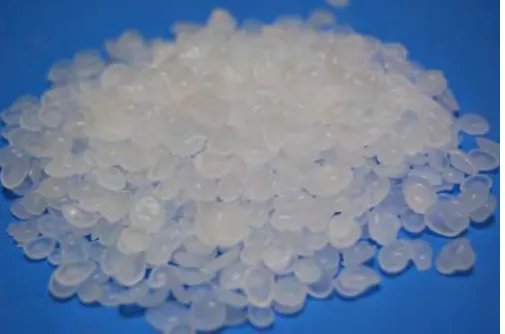
6 Figure 2.1: Paraffin Wax
A few years later, paraffin wax has been found. Fuchs extracted mineral oil from paraffins and Buchner produced the first paraffin wax in 1819. In 1830, Von Reichenbach overturned paraffin from a beech wood solution. (http://europecandles.org/raw-materials-and-candles-production-processes). On the same year 1830, paraffin wax was also identified by Carl Reichenbach (Sciences 2009).
The production of coal paraffin wax began in Glasgow in 1845. Paraffin wax was introduced in the 1850s, after chemists learned how to separate natural wax from petroleum and refine it (http://candles.org/history/). In 1861, the industry produced 750 tons of paraffin wax, ten years later the amount had reached 5000 tons.
7 Some types of paraffin wax are more expensive than others, according to the filtration level, the color changes from dark yellow to white, and the oil content from 0 to 15%. Paraffin wax is served in slabs, bead or powder. It is also transported in liquid form in tanker trucks. 350,000 tons of paraffin candles are produced in Europe every year. About half are sent to the candle industry. Some properties are more appropriate than others, depending on the industry they will use. For example the leather or textile industry, paper and card treatment industries, plastic materials, explosives, cables and also for the manufacture of cheese and chewing gum ( http://europecandles.org/raw-materials-and-candles-production-processes).
2.2.2 Definition
Paraffin wax is a solid white or colorless solid which is available from oil, coal or flake oil, comprising a combination of hydrocarbons containing between twenty and forty carbon atoms. It's different from kerosene, another petroleum product that is sometimes called paraffin. The paraffin's name comes from Latin parum ("almost no") + affinis, which means "lack of affinity" or "reactive deficiency", referring to inactive properties of paraffin (Kusumawati et al. n.d.).
In chemistry, paraffin is a term that can be used in conjunction with "alkanes", says hydrocarbons with the general formula CnH2n + 2. Paraffin wax is found in solid state at room temperature and starts accessing phase pore at about 37 ° C (99 ° F ) (Charanjeet Singh Sandhu & Sharma 2012).
8 paraffin wax, comes from the heaviest molecules from C20H42 to C40H82. Paraffin candles were identified by Carl Reichenbach in 1830 (Sciences 2009).
2.2.3 Properties
Paraffin may be the most common phase change material due to its high storage density properties, minimum inclination to super cool, low-pressure vapor pressure, chemical stability, non-toxic, and relatively low cost (Li et al. 2017). One of the qualities of paraffin wax is, it gives a better surface finish (Charanjeet Singh Sandhu & Sharma 2012).
Paraffin wax (or simply "paraffins") is mostly found as solid white, odorless, tasteless and candles. Insoluble in water, but soluble in benzene, and certain esters. Paraffins are not affected by chemical reagents, but are flammable (Sciences 2009).
[image:24.595.156.534.667.738.2]The paraffin features are they have a great resilience to penetrate wet, melt easily and froze quickly. It also has a small wooden power to cloth, so it is easily removed from the fabric. Paraffin wax is a low melting point at a temperature of 56-60 ° C but has a high boiling point of> 370 ° C (698 ° F). Although paraffin wax is not very durable, it is resistant to alkaline solution (Kusumawati et al. n.d.). Table 2.1 shows the properties of paraffin wax.
Table 2.1: Properties of paraffin wax. No. Name of the
wax
Density Melting point
Volumetric shrinkage
Flash point 1 Paraffin wax 0.78gm/cc 52-74°C 6.20 275 °C